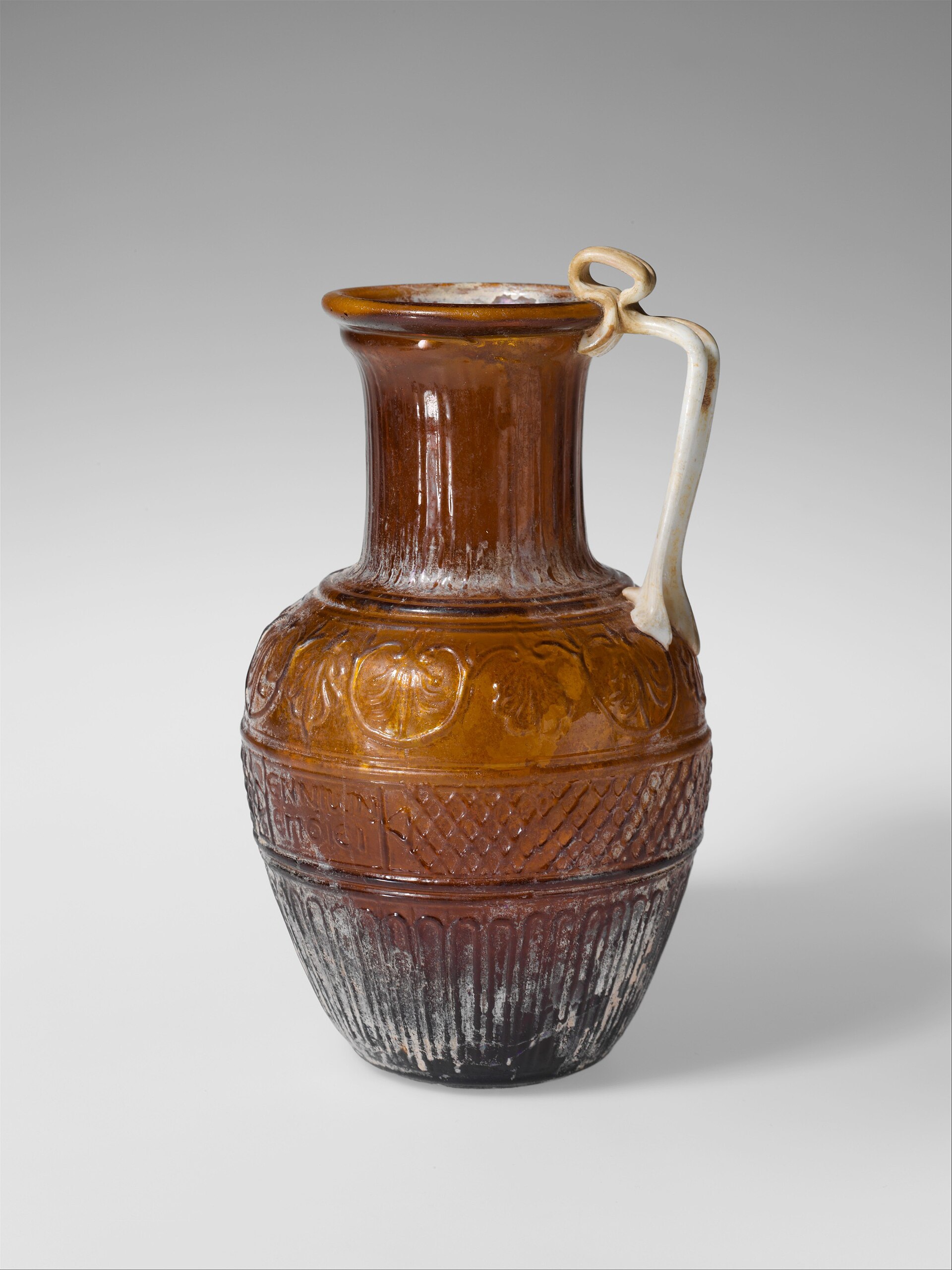
Jug Signed by Ennion
1st century CE · Glass
The Metropolitan Museum of Art, New York
 active 1st century CE
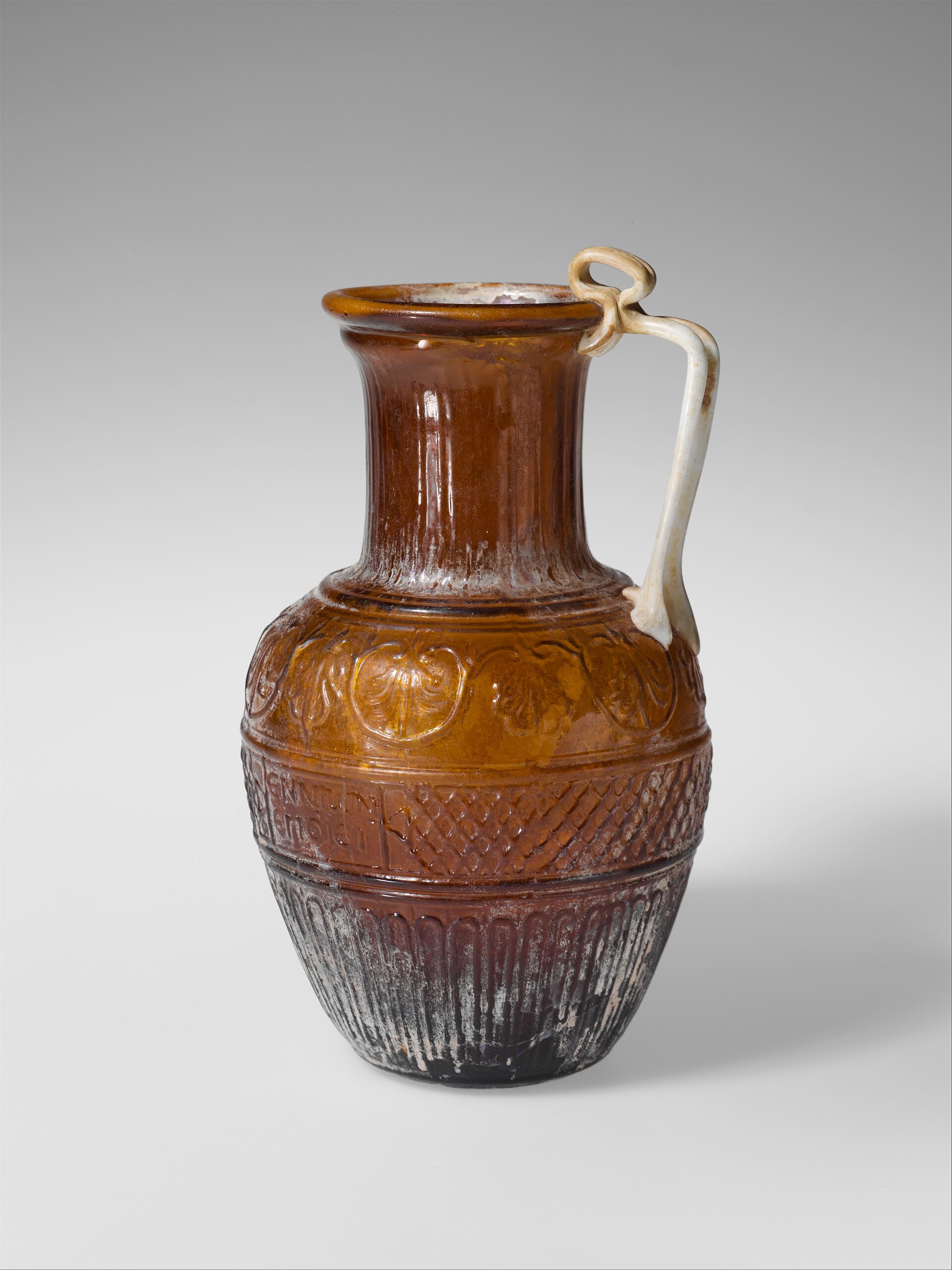
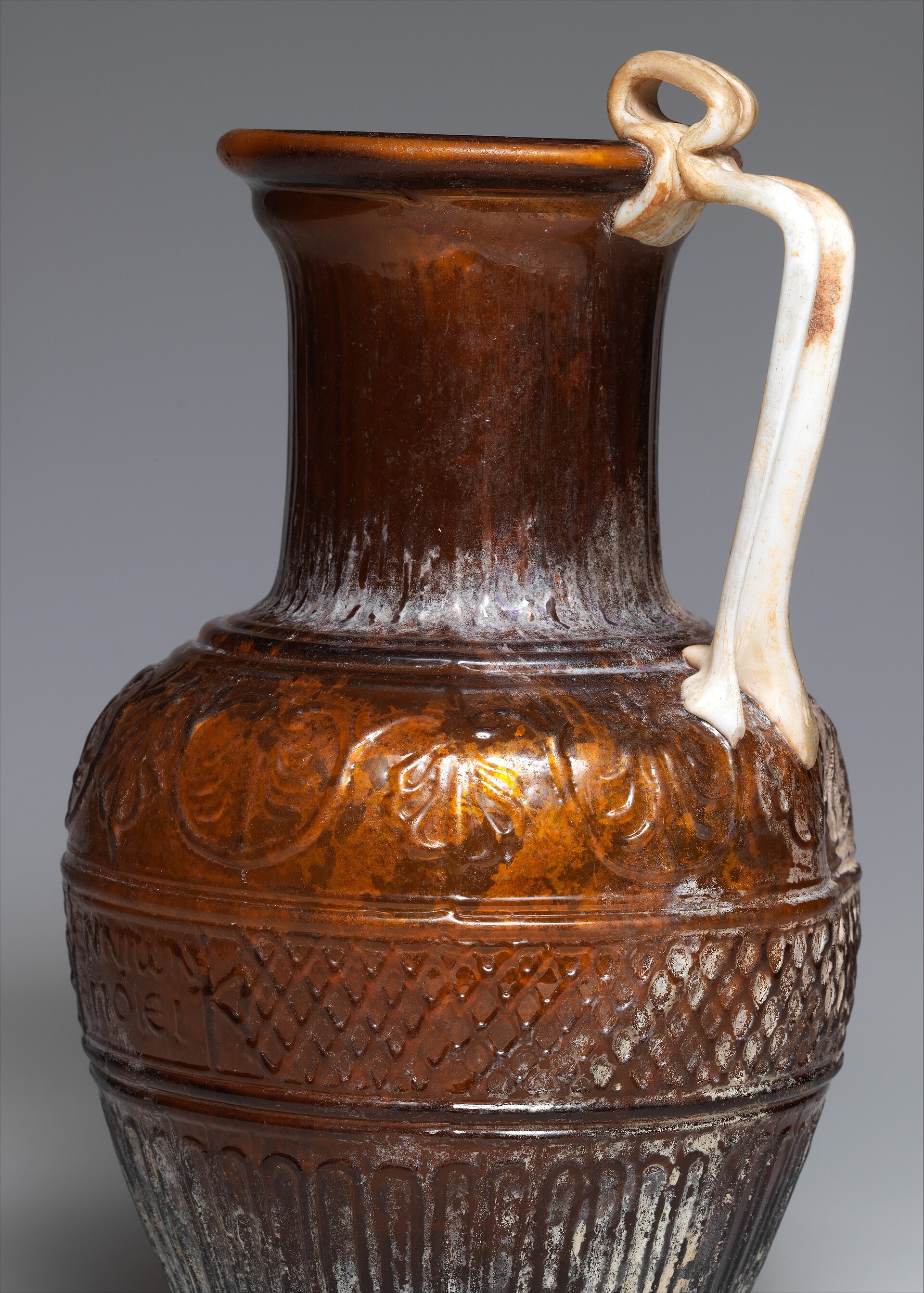
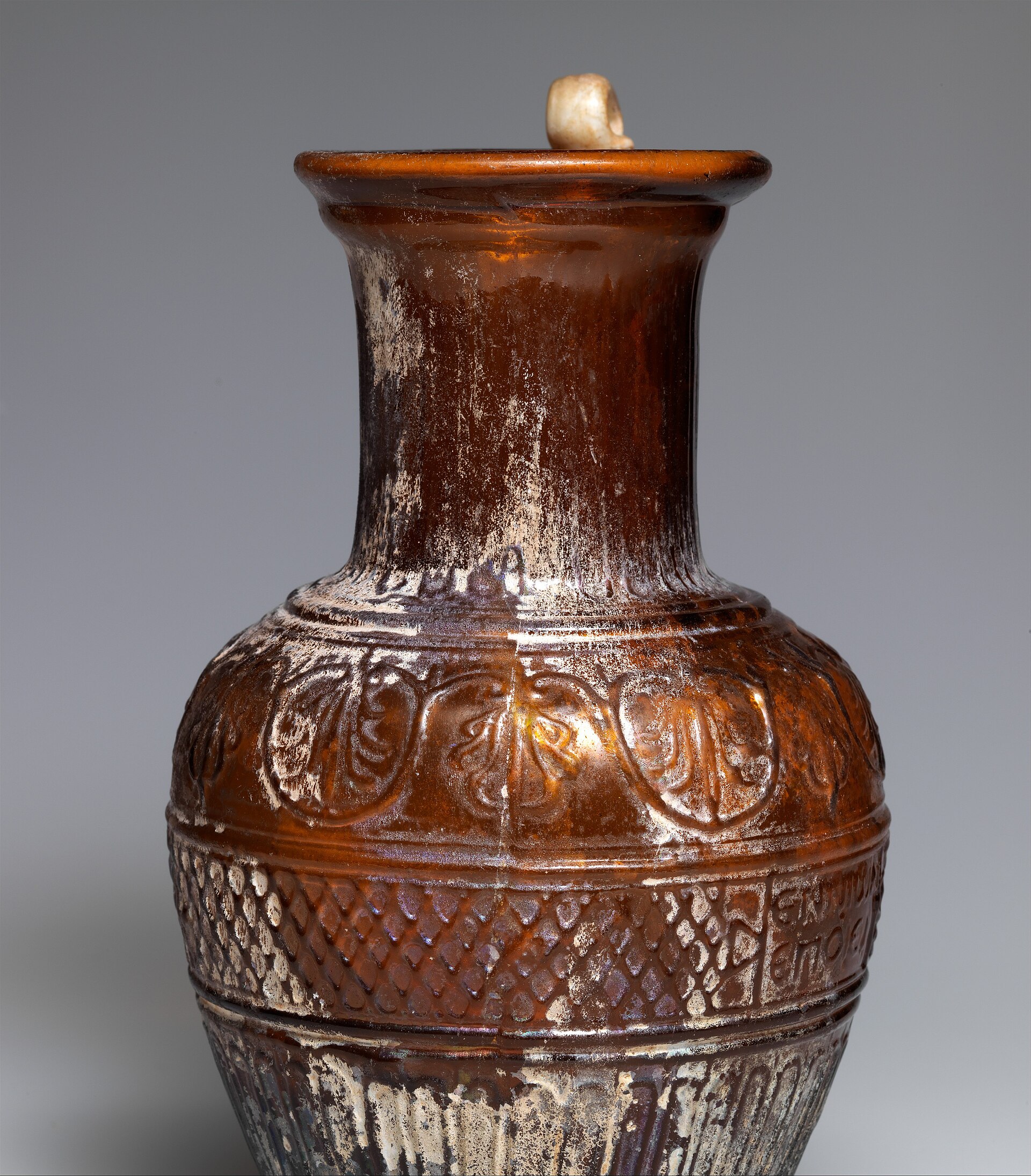
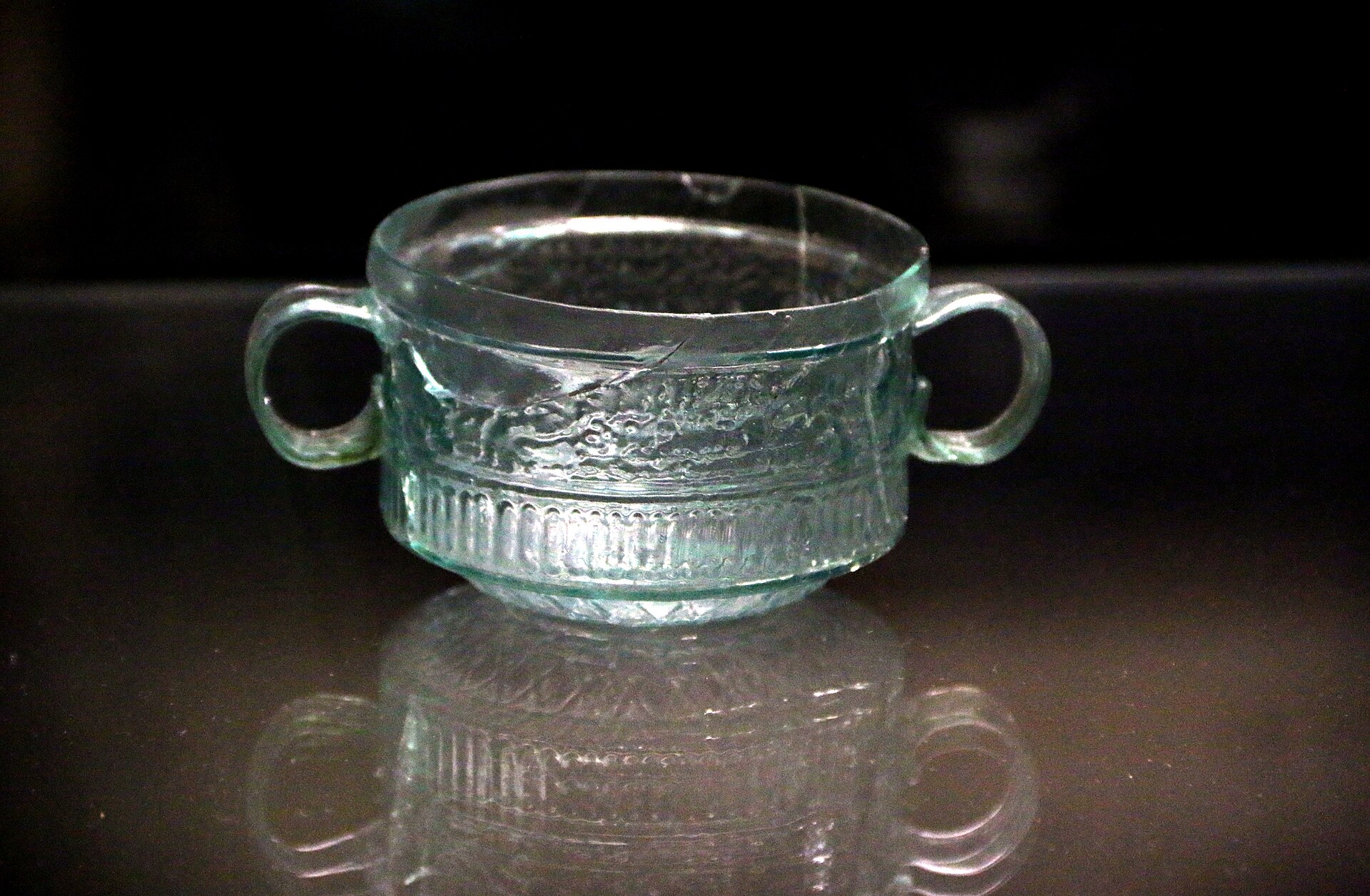
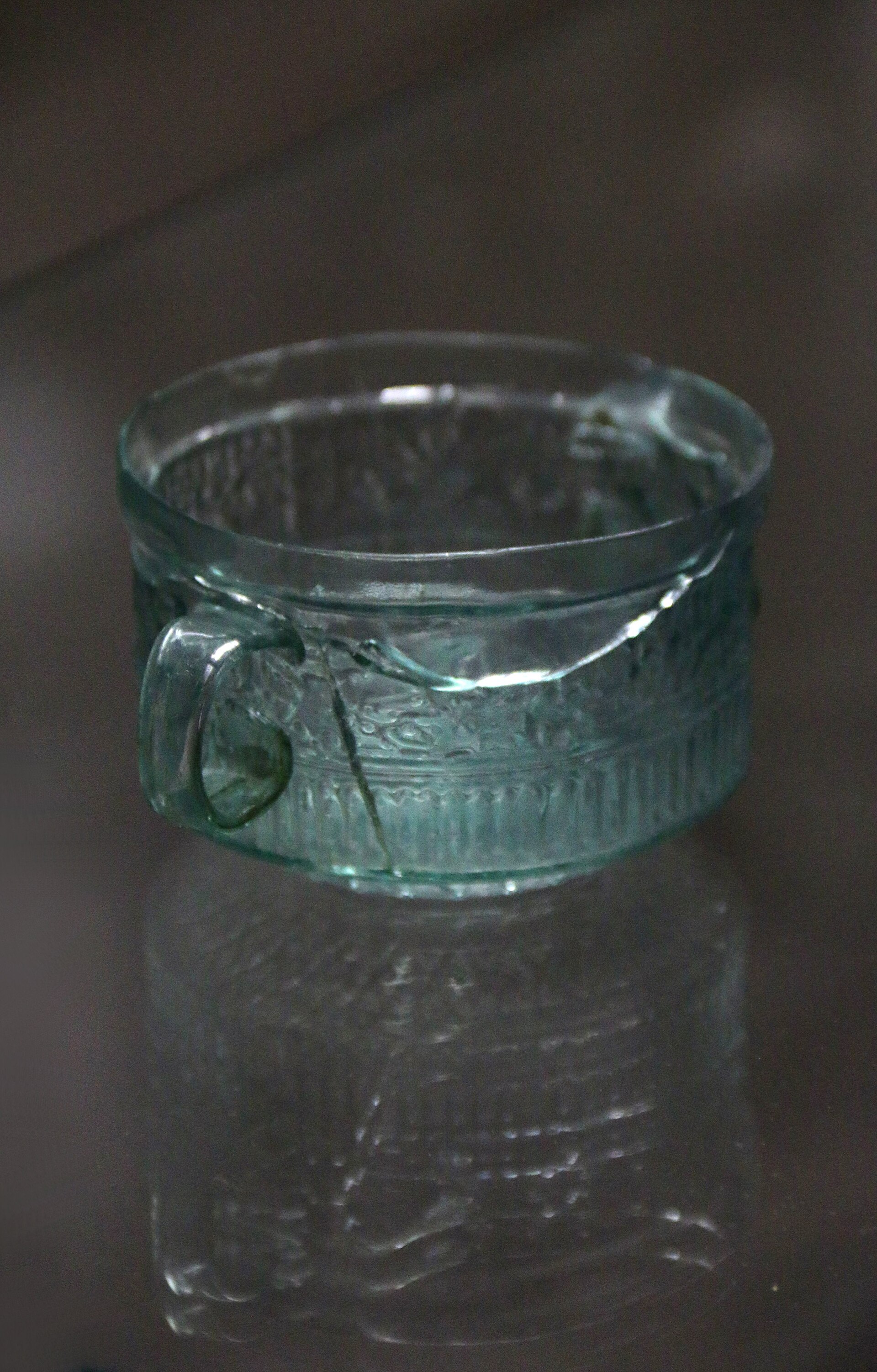
Jug signed by Ennion Signed jug, Metropolitan Museum of Art, accession 17.194.226. Blown in a four-part mold; the applied handle, in opaque white glass, is unique among the twenty-six vessels in the standard signed corpus. No verified portrait. No securely identified likeness of this maker is known under a free licence. We do not publish a face we cannot verify.
Metropolitan Museum of Art, New York (CC0)| Full name | Ennion (no patronymic or family name is recorded |
|---|---|
| Worked as | Glassmaker, Mold-cutter |
| Born | unknown, inferred c. 27 BC - AD 14 · probably Sidon, Roman Syria (Phoenicia) |
| Died | unknown · unknown |
| Nationality | Eastern Mediterranean, probably Phoenician, from Sidon on the coast... |
| Movement | Early Roman mold-blown glass, Julio-Claudian Sidon and its export trade |
| In this archive | 1 artwork |
| Sources | 14 cited |
| Last verified |
About this page 1 artwork in the archive · Last verified · 14 sources cited
Ennion is known only from the two words cast into his own glass. No ancient author names him, no portrait or grave marker records him, and no document fixes when he was born or died. What survives instead is a corpus of vessels, twenty-six of them complete enough to catalogue in detail, each one blown into a mold that carried his name as part of its own design: ENNIWN EPOIEI, or in some molds ENNIWN EPOIHCEN, "Ennion made it." He worked in the second quarter of the first century AD, probably at Sidon on the Phoenician coast, at the exact moment mold-blowing was invented, and he is one of only five ancient glassworkers whose names survive on their own products at all.
The single most important thing a reader should know is that his signature answers less than it appears to. It proves that a workshop operating under the name Ennion made a given vessel; it does not by itself prove that one man cut every mold, blew every vessel, or was even alive when a given mold was still in use. Whether "Ennion" names an individual master, a family business, or a brand that could in principle have outlived him is a live scholarly question, not a settled one, and this page treats it as such throughout.
What is not in doubt is the quality. Ennion's molds concealed their own seams more skillfully than any of his four named contemporaries or the generation of imitators who followed him, and later mold-cutters copied the trick. He is, on the evidence of what survives, the best mold-cutter of the first century of an entirely new technology, known to us because he chose, almost alone among ancient craftsmen, to put his name on what he made.
Lightfoot's inferred window for Ennion's birth, offered explicitly as inference from ordinary Roman-era life expectancy, not as a documented date.1
Marianne Stern's proposed earliest date for the invention of mold-blowing itself, the technology Ennion's whole known output depends on.1
The production window the British Museum assigns its signed Ennion cup, overlapping the wider AD 30-70 range Lightfoot's 2014 catalogue gives for the type as a whole.15
A signed Ennion cup is found with a coin of Claudius dated to this year at Caresana in Italy, one of the firmest single dating points for the corpus.1
A house in Jerusalem's Jewish Quarter burns during the Roman capture of the city, destroying a jug from the same mold family as the Metropolitan's signed Ennion jug. It is the latest secure date for any vessel signed by Ennion or his four named contemporaries.1
The British Museum purchases a signed two-handled Ennion cup from the excavator and dealer Luigi Palma di Cesnola, with a findspot recorded in the museum's glass register as Tremithusa, Cyprus, though Cesnola's own 1877 published account gives no provenance at all.5
The numismatist Canillo Brambilla, Inspector of Excavations and Monuments for the province of Pavia, donates his collection, including a signed Ennion cup from the Lomellina district west of Pavia, to the Musei Civici di Pavia.1
A signed Ennion jug, later given to the Metropolitan Museum, is recorded in the Paris collection of Julien Greau by this date; the only claim for its earlier history is a bare, undocumented assertion that it had been acquired in Constantinople.1
The dealer and cataloguer Wilhelm Froehner publishes a full catalogue of the Greau glass collection, among the earliest substantial print discussions of any Ennion vessel.1
J. Pierpont Morgan buys the Greau glass collection in its entirety; he dies the same year.1
J. Pierpont Morgan Jr. gives his father's Greau glass, including the signed Ennion jug, to the Metropolitan Museum of Art.12
Donald Harden publishes the first English-language survey of Ennion's work in the Journal of Roman Studies, the foundational catalogue on which nearly all later scholarship, including Lightfoot's, is built.1
A signed two-handled Ennion cup, later Lightfoot's cat. no. 14, first appears at a New York auction before entering the Shlomo Moussaieff collection.1
The Israel Museum, Jerusalem, publishes Yael Israeli's catalogue Made by Ennion: Ancient Glass Treasures from the Shlomo Moussaieff Collection and exhibits the pieces, later the subject of an unresolved forgery allegation against at least two vessels.13
The Musei Civici di Pavia's signed Ennion cup is professionally restored by the conservation studio Kriterion, commissioned by the Metropolitan Museum of Art and overseen by the Soprintendenza, so that it can travel to New York for loan.7
The Metropolitan Museum of Art mounts Ennion: Master of Roman Glass, the first exhibition devoted solely to the maker, with Christopher Lightfoot's accompanying catalogue; the show travels to the Corning Museum of Glass in 2015.1
Christie's, London, offers glass from the Shlomo Moussaieff collection including a signed Ennion footed jug (estimate GBP 450,000-550,000) and a signed two-handled amphora (estimate GBP 400,000-600,000); no confirmed result for either lot was found in the sources consulted for this page.10
Lightfoot's own 2014 catalogue states plainly that mold-blown Roman glass commands higher prices at auction than free-blown glass of comparable age and condition, and the trade record for Ennion's own signed work supports that claim without yet furnishing many confirmed public results. Individual signed pieces have passed through Sotheby's and Bonhams repeatedly across the twentieth century, cited in Lightfoot's own literature notes for 1922, 1931, 1974, 1975, 1983, 1994 and 1998 sales and a 1991 New York sale, with no published prices attached in the sources this page could fetch; what the pattern shows is continuous trade activity over a century, not the absence of a market.
The one confirmed recent public result located for this page is for a piece Christie's did not attribute to Ennion by signature: an unsigned Roman glass amphoriskos decorated with the myth of Ajax, sold in London in 2016 for a reported GBP 74,500, a total the source does not separate into hammer and premium, its value driven by style and by an exhibition history in the Israel Museum's Moussaieff show rather than by Ennion's name being on it. Genuinely signed pieces from the same Moussaieff collection carried far higher pre-sale estimates at Christie's London on 6 July 2016: a footed jug at GBP 450,000 to 550,000 and a two-handled amphora at GBP 400,000 to 600,000. No confirmed hammer price or total for either lot was found in the sources consulted; the results of that sale remain an open question on this page rather than a stated fact.
| Date | Sale | Work | Result | Note |
|---|---|---|---|---|
| 2016 | Christie's | Unsigned Roman glass amphoriskos, mold-blown, decorated with scenes from the myth of Ajax; not signed by Ennion but exhibited in the Israel Museum's 'Made by Ennion' show from the Shlomo Moussaieff collection | With premium GBP 74,500 (reported total; the source does not state whether this includes the buyer's premium, and this page records that ambiguity rather than guessing at a split) GBP | Not a signed Ennion piece. Included here because its price is the one confirmed public auction result this page located for any vessel connected to Ennion's name or workshop tradition, as a market comparandum, not as a price for his own signed work. |
Hammer is the price at which the bidding stopped; with premium adds the fee the house charges the buyer on top. Hammer price and buyer's premium in the glossary.
| Institution | City | Holdings | Note |
|---|---|---|---|
| The Metropolitan Museum of Art | New York | Three signed vessels (accessions 17.194.226, 17.194.225, 81.10.224), all on permanent public display in Gallery 166 | The largest single holding of signed Ennion glass; anchored the 2014-15 monographic exhibition and catalogue. |
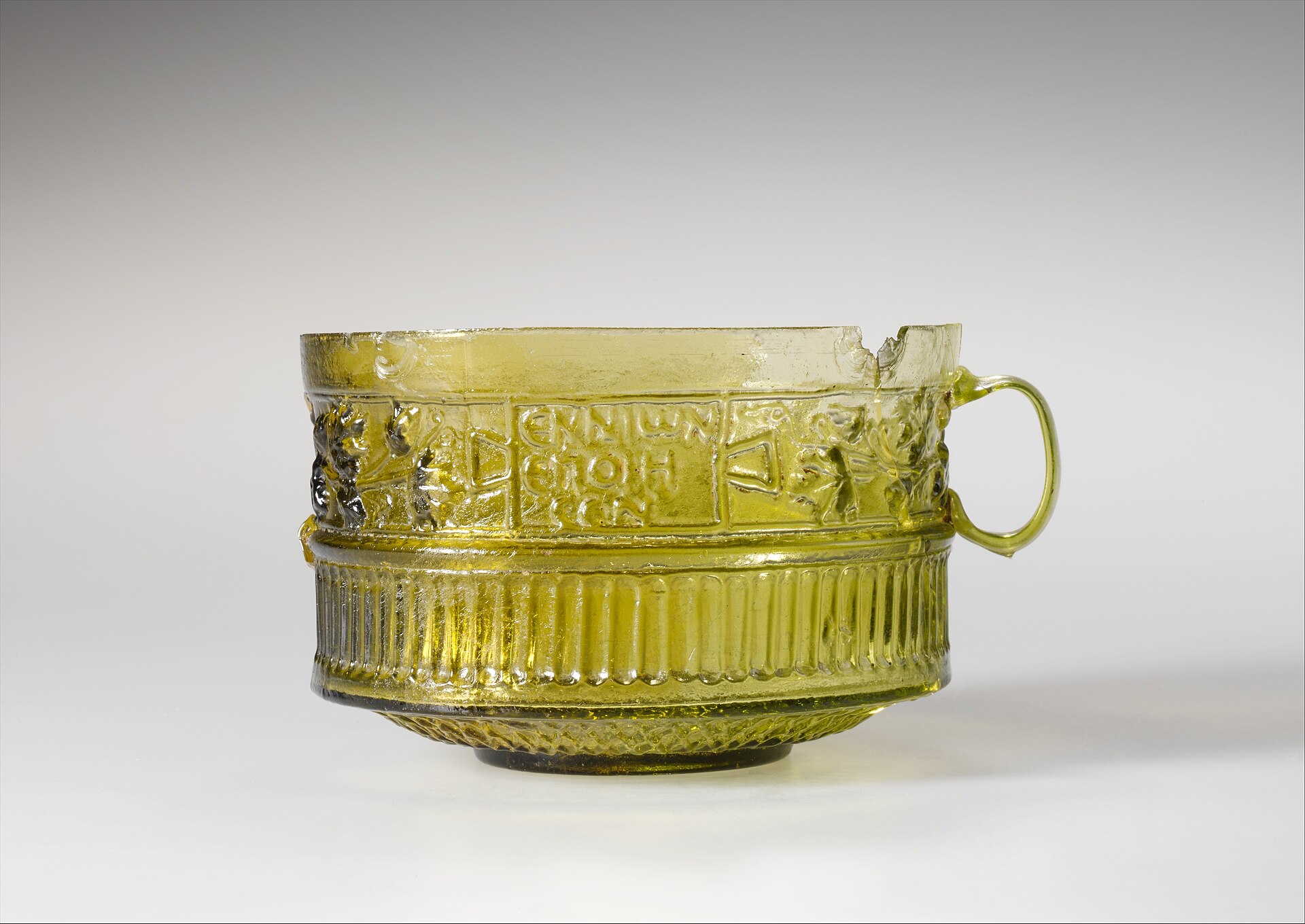
| British Museum | London | One signed two-handled cup, museum number 1876,1114.4, purchased from Luigi Palma di Cesnola in 1876 | Not currently on display. |
| Musei Civici di Pavia | Pavia, Italy | One signed two-handled cup, inventory A 243, from the Brambilla collection donated 1891 | Restored in 2014 for loan to the Metropolitan Museum's exhibition. |
| Museo Archeologico Nazionale di Adria | Adria, Italy | One two-handled cup attributed to Ennion, catalogue CRV-RA_0013226 | |
| Israel Antiquities Authority, exhibited at the Israel Museum | Jerusalem | One footed jug, from the mansion in the Jewish Quarter destroyed in AD 70 | The single clearest archaeologically dated context for the type. |
| Eretz Israel Museum | Tel Aviv | One footed jug, said to come from Jerusalem | |
| Corning Museum of Glass | Corning, New York | One footed jug (accession 59.1.76, ex Ray Winfield Smith collection) | No verified free-licence photograph of this specific object was located on Wikimedia Commons for this page; see notes_for_editor. |
| Musee du Louvre | Paris | One two-handled cup (inventory MNC 3) | From the same mold as the Pavia cup, per Donald Harden's identification. |
| Getty Villa | Malibu, California | One mold-blown cup, accession 10400N, catalogued by the museum only as possibly from the workshop of Ennion | Unsigned and attributed on style, not part of the twenty-six-vessel signed corpus. |
Almost nothing external documents Ennion.
Almost nothing external documents Ennion. His name is not Greek and not Roman; specialists take it to render a Semitic original, though that identifies a language, not a religion or an ethnicity, and the only other ancient epigraphic use of the same name belongs to a builder recorded at Damascus in the third century AD, three centuries too late to be the same man. Unlike his four named contemporaries in the trade, Aristeas, Jason, Meges and Neikais, all of whom carry Greek or Greek-style names, Ennion did not adopt a Hellenized name even though he worked, traded and inscribed his molds in Greek, the commercial language of the eastern Mediterranean.
No document records a birth or death date. Christopher Lightfoot, curator of Roman art at the Metropolitan Museum of Art and author of the standard modern catalogue of Ennion's work, offers an inference rather than a fact: a birth somewhere under Augustus, between 27 BC and AD 14, reasoned from ordinary Roman-era life expectancy and the archaeological window in which his products were made and used. He is explicit that this is inference, not record, and this page follows him in labelling it that way.
This is the real question behind the signature and it is not settled.
This is the real question behind the signature and it is not settled. The inscription says only that Ennion made the piece; it does not distinguish between the mold-cutter, the workshop owner who employed a mold-cutter, and the glassblower who used the finished mold. Lightfoot's own conclusion, stated directly rather than left open, is that Ennion was very probably both the owner of his workshop and its leading craftsman, on the reasoning that entrusting a still-experimental technique to anyone but a proficient glassblower was improbable at the time mold-blowing was invented. Comparison is drawn to the much larger Arretine pottery industry at Arezzo, where a factory owner's stamp and an individual employee's stamp could appear separately on the same vessel; ancient glass workshops, by contrast, are believed on current evidence to have been small enough that the distinction mattered less.
What the find record does not support is a workshop brand that ran on for generations after any individual master died. No securely dated find of a vessel signed by Ennion, or by any of his four named contemporaries, has been identified in a context later than AD 70, the year a house in Jerusalem's Jewish Quarter containing a jug from the same mold family burned during the Roman siege of the city. Production, on the evidence available, was compressed into a few decades rather than stretched across successive generations trading on an inherited name, though the evidence cannot rule out molds being reused or copied by others within Ennion's own working lifetime.
Where the workshop physically stood is argued from find-spots, because no kiln site associated with glassworking, let alone one linked specifically to Ennion, has ever been excavated at either...
Where the workshop physically stood is argued from find-spots, because no kiln site associated with glassworking, let alone one linked specifically to Ennion, has ever been excavated at either candidate location. Donald Harden's foundational 1935 study placed the workshop at Sidon on the strength of the eastern find-spots for the jugs, but proposed that Ennion, once his reputation was established, opened or reached a second market near Aquileia in northern Italy to account for the striking concentration of signed cups recovered from graves there.
Lightfoot's 2014 catalogue reports that later scholarship has questioned the two-workshop model and argues, on his own account, for a single eastern workshop whose products were simply traded west. His strongest piece of evidence is linguistic: every inscription on every signed Ennion vessel, wherever it was found, is in Greek, never Latin, even though a majority of the well-preserved cups came from graves in Latin-speaking northern Italy, a market in which a maker who had genuinely relocated his business would have had an obvious commercial reason to cut new molds in Latin. That he never did so is read as evidence the workshop itself never moved, whatever the distribution of its customers.
Mold-blowing was new technology when Ennion practiced it.
Mold-blowing was new technology when Ennion practiced it. A bubble of hot glass on a blowpipe was inflated inside a container carved in reverse with the vessel's design; as the glass pushed outward it took the shape and pattern, inscription included, in a single motion. Experiments reconstructing the ancient process, cited in the Metropolitan's 2014 technical essay by Karol Wight, tested wood, plaster, fired terracotta and metal as mold materials. Wood must be soaked and gives off steam that keeps the glass from taking the design; plaster is too fragile for repeated use; metal can be reused many times but leaves a telltale mottled chill mark on the glass surface; terracotta, especially when its interior is coated with soot to help the glass release, gives the best results of the two reusable materials, since metal leaves the chill mark; but terracotta is not the only material to survive from antiquity, since the small number of ancient mold fragments actually recovered are made of fired clay, stone, wood, and possibly plaster and metal.
Ennion's own molds were unusually complex, built in as many as eight side panels plus a separate base section for some forms, and his mold-segments fit so snugly that the join lines are hidden inside the vertical fluting and palmette borders rather than left as visible seams. That concealment is itself diagnostic: later imitators adopted the trick precisely because Ennion had set the standard for it. No pontil marks survive on the base of any signed Ennion vessel, meaning the finished piece was transferred from the blowpipe by some kind of clamp rather than a solid punty rod; no such tool has survived and exactly how the transfer was done is not established.
Lightfoot has also attempted a production estimate, built from the glassmaker David Hill's practical experiments reusing fired-clay molds, which showed a single mold set could survive hundreds, potentially thousands, of blowings if handled carefully. Ennion is calculated to have cut at least ten distinct mold designs, most of them probably represented by two or three physical molds each, implying twenty to thirty molds in total; at roughly two hundred vessels per mold, that yields a total output on the order of four to six thousand pieces across his working life, a figure Lightfoot himself calls conservative and explicitly unverifiable.
The standard modern reference, Lightfoot's 2014 Metropolitan Museum and Corning Museum of Glass catalogue, itemises twenty-six relatively complete vessels signed by Ennion, three of them in the...
The standard modern reference, Lightfoot's 2014 Metropolitan Museum and Corning Museum of Glass catalogue, itemises twenty-six relatively complete vessels signed by Ennion, three of them in the Metropolitan's own collection and the rest scattered across museums and private collections in Italy, France, Britain, Israel, Russia and the United States. That figure supersedes Harden's founding 1935 catalogue, compiled when fewer pieces were known.
Looser figures also circulate. A specialist glass-collector blog gives "fifty to fifty five" surviving pieces; Wikipedia's own entry rounds this further to "about fifty." Neither source itemises what it is counting, and both appear to fold in excavated fragments and vessels assigned only on stylistic grounds to the broader "Ennion group" rather than counting complete, individually catalogued, signed vessels. None of these figures are reconcilable with each other or with the twenty-six without knowing exactly what each source counted, and this page follows Lightfoot's itemised twenty-six as the citable number, while recording that wider and less precisely defined estimates exist and are commonly repeated.
Ennion is one of only five named ancient glassworkers whose signatures survive on mold-blown tableware at all, alongside Aristeas, Jason, Meges and Neikais. His vessels are consistently judged, on size, proportion and the sophistication of their decorative schemes, to surpass all four of the others, and the Metropolitan's own foreword to the 2014 catalogue states this directly rather than leaving it as an implication.
Fragments and complete vessels signed by Ennion or his contemporaries have been recorded from Spain to the Crimea: a beaker at Cadiz, an amphora from a tomb at Panticapaeum in the Crimea excavated in...
Fragments and complete vessels signed by Ennion or his contemporaries have been recorded from Spain to the Crimea: a beaker at Cadiz, an amphora from a tomb at Panticapaeum in the Crimea excavated in 1852, cup fragments from Athens and Corinth, fragments from military sites across Roman Dalmatia associated with army veterans, jugs and jug fragments from Jerusalem, and a heavy concentration of cups recovered from graves around Aquileia and Adria in northern Italy, where two of them remain today, in the Musei Civici di Pavia and the Museo Archeologico Nazionale di Adria. No piece of Ennion's signed glass has ever been recorded at Rome itself, or at Pompeii or the other sites buried by Vesuvius in AD 79, an absence Lightfoot calls surprising given how large a market either city might be expected to have offered.
The distribution matters for more than geography. It is the only evidence anyone has for where the workshop traded, since no findspot has ever produced a kiln, a mold fragment, or any other trace of actual production; every argument about Sidon, Aquileia, or both, is built entirely on where finished vessels ended their working lives, not on where they were made.
Six variant forms of Ennion's signature are documented across the corpus, differing in wording, spelling and layout.
Six variant forms of Ennion's signature are documented across the corpus, differing in wording, spelling and layout. Lightfoot's own concordance shows the corpus splitting close to evenly between the two tenses: twelve of the catalogued vessels, including the Metropolitan's own signed jug, use the imperfect tense, EPOIEI, and the other twelve use some form of the aorist, EPOIHCEN, and Lightfoot states plainly that why the tense changes between molds, and whether the change was meant to signify anything, is not understood. A second inscription, found only on some cups, addresses the buyer directly in a Greek phrase read two different ways by different translators, as an active wish, "may he remember," or a passive one, "may he be remembered"; Gisela Richter proposed the passive reading first, in a 1930 reprint of her own catalogue, and Luigi Conton and Anton Kisa had already linked the underlying word to a Semitic blessing formula before that. Donald Harden came later and added further philological support for the passive reading, from usage in the Septuagint and New Testament, without originating either the passive reading or the blessing-formula link himself, a documented scholarly argument rather than an established fact.
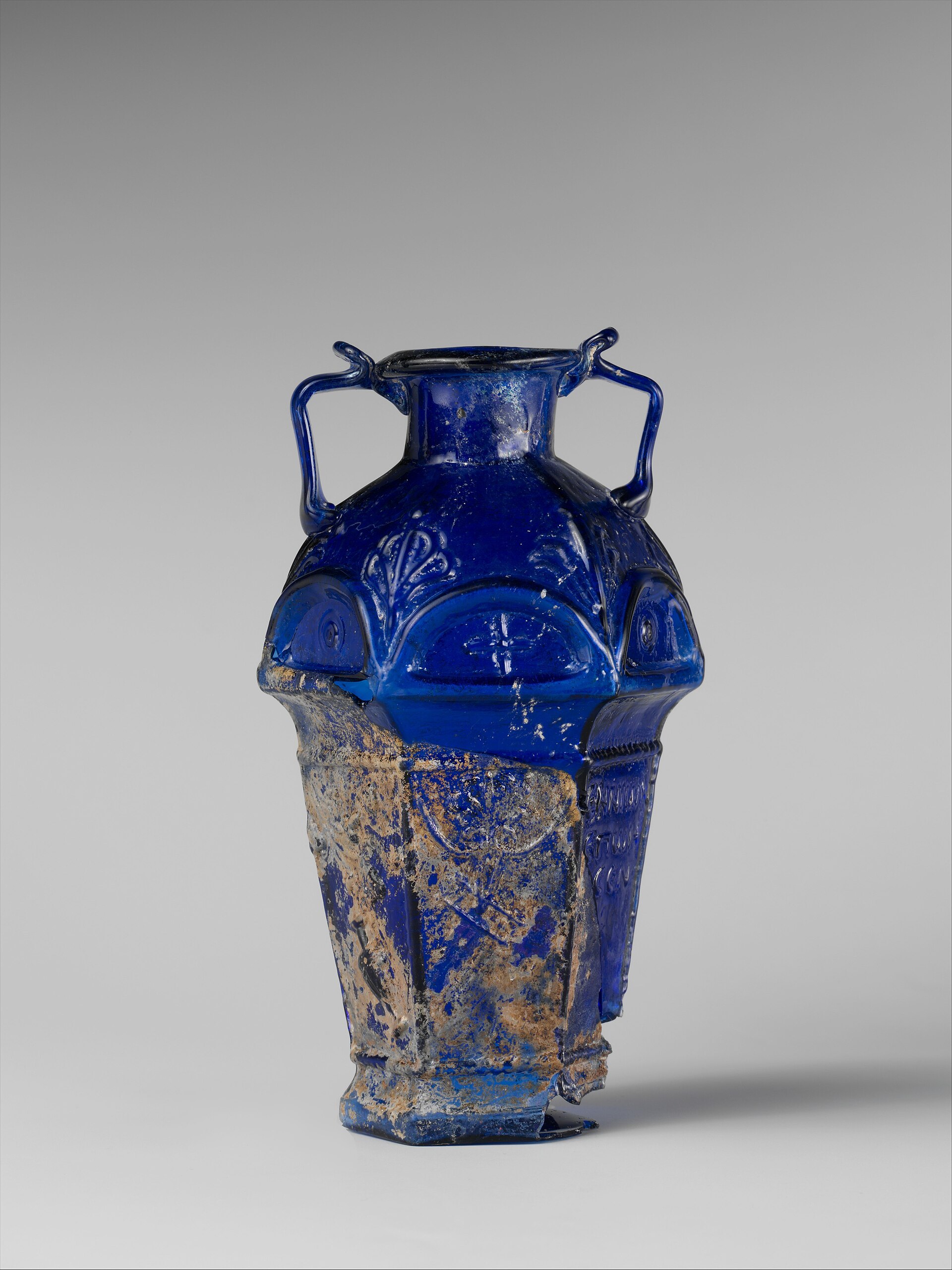
What is equally worth recording is what the decoration is not. Ennion's vessels carry no mythological, votive or funerary imagery of their own. Their ornament is architectural framing, floral friezes and geometric lattice, built around the maker's own name set inside a tabula ansata, the rectangular tablet-with-handles device the Romans used elsewhere for votive plaques, military standards and honorific inscriptions. Lightfoot argues, as a specific and citable claim rather than an assumption, that choosing that particular frame for a maker's trademark was itself a deliberate gesture toward the visual language of Roman commercial and civic authority, echoing in glass what Arretine pottery stamps were already doing in clay. The plainness of the rest of the programme, a trademark and nothing else, is itself the finding: most of what a viewer is meant to notice on an Ennion vessel is that Ennion made it.
Ennion's closest rival was Aristeas, known from only two complete vessels plus fragments excavated at Roman military sites in Dalmatia; some of Aristeas's pieces add the epithet "the Cypriot." Jason...
Ennion's closest rival was Aristeas, known from only two complete vessels plus fragments excavated at Roman military sites in Dalmatia; some of Aristeas's pieces add the epithet "the Cypriot." Jason and Meges are known from a small number of signed beakers found from Beit Shean to Cyprus. A separate, unsigned body of mold-blown glass known in the trade as the "Workshop of the Floating Handle" shares technical features with both Ennion's and Aristeas's products closely enough that Lightfoot's catalogue treats the three as probably connected without being able to say how. Once the fashion Ennion had set became general, a much larger and cruder body of unsigned mold-blown glass followed, imitating his patterns without approaching his technical standard.
One correction is worth making because it circulates online without being checked against the primary catalogue: pieces of first-century mold-blown glass at the Toledo Museum of Art and the Getty Villa are sometimes described loosely as "Ennion pieces." Toledo's example, found near Beroea, modern Aleppo, is signed NEIKAIC EPOHCEN; it is by Neikais, a distinct and, in Lightfoot's assessment, technically inferior workshop of the same period, not by Ennion. The Getty Villa's mold-blown cup, accession 10400N, is catalogued by the museum itself only as "possibly from the workshop of Ennion," unsigned and attributed on style. Neither piece belongs in the twenty-six-vessel signed corpus, and neither should be cited as one.
Ennion's reputation attracted imitation in antiquity and forgery in the modern trade.
Ennion's reputation attracted imitation in antiquity and forgery in the modern trade. Lightfoot's own 2014 catalogue states the problem directly: the fame attached to Ennion's name has led, in his words, "some unscrupulous people to make modern copies or construct pastiches of Ennion vessels," in some cases seemingly cast from molds taken as impressions of genuine ancient pieces, which makes them a real challenge for specialists to separate from authentic work by style and technical execution alone. Scientific analysis of the glass itself is offered as an additional check, but as of the 2014 study only four pieces signed by or attributed to Ennion had ever been chemically analyzed anywhere, and no comprehensive compositional study of the signed corpus as a whole has been undertaken since.
A specific and unresolved allegation sits below that general statement. David Hill identified at least two amber two-handled vessels shown in the Israel Museum's 2011 exhibition of glass from the Shlomo Moussaieff collection, catalogued by Yael Israeli as Made by Ennion: Ancient Glass Treasures from the Shlomo Moussaieff Collection, as modern fakes, describing decorative motifs he reads as Christmas trees and judging the pieces probably made in Damascus in relatively recent times. The identification appears in a comment Hill left on the Ancient Glass Blog of the Allaire Collection, a separate private glass collection whose own site had been showing photographs of the same two pieces; the collection's proprietor thanked Hill in reply and removed the images, the one piece of independent corroboration this page located, though it amounts to a collector accepting a claim rather than a scientific test. Neither Hill's comment nor the proprietor's response is a peer-reviewed publication, and the allegation sits in direct tension with the fact that the Metropolitan Museum's own 2014 catalogue credits Moussaieff with lending six pieces to the Ennion exhibition series without flagging any of them as suspect. This page records the allegation as what it is, a named but not independently corroborated claim, and takes no position on which account is right.
Lightfoot's own catalogue observes, in passing but as a stated fact rather than color, that mold-blown Roman glass "retains its special appeal for modern collectors and so often commands higher...
Lightfoot's own catalogue observes, in passing but as a stated fact rather than color, that mold-blown Roman glass "retains its special appeal for modern collectors and so often commands higher prices at auction than free-blown glass of similar age and condition." The trade history bears that out. Individual pieces in the signed corpus have passed through Sotheby's and Bonhams repeatedly across the twentieth century, cited in Lightfoot's own literature notes without published prices attached: Sotheby's in 1922, 1931, 1974, 1975, 1983, 1994 and 1998, Bonhams in 2004, and a New York sale in 1991 at which a two-handled cup, now cat. no. 14 in Lightfoot's numbering, first surfaced before entering the Moussaieff collection. None of those historical citations carries a price in the sources this page could fetch; what they establish is that signed Ennion glass has been continuously in the market, not off it, for a century.
The clearest modern price point this research located is for a piece Christie's did not attribute to Ennion by signature at all: an unsigned first-century Roman glass amphoriskos decorated with scenes from the myth of Ajax, sold at Christie's London in 2016 for a reported GBP 74,500, a figure the source does not separate into hammer and premium. The piece carried no Ennion signature; its value rested on stylistic attribution and on having been exhibited in the Israel Museum's Moussaieff show, a clear case of a noted exhibition history moving a price on an object nobody claims Ennion actually signed.
Genuinely signed pieces have carried far higher estimates. Christie's London offered two signed Ennion vessels from the Moussaieff collection on 6 July 2016: a footed jug, one of only three such jugs known, estimated at GBP 450,000 to 550,000, and a two-handled amphora, one of only two such amphorae known, its counterpart reportedly held by the State Hermitage Museum in St Petersburg, estimated at GBP 400,000 to 600,000. No confirmed hammer price or total for either lot turned up in the sources this page could reach; the estimates are recorded here as estimates, not results, and the outcome of that sale is an open question rather than a fact this page can state.
The corpus is genuinely scattered, not concentrated in one or two collections.
The corpus is genuinely scattered, not concentrated in one or two collections. Three signed vessels are on permanent view at the Metropolitan Museum of Art in New York; a fourth, held by the British Museum since 1876, is currently not on display. Two more sit in Italian civic collections, at the Musei Civici di Pavia and the Museo Archeologico Nazionale di Adria, both recovered from tombs in the Roman Cisalpine region rather than from Sidon or the wider eastern Mediterranean. A footed jug is held by the Israel Antiquities Authority on exhibition at the Israel Museum in Jerusalem, recovered from a burned house in the city's Jewish Quarter and dated by that destruction to AD 70; another is in the Eretz Israel Museum in Tel Aviv. Further pieces are recorded at the Corning Museum of Glass, the Newark Museum, the Musee du Louvre and a museum collection in Turin.
The Pavia cup is worth a specific note, because its recent history shows how fragile this kind of loan can be. It was restored by the conservation studio Kriterion, commissioned directly by the Metropolitan Museum of Art and overseen by the regional Soprintendenza, specifically so it could travel to New York for the Museum's 2014-15 exhibition and then on to Corning; without that conservation programme a broken and part-missing two-thousand-year-old object could easily not have been fit to lend at all.
Glassmaker; Mold-cutter. active 1st century CE, work archaeologically dated to roughly AD 25-70, most tightly to the second quarter of the century.
Born unknown, inferred c. 27 BC - AD 14, probably Sidon, Roman Syria (Phoenicia); died unknown, unknown.
Modern pastiches cast from mold impressions. Lightfoot's 2014 catalogue states directly that the fame of Ennion's name has led to modern copies and pastiches, in some cases apparently cast from molds taken as impressions of genuine ancient vessels, which makes style and technical execution alone an unreliable basis for separating fakes from originals in every case.
The Metropolitan Museum of Art (New York); British Museum (London); Musei Civici di Pavia (Pavia, Italy); Museo Archeologico Nazionale di Adria (Adria, Italy); Israel Antiquities Authority, exhibited at the Israel Museum (Jerusalem); Eretz Israel Museum (Tel Aviv).
Lightfoot's own 2014 catalogue states plainly that mold-blown Roman glass commands higher prices at auction than free-blown glass of comparable age and condition, and the trade record for Ennion's own signed work supports that claim without yet furnishing many confirmed public results. Individual signed pieces have passed through Sotheby's and Bonhams repeatedly across the twentieth century, cited in Lightfoot's own literature notes for 1922, 1931, 1974, 1975, 1983, 1994 and 1998 sales and a 1991 New York sale, with no published prices attached in the sources this page could fetch; what the pattern shows is continuous trade activity over a century, not the absence of a market.The one confirmed recent public result located for this page is for a piece Christie's did not attribute to Ennion by signature: an unsigned Roman glass amphoriskos decorated with the myth of Ajax, sold in London in 2016 for a reported GBP 74,500, a total the source does not separate into hammer and premium, its value driven by style and by an exhibition history in the Israel Museum's Moussaieff show rather than by Ennion's name being on it.
Was Ennion one man, a family workshop, or a brand name that could in principle have been used by successors? Lightfoot argues for a single owner-craftsman; the signature itself cannot settle the question, and no post-AD 70 find has been identified to test whether the name outlived an individual master.
Last verified
One artwork and its story every Tuesday, with the picture: who owned it, what it made, and what closes soon in the exhibition calendar. No promotion, and nothing we cannot cite.
We send one email to confirm the address and keep nothing else. Every letter carries a one-click unsubscribe. How we handle your data.