El Greco
 1541-1614
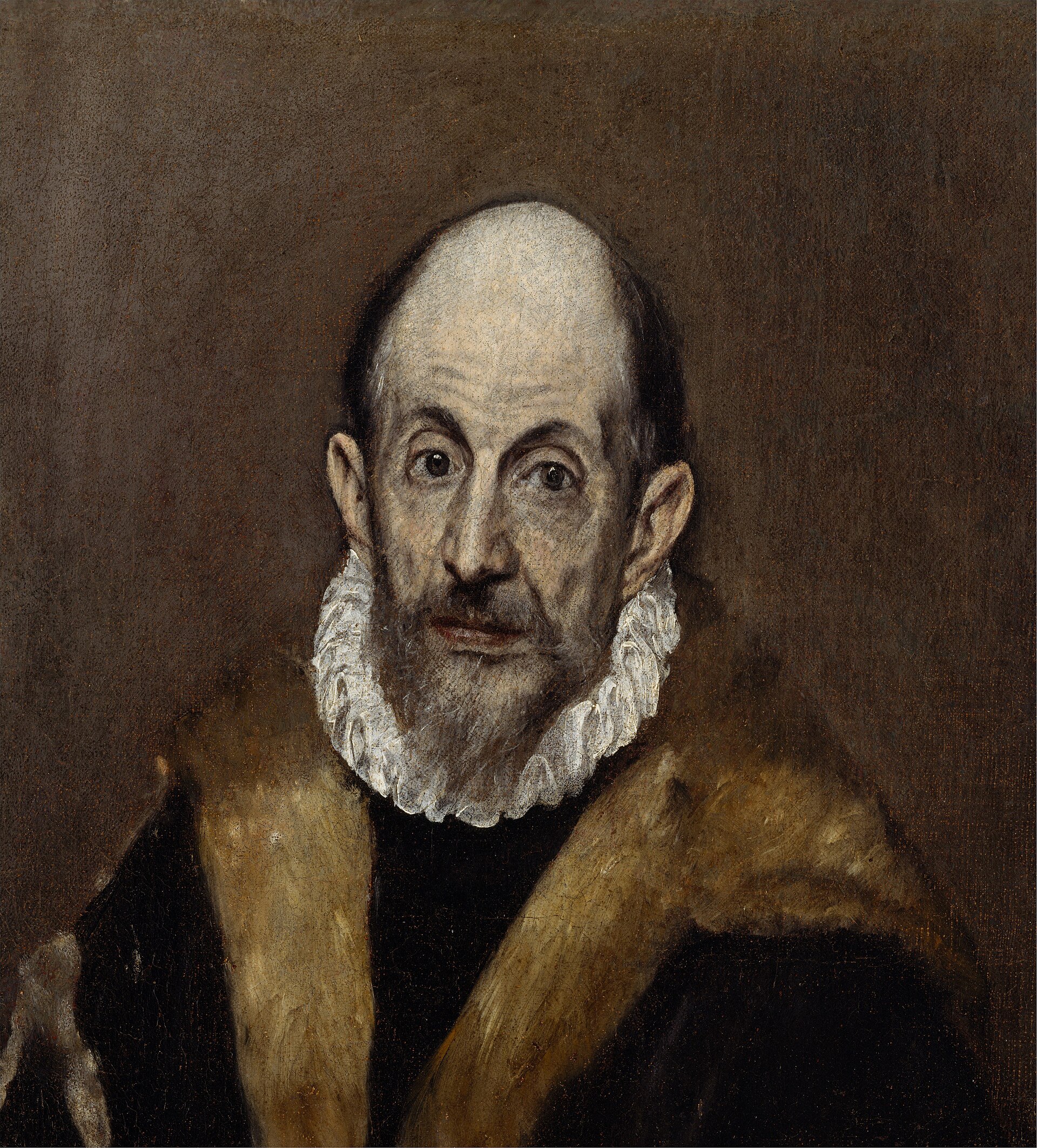
Portrait of an Old Man, Metropolitan Museum of Art 24.197.1, about 1595-1600, oil on canvas, 52.7 by 46.7 cm. Sanpere y Miguel first proposed in 1900 that it is a self-portrait; Paul Lafond was the first to dispute it in 1906; Mayer tied it in 1926 to item 189 of the 1621 inventory and that was generally accepted until Wehle in 1940 found no evidence for the link. Wethey doubted it in 1962 and Fernando Marias returned to the self-portrait idea in 1993. No document names the sitter, so this is a disputed candidate and not a secure likeness.
The Metropolitan Museum of Art, New York, Purchase, Joseph Pulitzer Bequest, 1924 (public domain)| Full name | Domenikos Theotokopoulos, called El Greco (the Greek) |
|---|---|
| Worked as | Painter, Icon painter, Portraitist, Designer of altarpiece frames |
| Born | 1541 (Wikipedia gives 1 October · Candia (Heraklion) or Fodele, Crete, then Venetian territory |
| Died | 7 April 1614 (the Toledo burial register records the burial... · Toledo, Spain |
| Nationality | Cretan Greek, Venetian subject by birth |
| Movement | Cretan school icon painting, then Venetian and Roman Mannerism, then Toledo |
| Sources | 25 cited |
| Last verified |
About this page Last verified · 25 sources cited
On this page 13 sections
ContentsClose
There is no settled count of how many paintings El Greco made. Jose Camon Aznar attributed between 787 and 829 pictures to him, Harold Wethey's catalogue of 1962 reduced that to 285 and Halldor Soehner recognised only 137 (figures as reported by Wikipedia). Wethey's reductions are themselves contested and have been partly reversed, and no authentication board was found in the sources read for this page. What the market does with the labels shows in the sale catalogues: the picture that held the auction record as of the 2017 report, a Saint Dominic in Prayer sold in London in 2013, appears in Wethey as 'El Greco and studio'.
He was a trained icon painter from Crete who signed in Greek and spent about nine years in Venice and Rome before settling in Toledo in 1577, where he ran a studio that his son Jorge Manuel inherited. When he died in 1614 his son listed 143 paintings, about fifty clay, wax and plaster models, 120 drawings and a library. Both inventories survive, and they help explain why so many of his subjects exist in several versions of different quality.
The question of hands is still open. In April 2026 a team led by researchers at Western Reserve University in Ohio reported in Science Advances that a brushwork-classification model finds the late Baptism of Christ, long given largely to Jorge Manuel, to be mostly El Greco's own work. The lead author says the method still needs work. In March 2026 the Vatican showed an El Greco, The Redeemer, that had been hidden for decades under a later painter's version of the Christ figure.
Images
Chronology
- before 1567
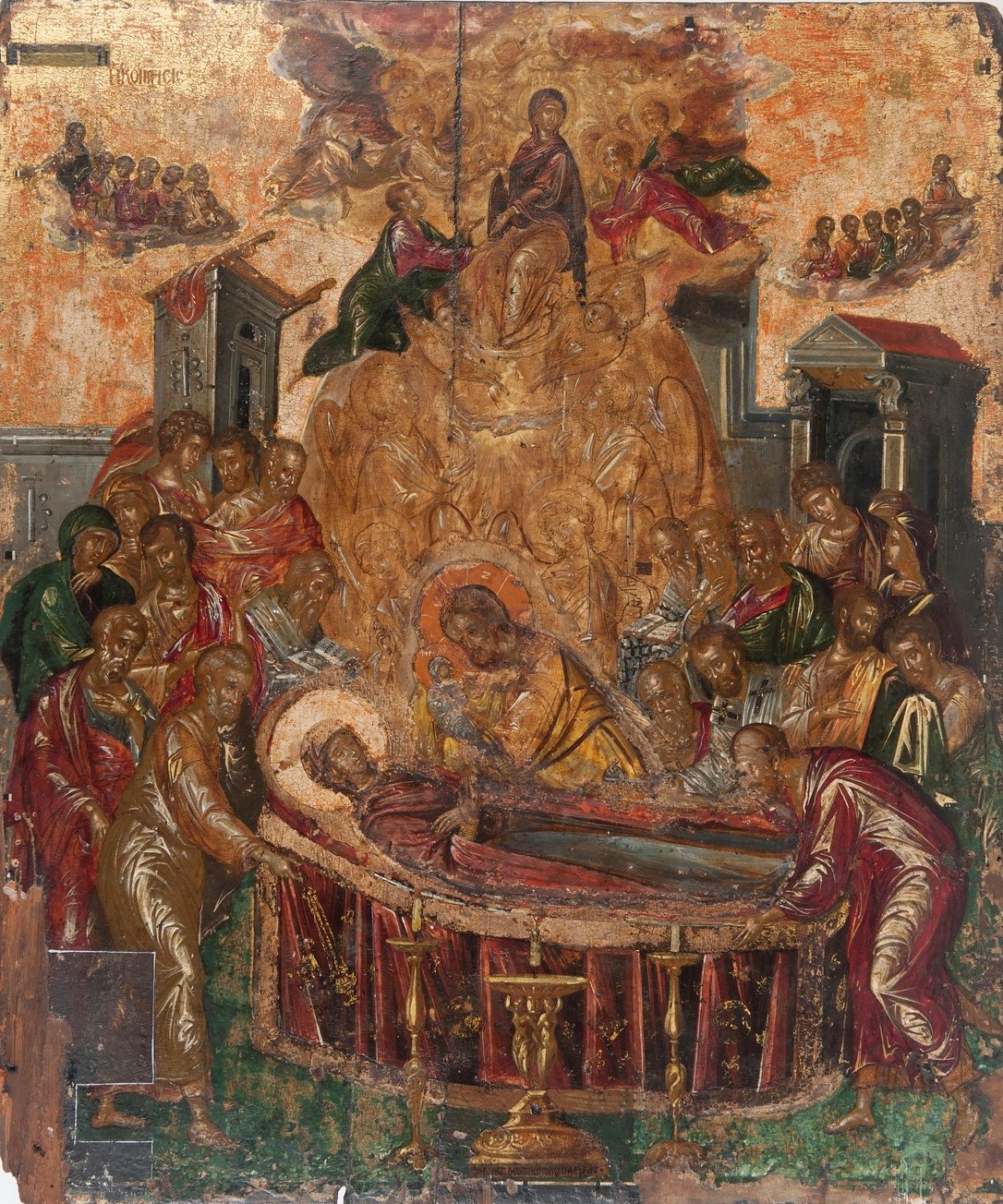
Paints the signed Dormition of the Virgin icon now on Syros, the infobox range being 1565-66.4
- 1541
Born in Candia or Fodele, Crete, then Venetian. Only his own statement of 1606 that he was 65 supports the year, according to the outline biography.13
- 1563
Described in a document as 'maestro Domenigo', a guild master painter.1
- 1566
26-27 December: asks leave to sell a panel in a lottery; it sells for 70 ducats against valuations of 80 and 70.1
- 1567
- 1570
Moves to Rome and is lodged at the Palazzo Farnese on Giulio Clovio's recommendation; Clovio's letter to Cardinal Farnese is dated 16 November.23
- 1572
18 September: pays dues to the guild of Saint Luke as a miniature painter; opens his own workshop at year end.12
- 1577
In Toledo by 2 July; commissions for Santo Domingo el Antiguo and the Espolio follow.23
- 1578
- 1579
Cathedral's valuation of the Espolio (about 225 ducats) contested by El Greco (900); an arbitrator sets about 320.3
- 1586
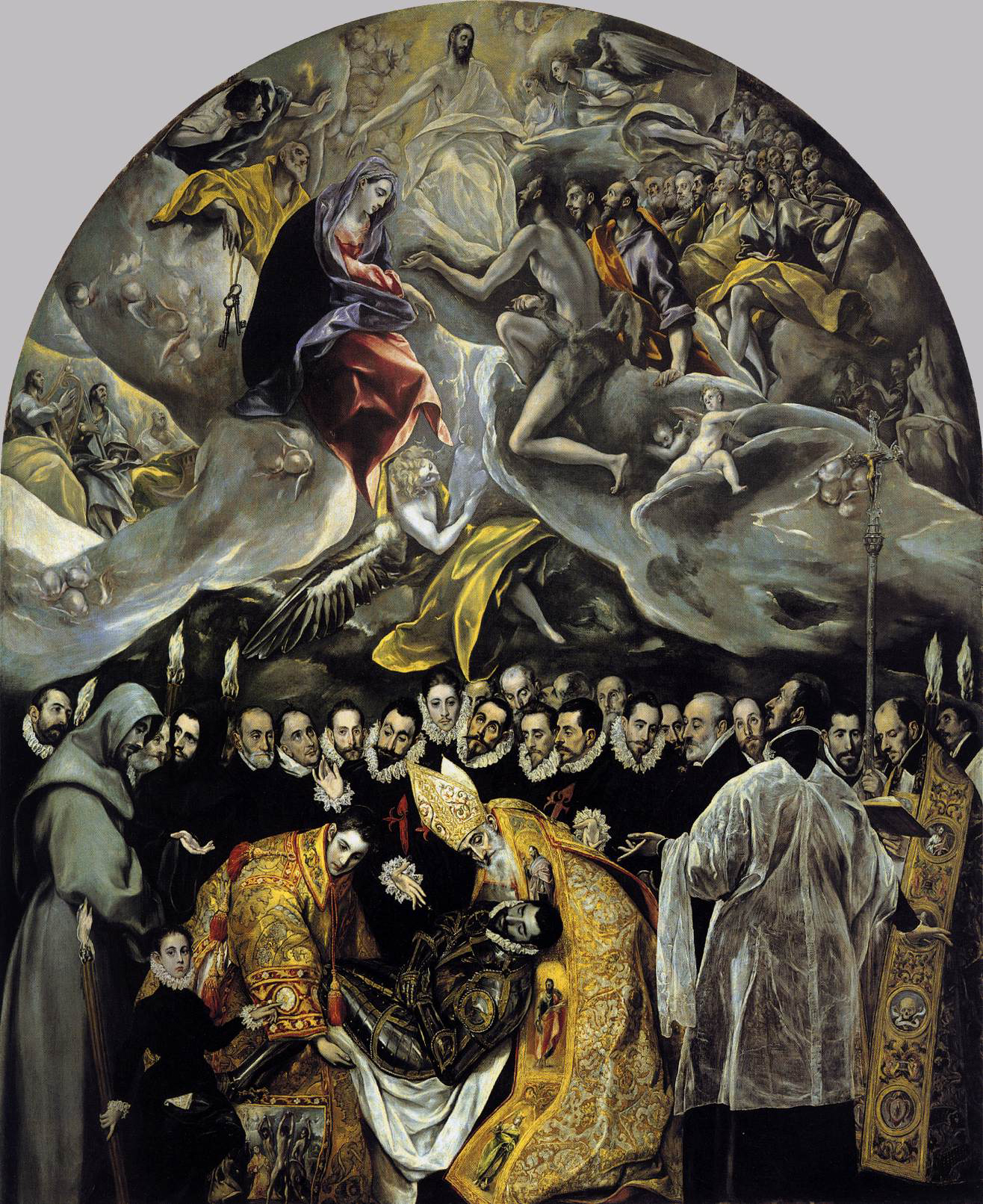
Orgaz commissioned in March for 1,200 ducats; painted 1586-88.325
- 1600
Delivers the paintings for the Augustinian college of Dona Maria de Aragon, nearly 6,000 ducats.3
- 1603
18 June: contract for Illescas with 'Domingo Greco and Xorje Manuel'; settled in May 1607 at a little over 2,000 ducats.3
- 1606
Contests a tax in the Illescas matter by arguing that painting is a liberal art.3
- 1611
Francisco Pacheco visits the studio and sees plaster, wax and clay figures.2
- 1614
31 March: power of attorney to Jorge Manuel. 7 April: death and burial at Santo Domingo el Antiguo, without a will. 7 July: inventory lists 143 paintings and about 50 models.320
- 1621
Jorge Manuel's inventory of his own possessions lists three Laocoons (items 41, 179 and 180); a portrait of his father is item 189 in Mayer's reading and a half-length self-portrait item 258 in Marias's.617
- 1624
The Baptism of Christ is fixed as the altarpiece at Hospital Tavera.16
- 1631
Jorge Manuel dies in Toledo, 29 March.23
- 1666
Madrid Alcazar inventory records a large Laocoon by El Greco at 300 silver ducados.6
- 1902
Madrid exhibition of El Greco's works, the first devoted to him; the Chicago Assumption is lent by the heirs of Prince Sebastian Gabriel.228
- 1904
Paul Durand-Ruel buys the Assumption of the Virgin; the Art Institute of Chicago has held it since 1906.22
- 1908
Cossio publishes the first comprehensive catalogue.1
- 1924
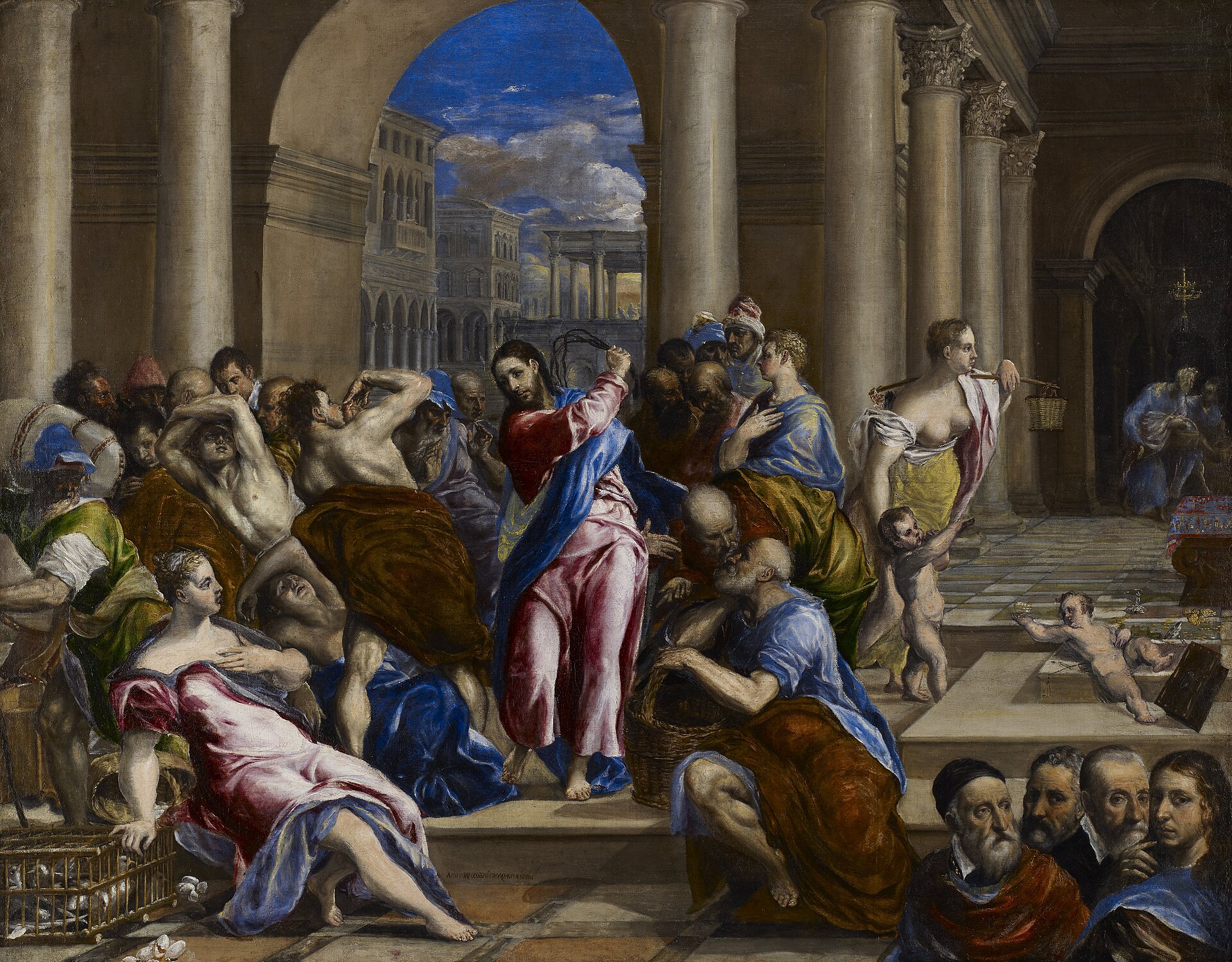
8 January: Minneapolis Institute of Art buys Christ Driving the Money Changers for $30,000.5
- 1962
Harold Wethey's El Greco and His School published at Princeton.18
- 1983
Signature discovered on the Syros Dormition.4
- 2013
3 July: Saint Dominic in Prayer makes GBP 9,154,500 at Sotheby's London, the auction record.711
- 2014
The Prado holds 'El Greco's Library' (April) and 'El Greco and Modern Painting'; the Met holds 'El Greco in New York'.1621
- 2017
7 December: Saint Francis and Brother Leo in Meditation makes GBP 6,871,250 at Christie's London.89
- 2025
February: Christie's withdraws Saint Sebastian after Romania objects; 18 February to 15 June the Prado reunites eight of nine Santo Domingo el Antiguo canvases.121322
- 2026
March: the Vatican shows The Redeemer found under a forger's overpaint. 17 April: Science Advances study on the Baptism of Christ.1516
The market
Three results and one withdrawn offer. The record is GBP 9,154,500 (2013) for a picture Wethey calls 'El Greco and studio'. The second is GBP 6,871,250 (2017) for a picture Wethey calls 'workshop'. A Christie's New York offer of a Saint Sebastian at $7m-9m in 2025 never reached the room because of Romania's claim. One museum purchase is on record from 1924 at $30,000. The sale prices can't be compared without the premium schedules in force on each date.
| Date | Sale | Work | Result | Note |
|---|---|---|---|---|
| 3 July 2013 | Sotheby's London, Old Master and British Paintings Evening Sale, lot 19 | Saint Dominic in Prayer, 75 by 58 cm, about 1600 or later; Wethey no. 206 | Hammer DERIVED: about GBP 8.1m (from the 2013 Sotheby's schedule as supplied: 25% to GBP 50,000, 20% to GBP 1m, 12% above; the schedule itself was not independently checked). Not published in the sources read. With premium GBP 9,154,500 price realised, premium-inclusive; the estimate of GBP 3m-5m is hammer-based. Derived premium about GBP 1.05m. GBP | First time at auction. Record for El Greco and a Spanish Old Master. Provenance includes Tomas Harris, Contini Bonacossi and Dr Gustav Rau, who bequeathed it to UNICEF. Sale total GBP 35,048,000. About USD 13.9m reported. |
| 7 December 2017 | Christie's London, Old Masters Evening Sale, lot 14 | Saint Francis and Brother Leo in Meditation, 110 by 64.5 cm; Wethey no. X-334 (workshop) | Hammer GBP 5,900,000 (as reported by The Value) With premium DERIVED: GBP 971,250 (total less the reported hammer; consistent with Christie's 2017 schedule as supplied: 25% to GBP 175,000, 20% to GBP 3m, 12.5% above) GBP | Total GBP 6,871,250 (US$9,186,861 reported). Estimate GBP 5m-7m. Property of Stanford Z. Rothschild Jr. Provenance on the lot page: Conde de Adanero, Marques de Castro Serna, Conde de Campo Giro, Marques de Albayda, then the anonymous Christie's sale of 13 December 1996, lot 129. |
Hammer is the price at which the bidding stopped; with premium adds the fee the house charges the buyer on top. Hammer price and buyer's premium in the glossary.
Recorded without a public price
- 8 January 1924 · Christ Driving the Money Changers from the Temple, 116.84 by 149.86 cm (Mia 24.1) · Private sale via Bohler and Steinmeyer and Henry Reinhardt & Co to the Minneapolis Institute of Art · not applicable (private sale) Price $30,000. The Earl of Yarborough had held it from at least 1857, catalogued as by Veronese.
- 2025-02 (withdrawn) · Saint Sebastian, Wethey no. 280 · Christie's New York, Old Masters sale · no sale Estimate $7m-9m. Withdrawn after Romania's objection; according to a letter from Romania's lawyers the work stays at Christie's New York until Romania's claim is resolved (June 2025).
Where to see the work
| Institution | City | Holdings | Note |
|---|---|---|---|
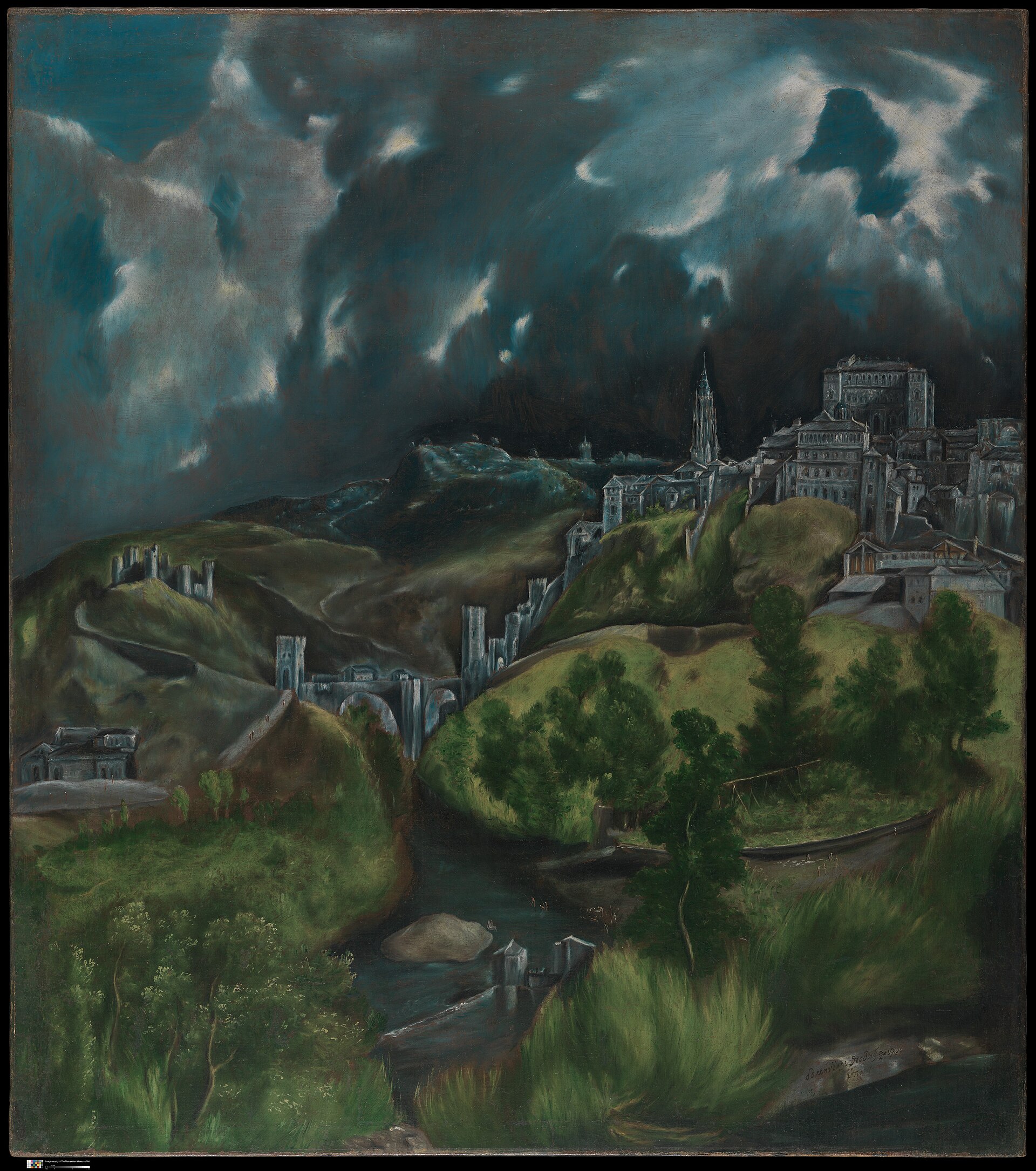
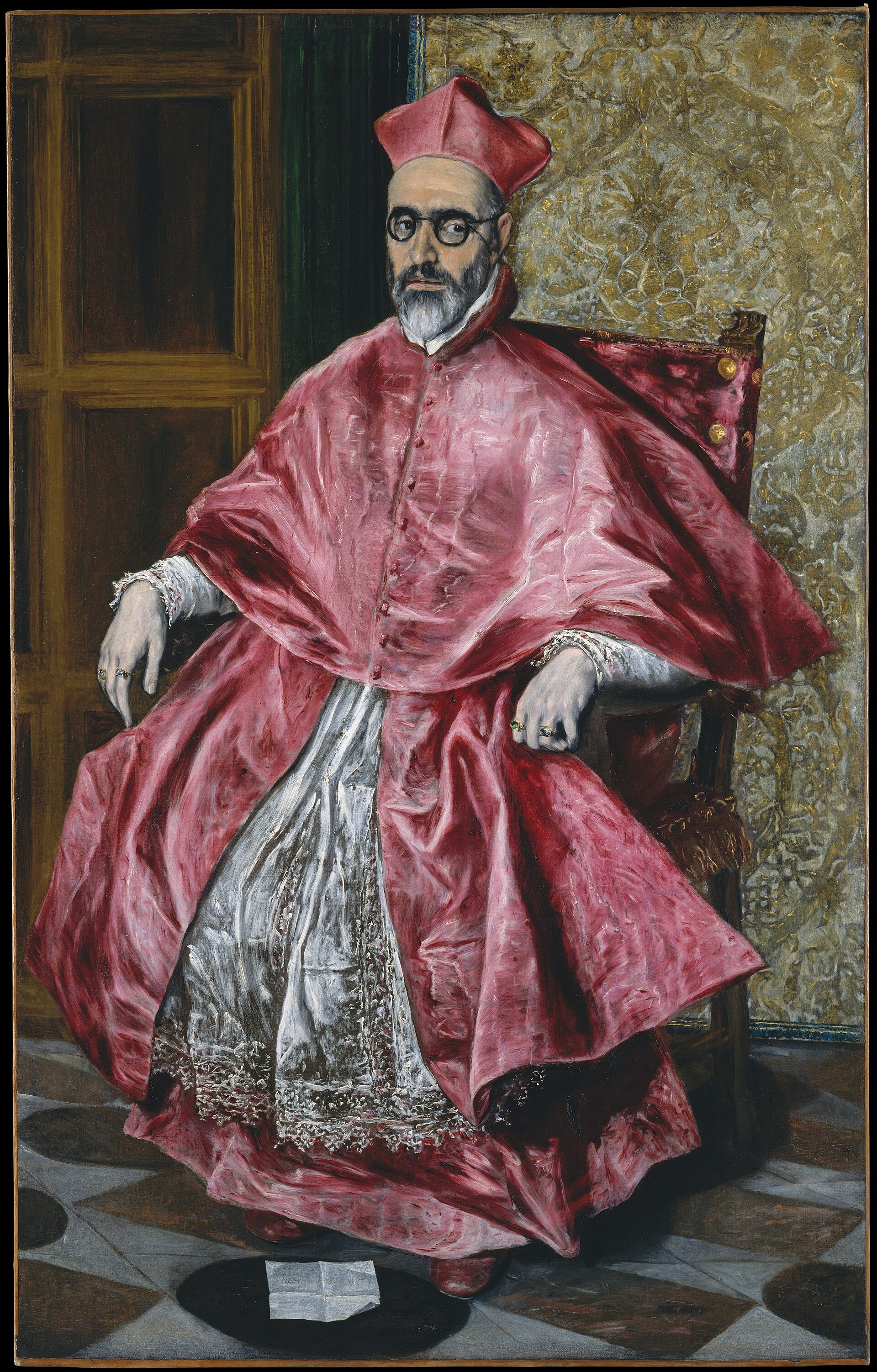
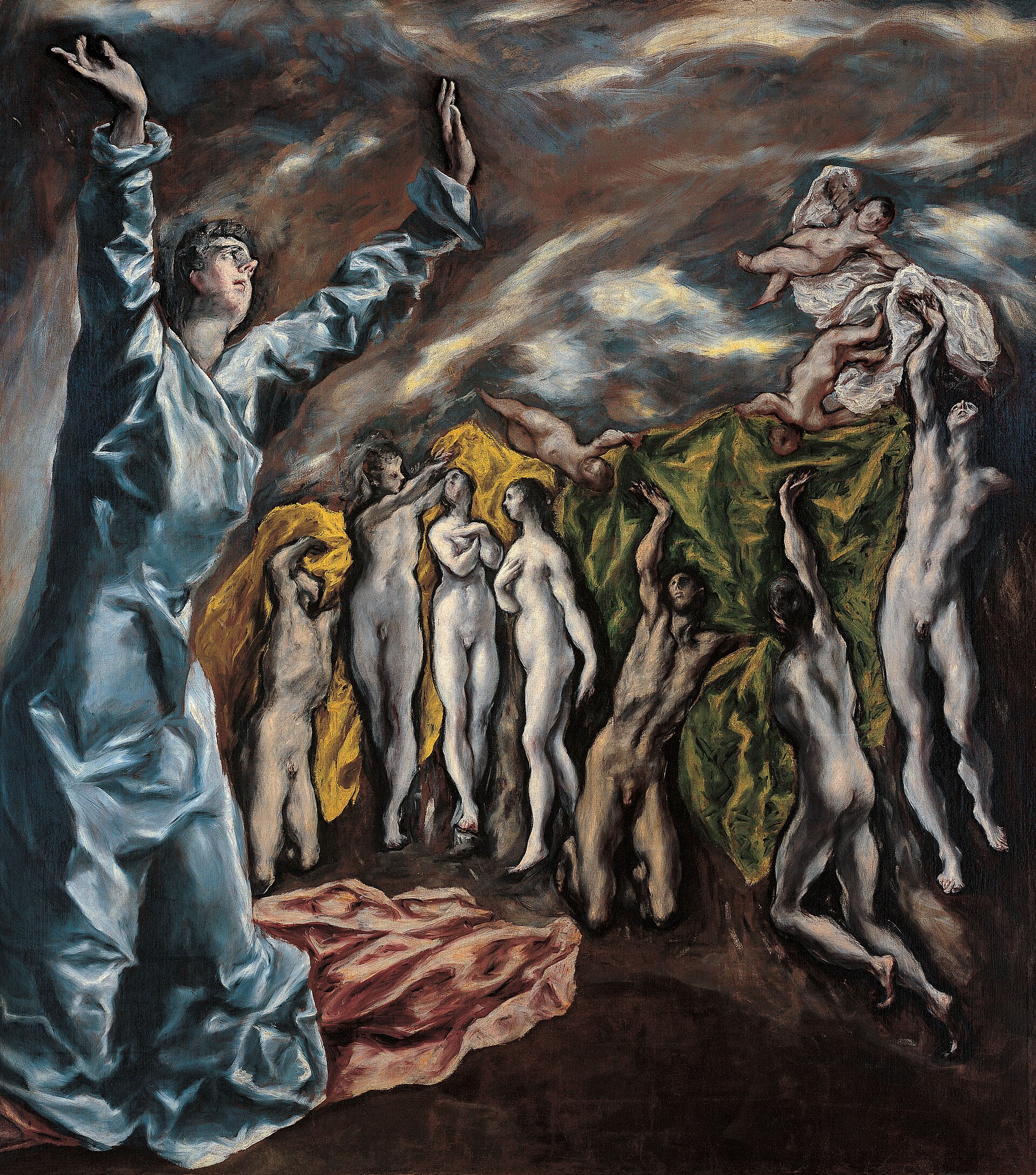
| Metropolitan Museum of Art | New York | View of Toledo (29.100.6), Cardinal Fernando Nino de Guevara (29.100.5), Vision of Saint John (56.48), Portrait of an Old Man (24.197.1), Christ Healing the Blind (1978.416). | The Vision is a fragment of a larger altarpiece for the Hospital of Saint John the Baptist in Toledo, with the top truncated. |
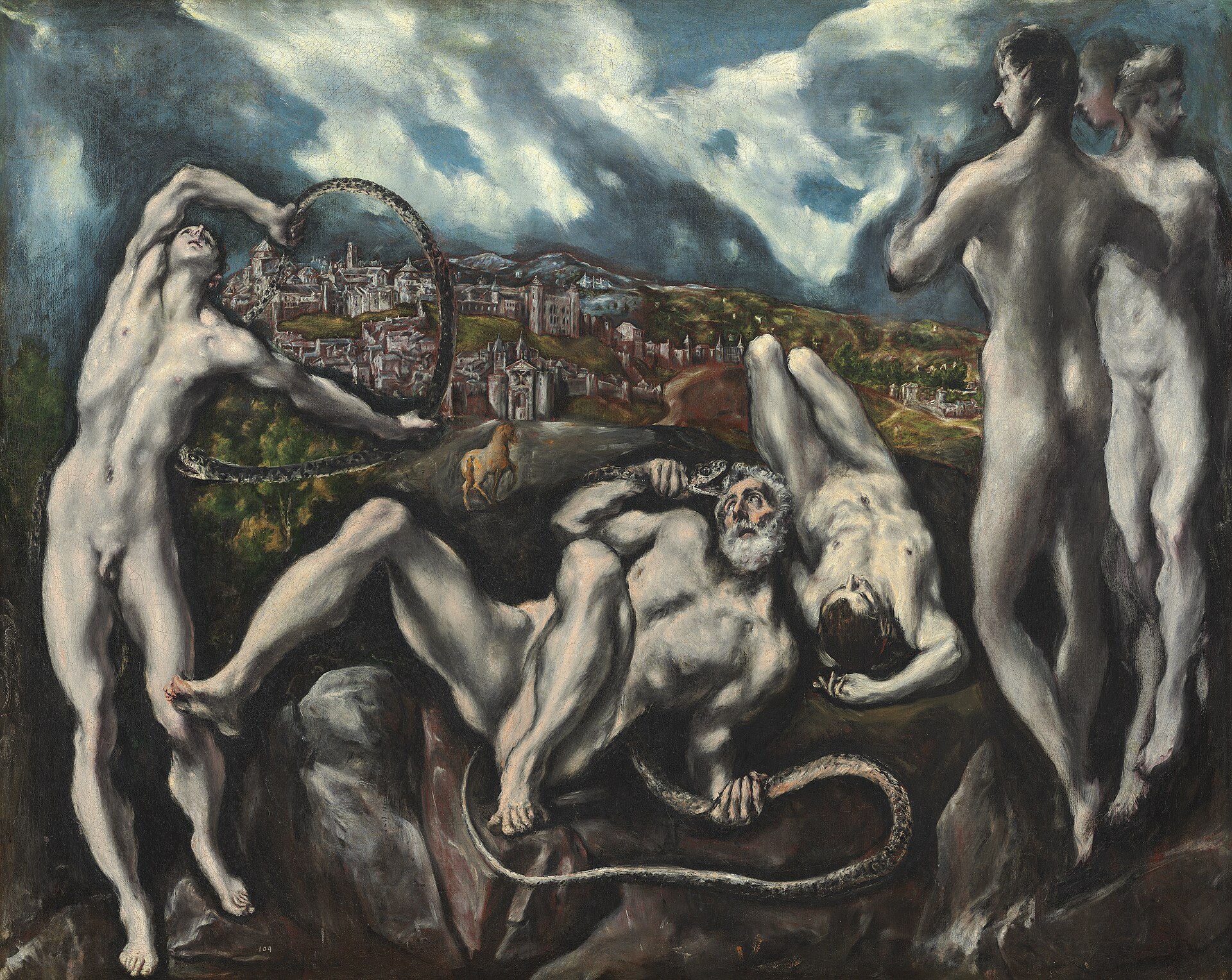
| National Gallery of Art | Washington | Laocoon, 1946.18.1. | Gallery M28 (West Building) when the NGA page was read; the NGA calls it El Greco's only known mythological painting. |
| Minneapolis Institute of Art | Minneapolis | Christ Driving the Money Changers from the Temple, 24.1. | Gallery 341. |
| Art Institute of Chicago | Chicago | The Assumption of the Virgin, central canvas of the Santo Domingo el Antiguo altarpiece. | Lent to the Prado in 1902 by the heirs of Prince Sebastian Gabriel; bought by Durand-Ruel in 1904; at Chicago since 1906; lent to the Prado again in 2025. |
| Church of Santo Tome | Toledo | The Burial of the Count of Orgaz, still in the church. | Commissioned for this church in 1586. |
| Toledo Cathedral, sacristy | Toledo | The Disrobing of Christ (El Espolio), 285 by 173 cm, per the Commons file page. | Other versions of the subject exist; this note is about the cathedral canvas only. |
| Hospital Tavera | Toledo | The Baptism of Christ, fixed as altarpiece in 1624. | Subject of the 2026 Patch study. |
| Holy Cathedral of the Dormition of the Virgin | Ermoupolis, Syros | Dormition of the Virgin, tempera and gold on panel. | Signature found 1983. |
| Museo Nacional del Prado | Madrid | The Adoration of the Shepherds, painted for his burial chapel, and the 2025 Santo Domingo el Antiguo reunion. | The Prado's own collection pages were not available for this record. |
| Vatican Museums (Castel Gandolfo) | Castel Gandolfo | The Redeemer, about 1590-95, restored and shown in March 2026. | Shown beside a tempera Saint Francis of about 1570 lent by the A. and M.A. Pagliara Foundation, in the exhibition 'El Greco in the Mirror'. |
Forgeries and misattributions
- The Redeemer, Vatican, overpainted
- A small oil on board given to Pope Paul VI in 1967 by Jose Maria Sanchez de Muniain Gil had a later painter's own rendition of Christ over El Greco's original. It hung in the Pope's apartments for decades without restoration or study. Restorers Alessandra Zarelli and Paolo Violini noticed conservation problems in a routine check; removing the overpaint recovered the original layers, and the data compared with other El Greco paintings confirmed it as entirely authentic. High-resolution imaging found two further compositions beneath it.15
- Minneapolis Purification sold as Veronese
- Mia lists it with the Duke of Buckingham until 1648 as by El Greco, then in the Earl of Yarborough's collection from at least 1857 to 1923 as by Veronese, and sold to Minneapolis as El Greco in 1924. A misattribution, not a forgery. Not stated in Mia's record.5
- Contested workshop attribution, Christie's 2017
- Saint Francis and Brother Leo was called workshop by Soehner and Wethey and autograph by William B. Jordan (the only autograph replica of the Ottawa canvas, per Christie's); it sold as El Greco. Not a detection. A scholarly disagreement recorded in the lot essay.8
- Wrong version linked in a 1937 catalogue
- Sotheby's says the 1937 Paris catalogue wrongly connected its Saint Dominic with Wethey no. 203, a different version. Sotheby's catalogue note.7
- Fakes made from scratch
- No documented case of a modern forgery of an El Greco that was exposed turned up in the sources read. Not found.15
The essay
Chapter 1The count: 800, 285 or 137
Wikipedia, used here as a tertiary summary of the attribution literature, reports that Camon Aznar attributed 787 to 829 paintings to El Greco, that Wethey's catalogue raisonne of 1962 cut the figure...
Wikipedia, used here as a tertiary summary of the attribution literature, reports that Camon Aznar attributed 787 to 829 paintings to El Greco, that Wethey's catalogue raisonne of 1962 cut the figure to 285 and that Soehner recognised 137. It adds that Pallucchini's study of 1937 had greatly raised the accepted number, that Wethey denied the small Modena triptych any link with El Greco and rejected any Cretan role in his formation, and that disputes over the exact number remain unresolved with Wethey's catalogue at their centre.
Wethey's position moved. Wikipedia says the discovery of the Dormition, along with archival research, led to the attribution of three more signed works (the Modena Triptych, Saint Luke Painting the Virgin and Child and The Adoration of the Magi) and then of further works including the Pieta with Angels of 1566. In one of his last articles Wethey accepted that El Greco left Crete in 1567 and said he 'probably had painted' the Modena triptych before leaving. So the 285 of 1962 isn't a ceiling, and the catalogue that sets the standard in sale catalogues is one its own author partly revised.
The auction catalogues show what the labels mean in practice. Sotheby's 2013 lot essay for Saint Dominic in Prayer lists Wethey 1962, volume II, no. 206 as 'El Greco and studio'. Christie's 2017 literature list for Saint Francis and Brother Leo in Meditation records Wethey no. X-334 and Soehner 1958-59 as 'workshop'. Both pictures sold as El Greco. Christie's essay reports that William B. Jordan endorsed the Christie's picture as the only autograph replica of the Ottawa canvas, so the disagreement was known and priced.
Even a single subject can't be counted cleanly. Sotheby's says August Mayer listed 56 autograph Saint Francis paintings and Wethey 24, with ten types.
Chapter 2An icon painter first
Wikipedia reports that El Greco trained as an icon painter in the Cretan school, that most scholars think his family was almost certainly Greek Orthodox and that in 1563 a document calls him 'maestro...
Wikipedia reports that El Greco trained as an icon painter in the Cretan school, that most scholars think his family was almost certainly Greek Orthodox and that in 1563 a document calls him 'maestro Domenigo', a master of the painters' guild. On 26 December 1566 he asked permission to sell a panel in a lottery; it was sold on 27 December for 70 ducats, against valuations of 80 and 70. His brother Manoussos (1531-1604) spent his last years in the Toledo household, according to the same source. The Metropolitan Museum's essay by Keith Christiansen says two certain icons survive.
One is the Dormition of the Virgin in the cathedral church of Ermoupolis on Syros, tempera and gold on panel, 61.4 by 45 cm. Wikipedia reports that his signature was found on the base of the central candelabrum in 1983 and that the work is dated 'probably before 1567', with an infobox range of 1565-66. The signature was found 369 years after he died. It shows him signing as a Cretan painter before he went west, and it's why the icon opens any list of his work.
Argued, not documented: Robert Byron holds that the Dormition's iconographic type was the compositional model for the Burial of the Count of Orgaz of 1586-88, and Marina Lambraki-Plaka sees a connection between the icon and that composition (both as reported by Wikipedia). The claim is a comparison and not evidence of what El Greco had in mind. It does mean the oldest work on this page may be an ancestor of the best known one.
Chapter 3Venice and Rome: about nine years, no altarpiece
The Met's essay says he went to Venice in 1567 and became a disciple of Titian and an avid student of Tintoretto, Veronese and Jacopo Bassano.
The Met's essay says he went to Venice in 1567 and became a disciple of Titian and an avid student of Tintoretto, Veronese and Jacopo Bassano. Wikipedia adds that Clovio described him as a disciple of Titian. In Rome from 1570 to 1576 he had a letter from the miniaturist Giulio Clovio that got him quarters in the palace of Cardinal Alessandro Farnese. According to Wikipedia he lodged a formal complaint about a dispute at the Palazzo Farnese on 6 July 1572, paid dues to the guild of Saint Luke as a miniature painter on 18 September and at the end of the year opened his own workshop, hiring Lattanzio Bonastri de Lucignano and Francisco Preboste as assistants.
Christiansen's judgment is that after six years in Rome he hadn't received a single commission for an altarpiece and that his reputation rested on portraits and small devotional pictures. He adds that El Greco had criticised Michelangelo's abilities as a painter, which may have shut him out of the Roman establishment. The Minneapolis Christ Driving the Money Changers from the Temple belongs to this period. Mia's catalogue text says its subject was popular in Italy and that Catholics read it as the purification of the Church by internal reform and the expulsion of Protestant heretics. It says he put four artists in the lower right corner (Titian, Michelangelo, Clovio and Raphael) and signed in Greek letters on the step. Those readings are Mia's.
The Minneapolis picture had a rough later life. Mia's provenance says it was with the Duke of Buckingham at York House until 1648 as by El Greco, went to the Archduke Leopold Wilhelm in Prague, then to the Dresden gallery in 1742 or 1749. The Earl of Yarborough had it in London from at least 1857 until 1923 as by Veronese, so it was catalogued as a Veronese for at least sixty years. Mia bought it in January 1924 through Bohler and Steinmeyer and Henry Reinhardt for $30,000. The same subject exists in other versions and every statement here about the Minneapolis canvas applies to that canvas only.
Chapter 4What he read: the library and the annotated Vasari
A library is evidence, and his is partly documented.
A library is evidence, and his is partly documented. The Met's essay says his treatises on painting are lost, but his copies of Vitruvius and Vasari's Lives survive with his annotations in the margins. The 2014 exhibition 'El Greco's Library', a joint project of the Prado, the Biblioteca Nacional de Espana and the Fundacion El Greco 2014, showed 39 books identified from two inventories, four of them his own. It displayed the heavily annotated Vitruvius and Vasari and the original inventories of 1614 and 1621, compiled by his son Jorge Manuel, according to the exhibition notice.
The counts differ by source. The outline biography at the Web Gallery of Art says the inventory made by his son on 7 July 1614 lists 27 Greek, 67 Italian and 17 Spanish books, 111 in all, together with 120 drawings, 30 plans probably for retables and 200 engravings. Wikipedia reports a 'working library' of 130 volumes including a Greek Bible. The two figures aren't reconciled here and the Prado's catalogue is the primary to check.
Wikipedia says the Vitruvius notes reject Vitruvius' canonical proportions, perspective and mathematics. No page giving the annotations themselves was available for this record, so none is quoted. What's documented is that he owned and annotated the two books a Renaissance painter used to argue about proportion and about the history of Italian painting. Christiansen argues, from the pictures, that Byzantine icon painting and Renaissance theory shared a respect for Neoplatonic theory about art, and that El Greco moved from one to the other. That's an argued reading by one curator and not a statement of what El Greco believed.
Chapter 5Toledo and what the commissions paid
The outline biography says he was in Toledo by 2 July 1577 and received commissions for Santo Domingo el Antiguo and the Espolio (the Disrobing of Christ) for the cathedral.
The outline biography says he was in Toledo by 2 July 1577 and received commissions for Santo Domingo el Antiguo and the Espolio (the Disrobing of Christ) for the cathedral. The Met says Diego de Castilla, dean of the cathedral, commissioned three altarpieces for Santo Domingo and helped bring about the Espolio; a report on the Prado's 2025 show says Castilla acted at the suggestion of his son Luis, who had met El Greco in Rome in 1571. Wikipedia says nine paintings for Santo Domingo were complete by September 1579. They left the convent from 1830.
A dispute over the price of the Espolio led to litigation. The outline biography gives the cathedral's valuation as about 225 ducats against El Greco's claim of 900, with an arbitrator setting roughly 320. The Met says he never got another comparable commission from the cathedral and worked afterwards for private patrons and convents. His bid for royal patronage in Madrid failed too; the outline biography says Philip II paid 800 ducats for the Martyrdom of Saint Maurice and, according to Siguenza in 1608, was displeased.
The money figures in the same source give a sense of scale. The 1586 Burial of the Count of Orgaz was 1,200 ducats. The Augustinian college of Dona Maria de Aragon, delivered in 1600, was nearly 6,000. The Chapel of San Jose was 2,850. The Illescas hospital contract of 18 June 1603 with 'Domingo Greco and Xorje Manuel' was settled in 1607 at a little over 2,000 ducats, which Wikipedia puts at 2,093. No wage or price series was found in the sources read, so no modern equivalent is offered.
The outline biography says that in 1606, in the Illescas matter, he contested a tax by arguing that painting was a liberal art, and calls it the first official recognition of that status in Spain. It also reports that he was criticised for portraits of Jorge Manuel and others in large ruffs and defended the design. That is the biographer's account and the document itself wasn't seen.
Chapter 6Orgaz: a vision commissioned to mark a debt repaid
The Met says the parish priest of Santo Tome in Toledo commissioned the Burial of the Count of Orgaz in 1586 to celebrate the restitution of a financial obligation to the church.
The Met says the parish priest of Santo Tome in Toledo commissioned the Burial of the Count of Orgaz in 1586 to celebrate the restitution of a financial obligation to the church. It honours a long-dead benefactor at whose funeral Saints Stephen and Augustine were seen to appear and help bury him, and shows the count's soul received into Paradise. The Commons description of the reproduction used here names him as Gonzalo Ruiz de Toledo, lord of Orgaz, said to have died in 1323 (or in 1312 by other accounts), gives the date as 1586-88 and the size as 480 by 360 cm, and says the picture remains in the church. The outline biography gives the commission as March 1586 and the price as 1,200 ducats.
The function is the meaning here. It's a memorial picture for a parish church, and it was visited. The outline biography says it includes portraits of himself and his son and that visitors flocked to see it. The Met's essay says Jorge, his son, kneels fictively at the front and gestures to the viewer, as an intermediary between the viewer's world and the miracle, and that the portraits of contemporaries sit below a heavenly vision in which the verisimilitude of the earthly scene gives way to shifting planes.
Nothing in the sources read places El Greco in a confraternity, a lodge or any association outside the church and the city's circle of patrons and friends. The documented setting is Counter-Reformation parish patronage and ordinary devotion. No hidden programme could be sourced and none is claimed.
Chapter 7The studio: Jorge Manuel, the models and the 1614 inventory
Wikipedia says that in Toledo by 1585 he rented three apartments and twenty-four rooms from the Marquis de Villena that also served as his workshop, one able to make altar frames and statues as well...
Wikipedia says that in Toledo by 1585 he rented three apartments and twenty-four rooms from the Marquis de Villena that also served as his workshop, one able to make altar frames and statues as well as paintings. The outline biography says the high altar paintings at Talavera la Vieja in 1591 were largely executed by assistants. His son Jorge Manuel, born in 1578 to Jeronima de las Cuevas, learned his trade in the studio. His first documented work was an altarpiece at Illescas around 1603 and he was named universal heir by a power of attorney dated 31 March 1614.
El Greco died on 7 April. The power of attorney has him profess 'the Faith of the Holy Church of Rome' and says that because of the gravity of his sickness he couldn't make a will, and the burial register says 'made no will'. The 1614 inventory made by Jorge Manuel on 7 July lists 143 paintings, mostly finished, 30 clay and wax models and 15 plaster models, 120 drawings and 30 plans. Xavier Bray's lecture at the Frick describes it as listing 'some fifty models'. The Met says Francisco Pacheco visited in 1611 and recorded seeing plaster, wax and clay figures from which El Greco worked, a method Pacheco didn't approve of. So the working method is documented twice, by a visitor and by the inventory.
The National Gallery of Art's provenance for its Laocoon shows what the inventories can and can't say. The 1614 estate inventory lists two small Laocoons and one large one. The 1621 inventory of Jorge Manuel's own possessions lists one of two varas in width, a large one and another of almost the same size. The NGA says the difference suggests Jorge Manuel sold one of the small ones and that he or another workshop hand produced another large copy before 1621, and adds that a mistake in one of the inventories is the alternative.
Chapter 8Who painted the Baptism of Christ
The Baptism of Christ from the Hospital Tavera in Toledo was among his last commissions.
The Baptism of Christ from the Hospital Tavera in Toledo was among his last commissions. The outline biography says he had been connected with the hospital since 1595 and was commissioned in 1608, and that Jorge Manuel finished the Baptism after his death. Artnet reports that it was fixed as the altarpiece in 1624, ten years after El Greco's death, and that this delay and some stylistic irregularities led scholars to believe it was largely by Jorge Manuel with workshop help.
Artnet's report on the study, published in Science Advances on 17 April 2026 and led by Andrew Van Horn, says the Patch model scanned the surface of the picture in 3D and compared it patch by patch. It treated the late Christ on the Cross as one hand, as expected, and found links between areas of the Baptism previously given to Jorge Manuel or the workshop, apart from a region at the bottom that it called undeniably by later hands. Artnet says the differences scholars perceived could be explained by experiment, different brushes or the effects of age. Van Horn is quoted saying 'we still have work to do'. The paper itself wasn't read for this record, and no independent test of the finding was found.
Chapter 9Versions: how a repeat differs from the prime picture
El Greco repeated subjects constantly, and the sale catalogues name the versions.
El Greco repeated subjects constantly, and the sale catalogues name the versions. For Saint Dominic in Prayer Sotheby's lists Arango (the earliest, about 1585-90), the Toledo cathedral sacristy, Boston (the most emaciated figure), an old copy at the Hispanic Society made after the lot, and a copy in Santa Cruz after an engraving by Diego Astor. It says the 1937 Paris catalogue wrongly linked the sale picture to Wethey no. 203. For Saint Francis and Brother Leo in Meditation Christie's calls the Ottawa canvas, 168.5 by 103 cm, the prime version and says a reproductive print of 1606 helped spread the composition.
The rule this page follows is that a fact is attached to a holding and never to a title. The Sotheby's picture is 75 by 58 cm, indistinctly signed, and its date runs from 1588-91 (1937 catalogue) to 1603-07 (Gudiol 1971) and 1600-05 (Pita Andrade). The Christie's picture is 110 by 64.5 cm with a cartellino signature recorded as 'signed (?)'. The Minneapolis, Met, NGA and Chicago pictures named elsewhere on the page are each their own object.
Chapter 10Pricing the hand: Wethey's labels against the hammer
Mia paid $30,000 for the Minneapolis canvas in January 1924 in a private purchase.
Mia paid $30,000 for the Minneapolis canvas in January 1924 in a private purchase. The Sotheby's Saint Dominic made GBP 9,154,500 on 3 July 2013, a premium-inclusive price realised against an estimate of GBP 3m-5m, a record for El Greco and for a Spanish Old Master, in a sale that totalled GBP 35,048,000. The Christie's Saint Francis and Brother Leo made GBP 6,871,250 on 7 December 2017 against GBP 5m-7m, with a hammer of GBP 5.9m reported by The Value.
The hammer for the Sotheby's picture isn't published in the sources read. A derived figure of about GBP 8.1m follows from the 2013 Sotheby's schedule as supplied to this record (25% to GBP 50,000, 20% to GBP 1m, 12% above), and it is labelled derived in the results. At Christie's the premium of GBP 971,250 is derived from the difference between the reported hammer and the total and matches Christie's 2017 schedule as supplied. Neither picture is an autograph Wethey by label: Sotheby's was 'El Greco and studio' and Christie's was 'workshop'.
Chapter 11Saint Sebastian: a painting held in a claim
Christie's withdrew a Saint Sebastian estimated at $7m-9m from its New York Old Masters sale in late January or early February 2025 after objections from Romanian officials, according to Artnet.
Christie's withdrew a Saint Sebastian estimated at $7m-9m from its New York Old Masters sale in late January or early February 2025 after objections from Romanian officials, according to Artnet. Romania contends that the work is part of the state's patrimony. According to the Romanian Journal report relayed by Artnet, King Carol I bequeathed it to the Crown of Romania in 1914, it passed from the Crown's collection to King Michael in 1947, and Christie's listing said the Romanian government 'allegedly' transferred it to him. The Art Newspaper reports that Christie's provenance notes present the transfer as with the government's accord and that Romania's Finance Ministry calls that account false and denies the state consented.
The Art Newspaper reported in June 2025 that Romania had secured a long-term hold. According to a letter from Romania's lawyers, Nixon Peabody, the painting would stay at Christie's New York until Romania's recovery efforts are heard and resolved by the proper legal authorities, and court filings name Dmitry Rybolovlev as owner. Romania argues Christie's provenance omits the dealer Yves Bouvier and that the picture is stolen and so can't be lawfully sold in New York. Wikipedia lists the picture as Wethey no. 280, says its date is uncertain between about 1600-05 and 1610-14 and says excess cleaning removed its glaze. No ruling was found as of the date of this record.
Chapter 12Technique: what the ground tells you
The Thyssen-Bornemisza museum's technical study of four paintings says each has a ground of gesso with animal glue.
The Thyssen-Bornemisza museum's technical study of four paintings says each has a ground of gesso with animal glue. Over it, the Annunciation of about 1576, painted in Italy, has a very light grey primer of lead white with charcoal and a little calcium carbonate, a method the museum says he borrowed from Italian artists. The three later pictures have brown primers that grow redder, to a deep red in the Immaculate Conception. He mixed palette scrapings into them, and the traces include smalt, lapis lazuli, azurite, lead-tin yellow and rose madder lake. The museum links the change to the place of work, local materials and his own development, so the primer is evidence that helps place a picture but doesn't date one alone.
Technical work also shows the painter changing his mind. The Vatican's high-resolution imaging of The Redeemer, a small oil on board with four holes that suggest a portable altarpiece, found two earlier compositions beneath it, one echoing the Apparition of the Virgin to Saint Lawrence of about 1580 and one echoing Saint Dominic in Adoration of the Crucifix of about 1590. Wikipedia reports that four drawings survive and quotes Pacheco's note that he liked colours 'crude and unmixed' and retouched repeatedly; that is a seventeenth-century opinion from a visitor who disliked his methods.
Chapter 13Forgotten, then rescued
Wikipedia reports that the Spanish commentators Palomino and Cean Bermudez criticised his mature manner after his death and that Velazquez and Goya were influenced by him.
Wikipedia reports that the Spanish commentators Palomino and Cean Bermudez criticised his mature manner after his death and that Velazquez and Goya were influenced by him. The Met's essay says he was rescued from obscurity by nineteenth-century collectors, critics and artists and that Picasso and the Blue Rider painters, Franz Marc among them, admired him as a proto-modern. Wikipedia adds that Gautier saw him as a Romantic precursor and that Ephraim Chambers' Cyclopaedia of 1899 still described him as having painted horrors in the Escorial.
The twentieth-century revival has dated steps. Manuel Bartolome Cossio published the first comprehensive catalogue in 1908 and presented him as founder of the Spanish School (Wikipedia). Julius Meier-Graefe travelled to Spain that year and later wrote that El Greco was greater than Velazquez; Roger Fry in 1920 called him an old master who seemed ahead of modern painters. The Met's catalogue entry says the Vision of Saint John was especially influential on avant-garde artists in Paris, including Picasso, and Wikipedia says Picasso made his Portrait of a Painter after El Greco on 22 February 1950. The Laocoon travelled the same circuit: it was shown at the Alte Pinakothek in Munich in 1910, went through Durand-Ruel and Paul Cassirer, then to the pianist Edwin Fischer; it reached Prince Paul of Yugoslavia and then the Kress Foundation in 1946 (NGA provenance).
Exhibitions marked the steps. A Madrid exhibition of 1902 at the Museo Nacional de Pintura was the first devoted to him, and the Chicago Assumption was lent to it by the heirs of Prince Sebastian Gabriel; Paul Durand-Ruel bought it in 1904 and the Art Institute of Chicago has held it since 1906. 'El Greco of Toledo' toured Toledo, Madrid, Washington and Dallas in 1982-83, the Met and the National Gallery in London shared a show in 2003-04 and in 2014 the Prado held exhibitions on modern painting and on his library. From 18 February to 15 June 2025 the Prado reunited eight of the nine canvases made for Santo Domingo el Antiguo, with the Chicago Assumption as the central loan.
What is documented
Technique
The surviving work
- What is accepted
- No single number. Wikipedia reports Wethey's 1962 catalogue at 285 authentic works, Soehner at 137 and Camon Aznar at 787 to 829, and says the disputes are unresolved. Wethey's reductions have been partly reversed: after the Dormition discovery and archival work the Modena Triptych, Saint Luke Painting the Virgin and Child, the Adoration of the Magi and the 1566 Pieta with Angels were added, and Pallucchini's study of 1937 had raised the count before him. The figures weren't checked in the books themselves.
- What is contested
- Camon Aznar's 787 to 829 was cut to 285 by Wethey. Two recent sale pictures show the effect: Wethey's 'El Greco and studio' (no. 206) and 'workshop' (X-334) pictures both sold as El Greco. On one subject, Saint Francis, Mayer counted 56 autograph pictures against Wethey's 24.
- Who rules on attribution
- No active authentication board was found in the sources read. Wethey 1962 is the working catalogue and sale houses cite it alongside Gudiol, Camon Aznar and Pita Andrade, but Wethey's reductions are contested and partly reversed. In practice the label on an individual picture is decided by whichever specialist the buyer trusts.
Catalogue raisonne
- Manuel B. Cossio, El Greco, Madrid, 1908 First comprehensive catalogue, according to Wikipedia. Christie's cites its no. 99 for Saint Francis and Brother Leo as 'de caracteres dudosos' (of doubtful character) and the NGA cites its no. 162 for the Laocoon.168
- August L. Mayer, El Greco, 1926 catalogue Sotheby's cites it (p. 37, no. 223a) in its note on Saint Dominic in Prayer and says Mayer saw that picture at the 1931 Harris exhibition and judged it fully autograph. Mayer counted 56 autograph Saint Francis paintings.7
- Jose Camon Aznar, Dominico Greco, Madrid, 1950 (2nd ed. 1970) Largest count (787 to 829 per Wikipedia).178
- Harold E. Wethey, El Greco and His School, Princeton, 1962, 2 vols The working reference cited in 2013 and 2017 catalogues: no. 206 'El Greco and studio', no. X-334 'workshop', no. 127 for the Laocoon, no. 280 for Saint Sebastian. Reported as 285 authentic works, with later partial reversals.167814
- Jose Gudiol, 1971; Pita Andrade, 1981/83; Frati 1969; Manzini 1969 Later catalogues cited by Sotheby's and Christie's; Gudiol 1971 dates the Sotheby's Dominic 1603-07 and Pita Andrade 1600-05.78
- Halldor Soehner, 'Greco in Spanien', Munchner Jahrbuch, 1958-59 Lists the Christie's Saint Francis as workshop; recognises 137 works per Wikipedia.18
Questions about El Greco
Who was El Greco?
Painter; Icon painter; Portraitist; Designer of altarpiece frames; Writer on art (his treatises are lost). 1541-1614.
When did El Greco live?
Born 1541 (Wikipedia gives 1 October; the outline biography at the Web Gallery of Art says the only evidence is his own statement of 1606 that he was sixty-five), Candia (Heraklion) or Fodele, Crete, then Venetian territory; the sources read name both; died 7 April 1614 (the Toledo burial register records the burial the same day, according to the outline biography), Toledo, Spain.
How are fakes and misattributions of El Greco detected?
The Redeemer, Vatican, overpainted. A small oil on board given to Pope Paul VI in 1967 by Jose Maria Sanchez de Muniain Gil had a later painter's own rendition of Christ over El Greco's original. It hung in the Pope's apartments for decades without restoration or study.
Where can you see work by El Greco?
Metropolitan Museum of Art (New York); National Gallery of Art (Washington); Minneapolis Institute of Art (Minneapolis); Art Institute of Chicago (Chicago); Church of Santo Tome (Toledo); Toledo Cathedral, sacristy (Toledo).
What does the market for El Greco look like?
Three results and one withdrawn offer. The record is GBP 9,154,500 (2013) for a picture Wethey calls 'El Greco and studio'.
What is still unresolved about El Greco?
Who painted the Baptism of Christ in the Hospital Tavera? Older opinion gave most of it to Jorge Manuel and the workshop; the 2026 Case Western Reserve Patch study (Andrew Van Horn) found it largely one hand and the authors say the method isn't finished.
Open questions
- Who painted the Baptism of Christ in the Hospital Tavera? Older opinion gave most of it to Jorge Manuel and the workshop; the 2026 Case Western Reserve Patch study (Andrew Van Horn) found it largely one hand and the authors say the method isn't finished. No independent test was found.
- Is the Met's Portrait of an Old Man a self-portrait? Sanpere y Miguel (1900) and Bryson Burroughs (1925) said yes; Mayer tied it to item 189 of the 1621 inventory; Wehle (1940) found no link; Wethey (1962) said the sitter doesn't resemble accepted self-portraits; Deborah Krohn (1992) proposed a relative such as Jorge Manuel; Fernando Marias (1993) preferred item 258.
- Was he a Catholic by conviction? The power of attorney of 31 March 1614 has him profess the Roman faith and the burial register says he made no will, so the 'will' that Wikipedia cites is probably the power of attorney. Wikipedia says the family was almost certainly Greek Orthodox and that Prevelakis doubted he practised as a Catholic.
- Where was he born, Candia or Fodele, and in what year? The only documents cited are his own 1606 age statement and his 1582 description of himself as from Candia.
- What happened to the third Laocoon? The NGA says Jorge Manuel either sold a small one or workshop made another large copy before 1621, or an inventory is mistaken.
- Was the Saint Sebastian lawfully transferred? Romania says the work was removed in 1947 without the government's consent. Christie's provenance says it passed to King Michael with the government's accord. A long-term hold keeps it at Christie's New York and no ruling was found.
- What do the Vitruvius and Vasari annotations actually say, and when were they written? No published transcription was available for this record.
Sources
- 1Replace with Wethey 1962, Cossio 1908 and the Prado/Met catalogues). en.wikipedia.org/wiki/...
- 2Keith Christiansen, 'El Greco (1541-1614)', Heilbrunn Timeline of Art History, The Metropolitan Museum of Art, 1 October 2004. metmuseum.org/essays/...
- 3Outline biography of El Greco, Web Gallery of Art ( aggregator; primary documents in San Roman and the Prado catalogues). wga.hu/tours/...
- 4Wikipedia, 'Dormition of the Virgin (El Greco)' (). en.wikipedia.org/wiki/...
- 5Minneapolis Institute of Art, collection record, Christ Driving the Money Changers from the Temple, 24.1. collections.artsmia.org/art/...
- 6National Gallery of Art, Washington, Laocoon, provenance and exhibition history, 1946.18.1. nga.gov/artworks/...
- 7Sotheby's, Old Master and British Paintings Evening Sale, London, 3 July 2013, lot 19, Saint Dominic in Prayer (lot page). sothebys.com/en/...
- 8Christie's, lot page for Saint Francis and Brother Leo in Meditation, lot 14 (sale of 7 December 2017; the page opened does not state the date or the price). christies.com.cn/lot/...
- 9The Value, 'El Greco's Painting Sold for GBP 6.87m at Christie's Old Masters Evening Sale' (secondary; source of date, price and hammer). en.thevalue.com/articles/...
- 10Cadogan Tate, 'El Greco's masterpiece St Dominic in Prayer sets new record', 6 July 2013 (secondary). cadogantate.com/art-services/...
- 11Art History News, 'Sotheby's Old Master sale makes GBP 35m', 4 July 2013 (secondary; price GBP 9,154,500). arthistorynews.com/articles/...
- 12Eileen Kinsella, 'Christie's Halts El Greco Offering After Romania Objects', Artnet News, 5 February 2025. news.artnet.com/art-world/...
- 13The Art Newspaper, 'Romania secures hold on stolen El Greco', 21 June 2025. theartnewspaper.com/2025/...
- 14Wikipedia, 'Saint Sebastian (El Greco, c. 1610-1614)' (). en.wikipedia.org/wiki/...
- 15Vittoria Benzine, 'El Greco Painting Found Hidden Beneath a Forgery in the Vatican', Artnet News, 16 March 2026. news.artnet.com/art-world/...
- 16Richard Whiddington, 'Has A.I. Solved the Mystery of This El Greco Painting?', Artnet News, 21 April 2026 (secondary report of the Science Advances paper; the paper itself was not opened). news.artnet.com/art-world/...
- 17Wikipedia, 'Self-Portrait (El Greco)' (; summarises Sanpere y Miguel, Burroughs, Mayer, Wehle, Wethey, Krohn and Marias). en.wikipedia.org/wiki/...
- 18The Metropolitan Museum of Art, Open Access API record for Portrait of an Old Man, 24.197.1. collectionapi.metmuseum.org/public/...
- 19Museo Thyssen-Bornemisza, 'Evolution of Pictorial Technique', El Greco: from Italy to Toledo (2014). microsites.museothyssen.org/exposiciones/...
- 20Frick Collection, lecture page: Xavier Bray, 'Demystifying El Greco: His Use of Wax, Clay, and Plaster Models', 28 January 2015. frick.org/interact/...
- 21Art Is Alive, 'Three Spanish cultural institutions join forces to present El Greco's Library', 11 April 2014 (secondary; Prado catalogue). artisalive.co.uk/2014/...
- 22Finestre sull'Arte, 'At the Prado Museum reunited, for the first time since 1830, a nucleus of El Greco's earliest works in Spain', 2025. finestresullarte.info/en/...
- 23Wikipedia, 'Jorge Manuel Theotocopuli' (). en.wikipedia.org/wiki/...
- 24The Metropolitan Museum of Art, object page, The Vision of Saint John, 56.48. metmuseum.org/art/...
- 25Wikimedia Commons file pages for the plates (descriptions, dimensions and licence templates): Burial of the Count of Orgaz, View of Toledo, Cardinal Nino de Guevara, Portrait of an Old Man, El Expolio. commons.wikimedia.org/wiki/...

Last verified