Clara Peeters
 Flemish (Southern Netherlands, Antwerp) · c. 1580s - after 1621
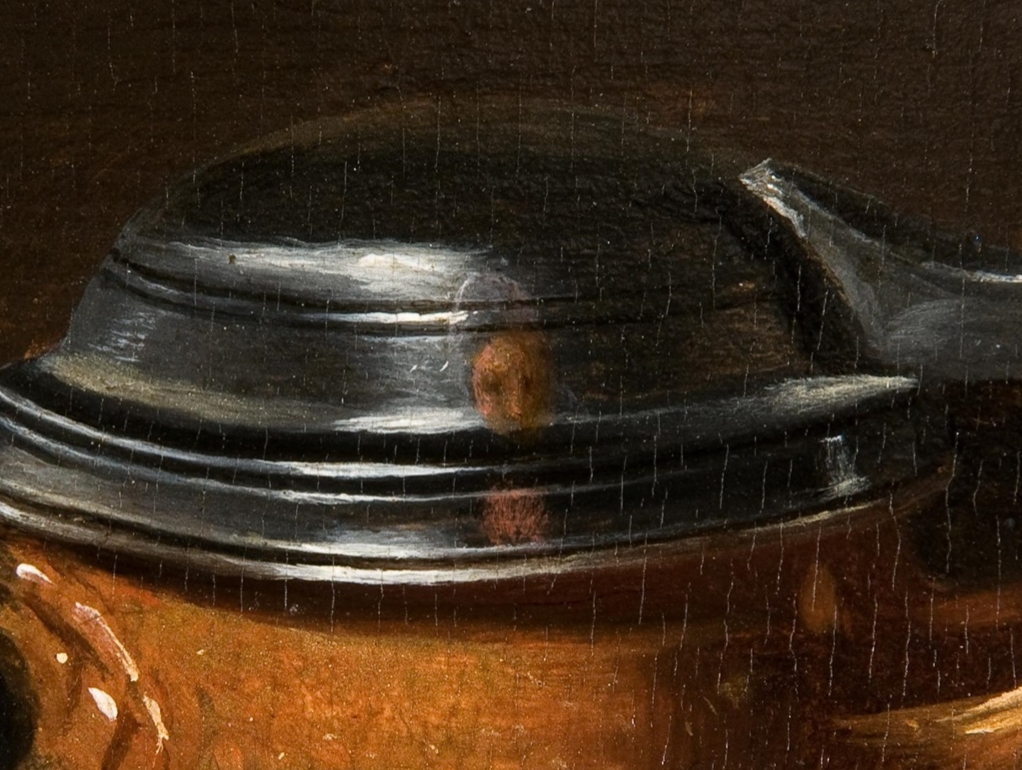
A self-portrait a few millimetres across, worked into the reflection on the pewter lid of an earthenware jug in Still Life with Cheeses, Almonds and Pretzels, c. 1615. Credited to the artist by the Mauritshuis, which owns the full painting; the same panel also carries her lettered signature on a knife blade elsewhere in the composition.
Mauritshuis, The Hague| Worked as | Painter |
|---|---|
| Nationality | Flemish (Southern Netherlands, Antwerp) |
| Movement | Flemish/Antwerp still life |
| Sources | 17 cited |
| Last verified |
About this page Last verified · 17 sources cited
On this page 12 sections
ContentsClose
Clara Peeters was one of the earliest specialists in still-life painting anywhere in Europe and one of the very few women documented as an independent master in the painting culture of the early seventeenth-century Southern Netherlands. Her signed and dated pictures run from 1607 to 1621, a fourteen-year span that is also, so far as any record shows, the whole of her working life: nothing securely dated to her hand exists before or after it.
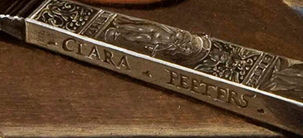
The fact a reader is least likely to already know is that Peeters signed many of her paintings twice. Once in plain letters, usually engraved on the blade or handle of a decorated table knife laid across the composition. And once in miniature, hidden in the curved reflection of a pewter lid, a gilded cup or a piece of glass, where a tiny painted face looks back out of the picture at whoever is looking in. Scholarship credits her with hidden self-portrait reflections in eight of her paintings, the earliest and most secure authorship claim available to a woman painter of her period, made in the material itself rather than in any document.
Her modern reputation has been substantially rebuilt in the past decade. A 2016 exhibition and catalogue at the Museo del Prado, curated by Alejandro Vergara, fixed her accepted corpus at roughly forty paintings and set aside a set of Antwerp archival documents, a baptism, two journeys, a marriage, that earlier biographers had attached to her but that the evidence does not support as referring to the same woman. In August 2026 a museum in Oslo added to that corpus again, publishing a picture that had spent a century first mislabelled and then unlabelled in storage.
Images
Chronology
- c. 1580s-1590
Estimated birth window under the 2016 Prado revision; no baptismal or parish record has been confirmed as hers.12
- 1607
Earliest work now accepted into her signed and dated corpus.1
- 1611
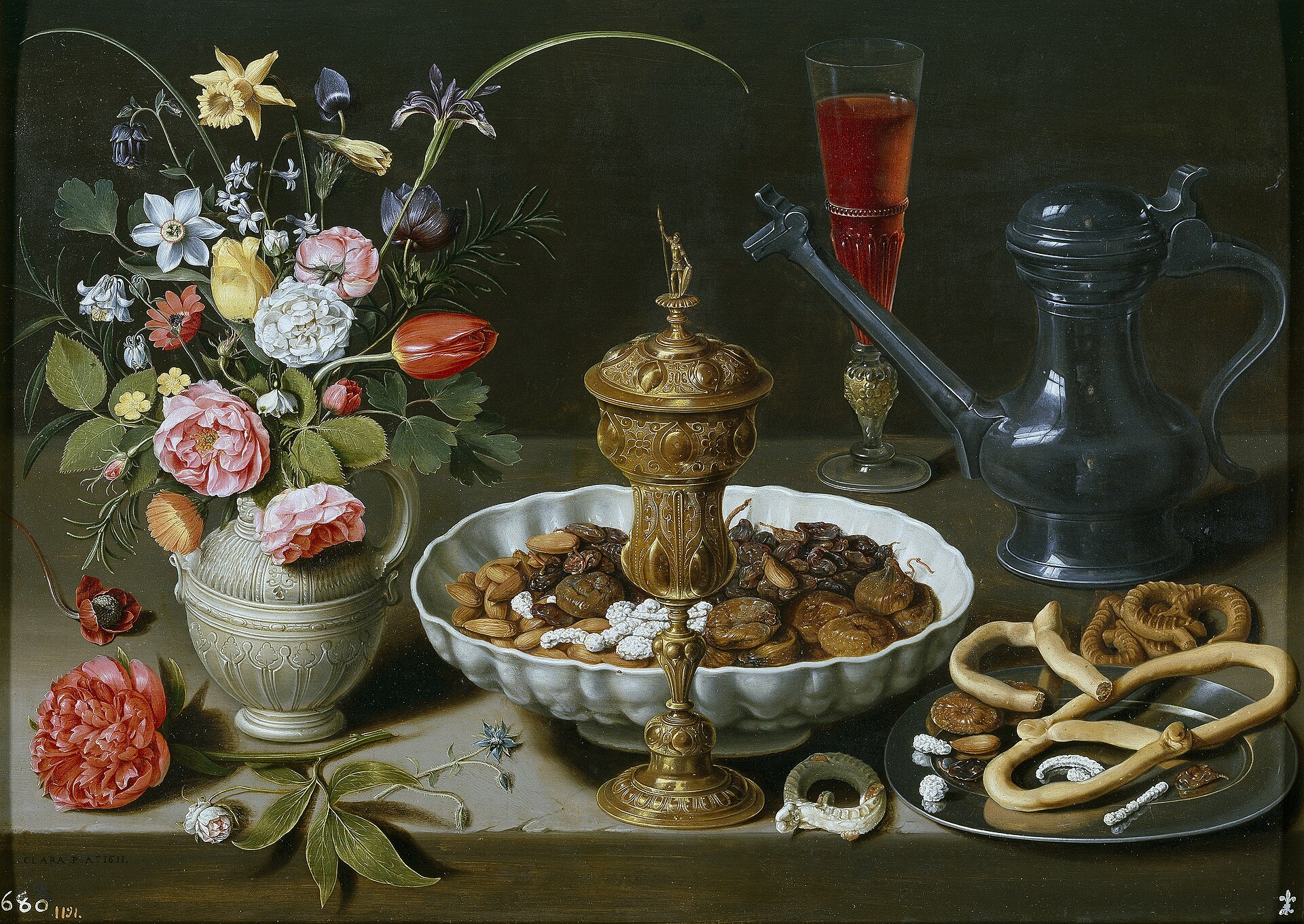
Four large banquet and game still lifes, now in the Museo del Prado, including what is described as the earliest still life of dead game birds in the tradition.25
- 1612
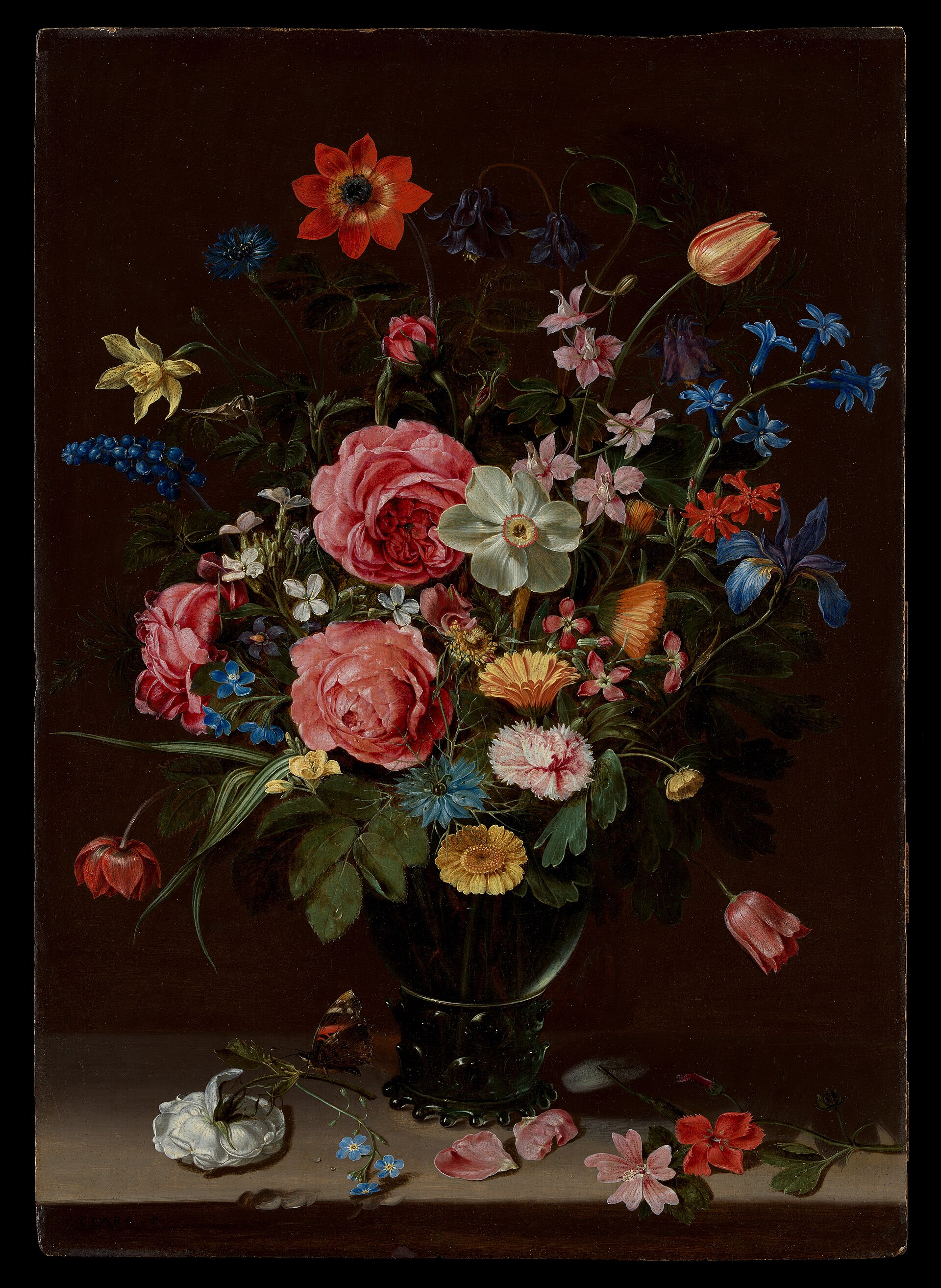
A flower still life with gilded goblets in which a further self-portrait reflection has been read by later commentators.5
- c. 1615
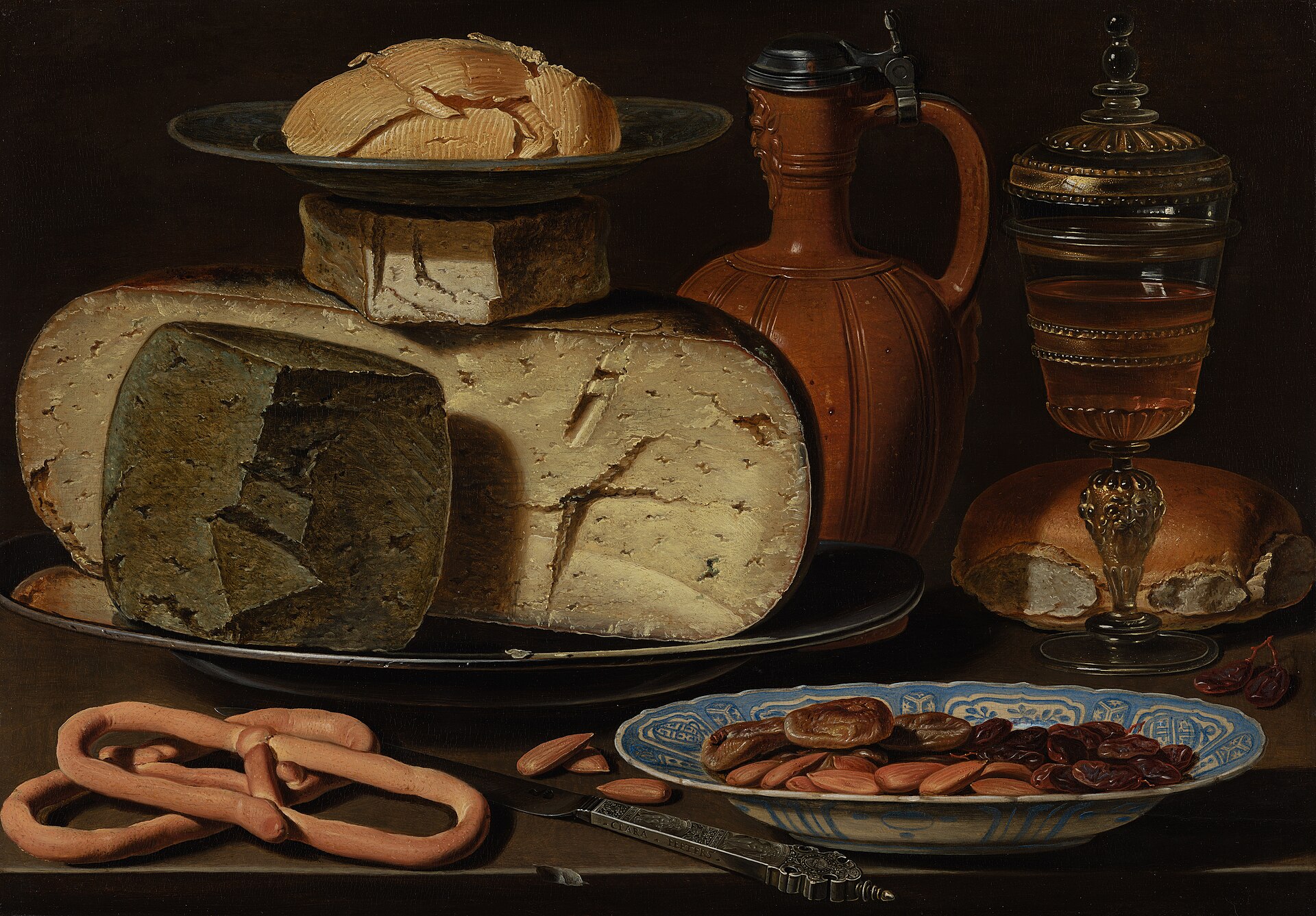
Still Life with Cheeses, Almonds and Pretzels painted: signed knife and a reflected self-portrait in a pewter jug lid, now in the Mauritshuis.13
- 1621
Last securely dated work in the accepted corpus; nothing confidently dated later has been found until the 2026 Oslo reattribution.1
- 1666
Two of her paintings recorded as having entered the Spanish royal collection by this date.13
- 1845
A still life later reattributed to Peeters is acquired by what is now Norway's Nasjonalmuseet, catalogued as the work of Ambrosius Brueghel.7
- 1994
The presumed self-portrait vanitas panel sells at auction for GBP 28,000.6
- 1998
A banquet still life sells at the Paris house Ferri for a reported 1.7 million dollars, described in trade coverage as her auction record.10
- 2012
The Mauritshuis acquires Still Life with Cheeses, Almonds and Pretzels, with support from the Rembrandt Association and other funds; at the time only one comparable cheese still life by Peeters was in a museum collection, at the Los Angeles County Museum of Art.3
- 2016
The Museo del Prado stages The Art of Clara Peeters, curated by Alejandro Vergara: the first monographic museum exhibition given to a woman painter by the Prado, and the exhibition and catalogue that fixed her current accepted corpus and revised her biography.12
- 2022 (June)
A floral still life sells at Christie's New York for a reported 1.5 million dollars.8
- 2023 (December)
A still life on copper, unseen publicly for about a century, sells at Sotheby's London.9
- 2025 (July)
The presumed self-portrait vanitas panel is offered again at Sotheby's London, estimated at GBP 1.2 to 1.8 million, and fails to sell.6
- 2026 (August)
Curator Cynthia Osiecki reattributes Still Life with Small Game and Grapes on a Gilded Tazza, dated 1626, to Clara Peeters at Norway's Nasjonalmuseet, ahead of the exhibition Woman Painter.712
The market
Peeters's market is thin and the trade press covering it does not agree with itself on the record price. A 1998 Paris sale is reported at 1.7 million dollars and called her record by one outlet; a 2022 New York sale of 1.5 million dollars is called her second-best by the same source and, elsewhere, effectively treated as the high point. Neither report separates hammer from buyer's premium, and this record has not attempted to reconcile the two record claims into one figure. The clearest single data point is the presumed self-portrait panel: GBP 28,000 in 1994, estimated at GBP 1.2 to 1.8 million in 2025, and unsold at that estimate, which says as much about how far attribution and reputation have moved in three decades as any completed sale would.
| Date | Sale | Work | Result | Note |
|---|---|---|---|---|
| 1994 | Phillips, London | Presumed self-portrait with vanitas still life and flowers | With premium GBP 28,000 GBP | Sotheby's own 2025 lot page (source 16) gives the full provenance: sold anonymously ('The Property of a Gentleman'), Phillips, London, 6 December 1994, lot 41, catalogued there as attributed to Clara Peeters, for GBP 28,000; not stated whether hammer or premium-inclusive. The same 1994 catalogue note followed Hibbs-Decoteau's 1992 downgrade to 'circle of Clara Peeters'; Huet (2000) later catalogued it 'Clara Peeters [?]'. An eighteenth-century Paris sale (1767) and the Skippe collection inventory had called the sitter 'Agnes Sorel', an identification since dropped. |
| 1998 | Ferri, Paris | Nature morte au pichet et l'assiette de fromages | With premium 1.7 million (reported in USD-converted trade coverage) unstated (USD-converted) | Described as her auction record by the source cited; original sale currency and hammer/premium split not given in the sources consulted. |
| 2022-06 | Christie's, New York | Floral still life ("Roses, lilies, an iris and other flowers in an earthenware vase, with a pot of carnations and a butterfly on a ledge") | With premium 1.5 million USD | Reported as her second-highest result by one outlet; hammer/premium split not given in the sources consulted. |
| 2023-12 | Sotheby's, London | Still life on copper, unseen publicly for about a century before the sale | With premium GBP 698,500 (reported also as USD 879,169 and USD 888,900 in different outlets) GBP | Dollar figures differ by conversion date, not by a dispute over the result; hammer/premium split not given in the sources consulted. |
Hammer is the price at which the bidding stopped; with premium adds the fee the house charges the buyer on top. Hammer price and buyer's premium in the glossary.
Recorded without a public price
- 2 July 2025 · Presumed self-portrait with vanitas still life and flowers · Sotheby's, London · did not sell Estimated GBP 1.2 to 1.8 million; failed to sell (bought in), per ArtTactic's post-sale market review, not the same-day pre-sale preview cited elsewhere on this page for the estimate and cataloguing.
Where to see the work
| Institution | City | Holdings | Note |
|---|---|---|---|
| Museo Nacional del Prado | Madrid | Multiple paintings, including the 1611 group of large banquet and game still lifes, descended through the Spanish royal collection. | Site of the 2016 monographic exhibition that fixed her current corpus. |
| Mauritshuis | The Hague | Still Life with Cheeses, Almonds and Pretzels, c. 1615. | Acquired 2012; carries both the signed knife and the reflected self-portrait discussed above. |
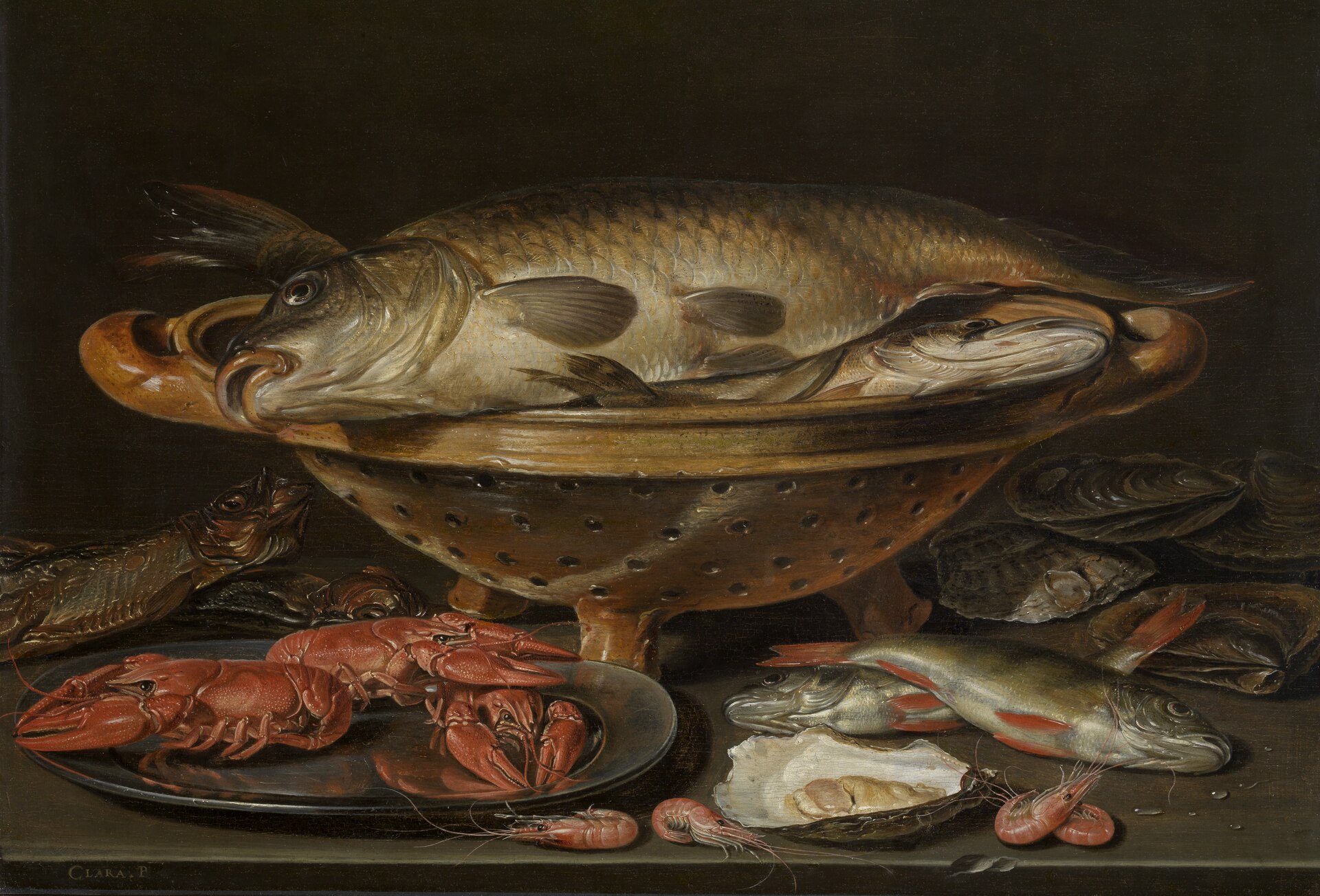
| Royal Museum of Fine Arts Antwerp (KMSKA) | Antwerp | Still Life with Fish. | |
| Metropolitan Museum of Art | New York | A Bouquet of Flowers, 1612. | |
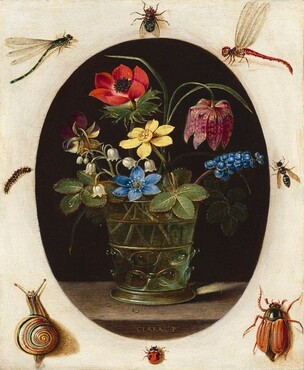
| National Gallery of Art | Washington, D.C. | Still Life with Flowers Surrounded by Insects and a Snail, c. 1610, oil on copper. | Acquired through the Lee and Juliet Folger Fund. |
| Nasjonalmuseet | Oslo | Still Life with Small Game and Grapes on a Gilded Tazza, dated 1626. | Reattributed to Peeters and announced August 2026, after a century unattributed in storage. |
The essay
Chapter 1Fourteen years, and nothing on either side of them
Everything that can be dated to Clara Peeters with confidence falls between 1607 and 1621.
Everything that can be dated to Clara Peeters with confidence falls between 1607 and 1621. The Historians of Netherlandish Art review of Vergara's 2016 catalogue gives two separate figures: thirty-nine paintings bear her signature, and forty are now accepted into the corpus overall, of which eleven are dated; both groups cluster in that window. No painting, document or record has been produced that places her earlier or later. The Mauritshuis and the network of European museum curators writing through CODART give her life as c. 1580/1590 to in or after 1621, which is a scholarly way of saying that the end of the record is not known to be the end of the life; CODART's own 2026 Oslo reattribution piece, however, gives conflicting life dates in its running text ("ca. 1588-1636" and "ca. 1587-after 1636"), which this record notes as an unreconciled discrepancy in a source it otherwise relies on rather than silently adopting either figure.
Nothing explains why the dated production stops. Marriage, death, a shift to work that was never signed or has not survived, all remain unproven guesses rather than findings, and this record does not adopt any of them as fact.
Chapter 2The knife and the face in the metal
Peeters asserted authorship in two different registers on the same panel.
Peeters asserted authorship in two different registers on the same panel. In plain letters, she engraved CLARA P or CLARA PEETERS on the blade or handle of an ornamented table knife of a pattern used for Antwerp wedding knives around 1595 to 1600, a real type of object or, possibly, an invented one modelled on it; the knife recurs across several paintings and functions as a second, harder-to-remove signature alongside her painted one.
The other register is optical rather than lettered. In the Mauritshuis's Still Life with Cheeses, Almonds and Pretzels, of about 1615, a tiny reflection of a woman's face under a white cap sits in the pewter lid of an earthenware jug behind the cheese, only millimetres across and identified through close examination of the surface. It is not decoration; the museum that owns the painting credits it as the artist's own likeness, worked into the same object that carries her signed knife in the same picture. A comparable device recurs in her 1612 flower still life with gilded goblets, where a reflection on the metal has likewise been read as the artist at work, though accounts of exactly what is shown vary in their description and this record notes that variance rather than resolving it.
The device was not new to Netherlandish painting; van Eyck had worked a self-portrait into a convex mirror in 1434. What is unusual is how often Peeters used it and how consistently it accompanies her lettered signature, as though one authorship claim was thought insufficient on its own for a woman working in a genre with no guild seat reserved for her.
Chapter 3Two women called Clara Peeters
For most of the twentieth century, biographies of the painter carried a baptism at St Walburga's church in Antwerp in 1594, journeys to Amsterdam and The Hague in 1612 and 1617, and a marriage in...
For most of the twentieth century, biographies of the painter carried a baptism at St Walburga's church in Antwerp in 1594, journeys to Amsterdam and The Hague in 1612 and 1617, and a marriage in 1637. Vergara's research for the 2016 Prado exhibition concluded that these documents cannot be validated as referring to the painter and are thought to belong to a different woman of the same name. On that basis the exhibition and its reviewers place her birth around 1588 to 1590 instead, with no secure death date at all.
The confusion has not fully cleared even now. Museum-adjacent and dealer biographies still in circulation give a different, equally unverified account: a birth in Mechelen as Clara Lamberts, and a marriage in 1605 to a painter named Henrick II Peeters. That version is inconsistent with the 1637 marriage the Prado research set aside, and neither has been confirmed as the same person documented in the signed pictures. This record does not adopt a birthplace, a maiden name or a marriage as fact; where a specific claim below is a proposal rather than a settled finding, it is named as one.
Chapter 4No master, no guild, no paper trail
The Historians of Netherlandish Art review states it plainly: we have no information about Peeters's life and training, and her name is missing from guild records in Antwerp and in the Netherlands.
The Historians of Netherlandish Art review states it plainly: we have no information about Peeters's life and training, and her name is missing from guild records in Antwerp and in the Netherlands. A painter working at the level of the 1607 pictures did not arrive there without instruction, but no apprenticeship contract, guild registration or named master has been produced for her. Dealer and general-audience accounts propose Osias Beert as a possible teacher on the strength of shared subject matter, though her handling is markedly more accomplished than his surviving still lifes, which makes the proposal a stylistic guess rather than a documented lineage; this record labels it as such.
One further possibility raised in the literature is that she was the daughter of a painter and so exempt from the normal apprenticeship record, which would explain the archival silence without requiring an unrecorded master at all. No document has been found to confirm it either.
Chapter 5What the table was set for
Peeters worked in the two related genres Antwerp and the northern Netherlands called ontbijtjes, breakfast pieces of simple food and plain vessels, and banketjes, banquet pieces built around costly...
Peeters worked in the two related genres Antwerp and the northern Netherlands called ontbijtjes, breakfast pieces of simple food and plain vessels, and banketjes, banquet pieces built around costly metalware, imported porcelain and Venetian-style glass. Both were domestic-scale pictures made for a private room rather than a church or a civic hall, meant to be looked at closely and for a long time by one household at a time.
The objects she paints are not neutral inventory. A half-peeled lemon, its rind curling off in one continuous spiral, was a standing device in this tradition for something that looks appealing and tastes bitter once opened, read against overindulgence and the deceptiveness of surface appearance. A burnt or guttering candle, wilting flowers and food already part-consumed carry the ordinary memento mori of the vanitas tradition: what is set on the table will be eaten, will spoil, will burn down, in the time it takes to look at the picture of it. None of this needs a hidden programme to be present; it is the standard moral furniture of the genre, and Peeters uses it as fluently as any of her contemporaries. Where a specific object in a specific Peeters picture has a meaning argued for it in the literature beyond this general convention, that argument is not asserted here as more than what it is.
The National Gallery of Art's small oil-on-copper Still Life with Flowers Surrounded by Insects and a Snail, of about 1610, signed CLARA P on the front of the stone ledge, sets a bouquet of flowers inside a glass roemer and rings it with eight insects arranged in a deliberate trompe l'oeil symmetry, a dragonfly, a housefly, a caterpillar, a hornet, a snail, a ladybird, a beetle. Insects and a snail on a flower piece were a standard shorthand in the period for the same brief span the cut flowers themselves stand for, decay already working on what looks freshest; Peeters turns that convention into a formal exercise in symmetry as much as a moral one.
Chapter 6Costly things, priced in the record
Her banquet pieces are inventories of expense as much as arrangements of objects: gilded cups, Chinese export porcelain, Venetian glass, coins, imported shells.
Her banquet pieces are inventories of expense as much as arrangements of objects: gilded cups, Chinese export porcelain, Venetian glass, coins, imported shells. Four large dated still lifes of 1611, now in the Prado, include what is described as the earliest still life of dead game birds in the tradition, alongside a table set with orange, olives and pie. The Prado's holdings of her work descended through the Spanish royal collection; two of her paintings are recorded as having entered that collection by 1666, and one is reported to have been saved from the 1734 fire at the Royal Alcazar of Madrid that destroyed a large part of the collection housed there.
Chapter 7Pulled out of storage twice, a century apart
A still life bought by what is now Norway's Nasjonalmuseet in 1845 was catalogued as the work of Ambrosius Brueghel, son of Jan Brueghel the Elder.
A still life bought by what is now Norway's Nasjonalmuseet in 1845 was catalogued as the work of Ambrosius Brueghel, son of Jan Brueghel the Elder. Early in the twentieth century that attribution was retracted, the painting was reclassified as anonymous, and it went into storage without a name attached. It stayed there for decades.
Researching the exhibition Woman Painter, curator Cynthia Osiecki reattributed the picture, Still Life with Small Game and Grapes on a Gilded Tazza, dated 1626, to Clara Peeters. The museum's supporting evidence, reported through CODART, includes the panel support itself, from a supplier the artist is said to have used regularly, and traces of what appears to be one of her characteristic minute self-portrait reflections on the painting's reflective surfaces. The reattribution was announced on 25 August 2026, first reported by The Guardian on 7 August 2026, ahead of the exhibition's opening in October 2026.
The 1626 date sits awkwardly against the 1607 to 1621 span that otherwise bounds her whole known output, five years past the last securely dated work discussed above. This record states that tension as it stands: either her active years ran later than the existing corpus shows, or the new dating will itself need to be reconciled with the rest of the record. Neither has happened yet in the sources consulted here.
Chapter 8One face, twice disputed
Set against the eight paintings with a reflected self-portrait stands a single painted panel showing a woman seated at a table among costly objects and a flower still life, one of only two works in...
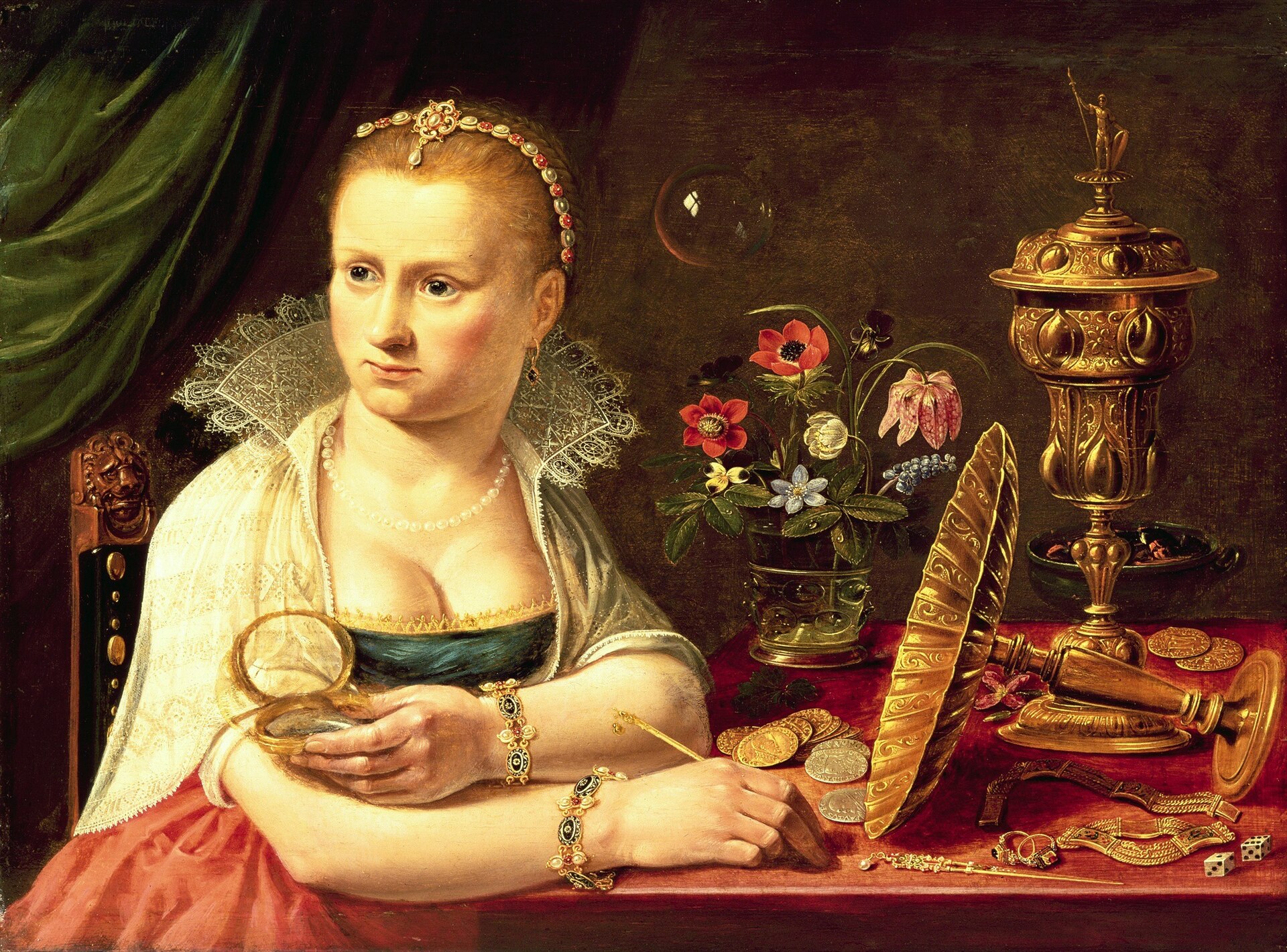
Set against the eight paintings with a reflected self-portrait stands a single painted panel showing a woman seated at a table among costly objects and a flower still life, one of only two works in Peeters's entire surviving catalogue of about forty paintings that include a human figure at all. Sotheby's catalogued it in 2025 as a presumed self-portrait, while stating in its own note that both the attribution and the identity of the sitter have been debated for centuries.
The panel last changed hands publicly in 1994, selling for GBP 28,000. It returned to Sotheby's London on 2 July 2025 with an estimate of GBP 1.2 to 1.8 million, more than forty times its 1994 price, and did not sell. This record treats the sitter's identity as unresolved and has not used the panel as the portrait plate for that reason; the reflected self-portrait in the Mauritshuis picture, credited to the artist by the museum that owns it, is used instead.
Chapter 9What the market has actually paid
Reported figures for Peeters's auction results are not fully reconciled across the trade press, and this record gives what each source states rather than smoothing the difference into one number.
Reported figures for Peeters's auction results are not fully reconciled across the trade press, and this record gives what each source states rather than smoothing the difference into one number. A 1998 sale at the Paris house Ferri, of a banquet still life titled Nature morte au pichet et l'assiette de fromages, is reported in dollar-converted trade coverage at 1.7 million dollars and described there as her auction record; the original sale currency, and whether that figure is hammer or hammer-plus-premium, is not stated in the sources consulted. A floral still life sold at Christie's New York in June 2022 for 1.5 million dollars, reported elsewhere as her second-highest result, which is not fully consistent with the 1998 figure being the record; both claims are given here as reported, unreconciled. In December 2023 a rediscovered still life on copper, unseen in public for about a century, sold at Sotheby's London; the price is reported at both GBP 698,500 and, in dollar terms, at figures of 879,169 and 888,900 in different outlets, a spread that reflects conversion date rather than a dispute over the hammer result itself. None of the press coverage consulted separates hammer from buyer's premium for any of these three sales.
What is documented
Technique
The surviving work
- What is accepted
- About forty paintings, per Alejandro Vergara's 2016 Museo del Prado catalogue and exhibition The Art of Clara Peeters, with a further painting, dated 1626, added by the Nasjonalmuseet in Oslo in August 2026.
- What is contested
- Earlier twentieth-century biographies rested on a set of Antwerp archival documents, a 1594 baptism, journeys of 1612 and 1617, a 1637 marriage, that the 2016 Prado research concluded cannot be validated as referring to the painter and are thought to belong to a different woman of the same name. A separate, still-circulating account in dealer and museum-adjacent profiles gives a different and equally unverified biography: birth in Mechelen as Clara Lamberts, marriage in 1605 to a painter named Henrick II Peeters. The two accounts are mutually inconsistent and neither has been adopted here. A group of still lifes signed CP and dated to the 1630s, after her documented working years, are treated in some cataloguing as anonymous imitators rather than autograph works; this record has not used any of them as plates for that reason.
- Who rules on attribution
- No standing authentication board or committee. Vergara's 2016 Prado catalogue functions as the current reference point for the accepted corpus; individual reattributions since, such as the Nasjonalmuseet's 2026 addition, have proceeded through museum curatorial research and publication rather than through any single ruling body.
Catalogue raisonne
- Alejandro Vergara, The Art of Clara Peeters, exhibition catalogue, Museo Nacional del Prado, 2016. The exhibition showed fifteen paintings and the catalogue discussed seven further attributed works, and revised both the accepted corpus and the biography. This record cites it through the Prado's own exhibition page and a published scholarly review rather than the catalogue text directly; the catalogue itself should replace both as the primary citation where available.12
Questions about Clara Peeters
Who was Clara Peeters?
Painter. c. 1580s - after 1621 (exact dates unresolved; see Corpus).
Where can you see work by Clara Peeters?
Museo Nacional del Prado (Madrid); Mauritshuis (The Hague); Royal Museum of Fine Arts Antwerp (KMSKA) (Antwerp); Metropolitan Museum of Art (New York); National Gallery of Art (Washington, D.C.); Nasjonalmuseet (Oslo).
What does the market for Clara Peeters look like?
Peeters's market is thin and the trade press covering it does not agree with itself on the record price. A 1998 Paris sale is reported at 1.7 million dollars and called her record by one outlet; a 2022 New York sale of 1.5 million dollars is called her second-best by the same source and, elsewhere, effectively treated as the high point.
What is still unresolved about Clara Peeters?
Her exact birth year and place are not established. The 2016 Prado revision proposes c.
Open questions
- Her exact birth year and place are not established. The 2016 Prado revision proposes c. 1588-1590 but this is itself an estimate, not a document.
- Her death date and place are unrecorded. No document has been found placing her alive after 1621, and none records her death.
- Whether she trained under Osias Beert, or any other named painter, is unconfirmed; no apprenticeship or guild record for her has been found at all.
- Two mutually inconsistent biographical traditions remain in circulation, a set-aside 1594/1612/1617/1637 Antwerp document trail and a separate 1605-marriage, Mechelen-birth account, and neither has been confirmed as referring to the painter.
- The 2026 Nasjonalmuseet reattribution carries a dated inscription of 1626, five years past the end of her previously accepted working years; how this is to be reconciled with the rest of the corpus has not yet been addressed in the sources consulted here.
- The identity of the sitter in the presumed self-portrait panel offered at Sotheby's in 1994 and 2025 remains disputed by Sotheby's own account, and this record has not resolved it either.
- Her auction record is reported inconsistently across trade sources (1.7 million dollars, Ferri 1998, versus 1.5 million dollars, Christie's 2022, each called the record by a different outlet), and no source consulted separates hammer from premium for either sale.
Sources
- 1Pamela Hibbs Decoteau, review of Alejandro Vergara, The Art of Clara Peeters (Museo Nacional del Prado, 2016), Historians of Netherlandish Art Reviews. hnanews.org/hnar/...
- 2Museo Nacional del Prado, exhibition page for The Art of Clara Peeters, 2016. museodelprado.es/en/...
- 3CODART, "Mauritshuis acquires one of Clara Peeters's finest still lifes." codart.nl/museums/...
- 4Wikipedia, "Still Life with Cheeses, Almonds and Pretzels." ; with the Mauritshuis's own catalogue entry, which returned an access error when fetched directly in this research session. en.wikipedia.org/wiki/...
- 5Wikipedia, "Clara Peeters." ; with Vergara's 2016 catalogue text directly. en.wikipedia.org/wiki/...
- 6The Art Newspaper, "A Clara Peeters self-portrait and the only work for which Gandhi posed are among this summer's auction highlights," 2 July 2025. theartnewspaper.com/2025/...
- 7ARTnews, "Oslo Museum Curator Attributes Forgotten Still Life to Flemish Old Master Clara Peeters." artnews.com/art-news/...
- 8Artnet News, "Still Life Painter Clara Peeters's Only Known Self-Portrait Comes to Auction." news.artnet.com/market/...
- 9Artnet News, "A Still Life by Dutch Master Clara Peeters, Unseen for a Century, Heads to Auction." news.artnet.com/market/...
- 10Galerie Magazine, "Auction of the Week: A Clara Peeters Still Life Hits the Block at Sotheby's." galeriemagazine.com/auction-of-the-week-clara-peeters-sot...
- 11MutualArt, Clara Peeters artist page and auction record summary. mutualart.com/Artist/...
- 12CODART, "National Museum of Norway Reattributes Still Life to Clara Peeters." codart.nl/art-works/...
- 13Kunsthandel P. de Boer, "Clara Peeters, Pioneer of the Flemish Still Life." Dealer site; , and its biographical claims (1605 marriage, Mechelen birth) conflict with the 2016 Prado revision and are treated here as unconfirmed and superseded pending resolution. kunsthandelpdeboer.com/artist/...
- 14National Museum of Women in the Arts, artist profile, Clara Peeters. nmwa.org/art/...
- 15Wikimedia Commons file page and , "Still Life with Cheeses, Almonds and Pretzels - detail with portrait of the painter," credited to the Mauritshuis. commons.wikimedia.org/wiki/...
- 16Sotheby's, lot page, "A presumed self-portrait with a lavish display of objects in a vanitas still life and a still life of flowers in a glass vase," Old Master and 19th Century Paintings Evening Auction, 2 July 2025 (L25033). Gives the full provenance chain including the 1994 Phillips sale. sothebys.com/en/...
- 17ArtTactic, "Mid-Year Review: The Old Masters Market at Sotheby's and Christie's in 2025," 16 July 2025. Reports the presumed self-portrait failed to sell against its GBP 1.2 to 1.8 million estimate. arttactic.com/editorials/...

Last verified