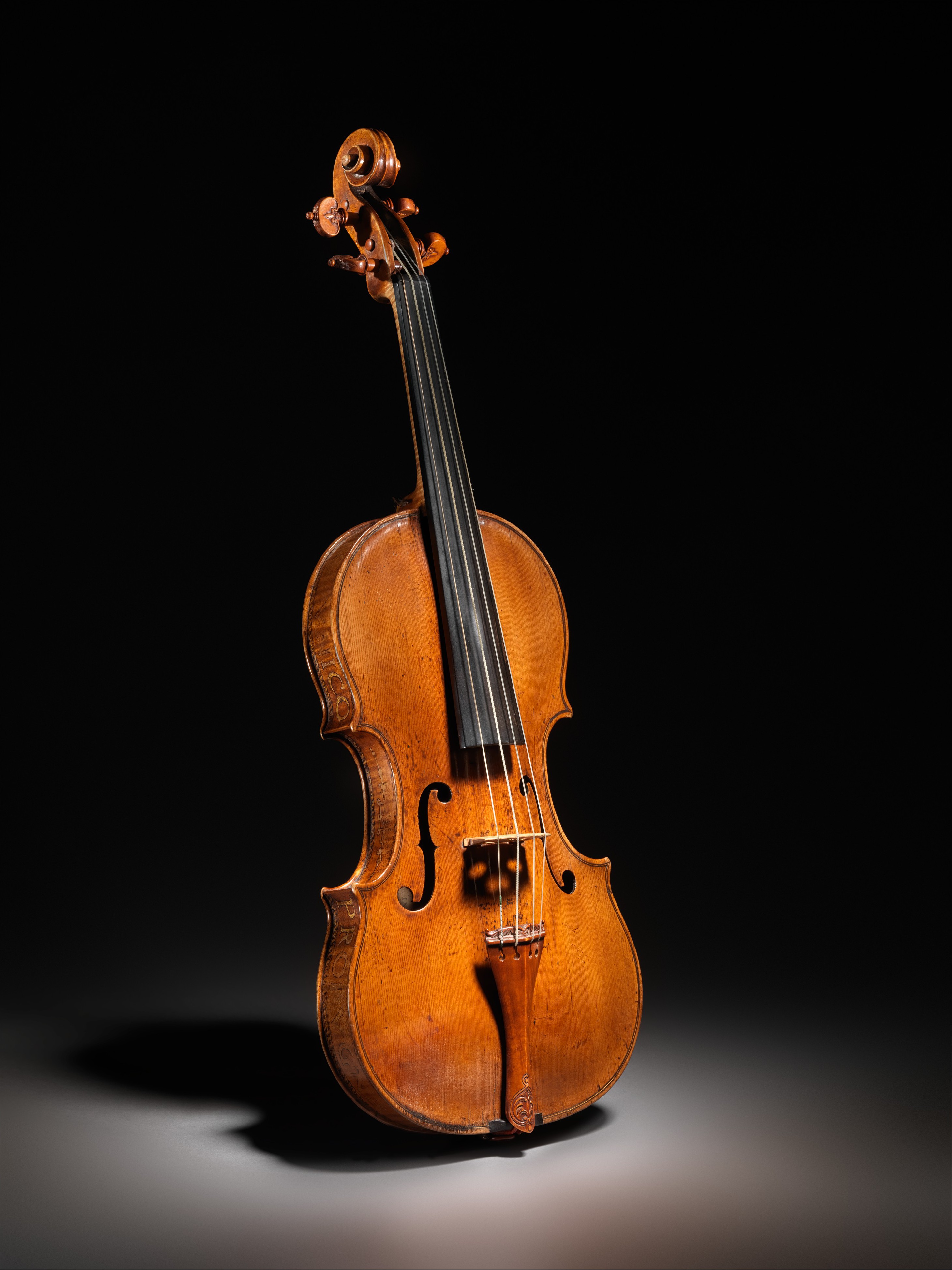
ex "Kurtz" Violin
c. 1560 · Spruce
Metropolitan Museum of Art, New York
 Italian (Cremonese) · 1505-1577
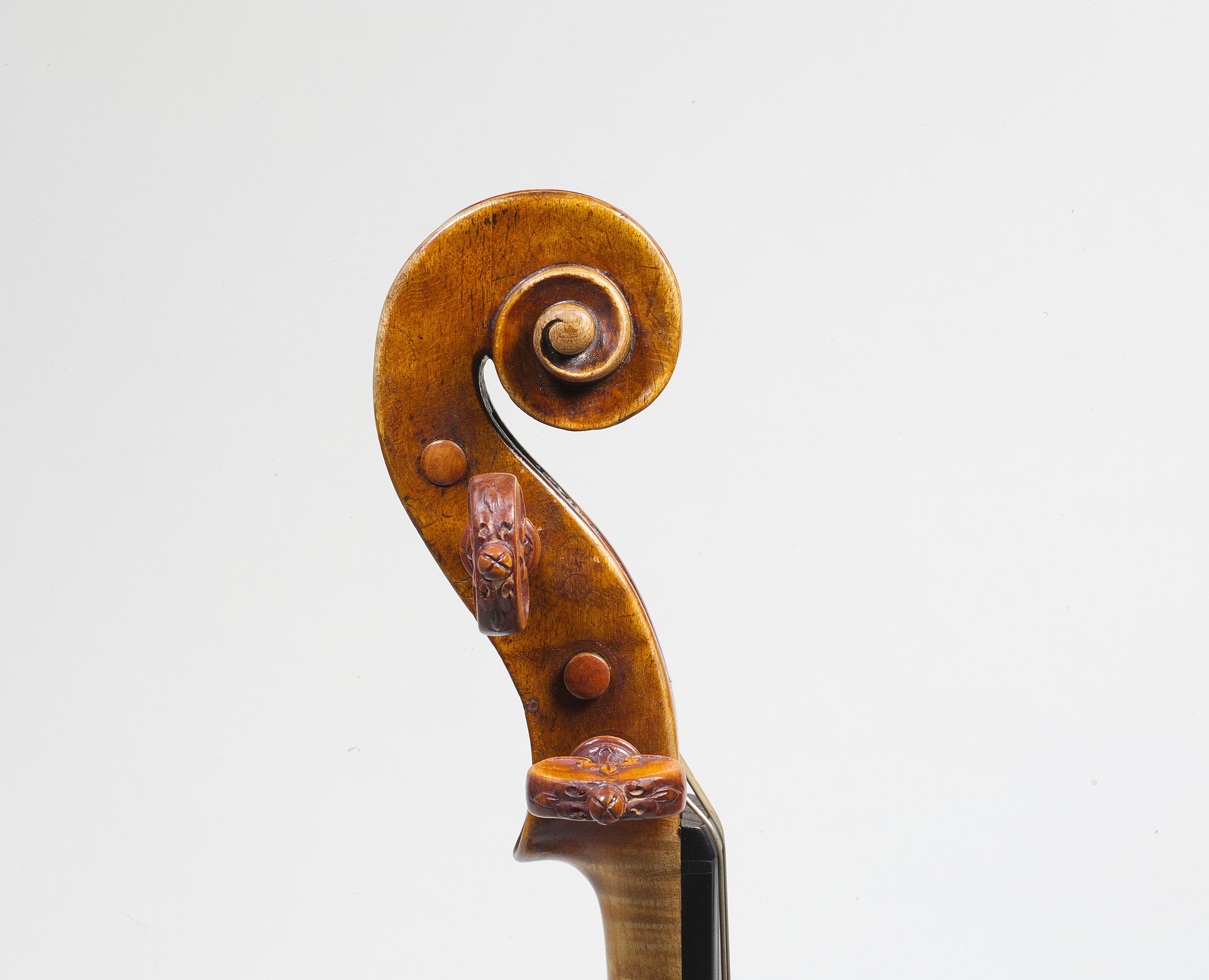
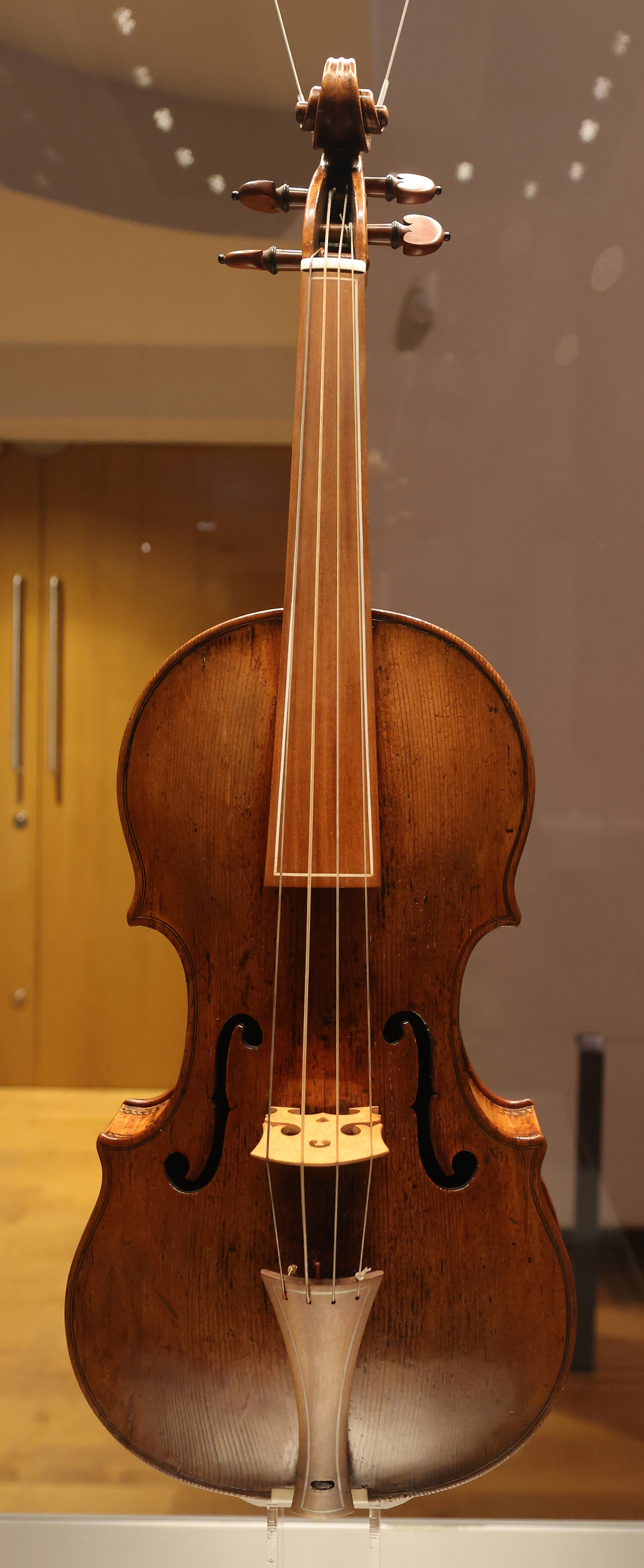
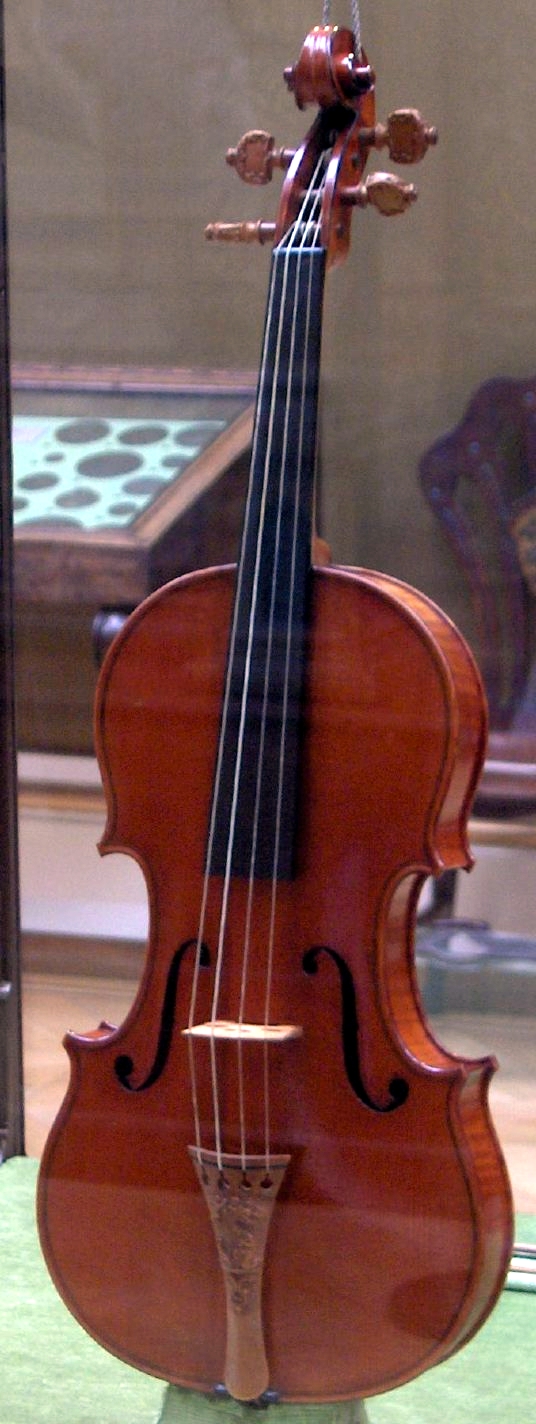
ex "Kurtz" Violin, Metropolitan Museum photograph The Metropolitan Museum's own violin, accession 1999.26, the subject of a separate record already published in this archive. One of the Museum's own open-access photographs of the instrument, released CC0. No verified portrait. No securely identified likeness of this maker is known under a free licence. We do not publish a face we cannot verify.
Metropolitan Museum of Art, New York, Purchase, Robert Alonzo Lehman Bequest, 1999 (1999.26)| Full name | Andrea Amati, Latinized on some labels as Andreas Amati |
|---|---|
| Worked as | Luthier |
| Born | c. 1505 (no baptismal record located · Cremona, Duchy of Milan (now Lombardy, Italy) |
| Died | 26 December 1577 (some sources give 1578 · Cremona |
| Nationality | Italian (Cremonese) |
| Movement | Founder of the Cremonese school of violin making |
| In this archive | 1 artwork |
| Sources | 23 cited |
| Last verified |
About this page 1 artwork in the archive · Last verified · 23 sources cited
Andrea Amati is credited, more often than he is documented, with fixing the proportions of the modern violin family in the Cremona workshop his sons and grandson carried forward into the line that runs to Antonio Stradivari and Giuseppe Guarneri del Gesu. The credit is not seriously disputed for the instrument's outline, arching and scroll pattern, which every later Cremonese maker worked from. It is disputed, and this record says so plainly, for the larger claim that he invented the violin outright: the documentary record for a rival Brescian workshop, Gasparo da Salo's, is roughly nine times the size of Amati's own, and no surviving contemporary document actually names the instrument Amati is now most famous for making.
Fewer than two dozen instruments are now individually catalogued to him, most in institutional hands, several with dates or attributions that specialists treat with open caution rather than certainty. No portrait of Andrea Amati survives from his own lifetime, and this record does not manufacture one. What survives instead is a small, scattered, expensively guarded group of violins, violas and cellos, several bearing a Latin motto painted in gold on behalf of a French or Spanish royal patron, and a family workshop whose internal division of labour is itself argued rather than settled.
The single hardest thing to find on this maker is not a date or a price. It is the admission, made in the trade's own specialist press as recently as 2020, that a cello claimed to be his could not be authenticated either way by the leading historic-instrument expert who examined it.
Born, most likely in Cremona; no baptismal record has been located, and the year is reconstructed from later documents. Britannica gives a materially different birth year, c. 1520, not used here since the Met's own accession record and the weight of specialist literature both give c. 1505.2
Active as a luthier in Cremona, per the Cozio Archive's own chronology of the maker.34
Established at a house in the San Faustino district of Cremona.34
Instruments of these dates are referenced by the collector Count Cozio di Salabue, writing in 1816; neither survives, and the Cozio Archive's own essay states the dates 'can only be taken on trust'.4
Label date on the 'Witten' viola, a decorated instrument in the same Quo Unico group as the Metropolitan Museum's later violin; the date sits three years before Philip II of Spain's accession, with which the rest of the group is associated, and no source consulted explains the discrepancy.5
Andrea's son Antonio joins the workshop, in his mid-twenties, well before most of the securely dated surviving corpus was made.4
Elisabeth de Valois marries Philip II of Spain; the Metropolitan Museum has speculatively, not documentarily, linked its own Amati violin's decoration to this marriage.12
Andrea's second son Girolamo is born; he is sixteen at his father's death and trains chiefly under Antonio.4
Most of the securely dated surviving Amati output was made in this period, including the instruments traditionally linked to the Charles IX and Quo Unico decorated groups.34
The earliest instrument by Andrea Amati that survives today and carries a checkable date; now held by the Ashmolean Museum, Oxford.39
A violin labelled 'Fait par Andre Amati en 1566 sous le regne de Charles IX' is made; now at the Museo del Violino, Cremona.8
The Brescian maker Gasparo da Salo receives the formal title 'maestro di violini', eight years before the single surviving document that clearly describes Amati's own trade.17
The sole surviving contemporary payment document connected to the Charles IX commission is dated to this year.34
The only surviving document that clearly describes Andrea Amati's trade is dated to this year; it states 'his art is of making instruments to play' without naming the violin specifically.17
Died in Cremona, per a 1985 archival discovery by Andrea Foglia; Britannica and the Met give only the year, and give it as 1578, not 1577, a discrepancy not reconciled here.22
The Paris maker Sebastien Renault reduces a surviving Charles IX bass violin, later known as 'The King', to modern cello proportions.7
The Paris maker Nicolas Lupot's restoration label documents conservation work on the Cremona museum's 1566 Charles IX violin.8
The 1566 Charles IX violin enters the collection of the Museo del Violino, Cremona, where it remains.8
The Metropolitan Museum of Art acquires its ex 'Kurtz' Andrea Amati violin, accession 1999.26.12
Traditional violin craftsmanship in Cremona, built on the inner-mould method Andrea Amati is credited with establishing, is inscribed on UNESCO's Representative List of the Intangible Cultural Heritage of Humanity.16
The historic-instrument expert Charles Beare examines a cello claimed as an Andrea Amati made for Charles IX's Royal Chapel, owned by Wieland Kuijken, and cannot authenticate it either way.10
Andrea Amati's current auction record, 327,282 US dollars for a violin, is set; the source does not state whether the figure is hammer or includes premium.3
A previously little-known Andrea Amati violin from the Rosenberg Collection is sold; dendrochronological analysis of its spruce top indicates growth beginning in the thirteenth century, described by the dealer handling the sale as possibly the oldest violin wood yet identified.1112
The market for this maker barely exists in the ordinary sense. Tarisio's own tracking lists nine total auction price results for Andrea Amati, with a current record of 327,282 US dollars for a violin sold in June 2023; the source does not specify whether that figure is a hammer price or includes a buyer's premium, and this record states that ambiguity rather than resolving it by assumption. Almost the entire surviving corpus sits in institutional collections that do not sell, so what little market exists is concentrated in rare private-collection dispersals rather than ordinary trade.
The clearest recent market event was the 2023 sale of the Rosenberg Collection, which included a single Andrea Amati violin, lot 193, alongside instruments by Stradivari, Guarneri and other major Cremonese makers; the auction house's own results page reports the main London sale that included this lot realized 8,894,000 pounds sterling in total, following an earlier, separate 4.7 million pounds sterling online sale of 96 lots in March 2023, but no source consulted for this record publishes a price specific to the Amati lot alone.
| Date | Sale | Work | Result | Note |
|---|---|---|---|---|
| 2023-06 | Not specified in sources consulted | Violin | Hammer USD 327,282 USD | Andrea Amati's current auction record per Tarisio's own tracking, out of nine total auction price results recorded for the maker. The source does not state whether the figure is a hammer price or a price including buyer's premium; this record does not assume one or the other. |
Hammer is the price at which the bidding stopped; with premium adds the fee the house charges the buyer on top. Hammer price and buyer's premium in the glossary.
| Institution | City | Holdings | Note |
|---|---|---|---|
| Metropolitan Museum of Art | New York | The ex 'Kurtz' violin, accession 1999.26, on view in the Department of Musical Instruments. | Subject of a separate, fully researched record already published in this archive. |
| Ashmolean Museum, University of Oxford | Oxford | A violin dated 1564, the earliest firmly dated surviving Andrea Amati instrument, from the Charles IX decorated group. | |
| Museo del Violino | Cremona | A violin dated 1566, 'Fait par Andre Amati en 1566 sous le regne de Charles IX', with a documented 1818 Lupot restoration label, in the city where Amati worked. | Held since 1966. |
| National Music Museum (The Shrine to Music) | Vermillion, South Dakota | 'The King', a bass violin from the Charles IX commission reduced to cello proportions in 1801, and the 'Witten' viola from the Quo Unico decorated group, labelled 1553. | Witten-Rawlins Collection. |
| Musee de la Musique | Paris | A small decorated viola (violetta) from the same Quo Unico group as the Metropolitan's violin. |
The Tarisio Cozio Archive, the closest thing this maker has to a working database of accepted works, individually catalogues five Andrea Amati instruments with full property records: three violins (c.
The Tarisio Cozio Archive, the closest thing this maker has to a working database of accepted works, individually catalogues five Andrea Amati instruments with full property records: three violins (c. 1559, 1566 'Charles IX of France', and the Metropolitan Museum's ex 'Kurtz' violin, dated by the Museum to about 1560 and by the Archive itself to about 1570), a 1573 violin known as 'Payne, Gonley', and a c. 1560 viola known as the 'Witten'. A specialist dealer's own account of a newly surfaced instrument, sold as part of the Rosenberg Collection in 2023, describes it as one of approximately twenty Andrea Amati examples known at all, individually catalogued or not, which frames the five fully documented property records as a floor rather than a ceiling on what survives.
Almost none of this corpus is privately held and playable in the ordinary sense a collector might expect of a historic violin. The Metropolitan Museum, the Ashmolean Museum in Oxford, the Museo del Violino in Cremona and the National Music Museum in Vermillion, South Dakota each hold one or more instruments; the Musee de la Musique in Paris holds a small decorated viola from the same decorated group as the Metropolitan's violin. What briefly passes through the trade, as the 2023 Rosenberg Collection sale shows, is treated as a genuine event rather than routine business.
Andrea Amati is popularly credited as the inventor of the violin, and general-audience sources from Britannica to the Metropolitan Museum's own collection notes repeat the claim without much...
Andrea Amati is popularly credited as the inventor of the violin, and general-audience sources from Britannica to the Metropolitan Museum's own collection notes repeat the claim without much qualification. The documentary record does not support it as cleanly as the popular claim implies.
Gaspar Bertolotti, known as Gasparo da Salo, worked fifty kilometres north of Cremona in Brescia and received the formal title 'maestro di violini', violin master, in 1568. Roughly a hundred surviving documents mention him across his career, and guild records place violin-makers working in Brescia as early as 1524. Andrea Amati, by contrast, appears in only about eleven surviving documents, and only one of them, dated 1576, clearly describes his trade at all: it states that 'his art is of making instruments to play', without naming the violin specifically. No contemporary document mentions the instrument for which Amati is now celebrated, although stylistic and dendrochronological evidence places his surviving violins from the early 1560s onward.
This record does not resolve the dispute, because the sources consulted do not resolve it either. What can be said cleanly is narrower than the popular claim: Amati's surviving instruments fixed the proportions, outline and scroll pattern that the entire later Cremonese school, including his own grandson and, through him, Antonio Stradivari, continued to build from. Whether he or a Brescian contemporary built the first instrument in that general shape is a separate question this record leaves open, because the documents genuinely leave it open.
Andrea Amati was active as a luthier in Cremona by at least 1526 and was established at a house in the city's San Faustino district by 1539.
Andrea Amati was active as a luthier in Cremona by at least 1526 and was established at a house in the city's San Faustino district by 1539. His son Antonio joined the workshop around 1556, in his mid-twenties, well before most of the securely dated surviving output was made; a second son, Girolamo, was born in 1561 and was only sixteen when his father died, so his training came chiefly from Antonio rather than directly from Andrea. Some general sources give different birth years for the two sons, Antonio around 1537 and Girolamo around 1551, which does not match the workshop chronology above; this record follows the Cozio Archive's chronology, the same source already used for the Metropolitan Museum's violin in this archive's own published record on that object, and notes the discrepancy rather than silently picking one.
Because Antonio was an adult tradesman in the workshop for most of the period from which dated instruments actually survive, specialists examining the surviving corpus have raised, without resolving, how much of the work now catalogued under Andrea's name alone was in fact made substantially by Antonio. Differences in soundhole design across the accepted corpus, more rounded on some instruments and straighter and smaller on others, have been read either as Andrea's own late-career development or as evidence of a second hand. No source consulted for this record settles the question, and none of them argues that any specific surviving instrument, including the Metropolitan's, should be reattributed away from Andrea on this basis. The honest position is that 'Andrea Amati' names a workshop hand reconstructed by connoisseurship, not a documented solo output, for essentially the entire period that matters.
Amati and every Cremonese maker after him, including Stradivari a century and a half later, built on an inner mould: a solid wooden form around which the ribs are shaped and glued before the top and...
Amati and every Cremonese maker after him, including Stradivari a century and a half later, built on an inner mould: a solid wooden form around which the ribs are shaped and glued before the top and back are fitted, producing an instrument whose outline is generated from the inside outward. This is distinct from the outside, or French, mould later associated with the nineteenth century Paris maker Jean-Baptiste Vuillaume, in which the completed outline is fixed by an external frame; an outside mould reproduces an outline with more mechanical precision but tends to read as stiffer and more symmetrical, while the inner-mould method carries the small asymmetries that specialists use to distinguish a genuine Cremonese hand from a later copy.
The method did not stay in the sixteenth century. Traditional violin craftsmanship in Cremona was inscribed on UNESCO's Representative List of the Intangible Cultural Heritage of Humanity in 2012, and UNESCO's own description of the living craft specifies makers hand-shaping and assembling more than seventy pieces of wood around an inner mould, using no semi-industrial or industrial materials, each producing only three to six instruments a year. A visitor to a present-day Cremona workshop is watching, in its broad outline, the same construction method Andrea Amati used, taught through the same close apprenticeship model the UNESCO listing credits as central to the craft's survival.
Dendrochronology dates a wooden object by matching the pattern of annual growth rings in its spruce or maple against reference chronologies built from timber of known origin and felling date.
Dendrochronology dates a wooden object by matching the pattern of annual growth rings in its spruce or maple against reference chronologies built from timber of known origin and felling date. Applied to a violin top, it establishes a terminus post quem, the earliest year the instrument's wood could have been cut, not a maker's signature; specialist analysis of the method notes explicitly that ring-pattern matching indicates probable geographic origin and confirms or excludes a proposed date, but does not by itself authenticate who built an object. The same body of research has matched the soundboards of sixteen Stradivari violins and violas of the following century to a single felled tree, and five further Italian and Spanish instruments to another, which is the clearest illustration available of how closely a documented Alpine spruce supply chain can pin an instrument's material history down, for makers working a century after Amati in the same city.
For Amati's own instruments, the dendrochronology reported by the Metropolitan Museum's own record on its ex 'Kurtz' violin is described as securely consistent with a mid sixteenth century felling date, without adjudicating between the Museum's own catalogue date of about 1560 and the Cozio Archive's date of about 1570 for the same object. The 2023 Rosenberg Collection violin produced the more striking result: dendrochronological analysis of its spruce top indicated growth beginning in the thirteenth century, described by the dealer handling the sale as possibly the oldest violin wood so far identified in any instrument, consistent with the long practice, documented for later Cremonese makers, of storing timber for years or decades before it was used.
Surviving Amati instruments are repeatedly described in the primary catalogue sources as carrying an orange or orange-brown varnish: the Witten viola's catalogue description calls its coating orange...
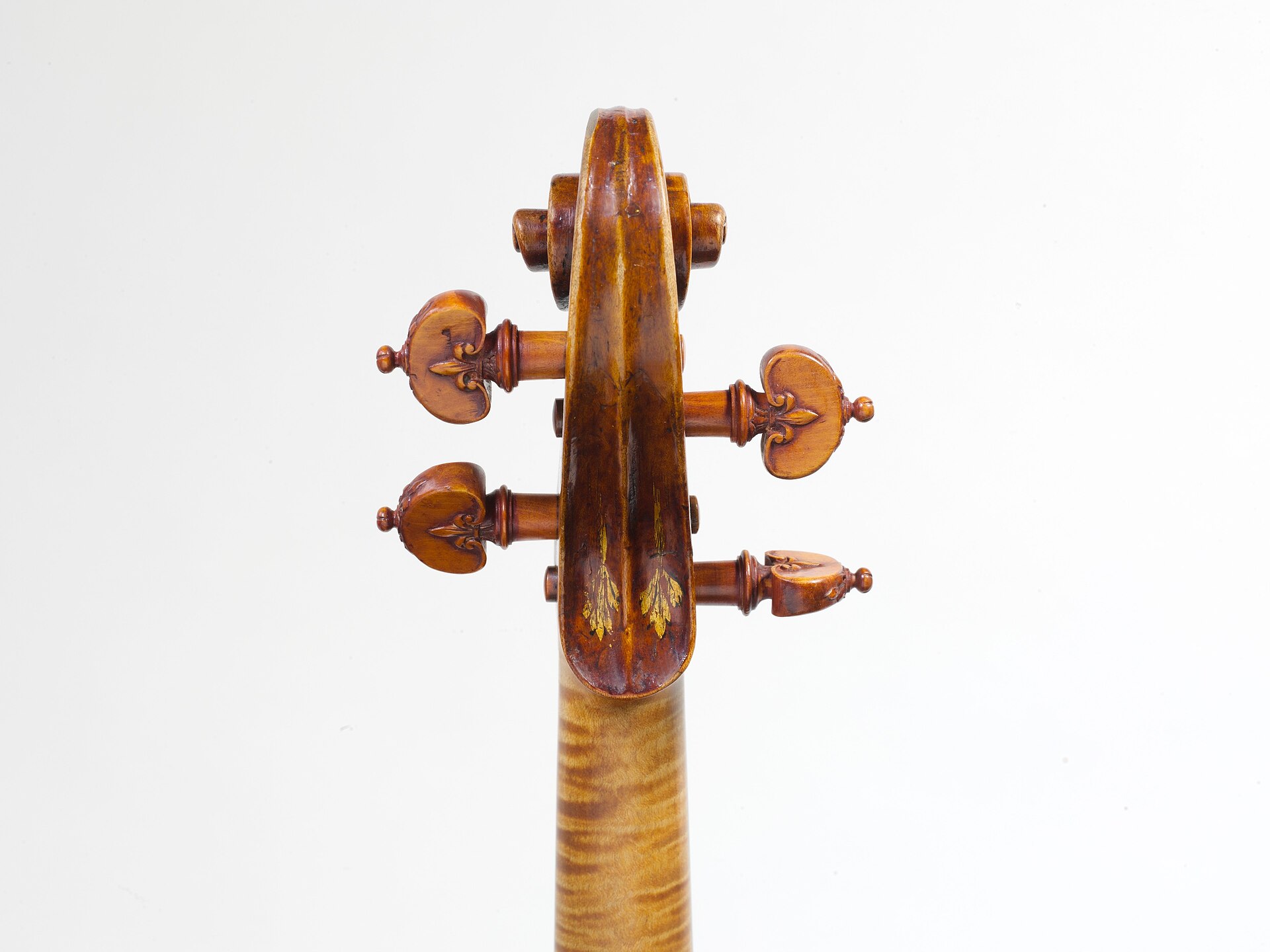
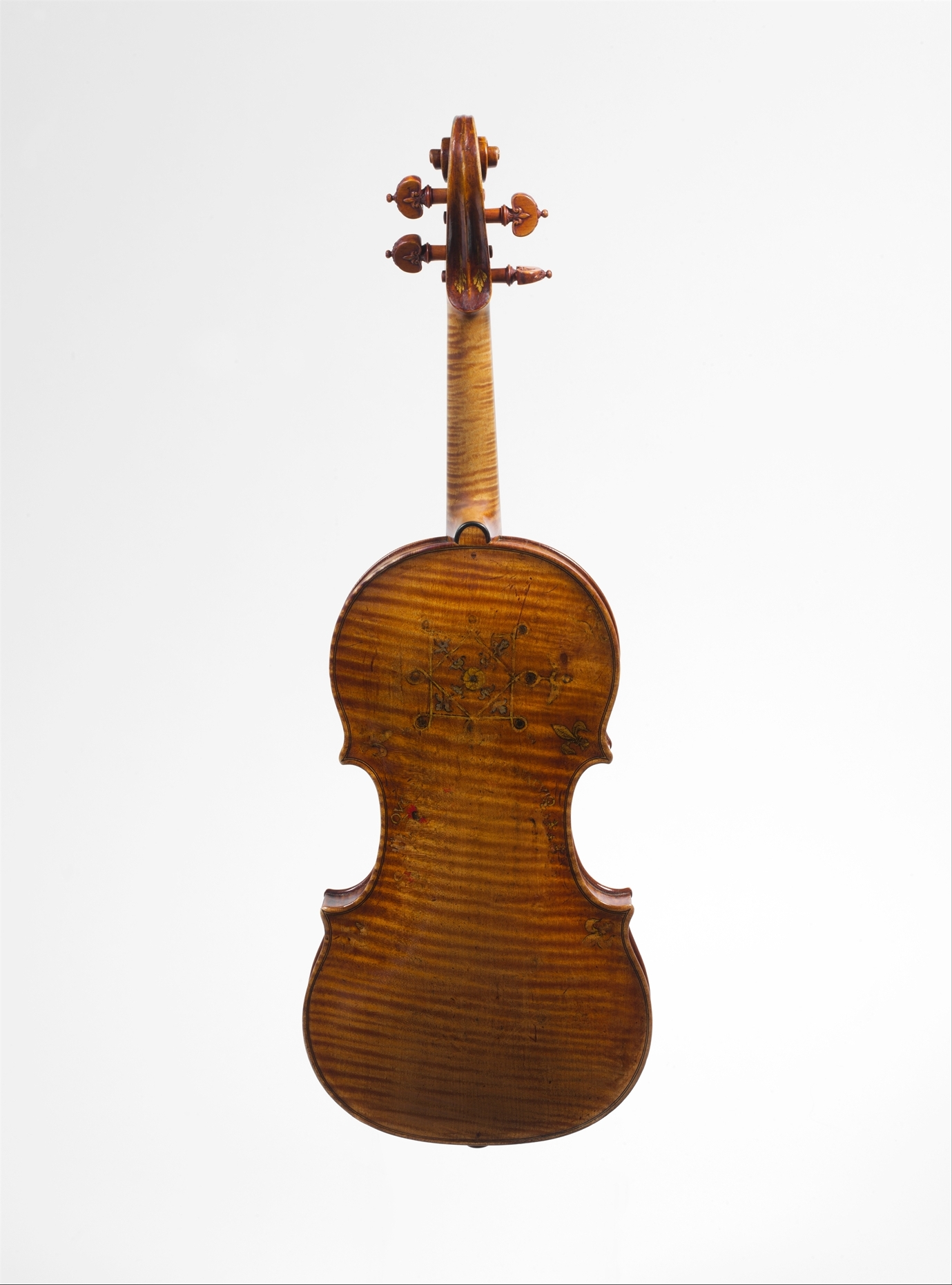
Surviving Amati instruments are repeatedly described in the primary catalogue sources as carrying an orange or orange-brown varnish: the Witten viola's catalogue description calls its coating orange varnish with the belly varnish restored, and the 1566 'Charles IX of France' violin at the Museo del Violino in Cremona is described in the same terms. The Metropolitan Museum's own ex 'Kurtz' violin retains traces of its original varnish and of its original oil-gilded, red-painted decoration beneath later retouching, most visible around the pegbox gilding.
No source consulted for this record reports a published chemical or scientific analysis of the pigment or resin composition of Amati's varnish specifically, the kind of study that exists for some later Cremonese makers. That is recorded here as an absence rather than papered over with a borrowed recipe from a different maker or period; a reader wanting the chemistry will not find it answered honestly anywhere in the literature consulted for this page.
The best documented episode in Amati's career is a royal commission traditionally linked to Charles IX of France, facilitated through his mother and regent Catherine de Medici's patronage of Italian...
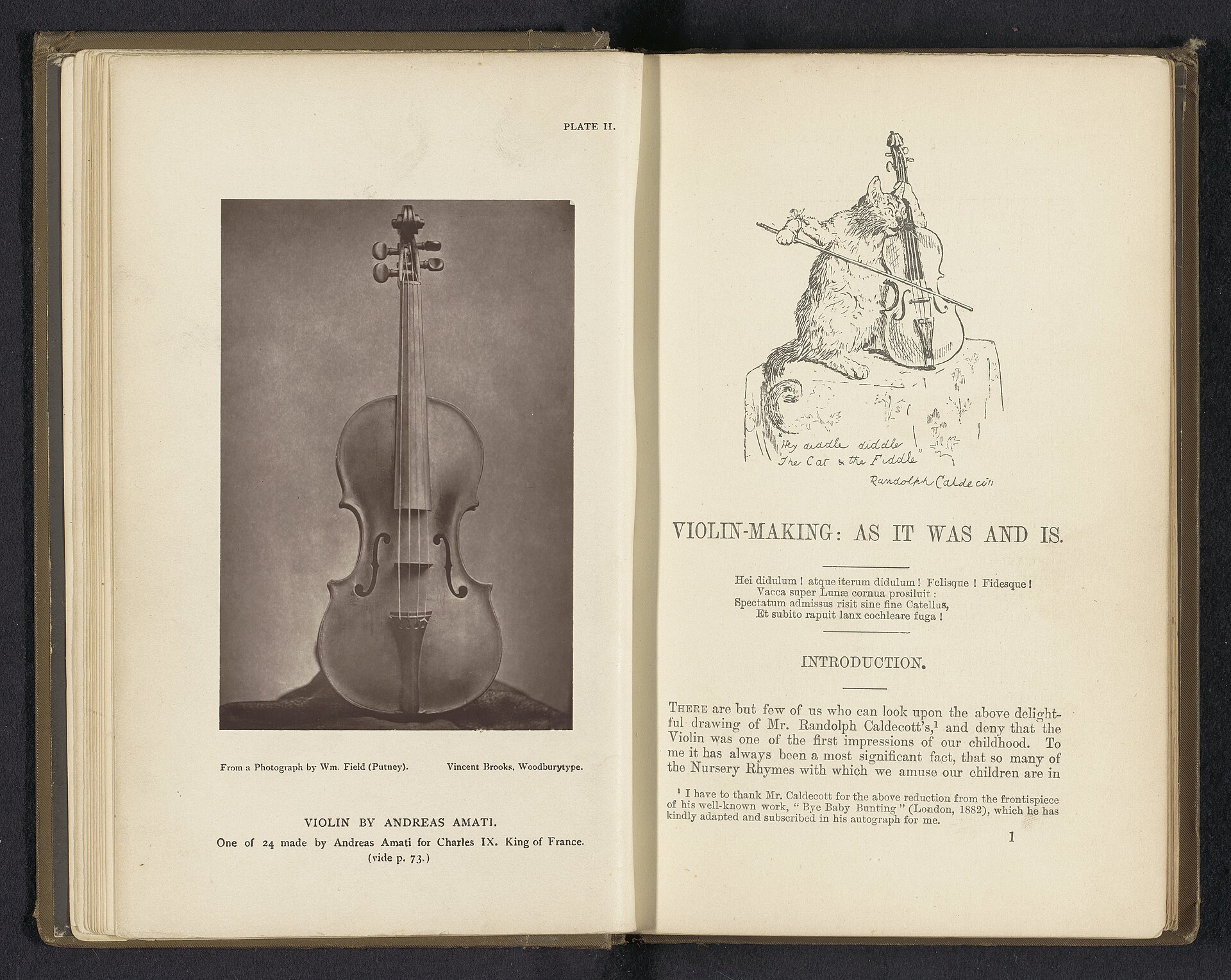
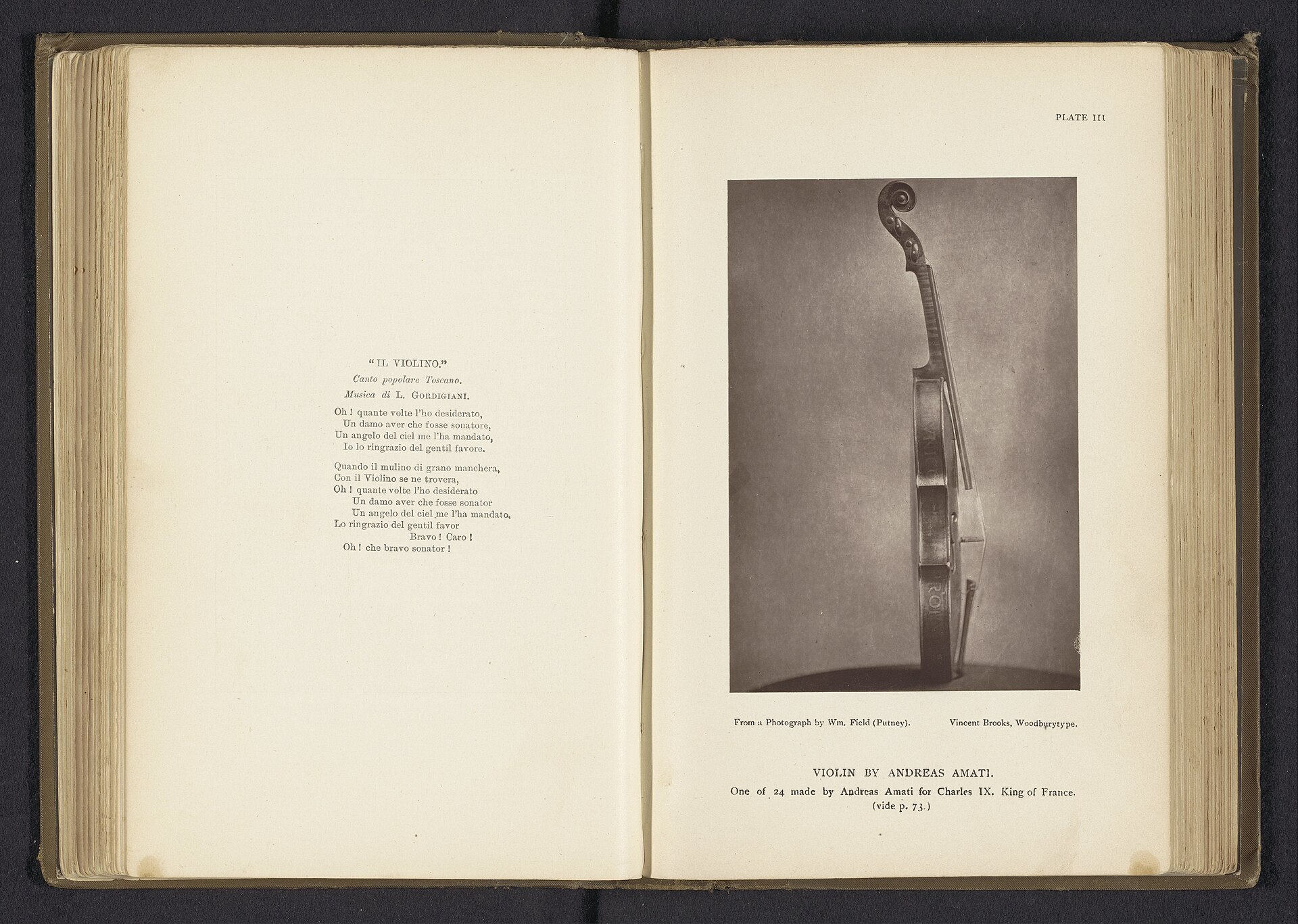
The best documented episode in Amati's career is a royal commission traditionally linked to Charles IX of France, facilitated through his mother and regent Catherine de Medici's patronage of Italian court musicians. The fullest early account, published by Jean Benjamin de la Borde in 1780, describes an order for thirty-eight decorated instruments: twelve large violins, twelve small violins, six violas and eight cellos. Only a single contemporary payment record, from 1572, is known to corroborate any part of it, and estimates of how many survive vary by source: this archive's own record on the Metropolitan's violin cites roughly eight to nine surviving decorated instruments from the group, while a Cozio Archive essay on the maker gives a count of nine instruments carrying the group's 'Pietate et Iustitia' motto surviving from around 1564 to 1566. Most of the set was lost or destroyed, substantially during the French Revolution.
Named survivors are scattered by design rather than kept together. The gilded bass violin known as 'The King', reduced to modern cello proportions in 1801 by the Paris maker Sebastien Renault, has been held since 1984 by the National Music Museum in Vermillion, South Dakota. A violin dated 1566 on its label, inscribed 'Fait par Andre Amati en 1566 sous le regne de Charles IX' and still carrying a partial 'Pietate et Iustitia' motto on its ribs, has been at the Museo del Violino in Cremona since 1966, having passed through the German violinist August Herrmann, the soloist Willy Burmester, and the American dealer Rembert Wurlitzer along the way; a restoration label from the Paris maker Nicolas Lupot dated 1818 documents nineteenth century conservation work on the same instrument. A separate violin dated 1564, the earliest firmly dated instrument in the group, is held by the Ashmolean Museum in Oxford. None of these three is the same object as the Metropolitan's violin, which carries a different motto entirely and belongs to a different decorated group discussed below; a reader who conflates any of them is repeating the exact kind of version error this archive exists to prevent.
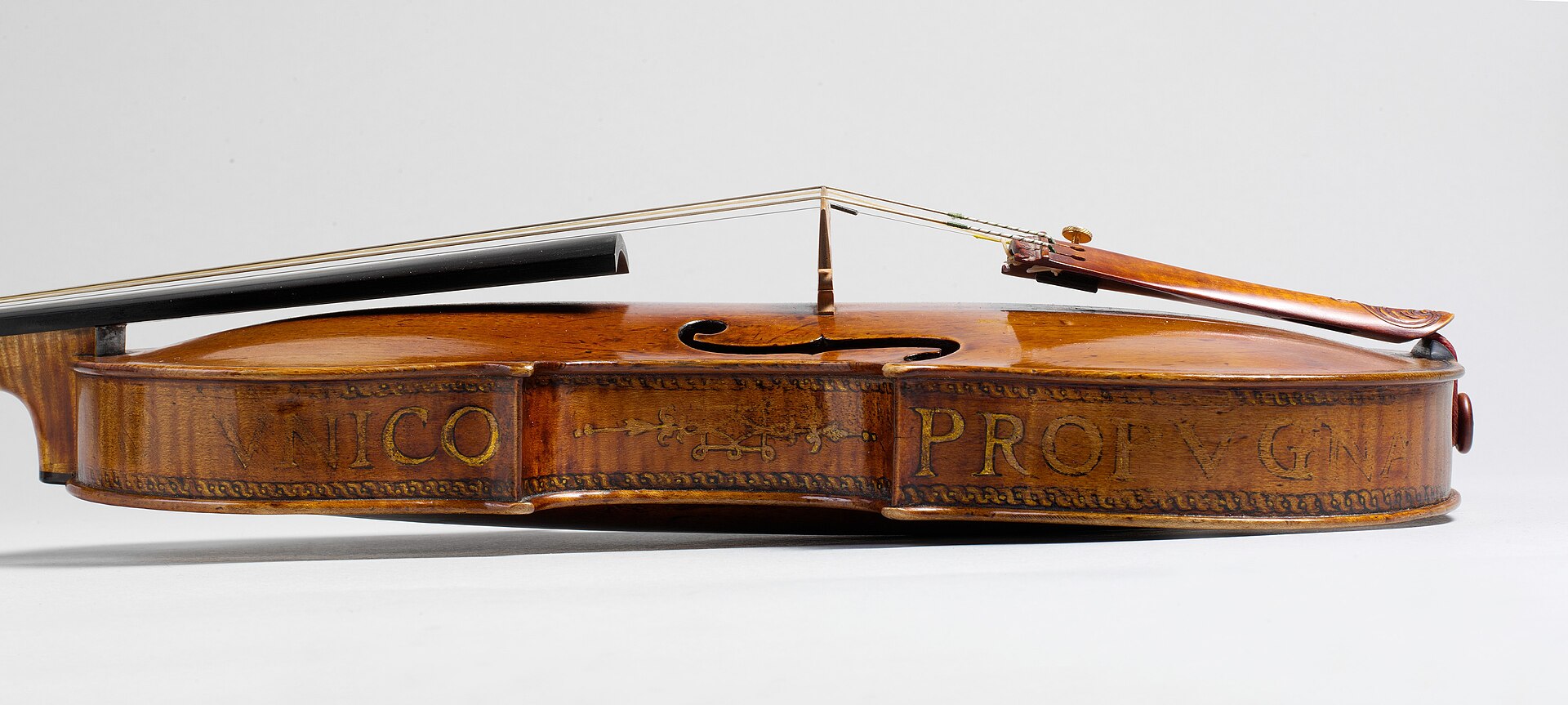
A smaller, less studied group of about five decorated Amati instruments carries a different motto, 'Quo unico propugnaculo stat stabitque religio', by this bulwark alone religion stands and will...
A smaller, less studied group of about five decorated Amati instruments carries a different motto, 'Quo unico propugnaculo stat stabitque religio', by this bulwark alone religion stands and will stand, and is associated with Spanish royal patronage under Philip II, though the source that documents the group ties it to the French royal family too, through Philip II's Valois in-laws, so the two courts are entangled here rather than opposed. The group comprises three violins carrying decoration linked to Philip II, including the Metropolitan's ex 'Kurtz' violin, a viola bearing the monogram of a Princess Marguerite (Charles IX's sister, and so on the French side of the same family), and a separate, more heavily cut-down viola in Paris whose decoration may predate the rest of the group and could relate to a period before Philip II's 1556 accession.
A further viola in this same decorated group, the 'Witten', now at the National Music Museum in Vermillion, carries the identical motto and, per the Cozio Archive's own property record, a label reading 'Andreas Amati fecit Cremonen 1553' - though that same record also preserves a countervailing note, attributed to the violist and scholar Laurence C. Witten II writing in Early Music, stating flatly that there is no label at all. This record does not resolve which account is correct. The 1553 date, if genuine, sits three years before Philip II's 1556 accession to the Spanish throne, which is difficult to square with a group otherwise associated with his reign and, in the Metropolitan's case, speculatively with his 1559 marriage to Elisabeth de Valois. No source consulted for this record explains the discrepancy, and this record does not resolve it either; it is recorded as exactly the kind of early, hard-to-verify date that recurs across this maker's catalogued output, discussed further below.
The earliest instruments referenced in connection with Andrea Amati carry dates of 1542 and 1546.
The earliest instruments referenced in connection with Andrea Amati carry dates of 1542 and 1546. Neither survives; both are known only because the eighteenth and early nineteenth century collector and chronicler Count Cozio di Salabue described them, and the Cozio Archive's own modern maker essay states plainly that these early dates 'can only be taken on trust', meaning there is no surviving physical object against which to check them. The earliest instrument that does survive today and carries a checkable date is the 1564 violin at the Ashmolean.
This pattern, an early label date that predates anything that can be independently verified, recurs on the Witten viola's 1553 inscription discussed above, and it is worth naming as a pattern rather than treating each instance as an isolated curiosity. Labels on instruments of this age are also frequently facsimiles rather than originals, as is explicitly the case on the Metropolitan's own violin, so a date read from a label is evidence about what a later owner, dealer or restorer believed or wished to claim, not a document contemporary with the instrument's making, unless independently corroborated by dendrochronology or another physical method.
Millions of instruments were mass-produced in trade centres such as Markneukirchen in Germany through the nineteenth and early twentieth centuries, and a great many of them were fitted with a printed...
Millions of instruments were mass-produced in trade centres such as Markneukirchen in Germany through the nineteenth and early twentieth centuries, and a great many of them were fitted with a printed facsimile label bearing a famous maker's name, Amati among the most common. The names were not always applied as outright fraud; they functioned, as one specialist guide to violin labels puts it, as a marketing device that borrowed a maker's name 'sometimes quite loosely' as a model, creating a cachet the actual instrument had no claim to. Sears, Roebuck and Co. catalogues at the turn of the twentieth century advertised 'Stradivarius' violins for as little as 1.95 dollars, and the same trade sold instruments labelled Amati at comparably modest prices; the practice continues today in a more transparent form, with some modern manufacturers openly using historic Cremonese names on instruments whose factory origin is disclosed rather than concealed.
The practical effect on this maker's reputation is real and ongoing: a trade violin labelled Amati but built with flat, later-style arching bears no construction relationship to Andrea Amati's own work, and an owner opening the f-hole of a family heirloom and finding that name printed inside is, in the overwhelming majority of cases, looking at exactly such a trade instrument rather than a discovery. This record's corpus figures, drawn from the Cozio Archive's individually verified property records and the dealer-reported count of roughly twenty known genuine examples, should be read against that background: the population of objects carrying Amati's name vastly exceeds, by many orders of magnitude, the population of objects that were actually made in his workshop.
The clearest documented test of how attribution is actually decided on this maker, as against how confidently it is sometimes asserted, is a cello that has been in the hands of the Belgian gambist...
The clearest documented test of how attribution is actually decided on this maker, as against how confidently it is sometimes asserted, is a cello that has been in the hands of the Belgian gambist and Baroque cellist Wieland Kuijken for roughly half a century. Claimed as an original Andrea Amati made for the Royal Chapel of Charles IX of France, the cello has gone through extensive modification over its working life and carries decoration on its front, back and ribs that the specialist violin trade press describes as magnificent.
The leading historic-instrument expert Charles Beare examined the cello in May 2019, and his published conclusion, reported in The Strad the following year, was genuinely inconclusive: he could not be certain the instrument was an authentic Andrea Amati, and he could not rule out that it was assembled, in the nineteenth century, from the surviving remains of something that once had been one. Extensive damage and repeated modification across four and a half centuries made a definite ruling impossible either way. This is recorded here precisely because it resists the tidy narrative a forgery story usually wants: no fraud was proven, no fake was unmasked, and the honest outcome of the best available expert examination was that the question remains open.
No dedicated authentication board or committee rules on Andrea Amati attributions the way some later makers' foundations do.
No dedicated authentication board or committee rules on Andrea Amati attributions the way some later makers' foundations do. What functions in that role is distributed: the Cozio Archive, compiled and maintained by the dealer-historians at Tarisio from certificates, sale records and connoisseurship, serves as the nearest thing to a continuously updated catalogue; dendrochronology, where a top survives in a condition that permits sampling, supplies an independent physical check; and individual expert opinion, historically the London firm of W. E. Hill and Sons, whose certificate accompanies the Metropolitan's own violin in its documented provenance, and in recent practice specialists such as Charles Beare, continues to carry weight in the absence of a formal body. No source consulted for this record identifies a published, print catalogue raisonne devoted specifically to Andrea Amati's own output, distinct from the wider Amati family literature; that absence is itself worth recording for a maker whose reputation rests so heavily on a reconstructed corpus.
Tarisio's own auction-record tracking lists nine total auction price results for Andrea Amati as of the most recent figure available to this record, with the maker's auction record standing at...
Tarisio's own auction-record tracking lists nine total auction price results for Andrea Amati as of the most recent figure available to this record, with the maker's auction record standing at 327,282 US dollars for a violin sold in June 2023; the source does not specify whether that figure is a hammer price or includes a buyer's premium, and this record states that ambiguity rather than assigning the figure to one column or the other on a guess. Nine total results across the entire history of the public auction record for a maker this famous is itself the finding: almost the whole surviving corpus sits in institutional collections that do not sell, so a market in the ordinary sense barely exists.
The clearest recent market event involving this maker was the 2023 sale of the Rosenberg Collection, a private assemblage that included instruments by Stradivari, Domenico Montagnana, Giuseppe Guarneri 'filius Andreae', Andrea Guarneri and others alongside a single Andrea Amati violin, lot 193 in the sale, on Andrea's smaller pattern and built from relatively modest materials apart from its remarkable, possibly record-old spruce. The auction house's own results page reports the main London sale that included lot 193 - the second of two parts, following an earlier 4.7 million pounds sterling online sale of 96 lots in March 2023 - realized 8,894,000 pounds sterling in total; no source consulted for this record publishes a price specific to the Amati lot alone, and this record does not estimate one.
The workshop passed to Andrea's sons Antonio and Girolamo, who continued making instruments under the family name into the early seventeenth century and are credited with refining the f-hole design...
The workshop passed to Andrea's sons Antonio and Girolamo, who continued making instruments under the family name into the early seventeenth century and are credited with refining the f-hole design further. Girolamo's son Nicolo Amati, born 1596, took the family workshop into a further generation and is widely credited with training a number of pupils who became the next wave of Cremonese makers, most famously Andrea Guarneri and, by tradition, Antonio Stradivari.
This archive's own record on Antonio Stradivari treats the training claim carefully rather than as settled fact, and this record follows it rather than restating a stronger version of the same claim: the entire basis for Stradivari's discipleship under Nicolo Amati is a label on his earliest surviving instrument, dated 1666, describing him as Amati's pupil, and that claim is disputed because Stradivari did not go on to credit Amati as consistently as other documented Amati pupils did, and because some specialists point to construction details, including the absence of Amati's characteristic dorsal pin technique, as evidence for training instead, or in addition, under the Cremonese maker Francesco Rugeri. The lineage from Andrea Amati, through his grandson, to Stradivari is real in the sense that the workshop, the city and the construction method all connect directly; it is not real in the sense of a documented, unbroken master-to-pupil chain, and this record does not present it as one.
The family firm's making activity continued for a further generation after Nicolo, with Girolamo Amati the younger, known as Hieronymus II, working until 1740, after which the Amati name effectively left active violin making in Cremona even as the city's wider tradition, carried forward by the Guarneri and Stradivari families and their own pupils, continued.
Several questions raised directly by this maker's own catalogued instruments have no answer in the sources consulted for this record, and they are recorded as open rather than smoothed into a...
Several questions raised directly by this maker's own catalogued instruments have no answer in the sources consulted for this record, and they are recorded as open rather than smoothed into a confident narrative. Whether Andrea Amati or a Brescian contemporary such as Gasparo da Salo built the first instrument in the violin's modern form is unresolved, and the surviving documentary record currently favours Brescia rather than Cremona, contrary to the popular framing of Amati as the instrument's sole inventor. The exact year of Amati's death is given as 1577 by some sources and 1578 by others, without reconciliation. The 1542 and 1546 instruments described by Count Cozio di Salabue do not survive and can only be taken on trust. The 1553 date on the Witten viola's label predates the Spanish royal reign the rest of its decorated group is associated with, and no source consulted explains why. How much of the instrument corpus catalogued under Andrea's name alone was substantially the work of his son Antonio, who joined the workshop as an adult well before most of the surviving dated output was made, is argued rather than settled. Whether the Kuijken cello is a genuine, heavily altered Andrea Amati or a nineteenth century assembly built from the remains of one could not be determined by the best available expert examination in 2019. And the price realized for the single Andrea Amati violin sold within the 2023 Rosenberg Collection has not been published in any source consulted for this record.
Luthier. c. 1505-1577.
Born c. 1505 (no baptismal record located; the year is reconstructed from later documents), Cremona, Duchy of Milan (now Lombardy, Italy); died 26 December 1577 (some sources give 1578; the sources consulted for this record do not reconcile the discrepancy), Cremona.
A cello owned by the cellist Wieland Kuijken, claimed as an Andrea Amati made for the Royal Chapel of Charles IX of France. The instrument has undergone extensive modification over roughly four and a half centuries and carries elaborate decoration on its front, back and ribs.
Metropolitan Museum of Art (New York); Ashmolean Museum, University of Oxford (Oxford); Museo del Violino (Cremona); National Music Museum (The Shrine to Music) (Vermillion, South Dakota); Musee de la Musique (Paris).
The market for this maker barely exists in the ordinary sense. Tarisio's own tracking lists nine total auction price results for Andrea Amati, with a current record of 327,282 US dollars for a violin sold in June 2023; the source does not specify whether that figure is a hammer price or includes a buyer's premium, and this record states that ambiguity rather than resolving it by assumption.
Did Andrea Amati or a Brescian contemporary such as Gasparo da Salo actually build the first instrument in the violin's modern form? The surviving documentary record, roughly a hundred documents for Gasparo against about eleven for Amati, currently favours Brescia over the popular Cremona-centred narrative.
Across 1,322 provenance events in this archive nineteen name a woman, and four of those give her no personal name at all.
11 min read
The Ashmolean says the Messiah Stradivari owes its fame not to the sounds it makes but to its condition.
9 min read
Last verified
One artwork and its story every Tuesday, with the picture: who owned it, what it made, and what closes soon in the exhibition calendar. No promotion, and nothing we cannot cite.
We send one email to confirm the address and keep nothing else. Every letter carries a one-click unsubscribe. How we handle your data.

,_RP-F-2001-7-396-2.jpg)
