ex "Kurtz" Violin
Andrea Amati · ca. 1560
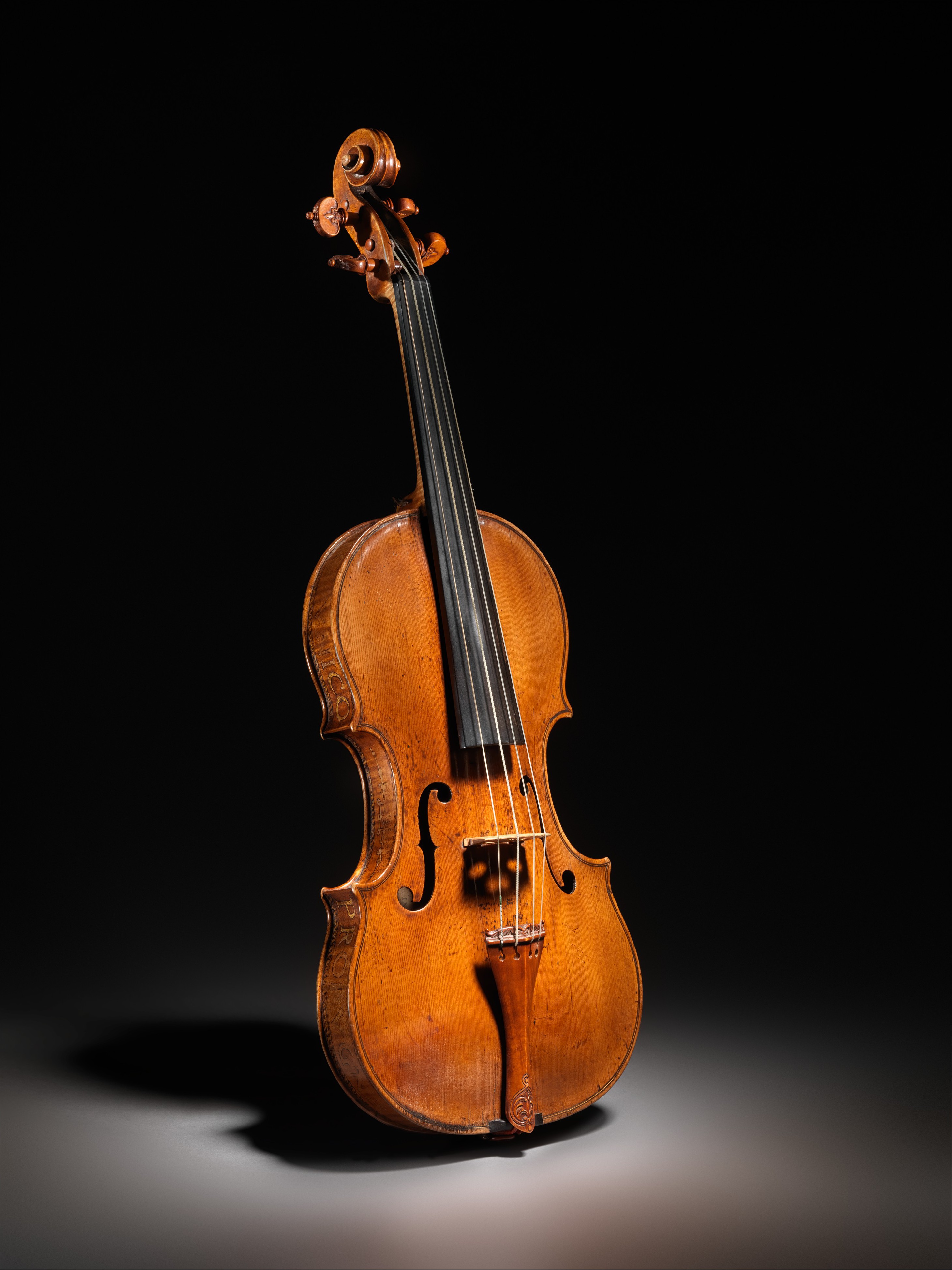
Andrea Amati, ex "Kurtz" Violin, Cremona, ca. 1560. Spruce, maple, ebony, paint, and gilding. The Museum's own photograph of the accessioned object, released under CC0 through the Museum's open access program. Institutional source: Metropolitan Museum of Art, object 503517.
| Artist | Andrea Amati |
|---|---|
| Date | ca. 1560 |
| Medium | Spruce, maple, ebony, paint, gilding |
| Dimensions | Overall height 57.4 cm (22 5/8 in.); width 20.2 cm (7 15/16 in.) (Metropolitan Museum). Back length 35.6 cm; upper bouts 16.2 cm; middle bouts 11 cm; lower bouts 20.2 cm (Cozio Archive component measurements). |
| Where it is now | Metropolitan Museum of Art, New York, Department of Musical Instruments, Gallery 684last confirmed |
| Inventory number | Accession number 1999.26 |
| Attribution | AcceptedThe attribution to Andrea Amati is not seriously disputed; it rests on the instrument's construction, the design of the scroll and outline (which every later Cremonese maker copied from Andrea), and dendrochronology of the spruce top, which is consistent with a mid sixteenth century felling date. Full note |
| Object type | Musical instrument |
| Period | Italian Renaissance, Cremona, sixteenth century |
| Cases | Has a provenance gap |
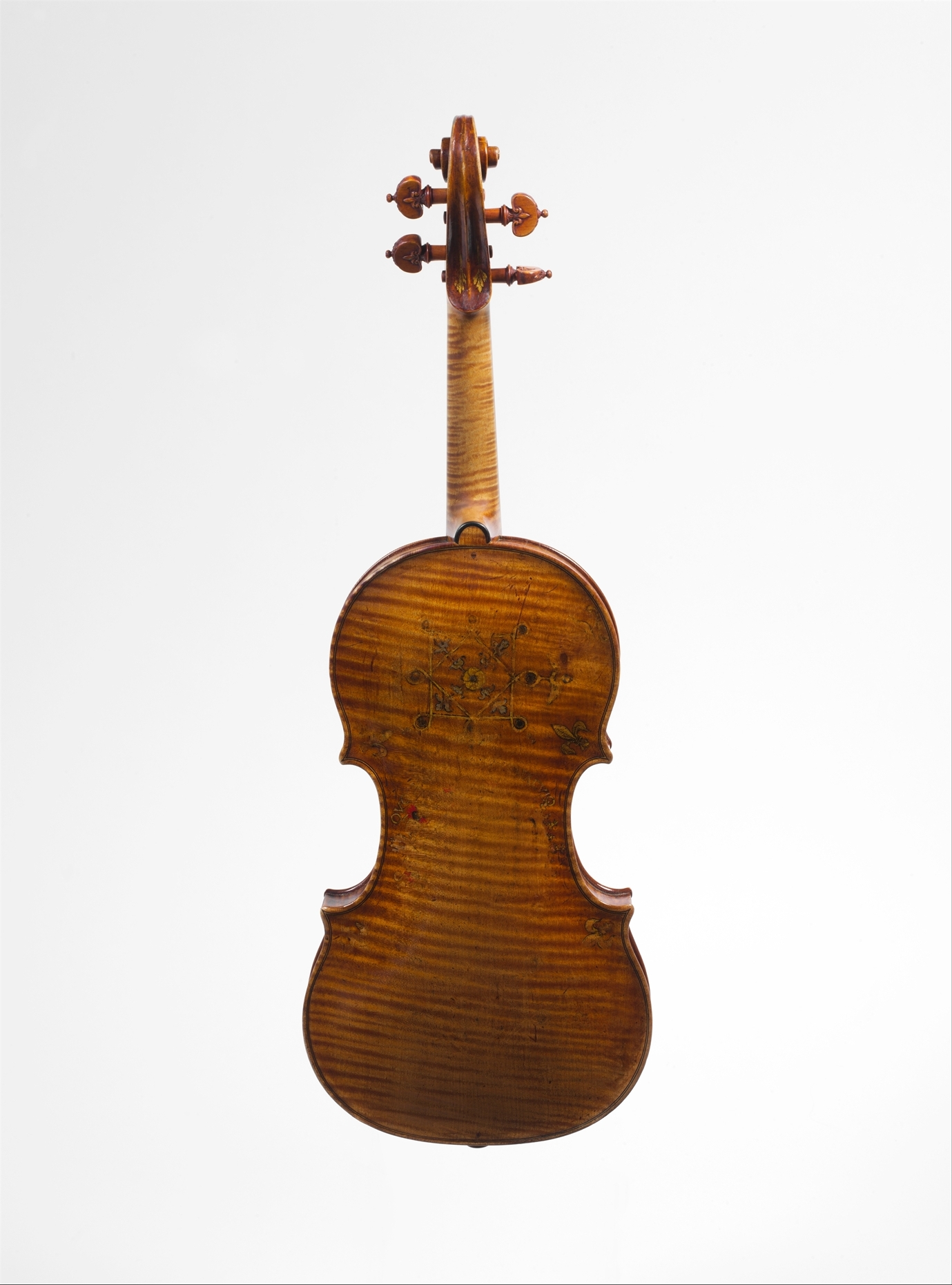
| Inscriptions | Latin couplet painted in gold lettering on the ribs and back: "Quo unico propugnaculo stat stabiq[ue] religio" (By this bulwark alone religion stands and will stand). Fleurs-de-lis in the back's corners; a geometric design with floral ornamentation between the upper bouts; effaced traces at the center of the back where a coat of arms is presumed to have been painted and later removed or worn away. |
| Owners on record | 17 links15 documented, 2 unknown |
| Sources | 14 cited |
About this record Last verified · 14 sources cited · Change log
On this page 9 sections
ContentsClose
A violin from the workshop that invented the violin. Andrea Amati of Cremona is credited with fixing the instrument's modern proportions, and this example, dated by the Metropolitan Museum to about 1560, is among the small number of his instruments to survive with anything like their original decoration: a gold Latin motto on the ribs, fleurs-de-lis on the back, and the ghost of an effaced coat of arms. The Museum has floated, cautiously, a connection to the 1559 marriage of Philip II of Spain to Elisabeth of Valois, on the strength of a decorated sister instrument in Paris; no document ties this specific violin to that wedding, and the Museum's own language treats the idea as speculation, not fact.
The violin is not the same instrument as any of the surviving pieces from Amati's better documented royal commission, the decorated set made across the 1560s and 1570s for Charles IX of France, several of which survive elsewhere including the celebrated "King" cello in Vermillion, South Dakota. That set carries a different Latin motto and a different history, and the two groups should not be conflated.
Its documented ownership history begins abruptly in nineteenth century England, runs through a chain of London and New York dealers and private owners including the violinist and instrument scholar Edward Heron-Allen, and ends with the New York musician and music educator Arved Kurtz, whose name the violin now carries. The Museum acquired it in 1999, four years after Kurtz's death, through the Robert Alonzo Lehman Bequest. Roughly three centuries between the workshop and the first named nineteenth century owner remain completely undocumented.
Provenance
Each link is graded. Documented: a cited source supports it. Disputed: the identification is argued but not established. Unknown: no owner for that span, and the gap is not smoothed into a narrative. The grades in the glossary.
- ca. 1560 -Workshop of Andrea Amati, Cremonadocumented
Attribution to Andrea Amati is accepted and supported by dendrochronology of the spruce top; the exact year is disputed between the Metropolitan Museum (about 1560, range 1558-1565) and the Cozio Archive (about 1570). Possible but unconfirmed connection to a set of instruments associated with the 1559 marriage of Philip II of Spain and Elisabeth of Valois, argued from decorative comparison to a related violetta in the Musee de la Musique, Paris, not from a document naming this instrument.135
- ca. 1560/1570 - mid-19th centuryUnknownunknown
No owner, location, or transaction is documented for roughly two and a half to three centuries. This is the largest undocumented span in the object's history.3
- unrecorded - unrecorded"Oliphant"unknown
Earliest name in the Cozio Archive's provenance chain for this instrument; no further identification, dates, or biographical detail located in sources consulted.3
- unrecorded - 1873Miss Irene Pellewdocumented
Per the Cozio Archive's compiled provenance for this instrument (Property ID 40073).3
- 1873 - 1873Sir Louis Mallet, and separately Michael Longridgedocumented
Sold in 1873 via the London dealer Edward Withers to Sir Louis Mallet; the Cozio Archive's chain also records a purchase by Michael Longridge around the same date via the dealer George Withers & Sons. The exact sequence of these 1873 transactions is not fully explained in the sources consulted.3
- 1873 - 1885George Soamesdocumented
Per the Cozio Archive.3
- 1885 - 1890Edward Heron-Allendocumented
London writer, palmist, and violin scholar; author of the 1885 reference work Violin-Making, As It Was and Is.3
- 1890 - 1896Sidney Courtaulddocumented
Per the Cozio Archive.3
- 1896 - 1923W. E. Hill & Sonsdocumented
London dealership; issued a certificate for the instrument.3
- 1923 - 1923Miss Hilda Barrydocumented
Per the Cozio Archive.3
- 1923 - 1927Rudolph Wurlitzer Co.documented
American dealership; exact dates of handling not specified beyond falling between Hilda Barry's ownership and Emil Herrmann's.3
- 1927 - 1930Emil Herrmanndocumented
New York violin dealer; issued a certificate for the instrument.3
- 1930 - 1930Dr. Steiner-Schweizerdocumented
Per the Cozio Archive.3
- 1930 - 1940Robert L. Dennisondocumented
Per the Cozio Archive.3
- 1940 - 1941Harry Wahldocumented
Per the Cozio Archive.3
- 1941 - 1995Arved Kurtzdocumented
New York-based violinist, conductor, and music educator (born Saint Petersburg, 29 June 1899; died New York, 23 March 1995), director then president of the New York College of Music from 1945 to 1965. The instrument's popular name derives from him. The Cozio Archive's own listing gives his ownership dates loosely as 1941 onward; his death date of 1995 is taken from an independent biographical source, four years before the Museum's 1999 acquisition, leaving the exact transfer mechanism (estate sale, dealer intermediary, or otherwise) undocumented.39
- 1999 - presentMetropolitan Museum of Art, New Yorkdocumented
Purchase, Robert Alonzo Lehman Bequest, 1999. Accession number 1999.26. Purchase price not published in sources consulted. The purchase fund's namesake has not been independently identified and should not be assumed identical to the banker Robert Lehman (1891-1969) of the Museum's separate Robert Lehman Collection.13
Technical evidence
| Attribution note | The attribution to Andrea Amati is not seriously disputed; it rests on the instrument's construction, the design of the scroll and outline (which every later Cremonese maker copied from Andrea), and dendrochronology of the spruce top, which is consistent with a mid sixteenth century felling date. What is not settled is the precise year within Andrea's working life: the Metropolitan Museum dates it about 1560 (its own internal date range runs 1558-1565), while the Cozio Archive, compiled independently by the dealer-historians at Tarisio from certificates and connoisseurship, dates the same instrument about 1570. Separately, and more speculatively, the Museum has proposed a link between this violin's decoration and a set of instruments made for the 1559 marriage of Philip II of Spain to Elisabeth of Valois; that link is argued from decorative comparison to a single related instrument in Paris, not from any document naming this violin. |
|---|---|
| Back | One-piece maple of medium figure, sloping left to right, original sixteenth century material.311 |
| Ribs | Maple of similar figure to the back, painted and gilded with the Latin inscription and fleurs-de-lis decoration.311 |
| Top | Spruce of fine to medium grain, in two pieces.311 |
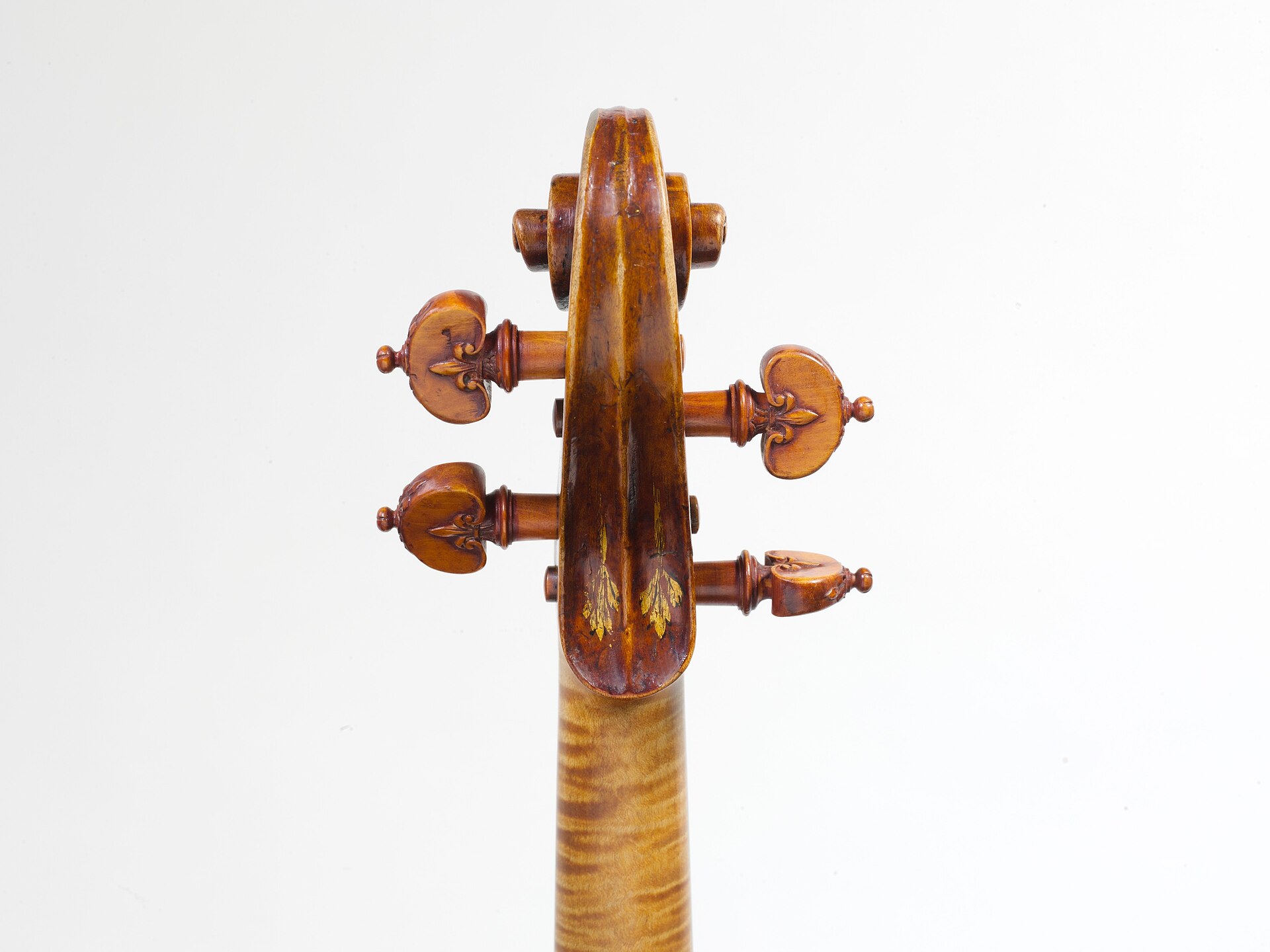
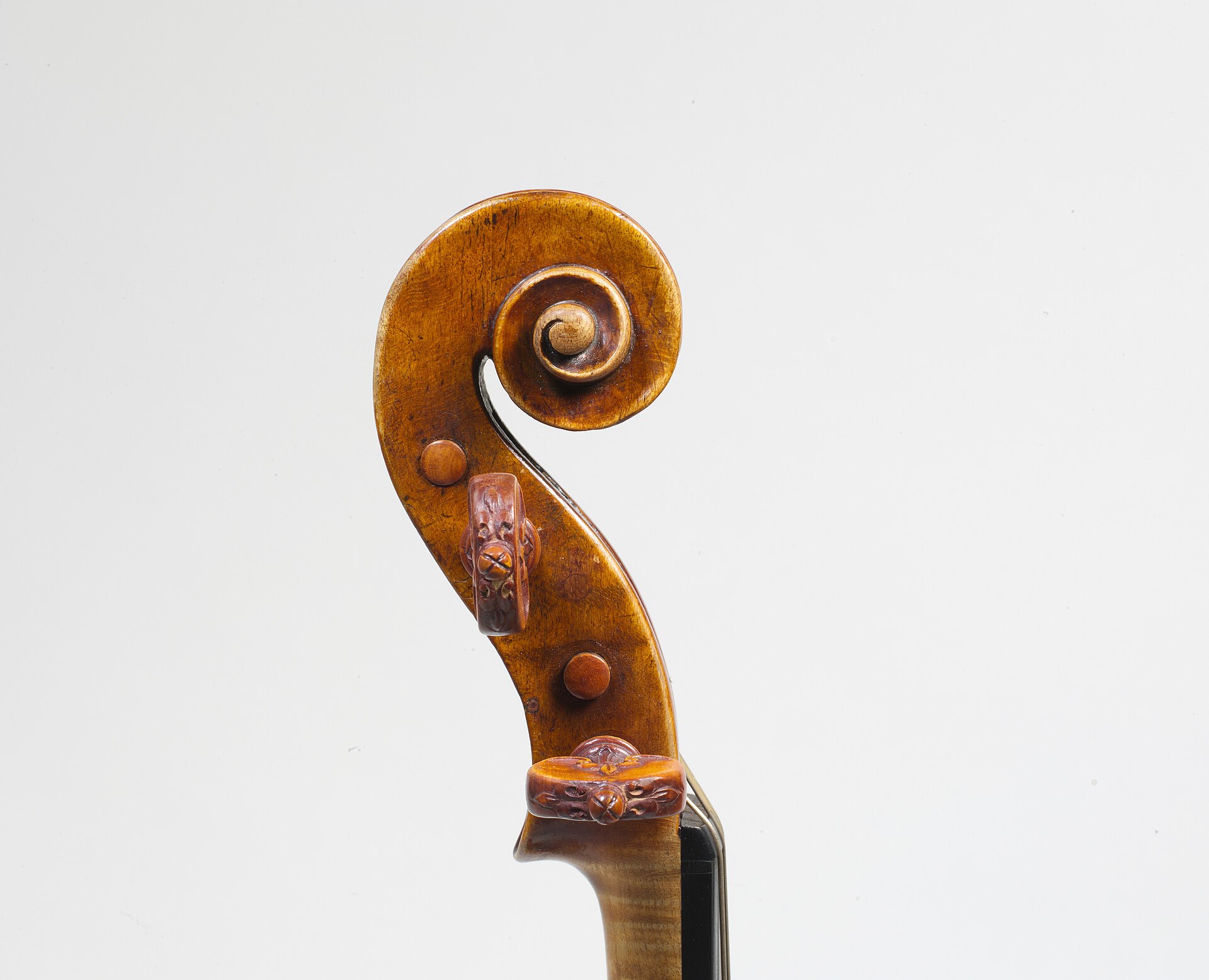
| Scroll and pegbox | Unfigured maple, original sixteenth century carving, but grafted onto a neck that is not original; the neck is a later, modern replacement.311 |
| Varnish and decoration | Traces of the original varnish and of the original oil-gilded, red-painted ornament survive beneath later retouching, most visibly around the pegbox gilding.311 |
| Inscription | Latin couplet in gold lettering, "Quo unico propugnaculo stat stabiq[ue] religio" (By this bulwark alone religion stands and will stand), on the ribs and back.1211 |
| Label | The maker's label inside the body is a modern facsimile; the original label, if one existed inside the body, has not survived.311 |
| Dimensions | Overall height 57.4 cm, width 20.2 cm (Metropolitan Museum). Back length 35.6 cm, upper bouts 16.2 cm, middle bouts 11 cm, lower bouts 20.2 cm (Cozio Archive).13 |
Images
The record in full
Chapter 1What it is
The instrument is a violin of essentially modern proportions and outline: 57.4 centimetres tall overall and 20.2 centimetres across at its widest, built from a one-piece maple back of medium figure...
The instrument is a violin of essentially modern proportions and outline: 57.4 centimetres tall overall and 20.2 centimetres across at its widest, built from a one-piece maple back of medium figure sloping left to right, ribs of similarly figured maple, and a two-piece spruce top of fine to medium grain. It is not a plain working instrument. The ribs and back carry painted and gilded decoration, including a Latin motto in gold lettering, fleurs-de-lis in the corners of the back, and a geometric and floral border between the upper bouts. At the center of the back is a small area of loss and overpaint where a coat of arms is presumed to have once been, and has since been effaced or worn away.
The maker's label inside the body is a modern facsimile; the original, if one was ever affixed inside rather than only painted on the exterior, has not survived. Traces of the instrument's original varnish, and of its original oil-gilded and red-painted decoration, remain beneath later coats applied at some undetermined point in its history, most visibly around the pegbox gilding.
One structural fact does the most work in placing the object honestly: the scroll and pegbox, carved from unfigured maple, are original Amati work, but they have been grafted onto a neck that is not original. This is a routine alteration on instruments of this age, discussed below, and it means the violin is best understood as a sixteenth century body carrying a sixteenth century head on a later neck, not as an untouched relic.
Chapter 2Andrea Amati and the invention of the violin's form
Andrea Amati worked as a luthier in Cremona from at least 1526 and was established at a house in the San Faustino district of the city by 1539.
Andrea Amati worked as a luthier in Cremona from at least 1526 and was established at a house in the San Faustino district of the city by 1539. Two documented instruments survive from relatively early in his career with dates of 1542 and 1546, though neither is the violin discussed here. Most of the work now attributed to him with confidence dates from later, roughly the 1560s onward, when his sons Antonio (who joined the workshop around 1556) and Girolamo (born 1561) were old enough to have had a hand in production.
What is generally agreed, and is the basis for calling Amati the founder of the Cremonese violin tradition, is that he fixed the proportions, outline, arching, and constructional logic that every later Cremonese maker, including his grandson Nicolo Amati and Nicolo's pupil Antonio Stradivari, continued to work from. Scholars who have studied the scroll design specifically note that the pattern used by essentially every Cremonese maker after Andrea traces back to his own drawing, with only minute differences separating Stradivari's version from the original.
None of this rests on a signed, dated declaration from Amati himself explaining his method. It rests on the surviving instruments, on the few payment and property records that mention him, and on more than a century of connoisseurship building a corpus of accepted works. That is the same evidentiary structure that applies to this particular violin, and it should be read with the same caution.
Chapter 3How old is it: what dendrochronology can and cannot say
Dendrochronology dates a wooden object by matching the pattern of annual growth rings in its wood against a reference chronology built from trees of known felling date and known origin.
Dendrochronology dates a wooden object by matching the pattern of annual growth rings in its wood against a reference chronology built from trees of known felling date and known origin. Applied to a violin's spruce top, it establishes a terminus post quem: the earliest year in which the youngest ring visible in the wood could have been cut, and therefore the earliest year in which the instrument could have been built from that particular piece of wood. It cannot, on its own, prove who built an instrument, and it can be defeated by a maker's use of old, stored timber, so a tree-ring date is a floor, not a fixed birthday.
For this violin, sources describe the dendrochronology as securely consistent with a mid sixteenth century felling date and note that the instrument's authenticity as an Andrea Amati product has not been seriously challenged. What is not resolved, and what the sources consulted for this record disagree about, is exactly which year within Amati's working life the instrument belongs to. The Metropolitan Museum's own catalogue date is about 1560, with an internal working range of 1558 to 1565. The Cozio Archive, an independent database built by the dealers and historians at Tarisio from certificates, sale records and connoisseurship, dates the same instrument to about 1570, a full decade later. Both institutions are working from the same physical object; neither published source consulted for this record explains the basis for the other's number, and this record does not attempt to adjudicate between them.
Chapter 4The Charles IX set, and why this violin is not part of it
The best documented episode in Andrea Amati's career is a royal commission traditionally linked to Charles IX of France, whose mother and regent, Catherine de Medici, is credited with bringing...
The best documented episode in Andrea Amati's career is a royal commission traditionally linked to Charles IX of France, whose mother and regent, Catherine de Medici, is credited with bringing Italian court music and musicians to France. The earliest written account of the commission, published by Jean Benjamin de la Borde in 1780, describes an order of twelve large violins, twelve small violins, six violas and eight cellos, thirty-eight instruments in total. Contemporary documentation is thin: only a single payment record, from 1572, is known to survive, and the commission's exact scope and dates remain a matter of reconstruction from the instruments themselves and from that later secondary account.
Instruments from this set, where they survive, are decorated with royal arms and a Latin motto reading "Pietate et Iustitia" (with piety and justice), painted and gilded in a style compared to Limoges enamel work. Roughly eight to nine decorated instruments belonging to this group are known to survive out of the original thirty-eight, the rest lost or destroyed, substantially during the French Revolution. The most famous survivor is a bass violin, reduced in size and converted to a modern cello format in 1801 by the Paris maker Sebastien Renault, known today as the "King" and held since 1984 by the National Music Museum in Vermillion, South Dakota, as part of the Witten-Rawlins Collection. Another survivor, a violin bearing the date 1564 in Roman numerals on its label, the earliest firmly dated instrument in the group, is held by the Ashmolean Museum in Oxford.
The Metropolitan Museum's ex "Kurtz" violin is a different instrument, decorated with a different Latin motto, "Quo unico propugnaculo stat stabiq[ue] religio" (by this bulwark alone religion stands and will stand), not "Pietate et Iustitia". No source consulted for this record places it within the Charles IX commission, and the difference in motto is the clearest available evidence that it belongs to a separate decorated group. Readers encountering references elsewhere to Amati's royal violins for the French court should not assume they refer to this object.
Chapter 5The Quo Unico group and the Philip II theory
The motto on the Metropolitan's violin belongs to a smaller and less studied group of decorated Amati instruments sometimes called, after its inscription, the "Quo Unico" set.
The motto on the Metropolitan's violin belongs to a smaller and less studied group of decorated Amati instruments sometimes called, after its inscription, the "Quo Unico" set. As described in Tarisio's Cozio Archive essay on Amati, this group comprises around five decorated instruments associated with Spanish royal patronage: three violins carrying decoration linked to Philip II of Spain, a viola bearing the monogram of a Princess Marguerite, and a separate, more heavily cut-down viola in Paris whose decoration may predate the group and could conceivably relate to a period before Philip II's 1556 accession.
The Metropolitan Museum connects its violin to this circle cautiously, and specifically to the 1559 marriage of the fourteen-year-old Elisabeth de Valois, daughter of Henry II of France and Catherine de Medici, to the thirty-two-year-old Philip II of Spain, a marriage negotiated as part of the Peace of Cateau-Cambresis that ended decades of Habsburg-Valois war. The couple married by proxy at Notre-Dame in Paris in the summer of 1559, with the wedding tournament held on 30 June 1559 becoming infamous for the jousting accident that killed Henry II himself days later. The Museum's basis for the connection is decorative: the ornament on its violin resembles that on a small viola, or violetta, by Amati held in the Musee de la Musique in Paris, which is itself associated with this circle of instruments.
This is an argued position, not a documented one. No contract, inventory, or payment record known to the sources consulted names this specific violin as part of a gift for the 1559 wedding. The claim rests on a family resemblance between two decorated instruments made by the same workshop within a few years of each other, which is suggestive but not proof. The fleurs-de-lis on the back point toward a French royal association; the Latin motto's emphasis on the defense of religion reads plausibly as Counter-Reformation Catholic language appropriate to a marriage alliance with Spain's Catholic king; both observations are consistent with the Philip II theory without confirming it. This record states the connection exactly as speculative as the Museum itself states it, and no further.
Chapter 6Condition: what is 1560s work and what is later
Early violins are working objects, and almost none survive four and a half centuries without intervention.
Early violins are working objects, and almost none survive four and a half centuries without intervention. This instrument is no exception, and its catalogue description is unusually candid about where the line falls.
The back, ribs, and top are original sixteenth century material, as is the scroll and pegbox, carved from unfigured maple. What is not original is the neck: the scroll and pegbox have been grafted onto a modern neck, the standard alteration applied to nearly all playable early violins to accommodate the longer neck, altered neck angle, and greater string tension that became standard as musical practice and instrument technology changed between the Baroque and modern periods. A violin with its scroll intact but its neck replaced is, in the trade's own terms, in very good condition for its age; an unaltered neck on an instrument this old would be the exception, not the rule, and would usually indicate the instrument had been retired from playing use centuries ago rather than preserved through continuous use.
The decorative surface has also been touched since the sixteenth century. Traces of the original varnish and of the original oil-gilded, red-painted ornament survive beneath later protective coats, with retouching most evident around the pegbox gilding. The maker's label inside the instrument is a modern facsimile, meaning whatever label, if any, was originally present is lost and has been replaced with a reproduction, a common practice among dealers and restorers of the eighteenth and nineteenth centuries that this record treats as an alteration, not as evidence in itself of the instrument's date or maker.
Chapter 7The nineteenth century chain: from an unnamed first owner to Heron-Allen
The documented ownership history of this violin, as compiled by the Cozio Archive from dealer certificates and sale records, begins with a name given only as "Oliphant", with no further...
The documented ownership history of this violin, as compiled by the Cozio Archive from dealer certificates and sale records, begins with a name given only as "Oliphant", with no further identification available in the sources consulted for this record; this record treats that name as an open question rather than a verified identity. The violin passed, at an unrecorded date, to a Miss Irene Pellew, who owned it until 1873, when it was sold via the London dealer Edward Withers to Sir Louis Mallet and, separately or subsequently, to a purchaser named Michael Longridge, with the dealer George Withers & Sons also handling the instrument around this period. The Cozio Archive's sequencing of these 1873 transactions is not fully explained in the material consulted, and this record reproduces it as given rather than resolving an order it cannot independently verify.
By 1885 the violin belonged to George Soames, and shortly after to Edward Heron-Allen, who owned it from 1885 to 1890. Heron-Allen is the first owner in this chain who is independently identifiable and significant in his own right: a London-based writer, palmist, science-fiction novelist, and serious amateur violin scholar, whose 1885 book "Violin-Making, As It Was and Is" was a standard reference for decades. That a serious violin historian owned this instrument for five years, in the very years he would have been researching and writing about historic Cremonese work, is a detail this record can state but cannot expand on further without his own papers, which were not consulted.
From Heron-Allen the violin passed to Sidney Courtauld, who held it until 1896, when it entered the stock of W. E. Hill & Sons, the London dealership that was, with the possible exception of its French counterparts, the most authoritative firm of Stradivari and Cremonese-instrument experts of its era; Hill & Sons issued a certificate for the violin and held or handled it until 1923. A Miss Hilda Barry owned it briefly from 1923, after which it passed through the American dealer Rudolph Wurlitzer Co. to Emil Herrmann, a prominent New York violin dealer active from 1927 onward, who also issued a certificate.
Chapter 8The twentieth century chain, and the name Kurtz
After Herrmann, the Cozio Archive's chain records the violin with a Dr.
After Herrmann, the Cozio Archive's chain records the violin with a Dr. Steiner-Schweizer until 1930, then with Robert L. Dennison until 1940, then with Harry Wahl until 1941. In 1941 the violin passed to Arved Kurtz, a New York-based violinist, conductor, and music educator, whose name it has carried ever since.
Kurtz was born in Saint Petersburg on 29 June 1899 into a professional musical family; his brothers Edmund and Efrem Kurtz became, respectively, a cellist and a conductor of international standing. Arved Kurtz studied violin under Leopold Auer in Saint Petersburg and later in Germany and with Marcel Chailley in Paris. His performing career included leading a symphony orchestra in Stuttgart in 1927 and five years in the orchestra of the Berlin State Opera, followed by appointments as concertmaster at the Bayreuth Festival in 1931 and 1933 and a period teaching at the Elder Conservatorium at the University of Adelaide. He settled in New York, where he became director of the New York College of Music in 1945 and its president in 1952, retiring in 1965. He died in New York on 23 March 1995.
Kurtz was, in other words, a working professional violinist and later a conservatory administrator, not a passive investor; a musician of his training and generation would have owned a serious instrument to play, and a Renaissance Amati in a working violinist's hands for close to sixty years is itself part of the object's history, whether or not it was his primary performing instrument throughout that time. The sources consulted for this record do not state whether Kurtz performed on the violin regularly, kept it as a study or reference instrument, or both.
The Metropolitan Museum acquired the violin in 1999, four years after Kurtz's death, through the Robert Alonzo Lehman Bequest, with the credit line "Purchase, Robert Alonzo Lehman Bequest, 1999". The mechanism of the transfer from Kurtz's estate to the Museum, whether by direct estate sale, through an intermediary dealer, or by another route, is not documented in the sources consulted. Nor is the purchase price, which the Museum has not published in any source consulted for this record; museum purchase prices for instruments of this rarity are frequently withheld from the public record. The purchase fund's namesake, Robert Alonzo Lehman, has not been independently identified in the sources consulted for this record and should not be assumed to be the same person as the banker Robert Lehman (1891-1969), whose separate and far larger bequest of paintings, drawings and decorative arts forms the Robert Lehman Collection housed in its own wing of the Museum; whether the two Lehmans are related has not been established here.
Chapter 9The gap: three centuries with no named owner
Between an instrument made in Cremona around 1560, or around 1570 on the Cozio Archive's dating, and the earliest name in its documented ownership chain, an otherwise unidentified "Oliphant" who is...
Between an instrument made in Cremona around 1560, or around 1570 on the Cozio Archive's dating, and the earliest name in its documented ownership chain, an otherwise unidentified "Oliphant" who is not further dated in the sources consulted, lies a gap of at minimum two and a half centuries and quite possibly closer to three, during which no owner, location, or transaction is recorded in any source consulted for this record. This is not unusual for an instrument of this age and rarity: violins were working tools, passed within families, through teachers and pupils, and through provincial dealers who kept no lasting records, for centuries before the modern trade in historic instruments, anchored by firms like Hill & Sons, began to generate the kind of paper trail visible from the 1870s onward in this violin's own history.
If the violin does belong to the group associated with the 1559 Spanish royal marriage, as the Museum has speculated, then the gap covers the entire distance between a Renaissance European royal court and a Victorian English drawing room, with nothing in between. This record treats that gap as a finding, not as an invitation to bridge it with plausible-sounding guesswork.
Chapter 10The corpus problem: how confident is any Andrea Amati attribution
Every claim in this record about "Andrea Amati's" instruments rests on a reconstructed corpus, not a documented one.
Every claim in this record about "Andrea Amati's" instruments rests on a reconstructed corpus, not a documented one. Only a small number of instruments carry dates that can be checked against independent evidence, and the reconstruction of Andrea's individual output has been complicated from within the workshop itself: his son Antonio joined the shop around 1556, well before the period from which most surviving instruments date, and scholars who have examined the surviving works in detail have raised, without resolving, the question of how much of the work conventionally given to "Andrea Amati" alone in the 1560s and 1570s in fact involved Antonio's hand. Differences in soundhole design between earlier and later instruments in the accepted corpus, more rounded on some, straighter and smaller on others, have been read by different observers either as Andrea's own stylistic development late in life or as evidence of a second hand at work.
None of the sources consulted for this record argue that the Metropolitan's violin specifically should be reattributed away from Andrea; the point is broader. An attribution to "Andrea Amati" for any instrument from this period is an attribution to a reconstructed workshop hand built up over more than a century of connoisseurship, dealer certification, and, more recently, dendrochronology, rather than to a documented individual act of making. This record treats the Metropolitan's own attribution as sound while flagging that the underlying method, for this maker as for most sixteenth century makers, is inference rather than record.
Chapter 11What is unresolved
Several questions raised by this violin's own catalogue and provenance material have no answer in the sources consulted for this record.
Several questions raised by this violin's own catalogue and provenance material have no answer in the sources consulted for this record. They are recorded as open rather than smoothed over.
The identity of "Oliphant", the earliest recorded owner in the Cozio Archive's chain, is unknown, as is the date at which that ownership began or ended. The three-century gap between the workshop and the mid-nineteenth century is undocumented. The Metropolitan Museum's dating of about 1560 and the Cozio Archive's dating of about 1570 for the same instrument are a decade apart, and no source consulted explains the discrepancy or attempts to reconcile it. The connection to the 1559 Philip II and Elisabeth de Valois marriage remains an argued decorative comparison, not a documented fact, and the sources consulted do not identify who first proposed it or in what publication the argument was made in full. The purchase price paid by the Museum in 1999 has not been published in any source consulted. The exact mechanism by which the violin passed from Arved Kurtz's estate, following his death in 1995, to the Museum's 1999 acquisition is not documented in the sources consulted. And the identity of "Robert Alonzo Lehman", the purchase fund's namesake, and his relationship, if any, to the banker Robert Lehman of the Robert Lehman Collection, has not been established here.
The artist
Andrea Amati
Andrea Amati has no surviving signed statement of method and no contract for this or any other single violin has been located by the sources consulted for this record. What is credited to him, the fixed proportions, outline, arching, and scroll pattern of the modern violin, is credited on the strength of a reconstructed corpus of instruments built up by dealers and scholars since the nineteenth century, cross-checked more recently by dendrochronology. He is nonetheless the figure every subsequent Cremonese maker, including his own grandson Nicolo Amati and Nicolo's pupil Antonio Stradivari, worked from.
Related works
| Work | Relation | Where it is |
|---|---|---|
| "King" Cello (bass violin, reduced 1801) Andrea Amati | Surviving instrument from the documented Charles IX commission; carries the motto Pietate et Iustitia, distinct from this violin's Quo Unico inscription. A different object in every respect, not a sibling of this violin. Reduced from a larger bass violin to modern cello size in 1801 by the Paris maker Sebastien Renault; the alteration is visible in the truncated painted figure of Justice on the back. Oldest known surviving cello. | National Music Museum, Vermillion, South Dakota (Witten-Rawlins Collection) |
| "Charles IX" Violin, 1564 Andrea Amati | Surviving instrument from the Charles IX commission; the earliest firmly dated instrument in that group. Belongs to a different decorated set than the Metropolitan's violin. Label inscribed with the date 1564 in Roman numerals. | Ashmolean Museum, Oxford |
| Violetta (small viola) Andrea Amati | The comparandum on which the Metropolitan's own speculative link between its violin and the 1559 Philip II and Elisabeth de Valois marriage is based, on decorative similarity. Associated with the same Quo Unico decorated group as the Metropolitan's violin. | Musee de la Musique, Paris |
| Violin, 1573, "Payne, Gonley" Andrea Amati | Another individually catalogued surviving Andrea Amati violin, per the Cozio Archive's maker listing; not part of either the Charles IX or Quo Unico decorated groups so far as sources consulted indicate. Listed among a small number of Andrea Amati instruments the Cozio Archive treats as individually documented survivals. | Not specified in sources consulted |
| Viola bearing Princess Marguerite's monogram Andrea Amati | Part of the same Quo Unico decorated group as the Metropolitan's violin, per the Cozio Archive. Cited alongside a separate, more heavily cut-down Paris viola whose decoration may predate the rest of the group. | Not specified in sources consulted |
Open questions
- Who was "Oliphant", the earliest recorded owner in the Cozio Archive's provenance chain, and when did that ownership fall? No further identification is given in the sources consulted.
- Where was the violin, and in whose hands, between its making around 1560-1570 and its first documented nineteenth century owner? A gap of roughly two and a half to three centuries carries no recorded name.
- Why do the Metropolitan Museum (about 1560) and the Cozio Archive (about 1570) date the same instrument a decade apart? No source consulted explains or reconciles the discrepancy.
- Is the link between this violin and the 1559 marriage of Philip II of Spain and Elisabeth of Valois anything more than a decorative resemblance to one related instrument in Paris? No document naming this specific violin in connection with that commission has been located in the sources consulted.
- What price did the Metropolitan Museum pay for the violin in 1999? Not published in any source consulted.
- By what mechanism did the violin pass from Arved Kurtz's estate, after his death in 1995, to the Museum's 1999 acquisition? Not documented in the sources consulted.
- Who was "Robert Alonzo Lehman", namesake of the purchase fund, and is he related to the banker Robert Lehman (1891-1969) of the Robert Lehman Collection at the same Museum? Not established in the sources consulted.
Questions about this object
What is ex "Kurtz" Violin?
ex "Kurtz" Violin is a musical instrument, dated ca. 1560. Medium: Spruce, maple, ebony, paint, gilding.
Who made ex "Kurtz" Violin, and is the attribution settled?
The attribution to Andrea Amati is recorded here as accepted. The attribution to Andrea Amati is not seriously disputed; it rests on the instrument's construction, the design of the scroll and outline (which every later Cremonese maker copied from Andrea), and dendrochronology of the spruce top, which is consistent with a mid sixteenth century felling date. What is not settled is the precise year within Andrea's working life: the Metropolitan Museum dates it about 1560 (its own internal date range runs 1558-1565), while the Cozio Archive, compiled independently by the dealer-historians at Tarisio from certificates and connoisseurship, dates the same instrument about 1570. Separately, and more speculatively, the Museum has proposed a link between this violin's decoration and a set of instruments made for the 1559 marriage of Philip II of Spain to Elisabeth of Valois; that link is argued from decorative comparison to a single related instrument in Paris, not from any document naming this violin.
Where is ex "Kurtz" Violin now?
Metropolitan Museum of Art, New York, Department of Musical Instruments, Gallery 684. Inventory number Accession number 1999.26. Last confirmed 20 August 2026. Purchase, Robert Alonzo Lehman Bequest, 1999.
What is still unknown about ex "Kurtz" Violin?
Who was "Oliphant", the earliest recorded owner in the Cozio Archive's provenance chain, and when did that ownership fall? No further identification is given in the sources consulted.
Sources
- 1Metropolitan Museum of Art Collection API, object record for accession 1999.26 (object ID 503517): title, artist, date range, medium, dimensions, credit line, department, gallery, image URLs, and public domain status. collectionapi.metmuseum.org/public/...
- 2Metropolitan Museum of Art, object page for accession 1999.26, "Andrea Amati, ex 'Kurtz' Violin". Description and provenance-speculation text verified via cached mirrors of the Museum's own catalogue copy (the live page returned repeated rate-limit errors on direct fetch during research). metmuseum.org/art/...
- 3Tarisio, Cozio Archive, property record for "Andrea Amati, Violin, Cremona, 1570, the 'Kurtz, Metropolitan'" (Property ID 40073): dimensions, condition description, and compiled ownership chain from Oliphant to the Metropolitan Museum. tarisio.com/cozio-archive/...
- 4Tarisio, Cozio Archive, maker record for Andrea Amati (Maker ID 7): biography and list of individually catalogued surviving instruments, including the Kurtz, Metropolitan violin. tarisio.com/cozio-archive/...
- 5Tarisio, Cozio Carteggio, "Andrea Amati, part 2": workshop chronology, the Charles IX commission, the Quo Unico/Spanish decorated group, and the attribution question regarding Antonio Amati's role in instruments credited to Andrea. tarisio.com/cozio-archive/...
- 6Tarisio, Cozio Archive, property record for the Andrea Amati "King, Il Re, Witten-Rawlins" cello (Property ID 40046): Charles IX set motto (Pietate et Iustitia), 1801 reduction by Sebastien Renault, and current location at the National Music Museum. tarisio.com/cozio-archive/...
- 7The Strad, "From the Archive: Andrea Amati, 1564 'Charles IX' violin from the Ashmolean Museum collection": dating and scope of the surviving Charles IX decorated group. thestrad.com/lutherie/...
- 8Wikipedia, "Andrea Amati": general biography and summary mention of the Metropolitan's violin and the Philip II set theory. en.wikipedia.org/wiki/...
- 9Wikipedia (German), "Arved Kurtz": biography of the violin's most recent private owner, including birth and death dates, training, and career. de.wikipedia.org/wiki/...
- 10Wikipedia, "Elizabeth of Valois": biography and marriage context, used for the 1559 marriage to Philip II of Spain and the Peace of Cateau-Cambresis, the historical event the Museum has speculatively linked to this violin's decoration. en.wikipedia.org/wiki/...
- 11Alamy stock photo caption reproducing the Metropolitan Museum's own catalogue description of the violin, including construction detail (one-piece maple back, unfigured maple scroll and pegbox grafted onto a modern neck, spruce top) and condition notes on varnish and gilding. alamy.com/ex-kurtz-violin-ca-1560-andrea-amati-italian-an...
- 12Wikimedia Commons, category "Ex 'Kurtz' Violin (ca. 1560) by Andrea Amati, Cremona, Italy. MET 1999.26": confirms the set of Museum open-access photographs of this object and their file names. commons.wikimedia.org/wiki/...
- 13Wikimedia Commons, file page for "Ex 'Kurtz' Violin MET DP147090.jpg": confirms CC0 1.0 Universal Public Domain Dedication license for the Museum's mirrored open-access photographs of this object. commons.wikimedia.org/wiki/...
- 14Wikipedia, "Robert Lehman": biography of the banker and collector Robert Lehman (1891-1969), used to note that his separate Robert Lehman Collection bequest should not be conflated with the differently named Robert Alonzo Lehman Bequest that funded this violin's 1999 purchase. en.wikipedia.org/wiki/...

Last verified · Published
Change log
20 August 2026 - Record created at the house standard: researched narrative, technical evidence, maker dossier, graded provenance chain, prices with hammer and premium separated, related works, open questions and sources.