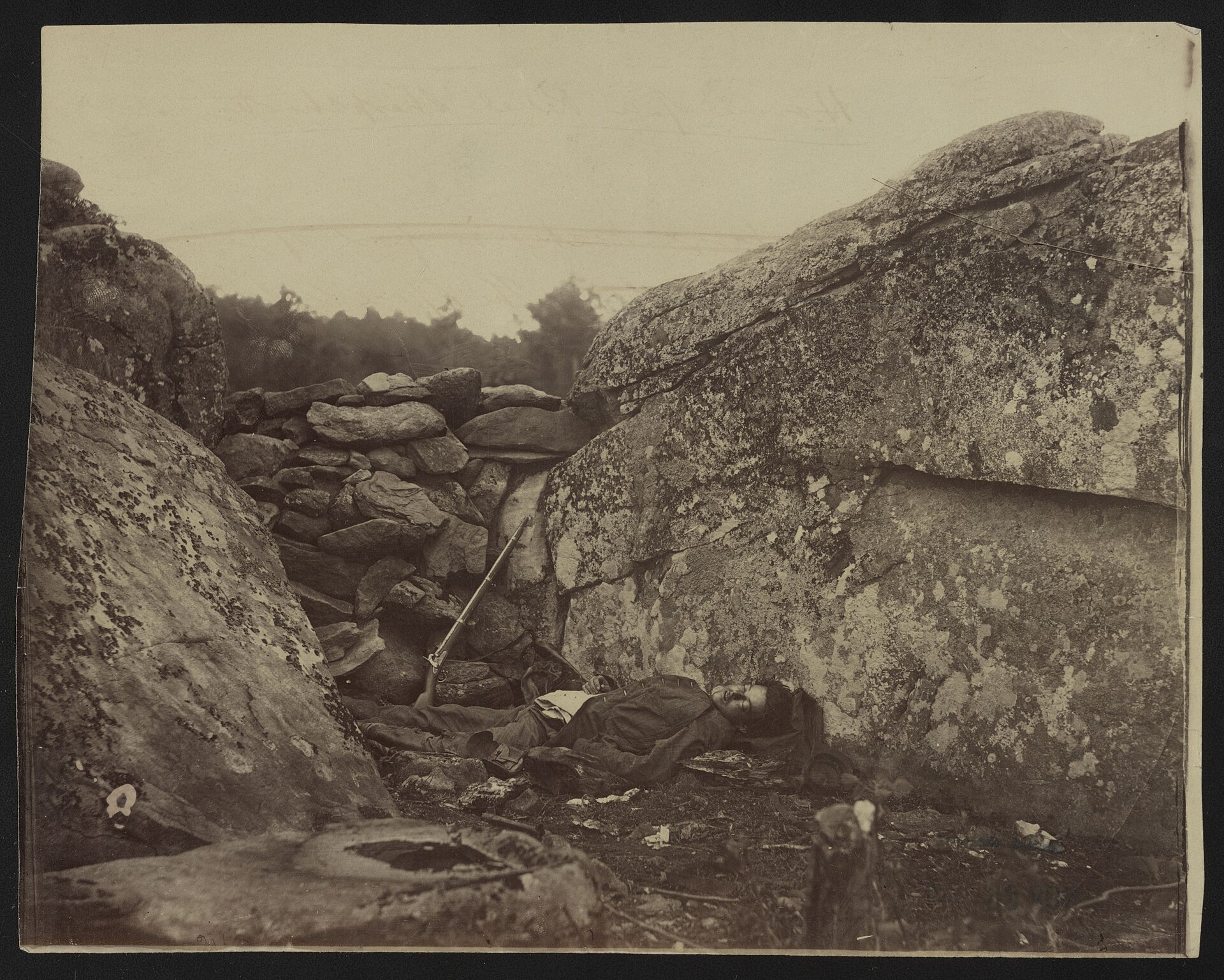
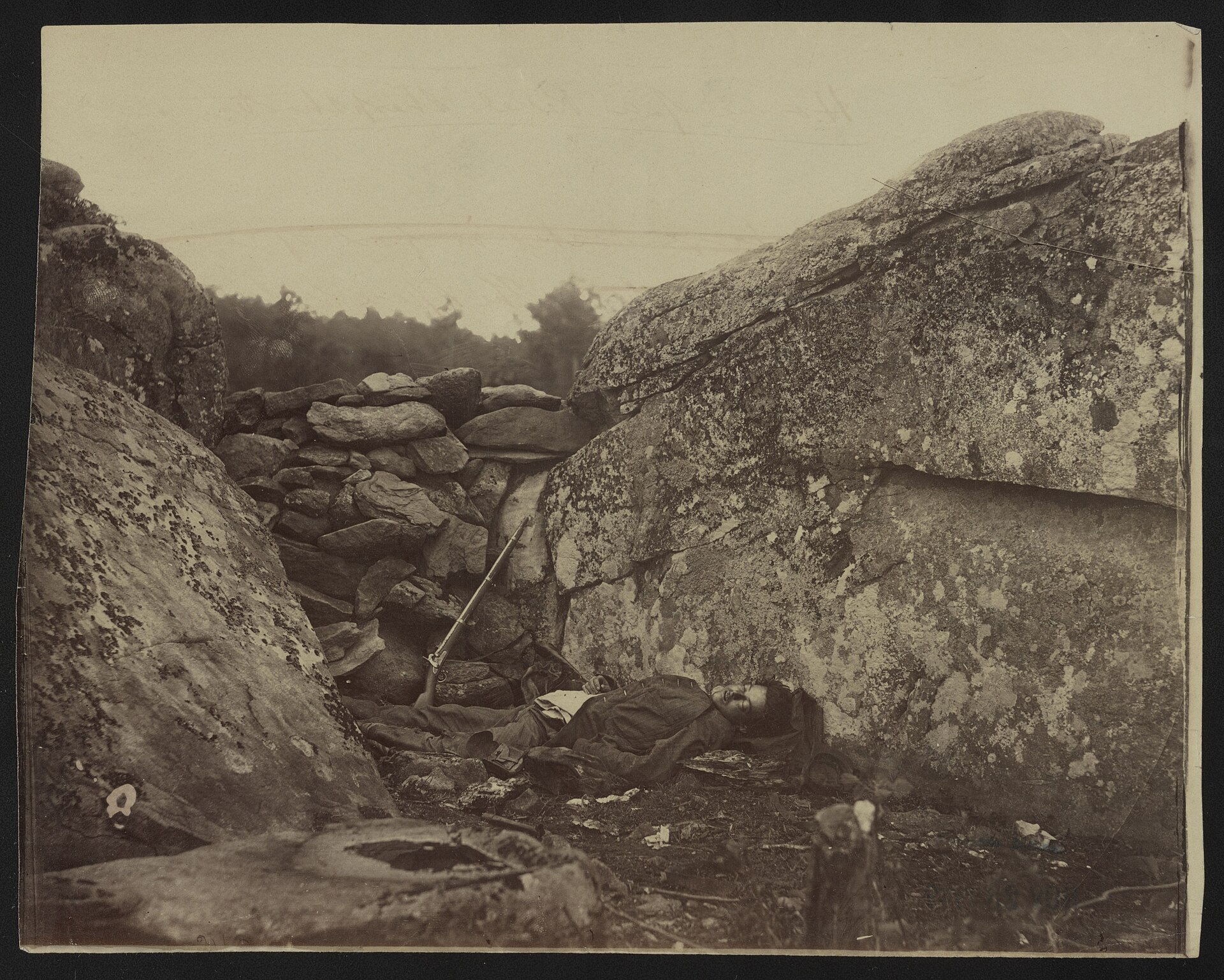
Home of a Rebel Sharpshooter
1863 · Albumen silver print from a wet collodion...
Library of Congress
 Scottish-American · 1821-1882
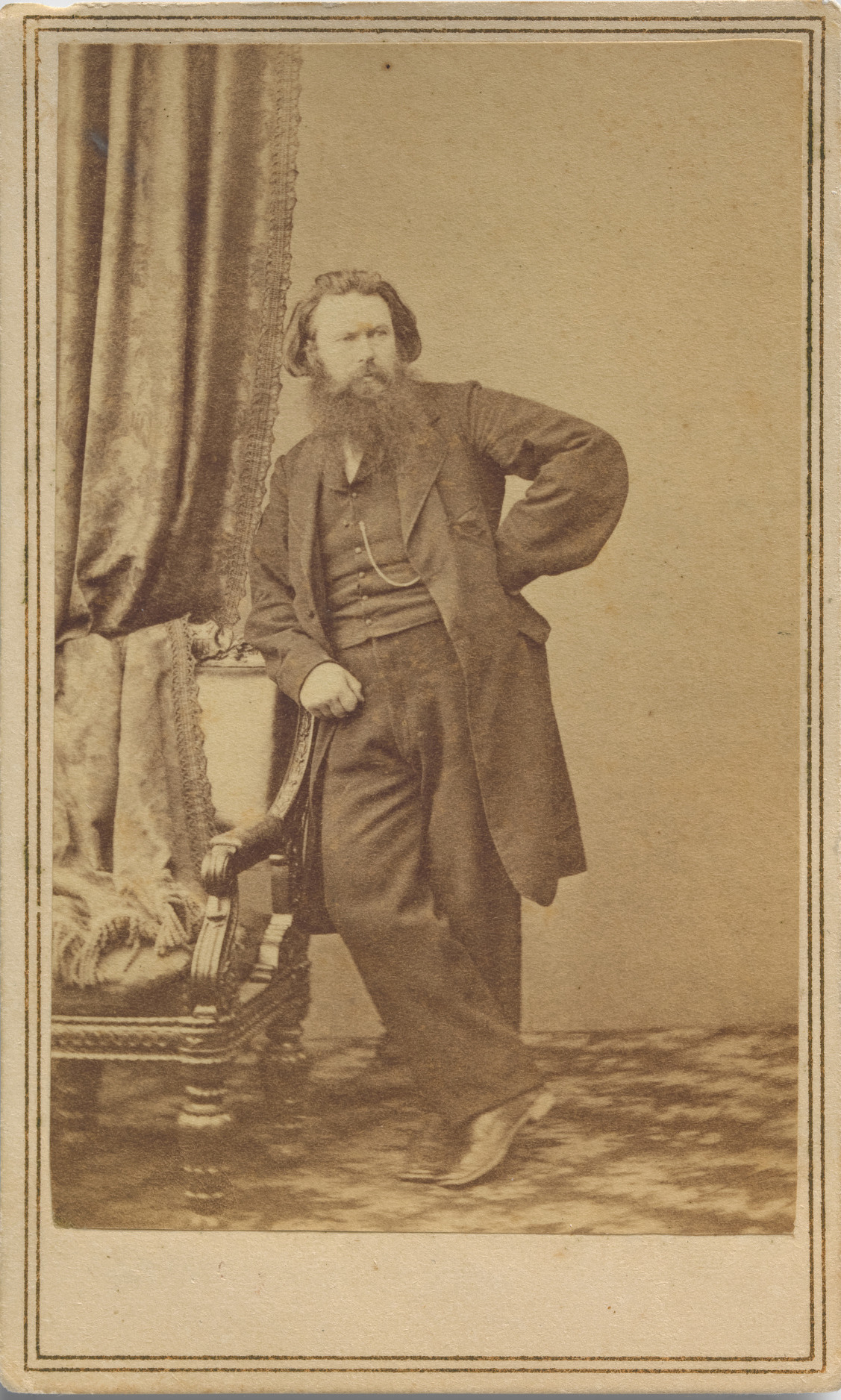
Gardner photographed at his own Washington gallery around 1864, presented as a settled Victorian gentleman rather than the frontiersman pose of an earlier self-portrait. Smithsonian curators have linked the change in self-presentation to the height of his Civil War reputation, built on the Antietam photographs and his standing as one of Lincoln's photographers. Held by the National Portrait Gallery, Smithsonian Institution.
National Portrait Gallery, Smithsonian Institution| Worked as | Photographer, Publisher, Newspaper editor |
|---|---|
| Born | 17 October 1821 · Paisley, Renfrewshire, Scotland |
| Died | 10 December 1882 · Washington, D.C |
| Nationality | Scottish-American |
| Movement | Civil War and frontier documentary photography |
| In this archive | 1 artwork |
| Sources | 32 cited |
| Last verified |
About this page 1 artwork in the archive · Last verified · 32 sources cited
Gardner is one of the two names Civil War photography is actually filed under, the other being his one-time employer Mathew Brady, and the difference between them is the whole point of his career. Brady published everything his staff made under a single line, Photographed by Brady. Gardner left Brady's studio in 1862 at least partly over that practice, opened his own gallery, and in 1866 published a two-volume album that did the opposite: it named eleven individual photographers by their own names, plate by plate. That album contains, at Plate 41, the single most consequential proof that a nineteenth-century war photograph can lie.
The photograph is Home of a Rebel Sharpshooter, and the man a reader probably does not know is William Frassanito, the historian who demonstrated in 1975 that Gardner's own field team moved a dead Confederate soldier's body into a more picturesque rock enclosure at Devil's Den, Gettysburg, and propped an ordinary infantry rifle beside it that no sharpshooter would have carried. The staging went unremarked in print for very nearly a century. It is now the textbook case for the limits of photographic evidence, and it sits inside a career that also produced the most reproduced photograph of Abraham Lincoln, the first photographs of American war dead the public was ever shown, a government-commissioned railway survey across four territories, and hundreds of studio portraits of Native American delegates brought to Washington under a federal policy that used population and industry to make its point before the negotiating even began.
Almost none of Gardner's negatives carry his signature, and no authenticating board has ever ruled on his corpus the way one might for a painter. What decides an attribution instead is a period sales catalogue, the printed imprint on a card mount, and the kind of ground-matching forensic work Frassanito did with a tape measure and a photograph of a rock. That is the correct frame for reading every claim on this page, including the ones made with confidence.
Born 17 October in Paisley, Renfrewshire, Scotland.4
Travels to the United States with his brother James intending to establish a co-operative community in Iowa; later returns to Scotland.9
Becomes owner and editor of the Glasgow Sentinel; sees Mathew Brady's photography exhibited at the Great Exhibition in London.4
Emigrates to the United States and joins Mathew Brady's photographic staff.4
Brady puts him in charge of his Washington, D.C. gallery as Brady's eyesight fails.49
Photographs Lincoln before his first inauguration (February); granted the honorary rank of Captain on General George B. McClellan's staff (November).413
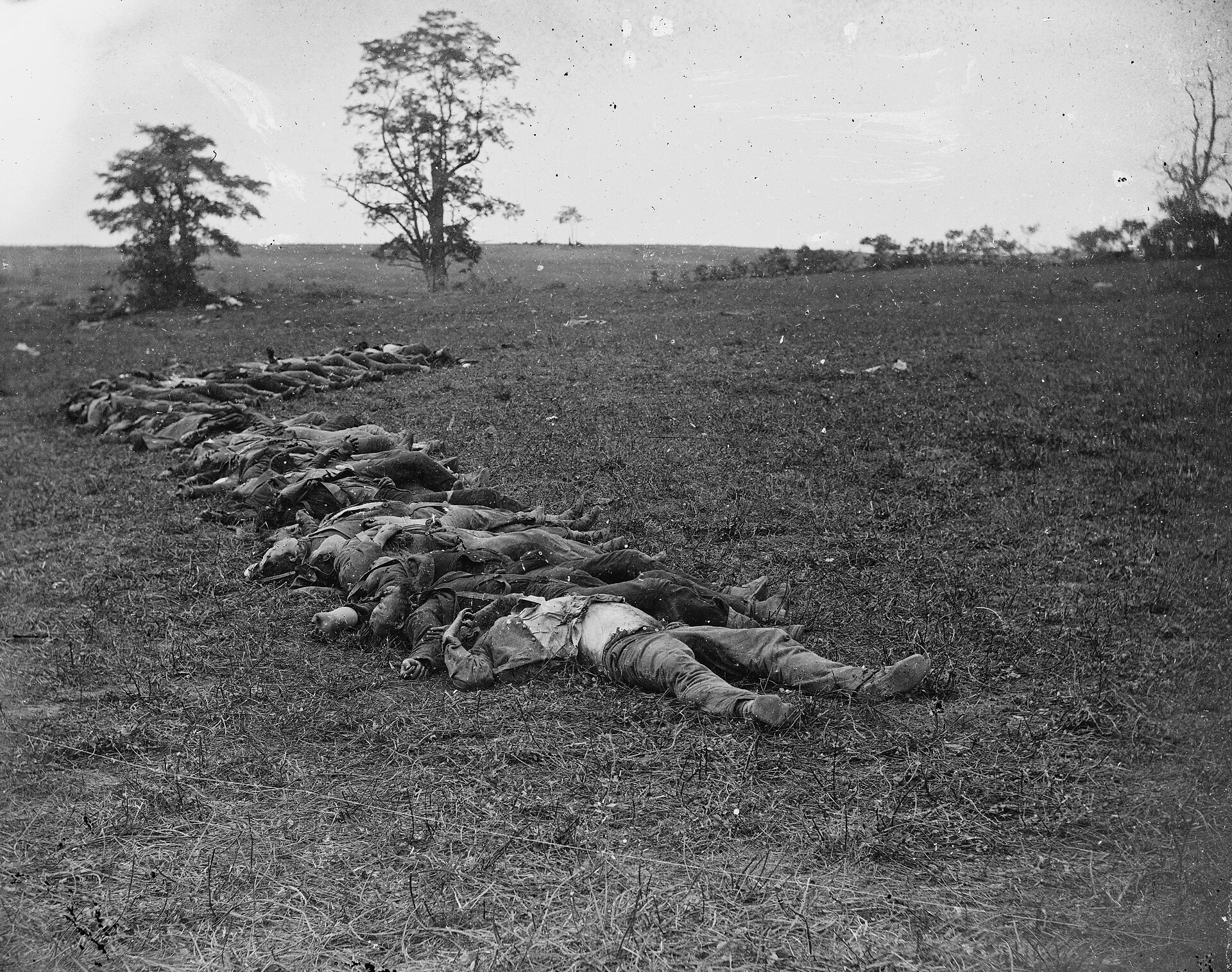
On 19 September, two days after the Battle of Antietam, photographs the battlefield dead with James Gibson before burial, the first time an American battlefield had been photographed this way; on 3 October photographs Lincoln's visit to McClellan's headquarters at the same site.91123
The New York Times reviews Brady's exhibition The Dead of Antietam on 20 October, crediting Brady by name and not mentioning Gardner or Gibson.10
Leaves Brady's employ around November, reportedly over a dispute about individual photographer credit.49
Opens his own Washington gallery with his brother James in May, hiring former Brady staff including Timothy O'Sullivan.49
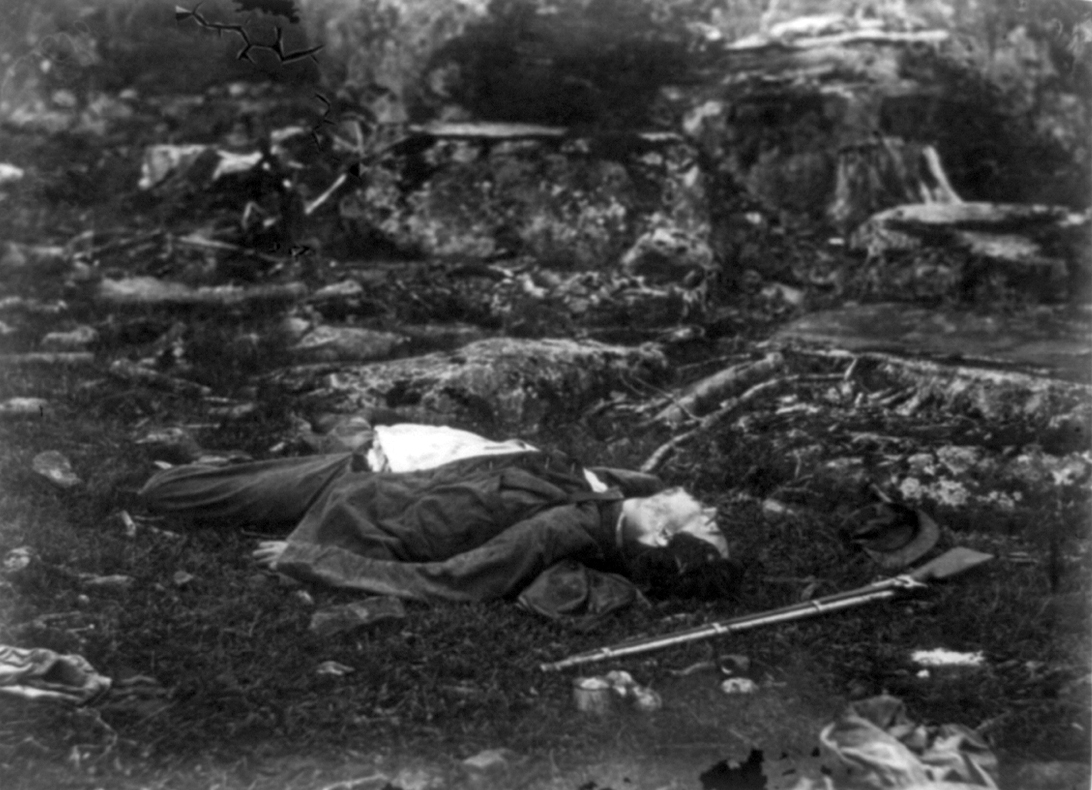
In early July, Gardner's Gettysburg field team photographs the staged Devil's Den sharpshooter scenes; his own September 1863 sales catalogue credits Timothy O'Sullivan as the cameraman.123
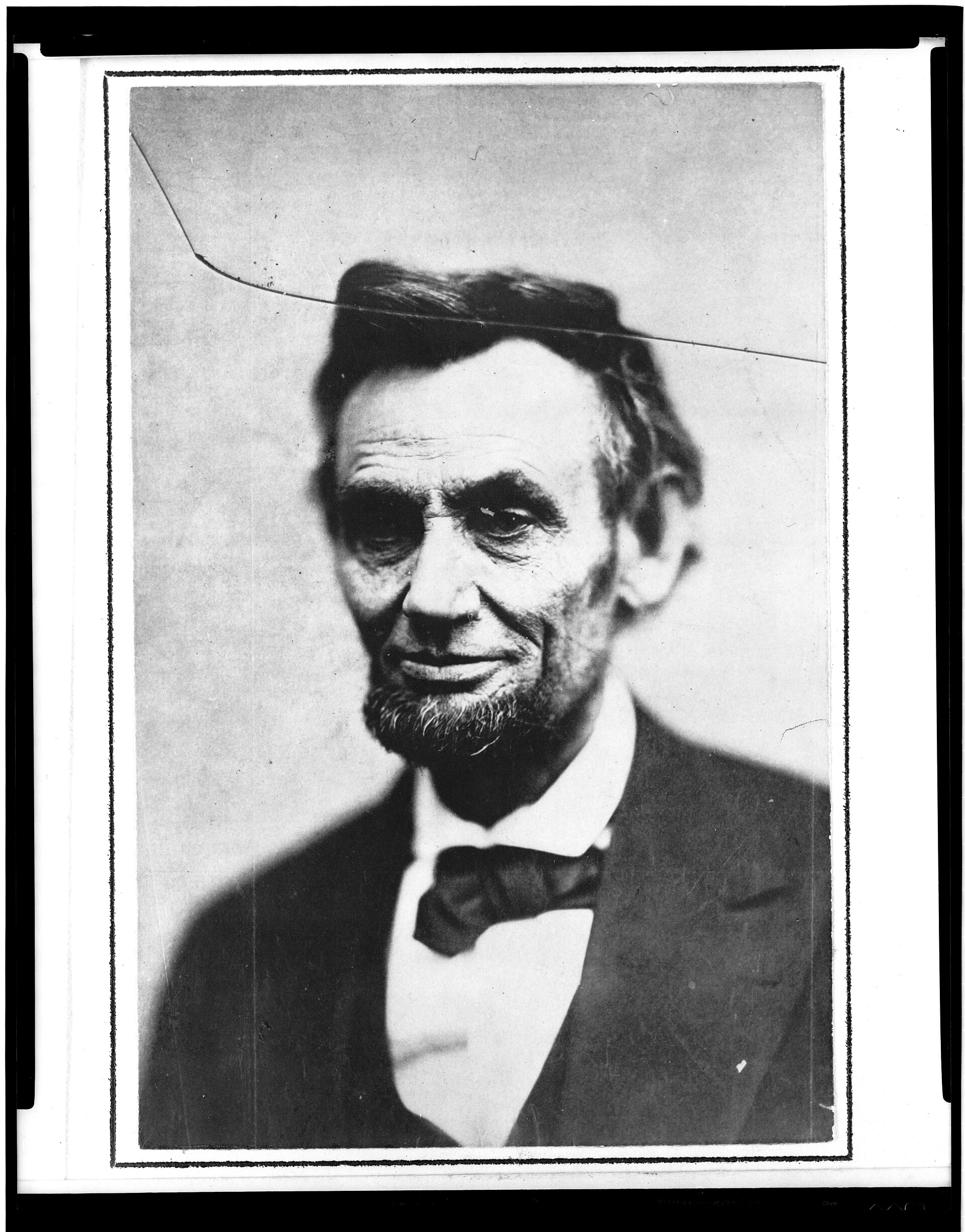
On 5 February, at his own gallery, makes the cracked-plate portrait of Lincoln in what is traditionally described as the president's last formal sitting.12
Photographs Lincoln's funeral and, on 7 July, the execution of four convicted conspirators in his assassination.9
Publishes Gardner's Photographic Sketch Book of the War in two volumes (1865-66), naming eleven individual photographers across one hundred tipped-in albumen plates.34
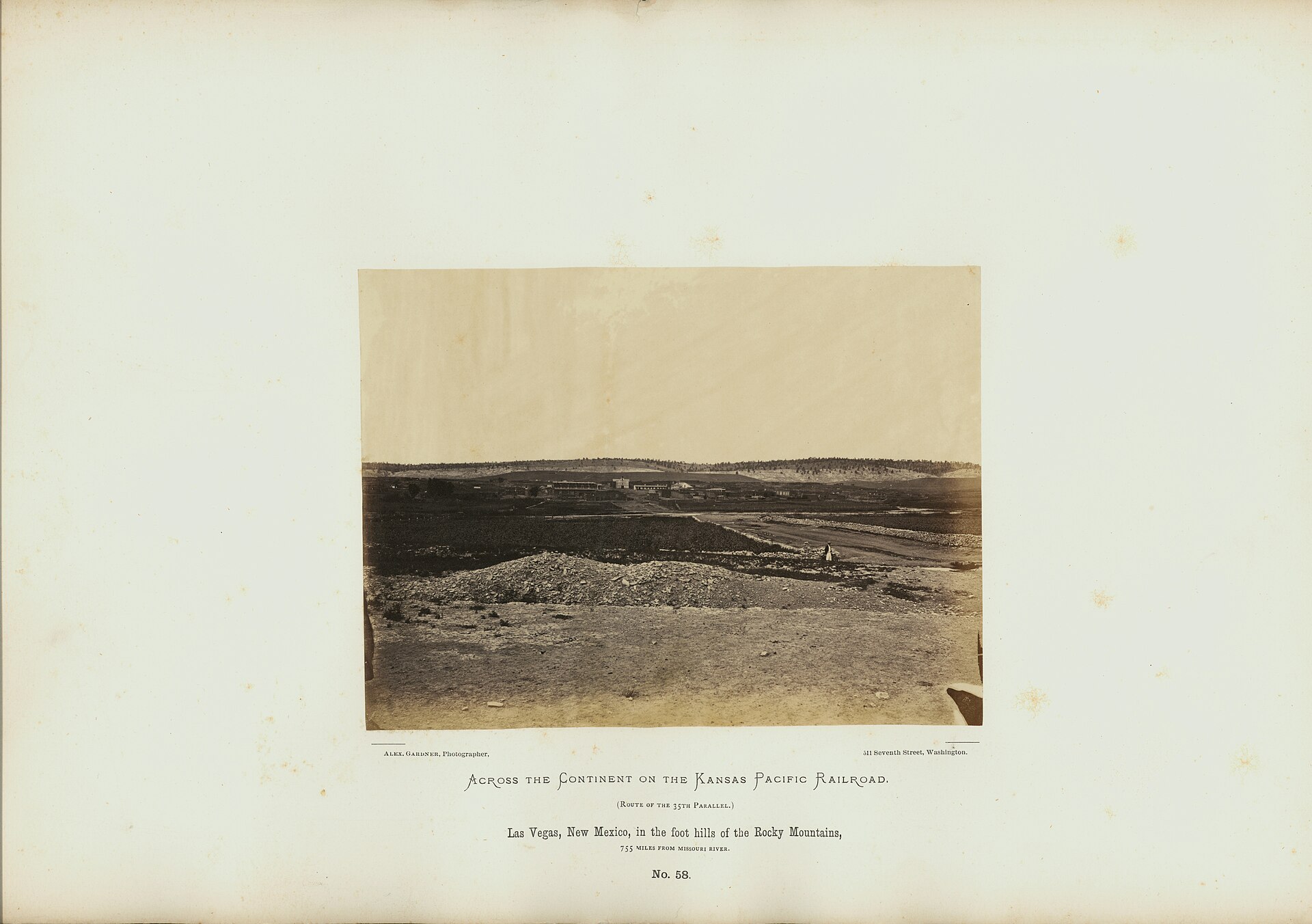
Appointed chief photographer for the survey of the Union Pacific Railway, Eastern Division, renamed the Kansas Pacific Railway in March 1869; joins the survey party at St. Louis that autumn.19
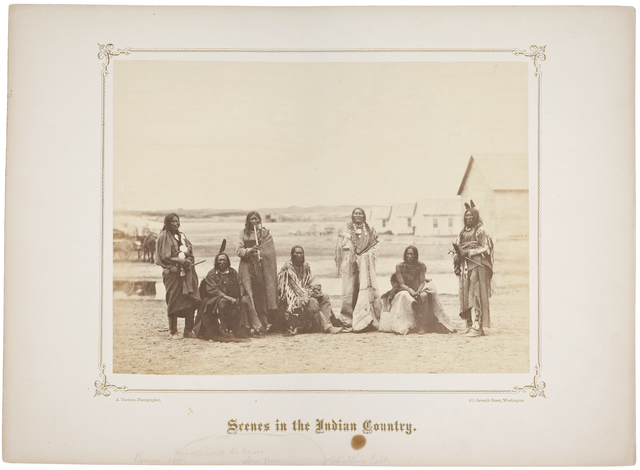
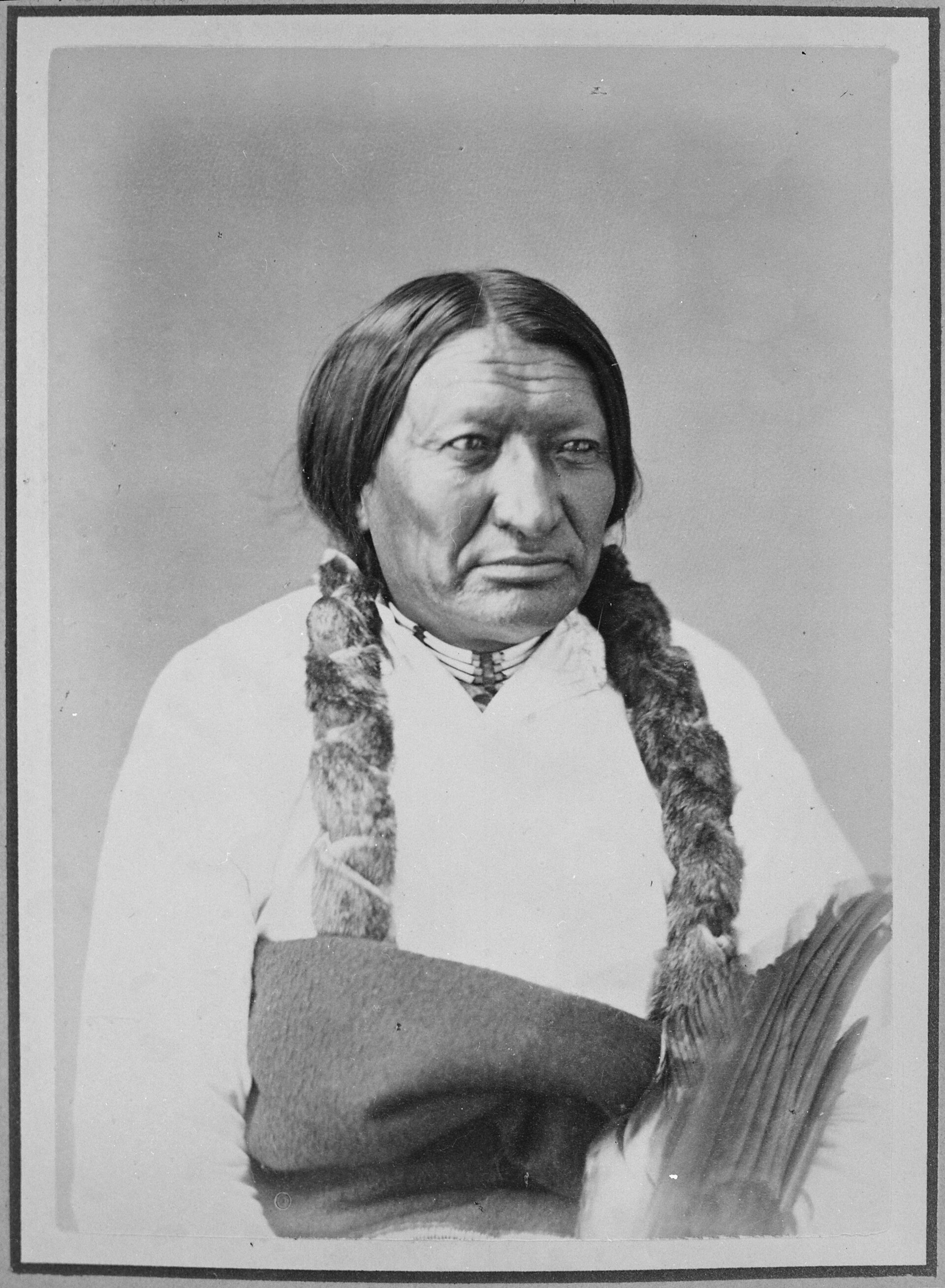
Serves April to November as official photographer to the federal commission negotiating the Fort Laramie Treaty, producing roughly two hundred glass negatives of Sioux, Crow, Northern Cheyenne and Northern Arapaho delegates.14
Photographs members of Sioux delegations visiting Washington under the Grant administration's Peace Policy; the National Archives catalogues the series as Alexander Gardner Portraits of Tribal Delegations to the Federal Government.16
Dies 10 December in Washington, D.C.; buried at Glenwood Cemetery.4
The National Portrait Gallery mounts Dark Fields of the Republic: Alexander Gardner Photographs, 1859-1872, the Smithsonian's first major retrospective of his work.1213
Jane L. Aspinwall, for the Nelson-Atkins Museum of Art, publishes the first and so far only catalogue raisonne of any part of Gardner's output, covering the 1867-68 Kansas Pacific and Fort Laramie series.20
Christie's sells two Gardner-attributed Richmond views deaccessioned from the Metropolitan Museum of Art in an online sale, 7 October.21
The market for Gardner divides into two tiers that do not really compare. A vintage period print, especially one bound into a surviving copy of the 1866 Sketch Book or carrying a clear period Gardner-studio mount, is a rare object: roughly seventy-three complete Sketch Book copies are recorded to survive at all. A complete first-edition set sold at Skinner in November 2013 for a hammer price of $192,000, reported as thirteen percent above estimate. Individual loose prints from Gardner's other Civil War work trade far lower: at an online Christie's sale of Civil War photography deaccessioned by the Metropolitan Museum of Art on 7 October 2021, two Gardner-attributed Richmond views estimated at $2,000 to $3,000 each realised $6,000 and $6,250 respectively, with the auction house's own reporting folding buyer's premium into both figures rather than separating hammer from premium. For comparison, the single highest price in that same 168-lot sale went to a print attributed to Timothy O'Sullivan, which sold for $15,000 against a $4,000-6,000 estimate, more than double its high estimate, while the sale as a whole saw a 36 percent buy-in rate, suggesting real softness in demand for this material outside a handful of standout lots. A period print titled Lincoln and His Generals at Antietam on what a dealer described as the original Alexander Gardner mount is reported to have sold at Heritage Auctions in December 2023 for $23,750, a figure sourced here from that dealer's own resale listing rather than independently checked against Heritage's price-realized database. No auction record for a period print of Home of a Rebel Sharpshooter itself, Gardner's single most historically significant image, was located in the sources consulted for this record; if one exists, it should replace this gap rather than be assumed from the prices above. Separately from any of this, most people who believe they have seen a Gardner photograph have in fact seen a modern digital reproduction made from a negative the Library of Congress now holds and distributes freely as a public-domain scan, a market of zero rather than a market of thousands of dollars, which is worth stating plainly rather than leaving implied.
| Date | Sale | Work | Result | Note |
|---|---|---|---|---|
| 2013-11 | Skinner | Gardner's Photographic Sketch Book of the War, complete first edition, two volumes | Hammer $192,000 With premium not separately stated in the source consulted USD | Reported as thirteen percent above estimate; the specific estimate figures were not given in the source consulted. |
| 7 October 2021 | Christie's (online) | Northeast Suburbs of Richmond, Virginia, April 1865 | Hammer not separately stated With premium $6,000 (price realized, premium included per the auction house's own reporting) USD | Lot 138, Metropolitan Museum of Art deaccession; estimate $2,000-3,000. |
| 7 October 2021 | Christie's (online) | Ruins of the Arsenal, Richmond, Virginia, after Evacuations, 1865 | Hammer not separately stated With premium $6,250 (price realized, premium included per the auction house's own reporting) USD | Lot 139, same sale as above; estimate $2,000-3,000. |
| 2023-12 | Heritage Auctions | Lincoln and His Generals at Antietam (period print on the original Alexander Gardner mount) | Hammer not stated With premium $23,750 (as reported) USD | Figure sourced from a dealer's resale listing citing this Heritage sale, not independently verified against Heritage's own price-realized database. |
Hammer is the price at which the bidding stopped; with premium adds the fee the house charges the buyer on top. Hammer price and buyer's premium in the glossary.
| Institution | City | Holdings | Note |
|---|---|---|---|
| Library of Congress, Prints and Photographs Division | Washington, D.C. | The bulk of the Civil War glass-negative collection, purchased in 1943: roughly 7,500 original negatives and 2,500 copy negatives from the Brady-Gardner operation as a whole, including Home of a Rebel Sharpshooter, A Sharpshooter's Last Sleep, the Antietam dead and multiple Lincoln portraits, digitized and public domain. | |
| National Portrait Gallery, Smithsonian Institution | Washington, D.C. | Gardner's self-portraits and the unique surviving print of the 5 February 1865 cracked-plate Lincoln portrait; mounted the 2015-16 retrospective Dark Fields of the Republic: Alexander Gardner Photographs, 1859-1872. | |
| National Archives at College Park | College Park, Maryland | Record Group 75, series 75-ID, Alexander Gardner Portraits of Tribal Delegations to the Federal Government, 1872; also holds War Department-custody prints of Civil War subjects independent of the Library of Congress collection. | |
| Nelson-Atkins Museum of Art | Kansas City, Missouri | Holdings of the 1867-68 Kansas Pacific Railway and Fort Laramie treaty photographs that form the subject of the 2016 catalogue raisonne. | |
| Metropolitan Museum of Art | New York | Civil War-era photography, part of which was deaccessioned and sold at Christie's in October 2021. | |
| Missouri History Museum | St. Louis, Missouri | Prints from the Kansas Pacific Railway survey album, including plates of New Mexico and Colorado towns along the route. | |
| Kansas Historical Society | Topeka, Kansas | Kansas Pacific survey views documenting the earliest photographic record of several Kansas towns. |
Gardner was not trained as a photographer.
Gardner was not trained as a photographer. He was apprenticed as a jeweler from the age of fourteen for seven years, and took evening classes at the Glasgow Athenaeum in astronomy, optics, physics and chemistry, a curriculum that happens to cover most of what wet-plate photography actually requires. In 1851 he became owner and editor of the Glasgow Sentinel, which he built into one of the largest papers in the city, and that same year he saw Mathew Brady's photography on display at the Great Exhibition in London, an encounter he later credited as his introduction to the medium.
He emigrated to the United States in 1856, already skilled in the wet-plate collodion process, and joined Brady's staff. Two years later, as Brady's eyesight began to fail, Brady put him in charge of the Washington, D.C. gallery. Gardner's own Photographic Sketch Book of the War would later refer to him, in its own captions, in the third person, as the artist, not as photographer or reporter. That is a documented self-conception, not a modern reading: it is his own byline, and it matters, because a man who thought of himself as the artist rather than the recorder is exactly the kind of photographer capable of composing a scene rather than merely finding one.
On 19 September 1862, two days after the battle, Gardner and his colleague James Gibson photographed the Antietam battlefield before the burial parties had finished their work.
On 19 September 1862, two days after the battle, Gardner and his colleague James Gibson photographed the Antietam battlefield before the burial parties had finished their work. It was the first time an American battlefield had been photographed with the dead still lying where they fell, and the two men made roughly seventy views.
In October 1862 a selection went on display at Brady's New York gallery under a sign reading The Dead of Antietam. The New York Times reviewed the exhibition on 20 October 1862, writing that Brady had done something to bring home to us the terrible reality and earnestness of war, and that if he had not brought bodies and laid them in our door-yards and along the streets, he had done something very like it. The review is instructive for what it does not say: it credits Brady by name and does not mention Gardner or Gibson, the men who had actually exposed the negatives two days after the battle. The same erasure of individual credit that the review performs without comment is the exact practice Gardner would break with within weeks.
Gardner left Brady's employ around November 1862, after General George B.
Gardner left Brady's employ around November 1862, after General George B. McClellan, whom Gardner had photographed extensively as a staff photographer, was relieved of command. The break is attributed to a dispute over credit: Brady's studio published every photograph made by any of his employees under the single line Photographed by Brady, which is precisely what had just happened to the Antietam pictures in the New York Times.
Gardner opened his own Washington gallery with his brother James in May 1863, hiring several former Brady staff, including Timothy O'Sullivan. His two-volume Photographic Sketch Book of the War, published in 1865-66, named eleven individual photographers across its hundred plates, crediting negative-maker and print-maker separately for each, a direct and deliberate departure from Brady's practice. O'Sullivan contributed the largest number of plates of any single photographer in the book. Set against that, Plate 41's own caption, crediting only Alex. Gardner, photographer, is an outlier inside a project otherwise built to correct exactly that kind of erasure, and the outlier is not incidental. It sits on the single most disputed image of Gardner's career.
In early July 1863, days after the battle, Gardner's field team photographed a dead Confederate soldier at Devil's Den.
In early July 1863, days after the battle, Gardner's field team photographed a dead Confederate soldier at Devil's Den. Plate 41 of the Sketch Book, Home of a Rebel Sharpshooter, shows the body wedged into a constructed stone breastwork with a rifle propped beside it; Gardner's caption presents the scene as a chance discovery of a sharpshooter's post, complete with a claim that he revisited the spot in November 1863 and found the man's skeleton still lying undisturbed.
It was not a chance discovery. The same corpse appears in a second photograph, A Sharpshooter's Last Sleep, published as Plate 40, lying in a more exposed position on the southern slope of Devil's Den, without the constructed stone enclosure. Historian William Frassanito, in his 1975 book Gettysburg: A Journey in Time, matched the surrounding boulders and rock formations across both photographs and the ground itself, and established that Gardner's team moved the body roughly forty yards, an estimate Frassanito himself later revised to approximately seventy-two yards after a 1995 ground survey. The rifle in the sharpshooter's-nest photograph is an ordinary Springfield-pattern infantry weapon, not a sharpshooter's rifle, which undercuts Gardner's own caption on its own terms. The manipulation went unremarked in print for nearly a century, noted only in a brief 1961 magazine article by Frederic Ray before Frassanito's book-length documentation. Camera credit for the pair is itself unresolved between Gardner, who claimed Plate 41 in his own Sketch Book; Timothy O'Sullivan, credited in Gardner's own September 1863 sales catalogue; and James Gibson, proposed by a 2014 Gettysburg National Military Park review as the possible operator of the companion stereo view. No signature or maker's mark exists on the negative. This is the same object and the same dispute already documented in full on this site's own record for Home of a Rebel Sharpshooter, and the two pages should be read together.
Viewers who queued at Brady's New York gallery in October 1862 to see the Antietam dead were looking at something they had never had access to before: photographic, and therefore in the period's own...
Viewers who queued at Brady's New York gallery in October 1862 to see the Antietam dead were looking at something they had never had access to before: photographic, and therefore in the period's own understanding mechanical and unmediated, evidence of the human cost of a battle. A photograph was assumed to record what stood in front of the lens without a hand shaping the account, in a way a painting or an engraving plainly could not claim to.
Gardner's own working practice sits inside that assumption and complicates it at the same time. He built narrative captions for his plates, up to and including an unverifiable claim to have returned to Devil's Den months later and found a skeleton undisturbed, and he described himself in the third person as the artist, a word that implies composition and design rather than passive recording. Frassanito's demonstration that the sharpshooter's body was moved and re-staged is not a claim that Gardner invented a scene from nothing; the man was genuinely dead at Devil's Den. It is a demonstration that the single kind of evidence nineteenth-century viewers trusted precisely because they believed a camera could not lie was, in this instance, arranged by the person operating it before the shutter ever opened. The caption that ran opposite the plate in 1866 asked readers to believe they were seeing an unstaged discovery. Nothing in the photograph itself would have told them otherwise, and nothing did, for the better part of a hundred years.
Gardner's Washington gallery, at 7th and D Streets NW, stood within walking distance of the White House and the War Department, and he photographed Lincoln repeatedly across the war, including before...
Gardner's Washington gallery, at 7th and D Streets NW, stood within walking distance of the White House and the War Department, and he photographed Lincoln repeatedly across the war, including before his first inauguration in February 1861. The best known sitting came on Sunday, 5 February 1865, at Gardner's own gallery. According to the Smithsonian's National Portrait Gallery, Gardner took several multiple-lens exposures that day before asking Lincoln for one further, closer pose; the glass negative for that final exposure cracked, and Gardner was able to pull only a single print, carrying an ominous fracture across the president's face, before the plate broke apart entirely and was discarded.
It was the last formal portrait sitting Lincoln gave before his assassination two months later; the Library of Congress's own catalogue title for its digitization is more careful, describing the print as traditionally called the last photograph of Lincoln from life, a phrasing that flags the claim as a durable tradition rather than a documented certainty. The unique surviving print is held by the National Portrait Gallery.
Gardner's studio photographed Lincoln's funeral procession in Washington and, on 7 July 1865, the execution by hanging of four of the convicted conspirators in his assassination, Mary Surratt, Lewis...
Gardner's studio photographed Lincoln's funeral procession in Washington and, on 7 July 1865, the execution by hanging of four of the convicted conspirators in his assassination, Mary Surratt, Lewis Powell, David Herold and George Atzerodt, taken from the roof of the Old Arsenal Penitentiary. Those images, along with photographs of the conspirators themselves during their imprisonment and trial, extended into judicial and penal subject matter a documentary practice Gardner had built on battlefields, and they remain among the most widely reproduced photographs of the immediate postwar period.
In 1867 Gardner was appointed chief photographer for the survey of the Union Pacific Railway, Eastern Division, renamed the Kansas Pacific Railway in March 1869.
In 1867 Gardner was appointed chief photographer for the survey of the Union Pacific Railway, Eastern Division, renamed the Kansas Pacific Railway in March 1869. That fall he travelled from Washington to St. Louis to join the survey party seeking the best route for the proposed southern branch of the transcontinental railroad, then continued with it through Kansas, Colorado, New Mexico and Arizona toward San Francisco, supervising photographers William A. Bell and William R. Pywell alongside his own camera. The resulting views, published as Across the Continent on the Kansas Pacific Railroad, Route of the 35th Parallel, ran to approximately one hundred fifty images documenting street scenes, new towns such as Ellsworth and Hays, established cities including Topeka and Lawrence, geological formations, and the survey crew itself. The glass-plate negatives had to be coated, exposed and developed within about an hour, which meant Gardner's outfit travelled with a portable darkroom across territory that had none.
In April 1868 Gardner was hired as official photographer to the federal commission negotiating what became the Fort Laramie Treaty.
In April 1868 Gardner was hired as official photographer to the federal commission negotiating what became the Fort Laramie Treaty. He arrived at the fort on 29 April, days after the Brule leaders Spotted Tail, Red Leaf and Swift Bear had signed, and remained through a summer of further signings by Crow, Northern Cheyenne, Northern Arapaho and Oglala leaders, producing roughly two hundred glass negatives: eight-by-ten prints supplied to the commissioners and stereo views sold to the public. He photographed named chiefs including Spotted Tail, Man Afraid of His Horses and Lone Horn, together with camp life, gift distributions, tipis and the fort's own buildings. General William Tecumseh Sherman, one of the commissioners, stated the treaty's aim as moving the tribes toward what he called their ultimate civilization; the commission's broader purpose was to open ceded land to settlers while formally recognising tribal sovereignty over what remained, an arrangement that within a decade the United States would not honour. This body of work, together with the Kansas Pacific survey, is the subject of the only catalogue raisonne that exists for any part of Gardner's output, published in 2016.
The National Archives holds a series, in Record Group 75, catalogued as Alexander Gardner Portraits of Tribal Delegations to the Federal Government, 1872, comprising studio portraits Gardner made in...
The National Archives holds a series, in Record Group 75, catalogued as Alexander Gardner Portraits of Tribal Delegations to the Federal Government, 1872, comprising studio portraits Gardner made in Washington of members of Sioux delegations, including Brule, Sans Arc and Yanktonai bands, who travelled to the capital that year under the Grant administration's Peace Policy. Bringing tribal delegates to Washington served a documented diplomatic purpose beyond negotiation: officials used the visits to demonstrate the scale of American population, wealth and industrial power before talks began. In May 1872, addressing a separate Sioux delegation led by Red Cloud, Interior Secretary Columbus Delano told the assembled chiefs that white people were, in his words, in number as the blades of grass upon the hill-side, and the number increases every day, an explicit statement of the strategy that shaped these visits generally. Red Cloud's own May 1872 sitting is credited by a contemporary newspaper to Brady's gallery rather than Gardner's, a reminder that more than one Washington studio worked this circuit in the same year and that individual sittings need to be checked rather than assumed; the National Archives series specifically attributed to Gardner covers other Sioux delegates photographed later that year.
Nothing resembling a complete catalogue of Gardner's output exists.
Nothing resembling a complete catalogue of Gardner's output exists. The Library of Congress's 1943 purchase of the Civil War glass-negative collection alone brought in roughly 7,500 original negatives and a further 2,500 copy negatives, covering work by Brady, Gardner and others together, and the Library's own published history of the collection states that after six changes of ownership before that purchase, it remains uncertain exactly which images were made by Brady, which by Gardner's independent operation, and what was added by each subsequent owner. The one true catalogue raisonne that has been produced, Jane L. Aspinwall's 2016 volume for the Nelson-Atkins Museum of Art, deliberately covers only the two 1867-68 western series, the Kansas Pacific survey and the Fort Laramie photographs; it does not extend to the Civil War work, the Lincoln sittings, or the 1872 Washington delegation portraits, none of which has been catalogued to that standard. For the Lincoln photographs specifically, Charles Hamilton and Lloyd Ostendorf's Lincoln in Photographs: An Album of Every Known Pose, first published in 1963, supplies the O-numbers still used to identify individual sittings, including Gardner's, but it catalogues every surviving photograph of Lincoln by any photographer, not Gardner's output as such. No authenticating board rules on any of it. Attribution proceeds image by image, on a period sales catalogue, a studio imprint on a card mount, or documentary detective work of the kind Frassanito applied at Devil's Den.
Gardner gave up photography in 1871 to help found an insurance company; its name is not established in the sources consulted for this record.
Gardner gave up photography in 1871 to help found an insurance company; its name is not established in the sources consulted for this record. He remained in Washington, D.C. until his death on 10 December 1882, and is buried at Glenwood Cemetery in the city where he had built and lost a studio, opened a second one, and photographed a war, a president, a railroad and a federal Indian policy, largely without putting his own name reliably on any of it.
Three unresolved questions run through Gardner's career rather than one photograph.
Three unresolved questions run through Gardner's career rather than one photograph. Camera credit for his most famous and most disputed image is still divided between three men. His total surviving output has never been catalogued as a whole, only in two carved-out pieces covering the American West. And the market for his work runs in two currencies that do not convert into each other: a handful of vintage albumen prints that occasionally reach five figures at auction, and millions of freely reproducible modern scans of negatives the Library of Congress now holds in the public domain, which is how most people who think they have seen a Gardner photograph actually encountered it.
Photographer; Publisher; Newspaper editor. 1821-1882.
Born 17 October 1821, Paisley, Renfrewshire, Scotland; died 10 December 1882, Washington, D.C.
Library of Congress, Prints and Photographs Division (Washington, D.C.); National Portrait Gallery, Smithsonian Institution (Washington, D.C.); National Archives at College Park (College Park, Maryland); Nelson-Atkins Museum of Art (Kansas City, Missouri); Metropolitan Museum of Art (New York); Missouri History Museum (St. Louis, Missouri).
The market for Gardner divides into two tiers that do not really compare. A vintage period print, especially one bound into a surviving copy of the 1866 Sketch Book or carrying a clear period Gardner-studio mount, is a rare object: roughly seventy-three complete Sketch Book copies are recorded to survive at all.
Who actually exposed the Home of a Rebel Sharpshooter negative: Gardner, Timothy O'Sullivan, or James Gibson? Gardner's own 1866 caption, his own 1863 sales catalogue and later historical review do not agree.
Last verified
One artwork and its story every Tuesday, with the picture: who owned it, what it made, and what closes soon in the exhibition calendar. No promotion, and nothing we cannot cite.
We send one email to confirm the address and keep nothing else. Every letter carries a one-click unsubscribe. How we handle your data.


