Adelaide Labille-Guiard
 French · 1749-1803
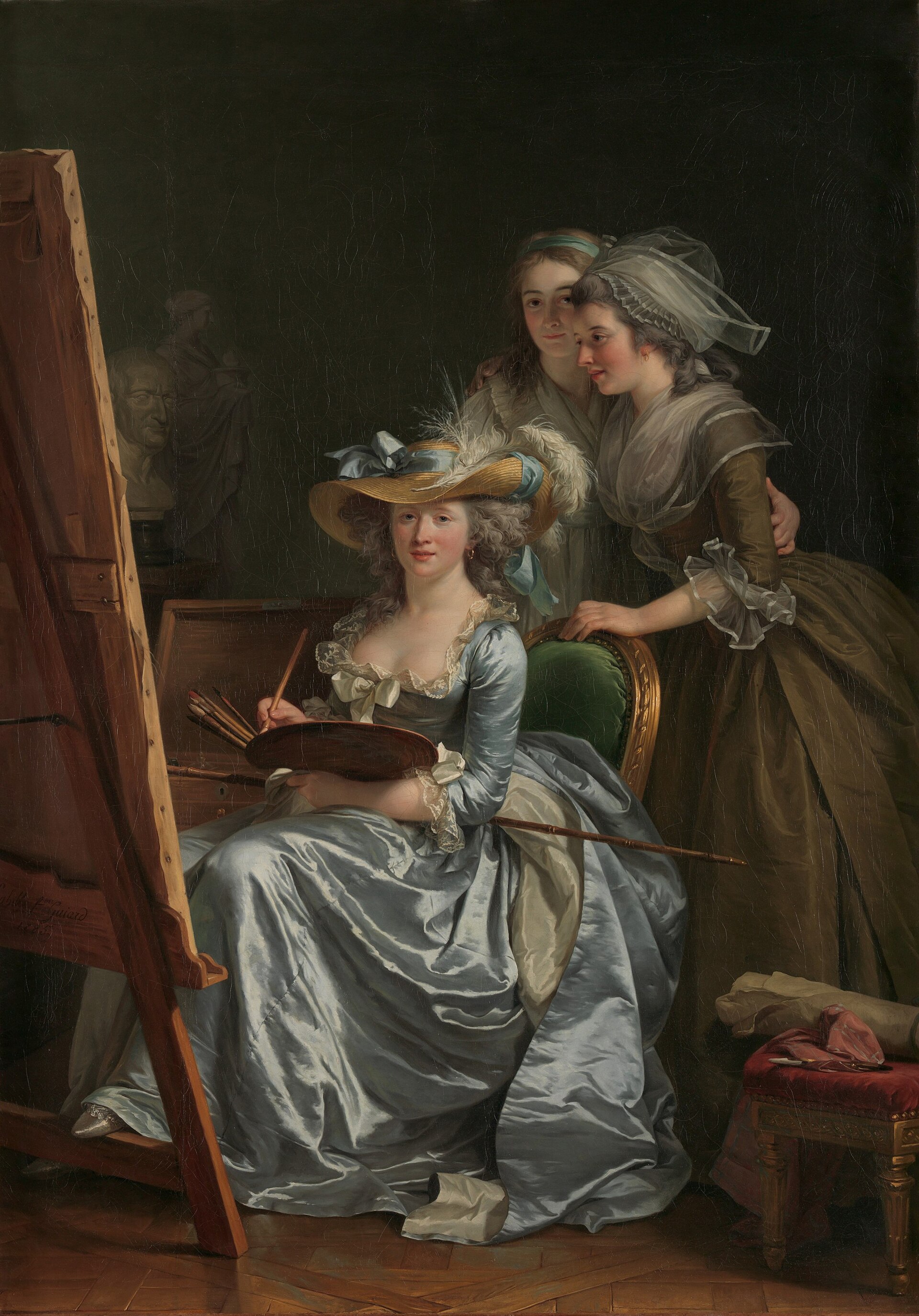
Self-Portrait with Two Pupils, 1785, oil on canvas, Metropolitan Museum of Art (53.225.5). Her own picture of herself at the easel; the museum and Versailles both treat the central figure as the artist, and her features match the 1782 pastel self-portrait (sources 2, 3).
The Metropolitan Museum of Art, New York (public domain; Commons PD-art)| Full name | Adelaide Labille, called Labille-Guiard (Madame Guiard, then Madame Vincent) |
|---|---|
| Worked as | Painter, Pastellist, Miniaturist, Teacher |
| Born | 11 April 1749 · Paris |
| Died | 24 April 1803 · Paris |
| Nationality | French |
| Movement | French eighteenth-century portraiture |
| Sources | 14 cited |
| Last verified |
About this page Last verified · 14 sources cited
On this page 13 sections
ContentsClose
Adelaide Labille-Guiard was a Paris portraitist who made her name in pastel, went on to large oils, and became received by the Academie royale de peinture et de sculpture in the same session as Elisabeth Vigee Le Brun on 31 May 1783. Her best-known picture is the 1785 self-portrait with two pupils in the Metropolitan Museum.
Her largest royal commission, for the Comte de Provence, was destroyed on the new regime's order, and most of what survives is bust-length pastel. That is why the printed catalogues disagree: Passez counted 183 numbers in 1973, and the Baillio-Auricchio revision of 2009 added 23 and removed 25 (source 1).
The thing a reader probably does not know is how much of her reputation is recent. Her self-portrait was refused by the Louvre in 1878 as without artistic value; the auction record for her work was set in 2026 (sources 1, 5).
Images
Chronology
- 1749
Born in Paris on 11 April, baptised the next day at Saint-Eustache.1
- 1769
Marries Nicolas Guiard, a clerk in the receiver-general's office of the clergy. By then she is a member of the Academie de Saint-Luc.1
- 1774
Exhibits a pastel and a miniature at the Academie de Saint-Luc.1
- 1779
Formal separation from Guiard; the divorce follows in 1793 once the new law allows it. English Wikipedia dates the separation to 1777.16
- 1782
First exhibits at the Salon de la Correspondance in May; the June showing includes a pastel self-portrait signed and dated 1782 and her pastel of Vincent.13
- 1783
On 31 May received, with Vigee Le Brun, by the Academie royale; shows the pastel of Pajou and the Madame Mitoire and her children pastel at the Salon (no. 131).1
- 1785
Self-portrait with two pupils shown at the Salon; the king's pension of 1,000 livres is granted this year.12
- 1786
Thomas Jefferson records a payment of 240 livres to 'Mlle Guyard' for a picture, now untraced.1
- 1787
Salon shows her full-length Madame Adelaide and the pastel of Madame Victoire (no. 111).110
- 1788
Named premier peintre of Mesdames in a notarial act (4 December); the Comte de Provence orders the Reception d'un chevalier de Saint-Lazare.1
- 1790
23 September: proposes unlimited women's membership of the Academy; accounts of the outcome differ.69
- 1791
Shows pastels of a series of deputies at the Salon, including a Robespierre (no. 34), now lost.1
- 1792
With Vincent, buys a house at Pontault-en-Brie for 30,000 livres.1
- 1793
The order to destroy the Reception for the Comte de Provence, with its studies, is dated 1793 by English Wikipedia; divorce from Guiard.16
- 1795
Granted lodgings in the Louvre after asking since 1785, and a national reward of 2,000 livres.1
- 1800
- 1803
Dies on 24 April.1
- 1816
Vincent dies; his sale of 17 to 19 October disperses her pastels at 38 to 200 francs each.1
- 1878
The Louvre refuses the bequest of the 1785 self-portrait as without artistic value.1
- 1902
- 1953
The self-portrait with two pupils enters the Metropolitan Museum as a gift of Julia A. Berwind.2
- 1973
Passez publishes the catalogue raisonne with 183 numbers.1
- 2009
Auricchio's Getty monograph prints Baillio and Auricchio's revision: 23 additions, 25 removals.1
- 2021
Madame Mitoire and her children sold at Christie's Paris on 16 June; bought by the Getty.1
- 2025
17 December: Tajan sells the 1782 pastel self-portrait; Versailles pre-empts it.134
- 2026
30 June: Christie's London sells the portrait of the marquise de La Valette playing the harp for about GBP 1.12m.5
The market
Her market is thin and recent. In HENI's table the record rose from USD 380,600 in 1988 to 754,100 in 2018 and 773,000 in 2021. Madame Mitoire and her children made EUR 520,000 at hammer and EUR 644,000 with premium at Christie's Paris in June 2021, the 1782 pastel self-portrait EUR 650,000 at hammer and, inferred, EUR 843,800 with premium at Tajan in December 2025 before Versailles pre-empted it, and a Christie's London sale of June 2026 made about GBP 1.12m for an oil portrait of the marquise de La Valette at the harp (sources 1, 4, 5).
In her own period the money was different. Jefferson paid 240 livres for a picture in 1786, the highest sum he spent on art in Paris; her royal pension was 1,000 livres; and in 1816 her pastels fetched 38 to 200 francs at Vincent's sale (source 1). The 2021 Mitoire result also rests on a 1901 sale to Duveen at GBP 1,440, and its 1923 appearance as a 'self-portrait' at 290 guineas shows the mislabelling that a cohort search must allow for (source 1).
| Date | Sale | Work | Result | Note |
|---|---|---|---|---|
| 17 December 2025 | Tajan, Paris | Self-portrait, pastel on paper, oval 62 x 51 cm, signed and dated 1782 | Hammer 650,000 With premium 843,800 (Jeffares's bracketed figure; read as including the buyer's premium, which is inferred, not stated) EUR | Estimate EUR 300,000-500,000. Pre-empted by Versailles. Size is 62 x 51 cm per Versailles and 66.5 x 54.5 cm per Jeffares. HENI converts to USD 991,600. Art History News gives EUR 650,000 only. |
| 30 June 2026 | Christie's, London | Portrait of the marquise de La Valette playing a harp, oil on canvas | Hammer not found With premium about 1.12m as reported by HENI; basis not stated GBP | Reported by HENI as USD 1.48m and a new auction record, 48% above the Tajan result. Third sale of this picture per HENI's count. Christie's own result page not read. |
| 16 June 2021 | Christie's, Paris | Madame Charles Mitoire and her children, pastel, 98.5 x 79 cm, signed and dated 1783 | Hammer 520,000 With premium 644,000 including premium EUR | Estimate EUR 100,000-150,000. Bought by the Getty (inv. 2021.37). HENI lists USD 773,000. |
| 21 June 2018 | Sotheby's, Paris | Portrait of the Duchesse d'Aiguillon (1770-1814) | Hammer not found With premium USD 754,100 as listed by HENI; basis not stated USD | Aggregator figure only. |
| 30 May 1988 | Ader Picard Tajan, Paris | Portrait de la comtesse de Selve | Hammer not found With premium USD 380,600 as listed by HENI; basis not stated USD | Aggregator figure only. |
| 20 April 1923 | Christie's, London | Madame Mitoire pastel, catalogued as her self-portrait with her two children | Hammer 290 guineas With premium not separated GBP (guineas) | Resold to Cailleux through the dealer Percy Moore Turner. Before this, Duveen paid GBP 1,440 in July 1901. |
Hammer is the price at which the bidding stopped; with premium adds the fee the house charges the buyer on top. Hammer price and buyer's premium in the glossary.
Where to see the work
| Institution | City | Holdings | Note |
|---|---|---|---|
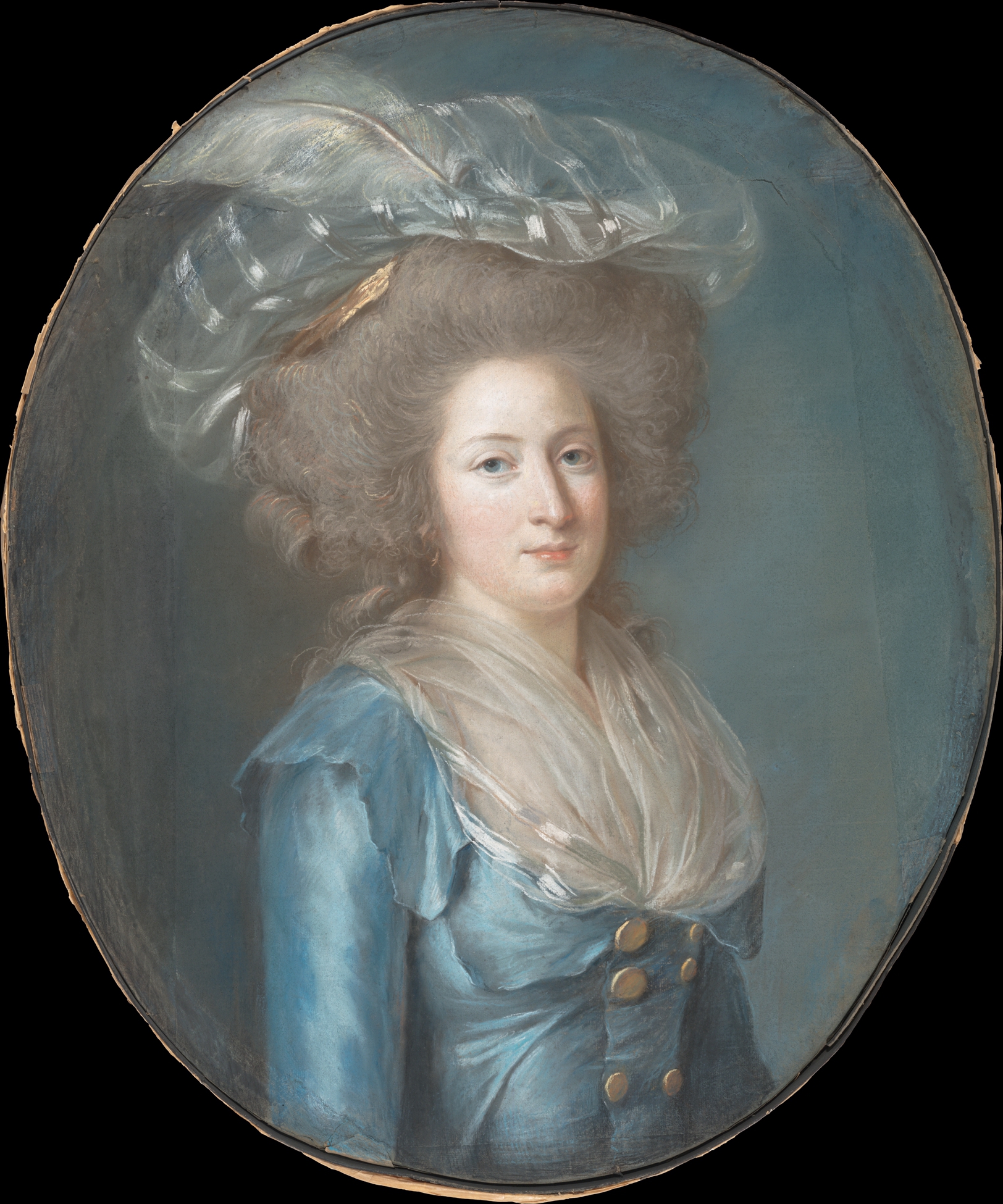
| Metropolitan Museum of Art | New York | Self-Portrait with Two Pupils (53.225.5, Gallery 632 on the open-access record); pastel of Madame Elisabeth (2007.441). | Gallery numbers change; check before travelling. |
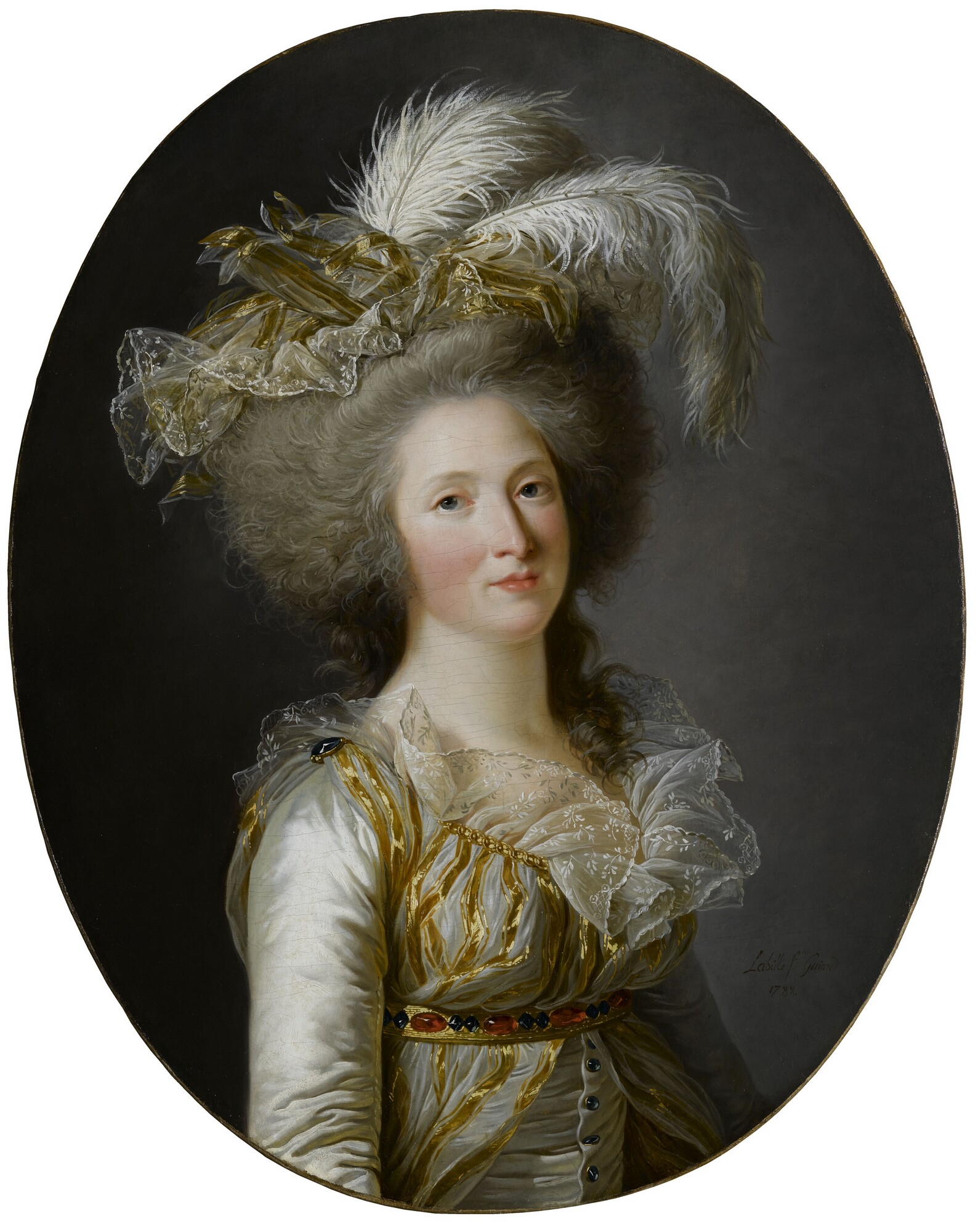
| Chateau de Versailles | Versailles | Madame Adelaide (oil, MV 3958) and its pastel study (MV 5940); Madame Victoire pastel (MV 5941); the 1782 pastel self-portrait pre-empted in 2025 (inv. V.2025.61); an oval oil of Madame Elisabeth of 1788 (MV 7332 per Jeffares). | The 1782 self-portrait was bought on 17 December 2025; current display not checked. A monographic exhibition is in preparation, undated. |
| Musee du Louvre | Paris | Pastels of Augustin Pajou and of Francois-Andre Vincent (inv. 27037), and a miniature replica of Madame Mitoire and her children (RF 4301). | Many are not on display; deposited works are at Versailles. |
| J. Paul Getty Museum | Los Angeles | Madame Mitoire and her children (2021.37); L'Heureuse Surprise (96.PC.327). | Display status not checked. |
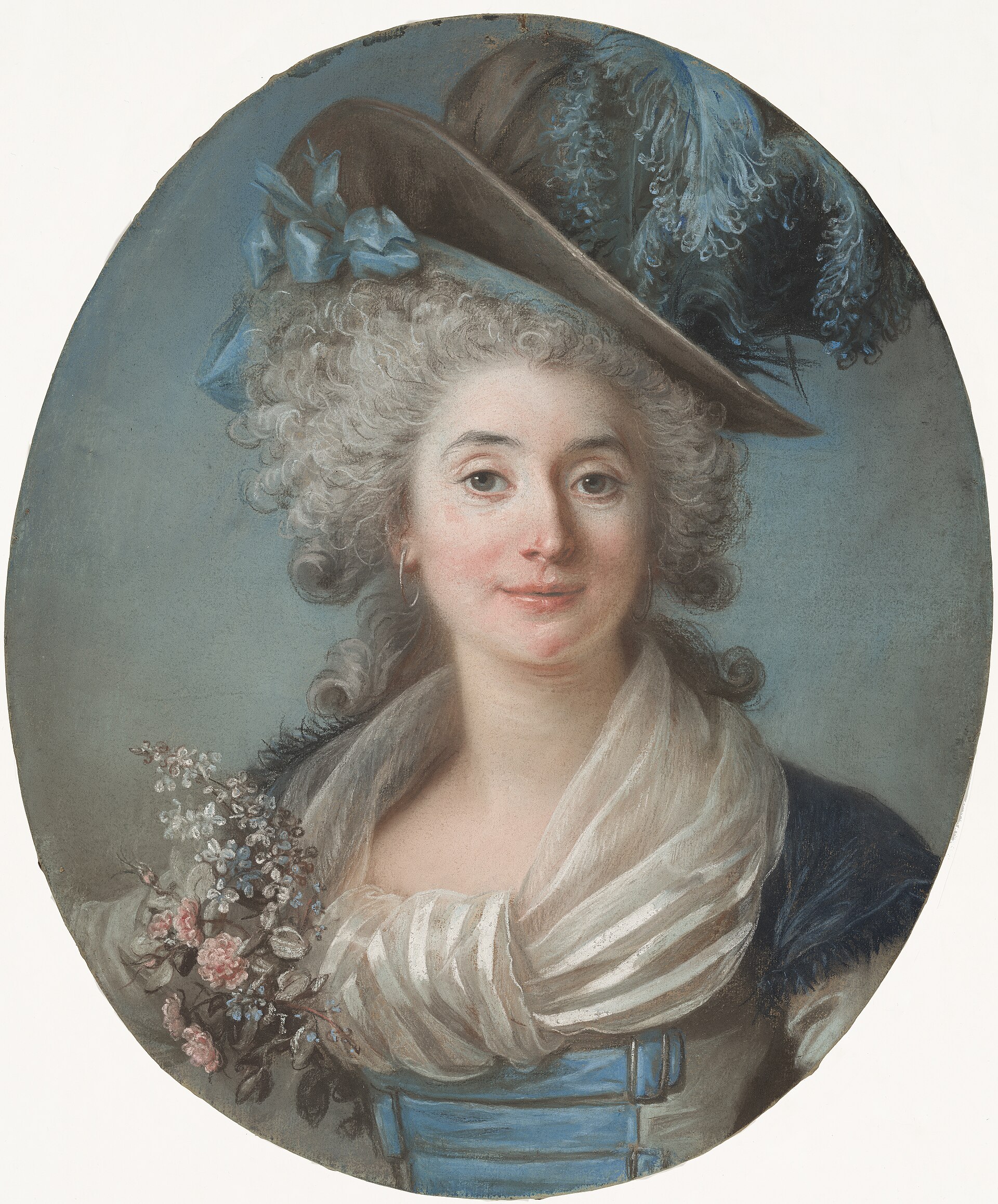
| National Gallery of Art | Washington | A Fashionable Noblewoman Wearing a Plumed Hat, c. 1789 (1999.92.1). | Open-access image. |
| Musee Antoine-Lecuyer | Saint-Quentin | Pastel of the Comte de Provence, c. 1788 (inv. 1983.8.3), the one surviving study for the destroyed Reception. | Display status not checked. |
Forgeries and misattributions
- No deliberate forgery documented
- None of the sources consulted documents a deliberate forgery of her work. The entries below are misattributions, misidentifications and copies. Not applicable.1
- Misattribution: the Robespierre oil
- A portrait of Robespierre in the dress of a Third Estate deputy circulates as hers and is illustrated as hers on Commons. Her own Robespierre of the 1791 Salon was a pastel; the oils are versions of a picture possibly by Danloux, per Jeffares. French Wikipedia is reported to say otherwise; not verified. The Salon livret entry (no. 34) describes a pastel; Auricchio's appendix flags the 100 x 75 cm version as rejected (source 1).19
- Misidentification: the Carraux de Rosemond pastel sold and published as her self-portrait
- A pastel of a woman at her easel, 72 x 58 cm, was sold in 1855 as a self-portrait of Madame Vigee Le Brun, published as Labille-Guiard's self-portrait (with a query in Portalis 1902, without one by Passez 1973 and Bonnet 2012) and shown in 2015 as a portrait of her pupil. Joseph Baillio: the sitter's eyes are brown and the artist's were blue (source 1).1
- Copy: a pastel after Madame Mitoire commissioned in 1901
- After buying the original in July 1901, Duveen Brothers commissioned a copy, 90 x 70 cm. It later passed through Paris and London sales as attributed to her and sold in New York in 1944 for USD 350 and in London in 1995 for GBP 2,300; a Brussels sale in 2018 offered it as autograph at an estimate of EUR 1,500-2,000. Jeffares records it as a copy commissioned by Duveen Brothers in July 1901; how it was later recognised as a copy is not stated (source 1).1
- Removed attributions in the revised catalogue
- Auricchio's appendix removes 25 of Passez's numbers; the pastel of Madame Roland (Passez 116) is filed by Jeffares under Vigee Le Brun. Connoisseurship and sale research in Baillio and Auricchio's appendix (source 1).1
The essay
Chapter 1Who she was, and what the standard account gets wrong
Adelaide Labille-Guiard was born in Paris on 11 April 1749, the daughter of Claude-Edme Labille and Marie-Anne Martin.
Adelaide Labille-Guiard was born in Paris on 11 April 1749, the daughter of Claude-Edme Labille and Marie-Anne Martin. The standard biography has her father running the fashionable shop in which the future Madame du Barry worked. Jeffares calls that legend and reports recent research showing that the father sold the shop in 1761; he afterwards became a Paris postal director and an agent for the royal military lottery (source 1).
She signed her pictures Labille f. Guiard, the f. standing for femme, wife of Guiard. Salon livrets and sale records spell her name several ways: Labille, Guiard, Guyard. After the divorce of 1793 she sometimes signed Labille dite Guiard, and from 1800 she was Madame Vincent (source 1).
Chapter 2Training, and a pastel claim that has stuck
Her first teacher was the miniaturist Francois-Elie Vincent.
Her first teacher was the miniaturist Francois-Elie Vincent. After his son Francois-Andre Vincent returned from Rome at the end of 1775, she learned oil painting from him; in 1800 she married him (source 1). She was already in the Academie de Saint-Luc, the guild academy, by the time of her marriage to Nicolas Guiard in 1769, and exhibited a pastel and a miniature there in 1774 (source 1).
The line that she was a pupil of Quentin de La Tour rests on the Salon de la Correspondance organiser Pahin de La Blancherie, who called her an eleve of La Tour in January 1783. Jeffares notes that she seems never to have made the claim herself, that no apprenticeship document survives, and that her name among the fifty artists in La Tour's 1784 will carries no weight; he finds her stylistically closer to Ducreux and Lenoir than to La Tour (source 1). The first biographer, Joachim Lebreton, reported only that La Tour allowed her to watch him work (source 1).
Chapter 31783: two women received on the same day
On 31 May 1783 she and Elisabeth Vigee Le Brun were received by the Academie royale de peinture et de sculpture in the same session (source 1).
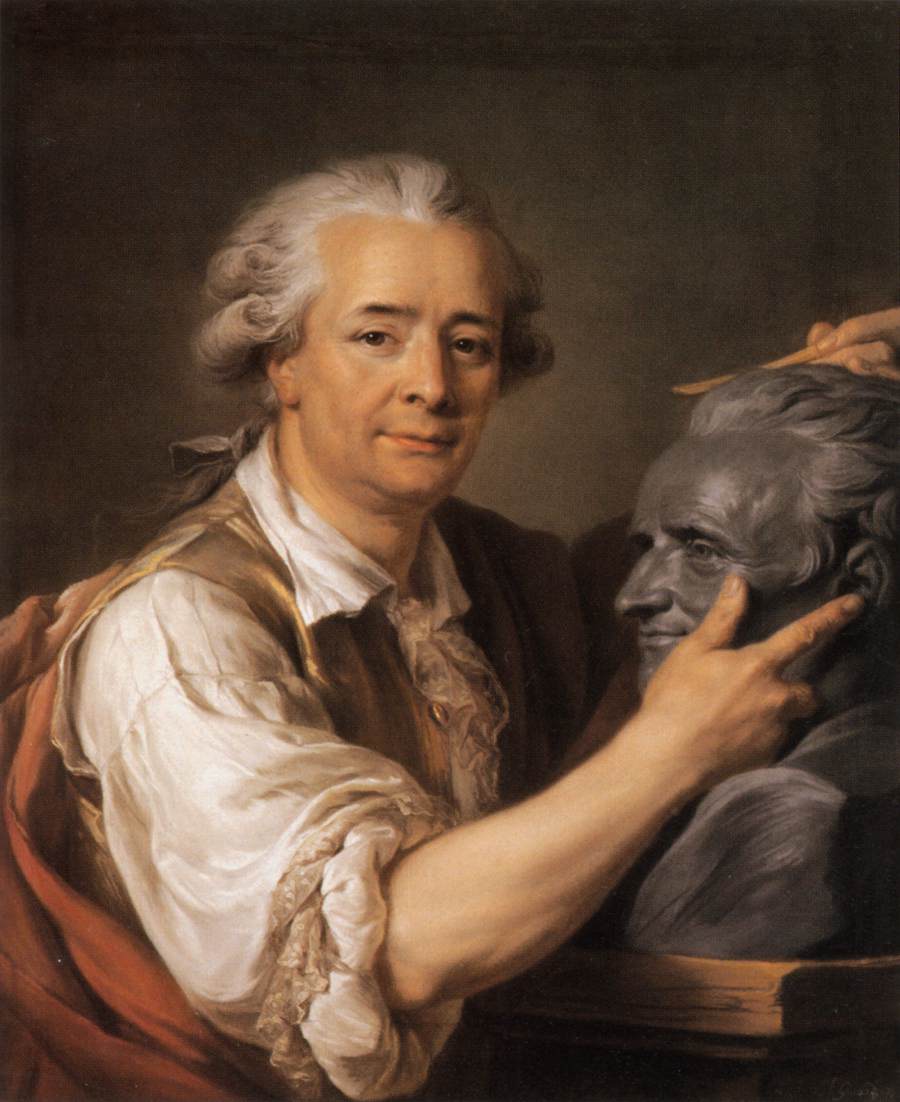
On 31 May 1783 she and Elisabeth Vigee Le Brun were received by the Academie royale de peinture et de sculpture in the same session (source 1). Her reception pieces were the pastel portrait of the sculptor Augustin Pajou, now in the Louvre, and an oil portrait of Amedee Van Loo that was to follow; Jeffares points out that the Pajou and her pastel of Vincent are drawn from below, an unusual viewpoint within her own pastels, and suggests 'perhaps a tribute' to Madame Roslin's monumental reception portrait of Pigalle (sources 1, 14).
The reception was not quiet. An anonymous song sheet, Suite de Malborough au Salon 1783, abused the women painters of the Salon and accused her of having many lovers, with Vincent named as one (sources 6, 9). Jeffares adds a further rumour, that her estranged husband was behind a pamphlet claiming that she had not drawn her own pastels (source 1). The critic of the Annee litteraire set the two new academicians against each other in a remark that Versailles quotes (see the quotation below). Versailles places it at the Salon of 1782; Jeffares places it with the Salon of 1783, and the two accounts are not reconciled here (sources 1, 3). Jeffares calls the resulting 'drawing against colour' contest a sterile one and suggests the rivalry between the two women may have been more of a critics' construction than a personal hostility (source 1).
Chapter 4Four seats and the vote of 1790
In 1787 an English newspaper described Vigee Le Brun as 'another of the four females admitted into this Academy' (source 1, quoting the World and Fashionable Advertiser, 11 September 1787).
In 1787 an English newspaper described Vigee Le Brun as 'another of the four females admitted into this Academy' (source 1, quoting the World and Fashionable Advertiser, 11 September 1787). That four was the ceiling on women members. Sources disagree on the wording of the rule: the English Wikipedia article on the 1785 self-portrait says the Academy limited women to four new members per year, while the usual account, and the 1787 newspaper, point to four women members at a time (sources 1, 7). The regulation itself was not located, and this page does not choose between the two.
What is documented is the attempt to remove the cap. On 23 September 1790 she proposed that women be admitted in unlimited numbers and allowed to sit on the governing board. English Wikipedia says both motions were approved and then overturned by conservatives; French Wikipedia says her motion was supported by Vincent, Pajou, Gois and Miger but the vote was held not to be valid. The two accounts disagree on whether it passed, and both are tertiary (sources 6, 9).
Chapter 5The self-portrait with two pupils, 1785
The picture exhibited at the Salon of 1785 shows her at the easel in a blue satin gown and straw hat, with Marie-Gabrielle Capet and Marie-Marguerite Carraux de Rosemond standing behind her.
The picture exhibited at the Salon of 1785 shows her at the easel in a blue satin gown and straw hat, with Marie-Gabrielle Capet and Marie-Marguerite Carraux de Rosemond standing behind her. It is oil on canvas, 210.8 by 151.1 centimetres, and has been in the Metropolitan Museum since the gift of Julia A. Berwind in 1953 (source 2). The Salon critic Gorsas, writing in 1785 about the picture, addressed her in the manner of a love note, saying that he had blown kisses to two roguish little faces (source 1).
Jeffares records that the bust in the background is Pajou's portrait bust of her father, signed and dated 1784, and that the composition inspired Mosnier's group portrait of himself with his daughters; he adds that the picture also resembles Vincent's own triple portrait of 1774, a link he says had not been noticed before 2024 (source 1). It has been argued, notably by Laura Auricchio (The Art Bulletin, 2007), that putting two female pupils in a picture meant for the Academy's eyes argued for admitting more women (source 7). That is a modern reading of the pictorial strategy, not a documented statement of intent; her 1790 motion is the documented position (sources 6, 7).
Chapter 6Mesdames, the Comte de Provence and the Revolution
The 1785 picture led to commissions from Madame Adelaide and Madame Victoire, the daughters of Louis XV, to whom she became premier peintre: a notarial act of 4 December 1788 gives her the title...
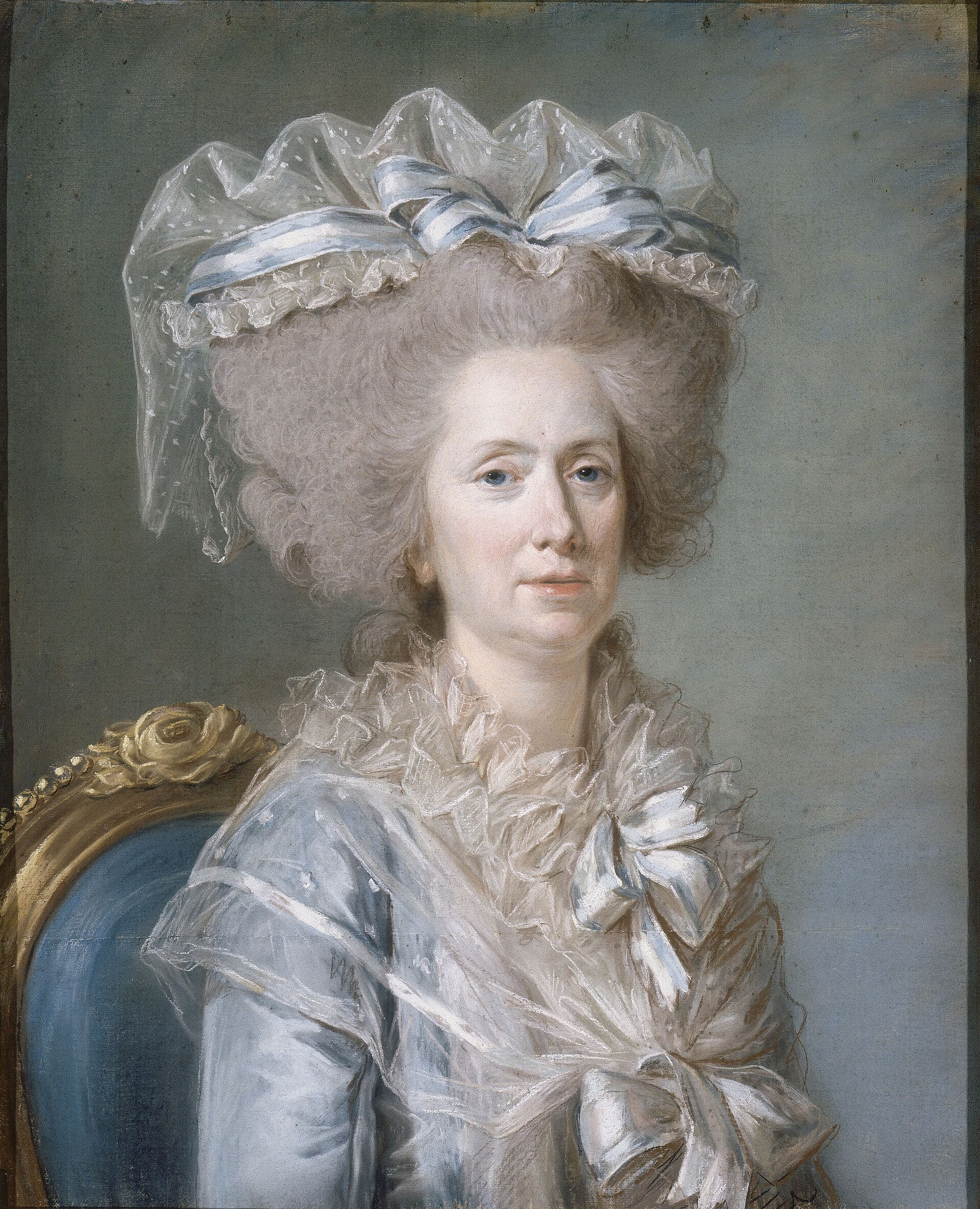
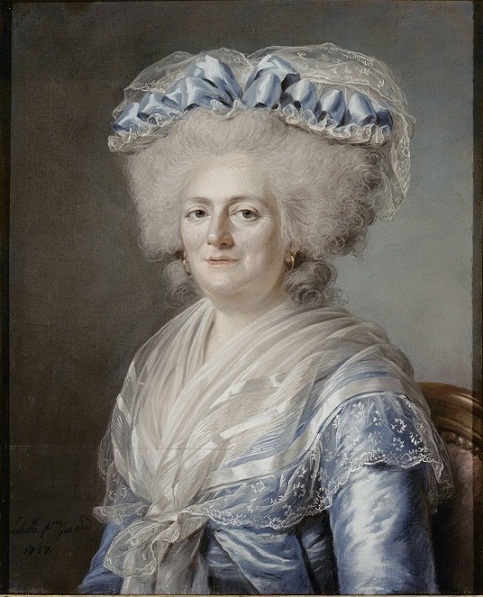
The 1785 picture led to commissions from Madame Adelaide and Madame Victoire, the daughters of Louis XV, to whom she became premier peintre: a notarial act of 4 December 1788 gives her the title (source 1). The Salon of 1787 showed her full-length portrait of Madame Adelaide before the medallions of the dead king, queen and dauphin, which the critic of L'Ami des artistes found 'made with wisdom', though weakened by the Queen's portrait hung beside it (source 1). The finished oil is Versailles MV 3958; the pastel study for it, MV 5940, was kept by her and her husband until the Vincent sale of 1816 (source 10). The bust-length pastel of Madame Victoire, MV 5941, was shown in 1787 as Salon no. 111 (sources 1, 10).
In 1788 the Comte de Provence, the future Louis XVIII, ordered an enormous picture, the Reception d'un chevalier de Saint-Lazare par Monsieur. It was incomplete when the new regime ordered it destroyed together with all the studies; one pastel study of Provence survived and is at Saint-Quentin (source 1). English Wikipedia says the order was made in 1793 and that she was forced to destroy it herself, and that neither Provence nor the royal sisters paid what they owed; The order and the payment records were not seen, so those details are tertiary (source 6).
She stayed in France. At the Salon of 1791 she showed pastels of a run of deputies, including Robespierre, Beauharnais, d'Aiguillon, Talleyrand and Alexandre and Charles Lameth. The critics saw the point: one asked her to paint Robespierre 'in oil', another feared that the mediocrity of her talent would keep her sitters from posterity (source 1). A curious notice of October 1791 in the Journal de la cour et de la ville called her 'first paintress of the nation' and announced a subscription for portraits of the greatest villains (source 1).
Chapter 7The pupils and the house at Pontault
She taught only women. Jeffares lists Alexandre, Bernard (Madame Dabos), Capet, Carraux de Rosemond, Davril, Fordrain, Fremy (her cousin), Hubert, Lambert, Merie (Madame Swagers), de Noireterre and...
She taught only women. Jeffares lists Alexandre, Bernard (Madame Dabos), Capet, Carraux de Rosemond, Davril, Fordrain, Fremy (her cousin), Hubert, Lambert, Merie (Madame Swagers), de Noireterre and Verrier, and calls Gabrielle Capet the most talented (source 1). The critics called them her 'nine muses in the cradle' (source 1). Marie-Victoire Davril kept house for her and was authorised to sign receipts for payments of Mlle Hubert's pension on the teacher's behalf (source 1).
In 1792 she and Vincent bought a house at Pontault-en-Brie from Lefevre d'Ormesson for 30,000 livres. She and Vincent each put in 12,000; the balance was lent by Mlles Vincent, Davril and Capet (source 1). In 1795, after asking since 1785, she was given lodgings in the Louvre, and in the same year the Committee of Public Instruction granted her 2,000 livres as a national reward (source 1). Capet lived with the couple and stayed with Vincent until his death in 1816; the pastel of Madame Elisabeth, bought at his sale for 200 francs, stood in Capet's post-mortem inventory of 14 November 1818 at 50 francs (source 1). Wikipedia gives her death as 1 November 1818 (source 8).
Chapter 8How she worked: pastel first, then oil
Jeffares's view is that her real strength was the bust-length pastel, and that scholarship on her large oils has pushed the pastels into the role of stepping stones.
Jeffares's view is that her real strength was the bust-length pastel, and that scholarship on her large oils has pushed the pastels into the role of stepping stones. He describes smooth faces, mouths 'captured with the solidity of chiselled stone', individual strands of hair painted more tidily than Ducreux's, and no vigorous hatching or blending into oblivion (source 1). Blue paper laid down on canvas recurs in the examples cited here: the Versailles Madame Adelaide and Madame Victoire are pastel on blue paper mounted on canvas, the Met's Madame Elisabeth is seven sheets of blue paper joined and laid on canvas, and the Pajou and the NGA pastel are also on blue paper (sources 1, 10, 12, 13).
He also argues that her move to large oils from about 1783 was driven by ambition to be taken seriously as a history-and-portrait painter rather than by the economics of pastel fashion, and that she returned to pastel afterwards, as the pendants of Mehul and his wife of about 1795 show (source 1).
Chapter 9Death, the estate and the sale of 1816
She died on 24 April 1803 (source 1). Vincent kept her pastels, and when he died in 1816 his sale at 1 rue de Seine on 17 to 19 October put them on the market at prices that say what they were then...
She died on 24 April 1803 (source 1). Vincent kept her pastels, and when he died in 1816 his sale at 1 rue de Seine on 17 to 19 October put them on the market at prices that say what they were then thought to be worth: the Madame Adelaide study at 40 francs, the Madame Victoire at 168, the Comte de Provence at 79, the Madame Elisabeth at 200 and the pastel of Vien at 38; these are the lots Jeffares cites, not a survey of the sale (source 1). The Madame Adelaide and Madame Victoire pastels were bought, probably on the orders of the Comte de Forbin of the royal museums, and passed into the Louvre's stores; both were deposited at Versailles on 6 August 1923 (sources 1, 10).
Davril received a self-portrait pastel by bequest in Vincent's will of 22 May 1816, with a note that it would remind her of 'the friend who was so dear to her' (source 1). Which of the surviving self-portraits that was is not established (source 1).
Chapter 10Reputation: dismissed, then rebuilt on a handful of catalogues
After her death her work fell out of favour.
After her death her work fell out of favour. Jeffares records that the 1785 self-portrait was later bequeathed by her family to the Louvre and rejected in 1878 as 'without artistic value'; the English Wikipedia article on it says it stayed in the family until 1905 and the Met's record shows it came to the museum as a gift in 1953 (sources 1, 2, 7). In 1934 Leroy still thought her pastels 'in general only a faded and attenuated reflection of La Tour' (source 1).
The revival runs through three books: Portalis's 1902 monograph, Anne-Marie Passez's 1973 catalogue raisonne, and Laura Auricchio's 2009 Getty monograph (source 1). The market followed. The Getty bought the Madame Mitoire pastel in 2021, Versailles pre-empted her 1782 pastel self-portrait in December 2025, and a Christie's London sale of June 2026 set a new record for an oil (sources 1, 3, 5). Versailles says it is preparing a monographic exhibition on her (source 3). No date was found for it.
Chapter 11The Robespierre claim, and the pictures that are not hers
A well-known oil portrait of Robespierre in the dress of a Third Estate deputy circulates under her name, including on Commons (file description: 'Portrait de Robespierre en habit de depute du Tiers...
A well-known oil portrait of Robespierre in the dress of a Third Estate deputy circulates under her name, including on Commons (file description: 'Portrait de Robespierre en habit de depute du Tiers Etat', 75 x 58 cm, dated 1790). Jeffares keeps the two apart. Her Robespierre was a pastel, Salon of 1791 no. 34, which a 1791 critic called 'always true, well drawn, a little greyish'; he lists it with no location. The oil versions, he writes, are of a painting possibly by Danloux and are unrelated to her lost pastel (source 1). His 'E, rejected' flag, from Auricchio's appendix, is on the 100 x 75 cm Marcille version; a 75 x 58 cm copy by Vigneron of 1860, 'after Danloux' (Versailles MV 6653), has the same dimensions as the Commons file, though the two are not shown to be the same picture (source 1). A reviewer reports that French Wikipedia (source 9) says the Commons oil is Vigneron's copy after a Labille-Guiard pastel, which would contradict Jeffares; that statement was not found in the text fetched for this page. The Commons image is not used as a plate.
The same dictionary documents a longer list of wrong calls. A pastel of a woman at her easel, shown in 1926 as her self-portrait and published as one by several authors up to 2012, is now read as her pupil Carraux de Rosemond; Joseph Baillio's objection, noted before 2006, is that the sitter's eyes are brown and the artist's were blue. In 1855 the same pastel was sold as a self-portrait of Madame Vigee Le Brun (source 1).
What is documented
Technique
The surviving work
- What is accepted
- No current accepted number was found. Passez (1973) had 183 numbers, of which about 105 were illustrated; Baillio and Auricchio (2009) added 23, marked 7 more as pending, and removed 25. Jeffares notes that 64 Labille-Guiards are reproduced in the Auricchio catalogue (source 1).
- What is contested
- The removed 25, the pending 7, and works re-given to Vigee Le Brun, Ducreux, Lenoir, Danloux or the French school. The Robespierre oil and the pupil pastel catalogued as her self-portrait are the best-known cases (source 1).
- Who rules on attribution
- No active authentication board found. Attribution currently rests on Passez 1973 as revised by Baillio and Auricchio in 2009, and on Neil Jeffares's online dictionary, updated 9 November 2026. Versailles is preparing a monographic exhibition (sources 1, 3).
Catalogue raisonne
- Anne-Marie Passez, Adelaide Labille-Guiard, 1749-1803: biographie et catalogue raisonne de son oeuvre (Paris, Arts et metiers graphiques, 1973). The only catalogue raisonne; Jeffares calls it flawed and poorly illustrated but the only one. Much of its information was assembled by Portalis in 1902.1
- Laura Auricchio, Adelaide Labille-Guiard: Artist in the Age of Revolution (Los Angeles, J. Paul Getty Museum, 2009), appendix by Joseph Baillio and Laura Auricchio. Updates Passez: 23 additions, 7 pending additions, 25 rejections. The Robespierre oil is among the rejections.1
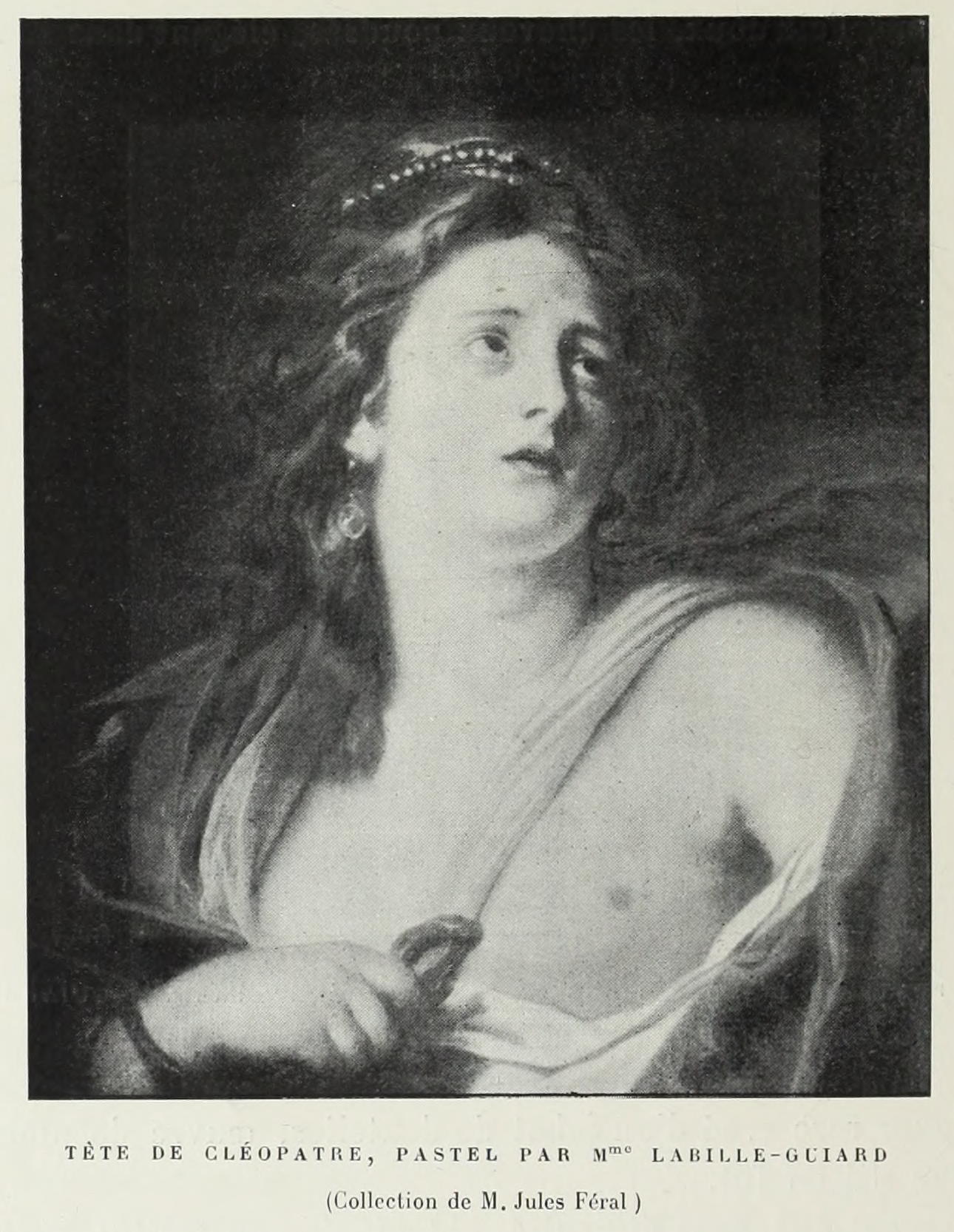
- Roger Portalis, Adelaide Labille-Guiard (Paris, Georges Petit, 1902). First monograph; source of the 1902 Cleopatra illustration.111
Questions about Adelaide Labille-Guiard
Who was Adelaide Labille-Guiard?
Painter; Pastellist; Miniaturist; Teacher. 1749-1803.
When did Adelaide Labille-Guiard live?
Born 11 April 1749, Paris; died 24 April 1803, Paris.
How are fakes and misattributions of Adelaide Labille-Guiard detected?
No deliberate forgery documented. None of the sources consulted documents a deliberate forgery of her work. The entries below are misattributions, misidentifications and copies.
Where can you see work by Adelaide Labille-Guiard?
Metropolitan Museum of Art (New York); Chateau de Versailles (Versailles); Musee du Louvre (Paris); J. Paul Getty Museum (Los Angeles); National Gallery of Art (Washington); Musee Antoine-Lecuyer (Saint-Quentin).
What does the market for Adelaide Labille-Guiard look like?
Her market is thin and recent. In HENI's table the record rose from USD 380,600 in 1988 to 754,100 in 2018 and 773,000 in 2021.
What is still unresolved about Adelaide Labille-Guiard?
Which of the surviving self-portrait pastels is the one Vincent left to Marie-Victoire Davril in his will of 22 May 1816 (Jeffares)?
Open questions
- Which of the surviving self-portrait pastels is the one Vincent left to Marie-Victoire Davril in his will of 22 May 1816 (Jeffares)?
- Did the 1790 motion for unlimited women members pass? English Wikipedia says it did; French Wikipedia says the vote was held invalid. Neither cites the Academy's minutes.
- Was the Academy's cap four women at a time or four new women per year? The 1787 newspaper and the standard account point to the first; one tertiary article says the second.
- Which of the larger oils (Madame Adelaide MV 3958 aside) are autograph, and which are studio or pupil versions? Capet's role in producing miniature copies is stated by tertiary sources only.
- Is the pastel Cleopatra of 1782, known from Portalis's 1902 illustration, the picture Jeffares lists as a tentative Adrienne Lecouvreur as Cleopatra (Feral-Cussac, Jules Feral, Dorotheum 1914, Christie's New York 1994, attributed to Coypel)?
- What did the Comte de Provence and Mesdames owe her, and was any of it paid? English Wikipedia gives 30,000 livres for the Reception; no primary record has been seen.
- Did she belong to any society or own a recorded library? None appears in the sources consulted, and none is claimed.
Sources
- 1Neil Jeffares, 'Labille-Guiard, Adelaide', Dictionary of pastellists before 1800, online edition (updated 9 November 2026). Specialist secondary source quoting Salon critiques, sale records and the Passez/Auricchio catalogue numbers; read in full. Replace page-level claims with Passez 1973 and Auricchio 2009 where the printed books can be consulted. pastellists.com/Articles/...
- 2Metropolitan Museum of Art, open-access collection record for object 436840, Self-Portrait with Two Pupils (accession 53.225.5; oil on canvas, 210.8 x 151.1 cm; Gift of Julia A. Berwind, 1953; Gallery 632; public domain flag true). collectionapi.metmuseum.org/public/...
- 3Chateau de Versailles press release, 'Acquisition of an exceptional self-portrait by Adelaide Labille-Guiard' (pre-emption at Tajan, 17 December 2025; signed and dated 1782; oval pastel 62 x 51 cm). en.chateauversailles.fr/press/...
- 4Art History News (Bendor Grosvenor), 'Adelaide Labille-Guiard pre-empted by Palace of Versailles': the work 'realised EUR 650,000 over its EUR 300k - EUR 500k estimate at Tajan'. arthistorynews.com/articles/...
- 5HENI News, 'Adelaide Labille-Guiard's Auction Record Jumps 48%', 1 July 2026: record table of her top auction results (Christie's London 30 June 2026; Tajan 17 December 2025; Christie's Paris 16 June 2021; Sotheby's Paris 21 June 2018; and earlier). heni.com/news/...
- 6Wikipedia, 'Adelaide Labille-Guiard'. en.wikipedia.org/wiki/...
- 7Wikipedia, 'Self-Portrait with Two Pupils'. en.wikipedia.org/wiki/...
- 8Wikipedia, 'Marie-Gabrielle Capet'. en.wikipedia.org/wiki/...
- 9Wikipedia (French), 'Adelaide Labille-Guiard'. fr.wikipedia.org/wiki/...
- 10Wikimedia Commons file page for the Versailles pastel study MV 5940 (cites Versailles collection record; notes it is a preparatory study for the 1787 portrait of Madame Adelaide, MV 3958) and the sibling file for Madame Victoire (INV.DESS 1160, MV 5941, Salon of 1787 no. 111). commons.wikimedia.org/wiki/...
- 11Wikimedia Commons file page for Cleopatra, pastel, 1782, quoting Roger Portalis, Adelaide Labille-Guiard (1902), p. 16 (the 1902 illustration is the only record; location now unknown). commons.wikimedia.org/wiki/...
- 12Wikimedia Commons file page, Madame Elisabeth de France, Metropolitan Museum of Art 2007.441 (pastel on blue paper, seven sheets joined, laid down on canvas; CC0). commons.wikimedia.org/wiki/...
- 13Wikimedia Commons file page, A Fashionable Noblewoman Wearing a Plumed Hat, c. 1789, National Gallery of Art 1999.92.1 (pastel on blue laid paper, oval 55 x 46 cm; CC0). commons.wikimedia.org/wiki/...
- 14Wikimedia Commons file page, The Sculptor Augustin Pajou (Louvre; pastel on blue paper, 71 x 59 cm; cites Joconde 50350212845). commons.wikimedia.org/wiki/...


Last verified