Why Nothing by Cimabue Is Signed, and What That Means for Attribution
The artist Vasari placed first in the history of Western painting left no signature and one documented work. The corpus is under ten panels, and worm holes hold three of them together.
Records in this piece: The Mocking of Christ
On this page 6 sections
ContentsClose
In short
- No work by Cimabue is signed or securely dated, and the accepted corpus runs to fewer than ten panels.
- The frequently quoted figure of forty works is the Louvre's 2025 exhibition checklist, which includes other artists.
- The Frick's Flagellation and the National Gallery's Virgin and Child were joined by wood grain, panel thickness, craquelure and worm holes as early as 2000.
- The Louvre's own record prices the Compiegne panel at EUR 19.5 million excluding fees and dates the national treasure classification to 20 November 2019.
One documented work, and no signature anywhere
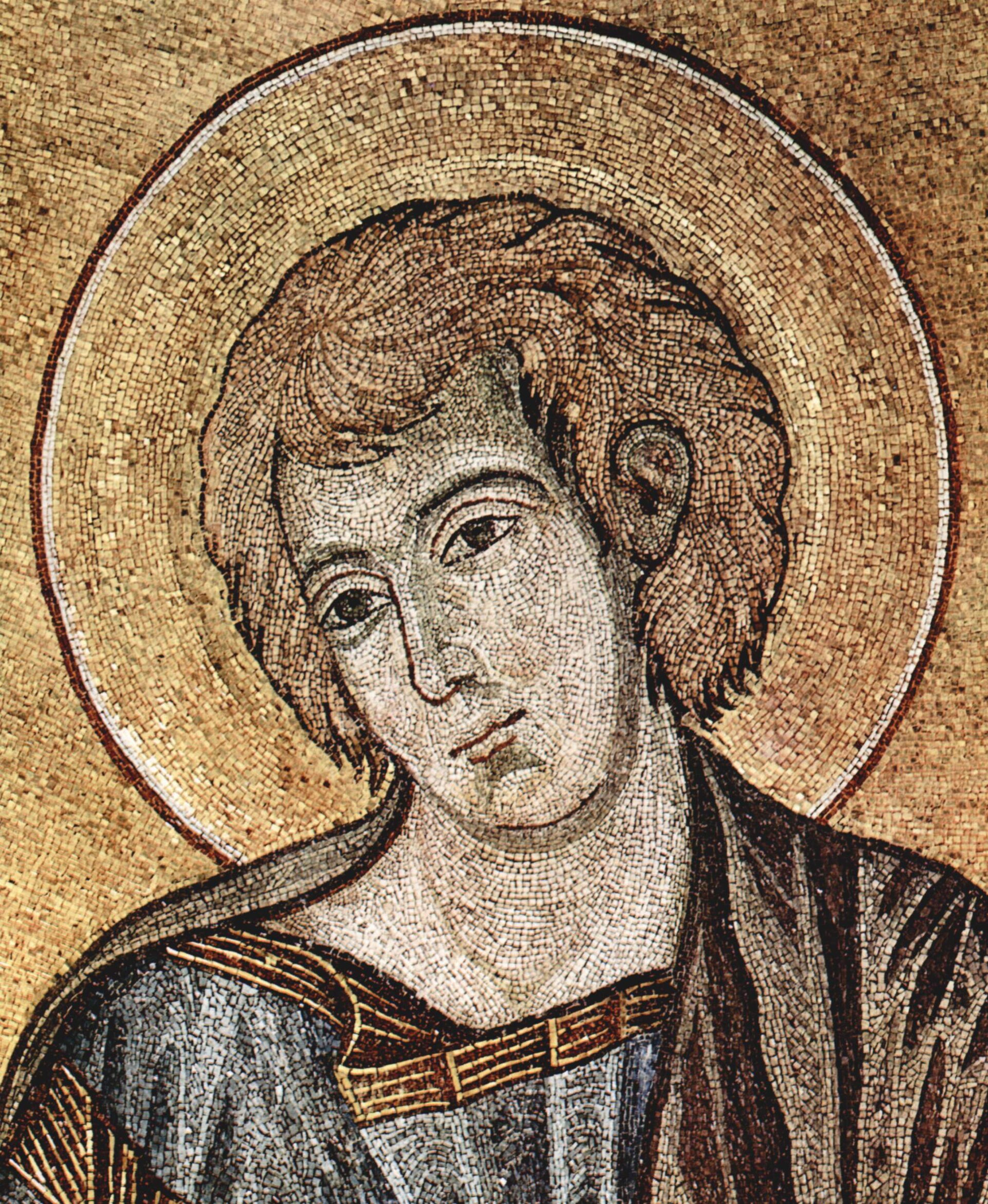
Cimabue, born Cenni di Pepe in Florence around 1240, died in Pisa in 1301 or 1302. He spent the last period of his life there, commissioned to finish a mosaic of Christ Enthroned in the apse of the cathedral, and executed the part of the mosaic depicting St John the Evangelist. That mosaic is the sole surviving work documented as being by the artist. None of the works given to him is signed or securely dated.
The absence of a signature is unremarkable for the thirteenth century. What makes it consequential is the position the artist occupies. Vasari opens the Lives with him: the first volume of the standard English edition is subtitled Cimabue to Agnolo Gaddi, and the first Life in it is headed Giovanni Cimabue. The written history of Western art therefore begins with a figure whose corpus is almost entirely inferred.
Every panel painting given to Cimabue rests on attribution rather than on record. There is no contract naming him as the painter of a surviving panel, no signature, no inscribed date. The single documented object is in a different medium from the works the attribution question actually concerns, which means the one fixed point in the corpus cannot serve as a straightforward benchmark for the rest of it.
The corpus is much smaller than the round numbers suggest
A figure of about forty works is widely repeated and it is a misreading. The Louvre's 2025 exhibition, A New Look at Cimabue: At the Origins of Italian Painting, brought together some forty works, and that checklist includes Duccio, Giotto and others assembled for comparison. It is a count of an exhibition, not of an oeuvre.
The scholarly figures are far lower. Donal Cooper, writing in Apollo in 2019 when the Compiegne panel emerged, placed it as joining fewer than ten accepted works on panel by the artist. That count excludes the Assisi frescoes and the Pisa mosaic and concerns the category in which attribution disputes actually arise. Press accounts at the time gave eleven works on wood, none of them signed.
There is also no register to appeal to. No modern catalogue raisonne of Cimabue is cited in the standard literature; the recent dedicated treatments are monographs, and the fullest current technical account is the Louvre's 2025 catalogue edited by Thomas Bohl, with the conservation study published separately in Techne. Attribution here reverts to argument between specialists, which is slower, less decisive and considerably more honest about its own uncertainty than a foundation's yes or no.
What a reconstructed corpus is, stated plainly
The group of works given to Cimabue was assembled over the nineteenth and twentieth centuries by comparing pictures to one another. Certain works were treated as central and others were measured against them. The logical structure of that procedure is worth stating without euphemism: there is no autograph benchmark, so the standard against which candidates are judged is itself an argument, and it was built by the same people who then applied it.
This is not a criticism peculiar to Cimabue. It is the ordinary situation for most artists before the fifteenth century, and it is the reason the field's confidence about the period is expressed in graded language rather than in yes and no. It does mean that a challenge to any single attribution is a challenge to the shape of the group, and that reattributing one panel can require rearranging several.
It also means that stylistic argument alone can never fully close a question here. Two panels that look alike may be by one hand or by two hands trained together, and there is no securely documented panel against which to test the difference. Any evidence that bears on the objects rather than on their style is therefore worth disproportionately more in this corpus than in a better documented one.
The Compiegne panel and what the Louvre actually records
The small Derision du Christ found above a hotplate in a kitchen near Compiegne in 2019 is now in the Louvre, and the museum's own catalogue entry is unusually specific. It gives the work as tempera on a gold ground on poplar, 25.8 by 20.3 centimetres, dated to the fourth quarter of the thirteenth century and around 1280, inventory RFML.PE.2023.33.1, acquired by purchase on 25 October 2023.
The provenance line records that it was in a private collection in Compiegne since at least 1871 and until 2019, that it was sold at Senlis by Acteon on 27 October 2019, and that it was acquired for 19.5 million euros excluding fees by the Alana collection. The panel was classified a national treasure on 20 November 2019. Those figures matter for a reason beyond the market: the widely quoted 24 million euro price is the premium-inclusive total, and the Louvre's own record uses the hammer.
The attribution argument published at the time had a conventional component and an unusual one. The conventional part was infrared reflectography, and the sale catalogue reproduced a reflectogram revealing underdrawing consistent with the accepted works. That is the ordinary kind of stylistic argument, and it is contestable in the ordinary way.
The provenance line is worth reading closely for what it does not contain. A private collection in Compiegne from at least 1871 to 2019 is a single unbroken holding of nearly a century and a half, and before 1871 there is nothing at all. For a panel cut from a larger object at some point in the eighteenth or nineteenth century, that silence is expected rather than suspicious, but it means the documentary track contributes almost nothing to the attribution. The case was made on the object.
Worm holes hold three panels together
The unusual component is physical, and it predates the Compiegne discovery by nearly twenty years. The Frick Collection purchased its Flagellation of Christ by Cimabue in 1950, and it remains the only painting by the artist in the United States. Following the emergence of the National Gallery's Virgin and Child Enthroned with Two Angels, the two were argued in 2000 to have been part of the same ensemble. The Frick sets out the evidence: the grain of the wood, the thickness of the panels, both of which have been thinned down since they were first painted, the pattern of craquelure in the paint, and even the worm holes in the wood are comparable. Both also carry a similar punched border in the gold ground, two rows of pinprick-like punches surrounding a delicate scroll pattern.
The Compiegne panel joined that group by the same method. The auction house established that the National Gallery picture stood directly above the Mocking in the original ensemble by matching the new panel's grain and worm holes against a photograph of the verso of the London picture. Insects bored through the wood while the panels were still joined, which means the tunnels record a physical fact about a single object that was later cut apart, probably so that smaller pieces could be sold individually, a fate common to early Italian pictures in the late eighteenth and early nineteenth centuries.
Conservation has since confirmed the reading. Writing in 2025, Cooper recorded that conservation of the Mocking confirmed what scholars supposed when the picture first emerged in 2019: it is a third fragment after the Flagellation in the Frick and the Virgin and Child with Two Angels in London. The Louvre's 2025 exhibition brought together, for the first time, the only three panels known today from what must have been a series of eight scenes.
The honest formulation, and what a challenge would have to show
The correct way to state an attribution in these conditions is not that a panel is by Cimabue but that it is by the hand that painted the works agreed to be called Cimabue. That reads like pedantry and it is not, because it changes what a challenger would have to prove. Disputing the Compiegne panel does not mean proving a negative about a documented artist. It means arguing that the reconstructed group should be divided differently.
No such division has in fact been proposed. The literature records varying degrees of certainty across the corpus and notes that many works in major collections have been wrongly given to Cimabue, but no scholar reached in this survey has argued for splitting the accepted group between two hands. That absence should be reported as an absence rather than as a consensus, since a corpus of under ten panels assembled by comparison has never had many people working on it at once.
It is also why the worm holes matter so much. Style can be argued about indefinitely in a corpus with no autograph benchmark. Insect tunnels running across three panels are a claim about objects, and the three pictures were joined before anybody had an opinion about who painted them. That evidence does not name Cimabue. It fixes three fragments to one original object, and it is the closest thing to a signature the artist's corpus contains.
Questions
Sometimes, and some of Cimabue's contemporaries did. The absence is normal rather than remarkable for the period, but it removes the simplest form of evidence and leaves a corpus that has to be assembled entirely by comparison and by physical association between objects.
Fewer than ten accepted works on panel, on Donal Cooper's count, with press accounts at the time of the 2019 discovery giving eleven works on wood. The figure of about forty comes from the Louvre's 2025 exhibition checklist, which includes works by other artists.
The part of the apse mosaic in Pisa Cathedral depicting St John the Evangelist, made at the very end of his life. It is the sole surviving work documented as by the artist, and it is a mosaic rather than a panel, so it is an imperfect benchmark for the paintings.
It is the form a serious challenge would have to take, but no such division appears in the literature reached for this article. The physical association of the Louvre, Frick and National Gallery panels through wood grain and worm holes constrains any rearrangement of at least those three.
Sources
- 1Musee du Louvre, collection record for Cimabue, La Derision du Christ, inv. RFML.PE.2023.33.1. collections.louvre.fr/en/...
- 2Musee du Louvre, exhibition page, 'A New Look at Cimabue: At the Origins of Italian Painting', 22 January to 12 May 2025. louvre.fr/en/...
- 3Donal Cooper, 'A long-lost Cimabue has emerged in a French kitchen', Apollo, 14 October 2019. apollo-magazine.com/cimabue-mocking-christ
- 4Donal Cooper, 'The Louvre restores Cimabue to his rightful place', Apollo, 3 February 2025. apollo-magazine.com/cimabue-louvre-mocking-of-christ-rest...
- 5The Frick Collection, 'Cimabue and Early Italian Devotional Painting', exhibition record, 2006, on the physical evidence linking the Flagellation and the National Gallery panel. frick.org/exhibitions/...
- 6Giorgio Vasari, Lives of the Most Eminent Painters Sculptors and Architects, trans. Gaston du C. de Vere, vol. I, Cimabue to Agnolo Gaddi, Macmillan and the Medici Society, 1912-14, Project Gutenberg text. gutenberg.org/files/...
- 7Wikipedia, 'Cimabue', for the Pisa Cathedral mosaic of St John the Evangelist as the sole surviving documented work and for the absence of signatures. en.wikipedia.org/wiki/...
- 8Finestre sull'Arte, on Eric Turquin's 2019 attribution and the reflectographic examination of the panel. finestresullarte.info/en/...
- 9Anna Brady, 'Kitchen Cimabue sells for 24.1m euros', The Art Newspaper, 27 October 2019, separating the hammer from the premium-inclusive total. theartnewspaper.com/2019/...
More in Attribution and Authenticity
The partA Hallmark Can Be Genuine, Legal and About a Different Object
The V and A catalogues a Paul de Lamerie ewer of 1736 as a duty dodger, hallmarked 1944.
Composite Names Three Different Objects, and Only One of Them Is a Fake
Fifty-seven records here use composite, pastiche or assembled, and the words are doing three incompatible jobs.
The Frame Has Its Own Provenance
Ten records carry evidence on a frame. Van Eyck's integral frames date the panels to 1410-1440; a 1970 loan label on a frame in Maine proves nothing...