What Bess of Hardwick's 1601 Inventory Proves About the Devonshire Hunting Tapestries
The 1601 Hardwick inventory shows Bess of Hardwick kept the Devonshire Hunting Tapestries already cut into pieces. No document shows who bought them.
Records in this piece: The Devonshire Hunting Tapestries
On this page 7 sections
ContentsClose
In short
- The V&A cites a 1601 inventory made for Bess of Hardwick as the earliest document for the Devonshire Hunting Tapestries and words the link with 'may have belonged' and 'probably'; nothing read documents her buying them.
- Helen Wyld reads the 1601 inventory as showing the Hunts already cut into at least six pieces: four in the Hall and two, which she says were almost certainly in Bess's Bedchamber, in an entry that may well refer to them and gives fifteen and a half feet as the depth.
- Three routes to Hardwick are suggested (her second husband Sir William Cavendish, the royal collection, Mary Queen of Scots), beside the V&A's hedged statement that Bess owned them; none is documented and the Mary link is unverified.
- Bess is documented elsewhere as a builder, a buyer and an embroiderer: ES on the towers, three Oxburgh panels signed ES and the National Trust's account of her buying the Gideon tapestries. The Hunts have no equivalent record of choice.
The 1601 inventory shows Bess of Hardwick kept the hunting tapestries and shows nothing about who bought them
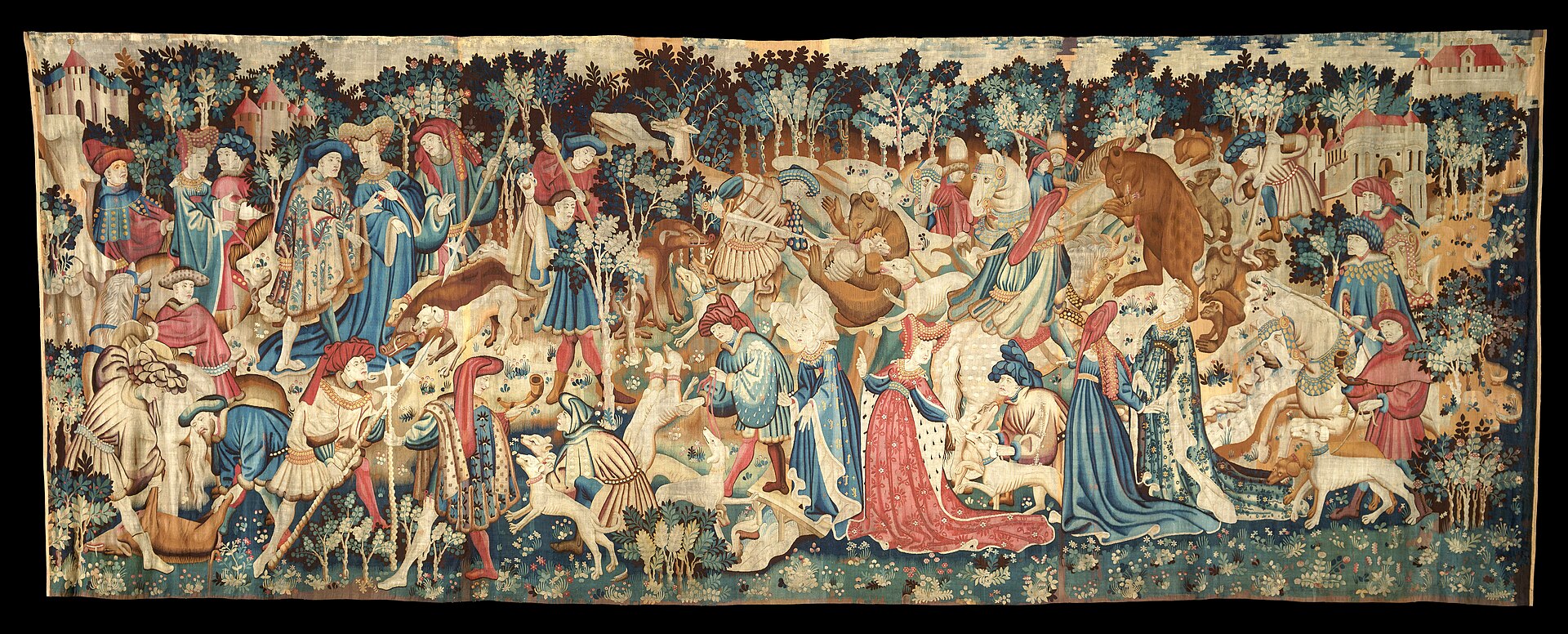
The earliest document the Victoria and Albert Museum cites for the four Devonshire Hunting Tapestries is an inventory of Hardwick Hall compiled in 1601 for Elizabeth Talbot, Countess of Shrewsbury, the woman known as Bess of Hardwick. The V&A's catalogue entries say the tapestries were identified at Hardwick in the sixteenth century from that inventory, and that the Countess "had Hardwick Hall built and furnished to her taste". The museum does not say the hunts were part of that taste. On ownership its Falconry entry says all four tapestries "may have belonged" to her and were "probably" part of one inventory entry.
That softness is the whole story. A 1601 inventory is a list of what stood in the house in 1601. It tells us she had the tapestries and where they hung. It does not say she paid for them, inherited them, was given them or took them over from someone else. Our own record of the object carries the same caution: the inventory documents presence at Hardwick at that date, and it does not by itself prove she acquired the tapestries.
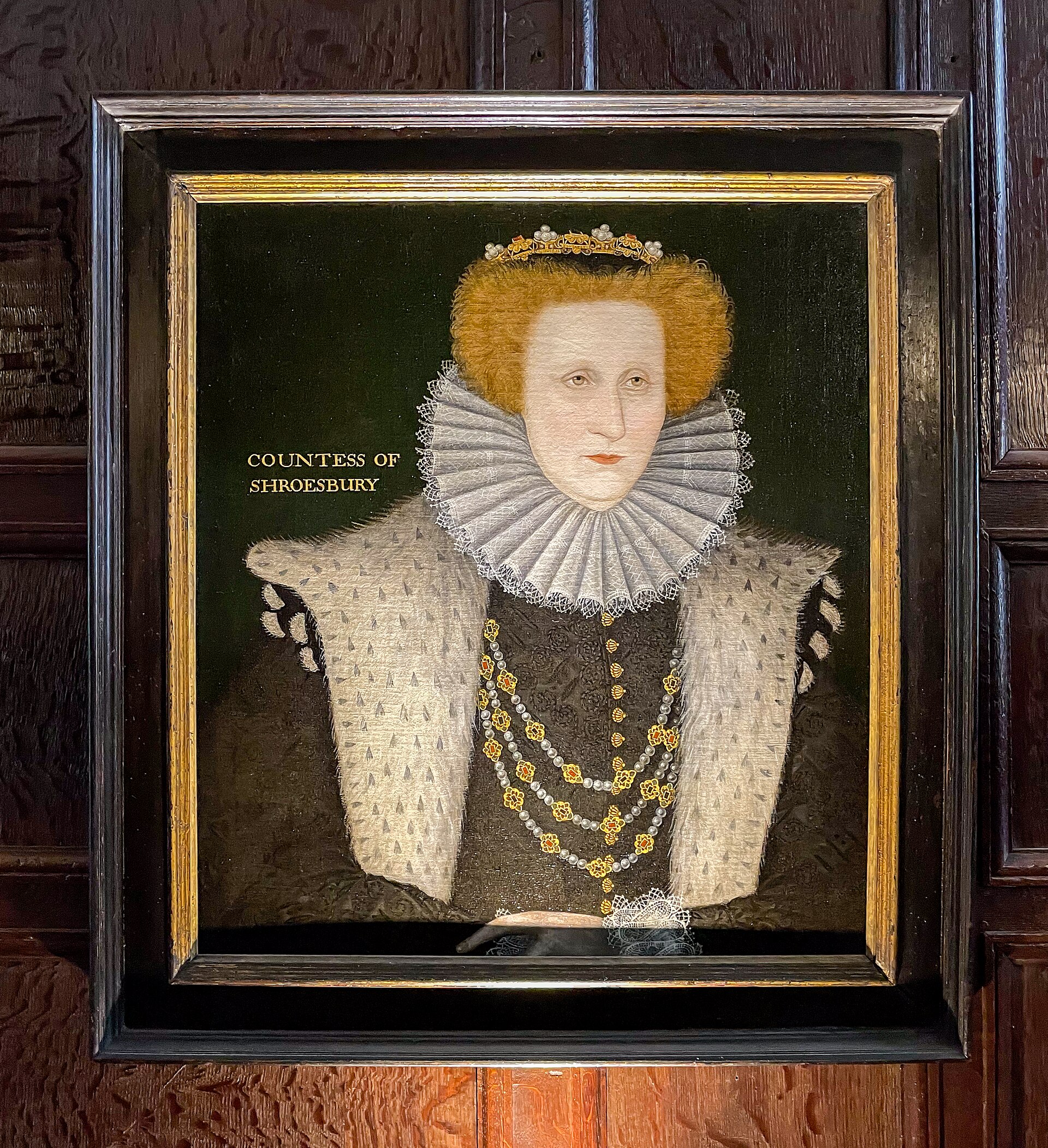
The woman at the centre of the chain is real and well documented elsewhere. The National Trust dates her birth to about 1527 and her death to 1608 (the National Trust's record gives ?1527; Commons files the portrait under 1520-1608). She married four times, the last time to George Talbot, 6th Earl of Shrewsbury, and the National Trust says she began the new Hardwick Hall after his death in 1590. English Heritage dates its completion to 1599. None of that tells us how four fifteenth-century hangings reached her.
Three routes to Hardwick are suggested and none is documented
The sources read for this piece suggest three routes by which the hunting tapestries reached Bess of Hardwick, and set beside them the V&A's hedged statement that she owned them. None is documented. The table sets out who says what, using the V&A's catalogue and Helen Wyld's 2016 chapter on Bess's tapestries in the Hardwick Hall volume edited by David Adshead and David Taylor.
| Route | Who raises it | Status in the source |
|---|---|---|
| Bess owned them | V&A catalogue | "May have belonged" to her; no purchase named |
| Her second husband Sir William Cavendish bought them second-hand | Santina Levey, as reported by Wyld | A suggestion ("perhaps"); no document cited in the passage we read |
| A gift from the English royal collection | Wyld | Cannot be ruled out; W. G. Thomson's older idea of Margaret of Anjou and Henry VI is called improbable on dating |
| Property of Mary, Queen of Scots | Wyld's abstract, as a possibility explored | Unverified; the chapter's abstract says it explores the possibility, and we found no Mary passage in the chapter text we read |
Wyld's own conclusion is careful. She writes that however the Hunts were acquired, hanging them in the Hall and in Bess's bedroom suggests how much they mattered to her. That is an argument from placement, and the placement is the one thing the inventory does document.
The older history is as blank as the route. The V&A's object history says the tapestries "may have been there since it was built in the 1590s". Wyld notes that the early provenance remains unknown. Our record puts a gap of roughly a century and a half between weaving in the second quarter of the fifteenth century and 1601, and nothing read for this piece closes it.
Wyld reads the 1601 inventory as showing the hangings already cut into at least six pieces
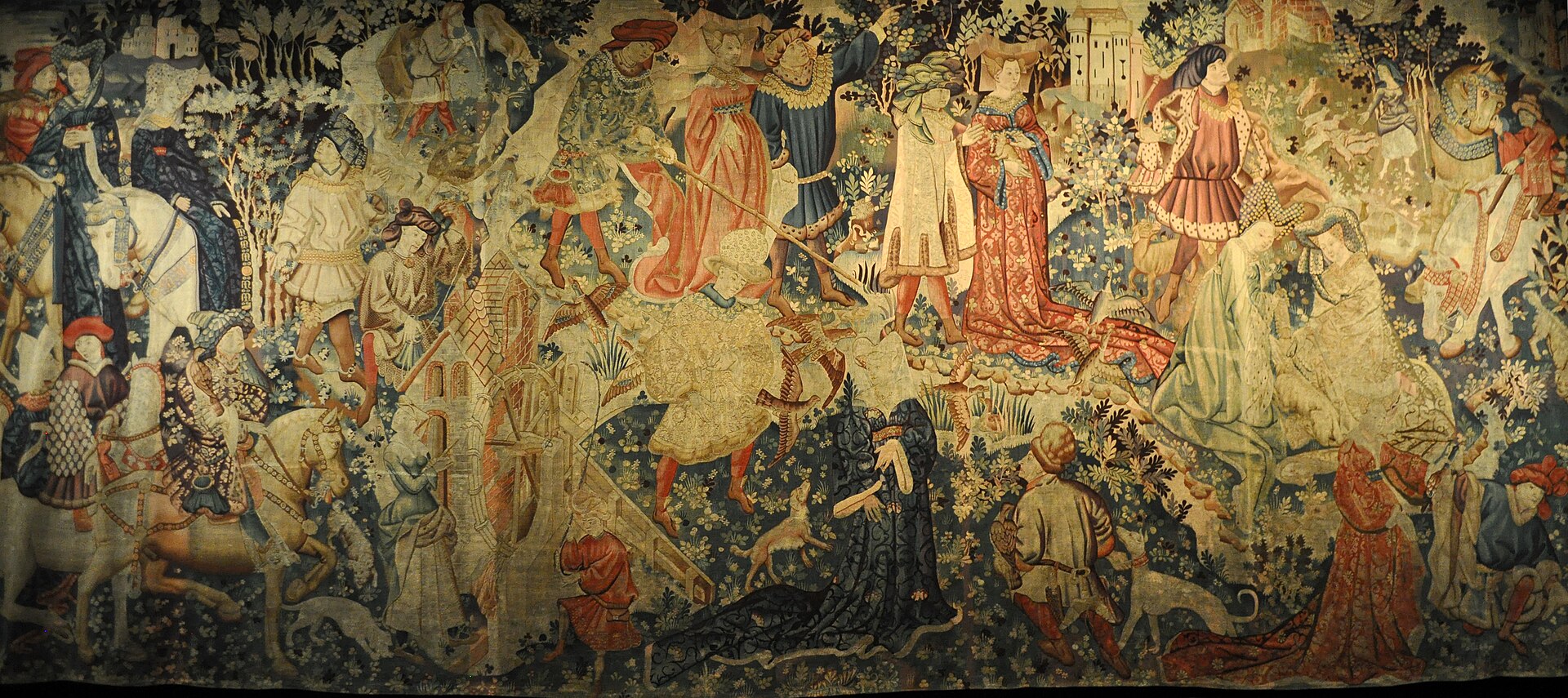
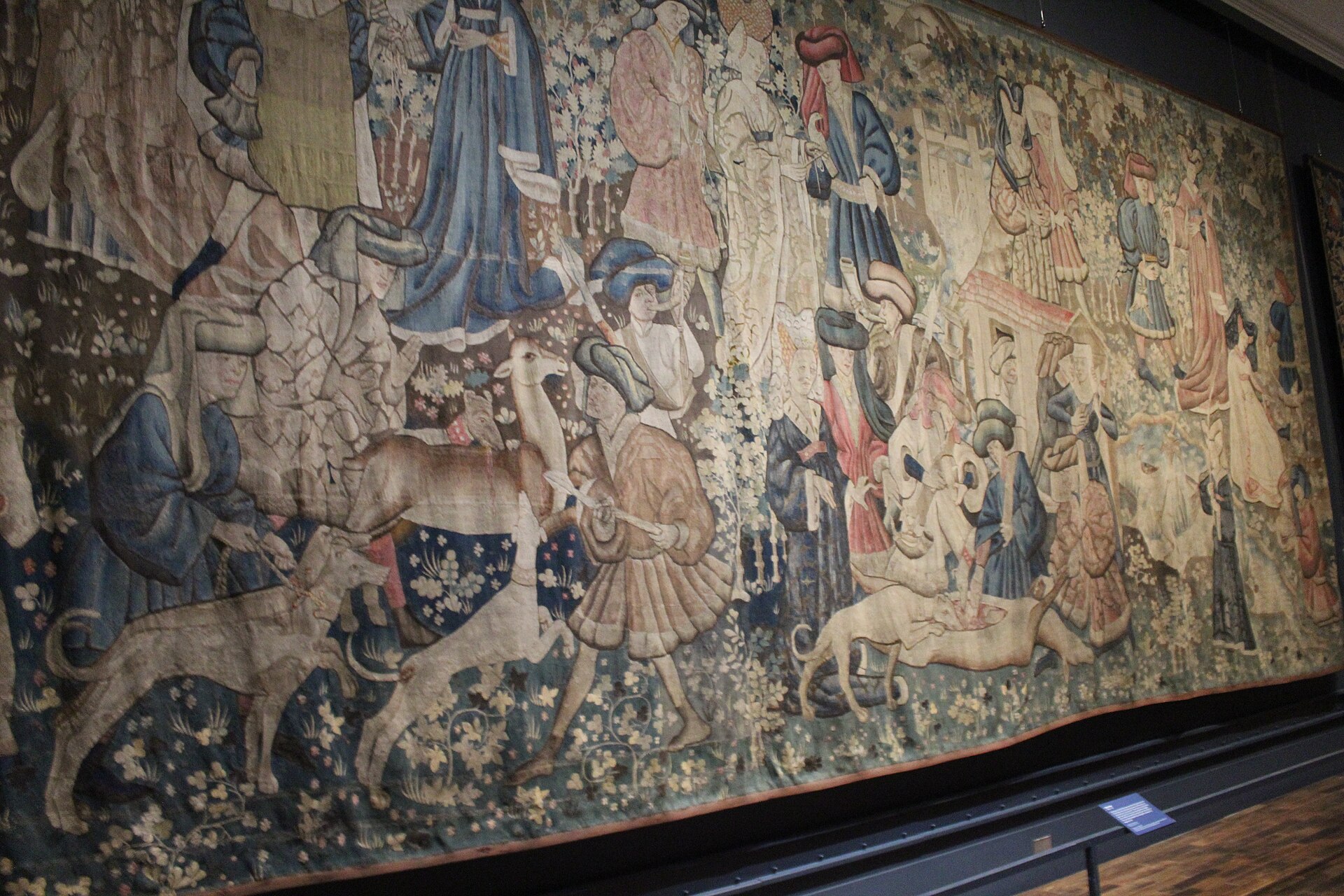
Wyld reads the 1601 inventory as showing that the Devonshire Hunts had already been cut into at least six smaller pieces. She counts four pieces in the Hall. She says two more were "almost certainly" in Bess's Bedchamber, where the inventory describes them as "too peeces of tapestrie hanginges with personages and forrest worke Fyftene foote and a halfe deep", an entry that she says "may well refer to" the Hunts. The V&A's Falconry catalogue entry quotes the same entry, with the spelling modernised, as "Tapestrie hanginges with personages and forrest work Fyftene feet and a half deep".
The depth matches. Falconry is now only 14.5 feet deep, and the museum says it has clearly lost some foliage at top and bottom. So the best-documented line in the whole file is a measurement, written by whoever drew up the list, of a hanging a little taller than the one we can see.
| Measure | 1601 inventory, as Wyld reads it | V&A today |
|---|---|---|
| Pieces | At least six on Wyld's reading (four in the Hall and two "almost certainly" in the Bedchamber) | Four assembled hangings |
| Sets of origin | At least three, on style and execution | Three, or more probably four, sets |
| Depth of the Bedchamber pieces | Fifteen and a half feet | Falconry 14.5 feet; the other three about 3.8 to 4.2 metres high |
One consequence is easy to miss. On Wyld's reading the cutting is older than 1601. Chatsworth's blog credits the 6th Duke of Devonshire in the 1840s with the repurposing of the hangings as draught excluders in the Long Gallery. Wyld reads six pieces in 1601, and the strips photographed in 1899 are presumably the 6th Duke's work. The sources do not say who cut the hangings first or why.
Wyld ties the cutting to the size of rooms. By the time Hardwick was built, the spaces in the grandest houses had shrunk from the great halls such tapestries were woven for, and she presents the cut pieces as the result.
The inventory was made as her goods moved between houses and for her will
Chatsworth's archive page on her will, which it dates 27 April 1601 with the Chatsworth and Hardwick inventories, says the Hardwick inventory was compiled because there had been much transferring of furniture and furnishings between her houses, especially after the new Hall at Hardwick was finished at the end of the 1590s. The National Trust gives a second purpose: in 1601 she commissioned an inventory of all her belongings for her will.
Chatsworth's page says both Halls at Hardwick, with their contents, went to her second son William Cavendish and his male heirs, while her eldest son Henry inherited Chatsworth without its contents. Henry sold his interest in 1609 for 8,000 pounds.
Who held the pen is not settled by the sources we opened. The National Trust says Bess "commissioned" the list in one place and, on its collections page, that she "compiled" it, and the V&A says it was "compiled for" her. We do not know whether the words are hers, a steward's or a clerk's. What the sources do support is that she ordered it and that it records her own possessions. Wyld counts fifteen sets of tapestries and seventy-eight hangings in the New Hall, plus smaller pieces, and the National Trust says the 1601 inventory still tells us what was in each room at that moment.
It is also the reason the Hunts have a date at all. Nobody wrote a purchase note for them that has been found. The nearest thing to a receipt is a list made for a will.
Her initials are in the parapet and on the Oxburgh panels, and no document links her to choosing the hunts
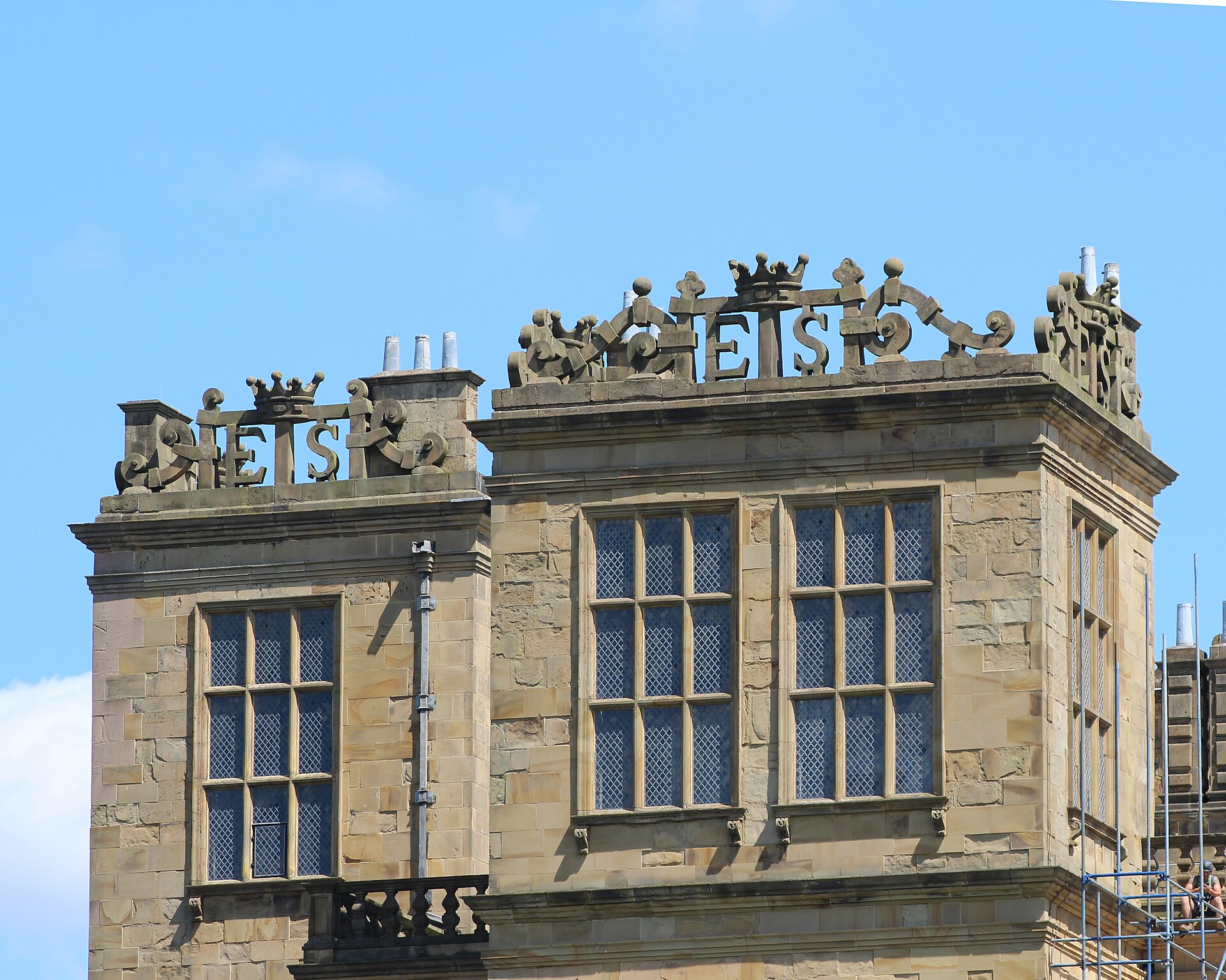
Bess of Hardwick's initials, ES for Elizabeth Shrewsbury, stand on the towers of Hardwick Hall. English Heritage says the towers are crowned by the initials surmounted by a countess's coronet. Chatsworth, describing a silver badge of the 1570s, says the same letters appear carved in stone and separate in the balustrade of her new house.
She did the same in thread. The V&A catalogues three of the Oxburgh Hangings panels as signed ES for Elisabeth Talbot, Countess of Shrewsbury, and its gallery label says Mary, Queen of Scots embroidered the panels with Bess and ladies of the household during Mary's custody. The panels were probably made at Tutbury and Sheffield. The museum adds that women could claim a work by signing it, as Mary and Bess did with personal ciphers. The National Trust says four surviving applique Noble Women hangings were probably made for Bess at Chatsworth in the 1570s and hung in her private Withdrawing Chamber at Hardwick.
Set that beside the purchases the sources do document. The National Trust says she bought the thirteen Gideon tapestries on a London shopping spree in 1592 or 1593 (Wyld gives a London journey of 1591-2), and they have hung in the Long Gallery since. In the sources read, the Gideon set has a buying trip and the Hunts have a list. Her initials stand on the towers and her purchases are on record elsewhere, and no document read records her choosing these hangings.
This is the point where an inference would be easy and unsafe. The V&A says the hunts "may have belonged" to her. Wyld reads their placement in the Hall and her bedroom as a sign of how much they mattered to her. Both readings are fair. Neither is a document of a decision, and we do not claim to know what she felt about them.
The tapestries survived her because later people kept them and a team of women rebuilt them
The Devonshire Hunting Tapestries survived the four centuries after Bess's death in 1608 because her descendants kept them, however badly, until women of the Decorative Needlework Society rebuilt them. Wyld reports from the 6th Duke's 1845 handbook that he stopped up many windows at Hardwick and covered them with spare tapestry, and a photograph of 1899 shows the Hunts in window bays in the Long Gallery, cut into numerous small pieces and patched with fragments of other sets. Chatsworth says that on a visit about fifty years after 1845 the Duke's great-niece Lady Louisa Egerton found the pieces folded in the two recesses.
Chatsworth names Arthur Strong, its librarian, and a local clergyman and historian, Rev Kerry (Chatsworth gives Charles, Wyld Richard), as the men who pushed for reconstruction. The V&A's 2007 blog credits Arthur Long of the House of Lords library instead. Wyld names Sanford Arthur Strong, librarian to the House of Lords and Chatsworth, as the man who arranged the work. The sources disagree on the name, and we do not settle it.
The work itself is documented in the same Chatsworth account. It began in December 1900 under Elizabeth Gemmell, a Glasgow-born embroiderer and former workroom mistress of the Royal School of Needlework, with the South Kensington Museum coordinating. The first piece, Swan and Otter Hunt, was finished in February 1902, fourteen months in. The Pall Mall Gazette praised the labour of fitting the strips together, and a team of eight women worked full time. It took the best part of a decade. Two of the restored hangings reached Chatsworth by 1905.
The tapestries came to the V&A in 1957. The museum's credit line says they were accepted by HM Government in lieu of tax on the estate of the 10th Duke of Devonshire, and the V&A says Deer Hunt has had more drastic repair than the others.
What would settle how Bess came to own them
Three kinds of document could settle how Bess of Hardwick came to own the hunting tapestries, and we have not seen any of them. The first is the transcribed inventory itself: Santina Levey and Peter Thornton published the 1601 inventories as Of Houshold Stuff for the National Trust in 2001, and our account of the entries rests on Wyld's reading of them and on the V&A's quotation, not on that transcription. The second is the Cavendish and Shrewsbury accounts, which are where a purchase would be recorded if there was one. The third is an earlier inventory: Wyld says a Sheffield Castle inventory of 1582 lists Cavendish and Shrewsbury possessions, though in the passage we read it concerns cheap verdure hangings, not the Hunts.
Until one of those turns up, the claim stays where the documents leave it. The 1601 inventory shows that Bess held the Hunts, that they were already in pieces, and where they hung. Every statement about how they came to her belongs to somebody's hypothesis.
Questions
No source read for this piece says so. The V&A says the tapestries may have belonged to her and were probably part of an entry in the 1601 Hardwick inventory, but it names no purchase, and Santina Levey suggests her second husband perhaps bought them second-hand.
The V&A quotes an entry for 'Tapestrie hanginges with personages and forrest work Fyftene feet and a half deep' as probably including them. Helen Wyld reads the inventory as showing at least six cut pieces: four in the Hall and two that she says were almost certainly in Bess's Bedchamber, in an entry that may well refer to the Hunts.
They were already cut by 1601 on Wyld's reading of the inventory. The 6th Duke of Devonshire is recorded using spare tapestry to cover windows in 1845, and the pieces were found folded in Long Gallery recesses in the 1890s.
It is only a possibility. Helen Wyld's 2016 chapter on Bess's tapestries explores whether some older tapestries in the 1601 inventory, including the Hunts, were Mary's. We have not seen a primary document confirming it.
The sources do not say. The National Trust says Bess commissioned it for her will, Chatsworth says it was made because furniture had been moved between her houses, and the V&A says it was compiled for her.
Sources
- 1Victoria and Albert Museum, collections catalogue, Falconry (Devonshire Hunting Tapestries), museum no. T.202-1957, gallery label and object history. collections.vam.ac.uk/item/...
- 2Victoria and Albert Museum, collections catalogue, The Devonshire Hunting Tapestries (Boar and Bear Hunt), museum no. T.204-1957, object history. collections.vam.ac.uk/item/...
- 3Helen Wyld, 'Bess of Hardwick's Tapestries', in David Adshead and David Taylor (eds), Hardwick Hall: A Great Old Castle of Romance, Yale University Press, 2016. Read as an author's copy on Academia.edu (abstract and chapter text). academia.edu/28979823/...
- 4National Trust, The history of Hardwick Hall (the 1601 inventory, her four marriages, the new Hall after 1590). nationaltrust.org.uk/visit/...
- 5National Trust, The collection at Hardwick (Noble Women hangings, the 1601 inventory, the Gideon tapestries). nationaltrust.org.uk/visit/...
- 6National Trust, Gideon tapestry project at Hardwick Hall (purchase in London 1592/3, 13 tapestries). nationaltrust.org.uk/visit/...
- 7Chatsworth House Trust, Bess of Hardwick's will, 1601, with Chatsworth and Hardwick inventories, dated 27 April 1601. chatsworth.org/art-archives/...
- 8Chatsworth House Trust, 'A Stitch in Time: The past lives of the Devonshire Hunting Tapestries, pt. I', 29 September 2021. chatsworth.org/news-media/...
- 9English Heritage, Women in History: Bess of Hardwick (the ES initials and coronet on the towers; completion in 1599). english-heritage.org.uk/learn/...
- 10Chatsworth House Trust, Bess of Hardwick's badge (ES in the balustrade at Hardwick Hall). chatsworth.org/art-archives/...
- 11Victoria and Albert Museum, The Oxburgh Hangings, panel by Elizabeth Talbot and Mary Queen of Scots (three panels signed ES). collections.vam.ac.uk/item/...
- 12Victoria and Albert Museum blog, Sue Lawty, 'The Devonshire Hunting Tapestries', 24 September 2007. vam.ac.uk/blog/...
- 13Victoria and Albert Museum, 'The Devonshire Hunting Tapestries' (article, updated 1 August 2025). vam.ac.uk/articles/...
More in The Women Behind the Art
The partWho Stitched the Bayeux Tapestry? What the Documents Say About English Women's Embroidery
No document names who stitched the Bayeux Tapestry. What Domesday, the 1476 inventory and the Queen Matilda story show about English women's...
The Two Women in the Oseberg Ship, and the Queen Nobody Named
Two women lay in the Oseberg ship in 834. What the bones, isotopes and DNA show, and how a queen and a servant were read into a grave that no text...
The Name on the Rim: What Documents Say About Projecta
The Projecta Casket names its bride in one line of Latin. What the British Museum, Dalton 1901, an epitaph and Parliament say about her, and what is...