Portable Altar of Countess Gertrude
Unknown goldsmith, probably Lower Saxony; commissioned by Countess Gertrude of Brunswick · Shortly after 1038 (Cleveland, record for the altar proper, 1931.462.a) or c. 1045 (Cleveland, record for the whole object, 1931.462); the museum's date range on the whole object is 1040-1050
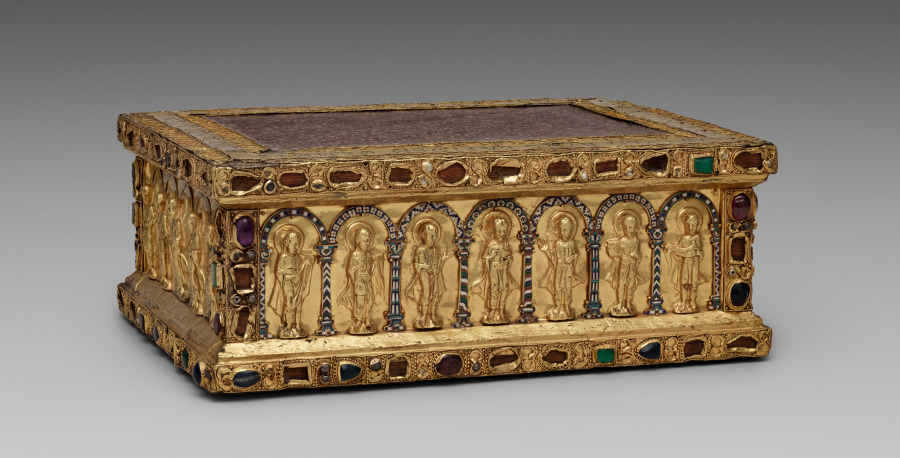
The whole object as catalogued, 1931.462: gold, cloisonne enamel, porphyry, gems, pearls and niello over a wood core. Cleveland Museum of Art, CC0.
| Artist | Unknown goldsmith, probably Lower Saxony; commissioned by Countess Gertrude of Brunswick |
|---|---|
| Date | Shortly after 1038 (Cleveland, record for the altar proper, 1931.462.a) or c. 1045 (Cleveland, record for the whole object, 1931.462); the museum's date range on the whole object is 1040-1050 |
| Medium | Gold, cloisonne enamel, porphyry, gems, pearls, niello, wood core |
| Dimensions | 10.5 x 27.5 x 21 cm (4 1/8 x 10 13/16 x 8 1/4 in.), overall |
| Where it is now | The Cleveland Museum of Art, Cleveland, Ohio (gallery 106C, Medieval Treasury, per the museum's record)last confirmed |
| Inventory number | 1931.462 (altar 1931.462.a; trap door .b; reliquary bag .c; relics .d to .m) |
| Attribution | UnknownThe patron is named on the object: the Latin inscription round the altar stone says Gertrude offered it to Christ. Full note |
| Object type | Goldsmith's work |
| Period | Ottonian-Salian Germany, eleventh century |
| Cases | Has a provenance gap |
| Inscriptions | Round the porphyry stone: GERDRVDIS XPO FELIX VT VIVAT IN IPSO OBTVLIT HVNC LAPIDEM GEMMIS AVROQ NITENTEM (Cleveland's translation: 'Gertrude offers to Christ, to live joyfully in him, this stone that glistens with gems and gold'). On the short side right of the front: SIGISMVNDVS, CONSTANTIVS, SANCTA CRVX, SCA ELENA, SCA ADALHEIT (Sigismund, Constantine, True Cross, Saint Helena, Saint Adelheid). Another Cleveland-linked page prints the second name as Constantinus. |
| Owners on record | 8 links6 documented, 2 unknown |
| Sources | 18 cited |
About this record Last verified · 18 sources cited · Change log
On this page 9 sections
ContentsClose
A small gold-covered portable altar with a slab of white-speckled porphyry as its stone, made shortly after 1038 or about 1045 for Countess Gertrude of Brunswick, whose Latin verse round the stone offers it to Christ. It served as the core of the treasury of the church of St Blasius in Brunswick, and its trap door still opens on a cavity that held ten labelled bundles of relics, examined in the 1980s and given new housings in 2020.
It left the House of Guelph in 1929 with the whole 82-piece Guelph Treasure, bought by three Frankfurt dealer firms for 7.5 million Reichsmarks. In 1931 the Cleveland Museum of Art took the altar and the two Gertrude crosses for 320,000 dollars, according to the Prussian Cultural Heritage Foundation's account, after the Metropolitan Museum was offered the same three for 450,000 and bought nothing. It has been in Cleveland ever since as accession 1931.462.
The Berlin restitution dispute concerns the 42 pieces sold to Prussia in 1935. No source read says that the Cleveland pieces are involved, and the altar was sold four years before that contract. The maker, the exact date and the reading of the saints on its short side remain open.
Provenance
Each link is graded. Documented: a cited source supports it. Disputed: the identification is argued but not established. Unknown: no owner for that span, and the gap is not smoothed into a narrative. The grades in the glossary.
- c. 1038 - c. 1045Countess Gertrude of Brunswick (patron), maker unknowndocumented
The verse on the altar says Gertrude offered it to Christ. Cleveland dates it shortly after 1038 (altar proper) or c. 1045 (whole object). The maker and exact place are not named in any source read and Cleveland queries Lower Saxony.123
- c. 1045 - 1482Collegiate church of St Blasius, Brunswick (treasury)unknown
Cleveland's open-access provenance gives the treasury of the Cathedral of St Blaise from 1045. The Museum's blog says Gertrude donated the altar with two crosses after her husband's death. No source read records a deed of gift or a date of entry, so custody is inferred from the patron and from the later inventory.24
- 1482 - 1671Church of St Blasius, Brunswickdocumented
The 1482 inventory of the church lists the altar and its relics, according to the Museum's blog and the Columbia project. The inventory itself was not read; Andrea Boockmann catalogued it in 1997.45
- 1671 - early 1920sHouse of Brunswick-Luneburg (Guelph), Hanover court chapel until 1803unknown
The Foundation's magazine says the treasure came into the House's possession in 1671, and Wikipedia says most objects left the cathedral in the seventeenth century and stayed in the Hanover court chapel until 1803. Neither names this altar, and the period from 1803 to the early 1920s is a gap for the object. Tertiary source, to be replaced with the Falke, Schmidt and Swarzenski catalogue.914
- early 1920s - 1929-10-05House of Brunswick-Luneburg, treasure held at Gmunden, Austriadocumented
By the early 1920s the treasure was at Gmunden. In 1925 Austria secured a purchase option in connection with export licences and the Federal Ministry waived it in January 1930. Sale efforts to Duveen, the Metropolitan Museum, the Victoria and Albert Museum, the Reich and Hanover all failed. The account is the Foundation's own submission.8
- 1929-10-05 - 1931Consortium of Frankfurt dealers J. and S. Goldschmidt, Z. M. Hackenbroch and J. Rosenbaumdocumented
Altar is item 3 in the 1930 catalogue. Shown in Frankfurt and Berlin in 1930, in New York from 30 November 1930 and in Cleveland from 10 January 1931. Offered to the Metropolitan Museum with the two crosses for USD 450,000 in December 1930; not bought.817
- 1931 - 1931William M. Milliken for the Cleveland Museum of Art, from the consortium via Goldschmidt Galleries, New Yorkdocumented
The Foundation records USD 320,000 (RM 1,347,200) for the altar and the two Gertrude crosses, with an earlier purchase returned in lieu of payment and a monstrance added free. Source for the price is original documents from an auctioned Guelph catalogue, not independently checked. Cleveland's own record names Goldschmidt Galleries as vendor. No auction: there is no hammer price or premium.28
- 1931 - presentThe Cleveland Museum of Art, Cleveland, Ohiodocumented
Credit line Gift of the John Huntington Art and Polytechnic Trust. On view in gallery 106C per the Museum's record. Not part of the 1935 sale to Prussia.128
Technical evidence
| Attribution note | The patron is named on the object: the Latin inscription round the altar stone says Gertrude offered it to Christ. The maker is not named in any source consulted, and the Cleveland Museum of Art gives the place of origin only as 'Germany, Lower Saxony?' with the question mark. Its two dates, shortly after 1038 and c. 1045, both rest on the patron's widowhood, not on a document. Scholarship groups the altar with a 'Gertrude group' of objects made for her (the subject of a 2024 dissertation by Katharina Beichler, as listed in the Cleveland bibliography and not read for this record). |
|---|---|
| Dimensions | Overall 10.5 x 27.5 x 21 cm (4 1/8 x 10 13/16 x 8 1/4 in.).12 |
| Materials | Gold, cloisonne enamel, porphyry, gems, pearls, niello and a wood core.12 |
| Altar stone | White-speckled porphyry. Cleveland reads it as an imperial colour used only by the imperial family and as a sign of the patron's aspirations (the museum's interpretation).13 |
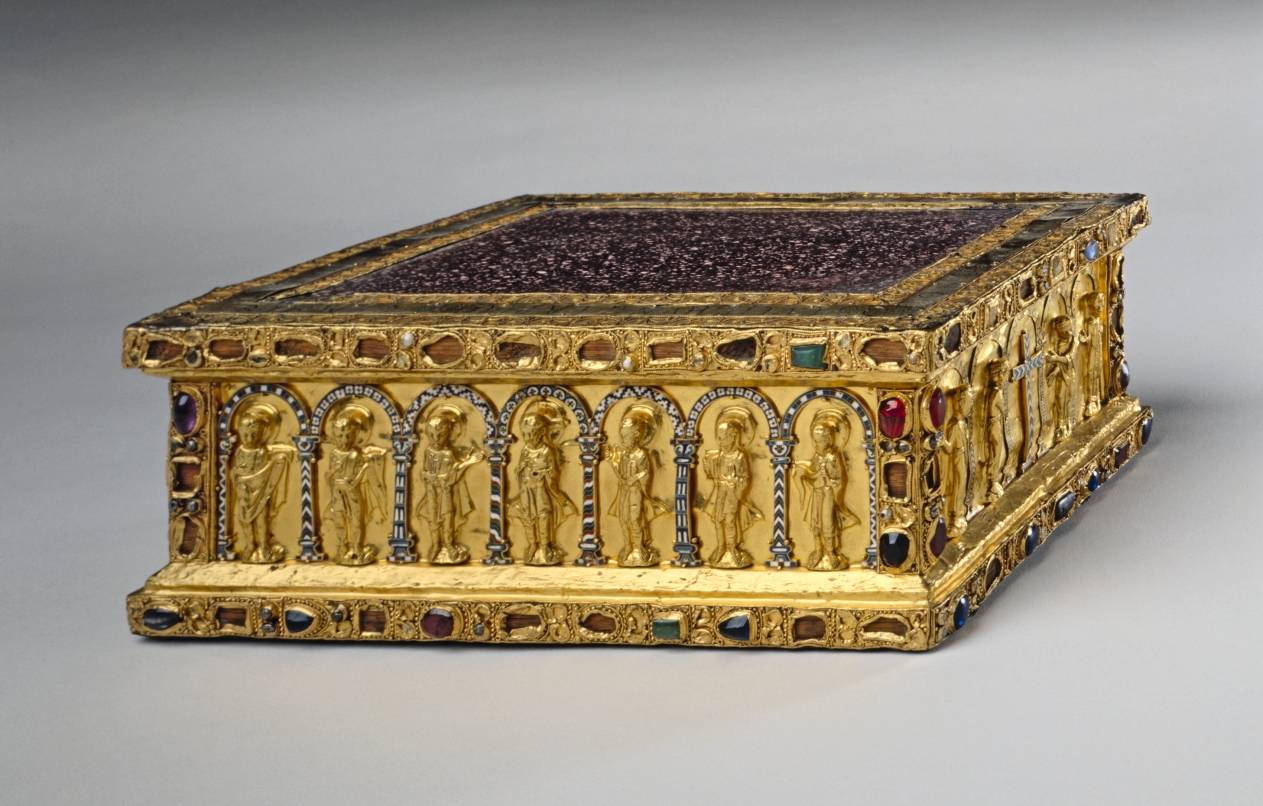
| Decoration | Figures in arched niches with blue and white enamel backgrounds; borders set with red, blue and green stones and small white pearls. 46 of the original 92 large stones survive.34 |
| Stones identified | Sapphire, garnet, fluorite, amethyst, emerald and carnelian, plus red, green and blue glass and a piece of fossilised tar, identified by the Cleveland Museum of Natural History using a thermal-conductivity tester.4 |
| Figural programme | Front: Christ with six apostles. Back: the Virgin praying between apostles. One short side: four sceptre-bearing angels and St Michael killing the dragon. Other short side: the adoration of the True Cross with Constantine, St Helena, Sigismund and Adelheid.35 |
| Inscription | Metric verse round the stone: GERDRVDIS XPO FELIX VT VIVAT IN IPSO OBTVLIT HVNC LAPIDEM GEMMIS AVROQ NITENTEM. Side labels: SIGISMVNDVS, CONSTANTIVS, SANCTA CRVX, SCA ELENA, SCA ADALHEIT. One Cleveland-linked page prints Constantinus.25 |
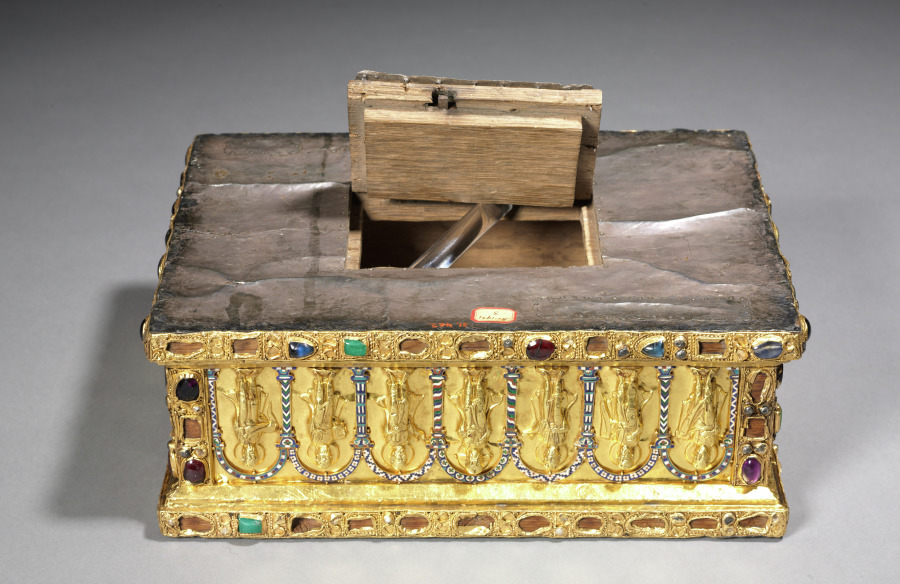
| Trap door and lock | Trap door in the underside opens with a key into a hollow cavity. The lock dates from the 1700s. The original key did not reach Cleveland in 1931 and a new one was made by Arthur Beukemann.4 |
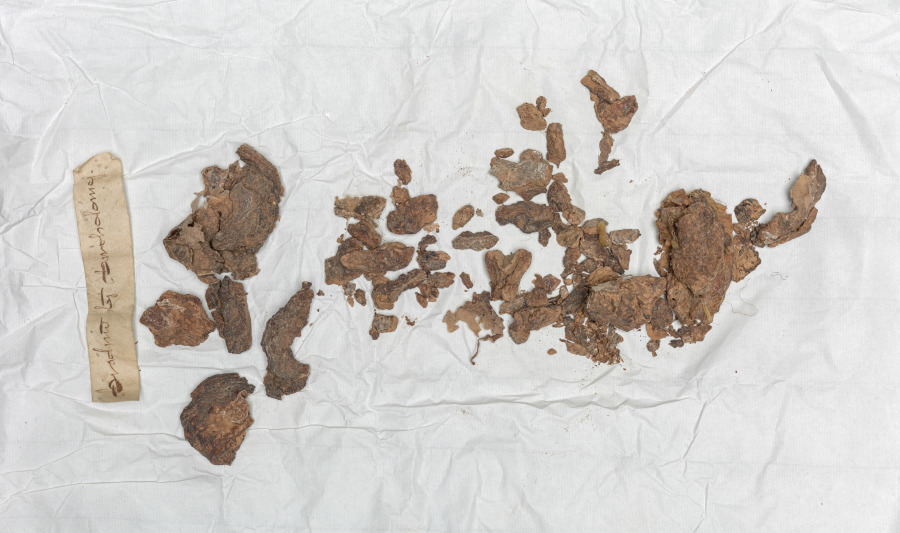
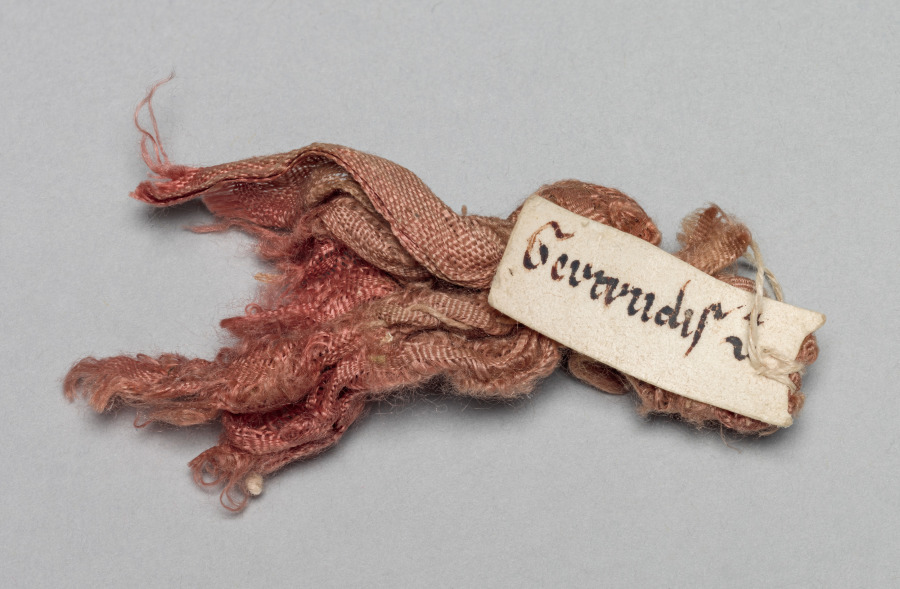
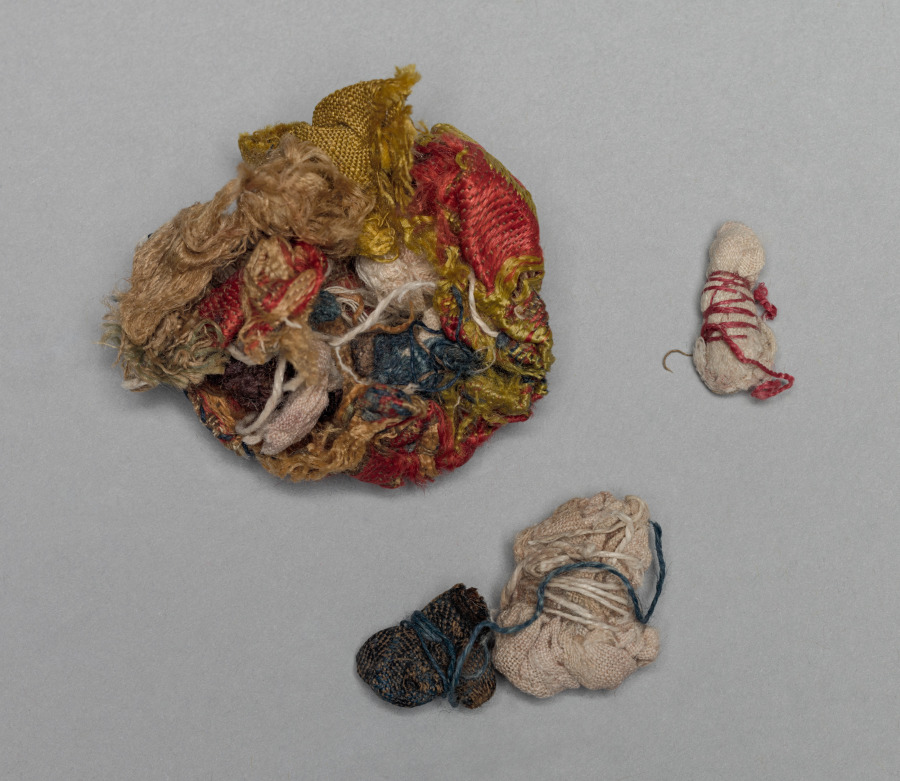
| Relic cavity | Ten bundles with medieval parchment labels (accessions 1931.462.d to .m): Hermetis, Adelaide, Vincent, Gertrude, Marcian, ten saints in one bundle, the stone that supported the Cross, Gregory, Januarius and Bartholomew. Identified by X-ray and visual inspection.24 |
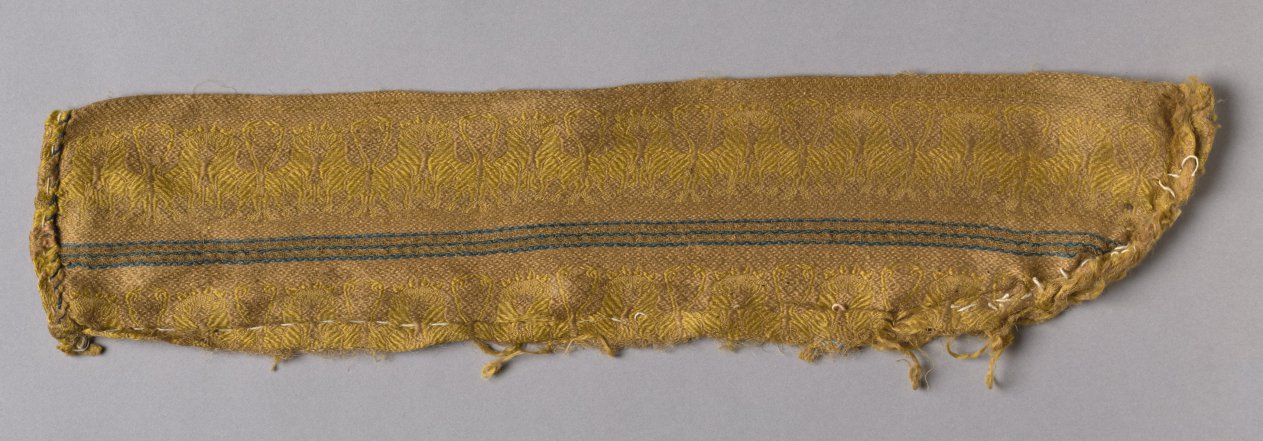
| Reliquary bag (1931.462.c) | Silk and gold thread cloth d'areste, weft-faced lozenge twill variant, with lions; 8 x 36.9 cm average. Dated late 1100s to 1300s in the open-access record; Spanish silk of the 1300s in the Museum's blog; thirteenth-century Spanish (Mudejar) silk in the Columbia project.245 |
| Accession and credit | 1931.462, Gift of the John Huntington Art and Polytechnic Trust. Components: .a altar, .b trap door, .c bag, .d to .m relics.12 |
| Images and licence | Cleveland Open Access, CC0, share_license_status read from the museum's API for every component used on this page on 2026-11-19.2 |
Images
The record in full
Chapter 1A slab of porphyry in a gold box, built to be carried and opened
The altar is small: 10.5 centimetres high, 27.5 wide and 21 deep.
The altar is small: 10.5 centimetres high, 27.5 wide and 21 deep. A wooden core is covered in gold and carries a slab of white-speckled porphyry as the altar stone, the surface on which bread and wine were placed. The frame is worked in cloisonne enamel, niello, gems and pearls. Figures stand in arched niches whose backgrounds are patterned in blue and white enamel, and the borders are set with red, blue and green stones and small white pearls. Cleveland records that 46 of the original 92 large stones survive.
It is a portable altar in the strict sense: an object on which Mass could be said away from a consecrated church. The Cleveland Museum of Art explains that an ecumenical council of 787 required every altar, large or portable, to contain relics, and this one does. The underside has a trap door, and behind it is a hollow cavity that held ten small bundles of relics. The object is therefore an altar and a reliquary at once, which is how Holger Klein describes its function in the Columbia University exhibition web project on the 2010 show Treasures of Heaven.
Chapter 2Gertrude put her name round the stone
The patron is not in doubt. A Latin verse runs round the altar stone and begins with her name.
The patron is not in doubt. A Latin verse runs round the altar stone and begins with her name. Cleveland translates it: Gertrude offers to Christ, to live joyfully in him, this stone that glistens with gems and gold. There is nothing hidden in it: a donor names herself, names the one receiving the gift and states what she hopes for.
Gertrude was the widow of Count Liudolf of Brunswick, who died in 1038. Wikipedia (a tertiary source, to be replaced) gives her death as 21 July 1077 and says that she and Liudolf founded the collegiate church of St Blasius in Brunswick in 1030 and that she raised their underage sons after 1038. The Columbia web project says she commissioned the altar shortly after her husband's death. Cleveland's own pages for the two crosses that came with the altar say the same of them: the museum states that she commissioned the Liudolf cross and gave it to St Blasius after her husband died, and reports a Latin inscription on it reading that the work was commissioned by Gertrude for the soul of Count Liudolf. The altar's own inscription does not mention her husband. That the altar too was a memorial for Liudolf is the museum's reading, not something the altar's verse says.
The date is the museum's own open question. The record for the altar proper (1931.462.a) says shortly after 1038. The record for the whole object (1931.462) says c. 1045 with a range of 1040 to 1050. Neither is tied to a document, and no source consulted explains the difference. This record carries both.
Chapter 3An imperial stone and a cast of saints that points at Burgundy
The front shows Christ flanked by six apostles under enamel arcades.
The front shows Christ flanked by six apostles under enamel arcades. On the back the Virgin stands in prayer between apostles. One short side has four sceptre-bearing angels either side of St Michael killing the dragon. The other short side shows the adoration of the True Cross, and its inscription names the figures: Constantine, St Helena, Sigismund and Adelheid. The inscription labels the cross as sancta crux and Helena and Adelheid as saints, and the names on the enamel are the only firm ground for identifying the figures.
Argued by the museum. Cleveland reads the porphyry as a statement of ambition. Porphyry was an imperial colour from antiquity, the museum says, and was used only by the imperial family. It reads the royal and imperial figures beside Christ, the Virgin and the apostles as stressing the countess's political ambitions and her claim to an imperial lineage for her dynasty. This is an interpretation by the holding institution and is presented here as that, not as Gertrude's documented intention.
Argued by a named scholar, argument not read. Patrick Corbet published the fullest case in 1991 in Cahiers de civilisation medievale. Its title frames the altar as a product of a royal Burgundian tradition and of aristocratic self-awareness in the Salian empire. A 2002 Dijon colloquium volume on the sanctity of Adelaide of Burgundy reproduces the altar. This record could confirm the title and a bibliographic abstract on the publisher's page but could not read Corbet's text, so the detail of his reading of Sigismund and Adelheid is not given here.
Facts sitting beside it. Liudolf's mother was Gisela of Swabia. She later married Conrad II, was crowned empress in 1027 and bore Henry III. Her mother Gerberga was a daughter of King Conrad the Peaceful of Burgundy. On these facts, taken from two Wikipedia articles, Liudolf was Henry III's half-brother, and the Burgundian line runs through Gisela. Putting them next to an altar that shows Sigismund and Adelheid is this record's observation. It is the territory Corbet's title stakes out, but no source read here states that the altar's figures refer to this family, and nobody should cite this paragraph for that. None of the sources read says that Conrad II, Gisela or Henry III appear on the altar.
Two documented things that fit together. The cavity held a limestone fragment that its medieval parchment label calls the stone that supported the Cross on Golgotha, and a bundle labelled for Saint Adelaide. The exterior carries an adoration of the True Cross and a saint named Adelheid. That the contents and the exterior answer each other is plain on the object. Whether Gertrude's workshop planned it so is not recorded.
Nothing in the sources suggests a hidden programme beyond dynastic piety, the cult of the True Cross and the use of a prestige stone. That absence is a finding.
Chapter 4Ten bundles, ten labels and one fragment that may not be human
Each of the ten bundles in the cavity has a small parchment label naming its saint.
Each of the ten bundles in the cavity has a small parchment label naming its saint. The Cleveland Museum reports that the script and text of the labels are medieval, and that relics may have been moved in and out during the altar's working life. The fifteenth-century inventory of the Brunswick church, dated 1482, lists the altar and relics of Saints Hermes, Bartholomew, Vincent, Adelheid, Gertrude and Marcian among others, and several are still there.
The relics were examined by staff of the Cleveland Museum of Natural History (Linda Spurlock and Lyman Jellema) with the visiting forensic anthropologist Socorro Baez Molgado, using X-rays and visual inspection. The museum's account of what they found, as published by curatorial assistant Amanda Mikolic in 2020: the bundle labelled Hermetis holds a fragment of a long bone; the bundle labelled Adelaide holds a fragment believed to be a metacarpal, though its curvature seems too pronounced for a human bone; Vincent's is part of the occipital bone; Gregory's is a fragment of the upper tibia; Januarius's is a nearly complete talus; Bartholomew's is mummified flesh or tissue. The bundles labelled for Gertrude and for Marcian showed no solid material on X-ray inside their Byzantine textile, and the bundle for ten saints (Stephen, Sophie, Perpetua, Paul, Barnabas, Philip, Simon, Thaddeus, John the Apostle and James) showed only small specks. The last bundle is the limestone from Golgotha.
These are findings about what the bundles contain, not about whose the bones are. The belief that they were the saints named is the belief of the people who labelled them. The museum records the textiles with precision: a blue plain-weave silk round Adelaide, a samite or compound weave round Hermetis, undyed silk round Vincent, green silk with a surviving selvage round Marcian, rose-coloured silk with a selvage round Gertrude. The bundle labelled Gertrude carries a saint's name, not necessarily the patron's. Which Saint Gertrude is meant is not stated in any source read.
Chapter 5Four centuries at St Blasius, then the House of Guelph
Cleveland's open-access record starts the provenance at the treasury of the Cathedral of St Blaise in Brunswick, dated from 1045.
Cleveland's open-access record starts the provenance at the treasury of the Cathedral of St Blaise in Brunswick, dated from 1045. The church was founded in 1030 and is the predecessor of Brunswick Cathedral, whose present building Henry the Lion began in 1173 (Wikipedia). The Cleveland Museum says the altar and two crosses given by Gertrude formed the core of the treasure. No source read records the deed of gift or the day the altar entered the church, so the move from workshop to church is a statement of belief, not a document. The first firm documentary hook is the 1482 inventory, as reported by Cleveland and Columbia and catalogued by Andrea Boockmann in 1997.
The treasure takes its modern name from the House of Guelph. The Prussian Cultural Heritage Foundation's own magazine says that it came into the House's possession in 1671. Wikipedia adds that most of it left the cathedral in the seventeenth century, passed to John Frederick, Duke of Brunswick-Luneburg, and stayed in the Hanover court chapel until 1803. The sources read do not name this altar in either account, so the Hanover years are a gap for this object specifically. By the early 1920s the whole treasure was at Gmunden in Austria, according to the Foundation's 2010 account.
That Austrian stay created the nearest thing to an export-licence record. In 1925 Austria secured a purchase option in connection with issuing the export licences for the treasure, the Foundation's account says, and the minimum price its experts set was 2.5 million schillings. The Federal Ministry for Education waived the option in January 1930, citing the general state financial situation. So the treasure left Austria because a state declined to pay, not because nobody tried.
Chapter 6Nobody would pay the price, so the House sold the lot to dealers in 1929
The Foundation's 2010 account, an interested party's submission, records the failed sales of the 1920s.
The Foundation's 2010 account, an interested party's submission, records the failed sales of the 1920s. Duveen Brothers and Robert Langton Douglas inspected the treasure in the early 1920s, and Douglas lost interest in 1921 because the House was asking far more than the pieces were worth. By December 1927 the Metropolitan Museum was in talks, and its applied-arts curator Joseph Breck called a demanded ten to twelve million dollars obviously absurd. In 1927 the House insured the whole treasure for 15.47 million Reichsmarks. In 1928 the asking price was cut by more than forty per cent to six million dollars, and in the same year the Victoria and Albert Museum was told of a price falling from 1.5 million pounds to 527,000 pounds and declined. Efforts to interest the German Reich in 1927 and the city of Hanover in 1929 also came to nothing.
On 5 October 1929 the House's administration sold all 82 objects to three Frankfurt dealer firms, J. and S. Goldschmidt, Z. M. Hackenbroch and J. Rosenbaum, for 7.5 million Reichsmarks payable in four instalments over twelve months. The contract gave the House a share of any resale profit and required the buyers to try to resell and to report quarterly; the Foundation says those reports have not been found. This is the sale that took the altar out of the Guelph family's ownership, and it is the same transaction the Berlin Guelph Cross record describes in more detail.
Chapter 7How the altar reached Ohio, and what Cleveland paid
The altar is item 3 in the 1930 catalogue by Otto von Falke, Robert Schmidt and Georg Swarzenski, with the two Gertrude crosses as items 4 and 5, according to the Foundation's account.
The altar is item 3 in the 1930 catalogue by Otto von Falke, Robert Schmidt and Georg Swarzenski, with the two Gertrude crosses as items 4 and 5, according to the Foundation's account. The consortium showed the treasure in Frankfurt and Berlin in autumn 1930 and then shipped the 64 unsold pieces to the United States in October and November 1930, insured for 1.75 million dollars. Six exhibitions followed: New York (Goldschmidt and Reinhardt Galleries, 30 November to 31 December 1930), Cleveland (10 January to 1 February 1931), Detroit, Philadelphia, Chicago and San Francisco.
The Foundation's account, drawing on original documents from an auctioned Guelph Treasure catalogue it describes as assumed to be from the Goldschmidt estate and now in private hands, records two Cleveland deals. At Frankfurt William M. Milliken of the Cleveland Museum bought six pieces for 259,500 dollars in total. These are probably the six that the Museum's Bulletin of November 1930 describes (an inference from the matching number), and TIME of 8 December 1930 reported that Cleveland had bought six pieces as a starter and that Milliken, the chief customer, lectured on the New York opening day. The altar was not among them. The Foundation places the next Cleveland deal among the sales made during the American exhibitions, and the accession year is 1931. Milliken bought the Portable Altar of Countess Gertrude and the two Gertrude crosses for 320,000 dollars (1,347,200 Reichsmarks, the Foundation's conversion) and returned one of the earlier pieces to the dealers in lieu of payment. The Foundation does not say whether 320,000 is net of that credit. Cleveland also received a monstrance as a free bonus. Milliken wrote the Museum's Bulletin article on the altar and crosses in February 1931.
The comparison that makes the figure readable is the Metropolitan Museum. In December 1930 the dealer Goldschmidt offered the Met the same three pieces for 450,000 dollars, and the Met bought nothing. Cleveland's 320,000 is about 71 per cent of that asking price, and its Reichsmark equivalent is about 18 per cent of the 7.5 million the consortium had paid for the whole treasure fifteen months earlier (both percentages are this record's arithmetic from the Foundation's figures). Set beside the Domed Reliquary at 600,000 dollars and the Eilbertus altar at 580,000, the other pieces the Met's curator singled out, the Gertrude group at 450,000 for three objects was among the dearest things the Met was shown. Museum purchases of this kind were private treaty sales; there was no hammer price or buyer's premium. Three Cleveland accessions carry three credit lines: the altar (1931.462) and the Liudolf cross (1931.461) are credited to the John Huntington Art and Polytechnic Trust, while the Gertrude cross (1931.55) is credited to the J. H. Wade Fund with a gift from Mrs Edward B. Greene. No source consulted says how the 320,000 dollars was split among those funds.
One further count: with the six first purchases less the one returned, the three Gertrude pieces and the monstrance, Cleveland's Guelph purchases come to nine, which matches the nine Wikipedia gives. That is the record's arithmetic; the Museum's 1991 handbook is reported in a search result to say eight, which could not be confirmed.
Chapter 8The people in the chain
Julius Goldschmidt of J. and S. Goldschmidt was the dealer who handled the American tour; the Foundation names him as the seller who made offers to the Met and to Otto Kahn and who sold on to other...
Julius Goldschmidt of J. and S. Goldschmidt was the dealer who handled the American tour; the Foundation names him as the seller who made offers to the Met and to Otto Kahn and who sold on to other American buyers. Zacharias Hackenbroch was the partner who pursued German buyers from the end of 1929 and was in America in March 1931, according to the Foundation. Saemy Rosenberg negotiated the price reductions offered to Brunswick in 1931. Cleveland's own provenance names Goldschmidt Galleries, New York as the vendor of the altar. The sources read do not document a Hackenbroch role in the Cleveland sale, so that remains an open point despite the brief's pairing of the two names.
Georg Swarzenski, director of the Staedel Institute in Frankfurt, co-authored the 1930 catalogue and corresponded with Milliken; a letter of 28 February 1931 from Swarzenski to Milliken shows the catalogues were far from sold out. Milliken, whom the Foundation calls a curator and later director and whom TIME in 1930 called director, wrote in his 1977 autobiography Born Under the Sign of Libra (as cited by the Foundation) that to his astonishment the representatives of the major European and American museums stayed away from the Frankfurt exhibition. On Milliken's account Cleveland had the field to itself at Frankfurt. The Frankfurt mayor Friedrich Krebs wrote to the Reich Chancellor in November 1933 that some key pieces of the treasure had been sold in America to the museum in Cleveland; the loss was already a German grievance two years after the sale.
Chapter 9Condition, a lost key and a relic put back in a new box
The lock on the trap door is not medieval.
The lock on the trap door is not medieval. The Cleveland Museum dates it to the 1700s. The original key did not arrive with the altar in 1931, and the art handler Arthur Beukemann made a new one. Mikolic writes that the altar's hidden contents were first photographed and examined in the 1980s, and the Columbia project dates the removal of the reliquary bag and the rehousing of the relics to 1985, the year of Patrick de Winter's study of the Guelph sacral treasure in the Museum's Bulletin. The relics were removed again for the exhibition of autumn 2009.
The stones were identified by David Saja, curator of mineralogy at the Cleveland Museum of Natural History, using a thermal-conductivity tester: sapphire, garnet, fluorite, amethyst, emerald and carnelian, together with red, green and blue glass and a piece of fossilised tar. In 2020 the textile conservator Robin Hanson made a new protective housing for each of the ten relics, and the work of putting them back was paused by the Covid closure. The reliquary bag now catalogued as 1931.462.c is dated late 1100s to 1300s in the open-access record, a Spanish silk of the 1300s in Mikolic's account and a thirteenth-century Spanish (Mudejar) silk in the Columbia project. It does not belong to the altar's eleventh-century moment.
The Museum's record lists the altar in gallery 106C. Mikolic notes that the gallery was closed when she wrote.
Chapter 10Why the Berlin restitution dispute does not reach this altar on any source read
The long-running Welfenschatz dispute concerns the 1935 sale.
The long-running Welfenschatz dispute concerns the 1935 sale. The Prussian Cultural Heritage Foundation says that in 1935 the Prussian state acquired 42 works from the consortium through Dresdner Bank, and that two more arrived by exchange, one in 1935 and one in 1937, so it now owns 44. The Foundation's press release of 2023 says the restitution request made since 2008 concerns 42 pieces. The claimants are heirs of the Goldschmidt, Hackenbroch, Rosenberg and Rosenbaum firms, according to the Foundation's magazine.
The altar was sold to Cleveland in 1931, four years before the 1935 contract, as part of the consortium's own sales. The Foundation lists the Cleveland Museum of Art among the institutions holding the 38 pieces that are not in its hands, and says the Treasure had been outside Germany since 1930. No source read says that the Cleveland pieces are the subject of a claim or of any procedure. The Cleveland Museum's own page for the altar carries a provenance list but no statement about restitution, and a search for a Cleveland statement on the Guelph Treasure claim found none. The brief this record was written to expected exactly that and it holds on the evidence, with the limit that the claimants' submissions to the Advisory Commission have not been read.
The first step in the dispute was the German Advisory Commission, chaired by Jutta Limbach. On 20 March 2014 it recommended against restitution. The Foundation's magazine quotes it as being of the opinion that the sale was not a compulsory sale due to persecution, and as having found no indication that the dealers had been pressured in the negotiations. The Foundation says both parties said they would accept the recommendation. The claimants' counter-arguments are not set out in the material read, and the Foundation is a party, so the framing is its own.
Chapter 11The lawsuit, and the proceedings reopened in 2024 and 2025
In February 2015 lawyers for some of the claimants announced a suit in Washington against the Federal Republic of Germany and the Foundation (Philipp and Stiebel v.
In February 2015 lawyers for some of the claimants announced a suit in Washington against the Federal Republic of Germany and the Foundation (Philipp and Stiebel v. Federal Republic of Germany and Stiftung Preussischer Kulturbesitz). The Supreme Court heard Federal Republic of Germany v. Philipp (docket 19-351) on 7 December 2020 and decided it on 3 February 2021. Chief Justice Roberts, for a unanimous Court, held that the expropriation exception to the Foreign Sovereign Immunities Act did not let the heirs sue Germany in a United States court, and the Court remanded the case. Wikipedia notes that other means of recovery might remain open. The ruling turned on jurisdiction under the Act.
According to the Foundation, the district court granted its motion to dismiss in 2022 and the Court of Appeals confirmed the dismissal in July 2023 (the Foundation's press release is dated 17 July and its chronology gives 15 July). On the Foundation's account, heirs of Alice Koch gave it new documents in 2022 showing that the consortium paid Reich flight tax a few months after the sale, and the Foundation says these do not materially change its assessment. The documents became known in March 2024 and the 2008 applicants approached the Advisory Commission again. In April 2024 another group of potential beneficiaries did the same. In 2025 the Foundation agreed to a new proceeding and filed its own application so that other possible claims would be considered. On 1 December 2025 the Arbitration Tribunal for Nazi-Looted Art replaced the Advisory Commission. No decision from the new body had been found as of 19 November 2026, and none of this changes the position stated above about the Cleveland pieces.
Chapter 12Where the altar has been shown and written about
Cleveland has shown the altar since it arrived.
Cleveland has shown the altar since it arrived. The Museum's bibliography records it in the Bulletin accounts of 1930 and 1931, in the 1941 Silver Jubilee Exhibition and the 1947 Exhibition of Gold, and in the Museum's handbooks from 1958 on. It was in the Museum's Treasures of Heaven exhibition of 2010 to 2011 (catalogue figure 42, page 86). It is reproduced in the 2019 Basel catalogue Gold und Ruhm (cat. 89) and in two 2026 publications, one on depictions of marble and one an article in Speculum on Ottonian legal documents, the last of which reproduces it as figure 8.
The monographic work is German. Michael Peter's 2001 Der Gertrudistragaltar aus dem Welfenschatz is a stylistic study. Patrick de Winter's 1985 Cleveland Bulletin article on the Guelph sacral treasure was followed by his 1986 book. Michael Budde's 1998 compendium of portable altars covers it, Corbet argued the Burgundian reading in 1991, and Katharina Beichler's 2024 dissertation takes the 'Gertrude group' as a sacred self-portrait of the widow of the Brunonid count. None of these books and articles has been read for this record; they are listed from Cleveland's own bibliography. Until someone reads Peter and Beichler, the questions of workshop and exact date have no answer on this page.
The artist
Unknown goldsmith of Lower Saxony (queried); patron Countess Gertrude of Brunswick (died 1077)
No maker's name survives and the museum's attribution to Lower Saxony carries its own question mark. What survives is a patron, a group of objects made for her and the church she and her husband founded. The 'Gertrude group' in the scholarship (Beichler, 2024; Gosebruch, 1979, as cited in the Persee page for Corbet) is a patron-based grouping: the objects belong together because she paid for them and her name is on at least some of them, not because anyone has named the hand. The altar is the most elaborate of them. The two crosses, now also in Cleveland, are among the others Patrick de Winter names. How the workshop is identified, and what separates its work from other eleventh-century German goldsmiths, is in Peter's 2001 monograph and Beichler's dissertation, neither of which could be read here.
Related works
| Work | Relation | Where it is |
|---|---|---|
| Ceremonial Cross of Count Liudolf Unknown goldsmith, Lower Saxony (queried) | Commissioned by Gertrude for the soul of Count Liudolf; sold to Cleveland with the altar Shortly after 1038. Relics of Saints Valerius and Pancratius and a fragment from the stone that sealed the Sepulchre are concealed behind the upper arm's enamel plaque. | The Cleveland Museum of Art (1931.461) |
| Ceremonial Cross of Countess Gertrude Unknown goldsmith, Lower Saxony (queried) | Third piece in the 1931 Cleveland purchase 1038 or shortly after. Four Evangelist symbols in damaged cloisonne enamel; the countess's name appears on the back at the bottom. | The Cleveland Museum of Art (1931.55) |
| Guelph Cross (Welfenkreuz) Lower Italian or Sicilian workshop | Another object of the same 82-piece treasure, now in Berlin; subject of the 1935 sale and the restitution dispute Offered to the Met with the Gertrude altar group in December 1930 at USD 280,000. | Kunstgewerbemuseum, Staatliche Museen zu Berlin (see our separate record) |
| Arm reliquary of St Blaise Unknown | One of four pieces Patrick de Winter thinks Gertrude commissioned The only one of the four still in Brunswick, according to Wikipedia's account of de Winter. | Herzog Anton Ulrich-Museum, Brunswick |
| Portable Altar of Eilbertus Eilbertus (as titled in the 1930 catalogue) | Fellow portable altar of the treasure, priced at USD 580,000 in December 1930 Appraised by Joseph Breck at about USD 100,000 in 1927 and offered at over 2 million Reichsmarks in the 1931 Brunswick talks. | Not stated in the sources read |
| Portable Altar of Adelvoldus Unknown | Lower-priced portable altar of the same treasure Priced at 120,000 Reichsmarks, reduced to 85,000, in the 1931 Brunswick negotiations. | Not stated in the sources read |
| Portable Altar, Cologne Unknown | Cleveland's later portable altar, for comparison of form c. 1200-1220, walrus ivory, gilded copper, porphyry and champleve enamel; bought from the J. H. Wade Fund four years before the Gertrude altar. | The Cleveland Museum of Art (1927.29) |
Open questions
- Who made the altar and where? Cleveland says 'Germany, Lower Saxony?' with a question mark, and the workshop is known only through its patron. Peter's 2001 stylistic study and Beichler's 2024 dissertation should say how firmly it is localised, and neither was read.
- Is the date shortly after 1038 or c. 1045? Cleveland's two records differ by up to seven years, and no source read says what evidence separates them.
- When did the altar enter the St Blasius treasury, and by whose act? The 1482 inventory is the first firm record read. Cleveland's account that Gertrude gave it after Liudolf's death is stated, not documented.
- Where was the altar between the seventeenth century and the 1920s? The Hanover court chapel years are stated for the treasure as a whole, and the sources read do not follow this object through them.
- Who exactly are Sigismund and Adelheid on the short side, and what does their pairing with Constantine and Helena argue? Corbet's 1991 reading was not accessible.
- Which Saint Gertrude does the bundle labelled Gertrude name? The label could mean the patron's name saint, and no source read says.
- What does the 'Adelaide' fragment actually belong to? The 2020 account says its curvature seems too pronounced for a human bone, and the bundle could not be inspected visually through its silk.
- Was USD 320,000 net of the piece Cleveland returned to the dealers? The Foundation's account does not say, and the Goldschmidt invoice is in private hands.
- What did the consortium take in? A 1934 informant, according to the Foundation, put sales at about RM 1.5 million, but the Foundation's own figures for Cleveland alone exceed that, so one number is wrong.
- Does the Cleveland Museum hold a statement on the Welfenschatz claim? None was found, and a short public line from the Museum on why the claim does not reach its pieces would close the question.
- Has the new arbitration tribunal received the Welfenschatz case, and has it decided to include any piece outside Berlin? Nothing reported to 19 November 2026 says so.
Questions about this object
What is Portable Altar of Countess Gertrude?
Portable Altar of Countess Gertrude is a goldsmith's work, dated shortly after 1038 (Cleveland, record for the altar proper, 1931.462.a) or c. 1045 (Cleveland, record for the whole object, 1931.462); the museum's date range on the whole object is 1040-1050. Medium: Gold, cloisonne enamel, porphyry, gems, pearls, niello, wood core.
Who made Portable Altar of Countess Gertrude, and is the attribution settled?
The attribution to Unknown goldsmith, probably Lower Saxony; commissioned by Countess Gertrude of Brunswick is recorded here as unknown. The patron is named on the object: the Latin inscription round the altar stone says Gertrude offered it to Christ. The maker is not named in any source consulted, and the Cleveland Museum of Art gives the place of origin only as 'Germany, Lower Saxony?' with the question mark. Its two dates, shortly after 1038 and c. 1045, both rest on the patron's widowhood, not on a document. Scholarship groups the altar with a 'Gertrude group' of objects made for her (the subject of a 2024 dissertation by Katharina Beichler, as listed in the Cleveland bibliography and not read for this record).
Where is Portable Altar of Countess Gertrude now?
The Cleveland Museum of Art, Cleveland, Ohio (gallery 106C, Medieval Treasury, per the museum's record). Inventory number 1931.462 (altar 1931.462.a; trap door .b; reliquary bag .c; relics .d to .m). Last confirmed 19 November 2026. Acquired 1931 from the Guelph Treasure consortium through Goldschmidt Galleries, New York; credit line 'Gift of the John Huntington Art and Polytechnic Trust'.
What is still unknown about Portable Altar of Countess Gertrude?
Who made the altar and where? Cleveland says 'Germany, Lower Saxony?' with a question mark, and the workshop is known only through its patron. Peter's 2001 stylistic study and Beichler's 2024 dissertation should say how firmly it is localised, and neither was read.
Sources
- 1The Cleveland Museum of Art, 'Portable Altar of Countess Gertrude', accession 1931.462, object page (description, dating, inscription translation, credit line, gallery). clevelandart.org/art/...
- 2The Cleveland Museum of Art Open Access API, records for 1931.462 and components .a to .m (dates, measurements, inscriptions, provenance, bibliography, share_license_status CC0). Read 2026-11-19. openaccess-api.clevelandart.org/api/...
- 3The Cleveland Museum of Art, 'Portable Altar of Countess Gertrude', accession 1931.462.a (shortly after 1038; enamel, figures and trap-door note). clevelandart.org/art/...
- 4Amanda Mikolic, 'Worshiping in Place through Art: The Hidden Gems of the Portable Altar of Countess Gertrude', Cleveland Museum of Art, 16 July 2020 (relics, 1482 inventory, stones, lock and key, conservation). The article states Liudolf died in 1077, which conflicts with the Museum's other pages and is not followed. clevelandart.org/articles/...
- 5Holger A. Klein, entry on the Portable Altar of Countess Gertrude, Treasures of Heaven web project, Columbia University (function, figures, 1482 inventory, 1985 and 2009 handling). projects.mcah.columbia.edu/treasuresofheaven/...
- 6The Cleveland Museum of Art, 'Ceremonial Cross of Countess Gertrude', accession 1931.55. clevelandart.org/art/...
- 7The Cleveland Museum of Art, 'Ceremonial Cross of Count Liudolf', accession 1931.461. clevelandart.org/art/...
- 8Stiftung Preussischer Kulturbesitz, 'Restitution Request Guelph Treasure (Welfenschatz): Account of the established historical facts ...', as of 30 November 2010, signed Hermann Parzinger. An interested party's submission to the Advisory Commission; the Cleveland prices come from documents it describes as from an auctioned catalogue in private hands. The public PDF's Appendix III (buyers and prices) was not in the text read. preussischer-kulturbesitz.de/fileadmin/...
- 9SPK-Magazin, 'What is the Guelph Treasure?' (1671, 1929, the 1935 sale of 42 works, today's 44, the 38 held elsewhere including Cleveland). spkmagazin.de/en/...
- 10SPK-Magazin, 'What has happened since the 2008 restitution request for the Guelph Treasure?' (chronology to the Arbitration Tribunal of 1 December 2025). Written by a party to the dispute. spkmagazin.de/en/...
- 11SPK-Magazin, 'Why was the sale of the Guelph Treasure not a forced sale?' (quotes the Advisory Commission's recommendation of 20 March 2014). Written by a party to the dispute. spkmagazin.de/en/...
- 12Stiftung Preussischer Kulturbesitz, press release, 'U.S. Courts Lack Jurisdiction for Guelph Treasure Lawsuit, Appeals Court Confirms', 17 July 2023. preussischer-kulturbesitz.de/en/...
- 13Wikipedia, 'Germany v. Philipp' (docket 19-351, argued 7 December 2020, decided 3 February 2021, Roberts C.J.). en.wikipedia.org/wiki/...
- 14Wikipedia, 'Guelph Treasure' (Hanover court chapel to 1803, nine Cleveland pieces). en.wikipedia.org/wiki/...
- 15Wikipedia, 'Gertrude the Elder of Brunswick' (dates, St Blasius foundation, de Winter's four pieces, grave). en.wikipedia.org/wiki/...
- 16Wikipedia, 'Gisela of Swabia' (marriages, children including Liudolf and Henry III, Burgundian descent). en.wikipedia.org/wiki/...
- 17TIME, 'Art: Welfenschatz', 8 December 1930, page 2 (Cleveland bought six pieces as a starter; Milliken lectured as chief customer). content.time.com/time/...
- 18Patrick Corbet, "L'autel portatif de la comtesse Gertrude de Braunschweig (vers 1040)", Cahiers de civilisation medievale 34, no. 134 (1991), pp. 97-120; bibliographic page and first footnote only, text not read. persee.fr/doc/...
Last verified · Published
Change log
19 November 2026 - Record created at the house standard: researched narrative, technical evidence, maker dossier, graded provenance chain, prices with hammer and premium separated, related works, open questions and sources.