Oseberg Tapestry Fragments
Unknown weaver or weavers, Vestfold workshop · c. 834 CE or somewhat earlier; the ship burial itself is dendrochronologically dated to 834
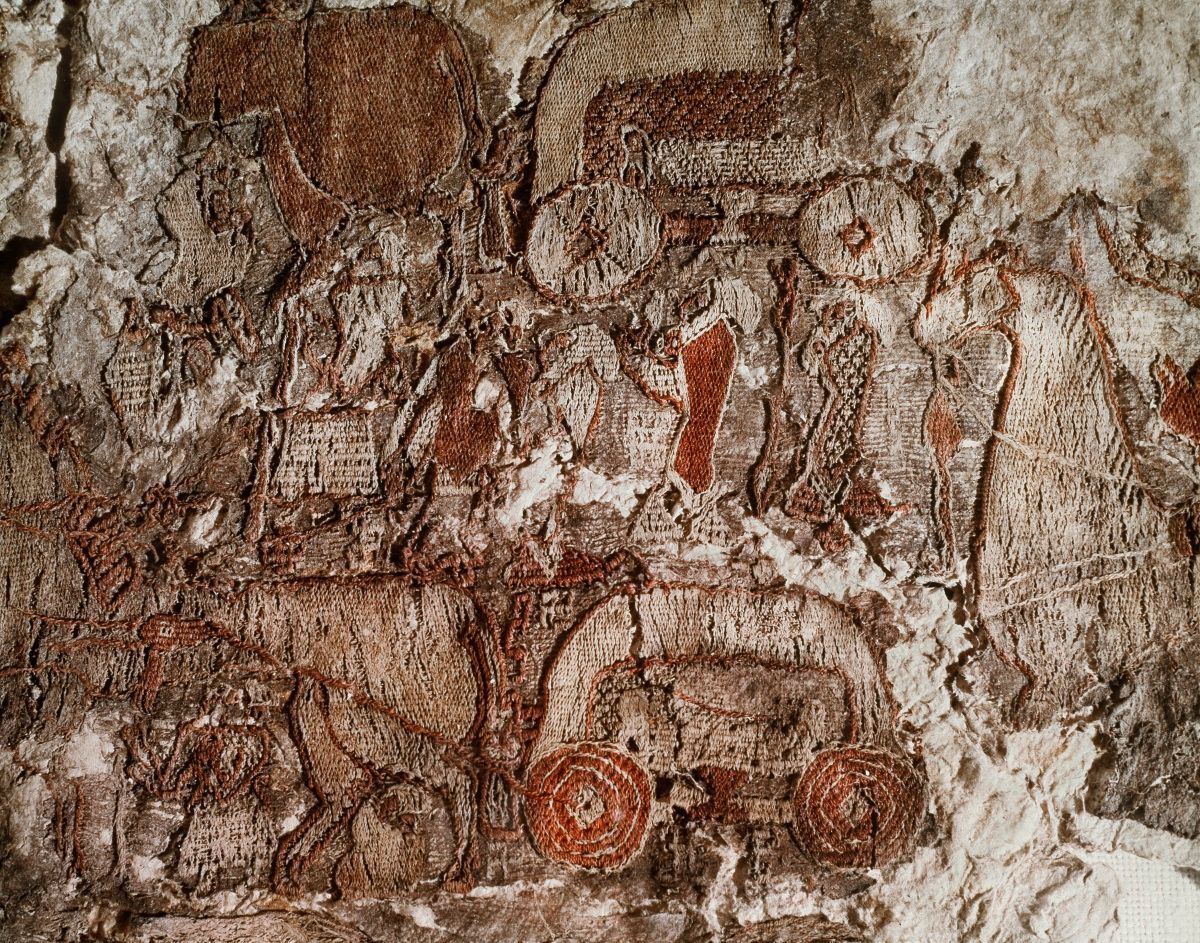
A fragment of the Oseberg tapestry, museum number 2029 b2, photographed for the Museum of Cultural History's own use in public history material. This is the piece this record is primarily built around.
Photo: Eirik I. Johnsen / Kulturhistorisk museum, University of Oslo · Photograph by Eirik I. Johnsen/Kulturhistorisk museum · CC BY-SA 2.0| Artist | Unknown weaver or weavers, Vestfold workshop |
|---|---|
| Date | c. 834 CE or somewhat earlier; the ship burial itself is dendrochronologically dated to 834 |
| Medium | Tapestry weave (rosepath and other techniques) in wool weft, on a warp originally of plant fibre, probably flax, now largely perished |
| Dimensions | Surviving fragments range c. 16 to 23 cm in width; the original length or lengths of the woven pieces are unknown |
| Where it is now | Museum of Cultural History, University of Oslo (Kulturhistorisk museum, UiO). The Oseberg ship and grave-goods collection is normally displayed at the Viking Ship Museum, Bygdoy, Oslo, which closed on 1 October 2021 for rebuilding and expansion as the Museum of the Viking Age, with reopening planned for November 2027. During the closure the museum has stated that visitors can see Viking Age exhibitions at the Historical Museum in central Oslo; some Oseberg objects, including the ship's original serpent-head post, have gone on temporary public display there since June 2025. No source consulted confirms that the tapestry fragments themselves are currently on public display anywhere; given their extreme fragility and their active use in the TexRec digital-reconstruction project, they are understood to be held in specialist textile conservation and study storage.last confirmed |
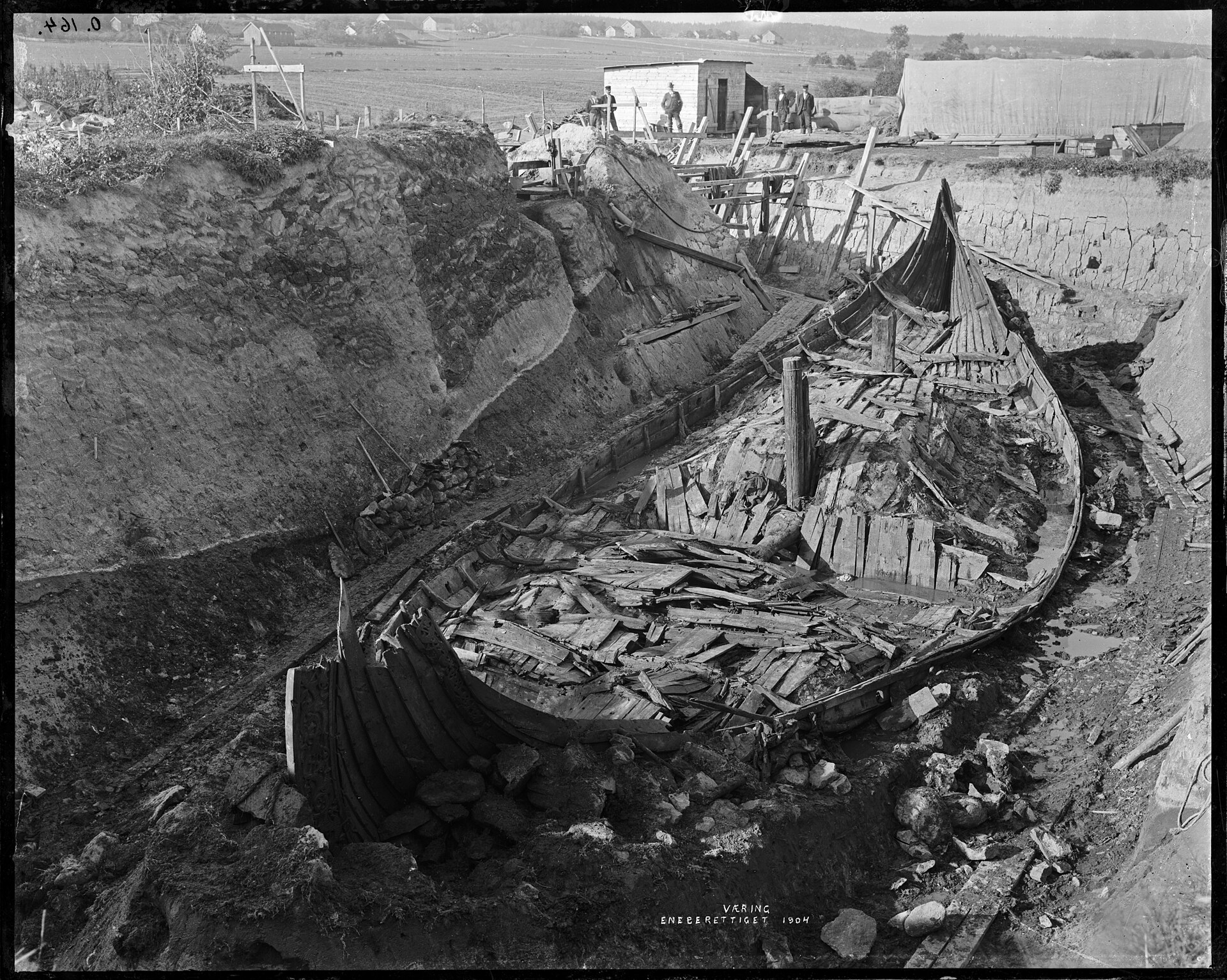
| Inventory number | The specific photographed piece is recorded in Commons/KHM-sourced metadata as museum number 2029 b2 (matching the historic file name '2029 b 2 oseberg tekstilfunn'). The wider Oseberg ship and grave assemblage carries the museum number C55000, per the Museum of Cultural History's own captions on its 1904 excavation photographs. This record could not independently confirm, via a direct search of the unimus.no university museums portal, how the two numbers relate to one another, and flags this as unresolved rather than assuming one supersedes the other. |
| Attribution | UnknownNo weaver is named or identifiable. Full note |
| Object type | Textile |
| Period | Norwegian, Viking Age, 9th century |
| Inscriptions | None |
| Owners on record | 5 links5 documented |
| Sources | 19 cited |
About this record Last verified · 19 sources cited · Change log
On this page 9 sections
ContentsClose
More than eighty fragments, none longer than a few tens of centimetres, are what remain of one or more woven tapestries buried in 834 CE with two women inside the Oseberg ship near Tonsberg, Norway. Excavated in 1904, the tapestries were the last part of the find to reach print, not properly published until Marianne Vedeler's 2019 monograph gave them, for the first time, dedicated study and a working fragment-numbering system.
The surviving imagery includes an armed procession, what may be a battle, and a tree with human figures shown hanging in its branches, feet down, no ropes visible. Vedeler herself has floated Yggdrasil; other writers have reached for ritual sacrifice on the model of Adam of Bremen's Uppsala; Neil Price, whose own 2022 paper is the fullest recent English-language treatment, leaves the question open in his own list of things nobody yet knows. The weavers are unnamed and, on present evidence, unrecoverable, in contrast to the individually identified master woodcarvers from the same grave.
The Museum of Cultural History's TexRec project is actively re-examining the fragments now, combining dye chemistry with machine-learning software that lets researchers manipulate high-resolution images of cloth too fragile to move. The home museum for this material, the Viking Ship Museum at Bygdoy, has been closed since October 2021 and will not reopen, as the Museum of the Viking Age, before November 2027; no source found for this record confirms where the tapestry fragments themselves are being kept in the meantime.
Provenance
Each link is graded. Documented: a cited source supports it. Disputed: the identification is argued but not established. Unknown: no owner for that span, and the gap is not smoothed into a narrative. The grades in the glossary.
- c. 834 CE - 834 CEUnknown weaver or weavers, Vestfold workshop traditiondocumented
The ship burial in which the tapestries were found is dendrochronologically dated to 834 CE. The tapestries themselves could have been woven somewhat earlier and used before burial; no independent date for the weaving itself, distinct from the burial date, was found in the sources consulted.615
- 834 CE - c. 953-990 CESealed within the Oseberg burial mounddocumented
Placed among the grave goods of a ship burial containing two female skeletons, animals, a wagon, sledges and other textiles and wooden objects.615
- c. 953-990 CE - 1904Sealed within the disturbed mounddocumented
The mound was reopened and partially disturbed within roughly a century of the burial, an event dated by Bill and Daly's dendrochronological study of the intervention to the period 953 to 990, plausibly during the reign of Harald Bluetooth. Objects and parts of the human remains were removed at this time; no source consulted states that the tapestry fragments were specifically among the material affected.6
- 1904 - 1904University of Oslo excavation team led by Gabriel Gustafsondocumented
Excavated over the summer of 1904 at the Oseberg farm, Slagen, near Tonsberg, Vestfold.615
- 1904 - presentMuseum of Cultural History, University of Oslo (successor to Oldsaksamlingen / Universitetets Oldsaksamling)documented
Held by the university museum since excavation. Publication of the textile find was delayed for decades: a short paper by Bjorn Hougen appeared in 1940, and the full textile volume of the official excavation report was not completed until 2006. Marianne Vedeler's dedicated monograph on the tapestries appeared in 2019. The Viking Ship Museum building at Bygdoy, where the ship and grave goods are normally displayed, closed on 1 October 2021 for rebuilding as the Museum of the Viking Age, with reopening planned for November 2027; some Oseberg objects have been shown temporarily at the Historical Museum in central Oslo since 2025, though no source consulted confirms the tapestry fragments themselves are among them. The fragments are currently the subject of the TexRec digital reconstruction project, active as of 2024-2026.123410111213
Technical evidence
| Attribution note | No weaver is named or identifiable. The tapestries are attributed on technical and contextual grounds to a workshop tradition associated with high-status textile production in Viking Age Vestfold, almost certainly carried out by women, though the individuals involved are not recoverable from the surviving evidence. |
|---|---|
| Weave | Tapestry weave, including rosepath and other pattern techniques, worked on narrow looms or possibly tablet-assisted set-ups; different technical hands have been identified within single fragments.57 |
| Materials | Wool weft; warp originally of plant fibre, probably flax, now almost entirely perished, surviving mainly as an impression in the surrounding soil and residue.614 |
| Dimensions | Surviving fragments 16 to 23 cm in width; original length or lengths unknown.14 |
| Number of fragments | More than 80 catalogued fragments per the Museum of Cultural History's own TexRec project description; some press accounts, and some fragments still folded and unseparated, put the figure over 100.14 |
| Estimated number of original tapestries | At least three distinct woven pieces, per Marianne Vedeler, though the true number cannot be confirmed since many fragments cannot be securely matched to one original weave.4 |
| Colour | Present-day colour is brown and grey throughout; original dyes are lost from the surviving fibre and are being reconstructed by chemical analysis (HPLC and SERS) under the TexRec project, not by visual inspection.12 |
| Museum numbers | The specific fragment photographed for this record's lead plate is recorded as museum number 2029 b2. The wider Oseberg ship and grave find carries the museum number C55000 in the Museum of Cultural History's own captioning of its 1904 excavation photographs. The relationship between the two numbering sequences was not established by this research.89 |
| Excavation context | Recovered in 1904 from a ship burial dendrochronologically dated to 834 CE, alongside two female skeletons, textile-working tools, a wagon, sledges, carved wooden objects and animal remains.615 |
Images
The record in full
Chapter 1What survives
What is called the Oseberg tapestry is not one object but a scatter of wreckage.
What is called the Oseberg tapestry is not one object but a scatter of wreckage. More than eighty separate fragments survive, narrow bands of tapestry weave sixteen to twenty-three centimetres wide, woven in wool on a warp that was originally plant fibre, probably flax, and has now almost entirely perished. Some accounts of the find count over a hundred pieces once smaller scraps and offcuts are included; the discrepancy is itself a fact about the material, which is too degraded and too fragmentary for any single count to be final.
The surviving colour is mostly brown and grey. The original palette is gone, leached out over eleven centuries in the wet clay of the burial mound, and has to be reconstructed from chemical analysis of the dye residues rather than read directly off the cloth. Some fragments remain folded exactly as they came out of the ground in 1904, layered against each other and not yet fully separated, which is one of the reasons the true extent of the find is still not settled.
Chapter 2The excavation
The Oseberg mound, on a farm at Slagen near Tonsberg in Vestfold, was opened in the summer of 1904 by Gabriel Gustafson and a team from the University of Oslo.
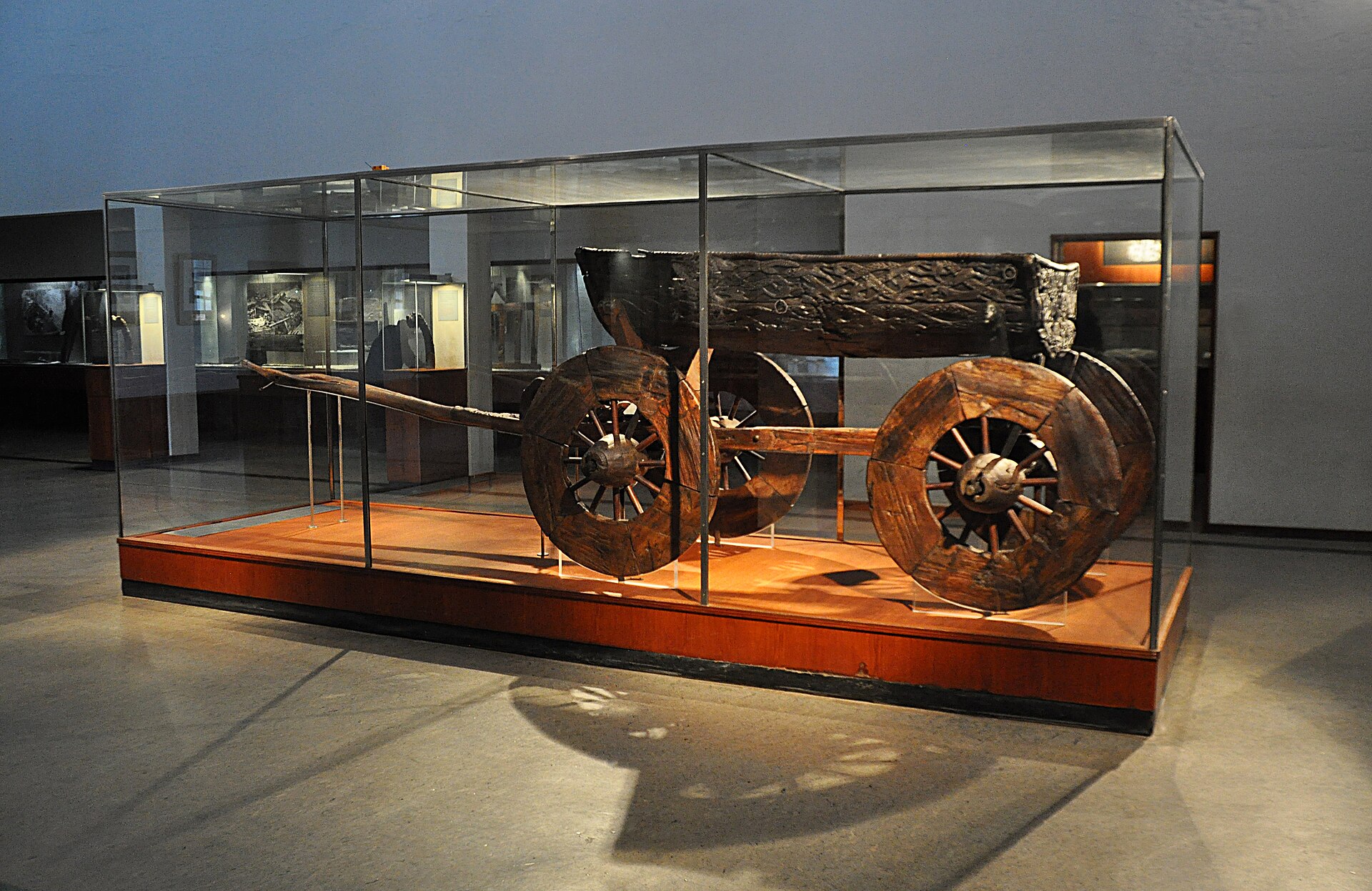
The Oseberg mound, on a farm at Slagen near Tonsberg in Vestfold, was opened in the summer of 1904 by Gabriel Gustafson and a team from the University of Oslo. It produced the richest Viking Age grave good assemblage ever recovered in Norway: a ship about ninety per cent intact in its original timber, two female skeletons, fifteen horses, two oxen and four dogs (several of the animals decapitated as part of the burial rite), a wagon, sledges, an elaborately carved bucket bearing runes, textile-working tools including looms and tablets, imported silk cut into decorative strips, and the tapestry fragments themselves.
Gustafson's 1906 report described the two women as, respectively, a distinguished woman and a thrall or servant woman, explicitly floating the idea that the second had followed the first in death. That framing set the terms for a century of debate about who the two women were and which of them, if either, was the grave's primary occupant; the question has not been resolved, and ancient DNA work has succeeded for only one of the two individuals. The mound itself was reopened and partially disturbed within a century or so of the burial, an intervention now dated by dendrochronological analysis of the disturbance to the period 953 to 990, placing it most plausibly in the reign of Harald Bluetooth. Objects, including possibly parts of the human remains, were removed at that time; the tapestries were not obviously among the casualties of this event, though the disturbance is one more reason the find as excavated in 1904 is incomplete.
Chapter 3What the largest fragments show
Fragments 1 and 2, the largest continuous piece, show a procession moving in profile: armed men with spears and swords, women in long gowns, three horse-drawn wagons, a lone rider on an unarmed...
Fragments 1 and 2, the largest continuous piece, show a procession moving in profile: armed men with spears and swords, women in long gowns, three horse-drawn wagons, a lone rider on an unarmed horse, and two birds shown above the scene. The clothing varies from figure to figure, in a way that argues for individualised, not formulaic, image-making. One of the women near the front of the procession carries what is clearly an oil lamp of a type also found among the actual grave goods, and of a kind known from other high-status graves; why a lamp appears in a procession that otherwise reads as daylight or ceremonial rather than nocturnal is not explained by any source consulted.
A second substantial piece, catalogued as Fragment 13b2, shows what has been read as a battle or muster: two men in animal-head costumes with the hoods pushed back so their faces show, at least five armed women bearing shields and spears, and a large body of male spearmen shown in ranks, twenty-eight spears drawn in a single row backed by further weapons. Loose, free-floating icons recur across several fragments beside the figures themselves: swastikas, valknut-like linked lozenges, birds with beaks pointed toward the top or bottom edge of the weave, and spears and arrows shown independent of any hand holding them. No source consulted offers a confirmed reading of what these floating signs meant; the working assumption among specialists is that they functioned as something like labels or captions within the image, without anyone being able to say what they labelled.
Chapter 4The tree, and a live disagreement
Fragment 4 shows a tree, its roots clearly delineated, possibly two trees drawn as one, with what appear to be seven human figures among its branches, feet hanging down, and two further ambiguous...
Fragment 4 shows a tree, its roots clearly delineated, possibly two trees drawn as one, with what appear to be seven human figures among its branches, feet hanging down, and two further ambiguous figures near a horse that may or may not belong to the same scene. Neil Price, describing the fragment directly from Marianne Vedeler's 2019 photographic reconstruction, is careful to note what is not there: there are no ropes or nooses drawn on any of the hanging figures. Around the tree stand several other figures, mostly read as female by their gowns and hairstyles, one holding a sword, others apparently clapping or holding small crossed objects similar to items associated elsewhere in the tapestries with so-called horned figures.
Marianne Vedeler, the textile specialist at the Museum of Cultural History whose 2019 monograph The Oseberg Tapestries is the definitive modern study of the find, has floated in interview that the image brings Yggdrasil, the world tree of later Norse cosmology, immediately to mind, and has suggested that as many as nine men may be shown hanging from the branches. The independent writer Irina Manea has taken this further in a public essay, connecting the scene explicitly to Adam of Bremen's eleventh-century account of the sacred grove at Uppsala, where the bodies of men and animals were said to be hung from trees as offerings, with one report of seventy-two bodies hanging together. Price himself, while noting the parallel is available, stops well short of endorsing it: in his own listing of open questions about the fragment he asks in as many words whether the tree could be Yggdrasil, without answering. No scholar consulted for this record claims the identification as settled. What can be said without dispute is only that the tapestries depict a tree with human figures shown among its branches, and that ritual hanging, whether real or purely mythological, was part of the world these images were made in.
Chapter 5Who wove them, and who gets remembered
Nobody is named. The Oseberg grave preserved an unusually full record of the equipment behind Viking Age textile production, from complete looms to tablet-weaving frames, balls of yarn and needles...
Nobody is named. The Oseberg grave preserved an unusually full record of the equipment behind Viking Age textile production, from complete looms to tablet-weaving frames, balls of yarn and needles, evidence read by specialists as displaying the entire production chain from raw material to finished cloth. Haakon Shetelig's influential 1920 study of the grave's carved wooden objects named individual master carvers by their identifiable styles, grouping them into what he called the Vestfold school. No equivalent has ever been possible for the textile workers. The archaeologist Gro Mandt observed in 1992 that the many hands behind the Oseberg textile work were, in her words, for too long ascribed to an anonymous group of women, a description meant as a criticism of the scholarship rather than a statement that the anonymity was ever going to be fixed. It has not been fixed. The weavers of the Oseberg tapestries remain, on the evidence available, an anonymous collective, almost certainly female on the strength of wider patterns in Viking Age textile production, but individually unrecoverable.
Specialists working on the fragments, including Vedeler, argue that the weave itself carries technical fingerprints, different patterns that can be traced continuing or changing across a single tapestry, which is read as evidence of several different hands working within one piece. That is a claim about collaboration inside the workshop, not about identity, and this record treats it as such.
Chapter 6Grave good, or borrowed from life
Whether the tapestries were purpose-made for the burial or were valued household or hall textiles taken from use and repurposed as grave goods is not established by any source consulted.
Whether the tapestries were purpose-made for the burial or were valued household or hall textiles taken from use and repurposed as grave goods is not established by any source consulted. The burial as a whole has been read by Unn Pedersen and others as staging a display of collective effort and status, in which costly, skilled, visibly time-consuming objects, ships, carved wood, and textiles alike, served to advertise the standing of whoever organised the funeral. On that reading the tapestries' presence in the grave is itself a message, independent of whether the cloth was new. This record does not resolve the question and lists it among the open points below.
Chapter 7The mortuary theatre reading
Terje Gansum's 2004 reconstruction of the excavation notes showed that the Oseberg ship was initially covered only by a half mound, leaving the open foredeck and the gable end of the burial chamber...
Terje Gansum's 2004 reconstruction of the excavation notes showed that the Oseberg ship was initially covered only by a half mound, leaving the open foredeck and the gable end of the burial chamber exposed as a kind of stage before the mound was completed. Neil Price has built on this and on his own long-running work on Viking Age mortuary performance to argue that funerals of this scale were witnessed and enacted dramas, in which the stories that later crystallised into what is now called Norse mythology were themselves partly created through the performance of the funeral rite, rather than simply illustrated by it. On this view the tapestries are not passive decoration but part of the material of performance, cloth that could have been displayed, carried, or referred to during the ritual itself, alongside the objects, the animals, and the crowd. This is Price's argued position, not an established consensus; the literary scholar Margaret Clunies Ross has published a direct critique of what she calls the performance paradigm in Viking archaeology, arguing that it borrows uncritically from textual studies and reads more certainty into fragmentary poetic sources than they can bear. Price has replied to that critique in print. The disagreement is active and unresolved.
Chapter 8TexRec: reconstruction in progress
The Museum of Cultural History is currently running TexRec, a multi-year, multi-institution project led by Hartmut Kutzke to digitally and chemically re-examine the Oseberg textile finds, the...
The Museum of Cultural History is currently running TexRec, a multi-year, multi-institution project led by Hartmut Kutzke to digitally and chemically re-examine the Oseberg textile finds, the tapestries among them. The project combines dye analysis by high-performance liquid chromatography and surface-enhanced Raman spectroscopy, reflectance transformation imaging, and machine-learning software developed with Colourlab at NTNU in Gjovik that treats the fragments as pieces of a puzzle, letting researchers manipulate high-resolution photographs of the fragile cloth without moving the originals. Partner institutions include the University of Bergen for conservation, the University of Bologna for dye chemistry, and groups in Germany, the United Kingdom and Poland working on bio-inspired conservation materials and imaging.
A 2024 paper by the NTNU postdoctoral researcher Davit Gigilashvili and colleagues, published in the Journal of Imaging Science and Technology, reported on the computational side of the work: algorithms trained to recognise style and motif across fragments, intended to suggest which pieces might once have belonged together. Gigilashvili was explicit in press interviews that the software is an aid, not a replacement for the archaeologists and conservators who have to judge what a proposed match actually means; a fully automated solution, he said, remains unlikely given the damage, the missing information and the lack of comparable training data for textiles this old. The project is ongoing and its findings, including Vedeler's own tentative reading of the tree fragment, are presented by the museum itself as work in progress rather than a finished picture.
Chapter 9The delayed publication history
The tapestries were nearly the last part of the Oseberg find to reach print.
The tapestries were nearly the last part of the Oseberg find to reach print. The official excavation report, Osebergfundet, appeared in four volumes between 1917 and 1928, but the textiles were held back for a planned fifth volume that did not appear on that schedule. Bjorn Hougen published a short standalone paper on the tapestries in 1940. The fuller textile volume, based in part on Hougen's own manuscript, was not completed until 2006, edited by Arne Emil Christensen and Margareta Nockert, more than a century after the fragments came out of the ground. Marianne Vedeler's 2019 monograph is the first study to focus on the wall hangings specifically, rather than as one category within the wider textile find, and it introduced the fragment-numbering system, and many of the digital reconstructions, that current scholarship including the TexRec project now uses as its working reference.
Chapter 10Comparanda
The Oseberg fragments are regularly discussed alongside other Scandinavian narrative textiles and stone carvings of the same broad period: the Overhogdal tapestries from Harjedalen in Sweden, another...
The Oseberg fragments are regularly discussed alongside other Scandinavian narrative textiles and stone carvings of the same broad period: the Overhogdal tapestries from Harjedalen in Sweden, another group of wall hangings with processional and figural imagery; the Gotland picture stones, whose horizontal image registers have been read by Anders Andren as visual narratives comparable in structure, though not in medium, to the Oseberg scenes; and, much later and in an entirely different tradition, the Bayeux Tapestry, whose horizontal narrative embroidery is the object most often reached for by way of comparison even though the two works are separated by more than two centuries and by embroidery versus woven tapestry technique.
Chapter 11What is still unresolved
The count of surviving fragments varies between sources by institution and by press account, from a little over eighty to more than a hundred, in part because some pieces remain folded and...
The count of surviving fragments varies between sources by institution and by press account, from a little over eighty to more than a hundred, in part because some pieces remain folded and unseparated. The number of original tapestries the fragments once belonged to is not established; Vedeler has suggested at least three distinct woven pieces, but cautions, and other sources echo this caution, that fragments cannot always be confidently matched to a single original weave. No weaver is identifiable. Whether the cloth was made for the funeral or taken from earlier use is not known. The meaning of the tree and its hanging figures is argued, not settled, and the strongest available account, Vedeler's own, is offered by her as a suggestion rather than a conclusion. And the current physical location and conservation status of the fragments during the multi-year closure of their home museum is not stated in any source this record could locate, beyond the museum's own general assurance that its Viking Age collections are being cared for during the rebuild.
The artist
Unknown weaver or weavers, working within a Vestfold textile workshop tradition
No individual weaver behind the Oseberg tapestries is named or identifiable, and this record treats that anonymity as a documented gap rather than a puzzle to be solved by inference. What can be said rests on the surviving equipment in the grave and on the technical study of the cloth itself, not on any record of a person.
Related works
| Work | Relation | Where it is |
|---|---|---|
| The Bayeux Tapestry Unknown embroiderers, probably English workshop | Most frequently cited comparandum for horizontal narrative textile art, though embroidered rather than woven and made more than two centuries later Already catalogued in this collection as 'bayeux-tapestry'. | Musee de la Tapisserie de Bayeux, Normandy, France (on loan to the British Museum, London, September 2026 to July 2027) |
| Overhogdal tapestries Unknown weavers | Comparable Scandinavian narrative wall hangings, Viking Age to medieval in date Cited alongside Oseberg as one of the few substantial bodies of Viking Age pictorial textile evidence. | Jamtli museum, Ostersund, Sweden |
| Gotland picture stones Unknown carvers | Stone comparanda for horizontally registered narrative imagery of the same broad period Anders Andren's reading of the stones' horizontal panels as sequential narrative is cited by Neil Price as a methodological model for reading the Oseberg tapestries. | Gotlands Museum, Visby, Sweden, and various in-situ and museum locations |
| Oseberg ship and other Oseberg grave goods Unknown Vestfold craftsmen and craftswomen | Found in the same 1904 excavation, same burial, same museum collection Includes the carved rune-inscribed bucket, the wagon, sledges and the ship itself; the carved wooden objects are individually attributed to named 'masters' by Haakon Shetelig's stylistic study, unlike the anonymous textile work. | Museum of Cultural History, University of Oslo; not on public display during the 2021-2027 closure |
Open questions
- How many fragments actually survive: institutional sources say over 80, some press accounts say over 100, and some pieces remain folded and unseparated, so no single count is final.
- How many original tapestries the fragments belonged to: Marianne Vedeler has suggested at least three, but cautions the true number cannot be confirmed from fragments that cannot always be matched to one weave.
- Whether the tree on Fragment 4 depicts ritual human sacrifice comparable to Adam of Bremen's account of Uppsala, or something else: Vedeler raises Yggdrasil cautiously, Irina Manea argues the sacrificial reading explicitly, and Neil Price leaves the question open in his own listing of unresolved points.
- Whether the tapestries were made specifically as grave goods for this burial or were valued textiles from earlier household or ceremonial use, repurposed for the funeral: not established by any source consulted.
- Who wove them: no individual is named or identifiable, though technical evidence suggests more than one hand worked on a given piece.
- How the museum number 2029 b2, recorded for the photographed fragment used as this record's lead plate, relates to the museum number C55000 recorded for the wider Oseberg ship and grave find: this record could not resolve the relationship through a direct search of the unimus.no university museums portal.
- Where the fragments are physically held and what condition they are in during the multi-year closure of the Viking Ship Museum: no source consulted states this explicitly beyond a general assurance that the collection is being cared for.
Questions about this object
What is Oseberg Tapestry Fragments?
Oseberg Tapestry Fragments is a textile, dated c. 834 CE or somewhat earlier; the ship burial itself is dendrochronologically dated to 834. Medium: Tapestry weave (rosepath and other techniques) in wool weft, on a warp originally of plant fibre, probably flax, now largely perished.
Who made Oseberg Tapestry Fragments, and is the attribution settled?
The attribution to Unknown weaver or weavers, Vestfold workshop is recorded here as unknown. No weaver is named or identifiable. The tapestries are attributed on technical and contextual grounds to a workshop tradition associated with high-status textile production in Viking Age Vestfold, almost certainly carried out by women, though the individuals involved are not recoverable from the surviving evidence.
Where is Oseberg Tapestry Fragments now?
Museum of Cultural History, University of Oslo (Kulturhistorisk museum, UiO). The Oseberg ship and grave-goods collection is normally displayed at the Viking Ship Museum, Bygdoy, Oslo, which closed on 1 October 2021 for rebuilding and expansion as the Museum of the Viking Age, with reopening planned for November 2027. During the closure the museum has stated that visitors can see Viking Age exhibitions at the Historical Museum in central Oslo; some Oseberg objects, including the ship's original serpent-head post, have gone on temporary public display there since June 2025. No source consulted confirms that the tapestry fragments themselves are currently on public display anywhere; given their extreme fragility and their active use in the TexRec digital-reconstruction project, they are understood to be held in specialist textile conservation and study storage. Inventory number The specific photographed piece is recorded in Commons/KHM-sourced metadata as museum number 2029 b2 (matching the historic file name '2029 b 2 oseberg tekstilfunn'). The wider Oseberg ship and grave assemblage carries the museum number C55000, per the Museum of Cultural History's own captions on its 1904 excavation photographs. This record could not independently confirm, via a direct search of the unimus.no university museums portal, how the two numbers relate to one another, and flags this as unresolved rather than assuming one supersedes the other.. Last confirmed 29 August 2026. Museum of Cultural History official project and collection pages; Commons file metadata sourced to Universitetsmuseenes fotoportal.
What is still unknown about Oseberg Tapestry Fragments?
How many fragments actually survive: institutional sources say over 80, some press accounts say over 100, and some pieces remain folded and unseparated, so no single count is final.
Sources
- 1Museum of Cultural History, University of Oslo, 'TexRec - Virtual Reconstruction, Interpretation and Preservation of the Textile Artefacts from the Oseberg Find' (project page). khm.uio.no/english/...
- 2Museum of Cultural History, University of Oslo, 'New knowledge about Viking tapestries from the Oseberg Ship' (2024). khm.uio.no/english/...
- 3Bjorn Kvaal, 'Piecing together Viking tapestries from the Oseberg Ship,' Norwegian SciTech News / NTNU (22 August 2024), reporting on Davit Gigilashvili et al., 'Toward Solving a Puzzle of Fragmented Archaeological Textiles,' Journal of Imaging Science and Technology 68, no. 4 (2024), DOI 10.2352/J.ImagingSci.Technol.2024.68.4.040407. norwegianscitechnews.com/2024/...
- 4ScienceNorway, 'Nine men who may have been sacrificed - modern technology aims to uncover more from the Oseberg Viking tapestries' (2024), quoting Marianne Vedeler and Davit Gigilashvili. sciencenorway.no/acheology-viking-age/...
- 5Neil Price, 'Performing the Vikings: From Edda to Oseberg,' Religionsvidenskabeligt Tidsskrift (RvT) 74 (2022): 63-88, drawing extensively on Marianne Vedeler, The Oseberg Tapestries (Oslo: Scandinavian Academic Press, 2019). tidsskrift.dk/rvt/...
- 6Unn Pedersen, 'The Oseberg ship burial: commemorating leadership and joint effort,' Viking Special Volume 3 (2023): 211-230. journals.uio.no/vikingspecialvolumes/...
- 7Marianne Vedeler, The Oseberg Tapestries (Oslo: Scandinavian Academic Press, 2019). Cited at second hand through Price 2022 and ScienceNorway 2024; flagged for direct consultation by the editor. scandinavianacademicpress.no/boker/...
- 8Wikimedia Commons file and metadata, File:2029 b 2 oseberg tekstilfunn.jpg. commons.wikimedia.org/wiki/...
- 9Wikimedia Commons file and metadata, File:CfO0164 museum no. C55000 1 Osebergskipet utgravning (Oseberg ship excavation 1904. Photo Olaf Vaering, Kulturhistorisk museum UiO Oslo, Norway. License CC BY-SA 4.0).jpg. commons.wikimedia.org/wiki/...
- 10Museum of the Viking Age, 'The Textiles in the Oseberg Find.' vikingtidsmuseet.no/english/...
- 11Museum of the Viking Age, 'The Viking Ship Museum' (closure and reopening status). vikingtidsmuseet.no/english/...
- 12Blooloop, 'Norway's new Museum of the Viking Age to open in 2027.' blooloop.com/museum/...
- 13Museum of Cultural History / Historical Museum, 'The Serpent's Head Exhibited for the Very First Time.' khm.uio.no/english/...
- 14Wikipedia, 'Oseberg tapestry fragments.' source, with Vedeler 2019 and the KHM catalogue directly. en.wikipedia.org/wiki/...
- 15Wikipedia, 'Oseberg ship.' source, used only for cross-checking excavation-level facts already sourced elsewhere; . en.wikipedia.org/wiki/...
- 16Irina Manea, 'The puzzle of the Oseberg tapestries,' Shield of Skuld (Substack essay). shieldofskuld.substack.com/p/...
- 17Wikimedia Commons file and metadata, File:A wooden cart from the Oseberg burial mound (from around 800), Norway. Viking Ship Museum, Oslo, Norway (Vikingskipshuset pa Bygdoy) 2011.jpg. commons.wikimedia.org/wiki/...
- 18Wikimedia Commons file and metadata, File:Oseberg tekstil - no-nb digifoto 20160713 00139 NB MIT FNR 17869.jpg. commons.wikimedia.org/wiki/...
- 19Wikidata, Q25055791, 'Oseberg tapestry fragments.' wikidata.org/wiki/...

.jpg)
,_Norway._Viking_Ship_Museum,_Oslo,_Norway_(Vikingskipshuset_p%C3%A5_Bygd%C3%B8y)_2011.jpg)

Last verified · Published
Change log
29 August 2026 - Record created at the house standard: researched narrative, technical evidence, maker dossier, graded provenance chain, prices with hammer and premium separated, related works, open questions and sources.