The Staff List That Names Camille Claudel
Our record of The Thinker names Camille Claudel among Rodin's assistants. Museums put her in his studio from 1884 and credit her with hands, feet and two heads.
Records in this piece: The Thinker
On this page 8 sections
ContentsClose
In short
- The Cantor Foundation sentence behind our Thinker record dates its fifty assistants to after 1900 and then names Camille Claudel among those who went on to fame. The museums place her studio years in the 1880s and early 1890s.
- The Musee Rodin says she apparently spent most of her time on difficult pieces such as hands and feet for monumental sculptures, and that the heads of The Slave and Laughing Man, signed by Rodin when cast, were actually modelled by her. It also says the head of Avarice has been wrongly attributed to her.
- The monumental Thinker was enlarged and cast in 1904, according to the Musee Rodin, after the 1893 distancing and the 1898 break that the Musee Camille Claudel records. No page we read ties her hand to the Thinker itself.
- In September 1896, by the Musee Camille Claudel's account, she asked Mathias Morhardt to have Rodin stop visiting her so as to prove that he had no hand in her works.
One line in a record, and what it can carry
Our record of The Thinker names Camille Claudel in a list of Rodin's studio assistants, and the sentence behind that list does not sit easily with the years the museums give for her.
The line comes from the Cantor Foundation's page on Rodin's studio. It says that after 1900 Rodin might have had as many as fifty assistants, and in the next sentence that "many of these went on to achieve their own fame as artists", naming Antoine Bourdelle, Camille Claudel, Charles Despiau and Malvina Hoffmann. The page does not say what Claudel did, and its "after 1900" falls later than the years the museums give for her in the studio. It does not say she worked then.
Other documents do say what she did. This piece sets them beside the Thinker and keeps one limit: no page we read ties her hand to the Thinker itself.
Her years in the studio, as four institutions word them
The institutions that care for her work agree that she entered Rodin's orbit in the early to mid 1880s and word her status four different ways.
The Musee Camille Claudel at Nogent-sur-Seine says she was admitted to his studio as an assistant in 1884, aged nineteen, and that Rodin took over her instruction in 1882. The French culture ministry, in a page signed 4 July 2019, says she entered his studio in 1884 as a praticienne, which the ministry then follows with collaborator, model and mistress. The Encyclopaedia Universalis says Rodin admitted her as a praticienne in November 1885. The Musee Rodin calls the early period "an intensive period of training under Rodin's supervision" and speaks of "works on which she collaborated as his assistant".
The gap between 1884 and November 1885 may describe two different steps, an arrival and a formal admission as praticienne, since the Musee Camille Claudel has Rodin teaching her from 1882. We do not settle it. A praticienne was, in the usual sense of the word, a sculptor who enlarged and finished work from the master's models. None of our sources defines it.
What the documents say she did there
The Musee Rodin says the exact nature of the tasks entrusted to her remains uncertain, but that she apparently spent most of her time on difficult pieces, such as the hands and feet of figures for monumental sculptures, notably The Gates of Hell.
The same page goes further on two objects. It says the heads of The Slave and Laughing Man, about 1885, which were signed by Rodin when they were cast in bronze, were actually modelled by Claudel. It also says the head of Avarice in Avarice and Lust has been erroneously attributed to her, so the correction runs both ways. The Universalis entry adds that Rodin entrusted her with the studies of hands and feet for the Burghers of Calais, which ran from 1889 to 1895, and that her own Giganti has qualities that led people to see Rodin's hand in it.
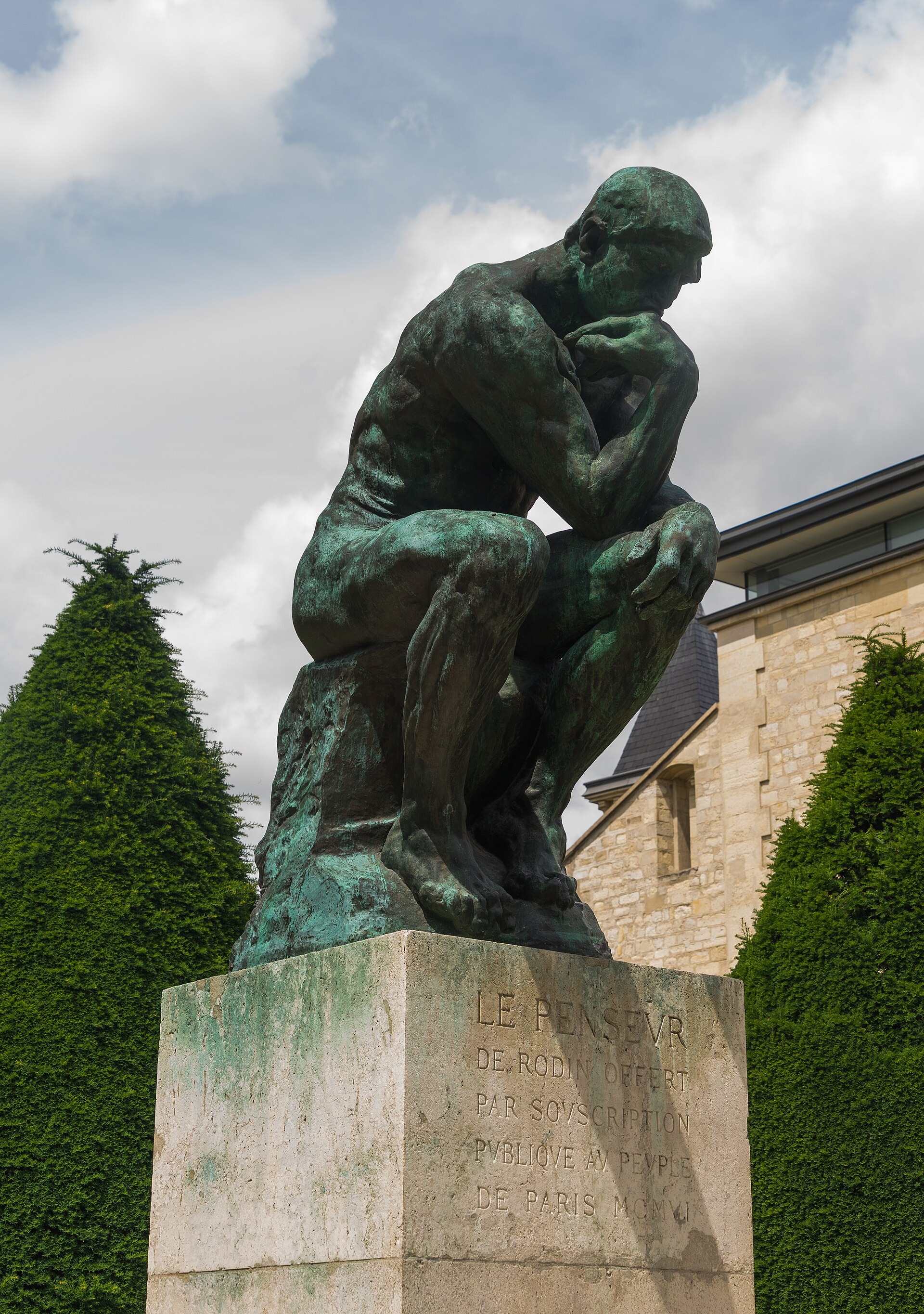
That is the documented ground, with the Musee Rodin's own "apparently" on the hands and feet: hands and feet for monumental commissions, two heads modelled by her and signed by him, and studies for Calais. The Thinker belongs to the same Gates of Hell, conceived in 1880 for its tympanum, yet we read no page that gives her any part in it.
Her dates against the Thinker's
Only the monumental Thinker, enlarged and cast in 1904, falls after the years she spent in the studio.
The table sets what the museums date for her beside what the Musee Rodin dates for the bronze in our record.
| Date | What the source records | Source |
|---|---|---|
| 1880 | The Thinker conceived at about 70 cm for The Gates of Hell | Musee Rodin |
| 1884 | Claudel admitted to Rodin's studio (Universalis: November 1885) | Musee Camille Claudel |
| 1889 to 1895 | Burghers of Calais, for which Universalis says she made hand and foot studies | Universalis |
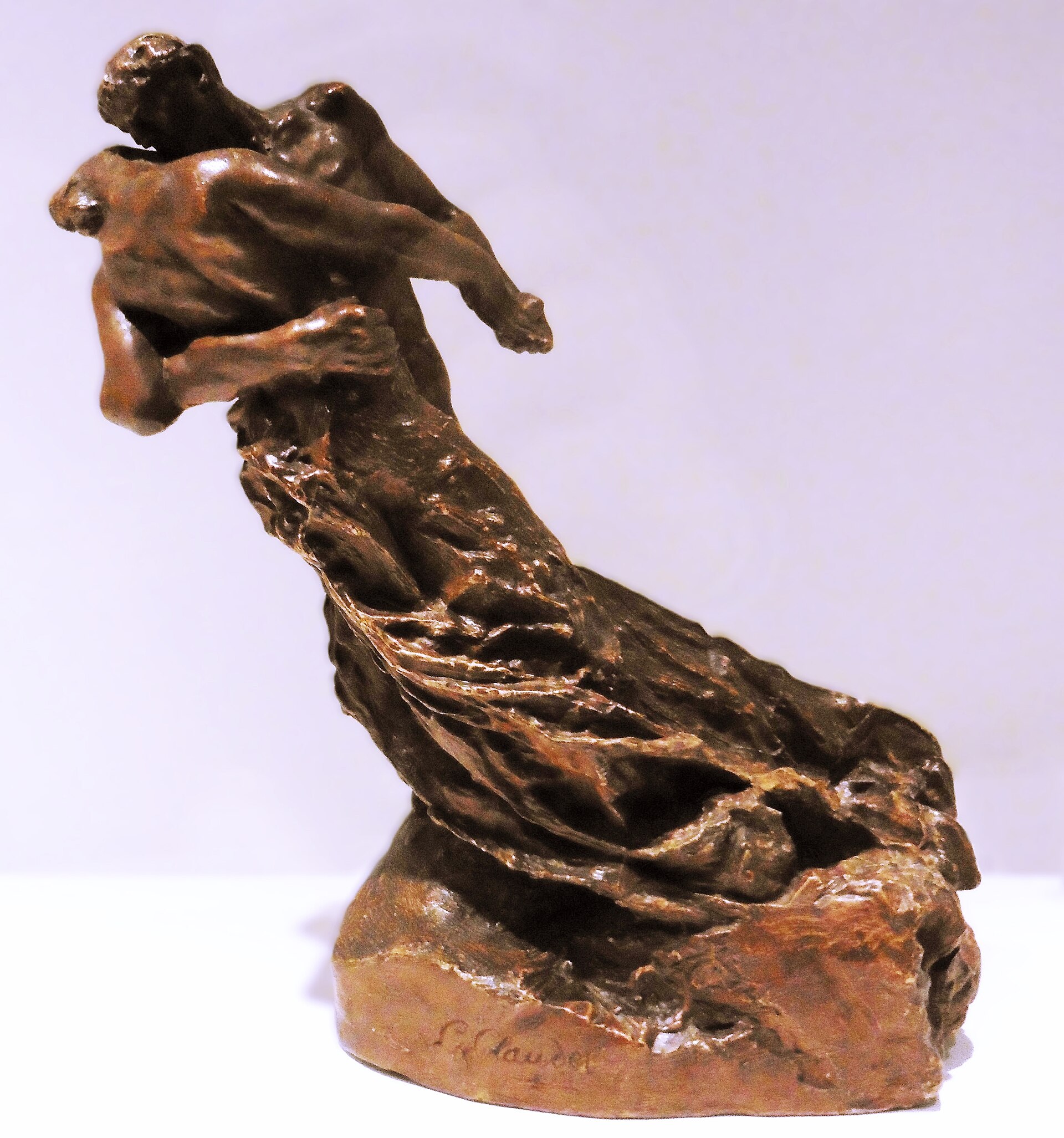
| 1893 | The Waltz and Clotho shown at the Societe nationale des beaux-arts; she distances herself from Rodin | Musee Camille Claudel |
| July 1895 | The Age of Maturity, her first commission from the French State | Musee Camille Claudel |
| 1898 | Final break with Rodin; she rents a studio in the rue de Turenne | Musee Camille Claudel |
| 1904 | The Thinker enlarged and cast by Alexis Rudier (Cantor Foundation: enlargement 1903-4) | Musee Rodin |
The ministry speaks of ten years of collaboration before she broke with him, which points to about 1894, and the Musee Camille Claudel puts the final break at 1898, and either way the monumental enlargement is later. The museum adds that Rodin kept supporting her discreetly afterwards, financially and in the art world.
What the museum records she asked in 1896
In September 1896 Claudel asked the critic Mathias Morhardt to persuade Rodin to stop visiting her, so as to prove that he had no hand in the creation of her works, according to the Musee Camille Claudel.
That is the museum's account of her instruction. The same page says that in 1893 critics hastened to link her work with his. It also says Rodin succeeded Dalou as president of the sculpture section of the Societe nationale des beaux-arts, where she was made a member.
The attribution has since moved in both directions. Universalis says some works kept in her family have been given back to Rodin, while others held at the Musee Rodin have been given to her. We could not open the catalogue that makes those individual changes, so we name none beyond the three objects above.
What survives in his museum, and what her family did with it
The Musee Rodin holds letters between the two and about twenty of her works, and her brother shaped how the works got there.
The museum says it holds about fifteen letters from Claudel and five from Rodin. One of hers, inventory Ms.00362, dated to the summer of 1890 or 1891, was given in 1916. One of his, L.01451, written about 1886 and also given in 1916, is described by the museum as one long, anguished plea. The culture ministry says the museum owns about twenty pieces by her. The Musee Rodin itself lists four major works given by Paul Claudel in 1952: the two versions of The Age of Maturity, Clotho and Vertumnus and Pomona. It also says several of her works were bought by French museums in the 1890s. In 1914 Paul strongly opposed Morhardt's proposal to set aside a room for her in Rodin's museum.
That 1914 date follows her confinement. The Musee Camille Claudel records that Dr Michaux wrote her confinement certificate on 7 March 1913, that she was placed at Ville-Evrard on 10 March under a voluntary placement requested by her mother, that she was moved to Montdevergues on 5 to 7 September 1914 because of the war, and that she died there on 19 October 1943. The ministry says the placement was made at her family's request. She was first put in a temporary tomb at Montfavet and later moved to the communal grave. Sources give her age at death as 78 or 79. We have not seen the certificate itself.
Her portrait of him
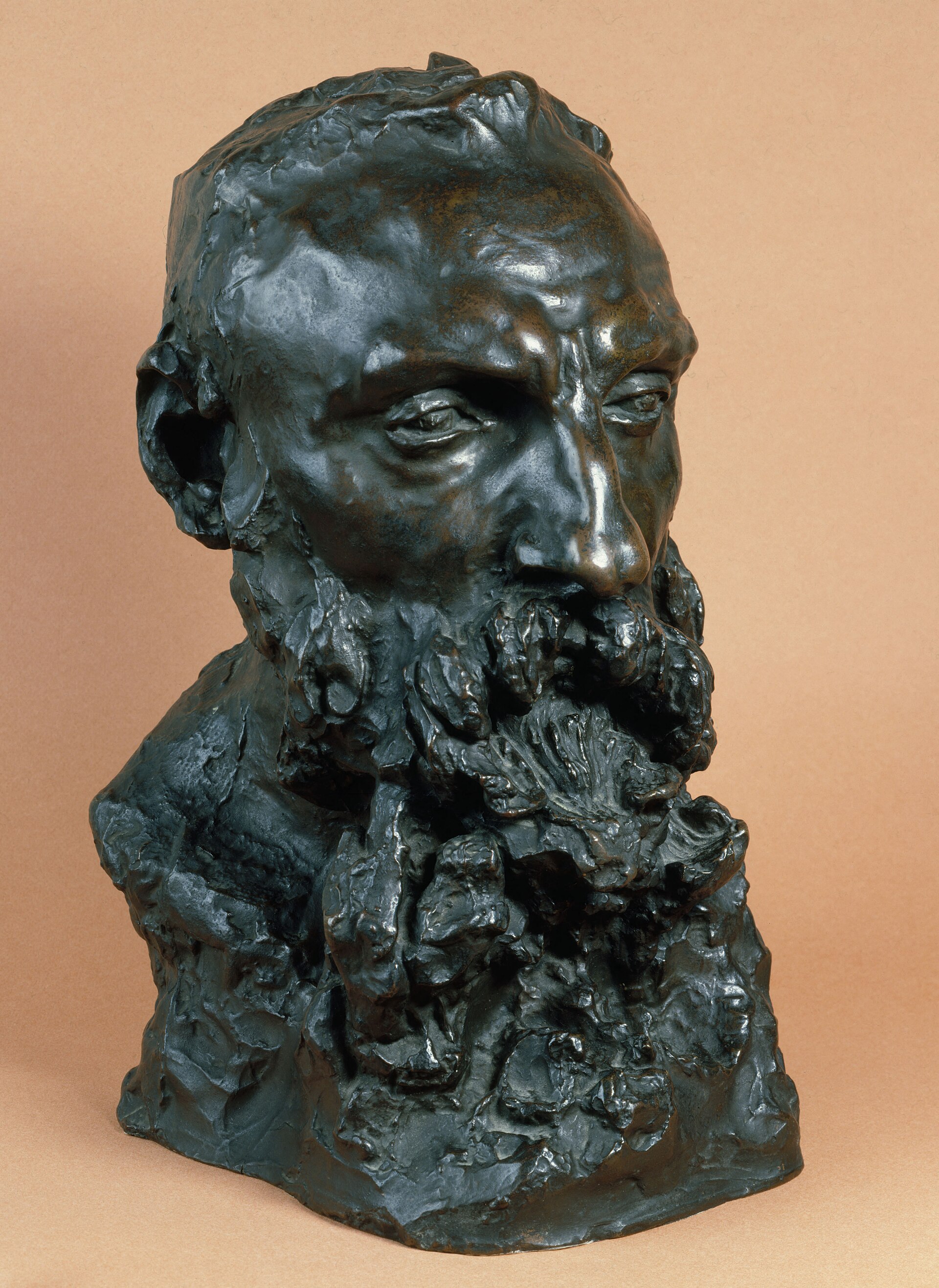
One object in this piece shows Rodin and is signed by her: a bronze bust of him now in the Petit Palais.
The Petit Palais gives it as after 1897, 41 cm high, signed Camille Claudel, inventory PPS1268, given in 1922 by Arnold Seligmann. The Musee Rodin dates its own Bust of Rodin to 1888 to 1889, inventory S.1695, and says it was not cast in bronze until 1892, inventory S.1021. These are different objects with a shared subject, and we have not matched the Petit Palais bronze to either of them.
What we could not establish
The pages we read leave four questions open.
We do not know which hands, feet or heads beyond those the museum names were hers, because the Musee Rodin says the exact nature of her tasks remains uncertain. We do not know which start date is right, or whether the two describe different steps. We have not seen the catalogue entries that moved individual works between her name and his. And we have not seen the 1913 certificate, only the museums' accounts of it.
None of this lowers her standing as a maker. It shows why her authorship has to be argued object by object, from signatures, exhibition records, commissions and foundry marks, and why a list of names is only where that work starts.
Questions
No page we read says so. The Musee Rodin dates the monumental bronze to 1904, after the break with Rodin that the Musee Camille Claudel dates to 1898. Other pages tie her to hands, feet and heads on other studio works.
The Musee Rodin says she apparently worked on hands and feet for monumental sculptures such as The Gates of Hell, and that the heads of The Slave and Laughing Man were modelled by her though signed by Rodin. The exact tasks remain uncertain.
The Musee Camille Claudel and the French culture ministry say 1884. The Encyclopaedia Universalis says November 1885. The two dates may describe different steps.
The Musee Camille Claudel records a confinement certificate of 7 March 1913 and her placement at Ville-Evrard on 10 March 1913. She was moved to Montdevergues in September 1914 and died there on 19 October 1943.
Sources
- 1Musee Camille Claudel, Nogent-sur-Seine, biography 1881-1885: admitted to Rodin's studio as an assistant in 1884; Gates of Hell commission 1880. museecamilleclaudel.fr/en/...
- 2Musee Camille Claudel, biography 1893-1908: distancing in 1893, September 1896 request to Morhardt, break of 1898, State commissions, Blot casting from 1904. museecamilleclaudel.fr/en/...
- 3Musee Camille Claudel, biography 1909-1943: confinement certificate 7 March 1913, Ville-Evrard 10 March, Montdevergues 1914, death 19 October 1943, Paul Claudel's gifts. museecamilleclaudel.fr/en/...
- 4French Ministry of Culture, Camille Claudel (Les femmes artistes sortent de leur reserve), Maeva Abillard, 4 July 2019: entered the studio in 1884 as a praticienne; the Musee Rodin holds about twenty pieces. culture.gouv.fr/Thematiques/...
- 5Encyclopaedia Universalis, Camille Claudel, L'atelier de Rodin: admitted as a praticienne in November 1885; works moved between Rodin and Claudel. universalis.fr/encyclopedie/...
- 6Iris and B. Gerald Cantor Foundation, In Rodin's Studio: as many as fifty assistants after 1900, including Claudel; the sentence naming her does not describe her role. cantorfoundation.org/resources/...
- 7Musee Rodin, The Thinker: conceived 1880, enlarged 1904, cast by Alexis Rudier in 1904, installed at the Pantheon in 1906. musee-rodin.fr/en/...
- 8Musee Rodin, Camille Claudel: tasks entrusted to her, heads of The Slave and Laughing Man, Avarice, Bust of Rodin S.1695 and S.1021, Paul Claudel's 1952 gifts, purchases in the 1890s. musee-rodin.fr/en/...
- 9Musee Rodin, Letter from Auguste Rodin to Camille Claudel, L.01451: about fifteen letters from her and five from him held. musee-rodin.fr/en/...
- 10Musee Rodin, Letter from Camille Claudel to Auguste Rodin, Ms.00362, summer 1890 or 1891, donation 1916. musee-rodin.fr/en/...
- 11Paris Musees Collections, Petit Palais, Buste de Rodin, PPS1268, signed Camille Claudel, gift of Arnold Seligmann 1922. parismuseescollections.paris.fr/fr/...
More in The Women Behind the Art
The partWho Stitched the Bayeux Tapestry? What the Documents Say About English Women's Embroidery
No document names who stitched the Bayeux Tapestry. What Domesday, the 1476 inventory and the Queen Matilda story show about English women's...
The Two Women in the Oseberg Ship, and the Queen Nobody Named
Two women lay in the Oseberg ship in 834. What the bones, isotopes and DNA show, and how a queen and a servant were read into a grave that no text...
The Name on the Rim: What Documents Say About Projecta
The Projecta Casket names its bride in one line of Latin. What the British Museum, Dalton 1901, an epitaph and Parliament say about her, and what is...