The Bryant Vase
Tiffany & Co. · 1875-1876
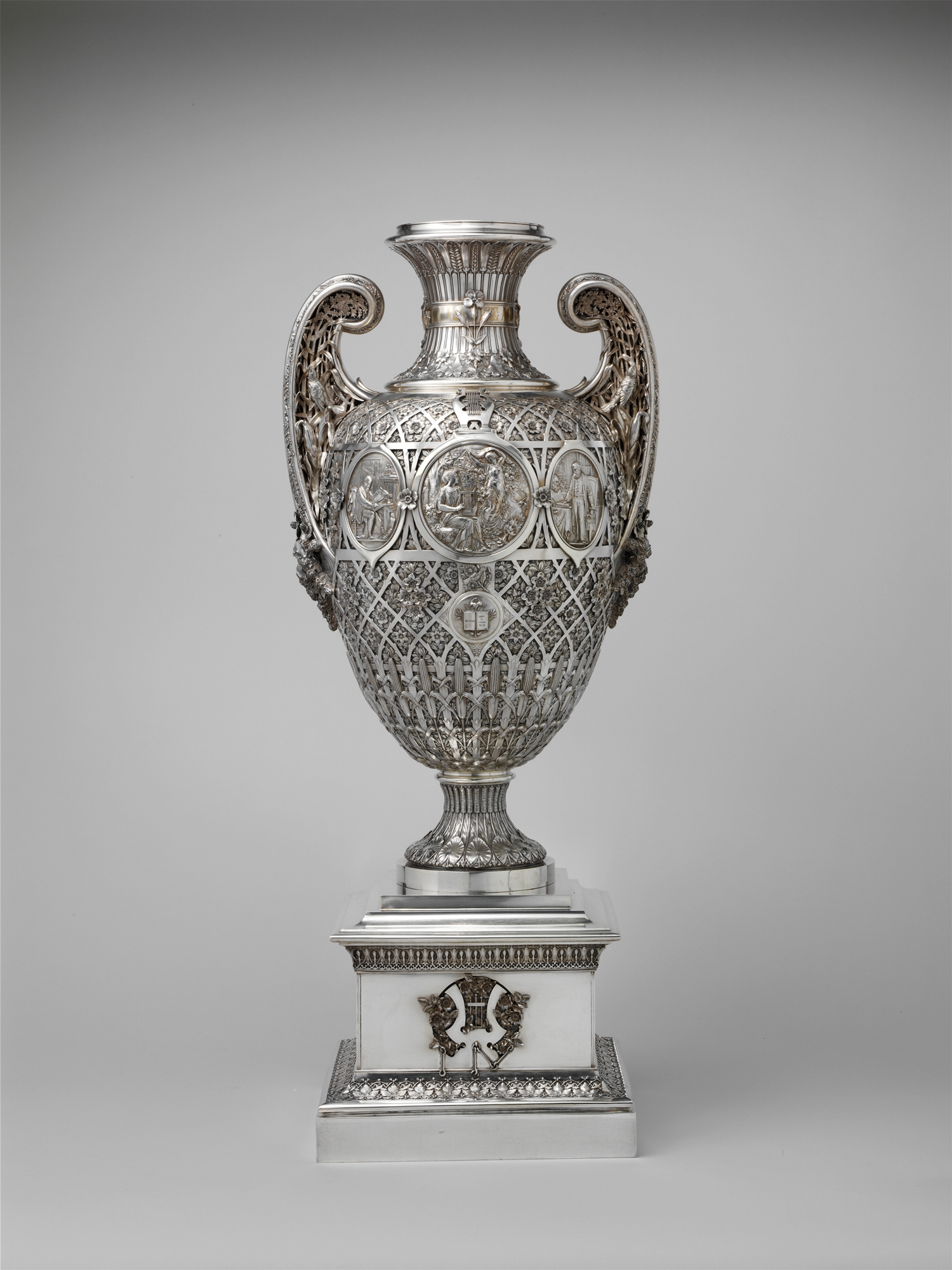
The Bryant Vase, silver and gold, Tiffany & Co., 1875-1876. The Metropolitan Museum's own primary image of the object, accession 77.9a, b.
| Artist | Tiffany & Co. |
|---|---|
| Date | 1875-1876 |
| Medium | Silver and gold |
| Dimensions | 33 1/2 x 14 x 11 5/16 in. (85.1 x 35.6 x 28.7 cm); 452 oz. 16 dwt. (14,084.2 g) |
| Where it is now | Metropolitan Museum of Art, New Yorklast confirmed |
| Inventory number | 77.9a, b |
| Attribution | AcceptedManufactured by Tiffany & Co., New York. Full note |
| Object type | Silver |
| Period | American, Gilded Age |
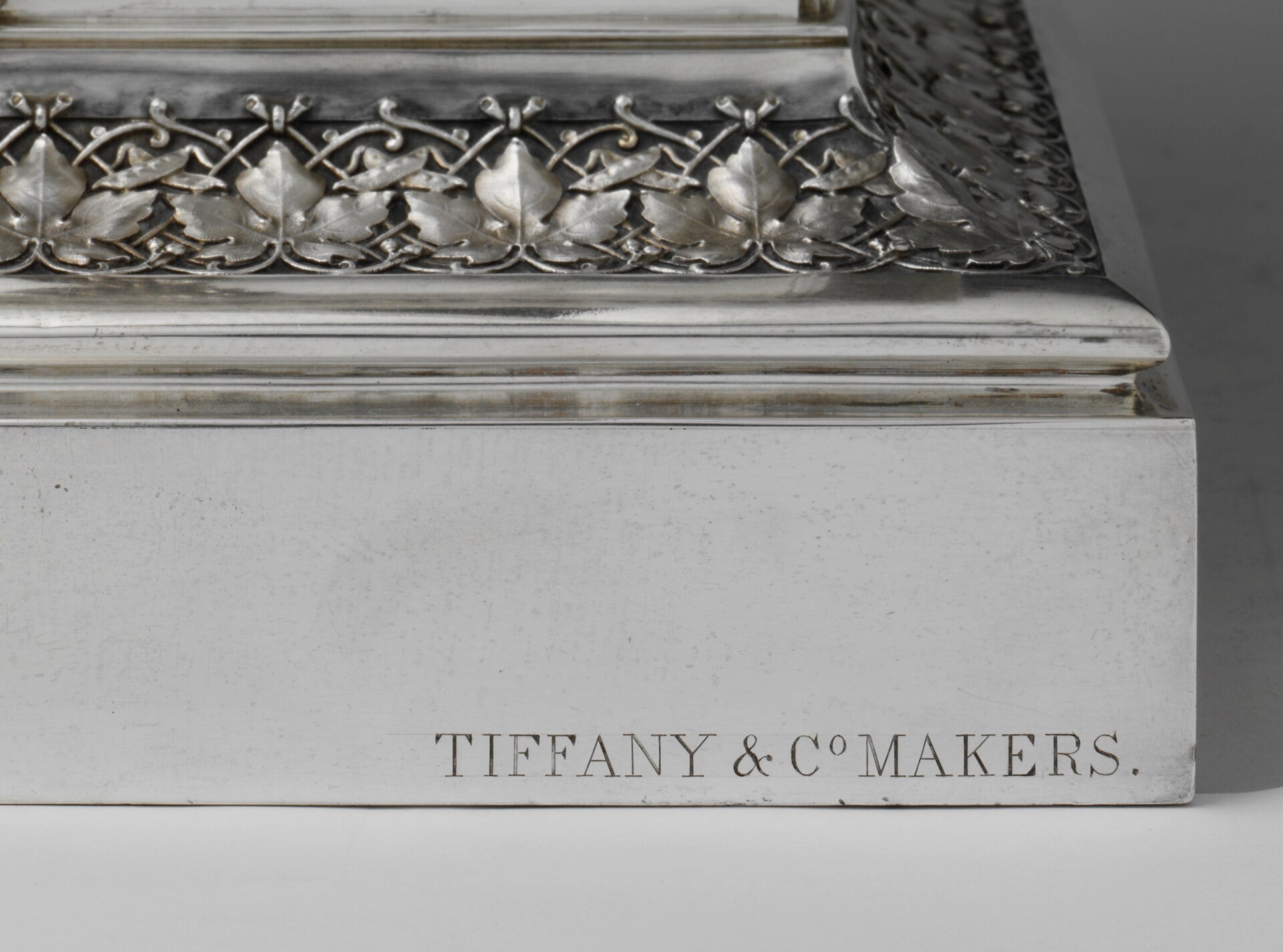
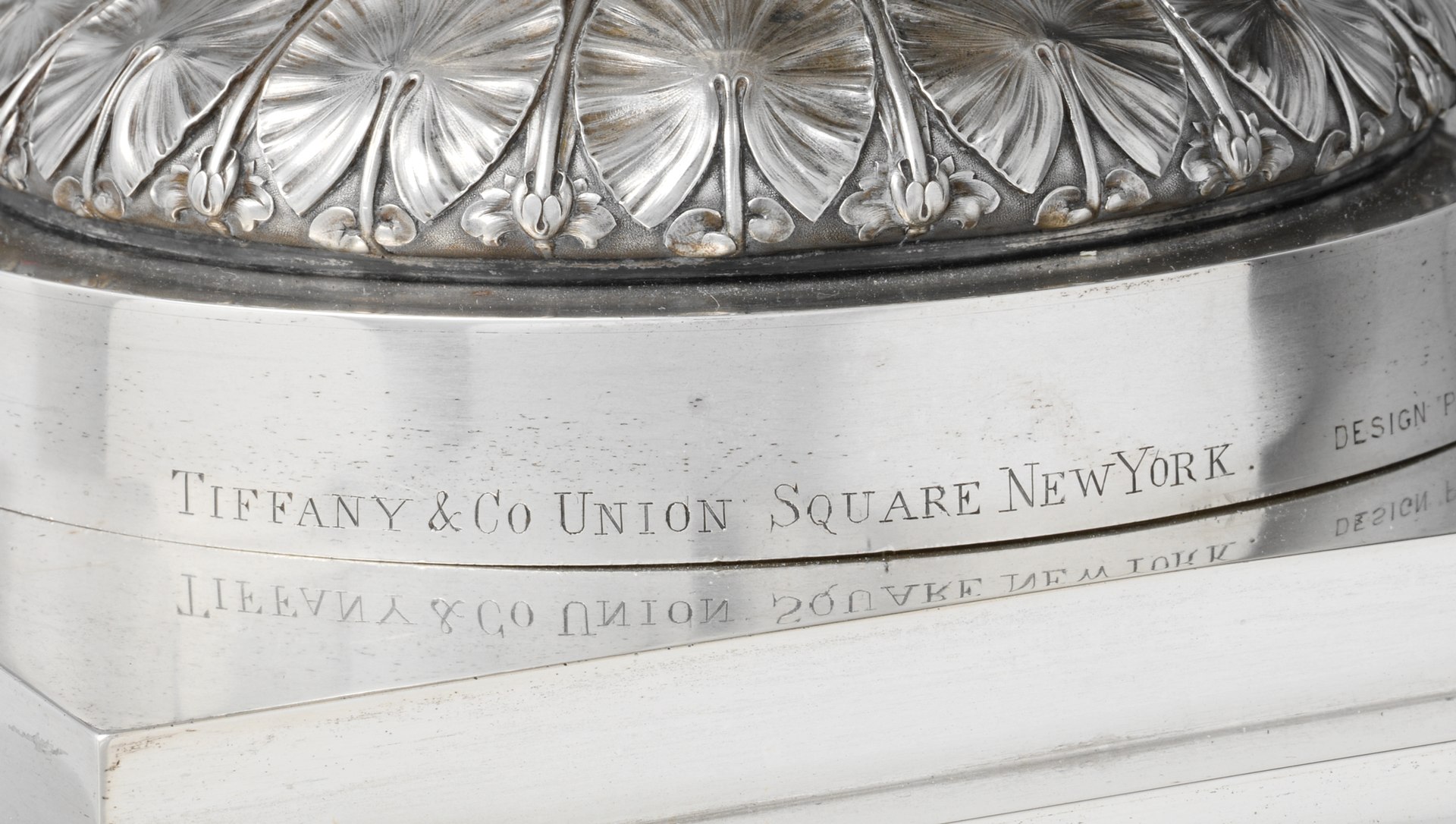
| Inscriptions | Inlaid in gold on the neck: "Truth crushed to earth shall rise again," from William Cullen Bryant's 1839 poem The Battlefield. Stamped on the base: TIFFANY & CO MAKERS. Engraved on the foot: TIFFANY & CO UNION SQUARE NEW YORK, with a partial design notation. The chaser's monogram, EJS, is worked into the portrait medallion beneath Bryant's shoulder. |
| Owners on record | 3 links3 documented |
| Sources | 14 cited |
About this record Last verified · 14 sources cited · Change log
On this page 9 sections
ContentsClose
A silver and gold presentation vase, 33 1/2 inches high and weighing just under 29 pounds, made by Tiffany & Co. of New York in 1875-1876 to honor the poet and Evening Post editor William Cullen Bryant on his eightieth birthday. The Metropolitan Museum's own record names the hands behind it: designed by James Horton Whitehouse, chased by Eugene J. Soligny, with five medallions by the young Augustus Saint-Gaudens, then newly returned to New York and still two years from the Farragut commission that would make his name.
The Century Association's own archives identify the commissioners as a committee of Bryant's friends including twenty-five fellow Centurions, continuing a tribute the club had already paid him once, at his seventieth birthday in 1864. Tiffany displayed the finished vase at the Centennial International Exhibition in Philadelphia in 1876, and Bryant himself gave it to the Metropolitan Museum in 1877, making it the first piece of American silver the Museum ever acquired.
Several details repeated across secondary web sources describing this commission, including the name of a nineteenth-century businessman as the committee's chairman and a specific 1875 house-call date, could not be corroborated against the Century Association's own institutional history and are contradicted by that individual's recorded date of death. This record states what is documented and marks the rest as open.
Provenance
Each link is graded. Documented: a cited source supports it. Disputed: the identification is argued but not established. Unknown: no owner for that span, and the gap is not smoothed into a narrative. The grades in the glossary.
- 1874 - 1876Commissioned by a committee of William Cullen Bryant's friends, including twenty-five members of the Century Associationdocumented
The Century Association's own archives record that, ten years after a festival marking Bryant's seventieth birthday in 1864, a committee of his friends including twenty-five Centurions commissioned the vase from Tiffany's for his eightieth birthday. Several secondary sources name a specific individual as committee chairman and date the event to November 1875; that claim is contradicted by the named individual's recorded death in November 1874 and is not corroborated by the Century Association's own account, so this record omits it.4
- 1876 - 1876William Cullen Bryantdocumented
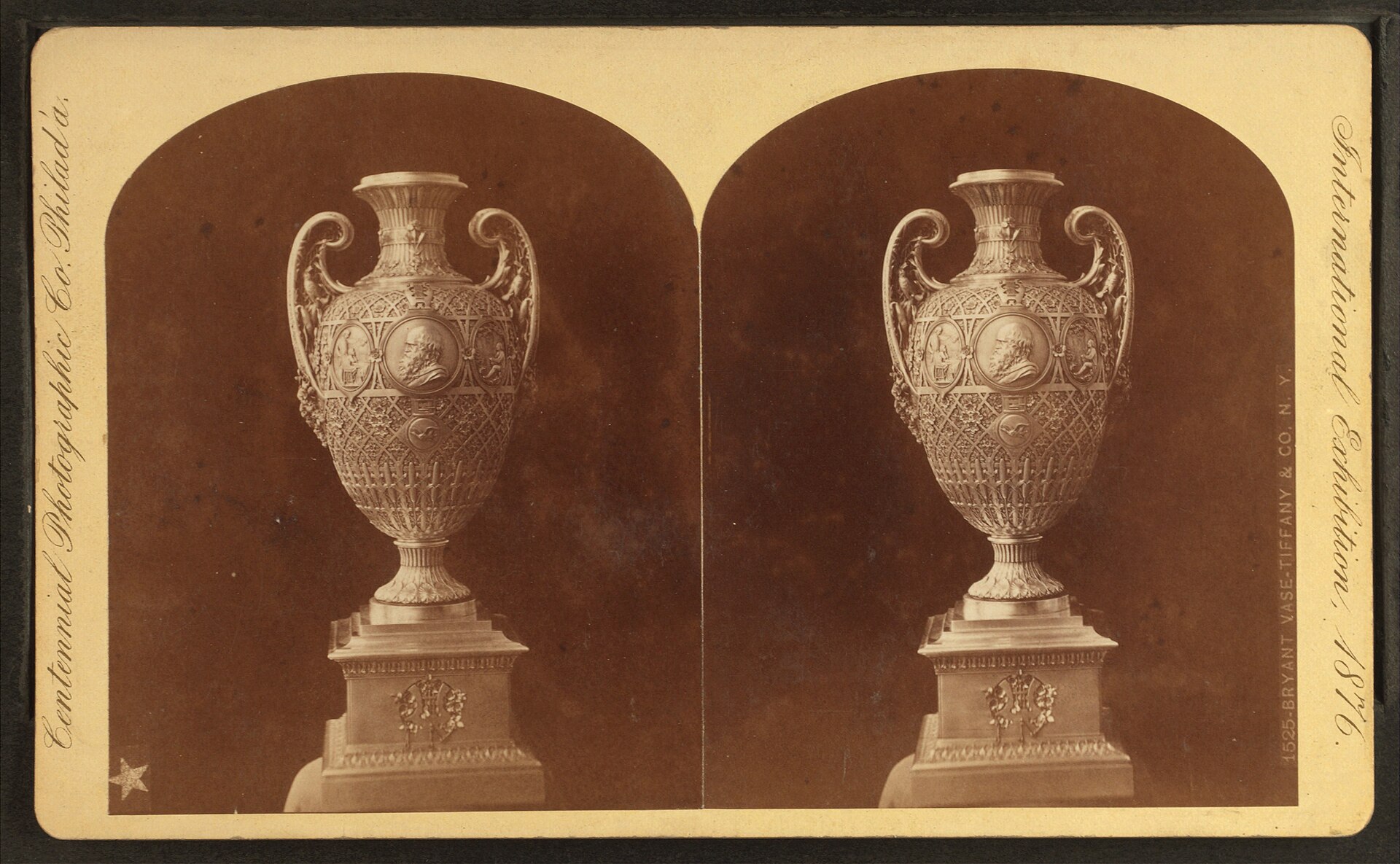
Tiffany & Co. completed and presented the vase to Bryant in 1876, and displayed it that year at the Centennial International Exhibition in Philadelphia, confirmed by a contemporary chromolithograph and an official exhibition-photographer stereograph, both naming the vase specifically.1569
- 1877 - presentMetropolitan Museum of Art, New Yorkdocumented
Bryant himself gave the vase to the Metropolitan Museum in 1877, credited as "Gift of William Cullen Bryant, 1877," the first piece of American silver the Museum acquired. Lent to the Smithsonian's National Portrait Gallery, Washington, D.C., June-October 1978, for an exhibition marking the centenary of Bryant's death; otherwise remained in the Museum's collection, now on view in the American Wing.127
Technical evidence
| Attribution note | Manufactured by Tiffany & Co., New York. The Metropolitan Museum's own object record names four hands: designed by James Horton Whitehouse, chased by Eugene J. Soligny, with five medallions designed by Augustus Saint-Gaudens, produced under the silver division then directed by Edward C. Moore. Nothing about the maker is in dispute; the attribution question this record has to resolve is a different one, addressed below: which committee, and on what date, actually commissioned it. |
|---|---|
| Medium | Silver and gold.12 |
| Dimensions and weight | 33 1/2 x 14 x 11 5/16 in. (85.1 x 35.6 x 28.7 cm); 452 oz. 16 dwt. (14,084.2 g).12 |
| Chasing | Worked by hand with small steel tools by Eugene J. Soligny, a Paris-trained specialist in repousse and chasing who held US patent 173510 for embossing and chasing metal. His monogram EJS is chased into the portrait medallion beneath Bryant's shoulder.110 |
| Design | James Horton Whitehouse, Tiffany's chief designer through this period, later designer of the 1885 die for the Great Seal of the United States.110 |
| Medallions | Five medallions designed by the sculptor Augustus Saint-Gaudens, made shortly after his return to New York and roughly a year before the Farragut Monument commission that established his public reputation.112 |
| Fretwork motifs | Pierced fretwork of American flora: corn stalks, apple branches and blossom, cattails, water lilies, and a separately applied cotton-plant motif at the base of one handle.138 |
| Inscription | "Truth crushed to earth shall rise again," from William Cullen Bryant's poem The Battlefield (1839), inlaid in gold on the neck.13 |
| Marks | Stamped on the base, TIFFANY & CO MAKERS; engraved on the foot, TIFFANY & CO UNION SQUARE NEW YORK, with a partial design notation, recording the firm's Union Square store address of the period.1 |
| Reproduction patterns | Full-size electroformed patterns (copper, metal alloy, lead) for the body, rim, neck, handles and foot, made ca. 1875 to allow electrotype copies to be cast; Tiffany & Co. gave a set of these patterns to the Metropolitan Museum in 1985, catalogued separately from the vase under accession numbers beginning 1985.191.8 |
Images
The record in full
Chapter 1What it is
The Bryant Vase stands 33 1/2 inches (85.1 cm) high on its pedestal, with a body diameter of 11 5/16 inches, worked in silver and gold and weighing 452 troy ounces 16 pennyweight, a little over 29...
The Bryant Vase stands 33 1/2 inches (85.1 cm) high on its pedestal, with a body diameter of 11 5/16 inches, worked in silver and gold and weighing 452 troy ounces 16 pennyweight, a little over 29 pounds. Its form follows a Greek vase, with two large scrolled handles rising from the shoulder, a pierced fretwork band of American plants running around the body, and a foot and pedestal in a plainer register that carries the maker's marks and the donor inscription.
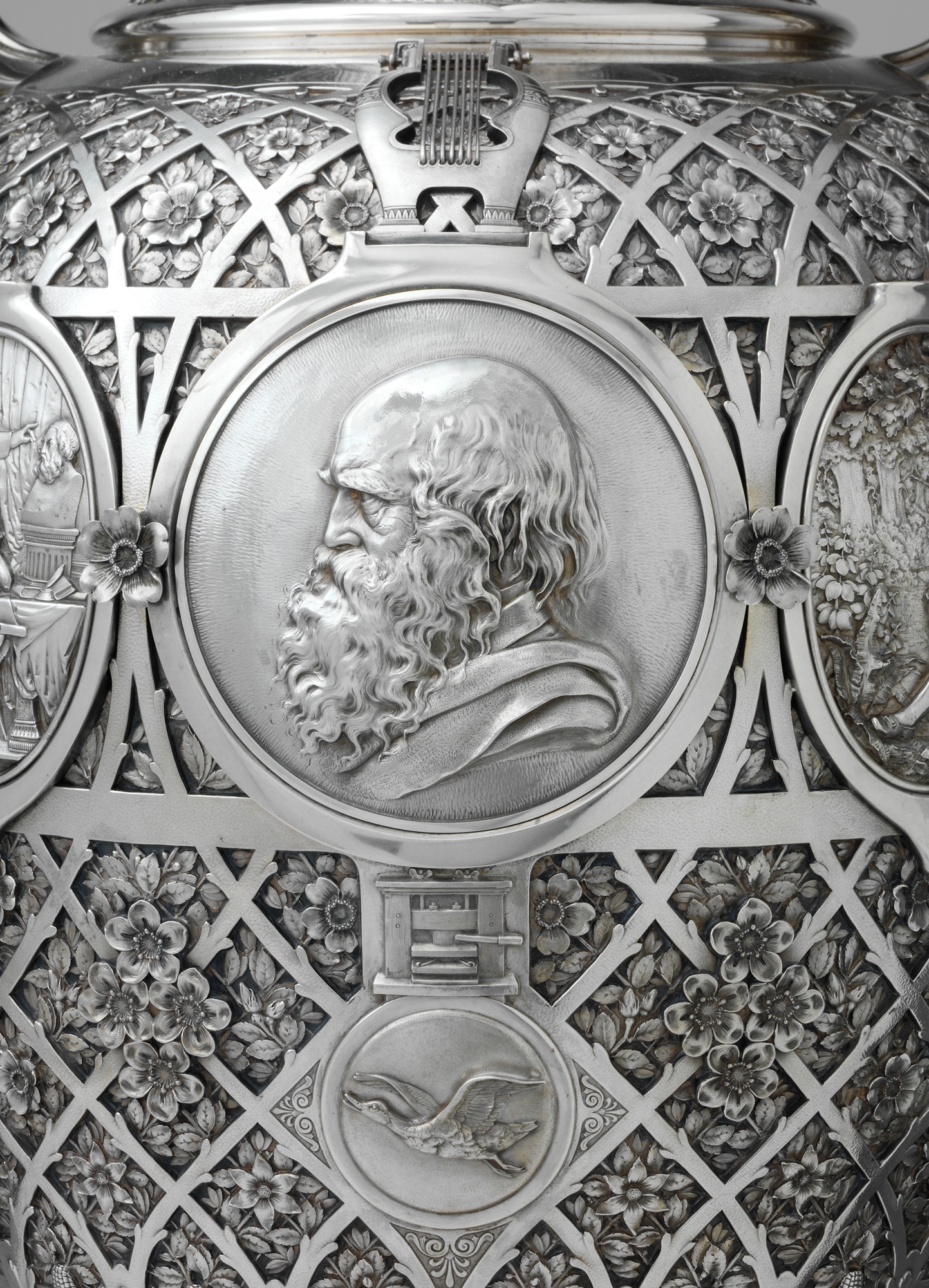
Two oval medallions dominate the front and back of the body. One is a profile portrait of Bryant himself, bearded and robed in a manner deliberately recalling a classical bust, set beneath a lyre worked into the fretwork above it and a small bird medallion below. The other, per the Met's own published description of the piece, shows Bryant seated writing in his library. Smaller medallions elsewhere on the vase depict further scenes from his life and work. The Museum's curatorial department describes the piece as a tour de force of chasing, meaning the ornament was worked into the solid silver by hand with small steel tools rather than cast or stamped.
Chapter 2How it was made
Chasing of this depth and consistency across a vessel this size was specialist work, and Tiffany & Co.
Chasing of this depth and consistency across a vessel this size was specialist work, and Tiffany & Co. gave the task to Eugene J. Soligny, a Paris-born silversmith who had trained under the metalworker Leonard Morel-Ladeuil before emigrating to the United States in 1856 and joining Tiffany by 1859. Soligny specialized in repousse and chasing and held at least one United States patent, number 173510, for advances in the embossing and chasing of metal. By 1867 some of his Tiffany work already carried his initials; on the Bryant Vase, his monogram EJS is worked into the portrait medallion, tucked beneath Bryant's shoulder where it is easy to miss.
The overall design was by James Horton Whitehouse, who worked as Tiffany's chief designer through this period and who would go on, in 1885, to re-cut the die for the Great Seal of the United States under a commission from President Chester Arthur. Five of the medallions were designed separately, by the sculptor Augustus Saint-Gaudens, then twenty-six or twenty-seven years old and only recently returned to New York. According to a National Gallery of Art biography of the sculptor, Saint-Gaudens was at that moment actively seeking commissions that could give him the financial security to marry Augusta Homer, to whom he had been engaged since 1874; he secured the Farragut Monument commission, his first major public statue and the work that made his reputation, in 1876, the same year the Bryant Vase was completed. He and Augusta Homer married in June 1877. The Bryant medallions therefore belong to the last months before Saint-Gaudens became a famous name, made while he was still, in effect, a jobbing designer of ornamental metalwork.
Standing over the whole silver division at Tiffany during these years was Edward C. Moore, who according to a contemporary account in the New York Sun spent his time superintending every detail of the work and assembling his own collections of models and designs to guide his designers and craftsmen. The Bryant Vase's combination of a Greek vase form, Renaissance Revival medallion framing and an Aesthetic Movement treatment of naturalistic American plant ornament is characteristic of the eclectic, source-mixing approach Moore encouraged at the firm in this decade.
Tiffany did not stop at the silver original. Once the vase was finished, the firm made electroformed patterns from it: copper, lead and metal-alloy molds built up by electrodeposition, precise enough to reproduce even fine engraved lines, which could then be used to cast electrotype copies of the vase. Tiffany did not offer this model for commercial sale, but at least two complete copies were made from these patterns: one for presentation to the Century Association, whose members had commissioned the original, and one for the Village of Cummington, Massachusetts, where Bryant was born. Tiffany & Co. later gave a set of these original ca. 1875 patterns, covering the body, rim, neck, handles, foot and pedestal top, to the Metropolitan Museum in 1985, where they are catalogued separately from the vase itself under accession numbers beginning 1985.191.
Chapter 3The Century Association and the eightieth birthday
William Cullen Bryant was not an occasional member of the Century Association, the private New York club for writers and artists founded in 1847: he was a founding Centurion, elected the same year...
William Cullen Bryant was not an occasional member of the Century Association, the private New York club for writers and artists founded in 1847: he was a founding Centurion, elected the same year, and served as the club's third president from 1868 until his death in 1878. The Century had already marked one of his birthdays in style. In 1864, for his seventieth birthday, the club held a festival in his honor at its Fifteenth Street clubhouse, with addresses from guests including Ralph Waldo Emerson and Julia Ward Howe, and several of the club's artist members donated paintings to him on the occasion.
The Century Association's own archives record what happened ten years later, in 1874: for Bryant's eightieth birthday, a committee of his friends including twenty-five fellow Centurions commissioned the vase from Tiffany's. This is the only institutionally sourced account of who initiated the commission that this record could verify, and it names no individual chairman.
Several secondary web sources describe the organizing committee as led by a named nineteenth-century New York merchant and art patron who called on Bryant at his home with testimonial sheets on November 3, dated to 1875. That claim could not be corroborated here: the individual named died in November 1874, which would place his death roughly a year before the date given for the event, and the claim does not appear in the Century Association's own account. It is possible the underlying event took place in 1874, consistent with the Century's own "ten years later" phrasing and with the named individual still being alive, and that the date given in the secondary sources is simply wrong by a year; it is also possible the name itself is a confusion with the same man's earlier, well-documented gift of a painting to Bryant in 1849. This record does not resolve which, and does not print the name.
What is well documented, from the Metropolitan Museum's own gallery text, is the language the commissioning group used: they asked for "a commemorative Vase of original design and choice workmanship" that would "embody . . . the lessons of [his] literary and civic career." The finished object took its design brief from that language literally, building its whole ornamental program around Bryant's life and writing rather than treating the commission as an occasion for generic display silver.
Chapter 4How the design was chosen
Beth Carver Wees, the Metropolitan Museum's own curator of American Decorative Arts, names the Bryant Vase in a 2004 essay on nineteenth-century American silver as an example of a presentation piece...
Beth Carver Wees, the Metropolitan Museum's own curator of American Decorative Arts, names the Bryant Vase in a 2004 essay on nineteenth-century American silver as an example of a presentation piece for which a design competition was held. She gives no further detail on the essay page itself: not who the competitors were, whether the competition was internal to Tiffany or ran between rival firms, or how Whitehouse's design was chosen over any rivals. This record treats the existence of a competition as documented, on Wees's authority, and its particulars as unresolved.
Wees places the vase inside a longer American habit rather than treating it as a one-off. Presentation silver had been a vehicle for celebrating political and civic achievement since early in the century; the pair of vases given to Governor DeWitt Clinton after the 1825 opening of the Erie Canal, formally modeled on a colossal antique marble urn but ornamented with American iconography and topped with eagle finials, is her example of the type half a century before Bryant's. She also places Tiffany's design department in a named sequence of directors across the century: John C. Moore, then Edward C. Moore, then later John T. Curran and Paulding Farnham, the men responsible in turn for the firm's Magnolia Vase, its Viking Revival punch bowl, and the gem-set Adams Vase. The Bryant Vase falls under Edward C. Moore's tenure, in the same house style and the same institutional habit of using elaborate presentation silver to mark an achievement, in this case a poet's long life rather than a canal or a war.
Chapter 5The iconographic program
The vase's ornament works on two levels at once, and the Museum's own description separates them clearly.
The vase's ornament works on two levels at once, and the Museum's own description separates them clearly. The fretwork covering the body is American flora: stalks of corn, apple branches and blossom, cattails and water lilies, with a cotton plant worked as a separate applied motif at the base of one handle. The Met's own text reads this plant ornament as standing generally for the beauty and wholesome quality of Bryant's poetry, without tying any single motif to a specific poem; the sources consulted for this record do not go further than that, and no source found here identifies which motif, if any, was meant to evoke a particular title such as The Planting of the Apple-Tree, Bryant's own well-known poem about that exact plant. The resemblance is suggestive; it is not documented, and this record does not assert it as fact.
The medallions work differently: they are not landscape or plant symbolism but biography and portraiture. The front medallion is a classicizing profile portrait of Bryant himself; another, per the Museum's own description, shows him seated writing in his library; further medallions, designed by Saint-Gaudens, depict further scenes from his life and work. Where the fretwork gestures at Bryant's poetry in general terms, the medallions are closer to an illustrated biography in miniature, set into a vessel shaped like a Greek prize vase.
The one place the design commits to a specific line rather than a general theme is the neck inscription, inlaid in gold: "Truth crushed to earth shall rise again," from The Battlefield, a poem Bryant had published in 1839. Of everything documented about the vase's meaning, this is the single point where a source can name the exact text the makers meant the object to carry.
Chapter 6The Centennial Exhibition
Tiffany completed and presented the vase to Bryant in 1876, the year of the Centennial International Exhibition in Philadelphia, and the firm put it on public display there as part of its own exhibit...
Tiffany completed and presented the vase to Bryant in 1876, the year of the Centennial International Exhibition in Philadelphia, and the firm put it on public display there as part of its own exhibit of American presentation silver. Two independent period sources confirm this. The National Gallery of Art holds a chromolithograph, plate 26 in the 1877-1878 portfolio Treasures of Art, Industry and Manufacture Represented at the International Exhibition, 1876, printed by Clay, Cosack & Co. of Buffalo and inscribed on the stone "The Bryant Commemorative Vase. Silver - Tiffany & Co. New York." Separately, the New York Public Library holds an 1876 stereograph by the Centennial Photographic Company, the exhibition's own official photographic concessionaire, titled simply "Bryant vase, Tiffany & Co., N.Y." and catalogued under the Library's Centennial Exhibition subject heading. Between them, a commercial souvenir print series and the exhibition's own photographic record agree that this specific vase, not a generic Tiffany display piece, was shown.
What the sources consulted here do not supply is any critical review of the vase specifically written at the time of the Centennial. Tiffany's silver was widely covered in the exhibition's press, but no period notice singling out the Bryant Vase for praise or criticism turned up in this research. That gap is recorded rather than filled.
Chapter 7Gift to the Metropolitan Museum
The following year, 1877, Bryant himself gave the finished vase to the Metropolitan Museum of Art.
The following year, 1877, Bryant himself gave the finished vase to the Metropolitan Museum of Art. The Museum's credit line reads simply "Gift of William Cullen Bryant, 1877," and its own curatorial account states plainly that this was the first piece of American silver the Museum ever acquired, a distinction repeated in the Museum's audio guide by curator emeritus Morrison Heckscher. That the donor was the recipient himself, rather than his estate or a later collector, means the object's presence in the Museum's collection was Bryant's own decision, made within a year of receiving it and a year before his death in 1878.
Chapter 8Loan history
The vase left the Metropolitan Museum at least once.
The vase left the Metropolitan Museum at least once. The Smithsonian's National Portrait Gallery in Washington, D.C. borrowed it for a small exhibition simply titled William Cullen Bryant, held June 12 through October 27, 1978, to mark the hundredth anniversary of Bryant's death. The Smithsonian's own record of the show describes it as pairing the vase with an issue of the New York Evening Post that Bryant edited for fifty years, a bust of Bryant by Henry Kirke Brown, and an oil portrait by Daniel Huntington. No further loan is documented in the sources consulted for this record; whether the vase has traveled since 1978 is not established here.
Chapter 9What is not documented
Several ordinary diligence questions about this object have no sourced answer in the material gathered for this record, and are recorded here rather than guessed at.
Several ordinary diligence questions about this object have no sourced answer in the material gathered for this record, and are recorded here rather than guessed at. No source found gives the amount of money the subscription actually raised, or a full list of subscribers beyond the Century Association's own count of twenty-five Centurions among the friends who organized it. No source gives William Cullen Bryant's own reaction to receiving the vase, whether he was pleased, embarrassed, or ambivalent about being the subject of an elaborate piece of presentation silver, a genre some of his contemporaries treated with real discomfort. No source establishes the current location of the two ca. 1875 electrotype copies Tiffany made from the original, one given to the Century Association and one to the Village of Cummington, Massachusetts; both would be worth locating, since either would settle at a stroke what the finished vase looked like before more than a century of museum handling and, in the original's case, gallery lighting.
The artist
Tiffany & Co., New York
The Bryant Vase carries no single artist's name because it was never the work of one hand. Tiffany & Co., founded in 1837 and still trading today, organized its silver production in this period around a small group of named specialists working under a single creative director, and the Museum's own record for this object credits four of them individually. The firm, not any one of them, is the maker of record, and its silver division in the 1870s and 1880s is the right subject for a dossier on this piece.
Related works
| Work | Relation | Where it is |
|---|---|---|
| DeWitt Clinton Vases Unrecorded American silversmith | Earlier precedent in the same American genre of presentation silver marking a public achievement with a vase form and American iconography Given to Governor DeWitt Clinton after the 1825 opening of the Erie Canal; formally modeled on a colossal antique marble urn but ornamented with American iconography and eagle finials. Cited by Met curator Beth Carver Wees as the type the Bryant Vase continues half a century later. | Metropolitan Museum of Art, New York |
| Century Vase Karl L. H. Muller, Union Porcelain Works | Another American presentation piece made for the 1876 Centennial Exhibition, in porcelain rather than silver Named by the Metropolitan Museum itself as a related work from the same time and exhibition context. | Metropolitan Museum of Art, New York; Brooklyn Museum, Brooklyn |
| The Magnolia Vase Tiffany & Co. | A later Tiffany presentation vase built around American regional plant symbolism, made for the 1893 World's Columbian Exposition Centerpiece of Tiffany's 1893 Chicago display; continues the firm's practice of building a vase's ornament around native American flora, as on the Bryant Vase. | Metropolitan Museum of Art, New York |
| The Adams Vase Paulding Farnham for Tiffany & Co. | A later, more lavish Tiffany presentation vase in the same named-donor genre Gold, gem-set, made 1893-95 and given to the Museum by Edward D. Adams in 1904, continuing the pattern the Bryant Vase set in 1877 of a Tiffany presentation piece entering the Met as a named gift. | Metropolitan Museum of Art, New York |
| Electrotype facsimiles of the Bryant Vase Tiffany & Co. | Direct electroformed copies of this object, cast from patterns made ca. 1875 The original patterns used to cast these copies were later given by Tiffany & Co. to the Metropolitan Museum in 1985; the copies themselves were not located in the sources consulted for this record. | Whereabouts not established; one was given to the Century Association, one to the Village of Cummington, Massachusetts |
Open questions
- A Met curator's own published essay states that a design competition was held for the vase, without saying who competed or how Whitehouse's design was chosen; that competition's particulars are not documented in any source consulted here.
- What amount, if any, did the 1874 subscription actually raise, and who beyond the twenty-five named Centurions subscribed to it? No source consulted gives a total or a full list.
- Did an individual chair or lead the organizing committee? A name recurring in secondary web sources is contradicted by that person's recorded date of death relative to the date usually given for the event, and is not corroborated by the Century Association's own institutional history, which names no individual.
- Did the committee's house call and public announcement take place in 1874, consistent with the Century Association's own account of Bryant's actual eightieth birthday, or in 1875, as most secondary sources state? The sources consulted disagree and this record could not resolve it against a primary contemporary account.
- Was any individual fretwork motif or medallion scene meant to evoke a specific named Bryant poem beyond The Battlefield, whose line is inlaid on the neck? No source found ties the apple-blossom fretwork, for instance, to The Planting of the Apple-Tree or any other single title.
- What critical reception did the vase receive at the 1876 Centennial Exhibition itself? No period review of the piece specifically was located.
- Where are the two ca. 1875 electrotype copies of the vase now, the one given to the Century Association and the one given to the Village of Cummington, Massachusetts?
- Has the vase been lent again since its 1978 loan to the Smithsonian's National Portrait Gallery? No further loan is documented in the sources consulted.
Questions about this object
What is The Bryant Vase?
The Bryant Vase is a silver, dated 1875-1876. Medium: Silver and gold.
Who made The Bryant Vase, and is the attribution settled?
The attribution to Tiffany & Co. is recorded here as accepted. Manufactured by Tiffany & Co., New York. The Metropolitan Museum's own object record names four hands: designed by James Horton Whitehouse, chased by Eugene J. Soligny, with five medallions designed by Augustus Saint-Gaudens, produced under the silver division then directed by Edward C. Moore. Nothing about the maker is in dispute; the attribution question this record has to resolve is a different one, addressed below: which committee, and on what date, actually commissioned it.
Where is The Bryant Vase now?
Metropolitan Museum of Art, New York. Inventory number 77.9a, b. Last confirmed 1 September 2026. On view at The Met Fifth Avenue, The American Wing, Gallery 706, per the Met's own object record.
What is still unknown about The Bryant Vase?
A Met curator's own published essay states that a design competition was held for the vase, without saying who competed or how Whitehouse's design was chosen; that competition's particulars are not documented in any source consulted here.
Sources
- 1Metropolitan Museum of Art, object record for The Bryant Vase, accession 77.9a, b, object ID 1029. metmuseum.org/art/...
- 2Metropolitan Museum of Art Collection API, object record 1029 (The Bryant Vase). collectionapi.metmuseum.org/public/...
- 3Wikipedia, 'Bryant Vase.' A stub article drawing on the Met's own object page; with primary Museum and exhibition-catalogue sources as they are located. en.wikipedia.org/wiki/...
- 4Century Association Archives, Member Directory, William Cullen Bryant, Archivist's Notes. centuryarchives.org/member-directory
- 5National Gallery of Art, object record for 'The Bryant Commemorative Vase - Tiffany & Co., New York,' chromolithograph by Clay, Cosack & Co. after Tiffany & Co., 1877, plate 26 of Treasures of Art, Industry and Manufacture Represented at the International Exhibition, 1876 (C. B. Norton, ed.). nga.gov/artworks/...
- 6New York Public Library Digital Collections, 'Bryant vase, Tiffany & Co., N.Y.,' stereograph by the Centennial Photographic Co., 1876, Robert N. Dennis collection of stereoscopic views. digitalcollections.nypl.org/items/...
- 7Smithsonian Institution, exhibition record for 'William Cullen Bryant,' National Portrait Gallery, June 12-October 27, 1978. si.edu/exhibitions/...
- 8Metropolitan Museum of Art, object record for 'Full-size pattern for facsimile of back half of body of Bryant Vase,' accession 1985.191.3b, Gift of Tiffany & Company, 1985. metmuseum.org/art/...
- 9Metropolitan Museum of Art, object record for '1526- Bryant Vase-Tiffany & Co. New York,' albumen silver print by the Centennial Photographic Company, Jefferson R. Burdick Collection, accession 63.350.651.579. metmuseum.org/art/...
- 10The Magazine Antiques, 'Cosmopolitan Craftsman,' on Edward C. Moore's direction of Tiffany & Co.'s silver division and the Bryant Vase's design team. themagazineantiques.com/article/...
- 11Wikipedia, 'Eugene J. en.wikipedia.org/wiki/...
- 12National Gallery of Art, artist biography of Augustus Saint-Gaudens. ngabiographies.org/biographies/...
- 13Metropolitan Museum of Art, object record for The Adams Vase, by Paulding Farnham for Tiffany & Co., accession 04.1a, b (object ID 35), Gift of Edward D. Adams, 1904. metmuseum.org/art/...
- 14Beth Carver Wees, Department of American Decorative Arts, Metropolitan Museum of Art, 'Nineteenth-Century American Silver,' Heilbrunn Timeline of Art History, October 2004. metmuseum.org/essays/...
Last verified · Published
Change log
1 September 2026 - Record created at the house standard: researched narrative, technical evidence, maker dossier, graded provenance chain, prices with hammer and premium separated, related works, open questions and sources.