Who Sewed the Star-Spangled Banner? What the 1813 Paper Says About Mary Pickersgill's Workshop
The 1813 bill names Mary Pickersgill and her niece's signature. Who else sewed the Star-Spangled Banner rests on a census, an indenture and an 1876 letter.
Records in this piece: Star-Spangled Banner
On this page 7 sections
ContentsClose
In short
- The only 1813 paper we could read is a bill dated 19 August 1813 for $405.90 (garrison flag) and $168.54 (storm flag), with a receipt in full dated 27 October 1813 signed for Mary Pickersgill by Eliza Young, whom Thomassen-Krauss and the Smithsonian name as her niece.
- The account of the sewing in Claggett's brewery malt house comes from a letter Caroline Pickersgill Purdy wrote in 1876, 63 years later, in which she asks for help; it names only herself and her mother.
- Five sources name different crews and give the making time as six to about ten weeks; the documented fact about Grace Wisher is her indenture, not her work on the flag.
- The conservator counts 14 stars left and says souvenir cutting cannot account for the more than twenty percent of the flag now missing.
The 1813 bill names Mary Pickersgill as maker, and a receipt is signed for her by Eliza Young
The only 1813 paper we could read is a bill and its receipt, and the bill names Mary Pickersgill as the maker. A transcription published by the Maryland in the War of 1812 project gives it as addressed to James Calhoun Jr., Deputy Commissary, dated 19 August 1813, the date the National Park Service gives for delivery: one American ensign of 30 by 42 feet in first quality bunting at $405.90, one of 17 by 25 feet at $168.54, $574.44 in all for Fort McHenry. A receipt dated 27 October 1813 acknowledges payment in full and is signed for Mary Pickersgill by Eliza Young, whom Thomassen-Krauss and the Smithsonian name as her niece. Major George Armistead signed for the flags. The Smithsonian gives the $405.90 and the American Battlefield Trust gives both prices.
Payment was acknowledged 69 days after the bill (our arithmetic). The paper we read doesn't say who ordered the flags. Suzanne Thomassen-Krauss, the Smithsonian conservator who studied the flag for nearly nine years, writes in her main text that General John Stricker and Commodore Joshua Barney ordered them. Her own footnote says Calhoun ordered and purchased them, citing the Commissary General's letter book in the National Archives. The Stricker and Barney version comes from a family letter written decades later. A third version, from Maryland in the War of 1812 and the Park Service, is that Armistead commissioned them, through Calhoun. We did not see the letter book, which Thomassen-Krauss cites for 1813-14. No contract appears in any source we opened, so the date of the order isn't known.
The prices can be set beside a later receipt. The Flag House museum shows a receipt of 6 February 1815 for a flag of 24 and a half by 15 feet at $120, which it calls the last known receipt for a flag made by her.
| Flag | Size in feet | Price | Area in square feet | Price per square foot |
|---|---|---|---|---|
| Garrison flag, 1813 | 30 by 42 | $405.90 | 1,260 | $0.32 |
| Storm flag, 1813 | 17 by 25 | $168.54 | 425 | $0.40 |
| Ensign, February 1815 | 24.5 by 15 | $120.00 | 367.5 | $0.33 |
The big flag cost about the same per square foot as the 1815 ensign and less than the storm flag. The Smithsonian says the $405.90 was more than most Baltimoreans earned in a year.
The only account of the sewing is a letter from 1876, and it asks for help
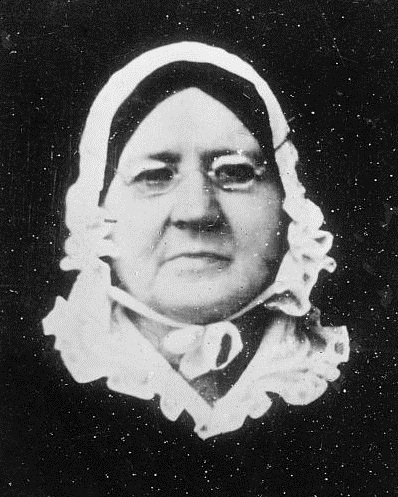
The only first-hand account of how the flag was made is a letter from Mary Pickersgill's daughter Caroline Purdy to Georgiana Armistead Appleton in 1876, which the Smithsonian publishes in transcript. Caroline had read in the newspapers that the flag was to go to the Centennial. She writes that it "was made by my mother, Mrs. Mary Pickersgill, and I assisted her." She says the flag was too big for the house, that her mother got leave to spread it in the malt house of Claggett's brewery nearby, and that she remembers seeing her mother "down on the floor, placing the stars." She adds that her mother worked many nights until 12 o'clock, and that the flag held, she thinks, four hundred yards of bunting.
She also says Commodore Barney and George Stricker, family connections, chose her mother because her grandmother Rebecca Young made the first flag of the Revolution under Washington's direction. That is family tradition. Nothing we opened confirms it, and the National Park Service describes Rebecca only as a maker of flags and military supplies during the war.
The same letter is behind another claim. Thomassen-Krauss says there is documentation that Armistead hired Pickersgill to repair the flag after the battle, and her footnote for it is this letter, where Caroline says Armistead insisted that only the maker mend it and that the rents be bound around.
The letter has a second purpose, and it is on the page. Caroline writes that she is widowed and childless, in her seventy-sixth year, in feeble health with "the barest pittance" of support, and she passes on her friends' idea that her particulars go on a card attached to the flag, to draw compassion. She names herself and her mother. She doesn't mention her cousins or any apprentice. A recollection from 63 years on, written by a woman asking for help, is the source for the malt house, the stars on the floor and the night work.
Five sources name the crew differently, and none of them is a payroll
The sources disagree on who besides Mary Pickersgill sewed the flag, and none of them rests on a list of workers from 1813.
| Source | People named | How the source words it |
|---|---|---|
| Caroline Purdy, 1876 | Herself | "I assisted her" |
| Smithsonian, Making the Flag | Caroline (13), nieces Eliza Young (13) and Margaret Young (15), Grace Wisher (13) | Helped; Rebecca Young "may have helped" |
| American Battlefield Trust | Caroline, Eliza and Margaret Young, Grace Wisher, Rebecca Young | Worked with them, plus "additional hired seamstresses as necessary" |
| Thomassen-Krauss, 2011 | Caroline, nieces, Grace Wisher; Rebecca | "Probably" with the help of; Rebecca "may have" helped |
| National Park Service | Caroline, nieces, Grace Wisher | Grace "would have" worked on it |
Even the signer's first name varies: the transcription and the Smithsonian say Eliza, and Thomassen-Krauss's footnote says Elizabeth. The National Park Service says three nieces lived in the house without naming them, and an essay in Baltimore Histories Weekly reads the 1810 census as showing three white girls there, probably relatives, besides Caroline. The time taken also varies: six weeks at the Battlefield Trust, six to eight at the Park Service, about seven at the Smithsonian and about ten in Thomassen-Krauss.
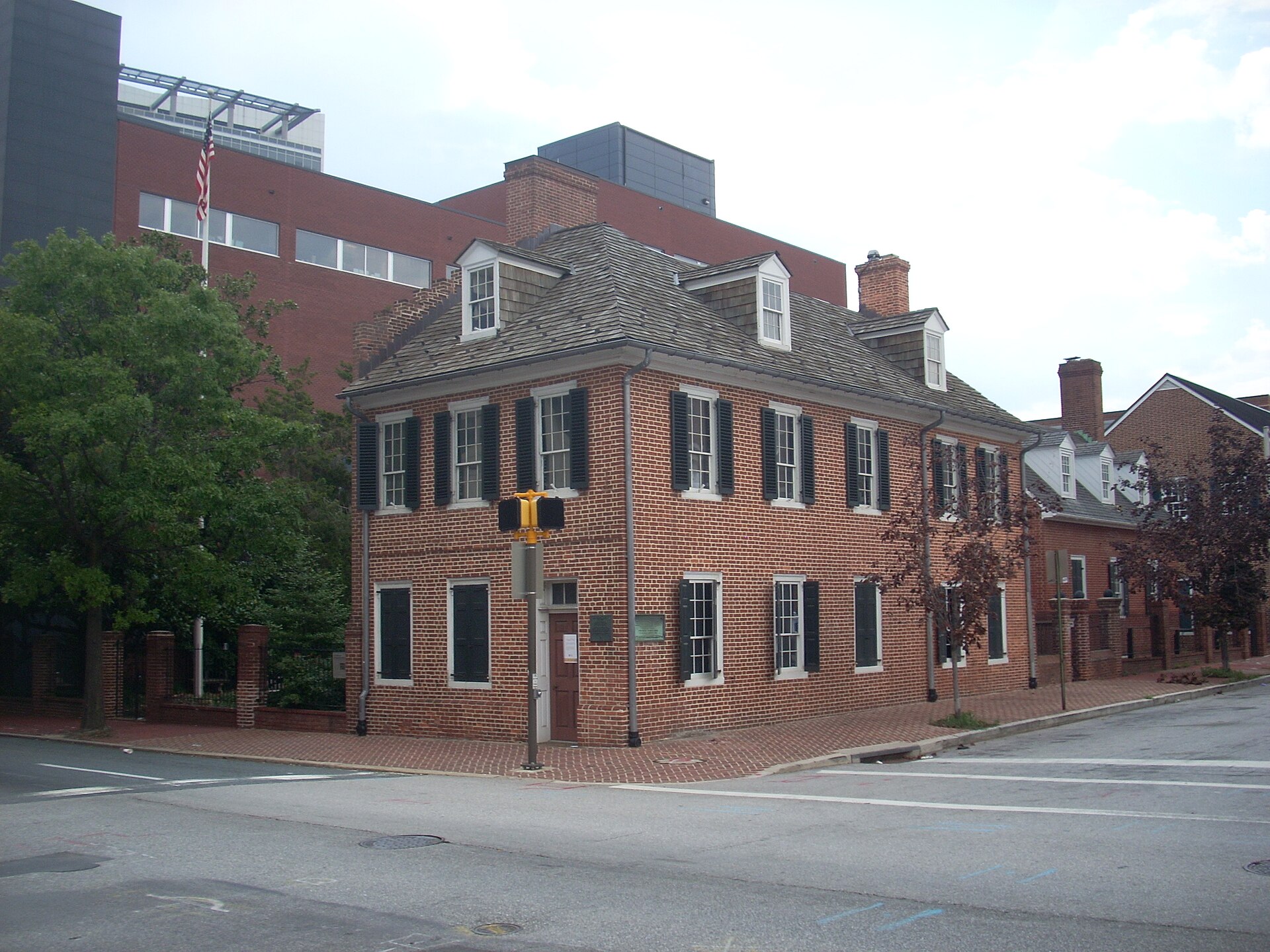
What the Park Service does document is the shape of the business. Pickersgill moved to Baltimore with her mother and daughter in 1806, and her mother advertised military colors, signal flags and merchant flags. The Park Service says the business depended on the labor of other people. Samples were shown in the front parlor and orders were settled in the dining room.
Grace Wisher is documented in the household, and no paper names her on the flag
Grace Wisher is documented as an apprentice in Mary Pickersgill's household, and no document that we found says she sewed the flag. The National Park Service says Grace's mother, Jenny Wisher, a free African American woman, bound her out in 1809 at about ten years old for six years. Pickersgill promised food, shelter, clothing and instruction in "the art of Housework and plain sewing", and $12 to Jenny at the start and end of the term. The contract didn't require reading and writing. The Park Service notes that Pickersgill did promise that to Mary Ann Martin, a white apprentice, in 1814.
The sources differ on the details. Emmanuel Mehr's essay cites the indenture as filed in the Orphans' Court of Baltimore County on 6 January 1810, quoting a 2014 book, and says the contract states no age, so ten is inferred from the six-year term. The Smithsonian says Grace was thirteen in 1813, while ten in 1809 would make her fourteen. Mehr writes that her apprenticeship is not to be confused with indentured servitude. The Park Service and the Flag House use both words. The Flag House says the indenture was found in the early 2000s. Caroline's letter of 1876 doesn't mention her.
The sewing is the weak link. The Smithsonian says she helped. Thomassen-Krauss says "probably" and adds in a footnote that research by the Smithsonian's Marilyn Zoidis showed an African American indentured servant lived in the household when the flag was made. The Park Service writes that she "would have" taken part. Her presence is documented and the apprenticeship was in sewing, so participation is a reasonable reading. It is still a reading. The Park Service says what became of her after about 1815 is unknown.
The household also held enslaved people. The Flag House counts one in the 1810 census, with no age or gender recorded, though Mehr and the Park Service read that person as female. It lists others in later years. An 1857 deed from Mary Pickersgill to Caroline names Emily, Jane, Julia and Maurice, a boy of three. The Park Service says she died in 1857 leaving four enslaved workers to Caroline, and the Flag House dates her death to 4 October 1857.
The flag itself shows several hands and no maker's mark
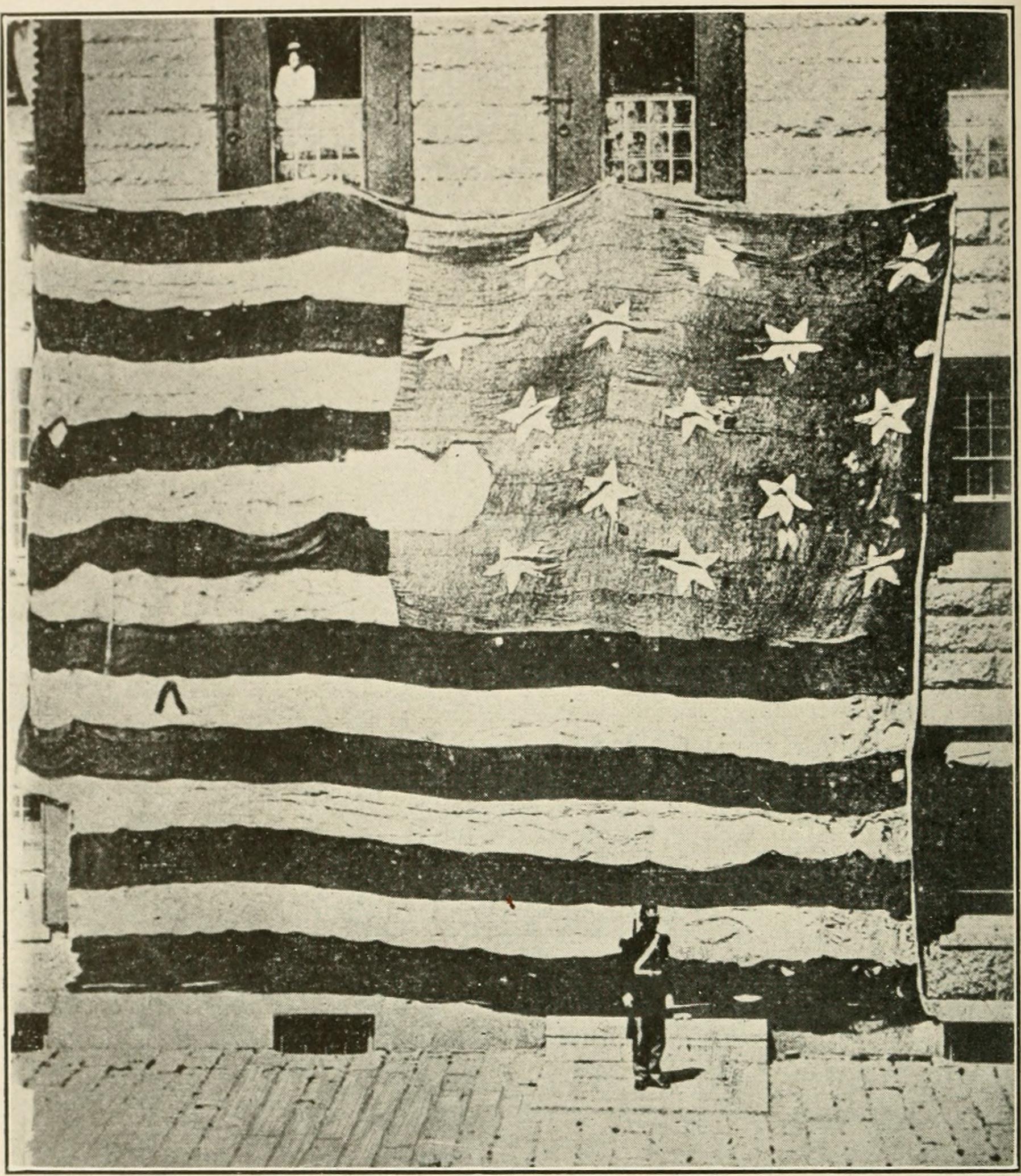
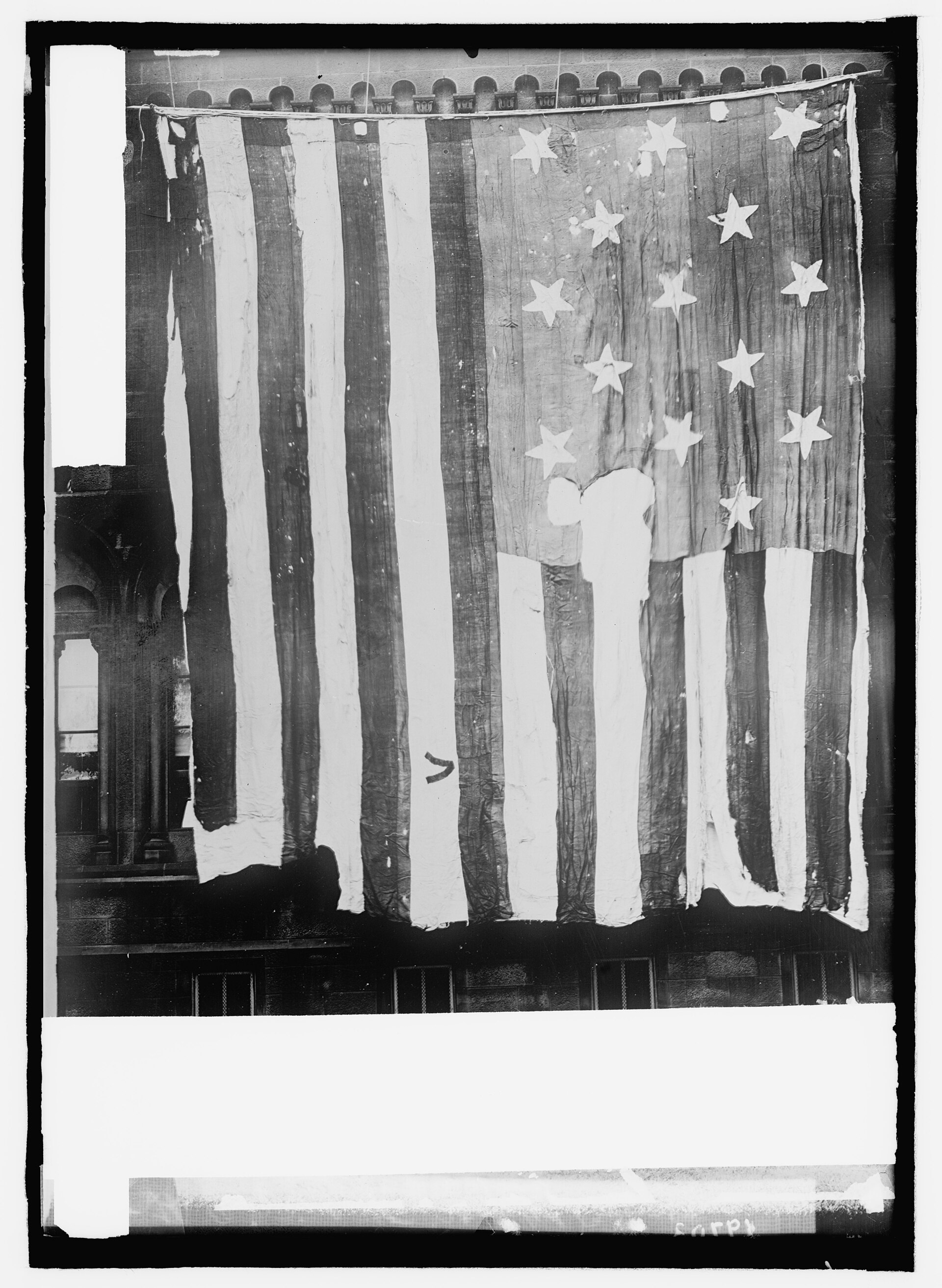
The flag carries no signature or mark from Pickersgill, so her attribution rests on the paper above. Thomassen-Krauss describes physical evidence of other hands and other dates. The first row of stars sits in a doubled area at the hoist and is stitched with different threads, by what looks to her like a different hand from the construction seams. She reads that area as an alteration made after manufacture while the flag was in use. A chevron on a white stripe is a twill weave with a red dye that differs from the flag's own and is water soluble. She dates it to the Armistead years and says it has been shown to be the start of an A for Armistead. She gives no date for an embroidered B or an inked mark that may be an M. A mark in the chevron's place shows in the 1873-74 photograph at the head of this article.
A conservator's 2003 note, quoted in her paper, calls the seam stitching high quality but not always consistent, with places where stitches look more like whip-stitches than running stitches. It sits in a footnote about seams Preble repaired in 1873, so the inconsistencies can't be assigned to 1813. Her footnote that one needle worker may have ended where another began concerns the 1914 restoration, not 1813.
| Quantity | Figure | Source |
|---|---|---|
| Weeks to make | 6 / 6 to 8 / about 7 / about 10 | Battlefield Trust / Park Service / Smithsonian / Thomassen-Krauss |
| Size today | 30 by 34 ft | Smithsonian object record |
| Size today | 29.5 by 34 ft | Thomassen-Krauss |
| Area lost against 30 by 42 ft | 240 sq ft, 19 percent | Our arithmetic from 30 by 34 ft |
| Area lost | More than 20 percent | Thomassen-Krauss |
| Stars on the field today | 14 of 15; one lost | Thomassen-Krauss |
| Date of the first photograph | 1873 / 1874 | Smithsonian / Preble's 1880 caption |
The sources agree on 15 stripes and 15 stars as made, and on the 30 by 42 foot garrison flag. Thomassen-Krauss is the only source we found that counts the stars on the flag today.
The Armistead family cut the flag up, and conservators say cutting doesn't explain all the loss
The Armistead family gave away pieces of the flag for generations, and the Smithsonian credit line reads Gift of Eben Appleton while the maker field reads Pickersgill, Mary. The Smithsonian says the flag stayed the private property of Louisa Armistead, her daughter Georgiana Armistead Appleton and her grandson Eben Appleton for 90 years, and that the family gave away dozens of small pieces. Georgiana wrote that if they had given all they were asked for, "little would be left to show." Eben inherited on his mother's death in 1878, and lent it to the Smithsonian in 1907 and gave it in 1912.
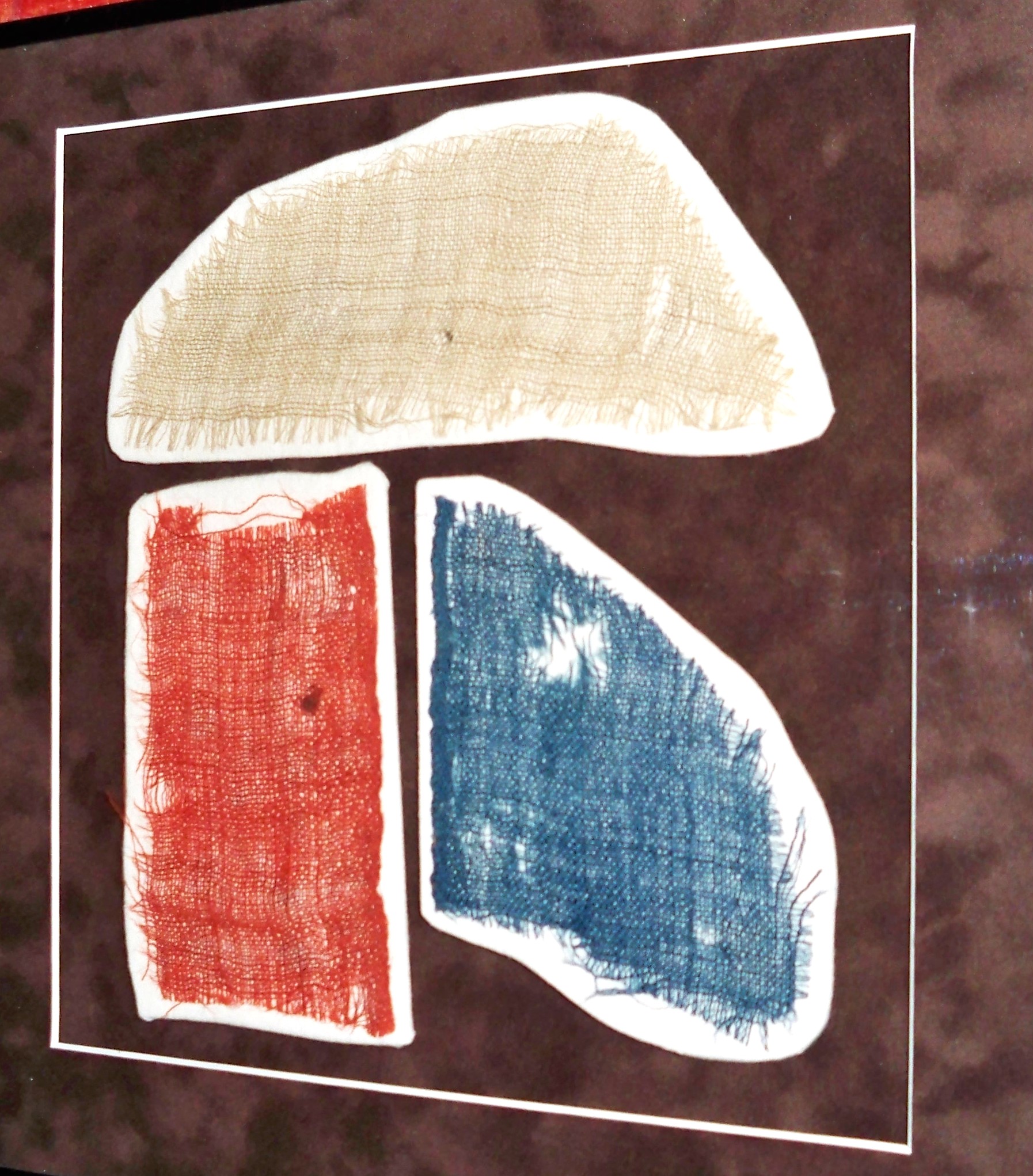
Thomassen-Krauss says mementos were removed from 1818 and into the 1880s. The first went to the widow of a soldier who fought at Baltimore, to be buried with him. A whole star left the flag, and when Admiral George Preble asked, Georgiana couldn't remember who got it. Comparing photographs of 1874 and 1907 shows more pieces gone in between. A star bears her ink inscription of 1861 calling the flag a "precious relic" of her father's fame, beside a hole where cloth was roughly cut out. It was once read as 1876, and Thomassen-Krauss reads it as 1861.
Cutting still doesn't add up. Thomassen-Krauss writes that the practice of removing mementos cannot by itself account for the more than twenty percent of the flag now missing.
A second group of women sewed on the flag in 1914, and the evidence of their hands is better
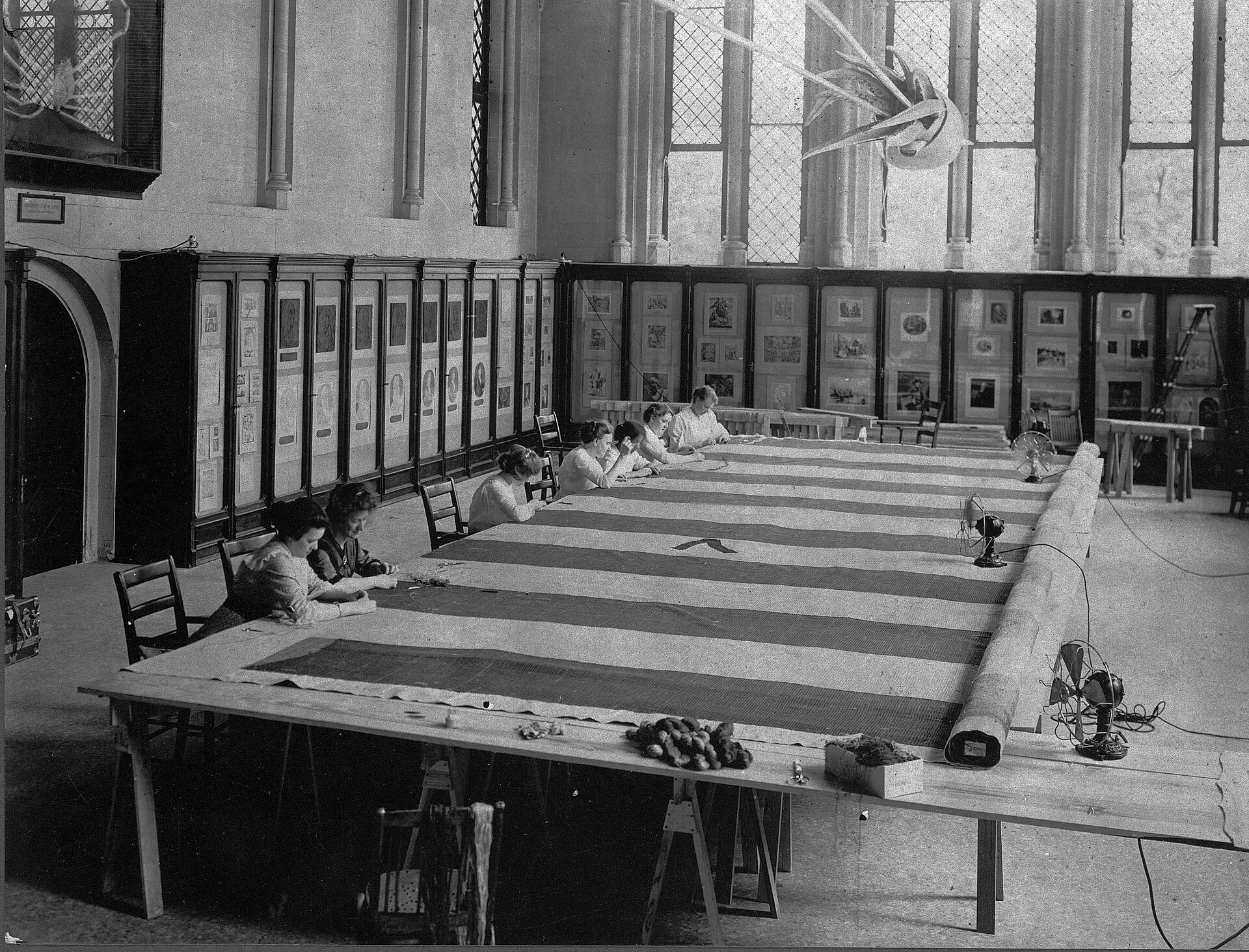
Amelia Fowler and a team of needlewomen sewed the flag to a linen backing at the Smithsonian in 1914, and their work left clearer marks than the 1813 crew's. Thomassen-Krauss records that the stitches show a range of expertise: rows in places expand and contract, and some compress many rows into one, which she says may show where one needle worker ended her section and another began. Fowler's own notes on her treatment were very brief. The American Battlefield Trust puts her stitches at 1.7 million.
The backing stayed until the project that began in 1998, which the Battlefield Trust says undid earlier repairs and cleaned and stabilized the flag before the gallery reopened in 2008. Thomassen-Krauss reports nearly nine years of observation and treatment and 4,000 images, and still lists unanswered questions.
Questions
Mary Pickersgill's Baltimore workshop made it in 1813. The bill to the Army's deputy commissary names her, and the receipt is signed for her by Eliza Young, whom Thomassen-Krauss and the Smithsonian name as her niece. Who else sewed on it rests on later accounts.
She was billed $405.90 for the 30 by 42 foot garrison flag and $168.54 for the 17 by 25 foot storm flag, $574.44 together. The bill is dated 19 August 1813, which the Park Service gives as the delivery date, and payment in full was acknowledged on 27 October 1813.
Her indenture to Pickersgill is documented, and it provided for instruction in plain sewing. No document found names her on the flag. The Smithsonian says she helped, while the Park Service says she would have and a conservator says probably.
No record counts them. The sources name between one and five people besides Mary Pickersgill, and one adds unnamed hired seamstresses. The time taken is given as six to about ten weeks.
From Caroline Pickersgill Purdy's letter of 1876, in which she says her mother spread it in the malt house of Claggett's brewery. It's a recollection from 63 years later, repeated by the Smithsonian.
Sources
- 1Suzanne Thomassen-Krauss, Discoveries Made while Preserving the Star-Spangled Banner, Proceedings of the 24th International Congress of Vexillology, Washington, 2011, pp. 960-987. fiav.org/wp-content/...
- 2Smithsonian National Museum of American History, The Star-Spangled Banner: Making the Flag. amhistory.si.edu/starspangledbanner/...
- 3Letter from Caroline Pickersgill Purdy to Georgiana Armistead Appleton, 1876, transcript published by the Smithsonian (original courtesy American Antiquarian Society). amhistory.si.edu/starspangledbanner/...
- 4Maryland in the War of 1812, A Flag for Fort McHenry, August 1813 (transcription of the bill and receipt). maryland1812.com/2011/...
- 5National Park Service, Fort McHenry National Monument, Mary Pickersgill. nps.gov/fomc/...
- 6National Park Service, Fort McHenry National Monument, Grace Wisher. home.nps.gov/fomc/...
- 7Star-Spangled Banner Flag House and Museum, Discovering Morris Brooks and the Flag House's History of Enslavement, 28 February 2023. flaghouse.org/discovering-morris-brooks-and-the-flag-hous...
- 8Emmanuel Mehr, blog essay, Slavery and Apprenticeship in the Making of the Flag That Inspired the National Anthem, Baltimore Histories Weekly, 1 April 2023. A blog essay by Emmanuel Mehr: secondary, used for the indenture citation and the 1810 census reading only. baltimorehistories.substack.com/p/...
- 9Smithsonian National Museum of American History, The Star-Spangled Banner: Family Keepsake. amhistory.si.edu/starspangledbanner/...
- 10Smithsonian National Museum of American History, The Star-Spangled Banner: National Treasure. amhistory.si.edu/starspangledbanner/...
- 11American Battlefield Trust, The Star-Spangled Garrison Banner. battlefields.org/learn/...
- 12Smithsonian National Museum of American History, object record Star-Spangled Banner, nmah_463144 (measurements, maker field, credit line). americanhistory.si.edu/collections/...
- 13Star-Spangled Banner Flag House and Museum, Happy 243rd Birthday to Mary Young Pickersgill, 1776-1857 (1815 receipt; death date). flaghouse.org/happy-243rd-birthday-to-mary-young-pickersg...
More in The Women Behind the Art
The partWho Stitched the Bayeux Tapestry? What the Documents Say About English Women's Embroidery
No document names who stitched the Bayeux Tapestry. What Domesday, the 1476 inventory and the Queen Matilda story show about English women's...
The Two Women in the Oseberg Ship, and the Queen Nobody Named
Two women lay in the Oseberg ship in 834. What the bones, isotopes and DNA show, and how a queen and a servant were read into a grave that no text...
The Name on the Rim: What Documents Say About Projecta
The Projecta Casket names its bride in one line of Latin. What the British Museum, Dalton 1901, an epitaph and Parliament say about her, and what is...