Star-Spangled Banner
Mary Pickersgill's flag-making workshop, Baltimore · 1813
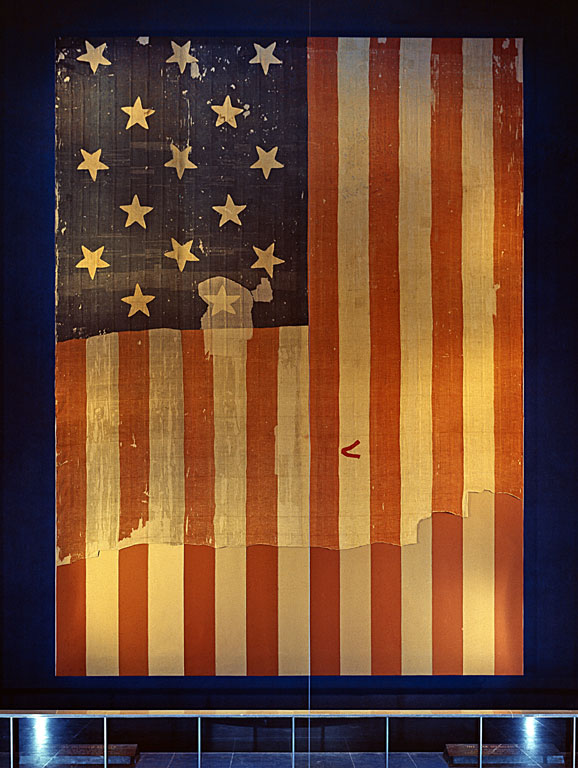
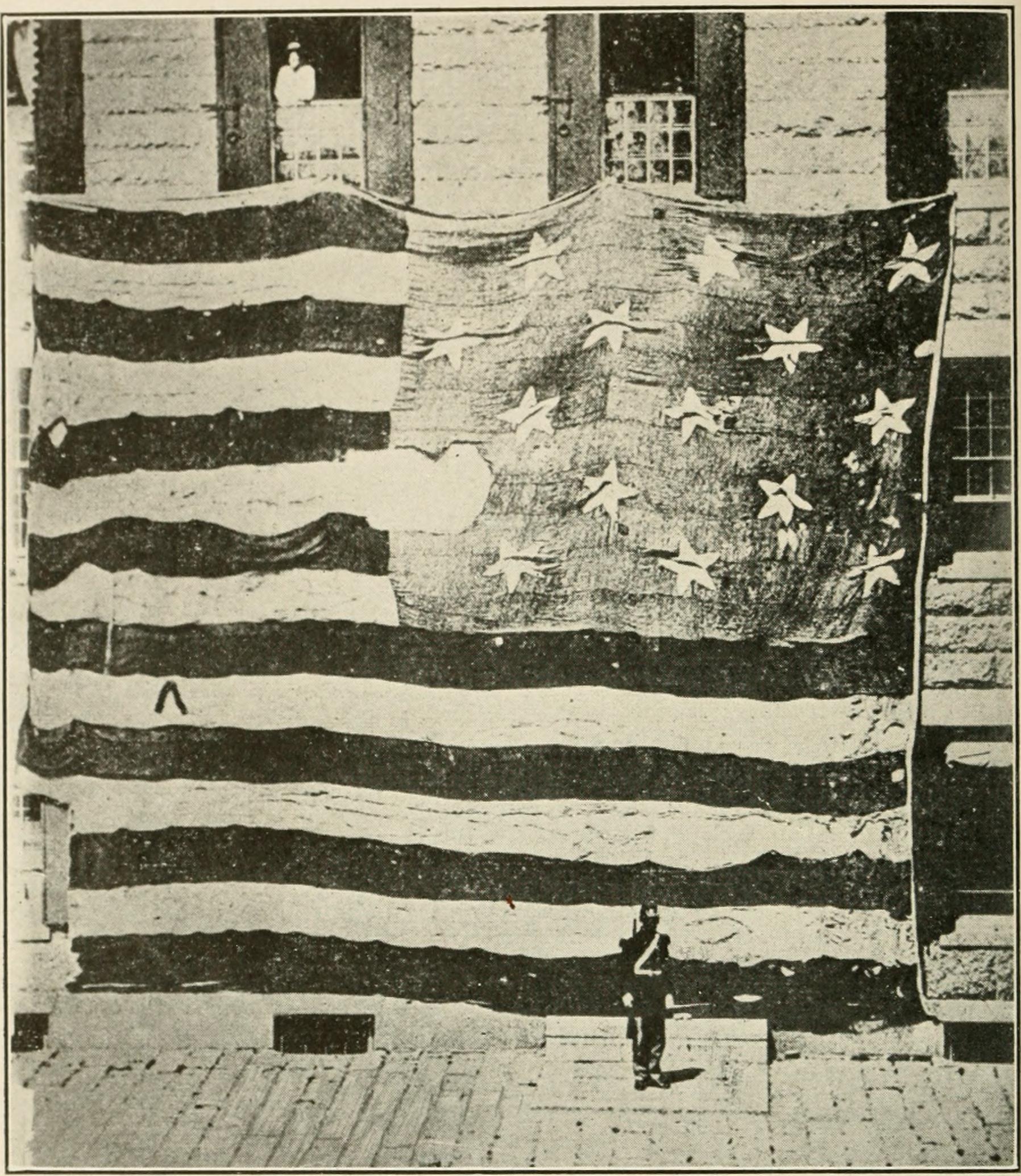
The flag as it hung at the Smithsonian's Museum of History and Technology from 1964, still carrying Amelia Fowler's 1914 linen backing and stitching, before it was taken down to begin the 1998-2008 conservation project.
| Artist | Mary Pickersgill's flag-making workshop, Baltimore |
|---|---|
| Date | 1813 |
| Medium | Wool bunting (stripes and canton) and cotton (stars), hand-sewn with linen thread |
| Dimensions | As currently mounted, approximately 30 x 34 feet (9.14 x 10.36 m). As made in 1813, approximately 30 x 42 feet, reduced by an estimated 240 square feet, nearly 20 percent, through fragments cut away as souvenirs and other losses. |
| Where it is now | National Museum of American History, Smithsonian Institution, Washington, D.C.last confirmed |
| Inventory number | ID Number AF.13649; catalog number 13649; accession number 54876 |
| Attribution | AcceptedCommissioned from, and made in, the Baltimore workshop of Mary Pickersgill in the summer of 1813, per the surviving military procurement receipt and family correspondence. Full note |
| Object type | Textile |
| Period | American, Federal period, War of 1812 |
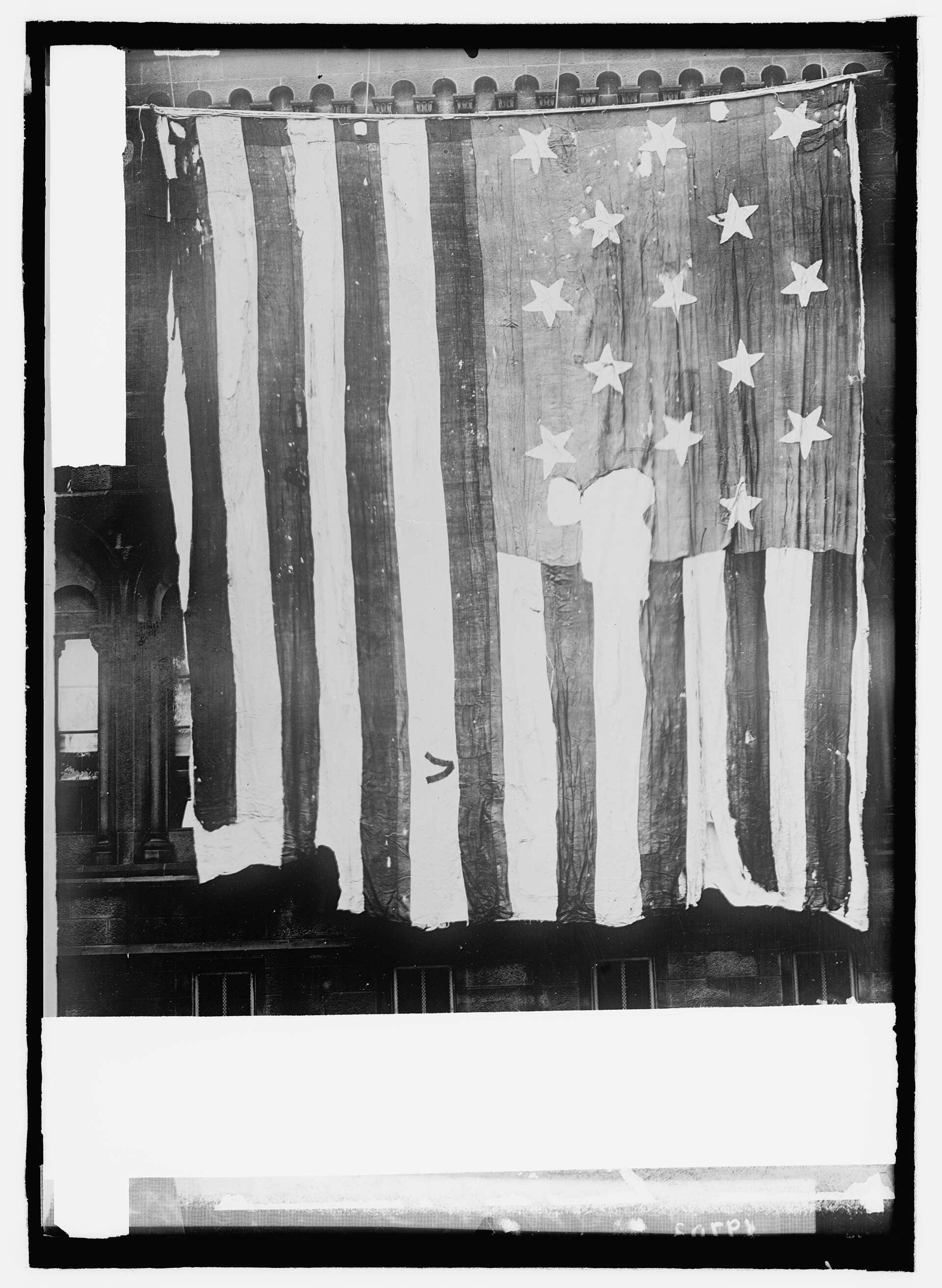
| Inscriptions | Ink inscription on Star #10, in the hand of Georgiana Armistead Appleton, dated 1861: 'this precious relic of my father's fame ... Georgiana Armistead Appleton.' An embroidered letter 'B' and a separate inked mark resembling an 'M' appear elsewhere on the flag; a chevron-shaped mark on one white stripe, in a different weave and dye than the flag itself, has been read as the start of an 'A', possibly for Armistead. None of these marks is fully explained. |
| Owners on record | 8 links8 documented |
| Sources | 10 cited |
About this record Last verified · 10 sources cited · Change log
On this page 11 sections
ContentsClose
A hand-sewn wool and cotton garrison flag made in the summer of 1813 in the Baltimore workshop of Mary Pickersgill, with her daughter, nieces, elderly mother, and an indentured servant named Grace Wisher all documented as having worked on it. In its smaller storm-flag form the same commission is believed to have flown over Fort McHenry during the British bombardment of 13-14 September 1814, and it was the larger garrison flag that Francis Scott Key saw flying the following dawn and described in the poem that became the United States national anthem.
Cut for souvenirs by the Armistead family across most of the nineteenth century, it lost an estimated 240 square feet, nearly 20 percent of its original 30-by-42-foot size, before Eben Appleton lent it to the Smithsonian in 1907 and gave it permanently in 1912. A 1914 restoration by Amelia Fowler, stitching it to a linen backing with roughly 1.7 million stitches, stabilized it for display but placed decades of tension on already-damaged fibers; a 1998-2008 conservation project removed that backing, cleaned the flag, and remounted it nearly flat in a climate-controlled case, where it remains today.
It is not the smaller storm flag that most historians believe actually flew during the worst of the bombardment, and it is not the modern replica that flies daily over Fort McHenry today; both are separate objects from the one described here.
Provenance
Each link is graded. Documented: a cited source supports it. Disputed: the identification is argued but not established. Unknown: no owner for that span, and the gap is not smoothed into a narrative. The grades in the glossary.
- 1813 - 1813U.S. Army, Fort McHenry, under Maj. George Armisteaddocumented
Commissioned from Mary Pickersgill's Baltimore workshop by Gen. John S. Stricker and Commodore Joshua Barney on Armistead's behalf; delivered 19 August 1813 per the surviving receipt.12
- 1813 - 1818Lt. Col. George Armisteaddocumented
Flown at Fort McHenry, including during the Battle of Baltimore, 13-14 September 1814. Armistead kept the flag until his death on 25 April 1818.2
- 1818 - 1861Louisa Hughes Armistead, his widowdocumented
Inherited on her husband's death in 1818; retained the flag, which she also referred to as a 'precious relic,' until her own death in 1861.2
- 1861 - unknownGeorgiana Armistead Appleton, their daughterdocumented
Born at Fort McHenry in November 1817; inherited the flag on her mother's death in 1861 and inscribed one of its stars that year. Lent the flag to historian George Preble in 1873 for photography and a lecture tour, during which fragments are believed to have been given away. Her own date of death was not found in the sources consulted.23
- 1818 - 1907Named and unnamed recipients of cut fragmentsdocumented
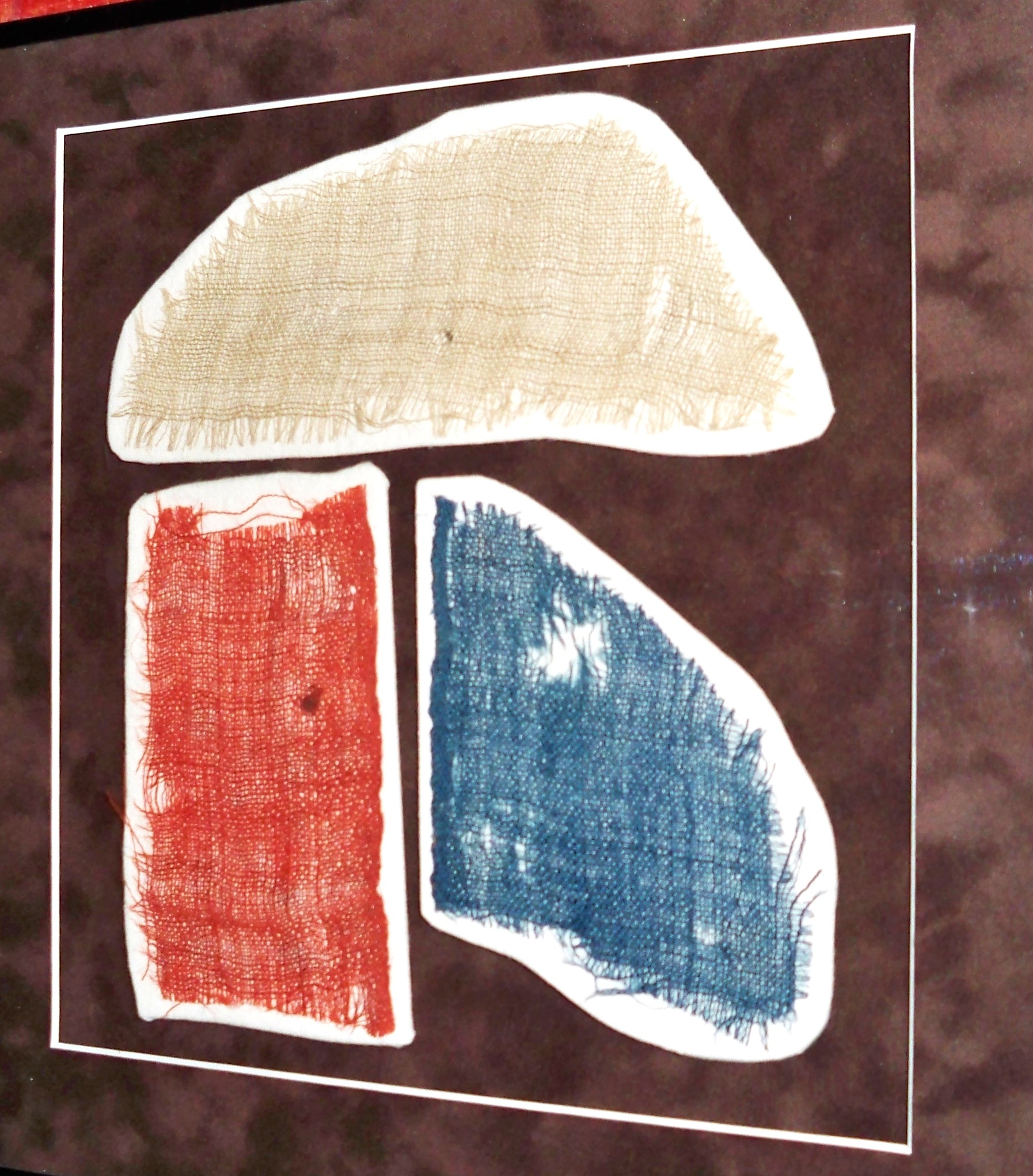
Pieces were cut from the flag as keepsakes from at least 1818 (a fragment given to a soldier's widow, to be buried with her husband) through the 1880s. Documented recipients include Stephen Salisbury II of Worcester, Massachusetts (a blue fragment from Georgiana Appleton in 1874, in addition to red and white pieces he already held), the United States Naval Academy (a fragment traced through family hands back to 1876), and the Francis Scott Key Monument in San Francisco's Golden Gate Park. A whole star was cut out and given to an unnamed official. The Smithsonian's own conservation team has concluded that documented souvenir-cutting alone cannot account for the full extent, roughly 240 square feet, of material now missing from the flag.23
- unknown - 1907Eben Appleton, Georgiana's sondocumented
Inherited the flag from his mother and stored it in a vault at a bank in New York City before agreeing, at the request of Smithsonian Secretary Charles D. Walcott, to lend it to the Institution.2
- 1907 - 1912Smithsonian Institution (on loan from Eben Appleton)documented
Arrived at the Smithsonian in summer 1907, folded in a canvas bag, still tacked to its 1873 canvas backing and described on arrival as badly moth-eaten though sturdier than expected once unfolded.12
- 1912 - presentSmithsonian Institution, National Museum of American Historydocumented
Appleton's loan converted to a permanent gift, formally accessioned 17 December 1912. Credit line: 'Gift of Eben Appleton.' Currently held under ID Number AF.13649, catalog number 13649, accession number 54876.1
Technical evidence
| Attribution note | Commissioned from, and made in, the Baltimore workshop of Mary Pickersgill in the summer of 1813, per the surviving military procurement receipt and family correspondence. Pickersgill was assisted by her daughter Caroline, nieces including Eliza Young, her mother Rebecca Young, and an indentured servant, Grace Wisher. The maker is documented by contemporaneous paperwork, not by any signature or mark on the object itself. |
|---|---|
| Original dimensions | Requisitioned and made as a 30-foot by 42-foot national color.2 |
| Current dimensions | Approximately 30 x 34 feet overall (9.144 x 10.3632 m) as measured in the Smithsonian's own object record.1 |
| Materials | Wool bunting, dyed red and white for the stripes and blue for the canton; cotton for the fifteen stars, attached by a reverse-applique technique (sewn on the reverse, then the ground fabric turned back and stitched down from the front).27 |
| Bunting weight and weave | Single-ply bunting rather than the double-ply typical of the period, with visible dye-lot variation between different bunting widths, consistent with wool supply disrupted by the British blockade of the Chesapeake in 1813.2 |
| Dyes | Red dyed with madder and a tin mordant; blue is an indigo vat dye. Dye-lot variation across panels suggests the bunting was not all dyed in a single batch.2 |
| Construction | Bunting sections, mostly full or partial 13-inch widths with one selvedge, hand-sewn together with 2-ply linen thread in running-stitched seams; hoist end fitted with a linen sleeve and an S-twist, Z-plied hawser rope.2 |
| 1814 damage | A note identified by Fort McHenry historian Scott Sheads records that a shell passed through the flag on 12 September 1814; a repaired tear near the center of the flag may be this damage, though the correspondence cannot be confirmed with certainty from the physical evidence alone.2 |
| 1861 inscription | Ink inscription on Star #10 in the hand of Georgiana Armistead Appleton, dated 1861, describing the flag as her father's relic; previously misread as 1876.2 |
| 1914 backing (removed 1998-2006) | Irish linen backing attached by Amelia Fowler using her patented method, a dense field of small stitches laid in rows (in places forming a honeycomb-like pattern), approximately 1.7 million stitches in total, later found to have placed sustained tension on the wool and to show variable stitch quality across different sections.256 |
| Present support | A sheer Stabiltex (polyester) backing applied during the 1998-2008 conservation project, replacing the full linen mount; the flag is displayed nearly flat rather than hung.5 |
Images
The record in full
Chapter 1What it is
The Star-Spangled Banner is a hand-sewn wool and cotton garrison flag, the flag flying over Fort McHenry, Baltimore, on the morning of 14 September 1814 that inspired Francis Scott Key to write the...
The Star-Spangled Banner is a hand-sewn wool and cotton garrison flag, the flag flying over Fort McHenry, Baltimore, on the morning of 14 September 1814 that inspired Francis Scott Key to write the poem that later became the United States national anthem. It is now mounted nearly flat in a climate- and light-controlled case at the National Museum of American History, Smithsonian Institution, carrying the Smithsonian's own identifiers: ID Number AF.13649, catalog number 13649, and accession number 54876.
As made in 1813 it measured roughly 30 by 42 feet, one of the largest garrison colors of its era. What is on view today measures approximately 30 by 34 feet, a difference of about 240 square feet, nearly 20 percent of the original cloth, lost mostly to the nineteenth-century practice of cutting away pieces as keepsakes. Fifteen stars and fifteen stripes remain, one star having been cut out whole at some point and never returned. The stripes are wool bunting dyed red and white, the canton is wool bunting dyed blue, and the stars are cut from cotton and attached to the canton by a reverse-applique method.
Chapter 2How it was made
The flag was made in the Baltimore workshop of Mary Pickersgill, a professional flag maker who had learned the trade from her mother, Rebecca Young, herself a maker of flags for the Continental Army...
The flag was made in the Baltimore workshop of Mary Pickersgill, a professional flag maker who had learned the trade from her mother, Rebecca Young, herself a maker of flags for the Continental Army during the Revolutionary War. In the summer of 1813, with British attack on Baltimore expected, General John S. Stricker and Commodore Joshua Barney ordered two flags from Pickersgill on behalf of Major George Armistead, the new commander at Fort McHenry: a smaller storm flag for foul weather and the large garrison flag now known as the Star-Spangled Banner. Pickersgill's workshop completed both in about ten weeks.
She was assisted by her daughter Caroline, by nieces including Eliza Young, who signed the receipt when the flags were delivered, and by an indentured servant named Grace Wisher. Rebecca Young, Pickersgill's elderly mother, was living in the household at the time and is believed to have helped as well. The garrison flag was too large to assemble inside the Pickersgill house, so Mary Pickersgill obtained permission to spread it on the floor of the malt-house at the neighboring Claggett's Brewery, where, by her daughter Caroline's later account, she was seen on her knees placing the stars.
The bunting itself carries a wartime story. It is single-ply rather than the double-ply bunting typical of the period, and dye-lot variation is visible across different widths of blue and red cloth, both pointing to a wool supply disrupted by the British blockade of the Chesapeake, which forced Pickersgill to piece the flag together from whatever bunting she could obtain quickly rather than from one uniform batch.
Chapter 3The commission and the defense of Baltimore
Fort McHenry guarded the entrance to Baltimore harbor, and by 1813 the city expected a British attack.
Fort McHenry guarded the entrance to Baltimore harbor, and by 1813 the city expected a British attack. Major Armistead, newly posted to the fort, needed a national flag large enough to be seen at a distance, and the two flags were procured through ordinary military supply channels at a cost of several hundred dollars, a substantial sum: it is likely that the flag cost roughly a quarter of what Pickersgill's own house was worth at the time. The flag went into service soon after delivery and was in use at the fort for no more than about five years, and probably less than two, before Armistead's death in 1818.
Chapter 4The bombardment, the shell tear, and the anthem
Between 13 and 14 September 1814, Fort McHenry withstood a 25-hour bombardment by the British fleet.
Between 13 and 14 September 1814, Fort McHenry withstood a 25-hour bombardment by the British fleet. Contemporary accounts describe some 1,500 to 1,800 shells fired at the fort, of which around 400 landed inside the works; the garrison lost four men killed and twenty-four wounded. Fort McHenry historian Scott Sheads has identified a contemporary note stating that a shell passed through the flag on 12 September, and a repaired tear near the center of the surviving flag may be the same damage, though this cannot be confirmed with certainty from the physical evidence alone.
Through the worst of the storm and bombardment, the fort is understood to have flown its smaller storm flag rather than the large garrison flag; the following morning, as the British withdrew, the garrison flag was raised in its place. It was this larger flag that Francis Scott Key, held offshore under a flag of truce, saw flying over the fort by the dawn's early light and described in the poem that became 'The Star-Spangled Banner.' The smaller storm flag that flew during the night of the bombardment has not survived to be traced; its fate is unknown.
Chapter 5The Armistead family, and what was cut away
Armistead kept the flag until his death on 25 April 1818, after which it passed to his widow, Louisa Hughes Armistead, and then, on her death in 1861, to their daughter, Georgiana Armistead Appleton...
Armistead kept the flag until his death on 25 April 1818, after which it passed to his widow, Louisa Hughes Armistead, and then, on her death in 1861, to their daughter, Georgiana Armistead Appleton, who had been born at Fort McHenry in November 1817. An ink inscription in Georgiana's hand on one of the flag's stars, dated 1861, describes the flag as 'this precious relic of my father's fame,' a phrase her mother is also recorded as having used.
The practice of cutting fragments from the flag as mementoes began as early as 1818, when the first documented piece went to the widow of a soldier who had died at the Battle of Baltimore, to be buried with her husband, and it continued for decades. In 1873 Georgiana Armistead Appleton lent the flag to the naval historian George Preble, who had it tacked to canvas sailcloth to stabilize it for what is believed to be the first photograph ever taken of the flag, at the Boston Navy Yard; Preble is thought to have given away further fragments to friends, historical societies, and family during this period. Documented recipients include Stephen Salisbury II of Worcester, Massachusetts, who received a blue fragment from Georgiana Appleton in 1874 in addition to red and white pieces he already held; the United States Naval Academy, which holds a fragment traced through a chain of family ownership back to 1876; and the Francis Scott Key Monument in San Francisco's Golden Gate Park. A whole star was cut out and given to an unnamed official.
By the 1860s the flag already had numerous holes, and by the time it reached the Smithsonian in 1907 it was described as badly moth-eaten. Comparison of photographs taken in 1874 and 1907 shows further fragments had been removed in the intervening years. Conservators who examined the flag closely during its 1998-2008 treatment concluded that the documented practice of snipping keepsakes, on its own, cannot account for all of the roughly 240 square feet, nearly 20 percent of the flag, that is missing today; some part of the loss remains unexplained.
Chapter 6From a bank vault to the Smithsonian: 1907 and 1912
The flag remained with Armistead's descendants through the Civil War and afterward, eventually passing to Eben Appleton, Georgiana's son, who kept it in a vault at a bank in New York City.
The flag remained with Armistead's descendants through the Civil War and afterward, eventually passing to Eben Appleton, Georgiana's son, who kept it in a vault at a bank in New York City. In 1907, at the request of Smithsonian Secretary Charles D. Walcott, who wrote that he hoped Appleton 'may be induced to place this worthy relic where it can always be seen by the public,' Appleton agreed to lend the flag to the Institution. It arrived folded in a canvas bag inside a box and, still loosely tacked to its 1873 canvas backing, appeared badly moth-eaten on arrival; once unfolded, Smithsonian staff found it in better condition than the edges had suggested, though still very fragile in places.
Appleton's loan became a permanent gift, and the flag was formally accessioned into the Smithsonian's collection on 17 December 1912, carrying the credit line 'Gift of Eben Appleton' that the object still bears today.
Chapter 7The 1914 Fowler restoration
In 1914 the Smithsonian hired Amelia Fowler, a flag restorer who had previously worked on the flag collections at the United States Naval Academy, to stabilize the increasingly fragile flag for...
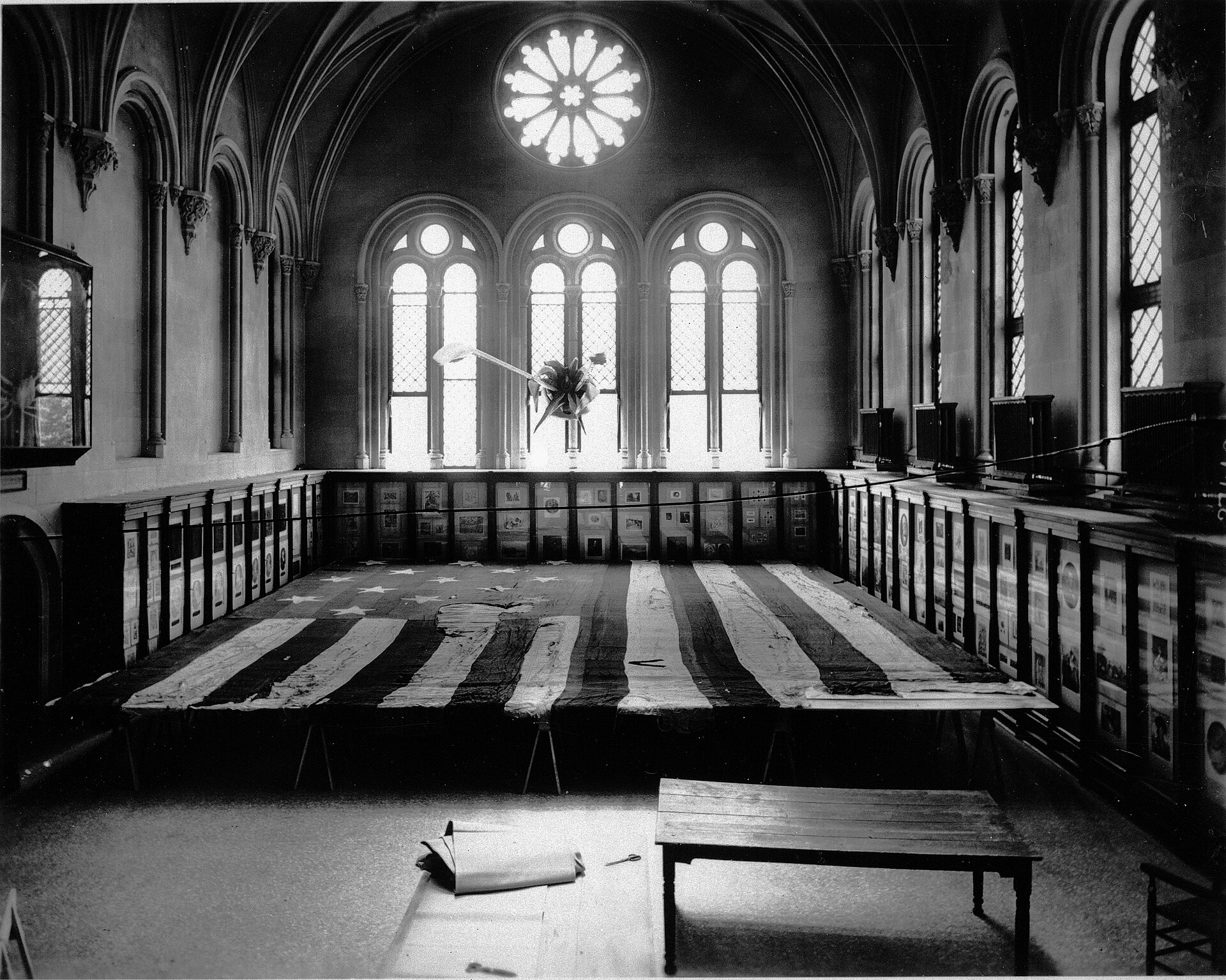
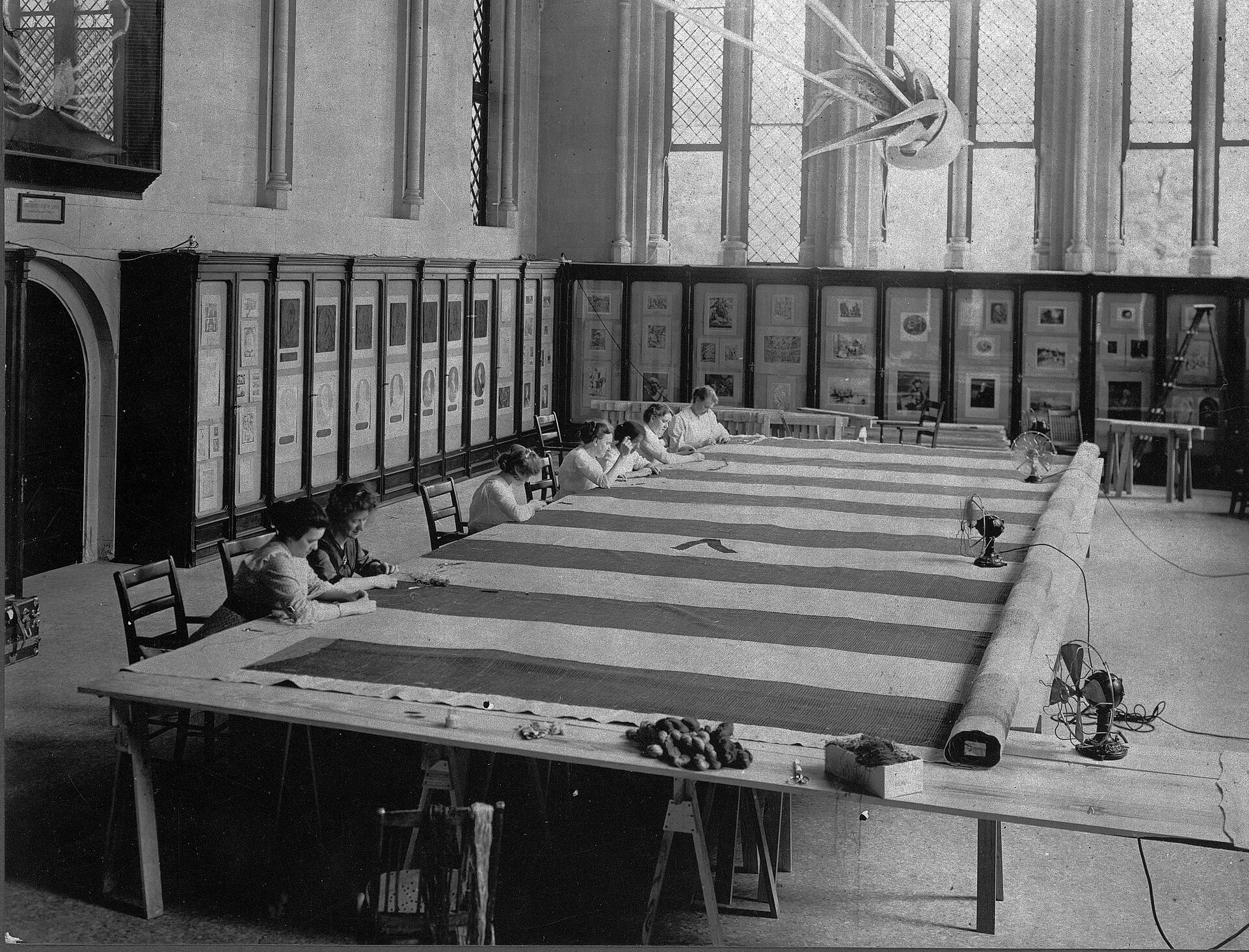
In 1914 the Smithsonian hired Amelia Fowler, a flag restorer who had previously worked on the flag collections at the United States Naval Academy, to stabilize the increasingly fragile flag for long-term display. Fowler and a team of about ten needlewomen spent roughly eight weeks, working in the Castle building through the humid Washington summer, removing the 1873 canvas and attaching a new Irish linen backing using a patented method: a dense field of small stitches, laid out in rows using guide threads, that in places form a honeycomb-like pattern. The finished work involved on the order of 1.7 million individual stitches across the flag. Fowler charged the Smithsonian 1,243 dollars in total, 243 for materials, 500 for herself, and 500 to be divided among her needlewomen, and believed the treatment would let the flag 'defy the test of time.'
Chapter 8What the stitching actually did
Close technical examination of the flag before and during its later removal shows the Fowler treatment as a more mixed intervention than her own confident notes suggest.
Close technical examination of the flag before and during its later removal shows the Fowler treatment as a more mixed intervention than her own confident notes suggest. The rectangular linen backing did not match the flag's own irregular, damaged shape, and attaching it required stretching, bunching, and folding the wool bunting to fit; the tension this placed on already-weakened fibers, sustained over 84 years, contributed to further fiber damage and to a visibly quilted surface where the stitching rows compress the bunting. Examination of the stitching itself shows real variation in skill and consistency: in places the needlework is fine and even, in others the rows expand, contract, or run together, suggesting several hands of differing experience working section by section. Fowler's own notes on the treatment are brief; she does not record how she aligned the flag's warp threads before stitching it down, and she ironed the flag afterward to press the new stitches flat, a step that itself likely reshaped and flattened surface distortions already present in the cloth.
Chapter 9The 1998-2008 conservation project
Modern conservation of the flag began in 1998, when it was included in Save America's Treasures, a national preservation initiative associated with the Smithsonian's Millennium program, and taken...
Modern conservation of the flag began in 1998, when it was included in Save America's Treasures, a national preservation initiative associated with the Smithsonian's Millennium program, and taken down from the wall of the Museum of History and Technology, where it had hung since 1964. In 1999 it was moved into a purpose-built, climate- and light-controlled conservation laboratory constructed within the museum and visible to the public as the work proceeded. Conservators, led by senior textile conservator Suzanne Thomassen-Krauss, spent nearly two years removing Fowler's roughly 1.7 million stitches and the linen backing beneath them, work that had to proceed stitch by stitch to avoid further damage to the wool. The flag was surface-cleaned with an acetone-water solution to remove decades of embedded soil, realigned closer to its true shape, and given a new, far lighter support: a sheer backing of Stabiltex, a polyester textile, rather than another full linen mount.
The finished flag was remounted nearly flat, tilted at a shallow angle rather than hung vertically, inside a sealed, climate-controlled case with sensors, filtered and dimmed lighting, and a waterless fire-suppression system, on a custom-built support table designed so that future conservators can examine and care for it without lifting or moving it again. The conservation work itself was reported at roughly seven million dollars, within a larger gallery renovation whose total cost has been put at closer to eighteen million; the reopened exhibition, 'The Star-Spangled Banner: The Flag That Inspired the National Anthem,' opened to the public in 2008.
Chapter 10What modern examination revealed, and what remains unexplained
The 1998-2008 project produced the most detailed technical record the flag has ever had: thousands of photographs, structural and chemical analysis of the wool and dyes, and a seam-by-seam...
The 1998-2008 project produced the most detailed technical record the flag has ever had: thousands of photographs, structural and chemical analysis of the wool and dyes, and a seam-by-seam reconstruction of how it was assembled. The red wool was dyed with madder and a tin mordant; the blue is an indigo vat dye, with visible variation between different bunting widths suggesting they were not all dyed in the same batch, consistent with a wartime supply chain under strain. The single-ply weight of the bunting, unusual for a flag of this size and period, points the same way.
Some questions remain open even after this examination. An embroidered letter 'B' and a separate inked mark resembling an 'M' appear on the flag, and their meaning is not established; a chevron-shaped mark on one of the white stripes has been read as the start of an 'A,' possibly for Armistead, but the twill weave and dye of the chevron do not match the rest of the flag, meaning it was added rather than cut from the original cloth, at a time and by a hand that are not documented.
Chapter 11Labor made invisible: Grace Wisher and the women of the workshop
Grace Wisher was about ten years old in 1809 when her mother, Jenny Wisher, a free African American woman, indentured her to Mary Pickersgill for a six-year term, an arrangement that would ordinarily...
Grace Wisher was about ten years old in 1809 when her mother, Jenny Wisher, a free African American woman, indentured her to Mary Pickersgill for a six-year term, an arrangement that would ordinarily have ended around 1815. Five years into that indenture, in 1813, Grace worked alongside Pickersgill's daughter Caroline and Pickersgill's nieces sewing the Star-Spangled Banner and its companion storm flag. Research undertaken by the historian Marilyn Zoidis, as part of the Smithsonian's own Star-Spangled Banner Project, confirmed that an African American indentured servant was living and working in the Pickersgill household at the time the flags were made.
For most of the flag's public history, credit went to Pickersgill alone, and later to Pickersgill together with her daughter and nieces; Grace Wisher's contribution went largely unrecorded outside the indenture and census documents that establish her presence. What became of her after her indenture ended is not known. Her role has only been given sustained public attention in recent decades, through National Park Service and Smithsonian research and public materials that now name her alongside Pickersgill as one of the flag's makers.
Chapter 12Not to be confused with
Two other objects are commonly confused with this flag and are worth stating plainly apart from it.
Two other objects are commonly confused with this flag and are worth stating plainly apart from it. The first is the storm flag, the smaller companion flag, about 17 by 25 feet, that Pickersgill made and delivered alongside the garrison flag in 1813. Historians believe it was the storm flag, not the garrison flag, that actually flew over Fort McHenry during the worst of the overnight bombardment, with the large garrison flag raised only the following morning. The storm flag is a distinct object from the flag described in this record, and its current whereabouts are not established in the sources consulted here.
The second is the Great Garrison Flag that flies today over Fort McHenry itself, maintained by the National Park Service. It is a modern reproduction, not the object described in this record, which has not left the Smithsonian's climate-controlled case since the 1998-2008 conservation project. Fort McHenry is one of a small number of sites authorized by Congress to fly its flag around the clock, and the replica flying there today is changed and replaced on an ordinary maintenance schedule, unrelated to the physical history of the original.
The artist
Mary Young Pickersgill
Mary Pickersgill ran a commercial flag-making business in Baltimore, one of a small number of women documented as professional flag makers in the early United States. She learned the trade from her mother, Rebecca Young, who had made flags for the Continental Army, and her own workshop combined family labor, hired assistance, and at least one indentured worker, a household structure typical of small artisanal shops of the period rather than a single hand working alone.
Exhibited
- 2008-presentThe Star-Spangled Banner: The Flag That Inspired the National AnthemNational Museum of American History, Smithsonian Institution, Washington, D.C.
Literature
- Lonn Taylor, The Star-Spangled Banner: The Flag that Inspired the National Anthem, Harry N. Abrams, 1998.
- Suzanne Thomassen-Krauss, Discoveries Made while Preserving the Star-Spangled Banner, Proceedings of the 24th International Congress of Vexillology, Washington, D.C., 1-5 August 2011, pp. 960-987.
Related works
| Work | Relation | Where it is |
|---|---|---|
| The storm flag Mary Pickersgill's workshop | Smaller companion flag from the same 1813 commission, about 17 by 25 feet, believed to be the flag actually flown over Fort McHenry during the worst of the overnight bombardment A genuinely different, smaller object from the flag described in this record. Not to be confused with it. | Whereabouts not established in the sources consulted |
| The Great Garrison Flag (modern replica) Unknown modern manufacturer | Full-scale reproduction flown daily over Fort McHenry today under National Park Service authority A later-made object with no physical connection to the flag in this record, which has remained inside the Smithsonian's climate-controlled case since 2008. | Fort McHenry National Monument and Historic Shrine, Baltimore |
| Fragment, U.S. Naval Academy Museum Cut from Mary Pickersgill's 1813 flag | Documented souvenir fragment of this flag Traced through a chain of family ownership back to 1876. | United States Naval Academy Museum, Annapolis, Maryland |
| Fragment, Francis Scott Key Monument Cut from Mary Pickersgill's 1813 flag | Documented souvenir fragment of this flag One of the named public-institution holders of a cut fragment. | Golden Gate Park, San Francisco |
Open questions
- Exactly how much of the missing roughly 240 square feet of flag is accounted for by documented souvenir-cutting, and how much by other, unexplained loss: the Smithsonian's own conservation team states the documented cutting alone cannot explain the full amount.
- The complete list of everyone who received a cut fragment of the flag, and where every fragment is today, has not been established; only a subset of named recipients could be confirmed in the sources consulted for this record.
- The exact date of Georgiana Armistead Appleton's death, and so the precise length of her ownership of the flag, was not found in the sources consulted.
- Whether the repaired tear near the center of the flag is in fact the shell damage recorded on 12 September 1814 cannot be confirmed from the physical evidence alone.
- The meaning of the embroidered 'B', the inked mark resembling an 'M', and the mysterious chevron-shaped mark reading as the start of an 'A' on the flag remain unexplained.
- What became of Grace Wisher after her indenture to Pickersgill ended, around 1815, is not documented in any source found for this record.
- The current whereabouts of the storm flag, the smaller companion flag likely flown during the worst of the actual bombardment, could not be established in the sources consulted.
Questions about this object
What is Star-Spangled Banner?
Star-Spangled Banner is a textile, dated 1813. Medium: Wool bunting (stripes and canton) and cotton (stars), hand-sewn with linen thread.
Who made Star-Spangled Banner, and is the attribution settled?
The attribution to Mary Pickersgill's flag-making workshop, Baltimore is recorded here as accepted. Commissioned from, and made in, the Baltimore workshop of Mary Pickersgill in the summer of 1813, per the surviving military procurement receipt and family correspondence. Pickersgill was assisted by her daughter Caroline, nieces including Eliza Young, her mother Rebecca Young, and an indentured servant, Grace Wisher. The maker is documented by contemporaneous paperwork, not by any signature or mark on the object itself.
Where is Star-Spangled Banner now?
National Museum of American History, Smithsonian Institution, Washington, D.C. Inventory number ID Number AF.13649; catalog number 13649; accession number 54876. Last confirmed 27 August 2026. Gift of Eben Appleton, grandson of Lt. Col. George Armistead. Loaned to the Smithsonian in 1907; accessioned as a permanent gift on 17 December 1912.
What is still unknown about Star-Spangled Banner?
Exactly how much of the missing roughly 240 square feet of flag is accounted for by documented souvenir-cutting, and how much by other, unexplained loss: the Smithsonian's own conservation team states the documented cutting alone cannot explain the full amount.
Sources
- 1Smithsonian Institution / National Museum of American History, object record for 'Star-Spangled Banner,' record ID nmah_463144, retrieved via the Smithsonian Open Access API (confirms ID Number AF.13649, catalog number 13649, accession number 54876, credit line 'Gift of Eben Appleton,' current physical measurements, and CC0 metadata-usage status). americanhistory.si.edu/collections/...
- 2Suzanne Thomassen-Krauss, 'Discoveries Made while Preserving the Star-Spangled Banner,' Proceedings of the 24th International Congress of Vexillology, Washington, D.C., 1-5 August 2011, pp. 960-987. fiav.org/wp-content/...
- 3Smithsonian Magazine, 'When Collectors Cut Off Pieces of the Star-Spangled Banner As Keepsakes.' smithsonianmag.com/history/...
- 4National Park Service, Fort McHenry National Monument and Historic Shrine, 'Grace Wisher.' home.nps.gov/fomc/...
- 5Smithsonian Magazine, 'Star-Spangled Banner Back on Display.' smithsonianmag.com/history/...
- 6Wikipedia, 'Amelia Fowler.' source; with a primary Smithsonian conservation-department account of the 1914 treatment. en.wikipedia.org/wiki/...
- 7Smithsonian Institution, 'Facts about the Star-Spangled Banner.' Content retrieved via search-tool page extraction; direct fetch of this page was blocked by the site () throughout this research session. si.edu/spotlight/...
- 8National Park Service, Fort McHenry National Monument and Historic Shrine, 'The Great Garrison Flag.' nps.gov/fomc/...
- 9American Battlefield Trust, 'The Star-Spangled Garrison Banner' (storm flag dimensions and function). battlefields.org/learn/...
- 10Wikimedia Commons, file description page for File:Star Spangled Banner Flag on display at the Smithsonian's National Museum of History and Technology, around 1964.jpg (description, credit line, and license metadata). commons.wikimedia.org/wiki/...

Last verified · Published
Change log
27 August 2026 - Record created at the house standard: researched narrative, technical evidence, maker dossier, graded provenance chain, prices with hammer and premium separated, related works, open questions and sources.