La Goulue Was in a Dictionary Four Years Before the Poster
An 1887 dictionary named La Goulue four years before Lautrec's poster. Museum records and 1929 papers show what the sheet prints, what she commissioned and how she was buried.
Records in this piece: Moulin Rouge: La Goulue
On this page 7 sections
ContentsClose
In short
- A dictionary of pseudonyms dated May 1887 already lists La Goulue as a dancer of the Alcazar, four years before the 1891 poster and two before the Moulin Rouge opened. The poster printed a name Paris already knew.
- On the Met's impression the lettering names the club four times and La Goulue once. Her partner, the club's director and her legal name do not appear on the sheet.
- The only Lautrec commission I found documented with her as client is the 1895 pair of booth panels. The Orsay records them as cut up in 1926 and bought in 1929, and Le Quotidien called them vanished on 31 January 1929.
- The 1929 papers give her last trades as hawking vegetables and sweets. The passages I read do not mention peanuts. Ten or twelve people followed the hearse, according to La Presse.
- No document I found gives her fee for the poster, and the print run of about 3,000 has no primary source.
A printed dictionary listed La Goulue in 1887, four years before the poster
Georges d'Heylli's Dictionnaire des pseudonymes, whose dedication is dated May 1887, has an entry for La Goulue. In my translation it reads: an eccentric dancer of the Alcazar and other places where the cancan and the splits are still in force. Born 1867. The scan reads Louise Wehert, which I take to be Weber. The nickname, the dancing and the venue are clear.
That puts her in a reference book four years before Toulouse-Lautrec drew her. The Moulin Rouge itself did not open until 1889, so the entry names a stage where she worked before the club that later carried her name. The newspapers of 1929 tell it the other way round. Le Quotidien says she went from unknown to one of the queens of Montmartre once the Moulin Rouge noticed her. The dictionary says Paris had a line on her already.
Will Visconti, who used her diary and police records for his 2022 biography, says in the University of Sydney's notice that she was engaged at the Moulin Rouge because she was already famous. I have not read the book, so I rest the point on the 1887 entry. The 1891 poster printed a name that Paris already had in its reference books.
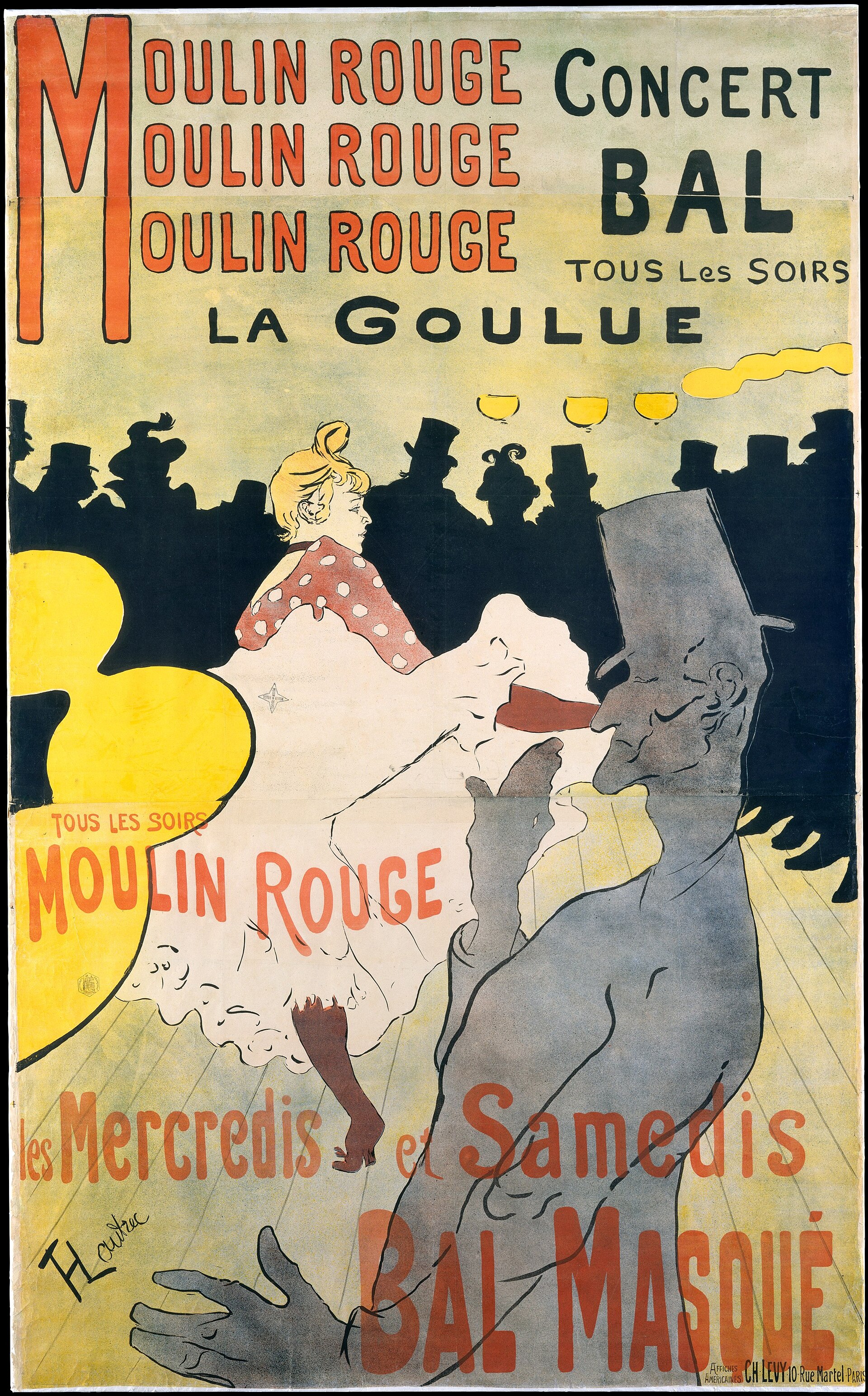
The sheet prints the club's name four times, hers once and her partner's never
On the Metropolitan Museum's impression, the words Moulin Rouge are printed four times and La Goulue once. The name of her partner Valentin le Desosse is not printed at all. Three stacked lines of Moulin Rouge run across the top left and a fourth sits on the lower left over the skirt. The single La Goulue runs under the top block in black capitals.
The rest of the lettering sells evenings. Near the top it reads Concert, Bal, tous les soirs and at the foot les Mercredis et Samedis, Bal Masque. A printer's stamp in the lower right corner reads Affiches Americaines, Ch. Levy, 10 rue Martel, Paris. The Victoria and Albert Museum records the artist's signature at the lower left. The Musee Toulouse-Lautrec in Albi, which holds a copy, says Charles Zidler, director of the Moulin Rouge, commissioned the poster from Lautrec in 1891 for the launch of the season. The Art Institute of Chicago describes it as made to advertise the performance of La Goulue and Valentin.
| Printed name or text | Times | What it is |
|---|---|---|
| Moulin Rouge | 4 | The club that commissioned the poster |
| La Goulue | 1 | The dancer's stage name |
| Valentin le Desosse | 0 | The grey silhouette in the foreground |
| Charles Zidler | 0 | The director who commissioned it |
| Louise Weber | 0 | Her name in law |
| Ch. Levy, Affiches Americaines | 1 | The printer's stamp |
The only name she gets is the one she worked under. No document I found says she had a say in the design or was paid for it. Neither the Met's data record nor the Art Institute's description says so, and I leave the question open rather than guess.
The one commission between them that survives in the record was hers, in 1895
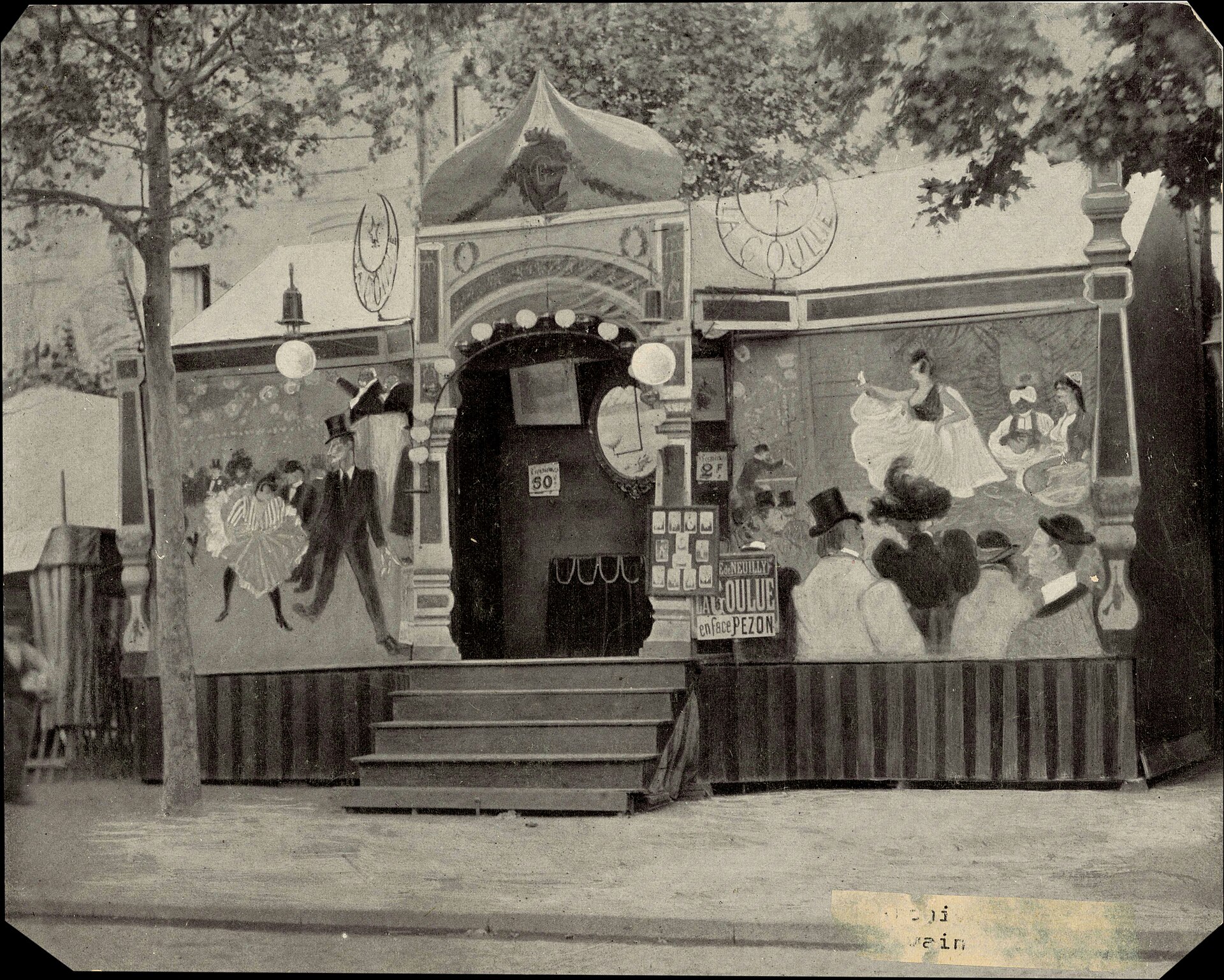
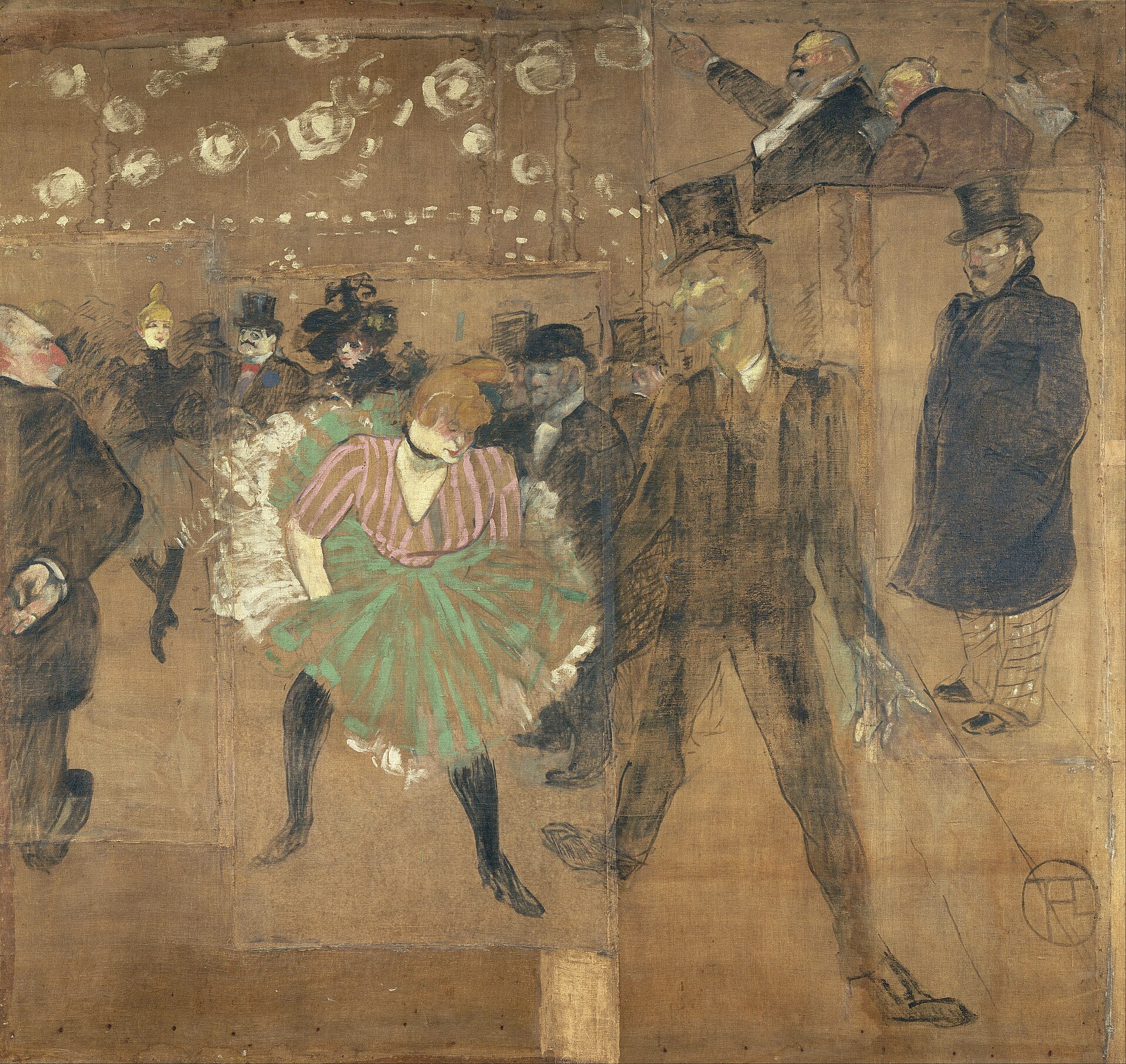
In 1895 Louise Weber was the client and Lautrec was the painter: the Musee d'Orsay and the Bibliotheque nationale de France both say she commissioned the booth panels. The Orsay says Lautrec accepted a commission for two monumental decorative panels for a well-known cabaret dancer who wanted to perform in a booth at the Foire du Trone. It adds that he painted them out of loyalty to a fading star of the Moulin Rouge. The Bibliotheque nationale says she ordered large canvases from him to decorate the front of her fairground booth.
Neither institution gives a price. The Orsay's provenance list for the panels begins with a line reading collection Weber, Louise, with no dates. That is the one Lautrec work in this story documented as hers. The Orsay lists 298 by 316 cm and 285 by 307.5 cm for the two panels. One shows her dancing with Valentin le Desosse before a crowd that includes Jane Avril in a feathered hat. The other recalls the belly dance she performed inside the booth.
A photograph taken about 1895 shows both panels in place on either side of the steps. A placard by the steps mentions Neuilly and reads La Goulue, en face Pezon. The Bibliotheque nationale catalogues the print as taken at the Foire de Neuilly, while the Orsay says Foire du Trone. Le Gaulois wrote in 1929 that crowds went to both fairs to see her in the lions' cage. The two round signs above the booth carry her stage name again. The Bibliotheque nationale adds that she took the canvases down after a few seasons and ordered new ones from Frantisek Kupka in 1899.
Her panels were cut up in 1926, and a newspaper called them lost in the week she died
The Galerie Hodebert cut the two panels into pieces in 1926 and the state bought them in 1929, the year she died. The Orsay's record gives the purchase as made from Hugues Simon, for eight panels and some scraps of canvas, with the fragment showing Valentin given by a M. Auffray the same year. A note on the date says they were put back together in 1930. Le Quotidien of 31 January 1929, reporting her death, said Lautrec had painted her magnificent panels, now vanished.
The Orsay's own account of how the panels got there has a loose end. The museum's commentary says the collector Viau bought them in 1900 and so saved them from the weather. Its provenance list shows the Viau sale at the Hotel Drouot on 21 March 1907, lots 81 and 82, and gives no date for Viau's purchase. Both can be true, but the page does not tie them together.
| Date | Event | Source |
|---|---|---|
| 1895 | Painted for her booth | Orsay; Bibliotheque nationale |
| 1899 | She orders new canvases from Kupka | Bibliotheque nationale |
| 1900 | Collector Viau buys them | Orsay commentary |
| 21 March 1907 | Viau sale, Hotel Drouot, lots 81 and 82 | Orsay provenance |
| 1926 | Galerie Hodebert cuts them up | Orsay date note |
| 31 January 1929 | A daily calls them vanished | Le Quotidien |
| 1929 | Bought from Hugues Simon, eight panels and scraps | Orsay provenance |
No source I read says what Weber was paid for the panels or what she received when they left her hands. The Orsay's dates for her ownership are blank.
Around 1925 a booth with her name on it still used a Lautrec poster to bring people in
Pierre Lazareff wrote in Paris-midi on 31 January 1929 that he first saw La Goulue about four years earlier in a booth at the Montmartre fair, where a large Toulouse-Lautrec poster of her hung at the door to draw customers. The banner above it announced the famous Goulue of the Bal du Moulin Rouge. He calls the paper yellowed and the woman on it young and mocking.
What he saw inside disappointed him and he wrote the next day asking that the show be stopped. The booth's keeper answered with a letter of threats, and La Goulue added a line in pencil. In my translation it says that thirty years ago his editor would not have had enough money to afford her. It is the only sentence of hers I found, and it comes second hand.
He then met her on the Porte de Saint-Ouen. Neighbours used her real name, Weber, he says, with respect. She had gone back to rag-picking, then one day went up to Montmartre with a basket of mint pastilles and oranges. People bought them, he says, and she never really sold them, because the buying ended in rounds of drinks at the bars. By his account a Lautrec poster was still working for her in the mid-1920s, as the sign of a booth whose banner carried the same stage name.
The papers of 1929 give her last trade as hawking, and none I read says peanuts
Three Paris dailies of 31 January to 3 February 1929 give her last trades as hawking vegetables and sweets, and none of the passages I read mentions peanuts. Le Gaulois gives her own figure, that the splits earned her more than a hundred thousand francs, and says that in the end she got the police prefecture's leave to hawk vegetables and lived at Saint-Ouen. Le Petit Journal of 3 February calls her a marchande des quatre-saisons, a street seller of fruit and vegetables. Paris-midi has the sweets and oranges. The peanuts, cigarettes and matches sold near the Moulin Rouge come from encyclopedia accounts, and French Wikipedia gives no citation for them.
The same papers agree on the rest. Le Petit Journal on 31 January says she has just died at the Lariboisiere hospital, aged 62, and that her real name was Louise Weber. Le Gaulois says she died there under that name. The hearse left the hospital at nine on the morning of 2 February with a delegation of fairground people behind it, according to Le Petit Journal, and went to the cemetery at Pantin. La Presse counted ten or twelve mourners and a wreath reading To our dear aunt.
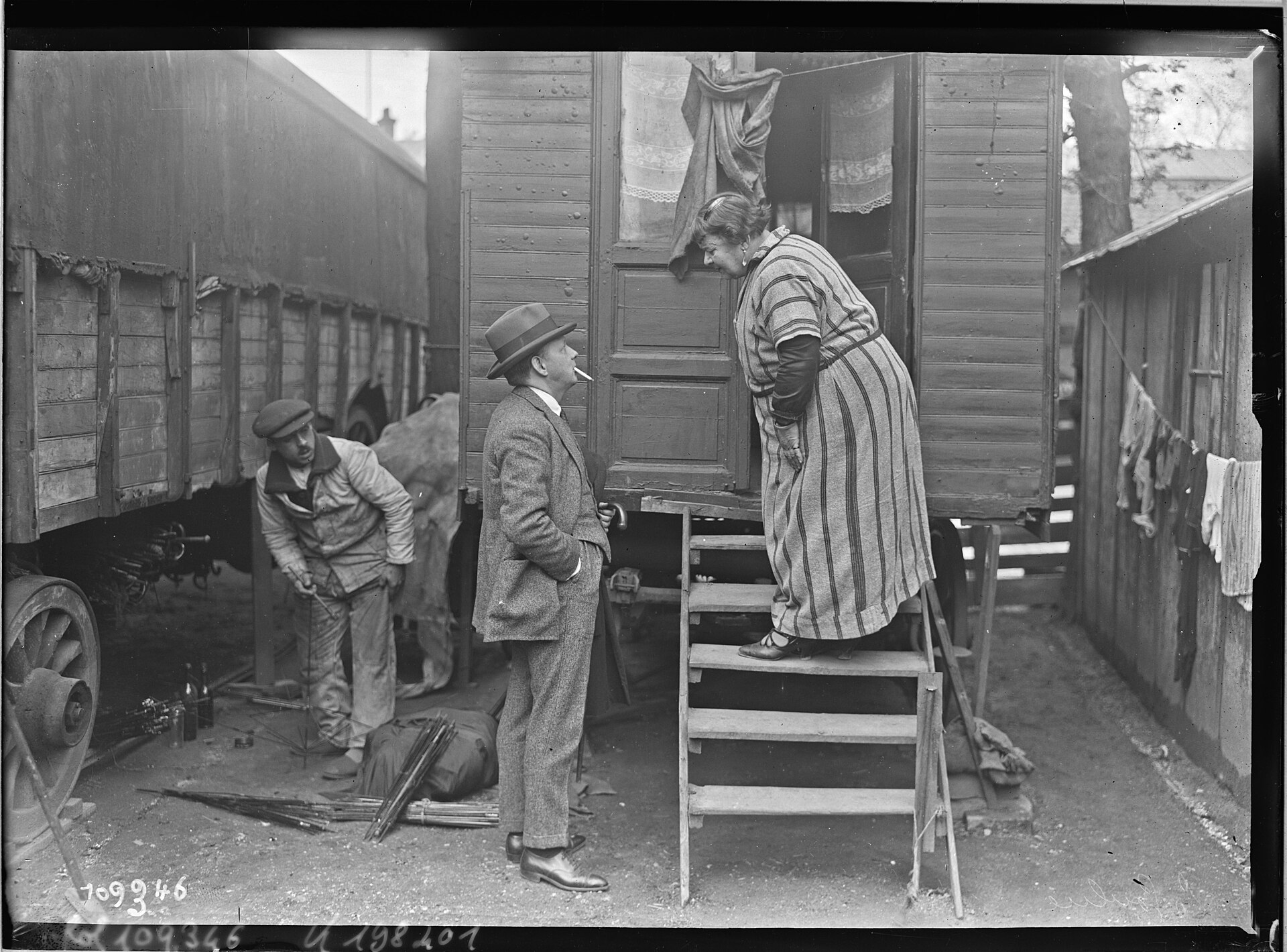
Agence Rol's press photograph of 13 May 1926, taken at Saint-Ouen, is catalogued by the Bibliotheque nationale with the subject La Goulue. I cannot check the identification, but it shows the kind of caravan life the papers place her in.
Her fee, her birth year, her nickname and the print run still rest on one source or none
Five things about her and the poster still rest on one source or on none. The table sets out what the documents give and how far each can be trusted.
| Question | What the documents say | Status |
|---|---|---|
| Her fee for the 1891 poster | Albi says Zidler commissioned it; nothing found on payment to her | Unknown |
| Print run | About 3,000 is repeated; English Wikipedia carries it from an Indianapolis handbook and our record found no ledger | No primary source |
| Birth year | 1867 in d'Heylli, 1887; age 62 at death in the Petit Journal fits 12 July 1866, the date at Clichy that French Wikipedia gives and that I could not check in the registry; the Bibliotheque nationale notice reads Louise (Josephine) Weber (1866-1929) | 1866 likelier |
| Nickname | Bibliotheque nationale: after her first protector Goulu-Chilipane; other accounts: she drained patrons' glasses | Two stories, no document |
| Father's trade | Le Quotidien: a rag-picker of Saint-Ouen; French Wikipedia: a carpenter, Dagobert Weber | In conflict |
The Archives de Paris death record cited by French Wikipedia was offline for maintenance when I tried it, and French Wikipedia is itself split, with 30 January in its infobox and 29 January in its text. The papers of 31 January say only that she had just died.
Questions
The Musee Toulouse-Lautrec in Albi says Charles Zidler, director of the Moulin Rouge, commissioned it from Lautrec in 1891 for the launch of the season. No document found shows La Goulue had a say in it or was paid for it.
Yes, in 1895. The Musee d'Orsay and the Bibliotheque nationale de France say she commissioned two large panels for her fairground booth. The Orsay holds them as RF 2826, bought in 1929 after they had been cut into pieces in 1926.
No. It was her stage name. The Paris dailies of 31 January 1929 gave her real name as Louise Weber, and a dictionary of pseudonyms of 1887 already listed La Goulue as a dancer's name.
Le Petit Journal of 31 January 1929 says she had just died at the Lariboisiere hospital in Paris, aged 62. Her hearse went to the Pantin cemetery on 2 February, and La Presse counted ten or twelve mourners.
About 3,000 is the figure repeated in print, but no printer's ledger or order has been found. Treat it as an estimate with no primary source.
Sources
- 1The Metropolitan Museum of Art, object record and public Collection API, Moulin Rouge: La Goulue (32.88.12). metmuseum.org/art/...
- 2Musee d'Orsay, Panneaux pour la baraque de la Goulue, a la Foire du Trone a Paris (RF 2826): commentary, date note and provenance. musee-orsay.fr/en/...
- 3Georges d'Heylli, Dictionnaire des pseudonymes, Paris, Dentu, dedication dated May 1887 (Internet Archive scan, entry La Goulue). archive.org/details/...
- 4Le Petit Journal, Paris, 31 January 1929, p. 1, and 3 February 1929, p. 3 (Gallica, Bibliotheque nationale de France). gallica.bnf.fr/ark:/...
- 5Le Gaulois, Paris, 31 January 1929, p. 1, Louis Schneider, La Goulue (Gallica). gallica.bnf.fr/ark:/...
- 6Paris-midi, 31 January 1929, p. 2, Pierre Lazareff, La triste fin de La Goulue (Gallica). gallica.bnf.fr/ark:/...
- 7Le Quotidien, Paris, 31 January 1929, p. 3, La Goulue est morte (Gallica). gallica.bnf.fr/ark:/...
- 8La Presse, Paris, 4 February 1929, p. 2, report on the funeral (Gallica). gallica.bnf.fr/ark:/...
- 9Bibliotheque nationale de France, Encyclopedie des arts du cirque, Facade de la baraque de La Goulue, danseuse puis dompteuse (4-COL-180 (152)). expositions.bnf.fr/cnac/...
- 10Musee Toulouse-Lautrec, Albi, Moulin Rouge. La Goulue (poster, 1891), collection page. musee-toulouse-lautrec.com/en/...
- 11Victoria and Albert Museum, Moulin Rouge - La Goulue (E.704-2000), object record via the V&A API. collections.vam.ac.uk/item/...
- 12Art Institute of Chicago, Moulin Rouge, La Goulue (1954.1193), object description. artic.edu/artworks/...
- 13University of Sydney, Beyond the Moulin Rouge: the true story of a cancan star, 31 May 2022 (on Will Visconti, Beyond the Moulin Rouge, University of Virginia Press, 2022). sydney.edu.au/arts/...
- 14French Wikipedia, La Goulue (; used only for the birth date, the father's trade and the unsourced peanuts claim, each labelled as such). fr.wikipedia.org/wiki/...
- 15English Wikipedia, Moulin Rouge: La Goulue (; the 3,000-copy figure and the 1889 opening). en.wikipedia.org/wiki/...
More in The Women Behind the Art
The partWho Stitched the Bayeux Tapestry? What the Documents Say About English Women's Embroidery
No document names who stitched the Bayeux Tapestry. What Domesday, the 1476 inventory and the Queen Matilda story show about English women's...
The Two Women in the Oseberg Ship, and the Queen Nobody Named
Two women lay in the Oseberg ship in 834. What the bones, isotopes and DNA show, and how a queen and a servant were read into a grave that no text...
The Name on the Rim: What Documents Say About Projecta
The Projecta Casket names its bride in one line of Latin. What the British Museum, Dalton 1901, an epitaph and Parliament say about her, and what is...