Hammer, Premium, and Why the Reported Price Is Usually Wrong
One Maine hammer of USD 1,175,000 produced three published prices, two of them from the auction house itself. The arithmetic is public and almost nobody does it.
Records in this piece: Portrait of a Girl
On this page 6 sections
ContentsClose
In short
- The Camden Rembrandt hammered at USD 1,175,000 and was reported at USD 1.2 million, USD 1.41 million and USD 1.47 million, all correctly.
- Thomaston Place charges 20 per cent to room, absentee and phone bidders and 25 per cent to internet bidders, which produces both of the higher figures exactly.
- The Canaletto's GBP 31.9 million, USD 43.8 million and EUR 37.8 million are one premium-inclusive sum at three exchange rates; the hammer was GBP 27.5 million.
- Sotheby's New York premium runs 28 per cent to USD 2 million, 22 per cent to USD 8 million and 15 per cent above.
Two numbers, one lot
When the hammer falls the bidding has reached a figure. That is the hammer price, and it is the number the seller's side of the arithmetic works from. The buyer then pays the hammer plus the buyer's premium, a percentage the house charges on top, and the sum is what actually leaves the buyer's account. Both are legitimate figures answering different questions.
Confusion arises because the two conventions run in opposite directions at the same moment. The premium is defined by every house as an addition to the hammer price, so bidding in the room runs to a number that excludes it. Published results run the other way: Sotheby's sale pages carry a standing note that results are inclusive of any Sotheby's premiums and exclusive of any applicable taxes and costs. A reader comparing a published result to a published estimate is comparing two quantities computed on different bases.
The remedy is small and costs nothing: label the number. A price with no label is half a fact, and once a figure has circulated for a week without one it becomes impossible to reconstruct which of the two it was.
One Maine hammer, three published prices
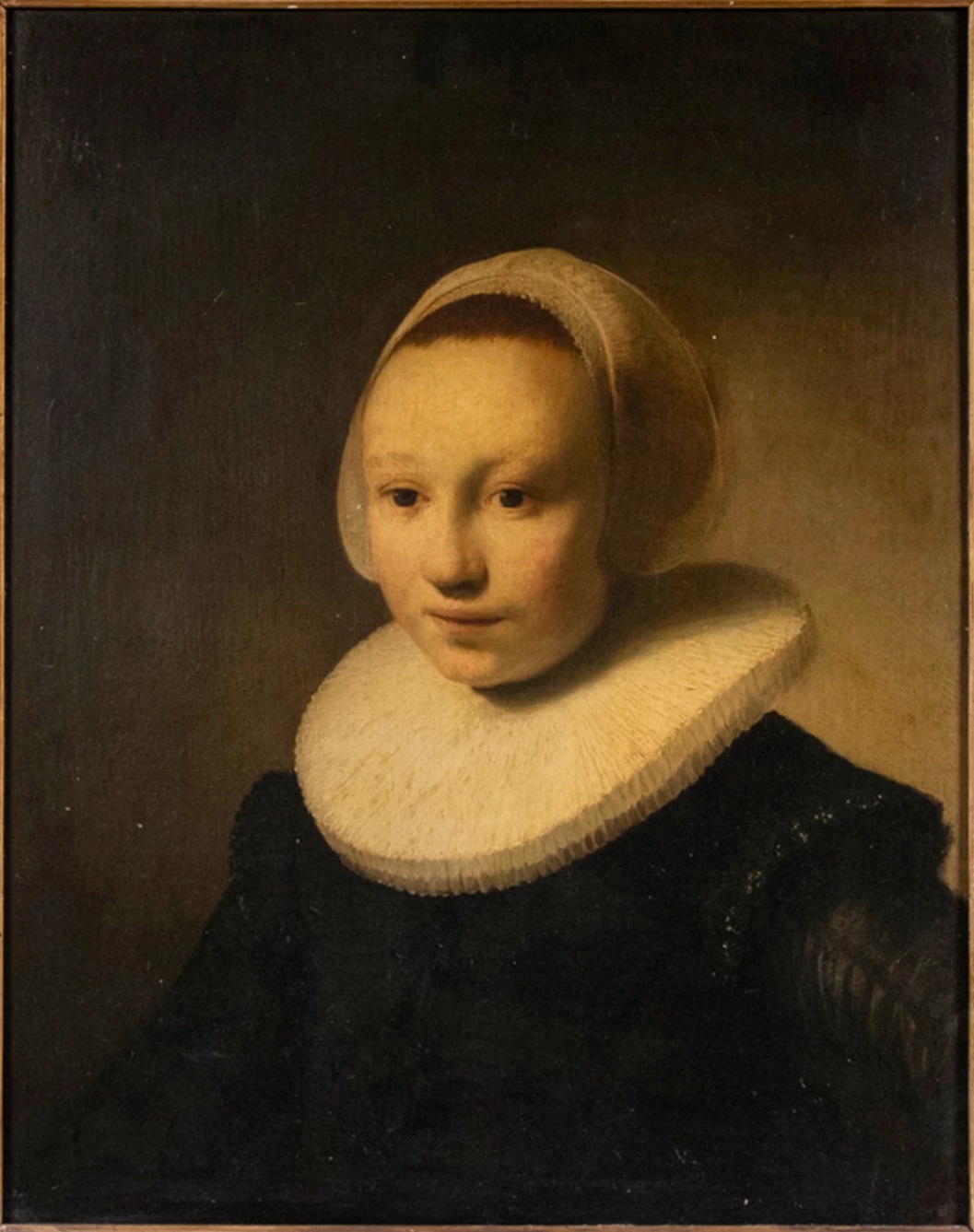
The portrait found in a house in Camden, Maine is the cleanest demonstration available, because the arithmetic is fully public. It sold at Thomaston Place Auction Galleries in Thomaston, Maine on 24 August 2024, on the second day of the Summer Grandeur sale, as lot 2363, catalogued as After Rembrandt Harmenszoon van Rijn, against an estimate of USD 10,000 to 15,000. The hammer was USD 1,175,000.
The house's published conditions of sale set the premium at 20 per cent for live in-house, absentee and phone bidders and 25 per cent for all internet bidders, including absentee and live online bids. Both rates were applied in print. Thomaston's own press release announced that the piece was awarded to a private collector for USD 1,410,000, which is the hammer plus 20 per cent to the cent. The figure of USD 1,468,750 that also circulated is the hammer plus 25 per cent, likewise exact. Local coverage led with the hammer rounded, reporting that the painting fetched nearly USD 1.2 million.
Three published prices, one lot, and no outlet was wrong. USD 1.2 million is the bare hammer, USD 1.41 million is the hammer at the room rate, and USD 1.47 million is the hammer at the internet rate. The auction house itself printed two of the three, and a reader without the premium schedule has no way to reconcile any of them.
When the reporting is clean, and what it still hides
The 1666 Frans Post view of Olinda is the counter-example, because the trade press gave both numbers. It sold at Sotheby's New York on 21 May 2025 as lot 42 in the single-owner sale of the collection of Jordan and Thomas A. Saunders III, estimated at USD 6 million to 8 million. The Art Newspaper reported that a bidder in the room won the work for USD 6 million, with USD 7.3 million the premium-inclusive figure, a record for the artist against a previous high of USD 4.5 million at Sotheby's in 1997.
The gap between those two numbers is USD 1.3 million on a single lot, which is more than most paintings sold that day made in total. That alone justifies the labelling habit. The more interesting point is what the clean reporting still conceals from a casual reader.
The hammer met the low estimate exactly. A picture that hammers at USD 6 million against a USD 6 to 8 million estimate has sold at the bottom of the range. Coverage that leads with USD 7.3 million, a figure inside the estimate band only because fees were added, invites a reading of strength that the bidding does not support. Nothing in that reporting is false. The comparison a reader instinctively performs is.
Neither figure describes what the consignor received. Seller's commission, insurance, illustration and shipping charges, and where applicable the artist's resale royalty, all come off the hammer before anything reaches the seller, and none of them appears in either published number. A lot reported at USD 7.3 million may have produced substantially less than USD 6 million for the person who owned it. Any analysis that treats a published result as a measure of what a collection is worth to its owner is measuring the wrong side of the transaction.
The premium is tiered, and the tiers move
The rate is not a single number and it is not stable. Sotheby's published schedule, updated in 2026, sets the premium in New York, the UAE and Saudi Arabia at 28 per cent on the portion up to and including USD 2 million, 22 per cent from USD 2 million to USD 8 million, and 15 per cent above USD 8 million. In London the bands are 28 per cent to GBP 1.5 million, 22 per cent to GBP 6 million and 15 per cent above. In Paris, Cologne and Milan they run to EUR 1.75 million and EUR 7 million on the same percentages. Wines and spirits are charged flat at 24 per cent with a 1 per cent overhead premium.
Christie's operates a similar structure at slightly different thresholds, reported at 27 per cent on lots up to USD 1.5 million or GBP 1 million, 22 per cent between USD 1.5 million and USD 8 million, and 15 per cent above, having previously been 26, 21 and 15 per cent at lower thresholds. Regional houses set their own: Thomaston's 20 and 25 per cent bear no relation to either.
Two consequences follow. First, the effective rate on a very expensive lot is much lower than on a cheap one, so the percentage gap between hammer and total narrows as the price rises. Second, a historical result cannot be converted between the two figures without knowing the schedule in force on the day. Reconstructing a 2016 total from a 2016 hammer using 2026 rates produces a number that never existed.
The tiering also explains why the distortion is worst at the bottom of the market, which is where most objects and most researchers actually operate. On a lot hammering below the first threshold the premium is the full headline rate, so a reported total can exceed the hammer by more than a quarter. On an eight-figure lot the blended rate falls toward the high teens. The percentage error introduced by confusing the two numbers is therefore largest on exactly the sales that receive the least careful reporting.
Currency introduces a third figure, and the hammer disappears
Canaletto's Venice, the Return of the Bucintoro on Ascension Day sold at Christie's in London on 1 July 2025. The hammer was GBP 27.5 million and the premium-inclusive total GBP 31.9 million, reported precisely elsewhere as GBP 31,935,000. Coverage in other currencies gave EUR 37.8 million and USD 43.8 million, with USD 43.77 million and USD 43.9 million also in print.
Every one of those foreign-currency figures is a conversion of the premium-inclusive total, made on a different day at a different rate. The hammer in euros, EUR 32.6 million, appeared in one outlet as a secondary figure. The hammer in dollars, roughly USD 37.7 million, appeared nowhere. A reader working in dollars or euros therefore has no access to the number the bidding actually reached, and at least one publication compounded the problem by labelling GBP 31,935,000 as the hammer price.
The sound practice is to record the result in the currency of the sale and to treat every conversion as derived and date-dependent. A record that stores USD 43.8 million as the price of a London lot has stored a rate as well as a price, and has not said so.
The habit, and why it matters at the bottom of the market too
The discipline is four lines: record the currency of the sale, record the hammer, record the premium-inclusive total, and never let a conversion masquerade as the result. Where a source gives only one number, say which one it is, and where a source conflates them, say so rather than picking. Records are conventionally quoted with premium; estimates are always without it.
This is not only a problem at the top. The Salvator Mundi is universally reported to have been bought in New Orleans in 2005 for USD 1,175. The house's own prices-realised sheet lists lot 664 under a column headed Aggregate at 1,175, and the buyer has described his winning bid as USD 1,000. The famous figure is itself a premium-inclusive total on a four-figure hammer, and the most repeated number in the modern history of the art market is mislabelled in almost every account of it.
The same applies further down still. Turner's Rising Squall is always described as having been bought for GBP 500 at a regional sale in 2024; the reported figure is GBP 524.80 including fees and VAT. Comparing that to the GBP 1.9 million premium-inclusive result is at least consistent, since both include fees, but the hammer-to-hammer comparison is a different pair of numbers, and nobody printed it.
Questions
Both, labelled. If only one is available, say which it is. Records are conventionally quoted with premium and estimates are always without it, so a record and an estimate cannot be compared directly without adjusting one of them.
It is tiered and house-specific. Sotheby's New York currently runs 28 per cent to USD 2 million, 22 per cent to USD 8 million and 15 per cent above; Christie's uses similar percentages at different thresholds; a Maine regional house charged 20 per cent in the room and 25 per cent online.
Usually because they applied different premium tiers, or because one used the hammer and the other the total, or because they converted the same premium-inclusive figure on different days. The Camden Rembrandt produced three correct prices from one hammer for the first two reasons.
Often, though for major consignments it is frequently negotiated away or offset through a guarantee arrangement. Seller's commission does not appear in either published figure, so neither the hammer nor the premium-inclusive total tells you what the consignor received.
Sources
- 1Bangor Daily News, on the Camden, Maine portrait selling for USD 1.175 million at Thomaston Place Auction Galleries on 24 August 2024. bangordailynews.com/2024/...
- 2Thomaston Place Auction Galleries, press release announcing the sale at USD 1,410,000. prnewswire.com/news-releases/...
- 3Thomaston Place Auction Galleries, Conditions of Sale, setting the buyer's premium at 20 per cent for in-house, absentee and phone bidders and 25 per cent for internet bidders. thomastonauction.com/conditions-of-sale
- 4Boston.com, reporting the Camden portrait at USD 1,175,000 and headlining almost USD 1.2 million. boston.com/news/...
- 5The Art Newspaper, 'Sotheby's $51.8m Saunders collection falls short, but still breaks Old Masters record', 21 May 2025, giving the Frans Post at USD 6m hammer and USD 7.3m with fees. theartnewspaper.com/2025/...
- 6Sotheby's, 'What is a buyer's premium?', giving the current tiered schedule by saleroom. help.sothebys.com/en/...
- 7The Art Newspaper, 'Sotheby's adjusts buyer's premiums and fee structures', 17 February 2026, including the reported Christie's schedule. theartnewspaper.com/2026/...
- 8The Art Newspaper, 'Canaletto painting of Venice sells for record 31.9m pounds', 1 July 2025, giving GBP 27.5m hammer and GBP 31.9m with fees. theartnewspaper.com/2025/...
- 9Euronews, on the Canaletto sale, printing both the premium-inclusive EUR 37.8m and the hammer in euros. euronews.com/culture/...
- 10HENI, results report for Christie's Old Masters Evening Sale, London, 1 July 2025, noting that all results include fees and premiums. heni.com/news/...
- 11St Charles Gallery, New Orleans, Prices Realized sheet for the April 2005 sale, listing lot 664 at an aggregate of 1,175. web.archive.org/web/...
- 12Anna Brady, 'Turner painting bought last year for 500 pounds sells for almost 2m pounds at Sotheby's', The Art Newspaper, 4 July 2025, giving GBP 524.80 with fees in 2024 and GBP 1.5m hammer, GBP 1.9m with fees in 2025. theartnewspaper.com/2025/...
More in The Market
The partThe hammer is the one number most auction houses do not print
Of 232 auction results in this archive, 53 carry no hammer price published by the house that sold the object.
The Objects Whose Price Was Set by a Tax Bill and Not a Buyer
The Louvre did not buy the most famous Vermeer in France. It accepted it against a death duty, and the acquisition price is not withheld, it does not...
The House That Cannot Be Asked: Who Keeps the Price After the Sale
Half this archive's sale record sits with two firms you can still write to. The other half sits with houses that shut, and with bodies that were...