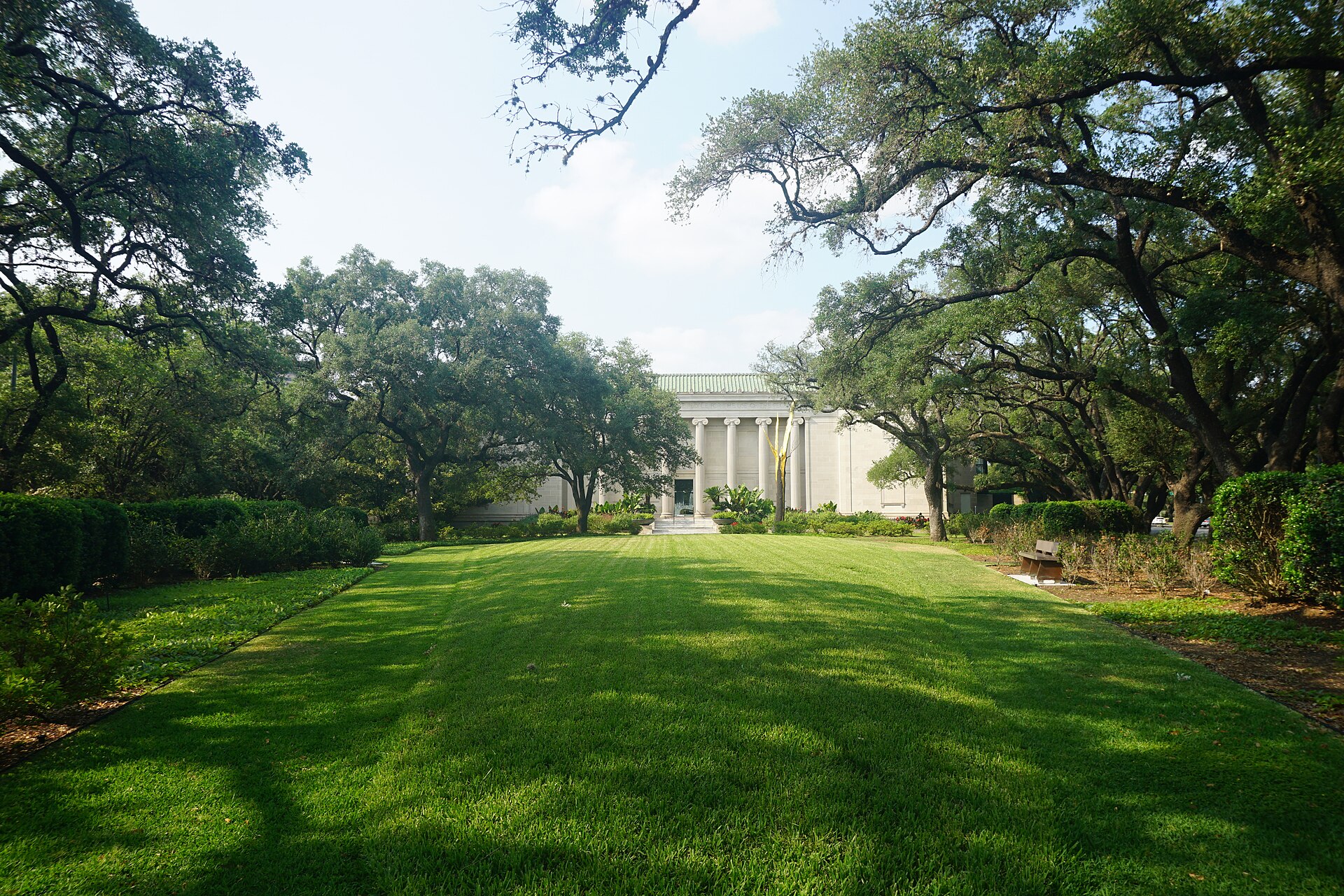
William Ward Watkin's 1924 Neoclassical entrance front of the Caroline Wiess Law Building, seen across the museum's front lawn through live oaks, GPS-tagged at the museum's own address.
Photograph by Michael Barera, released CC BY-SA 4.0Museum of Fine Arts, Houston
Museum · Founded 1900
Open, admission and hours confirmed 11 September 2026 · 17 sources
On this page 15 sections
ContentsClose
The MFAH's declared strengths run from Renaissance and Baroque European painting, anchored by the 1944 Straus bequest, through American decorative arts and paintings at Bayou Bend, French Impressionism, photography, and what the museum's own material describes as the largest collection of African gold objects in the world. The 2020 Kinder Building added a newer, actively growing strength: Latin American and Latino art, alongside modern and contemporary painting, sculpture, prints, drawings, and decorative arts and design.
| Kind | Museum |
|---|---|
| Founded | Land for a public art museum was acquired by the Houston Public School Art League in 1900; the first building, designed by William Ward Watkin in the Greek Neoclassical style, opened to the public in 1924 as the first purpose-built art museum in Texas |
| City and country |  Houston, United States Houston, United States |
| Address | 1001 Bissonnet Street, Houston, Texas 77005, United States |
| Website | mfah.org |
| Status | Open, confirmed |
| Record last verified |
Visiting
- Hours
- Sun12:30 to 18:00
- Wed11:00 to 17:00
- Thu11:00 to 21:00Free general admission to the Permanent Collections all day
- Fri11:00 to 21:00
- Sat11:00 to 18:00
- Closed
- Monday. Tuesday.
- Admission
- MFAH MembersFreeFree at every visit with paid membership
- All Access Adult (19 and older)USD 24The All Access ticket covers the Permanent Collections and any Special Exhibitions on view on the main campus
- All Access Senior (65 and older, with ID)USD 20
- All Access Youth (13 to 18)USD 20
- All Access Child (12 and younger)FreeFree, but a ticket is still issued at the admissions desk
Free entry: Every Thursday: admission to the Permanent Collections is free for all individuals, courtesy of Shell USA, Inc.; Special Exhibitions still require a separate, discounted All Access ticket on Thursday, and the Museum stays open until 9 pm that day. Texas Lone Star Card holders (TANF, SNAP, WIC programs): free general admission for up to six people per card, on presentation of the card and a photo ID, to the main campus, Bayou Bend and Rienzi. Texas public library cardholders aged 18 or younger, visiting on a Saturday or Sunday. The Cullen Sculpture Garden, the Brown Foundation Plaza, the PNC Roof Garden, and the museum's library, shop and restaurants are free and open to the public every day regardless of a Permanent Collections ticket- Tickets
- mfah.org/tickets The museum's own ticket page.
- Do I need to book?
- Not required for general admission; timed entry is used for some Special Exhibitions, and advance online booking is worth doing for Thursday's free admission, when the galleries are busiest
- Address
- 1001 Bissonnet Street, Houston, Texas 77005, United States MapLight rail METRORail Red Line to the Museum District station, a short walk from the main Sarofim Campus buildings
Car and parking Three museum-run garages open 6 am to 11 pm: the aboveground Beck Garage at 1144 Binz Street, the underground Glassell Garage at 5101 Montrose Boulevard, and the underground Kinder Garage at 5500 Main Street, with additional valet/drop-off points at the Kinder and Beck buildings
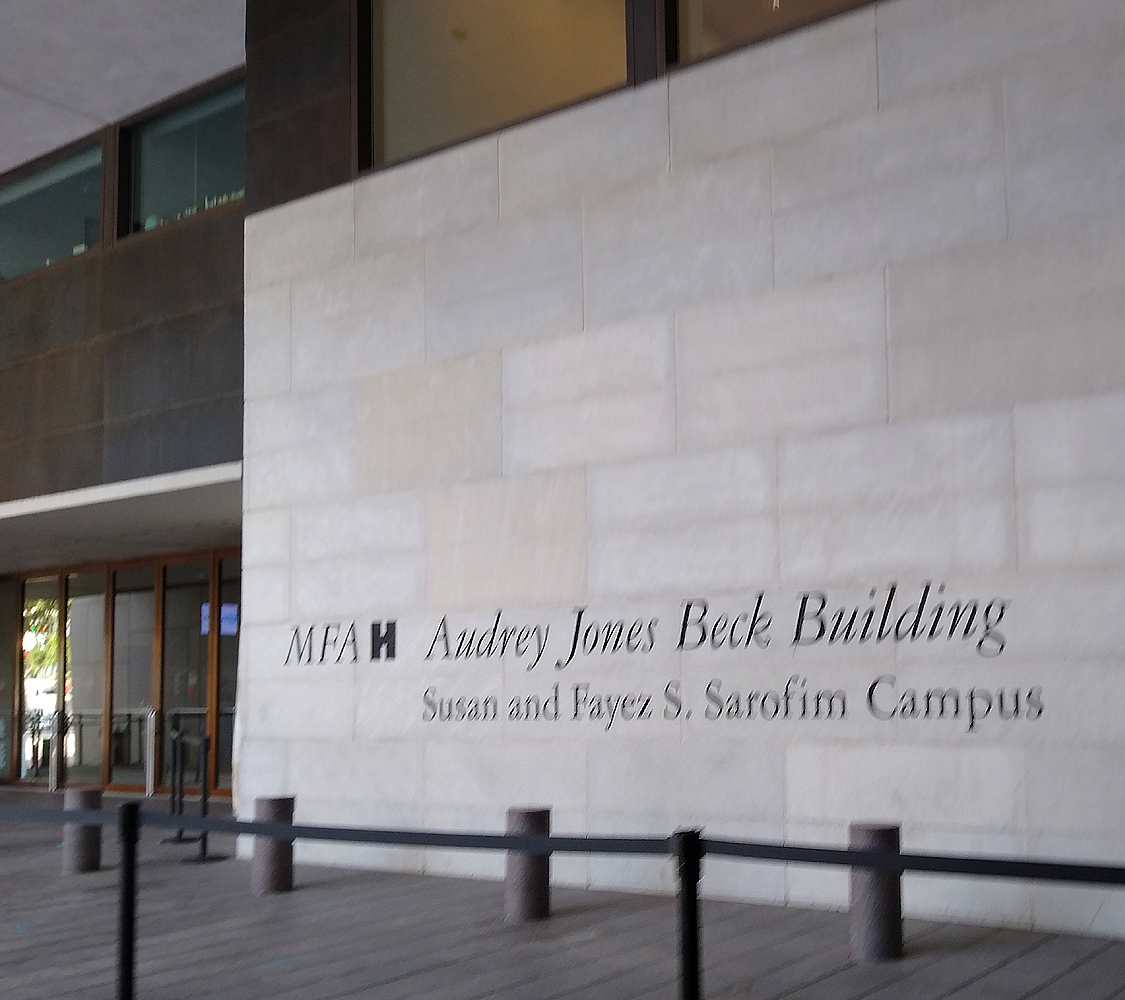
Entrances Main-campus entry is through the Audrey Jones Beck Building at 5601 Main Street or the Nancy and Rich Kinder Building at 5500 Main Street; both are listed by the museum as the wheelchair-accessible entrances - Website
- mfah.org
- Telephone
- +1 713-639-7300
- [email protected]
Before you go how long, access, photography, bags, eating, shop
- How long to allow
- The museum does not publish a single suggested duration. Outside listings such as TripAdvisor put a typical visit at more than three hours, and that is before counting the two off-site house museums, Bayou Bend and Rienzi, which each need a separate trip and a separate ticket
- Access
- Wheelchair-accessible entry is through the Beck Building (5601 Main Street) or the Kinder Building (5500 Main Street). Free manual wheelchairs, gallery stools and sensory kits (noise-reducing headphones, fidgets and sunglasses) are available on request. Three underground tunnels connect the campus buildings; two of them carry site-specific light and color installations, the Wilson Tunnel's The Light Inside by James Turrell and the Flores Tunnel's Cromosaturacion by Carlos Cruz-Diez, and the museum publishes street-level alternate routes around both for visitors with light or sensory sensitivities. Access questions go to [email protected] or 713-639-7300
- Photography
- Personal, non-commercial photography and video with a phone or handheld camera is generally welcome in the galleries; flash, tripods, selfie sticks, standing lights and drones are not permitted, and individual loans or Special Exhibitions can carry their own no-photography restriction
- Bags
- Large bags, rolling luggage, long umbrellas and wagons are not permitted in the galleries; small bags may be carried or checked
- Eating
- Cafe Leonelli at MFAH, an Italian-inspired cafe, and Le Jardinier, a Michelin-starred French restaurant serving lunch, dinner, happy hour and brunch, are both in the Kinder Building; a second, smaller Cafe Leonelli location serves the Glassell School of Art
- Shop
- A museum store on the main campus, plus an online shop at mfashop.mfah.org
Prices and hours change. We take them from the institution's own pages and print the day we read them, and you can check the current position at the source we used. Confirm before you travel.
What is inside
Caroline Wiess Law Building
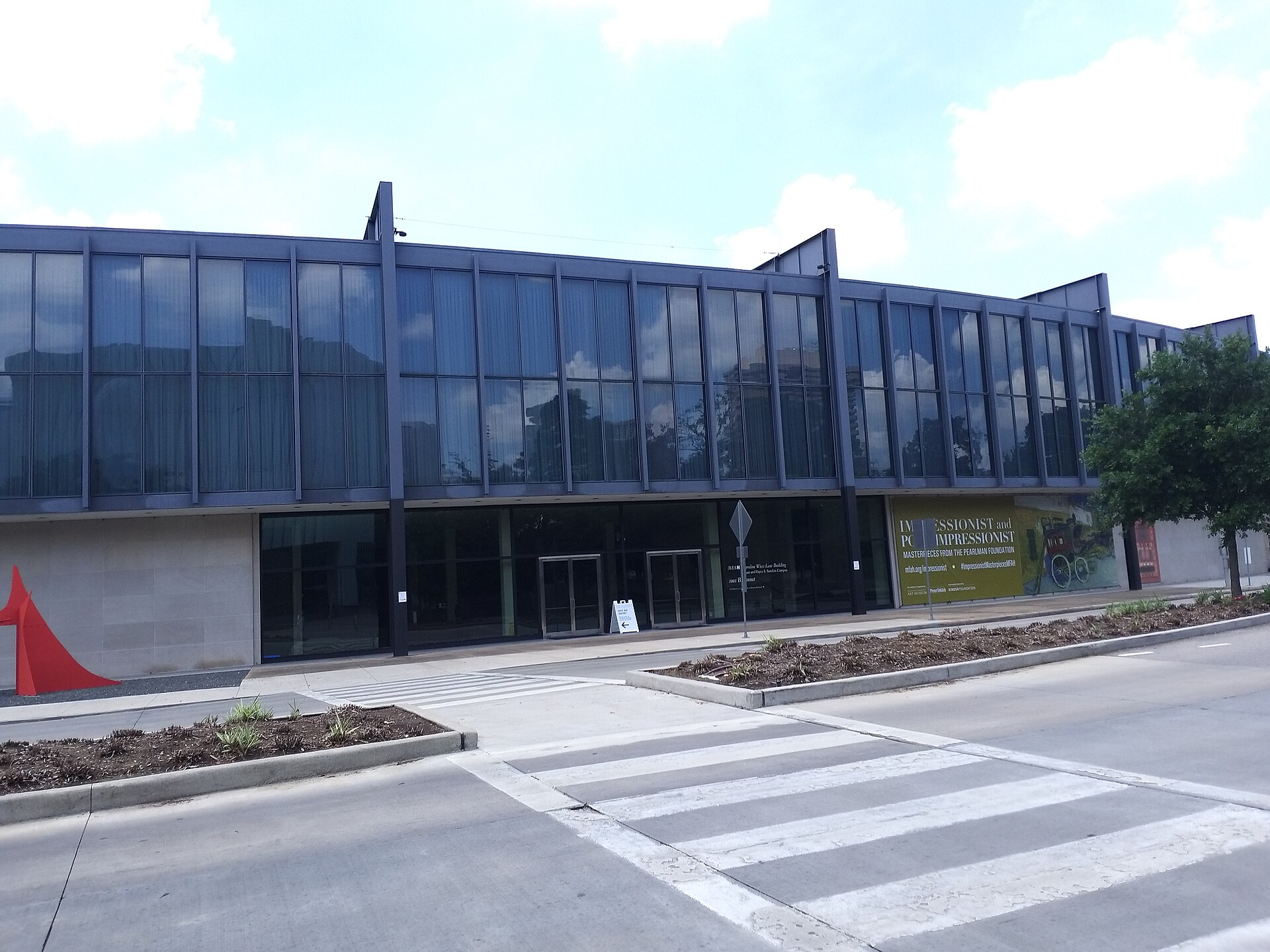
The original 1924 Neoclassical building by William Ward Watkin, expanded by Kenneth Franzheim in 1953 and then by Ludwig Mies van der Rohe's Cullinan Hall (1958) and Brown Pavilion (1974), making this the only Mies-designed museum building in the United States. It now houses traveling and temporary exhibitions and the museum's Islamic art, Pacific Island and Australian art, Asian art, Indonesian gold, and Mesoamerican and sub-Saharan African art, including the Glassell Collection of African Gold and the Nidhika and Pershant Mehta Arts of India galleries.
Audrey Jones Beck Building
Opened in 2000 to a design by Pritzker Prize laureate Rafael Moneo and named for donor Audrey Jones Beck. Its lower levels rotate photography, prints and drawings and traveling shows; its permanent galleries hold antiquities and European and American art up to 1900, including the Impressionist paintings and the Straus bequest of Renaissance works that reshaped the museum's European holdings in 1944.
Nancy and Rich Kinder Building
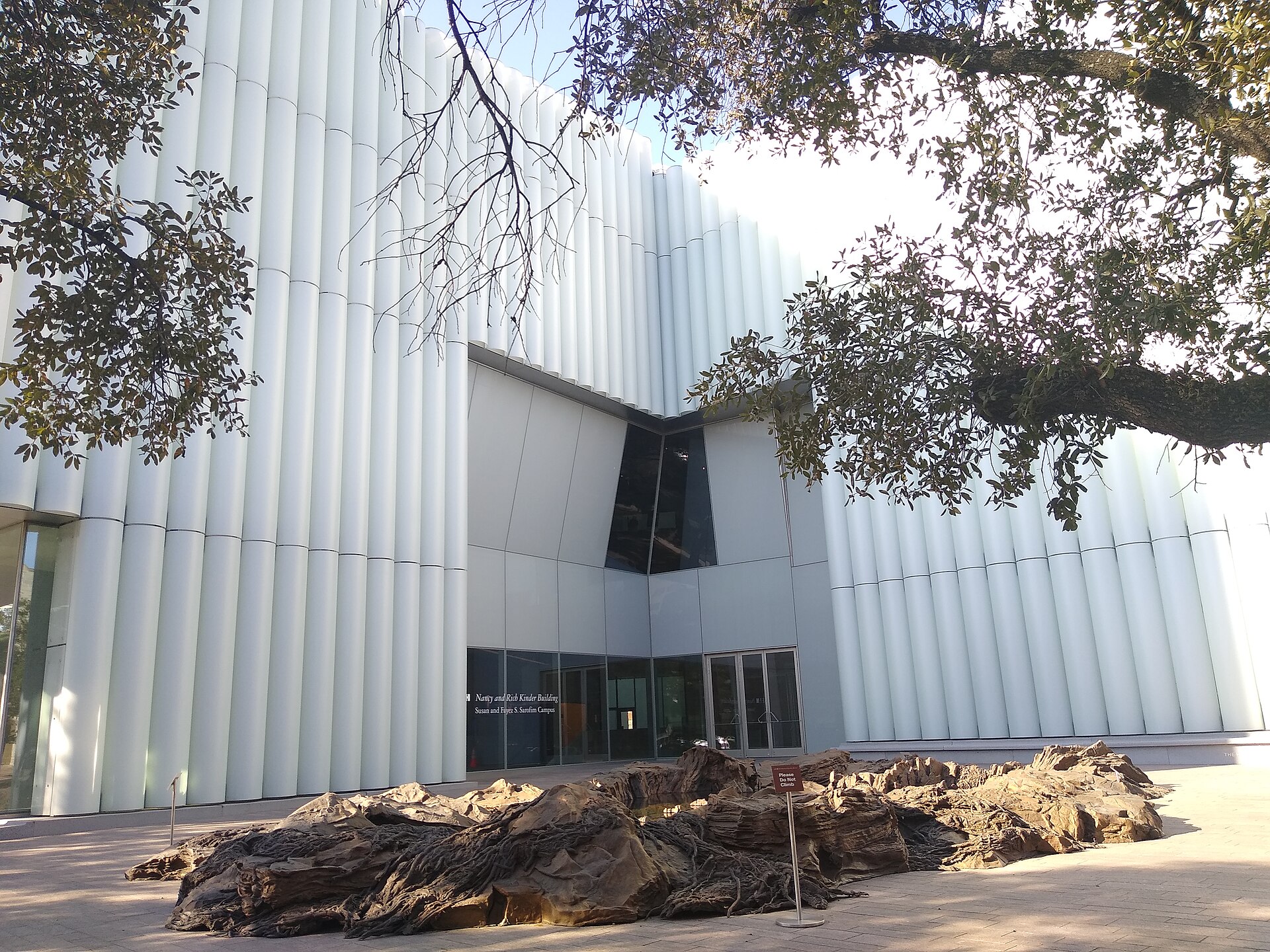
A Steven Holl Architects building that opened in November 2020 and increased the museum's total exhibition space by nearly 75 percent. Its two main floors, organized around a three-level atrium, hold the museum's international collections of art after 1900: Latin American and Latino art, photography, prints and drawings, decorative arts and design, and modern and contemporary painting and sculpture, plus a 215-seat theater, a restaurant and a cafe.
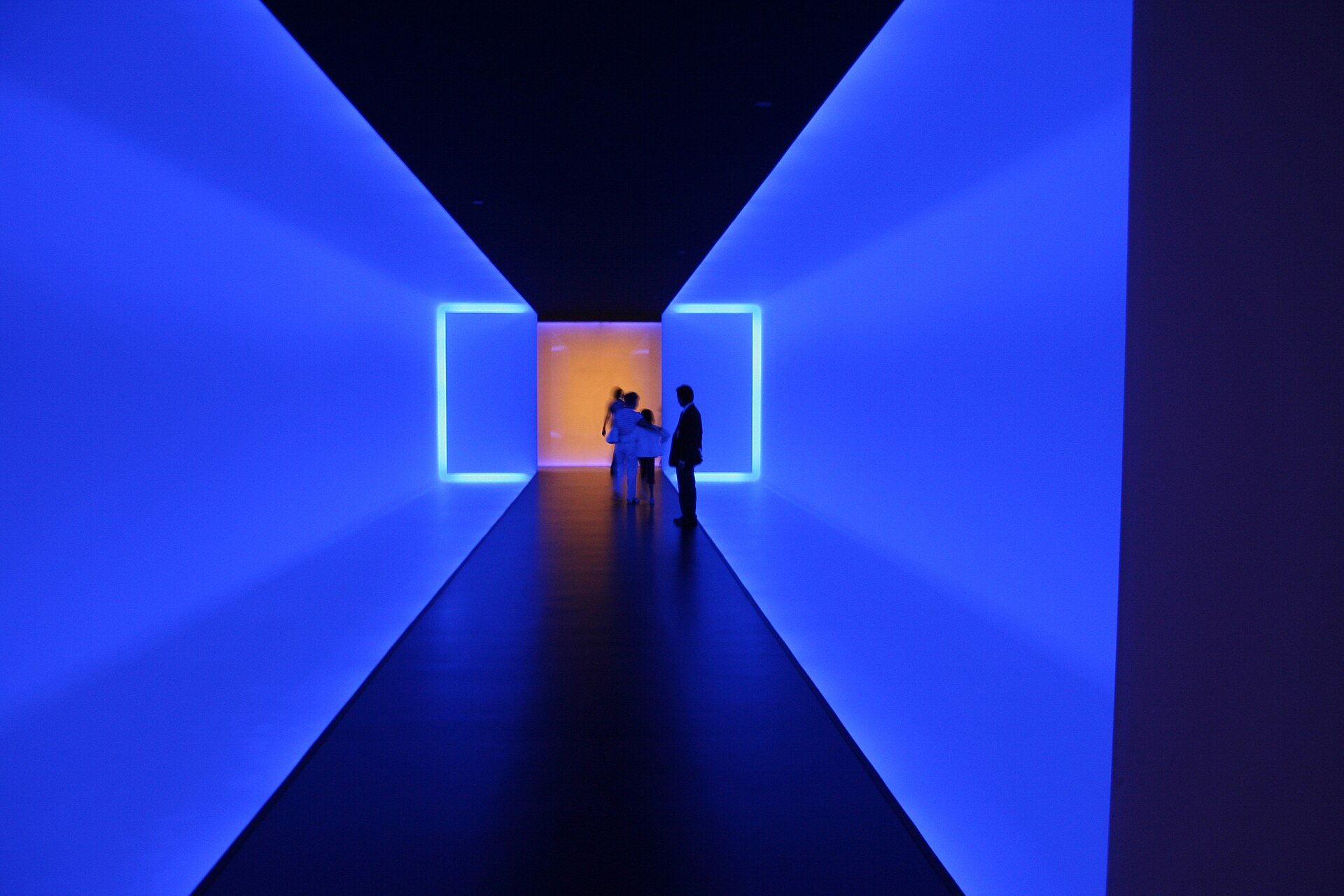
Photograph by Ed Schipul from Houston, TX, US · CC BY 2.0 Wilson Tunnel: The Light Inside, James Turrell
A 1999 museum commission by James Turrell, neon and ambient light in a raised, darkened underground passage connecting the Law and Beck buildings, funded by Isabel B. and Wallace S. Wilson; the illumination shifts slowly between blue, crimson and magenta and creates the sensation of the walls opening into deep space.
Lillie and Hugh Roy Cullen Sculpture Garden
A 1986 outdoor garden designed by artist and landscape architect Isamu Noguchi, holding more than twenty-five sculptures from the nineteenth to twenty-first centuries drawn from the MFAH and other collections. Unlike the gallery buildings it adjoins, the garden is free and open to the public every day, with no ticket required.
Glassell School of Art
The museum's studio art school, founded in 1979 and rebuilt in a Steven Holl-designed building in 2014 with a ramped amphitheater rising to the walkable PNC Roof Garden. It teaches the Studio School for adults, the Junior School for children, and the Core Artist-in-Residence Program, and its own exhibition spaces are free to visit.
Bayou Bend Collection and Gardens
The former River Oaks home of philanthropist Ima Hogg, designed by John F. Staub in 1927, donated to the MFAH in 1957 and opened to the public in 1966. An off-site house museum on 14 acres of gardens, five miles from the main campus, showing American decorative arts and paintings from the seventeenth to the mid-nineteenth centuries; it keeps its own admission schedule and requires a separate ticket.
Rienzi
A former private residence in River Oaks, designed by John F. Staub in 1952 for Carroll Sterling Masterson and Harris Masterson III, donated to the MFAH in 1991 and opened as a house museum in 1999. It is the MFAH's showcase for European decorative arts and paintings, is closed for the whole of August, and admission is by advance-purchase ticket only, though the gardens stay open to visitors at any time.
What to see first
The Marketplace at Pirna
Bernardo Bellotto, about 1764An eighteenth-century view of a Saxon market town, sold in 1938 by Jewish collector Max Emden to a dealer buying for Adolf Hitler's planned museum in Linz, and the subject of an unresolved restitution dispute with Emden's heirs that the museum has won three times on procedural and legal grounds without settling the underlying question of whether the 1938 sale was forced.11
The Glassell Collection of African Gold
Multiple West African cultures, donated by Alfred C. Glassell Jr.Described by the museum's own account as the largest assemblage of its kind in the world, shown in the Law Building alongside the museum's Indonesian gold holdings.9
The Light Inside
James Turrell, 1999A museum commission occupying the entire underground Wilson Tunnel between the Law and Beck buildings, and one of the most photographed single spaces in the museum precisely because it is one of the few places inside the MFAH where photography of the work itself is part of the point.17
The Nidhika and Pershant Mehta Arts of India galleries
South Asian collection, Law BuildingThe only exhibition space in Houston dedicated exclusively to Indian art and culture, part of the Law Building's holdings of Islamic, Pacific Island, Australian and Asian art.9
Latin American and Latino art collection
Multiple artists, Kinder BuildingOne of the collection strengths singled out at the Kinder Building's 2020 opening, built up across Latin American modern and contemporary art and the museum's Latino art holdings, and shown in dedicated second-floor galleries organized by curatorial department.5
The Straus bequest
Fra Angelico, Sandro Botticelli, Rogier van der Weyden and others, given 1944Eighty-three Renaissance paintings, sculptures and works on paper from New York collectors Edith and Percy S. Straus, which the museum's own history credits with having built its European painting collection almost from nothing; before the gift, the museum held only twelve European paintings.9
Lillie and Hugh Roy Cullen Sculpture Garden
Designed by Isamu Noguchi, 1986A rare instance of a major American sculpture garden designed in full by a single artist rather than assembled piecemeal, holding more than twenty-five works and free to the public every day.9
Bayou Bend and Rienzi decorative arts collections
American and European decorative arts, off-site house museumsTwo complete historic houses, not period rooms inside a larger building, each still furnished with the collections their donors assembled in them, giving a fuller sense of domestic use than a gallery installation can.9
Past exhibitions here
- Closed20 May to 13 Sep 2026Confirmed · check before you travel
Erected by the people, for the use of the people
The Museum of Fine Arts, Houston traces its founding to 1900, when the Houston Public School Art League began carrying art reproductions into the city's classrooms and, in doing so, built the case for a permanent public art museum. The league dedicated a site at Main Street and Montrose Boulevard in 1917, and the first building, designed by Houston architect William Ward Watkin in the Greek Neoclassical style, opened its doors in 1924 with a collection of sixty works of art and an inscription over the entrance that still gives the museum its self-description: erected by the people for the use of the people. It was the first purpose-built art museum in the state of Texas, and its holdings did not stay small for long: by 1970, after decades of gifts from Houston families and foundations, the permanent collection had grown to twelve thousand objects. It stands today at close to eighty thousand.
Three buildings, three architects, one long expansion
What a visitor calls the Museum of Fine Arts, Houston is, physically, three connected buildings by three different architects, built across nearly a century. The Caroline Wiess Law Building is Watkin's original structure, expanded twice by Kenneth Franzheim in 1953 and then, in 1958 and 1974, by Ludwig Mies van der Rohe's Cullinan Hall and Brown Pavilion, making this the only museum building Mies designed anywhere in the United States. The Audrey Jones Beck Building, opened in 2000 to a design by Pritzker Prize laureate Rafael Moneo, holds the museum's antiquities and its European and American paintings up to 1900. The Nancy and Rich Kinder Building, the newest of the three, opened in November 2020 to a design by Steven Holl: two floors of galleries wrapped in translucent glass tubes around a three-level atrium, built for the museum's collections of art after 1900, and large enough on its own to increase the museum's total exhibition space by nearly three-quarters. The three buildings are joined by underground tunnels rather than open plazas, and two of those tunnels are themselves permanent, commissioned artworks: James Turrell's The Light Inside, installed in 1999 between the Law and Beck buildings, and Carlos Cruz-Diez's Cromosaturacion, installed later between the Kinder and Law buildings.
A collection built almost entirely by donors
The museum's encyclopedic reach is largely the record of individual gifts rather than institutional purchasing power. Before 1944 the European painting collection held twelve pictures; that year, New York collectors Edith and Percy S. Straus bequeathed eighty-three Renaissance paintings, sculptures and works on paper, including works by Fra Angelico, Sandro Botticelli, Giovanni Bellini, Rogier van der Weyden, Hans Memling, Peter Paul Rubens and Anthony van Dyck, and the museum's own account credits the gift with having placed it on the map as a serious European collection. The pattern repeats across departments: Alfred C. Glassell Jr. gave what the museum describes as the largest assemblage of African gold objects in the world; the Nidhika and Pershant Mehta family endowed the only gallery space in Houston dedicated exclusively to Indian art; Ima Hogg gave both her Houston house, Bayou Bend, and the American decorative-arts collection inside it; and Carroll Sterling Masterson and Harris Masterson III gave their River Oaks residence, Rienzi, with its European decorative arts intact. The 2020 Kinder Building added a newer strand: one of the country's deepest institutional holdings of Latin American and Latino art, built up over decades and finally given galleries of its own.
A painting bought for Hitler's museum, and a case the museum has won without settling
Not every object in the collection arrived by straightforward gift. Bernardo Bellotto's The Marketplace at Pirna, painted around 1764, was sold in 1938 by Jewish collector Max Emden, through dealer Anna Caspari, to Karl Haberstock, an art dealer buying on behalf of the German government for Adolf Hitler's planned Fuhrermuseum in Linz. Two related Bellotto paintings from the same 1938 sale were restituted to Emden's heirs in 2019, after a German government advisory commission concluded the sale had been made under the economic duress the Nazis had inflicted on Emden. The third painting, now in Houston, took a different postwar path: American Monuments Men recovered it after the war, but a 1949 clerical error sent it to the Netherlands as if it were a different, similarly titled Bellotto, and it passed through a series of owners before New York collector Samuel Kress gave it to the MFAH in 1961. Emden's heirs have sought its return since 2007. The museum, backed by an independent provenance investigation it commissioned in 2007, maintains the sale was voluntary and that it holds clear legal title regardless; the heirs and the Monuments Men Foundation, which has supported their claim publicly since 2021, argue that the museum is relying on outdated research and a legal technicality rather than answering the substantive question. Three federal court rulings, most recently from the Fifth Circuit in 2024, have gone the museum's way, each on the narrow grounds of the 1949 clerical error and questions of legal title. None has resolved whether the 1938 sale itself was forced.
A campus, and two houses five miles from it
The Susan and Fayez S. Sarofim Campus, fourteen acres in Houston's Museum District, holds the three gallery buildings along with the Lillie and Hugh Roy Cullen Sculpture Garden, designed in full by artist and landscape architect Isamu Noguchi and opened in 1986, and the Glassell School of Art, the museum's own studio art school, rebuilt in a Steven Holl-designed building in 2014 that opens onto a walkable rooftop garden. Neither the sculpture garden nor the school's exhibition spaces require a ticket. Two further collections sit apart from the main campus entirely. Bayou Bend, the former River Oaks home of philanthropist Ima Hogg, opened as a house museum of American decorative arts in 1966 and sits on fourteen acres of its own gardens, five miles from Main Street. Rienzi, the former home of Carroll Sterling Masterson and Harris Masterson III, opened in 1999 as the museum's showcase for European decorative arts. Both keep separate hours, separate admission and, for Rienzi in particular, a genuinely seasonal schedule: it closes for the whole of August every year and reopens in September.
What a visit actually costs, and what it does not
General admission for an adult is 24 dollars, with reduced rates for seniors and youths and free entry for children twelve and under, but the museum's own published list of exceptions is longer than the price table itself: members, active-duty military and their families, Texas Lone Star Card holders, Texas public library cardholders visiting on a weekend, college students on an art-related assignment, museum professionals, and Bank of America cardholders on the first weekend of the month can all enter free under one condition or another. The one blanket exception applies every week rather than to a subset of visitors: on Thursdays, admission to the Permanent Collections is free for everyone, funded by Shell USA, and the museum stays open until 9 pm rather than closing at 5. The trade-off a visitor plans around is not price but time: the main campus is closed both Monday and Tuesday, opens no earlier than 11 am on any weekday, and a single Thursday evening is not enough time to see the Law, Beck and Kinder buildings properly, let alone the two off-site houses.
What visitors say
We do not reproduce visitor-review prose. Two tertiary aggregates read on 12 August 2026 point the same direction: Google recorded 4.8 out of 5 from roughly 12,200 ratings, and TripAdvisor recorded 4.6 out of 5 from 2,790 ratings, with outside listings and the museum's own account of its most-visited installations agreeing on what draws people through the door: the sheer scale of an encyclopedic, nearly 80,000-object collection across three architecturally distinct buildings, and specific immersive works, above all James Turrell's The Light Inside tunnel and, in season, the Yayoi Kusama infinity-room installations the museum periodically hosts. Set against that is a genuine, still-open dispute over one painting's Nazi-era provenance that the museum has won in court without resolving on the merits, and a 2020 decision, alongside three peer museums, to postpone a major retrospective over its subject's imagery, both of which this page treats as part of the record rather than leaving them out of it.
What is praised, what is criticised
- Praised: the scale and range of the encyclopedic collection, spanning six continents and more than 5,000 years across three connected gallery buildings, an amount of ground the museum itself does not pretend can be seen in one visit
- Praised: free general admission to the Permanent Collections every Thursday, funded by a named corporate sponsor rather than presented as a limited-time offer, plus a published list of further free-admission routes for military families, Lone Star Card holders and library cardholders
- Praised: the architectural range of the campus itself, from William Ward Watkin's 1924 Neoclassical original through the only Mies van der Rohe-designed museum building in the country to Rafael Moneo's Beck Building and Steven Holl's 2020 Kinder Building
- Praised: immersive, site-specific installations built into the fabric of the building rather than displayed on its walls, led by James Turrell's The Light Inside tunnel and Carlos Cruz-Diez's Cromosaturacion, both frequently singled out by visitors on the evidence of Yelp's own most-mentioned tags for the museum
- Praised: the Lillie and Hugh Roy Cullen Sculpture Garden and the Glassell School's PNC Roof Garden, both free and open every day independent of a Permanent Collections ticket
- Criticised: the Bellotto restitution dispute: the museum has prevailed three times in U.S. federal courts against the heirs of Max Emden, most recently at the Fifth Circuit in 2024, but each ruling turned on a 1949 postwar clerical error and questions of legal title rather than on whether Emden's 1938 sale of the painting to a dealer buying for Hitler's planned museum was made under duress, a question the museum's own commissioned 2007 provenance report answered in its own favor and that critics, including the Monuments Men Foundation, say it has not answered independently since
- Criticised: in September 2020 the MFAH joined the National Gallery of Art, the Museum of Fine Arts, Boston, and Tate Modern in postponing a major Philip Guston retrospective, whose late paintings include Ku Klux Klan imagery, to 2024; Texas and national art writers criticized the joint decision as an institution avoiding rather than contextualizing difficult work, a debate the museum has not revisited in its own published materials since the show eventually opened
- Criticised: opening hours that close the main campus on both Monday and Tuesday and open no earlier than 11 am on any weekday, a pattern outside visitor listings single out as the most common practical complaint about planning a visit
Ratings on other platforms
Google: 4.8 from 12,200 ratings, read 12 August 2026
TripAdvisor: 4.6 from 2,790 ratings, read 12 August 2026
A platform average is a tertiary source: it moves, it is not audited, and we quote no visitor's words.
Questions about Museum of Fine Arts, Houston
Where is Museum of Fine Arts, Houston?
1001 Bissonnet Street, Houston, Texas 77005, United States.
How much does it cost to visit?
MFAH Members: free; All Access Adult (19 and older): USD 24; All Access Senior (65 and older, with ID): USD 20; All Access Youth (13 to 18): USD 20; All Access Child (12 and younger): free. As confirmed 11 September 2026.
When is it open?
Sun 12:30-18:00; Wed 11:00-17:00; Thu 11:00-21:00; Fri 11:00-21:00; Sat 11:00-18:00. Closed: Monday. Tuesday. As confirmed 11 September 2026.
How do you get there?
Light rail: METRORail Red Line to the Museum District station, a short walk from the main Sarofim Campus buildings; Car and parking: Three museum-run garages open 6 am to 11 pm: the aboveground Beck Garage at 1144 Binz Street, the underground Glassell Garage at 5101 Montrose Boulevard, and the underground Kinder Garage at 5500 Main Street, with additional valet/drop-off points at the Kinder and Beck buildings; Entrances: Main-campus entry is through the Audrey Jones Beck Building at 5601 Main Street or the Nancy and Rich Kinder Building at 5500 Main Street; both are listed by the museum as the wheelchair-accessible entrances.
What should you see first?
The Marketplace at Pirna (Bernardo Bellotto, about 1764); The Glassell Collection of African Gold (Multiple West African cultures, donated by Alfred C. Glassell Jr.); The Light Inside (James Turrell, 1999); The Nidhika and Pershant Mehta Arts of India galleries (South Asian collection, Law Building); Latin American and Latino art collection (Multiple artists, Kinder Building); The Straus bequest (Fra Angelico, Sandro Botticelli, Rogier van der Weyden and others, given 1944).
What we could not confirm
- Whether the Bellotto restitution dispute will ever be resolved on the substance of the 1938 sale, given that three federal court rulings through 2024 have turned on the 1949 postwar clerical error and questions of legal title rather than on the sale itself
- Whether the museum's own account of the 2020 Guston retrospective postponement, and of the criticism it drew, will be added to its published history now that the exhibition has since opened
Images
Sources
- 1Museum of Fine Arts, Houston, Visit: Hours and Admission. Daily hours by day of week, the Monday and Tuesday closure, and the All Access admission price table (adult, senior, youth, child). Fetched 12 August 2026. mfah.org/visit/hours-and-admission
- 2Museum of Fine Arts, Houston, Admission Information. Free Thursdays and the full list of free-admission categories (members, age 12 and under, military, Lone Star Card, library cardholders, students, artists, museum professionals, Bank of America Museums on Us), plus the mailing address and information line. Fetched 12 August 2026. mfah.org/visit/admission-information
- 3Museum of Fine Arts, Houston, Contacts. Full departmental phone and email directory, including General Museum Info at 713-639-7300 and [email protected]. Fetched 12 August 2026. mfah.org/contact
- 4Museum of Fine Arts, Houston, History. Founding narrative from the 1900 Houston Public School Art League through the 1924 Watkin building, the naming and opening dates of the Law, Beck and Kinder buildings, and current collection size. Fetched 12 August 2026. mfah.org/about/history
- 5Museum of Fine Arts, Houston, The Nancy and Rich Kinder Building. Architecture and opening date, gallery organization by curatorial department, and the building's Latin American, Latino, photography and modern/contemporary collection strengths. Fetched 12 August 2026. mfah.org/about/nancy-and-rich-kinder-building
- 6Museum of Fine Arts, Houston, Accessibility Resources. Accessible entrances, the three connecting tunnels and their light installations (Wilson Tunnel/Turrell, Eliasson tunnel, Flores Tunnel/Cruz-Diez), parking garage locations, and accessibility contact information. Fetched 12 August 2026. mfah.org/visit/accessibility-resources/
- 7Museum of Fine Arts, Houston, Visiting the MFAH for Free. Free-admission routes and the Cullen Sculpture Garden, Brown Foundation Plaza and PNC Roof Garden as free, always-open outdoor spaces. Fetched 12 August 2026. mfah.org/about/mission-community/visiting-for-free
- 8Museum of Fine Arts, Houston, Tickets. Confirms main-campus admission is being sold normally and notes Rienzi is closed for the month of August, resuming 2 September. Fetched 12 August 2026. mfah.org/tickets
- 9Fetched 12 August 2026. en.wikipedia.org/wiki/Museum_of_Fine_Arts,_Houston
- 10Fetched 12 August 2026. wikidata.org/wiki/Q1565911
- 11Sarah Cascone, 'Restitution Experts Blast Houston's Museum of Fine Arts for Refusing to Return a Painting Once Purchased for Hitler's Museum,' Artnet News, 18 August 2021. The Bellotto/Emden restitution dispute, museum director Gary Tinterow's public defense of the museum's title, and criticism from the Monuments Men Foundation and independent legal experts. news.artnet.com/art-world/mfa-houston-bellotto-restitution-debate-2000062
- 12Kazeem Adeleke, 'Art Restitution Victory: MFA Houston Wins Legal Battle for a Masterpiece,' ARTCENTRON, 6 June 2024. The Fifth Circuit's 2024 ruling upholding MFAH's ownership of the Bellotto painting, and the postwar clerical-error history behind the case. artcentron.com/2024/06/06/art-restitution-victory-mfa-houston-wins-legal-battle-for-bellotto-masterpiece/
- 13Michael Agresta, 'A Museum Show in Houston Is Shelved, and the Texas Art Community Cries Foul,' Texas Monthly, 20 October 2020. The MFAH's joint decision with three other museums to postpone a Philip Guston retrospective, and the resulting criticism. texasmonthly.com/arts-entertainment/a-museum-show-in-houston-is-shelved-and-the-texas-art-community-cries-foul/
- 14Read 12 August 2026. tripadvisor.com/Attraction_Review-g56003-d144355-Reviews-Museum_of_Fine_Arts_Houston-Houston_Texas.html
- 15Read 12 August 2026. google.com/search?q=Museum+of+Fine+Arts+Houston+google+rating
- 16Yelp, 'Museum of Fine Arts Houston.' Corroborates published hours and lists the museum's own 'most mentioned' visitor tags (Permanent Collection Galleries, Interactive Light Tunnels, Yayoi Kusama Infinity Room, Islamic and Asian Art), used only to characterise consensus, not quoted. Read 12 August 2026. yelp.com/biz/museum-of-fine-arts-houston-houston
- 17Museum of Fine Arts, Houston, eMuseum collection record for 'The Light Inside' (object number 2000.1). Confirms James Turrell, 1999, neon and ambient light, museum commission funded by Isabel B. and Wallace S. Wilson, current location the Wilson Gallery of the Beck Building. Fetched 12 August 2026. emuseum.mfah.org/objects/42358/the-light-inside