The Antioch 'Chalice'
Unrecorded silversmith, northern Syria · 500-550. Formerly published as second half of the first century AD
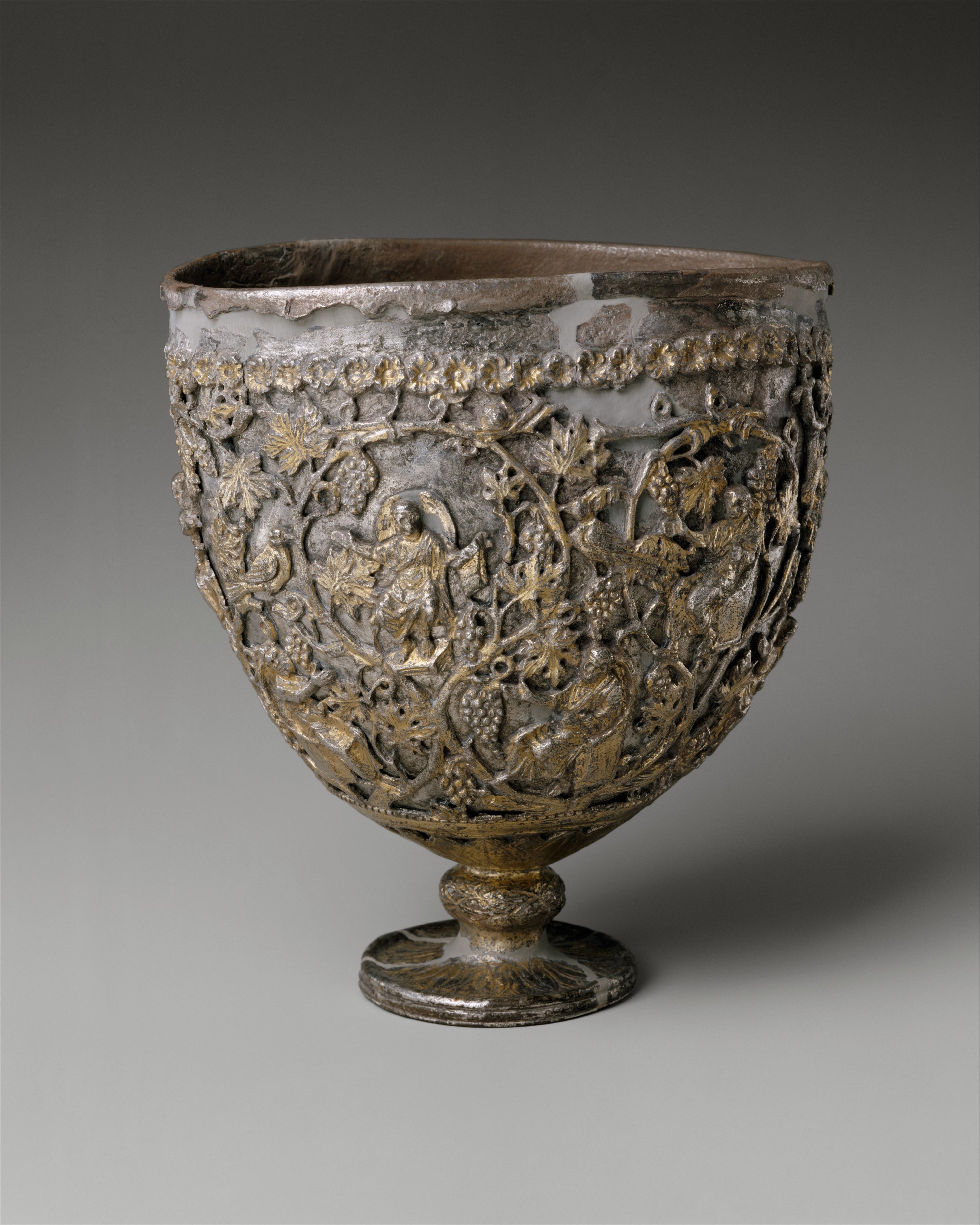
The record subject. Plain silver inner bowl inside a gilded openwork shell of fruiting grapevine with birds, animals and twelve seated figures. 19.6 x 18 x 15.2 cm. The compression at the top of the bowl, which Eisen attributed to falling debris, is visible in the outline.
| Artist | Unrecorded silversmith, northern Syria |
|---|---|
| Date | 500-550. Formerly published as second half of the first century AD |
| Medium | Silver (inner cup) and silver with gilding (outer cup and foot) |
| Dimensions | Overall 19.6 x 18 x 15.2 cm; foot 7.4 cm |
| Where it is now | Metropolitan Museum of Art, New York, Gallery 300last confirmed 4 August 2026 |
| Inventory number | 50.4 |
| Attribution | UnknownNo maker, workshop, donor or dedication is recorded, and the object carries no signature. Full note |
| Object type | Silver |
| Period | Early Byzantine, sixth century |
| Cases | Has a provenance gap |
| Inscriptions | None recorded on the Museum's public record for this object. |
| Owners on record | 5 links2 documented, 2 disputed, 1 unknown |
| Sources | 8 cited |
About this record Last verified 20 August 2026 · 8 sources cited · Change log
On this page 12 sections
ContentsClose
A sixth-century Syrian silver vessel of two parts, a plain inner bowl inside a gilded openwork shell of grapevine holding twelve seated figures, which was sold out of Paris and New York from 1910 as a first-century object. Gustavus Eisen dated it in print in October 1916, with certainty, to the second half of the first century after Christ; the identification of its plain inner cup as the Holy Grail followed from that date, was carried by the owner, and was what the object was exhibited as. It was shown as the Holy Grail at the Century of Progress exposition in Chicago in 1933 by the dealer who owned it, and bought by The Cloisters in 1950.
Every large claim made for it has since been withdrawn by the institution that owns it. The Museum dates it 500 to 550, states that the Grail identification has not been sustained, records that its authenticity has at times been challenged, keeps the word chalice inside quotation marks because the shape is now read as a sixth-century standing lamp, and gives the find-spot as Antioch or Kaper Koraon with a question mark.
The find was witnessed by no archaeologist, part of it was melted for scrap before anyone recorded it, and the whole surface was cleaned by a commercial restorer in Paris before it was first published. In 1985 a magazine named a Damascus coin forger as its probable maker. No metallurgical analysis has ever been published.
Provenance
Each link is graded. Documented: a cited source supports it. Disputed: the identification is argued but not established. Unknown: no owner for that span, and the gap is not smoothed into a narrative. The grades in the glossary.
- ca. 500-550 - unknownA church in or near Antioch, or the Church of Saint Sergios at Kaper Koraondisputed
The Museum's geography field reads 'Made in Antioch or Kaper Koraon (?)'. Marlia Mundell Mango's 1986 reconstruction of the Syrian church treasures places the object in the group of liturgical silver found in 1908 that had belonged to the Church of Saint Sergios at Kaper Koraon, southeast of Antioch, in which case its donors were a village congregation who may have bought it in Antioch. That is an argument from the group, not a document.1
- unknown - 1910Buriedunknown
Nothing is documented between manufacture and the reported discovery. No archaeologist witnessed the find and no excavation of the site was ever made; Eisen said so in 1916.
- 1910 - by 1913Kouchakji Freres, Paris and New Yorkdisputed
Eisen's 1916 report states that six pieces - two chalices, three book covers and a large ceremonial cross - were procured by Kouchakji Freres in Paris directly from the excavators in 1910, the objects having been found together by Arabs digging a well at Antioch on the Orontes at a depth of many metres. A seventh piece, a smaller silver cross said to be from the same find, went to Wilhelm Froehner and remained in Paris. Crumbled silver fragments sufficient to fill a sack were smelted for the metal. Every element of this account originates with the sellers. The Museum's own provenance line begins '[Kouchakji Freres, Paris and New York (by 1913)]', with the square brackets that denote a dealer, and gives no 1910 date. The Kouchakji objects were moved to New York for safety at the outbreak of the First World War.12
- by 1913 - 1950Fahim Joseph Kouchakji (1886-1976), New Yorkdocumented
Kouchakji owned the object through the period of its greatest fame, lent it to the Exposition internationale d'art byzantin in Paris in 1931 and to the Century of Progress exposition in Chicago in 1933-34, where it was shown as the Holy Grail, and published Eisen's popular account of it under his own imprint in New York in 1933. Sold to the Museum in 1950.15
- 1950 - presentThe Metropolitan Museum of Art, The Cloisters Collectiondocumented
Accession 50.4, credit line The Cloisters Collection, 1950, the fund endowed by John D. Rockefeller Jr. No price has been published in any source consulted. James J. Rorimer reported the acquisition in the Museum's Bulletin in summer 1951 and published an essay on the object's authenticity in 1954. Displayed at The Cloisters for decades; by 1985 shown in a corridor at Fifth Avenue labelled only as early Christian; now in Gallery 300.14
Prices realised
This object has never been offered at public auction. It moved twice by private treaty: from the finders to Kouchakji Freres in 1910, on the sellers' own account, and from Fahim Joseph Kouchakji to the Metropolitan Museum in 1950. No price is published for either transaction, so there is no hammer and no premium to separate, and any figure quoted for this object anywhere should be treated as unsourced until the Museum publishes its own.
Technical evidence
| Attribution note | No maker, workshop, donor or dedication is recorded, and the object carries no signature. The Metropolitan dates it 500-550 and places it 'Made in Antioch or Kaper Koraon (?)'. Gustavus A. Eisen dated it with certainty to the second half of the first century when he published it in October 1916. The identification of the plain inner cup as the Holy Grail followed from that date; it was the claim under which the object was exhibited in Paris in 1931 and at the Chicago world's fair in 1933, and the Museum states that it has not been sustained. How much of that claim Eisen argued in his own name is not established by the single article of his read for this entry. Authenticity itself was challenged in a magazine article in 1985, which named a Damascus coin forger as the probable maker; no scholarly literature has adopted that position, and no metallurgical analysis has ever been published. |
|---|---|
| Construction | Two vessels. An inner bowl of plain silver, hammered from a thick sheet with the rim turned outward into a collar about 1 cm wide, and an outer openwork shell soldered onto it. The stand and foot are turned from a solid block of silver.2 |
| Technique of the openwork | What Eisen called chased-applied: ornament carved on a sheet of silver, edges cut through, background removed, and the resulting openwork soldered to the bowl.2 |
| Gilding | The inner bowl was never gilded. The outer shell, stand and foot were covered with heavy gold leaf in two colours - deep red gold for the figures of the bowl, pale yellow for the lotus cup, stand and foot.2 |
| Dimensions (Museum) | Overall 19.6 x 18 x 15.2 cm; foot 7.4 cm.16 |
| Dimensions (Eisen, 1916) | Height 19 cm; greatest diameter at the top of the bowl 18 cm, narrowest 13 cm, the discrepancy caused by compression of the upper bowl by falling debris; original diameter calculated at about 15 cm; depth of bowl 15 cm; height of stand 3.5 cm; width of foot 6.5 cm; original capacity about 2.5 litres.2 |
| Condition on discovery | The whole surface was covered with a coating of oxide several millimetres thick, removed in Paris. The silver matrix had crystallised and become so brittle that a slight tap would break the vessel.2 |
| Wear | The faces of the two principal figures are worn, in Eisen's reading by repeated touching from worshippers; one further head is much damaged by oxidation and several are almost intact. Original gilding survives on some figures and much of the ornament.2 |
| Figures | Twelve human figures seated in high-backed chairs holding scrolls, of which two are read as Christ, once as a youth and once as a man. The remaining ten have been identified as ten of the apostles, as the twelve tribes, and as classical philosophers who foretold the coming of Christ.13 |
| Scientific testing | As of the 1985 challenge no thorough modern metallurgical or chemical analysis had been carried out. No published analysis has been located here since.4 |
| Classification | Metalwork-Silver. Museum medium line: silver for the inner cup, silver with gilding for the outer cup and foot.16 |
Images
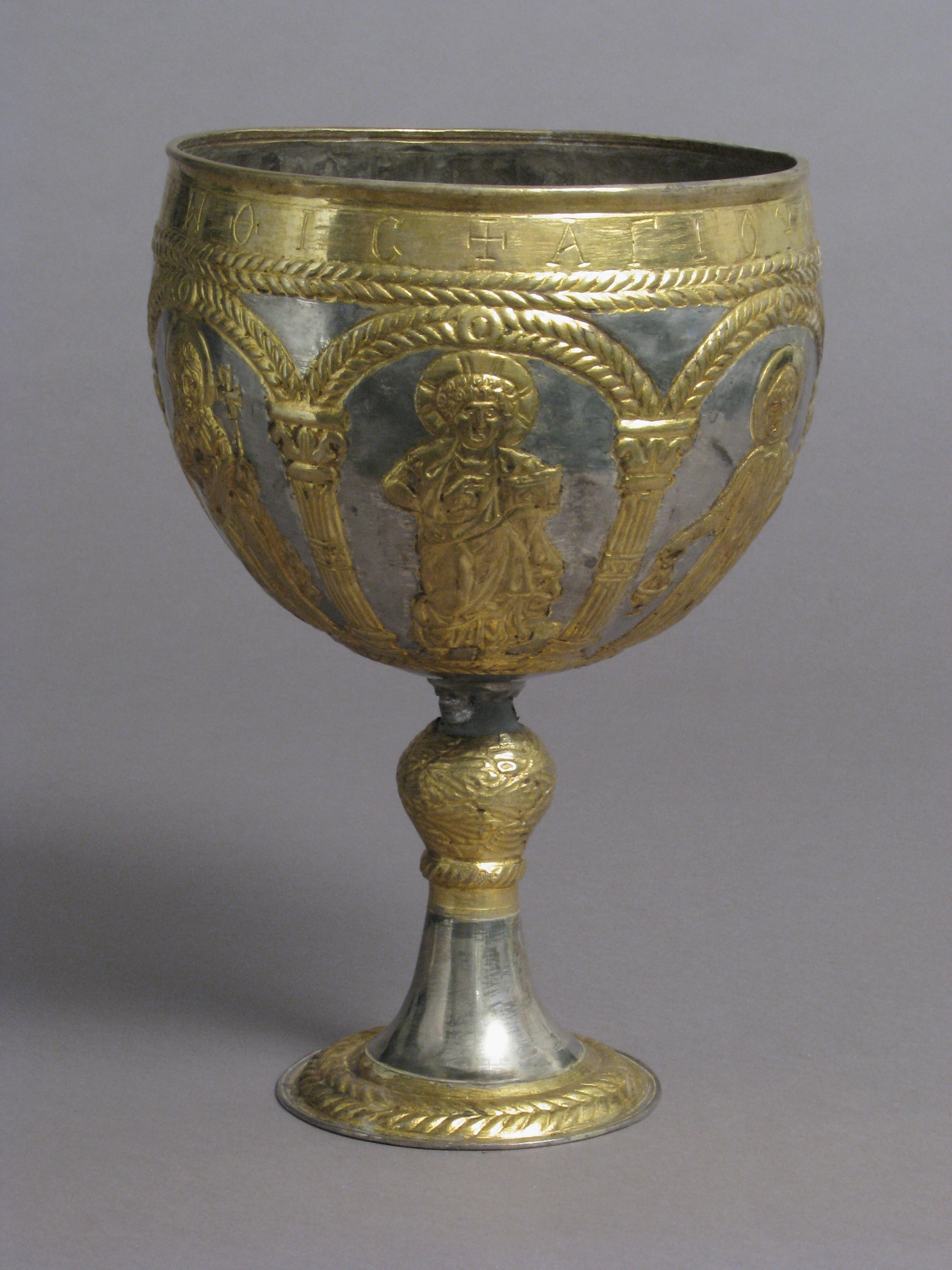
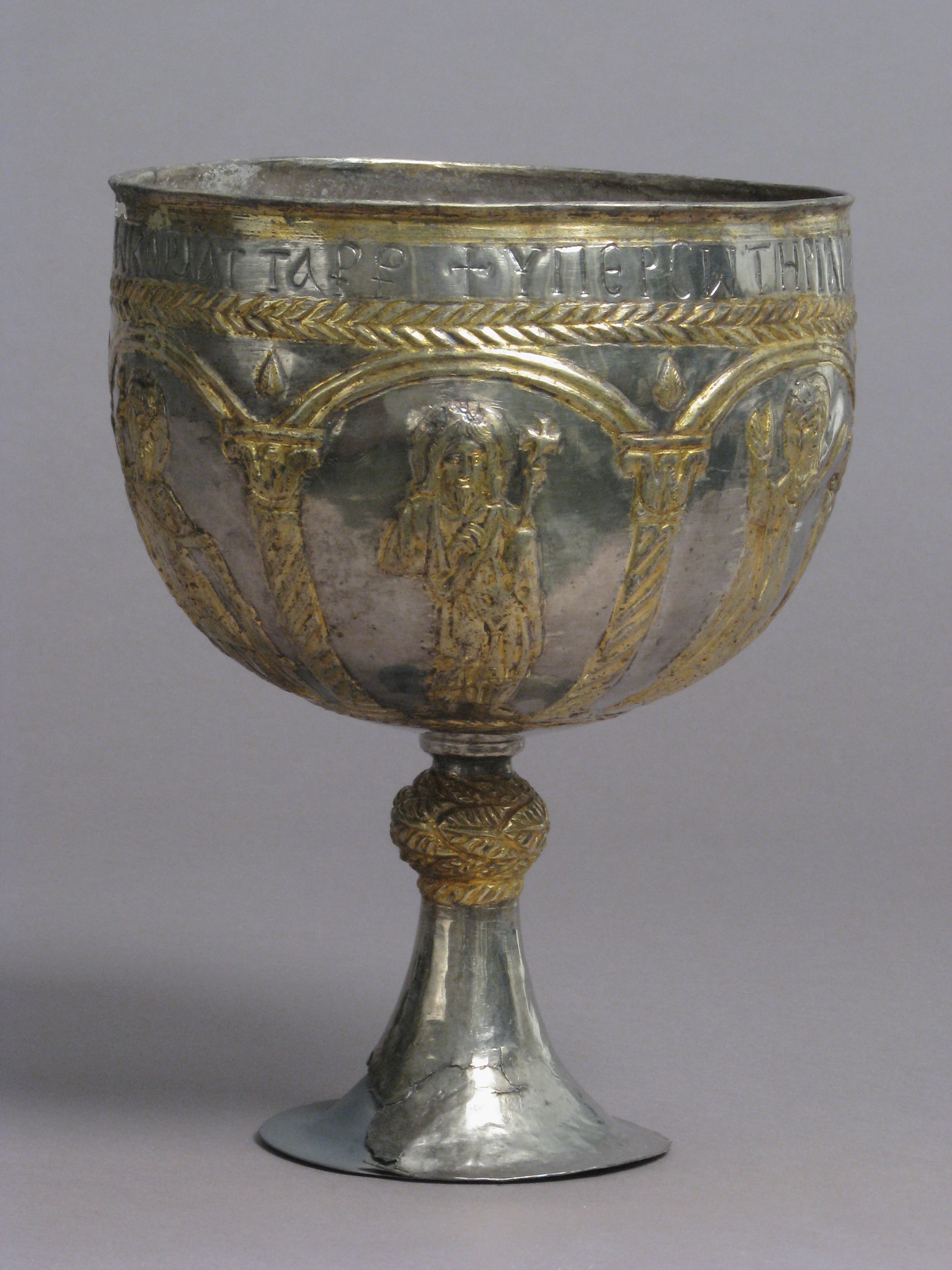
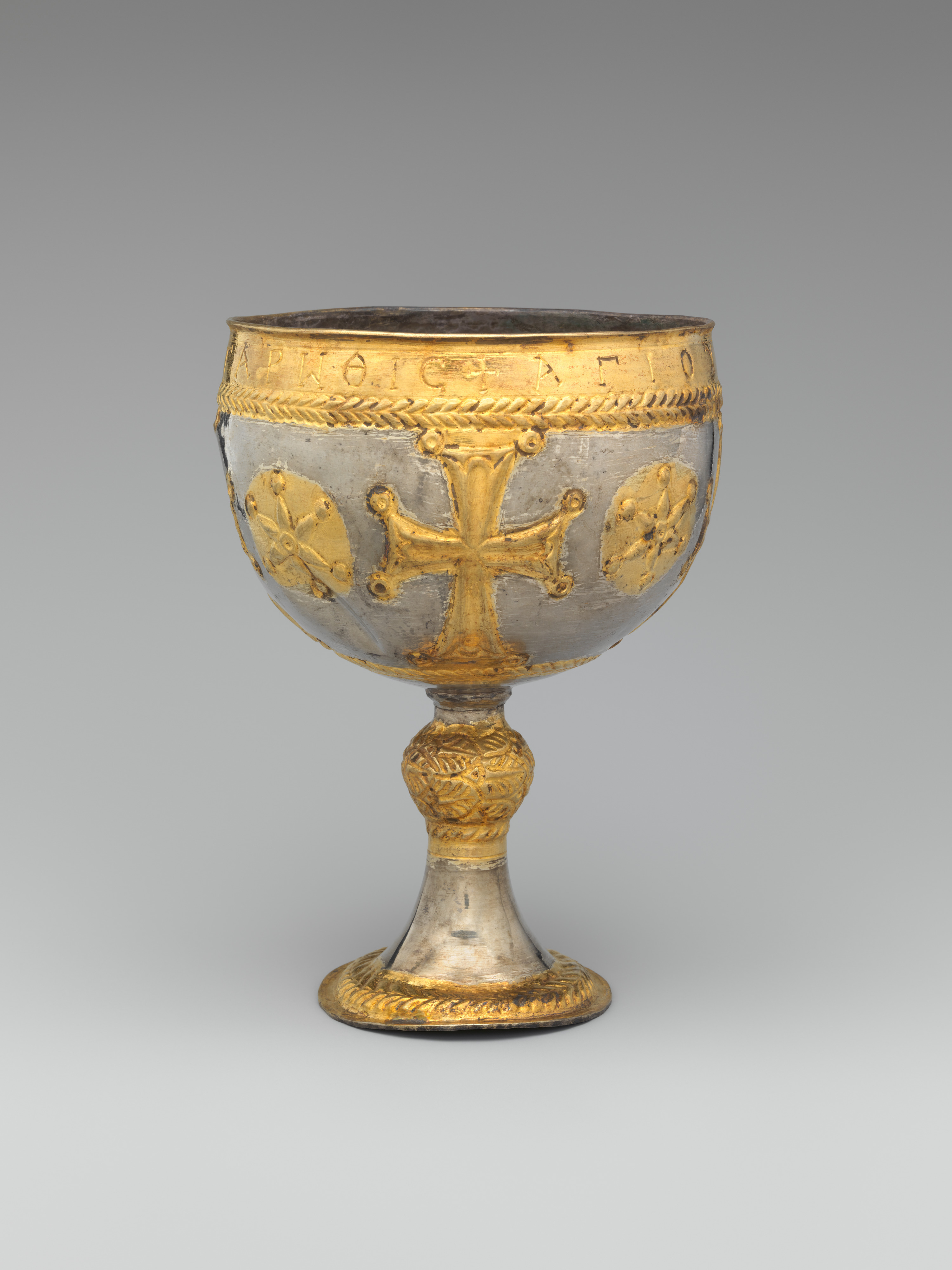
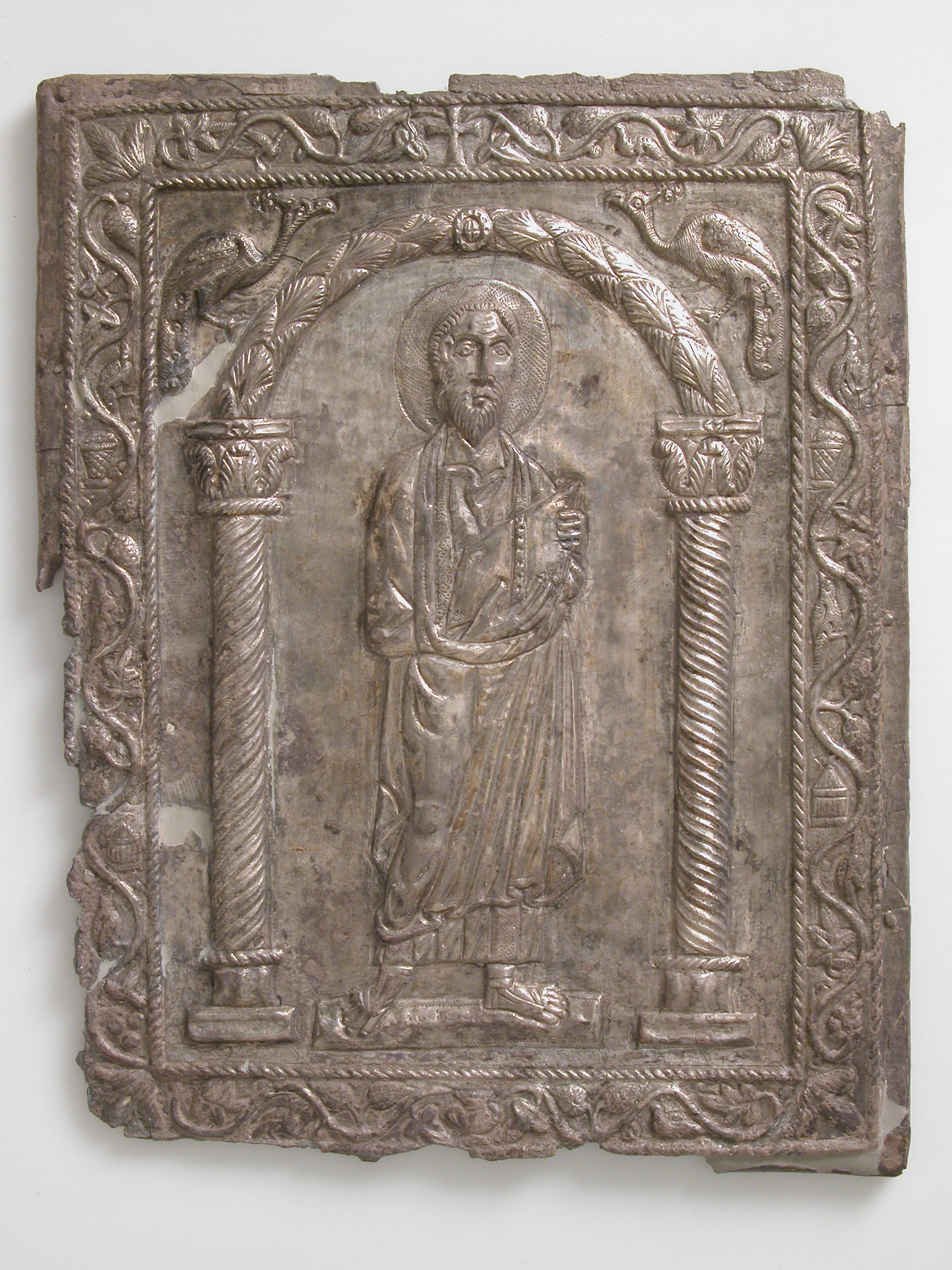
The record in full
Chapter 1The Museum puts the word chalice in quotation marks
The label reads The Antioch Chalice, with the second word inside inverted commas, and the Museum has kept those commas for years.
The label reads The Antioch Chalice, with the second word inside inverted commas, and the Museum has kept those commas for years. They are doing a lot of work. They record that this object was sold as the cup of the Last Supper, was published as first-century, was displayed at a world's fair as one of the holiest relics on earth, and is now dated 500 to 550, thought to be a lamp rather than a cup, and possibly not from Antioch at all.
Almost every claim ever made about it has been withdrawn. What has not been withdrawn is the object, which is a first-rate piece of early Byzantine silver whatever it was for, and the file, which is one of the most instructive in the history of collecting because every stage of it was published while it was happening.
Chapter 2What it is, physically
Two vessels, one inside the other. An inner bowl of plain, ungilded silver, hammered from a thick sheet with its rim turned outward into a collar about a centimetre wide.
Two vessels, one inside the other. An inner bowl of plain, ungilded silver, hammered from a thick sheet with its rim turned outward into a collar about a centimetre wide. Around it, an openwork shell of silver, gilded, carved as a fruiting grapevine inhabited by birds including an eagle, animals including a lamb and a rabbit, and twelve human figures seated in high-backed chairs holding scrolls. Below, a stand and foot turned out of a solid block of silver.
The Museum gives the overall dimensions as 19.6 by 18 by 15.2 centimetres, with a foot of 7.4 centimetres. Eisen, measuring it in 1916, gave the height as 19 centimetres and noted that the greatest diameter at the top of the bowl was 18 centimetres and the narrowest 13, a discrepancy he attributed to the upper part having been crushed by falling debris. He calculated the original diameter at about 15 centimetres and the original capacity at about two and a half litres.
The openwork was made by the method Eisen called chased-applied: the ornament was carved on a sheet of silver, the edges cut through, the background removed, and the resulting openwork soldered onto the bowl. Two different golds were used for the gilding, deep red for the figures on the bowl and pale yellow for the lotus cup, stand and foot. The inner bowl was never gilded at all.
Chapter 3The find, as the dealers told it
Everything known about how this object came out of the ground comes from the people who were selling it, written down six years later by the man they had engaged to publish it.
Everything known about how this object came out of the ground comes from the people who were selling it, written down six years later by the man they had engaged to publish it. That is the whole evidential problem in one sentence, and it should be read before the rest.
Eisen's account in 1916 is specific. What he calls the Kouchakji Silver Treasure of Antioch numbered six pieces: two chalices, three book covers and a large ceremonial cross. They were procured by Kouchakji Freres in Paris directly from the excavators in 1910. A seventh object, a smaller silver cross supposed to be from the same find, was acquired by the French archaeologist Wilhelm Froehner and stayed in Paris. The objects were all said to have been found together by Arabs digging a well at Antioch on the Orontes, in Syria, in 1910; at a depth of many metres the diggers came upon underground chambers, and the treasure was in them. The Kouchakji pieces were moved to New York for safety at the outbreak of the war.
One detail in that paragraph is worth more than the rest of it. Besides the seven entire pieces, the diggers found enough crumbled fragments of silver to fill a sack, and those fragments were smelted for the value of the metal. Whatever the treasure was, part of it was melted down before anyone recorded it, and no archaeologist ever saw the chambers. Eisen himself noted that no excavation had been made to establish what the building above them had been.
Chapter 4A restorer named only as M. Andre
Eisen records that when the chalice was found the whole surface was covered with a coating of oxide several millimetres thick, and that this was skilfully removed by the renowned restorer M.
Eisen records that when the chalice was found the whole surface was covered with a coating of oxide several millimetres thick, and that this was skilfully removed by the renowned restorer M. Andre in Paris. No first name is given, in 1916 or anywhere in the sources read here.
The best-known Paris restorer of that surname at that date was Alfred Andre, the goldsmith whose workshop supplied the dealer Frederic Spitzer with mounts and settings and whose name now appears on the Metropolitan's own labels beside nineteenth-century Renaissance-style plate. The Metropolitan holds objects attributed to him. Whether Eisen's M. Andre is that man is not established by anything consulted here, and the identification is offered as a question rather than a fact. It matters because the first thing that happened to this object in Europe was that a commercial restorer took its entire surface off, and because that is precisely the circumstance a later generation would use to argue the object had been made rather than cleaned.
Eisen also recorded something that argues the other way. The silver matrix, he wrote, had crystallised and become so brittle that a slight tap would break the vessel into fragments, and it could only be handled with the utmost care. Crystallisation of that kind is a consequence of long burial, and it is not a property a workshop can supply on request.
Chapter 5Eisen, and the first century
Gustavus A. Eisen, 1847 to 1940, was a Swedish-born naturalist turned archaeologist.
Gustavus A. Eisen, 1847 to 1940, was a Swedish-born naturalist turned archaeologist. His preliminary report in the American Journal of Archaeology in October 1916 set out the claim without hedging: the seven pieces belong to two distinct periods, the book covers to the fifth century, and the great chalice can with certainty be dated to the second half of the first century after Christ.
He built a context for it. Local tradition put a large vanished Christian church on the site. Constantine the Great had built a great cathedral at Antioch, a city bound to Peter and Paul and the place where the word Christian was first used, and Eisen thought it not improbable that an object of such importance had come into the emperor's possession and been given to that sanctuary. The cathedral, he noted, stood until the earthquake of 526 levelled the city during an assembly of 250,000 Christians.
If the chalice is first-century and was venerated in Antioch, only one identification is available for the plain inner cup it encloses. Eisen returned to the dating in a further article in April 1917 and published a two-volume monograph in 1923 under the title The Great Chalice of Antioch; a short popular version followed in 1933, printed by the object's owner. How much of the Grail claim was Eisen's own argument and how much was made for him by his readers and by the man who owned the object cannot be settled from the 1916 article, which is the only piece of his writing read for this entry. What is certain is that the object was exhibited as the Holy Grail, that its owner exhibited it that way, and that the Museum now says the identification has not been sustained.
Chapter 6What the vine was understood to mean
Within three months of the preliminary report, James A.
Within three months of the preliminary report, James A. Montgomery of the University of Pennsylvania published a note on the iconography that is still the most interesting thing written about the object's meaning, and that has survived the collapse of the date it was written under.
The vine, Montgomery observed, is the natural symbolism for a eucharistic cup, but it corresponds specifically to the opening of the eucharistic prayer in the Didache, which gives thanks to the Father for the holy vine of David. The Didache is Syrian, some say Antiochene, and early. Montgomery went further and proposed that the whole design is Jewish and drawn from the eightieth Psalm and its parable of the vine that is Israel: the beast at the foot of the design answers to the wild boar out of the wood that ravages it, and the sheep beside the figure of the Lord to the Shepherd of Israel who leads Joseph like a sheep.
He also noticed the arithmetic that still governs the argument. There are twelve figures, but two of them are the Lord, as a youth and as a man, so they cannot be the twelve apostles. Montgomery suggested the twelve tribes. The Museum's present text offers the alternative that the ten are philosophers of the classical age who, like the prophets, had foretold the coming of Christ, and points to the sixth-century Antiochene chronicler Malalas as a writer who made exactly that link. Nobody has settled it.
Montgomery wrote all of this believing the object was first-century. The reading of the vine does not depend on that, which is why it is the part of the early literature still worth reading.
Chapter 7The Grail on the midway
The object was exhibited in Europe and written about extensively through the 1920s.
The object was exhibited in Europe and written about extensively through the 1920s. In 1931 it was in the Exposition internationale d'art byzantin at the Musee des Arts Decoratifs in Paris, catalogued as number 335. In 1933 and 1934 it was in the Hall of Religion at the Century of Progress International Exposition in Chicago, shown as one of the world's holiest relics and among the most publicised attractions of the fair. In December 1935 the Brooklyn Museum gave it an exhibition of its own under the title The Chalice of Antioch and Associated Objects.
It was also being published by its owner. Eisen's short account of 1933, twenty-two pages with a coloured plate, was printed in New York by Fahim Kouchakji. Eisen explains in it that the 1923 monograph was both technical and expensive, and that this briefer untechnical version had been prepared in response to demand. The scholar who authenticated the object wrote the popular book about it; the dealer who owned the object published that book; and it appeared in the year the object went on show at the world's fair. None of that is concealed. It is on the title page.
Chapter 8The Cloisters buys it, 1950
The Metropolitan bought the chalice in 1950 from Fahim Joseph Kouchakji, 1886 to 1976, of New York, using the Cloisters Collection fund endowed by John D.
The Metropolitan bought the chalice in 1950 from Fahim Joseph Kouchakji, 1886 to 1976, of New York, using the Cloisters Collection fund endowed by John D. Rockefeller Jr. It carries the accession number 50.4. James J. Rorimer reported the acquisition in the Museum's Bulletin the following summer and, in 1954, published an essay titled The Authenticity of the Chalice of Antioch in a volume of studies for Belle da Costa Greene.
The title of that essay is the point. Four years after the Museum had bought the object, its own medieval curator was in print defending its authenticity, which means the question was live inside the institution at the moment of purchase and not raised for the first time by journalists thirty years later. No purchase price has been published in any source consulted here.
The object stayed at The Cloisters for decades in a lit case of its own. By 1985 it had been moved into a corridor at the Fifth Avenue building among other early Christian and Byzantine material, labelled simply as early Christian, with nothing in the display to single it out. It is now in Gallery 300.
Chapter 9The 1985 allegation
On 5 April 1985 the wires carried a story that an article prepared for the May issue of Art & Antiques, by the magazine's senior editor Jeffrey Schaire and two co-authors, would argue that the...
On 5 April 1985 the wires carried a story that an article prepared for the May issue of Art & Antiques, by the magazine's senior editor Jeffrey Schaire and two co-authors, would argue that the chalice is a twentieth-century forgery. The article named a probable forger: Constantine Christodoulos, a Cypriot Greek known as a master forger of ancient coins, who lived in Damascus, and who the article said was a cousin of the Kouchakji brothers. It suggested both the inner cup and the openwork shell may have been made by him about 1910, the year the object was said to have been dug up.
The evidence offered was testimony at two removes. An unidentified trustee of the British Museum was quoted saying that he met Christodoulos in Damascus in 1938 and that the elderly Greek admitted the forgery in his presence and that of a French diplomat, Count Stanislas Ostrorog; Ostrorog was said to have told the Briton that the object had been found in a garden belonging to a cousin of the forger and sold with the guarantee of a corrupt archaeologist. The report noted that no thorough modern metallurgical or chemical test had ever been made on the chalice, and called on the Museum to reopen the investigation. No comment was available from the Museum on the day.
This record does not adopt that allegation. An anonymous witness recalling a confession he heard forty-seven years earlier is not evidence of the kind that settles anything, and no scholarly literature since has adopted the forgery position: the object is catalogued as sixth-century by the Metropolitan, appeared as a sixth-century object in the Walters Art Gallery's 1986 Byzantine silver exhibition and in the Royal Academy's Byzantium in 2008, and the Museum's own summary says only that its authenticity has at times been challenged. What the 1985 story does establish, and what stands, is that the object's chain of custody begins with a family of dealers, that no archaeologist witnessed the find, and that the scientific testing the article asked for had not been done.
Chapter 10Not a chalice: the lamp
The quietest reversal is the largest. The complete vessel was believed for most of the twentieth century to be a chalice for the Eucharist.
The quietest reversal is the largest. The complete vessel was believed for most of the twentieth century to be a chalice for the Eucharist. The Museum now states that its shape is recognised as more closely resembling sixth-century standing lamps, and reads the decoration accordingly, with the vine and the light referring to the words in the eighth chapter of John, I am the light of the world.
That changes what the object was for, which on the house view is what it means. A eucharistic chalice is handled by a priest at an altar and touched by communicants; Eisen thought the wear on the faces of the two principal figures came from repeated touching by worshippers. A standing lamp burns in front of something. The twelve seated figures with their scrolls read differently in each case, and the argument about whether they are apostles, tribes or philosophers is not independent of the argument about whether the thing is a cup or a light.
Chapter 11Not Antioch: Kaper Koraon
The Museum's geography field now reads: made in Antioch or Kaper Koraon, with a question mark.
The Museum's geography field now reads: made in Antioch or Kaper Koraon, with a question mark. The alternative comes from the reconstruction of the Syrian church treasures published by Marlia Mundell Mango in the Walters Art Gallery's 1986 catalogue Silver from Early Byzantium: The Kaper Koraon and Related Treasures, where the chalice is number 40.
The argument is that the object belongs to a treasure of liturgical silver found in 1908 that had served the Church of Saint Sergios at Kaper Koraon, a town southeast of Antioch. The Museum adds a human gloss: if so, the parishioners of Saint Sergios might well have travelled into Antioch to buy the object and give it to their church, which would make it a village congregation's donation rather than an imperial treasure.
Note the date. The Kaper Koraon treasure is recorded as found in 1908; Eisen's dealers said this object came out of a well at Antioch in 1910. Both dates cannot be right for the same object, and the discrepancy is not a rounding error. It is the difference between the find story the trade supplied and the find story the scholarship has reconstructed from where the rest of the silver went.
Chapter 12What is left standing
The first-century date is gone. The Holy Grail identification is gone; the Museum says flatly that it has not been sustained.
The first-century date is gone. The Holy Grail identification is gone; the Museum says flatly that it has not been sustained. The Constantinian cathedral is gone. The word chalice is in quotation marks. The find-spot has a question mark against it. The forgery allegation of 1985 has not been adopted by the literature and has not been laid to rest by testing either.
What survives is a piece of sixth-century Syrian church silver of exceptional quality, whose openwork vine is among the finest surviving, and a documentary record in which every wrong answer was published under a respectable imprint at the time it was believed. The object is worth a page. The file around it is worth more.
The artist
Unrecorded silversmith, northern Syria, first half of the sixth century
No maker, no workshop and no patron is recorded for this object, and there is no signature or dedication to work from. What can be written about the hand behind it has to be assembled from the object itself, from the group of Syrian church silver it probably belonged to, and from the practices of a trade that furnished village churches in the hinterland of Antioch with plate of a quality that would not disgrace a cathedral. That is the point worth holding on to: this is provincial silver, and it is superb.
The dossier below therefore covers the tradition rather than a person, and it covers something else as well, because the two figures who actually shaped this object's history in the twentieth century are a naturalist-turned-archaeologist and a dealer.
Exhibited
- 1931Exposition internationale d'art byzantin, no. 335Musee des Arts Decoratifs, Pavillon de Marsan, Paris
- 1933Century of Progress International Exposition, Hall of ReligionChicago World's Fair
- 1935The Chalice of Antioch and Associated ObjectsBrooklyn Museum of Art, New York
- 1937The Dark Ages: loan exhibition of early Christian and Byzantine artWorcester Art Museum
- 1941Ecclesiastical Arts ExhibitionSpringfield Art Museum
- 1947Early Christian and Byzantine ArtBaltimore Museum of Art
- 1970The Middle Ages: Treasures from The Cloisters and The Metropolitan Museum of ArtLos Angeles County Museum of Art, then the Art Institute of Chicago
- 1986Silver from Early ByzantiumWalters Art Gallery, Baltimore
- 2000Antioch: The Lost Ancient CityWorcester Art Museum
- 2008Byzantium, 330-1453Royal Academy of Arts, London
Literature
- Gustavus A. Eisen, 'Preliminary Report on the Great Chalice of Antioch', American Journal of Archaeology 20 (October 1916), pp. 426ff - READ
- James A. Montgomery, 'A Note on the Great Chalice of Antioch', American Journal of Archaeology 21, no. 1 (1917), pp. 79-81 - READ
- Gustavus A. Eisen, 'The Date of the Great Chalice of Antioch', American Journal of Archaeology 21 (April 1917) - NOT read; bibliographic record only
- Benjamin Wisner Bacon, 'Eagle and Basket on the Antioch Chalice', Annual of the American Schools of Oriental Research 5 (1923-24), pp. 1-22 - NOT read
- Gustavus A. Eisen, The Great Chalice of Antioch, 2 vols (1923); short version, New York: Fahim Kouchakji, 1933 - NOT read; catalogue record and transcribed author's note only
- H. Harvard Arnason, 'The History of the Chalice of Antioch', The Biblical Archaeologist 4, no. 4 (December 1941), pp. 49-64, continued 5, no. 1 (February 1942), pp. 10-16 - NOT read
- Floyd V. Filson, 'Who Are the Figures on Chalice of Antioch', The Biblical Archaeologist 5, no. 1 (February 1942), pp. 1-10 - NOT read
- Glanville Downey, 'The Inscription on a Silver Chalice from Syria in the Metropolitan Museum of Art', American Journal of Archaeology 55, no. 4 (October 1951), p. 349 - NOT read
- James J. Rorimer, 'The Authenticity of the Chalice of Antioch', in Studies in Art and Literature for Belle da Costa Greene, ed. Dorothy Miner (Princeton, 1954), pp. 161-68 - NOT read
- Marlia Mundell Mango, Silver from Early Byzantium: The Kaper Koraon and Related Treasures (Baltimore: Walters Art Gallery, 1986), no. 40, pp. 18, 28-33, 63, 183-87 - NOT read
- Christine Kondoleon, Antioch: The Lost Ancient City (Princeton, 2000), no. 104, pp. 214-15 - NOT read
Related works
| Work | Relation | Where it is |
|---|---|---|
| The Attarouthi Treasure Unrecorded Syrian silversmiths | The Museum's other unexcavated Syrian church treasure Ten chalices, three censers, a dove and a wine strainer of 500-650, bought in 1986. The nearest comparison for material, date and evidential standing alike. | Metropolitan Museum of Art, 1986.3.1-.15 |
| Plaque with Saint Paul Unrecorded Byzantine silversmith | Accessioned in the same year as the chalice Byzantine silver of 550-600, shown in the same gallery. A control for the figure style of the period. | Metropolitan Museum of Art, 50.5.1 |
| The Kaper Koraon treasure Unrecorded Syrian silversmiths | The group this object has been argued into Liturgical silver recorded as found in 1908 belonging to the Church of Saint Sergios. Mango's reconstruction is the basis of the Museum's 'or Kaper Koraon (?)' geography line. | Dispersed; reconstructed in the Walters Art Gallery catalogue of 1986 |
| The smaller silver cross of the same reported find Unrecorded Syrian silversmith | The seventh piece, separated at source Eisen recorded in 1916 that it was supposed to be from the same find and had remained in Froehner's possession in Paris. Its present whereabouts were not established for this entry. | Formerly Wilhelm Froehner, Paris; not traced here |
| Ovoid cups of the Boscoreale treasure Unrecorded Roman silversmiths | The comparison Eisen used to argue a first-century date Eisen wrote that the chalice resembles in general shape the many ovoid cups of the Boscoreale treasure. The comparison is the visible mechanism of the wrong date. | Musee du Louvre, Paris |
Open questions
- Was the object found at Antioch in 1910, as the dealers said, or does it belong to the Kaper Koraon treasure recorded as found in 1908? The Museum's own geography line carries both with a question mark, and the two dates cannot both be right.
- Who was the 'M. Andre in Paris' who stripped several millimetres of oxide from the entire surface before 1916? Eisen gives no first name. The best-known Paris restorer of the surname at that date was Alfred Andre, whose workshop supplied Frederic Spitzer, but no source consulted makes the identification.
- Has any thorough metallurgical or chemical analysis ever been performed? The 1985 challenge said none had been, and no published analysis has been located since.
- Where is the seventh piece, the smaller silver cross acquired by Wilhelm Froehner and said to be from the same find?
- What did the Metropolitan pay Fahim Kouchakji in 1950? No figure is published by the Museum in any source consulted.
- Is the vessel a chalice or a standing lamp? The Museum now says the shape resembles sixth-century lamps, but keeps the word chalice in the title, in quotation marks.
- Are the ten non-Christ figures apostles, tribes of Israel or classical philosophers? Three readings have been in print since 1917 and none has prevailed.
- How much of the Holy Grail identification did Eisen argue in his own name, in the two-volume monograph of 1923 and the 1933 booklet, and how much was made for him? Only his 1916 preliminary report was read for this entry; the 1923 monograph could not be located free and the 1933 booklet is lending-restricted.
Questions about this object
What is The Antioch 'Chalice'?
The Antioch 'Chalice' is a silver, dated 500-550. Formerly published as second half of the first century AD. Medium: Silver (inner cup) and silver with gilding (outer cup and foot).
Who made The Antioch 'Chalice', and is the attribution settled?
The attribution to Unrecorded silversmith, northern Syria is recorded here as unknown. No maker, workshop, donor or dedication is recorded, and the object carries no signature. The Metropolitan dates it 500-550 and places it 'Made in Antioch or Kaper Koraon (?)'. Gustavus A. Eisen dated it with certainty to the second half of the first century when he published it in October 1916. The identification of the plain inner cup as the Holy Grail followed from that date; it was the claim under which the object was exhibited in Paris in 1931 and at the Chicago world's fair in 1933, and the Museum states that it has not been sustained. How much of that claim Eisen argued in his own name is not established by the single article of his read for this entry. Authenticity itself was challenged in a magazine article in 1985, which named a Damascus coin forger as the probable maker; no scholarly literature has adopted that position, and no metallurgical analysis has ever been published.
Where is The Antioch 'Chalice' now?
Metropolitan Museum of Art, New York, Gallery 300. Inventory number 50.4. Last confirmed 4 August 2026. The Cloisters Collection, 1950; on view 2026.
What is still unknown about The Antioch 'Chalice'?
Was the object found at Antioch in 1910, as the dealers said, or does it belong to the Kaper Koraon treasure recorded as found in 1908? The Museum's own geography line carries both with a question mark, and the two dates cannot both be right.
Sources
- 1Metropolitan Museum of Art, collection record for The Antioch 'Chalice', accession 50.4, Medieval Art and The Cloisters. Overview, provenance, exhibition history and references tabs, and the gallery audio transcript, all read 4 August 2026. metmuseum.org/art/...
- 2Gustavus A. Eisen, 'Preliminary Report on the Great Chalice of Antioch Containing the Earliest Portraits of Christ and the Apostles', American Journal of Archaeology 20, no. 4 (October 1916), pp. 426ff. Full text read from the JSTOR Early Journal Content scan. archive.org/details/...
- 3James A. Montgomery, 'A Note on the Great Chalice of Antioch', American Journal of Archaeology 21, no. 1 (1917), pp. 79-81, dated 20 January 1917. Full text read from the JSTOR Early Journal Content scan. archive.org/details/...
- 4Frederick M. Winship, 'Met Museum's holy grail challenged', United Press International, 5 April 1985, reporting an article prepared for the May 1985 issue of Art & Antiques by senior editor Jeffrey Schaire and two co-authors. upi.com/Archives/...
- 5Internet Archive catalogue record for Gustavus A. Eisen, The Great Chalice of Antioch (New York: Fahim Kouchakji, 1933), 22 pages, with the library transcription of the author's note on pp. 6-7 explaining that the 1923 two-volume monograph was 'both technical and expensive'. archive.org/details/...
- 6Metropolitan Museum of Art Collection API, object 468346: isPublicDomain true, medium 'Silver (inner cup) and silver with gilding (outer cup and foot)', geography 'Made in Antioch or Kaper Koraon (?)'. collectionapi.metmuseum.org/public/...
- 7Internet Archive catalogue record for Gustavus A. Eisen, 'The Date of the Great Chalice of Antioch', American Journal of Archaeology 21 (April 1917). Bibliographic record only; the article itself was not read for this entry. archive.org/details/...
- 8Wikipedia, 'Antioch chalice'. TERTIARY, used only to confirm the outline of the popular account; every substantive claim here is carried by 1 to 5. en.wikipedia.org/wiki/...
Last verified 20 August 2026 · Published 4 August 2026
Change log
2 August 2026 - Record deepened to the house standard: narrative sections, technical evidence, artist dossier, related works and open questions added; provenance chain and auction results replaced with the researched versions; sources rebuilt.
4 August 2026 - Record created at the house standard: researched narrative, technical evidence, maker dossier, graded provenance chain, prices with hammer and premium separated, related works, open questions and sources.
20 August 2026 - Re-verified 2026-08-20 (record desk moat pass): checked current location, attribution/function status, and litigation/restitution/export news since 2026-08-02. No change found. The Met's own object page still lists the piece in Gallery 300, credited The Cloisters Collection, 1950 (accession 50.4). The standing-lamp reattribution and the Kaper Koraon/Church of Saint Sergios group hypothesis already carried in this record's narrative remain the current state of the question; no newer scholarship, sale, claim or move was found. Source URLs spot-checked: metmuseum.org 429'd (known bot-block, not dead - the Museum's own Collection API confirms the object record is live and unchanged); archive.org and other cited sources resolve.