The Morgantina Treasure
Unrecorded Hellenistic Sicilian workshop, probably Syracuse · 3rd century BC, most likely made in the years of Hieron II's reign at Syracuse (269-215 BC) and buried around 214-211 BC
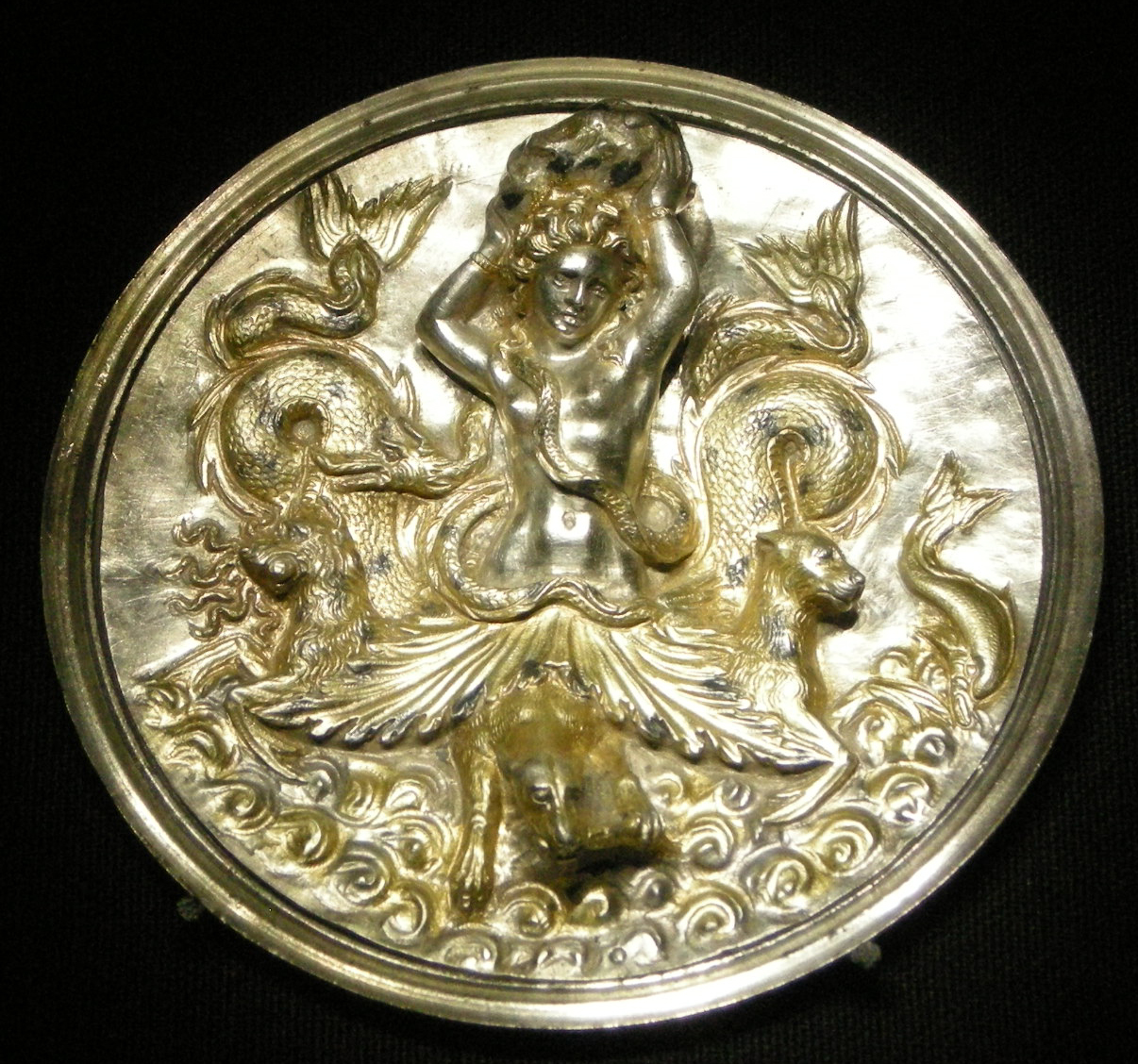
A gilt-silver medallion (emblema) from the hoard, showing the sea-monster Scylla, a woman to the waist with canine or lion-headed protomes at her sides and a serpentine, fish-tailed lower body, above a band of stylised waves. Photographed at the Museo Archeologico Regionale di Aidone. This is the single most reproduced image from the hoard.
Photograph by Wikimedia Commons contributor Folegandros; Museo Archeologico Regionale di Aidone · CC BY-SA 3.0| Artist | Unrecorded Hellenistic Sicilian workshop, probably Syracuse |
|---|---|
| Date | 3rd century BC, most likely made in the years of Hieron II's reign at Syracuse (269-215 BC) and buried around 214-211 BC |
| Medium | Silver and silver-gilt (parcel-gilt): sheet silver worked in repousse and chasing, with mercury (fire) gilding applied selectively to raised ornament |
| Dimensions | Sixteen pieces in the Metropolitan Museum's own published count (a 2003 letter from the museum's director and at least one secondary account instead give fifteen, a discrepancy not resolved in the sources consulted); individual dimensions and weights, where published, are given piece by piece in Technical below |
| Where it is now | Museo Archeologico Regionale di Aidone, Aidone, Sicilylast confirmed |
| Inventory number | No inventory number published in the sources consulted |
| Attribution | UnknownNo maker's mark, signature or workshop stamp survives on any of the sixteen pieces, which is normal for Hellenistic domestic and ritual silver. Full note |
| Object type | Silver |
| Period | Hellenistic, Greek Sicily |
| Inscriptions | A Greek graffito scratched on at least two of the vessels, read by the Metropolitan's curator Dietrich von Bothmer in 1984 as roughly 'from the war' and reread by Malcolm Bell in 1999, after examining the same letters, as the genitive form of the personal name Eupolemos, EYPOLEMOU rather than EKPOLEMOU, a one-letter difference with large consequences. Further engraved lettering is visible on the rim of at least one silver-gilt dish in the photographic record consulted for this entry; this record does not attempt to transcribe or translate it, since no published reading was located. |
| Owners on record | 7 links5 documented, 2 disputed |
| Sources | 15 cited |
About this record Last verified · 15 sources cited · Change log
On this page 10 sections
ContentsClose
The Morgantina Treasure is a hoard of sixteen pieces of Hellenistic silver, some of it gilt, made in Sicily in the third century BC and buried, on coin evidence, around the Roman sack of the Greek city of Morgantina in 211 BC. Illegally dug up in 1979-80 and sold on through a Lugano middleman to the dealer Robert Hecht, it reached the Metropolitan Museum of Art in New York in two purchases, in 1981 and 1982, for a price sources give as either 2.7 or 3 million dollars.
An archaeologist who had spent his career excavating Morgantina, Malcolm Bell III, recognised the hoard on the Met's own wall in 1987 and spent the next twelve years pressing a museum that stalled him at every step, until his own excavation of a looted house and his own rereading of a scratched Greek inscription overturned the museum's published account of what the objects were. The correction turned an anonymous 'trophy of war,' as the Met's curator had translated it, into the named property of a man called Eupolemos.
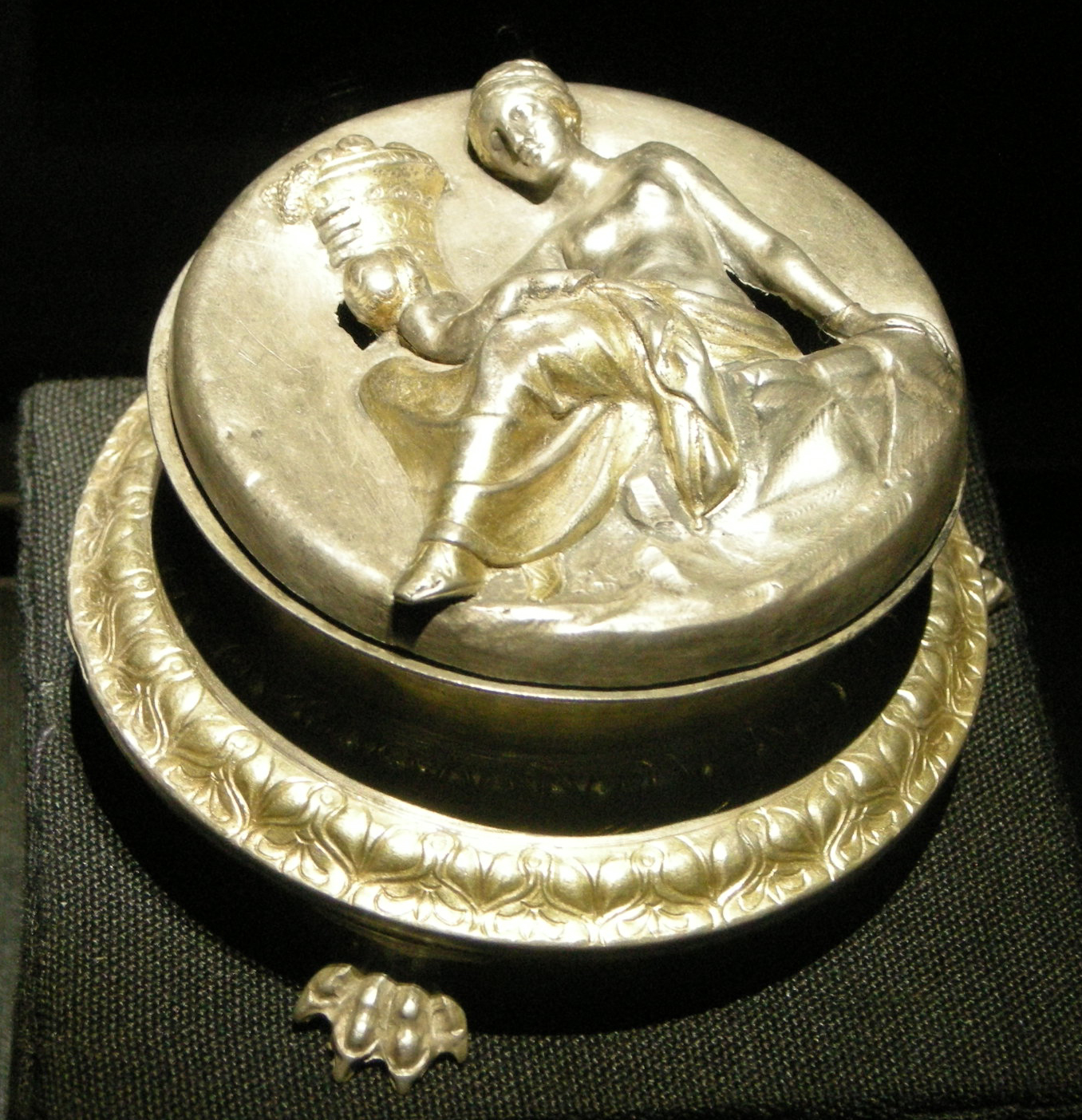
Italy and the Met settled the case within a wider 2006 framework agreement that also resolved the Euphronios krater. The silver returned to Italy in 2010 and now belongs to a loan arrangement, not a clean break: it rotates on an approximately four-year cycle between the Museo Archeologico Regionale di Aidone, two kilometres from where it was dug up, and the Met's own galleries in New York, where it was independently confirmed on display again in 2015. Individual pieces, above all a gilt medallion of the sea-monster Scylla and a pyxis lid showing the personification of Peace with a child, are now among the most reproduced images of Hellenistic Sicilian silverwork anywhere.
Provenance
Each link is graded. Documented: a cited source supports it. Disputed: the identification is argued but not established. Unknown: no owner for that span, and the gap is not smoothed into a narrative. The grades in the glossary.
- 3rd century BC - c. 214-211 BCA household at Morgantina identified by graffito as that of Eupolemos, argued by some scholars to be a hierophant of Demeter and Persephonedisputed
Made, on style, in the third century BC, probably in the decades of Hieron II's reign at Syracuse, and used as domestic and ritual plate at Morgantina. The graffito reading and the identification of the owner's status are both argued rather than documented; see open_questions.13
- c. 214-211 BC - 1979-80Buried at Morgantina; no owner recordeddocumented
Buried, on coin evidence, around the time of the Roman siege and sack of Morgantina in 211 BC, and never recovered by its owners. The findspot, a Hellenistic house identified in 1997-98 excavation as the likely source, is a strong circumstantial match, not a witnessed record.123
- 1979-80 - 1986Vincenzo Bossi (also spelled Bozzi) and Filippo Baviera, tomb robbers of Enna; then Orazio Di Simone, middleman, Luganodisputed
This account rests on information passed by the Carabinieri's art squad, published by Peter Watson and Cecilia Todeschini, and on testimony from tomb robbers with a direct interest in reducing their own legal exposure. Bossi and Baviera are reported to have sold the silver for 110 million lire (about 27,000 dollars) to Di Simone, a Sicilian middleman based in Lugano, Switzerland. No contemporaneous excavation record exists, by definition, and this record does not treat the account as more certain than its sourcing allows.35
- 1981 - 1982Robert Hecht, antiquities dealer, Paris and New Yorkdocumented
Di Simone sold the hoard to Robert Hecht for 875,000 dollars. Hecht sold it to the Metropolitan Museum of Art in two lots, in 1981 and 1982; sources disagree on the total price the Met paid, giving either 2.7 million or 3 million dollars. Hecht went on trial in Rome from 2005 on charges of trafficking in looted antiquities; the case was dismissed in 2012, shortly before his death.135
- 1981-82 - January 2010The Metropolitan Museum of Art, New Yorkdocumented
Published by curator Dietrich von Bothmer in the museum's Bulletin in 1984, with what a source consulted describes as only vague details of possible origin, and with a graffito translation ('from the war') later shown to be a misreading of a personal name. The museum refused Malcolm Bell's 1993 request to examine the pieces and did not grant access until 1999. In 2003 the museum's director offered to cede title after a further 25-year loan, an offer Italy declined.1345
- 21 February 2006 - January 2010Title agreed for transfer to Italy; possession with the Metropolitan Museum pending the agreed datedocumented
The Metropolitan Museum, Italy's Ministry of Culture and the Sicilian regional government signed a framework agreement on 21 February 2006 covering the Morgantina silver alongside the Euphronios krater, a Laconian kylix and three examples of red-figure pottery. The silver could remain on loan and on view in New York until January 2010; in exchange, Italy agreed to lend the Met other ancient works described in the agreement as 'comparably great'.12
- 2010 - presentItalian Republic; Museo Archeologico Regionale di Aidone, with a recurring loan rotation to the Metropolitan Museumdocumented
Title passed to Italy from January 2010; the hoard was displayed at the Palazzo Massimo alle Terme, Rome, through 23 May 2010, then in Palermo through roughly August 2010, then at Aidone, where the New York Times reported it on display by 5 December 2010. The 2006 agreement's terms have produced a recurring loan rotation, reported at roughly four-year intervals, between Aidone and New York; this was independently confirmed in February 2015 when the pieces were documented back on display at the Met. Later reports of a further return to Sicily conflict on the date (2020 in one account, 2022 in another), and this record has not established the object's exact physical custody as of 2026.1267910
Prices realised
This hoard has never been offered at public auction. Every figure attached to it is a private-sale or trafficking-chain figure: 110 million lire (about 27,000 dollars) reported for the sale from the tomb robbers to Orazio Di Simone; 875,000 dollars reported for Di Simone's sale to Robert Hecht; and either 2.7 million or 3 million dollars, sources disagree, for Hecht's sale to the Metropolitan Museum of Art in 1981-82. None of these carries a premium, an estimate or an underbidder in the ordinary auction sense, and none is independently documented by a published invoice or receipt in the sources consulted.
Technical evidence
| Attribution note | No maker's mark, signature or workshop stamp survives on any of the sixteen pieces, which is normal for Hellenistic domestic and ritual silver. The Metropolitan Museum's earliest published opinion, in 1984, placed manufacture broadly at Taranto in southern Italy or in eastern Sicily. Later opinion has favoured Syracuse specifically, the wealthy Sicilian Greek capital under Hieron II in the decades before the Roman conquest of the island, on the grounds of style and of the historical plausibility of a court-level workshop producing plate of this quality. That is an argued geographic attribution, not a documented one, and this record treats it as such. |
|---|---|
| Composition | Sixteen pieces (Metropolitan Museum's own published count; a 2003 museum letter and at least one secondary account instead give fifteen, unresolved in the sources consulted): two large mixing bowls with mask-form feet; three deep drinking cups; a small cup with a fishnet motif; a jug; a two-handled drinking cup; a ladle; a phiale (libation dish) with twelve gilt rays; two pyxides with figured lids; a gilt medallion (emblema) depicting Scylla; a miniature cylindrical altar; and a pair of silver horns.12 |
| Technique and gilding | Sheet silver worked in repousse and chasing, with mercury (fire) gilding applied selectively to raised ornament against a plain silver ground, the standard Hellenistic gilding method of the third century BC.2 |
| Selected weights and dimensions, where published | Pair of deep cups, diameter 22 cm, weight 407-418 g each; hemispheric cup, diameter 13-14 cm, weight 151 g; ovoid skyphos, diameter 13.3 cm, weight 300 g; pyxis with Eirene, diameter 10.5 cm, weight 81 g; kyathos (ladle), diameter 5.5 cm, height 24.7 cm, weight 119 g; miniature altar, height 11 cm, weight 370 g. Phiale (libation dish), diameter 14.8 cm, weight 104 g, height 2.3 cm; mixing bowls (pair), diameter 26 cm, weight 891 g each; Scylla medallion, diameter 8.3 cm, weight 148 g; pair of horns, length 15.5 cm, weight 74 g.2 |
| Inscription | A Greek graffito scratched on at least two vessels, read by Dietrich von Bothmer in 1984 as approximately 'from the war' and reread by Malcolm Bell in 1999 as the genitive of the personal name Eupolemos, a one-letter difference (EYPOLEMOY against EKPOLEMOY) with large interpretive consequences. Further engraved lettering, not transcribed in any source consulted, is visible on the rim of at least one dish in the photographic record used for this entry.134 |
| Dating evidence | Manufacture is placed on style in the third century BC, probably in the decades of Hieron II's reign at Syracuse (269-215 BC). Burial is dated externally, not by the objects themselves: a bronze coin minted 214-212 BC was found at the presumed findspot, consistent with concealment during or just before the Roman siege and sack of Morgantina of 211 BC recorded by Livy. A modern 1978 Italian 100-lire coin found in the same context is read as evidence of the date of the illegal disturbance rather than of the ancient burial.123 |
| Findspot | A Hellenistic house at Morgantina, identified through Malcolm Bell's 1997-1998 excavation as the probable source, on the strength of two floor cavities sized to match parts of the hoard. The house is referred to in the secondary literature as the House of Eupolemos, after the name read in the graffito. This is a strong circumstantial identification, not a witnessed excavation record.13 |
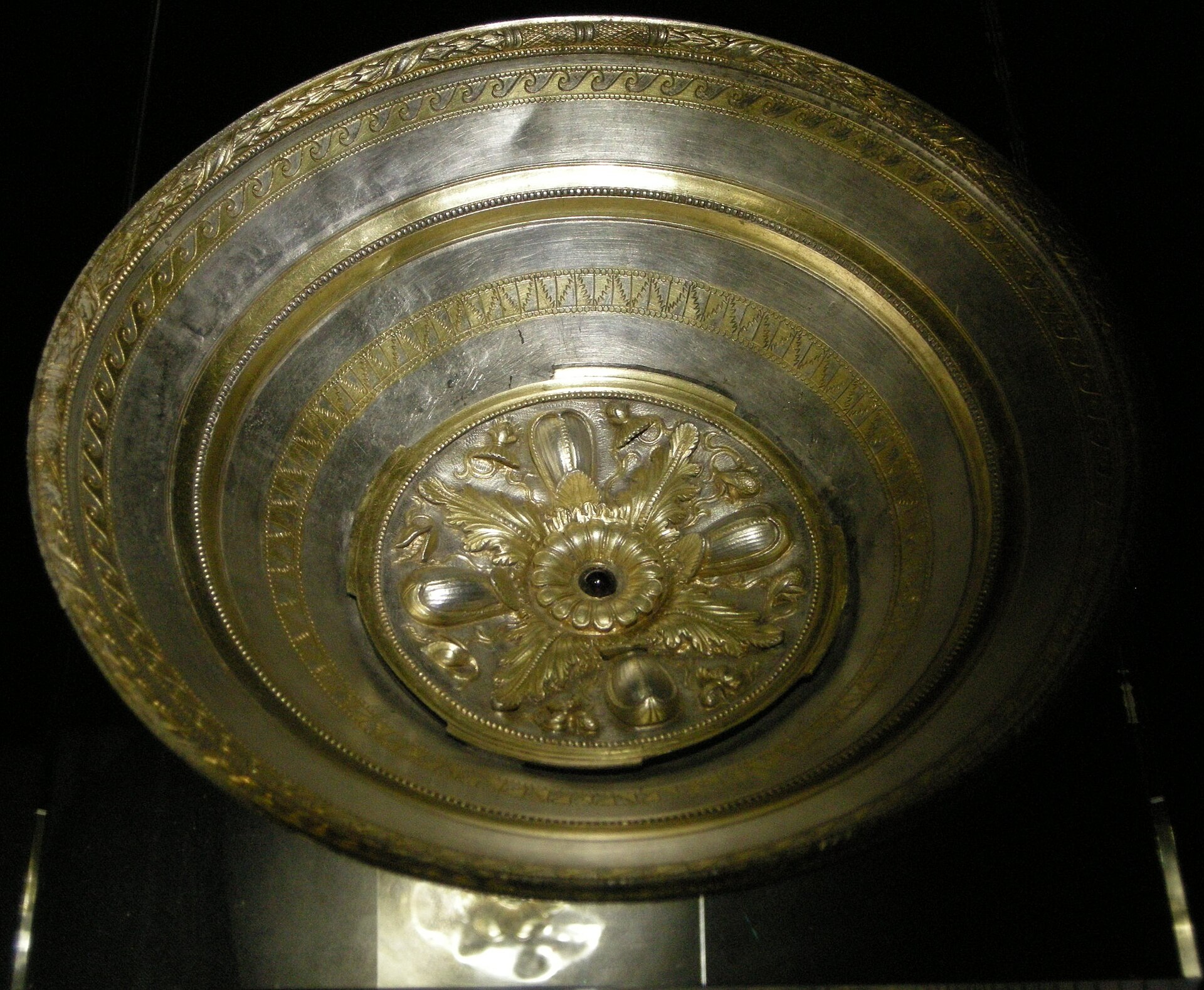
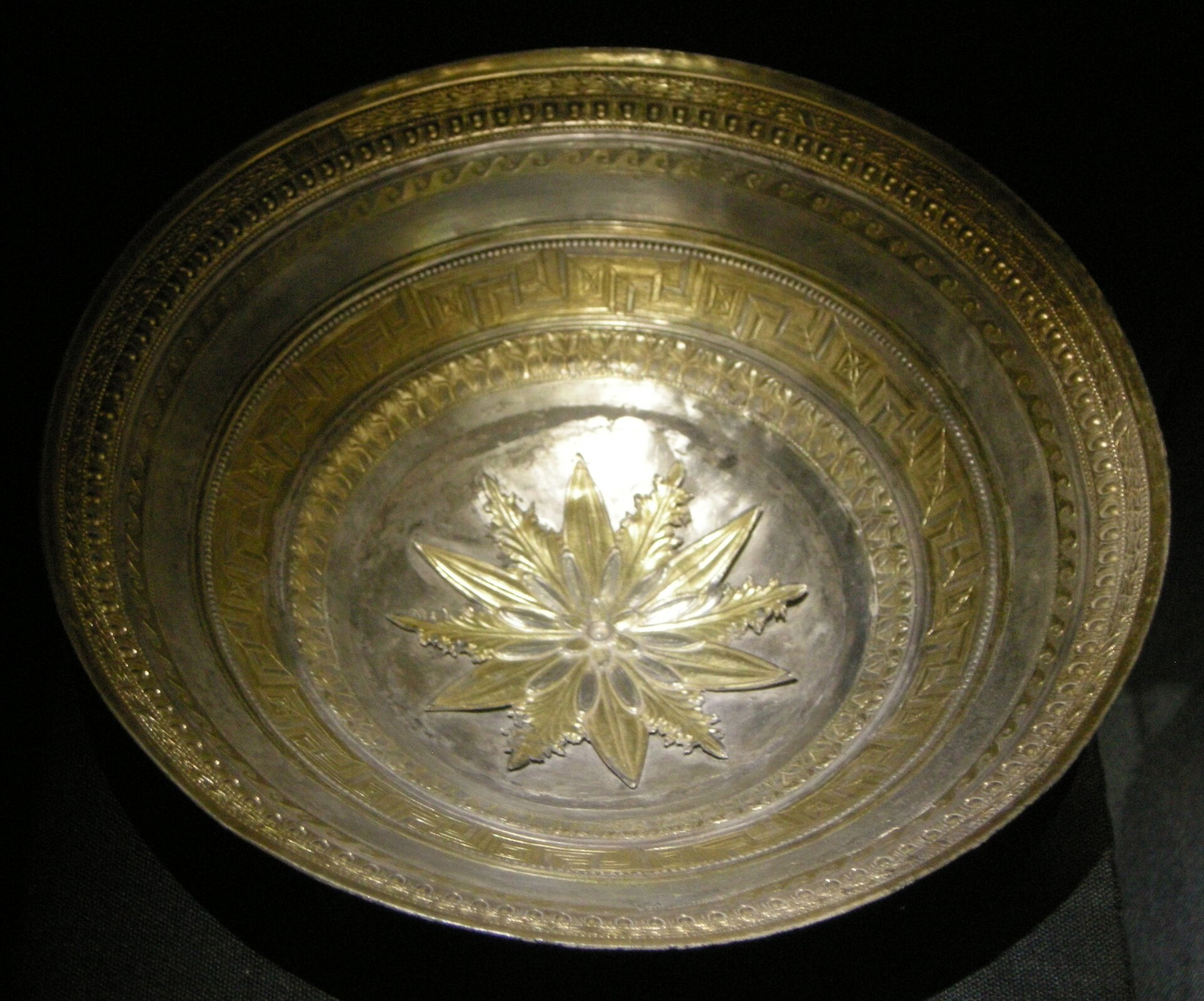
| Condition and modern imaging | Individual pieces show ancient damage and old repairs consistent with burial and recovery (visible cracking and old solder or repair lines on at least the twelve-rayed phiale and one mixing bowl in the photographic record consulted). The set has been recorded by structured-light 3D scanning (Artec Spider scanner, Artec Studio and Leios software) for research and exhibition use.8 |
Images
The record in full
Chapter 1Sixteen pieces of a Hellenistic dinner and its rites
The Morgantina Treasure is a hoard of Hellenistic silver, some of it gilt, dug illegally out of the ancient Greek city of Morgantina in central Sicily in the late 1970s.
The Morgantina Treasure is a hoard of Hellenistic silver, some of it gilt, dug illegally out of the ancient Greek city of Morgantina in central Sicily in the late 1970s. It comprises sixteen pieces by the Metropolitan Museum of Art's own published count, though a 2003 letter from the museum's director and at least one later secondary account instead give fifteen, a discrepancy this record has not been able to resolve. Whichever the true count, the set spans two functions that ancient owners did not always keep separate: dining and ritual.
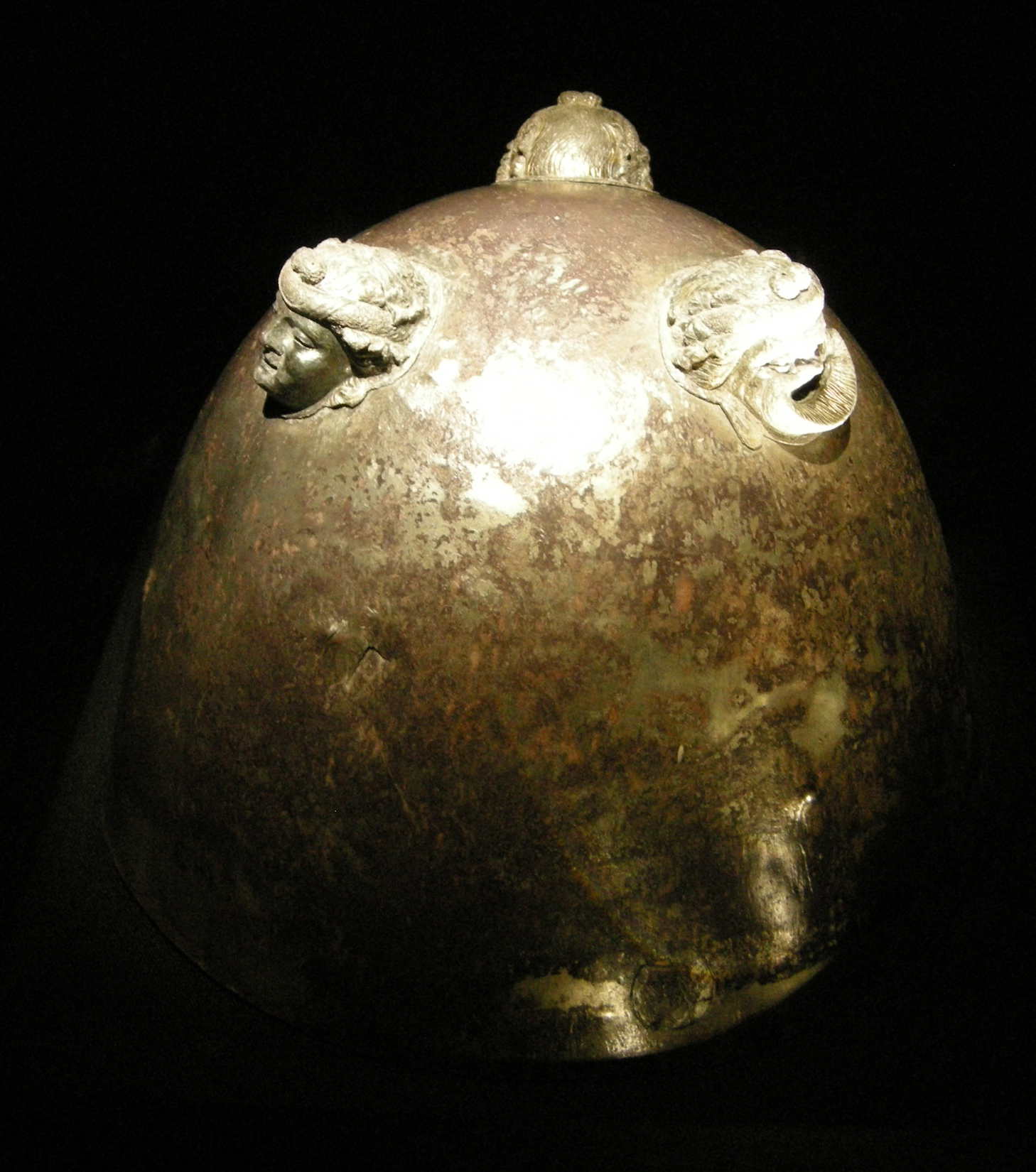
The dining half is what a wealthy Hellenistic household needed for a formal meal of wine: two large oval bowls for mixing wine with water, their supports formed as theatrical masks; three deep drinking cups; a small cup decorated with a fishnet motif; a jug; a wide two-handled drinking cup; a ladle for serving from the mixing bowl; and a shallow libation dish, its centre worked as a twelve-rayed sunburst in gilt relief. The ritual half is smaller but unmistakable: a miniature cylindrical altar just eleven centimetres high, and a pair of slender silver horns, thought to be the mounts for a leather cult mask rather than drinking vessels at all. Two small circular boxes, pyxides, carry figured lids in relief, and a gilt medallion shows the sea-monster Scylla in high relief against waves.
Nothing about this range is exotic. Every shape belongs to the standard Hellenistic Greek repertoire of tableware and libation vessels found across the Mediterranean. What makes the set exceptional is that so much of one household's silver survives together, entire, its relief work of a quality that has made individual pieces, above all the Scylla medallion and the Eirene pyxis lid, among the most reproduced images of Hellenistic Sicilian metalwork.
Chapter 2How it was made, and by whom nobody can say
The technique is repousse and chasing in sheet silver: the relief ornament was hammered up from the reverse and then refined with fine tools from the front, a method that leaves no doubt these are...
The technique is repousse and chasing in sheet silver: the relief ornament was hammered up from the reverse and then refined with fine tools from the front, a method that leaves no doubt these are worked originals rather than cast reproductions. Gilding was applied only where the makers wanted emphasis, using the standard Hellenistic method of mercury, or fire, gilding: a gold-mercury amalgam painted onto the silver surface and then heated until the mercury burned off, leaving a thin, durable layer of gold fused to the metal beneath. The result is a deliberate hierarchy within a single object. On the twelve-rayed phiale, the sunburst reads in gold against a plain silver ground; on the pyxis lids, the figures of Eirene and the winged Eros are picked out in gilt against silver drapery and background; on the altar, four gilt ox-heads support a gilt garland around an otherwise plain silver cylinder.
No maker's mark, signature or workshop stamp survives on any of the sixteen pieces, which is unremarkable for ancient plate; hallmarking of precious metal is a much later, largely post-medieval European convention. The Metropolitan's first published opinion, in the museum's own Bulletin in 1984, located manufacture broadly at Taranto in southern Italy or in eastern Sicily, a hedge that reads today as the caution of a curator working from a purchased object with no excavation record behind it. Later opinion has argued more specifically for Syracuse, the dominant Sicilian Greek city under Hieron II in the decades before the Roman conquest, on grounds of style and of the plausibility that a royal court city would support workshops capable of this standard of relief work. That argument has never been settled by anything harder than comparison; there is no inscription naming a Syracusan silversmith, and this record does not present the Syracuse attribution as more than the current scholarly preference.
Chapter 3The Scylla medallion
The single most reproduced piece in the hoard is a gilt-silver medallion, an emblema originally set into the floor of a bowl, showing the sea-monster Scylla in high relief.
The single most reproduced piece in the hoard is a gilt-silver medallion, an emblema originally set into the floor of a bowl, showing the sea-monster Scylla in high relief. She is rendered as a woman to the waist, her arms raised to bind her hair, with canine or lion-headed protomes springing from around her waist and a lower body of interlaced serpentine, fish-tailed forms, the whole composition set above a band of stylised waves.
Scylla is a conventional subject in Greek art of the sea, drawn from the Odyssey, where she and Charybdis guard a narrow strait against passing sailors, and ancient tradition placed that strait at the Strait of Messina, on Sicily's own doorstep. A Sicilian silversmith reaching for Scylla was reaching for local water as much as for Homer. Beyond that documented convention, this record does not attempt to read further private meaning into the choice; no source consulted records a specific dedication or occasion tied to this piece.
Chapter 4The pyxis lids: Eirene, and a second child of the same family of images
One small silver box, a pyxis about 10.5 centimetres across and weighing 81 grams, carries on its lid a reclining female figure in gilt relief, holding a cornucopia in one arm with a small winged...
One small silver box, a pyxis about 10.5 centimetres across and weighing 81 grams, carries on its lid a reclining female figure in gilt relief, holding a cornucopia in one arm with a small winged child figure at her side, described in the secondary literature consulted as either Eros or Ploutos, the personification of Wealth. The reclining woman is identified as Eirene, the personification of Peace. The pairing of Eirene with a child holding or accompanied by a cornucopia is a standard Hellenistic allegorical formula, descended from the celebrated bronze cult statue of Eirene carrying the infant Ploutos made by the Athenian sculptor Kephisodotos in the early fourth century BC, a composition copied and adapted many times afterward: peace nurtures wealth, stated as an image. Whether the child on this particular lid is meant as Ploutos specifically or as Eros is not resolved in the sources available for this record, and it is recorded here as an open question rather than settled either way.
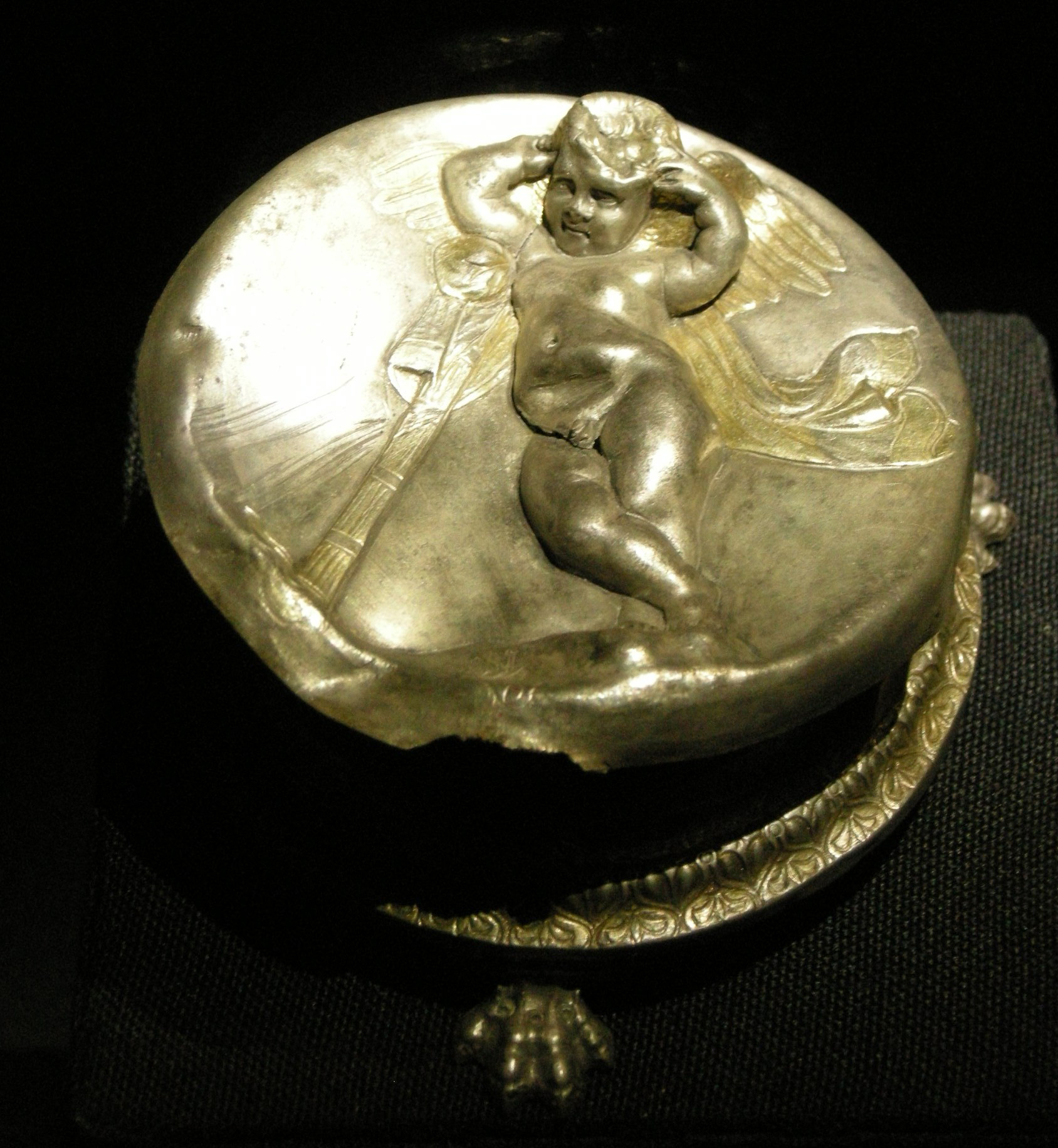
A second pyxis lid in the photographic record consulted for this entry shows a different, related image: a single winged child figure, arms raised to his head, a torch beside him, drapery beneath. A brief secondary account describes one of the hoard's pyxis lids as showing 'a cupid carrying a torch,' which appears consistent with this second lid, though this record has not located a full scholarly description or an agreed name for the piece, and does not assert the specific term sometimes used in casual description of comparable Hellenistic pyxides, an 'Erotes frieze,' for either lid. What can be said without qualification is that the hoard contains two distinct pyxis lids built around winged child figures from the same Hellenistic visual family, Eros, Ploutos and their kin, rather than one.
Chapter 5The altar and the horns: the hoard is not only a dinner service
The miniature altar is the clearest single piece of evidence that this assemblage served ritual as well as domestic use.
The miniature altar is the clearest single piece of evidence that this assemblage served ritual as well as domestic use. It stands eleven centimetres high and weighs about 370 grams, cylindrical, decorated with an Ionic dentil moulding and a Doric frieze of metopes and triglyphs, an unusual borrowing of full architectural vocabulary onto an object small enough to hold in one hand. Four gilt ox-heads, bucrania, support a gilt garland running around the body. An altar of this size was portable: it could travel with a household, or with a priest, rather than standing fixed in a sanctuary.
The pair of slender silver horns is harder to place with confidence. The most commonly repeated explanation in the secondary literature is that they were mounts for a leather ritual mask, ram-horned or otherwise, worn in ceremony rather than drunk from; this record grades that reading as argued rather than documented, since no source consulted cites a parallel object or a specific ancient text establishing the practice for Sicily. Whatever their exact function, the horns and the altar together move this hoard out of the category of ordinary Hellenistic tableware and toward something closer to the equipment of a household or personal cult.
Chapter 6The house of Eupolemos, and why the silver never came back up
Morgantina prospered under Hieron II of Syracuse through most of the third century BC.
Morgantina prospered under Hieron II of Syracuse through most of the third century BC. The Second Punic War ended that: the city went over to the Carthaginian side, and Roman forces stormed and sacked it in 211 BC, an episode recorded by Livy. A bronze coin found with the hoard's presumed findspot, minted between 214 and 212 BC, dates the deposit to those last years, consistent with silver buried for safekeeping as Roman troops closed on the city and never recovered by owners who were killed, enslaved or scattered.
The graffito read by Malcolm Bell in 1999 as the genitive of the name Eupolemos, scratched onto at least two of the vessels, connects the hoard to an actual named individual rather than to an anonymous spoil of war: the same name appears on a third-century BC document recording a real-estate transaction found separately at Morgantina, not a common name, which is part of why the match was taken seriously. On the strength of the altar, the horns, and the name, some scholars have proposed that the household this silver belonged to was not an ordinary one but that of a hierophant, a high priest of the cult of Demeter and Persephone that Morgantina's own excavated sanctuaries attest to in the town. This record grades that identification as argued: it rests on the combination of ritual objects with a named owner in a plausible cult landscape, not on a text that states the owner's office.
Chapter 7The looting, so far as it is documented, and no further
This is the point in the record where the evidence thins fastest, and the thinness is itself the finding.
This is the point in the record where the evidence thins fastest, and the thinness is itself the finding. No contemporaneous excavation record exists for this hoard, by definition: it left the ground illegally and unrecorded. What is documented rests substantially on testimony given years later by people with a direct interest in shortening their own legal exposure, and this record treats that origin with the caution it requires.
According to information passed by the Carabinieri's art squad and published by the investigative writers Peter Watson and Cecilia Todeschini, two tomb robbers from Enna, named as Vincenzo Bossi (also spelled Bozzi in at least one account consulted) and Filippo Baviera, removed the silver from Morgantina around 1979-1980, and sold it for 110 million lire, about 27,000 dollars, to a Sicilian middleman based in Lugano, Switzerland, Orazio Di Simone. Di Simone sold it on to the New York-based antiquities dealer Robert Hecht for 875,000 dollars. Separately, the tomb robber Giuseppe Mascara, arrested in 1996, gave testimony describing having seen and tried unsuccessfully to buy the silver himself, and offered an account of the alleged findspot; the Metropolitan's own vice president and counsel, Ashton Hawkins, told Italian officials the museum could not rely on the word of a convicted looter reducing his own sentence.
The exact findspot was not conclusively pinpointed by any contemporaneous record. It took Malcolm Bell's own excavation, in 1997 and 1998, of a Hellenistic house believed on the strength of local report to be the source, to establish physical evidence consistent with the hoard: two cavities in the floor sized to match parts of the assemblage, one of them containing both a 1978 Italian 100-lire coin, which helped date the disturbance, and the bronze coin of 214-212 BC discussed above. That is strong circumstantial evidence linking a specific house to the hoard. It is not a witnessed excavation. Who actually dug, on what date, in how many separate episodes, and what else may have come out of the ground with the silver and gone elsewhere unrecorded, remains open, and this record does not pretend otherwise.
Chapter 8Robert Hecht and the Metropolitan's two purchases
The Metropolitan Museum of Art bought the hoard from Robert Hecht in two lots, in 1981 and 1982.
The Metropolitan Museum of Art bought the hoard from Robert Hecht in two lots, in 1981 and 1982. The price is not agreed across the sources consulted for this record: an academic summary drawing on later press reporting gives a combined 2.7 million dollars; Watson and Todeschini's investigative account states Hecht sold the silver to the Met for 3 million dollars. Both figures rest on secondary reporting rather than a published invoice, and this record records the conflict rather than choosing between the two.
Hecht was already, by 1981, one of the most prominent antiquities dealers in the world, a Baltimore-born, Paris-based figure who had sold to nearly every major museum in the West over three decades, and who would go on trial in Rome from 2005 on charges of conspiring to traffic in looted antiquities; the case ended on 16 January 2012 with a statute-of-limitations ruling and no verdict, weeks before his death at 92. He was also, separately, the dealer at the centre of the Metropolitan's Euphronios krater, a case this archive covers as its own record.
Dietrich von Bothmer, the Met's curator of Greek and Roman art, published the hoard in the museum's Bulletin in 1984, with what one account describes as only vague details as to its possible origin. Museum officials are reported to have told inquirers at points that the pieces came originally from Turkey and had been legally imported via Switzerland, a claim never substantiated in any source consulted and quietly not repeated once the Sicilian origin became difficult to deny. Von Bothmer's 1984 publication also offered a reading of the Greek graffito on two of the vessels as meaning roughly 'from the war,' a translation that stood unchallenged in print for fifteen years and that, if true, would have framed the objects as an anonymous trophy rather than a named individual's stolen property. It was wrong by one letter, and the correction, when it came, came from outside the museum.
Chapter 9Malcolm Bell's investigation
Malcolm Bell III, an art historian at the University of Virginia who directed the American excavations at Morgantina for decades, first saw the hoard on display at the Metropolitan in 1987, three...
Malcolm Bell III, an art historian at the University of Virginia who directed the American excavations at Morgantina for decades, first saw the hoard on display at the Metropolitan in 1987, three years after its publication, in a corridor devoted to ancient gold and silver off the museum's main entrance hall. He recognised it. "I realized that it corresponded in its details to the description that had been circulated as rumor and gossip. I was amazed," he later said of that moment, the details in question being rumours already circulating among residents of Aidone, the town beside the ancient site.
Bell wrote to the museum stating his suspicion that the silver had come out of Morgantina, and informed Italian authorities. His first formal request to examine the pieces, in 1993, was refused outright, a rejection later described in press coverage as almost unheard of for a request from a serious scholar. In the years that followed, the museum did not repeat an outright refusal but did not grant access either. "They didn't deny me permission, just constantly put me off, set up obstacles," Bell said of the period.
In 1997 and 1998, Bell's team excavated the Morgantina house believed to be the findspot and recovered the coin evidence described above. In the spring and summer of 1999, twelve years after he first saw the silver on display, the Met finally allowed him to examine it directly, reportedly after the FBI offered secure laboratory facilities for the study. Reading the graffito for himself, Bell identified the letters as the genitive of the personal name Eupolemos rather than von Bothmer's 'from the war,' a difference of one letter, EYPOLEMOY against EKPOLEMOY, that converted an anonymous battle trophy into the property of a named individual. Carla Antonaccio, who joined Bell as co-director of the Morgantina excavations in 1990, later underlined why the match to a separately excavated land document carrying the same name mattered: "It wasn't a common name."
Bell continued to campaign publicly for the hoard's return through the 2000s, and was honoured with honorary citizenship of Aidone in 2008, two years before the silver itself reached the town. He died on 7 January 2024, at 82; the Archaeological Institute of America's citation for his 2016 Gold Medal credited him with having 'placed the problem front and center both in the international media and in the profession' of illicit excavation and antiquities smuggling, and with helping to craft the bilateral framework that eventually returned the Morgantina material.
Chapter 10Institutional resistance, and the road to 2006
The Metropolitan's position did not move for most of two decades.
The Metropolitan's position did not move for most of two decades. In a letter of 2003 to Italy's then culture minister Giuliano Urbani, the museum's director Philippe de Montebello proposed that the Met might be willing to cede title to what his letter described as the fifteen pieces of silver, if the museum were allowed to keep the set on display in New York for a further twenty-five years. Italy did not accept the offer.
What changed the calculation was not new evidence about Morgantina specifically but the collapse of the wider market the silver had moved through. The same years saw the Italian investigation into the trafficking network supplied by Giacomo Medici reach the Metropolitan's other major contested object, the Euphronios krater, also sold to the museum through Robert Hecht, and saw the criminal prosecution in Rome of the Getty's antiquities curator Marion True. Facing that pressure across multiple fronts at once, the Met and Italy reached a comprehensive settlement rather than litigating the Morgantina silver as a single, separable case.
Chapter 11The 2006 agreement and the 2010 return
The Metropolitan Museum and Italy's Ministry of Culture, together with Sicily's regional government, signed an agreement on 21 February 2006 covering several disputed objects at once: the Euphronios...
The Metropolitan Museum and Italy's Ministry of Culture, together with Sicily's regional government, signed an agreement on 21 February 2006 covering several disputed objects at once: the Euphronios krater, a Laconian kylix, three examples of red-figure pottery, and the Morgantina silver. Under its terms specific to the silver, the hoard could remain on loan and on display in New York until January 2010, after which title passed to Italy; in exchange, the Met was to receive long-term loans of what the agreement's own language called 'comparably great works of ancient art' from Italian collections.
On its return to Italy in early 2010, the hoard was displayed first at the Palazzo Massimo alle Terme, part of the Museo Nazionale Romano in Rome, through 23 May 2010, then at the archaeological museum in Palermo through roughly August of that year, before reaching the Museo Archeologico Regionale di Aidone, two kilometres from the ancient site itself. The New York Times reported it on display there by 5 December 2010. This record has not located a detailed account of a formal handover ceremony, its attendees or its speeches, comparable to what exists for some other repatriated Sicilian material from the same years, and does not invent one; that absence is recorded as an open question rather than filled with assumption.
Chapter 12A rotating loan, not a clean break
The 2006 agreement did not end the Metropolitan's relationship with this object.
The 2006 agreement did not end the Metropolitan's relationship with this object. Multiple sources describe the pieces as travelling on a loan rotation, reported at roughly four-year intervals, between Aidone and New York, part of the broader cultural-cooperation terms of the 2006 settlement rather than a one-way repatriation. This record has found independent confirmation that the arrangement was real and not merely promised on paper: the critic Lee Rosenbaum, writing as CultureGrrl for ArtsJournal, documented in February 2015, from her own visit to the Met's galleries, that the Morgantina silver was back on display in New York under 2015 loan labels, after what she described as an unexplained delay beyond the point at which the rotation should have brought it back. Rosenbaum also judged, as her own opinion rather than a documented fact, that the Italian antiquities lent to the Met in exchange under the 2006 terms were comparatively unremarkable next to what New York had sent to Sicily.
Reporting on the pieces' most recent return to Sicily does not agree. An Italian arts publication, Finestre sull'Arte, states the pieces spent four years at the Met before returning home in 2020. A separate 2024 report in Il Giornale dell'Arte, covering an unrelated seizure, states in passing that the original hoard was returned to Italy in 2022. This record has not been able to resolve that conflict from the sources available, and does not present either date as settled; the object's exact physical custody as of 2026 is recorded as an open question rather than assumed to be Aidone by default, notwithstanding that Aidone is where it is most consistently reported to be shown when it is in Sicily.
Chapter 132024: new material rejoins the house of Eupolemos
In 2024, as the Aidone museum marked forty years since its founding, Italy's Carabinieri Cultural Heritage Protection Unit seized a group of fragmentary third-century-BC silver objects reportedly...
In 2024, as the Aidone museum marked forty years since its founding, Italy's Carabinieri Cultural Heritage Protection Unit seized a group of fragmentary third-century-BC silver objects reportedly being offered for sale on the black market, said in Italian art-market press to originate from the same context as the original hoard, the House of Eupolemos near Morgantina's ancient agora, and intended to be reunited with it at Aidone. This record treats that report, sourced to a single specialist publication, as documented but flags it for a stronger citation if one becomes available. What it establishes, if accurate, is that not everything removed from the findspot in 1979-80 necessarily reached the Metropolitan Museum: some material from the same house appears to have remained in private hands, undetected, for over four decades after the original looting.
Chapter 14Study now: scanning what photography cannot hold
The Aidone hoard has been digitised using structured-light 3D scanning, with an Artec Spider scanner and Artec Studio and Leios software, specifically because the pieces' elaborate relief decoration...
The Aidone hoard has been digitised using structured-light 3D scanning, with an Artec Spider scanner and Artec Studio and Leios software, specifically because the pieces' elaborate relief decoration and reflective, partly gilt surfaces are difficult to record adequately with conventional photography. The resulting models are intended for museum exhibition and for research use by scholars who cannot travel to Aidone. This is one of relatively few instances in this archive of an actively maintained, open technical-imaging programme on a repatriated antiquity rather than on an object that never left a major research institution.
The artist
Unrecorded Hellenistic silversmiths' workshop, argued to be at Syracuse
There is no name to give, and ancient plate of this kind rarely carried one. What can be reconstructed is a practice: a workshop, or a small group of workshops, producing high-quality relief silver in the standard Hellenistic Greek repertoire of shapes for a wealthy Sicilian clientele in the decades before the Roman conquest, at a level of craftsmanship good enough that individual pieces from this single find are now among the most reproduced images of Hellenistic Sicilian metalwork. Where that workshop stood, whether Syracuse or somewhere else, is argument rather than record, and this record treats it as such throughout.
Related works
| Work | Relation | Where it is |
|---|---|---|
| Cult Statue of a Goddess Unknown sculptor, western Greek workshop | A completely different object from the same site, not to be confused with this hoard A limestone-and-marble cult statue, also looted from Morgantina in the same era, bought by the J. Paul Getty Museum in 1988 and returned to Italy separately in 2011, one year after this silver. The two cases share a site, a museum of destination in Aidone, and a broad period of resolution, but are otherwise distinct: different material, different American buyer, different dealers, and a different legal and diplomatic path. Held as its own record in this archive; every image in this record has been checked against the Commons category for this hoard specifically to avoid the two being conflated. | Museo Archeologico Regionale di Aidone |
| Euphronios Krater (Sarpedon Krater) Euxitheos, potter; Euphronios, painter | Sold to the Metropolitan Museum through the same dealer, Robert Hecht, and resolved under the same 21 February 2006 framework agreement Held as a separate record in this archive. Returned to Italy in 2008, two years ahead of the Morgantina silver's own 2010 return. | Museo Archeologico Nazionale Cerite, Cerveteri |
| The Morgantina acroliths Unknown, Greek, Sicily | Looted from the same site; formerly in the collection of Maurice Tempelsman; returned to Italy in the same repatriation wave Marble heads and extremities from acrolithic cult statues of Demeter and Persephone, believed to have been looted from Morgantina like this silver hoard and the Getty statue, and shown at Aidone alongside both. | Museo Archeologico Regionale di Aidone |
Open questions
- Is the correct piece count sixteen or fifteen? The Metropolitan's own object title and most secondary accounts say sixteen; a 2003 letter from the museum's director and at least one other secondary account say fifteen. This record has not found a source that explains the discrepancy.
- What was the actual price the Metropolitan paid Robert Hecht? Sources consulted give both 2.7 million dollars (an academic summary citing later press reporting) and 3 million dollars (an investigative account citing Carabinieri information), and neither cites a published invoice.
- Is the name on the two graffiti-bearing vessels definitely the same Eupolemos named on the separately excavated Morgantina land document, or two different men of the same name? The sources consulted treat the match as persuasive rather than certain.
- Was the household that owned this silver actually that of a hierophant of Demeter and Persephone, as some scholars have proposed? No source consulted cites a text stating the owner's office; the identification rests on combining the altar, the horns and the name.
- What is the function of the pair of silver horns? The common explanation, mounts for a leather ritual mask, is repeated in secondary sources without a cited parallel object or ancient text specific to Sicily.
- Is there a scholarly name for the second pyxis lid, the one showing a single winged child with a torch? This record could not locate one, and does not use the term sometimes applied loosely to comparable Hellenistic pyxides, an 'Erotes frieze', for lack of a source that applies it to this specific piece.
- What did the individual pieces from the 1979-80 looting fetch, and did all sixteen (or fifteen) reach Robert Hecht by the same route through Orazio Di Simone, or did some travel separately? The chain as documented covers the hoard as a whole, not piece by piece.
- Was there a formal handover ceremony when the hoard reached Aidone in late 2010, and if so, who attended and what was said? This record has not located an account of one, unlike the fuller press record that exists for some other repatriated Sicilian antiquities from the same years.
- Where is the hoard physically now, in 2026? Reporting on its most recent return to Sicily conflicts (2020 in one account, 2022 in another), and this record has not been able to establish whether it is currently at Aidone or on a further rotation to New York.
- What became of the 2024 seizure of fragmentary silver reportedly linked to the same house? This record could not confirm from the single source consulted whether the pieces have in fact been formally reunited with the hoard at Aidone.
Questions about this object
What is The Morgantina Treasure?
The Morgantina Treasure is a silver, dated 3rd century BC, most likely made in the years of Hieron II's reign at Syracuse (269-215 BC) and buried around 214-211 BC. Medium: Silver and silver-gilt (parcel-gilt): sheet silver worked in repousse and chasing, with mercury (fire) gilding applied selectively to raised ornament.
Who made The Morgantina Treasure, and is the attribution settled?
The attribution to Unrecorded Hellenistic Sicilian workshop, probably Syracuse is recorded here as unknown. No maker's mark, signature or workshop stamp survives on any of the sixteen pieces, which is normal for Hellenistic domestic and ritual silver. The Metropolitan Museum's earliest published opinion, in 1984, placed manufacture broadly at Taranto in southern Italy or in eastern Sicily. Later opinion has favoured Syracuse specifically, the wealthy Sicilian Greek capital under Hieron II in the decades before the Roman conquest of the island, on the grounds of style and of the historical plausibility of a court-level workshop producing plate of this quality. That is an argued geographic attribution, not a documented one, and this record treats it as such.
Where is The Morgantina Treasure now?
Museo Archeologico Regionale di Aidone, Aidone, Sicily. Inventory number No inventory number published in the sources consulted. Last confirmed 17 August 2026. Returned by the Metropolitan Museum of Art to Italy under the framework agreement of 21 February 2006; title passed to Italy from January 2010 and the hoard was on display in Rome and Palermo before reaching Aidone by December 2010. The agreement provided for the pieces to rotate on loan between Aidone and the Met approximately every four years; a return to New York was independently documented in February 2015, and Italian art-market press reported the pieces back in Sicily by 2020 or 2022 depending on the account (the two do not agree, see open_questions). Current physical custody as of 2026 is not confirmed in the sources consulted for this record.
What is still unknown about The Morgantina Treasure?
Is the correct piece count sixteen or fifteen? The Metropolitan's own object title and most secondary accounts say sixteen; a 2003 letter from the museum's director and at least one other secondary account say fifteen. This record has not found a source that explains the discrepancy.
Sources
- 1Suzie Thomas, 'Morgantina Silver', Trafficking Culture encyclopedia case study, last modified 26 November 2012, drawing on Watson and Todeschini (2006), Bell (2002), Stille (1999), Singleton (2006), Wilkerson (2001), Hundley (2000), Brodie (1998), Carroll (2002) and Eakin and Povoledo (2006). The fullest single sourced account consulted for this record; used throughout for the looting chain, the price chain, von Bothmer's 1984 publication, Bell's role and timeline, the 2003 letter, and the 2006 agreement's terms. traffickingculture.org/encyclopedia/...
- 2Wikipedia, 'Morgantina treasure'. Used for the itemised list of the sixteen pieces, individual weights and dimensions, the historical context of the 211 BC siege, the hierophant interpretation, and the display sequence in Rome and Palermo. en.wikipedia.org/wiki/...
- 3UVA Magazine, 'Plunder: The theft of the Morgantina silver'. Used for Malcolm Bell's direct quotations, the 1987 sighting at the Met, the twelve-year delay, the 1997-98 excavation and coin evidence, and the graffito correction. uvamagazine.org/articles/...
- 4Archaeological Institute of America, 'Spinning a Tale', interview with Malcolm Bell, Archaeology Magazine Archive. Used for corroboration of Bell's direct quotations and his account of the Met's response to his requests. archive.archaeology.org/online/...
- 5Peter Watson and Cecilia Todeschini, The Medici Conspiracy: The Illicit Journey of Looted Antiquities, From Italy's Tomb Raiders to the World's Greatest Museums, excerpted at erenow.org. Used for the looting chain with named tomb robbers and middleman, the price chain from tomb robber to Hecht to the Met, von Bothmer's inscription translation, and Ashton Hawkins's response to Giuseppe Mascara's testimony. erenow.org/common/...
- 6Lee Rosenbaum, 'Happy Returns: Relinquished Hellenistic Silver Back on Display at Metropolitan Museum', CultureGrrl, ArtsJournal, February 2015. Independent eyewitness documentation that the four-year loan rotation is real, based on a personal visit to the Met's galleries and 2015 loan labels. artsjournal.com/culturegrrl/...
- 7Kate Ludlow, 'A dark cloud with a silver lining - the Morgantina silver returns to Sicily', personal blog, 25 June 2010. Used for the Palermo display and the itemised description of individual pieces including the mask-footed mixing bowls. kateludlow.wordpress.com/2010/...
- 8Artec 3D, '3D digitalization of Sicily's Morgantina treasure', case study. Used for the structured-light scanning programme and its stated purpose. artec3d.com/cases/...
- 9Il Giornale dell'Arte, 'Un nuovo nucleo di argenti per il Tesoro di Morgantina' (2024). Used for the 2024 seizure of fragmentary silver reportedly linked to the same findspot, and for one of the two conflicting dates given for the hoard's most recent return to Sicily. ilgiornaledellarte.com/Articolo/...
- 10Finestre sull'Arte, 'The Morgantina silverware returns to Sicily after four years, on display at the Archaeological Museum of Aidone'. Used for the four-year rotation terms and for the other of the two conflicting dates given for the hoard's most recent return to Sicily. finestresullarte.info/en/...
- 11American Academy in Rome, 'Remembering Malcolm Bell III'. Used for Bell's biography, career, honours, honorary citizenship of Aidone in 2008, and death on 7 January 2024. aarome.org/news/...
- 12Duke Today, 'Morgantina' (2012). Used for Carla Antonaccio's role as co-director from 1990 and her quotation on the Eupolemos name. today.duke.edu/2012/...
- 13Wikimedia Commons, files 'Tesoro di morgantina, 01.JPG' through '10.JPG', photographs by Commons contributor Folegandros, own work, licensed CC BY-SA 3.0, category 'Morgantina Treasure'. Licence, authorship and category verified per file via the Commons API before use; the images were also visually inspected to confirm each shows a piece consistent with the documented hoard rather than the unrelated Getty cult statue displayed in the same museum. commons.wikimedia.org/wiki/...
- 14The Metropolitan Museum of Art, catalogue entry 'A group of 16 silver vases and utensils'. Flagged for the editor to re-verify directly against metmuseum.org before publication. metmuseum.org/art/...
- 15Center for Art Law, 'Italian Trial of Robert Hecht Concludes with No Verdict', 23 January 2012. Used for the Rome trial's 2005 start, its 16 January 2012 conclusion on a statute-of-limitations ruling with no verdict, and Hecht's age at the time. itsartlaw.org/2012/...
Last verified · Published
Change log
17 August 2026 - Record created at the house standard: researched narrative, technical evidence, maker dossier, graded provenance chain, prices with hammer and premium separated, related works, open questions and sources.