Cult Statue of a Goddess
Unknown sculptor, western Greek workshop · c. 425-400 BC
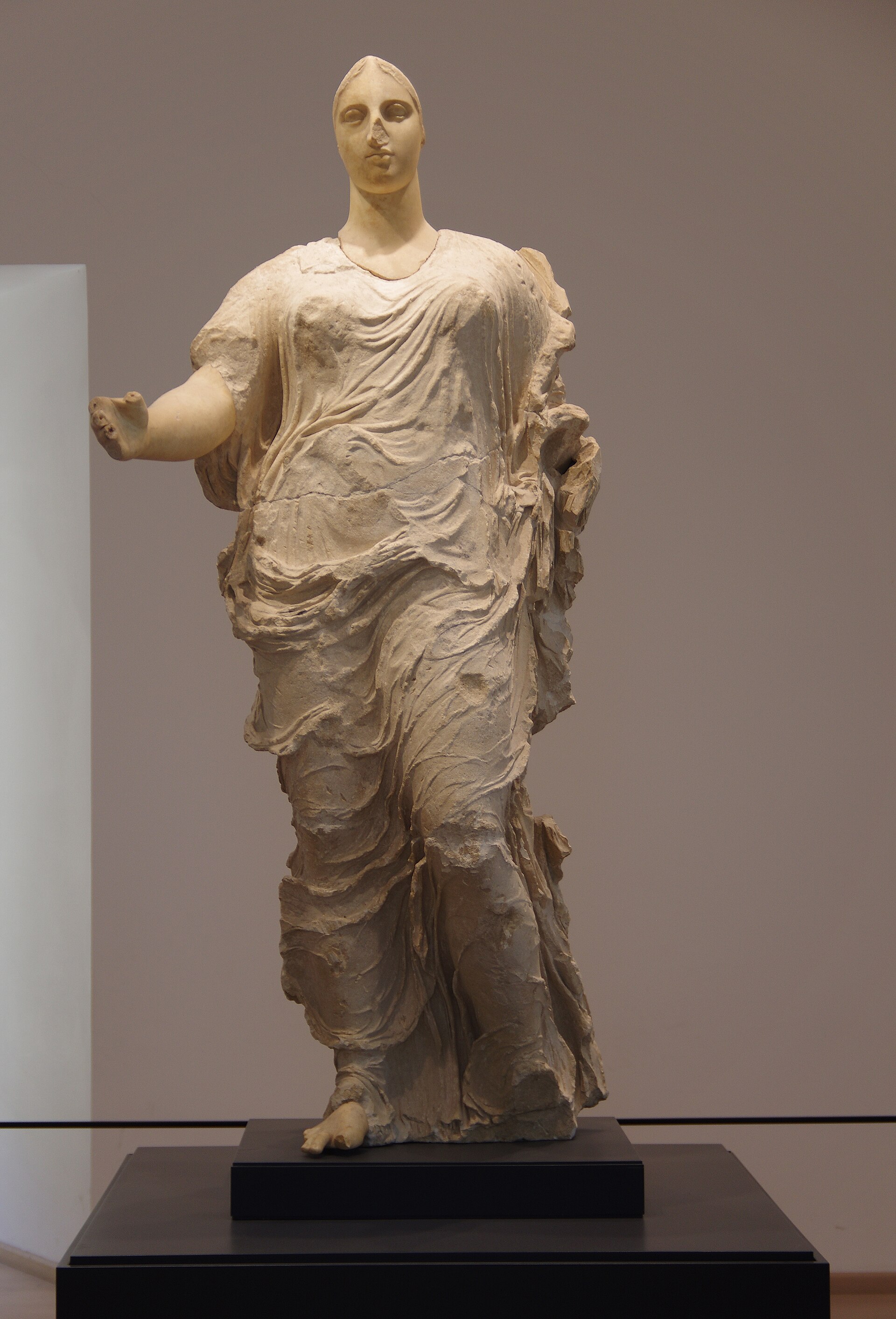
The record subject, photographed at the archaeological museum in Aidone, Sicily, on 29 June 2014, three years after the J. Paul Getty Museum transferred it to Italy. The marble head and the marble right forearm sit against a body carved from Sicilian limestone; it was the limestone that was traced to a quarry in the southeast of the island.
Photograph by the Wikimedia Commons contributor Algoe; Museo Archeologico Regionale di Aidone · CC BY-SA 4.0| Artist | Unknown sculptor, western Greek workshop |
|---|---|
| Date | c. 425-400 BC |
| Medium | Pseudo-acrolithic: body in Sicilian limestone, head and exposed flesh in Parian marble |
| Dimensions | Approximately 220 x 80 cm; about seven feet tall and reported at some 1,300 pounds |
| Where it is now | Museo Archeologico Regionale di Aidone, Aidone, Sicilylast confirmed 6 September 2026 |
| Inventory number | No inventory number published in the sources consulted |
| Attribution | UnknownNo sculptor is named and none can be. Full note |
| Object type | Antiquity |
| Period | Greek, high Classical, Sicily |
| Cases | Has a provenance gap |
| Inscriptions | None recorded |
| Owners on record | 8 links5 documented, 2 disputed, 1 unknown |
| Sources | 9 cited |
About this record Last verified 6 September 2026 · 9 sources cited · Change log
On this page 10 sections
ContentsClose
A seven-foot cult statue of the last quarter of the fifth century BC, built out of two materials: a body of Sicilian limestone with the head, arms and feet worked in imported Parian marble. It is one of very few pieces of high Classical sculpture to survive anywhere, and the only one of its kind in Italy. Nobody knows which goddess it represents.
It was dug out of the sanctuary at contrada San Francesco Bisconti at Morgantina, in central Sicily, in 1979, cut into pieces and moved. In 1986 the Lugano tobacconist Renzo Canavesi sold it to the London dealer Robin Symes for 400,000 dollars. On 25 July 1988 the J. Paul Getty Museum bought it from Symes for 18 million dollars, which remains among the largest sums ever paid for an antiquity. Within the same month Thomas Hoving, the former director of the Metropolitan Museum, said publicly that he knew it had come from a clandestine excavation at Morgantina.
The decisive evidence was in the stone. Petrographic analysis established that the limestone came from the Hyblaean quarries of southeastern Sicily. The Getty refused to give the statue up for nineteen years. What eventually moved it was not a court but a bargain: the Rome investigations into the Medici network, the criminal prosecution of the Getty's own antiquities curator Marion True, and an agreement signed with the Italian Ministry of Culture in September 2007 under which forty objects went back. True was never convicted of anything, in Italy or in Greece; both prosecutions ended when the limitation periods expired, the Italian one on 13 October 2010. The statue reached Italy on 17 March 2011 and went on show in a former Capuchin monastery in a hill town of six thousand people, where about seventeen thousand people a year see it. At the Getty Villa it had been seen by about four hundred thousand.
Provenance
Each link is graded. Documented: a cited source supports it. Disputed: the identification is argued but not established. Unknown: no owner for that span, and the gap is not smoothed into a narrative. The grades in the glossary.
- c. 425-400 BC -Made for a sanctuary in Greek Sicily; commissioning body unrecordeddocumented
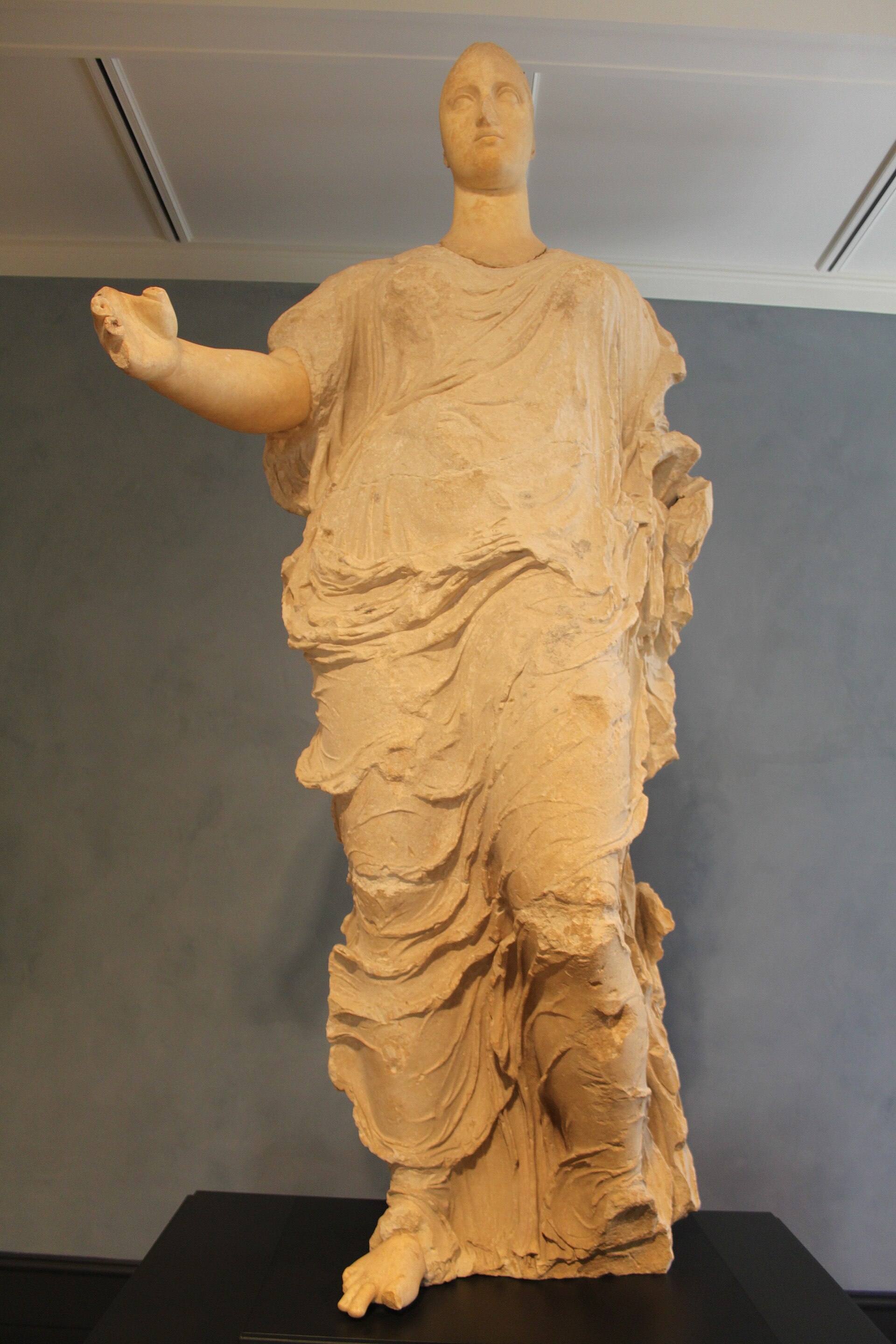
Dated on style to the last quarter of the fifth century BC. The body was carved from local Sicilian limestone and the flesh parts from imported Parian marble, a pseudo-acrolithic technique already used in Sicily for the metopes of Temple E at Selinunte. The back is fully worked, which indicates the figure was meant to be seen in the round on a pedestal rather than set against a wall.2
- - 1979Buried at Morgantina; exact findspot never establishedunknown
Italian accounts place the clandestine excavation at contrada San Francesco Bisconti at Morgantina in 1979. Local report in Aidone attributes the discovery to two shepherd brothers working the eastern flank of the site, where a sanctuary of Demeter and Persephone has been excavated. Nobody has ever confirmed it. The prosecutor who investigated the case in the 1990s, Silvio Raffiotta, said in 2011 that it was time for them to speak and that there was no longer any risk in doing so.12
- 1979 - 1986Renzo Canavesi, tobacconist, Chiasso and Luganodisputed
Italian accounts state that the statue was cut into pieces and exported to Switzerland, and that Canavesi held it before selling it on. Canavesi later maintained that his family had owned the statue since the 1930s. No document supporting that claim has been produced in any source consulted.2
- 1986 - 1988Robin Symes, Londondisputed
Canavesi is reported to have sold the statue to Symes for 400,000 dollars. Symes moved it to his London premises and, on the Italian account, tried without success to place it with the best-known American galleries before offering it to the Getty. Symes was among the principal conduits in the network later exposed by the Rome investigations.2
- 25 July 1988 - March 2011The J. Paul Getty Museum, Malibudocumented
Bought for 18 million dollars, on the recommendation of the antiquities curator Marion True, who proposed the identification as Aphrodite. Displayed at the Getty Villa, where it was seen by some 400,000 visitors a year and, by the account of the reporters who covered the case, was virtually ignored by scholars for twenty-two years because of the controversy around it.123
- 1988 - 2007Subject of an Italian claim; possession unchangeddocumented
Thomas Hoving stated publicly in the month of the purchase that he knew the statue had come from a clandestine excavation at Morgantina. The Tribunale di Enna opened an investigation, and petrographic analysis of the limestone body established a Sicilian origin. The Getty declined to give the statue up.2
- September 2007 - 17 March 2011Agreed for transfer to the Italian Republic; possession with the Getty pending shipmentdocumented
The Getty signed an agreement with the Italian Ministry of Culture in Rome under which forty of forty-six disputed objects would return, this statue in 2010. English-language accounts date the signature to 26 September 2007 and Italian accounts to 25 September 2007, when the museum's director Michael Brand signed for the transfer.23
- 17 March 2011 - presentItalian Republic; Museo Archeologico Regionale di Aidonedocumented
The statue arrived in Italy on 17 March 2011 and went on display at Aidone from 17 May 2011, in a museum housed in a seventeenth-century Capuchin monastery that holds about 150 visitors at a time. The inauguration was attended by two Getty officials, hundreds of townspeople, two bands and a children's choir; a souvenir shop opposite sold Aphrodite postcards, t-shirts and cigarette trays.124
Prices realised
This statue has never been offered at auction and has no hammer price. Every figure attached to it is a private transaction: 400,000 dollars reported for the sale from Canavesi to Robin Symes in 1986, and 18 million dollars paid by the J. Paul Getty Museum to Symes on 25 July 1988. Neither carries a premium, an estimate or an underbidder, and the 18 million is the museum's purchase price rather than a market valuation. A separate figure is not a price at all: the Tribunale di Enna's award against Canavesi in 2001 of 40 billion lire, of which 20 billion was the assessed value of the statue and 20 billion moral damages to the Italian state.
Technical evidence
| Attribution note | No sculptor is named and none can be. The statue is placed in the post-Phidian manner of the last quarter of the fifth century BC on the evidence of its wet drapery and the handling of the himation, and Italian scholarship has described its author as possibly a follower of Phidias. That is a stylistic placement, not an attribution. Because the object was dug up clandestinely, there is no context, no dedication, no inscription and no excavation record to argue from. |
|---|---|
| Technique | Pseudo-acrolithic: the body and drapery in limestone, the head and exposed flesh in marble. The same division of materials was used in Sicily for the metopes of Temple E at Selinunte.2 |
| Materials | Coloured limestone from a Hyblaean quarry in southeastern Sicily; Parian marble for the flesh parts.2 |
| Dimensions | Approximately 220 x 80 cm. Reported in American coverage as about seven feet tall and around 1,300 pounds.23 |
| Date | 425-400 BC, on style. The period corresponds to the years after the congress of Gela, when Morgantina was assigned to Kamarina.2 |
| Style | Post-Phidian mannerism of the Peloponnesian War years: the wet-drapery effect across the torso and deep folds visible from the side and rear, comparable to the Nike of Paionios and the Athena Nike parapet.2 |
| Finishing | The drapery is fully worked at the back, indicating that the figure was intended to stand free on a pedestal. The back of the head is only roughed out, probably because it was covered with a layer of stucco carrying a wig or a raised himation.2 |
| Condition | Italian accounts state that the statue was cut into pieces for removal in 1979. Fragments are missing, including whatever the figure held, which is why the identification of the deity cannot be settled.12 |
| Petrographic analysis | Analysis of the limestone body established a Sicilian origin, published as R. Alaimo, R. Giarrusso, G. Montana and P. Sean Quinn, 'Le prove geologiche a favore della provenienza siciliana', Kalos 2 (2007). Cited here from the Italian bibliography; the article itself was not retrieved.2 |
| Museum title | Catalogued by the J. Paul Getty Museum as Cult Statue of a Goddess, a formula that avoided naming the deity while the museum's labels and publicity used Aphrodite.1 |
Images
The record in full
Chapter 1A goddess made of two stones, and the join is the whole argument
The statue stands about 2.20 metres and weighs, by one report, around 1,300 pounds.
The statue stands about 2.20 metres and weighs, by one report, around 1,300 pounds. Its body, and all of the drapery, is Sicilian limestone. The head, the exposed arms and the feet - everything meant to read as skin - are Parian marble.
This is the pseudo-acrolithic technique, and in Sicily it has a history: the same division of materials appears in the metopes of Temple E at Selinunte. It exists for a plain economic reason. Marble had to be shipped to Sicily and limestone did not, so a workshop bought marble for the parts that had to be flesh and quarried the rest at home.
That economy is why this record exists in the form it does. A statue made entirely of imported marble tells you nothing about where it was carved. A statue whose bulk is local stone carries its birthplace in its body, and can be read by a geologist.
The carving is post-Phidian in manner, from the years of the Peloponnesian War: the wet-drapery effect across the torso, where the cloth clings and reveals the body beneath, and the deep, generous folds visible only from the side and the back. The drapery is finished all the way round, which means the figure was made to stand free on a pedestal and be walked around. The back of the head is not finished at all, only roughed out, which suggests it carried a layer of stucco supporting a wig or a drawn-up himation.
Chapter 2Nobody knows which goddess she is
The Getty called her Aphrodite. That identification was proposed by Marion True, the curator who recommended the purchase, and it stuck for twenty-two years in the museum's own labels, in the press...
The Getty called her Aphrodite. That identification was proposed by Marion True, the curator who recommended the purchase, and it stuck for twenty-two years in the museum's own labels, in the press, and in the title of the book that eventually told the story.
Most specialists no longer accept it. Katerina Greco, a Sicilian archaeological official and a leading scholar of Greek art who wrote one of the few studies of the statue, has argued for Demeter, on the matronly build and the remains of a veil covering the hair, a feature usually associated with older women in Greek convention. Clemente Marconi of New York University has argued for Persephone. An Italian reading has her as Demeter holding a torch, now lost, searching for her daughter. Sicilian officials, on the return, rebranded the object as the goddess of Morgantina and dropped the name Venus altogether.
The Getty's own catalogue title was and remains the most honest one available: Cult Statue of a Goddess.
The reason the argument cannot be settled is the reason this record is in an archive about provenance. Key fragments are missing. There is no attribute in her hands, no inscription, no altar, no votive deposit, no sanctuary plan and no assemblage of the objects around her, because none of that was recorded when she came out of the ground. A cult statue whose cult is unknown is the cleanest possible measure of what looting destroys: the object survives entirely and its meaning does not.
Central Sicily makes the loss sharper. This is Persephone country. The ancient sources place her abduction by Hades at the shores of Lake Pergusa, a short drive from Morgantina, and the Greek colonists who settled the region built sanctuaries to Persephone and to her mother Demeter; the ruins of Morgantina are full of terracotta and stone images of the two. A statue of that scale, in that landscape, was almost certainly made for one of those cults, and the one thing nobody can say is which.
Chapter 31979: the sanctuary at San Francesco Bisconti
Italian accounts place the clandestine excavation in 1979, in the contrada of San Francesco Bisconti at Morgantina, and record that the statue was cut into pieces to be moved.What is said in Aidone...
Italian accounts place the clandestine excavation in 1979, in the contrada of San Francesco Bisconti at Morgantina, and record that the statue was cut into pieces to be moved.
What is said in Aidone, and has never been confirmed, is that two shepherd brothers found it on the eastern flank of the site, where a sanctuary of Demeter and Persephone has since been excavated. The silence around the detail is not accidental: omerta has kept the exact spot unspoken for more than forty years. Silvio Raffiotta, the local prosecutor who investigated the looting in the 1990s, said in 2011 what a great many archaeologists were thinking - that it was time for them to speak, and that there was now no risk.
The stake is concrete rather than sentimental. If the exact excavation spot were known, archaeologists could go back and dig the area properly, and much of what was destroyed - the cult, the date of deposition, the associated material, possibly the missing fragments - could still be partly recovered. The information is not gone. It is being withheld.
Chapter 4A tobacconist, a London dealer, and a museum in Malibu
The chain that reached the Getty is short and it is not obscure.Renzo Canavesi kept a tobacconist's shop in the Swiss canton of Ticino, at Chiasso on the Italian border.
The chain that reached the Getty is short and it is not obscure.
Renzo Canavesi kept a tobacconist's shop in the Swiss canton of Ticino, at Chiasso on the Italian border. In 1986 he sold the statue to Robin Symes in London for 400,000 dollars. Symes, one of the two or three most important antiquities dealers of his generation and later a central figure in the exposure of the trade, took it to his London premises and, by the Italian account, tried without success to place it with the best-known American galleries before turning to Malibu.
On 25 July 1988 the J. Paul Getty Museum bought it for 18 million dollars. Canavesi's own account, offered later, was that the statue had been in his family since the 1930s. No document supporting that has ever been produced in any source consulted.
The arithmetic is the part a collector should look at twice. Four hundred thousand dollars in 1986; eighteen million dollars in 1988. A multiple of forty-five in two years, on an object with no publication history, no exhibition history and no owner before a shopkeeper in Chiasso. That is not a market appreciating. It is the price of a document, and the document did not exist.
Chapter 5The objection arrived the same month as the statue
Nobody had to wait for a warehouse raid to know what this object was.In the same month as the purchase, Thomas Hoving - the former director of the Metropolitan Museum of Art, a man with no...
Nobody had to wait for a warehouse raid to know what this object was.
In the same month as the purchase, Thomas Hoving - the former director of the Metropolitan Museum of Art, a man with no institutional reason to help Italy and a considerable personal history of aggressive acquisition - stated publicly that he knew the statue came from a clandestine excavation at Morgantina. The Tribunale di Enna opened an investigation on the strength of it.
This is the pattern that recurs across the cases in this archive and it is worth stating flatly. The Euphronios krater was attacked in print within four months of the Metropolitan announcing it. The Sevso export licences were found to be forged by the Getty itself in March 1984, six years before the silver was offered at Sotheby's. Here the objection came within weeks. In none of these cases did the buying museum lack information; in all of them it lacked the will to act on information it already had.
Chapter 6The limestone testified
Italian investigators did what the paperwork made necessary: they analysed the stone.Petrographic examination of the limestone body traced the material to the Hyblaean quarries of southeastern Sicily.
Italian investigators did what the paperwork made necessary: they analysed the stone.
Petrographic examination of the limestone body traced the material to the Hyblaean quarries of southeastern Sicily. The geological case was published by R. Alaimo, R. Giarrusso, G. Montana and P. Sean Quinn under the title Le prove geologiche a favore della provenienza siciliana - the geological evidence for the Sicilian provenance - in the journal Kalos in 2007.
Consider what that means in evidentiary terms. There was no export licence to forge or expose, no Polaroid, no confession and no witness. There was an object whose seller said it had been in a Swiss family since the 1930s, and a rock that said it had been cut out of a hillside in the province of Ragusa. Provenance research usually works on paper about objects. Here the object was the document.
The same logic recurs across this archive whenever a claim is finally proved: matching woodworm tunnels in a dismembered Cimabue diptych, a fracture surface joining two halves of a Roman Herakles, plaster fragments from a Lydian tomb chamber that fit the wall they were cut from. Physical evidence resists the market in a way that documents do not, because it cannot be commissioned.
Chapter 7A conviction in Enna, and exactly what it was worth
On 5 March 2001 the Tribunale di Enna convicted Renzo Canavesi.
On 5 March 2001 the Tribunale di Enna convicted Renzo Canavesi. He was sentenced to two years imprisonment and ordered to pay 40 billion lire to the Italian state: 20 billion representing the assessed value of the statue and 20 billion in moral damages. Italian commentary records it as the first sanction of that magnitude ever imposed for the clandestine export of an archaeological object.
Precision matters here, because a criminal conviction is routinely misread as settling ownership, and it does not.
First, this was a first-instance judgment of an Italian trial court. This record has not been able to establish whether it survived appeal, and an Italian conviction at first instance is not final. Second, it was a conviction of a middleman for an offence against Italian export law; it was not a judgment against the Getty, which was not a party, and it did not order anybody to hand over anything. Third, it produced no object and no money: the statue stayed in Malibu for another ten years, and no source consulted records the damages being paid.
What the judgment did was official. It put the Italian state's finding on the record, in a court, that this statue had been taken out of Sicily unlawfully. Ten years later that finding was one of the things the Getty was negotiating against.
Chapter 8What actually moved the statue was the prosecution of a curator
Between 1988 and 2005 the Getty's position did not change.
Between 1988 and 2005 the Getty's position did not change. What changed was the Italian investigation into the network that had supplied it.
In 2005 Italian prosecutors charged Marion True, the Getty's curator of antiquities, with trafficking in looted antiquities. She stood trial in Rome. In a letter to the J. Paul Getty Trust of 18 December 2006 she wrote that she was being made to carry the burden for practices that had been known, approved and condoned by the Getty's board of directors. In November 2006 the museum's director Michael Brand announced that twenty-six disputed objects would go back to Italy. In September 2007 Italy dropped its civil claims against True, and on 26 September 2007 - 25 September in Italian accounts - the Getty signed an agreement with the Italian Ministry of Culture in Rome for the return of forty of the forty-six objects in dispute, this statue among them, scheduled for 2010.
Neither prosecution of Marion True ever reached a verdict. The Greek charges concerning a gold funerary wreath were dropped in November 2007 when the limitation period expired; the wreath had already gone back to Greece. On 13 October 2010 a court in Rome ended the Italian case for the same reason. She was never convicted of anything, and this record will not describe her as though she had been.
The result is a peculiar and instructive one. The prosecution that produced no conviction produced forty objects.
Chapter 9A transfer under an agreement, not a judgment
The statue left Malibu in the early spring of 2011 and arrived in Italy on 17 March.
The statue left Malibu in the early spring of 2011 and arrived in Italy on 17 March. It went on public display at Aidone on 17 May.
What that was, precisely: a voluntary transfer of title by an American private trust to a foreign state, under a bilateral agreement that also covered thirty-nine other objects and provided for continuing cultural cooperation. It was not a court order. No American court ever ruled on the ownership of this statue and no American proceeding was ever brought about it. Italy did not sue the Getty. The 2001 Italian conviction bound Canavesi, not the museum.
The Getty has never conceded that it bought stolen property, and this record does not put that sentence in its mouth. What it did was agree to return objects whose Italian origin the evidence supported, in exchange for the end of a dispute that was costing it more than the objects were worth.
Chapter 10Four hundred thousand, then seventeen thousand
The Getty Villa showed the statue to around 400,000 people a year.
The Getty Villa showed the statue to around 400,000 people a year. The archaeological museum at Aidone, a hill town of about six thousand in one of the poorest parts of Europe, was seeing about 17,000. The building is a seventeenth-century Capuchin monastery and holds 150 visitors at a time.
The inauguration on 17 May 2011 was a village occasion: a scrum of politicians, journalists and townspeople, two bands in elaborate uniform, a children's choir, hundreds of people standing in cold drizzle, free Aphrodite postcards and t-shirts, and a souvenir shop across the road selling imitation Greek vases, Aphrodite dishes and Aphrodite cigarette trays.
Both halves of the arithmetic are real and neither cancels the other. A universal museum genuinely does show an object to more people; a returned object genuinely is in the landscape it was made for, where a local scholar can measure it, and where the sanctuary that produced it is a twenty-minute drive away. Flavia Zisa of the University of Kore at Enna put the case for the second in a sentence: the statue did not exist by herself, she was made for a specific place and a particular purpose.
There is a harder fact underneath. Many people around Aidone supplement thin incomes by digging and selling material from Morgantina, one of the most productive archaeological sites in the Mediterranean. The town that celebrated the goddess's return is, in part, the town that supplies the market she passed through. Any account of repatriation that ends with a ceremony has stopped one paragraph early.
Chapter 11The scholarship on this object is only starting
For twenty-two years at the Getty the statue was, by the account of those who covered it, virtually ignored by scholars, because the controversy made it untouchable.
For twenty-two years at the Getty the statue was, by the account of those who covered it, virtually ignored by scholars, because the controversy made it untouchable. One of the very few surviving pieces of high Classical sculpture sat in Malibu and generated almost no literature. Katerina Greco, who wrote one of the few studies of it, put its standing plainly: it is one of the very few examples we have from the high Classical period, and there is nothing like it in Italy.
Now that the legal question is closed, the art-historical questions are open, and they are substantial. Which goddess. Whether the slightly awkward marble head actually belongs on the limestone body, or was married to it by a restorer somewhere between a Sicilian hillside and a Swiss shop. Whether the missing attributes can be recovered. What the statue stood in, and what was done in front of it.
Not one of those questions would be difficult if the object had been excavated. All of them are now hard, and some are permanently unanswerable, because of what happened to it in 1979. That, and not the eighteen million dollars, is the cost this record is recording.
The artist
Anonymous sculptor of the western Greek high Classical, Sicily
There is no name to attach and there never will be. What can be reconstructed is a workshop practice: how a monumental cult figure was built in a Greek colony that had good limestone and no marble, what the choice of materials cost, and how a Sicilian carver in the 420s was working in a manner that had been set in Athens a generation earlier. The absence of a name is not the interesting gap here. The interesting gap is that a statue of this quality has no sanctuary, no dedication and no cult attached to it, and that gap was made in 1979.
Related works
| Work | Relation | Where it is |
|---|---|---|
| The Morgantina acroliths Unknown, Greek, Sicily | Looted from the same site; returned earlier Marble heads and extremities from acrolithic cult statues of Demeter and Persephone, returned to Sicily from an American private collection. They were shown at Aidone alongside this statue in the 2011 exhibition. | Museo Archeologico Regionale di Aidone |
| The Morgantina silver Unknown, Hellenistic | Looted from the same site; returned by the Metropolitan Museum of Art A hoard of Hellenistic silver plate. Its return, like this one, was negotiated rather than litigated. | Museo Archeologico Regionale di Aidone |
| Testa di Ade (Head of Hades) Unknown, Greek, Sicily | Another contested Morgantina object, now at Aidone A terracotta head identified as Hades, listed by the Italian literature among the related Morgantina material. Its own return history is not established in the sources consulted for this record and is flagged for research rather than asserted here. | Museo Archeologico Regionale di Aidone |
| The Getty kouros Unknown; Greek about 530 BC, or modern forgery | The same museum's other unresolved antiquity Acquired in 1985 with a provenance dossier later shown to contain anachronisms. The museum's own label reads 'Greek, about 530 B.C., or modern forgery'. It stands as the counter-case: an object nobody can return because nobody can say what it is. | J. Paul Getty Museum |
| The Euphronios krater Euxitheos, potter; Euphronios, painter | The same trafficking network, the same decade, a different museum Held as a separate record in this archive. Returned by the Metropolitan Museum of Art to Italy in 2008 under a similarly negotiated agreement. | Museo Archeologico Nazionale Cerite, Cerveteri |
Open questions
- Which goddess is she? Aphrodite was the Getty's identification, proposed by Marion True. Katerina Greco argues Demeter; Clemente Marconi argues Persephone; the Italian reading has her as Demeter with a lost torch. No attribute survives to settle it.
- Does the marble head belong to the limestone body? The join has been described as slightly awkward, and the question of whether head and body were together when they came out of the ground has never been answered publicly.
- Where exactly at Morgantina was she found? The contrada is named in Italian accounts and the eastern flank sanctuary is the local report, but no excavator has been shown the spot. If it were identified the area could be re-excavated.
- Did the 2001 conviction of Renzo Canavesi survive appeal? No appellate outcome has been located in the sources consulted, and an Italian first-instance conviction is not final. Nor has any source consulted recorded the 40 billion lire ever being paid.
- Where was the statue between 1979 and 1986, and who cut it up? The Italian account has it exported to Switzerland in pieces; the intermediate holders are not named. A separate English-language account (the Trafficking Culture research project, citing Felch and Frammolino's book Chasing Aphrodite) gives the excavation year as 1977 or 1978 rather than 1979, and names a Sicilian dealer, Orazio di Simone, as an intermediate holder before Canavesi, and a local dealer, Giuseppe Mascara, whose testimony placed the find alongside three marble heads and silver vessels. This record has not fetched Chasing Aphrodite itself to adjudicate the date conflict or confirm these names, and does not add them to the graded provenance chain on that basis alone; flagged here for the next re-verification pass.
- What did Canavesi's family-ownership claim rest on? He maintained the statue had been in his family since the 1930s and no supporting document has been produced in any account consulted.
- Are the missing fragments extant? Whatever the figure held is gone, along with the left arm. Nothing in the sources consulted says whether these were lost in antiquity, destroyed in 1979, or are still in circulation.
- RESOLVED September 2026: Clemente Marconi's study was published, and argues for Persephone. Per Marconi's own publications list (Accademia Nazionale dei Lincei): 'L'identificazione della Dea di Morgantina', Prospettiva 141-142 (2011): 2-31; a shorter entry 'The Goddess from Morgantina' in Sicily: Art and Invention between Greece and Rome, eds. Lyons, Bennett and Marconi (Los Angeles: Getty Publications, 2013), p. 60; and the full English study 'The Goddess from Morgantina', Antike Plastik 31 (2016): 1-31. None of the three has been fetched and read in full by this record; the Persephone conclusion is taken from the article titles, the CV entries themselves, and a third-party abstract, not from the primary text.
- What are the visitor numbers at Aidone now? The figure of about 17,000 a year dates from 2011, when the statue had just arrived.
Questions about this object
What is Cult Statue of a Goddess?
Cult Statue of a Goddess is an antiquity, dated c. 425-400 BC. Medium: Pseudo-acrolithic: body in Sicilian limestone, head and exposed flesh in Parian marble.
Who made Cult Statue of a Goddess, and is the attribution settled?
The attribution to Unknown sculptor, western Greek workshop is recorded here as unknown. No sculptor is named and none can be. The statue is placed in the post-Phidian manner of the last quarter of the fifth century BC on the evidence of its wet drapery and the handling of the himation, and Italian scholarship has described its author as possibly a follower of Phidias. That is a stylistic placement, not an attribution. Because the object was dug up clandestinely, there is no context, no dedication, no inscription and no excavation record to argue from.
Where is Cult Statue of a Goddess now?
Museo Archeologico Regionale di Aidone, Aidone, Sicily. Inventory number No inventory number published in the sources consulted. Last confirmed 6 September 2026. Transferred by the J. Paul Getty Museum under the agreement signed with the Italian Ministry of Culture in September 2007; arrived in Italy on 17 March 2011 and on public display at Aidone from 17 May 2011. Re-verified September 2026: the regional park authority's own current page for the museum still lists the object on display and now labels it 'the statue of the goddess, Demeter or Kore', without using Aphrodite or Venus.
What is still unknown about Cult Statue of a Goddess?
Which goddess is she? Aphrodite was the Getty's identification, proposed by Marion True. Katerina Greco argues Demeter; Clemente Marconi argues Persephone; the Italian reading has her as Demeter with a lost torch. No attribute survives to settle it.
Sources
- 1Jason Felch, 'Chasing Persephone?', Chasing Aphrodite, 28 May 2011, reproducing his Los Angeles Times report from Aidone. Source for the 1988 purchase at 18 million dollars, the late-1970s illegal excavation at Morgantina, the identification debate and the positions of Katerina Greco and Clemente Marconi, the Sicilian rebranding of the statue as the goddess, the Phidian reference in the drapery, the visitor figures of about 17,000 at Aidone against about 400,000 at the Getty, the two shepherd brothers and the eastern-flank sanctuary, Silvio Raffiotta's statement, Flavia Zisa's statement, and the observation that the statue was virtually ignored by scholars for twenty-two years. chasingaphrodite.com/2011/...
- 2Wikipedia (Italian), 'Dea di Morgantina'. TERTIARY, but the fullest Italian-language account and cited to Serena Raffiotta's 'La Venere di Morgantina: storia di un recupero' and to Tsao Cevoli. Used for the 1979 looting at contrada San Francesco Bisconti, the cutting into pieces and export to Switzerland in 1986, Renzo Canavesi of Lugano and the 400,000 dollar sale to Robin Symes, the purchase date of 25 July 1988, Thomas Hoving's public statement, the petrographic analysis, the Tribunale di Enna judgment of 5 March 2001 with its two-year sentence and 40 billion lire award split between value and moral damages, Michael Brand's signature in September 2007, the return on 17 March 2011 and the display from 17 May 2011, and the technical description including the pseudo-acrolithic construction, the Hyblaean limestone, the Parian marble, the 2.20 metre height, the finished back and the unfinished rear of the head. To be replaced with Raffiotta's monograph and with Alaimo and colleagues in Kalos 2 (2007). it.wikipedia.org/wiki/...
- 3Wikipedia, 'Marion True'. TERTIARY. Used for the 2005 charges, the letter to the J. Paul Getty Trust of 18 December 2006, Michael Brand's announcement of 26 objects in November 2006, the agreement of 26 September 2007 covering 40 of 46 objects with this statue scheduled for 2010, the dropping of the Greek charges in November 2007 on limitation, and the end of the Italian case on 13 October 2010 on limitation, sourced there to Elisabetta Povoledo in the New York Times. To be replaced with the Rome court's own disposition and with the Getty's press statement of September 2007. en.wikipedia.org/wiki/...
- 4Jason Felch, 'Chase Over: Aphrodite Crosses Final Finish Line', Chasing Aphrodite, 18 May 2011, reproducing his Los Angeles Times report. Source for the inauguration at Aidone, the seventeenth-century Capuchin monastery, the seven-foot limestone and marble description, the presence of two Getty officials, and the souvenir trade that accompanied the return. chasingaphrodite.com/2011/...
- 5Wikimedia Commons file page for the Getty Villa plate, 'Greek Marble & Limestone Goddess, 425-400 BC (10454670775).jpg', photograph by Gary Lee Todd dated 26 June 2010, released CC0 and Flickr-reviewed on 20 August 2021, geotagged to 34.044984, -118.564978. Read in the raw wikitext; it is the evidence that the second plate shows the statue in Malibu before the transfer. commons.wikimedia.org/wiki/...
- 6Wikimedia Commons file page for the lead plate, 'Sizilien, Aidone, Venus von Morgantina, Vorderansicht.jpg', own work by the contributor Algoe, dated 29 June 2014, licensed CC BY-SA 4.0. Read in the raw wikitext for the date, the licence and the attribution. commons.wikimedia.org/wiki/...
- 7Accademia Nazionale dei Lincei, official publications list for Clemente Marconi, consulted September 2026. Source for confirming that his identification study of this statue was actually published rather than remaining forthcoming: 'L'identificazione della Dea di Morgantina', Prospettiva 141-142 (2011): 2-31; 'The Goddess from Morgantina' in Sicily: Art and Invention between Greece and Rome (Getty Publications, 2013), p. 60; and 'The Goddess from Morgantina', Antike Plastik 31 (2016): 1-31. The full text of none of the three was fetched; this record cites the CV only as proof of publication and venue. lincei.it/sites/...
- 8Parco archeologico di Morgantina e della Villa Romana del Casale (Regione Siciliana), official page for the Museo Archeologico Regionale di Aidone, consulted September 2026. Confirms the statue remains on display and gives the museum's own current label for it as 'the statue of the goddess, Demeter or Kore', not Aphrodite or Venus. parchiarcheologici.regione.sicilia.it/morgantina-villa-ro...
- 9Trafficking Culture (University of Glasgow research project), case study 'Getty Aphrodite' by Neil Brodie, last modified 21 August 2012, consulted September 2026. TERTIARY, citing Jason Felch and Ralph Frammolino, Chasing Aphrodite: The Hunt for Looted Antiquities at the World's Richest Museum (2011). Source for the alternative excavation date of 1977 or 1978 and the names Orazio di Simone and Giuseppe Mascara, neither of which appears in the Italian-Wikipedia-derived account used elsewhere in this record. Flagged in open_questions rather than merged into the graded provenance chain; to be replaced with the book itself. traffickingculture.org/encyclopedia/...
.jpg)

Last verified 6 September 2026 · Published 4 August 2026
Change log
4 August 2026 - Record created at the house standard: researched narrative, technical evidence, maker dossier, graded provenance chain, prices with hammer and premium separated, related works, open questions and sources.
6 September 2026 - Re-verification pass. Confirmed via a fresh fetch of the regional park authority's own current page that the statue remains on public display at the Museo Archeologico Regionale di Aidone, and that the museum's own current label is 'the statue of the goddess, Demeter or Kore' rather than Aphrodite or Venus (added as source 8; current_location.as_of updated). Resolved the open question on whether Clemente Marconi's identification study was ever published: confirmed via his official Accademia dei Lincei publications list that it appeared in Prospettiva in 2011, in the Getty's 2013 Sicily catalogue, and in full as 'The Goddess from Morgantina', Antike Plastik 31 (2016): 1-31, arguing for Persephone (added as source 7; open_questions updated, marked resolved rather than removed since the primary texts were not read in full). Found and flagged, but did not merge into the graded provenance chain, an alternative English-language account (Trafficking Culture project, citing Felch and Frammolino's Chasing Aphrodite) giving the excavation year as 1977-78 rather than 1979 and naming two intermediaries, Orazio di Simone and Giuseppe Mascara, absent from this record (added as source 9; new detail folded into the existing open question on the 1979-1986 gap). Spot-checked 6 of the record's existing sources with live GET fetches (chasingaphrodite.com x2, it.wikipedia.org, en.wikipedia.org/Marion_True, and 2 Wikimedia Commons file pages) plus the two new external pages; all 8 resolved and matched their cited content, none rotted. No change was warranted to the narrative, provenance chain, technical block, attribution, dimensions, or auction figures. Nothing found on any 2025-2026 conservation, loan, or condition event for the statue itself; the November 2024 Morgantina conservation news found in research concerns the separate Morgantina silver hoard, already covered under a different record (morgantina-silver-treasure-aidone), and was not applied here.