Gilded Coffin of Nedjemankh
Unknown workshop, late Ptolemaic Egypt · c. 150-50 BC
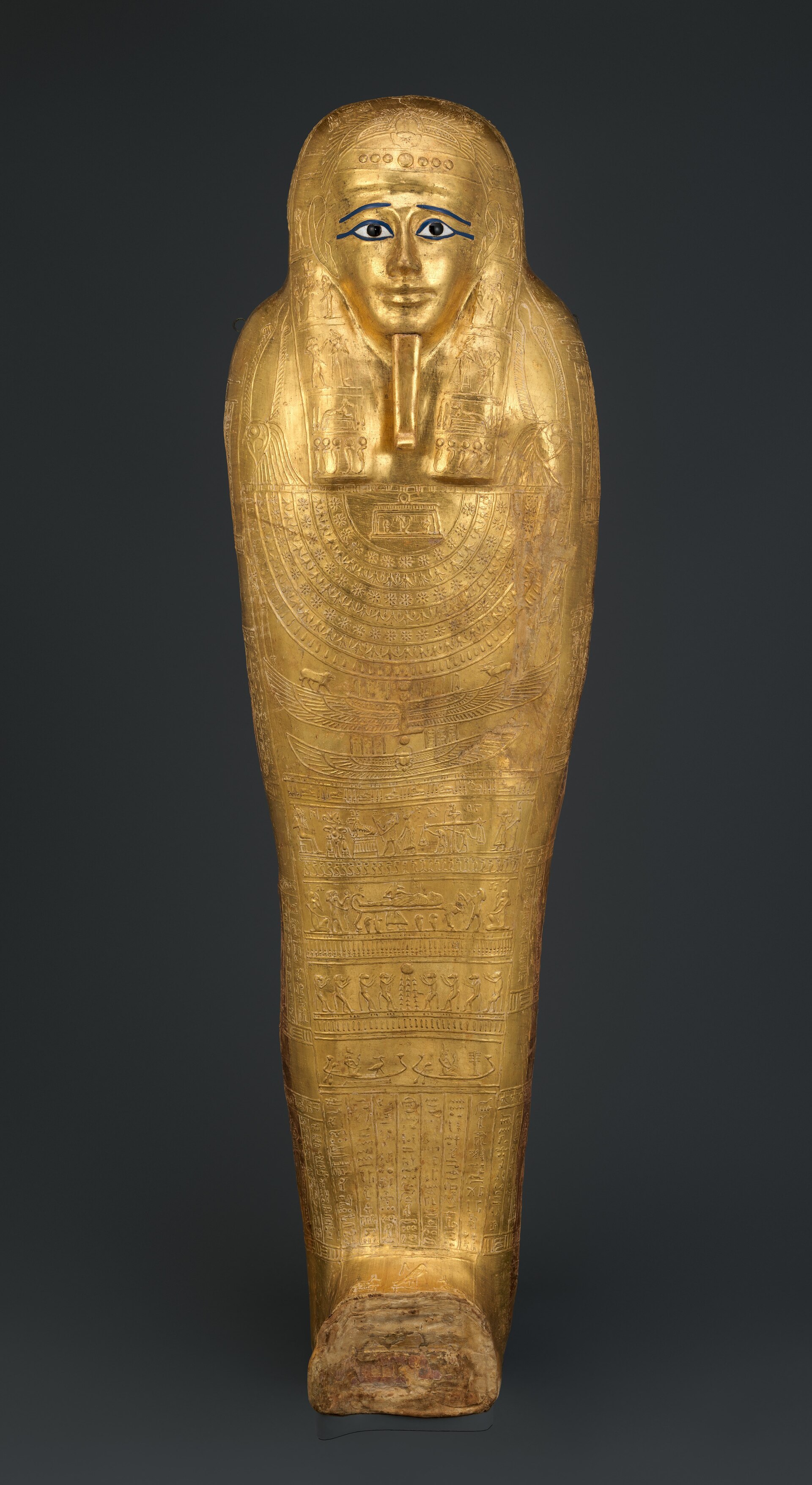
The record subject: the lid of the coffin of Nedjemankh, photographed by the Metropolitan Museum of Art while the object was accessioned there as 2017.255b. Seized under a New York search warrant in February 2019 and returned to Egypt on 25 September 2019.
| Artist | Unknown workshop, late Ptolemaic Egypt |
|---|---|
| Date | c. 150-50 BC |
| Medium | Cartonnage (linen, glue and gesso), gesso, paint, gold, silver, resin, glass, wood and leaded bronze |
| Dimensions | Lid 181 x 53 x 28 cm; base 180 x 54 x 12 cm |
| Where it is now | Arab Republic of Egypt; unveiled at the National Museum of Egyptian Civilization, el-Fustat, Cairolast confirmed 2 September 2026 |
| Inventory number | Formerly Metropolitan Museum of Art 2017.255a (base) and 2017.255b (lid); no Egyptian inventory number published in the sources consulted |
| Attribution | WorkshopNo maker is named and none can be. Full note |
| Object type | Antiquity |
| Period | Egyptian, late Ptolemaic |
| Cases | Has a provenance gap · Seized, looted or confiscated · Restituted or repatriated |
| Inscriptions | Hieroglyphic text above the feet of the lid giving the owner's name and titles - priest, Sameref-priest, priest who adorns the divine image, and priest of Heryshef-who-resides-in-Herakleopolis - and naming his mother, Banabes; a longer inscription on the front of the lid connecting gold and fine gold to the flesh of the gods, the sun and the rebirth of the deceased |
| Owners on record | 9 links5 documented, 3 disputed, 1 unknown |
| Sources | 7 cited |
About this record Last verified 2 September 2026 · 7 sources cited · Change log
On this page 10 sections
ContentsClose
A six-foot cartonnage coffin of about 150 to 50 BC, sheathed in an unbroken skin of gold over raised gesso relief, made for Nedjemankh, a priest of the ram-god Heryshef at Herakleopolis. The Metropolitan Museum of Art bought it in July 2017 for 3.5 million euros, about four million dollars, and made it the centrepiece of an exhibition that ran from July 2018 and drew close to half a million visitors. Kim Kardashian was photographed beside it at the 2018 Met Gala.
Its published provenance was a single sentence in the museum's own acquisition announcement: officially exported from Egypt in 1971, since then in a private collection. Every element of that sentence was false. The coffin was dug up in the Minya region in October 2011, in the looting that followed the Egyptian revolution, moved through Dubai to a warehouse in Cologne, restored in Germany and sold in Paris. The 1971 date was chosen because it sits twelve years before Egypt's Law No. 117 of 1983 closed the export of antiquities. The forged licence carried a government stamp reading Arab Republic of Egypt, a name the country did not adopt until September 1971, and two irreconcilable dates.
What broke the case was not connoisseurship but a grudge. A Jordanian trafficker who had never been paid his share told a Lebanese collector, who told the Manhattan District Attorney's Antiquities Trafficking Unit. In February 2019 a New York judge was satisfied that the museum was in possession of stolen property in the first degree; agents of Homeland Security Investigations and the District Attorney's office executed a search warrant and took the coffin off display. It went home to Egypt on 25 September 2019. Nobody at the Metropolitan has been charged. The criminal case is in Paris, where the dealers who supplied the museum and a former president of the Louvre are under investigation, and where, as at August 2026, nobody has been tried.
Provenance
Each link is graded. Documented: a cited source supports it. Disputed: the identification is argued but not established. Unknown: no owner for that span, and the gap is not smoothed into a narrative. The grades in the glossary.
- c. 150-50 BC -Made for Nedjemankh, priest of Heryshef-who-resides-in-Herakleopolisdocumented
The owner, his titles and his mother's name, Banabes, are given in the hieroglyphic inscription on the lid. Nothing else about him is recorded. No burial context has ever been excavated or published, so the coffin's own text is the only document of the man it was made for.46
- - October 2011Buried in Egypt; find-spot never archaeologically establishedunknown
Prosecutors place the looting in the Minya region on the evidence of metadata in photographs taken of the still-dirty coffin in the autumn of 2011. Abusir el-Meleq has also been proposed. No tomb, no plan and no associated assemblage exist for this object, which is the permanent loss in the case and the one no repatriation repairs.26
- at least 1936 (claimed) - 1971 (claimed)Habib Tawadros, dealer, Cairo, and his heirs (claimed)disputed
The story sold to the Metropolitan Museum was that the coffin had belonged to Habib Tawadros, a dealer who ran Habib and Company opposite Shepheard's Hotel in Cairo from at least 1936, and that his heirs exported it to Switzerland in 1971 with the authorisation of the Egyptian Antiquities Organization. Tawadros was a real dealer. In 1971 Simon Simonian was stripped of his Egyptian antiquities licence for registering the Tawadros shop in his own name, and the same Tawadros ownership story was later attached to a Tutankhamun stele sold to the Louvre Abu Dhabi. The Manhattan District Attorney's office concluded the documentation was forged.26
- October 2011 - late 2012Looters, then Mohammed Jaradat, known as Abu Said, Jordandisputed
A looter sent six photographs of the coffin, still encrusted with dirt, to Jaradat in late 2011 and early 2012; one showed a man in a hooded top crouched on a dune with an assault rifle across his chest. Jaradat offered the coffin to the Lebanese collector Georges Lotfi for 50,000 dollars and was refused. This link rests on emails seized under warrant in 2013 and on Jaradat's own account; no court has tried it.2
- late 2012 - 2015Roben Dib and Serop Simonian; Dubai, then a warehouse in Colognedisputed
Prosecutors say the coffin left Egypt for Dubai and was sent on by FedEx to a shipping agent near Cologne, declared on the airway bill as a gypsum wooden box and lid from Turkey with a value of 5,000 euros. It was restored while in Germany; no restorer has been named publicly. In a Gmail exchange of September 2012 quoted in the summary of the Manhattan grand jury investigation, Simonian asked when the big yellow one was going to arrive and Dib answered that it would be ready for the EU in early October. Both men deny wrongdoing.12
- 2015 - July 2017Christophe Kunicki, Paris, with Richard Semperdocumented
Dib showed Kunicki the coffin in the Cologne warehouse in 2015. Kunicki had it professionally photographed and emailed the pictures in May 2016 to Diana Craig Patch, the Metropolitan's curator in charge of Egyptian art. Kunicki was the seller of record. He and Semper were charged in France in 2020 with fraud, money laundering and forgery, and deny wrongdoing.23
- July 2017 - February 2019The Metropolitan Museum of Art, New Yorkdocumented
Bought for 3.5 million euros, about four million dollars, and accessioned as 2017.255a and 2017.255b. Announced on 12 September 2017. Exhibited as the centrepiece of Nedjemankh and His Gilded Coffin from 20 July 2018; the exhibition was scheduled to run to 21 April 2019 and was closed on 12 February 2019.1456
- February 2019 - 25 September 2019Seized under a New York County search warrant; custody of the Manhattan District Attorney's office and Homeland Security Investigationsdocumented
A judge was satisfied that the museum was likely in possession of stolen property in the first degree. Agents executed a search warrant and removed the coffin from display. The museum did not contest the seizure and no criminal charge was brought against anyone at the museum.12
- 25 September 2019 - presentArab Republic of Egyptdocumented
Handed to the Egyptian Minister of Foreign Affairs, Sameh Shoukry, at a ceremony in New York attended by District Attorney Cyrus R. Vance Jr and Peter C. Fitzhugh of Homeland Security Investigations. Unveiled at the National Museum of Egyptian Civilization in el-Fustat, Cairo, on 1 October 2019.16
Prices realised
This coffin has never been offered at auction and has no hammer price. The 3.5 million euros the Metropolitan Museum paid in July 2017 was a private treaty purchase from a dealer, a negotiated figure with no underbidder, no premium and no public record of what the seller had paid. Every dollar figure in circulation - most often four million - is a conversion of the euro price at an unstated date, and the euro figure is the real one.
Technical evidence
| Attribution note | No maker is named and none can be. The coffin is the product of an anonymous late Ptolemaic funerary workshop working in cartonnage, gesso relief and applied gold and silver leaf, almost certainly in or near Herakleopolis Magna, where the man it was made for served the ram-god Heryshef. Attribution in this class of object is by material, technique and inscription formula, not by hand. |
|---|---|
| Construction | Cartonnage - layers of linen soaked in glue and built up with gesso - moulded in two parts, a base and a lid.46 |
| Dimensions, lid | 181 x 53 x 28 cm. Accessioned by the Metropolitan Museum as 2017.255b.6 |
| Dimensions, base | 180 x 54 x 12 cm. Accessioned as 2017.255a.6 |
| Materials | Cartonnage, gesso, paint, gold, silver, resin, glass, wood and leaded bronze.6 |
| Surface technique | Decoration raised in gesso relief - pastiglia - then gilded with gold or silver leaf, producing an unbroken metallic skin over modelled scenes.46 |
| Iconography | Vignettes drawn from funerary literature including the Book of the Dead: the weighing of the heart, the embalming of the mummy, and a rarer scene of baboons worshipping the sun. A djed pillar appears on the base.6 |
| Interior | A figure of the sky goddess Nut on the inside of the lid, partly covered with silver foil.6 |
| Inscription | Hieroglyphic text above the feet giving the owner's titles and his mother's name, Banabes; a longer text on the front of the lid linking gold and electrum to the flesh of the gods, the sun and rebirth.46 |
| Condition and intervention | Restored in Germany between its arrival in Europe about late 2012 and its sale in 2017. The restorer is not named in any public document consulted, and no conservation report is in the public domain.12 |
| Catalogue availability | The Metropolitan Museum's public collection API returns no data for object identifiers 746821, 764105 and 764111, the museum's own records for the lid, the base and the pair. Tested 4 August 2026.6 |
Images
The record in full
Chapter 1The coffin is a hymn about gold, written on gold
A mummiform coffin in two parts, a base and a lid, each about 180 centimetres long.
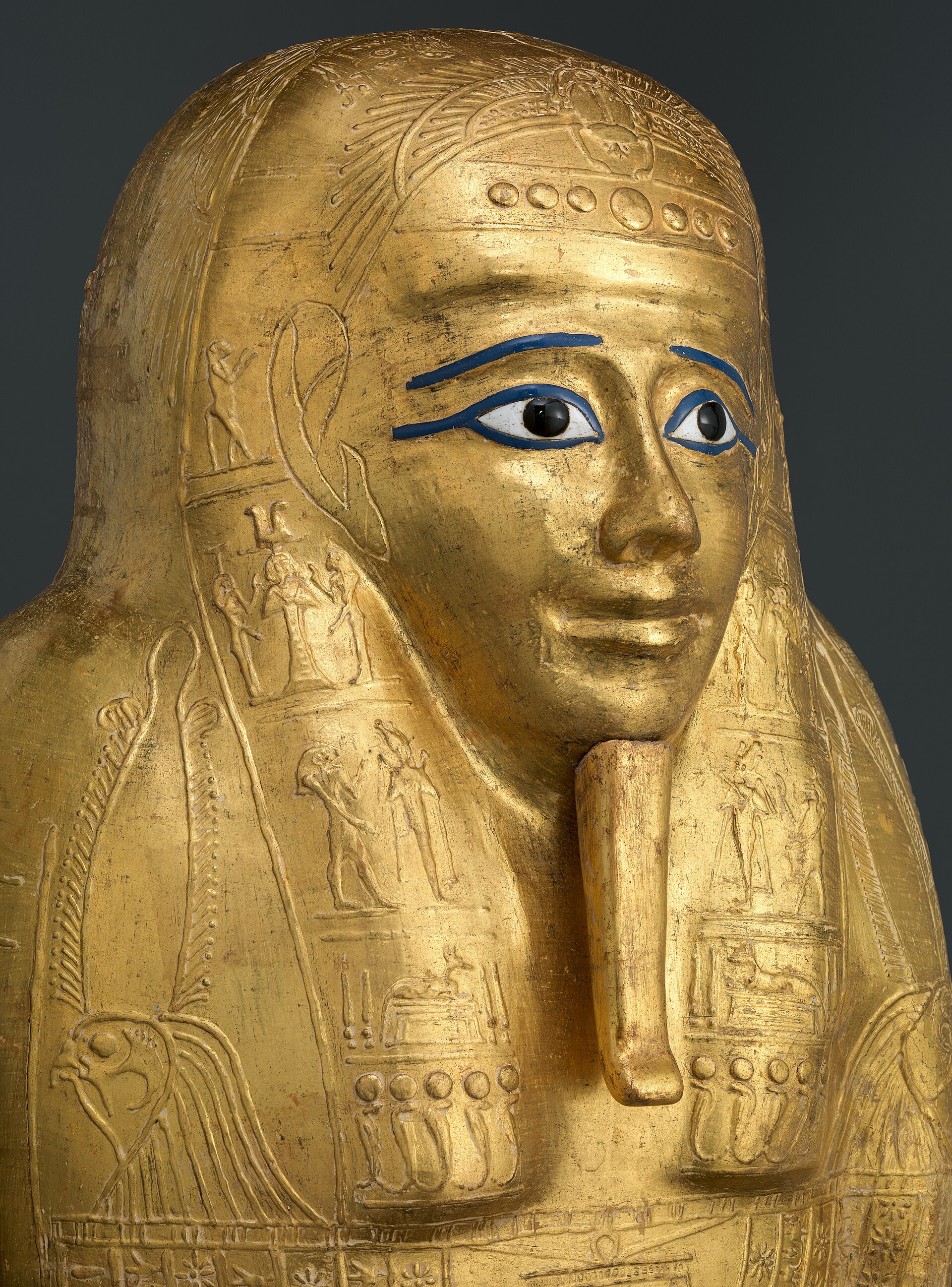
A mummiform coffin in two parts, a base and a lid, each about 180 centimetres long. The body is cartonnage: layers of linen soaked in glue and built up with gesso, a technique that gives a light, strong shell moulded to the shape of a wrapped body. Over the gesso the workshop raised the decoration in relief, a technique of built-up modelling later called pastiglia, and then covered the whole exterior in an unbroken skin of gold leaf. Silver, glass, resin, wood and leaded bronze appear in the fittings and the inlays.
The relief scenes are the standard furniture of the Egyptian afterlife and would be recognised by anyone who has read the Book of the Dead: the weighing of the heart, the embalming of the mummy. One is rarer, a group of baboons worshipping the sun. A djed pillar, the sign of stability read as the backbone of Osiris, is set on the base.
What makes the object unusual is not the iconography but the relation between the text and the materials. The long inscription on the front of the lid connects gold and fine gold - electrum - to the flesh of the gods, to the sun and to the rebirth of the deceased. The Metropolitan Museum, announcing the purchase in 2017, described the association of that inscription with the actual metals used on the object as a rare and possibly unique occurrence. Gold and silver were understood as sun and moon and, more specifically, as the eyes of Heryshef, the god Nedjemankh served. Inside the lid there is a figure of Nut, goddess of the sky, partly covered in silver foil, so that the dead man lay looking up at a silver heaven while wrapped in a gold skin that the text on his chest declared to be divine flesh.
This is not decoration. It is a claim, made in two media at once, that the man inside had become a god. A record that describes the gilding as sumptuous and stops there has missed the entire point of the object.
Chapter 2Nedjemankh served a ram, and that is nearly all we know of him
The inscription above the feet of the lid lists his titles: priest, Sameref-priest, priest who adorns the divine image, and priest of Heryshef-who-resides-in-Herakleopolis.
The inscription above the feet of the lid lists his titles: priest, Sameref-priest, priest who adorns the divine image, and priest of Heryshef-who-resides-in-Herakleopolis. It names his mother, Banabes. It does not name his father.
Heryshef, whom the Greeks identified with Herakles, was a ram-headed creator god whose cult centre was Herakleopolis Magna in Middle Egypt. The title priest who adorns the divine image is a working description: the man spent his career dressing and ornamenting a cult statue, handling the gold and linen on a god's body. He was then buried in a body-shaped case that had been dressed and ornamented in exactly the same way. The coffin is his own job performed on himself.
Beyond that, nothing. There is no tomb, no burial group, no papyrus, no stela, no mummy. Everything a normal excavation would have recovered about this man was destroyed by the way he came out of the ground, and no repatriation puts it back. The coffin returned to Egypt in 2019; the archaeology did not.
Chapter 3The dirt in the photographs is the provenance
In the autumn of 2011, months after the fall of Hosni Mubarak, the coffin was dug up.
In the autumn of 2011, months after the fall of Hosni Mubarak, the coffin was dug up. Metadata in photographs later obtained by prosecutors places those pictures in the Minya region of Middle Egypt. Six images were sent by a looter to Mohammed Jaradat, a Jordanian trafficker known as Abu Said, in late 2011 and early 2012. One of them shows a man in a hooded top crouched on a sand dune with an assault rifle held across his chest.
Matthew Bogdanos, who leads the Manhattan District Attorney's Antiquities Trafficking Unit, calls these dirty photographs, and explains their function precisely: a picture of an object still caked in earth is proof to a buyer that the thing is fresh out of the ground and therefore not a forgery. The logic of the market, in his summary of it, is that if it is looted, it is real. The soil that destroys the archaeological record is the same soil that authenticates the object commercially. That inversion is the whole economics of this trade in one image.
Jaradat offered the coffin to the Lebanese collector Georges Lotfi for 50,000 dollars. Lotfi declined. Jaradat sent it instead to Roben Dib, a dealer working with the Egyptian-Armenian dealer Serop Simonian, on a promise that the proceeds would be split. In a Gmail exchange of September 2012 quoted in the summary of the Manhattan grand jury investigation, Simonian asked when the big yellow one was going to arrive; Dib replied that it would be ready for the EU in early October. It travelled from Egypt to Dubai and then by FedEx to a shipping agent living near the Cologne warehouse where it was stored. The airway bill described a multi-million-dollar Egyptian coffin as a gypsum wooden box and lid, shipped from Turkey, worth 5,000 euros.
Somewhere in Germany, between arrival and sale, it was restored. No restorer has been named in any public document consulted for this record, and what was consolidated, replaced or added is not on file anywhere a curator could read it.
Chapter 4One sentence in a press release did the work of a provenance
The Metropolitan Museum announced the acquisition on 12 September 2017.
The Metropolitan Museum announced the acquisition on 12 September 2017. The published ownership history of the object, in full, was this: officially exported from Egypt in 1971, the coffin has since resided in a private collection.
Twenty-two words, two assertions, both false, and one of them chosen with care. The year 1971 is not a random date. Egypt's Law No. 117 of 1983, on the protection of antiquities, replaced a regime under which some export had been possible with one that made lawful export of an antiquity practically impossible and vested ownership in the state. Any object whose paperwork claims to have left Egypt before 1983 has been placed on the far side of that line. A forger choosing a year is choosing a legal regime, and 1971 buys twelve years of clearance.
The 1971 story also came with an unnamed private collection, which is the market's standard device for terminating an enquiry. The Art Newspaper's French edition, telephoning Kunicki's office on the day the return was announced, was told by a man who would not give his name that the documentation supplied was absolutely correct, that they did not understand what was happening, and that the coffin had been bought from a private collector whom he refused to identify.
Chapter 5The forged licence names a country that did not yet exist
When the Metropolitan's curators asked for provenance, Kunicki sent a scan of what he said was an Egyptian export licence issued to Simon Simonian in 1971.
When the Metropolitan's curators asked for provenance, Kunicki sent a scan of what he said was an Egyptian export licence issued to Simon Simonian in 1971. Three separate problems sat on the face of that document.
The first is the stamp. It reads Arab Republic of Egypt. The country was not called that until September 1971; before then it was the United Arab Republic. A licence stamped with a state name the state had not yet adopted is not a document that requires expert analysis to doubt.
The second is the dating. One date on the licence read as May 1961 and another as May 1971. They cannot both be right, and neither can be reconciled with the stamp.
The third is that the museum was given not one ownership story but three. In one the current owner was a Mme Chatz of Switzerland; in another an M.D. of Germany; in a third it was Serop Simonian. The documentation also included what was said to be an official translation of the export licence supplied by the German embassy in Cairo in February 1977, for the use of a European owner who was never named.
None of this is subtle forgery. It is the sort of inconsistency that a first-year archivist would flag. The failure was not one of forensic capacity.
Chapter 6The museum asked Egypt to check the licence, then sent Egypt the copy with the name removed
This is the part of the case that no museum press release describes, and it is the reason the record exists in this form.Janice Kamrin, a curator on Diana Craig Patch's staff, wrote to the Egyptian...
This is the part of the case that no museum press release describes, and it is the reason the record exists in this form.
Janice Kamrin, a curator on Diana Craig Patch's staff, wrote to the Egyptian government about the export licence. She told them it had all the proper stamps and that it looked right to us, and said the museum wished to confirm its authenticity as part of our due diligence. That is the correct instinct and the correct procedure: the only authority that can confirm an Egyptian export licence is Egypt.
An Egyptian official asked for all the data and pics. Kamrin asked whether the licence number and year would be enough. It was not; the Egyptians wanted a copy of the document Kamrin had told them looked right. According to the summary of the Manhattan grand jury investigation, she then replied that she did not have copies, electronic or otherwise - although Kunicki had emailed a scan to Patch months earlier.
Patch, for her part, pressed the dealers, writing that for the sale to proceed we of course will require the original export license. The original never came; the dealers produced a sequence of excuses. Egyptian officials stopped answering.
In May 2017 Patch and Kamrin recommended the purchase to the museum's director. When senior Egyptian officials learned that the acquisition was going ahead they again asked for a copy of the licence. The dealers had supplied two versions, one showing Simon Simonian's name and one with it blacked out. Kunicki asked Patch to send Egypt the copy without the names, and the grand jury summary records that she complied. Egypt was thus asked to authenticate a document from which the only detail that would have identified its holder had been removed - and the holder was a man Egypt had stripped of his antiquities licence in 1971.
Neither curator responded to requests for comment from the reporter who published these exchanges. The museum, asked about their conduct, described the acquisition as a museum decision supported by a multi-step institutional process in place at the time.
Chapter 7The case broke because a trafficker was not paid
In the autumn of 2017 Georges Lotfi was walking through the Metropolitan's Egyptian galleries when he recognised the coffin he had been offered five years earlier for 50,000 dollars.
In the autumn of 2017 Georges Lotfi was walking through the Metropolitan's Egyptian galleries when he recognised the coffin he had been offered five years earlier for 50,000 dollars. He telephoned Jaradat to ask what had become of it. Jaradat said he had sent it to Dib, who had promised to split the proceeds, and that he had heard nothing since. Lotfi told him where it was. The museum had paid four million dollars and Jaradat had received nothing.
In March 2018 Lotfi passed the story to Matthew Bogdanos. The names meant something: five years earlier, investigating a different matter, Bogdanos had come across emails from Dib and Jaradat in the inboxes of New York collectors and museum officials, full of dirty photographs of objects he could not seize because he did not know where they were. His office had served search warrants on Dib's and Jaradat's email accounts in 2013 and had thousands of messages sitting in evidence. Lotfi's tip turned that archive from a curiosity into a case: the six photographs of the coffin were in it, with their metadata.
The investigative pattern here is worth stating plainly, because it recurs. The Euphronios krater case was won out of a Geneva warehouse full of Polaroids; the Lydian Hoard was won in discovery out of a museum's own minutes. This case was won out of a trafficker's Gmail account, opened five years before anyone knew what was in it, and it turned on a falling-out over money between two criminals. Connoisseurship contributed nothing.
Chapter 8A search warrant is not a lawsuit, and a return is not a judgment
In February 2019 the District Attorney's office satisfied a New York judge that the Metropolitan Museum was likely in possession of stolen property in the first degree - a state criminal offence, not...
In February 2019 the District Attorney's office satisfied a New York judge that the Metropolitan Museum was likely in possession of stolen property in the first degree - a state criminal offence, not a civil claim to title. On that finding, agents of Homeland Security Investigations and the District Attorney's office executed a search warrant and took the coffin off the wall of a museum in the middle of its own exhibition.
Four things follow that are routinely blurred in accounts of this case, and they are different things with different consequences.
First, this was a criminal seizure by a county prosecutor under state law, not a federal civil forfeiture action in rem and not a suit by Egypt. No complaint was filed against the museum. No court ever ruled on who owned the coffin, because the museum did not contest it.
Second, no one at the Metropolitan was charged. The prosecutors made that decision; it was not a finding that the museum's conduct was beyond criticism.
Third, the museum's cooperation was real and it was also the only sensible course once a judge had made that finding. Describing what followed as the Met returning the object is true; describing it as the Met deciding to return the object understates the warrant.
Fourth, the museum closed the exhibition on 12 February 2019, ten weeks before its scheduled end on 21 April, and transferred the object to the Egyptian Ministry of Antiquities. The formal handover took place at a ceremony in New York on 25 September 2019, where District Attorney Cyrus R. Vance Jr said that returning stolen cultural treasures to their countries of origin is at the core of our mission to stop the trafficking of stolen antiquities, and Peter C. Fitzhugh of Homeland Security Investigations observed that it is the responsibility of a buyer to confirm the proper provenance of a piece of art or antiquity. The coffin was unveiled in Cairo on 1 October 2019.
Chapter 9What the museum said, and the sentence it did not say
Daniel Weiss, then the Metropolitan's president and chief executive, said that after we learned that the Museum was a victim of fraud and unwittingly participated in the illegal trade of antiquities...
Daniel Weiss, then the Metropolitan's president and chief executive, said that after we learned that the Museum was a victim of fraud and unwittingly participated in the illegal trade of antiquities, we worked with the DA's office for its return to Egypt. The museum said it would consider all available remedies to recoup the purchase price, announced that it would review and revise its acquisition process, and pointed to its existing practice of vetting acquisitions in recognition of the 1970 UNESCO convention and in adherence to the guidelines of the Association of Art Museum Directors.
Two things about that statement matter. The first is that victim of fraud is a legal position as well as an apology, and the museum has maintained it: it has filed a complaint as a party in the criminal proceedings in Paris. The second is what the statement does not concede. It does not say the museum should have refused the object on the documents it had. Asked, years later, whether it would in future buy antiquities without an original export licence and without confirmation from the source country that the object was legal, the museum's answer was that the guidelines it follows do not include those conditions, though it would make every effort to verify documents.
Some of what followed is measurable. The Metropolitan appointed its first head of provenance research in 2024, overseeing a team of twelve analysts reviewing objects acquired from problematic dealers. Against that, the Manhattan District Attorney's office states that it has seized more than two hundred antiquities valued at more than 54 million dollars from the same museum since 2023. Both numbers are true at once, and a reader who is offered only one of them is being managed.
Chapter 10The same forged name reappears on a stele in Abu Dhabi
The Tawadros story was not written for this coffin alone.
The Tawadros story was not written for this coffin alone. In November 2017, four months after the Metropolitan bought the coffin, the Louvre Abu Dhabi opened with a rose-granite stele carrying a decree of Tutankhamun. Its published ownership history also began with Habib Tawadros.
The Egyptologist Marc Gabolde, given permission to publish the first scholarly paper on the stele, could not make its provenance work. The chain ran back to a German merchant-navy officer named Behrens said to have acquired it in 1933, and Germany's economy in 1933 made that implausible on its face; searching the records, Gabolde could find no evidence that Behrens had ever existed. When the Manhattan seizure of the coffin was reported in February 2019 he saw the same dealer's name in both histories and concluded, in his research notes, that whole stories seemed to have been made up to hide the exact provenance of the artefacts.
Habib Tawadros was a real Cairo dealer. That is precisely why the name works. And in 1971 - the year the coffin's licence claims - Simon Simonian was stripped of his Egyptian antiquities licence for registering the Tawadros shop in his own name. The forgery reuses a dead dealer's identity in the same way it reuses a pre-1983 date: both are chosen because they are the shape of a legitimate document.
French police later established that early twentieth-century sales records had been fabricated on an old typewriter, and that friends and other witnesses had been paid to sign notarised letters claiming they had inherited objects from invented ancestors. From 2013 to 2018 the network sold the Metropolitan Museum and the Louvre Abu Dhabi some 65 million dollars of allegedly looted material, including a marble head of a Ptolemaic queen said to be Cleopatra bought for about 40 million dollars, the highest known price a museum has paid for a single antiquity.
Chapter 11The open case is in Paris, and nobody has been tried
Legal precision matters here more than anywhere, because the coffin's return is often read as though someone had been convicted of something.
Legal precision matters here more than anywhere, because the coffin's return is often read as though someone had been convicted of something. Nobody has.
Christophe Kunicki and Richard Semper were charged in France in 2020 with fraud, money laundering and forgery. French journalists quoting confidential police files reported that Kunicki admitted using forged paperwork to fill in missing links in ownership; their lawyer says they deny wrongdoing. Roben Dib was charged in France in 2022 with criminal conspiracy, organised fraud and money laundering, and has professed his innocence. Jean-Luc Martinez, president and director of the Louvre from 2013 to 2021 and the author of a 2015 report to UNESCO urging museums to refuse systematically any proposal to acquire works whose provenance is not certain, was charged in 2022 with complicity in fraud and money laundering; his lawyer says he was one of six members of a collective acquisitions committee, calls him a victim of alleged counterfeiters and expects him to be fully exonerated.
Serop Simonian was 81 when he was extradited from Germany to France in September 2023 and charged with criminal association, money laundering and organised fraud. He was held in La Sante prison in Paris, denied possessing illicit antiquities, and told investigators that if they really cared about illegal provenance he could empty half the Louvre. In December 2024, after more than a year in custody, a judge released him on health grounds. Prosecutors appealed successfully, but he had already left France by bus for an assisted-living centre in Hamburg and has not answered summonses to return. His son Abraham is being prosecuted in Germany for fraud and receiving stolen goods and his daughter Alice on a money-laundering charge; both deny the charges.
An Italian precedent hangs over all of this. In 2018 Italian prosecutors declared that a papyrus and a key provenance document sold by Simonian were fakes and that he had committed aggravated fraud - and then said they could not charge him, because the limitation period had run out. In this trade the clock is a defence.
Chapter 12Where the object is now, and what has quietly disappeared
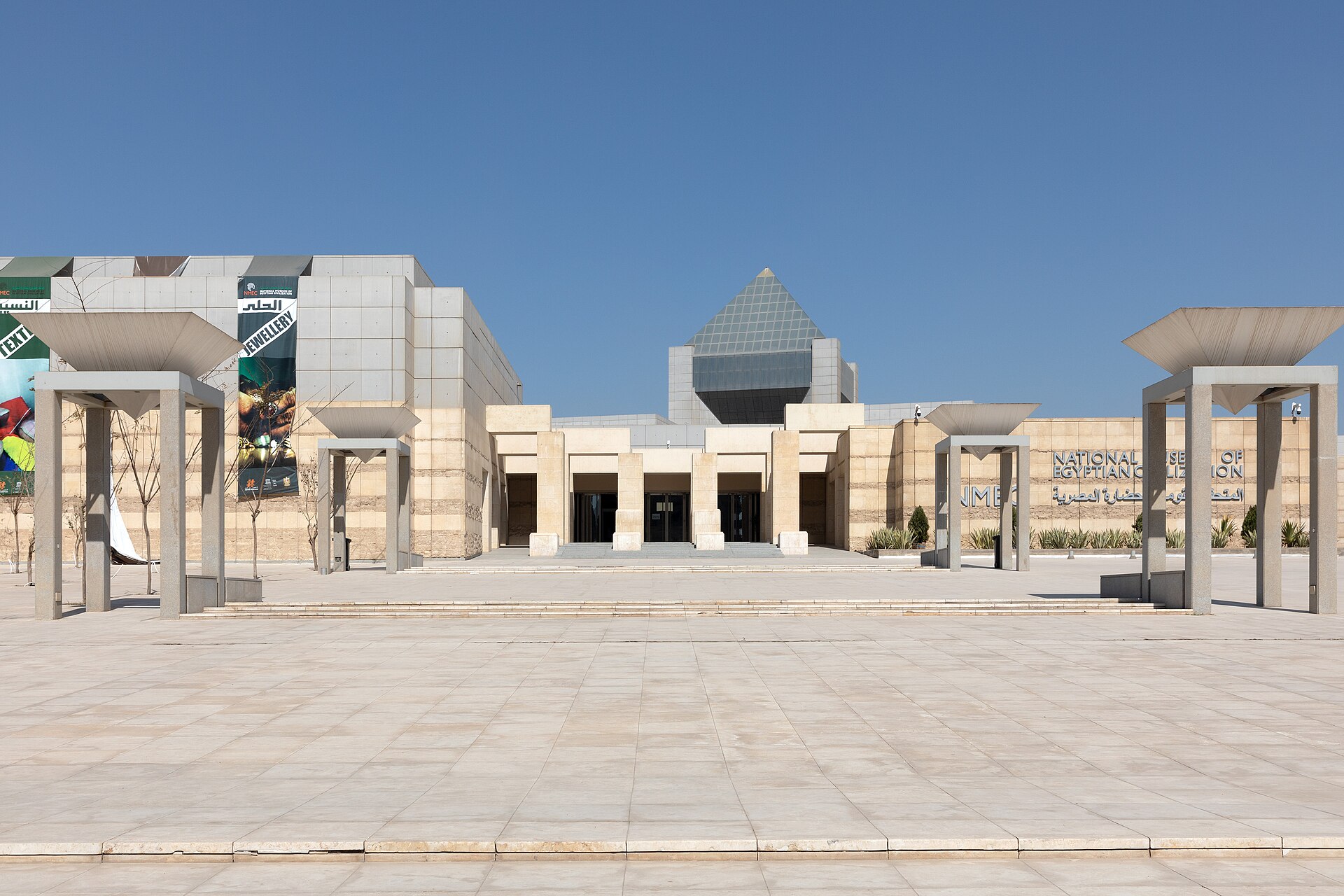
The coffin was unveiled at the National Museum of Egyptian Civilization in el-Fustat on 1 October 2019.
The coffin was unveiled at the National Museum of Egyptian Civilization in el-Fustat on 1 October 2019. No later account of its display status has been located, and this record does not assert that it is on view in 2026 on the strength of a seven-year-old ceremony.
One thing can be measured directly. On 4 August 2026 the Metropolitan Museum's public collection API was queried for the three object identifiers the museum had assigned to this coffin: 746821 for the lid, 764105 for the base, 764111 for the pair. All three return empty. The museum's own catalogue records for the object, its tombstone, its credit line and its images, are gone from the source that published them.
What survives in reproducible form is a pair of the museum's own photographs, released under CC0 before the seizure and mirrored on Wikimedia Commons, where the institution field has since been edited by a volunteer to read National Museum of Egyptian Civilization. The accession number in the same file, 2017.255b, still says Metropolitan Museum of Art. Both statements are on the same page, one of them a record of what was and one an assertion about what is, and a researcher who takes either as authority without reading the underlying wikitext will get the object's history wrong in one direction or the other.
That is the durable lesson of the case for anyone doing diligence. Every document in this story was in the correct format. The licence had stamps. The dealer had a reputation, dinners with curators and a place at the fairs. The museum had a multi-step institutional process. What was missing was a single act of confirmation from the only body able to give it, and the one time it was sought, the copy sent for checking had the name cut out of it.
The artist
Anonymous funerary workshop, late Ptolemaic Egypt, probably Herakleopolite
No maker is named on this coffin and none will be. Late Ptolemaic funerary equipment was produced by workshops, not by signing artists, and the useful questions about the maker are therefore questions about a trade: what cartonnage is, how gilded relief was built up, how such objects are dated when no excavation record exists, and why this particular class of object is so easily broken up and moved. The last of those questions is not incidental. The physical characteristics that make a cartonnage coffin a masterpiece of craft - light, hollow, modular, built in separable panels over a former - are the same characteristics that make it convenient to traffic.
Related works
| Work | Relation | Where it is |
|---|---|---|
| Stele of Tutankhamun Unknown, Eighteenth Dynasty | Sold by the same network with the same fabricated first owner Rose granite, dated to about 1318 BC. Its published history also began with the Cairo dealer Habib Tawadros and ran back to a German merchant-navy officer named Behrens whose existence Marc Gabolde could not verify. | Louvre Abu Dhabi |
| Marble head of a Ptolemaic queen, called Cleopatra Unknown, Ptolemaic | Sold by the same network Bought for about 40 million dollars, reported as the highest known price a museum has paid for a single antiquity. Simonian's two adult children claimed ownership of this head and the Tutankhamun stele, which routed some 30 million euros of proceeds into their accounts. | Louvre Abu Dhabi |
| Five further antiquities acquired by the Metropolitan Museum from the same network Various, ancient Egyptian and Roman Egyptian | Seized and repatriated after this case Bought for more than three million dollars in total. Two carried the Khashaba or Behrens provenance stories; one was said to have been sold by a Dutch gallery nine years before that gallery opened; a Roman-era portrait of a woman was, according to Manhattan prosecutors, looted in the 1990s and given an invented Munich purchase of 1968. | Egypt |
| The Euphronios krater Euxitheos, potter; Euphronios, painter | The same museum, the same failure, a generation earlier Bought by the Metropolitan in 1972 with an ownership story lifted from another vase and returned to Italy in 2008. Held as a separate record in this archive. | Museo Archeologico Nazionale Cerite, Cerveteri |
| The Lydian Hoard Unknown Lydian goldsmiths | The same museum, returned to Turkey in 1993 Bought in the 1960s and returned after litigation. Held as a separate record in this archive. | Usak Museum of Archaeology |
Open questions
- Where exactly was the coffin found? Prosecutors place the looting in the Minya region on photograph metadata and Abusir el-Meleq has also been proposed. No tomb has been identified and no assemblage recorded, so the burial context is permanently lost.
- What became of the mummy of Nedjemankh? A coffin of this quality contained a body. Nothing in any account consulted says what happened to it, or whether anything else came out of the same burial.
- Who restored the coffin in Germany between about 2012 and 2015, and what was done to it? No restorer has been named and no conservation report is public.
- Did the Metropolitan Museum recover any part of the 3.5 million euros? The museum said in 2019 that it would consider all available remedies and has filed a complaint in the French criminal proceedings. No outcome has been published.
- What is the exact date in February 2019 of the search warrant and the seizure? Accounts give the month; the day has not been found in any source consulted.
- Will anyone stand trial? Charges in France date from 2020 and 2022, the principal accused left the country for Hamburg in December 2024 and no trial date has been published as at August 2026.
- Is the coffin on public display at the National Museum of Egyptian Civilization in 2026? The last confirmed event is the unveiling of 1 October 2019.
- How many visitors saw the exhibition? One account gives nearly half a million for a show that ran from 20 July 2018 to 12 February 2019. The museum has not published an audited figure in any source consulted.
- Who authored the forged licence, and does the original template exist? French investigators identified a typewriter used to fabricate early twentieth-century sales records, but no source consulted attributes this specific document to a named hand.
Questions about this object
What is Gilded Coffin of Nedjemankh?
Gilded Coffin of Nedjemankh is an antiquity, dated c. 150-50 BC. Medium: Cartonnage (linen, glue and gesso), gesso, paint, gold, silver, resin, glass, wood and leaded bronze.
Who made Gilded Coffin of Nedjemankh, and is the attribution settled?
The attribution to Unknown workshop, late Ptolemaic Egypt is recorded here as workshop. No maker is named and none can be. The coffin is the product of an anonymous late Ptolemaic funerary workshop working in cartonnage, gesso relief and applied gold and silver leaf, almost certainly in or near Herakleopolis Magna, where the man it was made for served the ram-god Heryshef. Attribution in this class of object is by material, technique and inscription formula, not by hand.
Where is Gilded Coffin of Nedjemankh now?
Arab Republic of Egypt; unveiled at the National Museum of Egyptian Civilization, el-Fustat, Cairo. Inventory number Formerly Metropolitan Museum of Art 2017.255a (base) and 2017.255b (lid); no Egyptian inventory number published in the sources consulted. Last confirmed 2 September 2026. Seized under a New York search warrant in February 2019 and handed to the Egyptian government at a repatriation ceremony in New York on 25 September 2019; unveiled in Cairo on 1 October 2019.
What is still unknown about Gilded Coffin of Nedjemankh?
Where exactly was the coffin found? Prosecutors place the looting in the Minya region on photograph metadata and Abusir el-Meleq has also been proposed. No tomb has been identified and no assemblage recorded, so the burial context is permanently lost.
Sources
- 1U.S. Immigration and Customs Enforcement, Homeland Security Investigations, press release, 'Ancient gold coffin repatriated to Egypt in New York ceremony', 26 September 2019. Primary source for the February 2019 search warrant and seizure, the route through the United Arab Emirates and Germany, the 3.5 million euro value and the quotations from Cyrus R. Vance Jr and Peter C. Fitzhugh. Consulted in the Internet Archive capture of 27 September 2019 because ice.gov returns 403 to direct requests. web.archive.org/web/...
- 2Ariel Sabar, 'The Mystery of the Golden Coffin', The Atlantic, 13 May 2026. The fullest published account, drawing on the summary of the Manhattan grand jury investigation, French police files and interviews; source for the Kamrin and Patch emails, the three ownership stories, the Arab Republic of Egypt stamp, the 1961 and 1971 dates, the FedEx declaration, the Lotfi and Jaradat sequence and the status of the French proceedings. theatlantic.com/culture/...
- 3Art-Law Centre, University of Geneva, ArThemis case note, 'Nedjemankh and his Gilded Coffin - Metropolitan Museum of Art and Egypt'. Source for Daniel Weiss's statement, the museum's undertaking to consider all available remedies, the response given on behalf of Kunicki's office, and the relation of the claimed 1971 export date to Egyptian Law No. 117 of 1983. plone.unige.ch/art-adr/...
- 4The Metropolitan Museum of Art, press release, 'Metropolitan Museum Acquires Ancient Egyptian Gilded Coffin', 12 September 2017. The museum's own published provenance - 'Officially exported from Egypt in 1971, the coffin has since resided in a private collection' - and its description of the inscription linking gold and electrum to the flesh of the gods. Consulted in the Internet Archive because metmuseum.org returns 429 to direct requests. web.archive.org/web/...
- 5The Art Newspaper, 'Met hands over an Egyptian coffin that it says was looted', 15 February 2019. Source for the purchase price of 3.5 million euros, the July 2017 date, the identification of Kunicki as seller and the museum's statement that it was pursuing remedies against the dealer. theartnewspaper.com/2019/...
- 6Wikipedia, 'Coffin of Nedjemankh'. TERTIARY, used only for the physical description, the accession numbers, the inscription content, the exhibition dates and the 1 October 2019 unveiling at the National Museum of Egyptian Civilization. To be replaced with the Metropolitan Museum's Department of Egyptian Art Annals volume 4 (2017-18) entry on the coffin and with an Egyptian ministry statement on its current display. en.wikipedia.org/wiki/...
- 7The Art Newspaper, 'Alleged head of Egyptian antiquities trafficking ring leaves France amid breakdown in criminal investigation', 27 March 2025. Source for Simonian's release in December 2024, the successful prosecution appeal and his departure to Hamburg. theartnewspaper.com/2025/...
Last verified 2 September 2026 · Published 4 August 2026
Change log
4 August 2026 - Record created at the house standard: researched narrative, technical evidence, maker dossier, graded provenance chain, prices with hammer and premium separated, related works, open questions and sources.
2 September 2026 - Re-verified. No change to location (still the National Museum of Egyptian Civilization, Cairo), to attribution or to the graded provenance chain. Checked for developments in the French criminal case against Christophe Kunicki, Richard Semper and Roben Dib: no trial date has been published in any source consulted, consistent with the record as written. Noted but not adopted as a source: journalist Vincent Noce's book 'L'or pille des pharaons' (Buchet-Chastel, 8 January 2026) covers this case, but its content could not be read to verify any specific new claim, so nothing from it has been added. All sources re-checked and resolve.