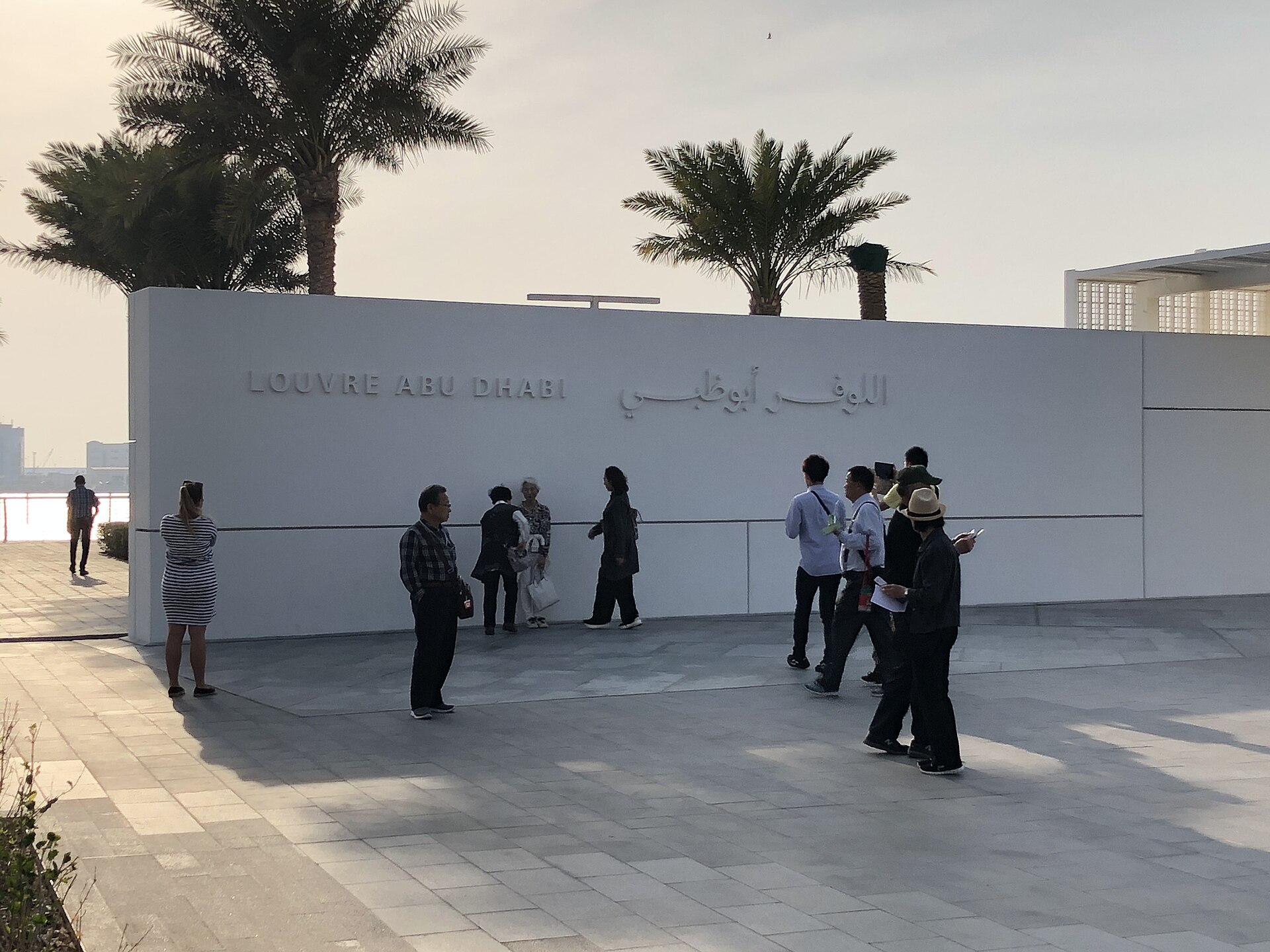
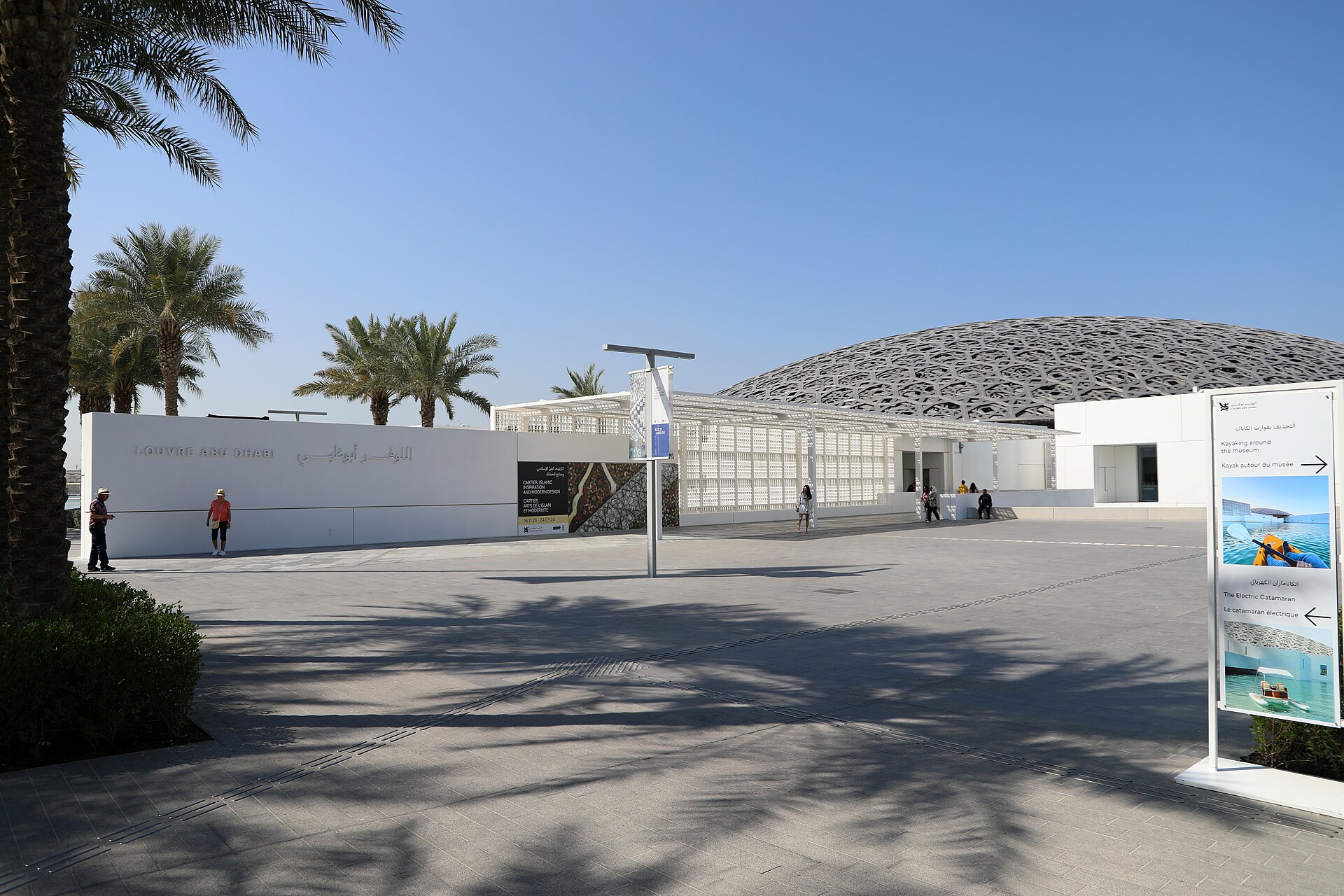
The museum's name cut into the entrance wall in English and Arabic, palm trees and the waterfront behind it. Photograph by Davide Mauro, CC BY-SA 4.0.
Davide Mauro, CC BY-SA 4.0, via Wikimedia Commons · Photograph by CodasLouvre Abu Dhabi
Museum · Founded 2007
Open, admission and hours confirmed 20 August 2026 · 21 sources
On this page 17 sections
ContentsClose
Around 600 works are on show at any time from a permanent collection that mixes objects Louvre Abu Dhabi owns outright with loans coordinated by Agence France-Museums on behalf of Louvre, Orsay, Versailles, Quai Branly, the Bibliotheque nationale de France and other French partner institutions, alongside loans from Emirati and regional collections such as the Department of Antiquities of Jordan and the National Museum of Ras al Khaimah. The distinguishing choice is arrangement rather than scale: the museum does not attempt to be encyclopaedic within any one culture the way its Paris namesake is, but instead builds each of its twelve chronological chapters out of objects from several civilisations shown in the same room, so a visitor moves through time rather than through geography. That structure is also the collection's most argued-over feature, since it depends on treating objects as evidence of a shared human pattern rather than of a specific culture's own terms -- the exact point on which its admirers and its critics disagree.
| Kind | Museum |
|---|---|
| Founded | Intergovernmental agreement signed 6 March 2007; opened to the public 11 November 2017 |
| City and country |  Abu Dhabi, United Arab Emirates Abu Dhabi, United Arab Emirates |
| Address | Louvre Abu Dhabi, Saadiyat Cultural District, Saadiyat Island, Abu Dhabi, United Arab Emirates |
| Website | louvreabudhabi.ae |
| Status | Open, confirmed |
| Record last verified |
Visiting
- Hours
- Tuesday to Thursday10:00 to 18:30Galleries, exhibitions and the Boutique. Last entry to the galleries is 30 minutes before closing, i.e. 18:00, per both the museum's Visit Us page and its Terms and Conditions of Sale.
- Friday to Sunday10:00 to 20:30Galleries, exhibitions and the Boutique. Last entry 30 minutes before closing, i.e. 20:00.
- Tuesday to Sunday10:00 to 00:00The Dome and the restaurants stay open until midnight, last entry 23:00. A museum ticket or a restaurant reservation is required for access until the gallery closing time; after that, entry to walk under the Dome is free and no ticket is required, though the galleries themselves are shut.
- Closed
- Closed on Monday, including the Dome and the restaurants.. The museum's own FAQ page states last entry to the galleries as 15 minutes before closing, which conflicts with the 30-minute figure given on the same site's Visit Us page and Terms and Conditions of Sale. This page follows the two-source figure; see open_questions..
- Admission
- Adult, 18 and overAED 70Standard single-entry admission, inclusive of VAT.
- Under 18FreeFree.
- UAE senior nationals and residents, 60 and overFreeFree.
- Members, with one guestFreeFree.
- ICOM / ICOMOS card holdersFreeFree.
- JournalistsFreeFree.
- People of Determination, with one companionFreeFree. People of Determination is the UAE's official term for visitors with disabilities.
- Express guided tour, 45 minutesAED 50Runs at 12:00 and 16:00. A general admission ticket is required in addition to the tour ticket.
- Private group express tour, up to 25 peopleAED 600Bookable daily at 10:30, 12:30, 14:30 and 16:30 through the museum's call centre. General admission tickets are required in addition.
Free entry: No recurring free day is published. Free entry is by visitor category (under 18, UAE seniors, members with a guest, ICOM/ICOMOS card holders, journalists, People of Determination with a companion), not by day of the week.. As of 20 August 2026 the museum is running a time-limited promotion, 30 percent off admission for UAE residents and free entry for children, from 1 August to 30 September 2026. This is a dated promotional offer, not a standing discount, and should be re-checked before being relied on.- Tickets
- louvreabudhabi.ae/en/buy-ticket The museum's own ticket page.
- Do I need to book?
- Not mandatory but recommended online in advance. Tickets can also be bought on arrival, until 17:30 Tuesday to Thursday and 19:30 Friday to Sunday.
- Address
- Louvre Abu Dhabi, Saadiyat Cultural District, Saadiyat Island, Abu Dhabi, United Arab Emirates MapCar From Abu Dhabi city via the Corniche and Mina Port; from Dubai via the E11 or Yas Island, taking the Saadiyat Island exit onto Sheikh Khalifa Highway E12 and following signs along Yas Highway to the Cultural District. Paid valet parking is available via Gate 1 (Gate 2 for Fouquet's). Visitor parking runs 7am to midnight with no overnight parking, and an electric-vehicle charging point is on a first-come basis.
Bus, taxi and the Cultural Express The museum lists bus, taxi and a dedicated Cultural Express shuttle among the ways to reach Saadiyat Island, alongside a shuttle service from Dubai; the museum's own page did not expand the detailed routes and timetables for these beyond naming them.
Boat The museum states visitors can also arrive by sea, reflecting the building's setting on the water. - Website
- louvreabudhabi.ae
- Telephone
- +971 600 56 55 66
- [email protected]
Before you go how long, access, photography, bags, eating, shop
- How long to allow
- The museum's own 45-minute Express Tour is a floor for a first visit; the permanent display runs across 12 chronological chapters in 23 of the site's 55 buildings, with around 600 works on show at any time, so a visitor who wants to see every chapter should plan considerably longer.
- Access
- Wheelchairs and strollers are available for complimentary loan next to the cloakroom, first come first served. Prayer rooms are on level -1. The free multimedia guide app, used in place of a rented handset, is offered in English, Arabic, French, Mandarin, Russian, German and Hindi.
- Photography
- Personal, non-commercial photography and filming are allowed inside the museum. Commercial filming, editorial shoots and drone photography of any kind require written authorisation in advance; the museum states it can confiscate equipment and destroy images taken in breach of this. A paid Photography Experience desk operates beside the Boutique for visitors who want a shoot arranged for them.
- Bags
- Bags and backpacks, other than small ladies' handbags, are not allowed into the galleries; a cloakroom sits just after the ticket-scanning point. Food and liquids are not permitted inside any gallery.
- Eating
- The Museum Cafe runs during gallery hours. Aptitude Cafe is open daily, including Mondays, from 09:00 to 22:00. Fouquet's Abu Dhabi, a French brasserie, and Marta Bar above it both operate Tuesday to Sunday. The Art Lounge was closed for the summer as of 20 August 2026, with a stated reopening in mid-September.
- Shop
- The Boutique sells art books, stationery and accessories tied to the collection; the museum also runs an online shop under the same brand.
Prices and hours change. We take them from the institution's own pages and print the day we read them, and you can check the current position at the source we used. Confirm before you travel.
What is inside
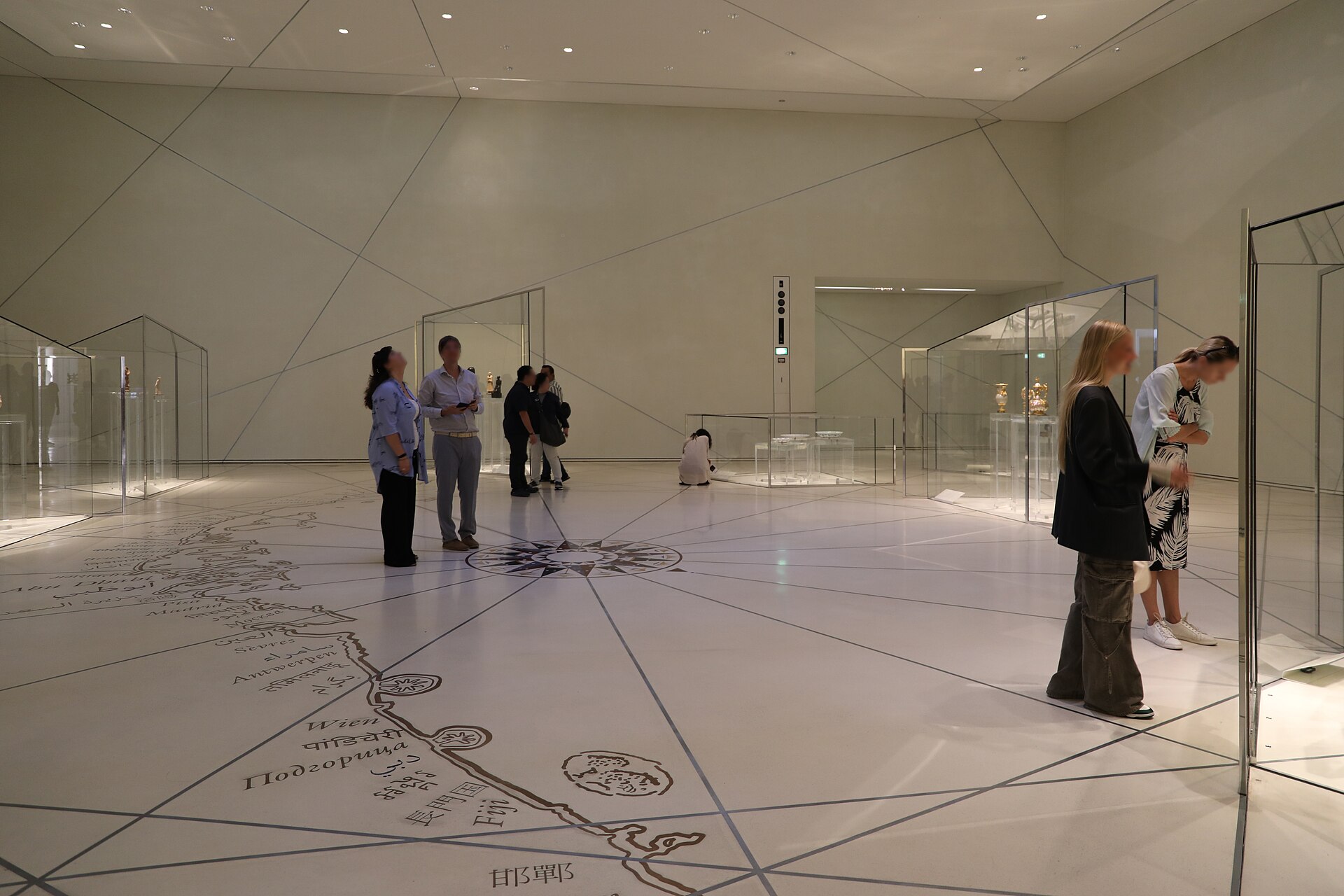
Photograph by Sailko · CC BY-SA 4.0 The Grand Vestibule
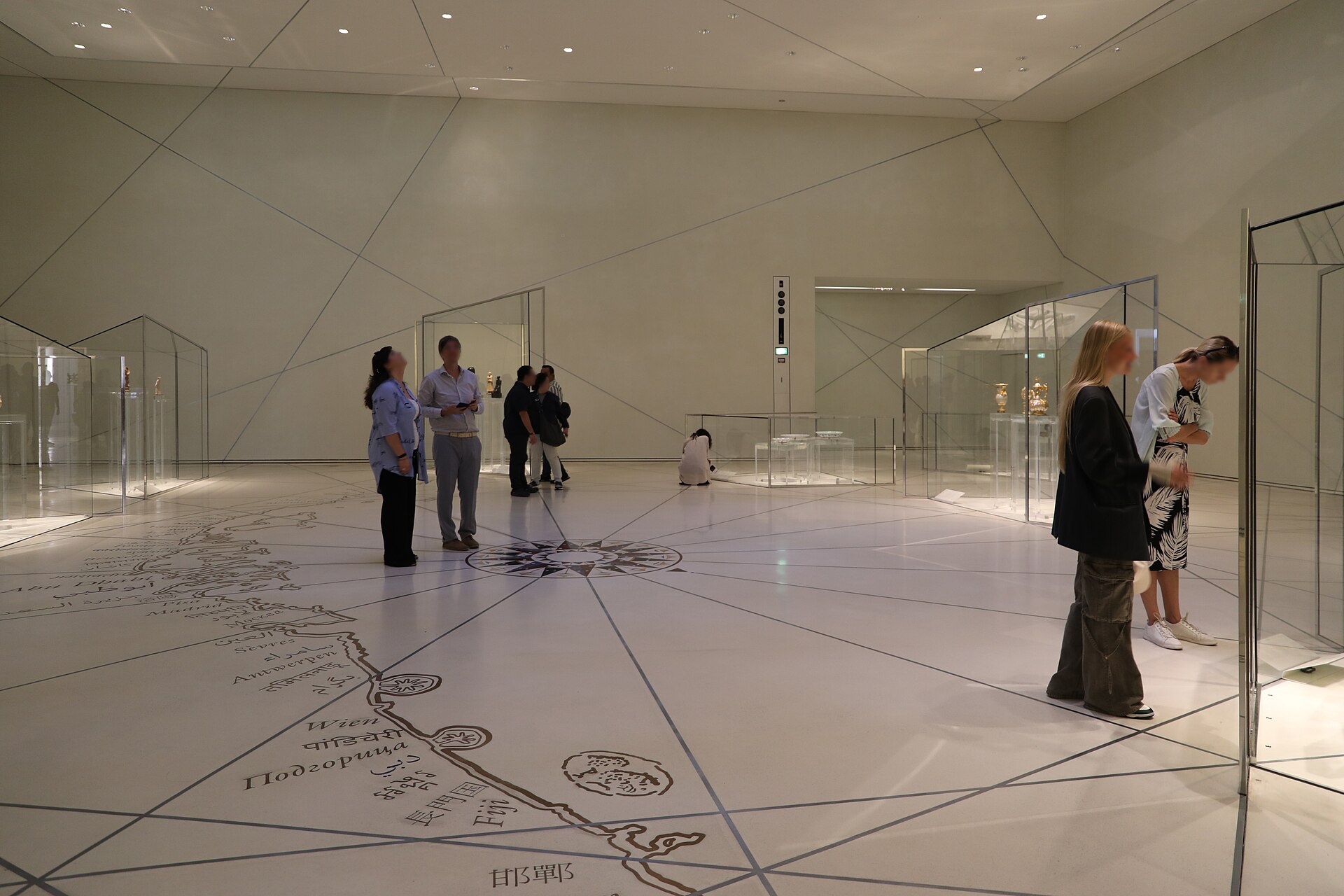
The introduction to the whole museum, its floor inlaid with a winding line copied from nautical charts of the UAE coastline; instead of port names the line carries the places of origin, in different languages, of works shown further in. On display here: a bronze figure of the goddess Isis nursing Horus (Egypt, 800-400 BCE), an ivory Virgin and Child (Paris, 1300-1400) and a carved wooden maternity figure, Phemba, from the Democratic Republic of the Congo (1800-1900) -- three continents and three religious traditions set beside each other before the chronological galleries begin.
Gallery 1, The First Villages
Opens the chronological sequence around 10,000 BCE, when communities in the Near East, China and Central America first settled and domesticated plants and animals. The gallery's own centrepiece is a two-headed plaster statue from Ain Ghazal in Jordan, about 6500 BCE, on loan from the Department of Antiquities of Jordan; alongside it stand a Bactrian stone figurine of a woman in a woollen garment (2300-1700 BCE) and a painted terracotta vase imported into what is now Abu Dhabi's own Marawah Island, about 5500 BCE -- an object the museum uses to place the UAE inside the same prehistoric exchange network as its neighbours.
Gallery 2, The First Great Powers
Covers the kingdoms that rose in the Tigris, Euphrates, Nile, Indus and Yellow River valleys from about 3000 BCE, when bronze weapons, writing and the first cities appeared together. Objects on view include a black stone statue of Gudea, Prince of Lagash (Iraq, about 2120 BCE), a diorite figure of Ramesses II from Tanis (1279-1213 BCE), the painted coffins and wrappings of the sarcophagus of Princess Henuttawy (Egypt, 950-900 BCE), and a gold pendant excavated at Dhayah in Ras Al Khaimah, on loan from the National Museum of Ras al Khaimah -- again pairing an internationally famous object with a locally excavated one.
Gallery 4, Universal Religions
Sets Buddhism, Christianity and Islam side by side as they spread across Europe, Asia and Africa from about 2000 years ago. The room holds a gilt-copper Nepalese figure of Maitreya (1100-1200), a bronze Dancing Shiva from Tamil Nadu (950-1000), a Limoges enamel book-binding cover of Christ in Majesty (1190-1200), a carved wooden Malian ancestor figure (1200-1300), an illuminated 30th section of the Quran from Damascus (1250-1300) and a bound Pentateuch scroll from Sana'a, Yemen, dated 1498 -- five faiths on adjoining plinths rather than in separate wings.
Gallery 9, A New Art of Living
Eighteenth-century material culture: the spread of manufactured luxury beyond royal courts, and the Enlightenment's turn toward the private sphere. The room shown in the museum's own photographs pairs marble and plaster figures against a red gallery wall with framed European portraiture; named works include Jacques-Louis David's Napoleon Bonaparte, First Consul, Crossing the Alps on 20 May 1800 (1803, on loan from the Chateaux de Versailles et de Trianon), a pair of Japanese folding screens showing the arrival of Portuguese merchants (about 1625), Jean-Etienne Liotard's Mr Levett and Miss Glavani in Turkish Costume (about 1740) and Francis Cotes's Portrait of William and Panelope Welby Playing Chess (1769).
Gallery 11, Challenging Modernity
Twentieth-century art shaped by colonialism, two world wars and decolonisation: Cubism, Abstraction and Surrealism as responses to a world in flux. On display are Piet Mondrian's Composition with Blue, Red, Yellow and Black (Paris, 1922) and Kazuo Shiraga's Chirisei Kyubiki (Japan, 1960), an oil painting made with the artist's own body rather than a brush.
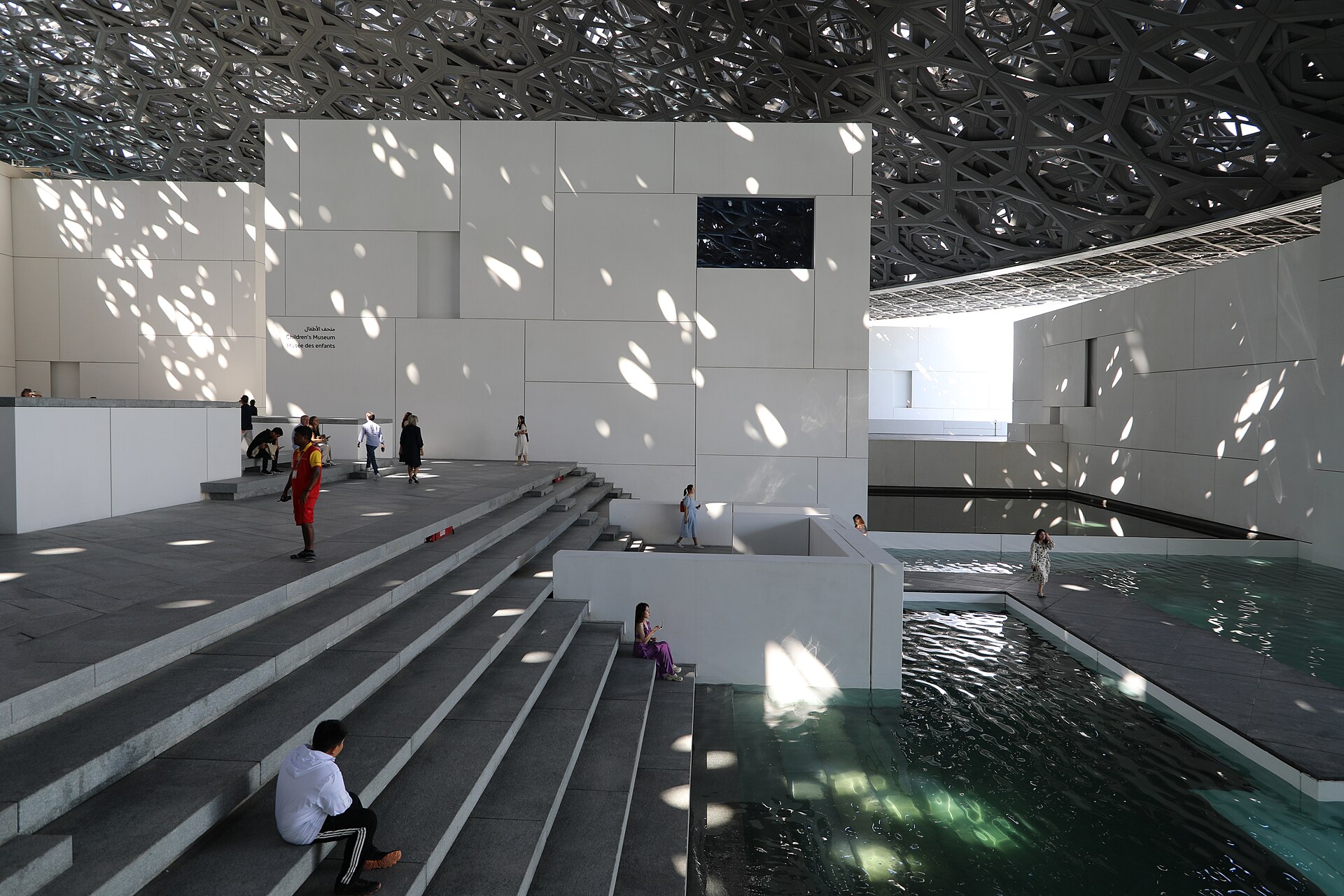
Photograph by Sailko · CC BY-SA 4.0 The Dome and the plaza beneath it
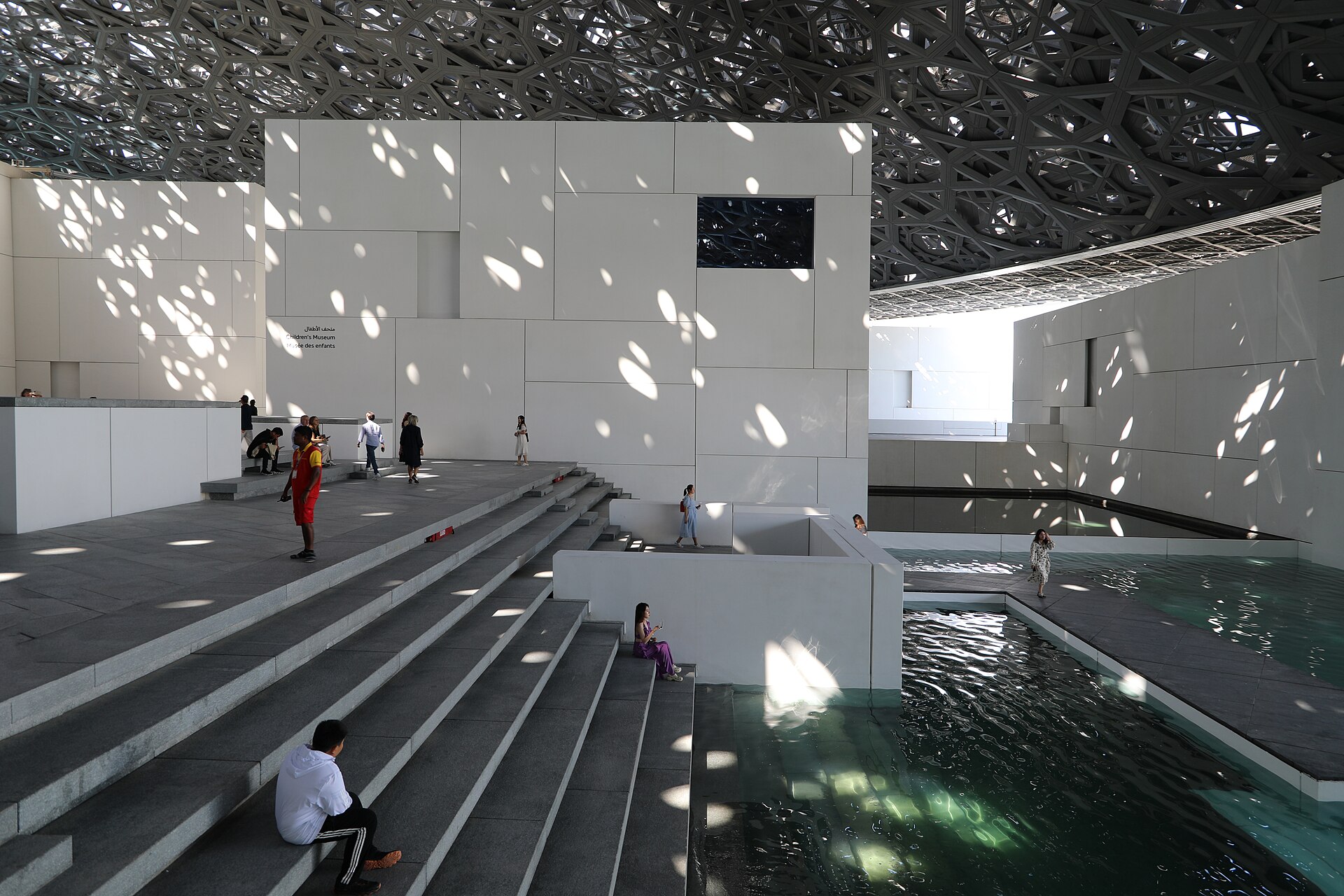
Not a gallery but the building's own centrepiece: a lattice dome of 7,850 star-shaped perforations across eight layers, four of stainless steel and four of aluminium, weighing about 7,500 tonnes and resting on four hidden piers spaced 110 metres apart. Sunlight filtering through the pattern produces what the museum calls the rain of light, falling across the white pavilion buildings and the water channel that runs beneath the dome. It stays open, and free to walk through, until midnight when the galleries themselves are shut.
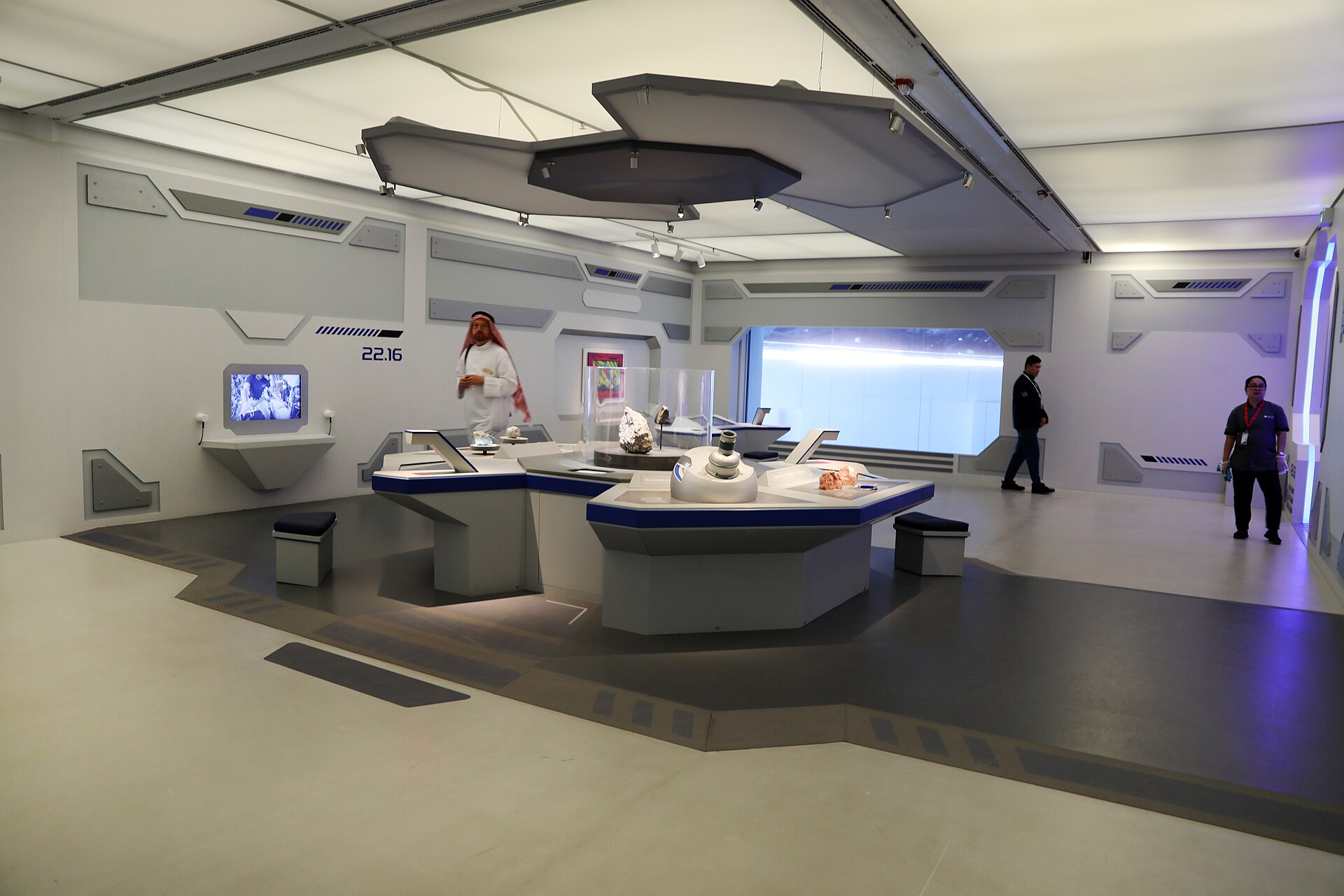
Photograph by Sailko · CC BY-SA 4.0 The Children's Museum
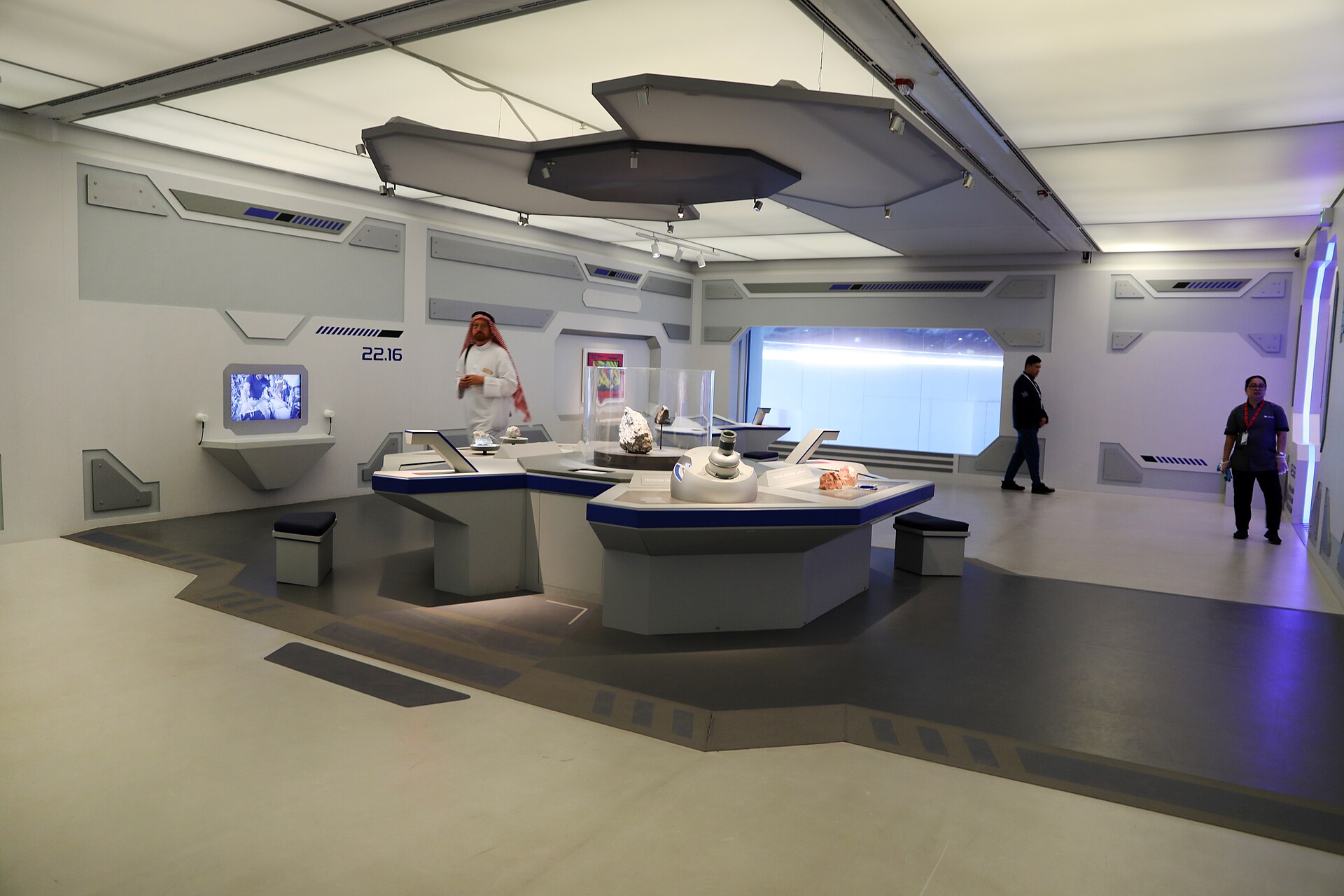
A dedicated space for young visitors, its theme changed periodically; as of 20 August 2026 the running exhibition is Picturing the Cosmos, a space-travel installation across three floors mixing art and interactive games. The museum's own photographs show a mission-control-style set of consoles and screens rather than object cases.
What to see first
The Isis and Horus bronze in the Grand Vestibule
Egypt, 800-400 BCEThe first object most visitors see, chosen to open the museum's cross-cultural argument: a mother-and-child bronze standing beside a French ivory Virgin and Child and a Congolese wooden maternity figure of similar theme but unconnected origin.5
The two-headed statue from Ain Ghazal
Jordan, Ain Ghazal, about 6500 BCEA plaster and bitumen figure on loan from the Department of Antiquities of Jordan, among the oldest large-scale human representations shown anywhere in the museum, opening Gallery 1's account of the first settled villages.6
The sarcophagus of Princess Henuttawy
Egypt, 950-900 BCEPainted wood coffins and stuccoed mummy wrappings from the era of the first great river-valley kingdoms, shown alongside a diorite Ramesses II from Tanis in the same room.7
The 30th section of the Quran from Damascus
Syria, Damascus, 1250-1300An illuminated Quran manuscript set in Gallery 4 beside a Nepalese Buddhist Maitreya, a Hindu bronze Dancing Shiva and a Yemeni Pentateuch scroll, the clearest single expression of the museum's founding idea that universal religions are best read side by side rather than in separate wings.8
The Dancing Shiva of Tamil Nadu
India, Tamil Nadu, 950-1000A bronze image of Hindu divinity from the same universal-religions room, dated three centuries earlier than the Quran manuscript it is displayed beside.8
Napoleon Bonaparte Crossing the Alps
Jacques-Louis David, France, 1803On loan from the Chateaux de Versailles et de Trianon, shown in Gallery 9 among Japanese, Ottoman and English 18th-century portraiture as an example of the museum's practice of hanging its own period rooms across cultures rather than by national school.9
Composition with Blue, Red, Yellow and Black
Piet Mondrian, Paris, 1922The clearest example in Gallery 11 of the museum's account of Modernism as a response to imperial collapse and world war, shown near Kazuo Shiraga's body-painted Chirisei Kyubiki of 1960.10
Chirisei Kyubiki
Kazuo Shiraga, Japan, 1960An oil painting made by dragging the artist's own body across the canvas, part of the Gutai movement; its pairing with Mondrian in the same gallery is a deliberate juxtaposition of a European and a Japanese response to the same mid-century moment.10
Exhibitions on now
- Opening soon25 Nov 2026 to 25 Apr 2027Confirmed , 7 weeks ago
Past exhibitions here
- Closed29 Jan to 25 May 2025Confirmed · check before you travel
A partnership written into a treaty
Louvre Abu Dhabi exists because of an intergovernmental agreement between the United Arab Emirates and France, signed 6 March 2007, rather than because an existing museum decided to open a branch. The deal paired the UAE's ambition to build a cultural quarter with France's museum expertise: Agence France-Museums, a body drawing on seventeen of France's most prominent cultural institutions, coordinates the loan of artworks to Abu Dhabi and provides management advice, while the Abu Dhabi Department of Culture and Tourism owns the building and its permanent collection outright. The museum's own account of itself is explicit that this is not a satellite: acquisitions are chosen jointly by a committee chaired by the Chairman of the Department of Culture and Tourism, with the President of the Musee du Louvre in Paris as vice-chairman, following a protocol the museum states is aligned with the 1970 UNESCO convention against illicit trafficking in cultural property. The stated aim, in the museum's own words, is universality defined narrowly: not a claim to hold everything, but a focus on what different cultures share, told through works ranging from the Palaeolithic to the present day.
Jean Nouvel's dome
The building the agreement produced is Jean Nouvel's, and its defining feature is a dome that appears to float, weighing about 7,500 tonnes -- comparable to the Eiffel Tower -- while seeming to rest on almost nothing. It is carried on four piers, each hidden within the structure and spaced 110 metres apart, and built up from 7,850 star-shaped perforations repeated at different sizes across eight layers: four of stainless steel outside, four of aluminium within. The pattern is drawn from the cupola of Arabic architecture, and its purpose is optical as much as structural -- sunlight filtering through the layered stars produces what the museum calls the rain of light, an effect the museum's own text compares to sun through palm fronds. The dome's base is 180 metres across and stands 36 metres above the plaza it shelters, itself raised 40 metres above sea level. Underneath and around it sit 55 separate buildings, of which 23 hold galleries, deliberately low-rise and modelled on the region's own vernacular architecture rather than on a single monumental block; visitors move between them along open walkways over water, arriving, as the museum intends, by land or by sea. The design earned a Silver LEED rating and a Three Pearl Estidama rating, the dome doubling as a passive cooling device that shades the plaza and lowers the energy load of the buildings beneath it.
Twelve chapters, not twelve nations
Inside, the museum organises around 600 works from its own growing collection, supplemented by loans, into twelve chronological chapters rather than by geography or civilisation. It begins in the Grand Vestibule, where the floor is inlaid with a line copied from nautical charts of the UAE coastline, its ports replaced with the places of origin, in their own languages, of the works shown beyond it -- an Egyptian bronze of Isis nursing Horus beside a French ivory Virgin and Child and a Congolese wooden maternity figure. Gallery 1, The First Villages, opens the historical sequence around 10,000 BCE with a two-headed plaster statue from Ain Ghazal in Jordan, on loan from the Jordanian Department of Antiquities, and a painted vase excavated on Abu Dhabi's own Marawah Island, deliberately placing a local find beside an internationally famous one. Gallery 2 follows the first river-valley kingdoms with a black stone Gudea of Lagash and a diorite Ramesses II, both on loan from the Musee du Louvre in Paris, alongside the sarcophagus of an Egyptian princess and a gold pendant excavated in Ras Al Khaimah. Gallery 4, Universal Religions, is the room where the museum's method is clearest: a Nepalese gilt Buddha, a bronze Dancing Shiva from Tamil Nadu, a Limoges enamel of Christ in Majesty, a Malian ancestor figure, an illuminated Quran from Damascus and a bound Yemeni Pentateuch scroll share a single space rather than five separate ones. Gallery 9, A New Art of Living, moves into the eighteenth century with Jacques-Louis David's Napoleon Bonaparte Crossing the Alps beside Japanese folding screens depicting Portuguese traders and English and Ottoman-costume portraiture. Gallery 11, Challenging Modernity, closes the sequence the museum showed on its own gallery pages with Mondrian's Composition with Blue, Red, Yellow and Black next to Kazuo Shiraga's body-painted Chirisei Kyubiki -- a European and a Japanese answer to the same mid-century rupture, hung together on purpose.
What the opening did not put on show
The building's public unveiling on 11 November 2017 coincided with a second, separate story that the museum's own materials do not tell. Human Rights Watch had published a series of reports on labour conditions across Saadiyat Island's construction sites, including this one, before its researchers were denied re-entry to the UAE in 2014; its February 2015 findings, covering contractors working under Tourism Development and Investment Company oversight, documented workers charged around $2,600 in recruitment fees that employers did not reimburse, passport confiscation, unpaid wages, and the 2013 case of workers whose visas were cancelled after they struck over pay. On the day the museum opened to the public, Human Rights Watch's France director Benedicte Jeannerod wrote that the achievement on display had come at a human cost, in a country she said continued to restrict independent civil society and made the true extent of any reform hard to verify from outside. None of this appears on the museum's own visit or about pages, which frame the building's history through architecture and diplomacy rather than through the labour that built it.
Critics abroad: the building admired, the premise questioned
International architecture criticism at the opening was, by most accounts, positive to the point of relief after a decade of renderings and delay. The National's own survey of the response, published two days after the opening, recorded the Telegraph's Nick Trend describing the simple experience of being in the building as hugely pleasurable, and the Guardian's Oliver Wainwright calling the building and the water around it mesmerising. The same survey placed the New York Times in a different register, framing the project within the wider politics of Gulf soft power and describing its decade-long history as turbulent. That second, more sceptical strand found its fullest expression in the New York Times art critic Holland Cotter's own review, which argued that the museum's central idea -- that showing visitors the connections between cultures builds tolerance -- risks teaching exactly the opposite lesson: that all cultures become interchangeable once a viewer has learned to spot the pattern, which is a different thing from understanding what makes each one distinct. The two readings of the same rooms, one admiring the juxtapositions and the other doubting what they flatten, have not been resolved by either side since.
A painting that vanished
The museum's most expensive single object may also be the one it has displayed least. At a Christie's sale in New York in November 2017, the same month the museum opened, the Abu Dhabi Department of Culture and Tourism bought Leonardo's Salvator Mundi for $450 million, the highest price ever paid for a work of art at auction, and Louvre Abu Dhabi announced it would go on public display here from September 2018. That unveiling did not happen and was not rescheduled with a public date. Reporting drawn from the New York Times, and covered in April 2019 by the Italian outlet Finestre sull'Arte, found that staff at the museum itself said they did not know where the painting currently was, with the Abu Dhabi culture authorities declining to answer the question directly; the conservator Dianne Modestini, who had worked on the painting's restoration, was quoted calling the situation deeply unfair to the public denied access to it. No confirmed public exhibition of the painting at Louvre Abu Dhabi has since appeared on the museum's own website, and this page could not establish its current status; see open_questions.
What is open to a visitor today
As of 20 August 2026 the museum operates Tuesday to Sunday and is closed on Monday. Galleries and the Boutique run 10:00 to 18:30 Tuesday to Thursday and 10:00 to 20:30 Friday to Sunday, with last entry 30 minutes before closing on both the museum's Visit Us page and its published Terms and Conditions of Sale; a separate FAQ page on the same site states a 15-minute cut-off instead, a discrepancy this page has not been able to resolve. The Dome and its restaurants stay open, and free to enter without a ticket, until midnight on the days the museum is open. Standard adult admission is 70 AED, with free entry for under-18s, UAE residents 60 and over, members with a guest, ICOM and ICOMOS card holders, journalists, and People of Determination with a companion; a 45-minute Express guided tour runs at 12:00 and 16:00 for 50 AED on top of admission, and private group tours of up to 25 people can be booked for 600 AED. A time-limited promotion running 1 August to 30 September 2026 offers UAE residents 30 percent off admission with free entry for children. The museum passed five million visitors between its November 2017 opening and 19 March 2024, including more than 1.2 million in 2023 alone; international visitors made up 72 percent of that cumulative total against 28 percent from UAE residents, with Russia, India, France, the United States and China among the leading countries of origin.
What visitors say
Louvre Abu Dhabi opened in November 2017 to two largely separate conversations that have not fully merged since. Architecture critics, including at the Guardian and the Telegraph, responded to Jean Nouvel's dome with something close to reviewers' relief -- a building read as delivering on a decade of renderings. A second conversation, run mostly through the New York Times and Human Rights Watch, concerned what the building had cost to put up and what its founding logic left out: years of documented abuse of the migrant construction workforce on Saadiyat Island, and a curatorial premise -- that juxtaposing objects from different cultures reveals a shared humanity -- that critics such as Holland Cotter read as smoothing over the very particularity the museum claims to honour. A third and more recent problem sits apart from both: the museum's own $450 million Salvator Mundi, bought by the Abu Dhabi Department of Culture and Tourism at the same November 2017 Christie's sale that made it the most expensive artwork ever sold at auction, was due to be unveiled here in September 2018 and has not been confirmed on public display since, with museum staff themselves reported as unable to say where it is.
What is praised, what is criticised
- Praised: the dome itself: a lattice of 7,850 perforations across eight metal layers that architecture critics at its opening called mesmerising, and that the museum's own photographs show casting a moving, dappled light across the plaza and water beneath it
- Praised: the chronological, cross-cultural hang, which puts a Quran manuscript, a Buddhist bronze, a Hindu bronze and a medieval European reliquary in the same room rather than in separate national or religious wings, an arrangement several critics singled out as the building's real curatorial risk paying off
- Praised: the range of facilities beyond the galleries -- kayaking under the dome, a children's museum with a changing interactive theme, a free multilingual app used as the museum's entire multimedia guide, and free admission for under-18s and UAE seniors
- Criticised: Human Rights Watch documented, in reports it was able to publish before its staff were barred from the UAE in 2014 and again in a further account published on the day of the museum's opening, unsafe working conditions, unreimbursed recruitment fees of around $2,600 per worker, passport confiscation and the arbitrary deportation of workers who struck in 2013, on the Saadiyat Island sites that included this museum's own construction
- Criticised: in the New York Times, Holland Cotter argued that the museum's premise of finding connections across cultures risks teaching visitors that all cultures are equally interchangeable rather than engaging with what makes each one specific, a critique aimed squarely at the chronological, juxtaposed hang other critics praised
- Criticised: the museum's own Salvator Mundi, on which it holds the rights as the buying institution, was announced for display in September 2018 and, according to reporting drawn from the New York Times and covered by Finestre sull'Arte in April 2019, its own staff could not say where the painting was; no public unveiling here has since been confirmed on the museum's own site
Questions about Louvre Abu Dhabi
Where is Louvre Abu Dhabi?
Louvre Abu Dhabi, Saadiyat Cultural District, Saadiyat Island, Abu Dhabi, United Arab Emirates.
How much does it cost to visit?
Adult, 18 and over: AED 70; Under 18: free; UAE senior nationals and residents, 60 and over: free; Members, with one guest: free; ICOM / ICOMOS card holders: free. As confirmed 20 August 2026.
When is it open?
Tuesday to Thursday 10:00-18:30; Friday to Sunday 10:00-20:30; Tuesday to Sunday 10:00-00:00. Closed: Closed on Monday, including the Dome and the restaurants. The museum's own FAQ page states last entry to the galleries as 15 minutes before closing, which conflicts with the 30-minute figure given on the same site's Visit Us page and Terms and Conditions of Sale. This page follows the two-source figure; see open_questions. As confirmed 20 August 2026.
How do you get there?
Car: From Abu Dhabi city via the Corniche and Mina Port; from Dubai via the E11 or Yas Island, taking the Saadiyat Island exit onto Sheikh Khalifa Highway E12 and following signs along Yas Highway to the Cultural District. Paid valet parking is available via Gate 1 (Gate 2 for Fouquet's). Visitor parking runs 7am to midnight with no overnight parking, and an electric-vehicle charging point is on a first-come basis; Bus, taxi and the Cultural Express: The museum lists bus, taxi and a dedicated Cultural Express shuttle among the ways to reach Saadiyat Island, alongside a shuttle service from Dubai; the museum's own page did not expand the detailed routes and timetables for these beyond naming them; Boat: The museum states visitors can also arrive by sea, reflecting the building's setting on the water.
What should you see first?
The Isis and Horus bronze in the Grand Vestibule (Egypt, 800-400 BCE); The two-headed statue from Ain Ghazal (Jordan, Ain Ghazal, about 6500 BCE); The sarcophagus of Princess Henuttawy (Egypt, 950-900 BCE); The 30th section of the Quran from Damascus (Syria, Damascus, 1250-1300); The Dancing Shiva of Tamil Nadu (India, Tamil Nadu, 950-1000); Napoleon Bonaparte Crossing the Alps (Jacques-Louis David, France, 1803).
What we could not confirm
- The museum's own site gives two different last-entry times for the galleries: 30 minutes before closing on the Visit Us page and in the Terms and Conditions of Sale, but 15 minutes before closing on the FAQ page. This page follows the two-source figure and flags the FAQ as the outlier.
- The public display status of the museum's Salvator Mundi, bought for $450 million in November 2017 and originally announced for unveiling here in September 2018, could not be established from sources fetched for this page. No confirmed exhibition date or location appears on the museum's own website as of 20 August 2026, and the most recent reporting located dates to 2019.
- Whether the abuses on Saadiyat Island documented by Human Rights Watch through 2015, before its researchers were barred from the country in 2014, have been substantively resolved on this specific site is not something this page can confirm; the museum's own published material does not address labour conditions during its construction at all.
- The museum's press kit for its 2017 opening lists further named highlights, including works attributed to Leonardo da Vinci, Bellini and Van Gogh among the opening loans, that this page's own fetches of the museum's current gallery pages did not directly confirm are still on display; they are not included in highlights above for that reason.
Images
Sources
- 1Louvre Abu Dhabi, Visit Us: opening hours, admission prices and free-entry categories, tour prices, getting here by car with parking and EV charging details, facilities, dining and shopping outlets. louvreabudhabi.ae/en/visit-us
- 2Louvre Abu Dhabi, Architecture: Jean Nouvel's design, the dome's weight, layer count, star count, pier spacing, base diameter and height above the plaza, the 55 buildings and 23 galleries, and the LEED and Estidama environmental ratings. Read in the in-app browser 20 August 2026. louvreabudhabi.ae/en/about-us/architecture
- 3Louvre Abu Dhabi, Our Story: the March 2007 intergovernmental agreement, Agence France-Museums and its seventeen partner institutions, the museum's definition of universal, and the acquisitions policy and committee chaired jointly with the Musee du Louvre. Read in the in-app browser 20 August 2026. louvreabudhabi.ae/en/about-us/our-story
- 4Louvre Abu Dhabi, Museum Galleries: the twelve-chapter structure, the four wings, and the list of gallery titles from the Grand Vestibule through Gallery 11. Read in the in-app browser 20 August 2026. louvreabudhabi.ae/en/explore/museum-galleries
- 5Louvre Abu Dhabi, The Grand Vestibule gallery page: the map-line floor, the multilingual place-name device, and the objects shown there including the Isis and Horus bronze, the ivory Virgin and Child, and the Phemba maternity figure. Read in the in-app browser 20 August 2026. louvreabudhabi.ae/en/explore/museum-galleries/introduction-gallery
- 6Louvre Abu Dhabi, Gallery 1, The First Villages: the gallery text and the objects shown, including the Ain Ghazal two-headed statue, the Bactrian figurine and the Marawah Island vase. Read in the in-app browser 20 August 2026. louvreabudhabi.ae/en/Explore/museum-galleries/gallery-1
- 7Louvre Abu Dhabi, Gallery 2, The First Great Powers: the gallery text and the objects shown, including Gudea of Lagash, Ramesses II, the sarcophagus of Princess Henuttawy and the Ras Al Khaimah pendant. Read in the in-app browser 20 August 2026. louvreabudhabi.ae/en/Explore/museum-galleries/gallery-2
- 8Louvre Abu Dhabi, Gallery 4, Universal Religions: the gallery text and the objects shown, including the Maitreya, the Dancing Shiva, the Limoges book cover, the Malian ancestor figure, the Quran manuscript and the Sana'a Pentateuch. Read in the in-app browser 20 August 2026. louvreabudhabi.ae/en/Explore/museum-galleries/gallery-4
- 9Louvre Abu Dhabi, Gallery 9, A New Art of Living: the gallery text and the objects shown, including David's Napoleon Crossing the Alps, the Japanese folding screens, Liotard's Turkish-costume portrait and Cotes's chess portrait. Read in the in-app browser 20 August 2026. louvreabudhabi.ae/en/Explore/museum-galleries/gallery-9
- 10Louvre Abu Dhabi, Gallery 11, Challenging Modernity: the gallery text and the objects shown, including Mondrian's Composition with Blue, Red, Yellow and Black and Shiraga's Chirisei Kyubiki. Read in the in-app browser 20 August 2026. louvreabudhabi.ae/en/Explore/museum-galleries/gallery-11
- 11Louvre Abu Dhabi, FAQ: opening-hours detail including the 15-minute last-entry figure, ticket purchase and tour booking, payment methods, bag and food rules, accessibility, the Children's Museum's current theme, photography and filming rules, parking, and the call-centre phone number and email. Read in the in-app browser 20 August 2026. louvreabudhabi.ae/en/about-us/visitor-guidance/faq
- 12Louvre Abu Dhabi, General Terms and Conditions of Sale: the registered contact address (Saadiyat Cultural District), phone, email, call-centre hours, accepted payment currencies and cards, the 30-minute last-entry figure restated as fixed clock times, and ticket, refund and photography policy. Read in the in-app browser 20 August 2026. louvreabudhabi.ae/en/terms-conditions
- 13Benedicte Jeannerod, 'The Louvre Abu Dhabi's Unlovely Back Story', Human Rights Watch, 8 November 2017. Published on the museum's opening day; argues the building's achievement came at the cost of migrant workers' rights on Saadiyat Island, and situates this within wider restrictions on UAE civil society. hrw.org/news/2017/11/08/louvre-abu-dhabis-unlovely-back-story
- 14Human Rights Watch, 'UAE: Abuses at NYU, Louvre, Guggenheim Project', 10 February 2015. Documents recruitment fees of about $2,600 per worker, wage withholding, passport confiscation and the October 2013 mass deportation of striking Arabtec workers on Saadiyat Island construction sites, and the gaps in PricewaterhouseCoopers' compliance monitoring for the Tourism Development and Investment Company. hrw.org/news/2015/02/10/uae-abuses-nyu-louvre-guggenheim-project
- 15'HRW: Louvre Abu Dhabi tainted by worker abuse', Al Jazeera, 10 November 2017. Reports Human Rights Watch's findings around the museum's opening and quotes Benedicte Jeannerod on the persistence of the kafala sponsorship system despite UAE legislative reforms. aljazeera.com/features/2017/11/10/hrw-louvre-abu-dhabi-tainted-by-worker-abuse
- 16James Langton, 'Louvre Abu Dhabi: the global critical response so far', The National, 9 November 2017. Surveys international architecture and news criticism of the opening, including the Telegraph's Nick Trend, the Guardian's Oliver Wainwright and the New York Times's Doreen Carvajal. thenationalnews.com/uae/louvre-abu-dhabi-the-global-critical-response-so-far-1.674241
- 17Editorial staff, 'Louvre Abu Dhabi doesn't know what happened to the Salvator Mundi (and it's not an April Fools' joke)', Finestre sull'Arte, 1 April 2019. Reports, drawing on New York Times sourcing, that museum staff could not confirm the painting's location more than a year after its planned unveiling, and quotes conservator Dianne Modestini. finestresullarte.info/en/news/louvre-abu-dhabi-doesn-t-know-what-happened-to-the-salvator-mundi-and-it-s-not-an-april-fools-joke
- 18Wikipedia, Louvre Abu Dhabi: used only for the precise opening date (8 November 2017 inauguration, 11 November 2017 public opening), the Louvre-name licence running to 2047, and the appointment of director Manuel Rabate in September 2016. en.wikipedia.org/wiki/Louvre_Abu_Dhabi
- 19Wikidata, Louvre Abu Dhabi (Q3176133): , used only to confirm the entity, label and coordinates against the museum's own site. wikidata.org/wiki/Q3176133
- 20Wikimedia Commons, Category:Louvre Abu Dhabi and its file list. Queried 20 August 2026. commons.wikimedia.org/wiki/Category:Louvre_Abu_Dhabi
- 21Gulf News, 'Louvre Abu Dhabi welcomes more than five million visitors': cumulative visitor total passing five million between the November 2017 opening and 19 March 2024, more than 1.2 million visitors in 2023 alone, the 72/28 international-to-UAE-resident split, the leading countries of origin (Russia, India, France, USA, China, Germany, Italy, Kazakhstan, UK), and the more than 500 official and diplomatic visits recorded. gulfnews.com/uae/louvre-abu-dhabi-welcomes-more-than-five-million-visitors-1.101886328