Diatretbecher
Unknown late Roman glass workshop (diatretarius, hand and location undocumented) · First half of the 4th century CE; some literature narrows this to c. 330-340 CE
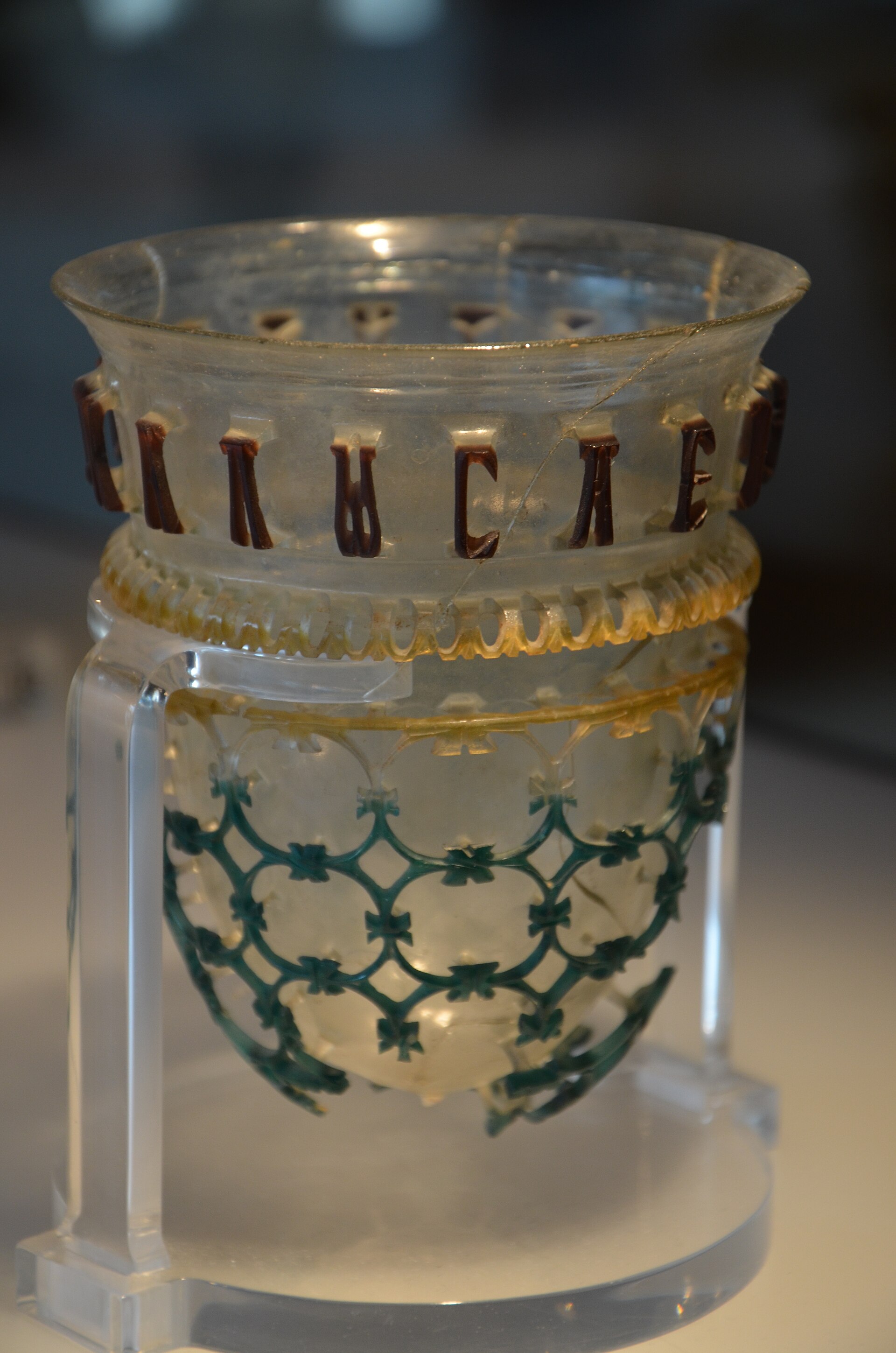
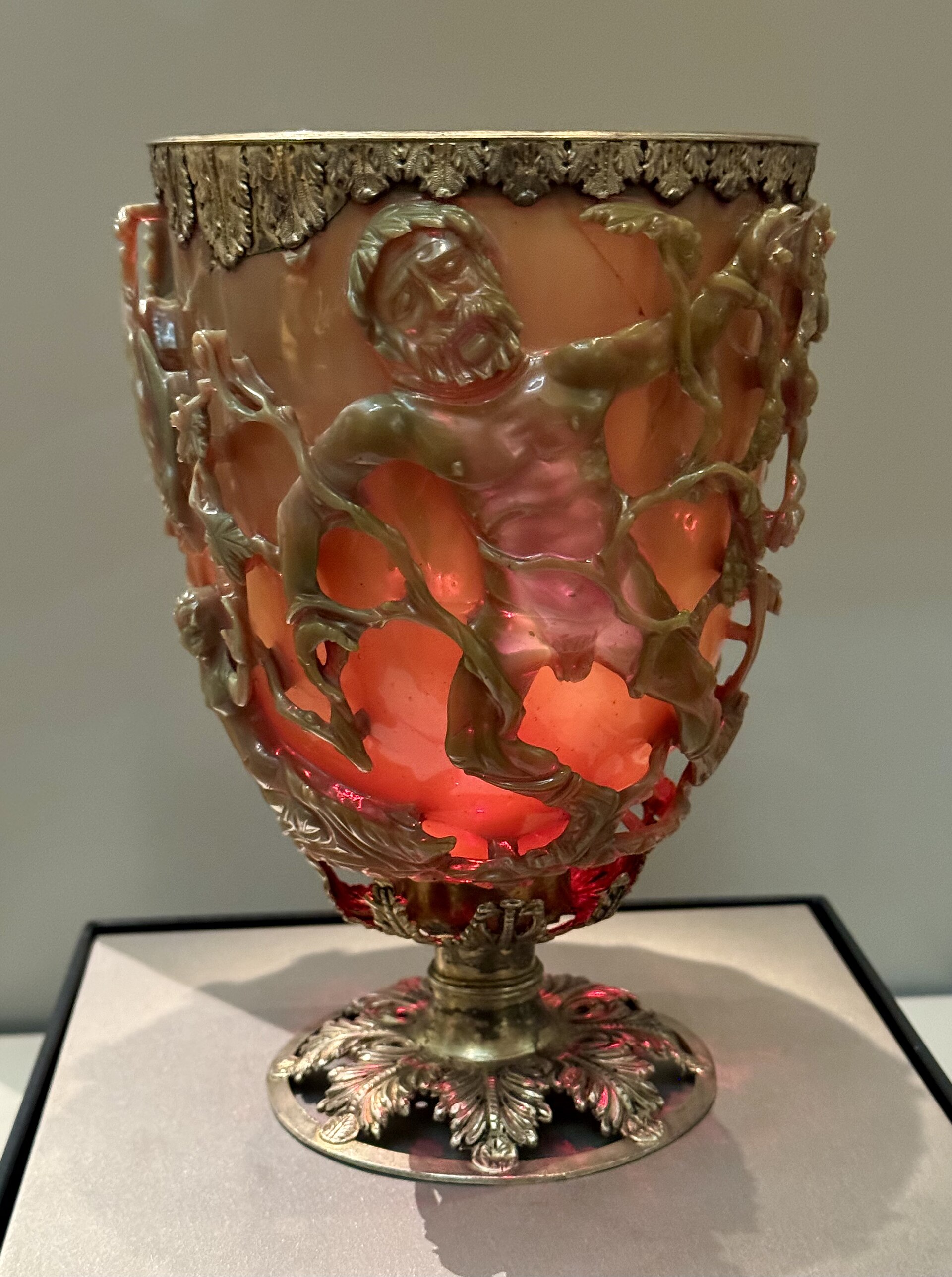
The record subject. Colorless glass, height 12.1 cm, cage of dark red, yellow and green glass, first half of the 4th century CE. Found 1960 in grave 5 of the villa rustica cemetery, Koln-Braunsfeld/Koln-Mungersdorf; Romisch-Germanisches Museum, Cologne, inventory 60,1.
Photo by Carole Raddato, CC BY-SA 2.0, via Wikimedia Commons| Artist | Unknown late Roman glass workshop (diatretarius, hand and location undocumented) |
|---|---|
| Date | First half of the 4th century CE; some literature narrows this to c. 330-340 CE |
| Medium | Colorless blown or cast glass, cold-cut and ground into a free-standing openwork network (the cage) of dark purple-red, gold-yellow and emerald-green glass, joined to the inner cup by short colorless struts |
| Dimensions | Height 12.1 cm (no other dimension published in the sources consulted) |
| Where it is now | Romisch-Germanisches Museum, Cologne, Germanylast confirmed |
| Inventory number | 60,1 |
| Attribution | UnknownNo cage cup of this class carries a maker's name, and this piece is no exception. Full note |
| Object type | Glass |
| Period | Late Roman, Rhineland (Germania Inferior/Secunda), first half of the 4th century CE |
| Cases | Has a provenance gap |
| Inscriptions | A Greek drinking toast in purple-red lettering below the rim: PIE ZESAIS KALOS AEI, conventionally translated Drink, live well, forever |
| Owners on record | 5 links3 documented, 1 disputed, 1 unknown |
| Sources | 13 cited |
About this record Last verified · 13 sources cited · Change log
On this page 9 sections
ContentsClose
A colorless glass beaker 12.1 cm high, encased in a free-standing network of dark red, yellow and green glass cut so that it appears to float around the cup on short struts, with a Greek drinking toast, Drink, live well, forever, cut in purple-red letters below the rim. It was found in 1960 in a sandstone sarcophagus in a Roman cemetery on the edge of Cologne, one of a documented handful of cage cups, a small and technically extraordinary class of late Roman luxury glass, to survive at all.
How its cage was actually cut or formed is a genuine, still-open dispute in the scholarship: cold-ground from a single solid blank, as the classic theory holds, or shaped with the help of a mould, as a rival theory argues. Neither side has fully replicated the ancient process, and modern glassmakers who have tried have not settled the question. This is a separate object from the more famous Lycurgus Cup in the British Museum, which belongs to the same broad class but is a distinct, dichroic, colour-changing piece; nothing in the sources consulted suggests the Cologne cup shares that optical property.
The find itself raises its own unresolved questions: which of the burials in the cemetery the cup belonged to, why so costly an object sits, on one account, among otherwise modest grave goods, and where the workshop that made it actually stood.
Provenance
Each link is graded. Documented: a cited source supports it. Disputed: the identification is argued but not established. Unknown: no owner for that span, and the gap is not smoothed into a narrative. The grades in the glossary.
- First half of 4th century CE (manufacture) -Unknown late Roman glass workshop, region undocumentedunknown
No maker, workshop name, or confirmed place of manufacture is documented for this piece. A Rhineland origin is argued by some scholars on the basis of findspot patterning (this cup and a separate example both surfaced in or near Cologne) but is not demonstrated.78
- c. 4th century CE - c. 4th century CEUnnamed deceased individual(s) interred in the villa rustica cemetery, Koln-Braunsfeld/Koln-Mungersdorfdisputed
That the cup was deposited as a grave good in a sandstone sarcophagus at this cemetery is documented by the 1960 excavation. Which individual within the grave assemblage it belonged to, and whether the surrounding grave goods were as modest as one secondary account states, is not settled and is the subject of a dedicated scholarly article on the problem of assigning grave goods to individuals in this specific grave.45
- c. 4th century CE - 1960Undisturbed in the sarcophagusdocumented
The archaeological context recorded at excavation (an intact sarcophagus within an undisturbed cemetery) is the evidence that the cup lay in place from its deposition until the 1960 excavation, roughly sixteen centuries.145
- 1960 - 1960City of Cologne, via excavation directed by Otto Doppelfelddocumented
Excavated 1960 at the corner of Stolberger Strasse and Eupener Strasse; published by Doppelfeld in the Kolner Jahrbuch fur Vor- und Fruhgeschichte, 1961. Entered the museum's collection directly as an archaeological find under German antiquities law; there is no market transaction to document.146
- 1960 - presentRomisch-Germanisches Museum, Cologne (inventory 60,1)documented
Continuously held by the museum since 1960. No export question, private ownership, or auction history exists for this piece.123
Technical evidence
| Attribution note | No cage cup of this class carries a maker's name, and this piece is no exception. The identity of the cutter, the workshop, and even the region of manufacture are all undocumented. A Rhineland origin has been argued because at least two cage cups, this one and a Latin-inscribed example now in Munich, were both found in or near Cologne, but the alternative that both were imported and simply deposited on the Rhine frontier has not been ruled out. Recent research (2025) reads small abstract symbols cut into the undersides of several cage cups as workshop marks rather than decoration, which points toward organized, identifiable workshops in principle, but no mark has been tied to a named workshop or place of production for any surviving piece, including this one. |
|---|---|
| Body | Colorless glass inner cup, blown or worked and then cold-cut/ground, forming the drinking vessel proper.14 |
| Cage (network) | A free-standing openwork network of dark purple-red, gold-yellow and emerald-green glass, cut so it stands clear of the inner cup, joined to it only by short colorless struts. Described by the holding museum as the only well-preserved three-colour network diatretum of its kind, with colour transition worked into the struts themselves.48 |
| Dimensions | Height 12.1 cm. No other dimension is given in the sources consulted.23 |
| Inscription | Greek drinking toast in purple-red lettering below the rim, transliterated PIE ZESAIS KALOS AEI, Drink, live well, forever.3811 |
| Manufacturing technique | Disputed. The classic account (Fremersdorf, 1956) holds the cage was cold-cut and ground from a single solid glass blank. An alternative (Lierke, 1990s) proposes a perforated mould was used to press the struts, with grinding applied afterward. The piece's own excavator, Doppelfeld, recorded macro-photographic evidence of colour transitions at the strut junctions in 1961, read by some later writers as evidence against pure cold-grinding. Whitehouse's 2015 study rejected Lierke's mould theory; Lierke replied at length in 2016. A 2020 review of that study is titled, in full, 'the debate continues.'6789 |
| Glass composition | Consistent in general terms with the natron-type glass typical of the class in this period. No published chemical or compositional analysis specific to this individual piece was located in the sources consulted for this record; broader compositional studies of diatreta fragments (for example Robert Brill's analyses of a separate group of fragments) exist in the literature but were not confirmed to include this object.7 |
| Excavation context | Found in 1960 in a red sandstone sarcophagus (recorded as grave 5) within a Roman villa rustica cemetery at the corner of Stolberger Strasse and Eupener Strasse, on the Koln-Braunsfeld/Koln-Mungersdorf boundary; the cemetery also contained four further sarcophagi, one inhumation and one cremation burial. Excavation directed and published by Otto Doppelfeld, 1961.145 |
Images
The record in full
Chapter 1What it is
The object is a small drinking cup, 12.1 centimetres high, blown or worked from colorless glass and then encased in a second, separate-looking layer: an openwork network, or cage, of dark purple-red...
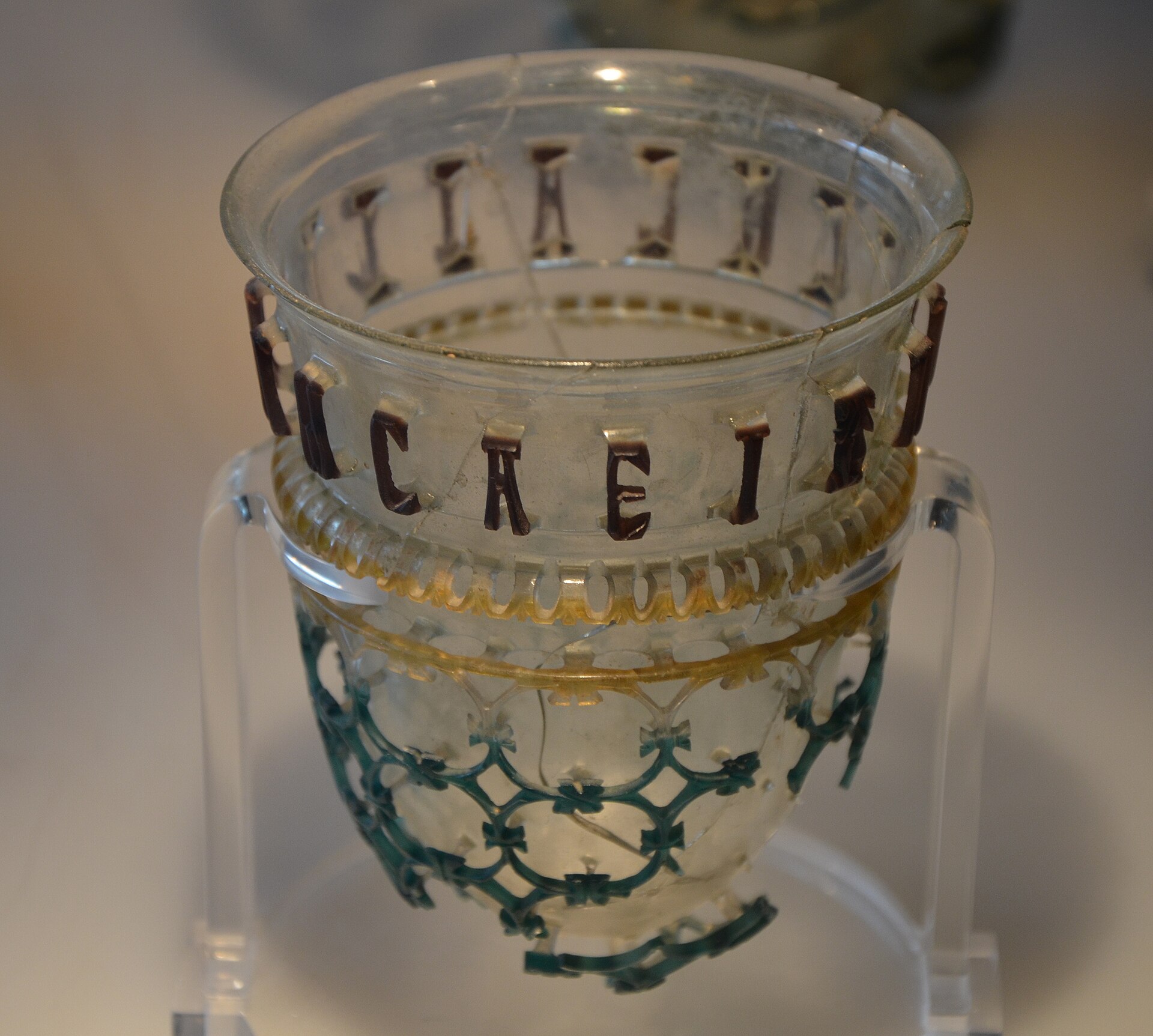
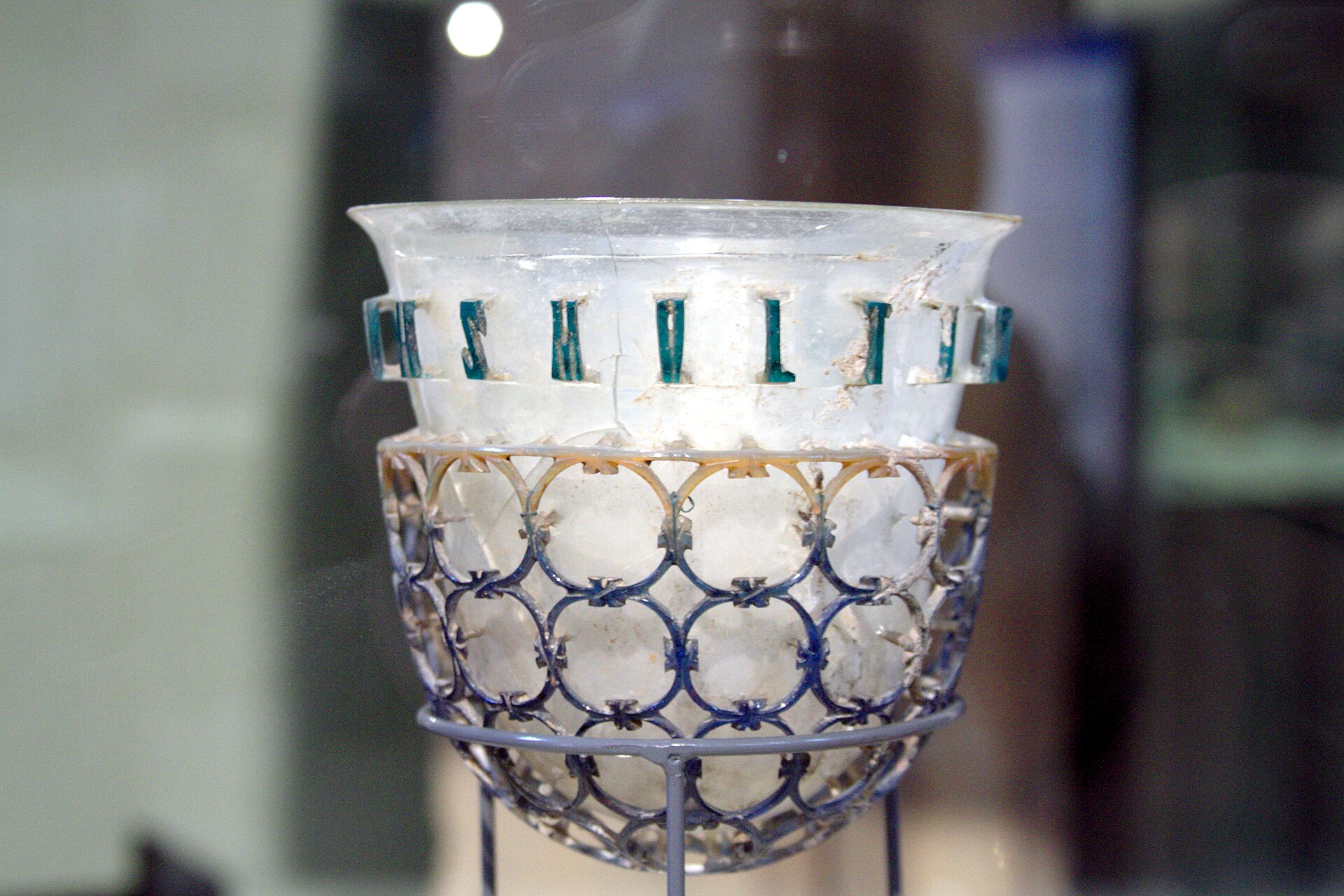
The object is a small drinking cup, 12.1 centimetres high, blown or worked from colorless glass and then encased in a second, separate-looking layer: an openwork network, or cage, of dark purple-red, gold-yellow and emerald-green glass cut so that it stands proud of the inner cup's surface, touching it only at a series of short colorless struts. Seen from any angle, the cage reads as a basket of coloured glass hovering a few millimetres off the vessel it protects.
Below the rim, in purple-red lettering worked into the same technique, runs a Greek inscription: PIE ZESAIS KALOS AEI, a drinking toast conventionally rendered Drink, live well, forever. The combination of a tricolour network cage with a colour transition worked into the connecting struts is, on the account of the museum that holds it, without an exact parallel among the surviving corpus: the piece is described by the Cologne city museums as the only well-preserved three-colour network diatretum of its kind known anywhere, with a pale green net-basket and a yellow collar shading into the strut material.
Chapter 2How the cage was cut, or cast: a dispute nobody has settled
Cage cups have been known and discussed in print since 1680, and for most of that time the working assumption was straightforward: a glassworker took a single thick blank of glass and, over what must...
Cage cups have been known and discussed in print since 1680, and for most of that time the working assumption was straightforward: a glassworker took a single thick blank of glass and, over what must have been weeks of patient cold-cutting and grinding, removed everything except the inner cup and the network of struts and cage that surrounds it. In 1956 the German scholar Fritz Fremersdorf, at the time associated with Cologne's own Roman-Germanic collections, set this account out in its classic form, and it remains the position most handbooks still give.
Rosemary Lierke proposed a rival account in the 1990s: that the vessel was pressed, using a perforated inner mould through which molten glass was forced to form the struts, with cutting and grinding applied afterward to refine the surface rather than to create the whole form from scratch. The case for a mould-assisted or two-part process rests partly on cups, including this one, that show smooth-looking joins where cage meets cup, and partly on the practical difficulty of freehand-cutting struts as fine and as regular as those that survive. Against it stands a fragmentary cup excavated at Corinth in the 1960s, examined under a microscope with no detectable joint at all where its cage meets its body, which reads as evidence for solid cold-working rather than assembly.
The most direct evidence bearing on this specific cup comes from its own excavator. Otto Doppelfeld, who published the Cologne find in 1961, used macro-photography to record what he described as colour transitions, Farbwechsel, at the points where the struts meet the cage, an observation some later writers have read as supporting some form of hot-working or fusion rather than pure cold-grinding of a single blank, though Doppelfeld's photographs alone do not settle the question either way.
David Whitehouse, with William Gudenrath and Paul Roberts, assembled the fullest study of the whole class, published by the Corning Museum of Glass in 2015 after Whitehouse's death from cancer in February 2013; his colleagues completed the manuscript and catalogue from his notes. Whitehouse examined Lierke's pressing theory in detail and was not persuaded by it; Lierke responded at length in a 2016 review. A 2020 review of the book in the Journal of Roman Archaeology was titled, without irony, Diatreta (cage cups): the debate continues. That title is the most accurate one-line summary available of where the question still stands.
Modern attempts to settle the question by replication have not done so either. An early German replica made in 1906 was toasted with champagne on completion and broke at the rim when the maker went to drink from it. The German experimental glass engraver Josef Wenzel has since reproduced several historic cage cups, including this Cologne example, by first shaping a thick-walled cup, applying the coloured glass on the outside as bands and plates, and then carving the network free, a hybrid method consistent with Rhineland gem-cutting traditions rather than a straightforward confirmation of either the pure-grinding or pure-moulding camp. No modern reconstruction has been accepted by all sides as a faithful reproduction of the ancient technique, and this record does not attempt to resolve a dispute the specialist literature has not resolved.
Chapter 3The grave at the edge of Roman Cologne
The cup was found in 1960 during work at the corner of Stolberger Strasse and Eupener Strasse, on the boundary between the Cologne districts of Braunsfeld and Mungersdorf, on the site of a Roman...
The cup was found in 1960 during work at the corner of Stolberger Strasse and Eupener Strasse, on the boundary between the Cologne districts of Braunsfeld and Mungersdorf, on the site of a Roman villa rustica, a rural estate, with its own cemetery. Excavation there uncovered five red sandstone sarcophagi, one further inhumation burial, and a separate cremation grave; the cage cup came from one of the sarcophagi, recorded by the photographer whose image accompanies this record as grave 5 of the family cemetery. The excavation was published the following year, 1961, by Otto Doppelfeld, then director of the Romisch-Germanisches Museum, in the Kolner Jahrbuch fur Vor- und Fruhgeschichte; that report, rather than any of the secondary summaries used here, is the primary source a researcher should consult for the full grave inventory and stratigraphy, and this record has not been able to read it directly.
One secondary account states that the rest of the grave goods found with the cup were comparatively mundane, which, if accurate, would make the presence of an object of this cost and technical difficulty in the same burial a genuine puzzle worth further study. A separate account of the associated cremation grave at the same cemetery describes a lead vessel, ceramic jugs and a folded beaker as accompanying goods, which may or may not be the same grouping being described as mundane; this record cannot reconcile the two secondary accounts without the primary excavation report, and flags the discrepancy rather than resolving it. A dedicated scholarly article exists specifically on the problem of assigning individual grave goods to individuals within this late-antique grave, which indicates that the question of whose grave, precisely, and whose cup, precisely, has itself been treated as unresolved in the specialist literature, not merely by this record.
Chapter 4A toast carved in glass
The Greek inscription on the Cologne cup belongs to a well-attested genre: a great many cage cups and other pieces of Roman luxury tableware carry short convivial toasts, wishing the drinker long...
The Greek inscription on the Cologne cup belongs to a well-attested genre: a great many cage cups and other pieces of Roman luxury tableware carry short convivial toasts, wishing the drinker long life, good health or good fortune, meant to be read aloud or simply enjoyed at the table where the object was used. Comparable formulas survive on other cage cups in Latin: the Munich cup, also found in Cologne but a separate and later object, reads BIBE MULTIS ANNIS, drink for many years; the Trivulzio cup in Milan reads BIBE VIVAS MULTIS ANNIS, a fuller version of the same wish; the Pljevlja cup in Montenegro carries VIVAS PANELLENI BONA, and the Autun cup found in France in 2020 carries VIVAS FELICITER, live happily. The Cologne cup's Greek phrasing rather than Latin is itself a small data point in the debate over where such objects, and such customers, sat within the wider Roman world of the Rhine frontier, a frontier province where Greek-language luxury goods were not the ordinary case.
These were not funerary inscriptions composed for the grave. They were dining-room and banqueting-hall phrases, meant for use, which makes their presence in a burial a matter of a valued possession being sent into the ground with its owner rather than an object made for the purpose.
Chapter 5What survives, and how much
Cage cups are one of the smallest well-defined classes of ancient luxury object.
Cage cups are one of the smallest well-defined classes of ancient luxury object. The fullest inventory available, David Whitehouse's 2015 catalogue, lists sixty-nine vessels and fragments, with a further thirteen added in an addendum compiled by his colleagues after his death, for a documented total in the low eighties; looser figures circulating in more popular sources put the number at about fifty cups or fragments, and the two figures should be read as different counts by different methods rather than as evidence that one is wrong. Whichever total is used, only a small minority survive complete or near-complete, and the great majority of what is known is fragmentary.
Named comparanda span several countries and several sub-types of the class. Beaker-shaped, drinking-vessel cage cups include this Cologne example; the Trivulzio cup in the Museo Archeologico, Milan, described in the literature as the only example with no damage at all, recovered from a sarcophagus near Novara in 1675; the Munich cup, held by the Staatliche Antikensammlungen but excavated in Cologne, a separate and later Latin-inscribed piece; the Daruvar network beaker in the Kunsthistorisches Museum, Vienna, found in 1785 and incomplete; the Piesport-Niederemmel cup in the Rheinisches Landesmuseum, Trier, found in a sandstone sarcophagus in 1950, another Rhineland grave find; the Pljevlja cup in Montenegro's Heritage Museum, found in 1975; and the Autun cup in the Musee Rolin, discovered as recently as 2020 and reported to have contained traces of ambergris, evidence of what such a vessel actually held. Bowl-shaped cage cups, thought in some cases to have served as hanging lamps rather than drinking vessels, include an example at the Corning Museum of Glass and the Constable-Maxwell cup, which remains in private hands.
A separate, rarer sub-type carries figural, narrative scenes rather than geometric network patterns cut directly into dichroic glass; of that sub-type, the Lycurgus Cup in the British Museum is the only complete survivor, with other figural examples known only from fragments, including a piece from the Begram hoard in Afghanistan showing the Pharos of Alexandria.
Chapter 6A separate object from the Lycurgus Cup, and not established to be dichroic
This record concerns the Cologne diatretum alone.
This record concerns the Cologne diatretum alone. It is not the Lycurgus Cup, and it is not the Portland Vase; all three are distinct objects in Iconotheca's records, made by different techniques or, in the Lycurgus Cup's case, a different sub-type of the same broad cage-cup class, with their own separate find histories.
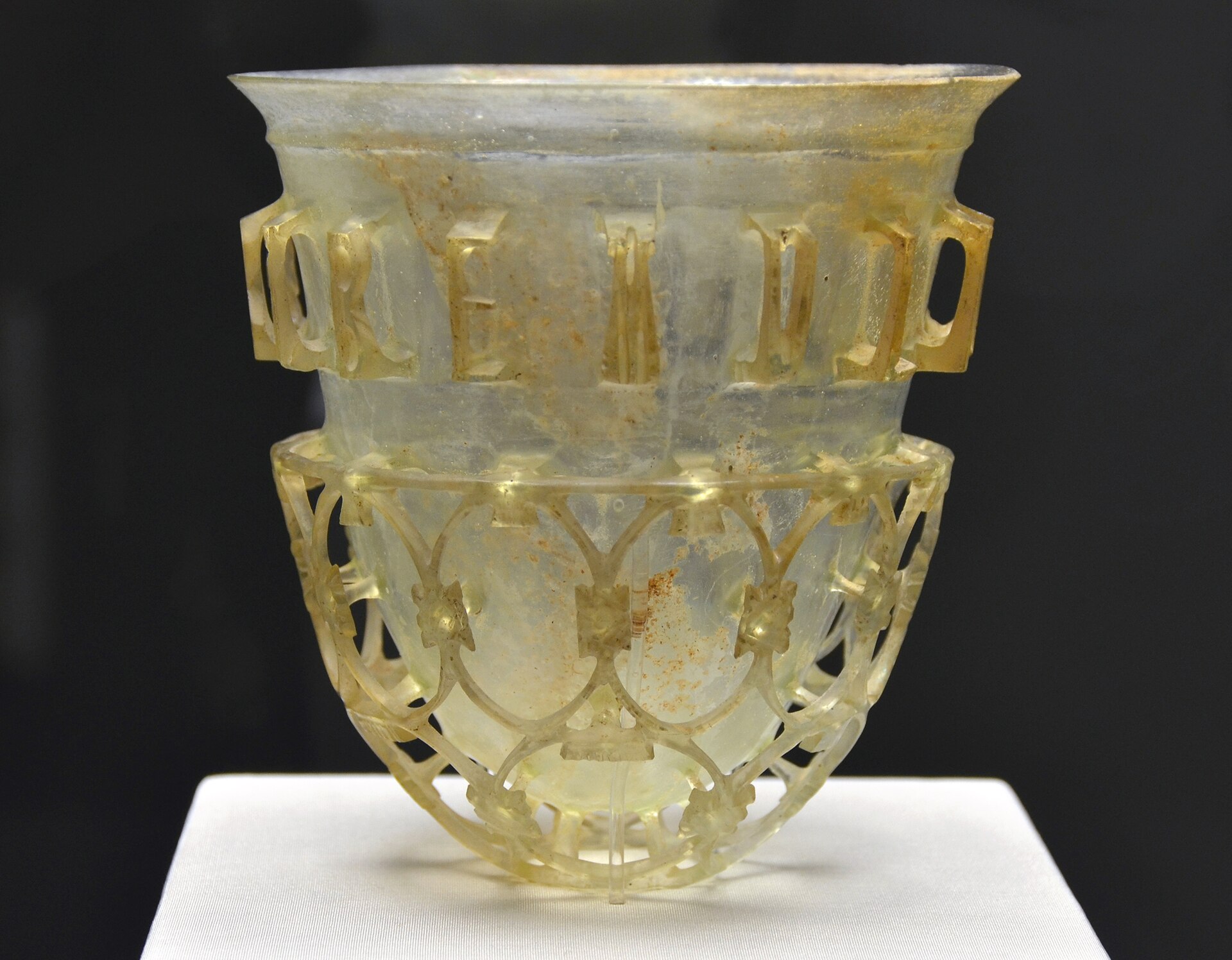
The Lycurgus Cup is dichroic: lit from the front it reads as an opaque jade green, and lit from behind or through the glass it glows a translucent ruby red, an effect produced by gold and silver metal nanoparticles suspended in the glass, identified through scientific analysis by Ian Freestone and colleagues. Every source consulted for this record describes that property as belonging specifically to the Lycurgus Cup, calling it the only complete ancient glass object known to show it, with only a very small number of other, non-vessel dichroic glass fragments known worldwide. Nothing in the sources consulted claims or implies that the Cologne cup, or any of the network-type comparanda listed above, shares this optical property; its cage is built from opaque coloured glass in discrete zones of red, yellow and green rather than a single dichroic glass body, and this record does not assume otherwise.
Chapter 7Recent scholarship: a possible maker's mark on the cage
In February 2023, the art historian and glassblower Hallie Meredith, examining cage cups in a private collection at the Metropolitan Museum of Art, turned one vessel over and noticed small abstract...
In February 2023, the art historian and glassblower Hallie Meredith, examining cage cups in a private collection at the Metropolitan Museum of Art, turned one vessel over and noticed small abstract symbols, diamonds, leaves and crosses, cut into the reverse of the openwork cage alongside its drinking-toast inscription. Her subsequent research, published in the Journal of Glass Studies in April 2025 and in World Archaeology in October 2025, argues that these symbols are workshop identifiers, a shared visual language marking which glass workshop produced a given piece, rather than personal signatures or pure ornament, and that cage cups were the output of organized, multi-person workshops operating across the 4th to 6th centuries CE rather than isolated individual masterpieces.
Press coverage of Meredith's work describes examining a vessel bearing the exact Greek inscription and date range of this Cologne cup, PIE ZESAIS KALOS AEI, dated 300 to 350 CE, among the pieces studied, alongside a separate Cologne-excavated but Latin-inscribed vessel (matching the Munich cup) and a Corning Museum piece. None of the popular-press accounts consulted for this record names the Romisch-Germanisches Museum explicitly as the holder of the Greek-inscribed vessel Meredith examined, so this record treats the identification as probable, given the exact match of inscription and date, but unconfirmed, and recommends checking Meredith's original journal articles directly to establish whether this specific object carries one of the newly identified maker's marks.
Chapter 8What such an object was worth, and what it was for
Cage cups were display and drinking vessels for elite dining, made by a process that, on any version of the manufacturing debate above, demanded weeks of a highly skilled worker's time on a single...
Cage cups were display and drinking vessels for elite dining, made by a process that, on any version of the manufacturing debate above, demanded weeks of a highly skilled worker's time on a single object that could shatter at any stage of the cutting. That combination of material cost, labour cost and fragility is itself the evidence for what such a cup signalled about its owner's standing, independent of which manufacturing theory is eventually vindicated.
No sale price exists for this specific cup; it has been public property since its excavation in 1960 and has never been on the market. As a point of comparison only, and not as a valuation of this object, a bowl-shaped cage cup of the same broad class, the Constable-Maxwell cup, sold at auction in 2004 for 2,646,650 pounds sterling, a price reported as a world record for a piece of Roman glass; that sale concerns a different, privately owned object and is cited here solely to indicate the order of value this class of object can command when one does reach the market.
Chapter 9In public ownership since the day it was found
Unlike several of its comparanda, the Cologne cup has no market history to record.
Unlike several of its comparanda, the Cologne cup has no market history to record. German law places archaeological finds of this kind under state and municipal heritage protection, and the cup passed directly from Doppelfeld's 1960 excavation into the Romisch-Germanisches Museum's own collection, where it has remained under inventory number 60,1 ever since. There has been no export question, no private ownership, and no auction. The museum itself describes the piece as the outstanding item within what it calls the world's largest collection of Roman glass of the 1st to 4th centuries CE, a claim made by the institution about its own holdings and recorded here as such rather than independently verified against rival collections.
Chapter 10What is still unresolved
Three separate questions about this object remain genuinely open in the published literature rather than merely under-researched by this record.
Three separate questions about this object remain genuinely open in the published literature rather than merely under-researched by this record. How the cage was actually formed, by freehand cold-cutting of a solid blank or by some mould-assisted or two-part process, has been argued in print since the nineteenth century and was still being argued, explicitly and by name, in a 2020 review of the most comprehensive study yet published. Which burial within the Braunsfeld cemetery the cup truly belonged to, and to which individual within that burial, has its own dedicated scholarly literature on the general difficulty of assigning grave goods to persons, without a settled answer for this grave in the sources this record could reach. And whether this piece was made on the Rhine or carried there from elsewhere in the Roman world remains argued rather than demonstrated on either side.
None of that uncertainty is a defect in the object or in the record of it. A cup this rare, cut by a method its own excavator could not fully explain from the evidence of his own photographs, sitting in a grave whose full inventory has not been re-examined here against the primary report, is exactly the kind of object where stating the open questions plainly is worth more than a smoothed-over story.
The artist
Unknown late Roman cage-cup workshop
No cage cup, including this one, carries the name of the person who cut it. What can be reconstructed is not a biography but a set of arguments about who this kind of object's makers were, what skill they possessed, and where they worked, built from technical study of the surviving pieces themselves and from the modern scholars who have tried to explain them.
Related works
| Work | Relation | Where it is |
|---|---|---|
| Lycurgus Cup Unknown Roman workshop | Same broad cage-cup class, but a distinct, separately catalogued and far more famous object with narrative figural decoration cut from dichroic (colour-changing) glass; NOT the same piece as this record and not established to share any construction detail beyond the general cage-cup technique. The only complete surviving figural cage cup; its dichroic property, produced by gold and silver nanoparticles, has not been shown to occur in any other complete cage cup, including the Cologne example. | British Museum, London (1958,1202.1) |
| Trivulzio Cage Cup Unknown Roman workshop | Comparanda: geometric network-type cage cup, described in the literature as the only surviving example with no damage at all Found in a sarcophagus near Novara in 1675; purchased by the Municipality of Milan in 1935; inscribed BIBE VIVAS MULTIS ANNIS. | Museo Archeologico, Milan |
| Munich Cup (cage cup found in Cologne) Unknown Roman workshop | A separate cage cup also excavated in or near Cologne, but a distinct object of later date and Latin rather than Greek inscription; not to be confused with this record's subject Dated to the second half of the 4th century CE, inscribed BIBE MULTIS ANNIS. | Staatliche Antikensammlungen, Munich |
| Cage cup fragment Unknown Roman workshop | Comparanda, bowl-shaped sub-type thought to have served as a hanging lamp rather than a drinking vessel Cited in press coverage of Hallie Meredith's 2025 maker's-mark research alongside this Cologne cup's inscription. | Corning Museum of Glass, New York |
| Constable-Maxwell Cup Unknown Roman workshop | Comparanda, bowl-shaped cage cup, cited here only as a market data point for the class Sold at auction in 2004 for GBP 2,646,650, reported as a world-record price for Roman glass. Unrelated in ownership history to the Cologne cup, which has never been offered for sale. | Private collection |
| Pljevlja Cage Cup Unknown Roman workshop | Comparanda, network-type cage cup with Latin inscription Found in 1975; inscribed VIVAS PANELLENI BONA, part of the same convivial-toast genre as the Cologne inscription. | Heritage Museum, Pljevlja, Montenegro |
| Daruvar Netzbecher Unknown Roman workshop | Comparanda, network-type cage cup, fragmentary Found in 1785; survives incomplete, unlike the Cologne cup. | Kunsthistorisches Museum, Vienna |
| Piesport-Niederemmel Cup Unknown Roman workshop | Comparanda, another Rhineland grave find of a cage cup Found in a sandstone sarcophagus in 1950, the closest geographic and burial-context parallel to the Cologne find among named comparanda. | Rheinisches Landesmuseum, Trier |
| Autun Cup Unknown Roman workshop | Comparanda, network-type cage cup, recently discovered Discovered in 2020; reported to retain traces of ambergris, physical evidence of what such a vessel actually held, inscribed VIVAS FELICITER. | Musee Rolin, Autun, France |
Open questions
- How was the cage actually formed: cold-cut and ground freehand from a single solid glass blank, as the classic Fremersdorf account holds, or shaped with the aid of a mould, as Rosemary Lierke has argued since the 1990s? Whitehouse's 2015 study did not settle it, and a 2020 review of that study says explicitly that the debate continues.
- To which burial, and to which individual within that burial, did the cup actually belong? A dedicated scholarly article exists on the general problem of assigning grave goods to individuals in this specific late-antique grave; this record could not obtain a settled answer from the sources consulted.
- One secondary account describes the rest of the grave goods found with the cup as comparatively mundane, which would make an object of this cost and difficulty an archaeological puzzle in that burial specifically; a separate account of grave goods from the same cemetery's cremation burial describes richer material. This record could not reconcile the two accounts without the primary 1961 excavation report and flags the discrepancy rather than resolving it.
- Was this cup made in the Rhineland, given that at least two cage cups (this one and the separate Munich example) were both found in or near Cologne, or was it imported from elsewhere in the Roman world and simply deposited on the frontier? Argued on both sides, not demonstrated.
- Is this specific vessel one of the pieces examined in Hallie Meredith's 2025 research identifying maker's-mark symbols on cage cups? Press coverage describes a piece matching this cup's exact inscription and date range among those studied, but no source consulted names the Romisch-Germanisches Museum explicitly, so the identification remains probable but unconfirmed.
- Has a modern chemical or compositional analysis been carried out on this specific piece? None was located in the sources consulted for this record, though such analyses exist for other diatreta fragments.
Questions about this object
What is Diatretbecher?
Diatretbecher is a glass, dated first half of the 4th century CE; some literature narrows this to c. 330-340 CE. Medium: Colorless blown or cast glass, cold-cut and ground into a free-standing openwork network (the cage) of dark purple-red, gold-yellow and emerald-green glass, joined to the inner cup by short colorless struts.
Who made Diatretbecher, and is the attribution settled?
The attribution to Unknown late Roman glass workshop (diatretarius, hand and location undocumented) is recorded here as unknown. No cage cup of this class carries a maker's name, and this piece is no exception. The identity of the cutter, the workshop, and even the region of manufacture are all undocumented. A Rhineland origin has been argued because at least two cage cups, this one and a Latin-inscribed example now in Munich, were both found in or near Cologne, but the alternative that both were imported and simply deposited on the Rhine frontier has not been ruled out. Recent research (2025) reads small abstract symbols cut into the undersides of several cage cups as workshop marks rather than decoration, which points toward organized, identifiable workshops in principle, but no mark has been tied to a named workshop or place of production for any surviving piece, including this one.
Where is Diatretbecher now?
Romisch-Germanisches Museum, Cologne, Germany. Inventory number 60,1. Last confirmed 15 August 2026. Excavated in 1960 from a sandstone sarcophagus in the Roman-period cemetery at the corner of Stolberger Strasse and Eupener Strasse, on the Koln-Braunsfeld/Koln-Mungersdorf boundary, and entered the Cologne municipal collection directly as an archaeological find under German antiquities law. There is no market acquisition to document; it has never left public ownership since discovery.
What is still unknown about Diatretbecher?
How was the cage actually formed: cold-cut and ground freehand from a single solid glass blank, as the classic Fremersdorf account holds, or shaped with the aid of a mould, as Rosemary Lierke has argued since the 1990s? Whitehouse's 2015 study did not settle it, and a 2020 review of that study says explicitly that the debate continues.
Sources
- 1Romisch-Germanisches Museum Koln, Staendige Sammlung (permanent collection page) roemisch-germanisches-museum.de/Staendige-Sammlung
- 2Deutsche Digitale Bibliothek, catalogue record for the Diatretbecher mit roter Schrift und grunem Netz, inventory 60,1 deutsche-digitale-bibliothek.de/item/...
- 3Bildindex der Kunst und Architektur, object record for the Diatretbecher, Koln, Stolberger Strasse bildindex.de/document/...
- 4Museen der Stadt Koln, Bild der Woche feature on the Diatretbecher ('Ein glasernes Meisterwerk') museen.koeln/portal/...
- 5kuladig.de, object entry on the Roman cremation grave and villa rustica cemetery, Koln-Mungersdorf/Wendelinstrasse, including the sarcophagus cemetery that produced the cage cup kuladig.de/Objektansicht/...
- 6Bookseller catalogue description of Otto Doppelfeld, 'Das Diatretglas aus dem Graberbezirk des romischen Gutshofs von Koln-Braunsfeld', Kolner Jahrbuch fur Vor- und Fruhgeschichte 5 (1960/61), pp. 34-44. The primary excavation report itself was not directly consulted for this record and should be obtained and checked against the claims here. zvab.com/servlet/...
- 7Wikipedia, 'Cage cup'. en.wikipedia.org/wiki/...
- 8Wikipedia (German), 'Diatretglas'. de.wikipedia.org/wiki/...
- 9Journal of Roman Archaeology, review 'Diatreta (cage cups): the debate continues', of David Whitehouse, with William Gudenrath and Paul Roberts, Cage Cups: Late Roman Luxury Glasses (Corning Museum of Glass, 2015) cambridge.org/core/...
- 10Corning Museum of Glass, publication page for Cage Cups: Late Roman Luxury Glasses info.cmog.org/publication/...
- 11Archaeology News Online Magazine, 'Hidden signatures of ancient Roman master glassmakers uncovered' (November 2025), reporting Hallie Meredith's research published in the Journal of Glass Studies (April 2025) and World Archaeology (October 2025) archaeologymag.com/2025/...
- 12Interesting Engineering, '1,700-year-old logo on prized Roman cage cups uncovered in new study' interestingengineering.com/culture/...
- 13Flickr, Carole Raddato, photo series captioned 'The Cologne diatreta glass bowl (cage cup), 1st half of 4th century AD, found in Cologne from grave 5 in the family cemetery of a villa rustica...Romisch-Germanisches Museum, Cologne', used here for image attribution flickr.com/photos/...
Last verified · Published
Change log
15 August 2026 - Record created at the house standard: researched narrative, technical evidence, maker dossier, graded provenance chain, prices with hammer and premium separated, related works, open questions and sources.