Millefiori Bowl
Unidentified Roman glassworkers (workshop not recorded) · 1-100 CE (Cleveland)
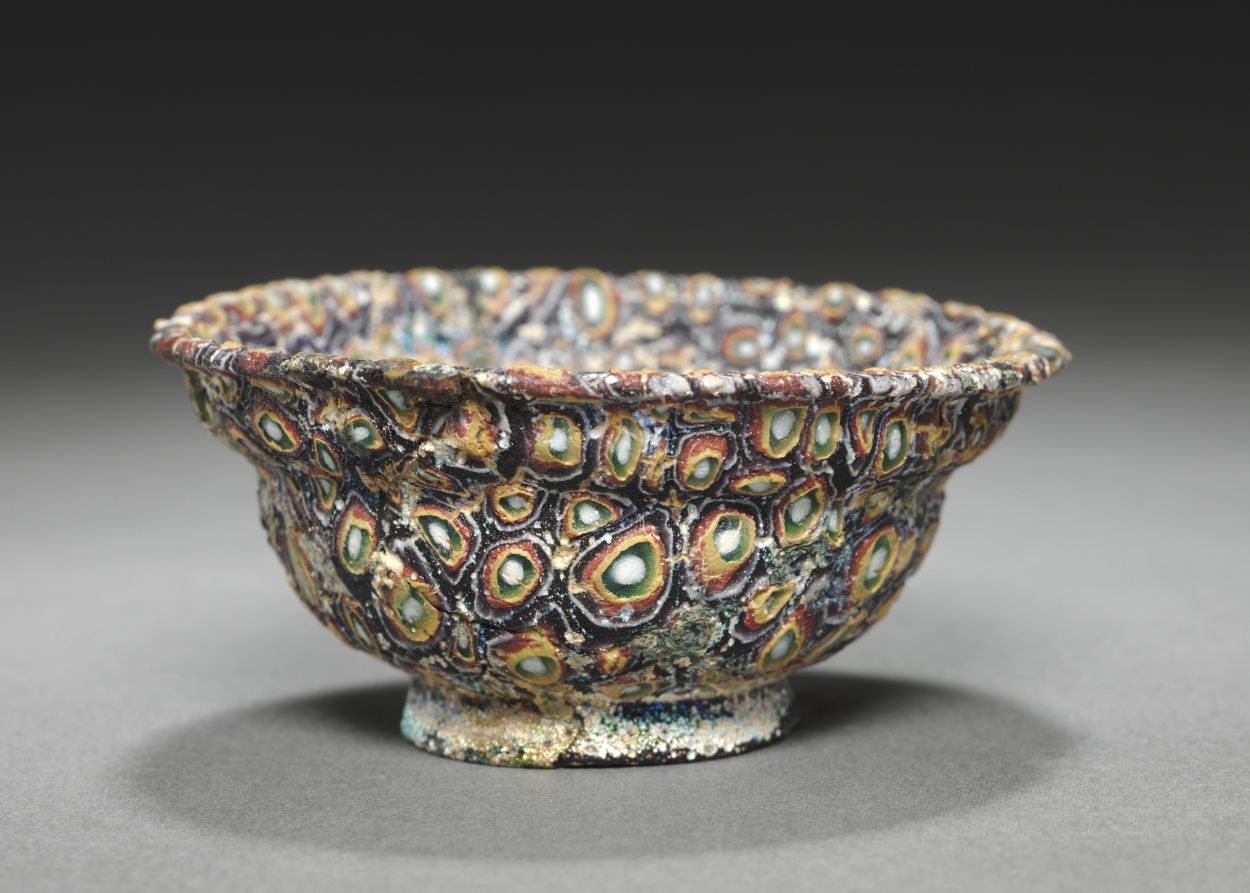
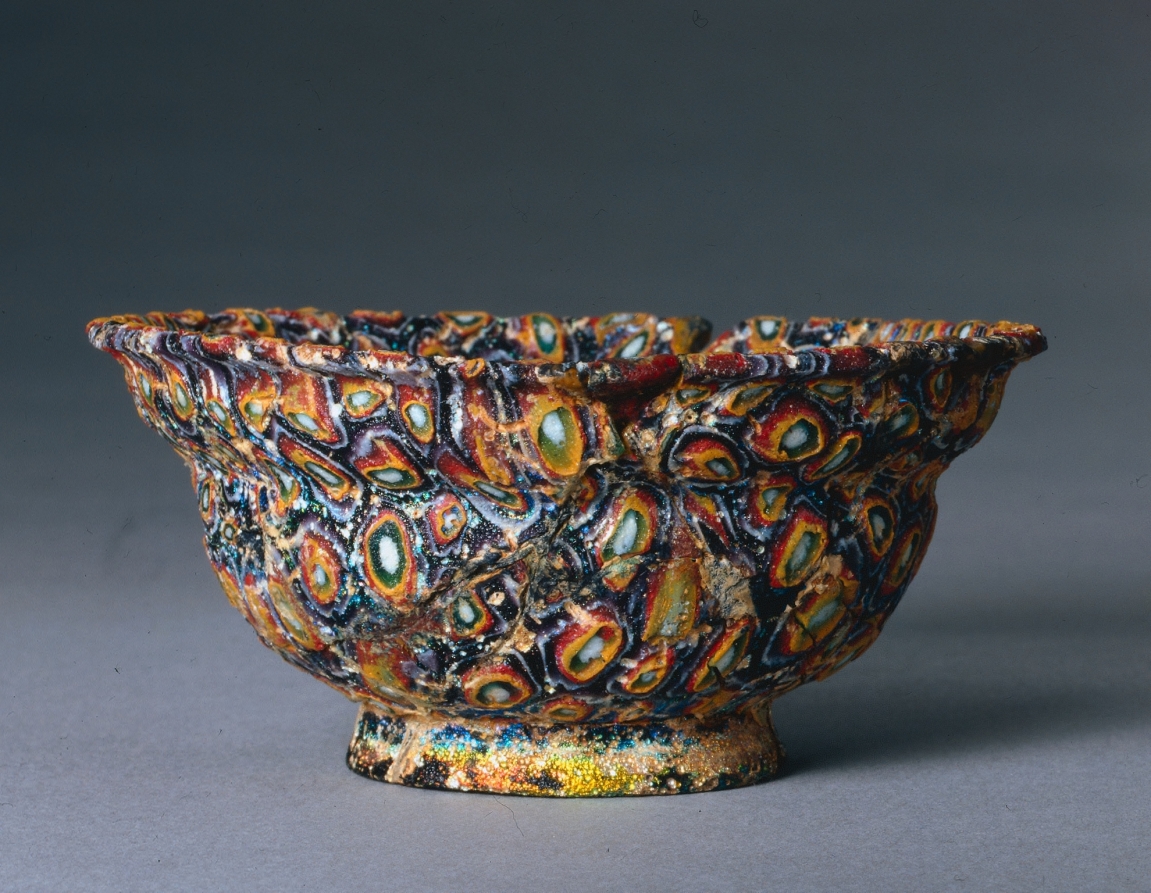
The bowl from the side, on its low foot: a shallow flaring cup patterned all over with small rosettes in white, green, yellow and brown on a dark ground, with a pale weathering crust and an uneven rim. Cleveland Open Access, CC0.
| Artist | Unidentified Roman glassworkers (workshop not recorded) |
|---|---|
| Date | 1-100 CE (Cleveland) |
| Medium | Glass, mosaic (millefiori), cast in a two-part mold from fused cane slices, fire- or wheel-polished |
| Dimensions | Overall 3.8 x 8.8 cm (1 1/2 x 3 7/16 in.); diameter of foot 4 cm (1 9/16 in.) |
| Where it is now | The Cleveland Museum of Art (listed as not on view on the museum's page, 23 November 2026)last confirmed |
| Inventory number | 1919.10 |
| Attribution | UnknownCleveland records no maker or workshop and gives the culture as Italy, Roman. Full note |
| Object type | Glass |
| Period | Roman Imperial |
| Cases | Has a provenance gap |
| Inscriptions | None recorded |
| Owners on record | 5 links3 documented, 2 unknown |
| Sources | 14 cited |
About this record Last verified · 14 sources cited · Change log
On this page 10 sections
ContentsClose
A small Roman bowl of mosaic glass, 3.8 cm high and 8.8 cm across, built from sliced multicoloured canes fused in a mold and polished. The Cleveland Museum of Art owns it as 1919.10, bought from the General Income Fund in January 1919. Cleveland's provenance runs John Whiting of Boston, Azeez Khayat of New York and the Anderson Galleries, and cites the Khayat sale catalogue of 31 January and 1 February 1919, lot 29.
The catalogue is on the record and confirms lot 29 as a Roman mosaic millefiori bowl in amethyst glass with rosettes in white, yellow and green. It does not mark that lot as ex-Whiting, though it marks many neighbouring glasses so, and Cleveland's accession date falls nine days before the sale opened. Find spot, maker and every owner before Whiting are unknown; no price was found.
Provenance
Each link is graded. Documented: a cited source supports it. Disputed: the identification is argued but not established. Unknown: no owner for that span, and the gap is not smoothed into a narrative. The grades in the glossary.
- 1-100 CE - Before 1919Unknownunknown
Cleveland records no find spot, no ancient or early modern owner and no date of discovery.12
- Unknown - UnknownJohn Whiting, Boston, MA (the catalogue gives John D. Whiting)unknown
Cleveland lists this owner without a date or citation. The 1919 catalogue says Khayat recently acquired the John D. Whiting Collection, which had been loaned to the Boston Museum of Fine Arts, and marks other lots ex-Whiting but not lot 29. The link to this bowl is therefore asserted by the museum alone.23
- By 1918 or 1919 - 1919Azeez Khayat (1875-1943), New Yorkdocumented
Khayat consigned his collection to the Anderson Galleries, with lot 29 described as a Roman mosaic millefiori bowl in amethyst glass; the description matches the Cleveland bowl though the diameter figure is uncertain.23
- 31 January 1919 - 1 February 1919Anderson Galleries, New York (sale 1397)documented
Sale of Khayat's collection, glass in lots 1 to 57 on the first day; Cleveland's provenance names the Anderson Galleries as seller to the museum.23
- January 1919 - presentThe Cleveland Museum of Artdocumented
Purchased with the General Income Fund; accession date 22 January 1919 in the museum's data, which precedes the sale date. Whether the bowl was bought at the sale or privately before it is unresolved. No price is published.1234
Prices realised
| Date | Sale | Estimate | Result | Note |
|---|---|---|---|---|
| 1919-01-31 to 1919-02-01 | Anderson Galleries, New York (sale 1397, conducted by Frederick A. Chapman) | none printed in the catalogue | Hammer not found With premium not found not stated (presumably US dollars) | Lot 29 on page 7 of the catalogue. Cleveland's accession date of 22 January 1919 precedes the sale, so it is unresolved whether the bowl was hammered at the sale; no prices realised were found. |
Hammer is the price at which the bidding stopped; with premium adds the fee the house charges the buyer on top. Hammer price and buyer's premium in the glossary.
Technical evidence
| Attribution note | Cleveland records no maker or workshop and gives the culture as Italy, Roman. The place of manufacture is a museum attribution, not a documented find; no find spot is recorded. No scientific analysis of this bowl was found. |
|---|---|
| Object | Millefiori bowl, Cleveland Museum of Art 1919.10 (open-access id 99419), General Income Fund12 |
| Date | 1-100 CE; comparable bowls elsewhere are dated late 1st century BCE to early 1st century CE or 25 BC to 50 AD2101314 |
| Culture | Italy, Roman (museum attribution; no find spot recorded)12 |
| Medium | Glass, mosaic (millefiori): fused multicoloured rods sliced into disks, fused in a two-part mold, then fire- or wheel-polished (Cleveland's wording)12 |
| Dimensions | Overall 3.8 x 8.8 cm; diameter of foot 4 cm2 |
| Colour and pattern | Rosettes with white centre, green and yellow rings and a reddish edge on a dark ground, repeated inside, outside and under the foot (from the museum's photographs); the 1919 lot text reads amethyst glass with rosettes in white, yellow and green23 |
| Condition | No conservation statement or conservation images published; photographs show a weathered, iridescent surface, an uneven chipped rim and a crack across the interior floor2 |
| Inscriptions | None recorded2 |
| Find spot | Not recorded12 |
| Accession date | 22 January 1919 in Cleveland's open-access data; the Khayat sale was 31 January and 1 February 191923 |
| 1919 catalogue lot | Anderson Galleries sale 1397, lot 29, page 7; Cleveland's own page reference reads lot 297, which is a necklace23 |
| Location | Listed as not on view; no exhibition history recorded12 |
| Rights | CC0 (Cleveland Open Access); legal status accessioned; Nazi-era provenance flag false in the open-access record2 |
Images
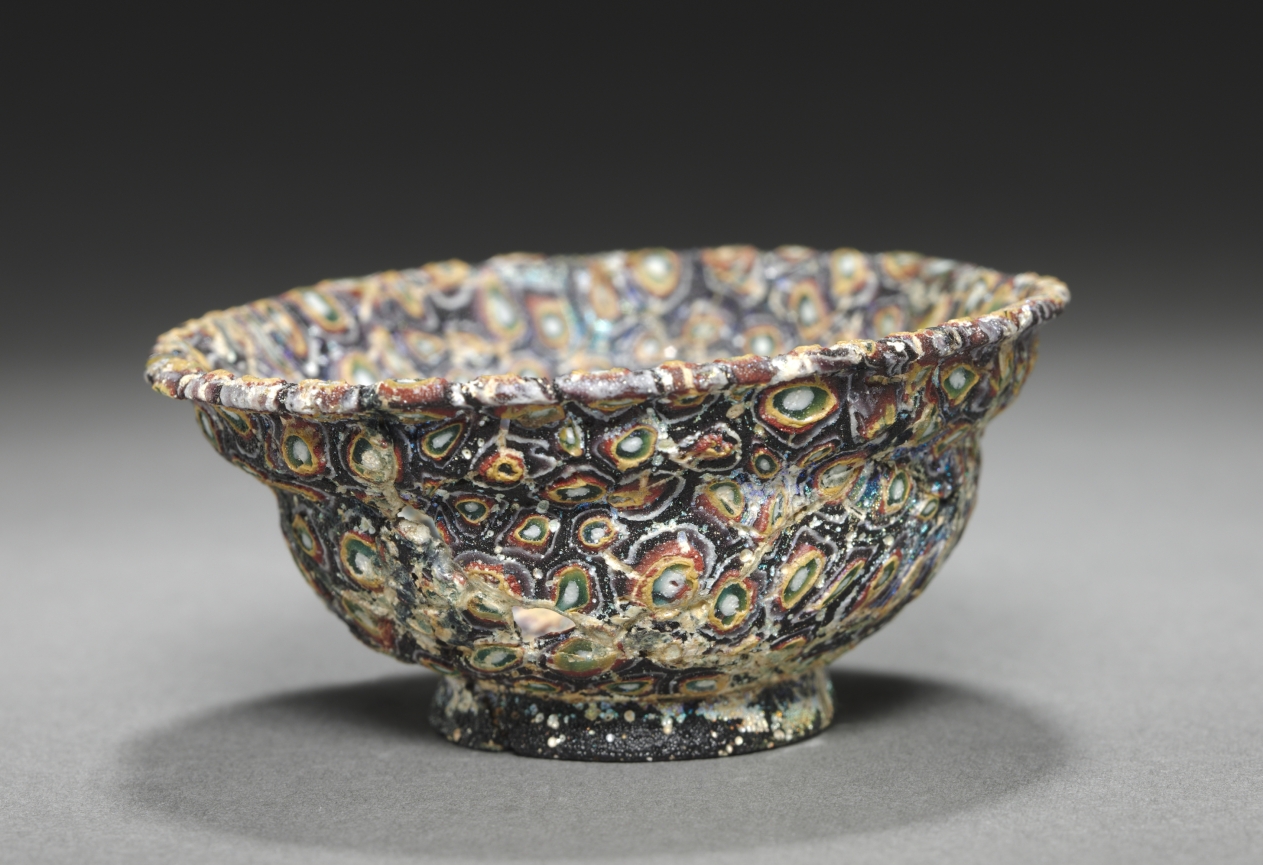
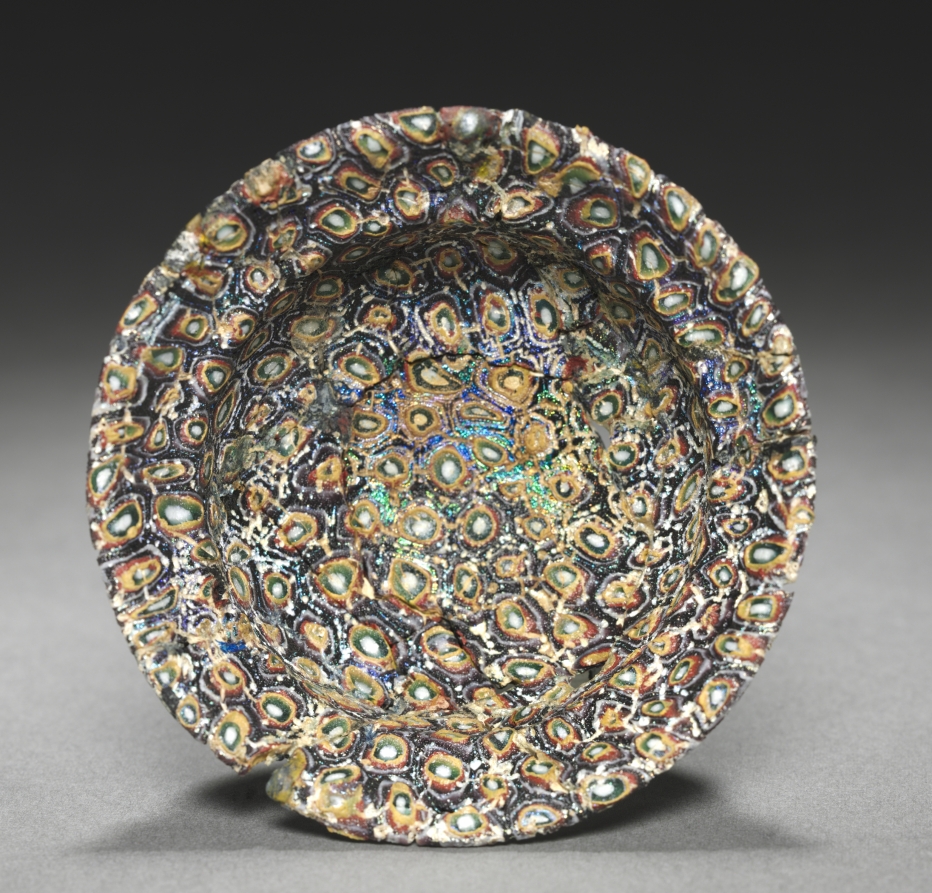
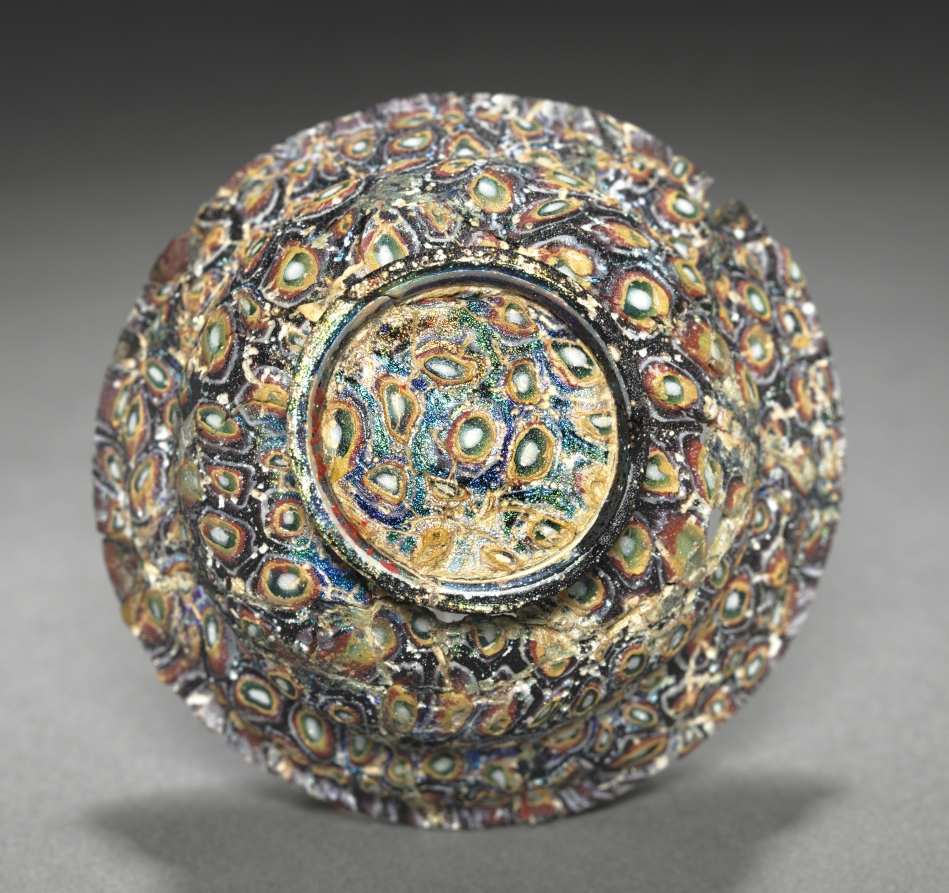
The record in full
Chapter 1A bowl built from slices of colour
The Cleveland Museum of Art catalogues the object as a millefiori bowl, 1-100 CE, Italy, Roman, glass, 3.8 cm high and 8.8 cm in overall width, standing on a foot 4 cm across.
The Cleveland Museum of Art catalogues the object as a millefiori bowl, 1-100 CE, Italy, Roman, glass, 3.8 cm high and 8.8 cm in overall width, standing on a foot 4 cm across. It is accession 1919.10, credit line General Income Fund. Cleveland's open-access data records no inscription, no exhibition and no find spot, and the museum's page, read on 23 November 2026, lists it as not on view.
In the museum's photographs the bowl is a shallow flaring cup on a low ring foot. Its whole surface, outside, inside and underneath, is a close pattern of small rosettes: a white centre ringed with green, then yellow, then a reddish brown, set against a dark purple ground. Weathering has left a pale encrustation across the surface and patches of rainbow iridescence, and the rim is uneven. The underside of the foot shows a separate disk of the same pattern. Nothing on the object or in the museum record gives a function; Cleveland's text is silent on what the bowl was for, and nothing in the record points to an iconographic programme beyond the repeating rosette pattern that the technique itself produces.
Chapter 2How a mosaic bowl was made
Cleveland's own wording is short: mosaic glass, also called millefiori, was cast in a two-part mold; fused glass rods of different colours were bundled into patterns and sliced into disk-shaped cross...
Cleveland's own wording is short: mosaic glass, also called millefiori, was cast in a two-part mold; fused glass rods of different colours were bundled into patterns and sliced into disk-shaped cross sections; the disks were placed in the mold and heated until fused; after cooling the surface was fire- or wheel-polished. The Getty Museum's description of its bowl 78.AF.32 gives the same sequence and adds that after release from the mold the surface was ground down to as little as half its original thickness.
Other museums describe the process differently, and the difference matters because no published study of this bowl says which was used. The Smithsonian American Art Museum, after conservation of a Roman mosaic bowl in its Gellatly collection, reports that canes were fused side by side on a ceramic plate to make a flat disk, which was then pressed into a ribbed mold and slumped over a bowl-shaped form, with parallel scratches inside and out showing Roman rotary polishing. The Victoria and Albert Museum records a bowl of this class as fused and slumped, with clear lathe marks at rim, foot and interior. The Cleveland bowl is described by its museum as cast in a two-part mold; whether the surviving surface shows slumping, casting or lathe work is not stated in anything seen.
Chapter 3Date and place: a museum attribution resting on a type
Cleveland dates the bowl 1-100 CE and calls it Italian Roman.
Cleveland dates the bowl 1-100 CE and calls it Italian Roman. The comparable bowls that other museums publish sit earlier and wider: the Metropolitan Museum dates its striped mosaic bowl 91.1.1391 and a fragment of a mosaic bowl late first century BCE to early first century CE, and its garland bowl 91.1.1402 late first century BCE; the Victoria and Albert Museum gives 25 BC to 50 AD and probably Italy for its bowl 969-1868; the Getty dates 78.AF.32 to the first century BC or AD and the Smithsonian its Gellatly bowl to the first century BC or AD. Cleveland's range of 1-100 CE therefore overlaps the later half of that group and runs past it.
No source seen explains how Cleveland reached 1-100 CE or the Italian attribution for this bowl, and no compositional analysis of it was found. The date and place are best read as a typological judgement, graded here as a museum attribution and not as a finding of the object itself.
Chapter 4What the photographs show of its condition
Cleveland publishes no conservation statement and has no conservation images for the bowl.
Cleveland publishes no conservation statement and has no conservation images for the bowl. The five open-access photographs show, as far as a viewer can tell, a bowl that survives in one piece with a weathered surface: a pale, crusty deposit over much of the wall, iridescent films in the interior and under the foot, an uneven and chipped rim and a visible crack across the interior floor. Whether any part is restored or filled cannot be judged from the images, and Cleveland does not say.
This matters for the object's history because every other mosaic bowl in Khayat's own catalogues was described by him as repaired, and the Smithsonian's Gellatly bowl turned out to be about half plaster with painted designs added before 1929. The lot 29 entry in 1919 carries no word about repair. That silence is evidence about the catalogue text, not about the glass.
Chapter 5Lot 29 in the 1919 catalogue
Cleveland's record cites Anderson Galleries, Ancient Works of Art ...
Cleveland's record cites Anderson Galleries, Ancient Works of Art ... Collected by Azeez Khayat, 31 January and 1 February 1919, lot 29, with a page reference given as lot 297, p. 7. The catalogue itself is digitised and was read for this record. It is Anderson Galleries sale number 1397, Park Avenue and Fifty-Ninth Street, New York, on public exhibition from 28 January, with lots 1 to 215b sold on Friday afternoon, 31 January, and lots 216 to 451 on Saturday afternoon, 1 February, at half past two, the sales conducted by Mr. Frederick A. Chapman.
Lot 29 reads: Roman mosaic millefiori bowl, amethyst glass, decorated with rosettes in white, yellow and green, charming iridescence, a very rare specimen and one of the finest in the collection; diameter given in the scan as about 3 and a half to 3 and three quarter inches, with a note that an illustration appears. The lot sits on page 7, which agrees with Cleveland's page reference, so Cleveland's figure 297 is a slip: lot 297 in the same catalogue is a necklace of Egyptian lapis lazuli beads. The description fits the Cleveland bowl in glass, rosette pattern and size, though not in a single exact measure; the catalogue's diameter reads a little larger than the 8.8 cm Cleveland records and the digital scan is uncertain on the fraction. No picture of the lot was examined, and the catalogue does not mention repair or a find spot.
A different mosaic bowl is also in the same sale and must not be mistaken for this one: lot 215b, a Roman onyx-glass mosaic bowl of the first century BC, found near Rome, repaired, 6 inches across.
Chapter 6Azeez Khayat, dealer and amateur archaeologist
Azeez Khayat was born on 1 January 1875 in Tyre, then Ottoman Syria, came to the United States in 1893 and was naturalised on 17 December 1898.
Azeez Khayat was born on 1 January 1875 in Tyre, then Ottoman Syria, came to the United States in 1893 and was naturalised on 17 December 1898. Two numismatic biographies, both tertiary and both flagged for replacement with primary documents, describe him as an amateur archaeologist who dug in Lebanon, Egypt, Syria and Greece and sold what he found or bought to collectors and museums. On 8 February 1900 he read a paper on discoveries of coins, glass and other antiquities in ancient Syria to the American Numismatic Society, giving it two Roman lamps and six pieces of Phoenician glass. His first recorded auction of antiquities was at the Fifth Avenue Art Galleries on 12 and 13 February 1903, followed by sales in December 1904, February 1905, November and December 1906, February 1907 through Thomas E. Kirby and two in 1908; the February 1908 sale, billed as his last and plainly not, realised $12,182. From no later than January 1911 he sold from 366 Fifth Avenue, the address of the Fifth Avenue Art Galleries, and New York directories list the office there from 1912 to 1949.
The same sources record that critics have called him a grave robber and that the biographers think the charge unfair and anachronistic. The biographies name no museum that bought from him, and nothing seen records a sale by Khayat to Cleveland other than this bowl's acquisition from his 1919 auction. His life dates are recorded as 1875-1943 by Cleveland and by both biographies; a search snippet for a Detroit Institute of Arts record gave 1973, which was not confirmed from the page and is not used.
Chapter 7John D. Whiting of Boston: one name, one line, no biography
Cleveland's provenance for the bowl begins with a single entry, John Whiting, Boston, MA, with no date and no citation.
Cleveland's provenance for the bowl begins with a single entry, John Whiting, Boston, MA, with no date and no citation. The catalogue supplies a fuller name and one fact. In his printed note at the front of the 1919 catalogue Khayat wrote that the glass included several marvellous pieces from the celebrated John D. Whiting Collection, which he had acquired recently, and that this collection had been loaned to and exhibited for several years at the Boston Museum of Fine Arts, where it was prized very highly. Many lots in the glass section carry the line From the John D. Whiting Collection, among them lots 39, 41, 42 and 57.
Lot 29 does not. Its entry is not marked as ex-Whiting while lots 39, 41 and 42, a few lines below it, are. The Whiting link for this bowl therefore rests on Cleveland's provenance line alone, which cites no source for it. Who John D. Whiting was, when he formed the collection and whether the Boston museum's own records of the loan survive were all searched for and not found: the web searches made for this record returned no biography and no loan record, and the Boston catalogue of ancient glass (von Saldern, 1968) was not seen.
One name coincidence is recorded to prevent confusion. The Cleveland Museum's own director in 1919 was Frederic Allen Whiting, as the masthead of the March 1919 Bulletin shows. No source seen connects him to John D. Whiting of Boston, and nothing here suggests a connection.
Chapter 8The sale, and a date that does not fit
Khayat explained the sale in the same printed note: owing to a forthcoming extended visit to his former home at Haifa, Palestine, from which the war had kept him absent for five years, he had placed...
Khayat explained the sale in the same printed note: owing to a forthcoming extended visit to his former home at Haifa, Palestine, from which the war had kept him absent for five years, he had placed his entire collection of Egyptian, Greek, Roman, Persian and Babylonian antiquities in the hands of the Anderson Galleries for unrestricted public sale. The glass, lots 1 to 57, was the first session's opening section. The note also names Lady Geraldine Overend as the source of several necklaces.
Cleveland's provenance lists the Anderson Galleries, New York, as the seller to the museum, dated before 1919, and the museum owns the bowl from 1919. The March 1919 number of the museum's Bulletin lists, among accessions, a millefleur glass bowl with a Roman glass bottle, drinking cup and amphora and a Sidonian amphora, and the OCR of the table aligns that group to the General Income Fund, which is the credit line on 1919.10. The alignment was read from the order of the columns in an uncorrected text scan, and the page image was not checked.
The date is the problem. Cleveland's open-access data gives the accession date of 1919.10 as 22 January 1919. The Khayat sale opened on 31 January and the public exhibition on 28 January. A bowl accessioned on 22 January cannot have been knocked down on 31 January. Either Cleveland bought lot 29 privately from Khayat or the Anderson Galleries before the sale, or the accession date is a record entry made when the museum agreed the purchase, or it is an error. Nothing seen decides between these, and the price paid is not published in the record or in the Bulletin. The hammer price, if there was one, is not known.
Chapter 9After 1919: Khayat sold again and again
The 1919 note spoke of his entire collection, but the Internet Archive holds further Khayat catalogues from the Anderson Galleries dated 1922, 1924, 1925, 1926 and 1928, and an earlier one from 3 and...
The 1919 note spoke of his entire collection, but the Internet Archive holds further Khayat catalogues from the Anderson Galleries dated 1922, 1924, 1925, 1926 and 1928, and an earlier one from 3 and 4 December 1915. The 1922 sale, number 1645, took place on 31 March and 1 April. Whether those later catalogues rest on newly bought stock, on pieces Khayat held back or on goods returned from the Near East on his Haifa trip is not stated in the sources seen.
The fate of the larger Khayat collection is not recorded in one place: his objects were dispersed through a run of sales from 1915 to 1928 at least, and no single successor owner was found. Cleveland's bowl is one of the few from the 1919 sale that this record can follow. No evidence was found of a restitution claim, an export dispute or a legal challenge, and Cleveland's data records the object as accessioned, not on loan and with no Nazi-era provenance flag.
Chapter 10The cohort: other millefiori bowls, and Khayat's own
Millefiori bowls are not rare as a type, and the market has always sorted them by cane pattern and condition, so the title alone identifies nothing.
Millefiori bowls are not rare as a type, and the market has always sorted them by cane pattern and condition, so the title alone identifies nothing. Khayat's own catalogues list several, each a different object from the Cleveland bowl. The 1915 sale had lot 158, a Roman mosaic millefiori bowl in ruby glass with rosettes in yellow and white, repaired, 4 and a half inches across, and lot 198, blue and white, repaired, about 3 and a quarter inches. The 1919 sale had lot 29 and lot 215b. The 1922 sale had lot 154, ruby glass with rosettes in several colours, repaired, 4 inches across, and lot 263, a Roman mosaic bowl of the first century BC on ruby glass, a museum piece, repaired, 4 inches. In 1922 Khayat added in print that millefiori glass bowls were getting very scarce and unobtainable and had enhanced a great deal in price, a dealer's statement about his own market and not an independent price record.
Of these, only lot 29 of 1919 is described as amethyst glass with white, yellow and green rosettes, and only it matches Cleveland's size; the ruby and blue lots are separate objects unless other evidence ties them to a museum. Museum comparanda in the Met's Edward C. Moore collection of 1891 and the V&A, Getty and Smithsonian bowls are listed under related works.
Chapter 11Doubt, fakes and repair in mosaic glass
Nineteenth-century Venice revived mosaic glass with firms such as Salviati and Moretti, and good copies exist.
Nineteenth-century Venice revived mosaic glass with firms such as Salviati and Moretti, and good copies exist. The Getty's bowl 2003.254 is described there as a copy very close to its Roman prototypes made in the 1880s, possibly in Venice, and the Met holds a millefiori bowl dated about 1880. The V&A's bowl 969-1868 was bought as antique Roman, thought modern from the 1960s, and then tested: British Museum analyses in 1996 and 1999 found the composition matches Roman glass and differs in some ways from nineteenth-century Venetian glass, while David Grose, re-examining it on 26 April 1999, still rejected it as Roman, on cane size, the number of layers in the canes, an all-over colourless casing, a thin rim and a slightly oversized foot. The V&A's conclusion is that there is no proof of a nineteenth-century origin and that the scientific evidence is not conclusive.
For the Cleveland bowl no such work has been published that was found. It has the survival marks of ancient glass in the photographs, a weathered crust, iridescence and an old crack, but a photograph is not a test. Restoration is the other risk: the Smithsonian's Roman bowl was about half later plaster. The Cleveland record gives no word on either point, so the bowl's authenticity and completeness rest on the museum's acceptance and on a 1919 catalogue text that calls it a rare specimen. A compositional and surface study would settle the question for this object.
The artist
Roman mosaic glass workshops and how their bowls are identified
No maker, workshop or place of manufacture is recorded for this bowl. The dossier therefore treats the class: Roman mosaic glass bowls of about the late first century BCE and the first century CE, made from fused canes and finished by polishing, and the methods by which museums identify, date and test them.
Related works
| Work | Relation | Where it is |
|---|---|---|
| Glass striped mosaic bowl (91.1.1391) Unidentified Roman | Comparable Roman mosaic bowl Edward C. Moore Collection, bequest 1891; late 1st century BCE to early 1st century CE; 6.7 cm high. | Metropolitan Museum of Art, New York |
| Glass garland bowl (91.1.1402) Unidentified Roman | Comparable Roman mosaic bowl Edward C. Moore Collection, bequest 1891; late 1st century BCE; 4.6 cm high and 18.1 cm across. | Metropolitan Museum of Art, New York |
| Bowl (969-1868) Unidentified | Mosaic bowl whose authenticity is disputed Bought 1868 as antique Roman; Grose rejected it as Roman in 1999 while British Museum analysis found Roman-type composition; the museum states the evidence is not conclusive. | Victoria and Albert Museum, London |
| Roman Mosaic Glass Bowl (1929.8.147.5) Unidentified Roman | Mosaic bowl with heavy old restoration Gellatly gift 1929; about half the bowl is later plaster with painted designs; first century BC to first century AD. | Smithsonian American Art Museum, Washington |
| Mosaic glass bowl (78.AF.32) Unidentified Roman | Source of a published description of the mold technique First century BC to first century AD. | J. Paul Getty Museum, Los Angeles |
| Bowl (2003.254) Unidentified, possibly Compagnia di Venezia e Murano | Nineteenth-century Venetian copy of the Roman type Dated 1880s; assembled from 36 fused mosaic canes; the Getty calls it a copy very close to Roman prototypes. | J. Paul Getty Museum, Los Angeles |
| Roman onyx-glass mosaic bowl, Anderson Galleries 1919 lot 215b Unidentified Roman | Different mosaic bowl in the same Khayat sale; not this object Described as first century BC, found near Rome, repaired, 6 inches across; whereabouts not traced. | Unlocated |
| Khayat millefiori bowls of 1915 and 1922 (lots 158, 198, 154, 263) Unidentified Roman | Other Khayat bowls of the same type; not this object Ruby or blue ground, all described as repaired; sizes 3.25 to 4.5 inches. | Unlocated |
Open questions
- Where was the bowl found? Cleveland records no find spot and no owner before John Whiting of Boston.
- Who was John D. Whiting, when did he form his collection and when did Azeez Khayat acquire it? No biography or loan record was found, and the Boston museum's own records of the loan were not seen.
- Was this bowl ever in the Whiting collection? Cleveland says so without a citation, but the 1919 catalogue marks many neighbouring glasses ex-Whiting and does not mark lot 29.
- Why does Cleveland's accession date of 22 January 1919 come nine days before the Khayat sale opened on 31 January? Was the bowl bought privately, or is the date a record entry?
- What did Cleveland pay, and what did lot 29 make? Neither is recorded in the museum entry, the Bulletin text or the catalogue as seen; a priced copy of the sale could answer it.
- Does the Bulletin's accession table, aligned only from OCR order, attribute the bowl to the General Income Fund as Cleveland's credit line does? The page image has not been checked.
- Has the bowl been analysed or examined for repair? No conservation statement or compositional study was found.
- Is the 3 and a half to 3 and three quarter inch diameter of lot 29 consistent with 8.8 cm? The catalogue's scan cannot be read with confidence, and the photographs show an uneven rim that could account for the difference.
- How did Khayat's later catalogues of 1922 to 1928 relate to a collection he called entire in 1919?
Questions about this object
What is Millefiori Bowl?
Millefiori Bowl is a glass, dated 1-100 CE (Cleveland). Medium: Glass, mosaic (millefiori), cast in a two-part mold from fused cane slices, fire- or wheel-polished.
Who made Millefiori Bowl, and is the attribution settled?
The attribution to Unidentified Roman glassworkers (workshop not recorded) is recorded here as unknown. Cleveland records no maker or workshop and gives the culture as Italy, Roman. The place of manufacture is a museum attribution, not a documented find; no find spot is recorded. No scientific analysis of this bowl was found.
Where is Millefiori Bowl now?
The Cleveland Museum of Art (listed as not on view on the museum's page, 23 November 2026). Inventory number 1919.10. Last confirmed 23 November 2026. Purchase, General Income Fund; Cleveland's open-access data gives the accession date as 22 January 1919.
What has Millefiori Bowl sold for?
Hammer not found; with premium, not found. Anderson Galleries, New York (sale 1397, conducted by Frederick A. Chapman), 1919-01-31 to 1919-02-01.
What is still unknown about Millefiori Bowl?
Where was the bowl found? Cleveland records no find spot and no owner before John Whiting of Boston.
Sources
- 1The Cleveland Museum of Art, collection page, Millefiori Bowl, 1919.10 (description, credit line, not on view; page states provenance may not be accurate and lists none). clevelandart.org/art/...
- 2Cleveland Museum of Art Open Access API, record 99419 (dimensions, provenance entries, citations, accession date 1919-01-22, legal status, rights). openaccess-api.clevelandart.org/api/...
- 3Anderson Galleries, Remarkable Collection of Ancient Works of Art ... Collected by Azeez Khayat of New York, sale 1397, 31 January and 1 February 1919 (Internet Archive full text, scanned from the Museum of Fine Arts, Boston library; OCR read for this record; lots 29, 39, 41, 42, 57, 215b and 297 and Khayat's printed note). archive.org/details/...
- 4The Bulletin of the Cleveland Museum of Art 6, no. 2 (March 1919), accessions list and masthead (Internet Archive OCR scan; column alignment of the table read from OCR order only). archive.org/details/...
- 5NumismaticMall, Encyclopedic Dictionary of Numismatic and Philatelic Biographies, 'Khayat, Azeez' (; biography, addresses, auction list with the 1908 total). numismaticmall.com/encyclopedic-dictionary-of-numismatic-...
- 6The E-Sylum (Numismatic Bibliomania Society), v. 19 n. 38, article on Azeez Khayat (; same biographical facts, reputation, American Numismatic Society gift). coinbooks.org/esylum_v19n38a10.html
- 7Anderson Galleries, A remarkable collection of ancient iridescent glass vases and bottles ... Azeez Khayat, 3 and 4 December 1915 (Internet Archive OCR; lots 158 and 198). archive.org/details/...
- 8Anderson Galleries, A notable collection of ancient Greek and Roman glass ... Mr. Azeez Khayat, sale 1645, 31 March and 1 April 1922 (Internet Archive OCR; lots 154 and 263 and the printed remark on scarcity). archive.org/details/...
- 9Internet Archive catalogue records for further Khayat catalogues by Anderson Galleries: notablecollectio00ande_0 (1924), beautifulrareegy00ande (1925), rarebeautifulegy00ande_1 (1926), egyptiangreekrom00ande_0 (1928); dates are those given in the Archive's metadata. archive.org/details/...
- 10Victoria and Albert Museum, Bowl, 969-1868 (mosaic glass, date, lathe marks, Grose re-examination of 26 April 1999, British Museum composition results). collections.vam.ac.uk/item/...
- 11Smithsonian American Art Museum, 'A Fragile Roman Mosaic Glass Bowl Reveals Its Secrets' (Gellatly bowl 1929.8.147.5; construction, plaster fills, conservation). americanart.si.edu/node/...
- 12J. Paul Getty Museum, Ancient Glass catalogue, cat. 437, bowl 2003.254 (Venetian copy of the 1880s; Salviati and Moretti revival). getty.edu/publications/...
- 13J. Paul Getty Museum, mosaic glass bowl 78.AF.32, as presented on Google Arts and Culture (technique description). artsandculture.google.com/asset/...
- 14Metropolitan Museum of Art Open Access API, objects 245776 (91.1.1391) and 245787 (91.1.1402) (date, dimensions, credit line; the API gives no provenance or description). collectionapi.metmuseum.org/public/...
Last verified · Published
Change log
23 November 2026 - Record created at the house standard: researched narrative, technical evidence, maker dossier, graded provenance chain, prices with hammer and premium separated, related works, open questions and sources.