Canteen
Unidentified workshop of the Mosul tradition of inlaid metalwork · Mid-13th century (Ayyubid period)
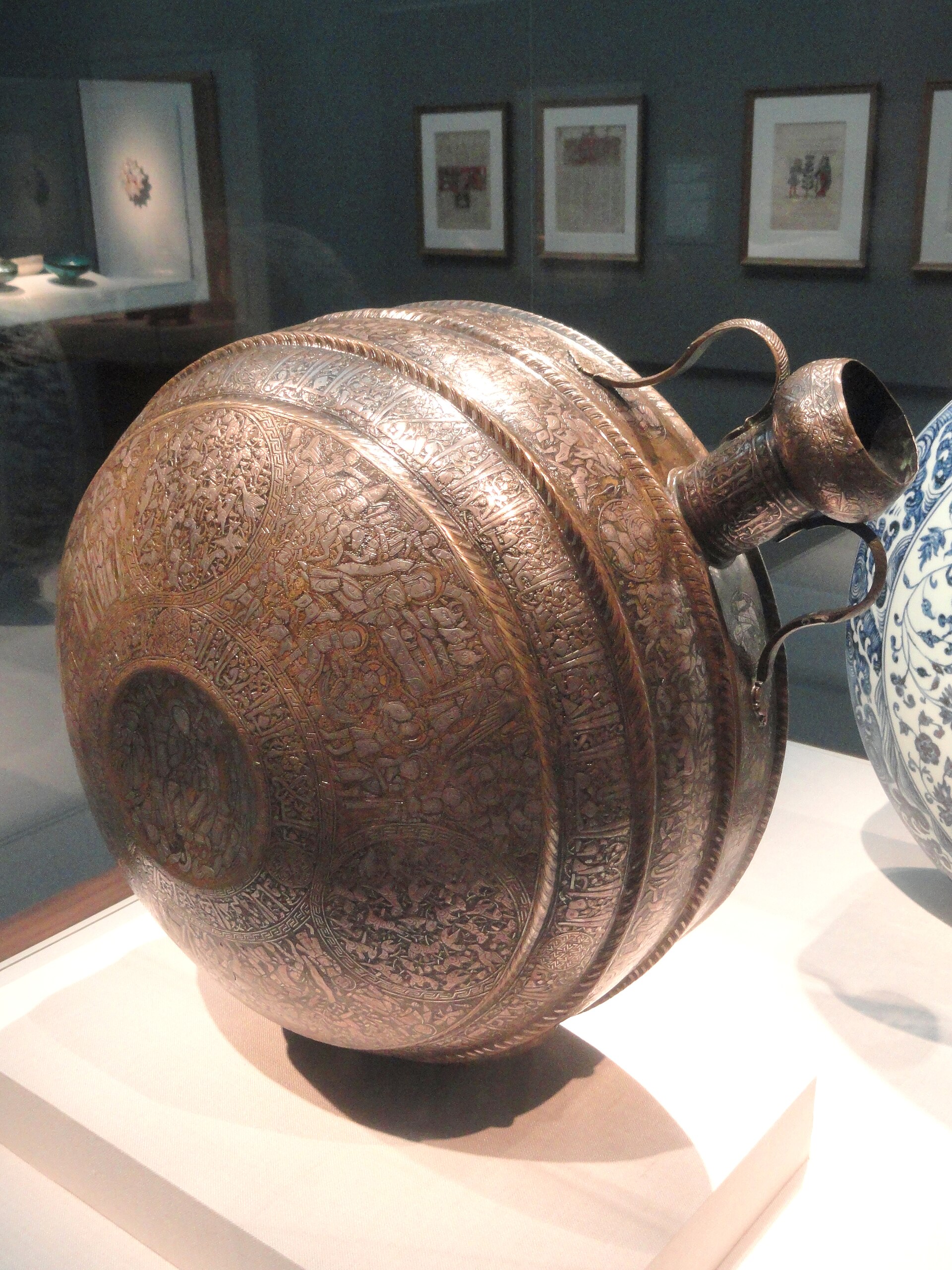
The front of the canteen, showing the central medallion of the enthroned Virgin and Child surrounded by the wider band of infancy scenes. Photographed on display at the Freer Gallery of Art.
| Artist | Unidentified workshop of the Mosul tradition of inlaid metalwork |
|---|---|
| Date | Mid-13th century (Ayyubid period) |
| Medium | Hammered brass, built up in several sections and soldered, inlaid with silver and engraved |
| Dimensions | 45.2 x 36.7 cm (17 13/16 x 14 7/16 in) overall; more than 4.5 kg (10 lb) empty |
| Where it is now | Smithsonian's National Museum of Asian Art (Freer Gallery of Art), Washington, DClast confirmed |
| Inventory number | F1941.10 |
| Attribution | DisputedThe object's broad classification is not contested: an Ayyubid brass vessel of the mid-13th century, inlaid with silver, made somewhere in Syria or the Jazira in the technical tradition associated with Mosul. Full note |
| Object type | Islamic metalwork |
| Period | Ayyubid, mid-13th century |
| Cases | Disputed attribution · Has a provenance gap |
| Inscriptions | Bands of Arabic script in Kufic and Naskhi combine with the figural decoration; a 2012 reconsideration of the object characterizes the text as benedictory (well-wishing) formulas rather than narrative or devotional Christian text |
| Owners on record | 6 links4 documented, 2 unknown |
| Sources | 12 cited |
About this record Last verified · 12 sources cited · Change log
On this page 9 sections
ContentsClose
A brass canteen inlaid with silver, made in Syria or northern Mesopotamia in the mid-13th century Ayyubid period, decorated on one face with the enthroned Virgin and Child surrounded by scenes from the infancy of Christ and on the other with mounted lancers and an assembly of saints under arches, all set among bands of Arabic script. Weighing more than four and a half kilograms empty, it is the largest and most fully decorated object of its type known to survive, and it has anchored a scholarly argument running from 1983 to 2012 over whether it was made for a Christian patron, for a shared Muslim-Christian audience, or as an expression of a fully integrated Ayyubid visual culture in which the distinction barely applied.
Its documented ownership begins with Prince Filippo Andrea Doria of Genoa, recorded to 1845, breaks for an undocumented gap of decades, resumes with the London collector George Eumorfopoulos, and passes through the New York dealer Hagop Kevorkian before the Freer Gallery of Art purchased it in 1941. Charles Lang Freer, whose endowment funded that purchase, had been dead for twenty-two years by then and, on the evidence available, never owned or saw the object that today carries his gallery's name.
No inscription on the canteen itself names a patron, and none of the major published readings of its imagery, from Katzenstein and Lowry's 1983 case for a Muslim workshop serving a Christian client to Hoffman's 2004 case for a fully shared visual culture, has displaced the others. The object remains, on its own terms, an open argument in metal.
Provenance
Each link is graded. Documented: a cited source supports it. Disputed: the identification is argued but not established. Unknown: no owner for that span, and the gap is not smoothed into a narrative. The grades in the glossary.
- Mid-13th century -Unrecorded, Ayyubid Syria or the Jaziradocumented
Made in the mid-13th century Ayyubid period in Syria or northern Iraq (the Jazira), in the technical tradition associated with Mosul. No maker's signature and no patron's name survive on the object.134
- - 1845Prince Filippo Andrea Doria, Genoa, Italydocumented
The earliest owner named in the Freer Gallery's own provenance record. How long before 1845 the Doria family had held the piece, and where it had been before, is not documented.1
- 1845 -Unrecordedunknown
No owner is documented between the Doria ownership recorded to 1845 and the next recorded owner, George A. Eumorfopoulos, whose dates (1863-1939) mean the piece could not have reached him before his own lifetime began. The gap is at minimum several decades.1
- - 1939George A. Eumorfopoulos, Londondocumented
Named as an owner in the Freer Gallery's provenance record, with his own dates (1863-1939) as the only chronological anchor given; the sources consulted do not state when he acquired the canteen. His death in 1939 was followed by a series of Sotheby's sales of his collection in London in 1940, held by order of his widow and executors.1
- 1939 -Hagop Kevorkian, New Yorkunknown
Kevorkian is the next owner named in the Freer Gallery's record. Whether the canteen passed through one of the 1940 Sotheby's Eumorfopoulos sales or left the estate by a separate private transaction is not established in the sources consulted.1
- 1941 - presentFreer Gallery of Art, Smithsonian Institution (now the National Museum of Asian Art)documented
Purchased from Hagop Kevorkian in New York in 1941 using the Charles Lang Freer Endowment. Charles Lang Freer himself died in 1919, twenty-two years before this acquisition, and the sources consulted give no evidence he ever owned or saw this specific object. The purchase price has not been found in the sources consulted.1
Technical evidence
| Attribution note | The object's broad classification is not contested: an Ayyubid brass vessel of the mid-13th century, inlaid with silver, made somewhere in Syria or the Jazira in the technical tradition associated with Mosul. What is disputed, and has been argued over in print since 1983 with no consensus reached by the most recent reconsideration in 2012, is who commissioned it, for what audience, and what the Christian imagery on an object made in an Islamic milieu was understood to mean by the people who made and used it. |
|---|---|
| Support | Hammered brass sheet, built up in several sections and soldered together to form the body, neck and handles.43 |
| Decorative technique | Surface inlaid with silver and finished with engraved detail over the whole decorated field.13 |
| Dimensions | 45.2 x 36.7 cm (17 13/16 x 14 7/16 in) overall, per the Freer Gallery's own measurement.1 |
| Weight | More than 4.5 kg (10 lb) empty, a figure repeatedly cited in the literature as evidence against the vessel's practical use as field equipment.34 |
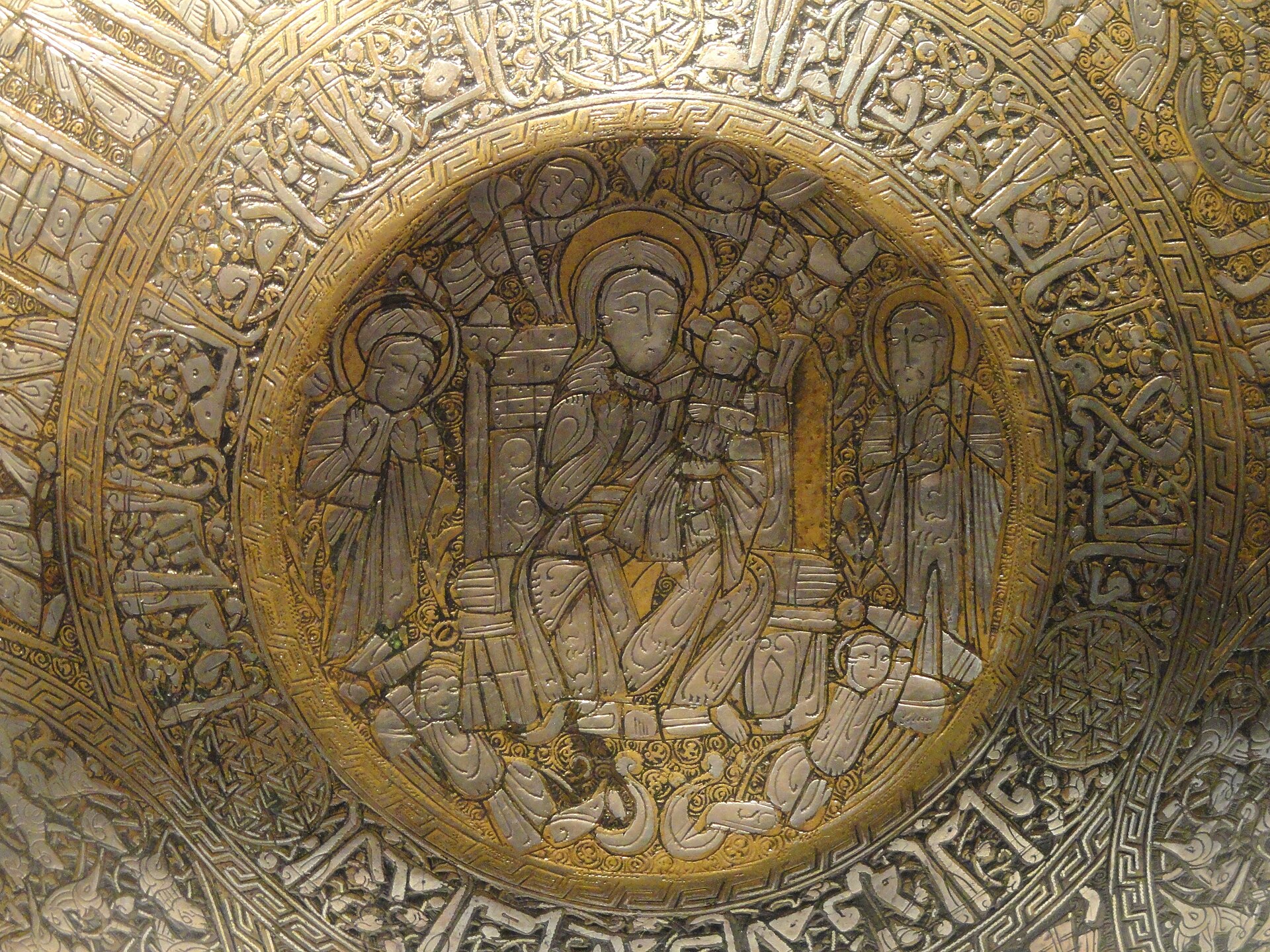
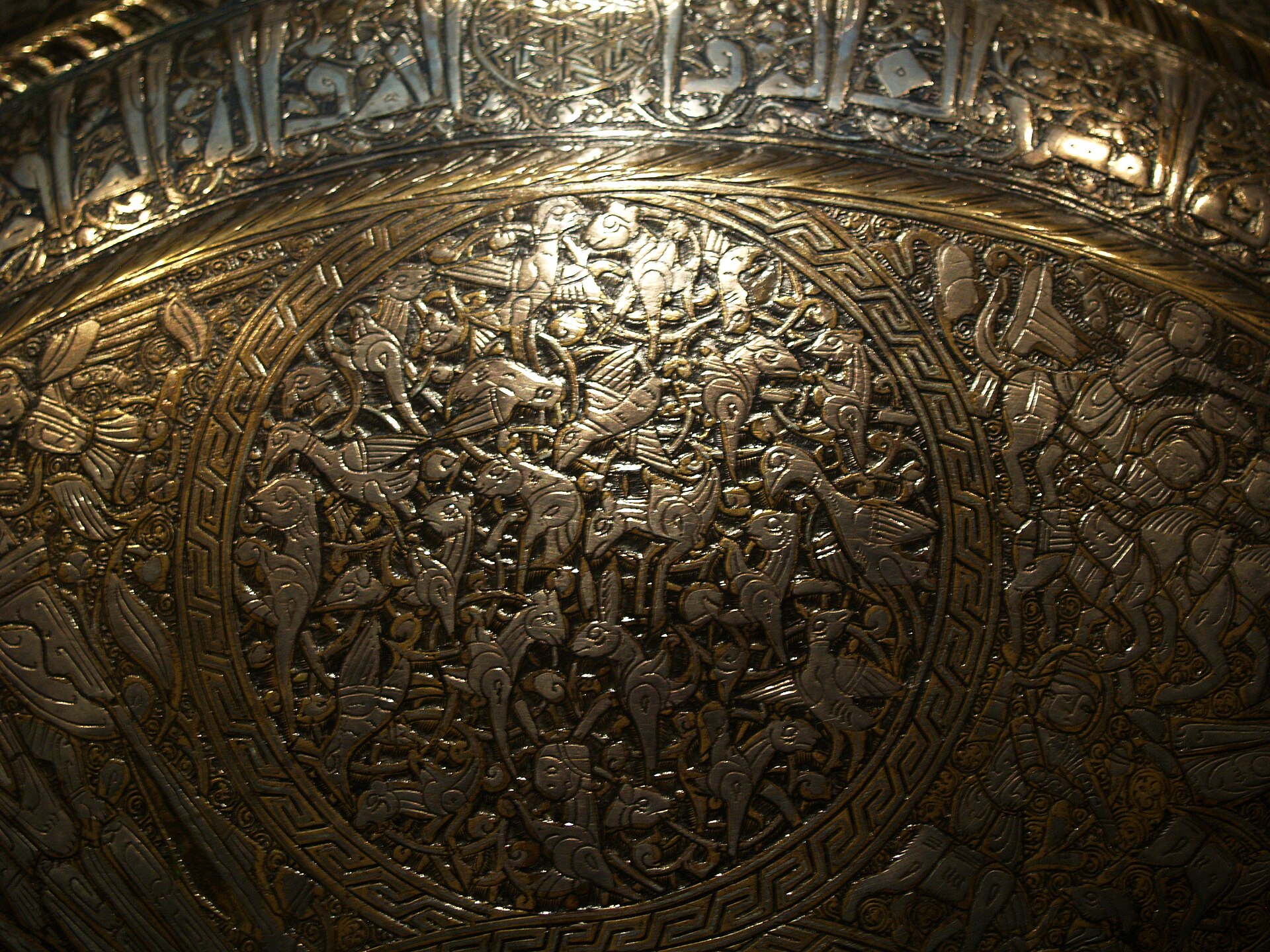
| Obverse programme | Central medallion of the Virgin and Child enthroned with two saints and angels, encircled by a band containing further scenes from the infancy of Christ (Nativity, Presentation in the Temple, Entry into Jerusalem, and in fuller accounts the Annunciation and Adoration of the Magi), separated by roundels of animals, birds, harpies, griffins and lions.313 |
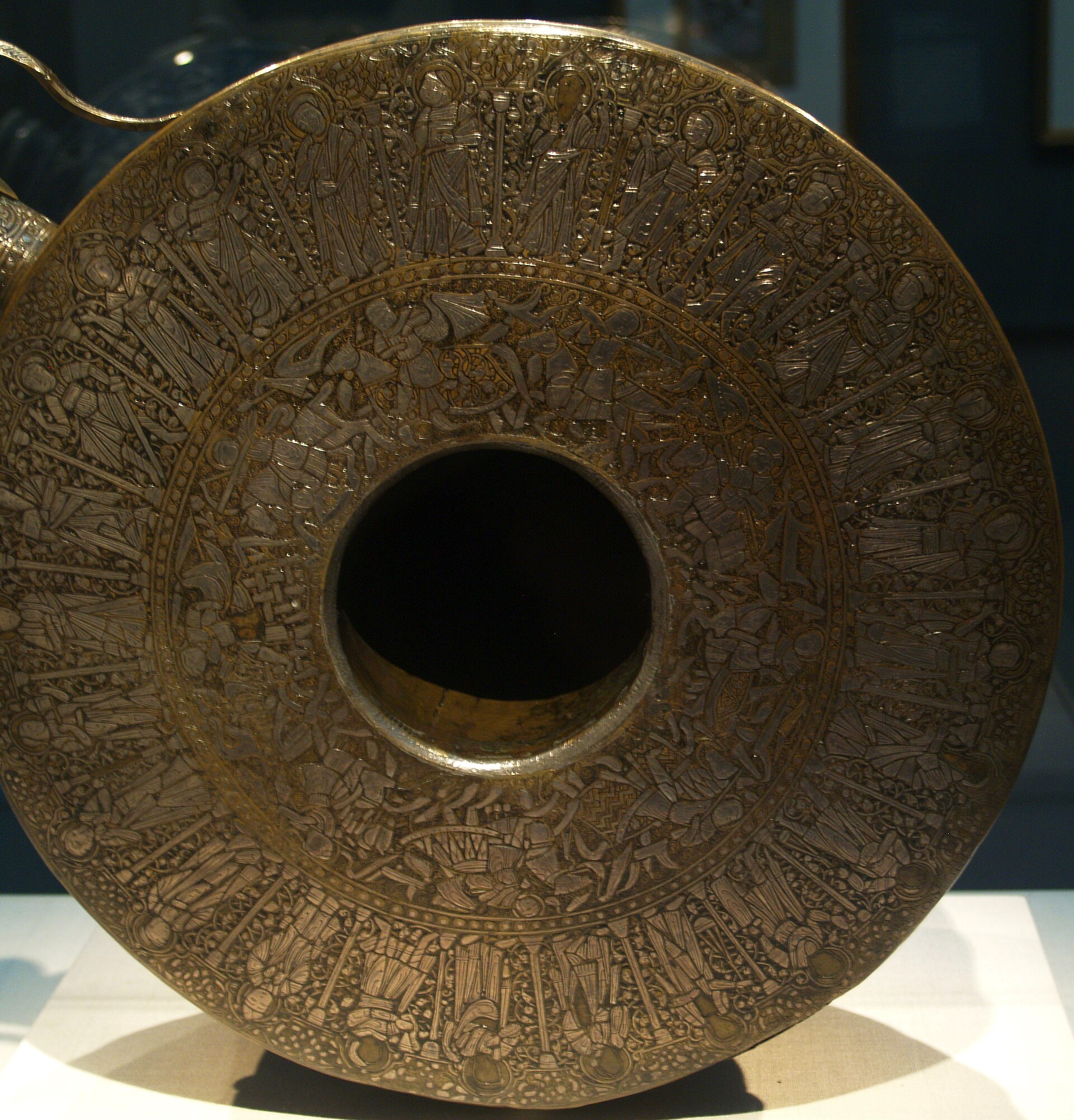
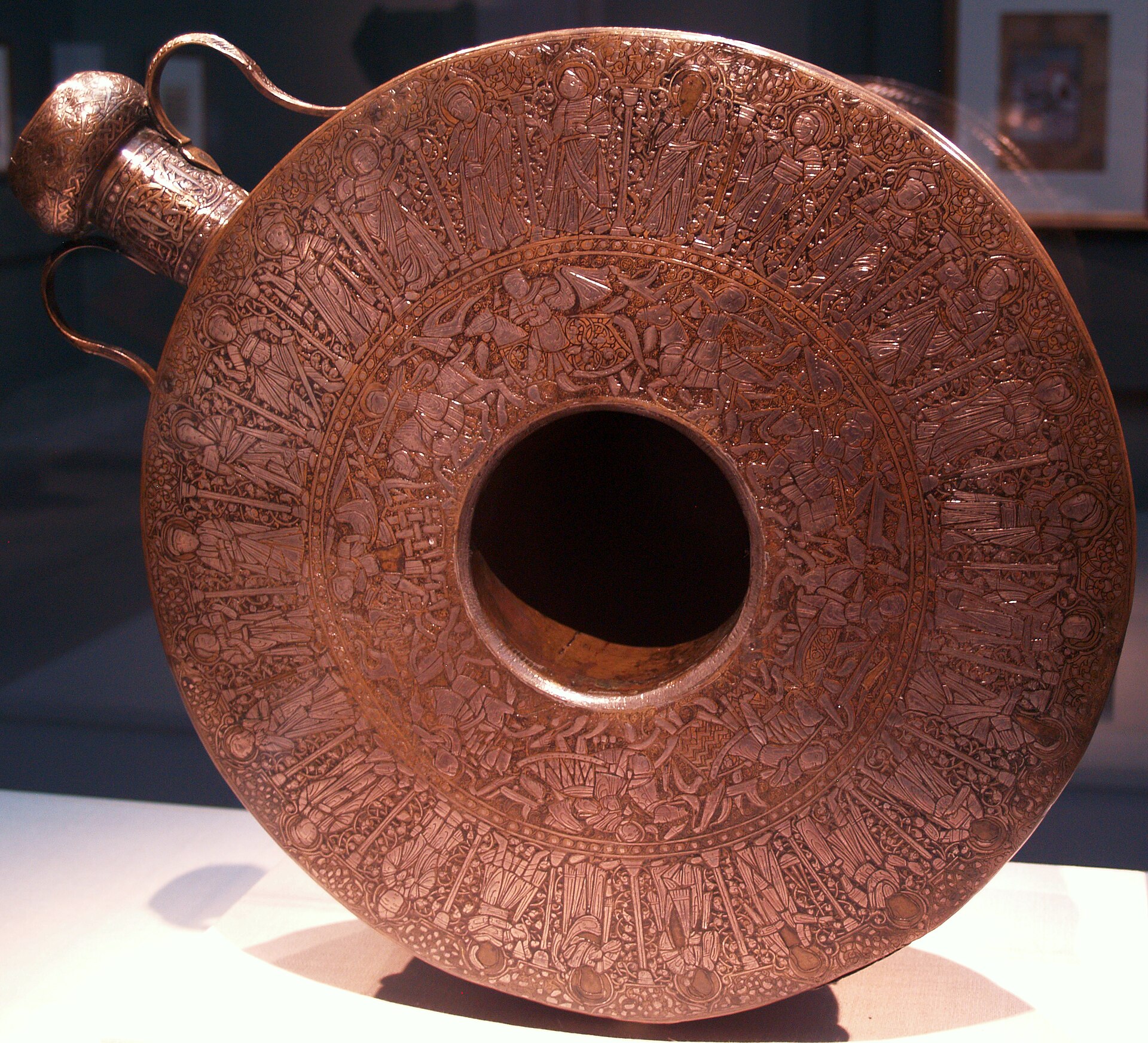
| Reverse programme | An inner band of nine mounted lancers and an outer band of twenty-five standing figures under arches, identified as saints, warriors, and biblical figures including Gabriel and a second image of the Virgin.35 |
| Inscriptions | Bands of Arabic script in Kufic and Naskhi accompany the figural decoration; a 2012 reconsideration of the object characterizes this text as benedictory (well-wishing) formula rather than narrative or liturgical Christian text.347 |
| Credit line and accession | Purchase, Charles Lang Freer Endowment; accession number F1941.10, Freer Gallery of Art, Smithsonian Institution.1 |
Images
The record in full
Chapter 1What it is
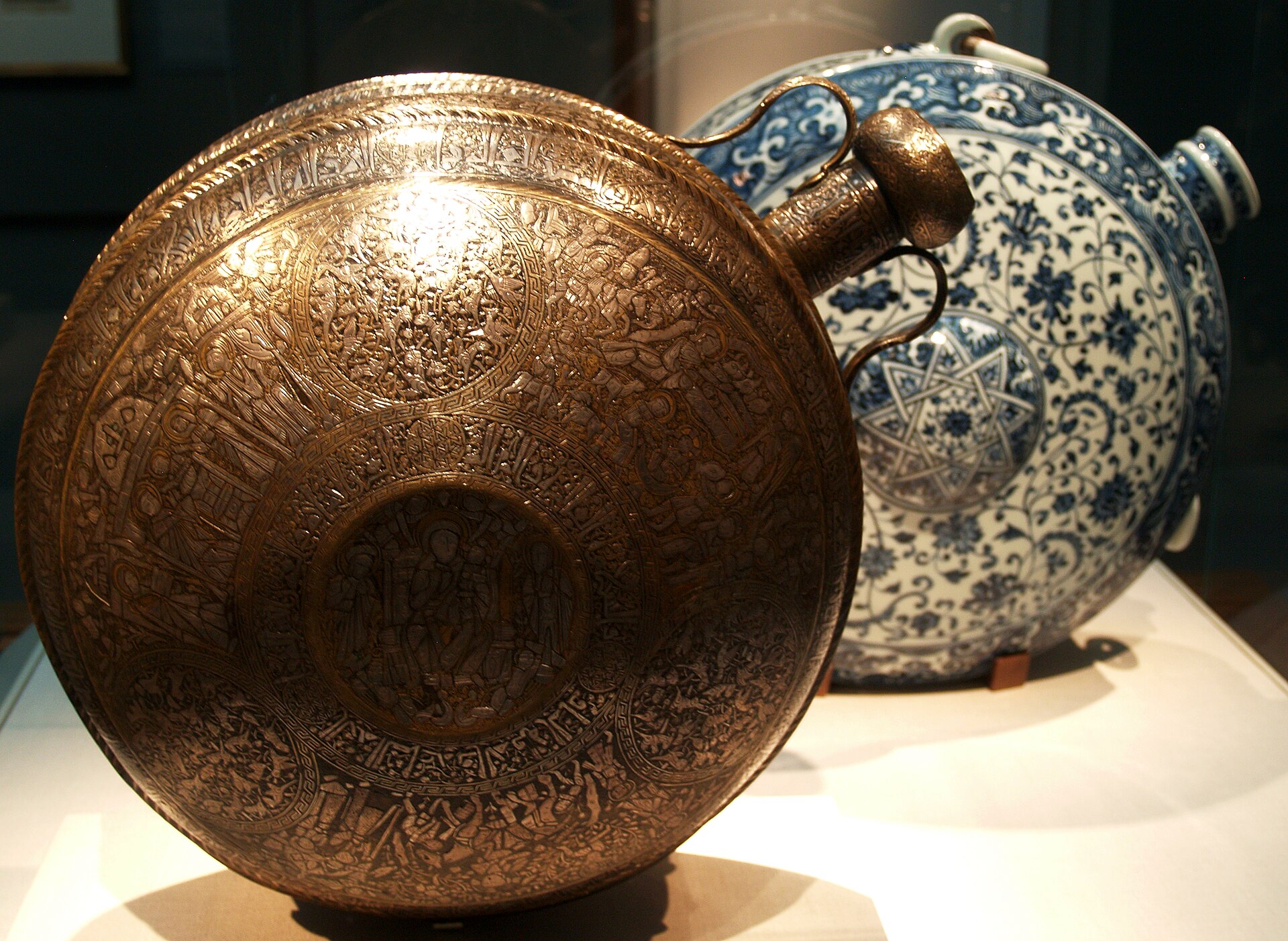
The Freer Canteen is a large brass vessel, 45.2 by 36.7 centimetres, in the flattened, drum-shaped form of a pilgrim flask, with a short cylindrical neck and looped handles for a carrying strap.
The Freer Canteen is a large brass vessel, 45.2 by 36.7 centimetres, in the flattened, drum-shaped form of a pilgrim flask, with a short cylindrical neck and looped handles for a carrying strap. It was not raised from a single sheet: the body was built up in several sections of hammered brass, soldered together, and the entire surface was then inlaid with silver and finished with engraved detail. Empty, it weighs more than four and a half kilograms, roughly ten pounds, a fact that has shaped a real argument about whether it was ever meant to hold liquid at all.
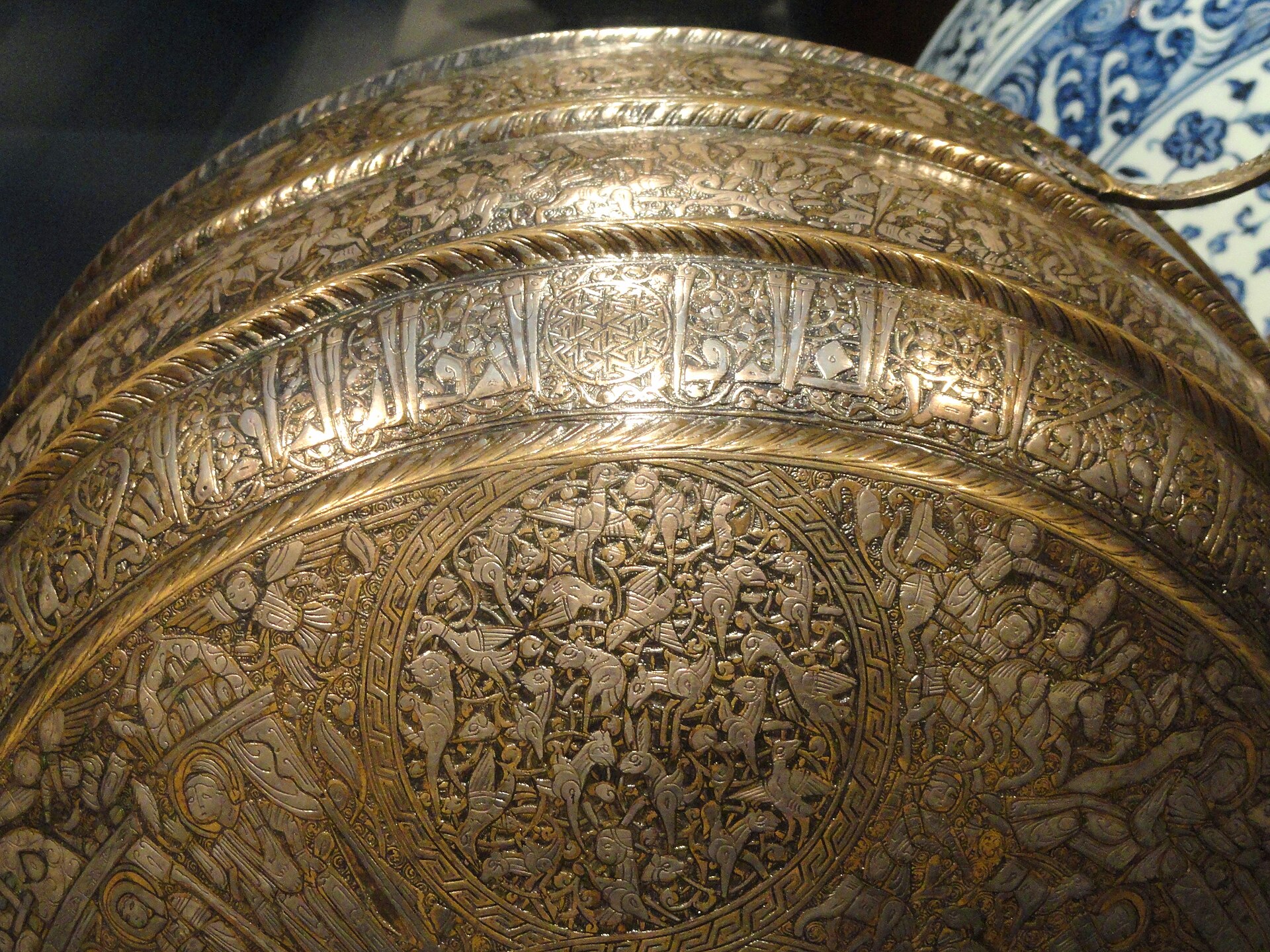
It is the largest known object of its type to survive from the period, and the decorative programme covering both faces and the neck is the densest and most legible of any comparable canteen: two wide concentric fields of figures wrap around a central medallion on the front, and a further two bands of figures cover the back, all set among bands of Arabic script in Kufic and Naskhi script.
Chapter 2The obverse: a Madonna surrounded by the life of Christ
The front of the canteen is organized around a central medallion showing a woman enthroned with a child on her lap.
The front of the canteen is organized around a central medallion showing a woman enthroned with a child on her lap. Both figures carry haloes, the child's marked with a cross, which is how the figures are read as the Virgin and Christ Child rather than a generic mother-and-child motif; two attendant saints flank the throne and angels fill the remaining ground.
Around this medallion runs a wider band containing three further scenes from the life of Christ, separated from one another by roundels of animals, birds, harpies, griffins and lions in the vegetal-and-animal repertoire standard to Ayyubid inlaid brass. The scenes identified in the published descriptions are the Nativity, the Presentation in the Temple, and the Entry into Jerusalem; a fuller account also lists the Annunciation and the Adoration of the Magi among the figures on this face. Joseph appears in more than one of these scenes, a detail worth pausing on because Joseph the carpenter has no counterpart role in the Quranic infancy narrative; his presence indicates that whoever supplied the iconographic programme was working from a Christian narrative source, not adapting an Islamic one.
Chapter 3The reverse: horsemen and an assembly of the church
The back of the canteen carries an entirely different register.
The back of the canteen carries an entirely different register. An inner band shows nine mounted lancers riding in procession. An outer band, arranged under a series of arches, holds twenty-five standing figures identified in the scholarship as saints, warriors, and named biblical figures including the archangel Gabriel and the Virgin Mary a second time, distinct from her appearance in the central medallion on the front.
What the published descriptions stress is the generality of these twenty-five figures: they read as types of the church, bishops, saints, liturgical figures, rather than as individually recognisable persons with specific attributes. Renee Katzenstein and Glenn Lowry, writing in Muqarnas in 1983, treated that generality as evidence in itself, arguing that it points to a maker with only a surface, non-devotional familiarity with Christian iconography rather than a Christian craftsman working from within the tradition.
Chapter 4What the canteen leaves out
The choice of scenes is as informative as the scenes themselves.
The choice of scenes is as informative as the scenes themselves. The infancy and entry narratives are all present, but the Crucifixion and the Resurrection, the two events at the theological centre of Christian doctrine and the two events Islamic scripture explicitly denies happened to Jesus in the manner Christians describe, are absent from the programme as published. A narrative selection that includes the birth and the acclaimed arrival of a prophet-like figure but stops short of his death and rising is not a neutral editorial choice; it is legible, on an object made in and for an Islamic milieu, as one where Jesus's Islamic identity as a revered prophet, not the second person of the Trinity, sets the boundary of what could be shown.
Chapter 5The patronage debate
No document names who ordered the canteen, and that gap has produced forty years of argument rather than a settled answer.
No document names who ordered the canteen, and that gap has produced forty years of argument rather than a settled answer. The terms of the debate were set by Katzenstein and Lowry in 1983: reading the Christian imagery as generic and slightly imprecise, they argued for a Muslim workshop producing a devotional or memorial object to order for a Christian client, most likely a wealthy pilgrim who wanted a durable, expensive souvenir of a journey to the Holy Land, made by artisans who had heard the stories but had not lived inside the liturgy that told them.
Eva Baer's 1989 monograph, the standard survey of the whole corpus of Ayyubid metalwork bearing Christian imagery and reviewed on publication as a milestone in the study of Islamic metalwork, placed the canteen within a wider group of thirteenth-century objects rather than treating it as a singular curiosity, which reframed the question from why does this one object exist to why did a whole category of objects like it exist under Ayyubid rule.
Nuha Khoury, writing in Orientations in 1998 in an article that treats the Freer canteen alongside its companion piece the d'Arenberg Basin, argued for a more integrated reading: that the imagery may draw on Christian Syriac narrative sources current among the indigenous Christian communities of the Jazira and the Holy Land, and that objects of this kind could function as part of a shared local rhetoric uniting Christians and Muslims of the region against the Crusader presence, pointing to the circulation of texts such as the Merits of Jerusalem literature in which Jesus himself is enlisted on the side of the Ayyubid reconquest. This is an argued position, tied to a named scholar and a specific textual parallel, not an established fact, and it stands in some tension with readings that see the imagery as addressed to a Christian buyer rather than a shared Muslim-Christian public.
Eva Hoffman, in Gesta in 2004, moved the argument toward a still more integrated model, proposing that the exchange of Christian and Islamic visual language had penetrated deeply into a genuinely shared Ayyubid visual culture rather than sitting as a foreign import commissioned from outside it, and describing objects like the canteen as functioning as visual sites where competing claims of religious truth and dynastic success could be displayed to whoever handled or viewed them, Christian or Muslim.
The most recent full treatment, by Heather Ecker and Teresa Fitzherbert in Ars Orientalis in 2012, explicitly reconsiders the object's intended purpose and audience, working from the combination of the Christian figural programme with Arabic benedictory inscriptions to ask what kind of person, and what kind of use, both halves of that combination were meant to serve. No reading commands universal agreement, and none of the four major published positions treats a rival position as fully answered.
Chapter 6Was it ever a canteen
The object takes its name from its shape, which recalls the rounded body, short neck and strap-lugs of a ceramic pilgrim flask meant to be slung from the shoulder and carried.
The object takes its name from its shape, which recalls the rounded body, short neck and strap-lugs of a ceramic pilgrim flask meant to be slung from the shoulder and carried. At more than four and a half kilograms empty, before any liquid is added, that practical reading is difficult to sustain literally; a vessel this heavy, this elaborately worked, and this large would have been a considerable burden to carry any distance and a very expensive way to transport water or wine. The likelier reading, shared across the scholarship without being the subject of dedicated dispute, is that the canteen form was retained as a recognisable and prestigious shape while the object itself functioned as a display piece, a treasury object, or a commemorative gift rather than as field equipment. The name is a description of its form, not proof of its use.
Chapter 7Its nearest relative, in the same room
The Freer Gallery holds a second Ayyubid vessel that belongs in the same conversation: the so-called d'Arenberg Basin, F1955.10, a large brass basin inlaid with silver and dated by inscription to...
The Freer Gallery holds a second Ayyubid vessel that belongs in the same conversation: the so-called d'Arenberg Basin, F1955.10, a large brass basin inlaid with silver and dated by inscription to 1247-1249, the reign of the last effective Ayyubid sultan of Egypt and Syria, al-Malik al-Salih Najm al-Din Ayyub. Made probably in Damascus, its exterior carries the same core sequence of Christian scenes found on the canteen, the Annunciation, the Virgin and Child enthroned, the Raising of Lazarus, and the Entry into Jerusalem, interspersed with a courtly polo game and a band of real and imaginary animals. Its interior carries something the canteen does not: a continuous row of thirty-nine standing figures identified as saints, arranged under arches running the full circumference of the bowl.
Because the basin is dated by its own inscription while the canteen is not, and because both objects entered the Freer collection through Charles Lang Freer's endowment rather than through his own lifetime purchases, the basin functions as the closest anchor available for placing the canteen in time and, per Khoury's 1998 article, in argument: she treats the pair together as a single body of evidence for how Ayyubid patrons and viewers held Christian narrative and Islamic ornament in the same object.
Chapter 8The Mosul tradition and its diaspora
Silver-inlaid brasswork of this refinement is conventionally traced to Mosul, where, under the patronage of the Zangid dynasty in the twelfth and early thirteenth centuries, metalworkers developed an...
Silver-inlaid brasswork of this refinement is conventionally traced to Mosul, where, under the patronage of the Zangid dynasty in the twelfth and early thirteenth centuries, metalworkers developed an inlay technique markedly more accomplished than the earlier Samanid work of Iran or the Buyid work of Iraq that preceded it. Very few objects in this tradition carry a maker's name; one of the exceptions is a brass ewer of about 1223 in the Cleveland Museum of Art signed by Ahmad al-Dhaki al-Mawsili, whose small workshop, including an apprentice named Ibn Hajji Jaldak, produced a handful of securely attested pieces across roughly two decades, among them a basin made for the Ayyubid sultan al-Malik al-Adil II in 1238-40 now in the Louvre. The Freer canteen carries no such signature and cannot be linked to al-Dhaki al-Mawsili's workshop by anything stronger than shared technique and period; it stands in the same tradition, not in the same attested hand.
That tradition did not stay put. The Mongol capture of Baghdad in 1258 and the subsequent occupation of Mosul scattered the city's metalworkers to Damascus, Aleppo and Cairo, carrying the inlay technique with them into what later Mamluk patrons in Cairo and Damascus would continue to commission and, eventually, export across the Mediterranean. If the Freer canteen was made in the mid-13th century, as the Ayyubid attribution holds, it belongs to the last Syrian generation of this craft before that rupture rather than to the diaspora that followed it, though the published sources consulted for this record do not commit to a single city of manufacture within Syria or the Jazira.
Chapter 9From Genoa to Washington: an incomplete chain
The Freer Gallery's own provenance record for the canteen names three owners before the museum and leaves the connections between them undocumented.
The Freer Gallery's own provenance record for the canteen names three owners before the museum and leaves the connections between them undocumented. The earliest recorded owner is Prince Filippo Andrea Doria of Genoa, Italy, who is recorded as holding the piece until 1845; nothing in the sources consulted establishes how long before 1845 the Doria family had owned it, or where it had been before that. What happened to the canteen between 1845 and its next recorded owner is not documented at all, a gap of the better part of a century.
The next name in the record is George A. Eumorfopoulos, the London-based collector of Chinese, Persian and Islamic art, who is recorded owning the piece; his dates, 1863 to 1939, set the outer limit for when he could have acquired and held it, but the sources consulted do not give the date he acquired it. Eumorfopoulos died in 1939, and much of his collection was dispersed at a series of Sotheby's sales in London in 1940, sold, as the sale catalogues record, by order of his widow and executors; whether the canteen passed through one of those 1940 sales specifically, or left the Eumorfopoulos collection by some other private transaction, is not established in the sources available for this record.
The canteen's next recorded owner is Hagop Kevorkian, the Armenian-born dealer and excavator who built two eponymous galleries in New York and Paris and did more than almost any other individual to bring Near Eastern and Islamic material into American collections in the first half of the twentieth century. The Freer Gallery of Art purchased the canteen from Kevorkian in New York in 1941, using the Charles Lang Freer Endowment, the fund established from the founder's estate to continue acquisitions after his death.
That last point deserves stating plainly because it runs against the natural assumption a visitor might make. Charles Lang Freer, the Detroit industrialist whose personal collection and 1906 gift founded the museum that bears his name, died in 1919. He never owned this canteen and, on the documentary record available, never saw it: it entered the collection twenty-two years after his death, bought with money he had left behind rather than through any acquisition he made himself. The gallery's name on the object is institutional, not biographical.
Chapter 10What is still unresolved
Four published positions on the canteen's intended patron and audience, from Katzenstein and Lowry in 1983 through Baer in 1989 and Khoury in 1998 to Hoffman in 2004 and the joint reconsideration by...
Four published positions on the canteen's intended patron and audience, from Katzenstein and Lowry in 1983 through Baer in 1989 and Khoury in 1998 to Hoffman in 2004 and the joint reconsideration by Ecker and Fitzherbert in 2012, do not converge on a single answer, and the object itself supplies no inscription that names a patron the way the d'Arenberg Basin's inscription names a sultan's reign. The most honest description of the current state of scholarship is that the question is open and has been argued in print for four decades without resolution, not that any one reading has prevailed.
The artist
Unidentified workshop, Mosul tradition of silver-inlaid brasswork
No name survives for whoever made this canteen. It carries no signature, and none of the small number of securely named thirteenth-century inlaid-brass makers has been matched to it by any evidence stronger than shared period and technique. What can be described is not an artist but a tradition: a craft milieu, centred on Mosul under Zangid and then Ayyubid rule, that developed the technical vocabulary this object is made in, and that scattered across Syria, Egypt and Iran within a generation of this piece being made.
Related works
| Work | Relation | Where it is |
|---|---|---|
| Basin (the d'Arenberg Basin) Unidentified Ayyubid workshop, probably Damascus | Companion piece in the same collection, dated by inscription to 1247-1249; shares the core sequence of Christian narrative scenes on its exterior and adds an interior band of thirty-nine standing saints. Treated together with the canteen by Nuha Khoury (1998) as a single body of evidence. Also acquired through the Charles Lang Freer Endowment, not by Freer personally. | Freer Gallery of Art, Smithsonian Institution, Washington DC (F1955.10) |
| Ewer signed by Ahmad al-Dhaki al-Mawsili Ahmad al-Dhaki al-Mawsili | One of a small group of securely signed works establishing the technical vocabulary (hammered brass, silver inlay, engraving) of the Mosul tradition the canteen's maker worked in; not attributed to the same hand. Dated to about 1223, roughly a generation before the canteen. | Cleveland Museum of Art |
| Basin made for al-Malik al-Adil II Workshop of Ahmad al-Dhaki al-Mawsili | Signed Ayyubid inlaid brass basin made for a named sultan in 1238-40, illustrating what a securely dated and attributed object in this same technical tradition looks like. Cited here only as comparative evidence of workshop practice; this is a different object from the Louvre's separately catalogued Baptistere de Saint Louis, a later Mamluk basin already covered elsewhere in this archive. | Musee du Louvre, Paris |
Open questions
- Who commissioned the canteen, and for what audience? Four major published positions (Katzenstein and Lowry 1983, Baer 1989, Khoury 1998, Hoffman 2004, Ecker and Fitzherbert 2012) disagree, and none has been shown to answer the others.
- In which city was it made? The sources consulted place it in Syria or the Jazira and associate its technique with the Mosul tradition, but none commits to a single city of manufacture.
- Where was the canteen between the unknown date it was made and 1845, when it is first recorded in the ownership of Prince Filippo Andrea Doria? No owner is documented for this period.
- How did the canteen leave the Doria family and reach George Eumorfopoulos? Neither a date nor a mechanism for this transfer is given in the sources consulted.
- Did the canteen pass through the 1940 Sotheby's dispersal of the Eumorfopoulos collection, or leave his estate by a different route to reach Hagop Kevorkian? This is not established in the sources available for this record.
- What price did the Freer Gallery pay Kevorkian in 1941? No purchase price is given in the sources consulted.
- Was the canteen ever used to hold or carry liquid, given its weight of more than 4.5 kg empty, or was the pilgrim-flask form purely a retained prestige shape? The literature leans toward the latter without treating the question as fully closed.
Questions about this object
What is Canteen?
Canteen is an islamic metalwork, dated mid-13th century (Ayyubid period). Medium: Hammered brass, built up in several sections and soldered, inlaid with silver and engraved.
Who made Canteen, and is the attribution settled?
The attribution to Unidentified workshop of the Mosul tradition of inlaid metalwork is recorded here as disputed. The object's broad classification is not contested: an Ayyubid brass vessel of the mid-13th century, inlaid with silver, made somewhere in Syria or the Jazira in the technical tradition associated with Mosul. What is disputed, and has been argued over in print since 1983 with no consensus reached by the most recent reconsideration in 2012, is who commissioned it, for what audience, and what the Christian imagery on an object made in an Islamic milieu was understood to mean by the people who made and used it.
Where is Canteen now?
Smithsonian's National Museum of Asian Art (Freer Gallery of Art), Washington, DC. Inventory number F1941.10. Last confirmed 10 August 2026. Freer Gallery of Art object record, Smithsonian Institution.
What is still unknown about Canteen?
Who commissioned the canteen, and for what audience? Four major published positions (Katzenstein and Lowry 1983, Baer 1989, Khoury 1998, Hoffman 2004, Ecker and Fitzherbert 2012) disagree, and none has been shown to answer the others.
Sources
- 1Smithsonian's National Museum of Asian Art, object record, 'Canteen', accession F1941.10. asia-archive.si.edu/object/...
- 2Smithsonian's National Museum of Asian Art, object record, 'Basin' (the d'Arenberg Basin), accession F1955.10. asia-archive.si.edu/object/...
- 3Smarthistory, 'A One-of-a-Kind Canteen'. smarthistory.org/brass-canteen
- 4Wikipedia, 'Freer Canteen'. en.wikipedia.org/wiki/...
- 5arteintransit, 'The Freer Canteen' (disquisition), a secondary summary quoting and paraphrasing Renee A. Katzenstein and Glenn D. Lowry, 'Christian Themes in Thirteenth-Century Islamic Metalwork', Muqarnas 1 (1983), pp. 53-68, and Eva R. Hoffman, 'Christian-Islamic Encounters on Thirteenth-Century Ayyubid Metalwork: Local Culture, Authenticity, and Memory', Gesta 43/2 (2004), pp. 129-142. arteintransit.wordpress.com/disquisition/...
- 7Bibliographic listing for Heather Ecker and Teresa Fitzherbert, 'The Freer Canteen, Reconsidered', Ars Orientalis 42 (2012), pp. 176-193, with abstract, located via ResearchGate. The full article was not accessible during research; its account here is limited to the published abstract. researchgate.net/publication/...
- 8Cambridge Core, review notice for Eva Baer, Ayyubid Metalwork with Christian Images, Studies in Islamic Art and Architecture, Supplements to Muqarnas vol. 4 (Leiden: E. J. Brill, 1989), in the Journal of the Royal Asiatic Society, source of the quoted assessment of the book. The monograph itself was not accessible during research. cambridge.org/core/...
- 9Bibliographic listing for Laura T. Schneider, 'The Freer Canteen', Ars Orientalis 9, Freer Gallery of Art Fiftieth Anniversary Volume (1973), pp. 137-156, the first dedicated scholarly publication on the object, located via Google Books listing. Full text not accessible during research. books.google.com/books/...
- 10Encyclopaedia Britannica, 'Mosul school (metalwork)'. britannica.com/art/...
- 11Wikipedia, 'Ahmad al-Dhaki al-Mawsili', and associated web search results on the migration of Mosul metalworkers to Damascus, Aleppo and Cairo following the Mongol capture of Baghdad in 1258. en.wikipedia.org/wiki/...
- 12Wikimedia Commons, category 'Canteen with Christian and Islamic motifs (Freer)' and associated file pages, consulted for license verification (LicenseShortName) of each image used in this record. commons.wikimedia.org/wiki/...
- 13Art and Architecture of the Middle Ages: Exploring a Connected World (Omeka S teaching site), 'Freer Canteen' item page. artofthemiddleages.com/s/...
Last verified · Published
Change log
10 August 2026 - Record created at the house standard: researched narrative, technical evidence, maker dossier, graded provenance chain, prices with hammer and premium separated, related works, open questions and sources.