Portrait of a Young Man Holding a Roundel
Alessandro di Mariano Filipepi, called Sandro Botticelli · c. 1480. Proposed dates run from about 1470 to about 1490.
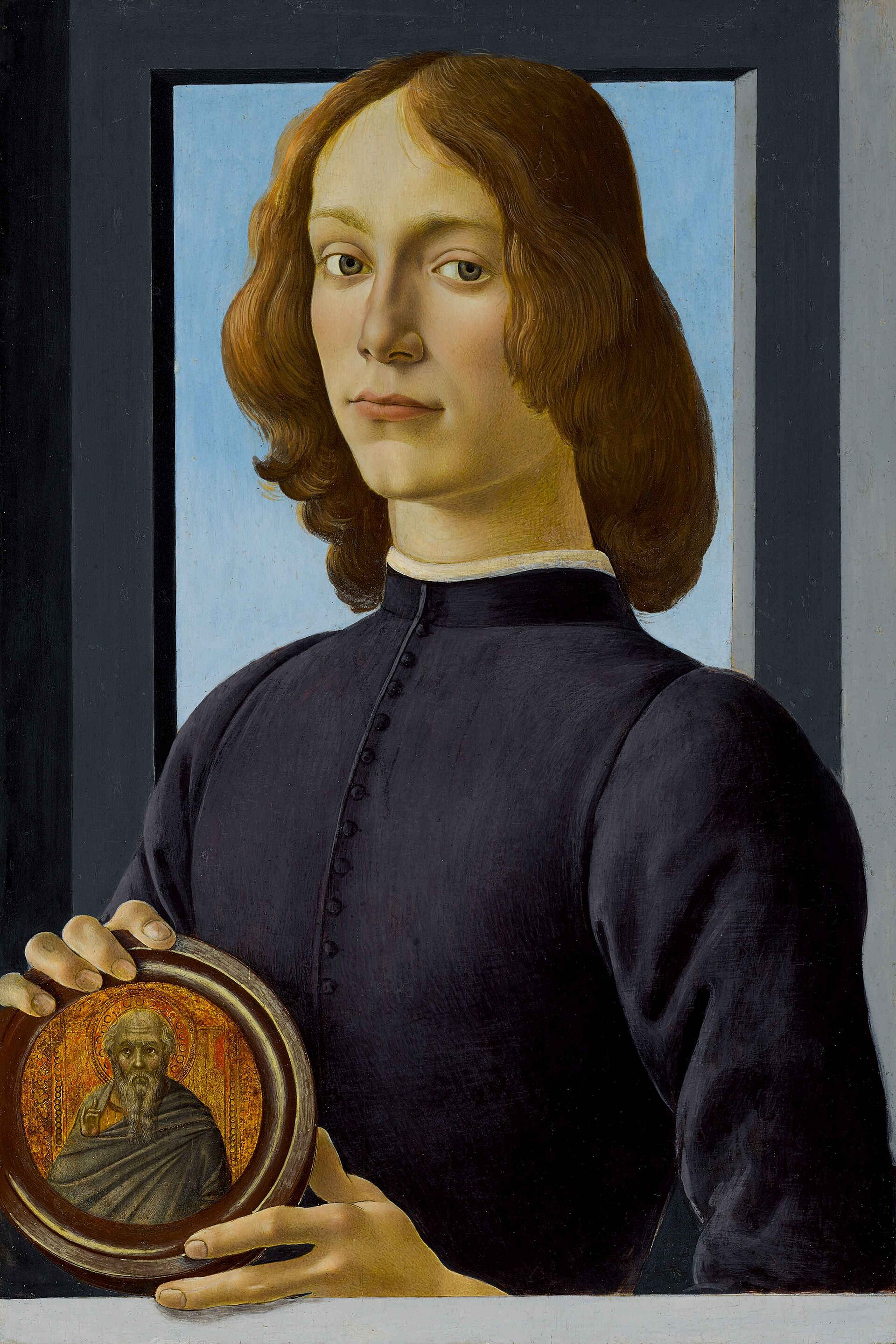
The record subject. Tempera on poplar panel, 58.4 x 39.4 cm, about 1480. The gilded disc in the sitter's left hand is a separate mid-fourteenth-century Sienese painting, inserted into the panel before Botticelli painted around it.
| Artist | Alessandro di Mariano Filipepi, called Sandro Botticelli |
|---|---|
| Date | c. 1480. Proposed dates run from about 1470 to about 1490. |
| Medium | Tempera on poplar panel, incorporating an inserted mid-fourteenth-century painted roundel |
| Dimensions | 58.4 x 39.4 cm (23 x 15 1/2 in.) |
| Where it is now | Private collection. Bought at Sotheby's New York on 28 January 2021 by an anonymous telephone bidder.last confirmed 4 August 2026 |
| Attribution | AcceptedSold by Sotheby's in January 2021 as fully autograph Botticelli and generally accepted as such, though the catalogue itself records that the division between Botticelli and his workshop has been argued over and that proposed dates run from about 1470 to about 1490. Full note |
| Object type | Painting |
| Period | Italian, fifteenth century |
| Cases | Has a provenance gap |
| Inscriptions | None recorded on the Botticelli surface. |
| Owners on record | 6 links5 documented, 1 unknown |
| Sources | 9 cited |
About this record Last verified 4 September 2026 · 9 sources cited · Change log
On this page 10 sections
ContentsClose
A poplar panel of about 1480, 58.4 by 39.4 centimetres, showing a young Florentine man holding, on a parapet, a painted roundel of a blessing saint. The roundel is not Botticelli's. It is a separate mid-fourteenth-century Sienese panel, dated by Richard Offner and attributed to Bartolommeo Bulgarini, which was set into the wood before Botticelli painted around it. The picture is one object, two paintings and two hands separated by roughly a hundred and thirty years.
It came out of Tuscany in the 1780s with a Welsh baron, descended through his family for a century and a half, was sold by trustees at Christie's in London in December 1982 for 810,000 pounds, and spent almost the whole of the next forty years on the walls of the National Gallery in London, the Metropolitan Museum and the National Gallery of Art in Washington. On 28 January 2021 it made 80 million dollars at the hammer, published at 92.2 million with fees, a record for the artist and for any Old Master sold at Sotheby's.
The record for Botticelli before that afternoon was 10,442,500 dollars. Nothing about the panel had changed. What had changed was that it was for sale, and that half a century of museum labels had done the work an attribution argument does elsewhere.
Provenance
Each link is graded. Documented: a cited source supports it. Disputed: the identification is argued but not established. Unknown: no owner for that span, and the gap is not smoothed into a narrative. The grades in the glossary.
- c. 1480 - c. 1790Unrecorded, presumably in Florenceunknown
No owner is documented for roughly three centuries. The roundel inside the panel is older still, a mid-fourteenth-century Sienese painting whose own history before its insertion is entirely unknown.
- c. 1790 - c. 1935The Wynn family, Barons Newborough, Caernarvondocumented
Likely acquired by Sir Thomas Wynn, 3rd Baronet and 1st Baron Newborough (1736-1807), during his residence in Tuscany between 1782 and 1791. Descended to his son Thomas John Wynn, 2nd Lord Newborough (1802-1832); to Spencer Bulkeley Wynn, 3rd Lord (1803-1888); to Frederick George Wynn (1853-1932), the 3rd Lord's youngest son; and to Thomas John Wynn, 5th Lord Newborough (1878-1957). The picture enters the published literature only in the 1930s, so the eighteenth-century acquisition rests on family history rather than on a document named in the catalogue.1
- c. 1935 - 1941Frank Sabin, Londondocumented
Acquired from the Newborough family by the London dealer Frank Sabin around 1935 and sold on to Sir Thomas Ralph Merton by May 1941.1
- 1941 - 1982Sir Thomas Ralph Merton (1888-1969), then Violet Marjory Merton (1891-1976), then trusteesdocumented
Merton was a spectroscopist and a Fellow of the Royal Society as well as a collector of Old Masters. The picture was lent to the Royal Academy in 1960 and to the National Gallery in London from November 1969, during this ownership. Sold by the trustees at Christie's London on 10 December 1982 as lot 92.1
- 1982 - 2021Sheldon Solow, New York, then his estatedocumented
Bought at Christie's London on 10 December 1982, lot 92, for 810,000 pounds, about 1.3 million dollars. Lent almost continuously for the whole period: the Metropolitan Museum 1987 to 1989, the National Gallery of Art in Washington 1990 to 2013, the Stadel Museum in Frankfurt in 2009 and 2010, and the Metropolitan again from 2013 to February 2020. The consignment to Sotheby's was announced in September 2020, while Solow was alive; he died in November 2020 and the sale was completed by his estate.14
- 2021 - presentAnonymous private buyerdocumented
Bought at Sotheby's New York on 28 January 2021, lot 15, at a hammer of 80 million dollars. The winning bid was taken on the telephone by Lilija Sitnika of Sotheby's Russia desk in London. The buyer has not been named and no location, loan or exhibition has been recorded since.24
Prices realised
| Date | Sale | Estimate | Result | Note |
|---|---|---|---|---|
| 10 December 1982 | Christie's London, lot 92 | Hammer GBP 810,000 With premium Not published in the sources consulted GBP | Sold by the Merton trustees and bought by Sheldon Solow. Reported at the time and since as about 1.3 million dollars. The sterling figure is the one reported; whether it is a hammer or a fee-inclusive total is not stated in the sources consulted, and Christie's London charged a buyer's premium in 1982, so the two are not identical. Treated here as the reported price rather than as a confirmed hammer. | |
| 28 January 2021 | Sotheby's Master Paintings and Sculpture Part I, New York, lot 15 | In excess of USD 80,000,000 | Hammer USD 80,000,000 With premium USD 92.2 m total per Sotheby's, USD 92.1 m per The Art Newspaper; the fee is about USD 12.2 m USD | No guarantee and no irrevocable bid on the lot. Bidding was thin and slow from 78 to 80 million and closed between Lilija Sitnika of Sotheby's Russia desk in London and Alexander Bell of the London Old Master department; Sitnika's client won and the underbidder was acting for an Asian collector. The two published totals are consistent with a single figure of 92,184,000 dollars, which rounds to 92.2 and truncates to 92.1; that figure has not been located printed in full. The fee of about 12.2 million is 15.2 per cent of hammer, which is not a rate. It reconciles as a buyer's premium of 25 per cent on the first 400,000 dollars, 20 per cent from 400,000 to 4,000,000 and 13.9 per cent above 4,000,000, giving 11,384,000, plus a further 800,000 which is exactly one per cent of hammer and matches the separate overhead premium Sotheby's charged at the time. Both components are DERIVED and neither schedule has been checked against a printed Sotheby's chart for January 2021. A record for the artist, a record for any Old Master sold at Sotheby's, and the second most expensive Old Master ever sold at auction. The previous Botticelli record was 10,442,500 dollars. |
Hammer is the price at which the bidding stopped; with premium adds the fee the house charges the buyer on top. Hammer price and buyer's premium in the glossary.
Technical evidence
| Attribution note | Sold by Sotheby's in January 2021 as fully autograph Botticelli and generally accepted as such, though the catalogue itself records that the division between Botticelli and his workshop has been argued over and that proposed dates run from about 1470 to about 1490. The complication peculiar to this object is that part of it is not by Botticelli at all and never was: the painted roundel the sitter holds is a separate mid-fourteenth-century panel, dated to the trecento by Richard Offner and attributed to the Sienese painter Bartolommeo Bulgarini, physically inserted into the poplar on which Botticelli then painted. The object is therefore two paintings about a hundred and thirty years apart, in one support, correctly catalogued under one name. |
|---|---|
| Support | Poplar panel, with a separate mid-fourteenth-century painted roundel physically inserted into it before Botticelli painted the portrait around it.13 |
| Medium | Tempera.1 |
| Dimensions | 58.4 x 39.4 cm (23 x 15 1/2 in.).1 |
| The roundel | A mid-fourteenth-century Sienese panel showing a male saint in the act of blessing. Dated to the trecento by Richard Offner and attributed to Bartolommeo Bulgarini, who died in 1378. It is an original painting, not a painted representation of one.135 |
| The illusion of the insert | The sitter's fingers rest on a parapet and support the roundel from beneath; the shadow they cast makes the disc appear set back into the picture space rather than lying on the surface of the panel.3 |
| Technical examination | Radiography and infrared reflectography record Botticelli plotting the composition and revising it continuously, with extensive underdrawing.3 |
| Condition | Described by Sotheby's as one of the best preserved classical Renaissance portraits. The full condition report was available only to registered bidders and has not been published.3 |
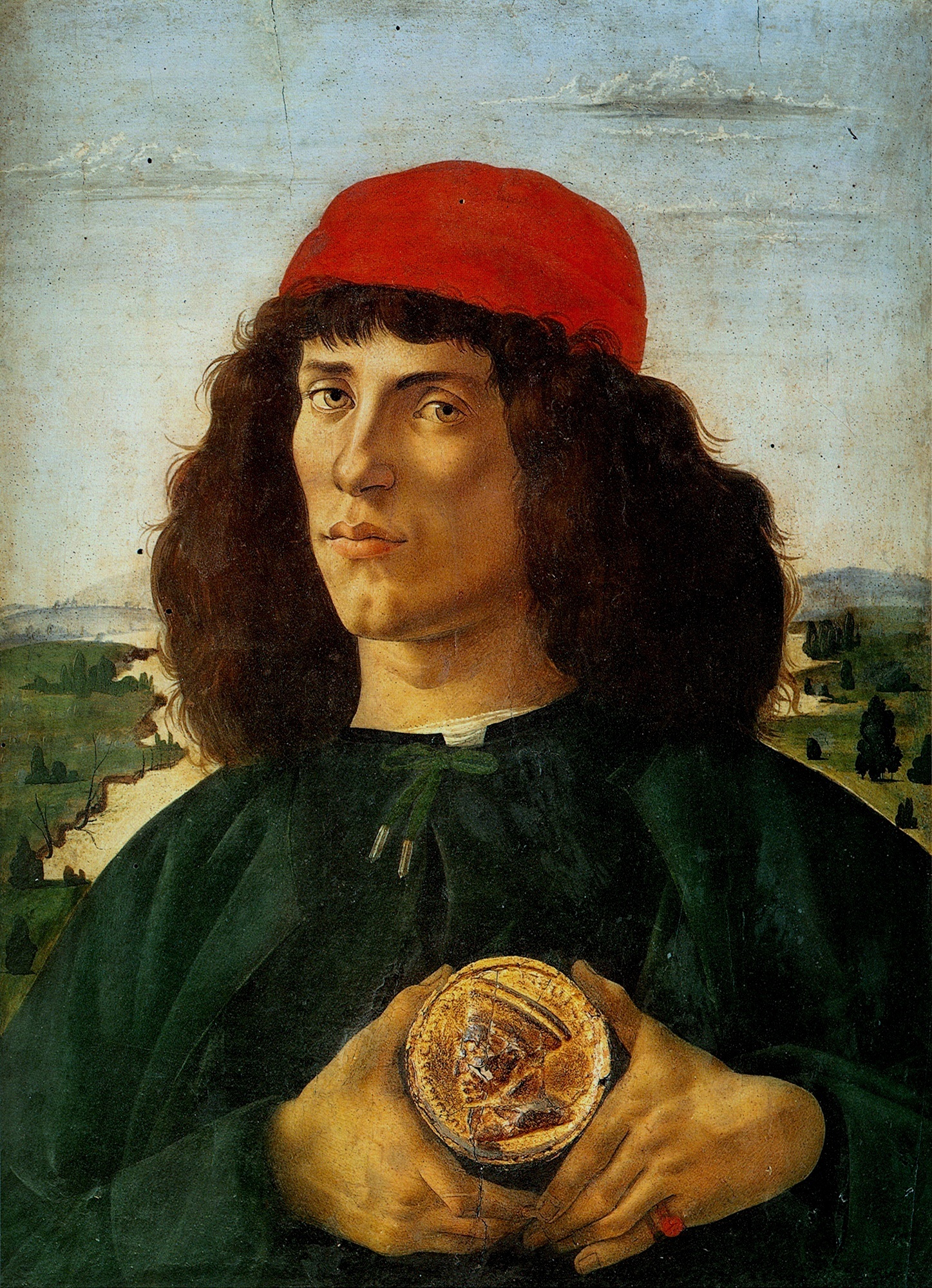
| The comparable insert | Botticelli's Portrait of a Man with a Medal of Cosimo the Elder, Uffizi inventory 1890:1488, tempera on panel, 58 x 45 cm, about 1474, carries a real medal in gilded gesso set into the panel. The same device, in metal rather than paint, about six years earlier.6 |
Images
The record in full
Chapter 1One panel, two paintings, a hundred and thirty years apart
The support is poplar, 58.4 by 39.4 centimetres, painted in tempera.
The support is poplar, 58.4 by 39.4 centimetres, painted in tempera. A young man of perhaps twenty, in a red cap and a plain dark tunic over a white shirt, is set against a warm grey ground behind a parapet. His right hand is held to his chest. In his left he holds a circular gilded panel showing a bearded saint in the act of blessing.
That roundel is a real object. It is not a painted representation of a picture; it is a separate painting, made in Siena in the middle of the fourteenth century, cut down to a disc and physically inserted into the poplar panel before Botticelli painted the portrait around it. Richard Offner dated it to the trecento. It is attributed to Bartolommeo Bulgarini, a Sienese painter of the generation after Duccio who died in 1378, more than sixty years before Botticelli was born.
The junction is disguised with some care. The sitter's fingers rest on the parapet and support the roundel from below, and the shadow they cast makes the disc read as set back into the picture space rather than lying on its surface. The illusion is of a young man holding an old and precious thing towards the viewer. The physical fact is that a fourteenth-century devotional fragment has been let into a fifteenth-century portrait.
For an archive that exists to say what an object actually is, this is the hard case. Catalogue it as a Botticelli and you are right, and you have also just described about a tenth of the painted surface incorrectly. Catalogue the roundel separately and you destroy the object. The correct entry is the one that holds both facts at once, which is why this record's medium line reads as it does.
Chapter 2Why a Florentine would hold a Sienese saint
The reading most often offered is a vanitas: living youth in the hands of the sitter, aged sanctity in his hands as well, the new face and the old gold in one frame.
The reading most often offered is a vanitas: living youth in the hands of the sitter, aged sanctity in his hands as well, the new face and the old gold in one frame. That is a modern reading and it belongs to the modern readers who make it, not to whoever commissioned the picture, and this record marks it as such.
What can be said with more confidence is what the gesture was for. A Florentine of the 1480s holding a devotional panel of the previous century towards the viewer is holding an heirloom, and heirlooms in that society were evidence: of a family old enough to have inherited things, of piety old enough to have been practised by grandparents, of a lineage. The saint blesses out of the picture at the person looking at it. Whatever else the arrangement does, it puts the sitter in a line of descent and lets a fourteenth-century hand do the blessing.
The choice of a Sienese panel rather than a Florentine one is not explained in any source consulted here, and this record does not manufacture an explanation for it.
Chapter 3Botticelli had done it before, with metal
The device is not unique in his work, which is the strongest argument that it was his idea rather than a later addition.
The device is not unique in his work, which is the strongest argument that it was his idea rather than a later addition. The Uffizi holds a Botticelli of about 1474, inventory 1890:1488, in which a young man holds a medal of Cosimo de' Medici the Elder, and that medal is also a real object set into the panel: a cast in gilded gesso, not a painted image of a cast.
The two pictures are close in size, 58 by 45 centimetres against 58.4 by 39.4, and close in conception. In both a young man holds out a portable object of a previous generation. In one the object is a medal of the dead ruler of Florence; in this one it is a devotional panel by a dead painter of Siena. In both the object is materially present in the picture rather than depicted in it, which is a much more literal-minded solution than the illusionism the period is famous for.
What the Uffizi picture establishes for this one is that inserting a physical object into a portrait panel was something Botticelli's shop knew how to do and had done at least once before. The roundel is not an anomaly to be explained away. It is a repeat.
Chapter 4The chain: a Welsh baron in Tuscany, and a hundred and fifty years in one family
The provenance published by Sotheby's in 2021 is unusually continuous for a Florentine portrait, and every link before 1935 is inside one family.Sir Thomas Wynn, third baronet and first Baron...
The provenance published by Sotheby's in 2021 is unusually continuous for a Florentine portrait, and every link before 1935 is inside one family.
Sir Thomas Wynn, third baronet and first Baron Newborough, lived in Tuscany from 1782 to 1791 and is the likely purchaser. From him the panel descended to his son Thomas John Wynn, second Lord Newborough; to his brother Spencer Bulkeley Wynn, third Lord; to Frederick George Wynn, the third Lord's youngest son, who died in 1932; and then to Thomas John Wynn, fifth Lord Newborough. The family seat was in Caernarvon, in north Wales, which is where the picture was when it entered the literature in the 1930s.
It left the family in about 1935, bought by the London dealer Frank Sabin. By May 1941 it belonged to Sir Thomas Ralph Merton, and it stayed with the Mertons for forty years: to Violet Marjory Merton, who died in 1976, and then to trustees, who sold it at Christie's in London on 10 December 1982 as lot 92 for 810,000 pounds, about 1.3 million dollars. The buyer was Sheldon Solow, the New York property developer.
The commission for this record specified a Newhouse provenance. There is no Newhouse in the chain. The name is Newborough, and the distinction matters, because the whole of the pre-1935 history hangs on a Welsh peerage rather than on a twentieth-century American collecting family.
Chapter 5Sir Thomas Merton, who owned it and also x-rayed pictures
The owner from 1941 is worth naming properly.
The owner from 1941 is worth naming properly. Sir Thomas Ralph Merton was a spectroscopist and a Fellow of the Royal Society, and he collected Old Masters. A picture that spent four decades in the hands of a working physicist who took an interest in the scientific examination of paintings is not an ordinary provenance link, and any technical file on the panel that predates the 1980s would most plausibly begin there.
Whether Merton examined this panel, and whether any record of it survives, is not established in the sources consulted here, and this record does not assume it. It notes the coincidence and marks the question open, because that is what an archive is for. If a Merton file exists, it is the earliest technical documentation of an object whose central physical peculiarity is an insert that would show instantly in a radiograph.
Chapter 6Fifty years of wall time, and what it was worth
The exhibition record is the part of this object's history that the price databases do not carry and that explains the 2021 result better than any connoisseurship.The panel was at the Royal Academy...
The exhibition record is the part of this object's history that the price databases do not carry and that explains the 2021 result better than any connoisseurship.
The panel was at the Royal Academy in London in 1960 in Italian Art and Britain, as number 345. It was on loan to the National Gallery in London from 24 November 1969 to 17 February 1978, a continuous eight and a quarter years. It was at the Metropolitan Museum of Art in New York from 26 February 1987 to 24 January 1989. It was at the National Gallery of Art in Washington from 19 April 1990 to 15 May 2013, a continuous twenty-three years, and appeared there in Virtue and Beauty in 2001 and 2002 as number 26. It was at the Stadel Museum in Frankfurt in Botticelli: Likeness. Myth. Devotion in 2009 and 2010 as number 19. It went back to the Metropolitan on 15 May 2013 and stayed until 25 February 2020.
Add those up. Between November 1969 and February 2020, a span of fifty years and three months, the picture was hanging in a major public museum for roughly forty-two of them. Sheldon Solow bought it in 1982 and lent it out for essentially his entire ownership. When it came to market in 2021 it arrived with an unbroken half-century of institutional endorsement, no condition surprises, no attribution to argue about, and a literature running from 1950.
That is what is being bought at 80 million dollars, and it is the opposite of a sleeper. A sleeper is an object nobody has looked at. This is an object that several hundred curators and several million visitors had looked at, in three national museums, for five decades. The premium is not for a discovery. It is for the absence of any question left to ask.
Chapter 8Sheldon Solow, and the ten weeks
Sheldon Solow built and owned office towers in Manhattan, most famously 9 West 57th Street, and was known for holding property rather than trading it and for litigating at length.
Sheldon Solow built and owned office towers in Manhattan, most famously 9 West 57th Street, and was known for holding property rather than trading it and for litigating at length. His art collection was substantial and rarely discussed, which is consistent with a man who lent this picture to museums for four decades rather than hanging it at home.
The consignment was announced in September 2020, with the 80 million dollar expectation attached to it from the start, so the decision to sell was made while Solow was alive. He died in November 2020. The picture sold on 28 January 2021, about ten weeks later, and the sale is recorded as being by his estate.
That sequence matters for anyone reading the result as an estate liquidation. It was not. It was a sale the owner had already set in motion, completed by his executors on the timetable he had chosen.
Chapter 9What the price says about the artist's market
The Botticelli auction record before this sale was 10,442,500 dollars, set by the Rockefeller Madonna at Christie's in New York in 2013.
The Botticelli auction record before this sale was 10,442,500 dollars, set by the Rockefeller Madonna at Christie's in New York in 2013. The hammer here was almost eight times that and the total nearly nine times it. Sotheby's called it a record for the artist and for any Old Master painting the house had sold, and the second most expensive Old Master ever sold at auction.
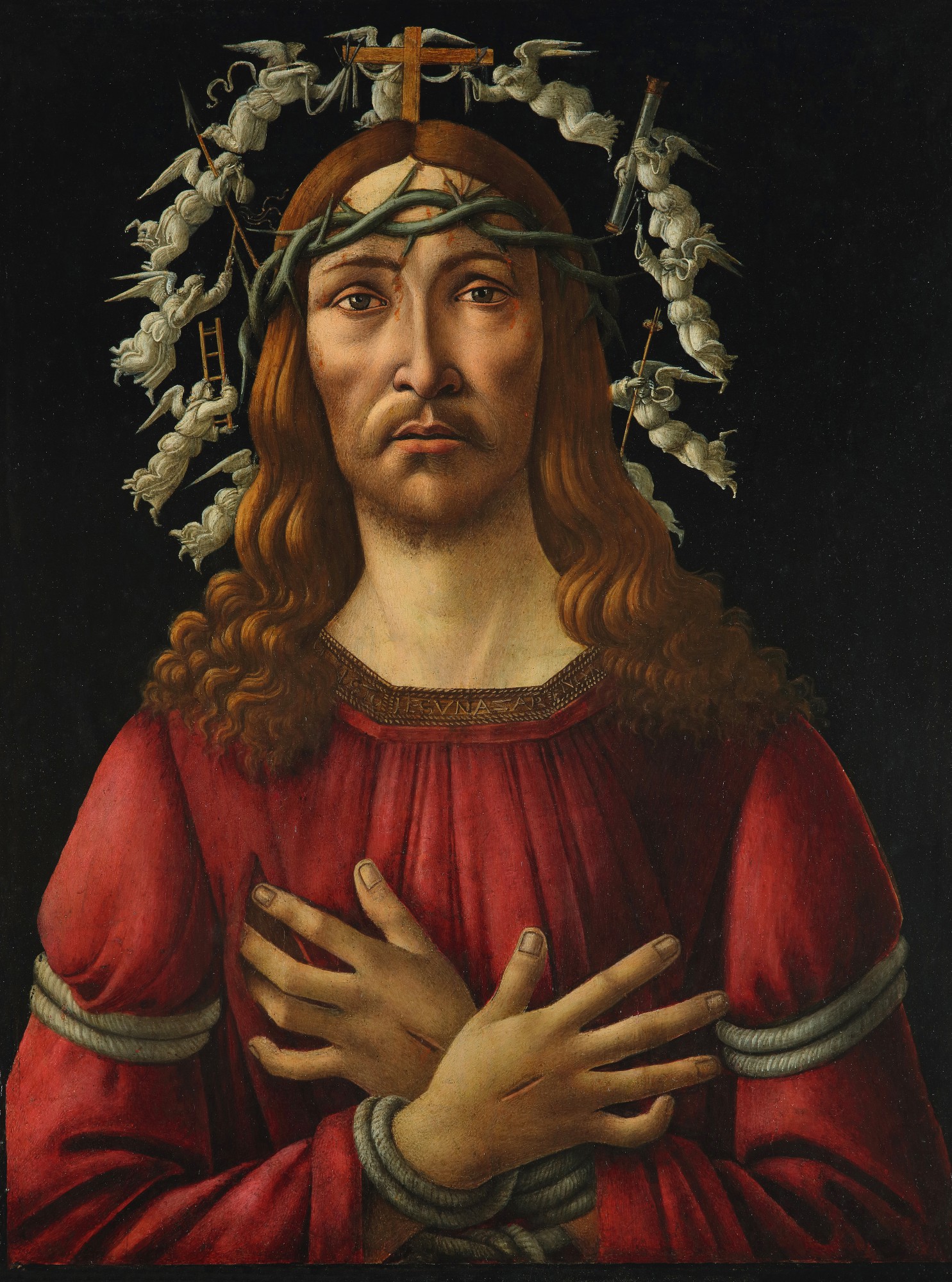
Almost exactly a year later, on 27 January 2022, Sotheby's sold Botticelli's Man of Sorrows in the same series of sales for 45,419,700 dollars. That is the most useful comparison available. Half the money, a year apart, same artist, same house, same week of the calendar. The difference is that the Man of Sorrows is a devotional picture of Christ from around 1500 and this is a secular portrait of a named type from Botticelli's best decade, with fifty years of museum wall behind it.
Sotheby's stated in 2021 that this was one of only three Botticelli portraits remaining in private hands. That claim is the substance of the price and it is also unverifiable from outside the trade; this record repeats it as the house's assertion and does not adopt it.
Chapter 10What is not settled
The sitter is unidentified. The picture has been catalogued in the past as Portrait of Giovanni di Pierfrancesco de' Medici, whose brother Lorenzo di Pierfrancesco was one of Botticelli's most...
The sitter is unidentified. The picture has been catalogued in the past as Portrait of Giovanni di Pierfrancesco de' Medici, whose brother Lorenzo di Pierfrancesco was one of Botticelli's most important patrons, and the identification has been proposed rather than demonstrated. Sotheby's own catalogue treats it as uncertain.
The date is unsettled within a twenty-year band. Proposals in the literature run from about 1470 to about 1490, which straddles the whole of Botticelli's central period.
The division of labour between Botticelli and his workshop has been argued over in the same literature, even while the picture is sold and shown as autograph. Technical examination by radiography and infrared reflectography has recorded extensive underdrawing and continuous revision beneath the paint, which is the ordinary evidence for a picture worked out on the panel rather than copied onto it.
And the roundel is attributed, not documented. Bartolommeo Bulgarini is a name proposed for a mid-fourteenth-century Sienese panel of which only a disc survives, embedded in another painting, and unavailable for examination from the reverse. It is a reasonable attribution and it is not a signature.
The artist
Alessandro di Mariano di Vanni Filipepi, called Sandro Botticelli
Botticelli's market is not his reputation. He is one of the most reproduced painters who ever lived and almost nothing by him is available: the great pictures are in Florentine, London, Washington and Berlin museums, and the portraits, which are the pieces a private buyer could realistically own, are nearly all in public collections. That scarcity, not any change in scholarly opinion, is what moved this picture from ten million dollars to ninety.
Related works
| Work | Relation | Where it is |
|---|---|---|
| Portrait of a Man with a Medal of Cosimo the Elder Sandro Botticelli | The same device, six years earlier, in metal rather than paint Tempera on panel, 58 x 45 cm, about 1474. The medal the sitter holds is a real cast in gilded gesso set into the panel. From the estate of Cardinal Carlo de' Medici. | Galleria degli Uffizi, Florence, inventory 1890:1488 |
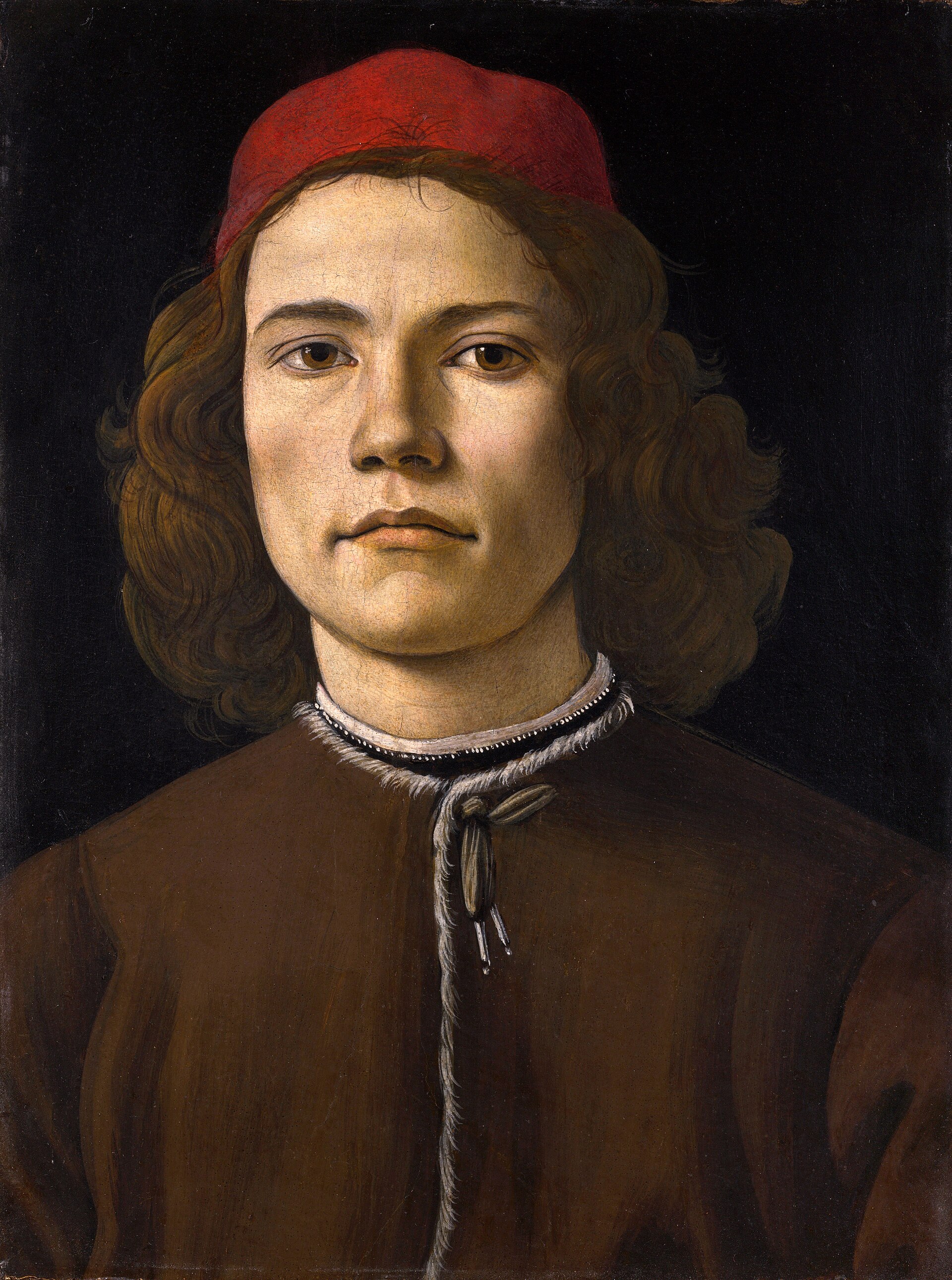
| Portrait of a Young Man Sandro Botticelli | The comparable Botticelli portrait in a public collection One of the small group of Botticelli portraits, and the kind of picture whose permanent public ownership is the reason the 2021 result went where it did. | The National Gallery, London |
| The Man of Sorrows Sandro Botticelli | The market comparable: the artist's next major auction appearance Sold at Sotheby's New York on 27 January 2022 for 45,419,700 dollars, roughly half this picture's total, one year and one day later. | Private collection |
| Madonna and Child, the Rockefeller Madonna Sandro Botticelli | Held the artist's auction record immediately before this sale Sold at Christie's New York in 2013 for 10,442,500 dollars. | Private collection |
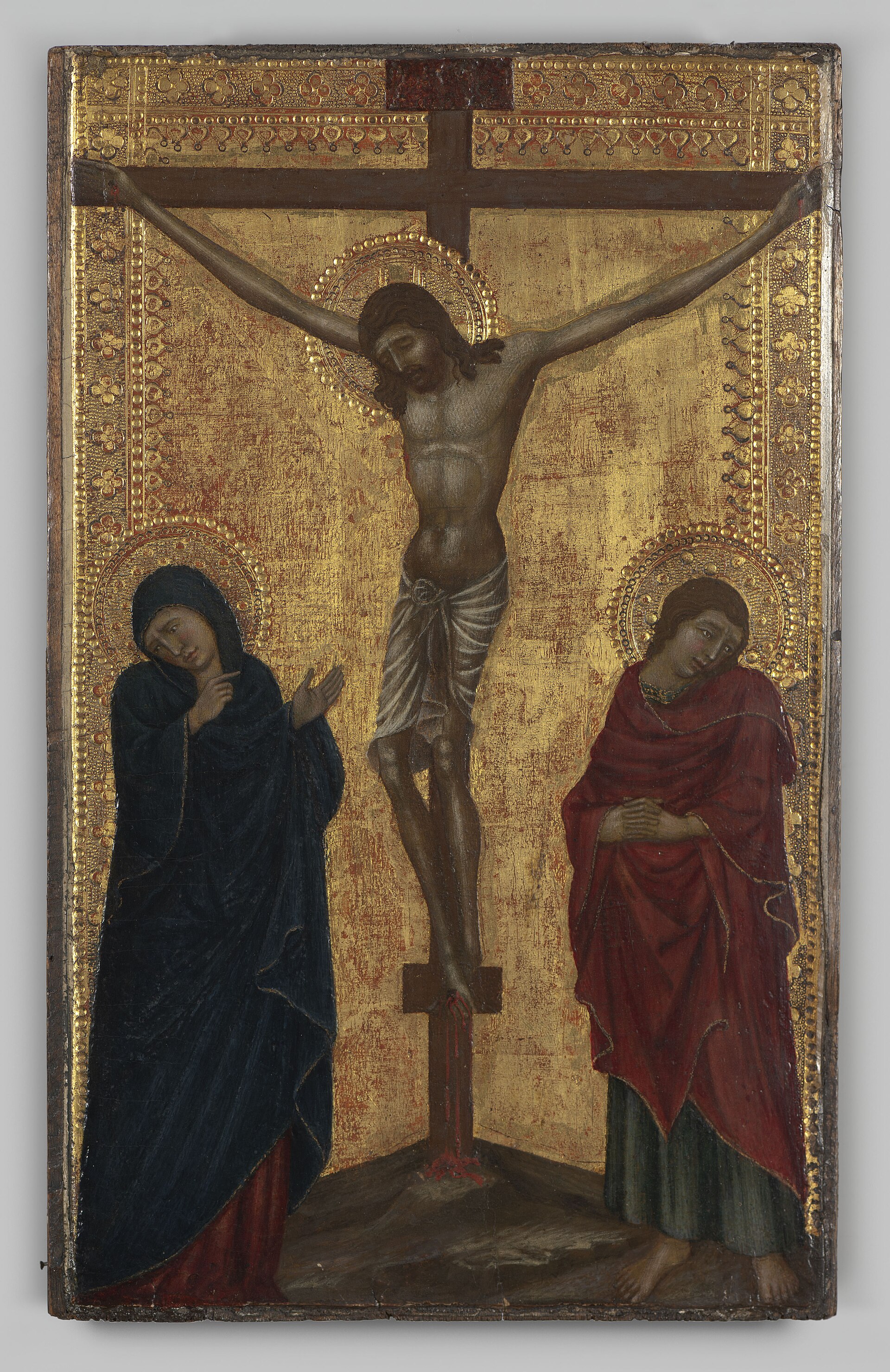
| Crucifixion with the Virgin and Saint John Bartolomeo Bulgarini | A documented panel by the painter to whom the inserted roundel is attributed Siena, about 1335 to 1340. The comparison material for an attribution that has to be argued from a disc a few centimetres across embedded in another painting. | Huis Bergh, 's-Heerenberg |
Open questions
- Who is the sitter? The picture has been catalogued as Giovanni di Pierfrancesco de' Medici, but the identification is a proposal and Sotheby's own catalogue treats it as uncertain.
- When was the roundel inserted, and by whom? Nothing establishes whether the insert was made for Botticelli, by Botticelli's shop, or in the panel he was given to work on.
- Is the Bulgarini attribution of the roundel testable? Only the painted face of the disc is accessible; the reverse is inside the poplar panel and cannot be examined without dismantling the object.
- Did Sir Thomas Ralph Merton, a Fellow of the Royal Society who owned the picture from 1941 and took an interest in the scientific examination of paintings, ever examine it? No such record has been located, and if one exists it would be the earliest technical file on the panel.
- What is the exact fee-inclusive total? Sotheby's published 92.2 million dollars and The Art Newspaper 92.1 million; both are consistent with 92,184,000, which has not been located printed in full.
- Who bought it? The winning bid was taken on the telephone by Sotheby's Russia desk in London and the buyer has never been named.
- Where is the panel now? No public location, loan or exhibition has been recorded since 28 January 2021.
- How were the pre-1935 links established? Sotheby's gives an unbroken Newborough family descent from about 1790, but the picture only enters the literature in the 1930s, so the earlier chain rests on family tradition and on Sir Thomas Wynn's Tuscan residence rather than on documents named in the catalogue.
Questions about this object
What is Portrait of a Young Man Holding a Roundel?
Portrait of a Young Man Holding a Roundel is a painting, dated c. 1480. Proposed dates run from about 1470 to about 1490.. Medium: Tempera on poplar panel, incorporating an inserted mid-fourteenth-century painted roundel.
Who made Portrait of a Young Man Holding a Roundel, and is the attribution settled?
The attribution to Alessandro di Mariano Filipepi, called Sandro Botticelli is recorded here as accepted. Sold by Sotheby's in January 2021 as fully autograph Botticelli and generally accepted as such, though the catalogue itself records that the division between Botticelli and his workshop has been argued over and that proposed dates run from about 1470 to about 1490. The complication peculiar to this object is that part of it is not by Botticelli at all and never was: the painted roundel the sitter holds is a separate mid-fourteenth-century panel, dated to the trecento by Richard Offner and attributed to the Sienese painter Bartolommeo Bulgarini, physically inserted into the poplar on which Botticelli then painted. The object is therefore two paintings about a hundred and thirty years apart, in one support, correctly catalogued under one name.
Where is Portrait of a Young Man Holding a Roundel now?
Private collection. Bought at Sotheby's New York on 28 January 2021 by an anonymous telephone bidder. Last confirmed 4 August 2026. The winning bid was taken by Lilija Sitnika, a Sotheby's director and senior client liaison on the Russia desk in London. The buyer has not been named.
What has Portrait of a Young Man Holding a Roundel sold for?
Hammer GBP 810,000; with premium, Not published in the sources consulted. Christie's, 1982-12-10.
What is still unknown about Portrait of a Young Man Holding a Roundel?
Who is the sitter? The picture has been catalogued as Giovanni di Pierfrancesco de' Medici, but the identification is a proposal and Sotheby's own catalogue treats it as uncertain.
Sources
- 1Sotheby's, lot 15, Alessandro di Mariano Filipepi, called Sandro Botticelli, Portrait of a young man holding a roundel, Master Paintings and Sculpture Part I, New York, 28 January 2021. The catalogue entry, giving the medium and dimensions, the full Newborough, Sabin, Merton and Christie's 1982 provenance, the exhibition record from 1960 to 2020, the literature from 1950 to 2015, Richard Offner's trecento dating of the roundel, the former Giovanni di Pierfrancesco de' Medici title and the range of proposed dates. sothebys.com/en/...
- 2Sotheby's press release, 'Sandro Botticelli's Portrait of a Young Man Holding a Roundel sells for record $92.2 million at Sotheby's New York', 28 January 2021. Gives the 92.2 million total, the estimate in excess of 80 million, the previous Botticelli record of 10,442,500 dollars set by the Rockefeller Madonna at Christie's New York in 2013, the transatlantic bidding and the underbidder acting for an Asian collector, and the quotations from Christopher Apostle and George Wachter. sothebys.com/en/...
- 3Sotheby's Magazine, 'The Ultimate Renaissance Portrait'. Gives the roundel as an original fourteenth-century work attributed to Bartolommeo Bulgarini showing a male saint blessing, physically inserted into the panel; the parapet and the shadow that sets the disc back into the picture space; the proposed vanitas reading; the uncertain sitter; the condition; and the radiographic and infrared evidence of extensive underdrawing and continuous revision. sothebys.com/en/...
- 4The Art Newspaper, 'Botticelli portrait sells for record $92.1m at Sotheby's in New York', 28 January 2021. Gives the hammer of 80 million dollars, the total of 92.1 million, the absence of a guarantee, the thin bidding from 78 to 80 million, the final contest between Lilija Sitnika of the Sotheby's Russia desk and Alexander Bell, the Asian underbidder, the sale by the estate of Sheldon Solow and the 810,000 pound purchase at Christie's in 1982. theartnewspaper.com/2021/...
- 5Wikimedia Commons file page for the lead plate, carrying the Sotheby's statement that the roundel is an original fourteenth-century work attributed to Bartolommeo Bulgarini inserted into the panel, with the medium, dimensions and dating. commons.wikimedia.org/wiki/...
- 6Wikimedia Commons file page for the Uffizi Portrait of a Man with a Medal of Cosimo the Elder, giving the accession number 1890:1488, the dimensions of 58 x 45 cm, the dating of about 1474 and the descent from the estate of Cardinal Carlo de' Medici, with the Polo Museale Fiorentino and Web Gallery of Art references. commons.wikimedia.org/wiki/...
- 7Wikimedia Commons file page for Botticelli's Man of Sorrows, recording the sale at Sotheby's on 27 January 2022 at 45,419,700 dollars with the Sotheby's lot page as its source. commons.wikimedia.org/wiki/...
- 8Wikimedia Commons file page for the Bulgarini Crucifixion at Huis Bergh, dated Siena about 1335 to 1340, used as comparison material for the hand attributed to the inserted roundel. commons.wikimedia.org/wiki/...
- 9Iconotheca, 'What a Sleeper Is, and Why They Still Happen', the market article this record extends. This object is the control case: an object nobody had overlooked. iconotheca.com/market/...


Last verified 4 September 2026 · Published 4 August 2026
Change log
4 August 2026 - Record created at the house standard: researched narrative, technical evidence, maker dossier, graded provenance chain, prices with hammer and premium separated, related works, open questions and sources.
4 September 2026 - Re-verified. Searched for any development since the 28 January 2021 Sotheby's sale: the buyer remains anonymous, and no loan, exhibition or further sale has been reported. Recorded as still-unresolved rather than assumed unchanged - this gap (a $92.2 million Old Master with an unnamed, unlocated new owner) is itself the finding.