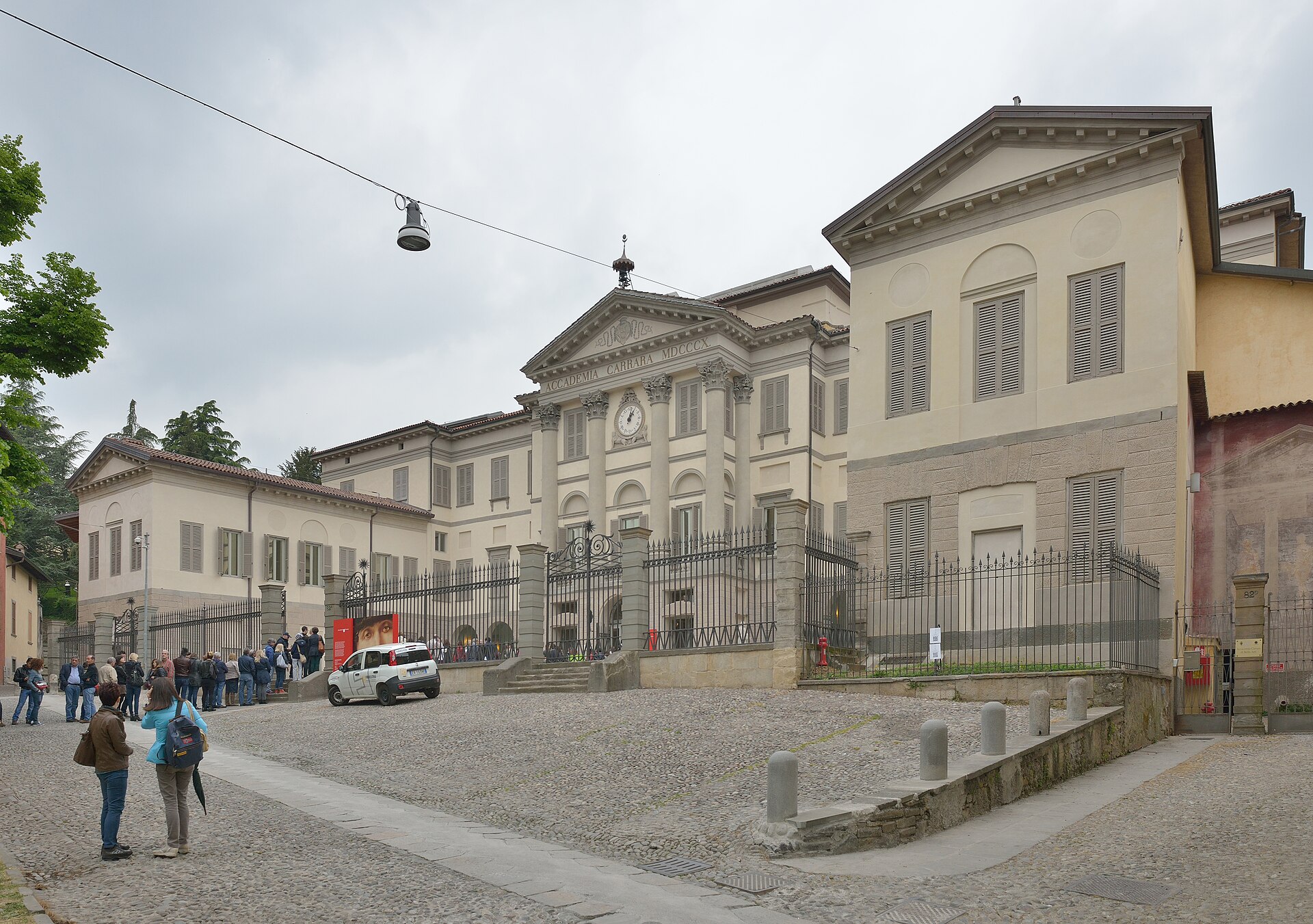
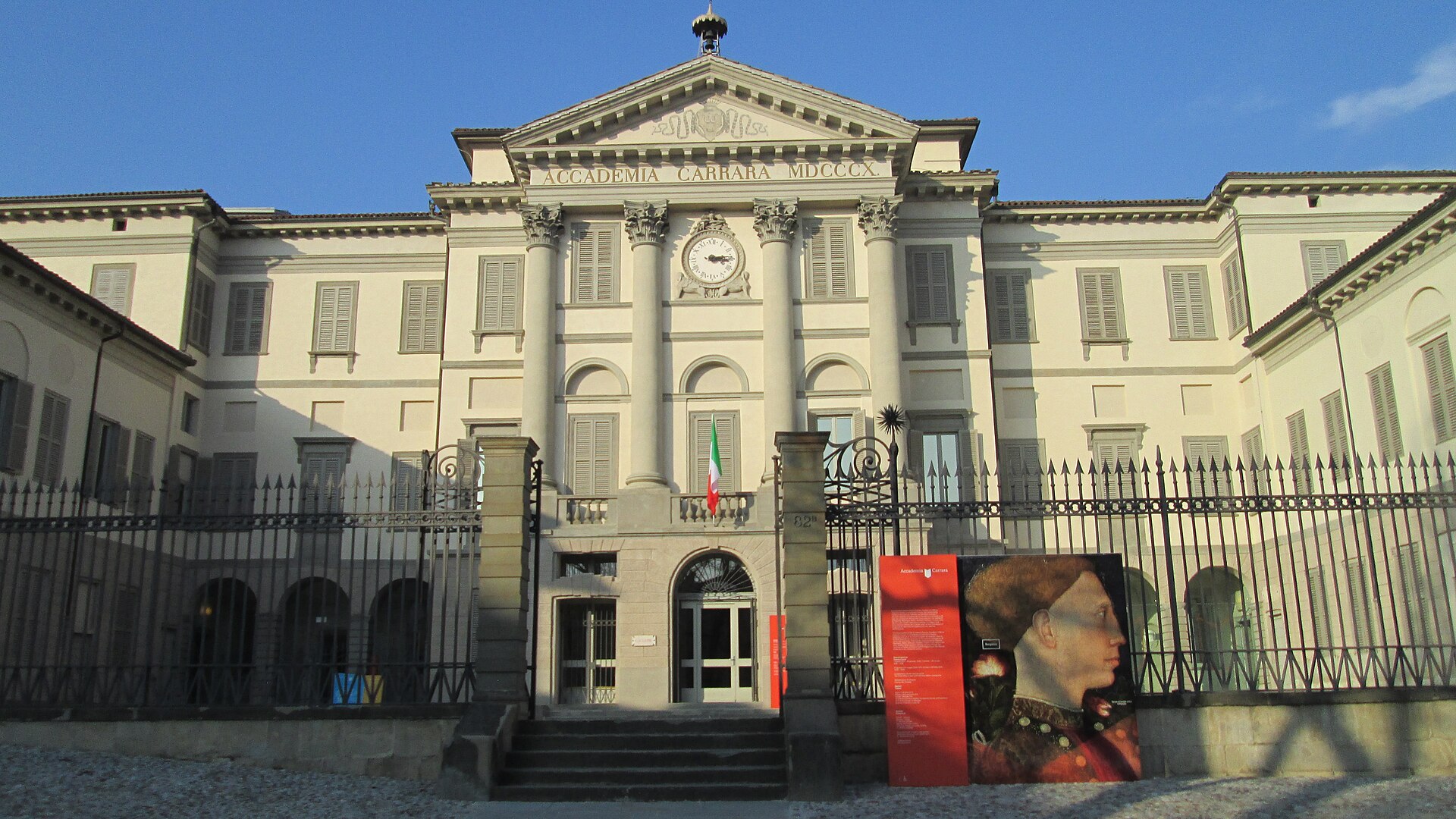
The museum's facade on Piazza Giacomo Carrara, its ACCADEMIA CARRARA inscription visible above the columned entrance, seen from across the square with visitors queuing at the iron gate.
Photograph by Wolfgang Moroder, CC BY-SA 3.0Accademia Carrara
Museum · Founded 1796
Open, admission and hours confirmed 18 September 2026 · 18 sources
On this page 15 sections
ContentsClose
The Accademia Carrara's particular strength is a continuous, donor-built run of the Venetian and Lombard schools from the Gothic period through the eighteenth century, anchored by Pisanello, Mantegna, Giovanni Bellini and Lorenzo Lotto, with a smaller but sharply chosen group of Tuscan Renaissance panels including Botticelli and a single Raphael. Because almost the entire 1,793-painting collection arrived as gift rather than purchase, its shape reflects two centuries of individual collectors' taste as much as any single curatorial plan, which is what the museum's own literature means when it calls itself Italy's museum of collecting.
| Kind | Museum |
|---|---|
| Founded | 1796 (Giacomo Carrara's bequest took effect on his death; the gallery had opened to visitors from 1785 and the Academy of fine arts he endowed was added in 1793-94) |
| City and country |  Bergamo, Italy Bergamo, Italy |
| Address | Piazza Giacomo Carrara, 82, 24121 Bergamo, Italy |
| Website | lacarrara.it/en |
| Status | Open, confirmed |
| Record last verified |
Visiting
- Hours
- Monday, Wednesday to Sunday and public holidays10:00 to 19:00Last admission 45 minutes before closing
- TuesdayClosed
- 1 January14:00 to 18:00Special reduced hours
- 31 December09:00 to 14:00Special reduced hours
- Closed
- Tuesday. 25 December.
- Admission
- Full price (Intero)EUR 10Add EUR 1.00 for the flexible Open Ticket, valid for one admission at a date and time of the holder's choosing
- Reduced (Ridotto)EUR 8Over-65s, history-of-art teachers, military and law-enforcement personnel, ATB and TEB transport subscribers, and holders of a long list of partner cards named on the museum's own price list (Touring Club, FAI and others)
- Reduced special, age 18-25EUR 5Also covers guests of residential care homes (RSA)
- Free entryFreeUnder-18s, ICOM members, Carrara Card holders, Abbonamento Musei Lombardia e Piemonte Valle d'Aosta holders, museum staff and volunteers, EU tour guides, working journalists, one companion per visitor with a disability, and every visitor on their own birthday
- Local resident promoEUR 8Residents of Bergamo, Clusone, San Pellegrino Terme and Scanzorosciate, booked online
Free entry: No recurring free-entry day: the Accademia Carrara is a private foundation and does not follow the Italian state museums' first-Sunday-of-the-month scheme. Free admission is by category year-round, see admission[] above- Tickets
- lacarrara.it/en/visit/tickets-opening-hours The museum's own ticket page.
- Do I need to book?
- Not required for individual visitors. Guided tours for groups of up to 30 must be booked through the call center on +39 035 4920090, Monday to Friday 09:00-18:00 and Saturday 09:00-13:00
- Address
- Piazza Giacomo Carrara, 82, 24121 Bergamo, Italy MapTrain Bergamo railway station is about a 30-minute walk from the museum; onward travel by bus or taxi
Bus ATB urban lines stop close by: Porta Sant'Agostino (Line 1); Piazzale Oberdan or Via Suardi (Lines C, 6, 7 and 9)
Car Paid parking at Parking Preda, Via Pitentino 14/D, or free parking in the stadium area except on Saturdays and match days
Air Milan Bergamo Airport (BGY) is about 5km away, reached by ATB Line 1 bus, taxi or rental car - Website
- lacarrara.it/en
- Telephone
- +39 035 234396
- [email protected]
Before you go how long, access, photography, bags, eating, shop
- How long to allow
- Two to three hours across the fifteen rooms of the second-floor permanent collection; add the PwC Gardens and bistro for a longer stop
- Access
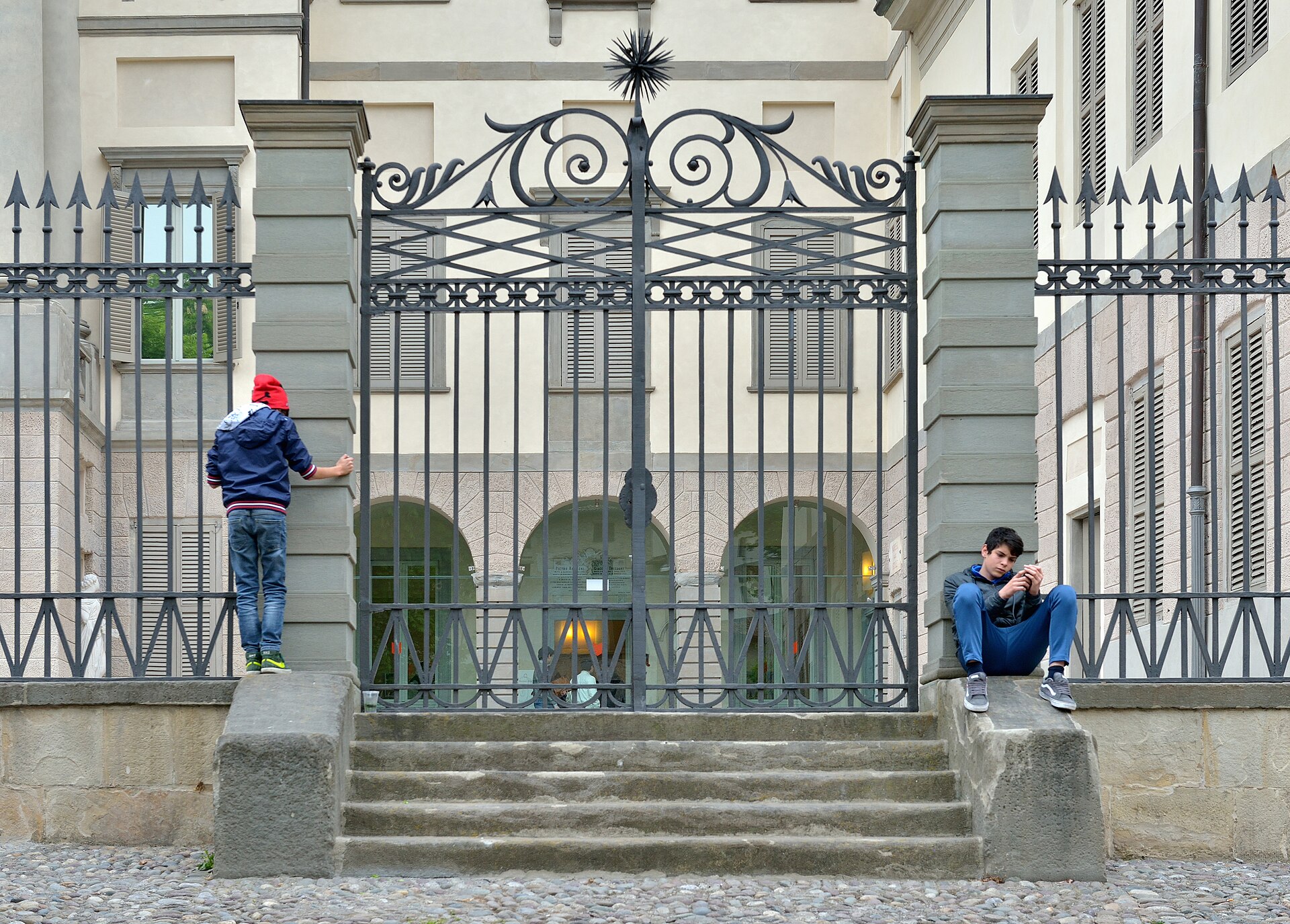
- Two manual wheelchairs are kept at the museum, and lifts beside both staircases reach the first and second floors. The main gate is five steps with no handrail, but a side gate on the facade has a ramp and a short walkway, opened by staff on request. Ground-floor cloakroom lockers are numbered in black and in Braille. The garden is not accessible to visitors with motor disabilities, though its bistro is reachable from the second floor by a sloping covered walkway
- Photography
- Personal photos and video are allowed for personal use only, without flash, tripods or stands. Any commercial, editorial or promotional use of an image of the building or the collection needs written clearance from the museum
- Bags
- Bags, backpacks and suitcases larger than 35 x 30 x 10cm are not allowed into the galleries; a free cloakroom is at the entrance
- Eating
- The PwC Gardens bistro serves an all-day menu, breakfast to after-dinner drinks, reachable from the second floor of the museum or from its own street entrance on Via della Noca
- Shop
- A museum bookshop on the ground floor sells publications and merchandise tied to the permanent collection and the current temporary exhibition. Audio guides cost EUR 4.00 (museum only) or EUR 5.00 (museum plus exhibition), in Italian and English
Prices and hours change. We take them from the institution's own pages and print the day we read them, and you can check the current position at the source we used. Confirm before you travel.
What is inside
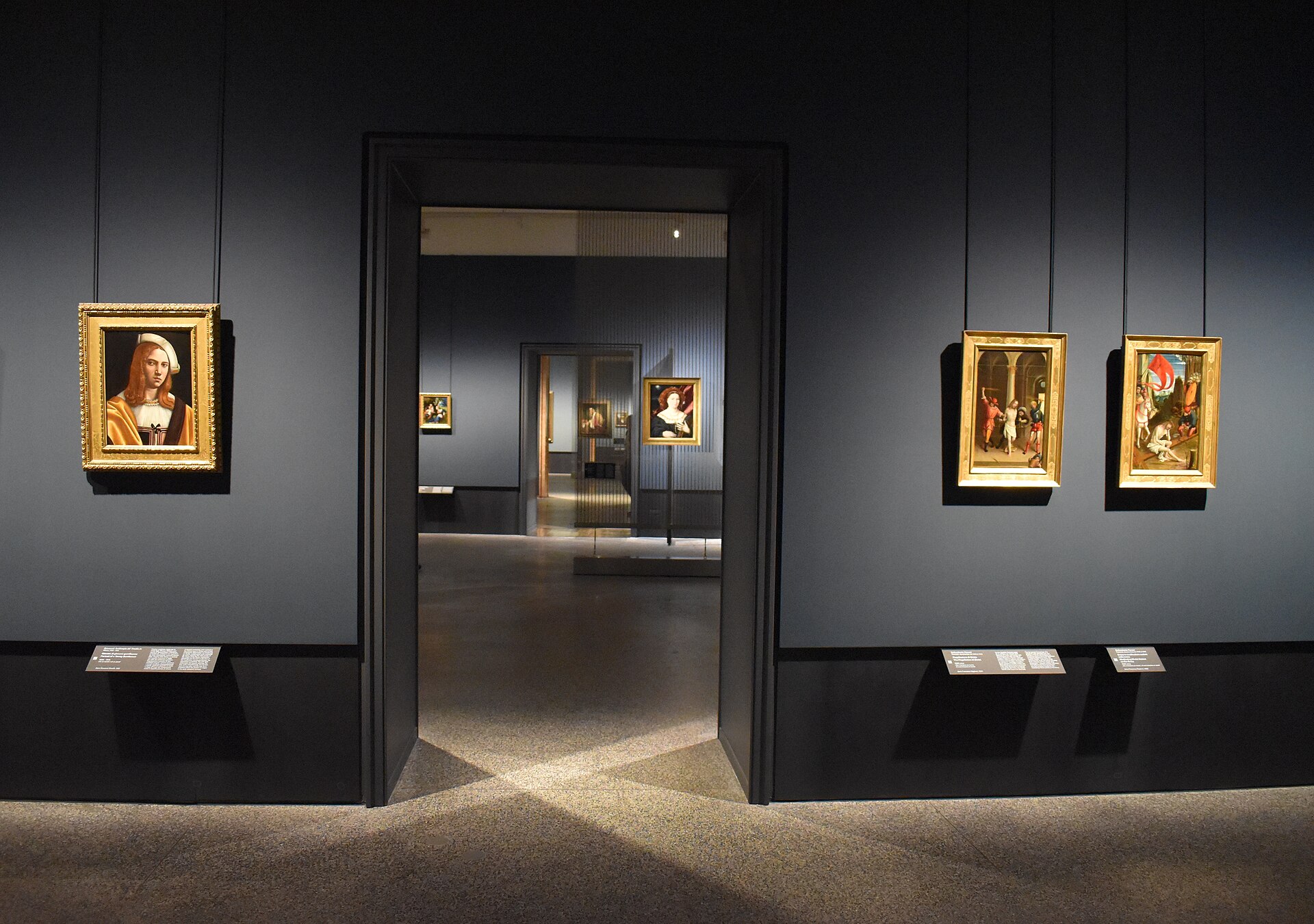
Photograph by Nicola Quirico · CC BY-SA 4.0 First sequence: the Gothic and early Renaissance, Po Valley and Venetian fifteenth century
Opens the second-floor route with a run of small, jewel-like devotional and courtly panels rather than one large hall: Pisanello's profile portrait of Lionello d'Este, Mantegna's small Madonna and Child, Giovanni Bellini's Madonna di Alzano and Botticelli's portrait of Giuliano de' Medici hang close together, tracing the shift from Gothic linearity to Renaissance modelling
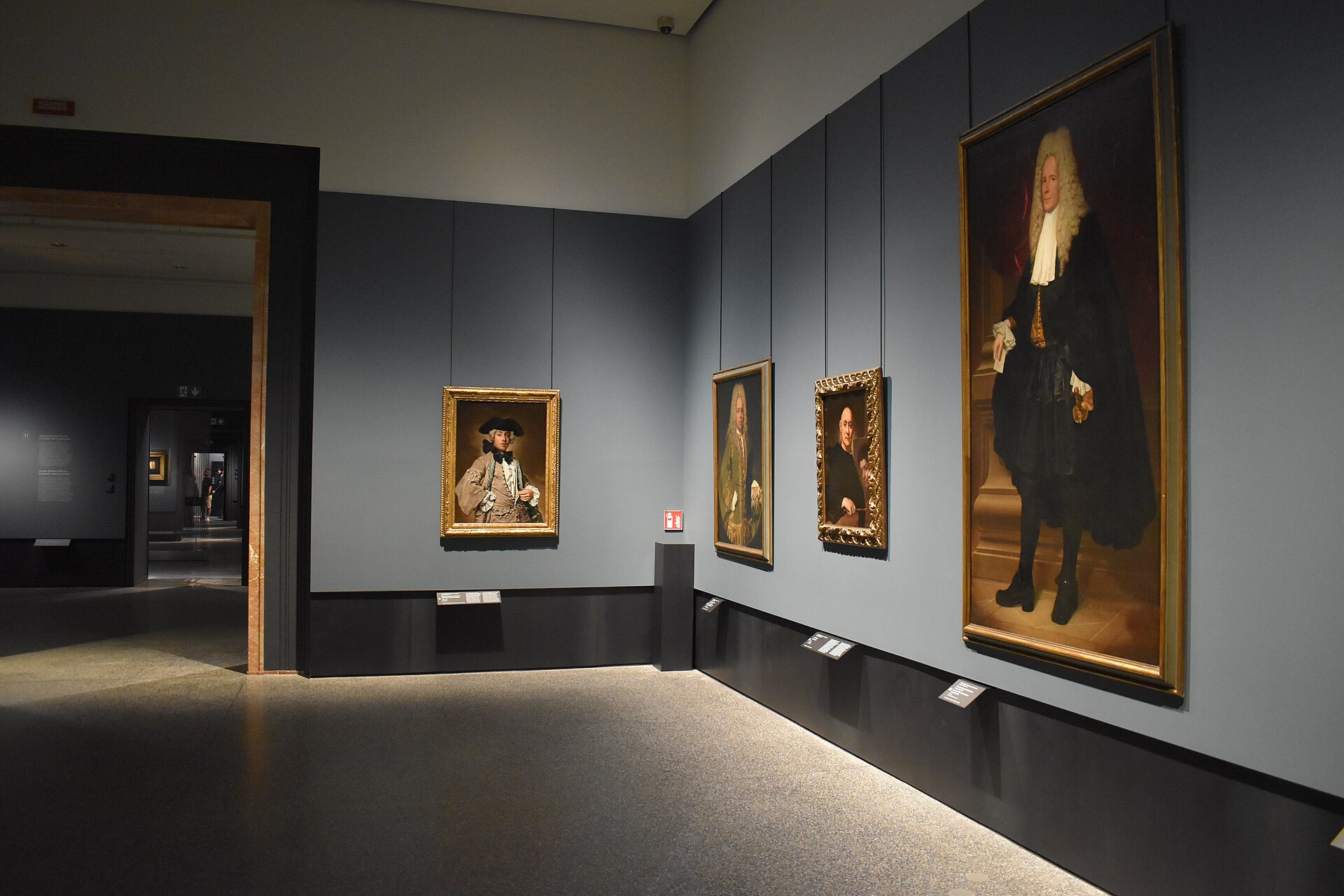
Photograph by Nicola Quirico · CC BY-SA 4.0 Second sequence: Lombardy and the Venetian mainland, fifteenth to eighteenth century
Follows the Bergamo-centred story of Lorenzo Lotto, Giovan Battista Moroni, Evaristo Baschenis and Fra Galgario, whose formal portraits of the local nobility and clergy, painted in the wigs and dark robes of eighteenth-century Bergamo, still hang in the sober grey-walled rooms this sequence occupies
Third sequence: the nineteenth century and the Accademia Carrara's own School of Painting
Closes the chronological route with the Lombard nineteenth century and the output of the Academy of fine arts Carrara himself endowed: works by Diotti, Piccio, Coghetti, Trecourt and Scuri, teachers and pupils of the school that trained Bergamo's painters for well over a century. We could not verify a free-licence photograph of this specific room; it renders as text
The sculpture collection
134 sculptures in all: three Tuscan Renaissance marbles that arrived with the Giovanni Morelli bequest of 1891, a group of 46 Baroque pieces given by the critic Federico Zeri in 1998, including work by Pietro Bernini, Domenico Guidi and Filippo Parodi, and 25 pieces from the Fantoni family workshop, active across Lombardy and the Veneto for two centuries. We could not verify a free-licence photograph of the sculpture rooms; it renders as text
Drawings, prints, coins and medals, and the historical library and archive
The least-seen and largest part of the collection: 2,824 Old Master drawings, most assembled by Giacomo Carrara himself for his own study and his school, 7,500 prints including sheets by Mantegna, Durer, Piranesi and Canaletto, 221 ancient and Italian coins, 976 medals, and a historical library and archive of over two centuries of the institution's own paperwork, open to researchers by appointment. We could not verify a free-licence photograph of these study rooms; it renders as text
What to see first
Saint Sebastian
Raphael, about 1501-1502Painted before Raphael turned twenty, this small oil on panel already shows the graceful arcs and Perugino-derived poise that mark his mature altarpieces, arriving at the Carrara in 1866 with the Lochis collection12
Portrait of Lionello d'Este
Pisanello, 1441A profile portrait that grew out of a documented painting contest between Pisanello and Jacopo Bellini for the same Ferrarese patron, and one of the few surviving works that lets a viewer compare Pisanello's courtly manner directly against Bellini's13
Madonna di Alzano (Madonna and Child)
Giovanni Bellini, about 1485Considered by scholars the prototype for Bellini's later Madonnas in Venice, this panel spent centuries in a parish church near Bergamo before Giovanni Morelli bought it and gave his whole collection to the Carrara in 189115
Portrait of Giuliano de' Medici
Sandro Botticelli, about 1478-1480One of several surviving versions of Botticelli's posthumous portrait of the Medici prince murdered in the Pazzi conspiracy of 1478; this is the Bergamo version, not the Berlin or Washington ones, and it is not the only likeness of its sitter16
Madonna and Child
Andrea Mantegna, about 1490-1500A small devotional panel from a series Mantegna painted after his Roman years, singled out among them for its unusually contented mood; the Christ child's coral bracelet is both an apotropaic charm and a hint at the Passion to come18
Portrait of Lucina Brembati
Lorenzo Lotto, about 1518Lotto hid his sitter's name in the painting itself, a crescent moon marked 'CI' beside her head reading as 'Lu-CI-na', the Brembati family arms set into the ring on her finger; in the Carrara's own collection since 188214
Still Life with Musical Instruments
Evaristo Baschenis, about 1670By a Bergamo-born priest-painter who made instrument still lifes into a local specialty other painters across Lombardy imitated for a century afterwards, known as the maniera bergamasca17
Exhibitions on now
- On now14 Nov 2025 to 9 Nov 2026Confirmed · check before you travel
A collector's gift becomes a city's museum
The Accademia Carrara exists because one Bergamo nobleman decided his private collection should belong to the public rather than his heirs. Count Giacomo Carrara opened his gallery to visitors from 1785, added a school of painting in 1793-94 under the Milanese painter Carlo Dionigi Sadis, and in 1795 wrote a will leaving his entire estate, collection and school together, to a five-member commission to run in trust for the city. He died in 1796, and that date is the one the museum itself now gives as its founding year.
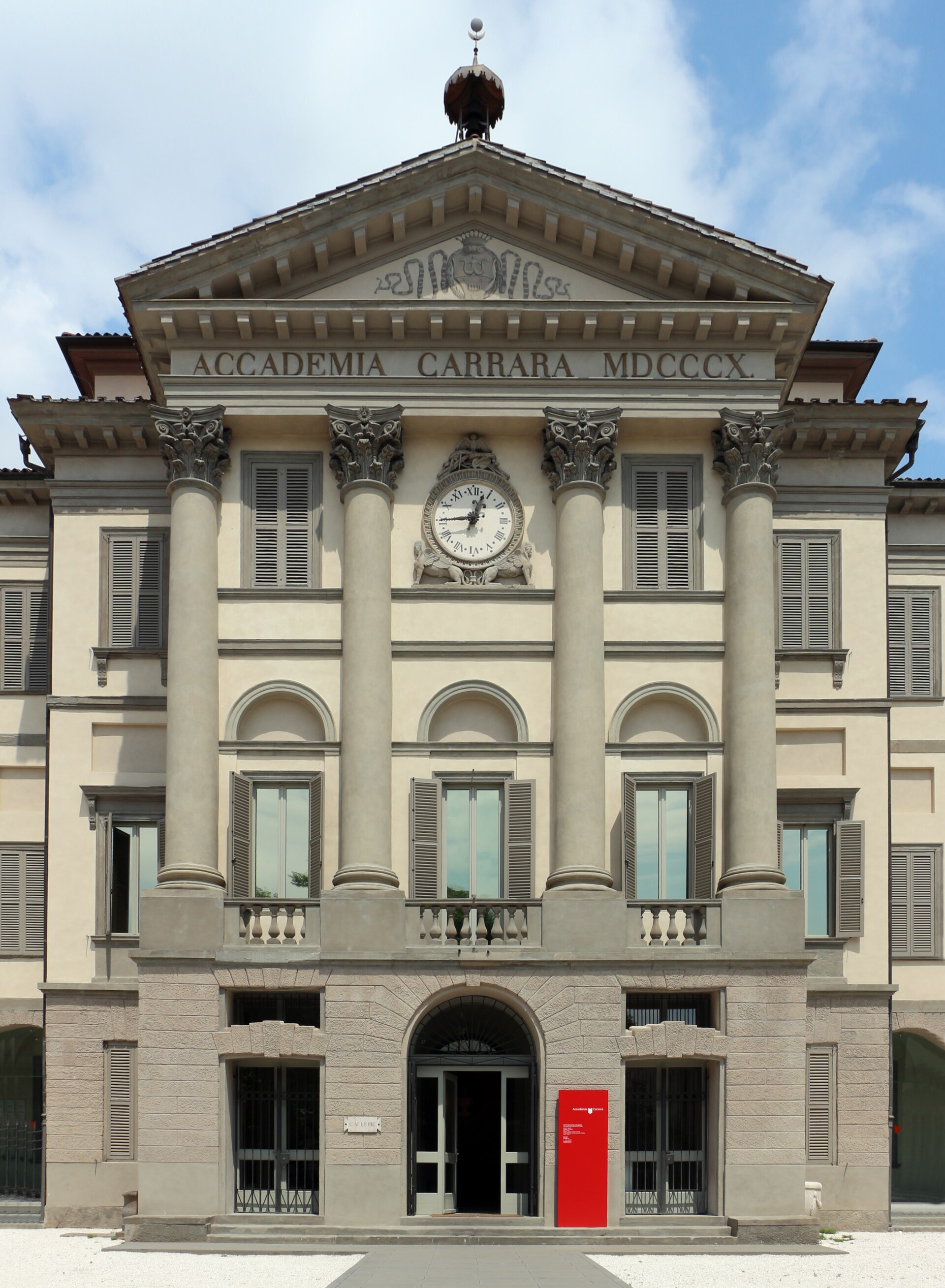
The building the collection still occupies was raised in stages. Costantino Gallizioli built the original structure between 1775 and 1781, absorbing parts of older buildings on the site, and between 1808 and 1813 the architect Simone Elia, a pupil of Leopoldo Pollack at Milan's Accademia di Brera, remodelled the facade in the Neoclassical style visitors see today, with the inscription ACCADEMIA CARRARA MDCCCX still cut into the pediment above the columned entrance. The Comune di Bergamo took over the museum's management in 1958, Italy's education ministry formally recognised it in 1988, and in 2023 the institution merged with the Gaetano Donizetti Conservatory to form the Politecnico delle Arti di Bergamo, a joint arts academy that now sits alongside the museum function under one roof.
What five centuries of donors built
Nothing in the Accademia Carrara's collection was bought by an acquisitions committee working from a wish list; every piece arrived because somebody who loved it chose to give it away. The museum owns 1,793 paintings, and the number keeps growing through private donation. Two bequests did more than any others to set its character: Count Giuseppe Lochis left 240 paintings in 1866, Raphael's Saint Sebastian among them, and the collector-connoisseur Giovanni Morelli gave his entire collection in 1891, bringing the Bellini Madonna and the Botticelli portrait of Giuliano de' Medici into the museum at a stroke.
The paintings are only the largest of several distinct collections under one roof. There are 134 sculptures, including 46 Baroque pieces given by the critic Federico Zeri in 1998; 2,824 Old Master drawings, most originally Giacomo Carrara's own; 7,500 prints; 221 coins and 976 medals; and a historical archive and library recording the institution's own two centuries of paperwork. Few Italian galleries this size can claim as thorough a run of the Venetian and Lombard schools side by side, alongside a smaller but sharply chosen group of Tuscan Renaissance panels, and that breadth is the direct result of donors who kept giving rather than a single founding purchase.
Closed twice to be rebuilt: 2008-2015 and 2022-2023
The Accademia Carrara has spent much of the twenty-first century behind scaffolding. A first restoration closed the museum from 2008 until its reopening on 24 April 2015, a project reported at the time as a quiet return after seven years away from the international art press's attention, most of which was on the Venice Biennale opening the same season. Critics who did notice praised the rehang for treating individual rooms as coherent arguments rather than a uniform march through the centuries.
A second closure followed within a decade. The museum shut its doors on 29 August 2022 for a functional reorganisation of all three floors of the building: ticketing, bookshop and a wall honouring the collection's 260-plus donors moved to the ground floor, temporary exhibitions and loan rotations to the first floor, and the permanent collection, in fifteen rooms, to the second floor. A new covered walkway now links all three levels and opens views over Bergamo's UNESCO-listed Venetian Walls. The interiors and a first exhibition reopened on 26 January 2023; the redeveloped 3,000-square-metre garden, named the PwC Gardens for its lead sponsor and holding a bistro of its own, followed on 23 June 2023. The museum's director at the time put the cost of the work at more than three million euros and described it as a chance for the institution to reconsider its own role rather than simply refresh its paint.
A walk through the second-floor rooms
A visitor climbing to the permanent collection today follows a route built around three sequences rather than a single unbroken timeline. The first covers the Gothic period and the early Renaissance, weighted toward the Po Valley and fifteenth-century Venice, where Pisanello's portrait of Lionello d'Este, Mantegna's small Madonna, Bellini's Madonna di Alzano and Botticelli's portrait of Giuliano de' Medici hang close together as a run of small, intensely worked panels rather than being spread thin across a large hall.
The second sequence turns north to Lombardy and the Venetian mainland from the fifteenth to the eighteenth century, with particular weight on Bergamo's own painters: Lorenzo Lotto, whose portraits worked in this city as much as in Venice; Giovan Battista Moroni; Evaristo Baschenis, whose still lifes of musical instruments became a genre other Lombard painters copied for a century; and Fra Galgario, whose formal portraits of local nobility and clergy still hang in these grey-walled rooms. The third and final sequence closes the visit in the nineteenth century, built around the output of the Academy of fine arts Carrara himself endowed, with paintings by its own teachers and students, Diotti, Piccio, Coghetti, Trecourt and Scuri among them.
What is worth the two hours
A reader with limited time should not try to see all fifteen rooms with equal attention; the collection rewards slowing down for a handful of works rather than walking past all 300 on display. The Raphael Saint Sebastian repays a close look at the painter's age when he made it, not yet twenty, and at how directly Perugino's influence shows in the saint's pose. The Pisanello portrait of Lionello d'Este is worth reading against its own origin story, a documented painting contest with Jacopo Bellini for the same patron, and against the Bellini Madonna di Alzano a few rooms further on, since both painters' work from the same court now hangs in the same building.
Lotto's portrait of Lucina Brembati carries a puzzle built into the paint itself, a crescent moon marked with the letters CI beside her head, forming Lu-CI-na when read together with the Italian word for moon, and the sitter's own family crest worked into the ring on her finger. Baschenis's still life of musical instruments is worth the detour for what it is not: a Roman or Florentine subject, but a genre this Bergamo-born painter effectively invented for his own city and that other Lombard painters kept copying for a hundred years afterwards.
What visitors and critics say
The Accademia Carrara holds a 4.6 out of 5 rating from 741 TripAdvisor reviews, among the higher scores for a museum of its size in northern Italy, and the pattern in what visitors say lines up with what the 2023 rehang was built to fix: praise for daylit, uncluttered rooms after decades of a denser and darker hang, and for a walkable route that does not exhaust a visitor before the highlights arrive. The complaints that recur are practical rather than curatorial, chiefly that a single guided tour group can fill one of the smaller first-sequence rooms and block the view of the paintings independent visitors came to see.
A different, more institutional criticism reached the local press in May 2022, when Bergamo's city council voted to remove the foundation's external committee of guarantors and fold its oversight role into the same board of directors it had been created to check. Finestre sull'Arte reported opposition councillors' argument that this left the museum's governors answerable chiefly to themselves, a criticism the mayor at the time rejected as inconsistent with those same critics' earlier support for the private-foundation model. The museum's collection and its rehang have drawn real praise since 2015 and 2023; its governance has drawn a real and separate argument that the page treats as exactly that, a matter still unresolved rather than settled in the foundation's favour.
What visitors say
Recent visitors, on TripAdvisor and elsewhere, consistently rate the Accademia Carrara among the best small-city art museums in Italy, crediting the 2023 rehang with turning what had been a dense, dimly lit picture gallery into a sequence of daylit, uncluttered rooms that let the Pisanello, the Bellini and the Botticelli breathe. The most repeated complaint is not about the art but the crowd: a single guided group can fill one of the smaller first-sequence rooms at once, and English-language wall text, while present throughout, is thinner than the Italian. A separate, more institutional strand of criticism concerns the foundation's own governance rather than its galleries.
What is praised, what is criticised
- Praised: The 2023 rehang's daylit, uncluttered rooms, which repeat visitors compare directly and favourably with the darker, denser pre-restoration galleries
- Praised: The compactness of the collection: the whole permanent route can be walked in two to three hours without gallery fatigue, yet still takes in a Raphael, a Pisanello, a Bellini and a Botticelli
- Praised: The PwC Gardens, reachable free of charge even without a museum ticket, as a genuine addition to a visit rather than a fenced-off extra
- Criticised: Guided tour groups can fill one of the smaller first-sequence rooms at once, crowding out independent visitors trying to see the same small panels
- Criticised: A 2022 change to the foundation's bylaws, removing its external committee of guarantors and folding oversight into the same board it used to check, drew criticism in the local press as governance policing itself
Ratings on other platforms
TripAdvisor: 4.6 from 741 ratings, read 13 August 2026
A platform average is a tertiary source: it moves, it is not audited, and we quote no visitor's words.
Questions about Accademia Carrara
Where is Accademia Carrara?
Piazza Giacomo Carrara, 82, 24121 Bergamo, Italy.
How much does it cost to visit?
Full price (Intero): EUR 10; Reduced (Ridotto): EUR 8; Reduced special, age 18-25: EUR 5; Free entry: free; Local resident promo: EUR 8. As confirmed 18 September 2026.
When is it open?
Monday, Wednesday to Sunday and public holidays 10:00-19:00; Tuesday closed; 1 January 14:00-18:00; 31 December 09:00-14:00. Closed: Tuesday. 25 December. As confirmed 18 September 2026.
How do you get there?
Train: Bergamo railway station is about a 30-minute walk from the museum; onward travel by bus or taxi; Bus: ATB urban lines stop close by: Porta Sant'Agostino (Line 1); Piazzale Oberdan or Via Suardi (Lines C, 6, 7 and 9); Car: Paid parking at Parking Preda, Via Pitentino 14/D, or free parking in the stadium area except on Saturdays and match days; Air: Milan Bergamo Airport (BGY) is about 5km away, reached by ATB Line 1 bus, taxi or rental car.
What should you see first?
Saint Sebastian (Raphael, about 1501-1502); Portrait of Lionello d'Este (Pisanello, 1441); Madonna di Alzano (Madonna and Child) (Giovanni Bellini, about 1485); Portrait of Giuliano de' Medici (Sandro Botticelli, about 1478-1480); Madonna and Child (Andrea Mantegna, about 1490-1500); Portrait of Lucina Brembati (Lorenzo Lotto, about 1518).
What we could not confirm
- The museum's own published materials do not set out how thoroughly the provenance of its nineteenth- and twentieth-century donations, several assembled during the two World Wars, has been checked against the Washington Conference Principles on Nazi-era ownership gaps; nothing found in this research indicates a specific contested work, only that no public provenance audit of the kind now standard at larger Italian state museums appears to have been published
- How many of the roughly 300 works described as on view at any time are actually on the walls on a given day is not published as a live figure, since works rotate between the second-floor permanent rooms and conservation or loan
Images
Sources
- 1Wikidata, Accademia Carrara (Q338367) wikidata.org/wiki/Q338367
- 2Wikipedia, 'Accademia Carrara' en.wikipedia.org/wiki/Accademia_Carrara
- 3Accademia Carrara, official site, 'Tickets & Opening hours' lacarrara.it/en/visit/tickets-opening-hours/
- 4Accademia Carrara, official site, home page lacarrara.it/en/
- 5Accademia Carrara, official site, 'Cultural heritage' (collections overview) lacarrara.it/en/collections/cultural-heritage/
- 6Accademia Carrara, official site, 'How to reach us' lacarrara.it/en/visit/how-to-reach-us/
- 7Accademia Carrara, official site, 'Accessibility' lacarrara.it/en/accessibility/
- 8L'Eco di Bergamo, 'La nuova Carrara: riallestimento delle sale, percorso esterno e giardini aperti', 12 April 2022 ecodibergamo.it/stories/bergamo-citta/la-nuova-carrara-riallestimento-delle-sale-percorso-esterno-giardini-o_1427341_11/
- 9Conceptual Fine Arts, 'Accademia Carrara in Bergamo quietly reopened: the victory of good taste', 12 May 2015 conceptualfinearts.com/cfa/2015/05/12/accademia-carrara-in-bergamo-quietly-reopened-the-victory-of-the-taste/
- 10Finestre sull'Arte, Leonardo Bison, 'There is much discussion in Bergamo about the future of the Accademia Carrara', 14 May 2022 finestresullarte.info/en/opinions/there-is-much-discussion-in-bergamo-about-the-future-of-the-accademia-carrara
- 11TripAdvisor, Accademia Carrara aggregate rating (4.6/5, 741 reviews, read 13 August 2026) tripadvisor.com/Attraction_Review-g187830-d243403-Reviews-Accademia_Carrara-Bergamo_Province_of_Bergamo_Lombardy.html
- 12Wikipedia, 'Saint Sebastian (Raphael)' en.wikipedia.org/wiki/Saint_Sebastian_(Raphael)
- 13Wikipedia, 'Portrait of Leonello d'Este' en.wikipedia.org/wiki/Portrait_of_Leonello_d%27Este
- 14Wikipedia, 'Portrait of Lucina Brembati' en.wikipedia.org/wiki/Portrait_of_Lucina_Brembati
- 15Wikipedia (Italian), 'Madonna di Alzano' it.wikipedia.org/wiki/Madonna_di_Alzano
- 16Wikidata, 'Portrait of Giuliano de' Medici' (Q3399438) wikidata.org/wiki/Q3399438
- 17Wikipedia, 'Evaristo Baschenis' en.wikipedia.org/wiki/Evaristo_Baschenis
- 18Wikipedia, 'Madonna and Child (Mantegna, Bergamo)' en.wikipedia.org/wiki/Madonna_and_Child_(Mantegna,_Bergamo)