The Wine of Saint Martin's Day
Pieter Bruegel the Elder · c. 1565-1568 (Prado's own catalogue narrows this to 1566-1567; the last digit of the painted date is illegible)
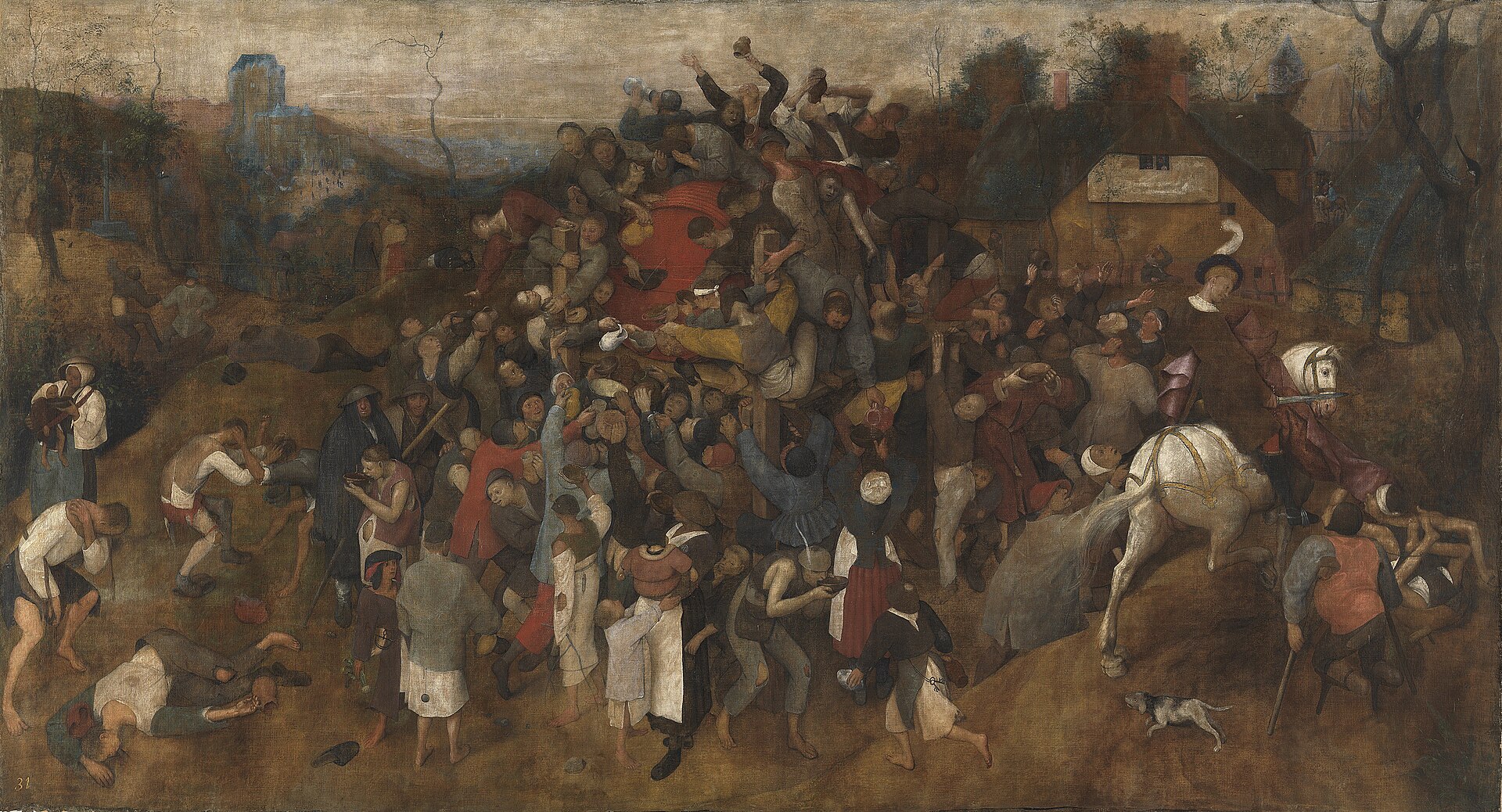
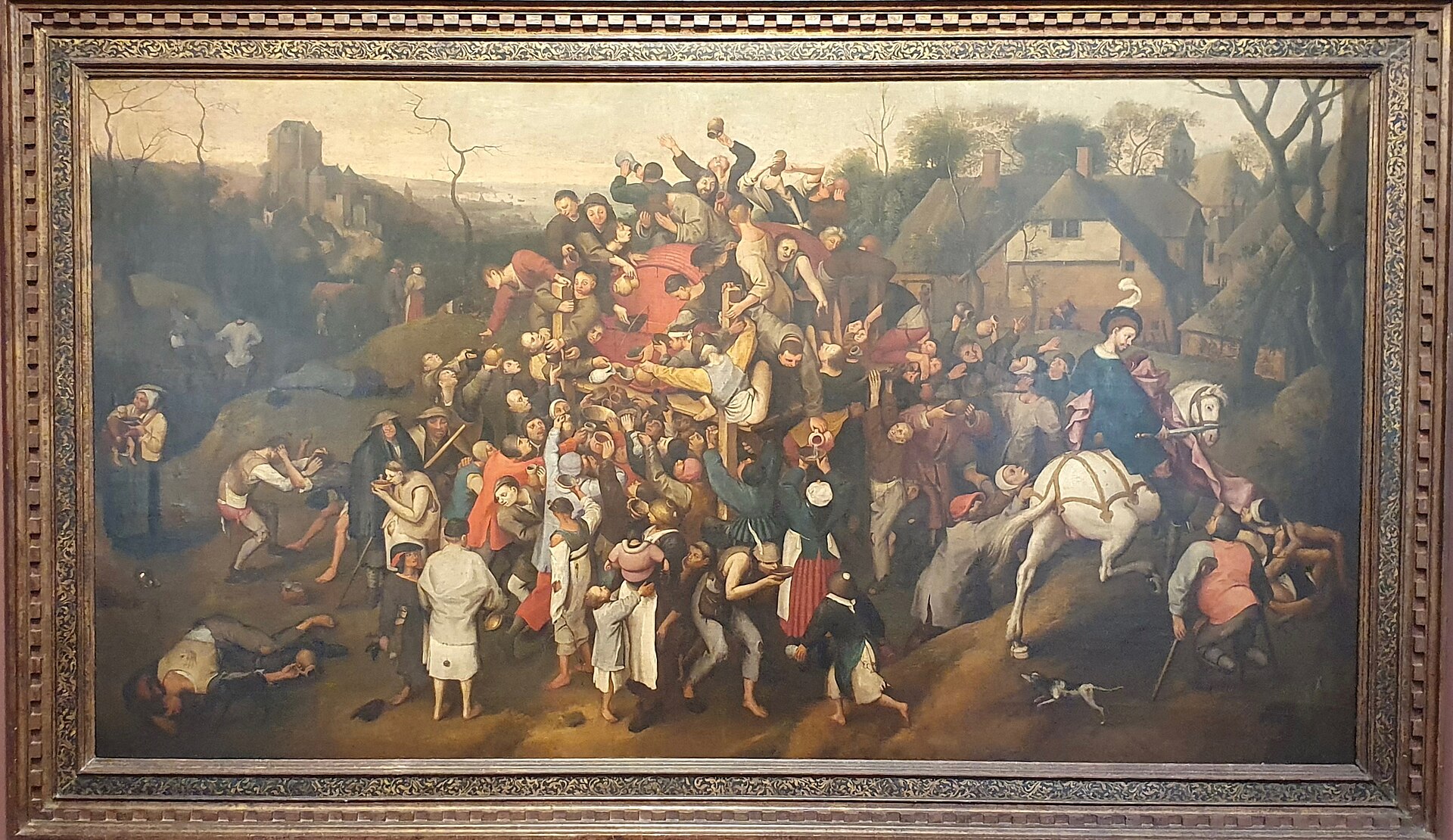
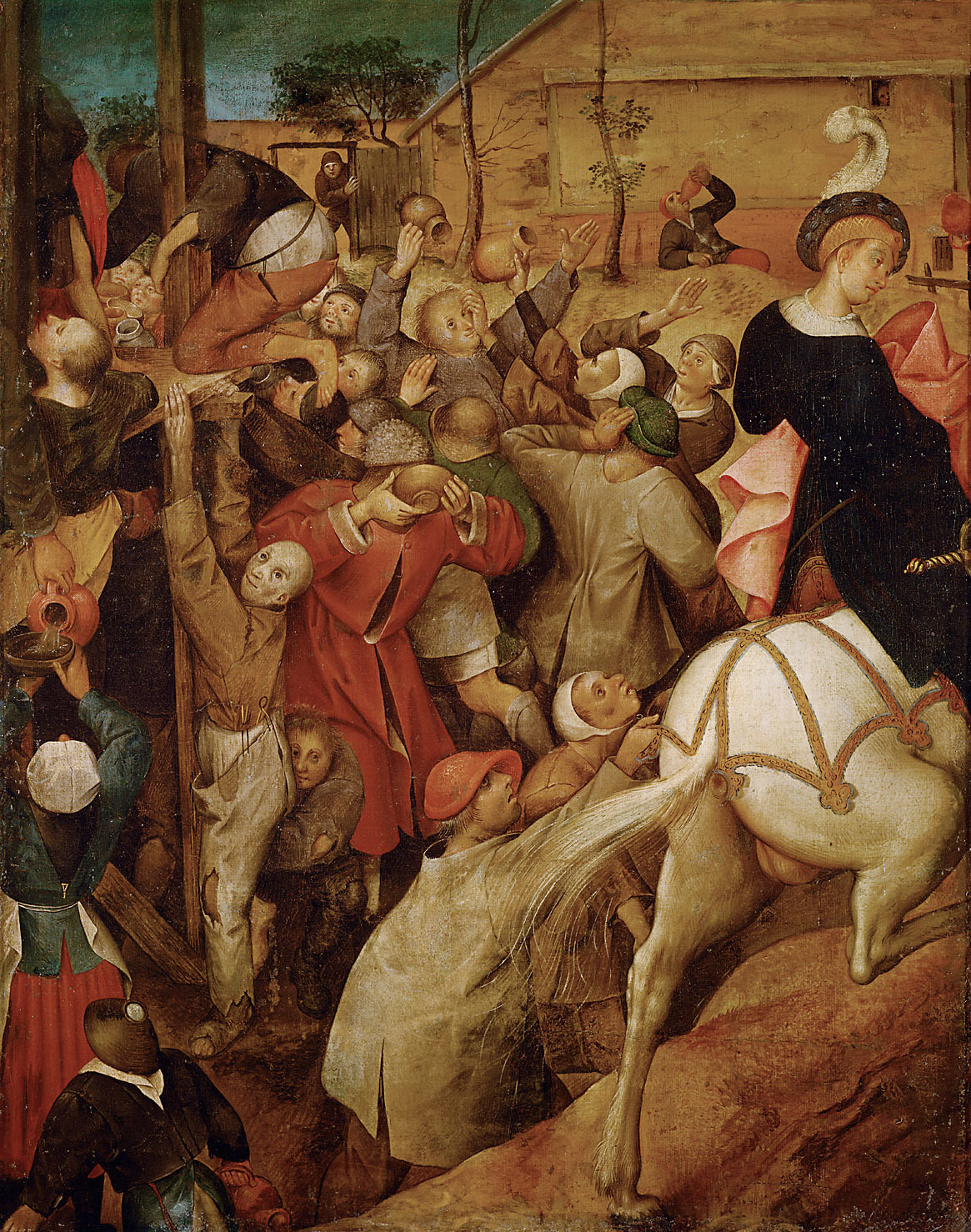
The record subject, after the 2010-2011 restoration by Elisa Mora removed a disfiguring later varnish and lining adhesive. Glue-size tempera on linen, 148 x 270.5 cm, Museo Nacional del Prado.
| Artist | Pieter Bruegel the Elder |
|---|---|
| Date | c. 1565-1568 (Prado's own catalogue narrows this to 1566-1567; the last digit of the painted date is illegible) |
| Medium | Glue-size tempera (tuchlein/distemper) on plain-woven linen, painted largely alla prima on an unprimed or only lightly sized ground |
| Dimensions | 148 x 270.5 cm |
| Where it is now | Museo Nacional del Prado, Madridlast confirmed |
| Inventory number | P008040 |
| Attribution | AcceptedLong known only from a black-and-white photograph and published in 1980 by Matias Diaz Padron as a copy by Pieter Brueghel the Younger, the picture was recognised as a probable autograph work by the CODART board member Manfred Sellink around 2007 while it was still in a private Spanish collection, on stylistic grounds, and he urged the owner to have it examined. Full note |
| Object type | Painting |
| Period | Netherlandish, sixteenth century |
| Cases | Has a provenance gap · Rediscovered |
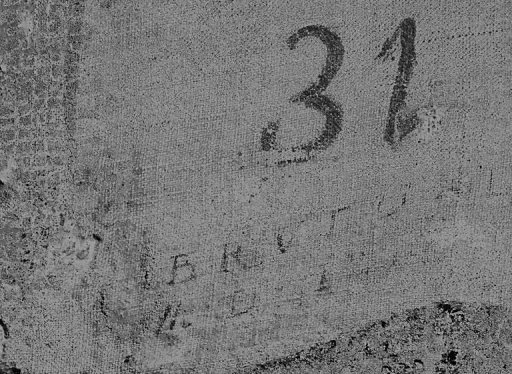
| Inscriptions | Signed and dated lower left in Roman numerals, worn and partly overpainted at discovery: MDL[.], the final digit illegible; the signature itself is incomplete. |
| Owners on record | 8 links4 documented, 2 disputed, 2 unknown |
| Sources | 19 cited |
About this record Last verified · 19 sources cited · Change log
On this page 9 sections
ContentsClose
A crowd swarms a cask of new wine outside a city gate while, off to the side and almost unnoticed, a mounted saint cuts his cloak in half for a beggar. For most of its life this canvas was assumed to be a copy or an anonymous imitation, sitting unremarked in a Spanish private collection. In 2010 the Museo Nacional del Prado established it as an autograph, previously unrecorded painting by Pieter Bruegel the Elder, one of only a handful of his works painted in distemper on cloth rather than oil on panel, and the largest picture he is known to have made.
The attribution rested on a worn signature uncovered during restoration, an X-radiograph showing brushwork the museum's own curators judged unmistakably Bruegel's, and a decade of quiet advocacy that began when a single scholar spotted it in a private house years before the museum ever saw it. The Spanish state paid 7 million euros for a painting some estimates put at fourteen times that on the open market, a gap the country's cultural-property law exists specifically to create.
What the picture actually shows remains genuinely contested: a moralising satire on gluttony in the tradition of Bruegel's other vice paintings, or a sympathetic record of an ordinary autumn custom. This record sets out the rediscovery, the technical case, the provenance as far as it can be traced, and the two readings side by side, without deciding between them.
Provenance
Each link is graded. Documented: a cited source supports it. Disputed: the identification is argued but not established. Unknown: no owner for that span, and the gap is not smoothed into a narrative. The grades in the glossary.
- c. 1565-1568 - before 1626Unrecordedunknown
No commission, patron or early owner is documented for the picture's first six decades. It is not mentioned in any inventory or source contemporary with Bruegel's life.12
- before 1626 - 1627Possibly the Gonzaga, Dukes of Mantuadisputed
A 1626-27 inventory of the Gonzaga collection in Mantua lists a painting of 'the feast of Saint Martin with many poor people drinking from a barrel, a work of Bruegel the Elder.' The Prado's own catalogue and the Silva Maroto/Sellink study both flag this as an uncertain identification: the entry could equally describe a different composition or a copy, and no measurement or further description survives to confirm it is this canvas.411
- 1627 - before 1662Possibly the Muselli collection, Veronadisputed
The Prado's catalogue entry notes a possible link to the Muselli collection of Verona, a family known to have acquired dispersed Gonzaga pictures after the sack of Mantua and the Gonzaga sale to Charles I's agents in the late 1620s. This link is stated by the museum as possible, not established.1
- before 1702 - 1956Luis Francisco de la Cerda y Aragon, 9th Duke of Medinaceli, and his descendantsdocumented
The earliest firm documentary link. The 9th Duke served as Spanish ambassador in Rome (1687-1696) and later as Viceroy of Naples, and is recorded to have acquired the painting in Italy and sent it to Spain before his death; it appears in a Medinaceli inventory as a Brueghel of 'the fiesta of San Martin and his children', valued at 8,000 reales. It descended in the Medinaceli family collections until the death of the 17th Duke in 1956.14
- 1956 - 2009Private collection, Spain (identity not published)unknown
The painting passed out of documented Medinaceli ownership after 1956 into what press and museum sources describe only as 'an old Spanish collection' or 'a private Spanish collection.' Whether it remained with Medinaceli heirs or passed to an unrelated family, and how it was regarded and treated during this period, is not stated in any source consulted; contemporary accounts of its physical state describe it as neglected, repeatedly relined and retouched by unrecorded hands, and displayed, according to one restoration account, in a passageway.410
- 2007 - 2009Same private Spanish collection; first scholarly noticedocumented
Manfred Sellink, then a CODART board member, director of Musea Brugge and author of the 2007 Bruegel catalogue raisonne, saw the painting in the private collection and judged it 'very close to Bruegel', advising the owner to have it examined. This is the first record of anyone proposing the Bruegel the Elder attribution seriously since Diaz Padron's 1980 publication of it as a copy by the son.67
- November 2009 - September 2010Consigned to the Museo Nacional del Prado via Sotheby's Madriddocumented
The owner consigned the painting through Sotheby's Madrid office; it entered the Prado for study and possible acquisition. A technical campaign followed under the deputy director Gabriele Finaldi and the department of Flemish and Northern School painting led by Pilar Silva Maroto, with restoration carried out by Elisa Mora beginning February 2010. The signature and traces of a date were uncovered during cleaning on or around 6 September 2010; the Prado announced the attribution on 23 September 2010.12610
- 2010 - presentMuseo Nacional del Prado, Madrid (Spanish state)documented
The Ministry of Culture announced the rediscovery and attribution on 23 September 2010. The Real Patronato del Prado, presided over by Culture Minister Angeles Gonzalez-Sinde, unanimously approved exercising a purchase option at 7 million euros at its plenary meeting on 20 October 2010, with the sum drawn from an extraordinary budget line. Spain's Junta de Calificacion, Valoracion y Exportacion (the state board for classification, valuation and export of artistic heritage) separately declared the painting a bien de interes cultural, a designation that bars permanent export and effectively removed it from the open international market before the Prado's own purchase was completed. Restoration, funded by Fundacion Iberdrola, concluded in time for the painting's first public display from 12 December 2011 to 25 March 2012.13891013
Technical evidence
| Attribution note | Long known only from a black-and-white photograph and published in 1980 by Matias Diaz Padron as a copy by Pieter Brueghel the Younger, the picture was recognised as a probable autograph work by the CODART board member Manfred Sellink around 2007 while it was still in a private Spanish collection, on stylistic grounds, and he urged the owner to have it examined. It was consigned to Sotheby's Madrid in November 2009 for study and possible sale, entered the Prado on that basis, and was subjected to a full technical campaign by the museum, overseen by the then deputy director Gabriele Finaldi with the department of Flemish and Northern painting under Pilar Silva Maroto. Removal of a disfiguring later varnish and lining adhesive during restoration by Elisa Mora, beginning February 2010, uncovered a worn, incomplete signature and the remains of a date in Roman numerals, MDL[.], in the lower left corner, together with an X-radiograph showing rapid, confident, synthetic brushwork consistent with Bruegel's late hand and unlike the character of known copies. The Prado announced the attribution on 23 September 2010 and the case was published by Silva Maroto and Sellink in The Burlington Magazine in December 2011. |
|---|---|
| Support | Fine, plain (taffeta) weave linen, prepared with animal-hide size only; no ground layer of the kind used under oil paint.2 |
| Medium | Glue-size tempera (tuchlein/distemper), applied in one or two thin paint layers with essentially no glazing and no impasto, giving a matte, absorbent surface.215 |
| Dimensions | 148 x 270.5 cm; the Prado's own museum website gives the same figures and describes it as the largest known painting by the artist.12 |
| Technique | Executed largely alla prima with minimal underdrawing, according to the Prado's published catalogue entry.1 |
| Signature and date | Lower left corner: a worn, incomplete signature and the remains of a painted date in Roman numerals, MDL[.], the final digit illegible. Uncovered during cleaning around 6 September 2010.24 |
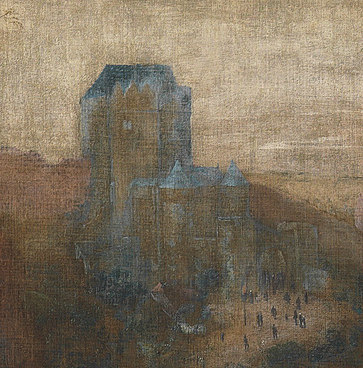
| X-radiography | Comparative radiography showed rapid, confident, synthetic brushwork consistent with Bruegel's late hand, and revealed a small port city in the upper left landscape invisible under the surface varnish before cleaning.2 |
| Condition at acquisition | Disfigured by a thick later polyester varnish and by adhesive from an earlier canvas relining that had penetrated the porous, unprimed support, giving the surface an inappropriate gloss over what should be a matte finish; extensive paint loss, concentrated on the figure of Saint Martin and his horse; distortions in the original linen from the old relining.210 |
| Restoration | Carried out by Elisa Mora at the Museo Nacional del Prado, beginning February 2010, funded by the Fundacion Iberdrola. The later varnish and lining adhesive were removed and the original matte surface recovered; no conventional oil-painting varnish was reapplied, to preserve the tuchlein's characteristic flat finish.2910 |
Images
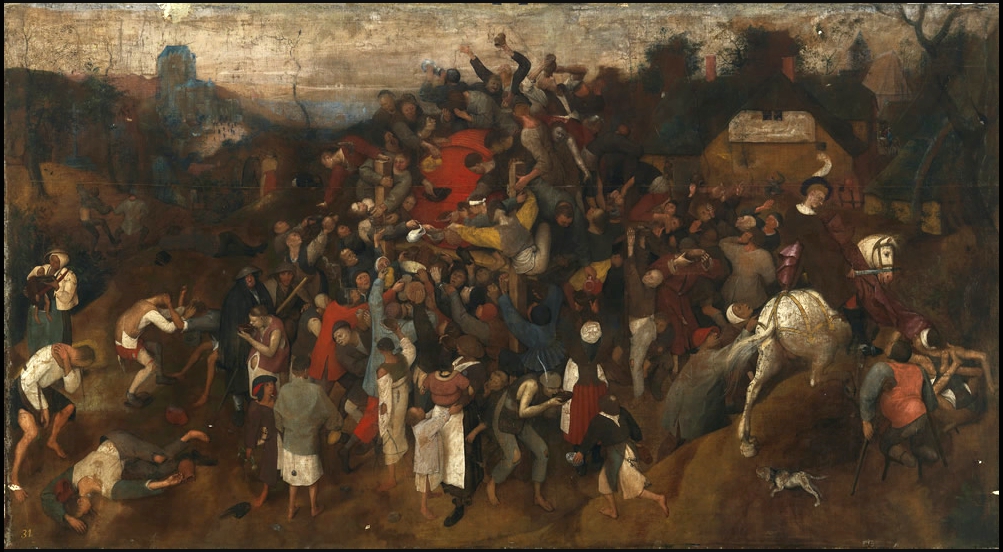
The record in full
Chapter 1A canvas the size of a small fresco
The picture is large for anything by Bruegel: 148 by 270.5 centimetres, close to nine feet across.
The picture is large for anything by Bruegel: 148 by 270.5 centimetres, close to nine feet across. It is his biggest known painting, larger than any of his celebrated panel compositions, and it is not painted in oil at all. The support is a plain-woven linen, prepared with little more than a coat of animal-hide size rather than the layered chalk-and-glue ground used under oil paint, and the paint itself is glue-size tempera, sometimes called distemper, applied thinly and quickly, mostly in a single pass, with almost no glazing and no impasto.
The technique is usually known by the German word tuchlein, cloth-painting, and it produces a matte, absorbent, almost fresco-like surface rather than the glossy depth of an oil panel. It was a cheaper and faster way to cover a large area, and it was also markedly more fragile: unvarnished distemper on unsized cloth is vulnerable to damp, to flexing, and to the kind of well-meant restoration that tries to make it look like an oil painting by varnishing it. All three things happened to this canvas before it reached the Prado.
Chapter 2What it shows
A crowd of perhaps a hundred figures presses around an enormous wine cask set up, according to the Prado's own reading of the background architecture, outside a city gate resembling the Porte de Hal...
A crowd of perhaps a hundred figures presses around an enormous wine cask set up, according to the Prado's own reading of the background architecture, outside a city gate resembling the Porte de Hal in Brussels (a Wikimedia Commons caption on one detail crop instead identifies the gate as Louvain's; the two identifications have not been reconciled in the sources consulted, and this record notes the disagreement rather than choosing between them). The occasion is Saint Martin's Day, 11 November, the traditional date in the Low Countries and much of northern and central Europe for tasting the new wine of the autumn harvest.
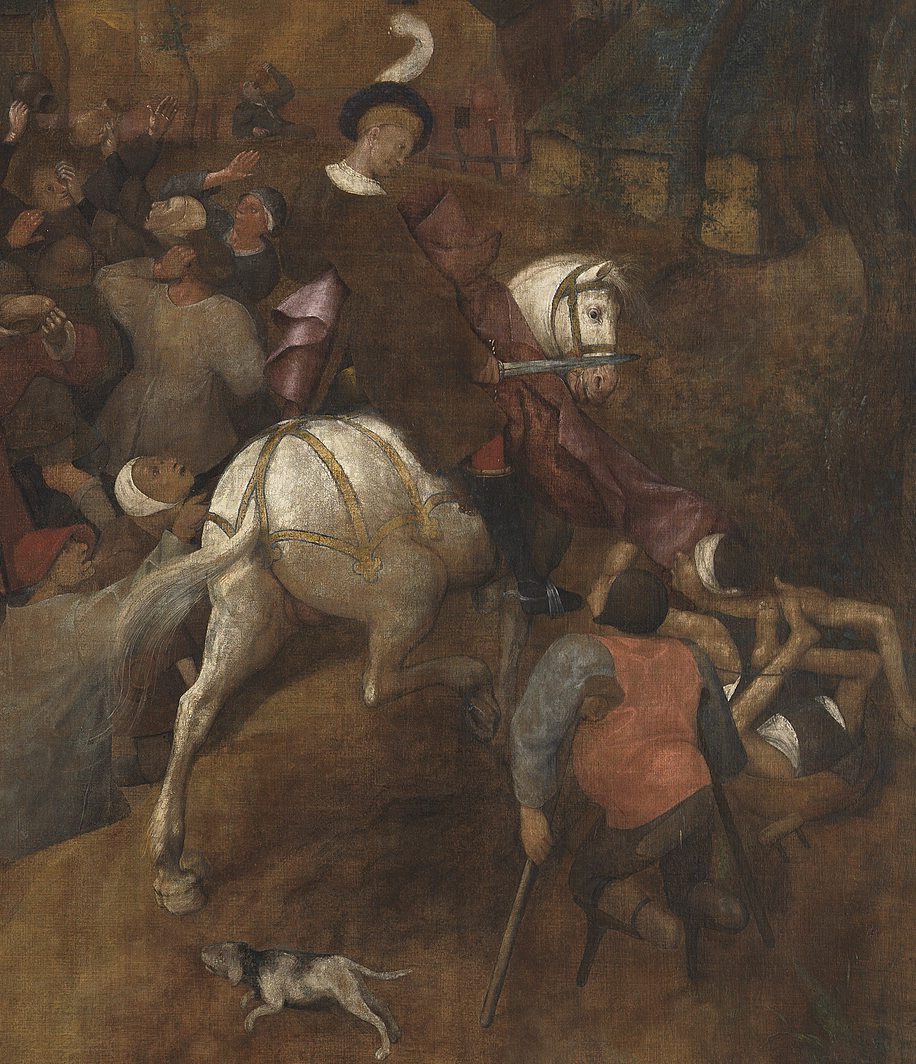
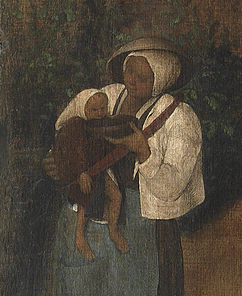
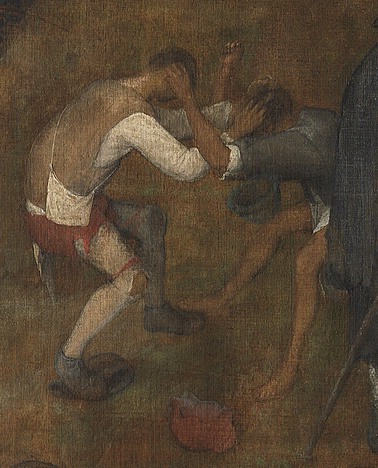
Around the barrel, men, women, children, beggars and at least one visible thief compete for the wine using whatever they have to hand, including a hat and a shoe. On the left side of the crowd the consequences are shown without softening: men fighting, a figure vomiting, another already unconscious in his own vomit, a mother giving wine to an infant. On the right, in a much smaller and quieter passage of the same canvas, a horseman in a plumed hat cuts his cloak in two with a sword to give half to a crowd of beggars and the disabled: Saint Martin of Tours himself, re-enacting the act of charity for which he is venerated, his own feast reduced in the crowd's memory to an excuse for a drinking bout.
Chapter 3Two ways of reading the same crowd
The Prado's own published account of the picture, by Silva Maroto and Sellink, situates it inside Bruegel's tradition of moralising satire.
The Prado's own published account of the picture, by Silva Maroto and Sellink, situates it inside Bruegel's tradition of moralising satire. On this reading the composition sets up a deliberate irony between Martin's charity and the crowd's gluttony, in company with Bruegel's other vice paintings and with Hieronymus Bosch's Haywain, also in the Prado, where a similar crowd claws after a cart of hay standing for worldly goods. The subject has been connected, in this reading, to Erasmus's satirical treatment of the veneration of saints' feast days and of gluttony as the first of the capital sins, with the saint pushed to the visual margin and the sin placed at the centre.
This is not the only way scholars have read Bruegel's crowds of feasting, drinking and quarrelling peasants as a body of work. A long debate opened in the 1970s between Svetlana Alpers, who argued for reading such scenes within a documentary or ethnographic tradition recording real festive custom rather than moral exempla, and Hessel Miedema, who insisted on their moralising content and disputed Alpers's approach as ahistorical. Walter Gibson has argued that Bruegel's aim in his peasant scenes was comic rather than didactic, that the laughter is the point rather than a vehicle for moral instruction, and that Bruegel's peasants, unlike the caricatured drunkards of earlier Netherlandish art, are monumental and not simply contemptible. Margaret Sullivan has argued for a middle position, reading the peasant subjects as 'earnest jests' addressed to an educated, humanist audience with real ties to Bruegel, presenting philosophical problems through comedy rather than through simple mockery.
That debate was conducted almost entirely before this canvas re-entered view in 2010, and it concerns Bruegel's peasant and festival imagery as a whole rather than this picture specifically; no scholar in the material reviewed for this record has yet published a treatment of this individual, newly rediscovered composition arguing explicitly for the documentary side of that older debate. What can be said honestly is that the Prado's own published position leans toward the moralising reading, that a live and unresolved scholarly disagreement exists over how to read Bruegel's peasant subjects generally, and that a reader should not take the museum's catalogue entry as the last word on a two-hundred-year argument.
Chapter 4A picture nobody could place
Bruegel's known life, on the scholarship available, does not include a documented friendship with a theologian or an inventory of his own books, unlike some later artists this publication covers...
Bruegel's known life, on the scholarship available, does not include a documented friendship with a theologian or an inventory of his own books, unlike some later artists this publication covers; what is documented is a circle. He trained under Pieter Coecke van Aelst, whose wife Mayken Verhulst was herself a miniaturist and has been proposed, without certainty, as the source of Bruegel's own facility with tempera and manuscript-derived techniques. He became a master in the Antwerp Guild of Saint Luke around 1551, then travelled to Italy between about 1552 and 1554, reaching as far south as Reggio Calabria and crossing the Alps on the way; the trip left its clearest mark not in any adoption of Italian figure style but in a body of Alpine landscape drawings, and in Karel van Mander's later, much-repeated anecdote that Bruegel 'swallowed all those mountains and rocks' on the crossing and 'spat them out again onto canvas and panels' on his return, a humanist commonplace about imitation of nature dressed up as gossip rather than a literal claim.
Back in Antwerp, Bruegel worked for years chiefly as a designer of prints for Hieronymus Cock's publishing house, Aux Quatre Vents, before his surviving painted output shifts toward the independent panels for which he is now known. His most important documented patron was the wealthy Antwerp merchant Nicolaes Jonghelinck, who at one point owned sixteen of his paintings, including the Months series from which The Harvesters (also in this collection, at the Metropolitan Museum) survives. Among his friends was the geographer and humanist Abraham Ortelius, part of a circle of Netherlandish Catholics shaped by Erasmus's insistence on toleration and inward piety over outward observance; it is this circle, rather than any documented statement of Bruegel's own religious position, that gives the Erasmian reading of pictures like this one its evidentiary weight. There is no record of Bruegel's own library, no signed letter setting out his views on saints' feast days, and no contract for this canvas. What is documented is the company he kept; what he privately believed about the crowd he painted is not.
Chapter 5Lost, and half-remembered
The provenance that can be reconstructed has long, undocumented stretches in it.
The provenance that can be reconstructed has long, undocumented stretches in it. A 1626-27 Gonzaga inventory in Mantua lists a Bruegel showing the feast of Saint Martin with poor people drinking from a barrel; both the Prado's own catalogue entry and the Silva Maroto/Sellink study treat the identification with this canvas as no more than plausible, since no measurements or further description survive to confirm it. A possible subsequent link to the Muselli collection in Verona, a family that acquired dispersed Gonzaga pictures, is likewise stated by the Prado as no more than a possibility.
The first firm documentary link is to Luis Francisco de la Cerda y Aragon, 9th Duke of Medinaceli, who served as Spanish ambassador in Rome in the late 1680s and later as Viceroy of Naples, and who is recorded to have acquired the picture in Italy and sent it to Spain before his death; a Medinaceli inventory values it, alongside a description of Saint Martin's feast and his children, at 8,000 reales. It then descended through the Medinaceli family until the death of the 17th Duke in 1956. What happened to it after 1956, in whose hands it passed, and how it came to rest, by the account of one Spanish restoration blog, in a hallway rather than on a wall, is not stated in any source found for this record. It surfaces again only in a description as 'an old Spanish private collection' by the time Manfred Sellink saw it, around 2007.
Chapter 6How the case was made
Sellink's private notice was not itself an attribution; it was an invitation to look properly.
Sellink's private notice was not itself an attribution; it was an invitation to look properly. The owner consigned the painting to Sotheby's Madrid in November 2009, and it went from there to the Prado for study rather than to a saleroom. The museum's technical case was built by its own department of Flemish and Northern School painting, led by Pilar Silva Maroto, under the oversight of the then deputy director for conservation and research, Gabriele Finaldi (later director of the National Gallery, London), with restoration carried out by Elisa Mora beginning in February 2010.
Mora's cleaning removed a heavy, later polyester varnish that had darkened and flattened the picture's original matte surface, along with an old canvas lining whose adhesive had penetrated the highly porous, unprimed support and given the whole surface an inappropriate gloss. X-radiography, comparing the underlying brushwork against securely attributed Bruegel paintings, showed the same synthetic, confident, rapid handling the Prado's curators judged incompatible with a copyist's more careful, descriptive touch; it also revealed a small port city in the upper left landscape, invisible to the naked eye under the old varnish. On or around 6 September 2010, cleaning in the lower left corner exposed a worn, incomplete signature and the remains of a painted date in Roman numerals, MDL followed by an illegible final character. The Prado announced the attribution publicly on 23 September 2010.
Chapter 7A price fixed below the market by design
The Ministry of Culture announced the attribution on 23 September 2010.
The Ministry of Culture announced the attribution on 23 September 2010. Just under a month later, on 20 October 2010, the Real Patronato del Prado, presided over by Culture Minister Angeles Gonzalez-Sinde, unanimously approved exercising a purchase option of 7 million euros at its plenary meeting, drawing the money from an extraordinary state budget line. Press accounts at the time put the picture's likely value on the open international market as high as 100 million euros, roughly fourteen times the price paid.
The gap is not a bargain in the ordinary sense; it is the intended effect of Spain's cultural-property law. Spain's Junta de Calificacion, Valoracion y Exportacion de Bienes del Patrimonio Historico Espanol (the state board for classification, valuation and export of Spanish artistic heritage) declared the picture a bien de interes cultural, a designation under which permanent export from Spain cannot be authorised. That declaration, whether it preceded or was contemporaneous with the Prado's negotiation, removed the international auction market as a realistic alternative for the owner and made a below-market private-treaty sale to the national museum the only route to a prompt, competitive-looking sale at all. It is the same mechanism, differently named, as the private-treaty sale and 'douceur' that operate under the UK's Acceptance in Lieu and Waverley regimes, and as France's dation en paiement: a national institution acquires at a price that is not, and is not intended to be, the open-market price.
Chapter 8What restoration found and could not fix
Once the later varnish and lining adhesive were removed, the extent of the damage the canvas had accumulated became clear.
Once the later varnish and lining adhesive were removed, the extent of the damage the canvas had accumulated became clear. Paint loss is extensive, and is concentrated on the figure of Saint Martin and his horse, the very passage that carries the picture's charitable counterweight to the crowd's gluttony. Earlier relining had also distorted and creased the original linen. Mora's restoration deliberately did not apply a conventional oil-painting varnish over the cleaned surface, in order to preserve the flat, absorbent, fresco-like matte quality that is characteristic of tuchlein technique and that a glossy varnish would have destroyed a second time. X-radiography, taken during the campaign, showed that many areas of apparent surface loss were in fact less severe than they looked once the disfiguring later varnish was accounted for.
The restored painting was shown to the public for the first time from 12 December 2011 to 25 March 2012, in Room D of the Jeronimos extension, alongside an X-ray image and a video of the restoration process; the conservation work itself was funded by the Fundacion Iberdrola.
Chapter 9The composition that outlived the memory of who painted it
Even while the original canvas sat unrecognised, its composition had a public life of its own, at one remove.
Even while the original canvas sat unrecognised, its composition had a public life of its own, at one remove. In 1670 the Rome-based engraver Nicolas Guerard produced a print of the composition, commissioned by Abraham Brueghel (1630/31-c.1690), Bruegel's own great-grandson through the painter line, then working in Rome as a still-life specialist. Abraham dedicated the engraving to Don Gaspare Altieri, nephew of Pope Clement X and titular head of the papal military, in a bid for patronage that, by the scholarly account available, did not succeed; Abraham relocated to Naples not long afterward. Abraham belonged to the Bentvueghels, the boisterous fraternity of Dutch and Flemish artists active in Rome between about 1625 and 1720, under the club name Rijngraaf, and the fraternity's documented taste for bacchic subject matter has been proposed as a reason a later cabinet-picture version of the composition also circulated among its members.
Abraham's own dedicatory inscription describes his wish to 'give to Immortality the Saint Martin work by Bruegel,' but misattributes the composition to his grandfather, Jan Brueghel the Elder, rather than correctly to his great-grandfather, Pieter Bruegel the Elder. That a member of the painting dynasty most invested in preserving its own reputation could not correctly place the composition within his own family tree, a full century after it was painted, is itself a small measure of how completely the original picture had already receded from view by 1670, a full three hundred and forty years before the Prado's technical study restored the correct name to it. The Guerard print survives in the British Museum, inventory 1874,0808.1576, in the mirror-reversed orientation typical of engravings after paintings.
Chapter 10Bruegel's other crowded panels, and the versions this is not
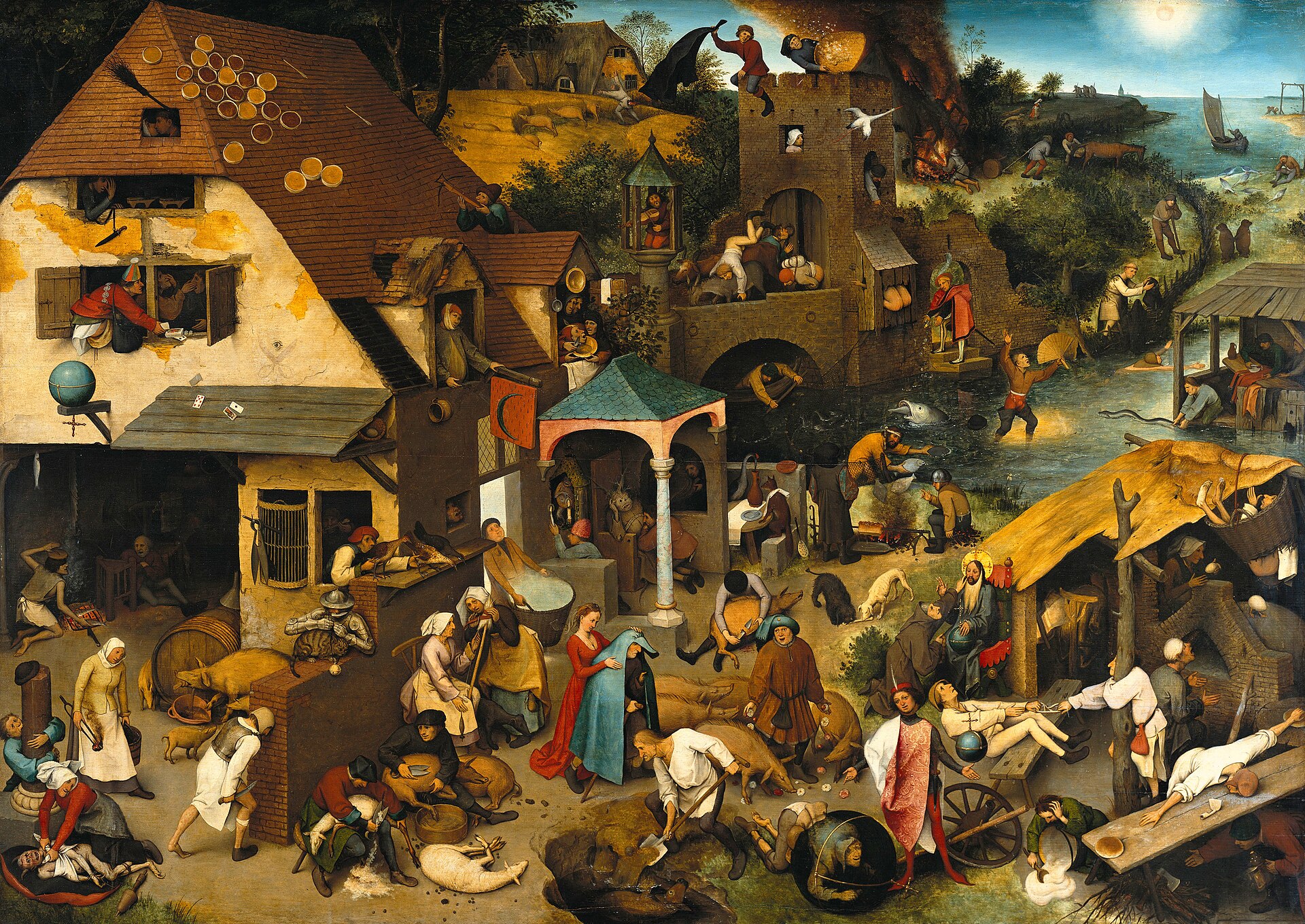
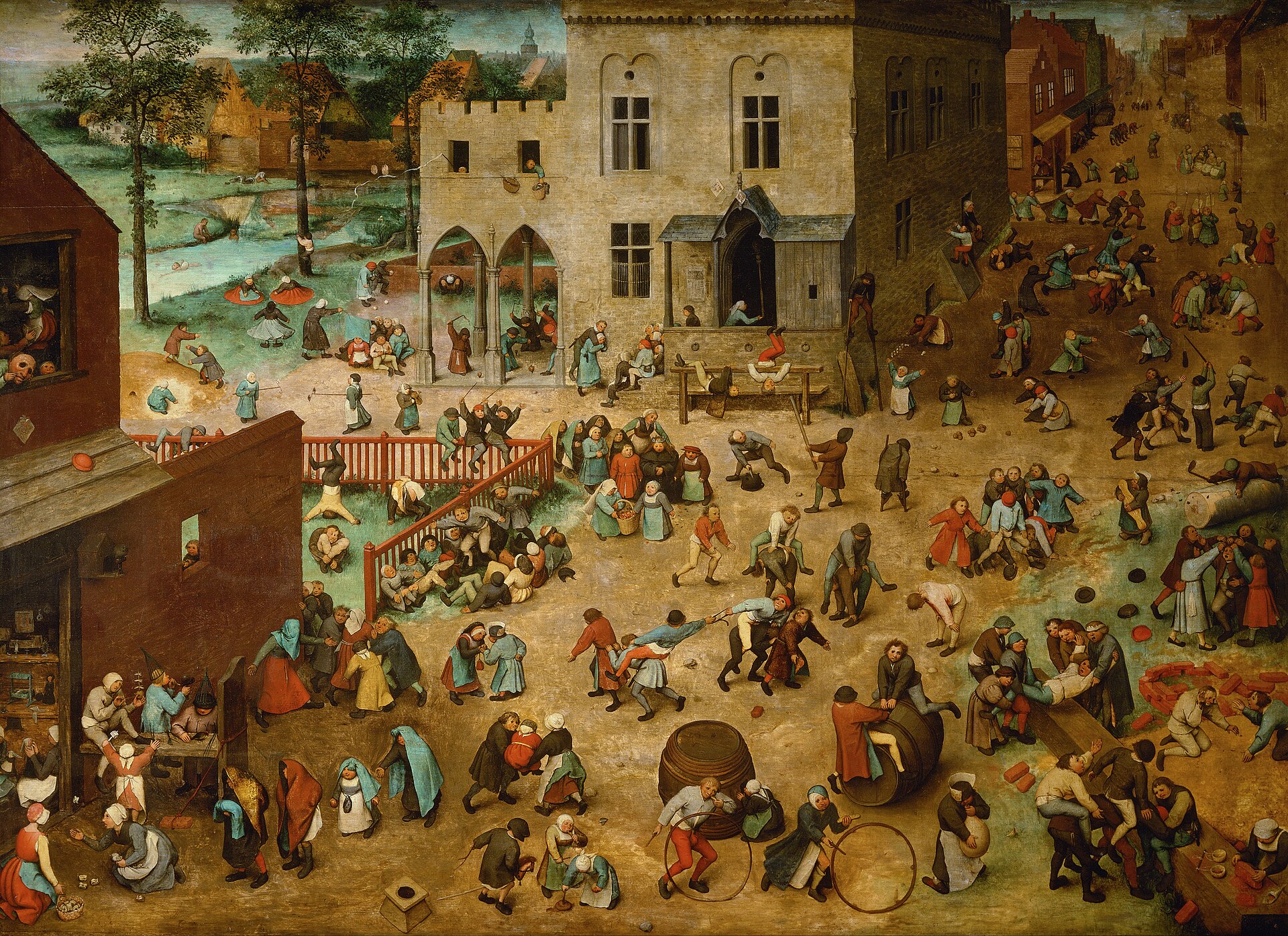
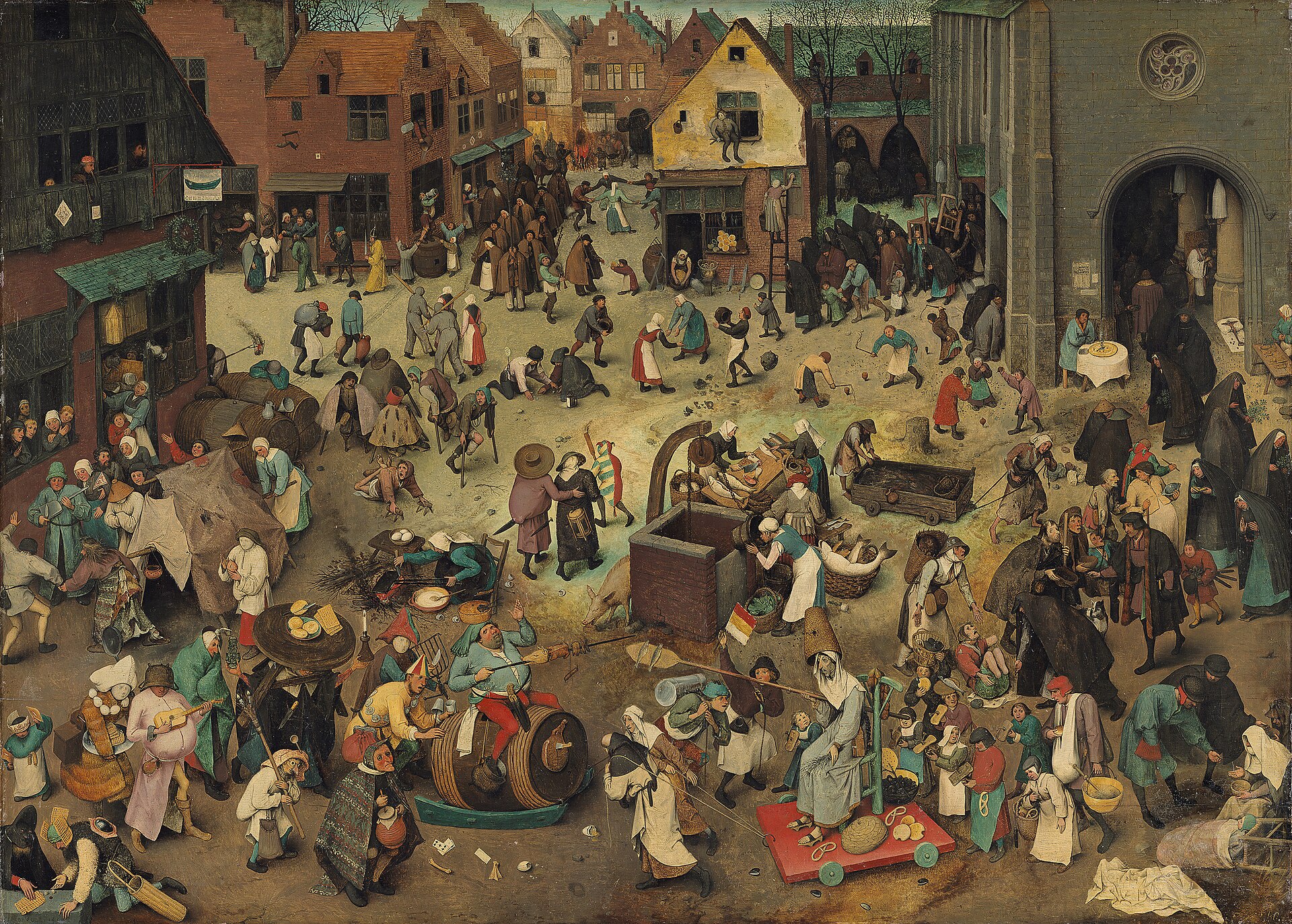
The Wine of Saint Martin's Day belongs, in scale of ambition if not in medium, with three other multi-figure compositions from earlier in Bruegel's career: Netherlandish Proverbs (1559...
The Wine of Saint Martin's Day belongs, in scale of ambition if not in medium, with three other multi-figure compositions from earlier in Bruegel's career: Netherlandish Proverbs (1559, Gemaldegalerie, Berlin), which catalogues more than a hundred popular sayings in a single village scene; Children's Games (1560, Kunsthistorisches Museum, Vienna), which crowds well over ninety distinct games into one square; and The Fight Between Carnival and Lent (1559, Kunsthistorisches Museum, Vienna), which stages an allegorical battle between feasting and fasting across a market square. All three are painted in oil on panel, at a broadly similar scale to one another, roughly 118 by 160 centimetres, and all three were produced within a year or two of each other around 1559-1560. The Wine of Saint Martin's Day, painted perhaps six to eight years later and on cloth rather than panel, is both larger than any of them and executed in a technique none of them shares; its 'about a hundred figures' compares with the encyclopaedic ambition of the earlier panels while using a wholly different physical means to achieve it.
Two other objects must be kept firmly apart from this one, because they show the same composition and have at times been confused with it in the literature and in image searches. The Royal Museums of Fine Arts of Belgium in Brussels holds a painted version of the same composition, oil on canvas, 147 by 269.5 centimetres, attributed to Bruegel's son Pieter Brueghel the Younger and catalogued by the museum as a reproduction of a design by his father; this is not the picture described in this record, and before the Prado's 2010 discovery it was this Brussels version, or the tradition behind it, that represented the composition's only well-known painted witness. Separately, the Kunsthistorisches Museum in Vienna holds a smaller fragment, 90 by 72 centimetres, showing only the Saint Martin cloak-dividing scene, once published by Gustav Gluck as a possible surviving fragment of Bruegel the Elder's own lost original; it is now catalogued by the museum itself as the work of Pieter Brueghel the Younger, not the elder. Neither the Brussels canvas nor the Vienna fragment is the object described here, and any reproduction of either found on Wikimedia Commons or elsewhere is captioned accordingly in the gallery below.
Chapter 11What is still unresolved
The scholarly record on this specific canvas is younger than the picture's own rediscovery: aside from the Prado's own catalogue and website, and the 2011 Silva Maroto and Sellink study in The...
The scholarly record on this specific canvas is younger than the picture's own rediscovery: aside from the Prado's own catalogue and website, and the 2011 Silva Maroto and Sellink study in The Burlington Magazine, there is not yet a deep, independent literature treating this individual composition the way Bruegel's earlier panel paintings have been treated for a century. The Gonzaga and Muselli links remain proposals, not proofs. The gap between 1956 and 2007 has, on the evidence gathered here, no documented owner at all. The final digit of the painted date is lost, so the picture's place within Bruegel's last four years of activity cannot be fixed more precisely than the Prado's own range allows. And whether this rediscovered original is best read as Bruegel's harshest satire on a popular vice or as his most sympathetic record of one, remains an open scholarly question that this record has deliberately declined to settle on the museum's behalf.
The artist
Pieter Bruegel (also spelled Brueghel; he himself dropped the h from his signature around 1559)
Bruegel is documented mainly through what other people said and paid, not through his own words. No letter in his hand survives, no inventory of his books, no signed statement of belief. The first connected account of his life was written more than three decades after his death, by a fellow painter who had never met him. What can be said with confidence rests on guild records, a will, a small number of dated paintings and prints, and the testimony of the humanist circle he moved in while he was alive.
Related works
| Work | Relation | Where it is |
|---|---|---|
| Netherlandish Proverbs Pieter Bruegel the Elder | Earlier encyclopaedic multi-figure composition, comparable in ambition though smaller and in oil on panel 1559; catalogues over a hundred popular proverbs in a single village scene. | Gemaldegalerie, Berlin |
| Children's Games Pieter Bruegel the Elder | Earlier encyclopaedic multi-figure composition, comparable in ambition though smaller and in oil on panel 1560; crowds over ninety distinct children's games into one square, 118 x 161 cm. | Kunsthistorisches Museum, Vienna |
| The Fight Between Carnival and Lent Pieter Bruegel the Elder | Earlier encyclopaedic multi-figure composition on the theme of feasting and fasting 1559; a companion piece in scale and ambition to Netherlandish Proverbs and Children's Games. | Kunsthistorisches Museum, Vienna |
| The Triumph of Death Pieter Bruegel the Elder | The only other autograph Bruegel painting in Spain before this acquisition, also in the Prado Entered the Spanish royal collection long before this canvas; this acquisition doubled the Prado's holding of the artist. | Museo Nacional del Prado, Madrid |
| The Blind Leading the Blind Pieter Bruegel the Elder | One of the small number of Bruegel's other surviving works painted in the same distemper-on-cloth (tuchlein) technique 1568, distemper on linen, 86 x 154 cm. | Museo di Capodimonte, Naples |
| The Wine of Saint Martin's Day, copy after Bruegel Pieter Brueghel the Younger (attributed) | A separate painted version of the same composition, NOT the object described in this record Oil on canvas, 147 x 269.5 cm; catalogued by the Brussels museum as a reproduction of a design by the elder Bruegel, made by his son. Before 2010 this canvas, or the tradition behind it, was the composition's best-known painted witness. | Royal Museums of Fine Arts of Belgium, Brussels |
| Fest des Hl. Martin (fragment) Once proposed as Pieter Bruegel the Elder; now catalogued as Pieter Brueghel the Younger | A smaller fragment of the same subject, showing only the Saint Martin cloak-dividing scene, NOT the object described in this record 90 x 72 cm. Once published by Gustav Gluck as a possible surviving fragment of Bruegel the Elder's lost original; the Vienna museum now attributes it to the son. | Kunsthistorisches Museum, Vienna (GG 2691) |
Open questions
- Is the 1626-27 Gonzaga inventory entry for a 'feast of Saint Martin' by Bruegel the Elder actually this canvas? Both the Prado and the Silva Maroto/Sellink study treat this as plausible but unconfirmed; no measurements or fuller description survive in the inventory to test it.
- Is the proposed link to the Muselli collection of Verona (before 1662) correct? The Prado's own catalogue states this only as a possibility.
- What is the true painted date? The final digit of the Roman-numeral date (MDL[.]) uncovered in restoration is illegible, so the picture cannot be placed more precisely within Bruegel's last four years of activity than the museum's own bracket of 1565-1568 (elsewhere narrowed by the Prado to 1566-1567).
- Who owned the painting between the death of the 17th Duke of Medinaceli in 1956 and its consignment to Sotheby's Madrid in 2009? No source consulted names an owner for this roughly fifty-year gap, or explains whether it remained with Medinaceli heirs or passed outside the family.
- Was Abraham Brueghel's 1670 engraving made directly from this canvas, from an intermediate copy, or from another version entirely? Abraham misattributed the composition to his grandfather Jan Brueghel the Elder rather than his great-grandfather Pieter Bruegel the Elder, which suggests his own knowledge of its authorship and immediate source was already uncertain a century after it was painted.
- Has any scholar published a sustained documentary or ethnographic reading of this specific, individually rediscovered canvas, as opposed to applying the general Alpers/Gibson/Sullivan framework for Bruegel's peasant scenes to it? Nothing found for this record does so; the moralising-satire reading currently stands unopposed in the literature specific to this picture.
Questions about this object
What is The Wine of Saint Martin's Day?
The Wine of Saint Martin's Day is a painting, dated c. 1565-1568 (Prado's own catalogue narrows this to 1566-1567; the last digit of the painted date is illegible). Medium: Glue-size tempera (tuchlein/distemper) on plain-woven linen, painted largely alla prima on an unprimed or only lightly sized ground.
Who made The Wine of Saint Martin's Day, and is the attribution settled?
The attribution to Pieter Bruegel the Elder is recorded here as accepted. Long known only from a black-and-white photograph and published in 1980 by Matias Diaz Padron as a copy by Pieter Brueghel the Younger, the picture was recognised as a probable autograph work by the CODART board member Manfred Sellink around 2007 while it was still in a private Spanish collection, on stylistic grounds, and he urged the owner to have it examined. It was consigned to Sotheby's Madrid in November 2009 for study and possible sale, entered the Prado on that basis, and was subjected to a full technical campaign by the museum, overseen by the then deputy director Gabriele Finaldi with the department of Flemish and Northern painting under Pilar Silva Maroto. Removal of a disfiguring later varnish and lining adhesive during restoration by Elisa Mora, beginning February 2010, uncovered a worn, incomplete signature and the remains of a date in Roman numerals, MDL[.], in the lower left corner, together with an X-radiograph showing rapid, confident, synthetic brushwork consistent with Bruegel's late hand and unlike the character of known copies. The Prado announced the attribution on 23 September 2010 and the case was published by Silva Maroto and Sellink in The Burlington Magazine in December 2011.
Where is The Wine of Saint Martin's Day now?
Museo Nacional del Prado, Madrid. Inventory number P008040. Last confirmed 28 August 2026. Acquired by the Spanish state for the Prado at the end of 2010: the Ministry of Culture announced the rediscovery and attribution on 23 September 2010, and the Real Patronato unanimously approved exercising the purchase option, at 7 million euros, at its plenary meeting on 20 October 2010.
What is still unknown about The Wine of Saint Martin's Day?
Is the 1626-27 Gonzaga inventory entry for a 'feast of Saint Martin' by Bruegel the Elder actually this canvas? Both the Prado and the Silva Maroto/Sellink study treat this as plausible but unconfirmed; no measurements or fuller description survive in the inventory to test it.
Sources
- 1Museo Nacional del Prado, official collection catalogue entry, 'The Wine of Saint Martin's Day' (P008040), including description, attribution, technique and provenance summary. museodelprado.es/en/...
- 2Museo Nacional del Prado, 'Studies and Restorations' resource page on The Wine of Saint Martin's Day: technical study, X-radiography, restoration by Elisa Mora, and the discovery of the signature and date. museodelprado.es/en/...
- 3Museo Nacional del Prado, special-display exhibition page, 'The Wine of Saint Martin's Day by Pieter Bruegel the Elder' (12 December 2011 - 25 March 2012). museodelprado.es/en/...
- 4Wikipedia (Spanish), 'El vino de la fiesta de san Martin', consolidating the attribution history, Gonzaga and Medinaceli provenance, acquisition process and iconographic reading, citing Silva Maroto/Sellink/Mora 2011 and the Ministry of Culture. es.wikipedia.org/wiki/...
- 5Wikipedia (English), 'The Wine of Saint Martin's Day', for dimensions, medium, subject description and general provenance summary. en.wikipedia.org/wiki/...
- 6CODART, 'The Museo del Prado identifies an unknown work by Pieter Bruegel the Elder', on Manfred Sellink's role in first proposing the attribution around 2007 and the subsequent technical study. codart.nl/research-study/...
- 7CODART, 'Museo del Prado exhibits The Wine of Saint Martin's Day by Pieter Bruegel the Elder', on the 2011-2012 exhibition and the significance of the discovery. codart.nl/museums/...
- 8hoyesarte.com, 'El vino de la fiesta de San Martin se expone por primera vez en el Prado tras su restauracion', on the purchase price, funding, restoration and exhibition dates. hoyesarte.com/sin-categoria/...
- 9hoyesarte.com, 'Cultura confirma la adquisicion de la obra de Bruegel el Viejo para el Prado', on the Real Patronato's approval of the purchase, the 7 million euro price and the ministerial announcement. hoyesarte.com/mercado/...
- 10Artelier Restauracio, 'Bruegel, de un oscuro pasillo a el Museo del Prado', on the painting's condition and neglect before acquisition, the restoration by Elisa Mora and the discovery of the signature on 6 September 2010, the purchase price and the bien de interes cultural declaration. artelierestauracio.com/2011/...
- 11Pilar Silva Maroto and Manfred Sellink, 'The rediscovery of Pieter Bruegel the Elder's Wine of St Martin's Day, acquired for the Museo Nacional del Prado, Madrid', The Burlington Magazine, vol. CLIII, December 2011. The principal scholarly publication of the attribution case; consulted via secondary reporting of its findings, not the full original article text. burlington.org.uk/media/...
- 12Martin William Walsh, 'Abraham Brueghel's Engraving of The Wine of St. Martin's Day and the Bentvueghels Fraternity in Rome', International Journal of Literature and Arts, vol. 13, no. 2, 31 March 2025, on Abraham Brueghel's 1670 engraving, its dedication to Don Gaspare Altieri, and Abraham's own misattribution of the composition to Jan Brueghel the Elder. sciencepublishinggroup.com/article/...
- 13Terrae Antiqvae, 'El Museo del Prado adquiere la obra El vino en la fiesta de San Martin, de Pieter Brueghel El Viejo', on the acquisition and its significance for the Prado's Bruegel holdings. terraeantiqvae.com/xn/...
- 14Byron Breedlove and Anne Schuchat, 'A Masterwork of Art, a Metaphor for Prevention', Emerging Infectious Diseases, vol. 24, no. 7, July 2018, Centers for Disease Control and Prevention: a later, non-art-historical reception of the picture, using Saint Martin's cloak-sharing as a public-health metaphor for vaccination. pmc.ncbi.nlm.nih.gov/articles/...
- 15The History of Art, 'The Wine of Saint Martin's Day', for a plain-language restatement of the medium (glue-size/distemper on linen) and condition at acquisition. thehistoryofart.org/pieter-bruegel/...
- 16Wikipedia, 'The Blind Leading the Blind', for comparison with another of Bruegel's small number of surviving distemper-on-cloth (tuchlein) paintings. en.wikipedia.org/wiki/...
- 17The Metropolitan Museum of Art, 'Pieter Bruegel the Elder (ca. 1525-1569)', department essay, for biography: training under Pieter Coecke van Aelst, guild membership, the Italian journey, and his sons. metmuseum.org/essays/...
- 18Wikipedia, 'Pieter Bruegel the Elder', for biography, including the friendship with Abraham Ortelius, the patron Nicolaes Jonghelinck, work for Hieronymus Cock's Aux Quatre Vents, and Karel van Mander's Schilder-boeck (1604) as the earliest biographical source. en.wikipedia.org/wiki/...
- 19Wikipedia, 'Nicolaes Jonghelinck', for Bruegel's principal documented patron and his ownership of sixteen Bruegel paintings including the Months series. en.wikipedia.org/wiki/...
Last verified · Published
Change log
28 August 2026 - Record created at the house standard: researched narrative, technical evidence, maker dossier, graded provenance chain, prices with hammer and premium separated, related works, open questions and sources.