The Harvesters
Pieter Bruegel the Elder · 1565
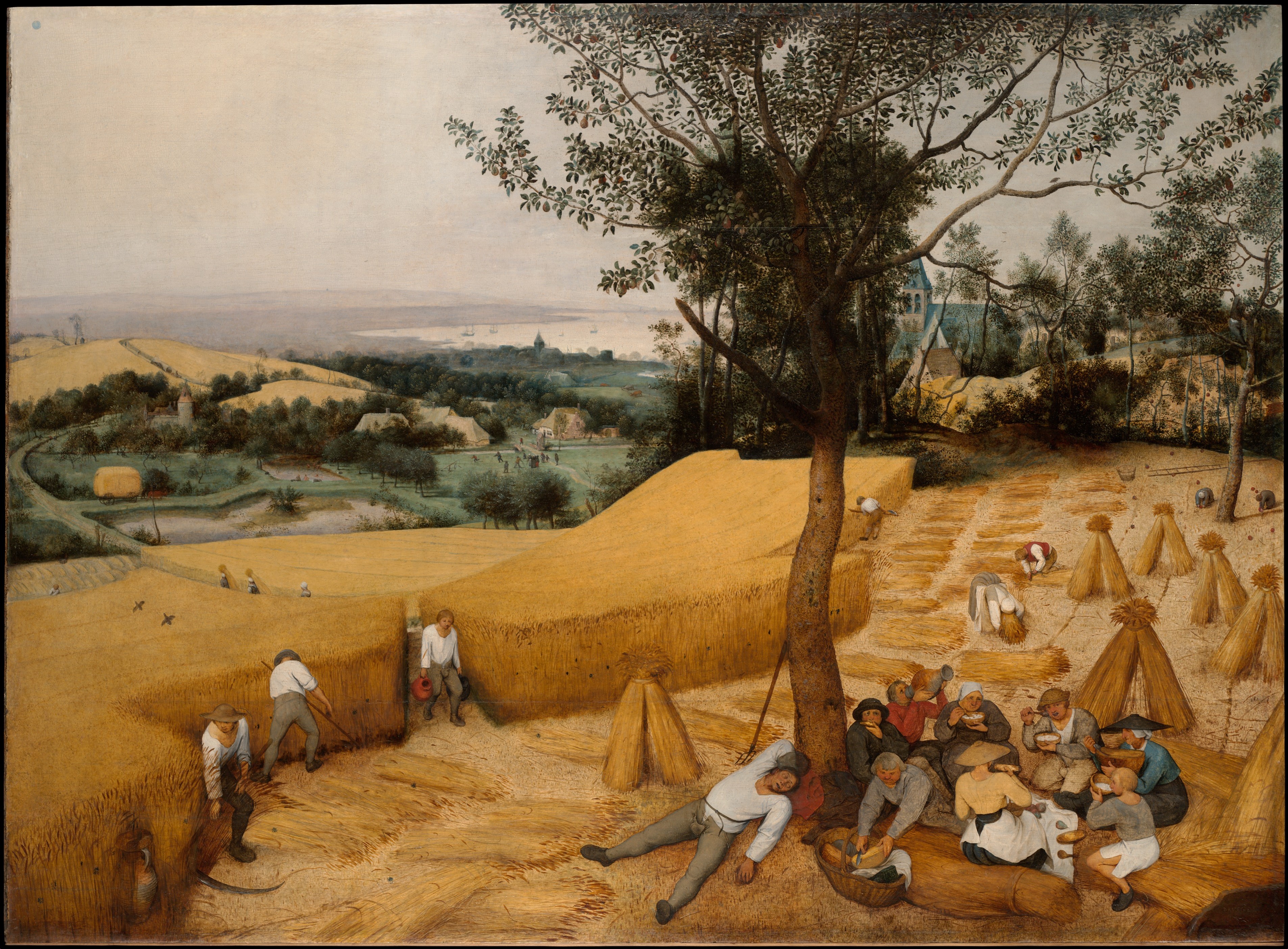
The record subject. Oil on oak, original painted surface 116.5 x 159.5 cm, signed and dated 1565. The Metropolitan Museum of Art, 19.164, published by the museum as open access.
| Artist | Pieter Bruegel the Elder |
|---|---|
| Date | 1565 |
| Medium | Oil on oak |
| Dimensions | Overall, including added strips at top, bottom and right, 119 x 162 cm (46 7/8 x 63 3/4 in.); original painted surface 116.5 x 159.5 cm (45 7/8 x 62 7/8 in.) |
| Where it is now | The Metropolitan Museum of Art, New Yorklast confirmed 4 August 2026 |
| Inventory number | 19.164 |
| Attribution | AcceptedNot in question. Full note |
| Object type | Painting |
| Period | Netherlandish, sixteenth century |
| Cases | Has a provenance gap |
| Inscriptions | Signed and dated at the lower left edge: BRVEGEL / [MD]LXV. Recovered when the panel was cleaned after the 1919 purchase and now largely illegible. |
| Owners on record | 11 links9 documented, 1 disputed, 1 unknown |
| Sources | 3 cited |
About this record Last verified 7 September 2026 · 3 sources cited · Change log
On this page 10 sections
ContentsClose
One panel of the most famous broken set in European painting. Bruegel painted a cycle of landscapes through the year in 1565 for the Antwerp merchant Niclaes Jongelinck; within a year the whole of Jongelinck's collection had been pledged to the city of Antwerp as security for somebody else's tax debt, and the document that records the pledge is the earliest thing anyone knows about these pictures. Three of the survivors are in Vienna, one is in Prague and this one is in New York.
Its route there runs through an archduke, an emperor, a Napoleonic general and a Paris couturier. In 1816 it was sold in Paris as the work of an unnamed master of the old German school, dated 1546, for ninety francs and eleven centimes. In 1919 the Metropolitan Museum bought it in a market flattened by the war, under dirt and varnish, and found the signature when it cleaned it.
Provenance
Each link is graded. Documented: a cited source supports it. Disputed: the identification is argued but not established. Unknown: no owner for that span, and the gap is not smoothed into a narrative. The grades in the glossary.
- 1565 - 1566Niclaes Jongelinck, Antwerpdocumented
The cycle was made for Jongelinck, probably for his suburban house outside Antwerp, and possibly as part of a decorative programme that also included Frans Floris's Seven Liberal Arts and Labours of Hercules and Jacques Jonghelinck's Seven Planets. On 21 February 1565 by the old calendar, that is 1566 by the new, a document in the Antwerp city archives records that Jongelinck's art collection was pledged as collateral for the tax arrears owed to the city by Daniel de Bruyne. It names sixteen pieces by Bruegel and singles out the Tower of Babel, the Carrying of the Cross and the Twelve Months. Bruegel had signed the panels in 1565; within a year they had been pledged against another man's debt.1
- 1566 - 1594Unclear; the pledge and the city's later possession are not bridged by a document consulted hereunknown
The city of Antwerp held the collateral, and by 1594 the paintings were on the market with a dealer named Hane van Wijke. What happened in between, and whether de Bruyne's debt was ever settled, is not established in the sources consulted.1
- 1594 - 1594Hane von Wijke, Antwerpdocumented
An Antwerp city archive document of 1594 records the purchase of six paintings from Hane van Wijke for 1,400 florins, together with tapestries from the Brussels weaver Merten Reynbouts for 8,550 florins, to be presented as a gift. The tapestries cost six times the Bruegels.1
- 1594 - 1595Archduke Ernst, governor of the Netherlands, Brusselsdocumented
Blasius Huetter, the archduke's secretary, entered in the account book on 5 July 1594 that the Antwerp city fathers presented Ernst with eight tapestries and six paintings representing the twelve months. Ernst died the following year; the posthumous inventory of 17 July 1595 lists the pictures as nos. 7 to 12, six panels of the twelve months of the year by Bruegel. This is the last document in which six of them are together.1
- 1595 - 1612Emperor Rudolf II, Praguedocumented
The panels passed to Rudolf II and were in Prague until his death in 1612.1
- 1612 - 1662Archduke Leopold Wilhelm, governor of the Netherlands, Brussels and Viennadocumented
His inventory of 1659 lists them as nos. 582 to 586: five large pieces showing the times of the year, in oils on wood, originals by the old Bruegel. Five, not six. One panel disappears between 1595 and 1659 and has never been identified.1
- 1662 - 1809Emperor Leopold I and the Imperial collection, Viennadocumented
In the imperial collection in Vienna until 1809. The other survivors are in Vienna still.1
- 1809 - 1816Comte Antoine-Francois Andreossy, Vienna and Parisdocumented
Andreossy was a French general and diplomat who was in Vienna in 1809, the year Napoleon occupied the city. The Met records only that the panel was his from 1809. How a picture left the imperial collection in the year of the occupation, and under what authority, is not stated in the sources consulted, and this record does not fill the gap with a plausible sentence.1
- 1816 - before 1912Unrecorded, then Jacques Doucet, Parisdisputed
Sold at the Andreossy sale, Perignon, Paris, 11 March 1816, lot 1, for 90 francs 11 centimes, catalogued as by a master of the old German school and dated 1546. The buyer at that sale is not named in the Met's provenance. The panel is next recorded with the couturier and collector Jacques Doucet in Paris, who sold it to Cels shortly before 1912. Whether Doucet bought it at the 1816 sale is impossible, and who held it in the intervening ninety-odd years is unrecorded.1
- before 1912 - 1919Paul Jean Cels, Brusselsdocumented
Bought from Doucet and sold to the Metropolitan Museum in 1919.1
- 1919 - presentThe Metropolitan Museum of Art, New Yorkdocumented
Rogers Fund, accession 19.164. The Met's own catalogue entry describes the sale price as extraordinarily low, and attributes that partly to an art market that had virtually collapsed during the First World War and partly to the state of the panel, which was hidden beneath accumulated dirt, discoloured varnish and unsightly restorations along the cracks at the joins. The museum records that the work may not be lent.12
Prices realised
The two other transactions in this object's history were private and carry no hammer price: the sale by Jacques Doucet to Paul Jean Cels shortly before 1912, and the sale by Cels to the Metropolitan Museum in 1919. The Met describes the 1919 price as extraordinarily low but does not publish it. Separately, two later versions of this composition by Pieter Bruegel the Younger have appeared at Christie's in London, one in 1981 and one in 2012; neither is by the elder Bruegel, and prices for them are prices for the son. Anyone valuing this panel from database comparables will be pricing the wrong painter.
| Date | Sale | Estimate | Result | Note |
|---|---|---|---|---|
| 11 March 1816 | Perignon, Paris The Andreossy sale, lot 1 | Not published in the sources consulted | Hammer FRF 90.11 (ninety francs eleven centimes) With premium None. No buyer's premium existed at a Paris auction in 1816; the figure is the price. French francs | The catalogue described the lot as by a master of the old German school, a landscape of the greatest detail showing the labours of the harvest, 58 by 44 pouces, and dated 1546. Every element of that description except the subject is wrong: the painter was Netherlandish, he was one of the most famous names of the previous century, and the date on the panel is 1565. This is the cheapest documented price in the object's history and it is cheap because nobody in the room knew what it was. |
Hammer is the price at which the bidding stopped; with premium adds the fee the house charges the buyer on top. Hammer price and buyer's premium in the glossary.
Technical evidence
| Attribution note | Not in question. When the Metropolitan Museum bought the panel in 1919 it was buried under dirt, discoloured varnish and restorations along the cracks at the panel joins, and the curator Bryson Burroughs bought it on judgement. Cleaning recovered the signature and date at the lower left edge, BRVEGEL / MDLXV, now largely illegible again. What remains genuinely contested is not the hand but the shape of the series the panel belongs to: how many pictures there were, which months each covered, and whether the missing one is lost or has been hanging in Vienna under another title all along. |
|---|---|
| Support | Four oak planks with the grain horizontal, three joins originally held by four dowels each, visible in the x-radiograph.1 |
| Dendrochronology | Earliest possible creation date 1550, more plausibly from 1556 onwards. The wood originated in the Baltic and Polish region, and two of the boards came from the same tree.1 |
| Original edges | Only the left edge is original, shown by a narrow unpainted margin and a barbe likely formed by a channel-edge support rather than an engaged frame. The top, right and bottom were each trimmed by roughly 1.3 to 1.9 cm.1 |
| Later alterations | Before entering the Met the panel was planed to 0.5 cm, a 1.9 cm strip was added at the bottom and a cradle was applied. In a 1998 treatment the cradle was removed, the joins and several splits repaired, a spring-mechanism strainer fitted, and strips averaging 1.3 cm added to the top and right edges.1 |
| Preparation | Off-white ground primed with a lead white layer whose broad strokes show in the x-radiograph. The imprimatura was not sampled and does not appear to be coloured.1 |
| Underdrawing | Extensive, in a dry medium, revealed by infrared reflectography and now largely visible to the naked eye as the oil has grown translucent. The lines break over the ridges of the priming, proving Bruegel drew on top of the imprimatura.1 |
| Late changes in paint | The falling hat was painted over the finished sleeve and has become transparent. The dead branches above the sleeping man and the eating group have no underdrawing and were added in paint at a late stage.1 |
| Signature | BRVEGEL / [MD]LXV at the lower left edge, recovered on cleaning after 1919 and now largely illegible.1 |
| Open access | The Metropolitan Museum publishes the primary photograph of this painting as open access under CC0, verified against the museum's own isPublicDomain flag at fetch time. Ten additional images are published for the same object.2 |
Images
The record in full
Chapter 1What it is
Oil on four planks of oak, laid with the grain running horizontally, joined and originally dowelled, measuring 116.5 by 159.5 centimetres of original painted surface.
Oil on four planks of oak, laid with the grain running horizontally, joined and originally dowelled, measuring 116.5 by 159.5 centimetres of original painted surface. A wheat field in the heat of the day, cut on the left, standing on the right, with a path driven through it. Under a pear tree in the middle a group has stopped to eat; one man lies on his back with his legs apart and his hat falling off, asleep or drunk. Beyond them the land drops away to a village, a church, an estuary and ships.
There is no story and no saint. That is the point of the picture and it is why it is usually called the beginning of European landscape painting as a subject in its own right. What Bruegel put in the middle of the field is a jug of beer or water, cooling in the wheat, and a man with a scythe looking at it.
One thing in the picture cannot be explained. At the upper left there is a blue sphere. The Met's catalogue entry sets out why it is not the harvest moon, which comes near the autumn equinox and could not stand that high in the sky at noon, and why it is not a solar eclipse, since the disc is not black, there is no corona, the landscape is not darkened and nobody in the field has looked up. The museum's position is that it is an enigma and may simply be the sun veiled by the haze of a late-summer midday. Recording the enigma is more useful than resolving it.
Chapter 2Made for a merchant, pledged against a tax debt
The cycle was painted in 1565 for Niclaes Jongelinck, an Antwerp merchant who had also bought Frans Floris's Seven Liberal Arts and Labours of Hercules and a set of Seven Planets by the sculptor...
The cycle was painted in 1565 for Niclaes Jongelinck, an Antwerp merchant who had also bought Frans Floris's Seven Liberal Arts and Labours of Hercules and a set of Seven Planets by the sculptor Jacques Jonghelinck. Several scholars have argued the four commissions were meant to work together as one programme in his suburban house.
What survives from that moment is not a contract. It is a document in the Antwerp city archives dated 21 February 1565 by the old calendar, which is 1566 by ours, recording that Jongelinck's whole art collection was pledged as collateral for tax arrears owed to the city by Daniel de Bruyne. It names sixteen pieces by Bruegel and singles out three: the Tower of Babel, the Carrying of the Cross and the Twelve Months.
So the earliest evidence for the greatest landscape cycle of the sixteenth century is a security instrument for somebody else's unpaid tax. The pictures were painted, signed, hung and encumbered inside twelve months. Every later dispute about the series turns on the two Dutch words in that document, de Tweelff maenden, the twelve months, and on whether they describe twelve panels or one subject.
Chapter 3Six or twelve, and how many are left
The question is not academic. If there were twelve panels, seven are missing.
The question is not academic. If there were twelve panels, seven are missing. If there were six, one is.
Gustav Gluck argued in 1932 that the five known works belonged to an incomplete series of twelve, and changed his mind in 1936. Charles de Tolnay had proposed in 1934 that the cycle was six pictures, each covering two successive months, and most recent scholarship follows him: not more than six could ever have existed. Fritz Grossman reverted to twelve in 1955, observing that calendar series always begin in January even where the official year began at Easter.
Two documents decide it as far as anything does. The 1594 Antwerp record and Blasius Huetter's account-book entry of 5 July 1594 both say six paintings representing the twelve months. The posthumous inventory of Archduke Ernst in 1595 lists six panels of the twelve months of the year by Bruegel, as nos. 7 to 12. The inventory of Archduke Leopold Wilhelm in 1659 lists five. One panel is lost between those two dates and no other picture has ever surfaced that could belong to the series or be a copy of a lost member of it.
If the cycle was six, it is among the earliest calendar series to divide the year into six parts rather than twelve. Not the only one: Novotny pointed in 1948 to a contemporary Months by Marten van Cleve in which the months are paired, and Huetter recorded the archduke buying six pictures of the seasons from a Namur painter, Jean Sayve, in February 1594.
Chapter 4Which months this one is
Even the title is contested. Tolnay, starting the year atypically at December and January, made this panel August and September.
Even the title is contested. Tolnay, starting the year atypically at December and January, made this panel August and September. Gluck, following the calendar of the Spanish Netherlands and starting at March and April, made it July and August. Robert Delevoy, Claessens and Rousseau, and the 1991 Vienna catalogue follow Gluck. A late sixteenth-century drawing after this composition ascribed to Pieter Balten, in the Kupferstichkabinett in Berlin, is inscribed Der Monat Juli.
Others reject the whole framework. Novotny, Genaille and Demus argue that this is not a clear-cut series of months at all but an extended cycle of the seasons, or in Genaille's phrase the characteristic moments of each season.
The drawing that supports Tolnay is a different one: Pieter Stevens's sheet in the Steiner collection in New York, published by Van Miegroet in 1986, comparable to The Gloomy Day and inscribed februarius and mert. Iain Buchanan followed Van Miegroet and Tolnay in 1990. The debate is now more than ninety years old and it turns on two inscribed drawings by other artists.
Chapter 5The missing panel, and a bold proposal about it
It is generally agreed that the missing picture showed March and April.
It is generally agreed that the missing picture showed March and April. Bruegel left a drawing of Spring in the Albertina in Vienna, inscribed by him De Lenten Meert April Meij, and the lost panel is usually assumed to have resembled it at least in subject. His second drawing for that series, Summer, in the Hamburg Kunsthalle, is a harvest scene with elements in common with this painting but a quite different composition; Hans Bol completed Autumn and Winter and Hieronymus Cock published the four as an engraved series of the Four Seasons in 1570.
Reindert Falkenburg made a different proposal in 2017, and the Met's own curator reports it and then declines it. Falkenburg suggests the lost painting may not be lost: that it is the Procession to Calvary in the Kunsthistorisches Museum in Vienna, which drifts in and out of the same inventories as the Seasons panels, and that it represents the pivotal event in the history of salvation which the cycle is otherwise built around.
Maryan Ainsworth, writing the Met's entry, calls that a bold leap open for discussion and prefers a panel based on the Albertina Spring drawing. Both positions are set out here because the disagreement is between named scholars in print, and arbitrating it is not this record's business.
There is a related trap for anyone reading old inventories. Grossman, Demus and Buchanan agree that the paintings of the seasons listed in inventories of the Brussels palace in 1659, in the 1660s to 1690s and in 1732 must be either copies destroyed in the palace fire of 1731 or unrelated pictures. They are not these panels.
Chapter 6Where the wood came from, and what it proves
Dendrochronological analysis of the four planks gives an earliest possible creation date of 1550 and a more plausible one from 1556 onwards, which is consistent with the painted date of 1565.
Dendrochronological analysis of the four planks gives an earliest possible creation date of 1550 and a more plausible one from 1556 onwards, which is consistent with the painted date of 1565. Two of the four boards came from the same tree. The wood is from the Baltic and Polish region.
That last fact is not a curiosity. Antwerp painters worked on oak shipped down from the eastern Baltic through the Hanseatic trade, and the timber trade is frequently the strongest dating and localisation evidence a Netherlandish panel has. The same analysis on the frames of the Met's van Eyck diptych ties that oak to the same part of the eastern Baltic as a panel now in Williamstown. A supply chain running from a Polish forest to an Antwerp workshop is doing evidential work here that no amount of connoisseurship could do.
Chapter 7Cut down, planed, cradled and put back
The panel is not the size Bruegel made it, and it has been through more physical intervention than almost anything else the Met holds from the century.Only the left edge survives as an original edge...
The panel is not the size Bruegel made it, and it has been through more physical intervention than almost anything else the Met holds from the century.
Only the left edge survives as an original edge, identifiable by a narrow unpainted margin and a barbe, and the Met's conservators note that the barbe was probably formed by a channel-edge support rather than an engaged frame. The top, right and bottom were all trimmed, by somewhere between 1.3 and 1.9 centimetres each, judging from the other panels of the series. Half an inch off the top left the blue sphere so close to the edge that a frame shadow nearly hid it; the cropping at the right bisected a bending figure.
At some point before the picture reached New York the oak was planed down to five millimetres, a strip nineteen millimetres deep was added at the bottom and a cradle was fixed to the back. In 1998 the Met removed the cradle, repaired three joins and several splits, and fitted a strainer with a spring mechanism to let the wood move. It kept the old bottom strip and added strips averaging thirteen millimetres to the top and right, which is why the tombstone quotes two sets of dimensions and why the larger of them is not a measurement of anything Bruegel painted.
Chapter 8Watching him change his mind
Under the paint is an extensive underdrawing in a dry medium, probably black chalk, laid over an off-white ground and a lead white priming.
Under the paint is an extensive underdrawing in a dry medium, probably black chalk, laid over an off-white ground and a lead white priming. Because the oil has grown more translucent with age, much of it can now be seen with the naked eye.
Bruegel drew the composition freely and fast, repeating contours two or three times as he hunted for a position, exaggerating the hunched shoulder of the labourer at lower left and scribbling the sprawled figure at the centre into place. He even planned where the birds would go in the sky. The lines break slightly where they cross the ridges of the priming, which proves he drew on top of the imprimatura rather than under it.
Two late changes carry the argument about what the picture means. The hat falling from the sleeping man's head was painted over his finished sleeve at a late stage and has grown transparent, so the sleeve now shows through it. And the dead limbs hanging over both the sleeper and the group eating their meal have no underdrawing at all; Bruegel added them in paint alone, late, directly above the figures.
Chapter 9Sloth, diligence, and a jug of beer in the wheat
Three readings of the picture are in play and the physical evidence bears on two of them.Bertram Kaschek reads the man with the scythe as about to destroy the vessel cooling in the wheat, an...
Three readings of the picture are in play and the physical evidence bears on two of them.
Bertram Kaschek reads the man with the scythe as about to destroy the vessel cooling in the wheat, an apocalyptic shock breaking in on the people resting. The Met's entry counters him with the underdrawing: Bruegel adjusted the scythe-man's pose but was consistently definite about his line of sight, and took care not to pull the hat down over his eyes, so that he looks straight at the jug. A labourer eyeing the drink he is about to be allowed is not an angel of judgement. Two later versions by Pieter Bruegel the Younger, sold at Christie's in London in 1981 and 2012, leave the vessel out altogether, which suggests his son did not read it as load-bearing either.
Lyckle de Vries reads the picture as an opposition of sloth and diligence, supported by proverbs and by biblical warnings against laziness. Here the physical evidence supports the reading: the dead branches were added late, in paint, directly over the sleeping man and the eaters. A tree withers for want of water as a man is paralysed by idleness, and Bruegel put the branches in after the fact, as if fine-tuning the moral.
Falkenburg reads the whole cycle as the presence of God in the created world, to be found by a viewer who looks closely: the fallen apples in the right background, the partly barren pear tree in the foreground recalling the tree in Eden and the fruit of the Virgin's womb, the natural year running beneath the history of salvation. The Met's entry sets out all three and observes that they could have coexisted, offering the wealthy, educated visitors to Jongelinck's country house something to argue about over the meal. That is very likely what the pictures were for.
Chapter 10Ninety francs, and a hundred and three years
The Andreossy sale at Perignon in Paris on 11 March 1816 offered the panel as lot 1: by a master of the old German school, a landscape of the greatest detail showing the labours of the harvest, dated...
The Andreossy sale at Perignon in Paris on 11 March 1816 offered the panel as lot 1: by a master of the old German school, a landscape of the greatest detail showing the labours of the harvest, dated 1546. It made 90 francs 11 centimes.
Nothing in that catalogue line is correct except the subject. The nationality is wrong, the date is nineteen years out, and the painter, far from anonymous, is one of the most reproduced names of the previous century. This is what a cataloguing failure costs, expressed in money: a Bruegel from the imperial collection sold for less than the price of a good clock because the room did not know what it was looking at.
A hundred and three years later the Metropolitan Museum bought it from Paul Jean Cels for a price its own curators describe as extraordinarily low, in a market flattened by the First World War, with the picture still under dirt, discoloured varnish and clumsy restoration along the joins. Bryson Burroughs took the risk and was right. The signature and the date came up when the panel was cleaned.
Chapter 11Afterlife
Copies and versions exist and they are the standing hazard for anyone matching a photograph to this record.
Copies and versions exist and they are the standing hazard for anyone matching a photograph to this record. A late sixteenth-century drawing after the composition ascribed to Pieter Balten is in the Kupferstichkabinett in Berlin as no. 13220, titled Der Monat Juli. Two painted versions by Pieter Bruegel the Younger, closely based on this panel, passed through Christie's in London in 1981 and 2012. A small copy on copper by an anonymous Flemish painter belonged to the Met itself until 1978, when it was deaccessioned and sold at Parke-Bernet, having carried another attribution for many years.
The picture's fame in New York is a twentieth-century construction and one witness to it is unexpected. Lillian Ross, profiling Ernest Hemingway in the New Yorker of 13 May 1950, recorded his comments in front of this painting; he admired the geometric handling of the grain.
The Met does not lend it. The object record carries the line in capitals. A panel of four planed oak boards, trimmed on three sides, cradled and uncradled, is not a travelling picture, and the other survivors of the cycle in Vienna are subject to the same reasoning. The set has not been reassembled and, on present conservation policy at both museums, will not be.
The artist
Pieter Bruegel the Elder
Bruegel is a painter whose reputation has been repeatedly rebuilt on the wrong foundations: first as a peasant comedian, then as a moralist, then as a proto-ethnographer. What the Metropolitan Museum's own research on this panel establishes is narrower and more useful. He travelled, he drew relentlessly, he learned manuscript illumination and tapestry design from people in his own family and his own city, and he composed his landscapes by drawing freely on the panel and then correcting himself in paint. The Seasons are his only undisputed painting series, and they were made at the end of a long apprenticeship in other media.
Related works
| Work | Relation | Where it is |
|---|---|---|
| Hunters in the Snow Pieter Bruegel the Elder | Panel from the same 1565 cycle One of three from the series in Vienna. | Kunsthistorisches Museum, Vienna |
| The Gloomy Day Pieter Bruegel the Elder | Panel from the same 1565 cycle Compared by Van Miegroet in 1986 with a Pieter Stevens drawing inscribed februarius and mert, which is the main support for Tolnay's month scheme. | Kunsthistorisches Museum, Vienna |
| The Return of the Herd Pieter Bruegel the Elder | Panel from the same 1565 cycle The third Vienna panel. | Kunsthistorisches Museum, Vienna |
| Haymaking Pieter Bruegel the Elder | Panel from the same 1565 cycle The only member of the series outside Vienna and New York. | Lobkowicz Collections, Prague |
| Spring Pieter Bruegel the Elder | Drawing thought to indicate the subject of the missing panel Inscribed by the artist De Lenten Meert April Meij. Engraved with Summer and with Hans Bol's Autumn and Winter as a Four Seasons series published by Hieronymus Cock in 1570. | Albertina, Vienna |
| The Procession to Calvary Pieter Bruegel the Elder | Proposed by Falkenburg in 2017 as the missing member of the cycle; the proposal is contested Appears in several of the same inventories as the Seasons panels. Maryan Ainsworth calls the identification a bold leap and prefers a lost panel based on the Albertina Spring drawing. | Kunsthistorisches Museum, Vienna |
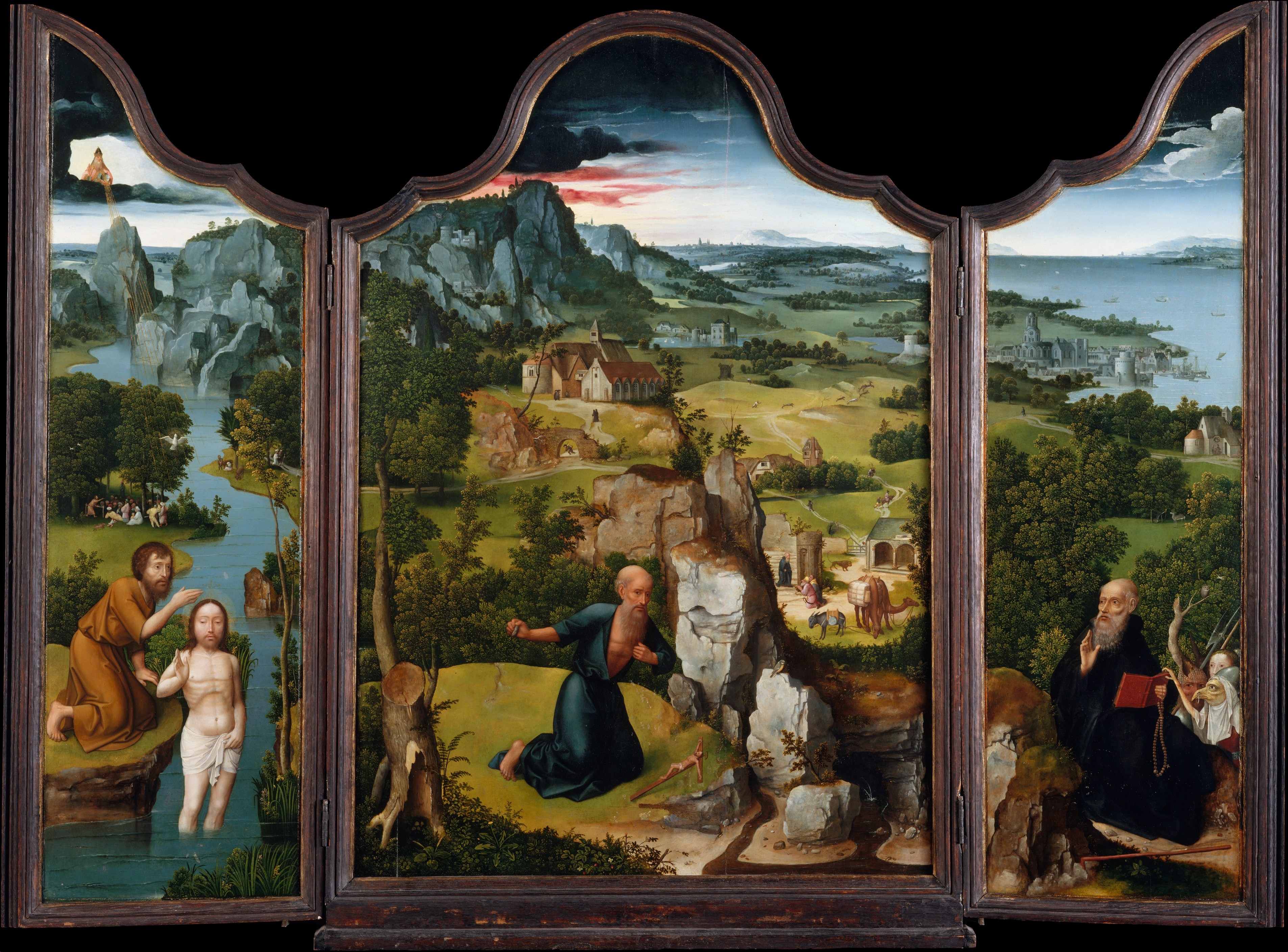
| The Penitence of Saint Jerome Joachim Patinir | The landscape tradition the Seasons depart from The Met's entry contrasts Patinir's airless, seasonless vistas with Bruegel's humid noon. | The Metropolitan Museum of Art, New York, 36.14a-c |
Open questions
- Did the cycle consist of six panels or twelve? The Antwerp document of 1565-66 says the twelve months; the 1594 and 1595 records say six paintings of the twelve months; scholarship has changed sides repeatedly since 1932.
- What became of the sixth panel? It is present in the 1595 inventory of Archduke Ernst and absent from the 1659 inventory of Archduke Leopold Wilhelm, and no candidate, copy or derivative has ever surfaced.
- Which two months does the Met's panel represent? Tolnay says August and September, Gluck says July and August, and a Berlin drawing after it is inscribed for July alone.
- How did the panel leave the imperial collection in Vienna in 1809, the year of the French occupation, and reach comte Andreossy? The Met's provenance records the change of ownership without a mechanism.
- Who bought lot 1 at the Perignon sale of 11 March 1816, and where was the panel between then and Jacques Doucet? Nearly a century is unaccounted for.
- What did the Metropolitan Museum pay Paul Jean Cels in 1919? The museum's own entry calls the price extraordinarily low but does not give it.
- What is the blue sphere at the upper left? The Met has ruled out the harvest moon and a solar eclipse and states that it remains an enigma.
Questions about this object
What is The Harvesters?
The Harvesters is a painting, dated 1565. Medium: Oil on oak.
Who made The Harvesters, and is the attribution settled?
The attribution to Pieter Bruegel the Elder is recorded here as accepted. Not in question. When the Metropolitan Museum bought the panel in 1919 it was buried under dirt, discoloured varnish and restorations along the cracks at the panel joins, and the curator Bryson Burroughs bought it on judgement. Cleaning recovered the signature and date at the lower left edge, BRVEGEL / MDLXV, now largely illegible again. What remains genuinely contested is not the hand but the shape of the series the panel belongs to: how many pictures there were, which months each covered, and whether the missing one is lost or has been hanging in Vienna under another title all along.
Where is The Harvesters now?
The Metropolitan Museum of Art, New York. Inventory number 19.164. Last confirmed 4 August 2026. Rogers Fund, 1919, bought from Paul Jean Cels, Brussels. The museum records that this work may not be lent.
What has The Harvesters sold for?
Hammer FRF 90.11 (ninety francs eleven centimes); with premium, None. No buyer's premium existed at a Paris auction in 1816; the figure is the price. Perignon, Paris, 1816-03-11.
What is still unknown about The Harvesters?
Did the cycle consist of six panels or twelve? The Antwerp document of 1565-66 says the twelve months; the 1594 and 1595 records say six paintings of the twelve months; scholarship has changed sides repeatedly since 1932.
Sources
- 1The Metropolitan Museum of Art, object record 435809, Pieter Bruegel the Elder, The Harvesters, accession 19.164. Consulted for the tombstone, the catalogue entry by Maryan W. Ainsworth (2023), the technical notes, the full provenance, the exhibition history, the notes and the bibliography, which supplies the Antwerp Tresorij document of 1565-66, Huetter's account-book entry of 5 July 1594, the 1595 and 1659 inventories, the Perignon catalogue of 1816, Hulin de Loo 1907, Gluck 1932 and 1936, Tolnay 1934, Novotny 1948, Held 1949, Ross's New Yorker profile of 1950, Grossman 1955, Van Miegroet 1986, Buchanan 1990, Falkenburg 2017 and Borchert, Sellinck and Meganck 2019. metmuseum.org/art/...
- 2The Metropolitan Museum of Art Open Access API, object 435809. Consulted for isPublicDomain, primaryImage, the count of additional images, medium, dimensions, artist dates, accession number and credit line. collectionapi.metmuseum.org/public/...
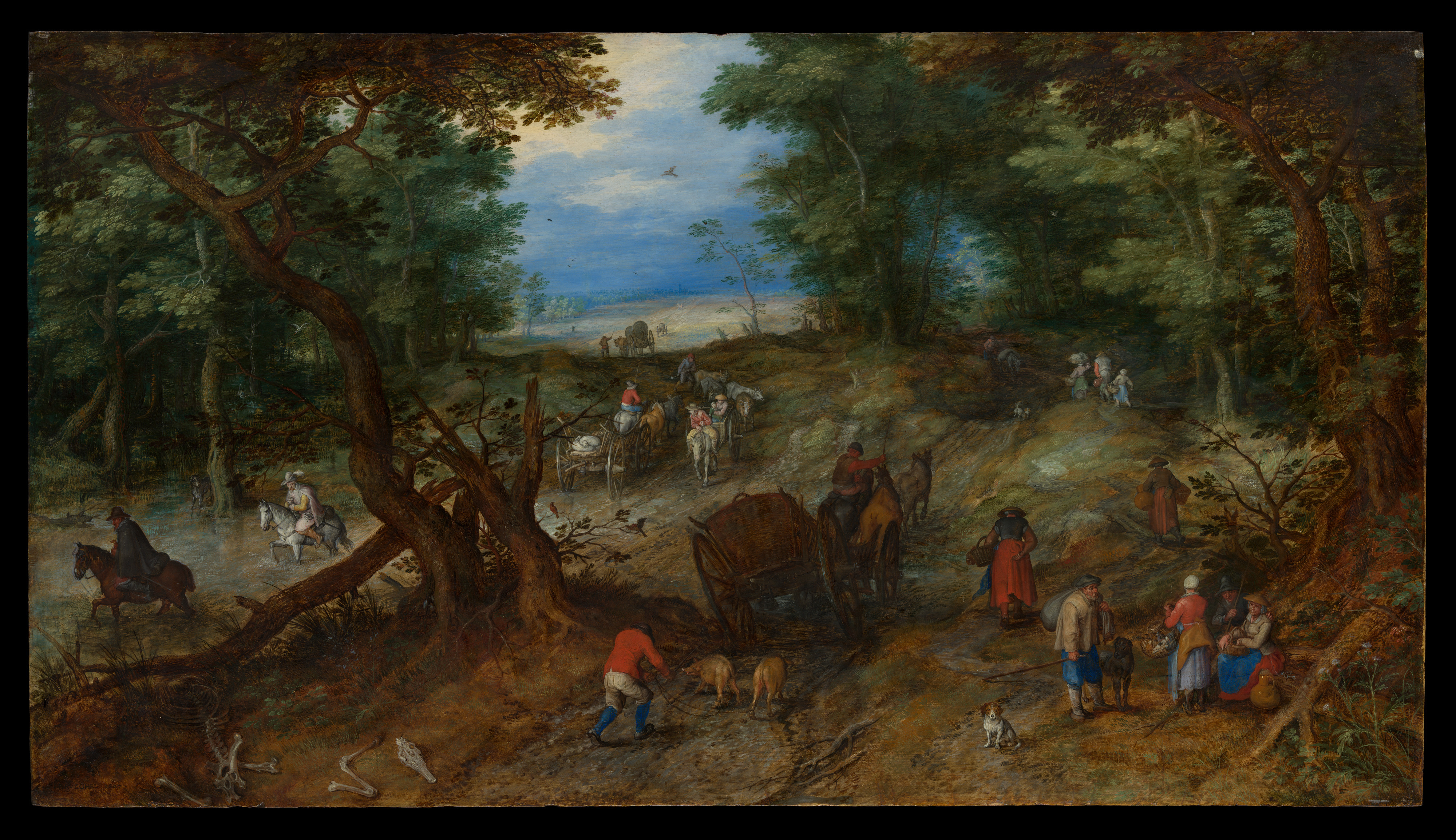
- 3The Metropolitan Museum of Art Open Access API, object 437261, Joachim Patinir, The Penitence of Saint Jerome, and object 435810, Jan Brueghel the Elder, A Woodland Road with Travelers. Consulted to verify open-access status and the tombstones of the two comparison plates. collectionapi.metmuseum.org/public/...
Last verified 7 September 2026 · Published 4 August 2026
Change log
4 August 2026 - Record created at the house standard: researched narrative, technical evidence, maker dossier, graded provenance chain, prices with hammer and premium separated, related works, open questions and sources.
7 September 2026 - Re-verified. No change to location, attribution or the open questions: still the Metropolitan Museum of Art, gallery 638, Rogers Fund 1919, object 19.164, still Public Domain per the Met's own object page. No new scholarship, technical study, loan, litigation or sale found addressing the six-versus-twelve-panel question, the identity of the missing sixth panel, the blue sphere, or the 1809-1816 gap in provenance. All three source URLs re-checked and resolve 200.