Attic Red-Figure Kylix with the Sack of Troy
Onesimos · c. 500-490 BC
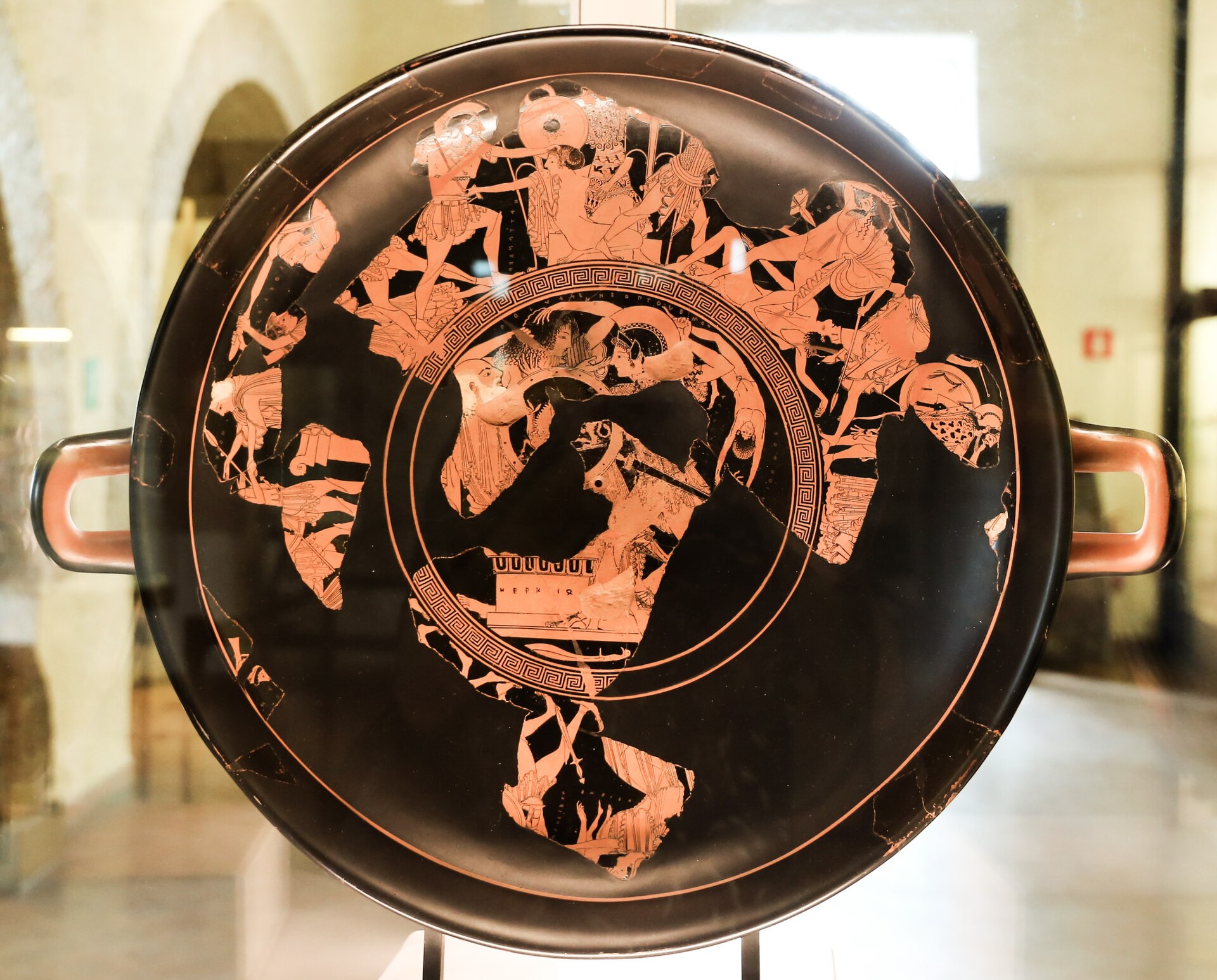
General view of the reassembled cup, potted by Euphronios and painted by Onesimos, as displayed at the Museo Archeologico Nazionale Cerite, Cerveteri.
Photograph by Sailko, via Wikimedia Commons · CC BY 3.0| Artist | Onesimos |
|---|---|
| Date | c. 500-490 BC |
| Medium | Attic red-figure terracotta, wheel-thrown and painted with a fired slip |
| Dimensions | Height c. 19-20.5 cm; diameter c. 46.5-46.6 cm; foot diameter c. 20.5 cm. Published figures vary slightly between the Commons/museum caption and the Beazley Archive/Perseus catalogue record; both are given in the technical section rather than silently reconciled. |
| Where it is now | Museo Archeologico Nazionale Cerite (National Archaeological Museum of Cerveteri), housed in the Rocca Ruspoli, Cerveteri, Italy, within the Parco Archeologico di Cerveteri e Tarquinialast confirmed |
| Inventory number | Beazley Archive Pottery Database no. 13363 (Para. 455.2). Former J. Paul Getty Museum accession 83.AE.362, with joining fragment groups accessioned separately as 84.AE.80 and 86.AE.385. Carried a Villa Giulia inventory number during its 1999-2014 display in Rome. |
| Attribution | AcceptedThe potter's signature EUPHRONIOS EPOIESEN (Euphronios made it) is incised on the cup, so the potter attribution is documented by autograph inscription. Full note |
| Object type | Antiquity |
| Period | Greek, Late Archaic (Attic red-figure) |
| Cases | Seized, looted or confiscated · Has a provenance gap |
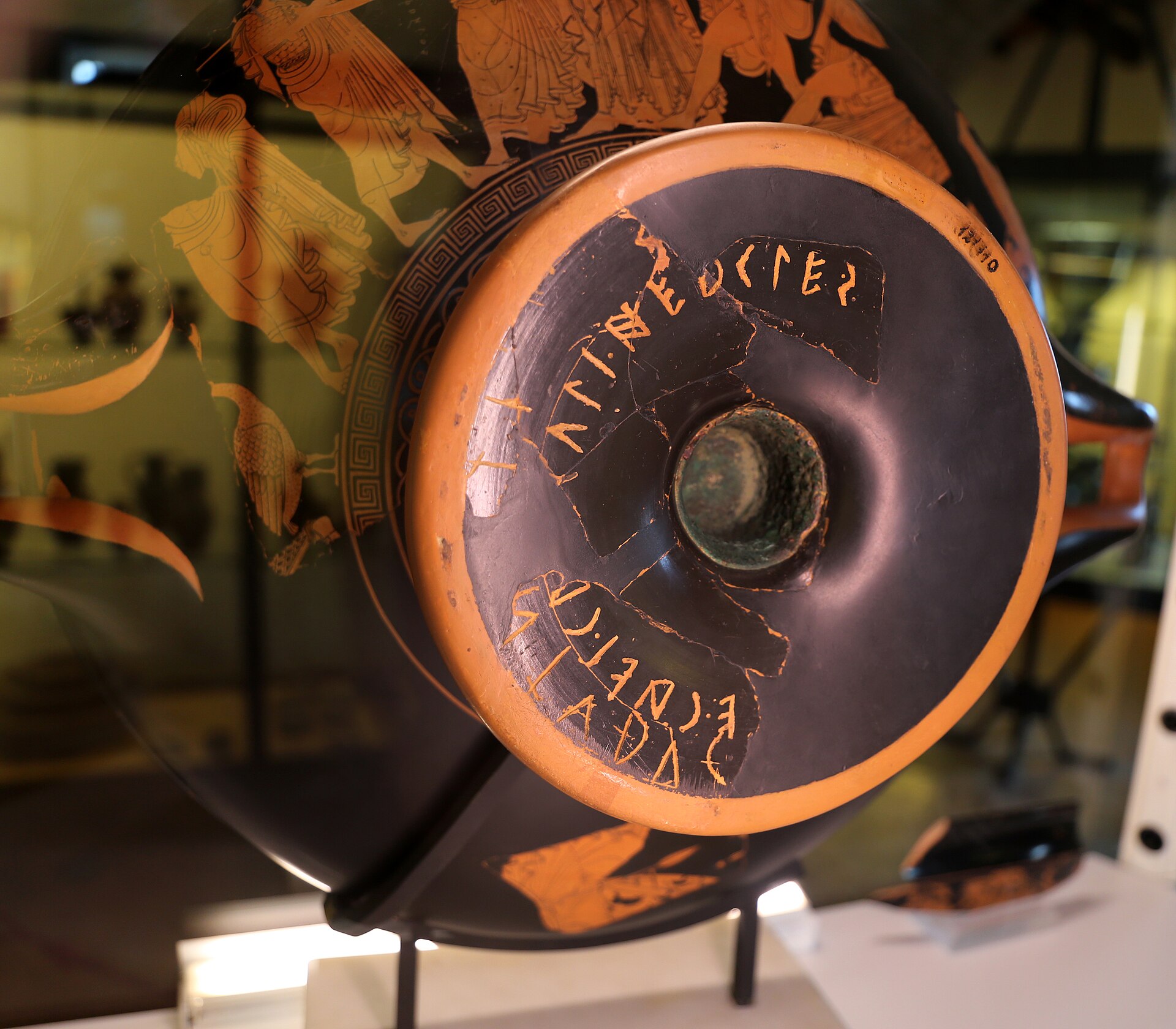
| Inscriptions | Potter's signature EUPHRONIOS EPOIESEN. A separate dedicatory inscription in the Caeretan Etruscan alphabet, addressed to the god Hercle, is incised under the foot. |
| Owners on record | 9 links8 documented, 1 unknown |
| Sources | 21 cited |
About this record Last verified · 21 sources cited · Change log
On this page 9 sections
ContentsClose
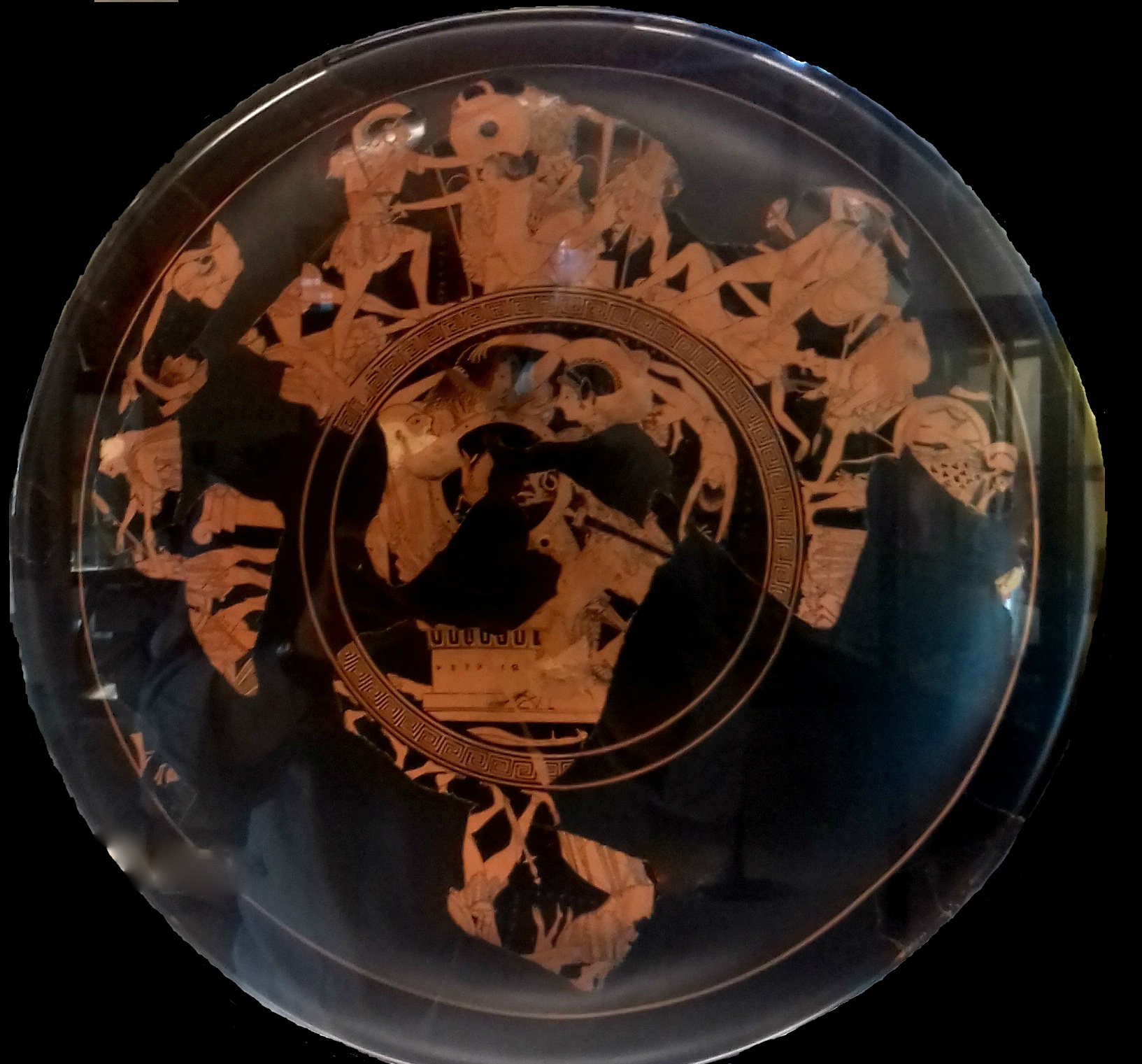
A large Attic red-figure kylix of about 500-490 BC, potted by Euphronios and painted by his presumed pupil Onesimos with nine scenes of the Ilioupersis, the sack of Troy, centred on the killing of Priam and the child Astyanax. Dug illegally from the Cerveteri area in the late 1970s or early 1980s, it was sold to the J. Paul Getty Museum in pieces across the 1980s through a chain of dealers built to launder its origin, including Giacomo Medici's network.
It was identified as looted through one of the most damning categories of evidence the antiquities trade has produced: a Polaroid photograph, seized from Medici's Geneva Freeport storerooms in 1995, showing a fragment of this exact cup still dirty from the ground. Confronted with that evidence by the Italian archaeologist Daniela Rizzo at a 1997 Viterbo conference, and facing further corroboration, the Getty returned the kylix to Italy in February 1999; Medici himself surrendered three more matching fragments two months later.
The cup is not the archive's other Euphronios-connected object. It is a different vessel, potted rather than painted by Euphronios, recovered and returned through an unrelated process, and now displayed at Cerveteri's Rocca Ruspoli rather than at the museum that holds the krater under a different chain of title.
Provenance
Each link is graded. Documented: a cited source supports it. Disputed: the identification is argued but not established. Unknown: no owner for that span, and the gap is not smoothed into a narrative. The grades in the glossary.
- c. 500-490 BC -Unrecorded original owner or dedicantdocumented
Potted by Euphronios and painted by Onesimos in Athens (documented by signature and by connoisseurship respectively). A later Etruscan hand added a dedicatory inscription to Hercle under the foot; Rizzo argues this points to a period of use at a sanctuary in the Sant'Antonio sacred area at Cerveteri. That specific placement is argued, not documented.91013
- unknown ancient date - late 1970s/early 1980sUnrecorded tomb or sanctuary context near Cerveteriunknown
No excavation permit, archaeologist's report or tomb inventory has surfaced in the sources consulted. Two different location clues exist (Sant'Antonio sanctuary per the inscription argument; Monte Abatone per Marion True's 1992 letter) and are not reconciled by the available sources.5910
- late 1970s/early 1980s - 1983-1989Giacomo Medici's trafficking network, including the Hydra Gallery (Christian Boursaud), Frieda Tchacos-Nussberger's Galerie Nefer (Zurich), Nino Savoca (Munich), and a claimed S. Schweitzer collection (Arlesheim)documented
Established through the Italian investigation of Medici (1995 raid, 1997 arrest, later conviction) and through Watson and Todeschini's published account, which reproduces Getty acquisition paperwork citing these names.12515
- 1983 - 1989J. Paul Getty Museum, Malibudocumented
The tondo group cost 180,000 dollars (from Tchacos); a further group cost 100,000 dollars (from the Hydra Gallery, 1985). No total price across all purchases is documented in the sources consulted.1418
- October 1997 - 1999Disputed between the Getty and the Italian statedocumented
Daniela Rizzo presented the case directly to Marion True at the Antichita Senza Provenienza conference, Viterbo, October 1997, backed by a Polaroid of dirty, unrestored fragments seized from Medici's Geneva storerooms in 1995 and by a physical fracture match.1356714
- 5 February 1999 - April 1999Republic of Italydocumented
The Getty's formal return, 5 February 1999, was one of three objects returned in that round. Medici surrendered three additional fragments in April 1999 that matched the Polaroid image, an act he attributed to love of country.1345
- 1999 - 2014Museo Nazionale Etrusco di Villa Giulia, Romedocumented
The cup was exhibited in Rome for fifteen years before its transfer to Cerveteri.891016
- 8 May 2014 - 20 July 2014Temporary loan to the Museo Archeologico Nazionale Cerite, Cerveteridocumented
Exhibition title reported as 'Euphronios' Cup: A World Heritage'.8
- 2015 - presentMuseo Archeologico Nazionale Cerite, Rocca Ruspoli, Cerveteridocumented
Displayed alongside the Euphronios Krater, a separate object with an unrelated recovery history, since 2015.91016
Technical evidence
| Attribution note | The potter's signature EUPHRONIOS EPOIESEN (Euphronios made it) is incised on the cup, so the potter attribution is documented by autograph inscription. The painting is unsigned; the attribution to Onesimos rests on connoisseurship, chiefly the argument set out by Dyfri Williams in 1991 and now standard in the literature. This is NOT the same Euphronios-connected object as this archive's Euphronios Krater. On the krater, Euphronios signed as painter (EGRAPHSEN) and Euxitheos as potter. On this kylix the roles reverse: Euphronios is the potter and Onesimos, his presumed pupil, is the painter. The two objects also have unrelated excavation and restitution histories and only share a holding city since 2015. |
|---|---|
| Shape | Kylix, Type C, drinking cup with a wide shallow bowl on a stemmed foot; counted among the earliest preserved examples of this specific cup type.13 |
| Fabric and technique | Attic terracotta, wheel-thrown, decorated in the red-figure technique with a fired black gloss slip.1320 |
| Dimensions (museum caption) | Height c. 20.5 cm; diameter c. 46.5 cm.19 |
| Dimensions (Beazley/Perseus catalogue) | Height c. 19 cm; diameter c. 46.6 cm; foot diameter c. 20.5 cm. Given alongside the museum caption's figures above rather than silently resolved, since the two do not agree.13 |
| Potter's signature | EUPHRONIOS EPOIESEN (Euphronios made it), incised in the potting.520 |
| Secondary inscription | A dedication to the god Hercle, incised under the foot in the Caeretan Etruscan alphabet, added after the cup left Athens.910 |
| Cataloguing | Beazley Archive Pottery Database no. 13363; Paralipomena (Para.) 455.2.13 |
| Former Getty accession numbers | 83.AE.362 (principal group), with additional joining fragment groups accessioned as 84.AE.80 and 86.AE.385, reflecting the piecemeal 1983-1989 acquisitions.18 |
| Condition | The cup survives as a reassembled composite of dozens of fragments acquired in separate batches across the 1980s; press accounts describe further small fragments recovered after the 1999 return, which this record could not independently verify. See open questions.1510 |
Images
The record in full
Chapter 1A drinking cup built to be looked into
The object is a kylix, a wide, shallow, two-handled cup for drinking wine, of the type scholars class as Type C, and an unusually large example of it: one of the earliest preserved cups of this exact...
The object is a kylix, a wide, shallow, two-handled cup for drinking wine, of the type scholars class as Type C, and an unusually large example of it: one of the earliest preserved cups of this exact shape. It stands roughly 19 to 20.5 centimetres tall and spans 46.5 to 46.6 centimetres across, figures that come from two different published sources and are given here as a range rather than reconciled to a false precision.
It was made in Athens around 500 to 490 BC, thrown on the wheel by the potter Euphronios and decorated in the red-figure technique, in which the background is painted in a glossy black slip and the figures are left in the reserved colour of the clay, with internal detail added in dilute glaze and, originally, added colour now mostly lost. A cup this size is not a modest household object. Its scale and the density of its decoration mark it as a display piece, made for a symposium where the drinker would tip it back and find a mythological scene waiting in the bowl.
Chapter 2The interior: nine scenes of one night
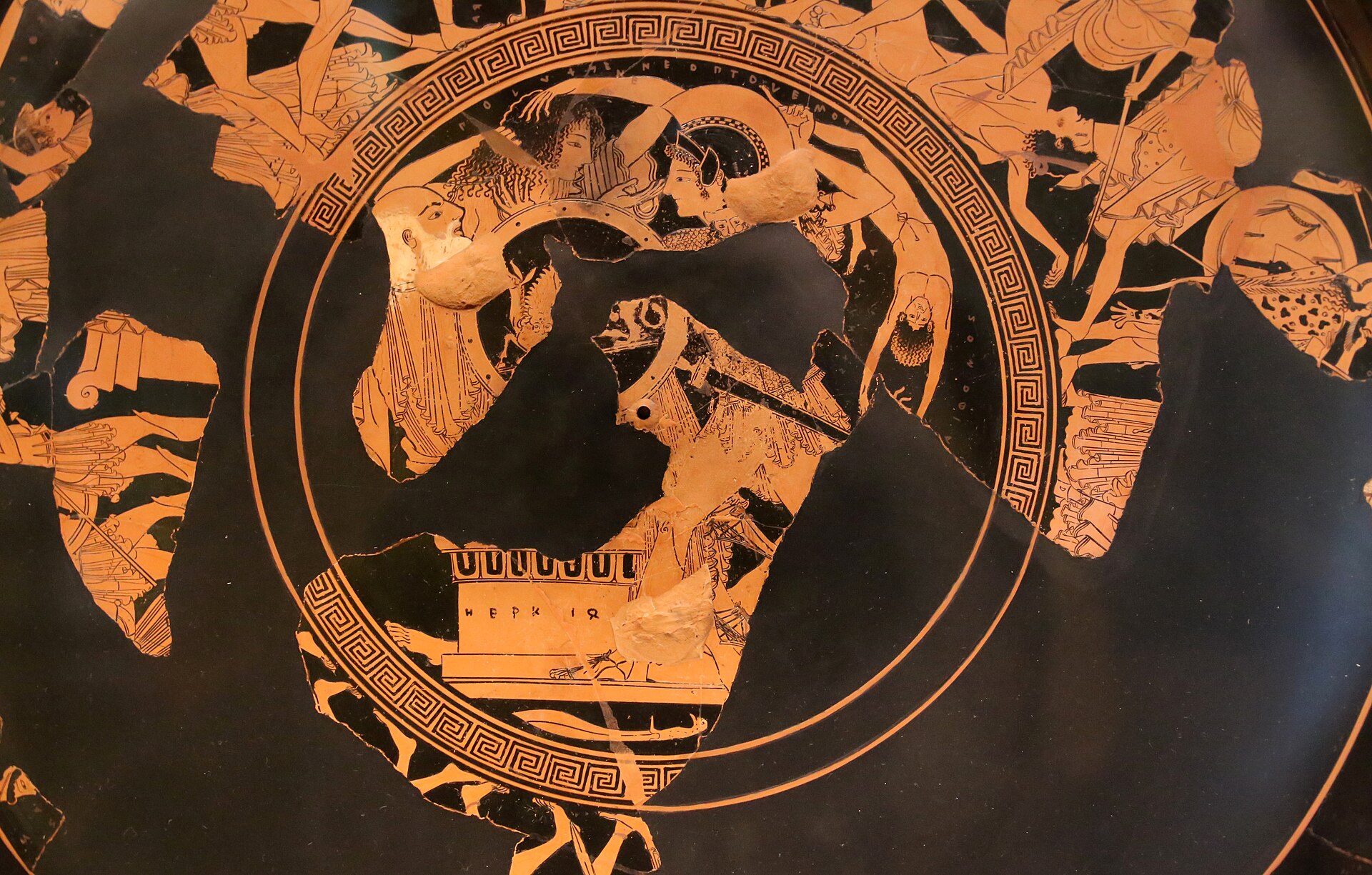
The tondo, the roundel at the centre of the interior, shows the killing of Priam.
The tondo, the roundel at the centre of the interior, shows the killing of Priam. The old king sits on an altar, draped and white-haired; Neoptolemos approaches from the right in a black helmet and scaled armour, using the body of the child Astyanax as a weapon against him. A woman stands between them, and a fallen warrior lies half-hidden by the altar while Polyxena, nearby, wields an object resembling a pestle. This is the single most quoted image of the fall of Troy in Attic vase painting, and it sits at the centre of a cup meant to be drained to reveal it.
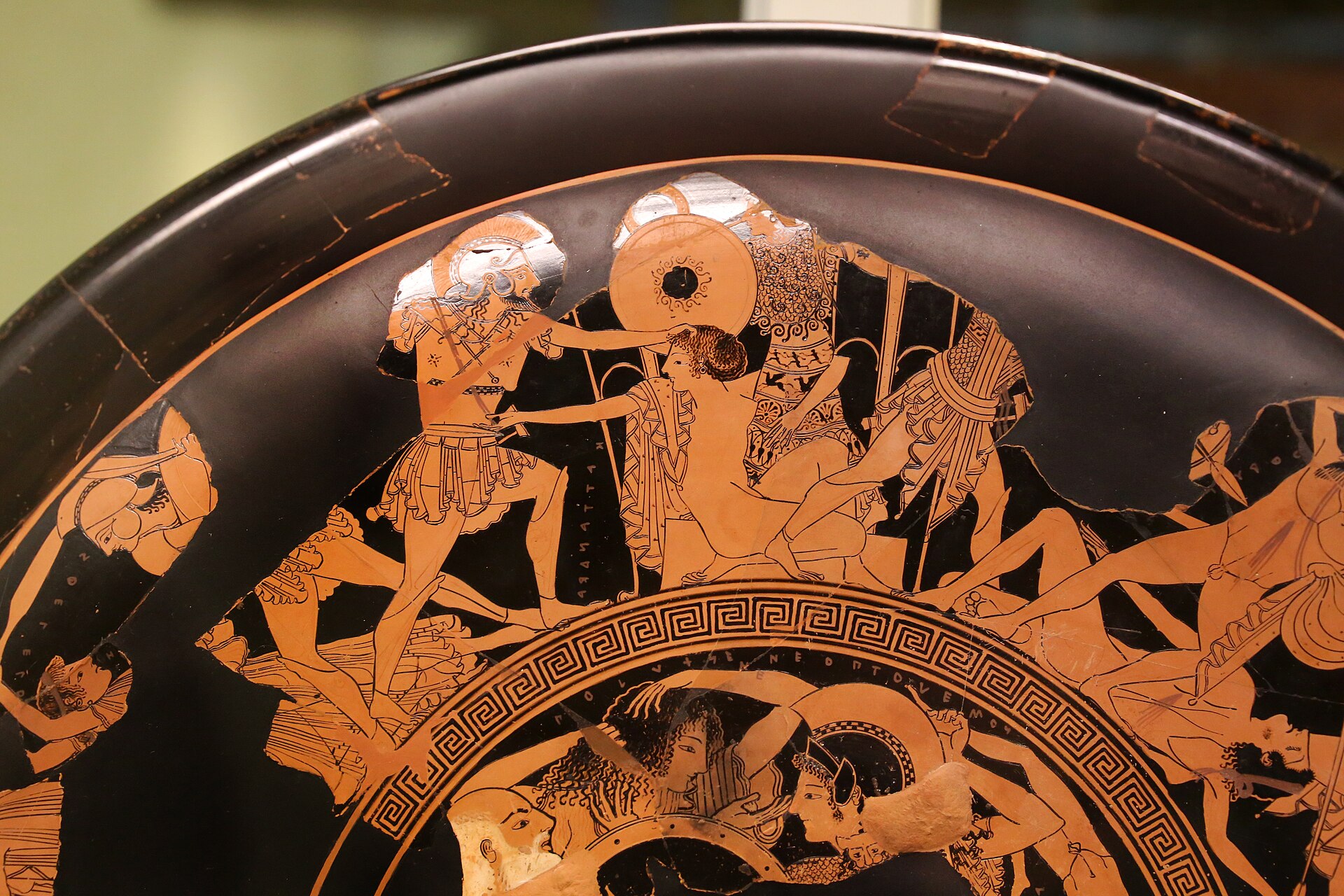
Around the tondo, in the surrounding zone, eight further scenes complete the night: the sons of Theseus, Akamas and Demophon, rescuing their grandmother Aithra; the lesser Ajax dragging Cassandra from the statue of the Palladion, an act of sacrilege inside a sanctuary; Menelaos confronting Helen, with Eros hovering between them; a Greek fighting two Trojans; a Greek warrior in an animal skin facing an old man and woman usually read as Antenor and Theano; and Stenelos attacking a woman armed with a pestle. Nine scenes in total decorate the single interior surface, a density of narrative that is itself part of the argument scholars make about the cup's meaning.
Dyfri Williams set out the first full account of this scheme in 1991, and Michael Anderson, writing in the Journal of Hellenic Studies in 1995, argued that the nine scenes are not simply a catalogue of sack-of-Troy incidents but a composition, arranged so that scenes of death, rescue and survival answer one another visually and thematically around the tondo. That is a scholarly argument, not a fact recovered from the object itself, and it is credited to the two named scholars who made it rather than presented as what Onesimos himself said he intended.
Chapter 3The exterior: what came before the sack
The outside of the cup carries a different moment in the story.
The outside of the cup carries a different moment in the story. One side shows Briseis being led away from Achilles's tent by Patroklos, with heralds following, among them Talthybios, and a scene of Thetis with Achilles; the other, more fragmentary, preserves part of a duel between Ajax and Hektor with Apollo intervening between them. Both belong not to the sack itself but to its causes and to the war that preceded it, the quarrel over Briseis that opens the Iliad and the single combats that punctuate it.
Read together with the interior, the cup moves from the causes of the Trojan War on the outside to its catastrophic end on the inside, a structure a drinker would experience in sequence: the wrath of Achilles on the surface, the fall of the city waiting inside the bowl.
Chapter 4Two hands, one signature
Only one name is actually written on the cup.
Only one name is actually written on the cup. EUPHRONIOS EPOIESEN, Euphronios made it, is incised in the potting, which is why the potter attribution is treated as documented rather than argued: it rests on an autograph inscription, not on style. The painting carries no signature. It is given to Onesimos on the basis of connoisseurship, the comparison of drawing style, figure types and technical habits against a body of cups where Onesimos's hand is independently established, chiefly through Williams's 1991 study. The workshop relationship between the two men is itself inferred rather than documented: a number of surviving cups pair Euphronios's potter signature with painting attributed to Onesimos, which is the evidentiary basis for the common description of Onesimos as Euphronios's pupil.
It matters to be precise about which role Euphronios holds here, because this archive already holds a separate record for a different vessel connected to him, the Euphronios Krater, where he signed as painter rather than potter. The two objects are not versions of each other and do not share a provenance chain, an excavation context, or a restitution history. They share a name, a rough period, and, since 2015, a display case in the same Italian museum.
Chapter 5An Etruscan hand adds a second inscription
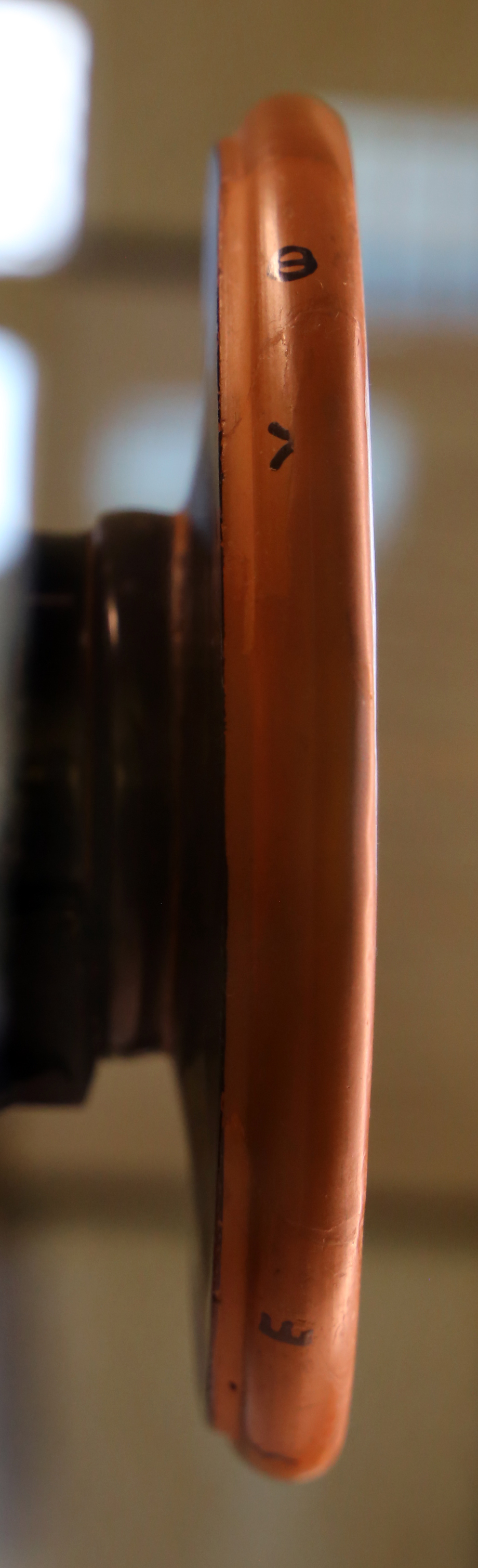
Under the foot, a second inscription was added later and by a different hand: a dedication to the god Hercle, the Etruscan Herakles, cut in the Caeretan alphabet used at ancient Caere, the city on...
Under the foot, a second inscription was added later and by a different hand: a dedication to the god Hercle, the Etruscan Herakles, cut in the Caeretan alphabet used at ancient Caere, the city on whose territory modern Cerveteri stands. The archaeologist M. A. (Daniela) Rizzo drew attention to this inscription and argued that it points to the cup's presence, at some point after it reached Etruria, at a sanctuary dedicated to Hercle identified through excavation in the sacred area of Sant'Antonio at Cerveteri, where two temples dated to the late sixth and early fifth centuries BC have been documented.
That is an argued conclusion, credited to Rizzo, not a certainty. It describes a documented pattern in Etruscan religious practice, in which imported Athenian pottery entered sanctuaries as votive offerings rather than staying purely domestic. If Rizzo's reading is right, an Athenian drinking cup made for a symposium ended its ancient life as an offering to an Etruscan god, which is a change of function as significant as the change of hands. It is presented here as a finding about the cup's ancient afterlife, not as anything Onesimos or Euphronios could have intended when they made it in Athens.
Chapter 6Out of the ground
The circumstances of the cup's exit from the ground are not documented with the precision of a formal excavation report; what survives is investigative reconstruction built after the fact.
The circumstances of the cup's exit from the ground are not documented with the precision of a formal excavation report; what survives is investigative reconstruction built after the fact. Multiple sources place the clandestine excavation in the Cerveteri area between the late 1970s and the early 1980s, ahead of the fragments' arrival on the market in 1983. No excavation permit, archaeologist's report, or find inventory for a specific tomb has surfaced in the sources consulted for this record.
Two different location clues exist and they do not obviously agree. Rizzo's argument from the Hercle inscription points to the sanctuary area of Sant'Antonio. Separately, a letter written by the Getty's own curator in 1992, discussed below, names Monte Abatone, a necropolis south of the ancient city, as the reported area of origin. A sanctuary and a necropolis are different kinds of site, and nothing in the sources fetched for this record resolves whether the cup passed through both, whether one report is simply wrong, or whether Monte Abatone and the Sant'Antonio sacred area were treated loosely as interchangeable shorthand for the general Cerveteri excavation zone by people who had reason not to be precise. That looseness is itself characteristic of looted material: the more exactly a findspot is known, the more it incriminates the people describing it.
Chapter 7Into the market: dealers and fabricated collections
The fragments reached the Getty through a chain built, on the evidence later assembled by Italian investigators, to obscure a single illegal excavation behind several unconnected-looking sales.
The fragments reached the Getty through a chain built, on the evidence later assembled by Italian investigators, to obscure a single illegal excavation behind several unconnected-looking sales. The tondo fragment came from Frieda Tchacos-Nussberger's Galerie Nefer in Zurich, for which the Getty paid 180,000 dollars for pieces said to comprise around forty percent of the whole cup; Tchacos told the Getty she had bought them from Nino Savoca, a dealer in Munich. Other fragments were said to come from the S. Schweitzer collection of Arlesheim, an old Swiss collection name investigators came to regard as one of the standard fictions used to give a piece a documented-sounding history it did not have.
A further group of fragments was sold to the Getty in 1985 by the Hydra Gallery in Geneva, for around 100,000 dollars, on paperwork citing a 'Zbinden collection.' The Hydra Gallery, run by Christian Boursaud, is now understood by investigators to have functioned as a front for Giacomo Medici's trafficking network; Watson and Todeschini report that Boursaud's Hydra Gallery and the invented Zbinden name shared the same Sotheby's account number, a detail that, if accurate, is not consistent with two independent private collections and instead points to one operation using two names to make a single line of stolen fragments look like separate legitimate sources.
Chapter 8Into the Getty, fragment by fragment
The Getty did not buy this cup once. It assembled it, paying for groups of fragments in at least 1983, 1984, 1985, 1986 and 1989 and recording them under separate accession numbers, principally...
The Getty did not buy this cup once. It assembled it, paying for groups of fragments in at least 1983, 1984, 1985, 1986 and 1989 and recording them under separate accession numbers, principally 83.AE.362, with additional fragment groups accessioned as 84.AE.80 and 86.AE.385. Each purchase came with its own paper trail and, in several cases, its own fictional collection history, so that a single looted object was absorbed into the museum's holdings as what looked, on paper, like several small, unrelated acquisitions of European-market material.
The published scholarly catalogue of the assembled cup, Dyfri Williams's 'Onesimos and the Getty Iliupersis,' appeared in 1991 in a Getty Occasional Papers volume edited by Marion True herself, the museum's curator of antiquities. A letter from True to Medici, dated January 1992 and later recovered by investigators, reads in part: 'To know that they came from Cerveteri and the area of Monte Abatone is very helpful.' Watson and Todeschini, whose book prints the letter, treat it as evidence that True privately understood and recorded the Italian findspot years before the Getty's public position was tested. This record states that as a fact about a documented letter, not as a verdict on True's later criminal case, which concerned a different, wider body of acquisitions and reached no finding of guilt; that distinction is addressed on its own below.
Chapter 9The Geneva Freeport raid and the Polaroid archive
On 13 September 1995, a joint Swiss-Italian operation raided storerooms registered to a company called Editions Services in the Geneva Freeport, the tax-free warehouse district near Geneva's airport.
On 13 September 1995, a joint Swiss-Italian operation raided storerooms registered to a company called Editions Services in the Geneva Freeport, the tax-free warehouse district near Geneva's airport. The raiding party combined a Swiss magistrate and police with officers from the Carabinieri's Comando Tutela Patrimonio Culturale, Italy's specialist art-crime unit, then under the command of General Roberto Conforti. Behind an unremarkable warehouse door investigators found roughly 3,800 objects, whole or fragmentary, spread across about five rooms covering some 200 square metres, one of them fitted out as a restoration laboratory and another as a showroom for meeting clients. The storerooms belonged, the investigation established, to the dealer Giacomo Medici, who was arrested in January 1997.
What made the raid decisive was not primarily the objects but the paperwork: more than 4,000 photographs, most of them Polaroids, along with roughly 35,000 pages of business records. The document specialist Maurizio Pellegrini, working through the material, identified a recurring sequence in the photographs: an object shown dirty and broken, just out of the ground; the same object shown again mid-restoration; and, in some cases, a third image of the finished piece on display in a museum. Two Polaroid SX-70 cameras were recovered from the premises. Watson and Todeschini's account of the investigation states the underlying logic plainly: a Polaroid of a dirty, unprovenanced object is itself evidence that the object left the ground illegally, because no legitimate excavation documents a find with a Polaroid snapshot rather than a context record. Professional archaeologists did not use Polaroids for exactly this reason; people hiding an excavation did, because the film needed no outside laboratory and left no processing trail.
This is why the Medici archive was a different order of evidence from an ordinary gap in a museum's paperwork. A missing provenance record proves an absence. A Polaroid of a specific object, still caked in soil, in the private possession of a dealer later convicted of trafficking, proves a presence: that object was in that dealer's hands before it was clean, before it was whole, and before any museum owned it.
Chapter 10Naming this cup: Viterbo, 1997
In October 1997, at the conference Antichita Senza Provenienza held at the University of Viterbo, the archaeologist Daniela Rizzo, of the Soprintendenza responsible for the Villa Giulia collections...
In October 1997, at the conference Antichita Senza Provenienza held at the University of Viterbo, the archaeologist Daniela Rizzo, of the Soprintendenza responsible for the Villa Giulia collections, presented evidence that this specific kylix had been illegally excavated from the Cerveteri area. Marion True was present. Rizzo addressed her directly and asked for the cup's return.
The evidence behind that request rested on the Geneva material. Among the seized Polaroids was a photograph of fragments matching this cup, still dirty, its margin annotated 'Prop. P.G.M.,' read by investigators as shorthand for 'proposed to the Paul Getty Museum,' an internal Medici-network note recording that these very pieces had been offered to the museum that went on to buy them. Investigators also matched the physical fracture edge of a fragment recovered through the investigation against the corresponding edge on the Getty's assembled cup, a join that does not depend on style or provenance paperwork at all: broken pieces of the same object fit together or they do not, and by the accounts consulted for this record, these did.
Chapter 11Marion True: curator, correspondent, defendant
Marion True joined the Getty's antiquities department in 1982 and became its curator in 1986, a post she held until 2005.
Marion True joined the Getty's antiquities department in 1982 and became its curator in 1986, a post she held until 2005. During her tenure she also wrote and implemented acquisition policies, in 1987 and again in 1995, intended to restrict the museum's purchase of undocumented or illegally exported antiquities, a record the sources consulted treat as genuine even though it sits uneasily beside the 1992 letter discussed above.
On 1 April 2005 an Italian court indicted True, together with the dealer Robert Hecht, on charges alleging a conspiracy to receive stolen antiquities and to launder their origin through fabricated collection histories; the indictment concerned a broad set of Getty acquisitions across her tenure, not this kylix alone, which the Getty had already returned six years earlier. True resigned from the Getty in September 2005, separately, over an undisclosed personal loan from a collector that the museum judged a conflict of interest. Her Italian trial opened on 16 November 2005 and ran without a verdict until 13 October 2010, when the court held that the statute of limitations on the alleged offences had expired; under Italian procedure that outcome leaves the accused neither convicted nor acquitted. A related Greek prosecution, over a gold funerary wreath, was separately dismissed on the same statute-of-limitations grounds in November 2007. Watson and Todeschini's book, and the Trafficking Culture project's case summaries, are the sources for these dates and outcomes; both are named here as the source of the claim, in keeping with the rule that an allegation against a named person is reported as what a named source states, not adopted as this record's own finding. This record's account of the kylix's return does not depend on, and is not a comment on, the outcome of that separate case.
Chapter 12Return, February and April 1999
The Getty returned the kylix to Italy on 5 February 1999, one of three objects handed back in that round of restitutions alongside a Roman-period head of Diadoumenos from the Fleischman collection...
The Getty returned the kylix to Italy on 5 February 1999, one of three objects handed back in that round of restitutions alongside a Roman-period head of Diadoumenos from the Fleischman collection and a torso identified as Mithra. Two months later, in April 1999, Medici himself surrendered three additional fragments of the cup that matched the pieces shown in the seized Polaroid, an act he described, in the account given by Watson and Todeschini, as done 'out of love for his country,' a claim this record repeats as his stated reasoning rather than an established motive.
Press coverage in the years since has referred in passing to further fragments returned in 2005 and to a fragment reportedly seized at Cerveteri in 2008. Neither claim could be confirmed against a primary document in the research for this record, and both are flagged rather than asserted; see the open questions and the editor's note below.
Chapter 13Display history: Rome, then home to Cerveteri
After its return the kylix went on display at the Museo Nazionale Etrusco di Villa Giulia in Rome, where it remained from 1999 to 2014.
After its return the kylix went on display at the Museo Nazionale Etrusco di Villa Giulia in Rome, where it remained from 1999 to 2014. In May 2014 it travelled to Cerveteri for a temporary exhibition, held from 8 May to 20 July at the Museo Archeologico Nazionale Cerite, timed to mark the tenth anniversary of the Banditaccia necropolis's inscription on the UNESCO World Heritage List. The temporary loan became permanent the following year: in 2015 the kylix was transferred definitively to the Cerveteri museum, where it is displayed today in the Rocca Ruspoli, the town's thirteenth-century castle, alongside the Euphronios Krater, which reached the same museum by an entirely separate route.
The two objects now share a building, a fact that has done more than anything else to blur the two Euphronios cases in casual retelling. This record exists in part to keep them separate: same potter, different painter role, different findspot narrative, different trafficking chain, different return process, and, until 2015, different countries.
Chapter 14What the case changed, and what it did not
The Getty-Medici affair, of which this kylix's return is one early episode, is widely credited with pushing US museum acquisition practice toward due diligence standards that did not exist when the...
The Getty-Medici affair, of which this kylix's return is one early episode, is widely credited with pushing US museum acquisition practice toward due diligence standards that did not exist when the Getty bought these fragments in the 1980s. The sources consulted for this record describe a broader restitution wave following the Medici and True proceedings, including the Getty's own return of further contested pieces, such as the Aphrodite of Morgantina in 2011, and a general tightening of museum acquisition guidelines industry-wide. That wider history is described here in outline because it is well attested for the Getty as an institution; the sources consulted do not tie a specific post-1999 policy clause to this kylix by name, and this record does not claim they do.
The artist
Onesimos, painter; Euphronios, potter
The cup names its potter, Euphronios, in its own inscription, and gives no name for its painter at all. The painter is called Onesimos on the strength of a connoisseurship argument built chiefly by Dyfri Williams, comparing drawing style and figure types across a group of unsigned cups against a smaller core where Onesimos's hand is independently secure. Euphronios himself is documented elsewhere as both a painter, in his own right, on other surviving pots, and as a potter working with several different painters across his career; this cup documents him only in the potter role. Onesimos is thought, on stylistic grounds, to have trained in Euphronios's workshop, which would make this cup a collaboration between an established master potter and the younger painter working under him.
Related works
| Work | Relation | Where it is |
|---|---|---|
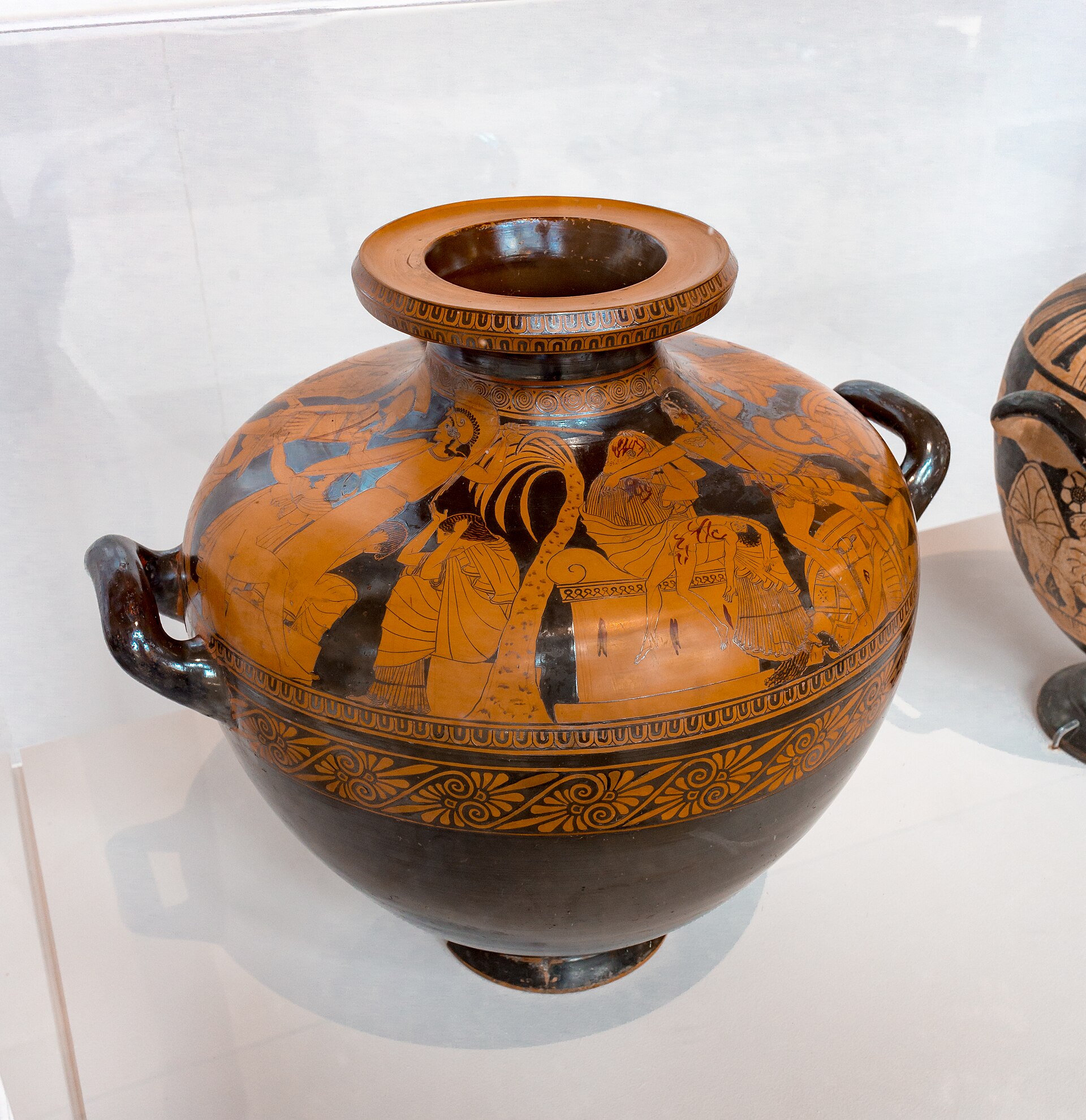
| Vivenzio Hydria (kalpis) with the Sack of Troy Kleophrades Painter | Closest iconographic comparandum: a near-contemporary Ilioupersis scene centred on the same killing of Priam with Astyanax, discussed alongside this cup in the scholarly literature on the iconography of the sack of Troy. c. 480 BC. A different object on a different shape (a water jar, not a cup) by a different painter; included here as comparison material, not as a version of this kylix. | Museo Archeologico Nazionale, Naples (inv. 2422) |
| Kylix depicting athletic combats Onesimos | Another documented cup by the same painter, on an unrelated athletic subject, showing the range of his output beyond the Ilioupersis theme. A wholly separate object; listed to demonstrate Onesimos's other work, not to be confused with the cup described in this record. | Museum of Fine Arts, Boston |
| The Euphronios Krater Euphronios (painter), Euxitheos (potter) | The archive's other Euphronios-connected object. Euphronios's role is reversed here: on the krater he signed as painter, on this kylix he signed as potter. Recovered and returned to Italy through an unrelated, later process concerning a 1972 sale to the Metropolitan Museum of Art. Explicitly NOT the object described in this record. See the attribution note above for the full distinction. | Museo Archeologico Nazionale Cerite, Cerveteri (same museum as this kylix since 2015) |
| Other Onesimos kylikes formerly catalogued at the Getty Villa Onesimos | Separate vessels by the same painter, catalogued individually under Getty accession numbers including 86.AE.285, 86.AE.284, 82.AE.14 and 86.AE.607. Different objects, not fragments of the kylix described in this record. Flagged here specifically because Wikimedia Commons groups images of all of them under a shared Onesimos category, which is a real source of version confusion. | J. Paul Getty Museum, Getty Villa, Malibu |
Open questions
- Is the findspot a documented tomb, or an inference stitched together from two different clues? Rizzo's argument from the Hercle inscription points to the Sant'Antonio sanctuary area; Marion True's 1992 letter names Monte Abatone, a necropolis. The sources consulted do not resolve whether both are correct, one is mistaken, or the two names were used loosely as shorthand for the general Cerveteri excavation zone.
- Is every fragment in the current reassembly ancient and original to this cup? Press accounts refer in passing to further fragments returned in 2005 and to one reportedly seized at Cerveteri in 2008; this record could not confirm either claim against a primary source and has left both out of the formal provenance chain.
- What did the Getty pay for the complete cup? Only individual fragment-group prices are documented (180,000 dollars for the Tchacos tondo group, 100,000 dollars for the 1985 Hydra Gallery group); no total acquisition cost across all five to six purchases (1983-1989) appears in the sources consulted.
- Was Marion True's January 1992 letter to Medici, acknowledging the Cerveteri and Monte Abatone origin, ever put to her directly during her 2005-2010 trial, and if so, how did she respond? The sources consulted describe the letter's content and its later publication but not a courtroom exchange about it.
- What became of the S. Schweitzer collection and Zbinden collection names invoked in the Getty's original acquisition paperwork? The sources consulted describe them as suspected fabrications used to launder provenance but do not report a formal finding establishing that as fact.
- Is there a full published catalogue of the reassembled cup, with every joined fragment illustrated, produced since its 2015 move to Cerveteri, comparable to Williams's 1991 Getty publication of the piece as it then stood?
Questions about this object
What is Attic Red-Figure Kylix with the Sack of Troy?
Attic Red-Figure Kylix with the Sack of Troy is an antiquity, dated c. 500-490 BC. Medium: Attic red-figure terracotta, wheel-thrown and painted with a fired slip.
Who made Attic Red-Figure Kylix with the Sack of Troy, and is the attribution settled?
The attribution to Onesimos is recorded here as accepted. The potter's signature EUPHRONIOS EPOIESEN (Euphronios made it) is incised on the cup, so the potter attribution is documented by autograph inscription. The painting is unsigned; the attribution to Onesimos rests on connoisseurship, chiefly the argument set out by Dyfri Williams in 1991 and now standard in the literature. This is NOT the same Euphronios-connected object as this archive's Euphronios Krater. On the krater, Euphronios signed as painter (EGRAPHSEN) and Euxitheos as potter. On this kylix the roles reverse: Euphronios is the potter and Onesimos, his presumed pupil, is the painter. The two objects also have unrelated excavation and restitution histories and only share a holding city since 2015.
Where is Attic Red-Figure Kylix with the Sack of Troy now?
Museo Archeologico Nazionale Cerite (National Archaeological Museum of Cerveteri), housed in the Rocca Ruspoli, Cerveteri, Italy, within the Parco Archeologico di Cerveteri e Tarquinia. Inventory number Beazley Archive Pottery Database no. 13363 (Para. 455.2). Former J. Paul Getty Museum accession 83.AE.362, with joining fragment groups accessioned separately as 84.AE.80 and 86.AE.385. Carried a Villa Giulia inventory number during its 1999-2014 display in Rome.. Last confirmed 24 August 2026. Returned to Italy by the Getty in 1999; displayed at the Museo Nazionale Etrusco di Villa Giulia, Rome, 1999-2014; permanently transferred to the Museo Archeologico Nazionale Cerite in 2015.
What is still unknown about Attic Red-Figure Kylix with the Sack of Troy?
Is the findspot a documented tomb, or an inference stitched together from two different clues? Rizzo's argument from the Hercle inscription points to the Sant'Antonio sanctuary area; Marion True's 1992 letter names Monte Abatone, a necropolis. The sources consulted do not resolve whether both are correct, one is mistaken, or the two names were used loosely as shorthand for the general Cerveteri excavation zone.
Sources
- 1Trafficking Culture, 'J. Paul Getty Museum Returns to Italy (1999)', case study. traffickingculture.org/encyclopedia/...
- 2Trafficking Culture, 'Giacomo Medici', case study. traffickingculture.org/encyclopedia/...
- 3Trafficking Culture, 'Marion True', case study. traffickingculture.org/encyclopedia/...
- 4The Art Newspaper, 'Getty returns three stolen works to Italy', 1 March 1999. theartnewspaper.com/1999/...
- 5Peter Watson and Cecilia Todeschini, The Medici Conspiracy: The Illicit Journey of Looted Antiquities - From Italy's Tomb Raiders to the World's Greatest Museums, chapter 'The Getty - The Museum of the Tombaroli'. Standard investigative account of the affair, not a court judgment; treated as such throughout this record. erenow.org/common/...
- 6Peter Watson and Cecilia Todeschini, The Medici Conspiracy, chapter 'Forensic Archaeology in the Freeport', on the 1995 Geneva raid and the Polaroid archive. erenow.org/common/...
- 7Peter Watson and Cecilia Todeschini, The Medici Conspiracy, chapter 'The Paper Trail, the Polaroids, and the Cordata', on Maurizio Pellegrini's reconstruction of the photographic sequences. erenow.org/common/...
- 8ANSA, 'Euphronios' kylix on show after return from Getty', 8 May 2014. ansa.it/english/...
- 9Terzo Binario News, 'Cerveteri, il grande ritorno della Kylix di Euphronios'. terzobinario.it/cerveteri-il-ritorno-della-kylix-di-euphr...
- 10The Journal of Cultural Heritage Crime, 'Il recupero della kylix di Euphronios e Onesimos', 20 November 2023. journalchc.com/2023/...
- 11Michael J. Anderson, 'Onesimos and the Interpretation of Ilioupersis Iconography', The Journal of Hellenic Studies, vol. 115 (1995), pp. 130-135. cambridge.org/core/...
- 12Dyfri Williams, 'Onesimos and the Getty Iliupersis', in Marion True (ed.), Greek Vases in the J. Paul Getty Museum, vol. 5, Occasional Papers on Antiquities 7 (Malibu: J. Paul Getty Museum, 1991). getty.edu/publications/...
- 13Classical Art Research Centre / Beazley Archive Pottery Database, catalogue record for the cup (Beazley no. 13363; Villa Giulia inv. 121110; former Getty 83.AE.362 etc.), cross-checked against the Perseus Project mirror. perseus.tufts.edu/hopper/...
- 14Wikipedia, 'Marion True'. en.wikipedia.org/wiki/...
- 15Wikipedia, 'Giacomo Medici (art dealer)'. en.wikipedia.org/wiki/...
- 16Wikipedia, 'National Archaeological Museum of Cerveteri'. en.wikipedia.org/wiki/...
- 17Wikipedia, 'Onesimos (vase painter)'. en.wikipedia.org/wiki/...
- 18The J. Paul Getty Museum, online collection record for the Attic Red-Figure Kylix, accession 83.AE.362 with joining fragment groups 84.AE.80 and 86.AE.385. getty.edu/art/...
- 19Wikimedia Commons, File:Kylix di Eufronio - Cerveteri.jpg, file description and API metadata (licence, uploader, dimensions given in caption). commons.wikimedia.org/wiki/...
- 20Wikimedia Commons, Category:Kylix di Eufronio, detail photographs credited to the contributor Sailko, licensed CC BY 3.0. commons.wikimedia.org/wiki/...
- 21Wikimedia Commons, File:Kleophrades Painter - ARV 189 74 - Ilioupersis - Napoli MAN 2422 - 01.jpg, credited to the contributor ArchaiOptix, licensed CC BY-SA 4.0. commons.wikimedia.org/wiki/...


Last verified · Published
Change log
9 November 2026 - Record created at the house standard: researched narrative, technical evidence, maker dossier, graded provenance chain, prices with hammer and premium separated, related works, open questions and sources.