Praeneste Fibula
Unknown goldsmith of Orientalizing-period Latium or Etruria, named only as 'Manios' in the object's own inscription · If genuine, 7th century BC (Orientalizing period); sources differ on whether to place it in the first half, the middle, or the end of that century
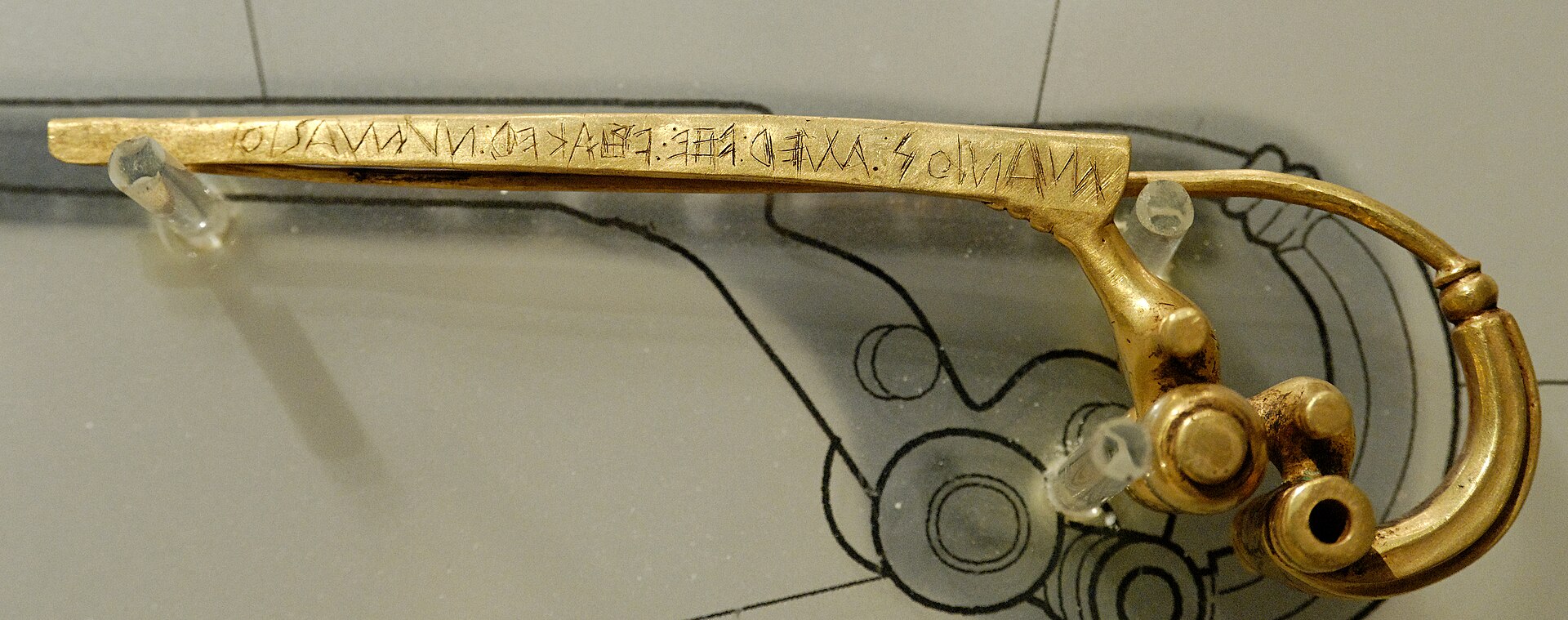
The gold fibula in full, photographed in 2009 while on display at the Baths of Diocletian, Rome, part of the Museo Nazionale Romano complex, before its later transfer with the rest of the Pigorini collection to the Museo delle Civilta. Inventory Museo Pigorini 2819.
Photograph by Marie-Lan Nguyen (Jastrow), CC BY 2.5| Artist | Unknown goldsmith of Orientalizing-period Latium or Etruria, named only as 'Manios' in the object's own inscription |
|---|---|
| Date | If genuine, 7th century BC (Orientalizing period); sources differ on whether to place it in the first half, the middle, or the end of that century |
| Medium | Gold, worked in at least two distinct alloys within the same object: a harder, more silver-rich gold at the pivot and a softer, more gold-rich, more ductile gold at the engraved catch-plate. This record found no source describing a bronze component; the object is gold throughout, and a description of it as a 'bronze-and-gold' fibula is not supported by any source consulted (see notes_for_editor). |
| Dimensions | Length approximately 10.7 cm per the Museo delle Civilta's own 2011 study reporting; one Wikimedia Commons caption gives 11.7 cm. This record could not resolve the one-centimetre discrepancy and flags it rather than silently picking one figure. |
| Where it is now | Museo delle Civilta, Rome (the institution formed in 2016 that absorbed the former Museo Nazionale Preistorico Etnografico 'Luigi Pigorini'), on display in the writing/prehistory gallerieslast confirmed 17 September 2026 |
| Inventory number | Museo Pigorini inv. 2819 (the historical number used throughout twentieth-century scholarship and in the Wikimedia Commons photographic record); the museum's current online catalogue instead gives the general inventory number MPE 152294. This record could not confirm from the sources gathered exactly when or why the renumbering occurred, and states both numbers rather than silently preferring one. |
| Attribution | DisputedThe object carries two layered attribution problems, not one. Full note |
| Object type | Antiquity |
| Period | Orientalizing-period central Italy (if genuine); Italian antiquities market of the 1880s (if not) |
| Cases | Disputed attribution · Has a provenance gap |
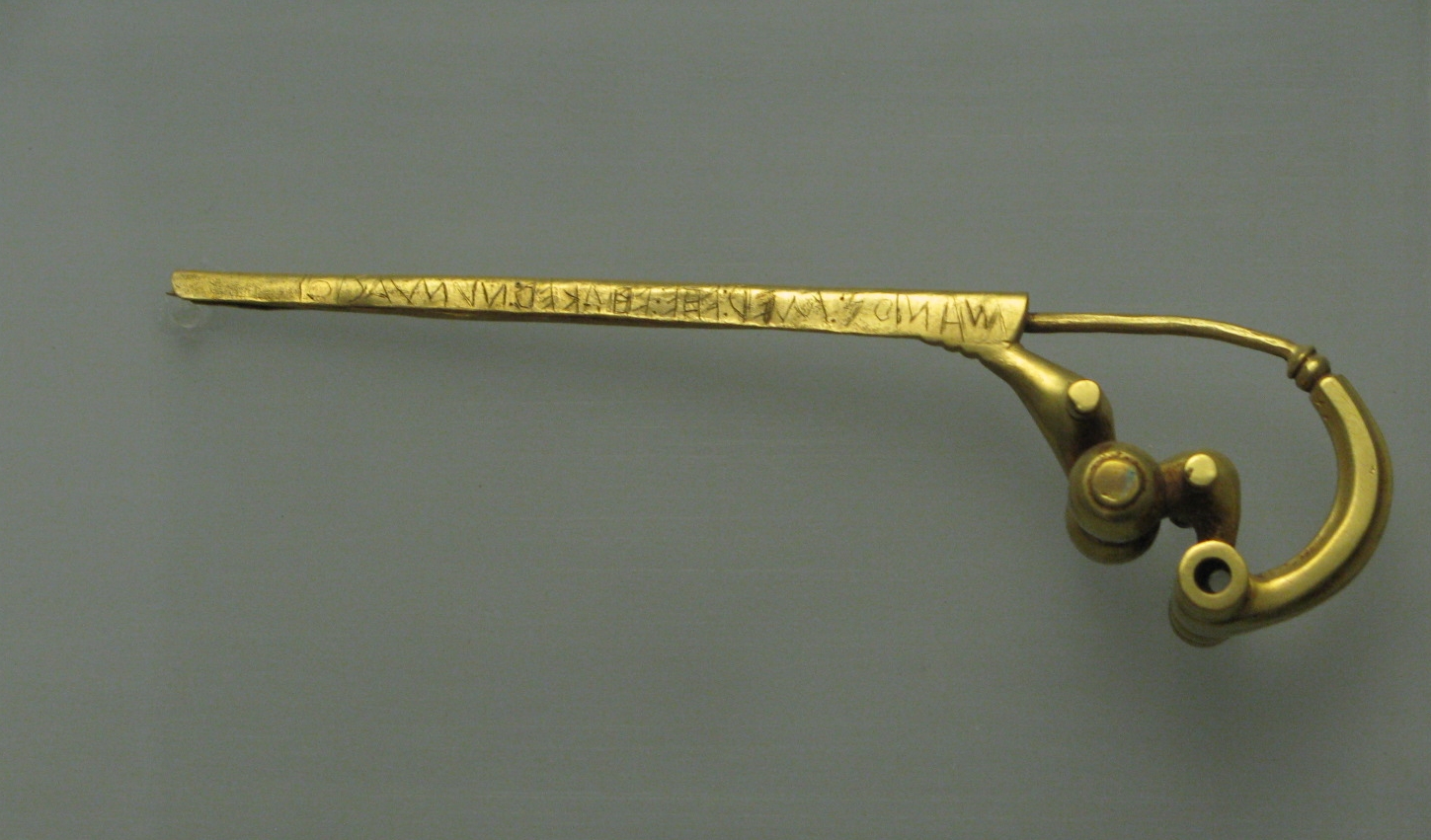
| Inscriptions | Old Latin, engraved in retrograde (right to left) on the flat bow of the fibula: MANIOS MED FHEFHAKED NVMASIOI. Rendered in Classical Latin, approximately Manius me fecit Numerio, 'Manius made me for Numerius.' |
| Owners on record | 8 links5 documented, 2 disputed, 1 unknown |
| Sources | 22 cited |
About this record Last verified 17 September 2026 · 22 sources cited · Change log
On this page 9 sections
ContentsClose
A small gold dress-fastener, announced in 1887 by the German archaeologist Wolfgang Helbig, that carries an Old Latin inscription, MANIOS MED FHEFHAKED NVMASIOI, 'Manius made me for Numerius,' which is, if genuine, the oldest surviving specimen of the Latin language. It was declared a forgery by the epigrapher Margherita Guarducci across the 1970s and 1980s, who argued Helbig and the antiquarian Francesco Martinetti had invented it together, a charge made credible by the same pair's documented connection to a separate, and generally accepted, forgery, the Boston Throne.
A 2011 scanning-electron-microscope and X-ray microprobe study by Daniela Ferro and Edilberto Formigli found microcrystallization in the gold and inside the inscribed letters that the team argues could only have formed over centuries, along with an ancient repair and alloy engineering matched functionally to the object's parts. Most subsequent scholarship and the object's own holding museum, now the Museo delle Civilta in Rome, treat the case as settled in favour of authenticity, though this record found evidence the specialist literature has not entirely stopped asking the question, and that the object's own documented history before 1887 remains as unrecovered as ever.
What is not in dispute is more modest and, this record argues, more interesting than either the forgery accusation or its rebuttal: two ordinary Latin names, a craftsman's signature, and a functioning piece of Orientalizing-period clothing hardware that happened to become, for over a century, the single most contested sentence in the study of how Latin began.
Provenance
Each link is graded. Documented: a cited source supports it. Disputed: the identification is argued but not established. Unknown: no owner for that span, and the gap is not smoothed into a narrative. The grades in the glossary.
- 7th century BC (claimed) -Unknown Orientalizing-period goldsmith and first owner(s), 'Manios' and 'Numasioi' per the inscriptiondisputed
The entire ancient origin of the object is the subject of the authenticity dispute described in the narrative. No excavation record exists; the case for an ancient origin rests on twenty-first-century material science (the 2011 SEM-EDX study), not on any documented find in situ.910
- 7th century BC (claimed) - 1919Provisionally associated with the Bernardini Tomb assemblage, Palestrinadisputed
Helbig attached the fibula to the Bernardini Tomb's grave goods. It does not appear among that tomb's catalogued holdings in the Museo Nazionale Etrusco di Villa Giulia and was formally struck from the tomb's inventory in 1919 for lack of certainty about its exact provenience and recovery context.2
- 1871 (claimed) or 1887 (per a conflicting account) - 1887Francesco Martinetti, Roman antiquarian and gem-engraver (per Helbig's account, via an unnamed 'friend' generally identified as Martinetti)unknown
Two mutually exclusive accounts exist. Per Helbig, a friend purchased the fibula in the Palestrina antiquities market in 1871 and held it privately for sixteen years. Per a later local historian's account, the fibula surfaced only in 1887, illegally removed from a tomb by a workman and sold to Martinetti with no gap before Helbig's announcement. Neither account is supported by a sale receipt, customs record, or excavation report located by this record.6714
- 1887 - 1887Wolfgang Helbig, second secretary of the German Archaeological Institute in Romedocumented
Announced in a short notice in Mitteilungen des Deutschen Archaologischen Instituts, Romische Abteilung 2 (1887), pp. 37-39. One secondary source instead dates the oral presentation to January 1886; this record could not resolve the discrepancy.679
- 1887 - circa 1889Francesco Martinettidocumented
Martinetti retained ownership after the public announcement, per the sources consulted, before donating the object to a public collection.14
- circa 1889 - circa 1900-1901Museo Nazionale di Villa Giulia, Romedocumented
Reported in the sources gathered as a donation from Martinetti to Villa Giulia roughly two years after the 1887 announcement. This record found this date in secondary reporting only and was not able to independently verify it against a primary archival document.14
- circa 1900-1901 - 2016Museo Preistorico Etnografico 'Luigi Pigorini', Romedocumented
Sources disagree on the exact year of transfer, giving either 1900 or a formal handover completed 24 January 1901 under a ministerial order of 19 January 1901, with an inspector named Angiolo Pasqui as intermediary. This record states the transfer as occurring around 1900-1901 rather than asserting a single precise date, since no primary document was independently viewed.14
- 2016 - presentMuseo delle Civilta, Romedocumented
The Pigorini merged with three other Rome national museums into the Museo delle Civilta in September 2016; the fibula transferred with the rest of the Pigorini's prehistoric and protohistoric holdings and remains there, currently catalogued under inventory MPE 152294 alongside its historical Pigorini number 2819.820
Technical evidence
| Attribution note | The object carries two layered attribution problems, not one. First, whether it is ancient at all: presented in 1887 by Wolfgang Helbig, denounced as a forgery by Margherita Guarducci from the mid-1970s into the 1980s, and defended as genuine by a 2011 scanning-electron-microscopy and energy-dispersive-X-ray (SEM-EDX) study by Daniela Ferro and Edilberto Formigli. Most subsequent literature and the holding museum itself now treat it as ancient, but this record found at least one specialist publication from after 2011 whose own title still poses the question ('Aut falsa aut Latina?'), so 'closed' would overstate the consensus. Second, even if ancient, the maker is not independently identified: 'Manios' is a name inside the text, not a documented craftsman cross-checked against any other signed object. |
|---|---|
| Material and alloy | Gold worked in at least two distinct alloys within the same object: a harder, more silver-rich gold at the mechanically stressed pivot, and a softer, more gold-rich, more ductile alloy at the catch-plate that carries the inscription. No bronze component is described in any source consulted.910 |
| Dimensions | Length approximately 10.7 cm per the 2011 study's own reporting; one Wikimedia Commons file caption instead gives 11.7 cm. This one-centimetre discrepancy between sources is unresolved.915 |
| Inscription and technique | Old Latin, MANIOS MED FHEFHAKED NVMASIOI, engraved in retrograde (right to left) along the bow, cut with a dry stylus or point rather than the burin that Margherita Guarducci had argued for.1910 |
| Ancient repair | A thin sheet of gold laid over a small fracture in the catch, read by the 2011 study as evidence of a real working life before burial rather than a single, freshly made object.91011 |
| Corrosion and recrystallization | Microcrystallization detected both on the smooth gold surface and inside the inscribed letter grooves, presented as the central 2011 evidence for age, since this structural change is argued to require centuries to develop naturally.910 |
| Earlier chemical analysis (1978) | Chemists Pico Cellini and Giulio Devoto reported traces of turpentine apparently used to age the metal artificially and irregularities in the mercury gilding, the original chemical case for forgery that predates and reinforced Guarducci's epigraphic case.711 |
| Inventory numbering | Carries two inventory numbers in the sources consulted: the historical Museo Pigorini inv. 2819, used throughout twentieth-century scholarship and the Wikimedia Commons photographic record, and the Museo delle Civilta's current general inventory number MPE 152294. The reason for or exact date of the renumbering was not found.81516 |
Images

The record in full
Chapter 1What it is
A gold fibula, a hinged dress-fastener functioning like a large safety pin, of the type conventionally called 'dragon' or 'a drago' in the Italian literature on Orientalizing-period ornament.
A gold fibula, a hinged dress-fastener functioning like a large safety pin, of the type conventionally called 'dragon' or 'a drago' in the Italian literature on Orientalizing-period ornament. It is not a devotional object, a coin or a weapon; it is a piece of everyday high-status clothing hardware, the kind of thing a person actually wore and closed a cloak or tunic with, which happens to carry the single most argued-over sentence in the history of Latin epigraphy.
The body is gold throughout, but not uniform gold. The 2011 scientific study found that the smith used a harder, more silver-rich alloy at the pivot, where mechanical wear mattered, and a softer, more gold-rich and more ductile alloy at the flat catch-plate, where the metal needed to take an engraved inscription cleanly. That functional variation, matched to what each part of the object had to do, is treated in the recent literature as a mark of real goldsmithing knowledge rather than decoration for its own sake.
Along the bow, in a script running right to left, is engraved MANIOS MED FHEFHAKED NVMASIOI: in Classical Latin, approximately Manius me fecit Numerio, 'Manius made me for Numerius.' The doubled FH spelling for the sound later written simply as F is itself part of why the object matters: it preserves, or claims to preserve, a stage of Latin spelling older than anything else on record.
Chapter 2Why the inscription matters, if it is what it claims to be
Latin epigraphy has a short list of fixed points for the language's early history, and for most of the twentieth century this fibula sat at the head of that list.
Latin epigraphy has a short list of fixed points for the language's early history, and for most of the twentieth century this fibula sat at the head of that list. If genuine, it is the oldest attested specimen of Latin, older than the Duenos inscription found in Rome, which is usually placed in the sixth century BC, roughly a century later. Losing the fibula does not erase Old Latin's early history, but it does move the starting line: the Duenos vase becomes the earliest fixed point instead, and every phonological argument that leaned on the fibula's date has to be re-run without it.
The grammar itself is part of the argument for antiquity: fhefhaked is a reduplicated perfect of the verb that becomes facio, a formation Classical Latin had already abandoned in favour of the simple fecit. A forger inventing a fake inscription in the 1880s would have had to know, and correctly reconstruct, a verb form that the philology of the time had only begun to theorize about from comparative Indo-European grammar, not from any other surviving Latin text of comparable age. That is one of the reasons Guarducci's accusation could never be casually dismissed and also, later, one of the reasons some scholars found forgery hard to credit: it demands either a forger with formidable comparative-linguistic competence, or a genuinely ancient hand.
Chapter 3The 1887 announcement, and two accounts that cannot both be true
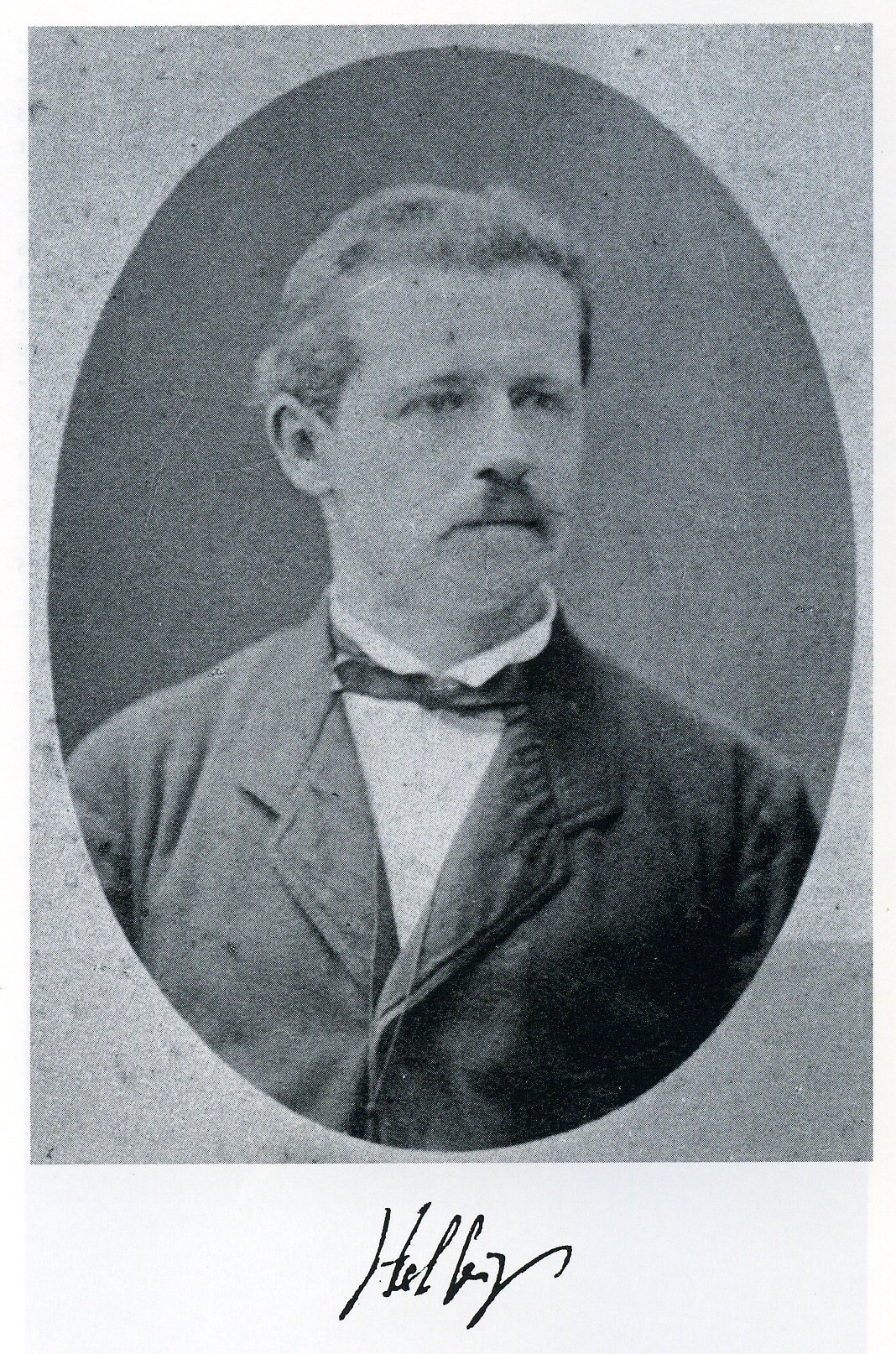
Wolfgang Helbig, then second secretary of the German Archaeological Institute in Rome, made the fibula public in a short notice for the Institute's Mitteilungen in 1887.
Wolfgang Helbig, then second secretary of the German Archaeological Institute in Rome, made the fibula public in a short notice for the Institute's Mitteilungen in 1887. One secondary account gives the actual oral presentation as January 1886, a year ahead of the journal date; most sources place the announcement itself in January 1887, matching the year of publication. This record did not find a way to reconcile the one-year gap and states it as an open discrepancy rather than picking a date.
Helbig's own account, as reported in the secondary literature, was that a friend had purchased the fibula in the Palestrina antiquities market in 1871, some sixteen years before he made it known. The friend is usually identified as Francesco Martinetti, a Roman antiquarian and gem-engraver. Why an object of this claimed importance sat privately owned and unpublished for sixteen years is not explained in any source this record consulted.
A different modern account, published by a local Palestrina historian, describes no gap at all: the fibula found in 1887 itself, illegally removed from a tomb at the Colombella necropolis by a workman and sold to Martinetti, with Helbig presenting it to scholars only months later. These two stories disagree on the most basic facts, the year of discovery and the length of time the object was held privately, and neither is supported in the sources gathered by a contemporary excavation record, a sale receipt, or a customs document. This record treats the entry of the fibula into the modern world as genuinely undocumented rather than smoothing the two accounts into one.
Chapter 4The Bernardini Tomb problem
Helbig eventually attached the fibula to the Bernardini Tomb, a rich Orientalizing-period burial in the Colombella necropolis at Palestrina financed and dug by the Bernardini brothers as a private...
Helbig eventually attached the fibula to the Bernardini Tomb, a rich Orientalizing-period burial in the Colombella necropolis at Palestrina financed and dug by the Bernardini brothers as a private excavation. The tomb is real and its other contents, now in the Museo Nazionale Etrusco di Villa Giulia, are not in dispute: a gold pectoral fibula covered in 131 tiny granulated figures of lions, horses, chimaeras and harpies, a silver-sheathed dagger, a gold bowl with Egyptianizing animal reliefs, a bronze cauldron with griffin protomes, and further gold, silver and ivory grave goods. That pectoral fibula is a completely different, undisputed object from the one described in this record, and the two must never be confused: this record's subject is the small inscribed 'Manios' fibula now in the Museo delle Civilta, not the large granulated pectoral fibula in the Villa Giulia.
Sources disagree even on when the Bernardini Tomb itself was excavated, one account placing discovery in 1851 with excavation from 1871, another placing the dig in 1876. Whichever date is correct, the fibula does not appear as a catalogued item among the tomb's other Villa Giulia holdings. It was carried for a time on the tomb's provisional inventory and was formally struck from it in 1919, for what the Italian-language literature describes as a lack of archaeological certainty about its exact provenience and recovery context. In plain terms: the institution that holds the rest of the Bernardini Tomb's contents does not, and for over a century has not, treated this fibula as part of that assemblage.
Chapter 5Francesco Martinetti and the Roman antiquities trade
Francesco Martinetti (1833-1895) was a Roman antiquarian, numismatist, gem-engraver, restorer and art dealer, and one of the central figures of the Roman antiquities market in the second half of the...
Francesco Martinetti (1833-1895) was a Roman antiquarian, numismatist, gem-engraver, restorer and art dealer, and one of the central figures of the Roman antiquities market in the second half of the nineteenth century. He was, by the accounts of his own contemporaries, cultured and widely respected: a correspondent and business associate of the archaeologists Paul Hartwig and Ludwig Pollack, of Baron Giovanni Barracco, and of the Danish brewer and collector Carl Jacobsen, founder of the Ny Carlsberg Glyptotek in Copenhagen. His standing was such that the Italian state itself employed him as an official valuer, a perito, for antiquities it was considering acquiring, a position of trust that his biographers describe as having made it easier, not harder, for him to pass off fabrications.
Martinetti's name recurs in the era's other major archaeological forgery case, the so-called Boston Throne, discussed below. Guarducci's 1980 work names him as the physical maker in that affair and Helbig as its deviser. Whatever the truth of the Praeneste fibula, Martinetti's documented career shows a man with both the trade contacts and the engraving skill to have produced a convincing fake, which is precisely why the accusation against him and Helbig was taken seriously for three decades rather than dismissed outright.
Chapter 6Helbig: scholar, secretary, and dealer
Wolfgang Helbig (1839-1915) trained at Gottingen and Bonn, joined the German Archaeological Institute in Rome in 1862, and served as its second secretary from 1865 until 1887, the same year he...
Wolfgang Helbig (1839-1915) trained at Gottingen and Bonn, joined the German Archaeological Institute in Rome in 1862, and served as its second secretary from 1865 until 1887, the same year he announced the fibula. His scholarly reputation rested chiefly on his study of Campanian wall painting; a popular guide to Roman antiquities he wrote remained in use for decades. After 1887 he left institutional life and worked as a private scholar who was also, simultaneously, a paid broker of antiquities, most notably for the Ny Carlsberg Glyptotek. That dual role, authenticating scholar and commission-earning dealer in the same objects, is not proof of anything by itself, but it is the honest context in which to weigh any claim he made about where an object came from.
The fibula was not the only disputed antiquity to carry Helbig's name alongside Martinetti's. The English-language literature on the so-called Boston Throne, a marble relief that surfaced in 1894 shortly after the celebrated Ludovisi Throne and was bought by the Museum of Fine Arts, Boston, in 1896, describes the Praeneste fibula in the same breath as 'another highly contested piece sold by Martinetti and Helbig.' The Boston Throne circle also involved the archaeologist Paul Hartwig and, in one account, the sculptor Pacifico Piroli as the actual carver; sources disagree on this point, with some attributing the carving instead to Alceo Dossena. Guarducci's scientific case against the Boston/Ludovisi circle, made in the same period as her fibula work, is now the majority scholarly position: that object is generally treated as a forgery. The fibula is the one object in this circle that a later, independent scientific study has since cleared. That reversal, an object suspected because of the company it kept, then vindicated by microscopy the company's other fakes could not survive, is the central irony of this whole file.
Chapter 7Guarducci's case against authenticity
Margherita Guarducci (1902-1999), the Italian epigrapher best known for her work identifying the tomb of St Peter beneath the Vatican, built the case against the fibula across two publications, from...
Margherita Guarducci (1902-1999), the Italian epigrapher best known for her work identifying the tomb of St Peter beneath the Vatican, built the case against the fibula across two publications, from the mid-1970s into 1980, collected as La cosiddetta Fibula Prenestina: antiquari, eruditi e falsari nella Roma dell'Ottocento in the Memorie of the Accademia Nazionale dei Lincei, with a further 'elementi nuovi' study following. Her thesis was direct: not only the inscription but the fibula itself was invented, the joint work of Helbig and Martinetti, staged to advance both men's standing.
Her technical case, as reported across the secondary literature, rested on several strands. The engraving struck her as poorly executed next to genuine archaic work, as though cut by an amateur. The gold itself seemed too ductile and too fresh: buried gold of real antiquity is typically more brittle and shows more surface degradation. She read the surface as chemically treated with acid to fake an aged patina, and the letters as cut with a burin, a tool she considered unavailable to seventh-century-BC Latin or Etruscan goldsmiths, who worked instead in dry-point or stylus technique. Most personally, she argued the letterforms resembled Helbig's own handwriting.
Guarducci was not building this case from nothing. Chemists Pico Cellini and Giulio Devoto had already run microscopy and X-ray fluorescence analysis on the fibula in 1978, reporting traces of turpentine apparently used to age the metal artificially and irregularities in the mercury gilding. Nor was she the first to doubt the object at all: the archaeologist Giovanni Pinza had raised questions as early as 1905, without effect on Helbig's continued insistence, and the linguists Giacomo Lignana and Vittore Pisani had independently questioned whether the language of the inscription could genuinely be as old as claimed. The forgery case, in other words, had chemical, epigraphic and linguistic strands that reinforced each other for decades before the object was ever re-examined with an electron microscope.
Chapter 8Three decades of open dispute
Guarducci's accusation did not settle the question.
Guarducci's accusation did not settle the question. Sources describing the period between 1978/1980 and 2011 are explicit that her position, however forcefully argued, did not achieve unanimous scholarly consensus. The Etruscologist Giovanni Colonna continued to defend authenticity against the chemical findings, arguing, in the accounts available to this record, that a forger working before the 1899 discovery of the Forum's early Latin inscription (the Lapis Niger cippus) could not plausibly have invented letterforms as anomalous and internally consistent as the fibula's, since the comparative material needed to fake them convincingly did not yet exist to be copied.
This record could not establish from the sources gathered the exact dates on which the fibula was removed from or returned to public display during the dispute, nor find a single authoritative account of how museum cataloguing described the object during those years, whether as accepted, doubtful, or formally deaccessioned as authentic. That gap is recorded here as a gap, in open_questions, rather than filled with an assumption.
Chapter 9The 2011 archaeometric study
On 6 June 2011, Daniela Ferro of the CNR's Institute for the Study of Nanostructured Materials and Edilberto Formigli, a restorer who taught at Sapienza University of Rome and at the Opificio delle...
On 6 June 2011, Daniela Ferro of the CNR's Institute for the Study of Nanostructured Materials and Edilberto Formigli, a restorer who taught at Sapienza University of Rome and at the Opificio delle Pietre Dure in Florence, presented new findings at the Museo Pigorini itself. Their method was non-destructive: scanning electron microscopy coupled with an energy-dispersive X-ray microprobe, run at the Chemistry Department laboratory of Sapienza University, examining both the object's surface and the internal structure of the letter grooves.
Their central finding was microcrystallization, a structural change in the gold detected both on the smooth surface and inside the engraved letters themselves. The team's argument is that this kind of recrystallization takes centuries to occur naturally after casting and working, and cannot be produced by an object that is only as old as the 1880s. Alongside this they confirmed the alloy engineering described above (harder, silver-richer gold at the pivot; softer, gold-richer alloy at the inscribed catch-plate, cut with a dry stylus point rather than the modern burin Guarducci had proposed) and identified an ancient repair: a thin sheet of gold laid over a small fracture in the catch, evidence, in their reading, of a real working life before the object was ever buried.
The findings were reported publicly under headlines declaring the fibula genuine 'beyond any reasonable doubt,' and were subsequently written up for the Bullettino di Paletnologia Italiana, volume 99 (2011-2015), under the title 'Risultati delle recenti indagini archeometriche sulla Fibula di Manios.' This record was able to confirm the journal and volume from a publisher's listing but was not able to fetch and read the article itself, and flags the exact page numbers as unverified pending direct access to the volume.
Chapter 10Is the dispute actually closed
The weight of everything gathered for this record points one way: the object's own holding museum presents it without hedging, the CNR's own account of its findings is unequivocal, and every...
The weight of everything gathered for this record points one way: the object's own holding museum presents it without hedging, the CNR's own account of its findings is unequivocal, and every secondary account written since 2011 that this record could access treats the authenticity question as resolved in the fibula's favour. That is a fair summary of where the field has landed.
It is not, on the evidence gathered, quite the same as saying the matter is closed. One account of the June 2011 presentation itself noted that no independent chemist appears to have been present among the audience able to cross-examine Ferro's data on the spot, leaving the immediate reception more a matter of persuasion than independent replication. More tellingly, a paper exists in the specialist literature, published after 2011, under the title 'Aut falsa aut Latina? The fibula of Praeneste: another turn of the screw' (still or false or Latin, another turn of the screw). This record was blocked from reading the paper itself by an access restriction and cannot report what conclusion it reaches. But a title framed as a live question, published in a peer-reviewed venue after the SEM-EDX study that supposedly ended the debate, is itself evidence that at least one specialist did not consider the file closed. This record states the current position as: authenticity is the majority scientific view since 2011, held with high confidence by the institutions that publish about the object, but not universally treated in the specialist literature as beyond further discussion.
Chapter 11From the antiquities market into a public collection
Accounts agree that Martinetti donated the fibula to the Museo Nazionale di Villa Giulia, and place that gift roughly two years after Helbig's 1887 announcement, which points to around 1889; this...
Accounts agree that Martinetti donated the fibula to the Museo Nazionale di Villa Giulia, and place that gift roughly two years after Helbig's 1887 announcement, which points to around 1889; this record found that date in only one directly consulted secondary account and treats it as reported rather than independently archival-verified.
From Villa Giulia the object passed to the Museo Preistorico ed Etnografico under its founding director, Luigi Pigorini. Sources disagree on the exact year, one giving 1900, another describing a formal transfer completed on 24 January 1901 under a ministerial order dated five days earlier, with an inspector named Angiolo Pasqui as the intermediary who delivered the object. This record could not independently verify either specific date against a primary archival document and states the transfer as occurring around 1900-1901 rather than asserting a single precise day.
Chapter 12From the Museo Pigorini to the Museo delle Civilta
The Museo Preistorico Etnografico 'Luigi Pigorini' was founded in 1876 in the Palazzo del Collegio Romano and moved to its present building, the Palazzo delle Scienze at EUR, between 1962 and 1977.
The Museo Preistorico Etnografico 'Luigi Pigorini' was founded in 1876 in the Palazzo del Collegio Romano and moved to its present building, the Palazzo delle Scienze at EUR, between 1962 and 1977. In September 2016, as part of a reorganization of Italy's national museums, the Pigorini merged with three other Rome institutions (the Museum of Arts and Popular Traditions, the Museum of Oriental Art 'Giuseppe Tucci,' and the Museum of the Early Middle Ages) into the new Museo delle Civilta, which now holds the fibula.
A 2009 photograph used in this record's own gallery shows the object on display not at EUR but at the Baths of Diocletian in central Rome, part of the Museo Nazionale Romano complex, indicating at least one period of loan or temporary exhibition away from its usual home. The museum's current online catalogue places the fibula within its writing-focused display, part of a reinstalled prehistory and protohistory circuit; this record treats it as currently on public view, per the museum's own listing, rather than in storage.
Chapter 13What the object was for, and what it is not
Stripped of the forgery question, the fibula's evident function is plain and does not need to be dressed up as more than it is: a dress-fastener inscribed with a maker's or giver's dedication.
Stripped of the forgery question, the fibula's evident function is plain and does not need to be dressed up as more than it is: a dress-fastener inscribed with a maker's or giver's dedication. Manios and Numasioi are not rulers or priests; both names were, in Latin, among the most common praenomina in use, roughly equivalent to naming a modern object 'John made this for Robert.' If genuine, the inscription documents an ordinary transaction of craft and gift between two people of no larger recorded significance, set down in the writing system a small, literate, goldsmithing culture in Orientalizing Latium had access to. That the culture used its earliest surviving alphabet to record a maker's pride and a personal gift, rather than a king's decree or a temple dedication, is itself a modest and real finding about the period: this record found no evidence of religious, funerary or dynastic symbolism attached to the object beyond that ordinary function, and states that absence plainly rather than inventing a hidden programme where the sources describe none.
The larger cultural context is the Orientalizing period's Etrusco-Latin elite goldsmithing tradition attested at Praeneste by the genuinely documented Bernardini and Barberini tombs: granulated gold jewelry, worked in a shared technical vocabulary across the Latin and Etruscan-speaking communities of seventh-century-BC central Italy, exchanged as grave goods and personal ornament among a class wealthy enough to import and work precious metal at scale. Whether or not this specific fibula belongs to that world, the world itself is well documented independently of it.
Chapter 14What remains unresolved
Setting aside the authenticity question itself, this record found a genuine, unresolved gap between the moment the fibula is claimed to have been made and the moment it entered any documented modern...
Setting aside the authenticity question itself, this record found a genuine, unresolved gap between the moment the fibula is claimed to have been made and the moment it entered any documented modern hand. No excavation record, sale receipt or customs document from before 1887 was located in any source consulted. The two competing modern accounts of how it surfaced, a 1871 purchase followed by a sixteen-year private holding, or a single undocumented 1887 removal from a tomb, cannot both be correct, and nothing gathered here adjudicates between them.
What can be said with confidence is narrower than either the forgery case or the vindication case alone would suggest: the object's material composition and internal structure now match what independent laboratory analysis expects of genuine seventh-century-BC gold, and that finding has persuaded the great majority of the field. Its documentary history before 1887, however, remains as unrecovered today as it was when Guarducci first asked the question.
The artist
Unknown; the object's own inscription names only 'Manios' as maker and 'Numasioi' as recipient
There is no artist to profile in the ordinary sense, and this record treats that absence as the finding it is rather than inventing a workshop biography. If the fibula is genuine, its maker is a seventh-century-BC goldsmith working in the shared Latin-Etruscan technical culture of Orientalizing central Italy, known to us only by a personal name inscribed on the object itself, a name that was, in that period and language, extremely common. If the fibula is a nineteenth-century invention, its maker is not identified by any confession or connoisseurship attribution comparable to, for instance, Israel Rouchomovsky's admitted authorship of the Tiara of Saitaphernes; the forgery hypothesis names only accusers (Guarducci) and suspects (Helbig, Martinetti), never a demonstrated hand.
Related works
| Work | Relation | Where it is |
|---|---|---|
| Duenos inscription Unknown | The next-earliest attested Old Latin text; becomes the earliest surviving specimen of Latin if the Praeneste fibula is not genuine Usually dated to the sixth century BC, roughly a century after the fibula's claimed date. | Antikensammlung, Staatliche Museen zu Berlin |
| Lapis Niger / Forum cippus inscription Unknown | Early Latin comparanda recovered from a controlled, documented excavation in 1899, unlike the fibula's undocumented findspot Cited by Giovanni Colonna in defending the fibula's authenticity, on the argument that its own letterforms could not have been convincingly forged before this comparative material existed. | Roman Forum / Museo Nazionale Romano, Rome |
| Gold pectoral fibula with 131 granulated figures Unknown Orientalizing-period workshop | The genuine, catalogued gold fibula actually recovered from the Bernardini Tomb; not the object described in this record Version-safety note: this is a different physical object. The Praeneste/Manios fibula in this record was struck from the Bernardini Tomb's own inventory in 1919 and is not among the Villa Giulia's tomb holdings. | Museo Nazionale Etrusco di Villa Giulia, Rome |
| Gold pectoral fibula, Barberini Tomb Unknown Orientalizing-period workshop | Grave goods of the neighbouring Orientalizing-period tomb at the same Palestrina necropolis, same craft milieu Comparandum for the wider seventh-century-BC Praeneste goldsmithing tradition, independent of the fibula's own authenticity. | Museo Nazionale Etrusco di Villa Giulia, Rome |
| Tiara of Saitapharnes Israel Rouchomovsky | The archetypal nineteenth-century antiquities-market gold forgery; unlike this fibula, its maker eventually confessed and demonstrated his own technique Bought by the Louvre in 1896, defended for seven years, exposed in 1903. Already a published Iconotheca record; instructive contrast in how a forgery case can end. | Musee du Louvre, Paris |
| Boston Throne Disputed; possibly Pacifico Piroli under Paul Hartwig's direction, or Alceo Dossena, depending on the account | Another disputed antiquity linked to the same Helbig-Martinetti trading circle; generally regarded as a forgery, unlike this fibula Bought 1896. English-language sources describe the Praeneste fibula as 'another highly contested piece sold by Martinetti and Helbig,' making this the closest documented parallel case. | Museum of Fine Arts, Boston |
| Ludovisi Throne Disputed | The archaic Greek relief the Boston Throne was produced to complement; itself occasionally the subject of authenticity debate Generally still accepted as ancient, unlike its Boston counterpart. | Museo Nazionale Romano, Palazzo Altemps, Rome |
Open questions
- Where was the fibula, and in whose hands, between the seventh century BC and its first documented appearance in the modern antiquities trade? No source consulted places it anywhere in that interval.
- Which account of its modern discovery is correct: a friend's 1871 purchase at Palestrina followed by a sixteen-year private holding before Helbig's 1887 announcement, or a single undocumented removal from a tomb in 1887 itself with no gap at all? The two accounts in the sources gathered are mutually exclusive.
- Did the fibula genuinely come from the Bernardini Tomb, and if not, is any other specific Praeneste tomb documented as a plausible source? The object was struck from the Bernardini Tomb's own inventory in 1919 for lack of certainty on exactly this point.
- What is the exact year the fibula passed from Francesco Martinetti's ownership into the Museo Nazionale di Villa Giulia, and the exact year of its further transfer to the Museo Preistorico Etnografico? Sources consulted disagree between 1889 and other years for the first transfer and between 1900 and 1901 for the second.
- Has the 2011 SEM-EDX dataset been independently replicated by a second laboratory, or was the July 2011 presentation the only public airing of the raw data? One account specifically notes the absence of an independent chemist among the presentation's audience.
- What argument does the post-2011 academic paper 'Aut falsa aut Latina? The fibula of Praeneste: another turn of the screw' actually make? This record was blocked from reading it and could not establish whether it supports, qualifies, or challenges the authenticity finding.
- Were Manios and Numasioi real, identifiable individuals with any other documented trace in the archaeological or epigraphic record of seventh-century-BC Praeneste, or are they preserved solely by this inscription?
Questions about this object
What is Praeneste Fibula?
Praeneste Fibula is an antiquity, dated if genuine, 7th century BC (Orientalizing period); sources differ on whether to place it in the first half, the middle, or the end of that century. Medium: Gold, worked in at least two distinct alloys within the same object: a harder, more silver-rich gold at the pivot and a softer, more gold-rich, more ductile gold at the engraved catch-plate. This record found no source describing a bronze component; the object is gold throughout, and a description of it as a 'bronze-and-gold' fibula is not supported by any source consulted (see notes_for_editor).
Who made Praeneste Fibula, and is the attribution settled?
The attribution to Unknown goldsmith of Orientalizing-period Latium or Etruria, named only as 'Manios' in the object's own inscription is recorded here as disputed. The object carries two layered attribution problems, not one. First, whether it is ancient at all: presented in 1887 by Wolfgang Helbig, denounced as a forgery by Margherita Guarducci from the mid-1970s into the 1980s, and defended as genuine by a 2011 scanning-electron-microscopy and energy-dispersive-X-ray (SEM-EDX) study by Daniela Ferro and Edilberto Formigli. Most subsequent literature and the holding museum itself now treat it as ancient, but this record found at least one specialist publication from after 2011 whose own title still poses the question ('Aut falsa aut Latina?'), so 'closed' would overstate the consensus. Second, even if ancient, the maker is not independently identified: 'Manios' is a name inside the text, not a documented craftsman cross-checked against any other signed object.
Where is Praeneste Fibula now?
Museo delle Civilta, Rome (the institution formed in 2016 that absorbed the former Museo Nazionale Preistorico Etnografico 'Luigi Pigorini'), on display in the writing/prehistory galleries. Inventory number Museo Pigorini inv. 2819 (the historical number used throughout twentieth-century scholarship and in the Wikimedia Commons photographic record); the museum's current online catalogue instead gives the general inventory number MPE 152294. This record could not confirm from the sources gathered exactly when or why the renumbering occurred, and states both numbers rather than silently preferring one.. Last confirmed 17 September 2026. Museo delle Civilta official object page, and the Wikimedia Commons file descriptions for the three photographs used in this record.
What is still unknown about Praeneste Fibula?
Where was the fibula, and in whose hands, between the seventh century BC and its first documented appearance in the modern antiquities trade? No source consulted places it anywhere in that interval.
Sources
- 1Wikipedia, 'Praeneste fibula'. Tertiary source; consulted for the bibliographic trail (Hoving 1996, Hartmann 2005, Maras/Etruscan News 2012) and flagged for replacement with the primary literature it cites. en.wikipedia.org/wiki/...
- 2Wikipedia (Italian), 'Fibula prenestina'. Tertiary source; consulted for the 1919 removal from the Bernardini Tomb inventory and for Guarducci's and Formigli's publication citations. it.wikipedia.org/wiki/...
- 3Wikipedia, 'Wolfgang Helbig'. Tertiary source; consulted for Helbig's career, his dual role as Institute secretary and later antiquities dealer/broker for the Ny Carlsberg Glyptotek. en.wikipedia.org/wiki/...
- 4Wikipedia (Italian), 'Francesco Martinetti'. Tertiary source; consulted for Martinetti's biography, his trade connections, his role as state antiquities valuer, and his link to the Boston Throne affair. it.wikipedia.org/wiki/...
- 5Wikipedia, 'Boston Throne'. Tertiary source; consulted for the Helbig-Martinetti connection to this separate disputed antiquity and its description of the fibula as 'another highly contested piece sold by Martinetti and Helbig.' en.wikipedia.org/wiki/...
- 6Archaeological Institute of America, Archaeology Magazine archive, 'Who Made the Praeneste Fibula?' (Hoaxes, Fakes, and Strange Sites feature). Secondary journalistic source, used for the 1886/1887 announcement date and Guarducci's technical arguments. archive.archaeology.org/online/...
- 7StorieParallele.it, 'La Fibula Prenestina: storia di un reperto discusso'. Secondary source, used for the Guarducci publication date, the Cellini/Devoto 1978 chemical analysis, and Colonna's defence of authenticity. Flagged as a general-audience site to be cross-checked against the primary Lincei and Bullettino di Paletnologia publications. storieparallele.it/fibula-prenestina
- 8Museo delle Civilta, official collection page for the fibula ('Fibula a drago d'oro, la cosiddetta Fibula Prenestina'). Primary institutional source, used for the current inventory number, dating, and display context. museodellecivilta.it/oggetti/...
- 9Consiglio Nazionale delle Ricerche (CNR), press release, "E' autentica la Fibula prenestina, con la prima iscrizione latina" (6 June 2011). Primary institutional source for the 2011 SEM-EDX study's researchers, methodology, and findings. cnr.it/it/...
- 10Art-Test, 'The Prenestine Fibula'. Secondary source specializing in technical art analysis, used for methodological detail on the 2011 study and the attributed Ferro quotation. art-test.com/en/...
- 11Archeomedia, review of Mario Zaniboni, 'La fibula prenestina: autentica o falsa?'. Secondary source, used for the 1978 Cellini/Devoto findings, Lignana's and Pisani's early linguistic doubts, and a summary of the 2011 findings. archeomedia.net/mario-zaniboni-la-fibula-prenestina-auten...
- 12Perseus Digital Library, The Princeton Encyclopedia of Classical Sites, entry 'Praeneste (Palestrina) Italy'. Standard reference work, used for the Bernardini and Barberini Tomb contents and dating. perseus.tufts.edu/hopper/...
- 13Wikipedia, 'Duenos inscription'. Tertiary source, used for the comparative dating of the next-earliest Old Latin text. en.wikipedia.org/wiki/...
- 14Angelo Pinci, 'Fibula Prenestina. Confidenze di un oggetto parlante'. Secondary source, the only one consulted to give specific (if internally inconsistent with other sources) dates for the Villa Giulia donation and the Pigorini transfer, and an alternative account of the 1887 discovery. angelopinci.it/fibula-prenestina-confidenze-di-un-oggetto...
- 15Wikimedia Commons, File:Fibula Praenestina Terme Inv Museo Pigorini 2819.jpg. Used as the lead image; licence and photographer verified directly from the file description page. commons.wikimedia.org/wiki/...
- 16Wikimedia Commons, File:Fibula Praenestina Terme Inv Museo Pigorini 2819 (main part).jpg. Used as a detail image; licence and photographer verified directly from the file description page. commons.wikimedia.org/wiki/...
- 17Wikimedia Commons, File:Praeneste fibula.JPG. Used as an alternate-view image; licence and photographer verified directly from the file description page. commons.wikimedia.org/wiki/...
- 18Wikimedia Commons, File:Wolfgang Helbig.jpg. Used as a context image of Helbig; public-domain status verified directly from the file description page. commons.wikimedia.org/wiki/...
- 19rogueclassicism, 'Praeneste Fibula Authentic?'. Secondary academic-blog source, used to corroborate the 2011 findings and researcher names. rogueclassicism.com/2011/...
- 20Wikipedia (Italian), 'Museo nazionale preistorico etnografico Luigi Pigorini'. Tertiary source, used for the museum's founding date, EUR relocation, and 2016 merger into the Museo delle Civilta. it.wikipedia.org/wiki/...
- 21Edizioni Espera, publisher listing for Bullettino di Paletnologia Italiana, volume 99 (2011-2015). Consulted only to confirm the journal and volume in which the 2011 study was reportedly published; the article itself was not read and its page numbers are unverified. edizioniespera.com/bullettino-di-paletnologia-italiana/...
- 22Academia.edu listing, [author unread], 'Aut falsa aut Latina? The fibula of Praeneste: another turn of the screw'. Access to the full text was blocked (HTTP 403) after both a plain retry and a browser-user-agent retry; cited here only for its title as evidence that the authenticity question continued to be actively discussed in the specialist literature after 2011. Its argument and conclusion are unknown to this record. academia.edu/47747541/...

.jpg)


Last verified 17 September 2026 · Published 17 September 2026
Change log
17 September 2026 - Record created at the house standard: researched narrative, technical evidence, maker dossier, graded provenance chain, prices with hammer and premium separated, related works, open questions and sources.