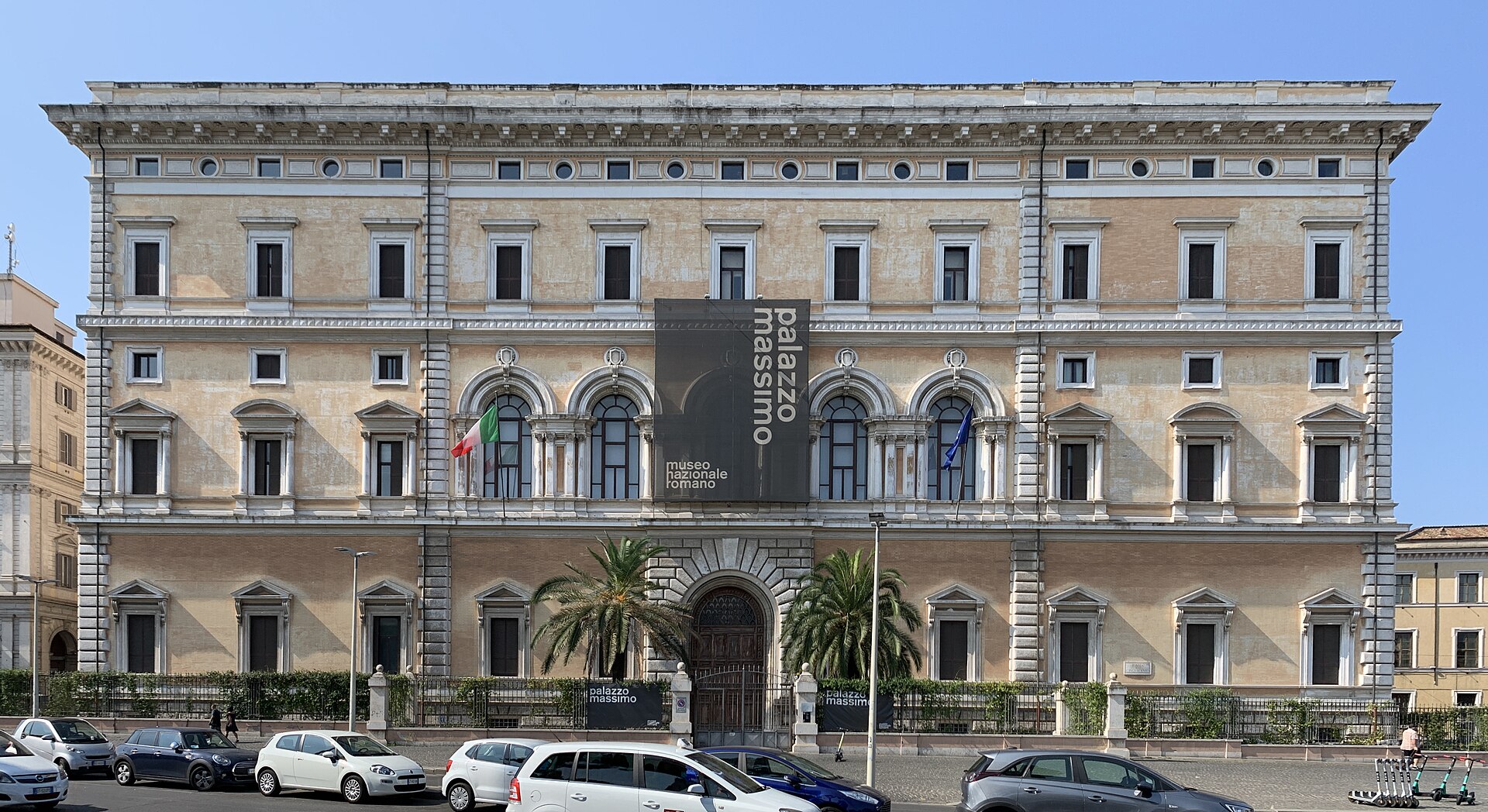
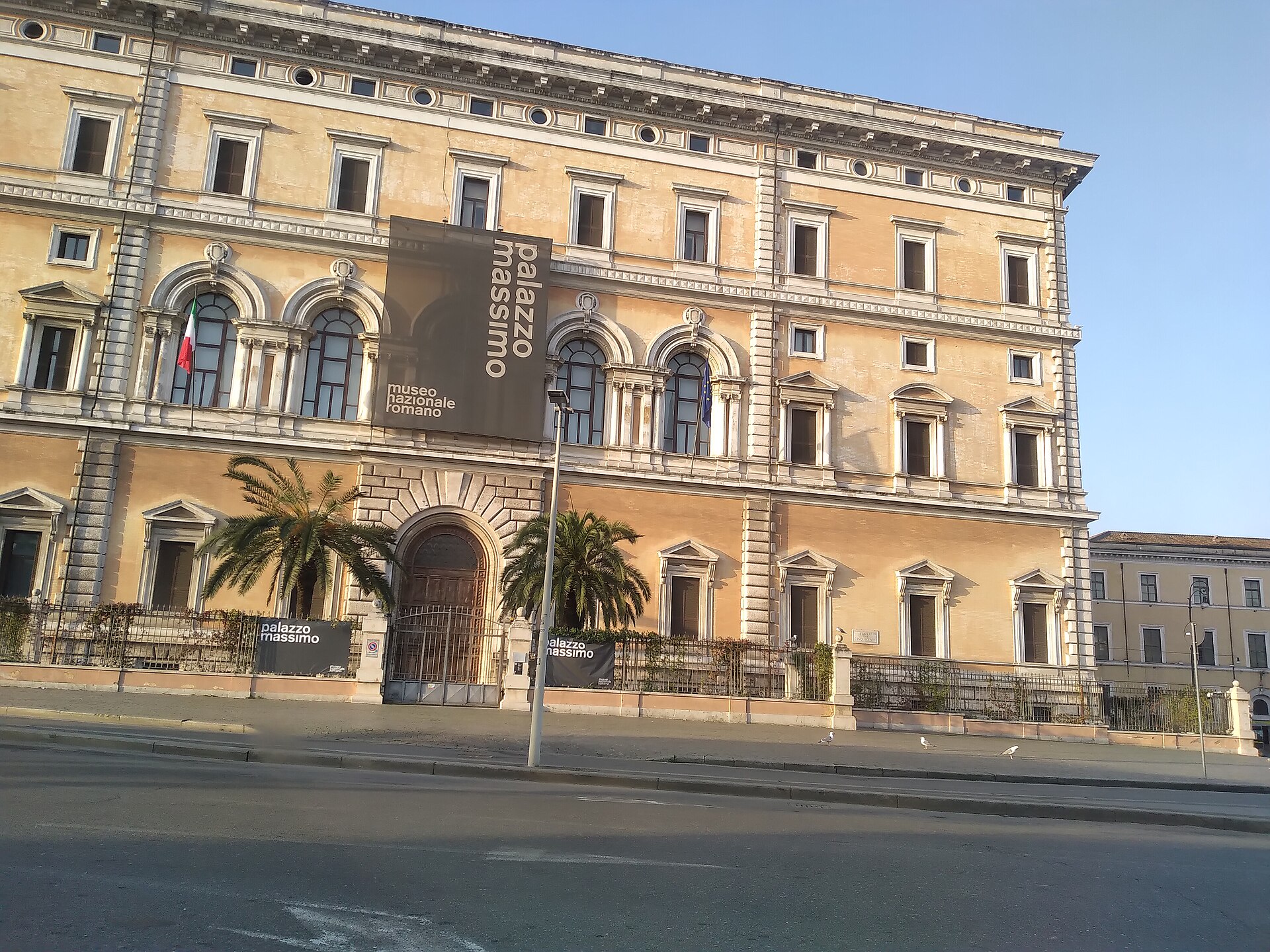
The facade of Palazzo Massimo alle Terme, near Rome's Termini station, with a MUSEO NAZIONALE ROMANO banner over the entrance. This is the largest and most-visited of the museum's four sites.
Photograph by Chabe01 · CC BY-SA 4.0Museo Nazionale Romano
Museum · Founded 1889
Open, admission and hours confirmed 24 August 2026 · 20 sources
On this page 14 sections
ContentsClose
Not one museum so much as four related ones sharing a ticket and a name: the deepest holding of Roman-period sculpture, portraiture and painted wall decoration excavated within Rome itself, spread across a Renaissance cardinal's palace, a purpose-built 1990s gallery, the surviving fabric of an imperial bath complex, and a single excavated city block. Its single most celebrated object, the bronze Boxer at Rest, survives only because it was deliberately buried and forgotten in antiquity, a fate bronze sculpture almost never escaped. Its coin cabinet, rarely mentioned first, is nonetheless one of the largest anywhere. Against that depth sits a genuinely awkward current reality: one of the four sites, Crypta Balbi, is closed outright, several rooms at the Baths of Diocletian are shut for restoration, and the museum's own account of who currently directs it does not agree with the most recent English-language reference source.
| Kind | Museum |
|---|---|
| Founded | 7 March 1889, inaugurated 1890, built around the archaeological finds Rome's post-1870 expansion as capital of Italy kept turning up, plus the appropriated Kircherian Museum collection; the Ludovisi collection was added in 1901 |
| City and country |  Rome, Italy Rome, Italy |
| Address | Largo di Villa Peretti 2 (Palazzo Massimo alle Terme), 00185 Roma, Italy - one of four sites, see Inside |
| Website | museonazionaleromano.it |
| Status | Open, confirmed |
| Record last verified |
Visiting
- Hours
- Tuesday to Sunday09:00 to 19:00Last admission 18:00
- MondayClosed (weekly closing day, per the museum's own hours page)
- Closed
- Monday.
- Admission
- Single ticket, all sites (Biglietto unico)EUR 15Valid for one entry to each site within a week of first use. As of August 2026 this nominally covers four sites but only three are actually open to the public, since Crypta Balbi is temporarily closed (see open_questions and Inside)
- Reduced (Ridotto)EUR 2Conditions set by the museum's own concessions page
- Musei in rete (affiliated-museum cardholders)EUR 10
- Aula Ottagona only (Museo dell'Arte Salvata)EUR 5A standalone ticket introduced 30 June 2026 for the Octagonal Hall alone, separate from the four-site single ticket
- MNR Card, annual, fullEUR 30Unlimited entry to all sites for one year from first use
- MNR Card, annual, reducedEUR 20
- Free admissionFreeFirst Sunday of every month, at all Italian state cultural sites; specific conditions for other free categories are set on the museum's own concessions page, not itself fetched for this record
Free entry: First Sunday of every month. 2 June 2026 (free opening). 1 November 2026 (free opening). 4 November 2026 (free opening). 26 September 2026: evening opening for European Heritage Days at EUR 1.00- Tickets
- museonazionaleromano.it/orari-e-biglietti The museum's own ticket page.
- Do I need to book?
- Not stated as compulsory; tickets are sold via the Musei Italiani platform linked from the museum's own tickets page
- Address
- Largo di Villa Peretti 2 (Palazzo Massimo alle Terme), 00185 Roma, Italy - one of four sites, see Inside MapMetro Palazzo Massimo and the Baths of Diocletian are both a short walk from Roma Termini station, served by Metro lines A and B
Bus Palazzo Altemps (Piazza Sant'Apollinare) and Crypta Balbi (Via delle Botteghe Oscure) are both served by routes 70, 81, 87, 116, 116T, 186, 492 and 628, well away from the Termini pair - Website
- museonazionaleromano.it
- Telephone
- 06.684851
- [email protected]
Before you go how long, access, photography, bags, eating, shop
- How long to allow
- The single ticket covers up to four separate buildings in different parts of Rome, so a full visit is not a single afternoon: Palazzo Massimo and the Baths of Diocletian sit near Termini station, while Palazzo Altemps (near Piazza Navona) and Crypta Balbi (on Via delle Botteghe Oscure) are a considerable walk or bus ride away in the historic centre. The ticket's one-week validity window exists specifically because the four sites cannot realistically be seen in one day
- Access
- All four sites are step-free for visitors with reduced mobility, though none has dedicated disabled parking; free wheelchairs are available at every site, and seating is provided throughout. Free tactile tours for blind and low-vision visitors are offered by appointment ([email protected]), and at the Baths of Diocletian, visually impaired visitors on an independent visit may touch original exhibits outside display cases where no barrier is posted; a Braille guide to the museum, produced with local school work-placement students, is available for download. Since 2017 the museum has taken part in Museo per tutti, a programme for visitors with intellectual disabilities developed with the association L'abilita onlus and the Fondazione De Agostini
- Photography
- Not detailed on the pages fetched for this record
- Bags
- Not detailed on the pages fetched for this record
- Eating
- Notice posted 20 June 2026 states the cafe at (unspecified which site) closes earlier than before; not otherwise detailed
- Shop
- Not detailed on the pages fetched for this record
Prices and hours change. We take them from the institution's own pages and print the day we read them, and you can check the current position at the source we used. Confirm before you travel.
What is inside
Palazzo Massimo alle Terme - Roman portraiture and mosaics (ground and first floors)
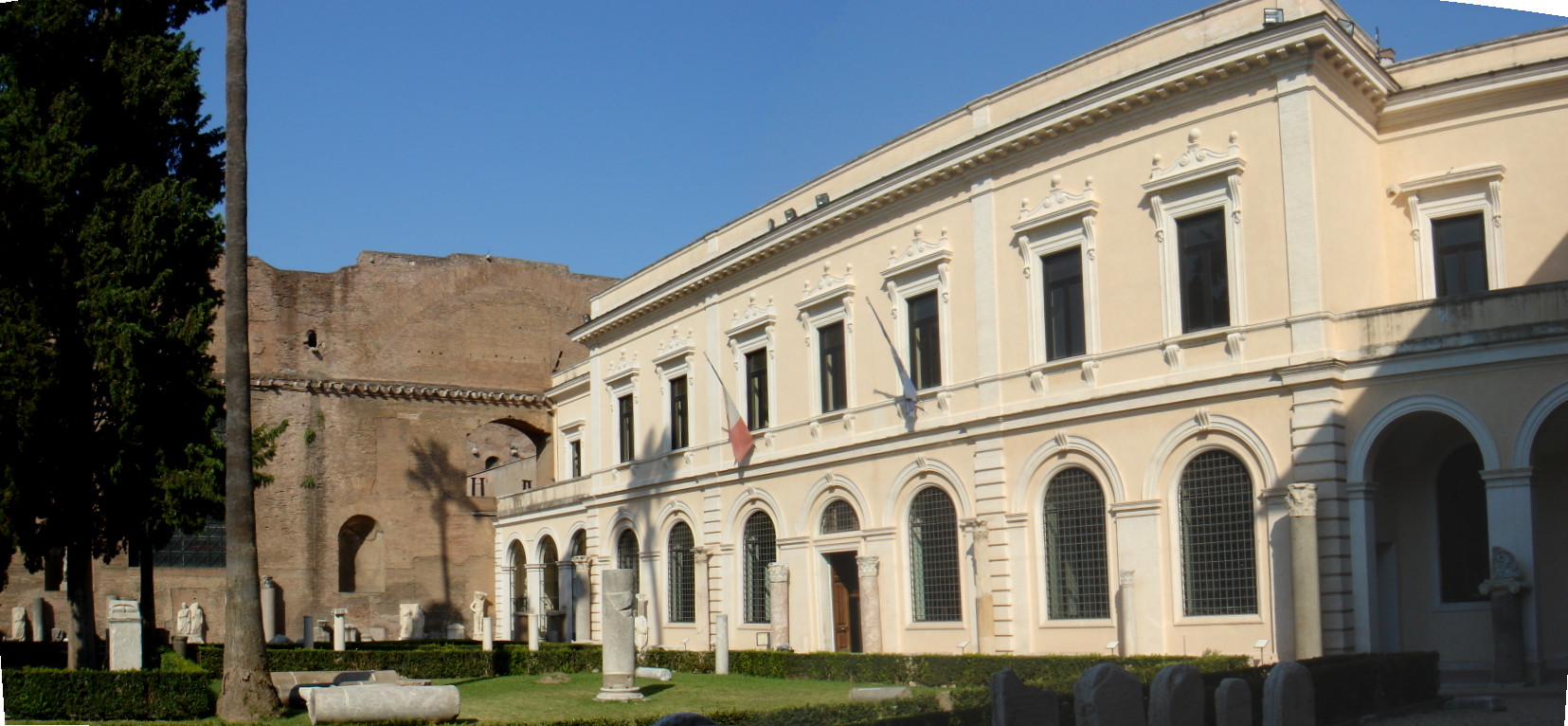
Widely treated as the main site of the four. Ground-floor galleries run chronologically through Republican and Julio-Claudian Rome: an ancestor-portrait gallery, the Fasti Antiati and Fasti Praenestini calendar fragments, and funerary reliefs of freedmen alongside the nobility. Upper floors hold portraiture from Hadrian's Villa and copies after Greek originals including the Discobolus and the Crouching Venus. The basement holds the numismatics and goldsmithing section, including the Medagliere, one of the largest coin and medal collections in the world at over half a million pieces, moved here from the Baths of Diocletian at the end of the 1990s
Palazzo Massimo - Villa of Livia and Villa Farnesina fresco rooms
A dedicated suite, restored and reopened 30 June 2010, housing wall paintings removed from two Roman houses: the underground nymphaeum of Livia's Villa ad Gallinas Albas near Prima Porta, a trompe-l'oeil garden of fruit trees and birds painted on all four walls of a single room, and the frescoed underground rooms of the so-called Villa or House of the Farnesina, discovered under the Renaissance gardens later flattened for the Lungotevere embankment road
Photograph by JTSH26 · CC BY-SA 4.0 Palazzo Altemps - the history of collecting
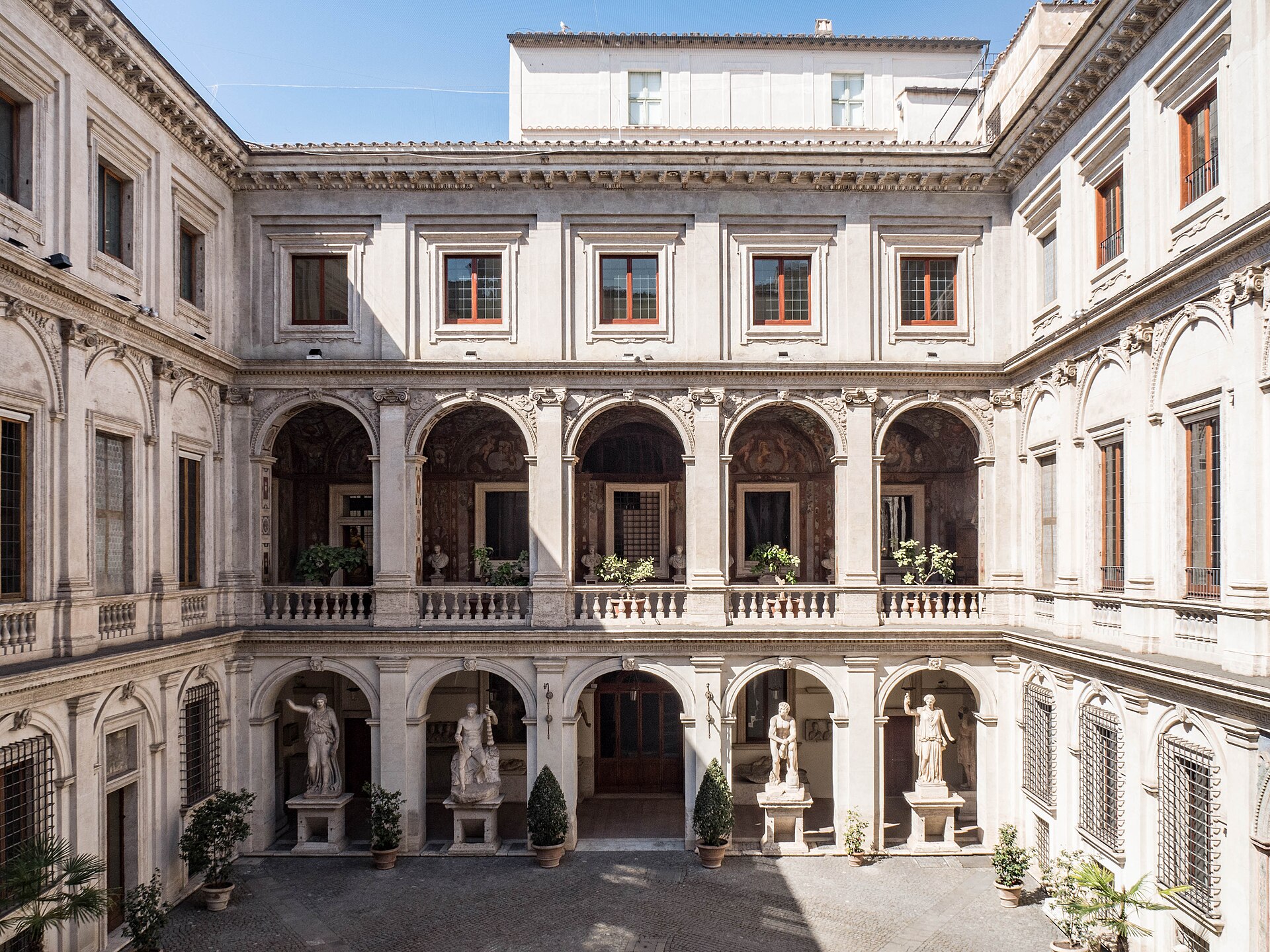
A 15th-century cardinal's palace, designed under Melozzo da Forli for Girolamo Riario and expanded by Martino Longhi for Cardinal Mark Sittich von Hohenems Altemps after 1568, still carrying a fresco of Girolamo's 1477 wedding to Caterina Sforza. Rather than displaying finds by excavation site, this building tells the story of Renaissance and Baroque collecting itself: the Ludovisi and Mattei family sculpture collections, including the Ludovisi Throne, the Ludovisi Ares and the Suicide of a Gaul (from the same Pergamene sculptural group as the Dying Gaul), plus an Egyptian collection and the palace's own private theatre, now used for temporary exhibitions
Public domain Terme di Diocleziano - Michelangelo's Cloister and the epigraphic collection
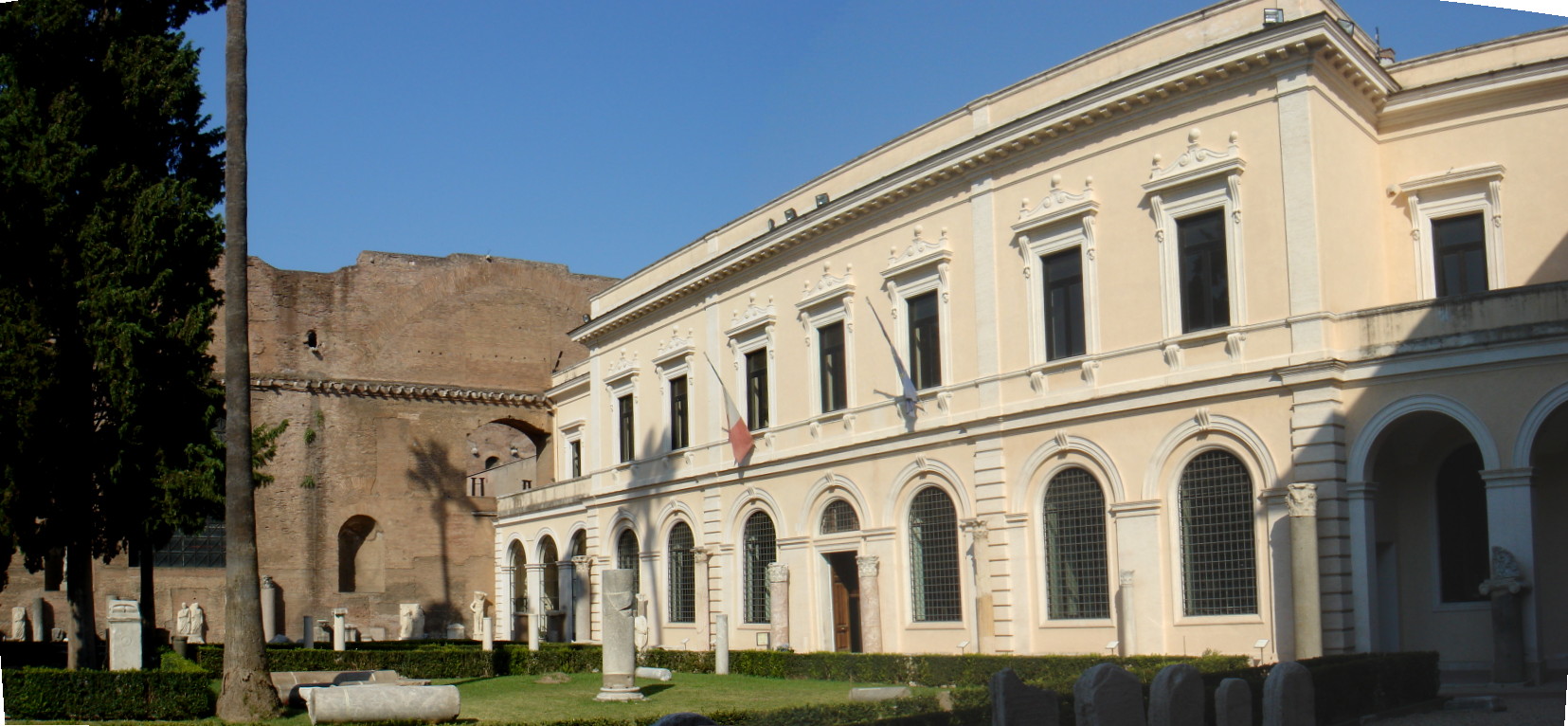
The museum's original 1889 home, built into the surviving structure of the Baths of Diocletian. The Great Cloister, traditionally credited to Michelangelo though more likely executed to a design he sketched by his pupil Giacomo del Duca, was not built until after Michelangelo's death in 1564, completed only around 1600, with its fountain added in 1695; it now holds a 16th-century garden of funerary sculpture and colossal ancient animal heads found near Trajan's Column in 1586. A separate modern building on the site holds the epigraphic section, over 900 inscriptions on display of a 10,000-plus holding, including the Zoninus collar. As of August 2026 the Natatio (the baths' ancient swimming pool footprint), Aula VIII and the Museum of Protohistory of the Latin Peoples, all part of this site, are closed to the public until further notice, and the whole site is under an open restoration programme visitors can currently tour as a construction site
Photograph by Falk2 · CC BY-SA 4.0 Museo dell'Arte Salvata, Aula Ottagona (Baths of Diocletian)
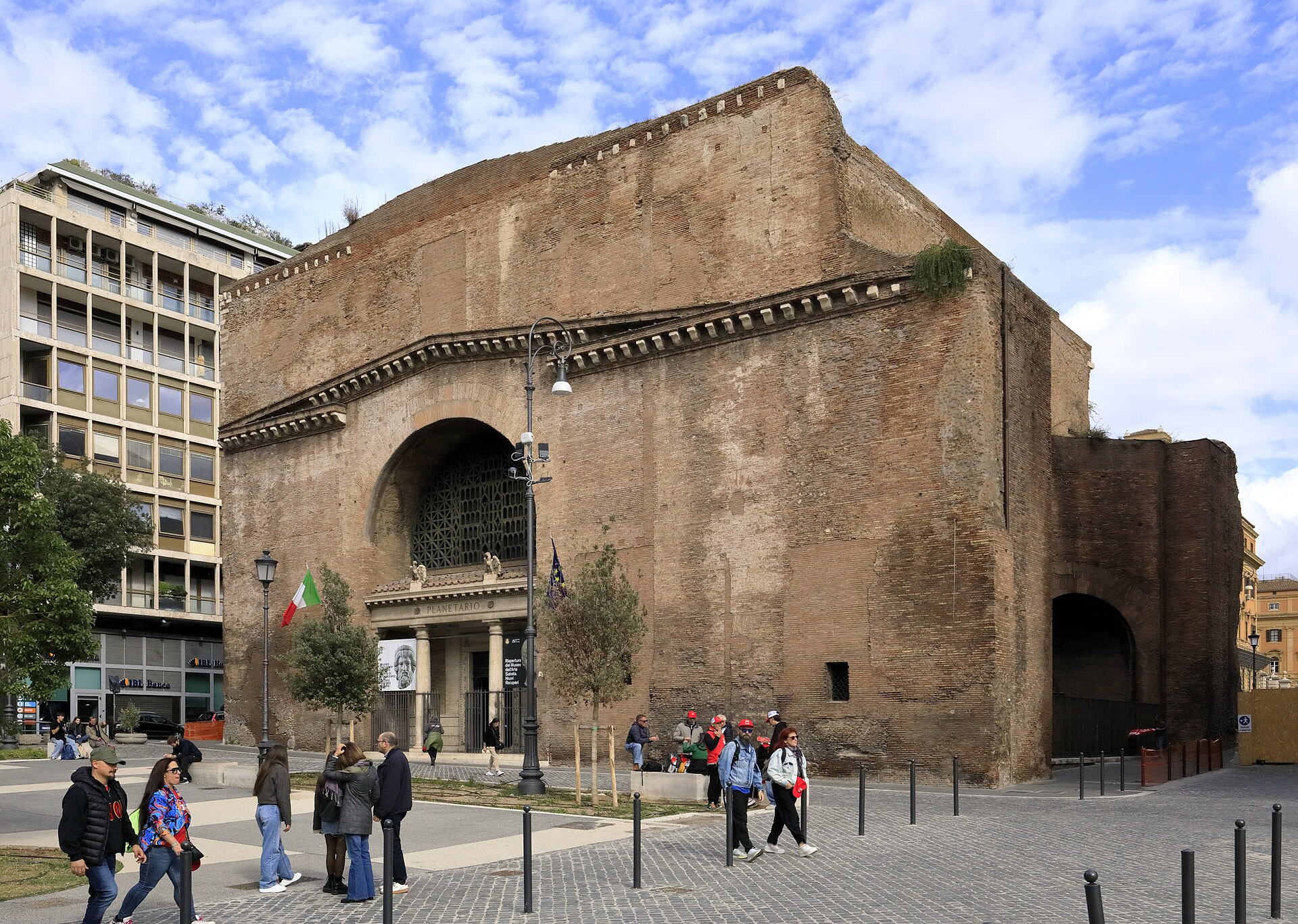
A single octagonal Roman hall with a documented history of its own: a grain store from 1575, an oil store from 1764, an exhibition space in 1911, then a cinema, then, from 1928, a planetarium, before restoration in 1991 turned it into a sculpture gallery. Since 2022 it has held the Museo dell'Arte Salvata, a rotating display, established by the Ministry of Culture, of art recovered from theft, looting, illegal export and disaster: work of the Carabinieri Command for the Protection of Cultural Heritage, the Caschi Blu della Cultura (Italy's UNESCO-linked rapid-response unit for heritage in war and disaster zones), and the restoration institutes ISCR, the Opificio delle Pietre Dure and ICPAL. Objects are shown only until the next recovery or restitution is ready to take their place, then returned to their place of origin
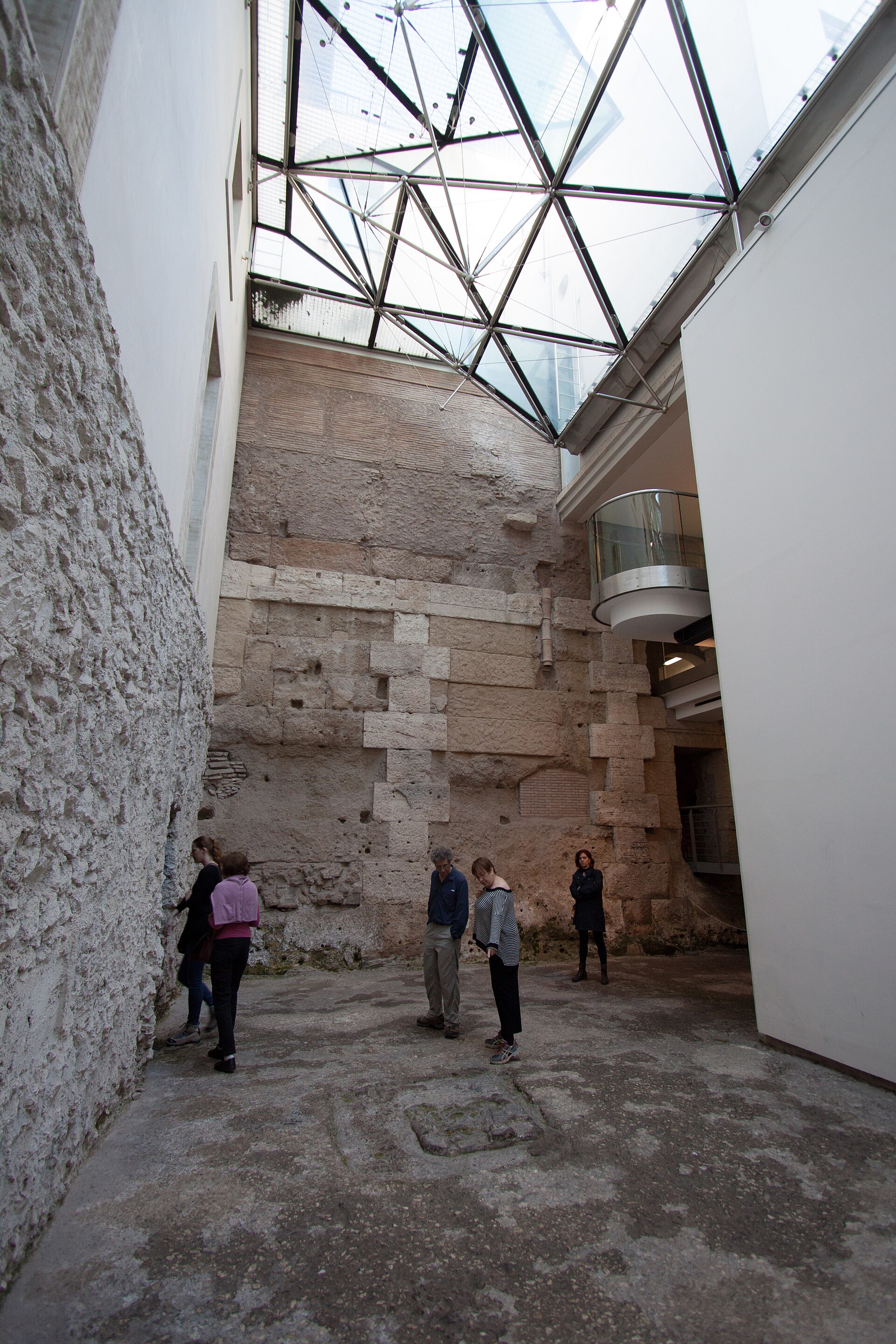
Public domain Crypta Balbi (currently closed to the public)
A 1981 excavation by the archaeologist Daniel Manacorda uncovered the colonnaded quadriporticus of the ancient Theatre of Lucius Cornelius Balbus here, together with continuous later occupation running through the medieval period; the site opened as a museum of the archaeology of a single urban block, and of medieval Rome, in 2001. As of August 2026 the museum's own notice states this site is temporarily closed to the public, with no reopening date given, meaning the single ticket for all four sites currently admits to only three
What to see first
Boxer at Rest (Terme Boxer)
Hellenistic bronze, c. 330-50 BCEOne of the very few large bronzes to survive from the ancient world at all, since bronze was routinely melted down and reused; this one and a companion piece, the so-called Hellenistic Prince, were both found deliberately buried on the Quirinal Hill in 1885, within a month of each other, probably near the remains of the Baths of Constantine. The archaeologist Rodolfo Lanciani, present at the discovery, wrote that in his whole career he had never felt such an extraordinary impression as watching this weathered, seated athlete emerge slowly from the ground.7
Ludovisi Throne
Greek, 5th century BCE (attribution and authenticity long debated)A carved marble relief, part of the Boncompagni-Ludovisi collection acquired for the museum in 1901, displayed at Palazzo Altemps as the centrepiece of the story of how Renaissance and Baroque Roman collectors assembled their own antiquities cabinets, the specific theme this building was designed to tell. As of 24 August 2026 the throne is temporarily off view: on loan since 4 June 2026 for the touring exhibition 'Le vite italiane dell'arte greca', shown at the Acropolis Museum, Athens (18 June-30 August 2026) and then the National Archaeological Museum, Reggio Calabria (September-December 2026), with no return date to Palazzo Altemps yet announced.20
Suicide of a Gaul (Ludovisi Gaul)
Roman marble copy of a lost Hellenistic bronze original, from the same Pergamene commemorative group as the Dying Gaul now in Rome's Capitoline MuseumsShows a defeated Gallic chieftain killing himself rather than be taken, having already killed his wife, whose body he supports as he falls; it is the most violent and most explicitly narrative piece in the Ludovisi collection at Palazzo Altemps, and its companion sculpture from the same original group is displayed across the city at the Capitoline.8
Villa of Livia garden fresco
Roman wall painting, Augustan period, c. 30-20 BCEA full-room trompe-l'oeil garden, fruit trees, flowers and birds painted continuously around all four walls of an underground summer room in the villa of Augustus's wife Livia near Prima Porta; removed to the museum and reinstalled as a complete room rather than as individual panels, so a visitor stands inside the illusion rather than looking at a fragment of it.6
Sleeping Hermaphroditus
Roman marble, 2nd century CE, after a Hellenistic originalA double-take sculpture designed to be walked around: seen from behind it reads as a sleeping woman, and only from the front does the figure's dual sex become apparent, a deliberately staged reveal typical of Hellenistic and Hellenistic-influenced sculpture's interest in ambiguity and surprise.6
Il Medagliere (the coin and medal collection)
Roman Republican through modern, multiple acquisitionsAt over half a million pieces, one of the largest numismatic collections anywhere, moved to Palazzo Massimo's basement at the end of the 1990s from its original home at the Baths of Diocletian; it is the kind of holding that rarely gets a museum's marquee billing but underpins most serious research into Roman-period economic history done anywhere in the world.3
The bronzes of the Ponte di Valentiniano (Memorie sommerse)
Late Roman, 4th century CE, from the decoration of the bridge now called Ponte SistoA diademed male head, a gilded bronze togate statue and the right wing of a Victory figure, all pulled from the Tiber's banks in 1878 during 19th-century river-engineering works and left in storage for well over a century before conservation and new research put them on public display for the first time, from 5 December 2025 to 31 August 2026, together with a video reconstruction of the bridge's own dedicatory inscriptions to the emperors Valentinian and Valens.5
Museo dell'Arte Salvata (Museum of Rescued Art)
Rotating display, established 2022Not a fixed collection but a changing one: objects recovered from theft, illegal export, war looting or natural disaster are shown here only until they are ready to be returned to their place of origin, so what is on the wall changes with the pace of Italy's own restitution and recovery work rather than with any curatorial schedule.9
Past exhibitions here
- Closed2 Jul to 27 Sep 2026Confirmed · check before you travel
- Closed5 Dec 2025 to 31 Aug 2026Confirmed · check before you travel
A capital needed a museum, and got one from a suppressed Jesuit collection
Rome became the capital of a unified Italy in 1870, and the building boom that followed kept turning up antiquities the new state had nowhere organised to put. The Museo Nazionale Romano was established on 7 March 1889 to solve exactly that problem, and it did not start from nothing: its founding core was the Kircherian Museum, the antiquarian collection assembled by the Jesuit polymath Athanasius Kircher and housed at the Jesuit complex of Sant'Ignazio until the Italian state seized it in 1874, following the suppression of the Society of Jesus. Chosen as the new museum's site were the Baths of Diocletian and part of the monastery cloister built into them, space that had until then been occupied by a miscellany of tenants, including a hospice for the blind poor and, in what had been Hall V of the ancient baths, a Caffe Concerto called Al Diocleziano. The Grande Mostra Archeologica staged in 1911 for the 50th anniversary of Italian unification gave the museum the excuse it needed to clear the whole complex back to archaeological use. In 1901 the museum's holdings were transformed again by the addition of the Ludovisi collection, the assembled antiquities of one of Rome's great noble families, which is now the core of what a visitor sees at Palazzo Altemps.
One institution split deliberately into four
The museum's present four-site shape dates only to the 1980s. A special 1981 law for the protection of Rome's archaeological heritage funded the purchase of Palazzo Altemps, Palazzo Massimo and the entire city block containing the Crypta Balbi, while the Baths of Diocletian went through a further round of restoration. Rather than merge everything into one undifferentiated collection, the museum was deliberately organised around what each building could best tell: Palazzo Altemps for the history of collecting itself, using the Ludovisi and Mattei holdings; Palazzo Massimo for the masterpieces of Roman art actually found within the city and its territory; the Baths of Diocletian for the epigraphic collection and a museum of the pre-Roman Latin peoples; and, after systematic archaeological research on the site itself, the Crypta Balbi for the archaeology of a single Roman-to-medieval city block. Palazzo Massimo opened in stages, its ground floor in 1995 and the rest in 1998; Palazzo Altemps opened in 1997 after fifteen years of restoration; the Crypta Balbi opened last, in 2001. A single ticket, valid across all four sites for a week from first use, exists because the museum itself was designed on the assumption that nobody sees this collection in one afternoon.
A grain store that became a cinema, a planetarium, and now a museum of what was almost lost
Few rooms anywhere have changed function as often as the Octagonal Hall at the Baths of Diocletian. Part of the original bath complex's central block, it became a grain store in 1575, an oil store in 1764, an exhibition space for the 1911 Grande Mostra Archeologica, then a cinema, then, from 1928, Rome's planetarium, before a 1991 restoration turned it into a sculpture gallery for pieces found across the city's other bath complexes. In 2022 it took on a purpose distinct from anything asked of it before: the Museo dell'Arte Salvata, a Ministry of Culture initiative that shows, on rotation, art recovered from theft, illegal export, war looting or disaster, drawing on the work of the Carabinieri's cultural-heritage protection command, Italy's UNESCO-linked disaster-response Caschi Blu della Cultura, and the country's leading restoration institutes. Nothing here stays long by design: each object is shown only until it is ready to go back to wherever it came from, which makes this the one gallery in the whole museum whose contents cannot be planned around in advance.
What is actually open right now
A visitor buying the single four-site ticket in August 2026 is, in practice, buying access to three sites. The museum's own notice states plainly that the Crypta Balbi is temporarily closed to the public, with no functional detail beyond that and no reopening date. At the Baths of Diocletian, the same notice lists the Natatio, Aula VIII and the Museum of Protohistory of the Latin Peoples as closed until further notice, and the site is additionally under an active, open restoration programme that the museum itself frames as something visitors can tour as a construction site rather than something hidden from them. None of this is reflected in a reduced ticket price; the single ticket and the annual MNR Card are both sold at the same rate regardless of which of the four sites happen to be open on the day of the visit.
Bronzes back from a century in storage
Not every gap in the display is a closure. In 1878, river-engineering work on the banks of the Tiber turned up a group of bronze fragments, a diademed male head, a gilded bronze togate statue, the right wing of a Victory figure, that belonged to the decoration of a late Roman bridge across the Tiber built under the emperors Valentinian and Valens and today known as the Ponte Sisto. The pieces went into storage and stayed there, largely unseen, for well over a century. From 5 December 2025 to 31 August 2026 the museum is showing them together for the first time as Memorie sommerse (Submerged Memories), alongside a video reconstruction, narrated by the Sapienza University epigraphist Silvia Orlandi, of the bridge's own dedicatory inscriptions. The museum frames the show explicitly as part of a wider strategy of reactivating objects sitting unshown in storage, the same strategy that let it lend its own Niobid and Peplophoros, Greek originals of the 4th century BCE, to a Capitoline Museums exhibition during the same period rather than keep every significant object permanently on its own walls.
What visitors say
Specialists and serious visitors consistently rank the Museo Nazionale Romano's four sites, and Palazzo Massimo and Palazzo Altemps in particular, among the finest collections of Roman and Roman-collected antiquity anywhere, holding pieces (the Boxer at Rest, the Ludovisi Throne) that would anchor any museum in the world; the same visitors, and the museum's own logistics, agree the four-site structure is genuinely hard to navigate in a single visit.
What is praised, what is criticised
- Praised: the Boxer at Rest and the other Quirinal bronzes at Palazzo Massimo, consistently singled out as among the finest ancient bronzes to survive anywhere
- Praised: the low crowds relative to the Colosseum or the Vatican museums, which visitors and critics alike attribute to how few tourists realise the single ticket covers four separate, excellent sites
- Praised: the Villa of Livia fresco room and the Palazzo Altemps courtyard, both praised for letting a visitor stand inside a reconstructed ancient or Renaissance space rather than viewing fragments in isolation
- Criticised: the geography of the four-site ticket itself: Palazzo Massimo and the Baths of Diocletian sit together near Termini, while Palazzo Altemps and Crypta Balbi are well across town near Piazza Navona and the Ghetto, so seeing all of it inside the ticket's one-week window takes real planning
- Criticised: the current, undated closure of an entire site, Crypta Balbi, plus the Natatio, Aula VIII and the Museum of Protohistory within the Baths of Diocletian, none of which the museum's own ticketing page adjusts the single-ticket price to reflect
- Criticised: that the museum's own leadership is hard to establish from public records: at the time this page was written both Wikidata and the English Wikipedia infobox were out of date, naming Stephane Verger and Daniela Porro respectively, when the director since November 2024 has been Edith Gabrielli
Questions about Museo Nazionale Romano
Where is Museo Nazionale Romano?
Largo di Villa Peretti 2 (Palazzo Massimo alle Terme), 00185 Roma, Italy - one of four sites, see Inside.
How much does it cost to visit?
Single ticket, all sites (Biglietto unico): EUR 15; Reduced (Ridotto): EUR 2; Musei in rete (affiliated-museum cardholders): EUR 10; Aula Ottagona only (Museo dell'Arte Salvata): EUR 5; MNR Card, annual, full: EUR 30. As confirmed 24 August 2026.
When is it open?
Tuesday to Sunday 09:00-19:00; Monday closed. Closed: Monday. As confirmed 24 August 2026.
How do you get there?
Metro: Palazzo Massimo and the Baths of Diocletian are both a short walk from Roma Termini station, served by Metro lines A and B; Bus: Palazzo Altemps (Piazza Sant'Apollinare) and Crypta Balbi (Via delle Botteghe Oscure) are both served by routes 70, 81, 87, 116, 116T, 186, 492 and 628, well away from the Termini pair.
What should you see first?
Boxer at Rest (Terme Boxer) (Hellenistic bronze, c. 330-50 BCE); Ludovisi Throne (Greek, 5th century BCE (attribution and authenticity long debated)); Suicide of a Gaul (Ludovisi Gaul) (Roman marble copy of a lost Hellenistic bronze original, from the same Pergamene commemorative group as the Dying Gaul now in Rome's Capitoline Museums); Villa of Livia garden fresco (Roman wall painting, Augustan period, c. 30-20 BCE); Sleeping Hermaphroditus (Roman marble, 2nd century CE, after a Hellenistic original); Il Medagliere (the coin and medal collection) (Roman Republican through modern, multiple acquisitions).
What we could not confirm
- Crypta Balbi is stated by the museum's own site to be 'temporarily closed to the public' with no reopening date given, and no explanation offered beyond that phrase; what condition prompted the closure, and how long it is expected to last, could not be established from any source fetched for this record.
- RESOLVED 2026-08-07 by an adversarial check: the director is Edith Gabrielli, appointed November 2024 after Stephane Verger was not renewed. Wikidata (Verger) and the English Wikipedia infobox (Daniela Porro, 2017) were both stale. This page follows Wikidata as the more recently updated record but did not find a single dated, fetched official source stating the current director by name.
- The museum's own beniculturali.it domain (the address given in the research brief and still cited as the 'official website' on several Wikipedia pages) was unreachable throughout this research: a direct HTTP fetch timed out after 75 seconds, and the in-app browser separately reported the navigation denied or failed. The Italian Ministry of Culture's own cultura.gov.it portal was equally unreachable by both methods. All content on this page instead comes from the museum's current working domain, museonazionaleromano.it, confirmed live and fetched directly throughout.
Images
Sources
- 1Wikidata, Museo Nazionale Romano (Q1135392): label, description, country Italy, city Rome, four child organisations (Palazzo Altemps, Palazzo Massimo, Crypta Balbi, Baths of Diocletian), director Stephane Verger, headquarters Palazzo Altemps. Fetched and raw-verified 7 August 2026. wikidata.org/wiki/Q1135392
- 2Museo Nazionale Romano, official Come arrivare page: full addresses and transport for all four sites (Palazzo Altemps, Palazzo Massimo, Terme di Diocleziano, Crypta Balbi). Fetched by direct HTTP GET (museonazionaleromano.it, the museum's current working domain) and read in full, 7 August 2026. museonazionaleromano.it/come-arrivare/
- 3Museo Nazionale Romano, official homepage: current exhibitions and notices (Memorie sommerse, Roma in Moneta, Mircea Cantor at Palazzo Altemps, AEGYPTUS), the Medagliere's description as 'over half a million works, one of the richest collections in the world', ongoing-restoration and archive-closure notices. Fetched and read in full, 7 August 2026. museonazionaleromano.it/
- 4Museo Nazionale Romano, official Accessibilita page: step-free access at all four sites, free wheelchairs, tactile tours by appointment, the Braille guide, and the Museo per tutti programme for visitors with intellectual disabilities since 2017. Fetched and read in full, 7 August 2026. museonazionaleromano.it/accessibilita-e-servizi-al-pubblico/
- 5Museo Nazionale Romano, official exhibition page for 'Memorie sommerse. I bronzi del Ponte di Valentiniano': the 1878 Tiber-bank discovery, the three bronze objects on display, curators Federica Rinaldi and Agnese Pergola, the 5 December 2025-31 August 2026 run, the video narrated by Silvia Orlandi, and the concurrent Niobid/Peplophoros loan to the Capitoline Museums. Fetched and read in full, 7 August 2026. museonazionaleromano.it/evento/memorie-sommerse-i-bronzi-del-ponte-di-valentiniano/
- 6Notes the English infobox still names Daniela Porro (sourced 2017) as director. Fetched and read in full, 7 August 2026. en.wikipedia.org/wiki/Museo_Nazionale_Romano
- 7Fetched and read in full, 7 August 2026. en.wikipedia.org/wiki/Boxer_at_Rest
- 8Same URL and fetch as source 6. en.wikipedia.org/wiki/Museo_Nazionale_Romano
- 9Museo Nazionale Romano, official Museo dell'Arte Salvata page: the room's establishment in 2022 in the Aula Ottagona, its rotating-exhibition model, and the named partner institutions (Carabinieri Comando Tutela Patrimonio Culturale, Caschi Blu della Cultura, ISCR, Opificio delle Pietre Dure, ICPAL). Fetched and read in full, 7 August 2026. museonazionaleromano.it/il-museo-dellarte-salvata/
- 10Museo Nazionale Romano, official Orari e Biglietti page: full ticket structure and prices (single ticket EUR 15/2/10, Aula Ottagona-only EUR 5, MNR Card EUR 30/20), 2026 free and extraordinary-opening dates, and the notices that Crypta Balbi is temporarily closed and that the Natatio, Aula VIII and Museum of Protohistory at the Baths of Diocletian are closed until further notice. Fetched and read in full, 7 August 2026. museonazionaleromano.it/orari-e-biglietti/
- 11Museo Nazionale Romano, official Storia del Museo Nazionale Romano page: the 7 March 1889 founding date, the Kircherian Museum and 1901 Ludovisi acquisitions, the original Baths of Diocletian tenants including the Caffe Concerto Al Diocleziano, the 1911 Grande Mostra Archeologica, and the 1981 four-site reorganisation. Fetched and read in full, 7 August 2026. museonazionaleromano.it/storia-del-museo-nazionale-romano/
- 12Museo Nazionale Romano, official Contatti page: individual phone numbers and addresses for all four sites and the central secretariat, plus department emails. Fetched and read in full, 7 August 2026. museonazionaleromano.it/contatti/
- 13Wikimedia Commons, File:Palais Massimo Thermes - Rome (IT62) - 2021-08-25 - 1.jpg: CC BY-SA 4.0, author Chabe01, camera-location geotag matching Palazzo Massimo's coordinates, confirmed by eye as the facade with a MUSEO NAZIONALE ROMANO banner. Used as the lead plate. commons.wikimedia.org/wiki/File:Palais_Massimo_Thermes_-_Rome_(IT62)_-_2021-08-25_-_1.jpg
- 14Wikimedia Commons, File:National Roman Museum in 2021.01.jpg: CC BY-SA 4.0, author CAPTAIN RAJU, confirmed by eye as the same Palazzo Massimo facade at wider angle. Used as a context plate. commons.wikimedia.org/wiki/File:National_Roman_Museum_in_2021.01.jpg
- 15Wikimedia Commons, File:Terme Diocleziano - ingresso al Museo Nazionale Romano 00355-6.JPG: public domain (PD-self), author Lalupa, English caption on the file itself states it is 'one of the four sites of the National Roman Museum', confirmed by eye as the Baths of Diocletian entrance with ancient ruins visible behind. Used as a context plate. commons.wikimedia.org/wiki/File:Terme_Diocleziano_-_ingresso_al_Museo_Nazionale_Romano_00355-6.JPG
- 16Wikimedia Commons, File:Cortile des Palazzo Altemps 2018.jpg: CC BY-SA 4.0, author JTSH26, confirmed by eye as the Palazzo Altemps Renaissance courtyard with ancient statues in the loggia. Used as the Palazzo Altemps wing plate. commons.wikimedia.org/wiki/File:Cortile_des_Palazzo_Altemps_2018.jpg
- 17Wikimedia Commons, File:L06 960 Aula Ottagona.jpg: CC BY-SA 4.0, author Falk2, confirmed by eye as the exterior of the Octagonal Hall at the Baths of Diocletian, current home of the Museo dell'Arte Salvata. Used as that wing's plate. commons.wikimedia.org/wiki/File:L06_960_Aula_Ottagona.jpg
- 18Wikimedia Commons, File:Crypta Balbi, courtyard.jpg: public domain (PD-self), author Szilas, confirmed by eye as the Crypta Balbi's internal courtyard. Used as the Crypta Balbi wing plate, captioned to note the site's current closure. commons.wikimedia.org/wiki/File:Crypta_Balbi,_courtyard.jpg
- 19Edith Gabrielli was appointed director of the Museo Nazionale Romano in November 2024, after the Ministry of Culture under Alessandro Giuli declined to renew Stephane Verger, who had been appointed by Dario Franceschini in 2020 following an international competition. Gabrielli, who already led the ViVe institute of the Vittoriano and Palazzo Venezia, was still serving as of 2025. Both Wikidata and the English Wikipedia infobox were out of date on this point when this page was first written. insideart.eu/2024/11/06/mic-al-museo-nazionale-romano-arriva-edith-gabrielli/
- 20Museo Nazionale Romano, official notice: the Ludovisi Throne at Palazzo Altemps is temporarily not visible to the public from 4 June 2026, on loan for the exhibition 'Le vite italiane dell'arte greca' (Acropolis Museum, Athens, 18 June-30 August 2026; National Archaeological Museum, Reggio Calabria, September-December 2026). Fetched and raw-verified 24 August 2026. museonazionaleromano.it/2026/05/palazzo-altemps-trono-ludovisi/
_-_2021-08-25_-_1.jpg)


