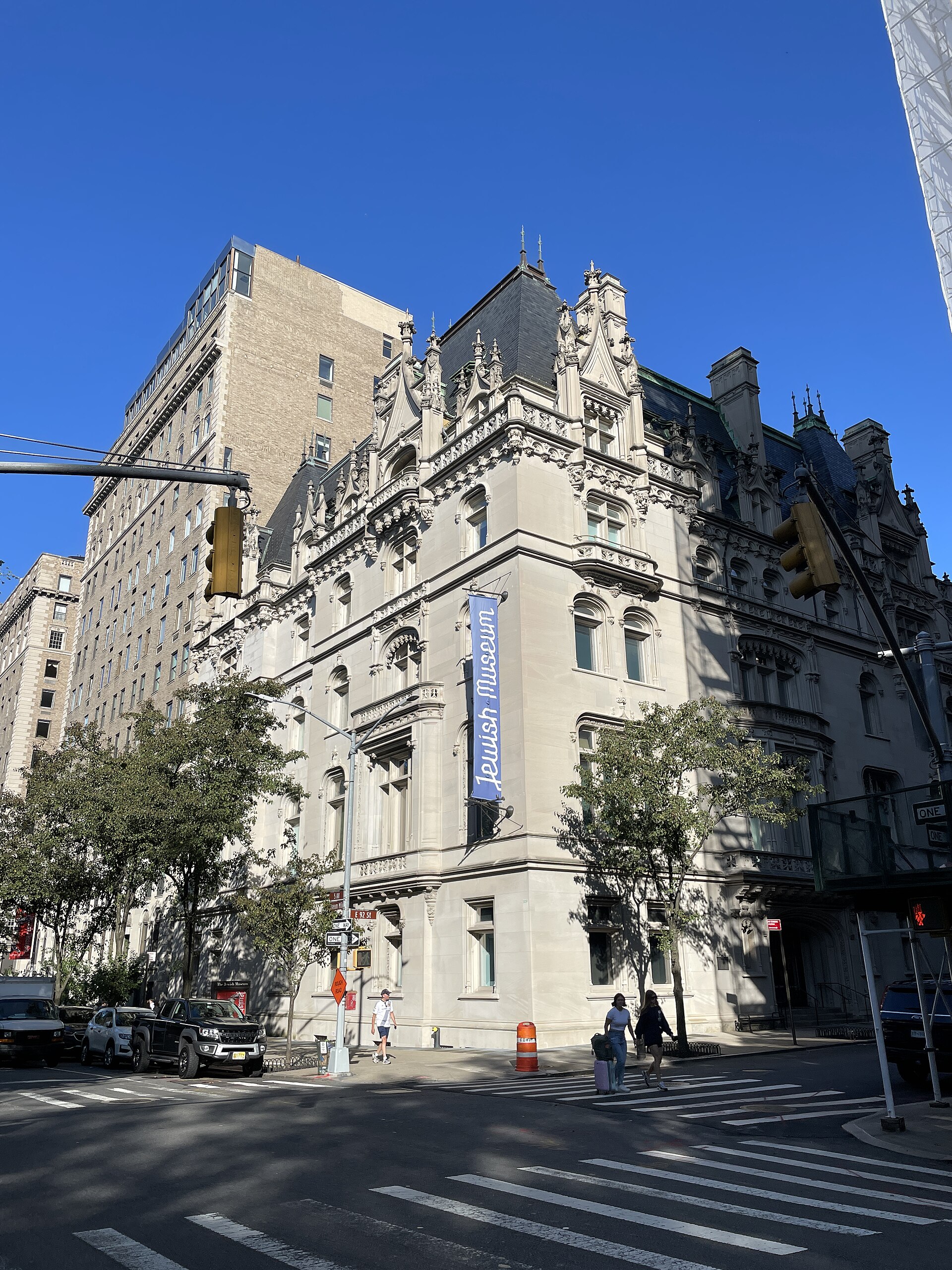
The former Warburg mansion at Fifth Avenue and 92nd Street, home to the Jewish Museum, photographed in 2023.
Deans Charbal / Wikimedia Commons, CC BY-SA 4.0 · Photograph by DeansfaThe Jewish Museum
Museum · Founded 1904
Open, admission and hours confirmed 19 August 2026 · 13 sources
On this page 15 sections
ContentsClose
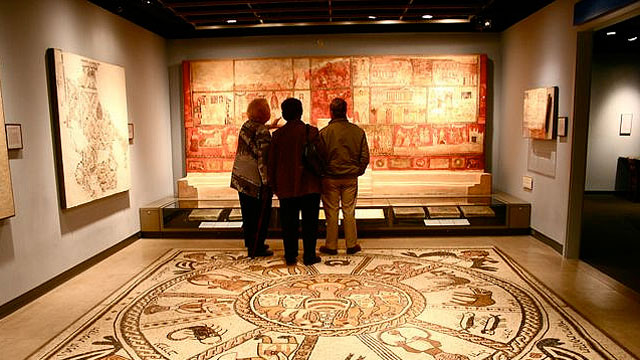
The museum's roughly 30,000 objects divide, broadly, into three overlapping strengths. It holds one of the largest collections of Jewish ceremonial art (Judaica) in the world, including a holding of more than 1,000 Hanukkah lamps spanning centuries and continents, alongside Torah ornaments, textiles and ritual silver. It holds a body of archaeological and antiquities material, including the Poland shipment sent for safekeeping in 1939, that reaches back more than 4,000 years. And, as a legacy of its 1960s run as a venue for new American art, it holds a body of mid-twentieth-century and contemporary painting and sculpture, by artists including Mark Rothko, Louise Nevelson, Lee Krasner, Eva Hesse and Larry Rivers, that is unusual in depth for an institution defined by subject rather than period.
| Kind | Museum |
|---|---|
| Founded | 1904 |
| City and country |  New York, United States New York, United States |
| Address | 1109 Fifth Avenue at 92nd Street, New York, NY 10128 |
| Website | thejewishmuseum.org |
| Status | Open, confirmed |
| Record last verified |
Visiting
- Hours
- Sun11:00 to 18:00
- Mon11:00 to 18:00
- Thu11:00 to 20:00
- Fri11:00 to 18:00
- Sat11:00 to 18:00
- Closed
- Tuesday. Wednesday.
- Admission
- AdultUSD 24
- Senior (65+)USD 14
- StudentUSD 10with valid ID
- Children (18 and under)Freefree
- MemberFreefree
Free entry: Saturdays, free to all. Free to visitors with disabilities and one caregiver, and to SNAP/EBT cardholders- Tickets
- buy.acmeticketing.com/orders/213/calendar?eve... The museum's own ticket page.
- Do I need to book?
- No, but advance timed tickets are recommended and available online as well as onsite in the Museum's lobby
- Address
- 1109 Fifth Avenue at 92nd Street, New York, NY 10128 MapSubway 4, 5 or 6 train to 86th Street or 96th Street, then walk east to Fifth Avenue
Bus M1, M2, M3, M4 or M86 to Fifth Avenue and 92nd Street - Website
- thejewishmuseum.org
- Telephone
- +1 212-423-3200
- [email protected]
Before you go how long, access, photography, bags, eating, shop
- How long to allow
- 2 to 3 hours, per third-party visitor guides; the museum's own site does not state a typical duration
- Access
- Wheelchair-accessible entrance immediately right of the main Fifth Avenue entrance, on 92nd Street. All floors are accessible for people using mobility aids. Hearing loops at the admissions desk, coat check and shop. Large-print labels and free sensory kits available at the admissions desk. Verbal Description audio tours on the Bloomberg Connects app. Guide dogs and trained service animals welcome; pets and emotional-support animals are not.
- Photography
- Non-flash photography permitted for personal, non-commercial use except where noted. Tripods, camera mounts and professional video equipment are not permitted without prior approval; videotaping or streaming of programs and events is not permitted without written authorization.
- Bags
- Bags larger than 11 x 14 x 8 inches must be checked. Backpacks must be worn on the front or checked. Coats must be worn or checked, not carried. Luggage, wheeled bags and large umbrellas are not permitted and cannot be checked.
- Eating
- Lox at the Jewish Museum, an OU Kosher-certified restaurant serving Jewish comfort food (bagels, blintzes, house-cured salmon); open to the public without museum admission.
- Shop
- The Cooper Shop, Judaica, jewelry, books and gifts tied to the current exhibitions and the permanent collection.
Prices and hours change. We take them from the institution's own pages and print the day we read them, and you can check the current position at the source we used. Confirm before you travel.
What is inside
Ground floor - restored mansion entrance
The Warburg mansion's original formal Fifth Avenue entrance, restored and used as the museum's main entrance; the ground-floor rooms behind it were renovated into galleries, a reception hall and bookshop (the Cooper Shop), and staff offices.
First and second floors - changing exhibitions
Rotating loan and thematic exhibitions, several times a year: recent examples include an early-career survey of Anish Kapoor, a Paul Klee exhibition, Joan Semmel's 2024 exhibition 'Flesh', 'Circa 1776: Jews in Colonial America', and a history of Coney Island's Jewish connections told through photographs and two carved carousel horses.
Third floor - Identity, Culture, and Community
The museum's reinstalled permanent-collection galleries, opened October 2025: more than 200 works, from archaeological artifacts and ceremonial Judaica to contemporary painting and sculpture by artists including Mel Bochner, Nicole Eisenman, Eva Hesse, Lee Krasner, Louise Nevelson, Mark Rothko, Michal Rovner and Miriam Schapiro, arranged thematically rather than chronologically.
Fourth floor - Robert and Tracey Pruzan Family Center for Learning
A roughly 7,000-square-foot space, new in October 2025: a floor-to-ceiling display of more than 130 Hanukkah lamps drawn from a holding of over 1,000, a simulated archaeological dig, a touch wall on artistic materials, two art studios, and the Wilf Family Salon, a space for changing commissioned installations.
What to see first
The Steerage
Alfred StieglitzA 1907 photograph (this print 1915) regarded as one of the foundational images of American photographic modernism; the museum holds one of the prints.4
Dancer
Elie NadelmanA carved and painted wood figure, circa 1920-22, by the Polish-American sculptor whose stylized figures shaped American modernist sculpture.4
Untitled (Old Man with Beard)
Marc ChagallA circa-1931 work by Chagall in the museum's holdings of the artist, whose paintings recur through the collection's twentieth-century galleries.4
Torah Ark from Adath Yeshurun Synagogue
Abraham ShulkinAn 1899 hand-carved and painted wooden Torah ark from a Sioux City, Iowa synagogue, a rare surviving example of American folk-craft ceremonial furniture.4
Esther Scroll
Salom ItaliaAn illustrated 1641 megillah (Book of Esther scroll) by one of the best-documented Jewish engravers of seventeenth-century Italy.4
Portrait of Vera List
Larry RiversA circa-1965 portrait of the collector and philanthropist Vera List, tying the collection to one of its own historic patron families.4
Landscape with Black Sun
Mordecai ArdonA 1961 painting by the Bauhaus-trained Israeli painter, representing the museum's holdings of Israeli modernism.4
Goldfish Vendor
Reuven RubinA 1928 painting by the Romanian-born Israeli painter, part of the museum's early-twentieth-century Palestine and Israel holdings.4
Exhibitions on now
- On now17 Jul to 15 Nov 2026Confirmed , 8 weeks ago
- On now18 Sep 2026 to 7 Feb 2027Confirmed , 8 weeks ago
Past exhibitions here
- Closed24 Oct 2025 to 1 Feb 2026Confirmed · check before you travel
A banking family's mansion on Museum Mile
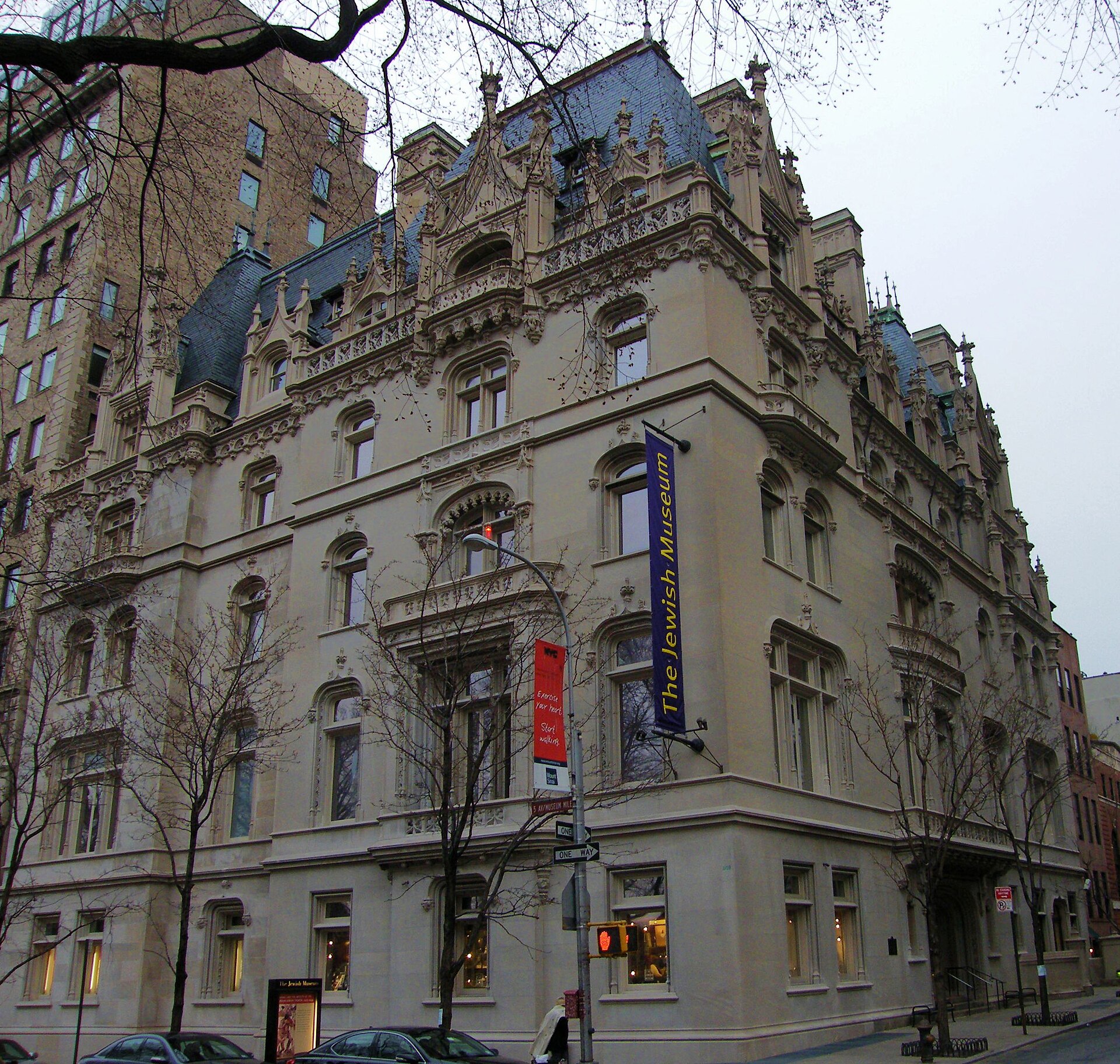
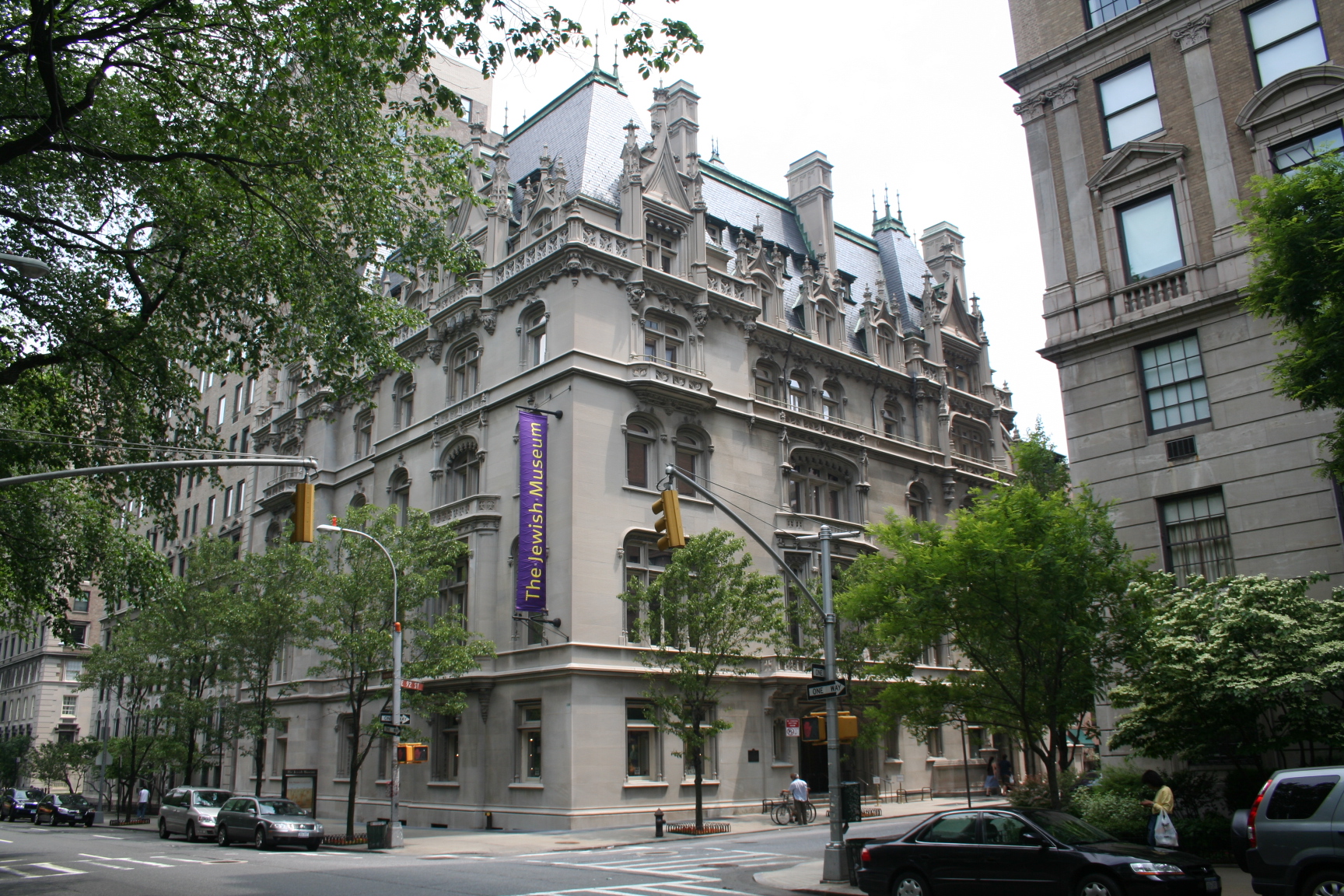
The building the Jewish Museum occupies was not built to hold a museum. Felix M. Warburg, the banker and philanthropist, and his wife Frieda Schiff Warburg commissioned architect C.P.H. Gilbert, who had trained under Richard Morris Hunt, to design a limestone townhouse at the northeast corner of Fifth Avenue and 92nd Street. Built in 1906-1908 in the Francois I style associated with the chateaux of the Loire, with mansard roofs, dripping moldings and carved gables, it was for three decades a private family residence, one of the grandest on a stretch of Fifth Avenue that already held some of the city's grandest houses.
Felix Warburg died in 1937. In January 1944 his widow donated the mansion to the Jewish Theological Seminary of America, on the understanding, in her own words, that it become a place to celebrate Jewish culture, history and tradition rather than serve only as a memorial to Jewish suffering. It opened to the public as the Jewish Museum in May 1947. The address has not changed since: 1109 Fifth Avenue, at 92nd Street, is the same corner Gilbert built on for the Warburgs.
A collection that began in a rabbinical seminary
The collection predates the building by four decades. It was founded on 20 January 1904, when Judge Mayer Sulzberger, a Philadelphia jurist and bibliophile, donated 26 ceremonial objects to the Jewish Theological Seminary to form the nucleus of a museum collection, first housed in the Seminary's library at 122nd Street and Broadway. On the museum's own account it is the first institution of its kind in the United States and one of the oldest Jewish museums anywhere in the world.
The collection grew through major gifts from collectors Hadji Ephraim Benguiat and Harry G. Friedman. In 1939, roughly 350 Judaica objects were sent from Poland to New York for safekeeping ahead of the German invasion; given what followed in Poland, most of that shipment never went home, and the objects remain part of the collection today. By the time the museum moved into the Warburg mansion in 1947 it had already outgrown a seminary library. It now holds close to 30,000 objects, ceremonial pieces, works of fine art and archaeological material spanning more than 4,000 years, from antiquity to work acquired this year.
The decade the museum became a laboratory for American contemporary art
From the early 1960s the Jewish Museum ran, for roughly a decade, as one of New York's most consequential venues for new art carrying no explicitly Jewish subject matter at all. Under director Alan R. Solomon, appointed in 1962, the museum gave first solo museum exhibitions to Helen Frankenthaler, Kenneth Noland and Ad Reinhardt. Its 1957 survey 'Artists of the New York School: Second Generation' was an early platform for Jasper Johns; its 1963 show gave Robert Rauschenberg his first museum retrospective; and the 1966 exhibition 'Primary Structures' is still cited by historians as the show that gave Minimalism its name as a movement. The run continued under Karl Katz through 1970's 'Software,' an early survey of art built from computing and information systems.
It ended abruptly. Financial pressure and trustee objections to a program that by then had almost no connection to Jewish subject matter led the museum to discontinue non-Jewish exhibitions in 1971, and Katz resigned. Joy Ungerleider-Mayerson, who succeeded him in 1972, redirected the program back toward Jewish history and culture and secured a major loan of ancient artifacts from Israel. Joan Rosenbaum, director from 1981 to 2010, grew the collection to some 26,000 objects, built the endowment past 90 million dollars, and in 1992 launched the New York Jewish Film Festival, run jointly with Lincoln Center, which continues today.
Three renovations, and a building that has never stopped changing
The mansion the museum occupies today is considerably larger than the one Frieda Warburg gave away in 1944. Tertiary sources describe a 1963 expansion that added exhibition space to accommodate the growing Judaica collection and a fuller public program; this desk could not independently confirm the addition's architect from a source it was able to read directly, and the claim is not repeated here as fact.
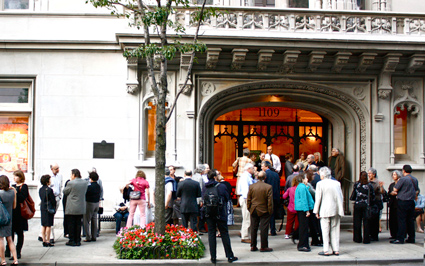
The larger transformation is well documented. Between 1990 and 1993, architect Kevin Roche designed a seven-story, 11,000-square-foot addition, at a reported cost of 36 million dollars, that doubled the museum's size while carrying forward the Gothic Revival limestone language of Gilbert's original facade; the project was overseen by then-director Joan Rosenbaum. The mansion's original formal entrance on Fifth Avenue has itself been restored and now serves as the museum's main entrance, with the ground-floor rooms behind it renovated into galleries, a reception hall and bookshop, and staff offices.
Most recently, a 14.5-million-dollar renovation of the third and fourth floors, roughly 20,000 square feet, or about half the museum's public space, opened on 24 October 2025. It was designed by UNStudio of Amsterdam with New Affiliates Architecture of New York, with Method Design of New York as architect of record. Director James S. Snyder, who took over the museum in November 2023, called it a new chapter for the institution; senior deputy director Darsie Alexander said the redesigned galleries were built to foreground the diversity and experimentation of the artists in the collection rather than march the material through a single chronological line.
What is on view now, and a dispute the museum has had to answer
The reinstalled third floor, titled 'Identity, Culture, and Community,' shows more than 200 works arranged thematically rather than by date, so that a medieval Torah crown can sit near a contemporary canvas by an artist such as Nicole Eisenman, Mark Rothko or Louise Nevelson. The fourth floor's new Robert and Tracey Pruzan Family Center for Learning is built around a floor-to-ceiling display of more than 130 Hanukkah lamps drawn from a holding of over 1,000, alongside a simulated archaeological dig, a touch wall exploring artistic materials, two art studios, and the Wilf Family Salon, a space reserved for changing, commissioned installations. The first and second floors continue to carry loan and thematic exhibitions that rotate several times a year; recent examples include an early-career survey of Anish Kapoor, a Paul Klee exhibition, Joan Semmel's 2024 exhibition 'Flesh,' 'Circa 1776: Jews in Colonial America,' and a history of Coney Island's Jewish connections told through photographs and two carved carousel horses.
Not every show at the museum has gone unchallenged. In 2022 the museum's retrospective of filmmaker Jonas Mekas, 'The Camera Was Always Running,' was publicly criticized by historian Michael Casper, who argued in the New York Review of Books and in Jewish Currents that Mekas had obscured his own record in wartime Lithuania, where he worked on two newspapers that carried Nazi propaganda and antisemitic material, and that the exhibition did not interrogate that record. The museum's senior director of communications, Anne Scher, called Casper's claims unsubstantiated. Curator Kelly Taxter said the wartime period was addressed in her catalogue essay, though it was not the exhibition's central focus, and characterized inconsistencies in Mekas's own retelling of his history as a survivor's way of coping with trauma rather than deliberate deception. The Jewish Telegraphic Agency's coverage of the dispute noted it divided outside critics: New Yorker film critic Richard Brody called Casper's findings cogent and troubling, while a New York Times review of the exhibition argued that strict reliability was not the right measure for an artist working in that register. On the record available to this desk it remains an unresolved disagreement between a named historian and the museum over how one exhibition handled one artist's biography, not a settled finding against the institution.
What visitors say
Visitors consistently single out the building itself, C.P.H. Gilbert's Gothic Revival Warburg mansion, as much as anything inside it, and the reinstalled third and fourth floors that opened in October 2025 are described as the strongest thing the museum has done in years, particularly the wall of Hanukkah lamps in the new learning center. The most repeated caution is one of scale: this is a townhouse, not a Met or a Guggenheim, and reviewers say a visit runs two to three hours rather than a full day, with the rotating shows on the lower floors occasionally judged thinner than the permanent collection above them.
What is praised, what is criticised
- Praised: The Warburg mansion itself: its Gothic Revival Fifth Avenue facade and the sense of visiting a historic private house rather than a converted institutional shell
- Praised: The October 2025 reinstallation of the third and fourth floors, especially the floor-to-ceiling wall of more than 130 Hanukkah lamps in the new Pruzan Family Center for Learning, and the thematic (rather than strictly chronological) hang that lets a medieval object sit near a contemporary one
- Praised: Free admission on Saturdays, and staff described repeatedly as friendly and accommodating, including help for visitors who arrive without a timed ticket
- Criticised: The museum's physical scale relative to its neighbors on Museum Mile: several visitors note it can be covered in two to three hours and that the rotating exhibitions can feel slight measured against the building
- Criticised: Inconsistent floor access on some visits: one 2024 visitor reported only two of the museum's floors open and the cafe closed while full admission was still charged, with no notice before payment
- Criticised: A minority of visitors found specific contemporary-art installations, one named Joan Semmel's 2024 exhibition 'Flesh', out of step with what they expected of a museum billed around Jewish history and culture
Ratings on other platforms
Tripadvisor: 4.4 from 499 ratings, read 19 August 2026
A platform average is a tertiary source: it moves, it is not audited, and we quote no visitor's words.
Questions about The Jewish Museum
Where is The Jewish Museum?
1109 Fifth Avenue at 92nd Street, New York, NY 10128.
How much does it cost to visit?
Adult: USD 24; Senior (65+): USD 14; Student: USD 10; Children (18 and under): free; Member: free. As confirmed 19 August 2026.
When is it open?
Sun 11:00-18:00; Mon 11:00-18:00; Thu 11:00-20:00; Fri 11:00-18:00; Sat 11:00-18:00. Closed: Tuesday. Wednesday. As confirmed 19 August 2026.
How do you get there?
Subway: 4, 5 or 6 train to 86th Street or 96th Street, then walk east to Fifth Avenue; Bus: M1, M2, M3, M4 or M86 to Fifth Avenue and 92nd Street.
What should you see first?
The Steerage (Alfred Stieglitz); Dancer (Elie Nadelman); Untitled (Old Man with Beard) (Marc Chagall); Torah Ark from Adath Yeshurun Synagogue (Abraham Shulkin); Esther Scroll (Salom Italia); Portrait of Vera List (Larry Rivers).
What we could not confirm
- The architect and scope of the museum's 1963 building expansion is repeated across tertiary sources but could not be confirmed by this desk from a source it could read directly; the claim is noted in the narrative as unconfirmed rather than stated as fact.
- Whether the 1959-63 outdoor sculpture space attached to the building is still open to visitors in its original form, or was absorbed into a later renovation, is not established by the sources checked for this page.
- No independent, dated critical review of the October 2025 renovation of the third and fourth floors was located beyond the museum's own press materials and trade coverage in The Art Newspaper; a review from a general newspaper of record was searched for and not found.
Images
Sources
- 1The Jewish Museum, Visit (hours, admission, contact, accessibility, policies) thejewishmuseum.org/visit/
- 2The Jewish Museum, About (history, mission, leadership) thejewishmuseum.org/about/
- 3The Jewish Museum, Identity, Culture, and Community: Stories from the Collection of the Jewish Museum and Pruzan Family Center for Learning thejewishmuseum.org/exhibitions/collection-exhibition-and-center-for-learning-october-2025/
- 4The Jewish Museum, Online Collection - Highlights collections.thejewishmuseum.org/highlights
- 5The Jewish Museum, press release: The Jewish Museum to Debut Newly Transformed Collection Galleries and Learning Center on October 24, 2025 thejewishmuseum.org/press/reimagined-third-and-fourth-floor-opening-release/
- 6Wikidata, Q592116 (Jewish Museum) wikidata.org/wiki/Special:EntityData/Q592116.json
- 7Wikipedia, Jewish Museum (Manhattan) [, used for machine facts and cross-checking only] en.wikipedia.org/wiki/Jewish_Museum_(Manhattan)
- 8Tripadvisor, The Jewish Museum (rating, review text read in full) [] tripadvisor.com/Attraction_Review-g60763-d106187-Reviews-The_Jewish_Museum-New_York_City_New_York.html
- 9Jewish Telegraphic Agency, 'Historian accuses NY's Jewish Museum of sanitizing filmmaker's World War II record in new exhibit', 12 May 2022 jta.org/2022/05/12/global/historian-accuses-nys-jewish-museum-of-sanitizing-filmmakers-world-war-ii-record-in-new-exhibit
- 10The Art Newspaper, 'Inside the Jewish Museum's $14.5m renovation in New York City', 5 November 2025 theartnewspaper.com/2025/11/05/jewish-museum-renovation-new-york-city
- 11Architizer, The Jewish Museum (Kevin Roche John Dinkeloo and Associates project page) architizer.com/projects/the-jewish-museum/
- 12Wikimedia Commons, Category:Jewish Museum (New York City) commons.wikimedia.org/wiki/Category:Jewish_Museum_(New_York_City)
- 13Yelp, The Jewish Museum (hours cross-check) [] yelp.com/biz/the-jewish-museum-new-york