Bloempiramide
De Metaale Pot (workshop of Lambertus van Eenhoorn) · c. 1692 - c. 1700 (the Rijksmuseum's own annual report caption gives 'ca. 1695' as a working midpoint)
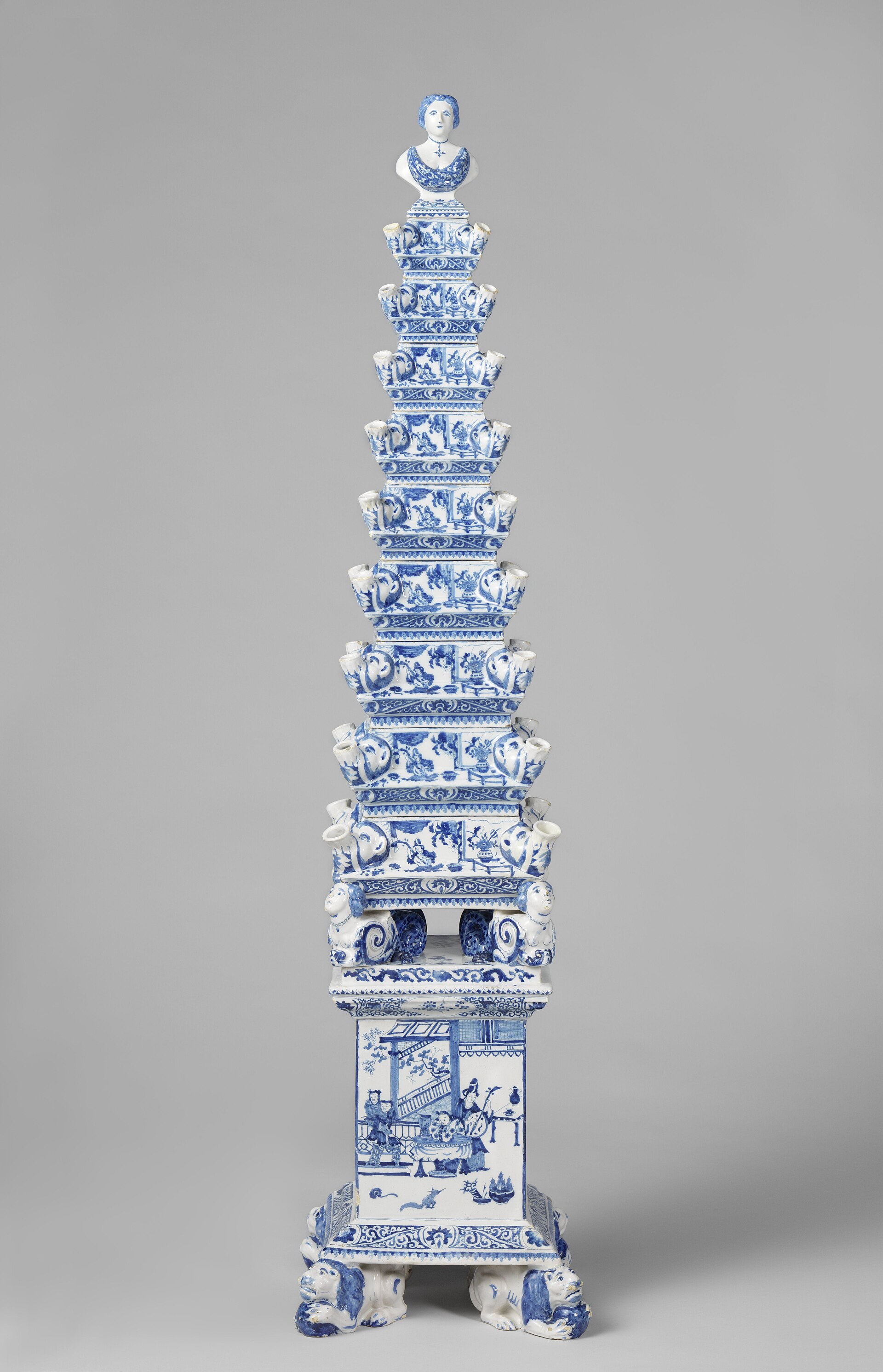
One of the pair, all eleven segments assembled: the lion-footed base, the sculpted fantasy figures, the tiered reservoir segments with monster-head spouts, and the crowning bust. Rijksmuseum's own photograph, verified against the museum's object record for this accession number.
| Artist | De Metaale Pot (workshop of Lambertus van Eenhoorn) |
|---|---|
| Date | c. 1692 - c. 1700 (the Rijksmuseum's own annual report caption gives 'ca. 1695' as a working midpoint) |
| Medium | Faience (tin-glazed earthenware), painted in cobalt blue under the glaze |
| Dimensions | Height 156 cm; width 38 cm; depth 38 cm; weight 29 kg. Figures given identically for both BK-2004-4-A and BK-2004-4-B in the Rijksmuseum's own object records, consistent with a matched pair. |
| Where it is now | Rijksmuseum, Amsterdamlast confirmed |
| Inventory number | BK-2004-4-A / BK-2004-4-B |
| Attribution | AcceptedThe Rijksmuseum itself catalogues both segments of the pair as 'toegeschreven aan' (attributed to) De Metaale Pot and 'naar' (after, i.e. Full note |
| Object type | Ceramic |
| Period | Dutch, late seventeenth century (the court style of William III and Mary II) |
| Cases | Has a provenance gap |
| Inscriptions | None recorded on the surviving 17th-century fabric. No maker's mark is reported for this pair, distinguishing it from smaller, LVE-marked De Metaale Pot flower pyramids in the same collection. |
| Owners on record | 4 links3 documented, 1 unknown |
| Sources | 20 cited |
About this record Last verified · 20 sources cited · Change log
On this page 9 sections
ContentsClose
A pair of Delft faience flower pyramids, 156 centimetres tall and built from eleven stackable segments each, made around 1692-1700 and attributed - on stylistic grounds, since no maker's mark survives on this pair - to the De Metaale Pot workshop under its owner Lambertus van Eenhoorn. They belong to a short-lived fashion for tall stacked flower vases at the court of William III and Mary II, and the Rijksmuseum had wanted a pair for its own collection for more than fifty years before finally acquiring one in 2004.
The acquisition was funded jointly by the BankGiro Loterij, the Vereniging Rembrandt, the Prins Bernhard Cultuurfonds, the Loudon family and the Rijksmuseum Fonds, but the museum's own annual report names no seller and discloses no price - and a widely repeated online claim about the dealer turns out, on checking the museum's own report directly, to describe an unrelated gift of a different object that same year. Four of the eleven segments in one of the two vases were not made in the 1690s at all: they are 2003-2004 reconstructions by the historic Tichelaar pottery of Makkum, disclosed plainly in the museum's own segment-by-segment catalogue records rather than folded silently into the object's original date.
What is missing from the record - the seller, the price, and three centuries of ownership between manufacture and 2004 - is missing from the Rijksmuseum's own published account as well, not from a shortfall in this research; it is recorded here as an honest gap rather than smoothed over.
Provenance
Each link is graded. Documented: a cited source supports it. Disputed: the identification is argued but not established. Unknown: no owner for that span, and the gap is not smoothed into a narrative. The grades in the glossary.
- c. 1692 - c. 1700De Metaale Pot workshop, Delft, under the ownership of Lambertus van Eenhoorndocumented
Dating and workshop location are given by the Rijksmuseum's own cataloguing. The specific attribution to De Metaale Pot and to Van Eenhoorn as owner is stylistic rather than mark-based; the museum itself uses the qualifier 'attributed to' for both.12
- c. 1700 - 2004Unknownunknown
No owner is documented for roughly three centuries. By the time the pair reached the Rijksmuseum, both vases were missing entire segments, requiring later reconstruction; nothing in the sources consulted establishes where the vases spent this period or how they came to be incomplete.128
- 2003 - 2004Koninklijke Tichelaar, Makkum (restorer, not owner)documented
Four segments - BK-2004-4-B-1, B-7, B-9 and B-10 - were newly made by the historic Tichelaar pottery of Makkum in 2003-2004, replacing lost or unusable originals, evidently in the course of preparing the pair for accession and display. Individually dated and credited in the Rijksmuseum's own object records for each segment.34568
- 2004 - presentRijksmuseum, Amsterdamdocumented
Purchased in 2004, funded jointly by the BankGiro Loterij, the Vereniging Rembrandt (aided by the Prins Bernhard Cultuurfonds), the Loudon family and the Rijksmuseum Fonds, per the museum's own 2004 annual report and current object records. Seller and price not disclosed in any source consulted. First presented to the public in the Philipsvleugel in 2004; currently on display in gallery 2.22.127
Technical evidence
| Attribution note | The Rijksmuseum itself catalogues both segments of the pair as 'toegeschreven aan' (attributed to) De Metaale Pot and 'naar' (after, i.e. attributed to) Lambertus van Eenhoorn as the pottery's owner - the museum's own wording for an unmarked piece. No maker's mark has been reported on the surviving 17th-century segments of BK-2004-4-A/B. The attribution rests on stylistic comparison with marked De Metaale Pot output of the 1690s, including the sculptural handling associated with the modeller Guillaume Nieullet, whom Van Eenhoorn employed from 1691. Smaller, related flower pyramids from the same workshop, such as Rijksmuseum BK-14852-A/B (c. 1710), do carry the impressed LVE mark, which is why the workshop attribution for this larger, unmarked pair is treated here as accepted scholarly consensus rather than as documented certainty. |
|---|---|
| Material | Faience (tin-glazed earthenware); Delft clay body.12 |
| Decoration technique | Painted in cobalt blue under the tin glaze ('blauw beschilderd in de glazuur' in the Rijksmuseum's own cataloguing).12 |
| Dimensions | Height 156 cm; width 38 cm; depth 38 cm; weight 29 kg. Identical figures given for both BK-2004-4-A and BK-2004-4-B.12 |
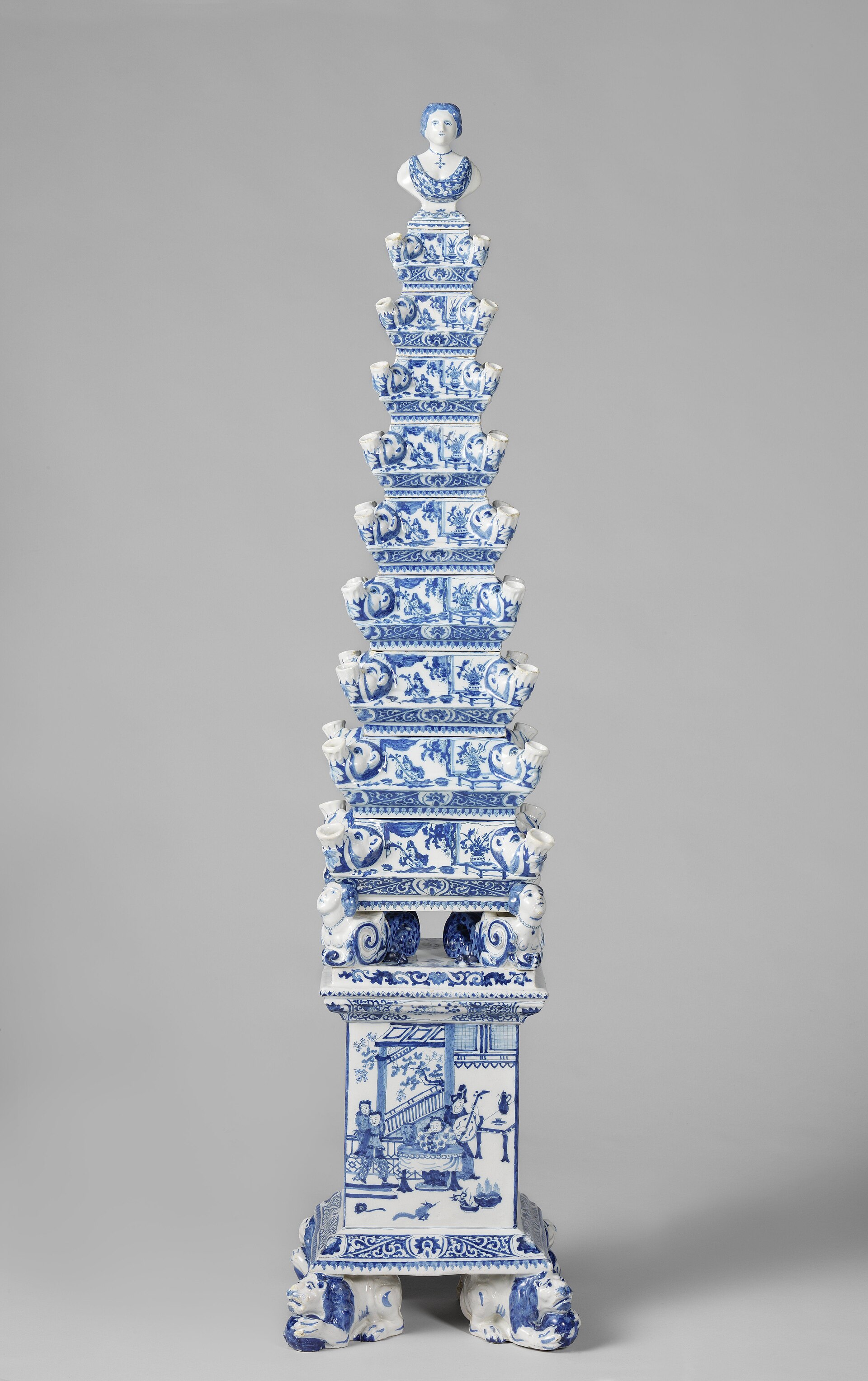
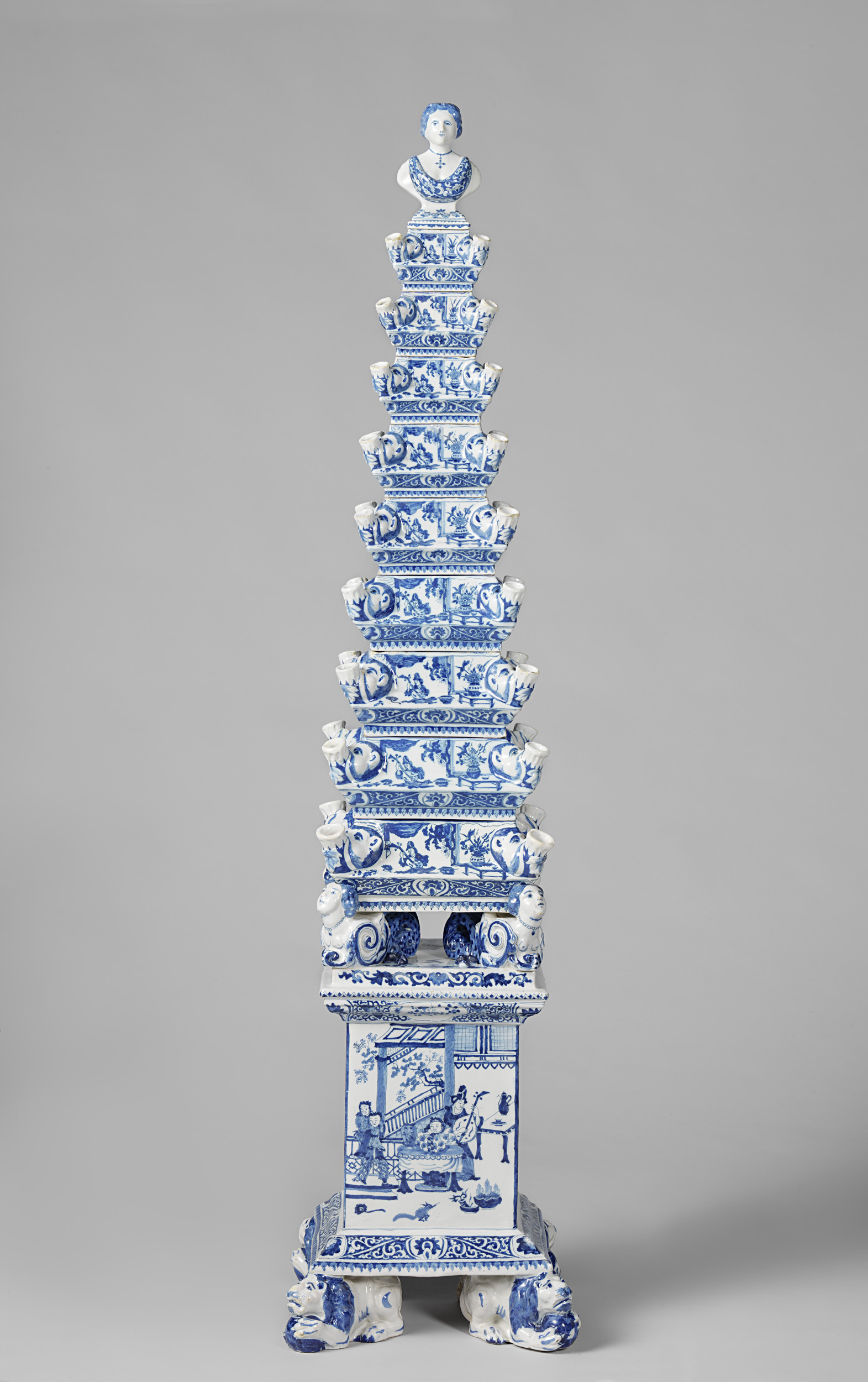
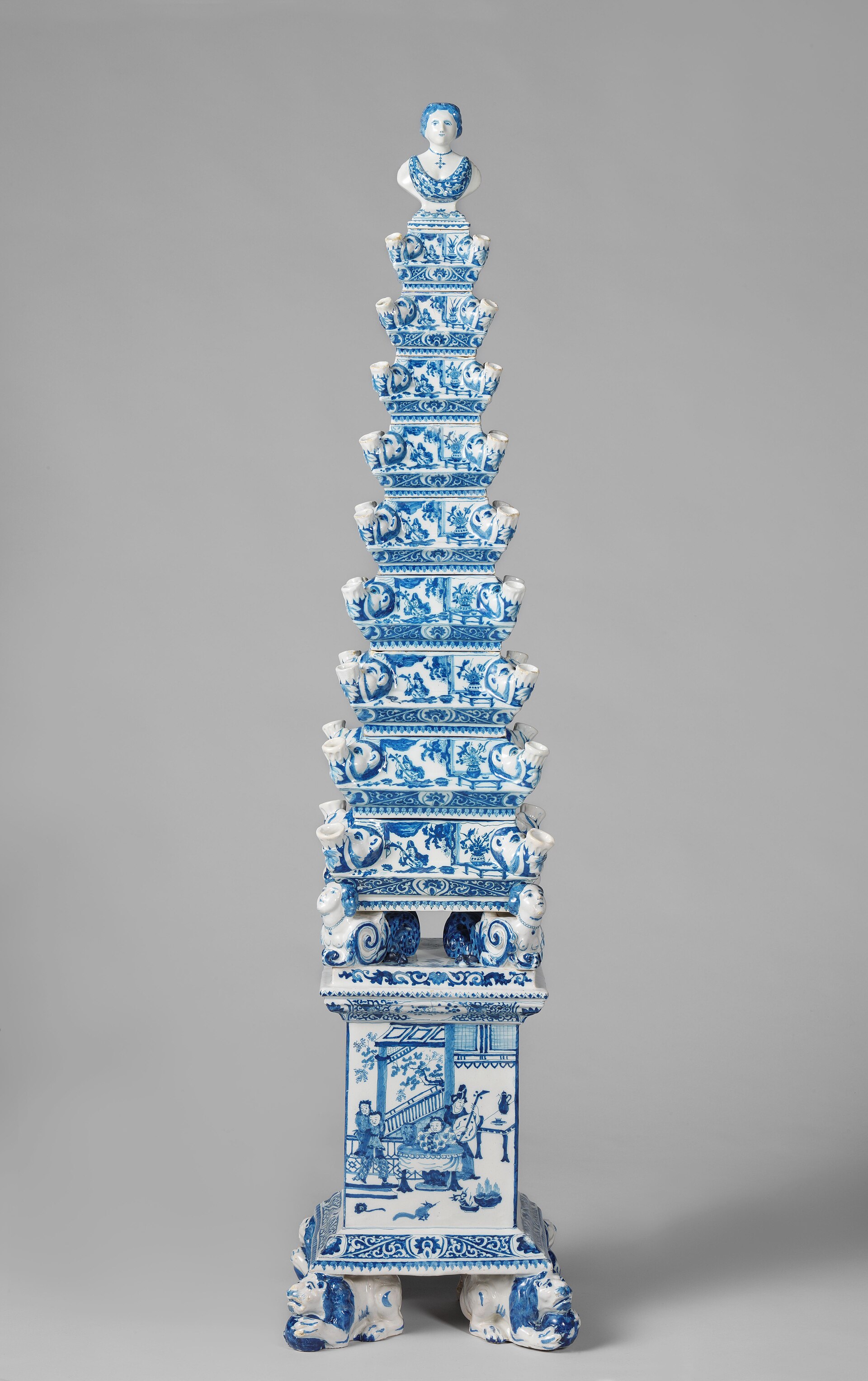
| Construction | Eleven loose, stackable segments per pyramid: a square base on four lion supports (each lion holding a small globe), four sculpted fantasy figures above the base, a column of reservoir tiers pierced with monster-head spouts, and a crowning bust of a woman, also pierced for flowers.128 |
| Modeller | The sculptural elements are consistent with work by Guillaume Nieullet, the French modeller Lambertus van Eenhoorn employed at De Metaale Pot from 1691, with his contract renewed for a further ten years in 1693 - an unusual investment for a Delft factory, where the emphasis normally lay in painted decoration rather than modelled form.714 |
| Marks | None reported on the surviving 17th-century segments of this pair. The workshop and maker attribution is stylistic. Compare the smaller, related Rijksmuseum pair BK-14852-A/B (c. 1710), which does carry the impressed mark LVE for Lambertus van Eenhoorn.121116 |
| Restored segments | Segments BK-2004-4-B-1 (crowning bust), B-7, B-9 and B-10 (reservoir tiers with musicians and figures holding vessels) were made in 2003-2004 by the Koninklijke Tichelaar pottery, Makkum, replacing lost or unusable 17th-century originals ahead of the pair's display.34568 |
| Manufacturing method | Built as separate, individually fired and glazed, watertight segments rather than as a single thrown or cast vessel, because a tin-glazed earthenware vase of this height could not reliably survive firing intact using the kiln technology available in Delft around 1700; this is also the structural reason the type proved so vulnerable to losing individual segments over three centuries of use and storage.17 |
Images
The record in full
Chapter 1What it is
A pair of faience flower pyramids, each 156 centimetres tall and built from eleven loose, stackable segments rather than thrown or cast as one piece.
A pair of faience flower pyramids, each 156 centimetres tall and built from eleven loose, stackable segments rather than thrown or cast as one piece. A square base rests on four lion supports, each lion set with a small globe; above the base stand four sculpted fantasy figures; then a column of square reservoir segments rises in tiers, each pierced with spouts modelled as open-mouthed monster heads, with room in every spout for a single cut flower or a small bouquet. The whole tapering structure is crowned by a small bust of a woman, itself pierced for flowers. The decoration throughout is painted in cobalt blue under a tin glaze, in the idiom Delft potters had built up over the previous half-century imitating, and then departing from, Chinese blue-and-white export porcelain.
Each pyramid weighs 29 kilograms and stands taller than a person seated. It is not a container in the ordinary sense. It is a piece of engineered architecture in earthenware, designed to hold a display of flowers the way a chandelier holds a display of light.
Chapter 2A fashion built for one court
The form belongs to a specific and short-lived courtly fashion.
The form belongs to a specific and short-lived courtly fashion. William, Prince of Orange and stadtholder of the Dutch Republic, married Mary Stuart in November 1677, and the couple took up residence at Honselaarsdijk, a country palace outside The Hague, within two weeks of the wedding. They rebuilt and refurnished it lavishly, in step with a wider fashion among European ruling families for filling their principal rooms with costly furniture and ornamental objects whose only function was to advertise wealth and power.
Flowers, especially rare and heavily scented cut flowers displayed by the boquet, were part of that programme, and Mary took the demand for them seriously enough to put it in writing. In 1678 she had a contract drawn up with Charles du Buisson, the gardener responsible for the grounds at Honselaarsdijk, instructing him to keep and multiply the bulbs and seeds given into his care so as to have flowers blooming in every season, in order to make two or three bouquets a week for Her Highness. An inventory of the house taken in 1755, by then listing the Delft porcelain as partly damaged, still records a considerable quantity of small vases, flower pyramids, flowerpots and planters on both galleries - a last glimpse of a princely Delftware display that has since been entirely lost.
When William and Mary were crowned king and queen of England in 1689, the fashion travelled with them, and flower pyramids became sought after among the English nobility around their court as well as among the Dutch. The form's popularity did not outlast Mary: she died in 1694, and demand for the largest and most extravagant vases fell away within a generation.
Chapter 3Two Delft factories, one royal market
Around 1700 there were close to thirty working potteries in Delft, and two stood above the rest: De Grieksche A (the Greek A) and De Metaale Pot (the Metal Pot).
Around 1700 there were close to thirty working potteries in Delft, and two stood above the rest: De Grieksche A (the Greek A) and De Metaale Pot (the Metal Pot). De Grieksche A, run by Adrianus Kocx together with his wife Judith van Eenhoorn, held the position of supplier to the English court itself, producing ensembles of large vases, flower holders and jug stands sized for the state rooms of the rebuilt Hampton Court Palace. The high nobility around the king and queen bought Delft faience of the same kind for their own houses, and it is this second, wider market of courtiers and grandees, rather than a direct royal commission, that the Rijksmuseum's pair belongs to.
The connection between the two factories was not only commercial. Adrianus Kocx was Lambertus van Eenhoorn's brother-in-law, and stood as guarantor when Van Eenhoorn bought De Metaale Pot in 1691. A comparably tall flower pyramid attributed to Kocx and De Grieksche A survives in the Royal Collection at Hampton Court Palace (RCIN 1085) and another, formerly in Cecil Beaton's collection, is now at the Cleveland Museum of Art. Both are different objects, by a different workshop, in different collections, from the pair described in this record, and none of their images, dimensions or history apply here.
Chapter 4How it was made
The pyramid's segmented construction was not a stylistic choice so much as a structural necessity.
The pyramid's segmented construction was not a stylistic choice so much as a structural necessity. A tin-glazed earthenware vessel of this height, thrown or built in one piece, would not have survived the firing intact at the technology available to Delft potters around 1700; the practical solution was a set of separate, watertight, stackable elements, threaded or seated onto a central support, each fired and glazed on its own before assembly. That method is also what let the pyramids be dismantled for cleaning and storage, and it is the same feature that made them so vulnerable to loss over time: individual segments and spouts broke off, were misplaced, or were judged not worth keeping once the fashion had passed, so that of the handful of tall flower pyramids known to survive, none is reported to retain every original tuit and segment intact.
De Metaale Pot's own production in this period carried an unusual degree of sculptural ambition for a Delft workshop. Delft's competitive strength was traditionally in painting rather than modelling, and pieces requiring elaborate three-dimensional form could expose a factory's lack of a dedicated modeller. Van Eenhoorn addressed this directly: in 1691, the year he bought the factory, he took on the French modeller Guillaume Nieullet, renewing his contract for a further ten years in 1693. The lions, fantasy figures, monster-head spouts and crowning bust of this pair are consistent with output from De Metaale Pot's workshop in the last decade of the seventeenth century, when Nieullet's hand is traceable in the factory's more ambitious pieces.
Chapter 5A want that took the museum more than fifty years to satisfy
The Rijksmuseum's own 2004 annual report states plainly that the museum had wanted to add a pair of flower pyramids to its Delftware collection for more than fifty years before this acquisition.
The Rijksmuseum's own 2004 annual report states plainly that the museum had wanted to add a pair of flower pyramids to its Delftware collection for more than fifty years before this acquisition. The two vases described here, and now catalogued together under inventory number BK-2004-4, with segments individually numbered A and B, were bought in 2004 - the museum's report calls their arrival, after decades of searching, a long-held wish finally granted, and notes that it counts itself fortunate to have secured two such fragile vases in the very largest size that survives.
The purchase was funded jointly by the BankGiro Loterij (the Dutch lottery that channels a share of its proceeds into cultural causes), the Vereniging Rembrandt, itself aided in this instance by the Prins Bernhard Cultuurfonds, the Loudon family, and the Rijksmuseum Fonds. All five names appear together in the museum's own printed credit line for BK-2004-4, both in its 2004 annual report and in its current online object records.
Chapter 6What the acquisition record does and does not say
The Rijksmuseum's 2004 annual report devotes three full pages, with photographs, to this acquisition under the heading 'Twee vorstelijke bloempiramides' (Two princely flower pyramids), and names the...
The Rijksmuseum's 2004 annual report devotes three full pages, with photographs, to this acquisition under the heading 'Twee vorstelijke bloempiramides' (Two princely flower pyramids), and names the funding consortium in full in both its narrative text and its formal list of the year's acquisitions. What neither the annual report nor any other source consulted for this record discloses is the identity of the seller, or a purchase price.
A caution is worth recording here because it very nearly produced an error in this file. A general web search for the acquisition returns a synthesised claim that the pair was bought from 'Kunsthandel Salomon Stodel Antiquites, Amsterdam/London'. Checked directly against the Rijksmuseum's own 2004 annual report, this is a conflation: Salomon Stodel Antiquites did have a dealing with the museum that year, but it was a gift, not a sale, of an unrelated object - an 1884 Delft tile tableau, catalogued separately as BK-2004-2 - listed on the same page of the report's acquisitions summary as the flower pyramids, immediately above them. No dealer, auction house or private seller is named anywhere in the museum's own account of how it obtained BK-2004-4. The 'Loudon family' named among the funders is likewise not documented, in any source found, as a prior private owner of this pair; John F. Loudon (1824-1900) was a major nineteenth-century Delftware collector whose separate collection later entered the Rijksmuseum, and the family name attached to the 2004 acquisition credit most plausibly reflects a Loudon family fund or gift in support of the purchase, in the same way the report lists the BankGiro Loterij, the Vereniging Rembrandt and the Rijksmuseum Fonds as funding bodies rather than as former owners. Where this record cannot go further than 'not documented,' it says so rather than filling the gap with a plausible-sounding guess.
Chapter 7Four segments that are not seventeenth century
The Rijksmuseum's own object records for the individual segments state that four of them, catalogued as BK-2004-4-B-1, B-7, B-9 and B-10, were made in 2003-2004 by the historic Koninklijke Tichelaar...
The Rijksmuseum's own object records for the individual segments state that four of them, catalogued as BK-2004-4-B-1, B-7, B-9 and B-10, were made in 2003-2004 by the historic Koninklijke Tichelaar pottery of Makkum, not in the 1690s. BK-2004-4-B-1 is the crowning bust of a woman at the very top of pyramid B; B-7, B-9 and B-10 are reservoir segments from partway up the stack, decorated with musicians and figures holding vessels. Each is individually dated '2003-2004' and credited to Tichelaar Makkum in the museum's own collection database, in contrast to every other segment of the pair, which the museum dates to the object's original manufacture around 1692-1700.
This means that, of the eleven segments that make up pyramid B, four - more than a third by count, though a smaller share by the bulk of surviving fabric, since the reconstructed pieces include the small crowning bust and three mid-sized reservoir tiers rather than the large lion-footed base - are twenty-first-century remakes rather than seventeenth-century originals. The Rijksmuseum's own podcast on the acquisition, an interview with Femke Diercks, head of the museum's applied arts department, states that the pair arrived incomplete, missing entire segments, and that matching the historic glaze and colouring for the replacements took the Tichelaar workshop, in her words, countless attempts.
Chapter 8Reading the restoration plainly
This is exactly the kind of disclosed, substantial restoration this publication exists to state clearly rather than pass over.
This is exactly the kind of disclosed, substantial restoration this publication exists to state clearly rather than pass over. The Rijksmuseum does not hide the 2003-2004 reconstruction: it is recorded, segment by segment, in the museum's own online catalogue, with each reconstructed piece individually dated and credited to Tichelaar Makkum rather than folded silently into the object's seventeenth-century date range. That is good practice, and it is also why this record can state the extent of the restoration with reasonable confidence: four named, individually catalogued segments, out of eleven, replaced before the pair went on display.
What remains harder to establish from the sources available is the technical detail of what exactly required reconstruction and why - whether the four segments were entirely missing, present only as fragments, or damaged beyond safe display, and what specifically proved difficult about matching a three-century-old blue glaze. A dedicated technical article exists on this question: J.D. van Dam, the Rijksmuseum's own Delftware specialist, published 'Technische problemen bij de reconstructie van enkele delen van een bloempiramide' (Technical problems in the reconstruction of several parts of a flower pyramid) in the museum's Bulletin van het Rijksmuseum in 2008. This researcher located the article's citation and its place in the journal but could not obtain its full text; the specific technical content of Van Dam's account is flagged in the editor's notes below as unverified and worth chasing down before this record is considered final on the restoration question.
Chapter 9Survival of a fragile form
The Rijksmuseum's own account of the type is blunt about how few of these vases made it to the present day at all.
The Rijksmuseum's own account of the type is blunt about how few of these vases made it to the present day at all. Flower pyramids were vulnerable both in ordinary use and in cleaning: the museum's annual report notes that spouts broke off first, then whole segments, after which most damaged examples will have been thrown away outright, or, too battered to display but too fine to discard outright, put away in a cellar or attic. By the time collectors began to take a serious interest in Delft faience as a decorative art, around 1860, the fashion for filling princely rooms with tall stacked flower vases had already been over for roughly a hundred and thirty years. Even the Honselaarsdijk collection itself, once the finest assembly of Delftware furnishing in the Netherlands, was by then completely lost.
Against that backdrop, Femke Diercks's own description of the surviving population, given in the museum's podcast on the acquisition, is worth recording precisely: she describes only three pairs and two single examples of this specific tall, stacked type as known to survive worldwide. The Rijksmuseum's wider Delftware collection holds other, smaller or differently attributed flower pyramids under separate inventory numbers - among them BK-KOG-1723, an anonymous c. 1700 example on loan since 1936 from the Koninklijk Oudheidkundig Genootschap, and BK-14852-A/B, a smaller, LVE-marked pair from the same De Metaale Pot workshop, dated a decade or so later - and none of those objects, their images or their separate provenance histories belong to the pair described in this record.
Chapter 10On display
The pair was first presented to the public, according to the Rijksmuseum's own annual report, in the museum's Philipsvleugel in 2004, in a display the report describes as drawing considerable...
The pair was first presented to the public, according to the Rijksmuseum's own annual report, in the museum's Philipsvleugel in 2004, in a display the report describes as drawing considerable interest. The museum's current online collection records place the objects in gallery 2.22 of the main building, among its holdings of Delftware and other applied art from the second half of the seventeenth century.
The artist
De Metaale Pot ('The Metal Pot'), Delft, under the ownership of Lambertus van Eenhoorn (1651/1652-1721)
De Metaale Pot was one of the two leading Delft potteries around 1700, the other being De Grieksche A. It takes its workshop dossier here rather than an individual painter's, because the maker of record for this pair is the factory operating under Lambertus van Eenhoorn's ownership, and because the surviving evidence identifies the workshop and its production practices with more certainty than it identifies the hand of any single painter or modeller on this specific pair.
Related works
| Work | Relation | Where it is |
|---|---|---|
| Bloempiramide Anonymous Delft workshop | A different, smaller flower pyramid in the same museum, by a different, unidentified maker - not to be confused with this record's subject Height 108 cm, ten tiers on a six-part base, decoration in the style of a Chinese pagoda. Former collection of Lodewijk Cornelis Enthoven (1854-1920), Voorburg; sold Amsterdam, Mensing fils, October 1932; acquired by the Koninklijk Oudheidkundig Genootschap on the art market in 1936 for 700 guilders. | Rijksmuseum, Amsterdam (BK-KOG-1723; on loan since 1936 from the Koninklijk Oudheidkundig Genootschap) |
| Flower pyramid (a pair) De Grieksche A (workshop of Adrianus Kocx) | The Hampton Court flower pyramid by the rival Delft factory whose owner was Lambertus van Eenhoorn's brother-in-law - a genuinely different object, by a different maker, in a different collection c. 1694, tin-glazed earthenware, height 147.2 cm, hexagonal-based baroque design associated with the designer Daniel Marot. Made for or acquired by Mary II's own household; not to be conflated with the Rijksmuseum pair. | Royal Collection Trust, Hampton Court Palace (RCIN 1085) |
| Pair of flower pyramids De Metaale Pot (workshop of Lambertus van Eenhoorn) | A smaller, later, LVE-marked pair from the same workshop c. 1710, height 104 cm, bears the impressed mark LVE - a marked comparison piece for the unmarked attribution of BK-2004-4-A/B. | Rijksmuseum, Amsterdam (BK-14852-A/B) |
| Obelisk Attributed to Lambertus van Eenhoorn | A small, single-tier tabletop obelisk from the same attributed hand, showing the range of scale the workshop produced c. 1700-1725, tin-enamelled earthenware, height 18.7 cm, floral shaft with East Asian landscape scenes on the base. | The Metropolitan Museum of Art, New York (accession 50.211.35) |
| Flower pyramid Adrianus Kocx / De Grieksche A | Another surviving example of the wider genre, by the rival Delft factory, formerly in a well-documented private collection c. 1690; formerly in the collection of Cecil Beaton. Cited here only as comparanda for the genre's rarity, not as a version of the object described in this record. | Cleveland Museum of Art |
Open questions
- From whom, and through what dealer or intermediary, did the Rijksmuseum actually buy this pair in 2004? No seller is named in the museum's own annual report or in any other source consulted; a widely repeated online claim that the seller was Kunsthandel Salomon Stodel Antiquites conflates the flower pyramids with an unrelated gift the same dealer made to the museum that year (BK-2004-2, a Delft tile tableau).
- What price did the Rijksmuseum pay in 2004? Not disclosed in the annual report or elsewhere.
- Where were these two vases, or their surviving 17th-century segments, between manufacture c. 1692-1700 and their appearance in the 2004 acquisition? No owner is documented for roughly three centuries, and it is not established whether they were ever part of a princely Dutch or English collection such as Honselaarsdijk, or spent that time in later private hands.
- Is the 'Loudon family' credited among the funders a distinct benefactor family, or connected to the 19th-century collector John F. Loudon, whose separate Delftware collection also entered the Rijksmuseum? No source found states the connection explicitly, and no source documents the Loudon family as a prior owner of this specific pair.
- What, precisely, did the four reconstructed segments (B-1, B-7, B-9, B-10) look like or consist of before Tichelaar Makkum's 2003-2004 work - were they missing outright, fragmentary, or too damaged to display? J.D. van Dam's 2008 technical article in the Bulletin van het Rijksmuseum appears to be the primary account of this work, but this researcher could not obtain its full text.
- Does any documentary or archival record - a factory ledger, a contemporary inventory, a later sale catalogue - independently confirm the attribution to De Metaale Pot and Lambertus van Eenhoorn, given that no maker's mark survives on this pair?
Questions about this object
What is Bloempiramide?
Bloempiramide is a ceramic, dated c. 1692 - c. 1700 (the Rijksmuseum's own annual report caption gives 'ca. 1695' as a working midpoint). Medium: Faience (tin-glazed earthenware), painted in cobalt blue under the glaze.
Who made Bloempiramide, and is the attribution settled?
The attribution to De Metaale Pot (workshop of Lambertus van Eenhoorn) is recorded here as accepted. The Rijksmuseum itself catalogues both segments of the pair as 'toegeschreven aan' (attributed to) De Metaale Pot and 'naar' (after, i.e. attributed to) Lambertus van Eenhoorn as the pottery's owner - the museum's own wording for an unmarked piece. No maker's mark has been reported on the surviving 17th-century segments of BK-2004-4-A/B. The attribution rests on stylistic comparison with marked De Metaale Pot output of the 1690s, including the sculptural handling associated with the modeller Guillaume Nieullet, whom Van Eenhoorn employed from 1691. Smaller, related flower pyramids from the same workshop, such as Rijksmuseum BK-14852-A/B (c. 1710), do carry the impressed LVE mark, which is why the workshop attribution for this larger, unmarked pair is treated here as accepted scholarly consensus rather than as documented certainty.
Where is Bloempiramide now?
Rijksmuseum, Amsterdam. Inventory number BK-2004-4-A / BK-2004-4-B. Last confirmed 9 September 2026. Purchased 2004 with support from the BankGiro Loterij, the Vereniging Rembrandt (aided by the Prins Bernhard Cultuurfonds), the Loudon family and the Rijksmuseum Fonds. On display in gallery 2.22 as of the Rijksmuseum's own online collection record.
What is still unknown about Bloempiramide?
From whom, and through what dealer or intermediary, did the Rijksmuseum actually buy this pair in 2004? No seller is named in the museum's own annual report or in any other source consulted; a widely repeated online claim that the seller was Kunsthandel Salomon Stodel Antiquites conflates the flower pyramids with an unrelated gift the same dealer made to the museum that year (BK-2004-2, a Delft tile tableau).
Sources
- 1Rijksmuseum, object record for 'Flower pyramid', BK-2004-4-A. rijksmuseum.nl/en/...
- 2Rijksmuseum, object record for 'Flower pyramid', BK-2004-4-B. rijksmuseum.nl/en/...
- 3Rijksmuseum, object record for BK-2004-4-B-1, the crowning bust, dated to its 2003-2004 reconstruction by Koninklijke Tichelaar, Makkum. rijksmuseum.nl/en/...
- 4Rijksmuseum, object record for BK-2004-4-B-7, a reservoir segment dated to its 2003-2004 reconstruction by Koninklijke Tichelaar, Makkum. rijksmuseum.nl/en/...
- 5Rijksmuseum, object record for BK-2004-4-B-9, a reservoir segment dated to its 2003-2004 reconstruction by Koninklijke Tichelaar, Makkum. rijksmuseum.nl/en/...
- 6Rijksmuseum, object record for BK-2004-4-B-10, a reservoir segment dated to its 2003-2004 reconstruction by Koninklijke Tichelaar, Makkum. rijksmuseum.nl/en/...
- 7Rijksmuseum, Jaarverslag 2004 (annual report), 'Twee vorstelijke bloempiramides', pp. 56-59, and the formal acquisitions list, p. 72, naming BK-2004-4 and its funders and, on the same page, Kunsthandel Salomon Stodel Antiquites' separate gift of BK-2004-2. Primary source, fetched and read in full. catalogus.boekman.nl/pub/...
- 8Rijksmuseum, podcast 'In het Rijks', episode 'Bloempiramides', Janine Abbring interviewing Femke Diercks, head of applied arts, published 1 December 2020. rijksmuseum.nl/nl/...
- 9J.D. van Dam, 'Technische problemen bij de reconstructie van enkele delen van een bloempiramide', Bulletin van het Rijksmuseum 56 (2008), pp. 58-59. Bibliographic record located via the journal's JSTOR issue index; full text not accessible to this researcher - flagged in notes_for_editor for follow-up. jstor.org/stable/...
- 10Rijksmuseum, object record for BK-KOG-1723, 'Bloempiramide', anonymous, c. 1700, on loan from the Koninklijk Oudheidkundig Genootschap since 1936. rijksmuseum.nl/nl/...
- 11Rijksmuseum, object record for BK-14852-A, 'Pair of flower pyramids', De Metaale Pot under Lambertus van Eenhoorn, c. 1710, marked LVE. rijksmuseum.nl/en/...
- 12TEFAF, 'A Wondrous Pyramidal Flower Vase by Adrianus Kocx'. tefaf.com/stories/...
- 13Christopher Stevens for Aronson Antiquairs of Amsterdam, 'A Passion and a Fashion: Queen Mary II's Delftware at Hampton Court Palace'. aronson.com/a-passion-and-a-fashion-queen-mary-iis-delftw...
- 14Aronson Antiquairs of Amsterdam, 'De Metaale Pot Factory'. aronson.com/de-metaale-pot-factory
- 15Aronson Antiquairs of Amsterdam, 'Lambertus van Eenhoorn'. aronson.com/lambertus-van-eenhoorn
- 16Delftsaardewerk.nl, mark record for 'LVE' (Lambertus van Eenhoorn, owner of De Metaale Pot, 1691-1724). delftsaardewerk.nl/en/...
- 17Wikipedia, 'Tulip vase', for the general point that the stacked construction of large flower pyramids was a structural response to the limits of firing a single large tin-glazed vessel intact c. 1700. en.wikipedia.org/wiki/...
- 18Wikimedia Commons, for File:Bloempiramide, BK-2004-4-A.jpg and sibling files (BK-2004-4-B, BK-2004-4-B-1, BK-2004-4-B-10, BK-KOG-1723), each independently checked: LicenseShortName 'CC0', Artist/credit 'Rijksmuseum'. commons.wikimedia.org/wiki/...
- 19The Metropolitan Museum of Art, 'Obelisk', attributed to Lambertus van Eenhoorn, accession 50.211.35. The museum's own object page could not be fetched directly (repeated rate-limit errors); details are drawn from a corroborating third-party index of the Met's own listing and should be re-verified against metmuseum.org directly before this related work is relied on for exact wording. metmuseum.org/art/...
- 20Delftsaardewerk.nl, object record for BK-2004-4-B, 'bloempiramide, onderdeel van een paar'. delftsaardewerk.nl/bekijken/...

Last verified · Published
Change log
9 September 2026 - Record created at the house standard: researched narrative, technical evidence, maker dossier, graded provenance chain, prices with hammer and premium separated, related works, open questions and sources.