Armor for the Joust of Peace
Daniel Tachaux · Genuine elements probably late 15th century; assembled and completed as a composite armor by Costantino Ressman, 1881-1891; helmet made by Daniel Tachaux, Paris, 1891
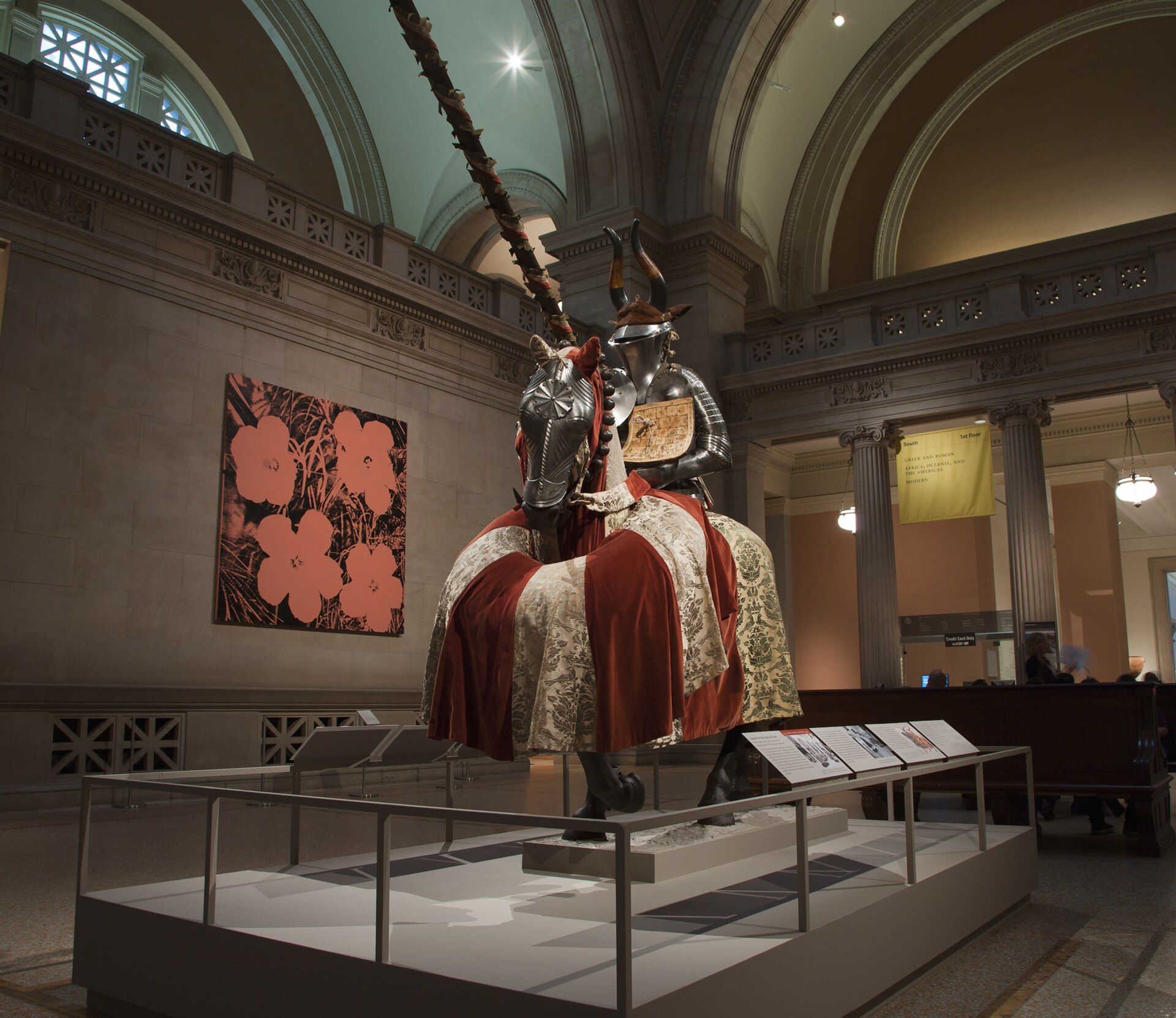
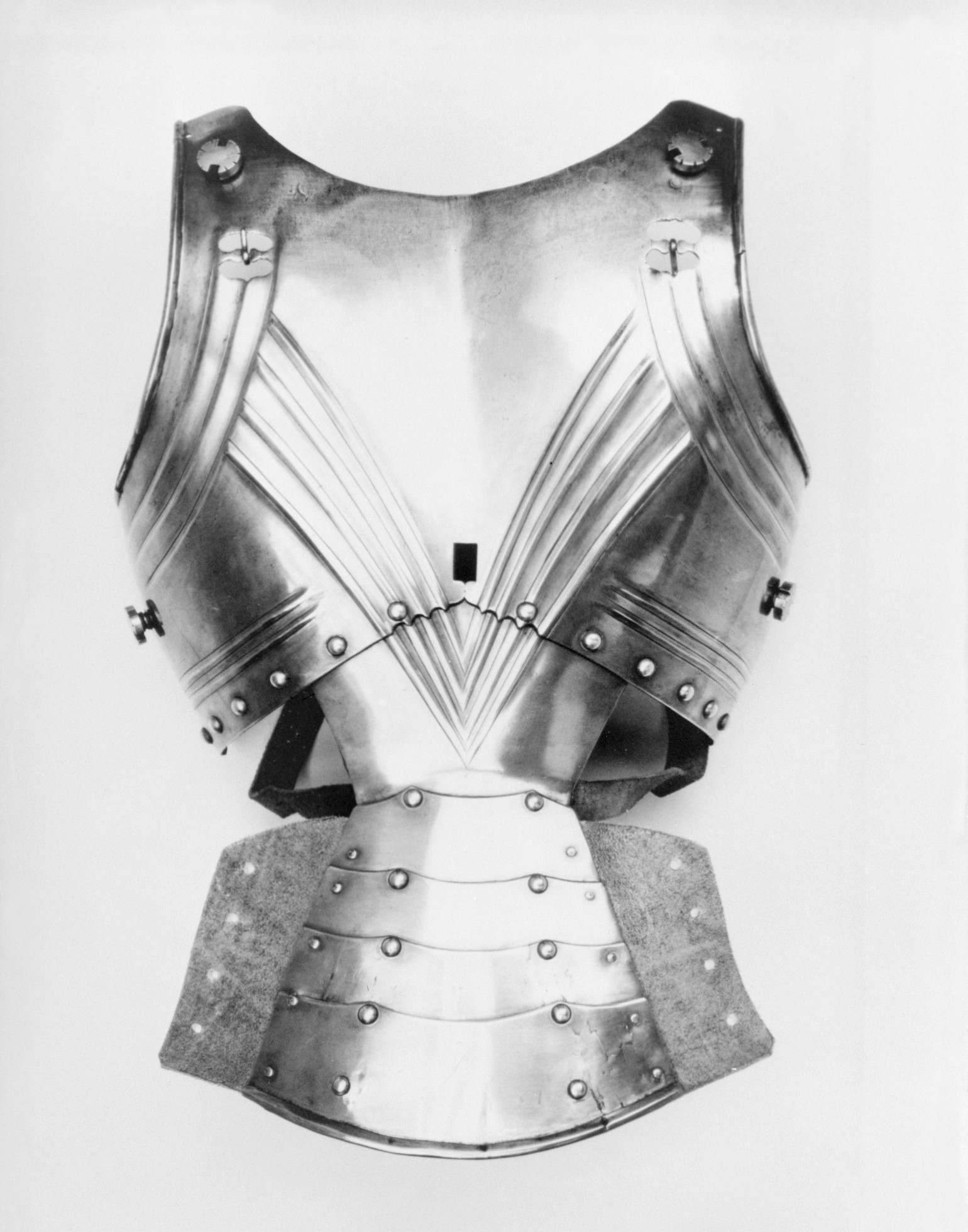
The composite Stechzeug as mounted and photographed by the Metropolitan Museum, accession 04.3.291a-q. The helmet, the most visible element, is Daniel Tachaux's 1891 forging; several of the body elements beneath it are genuine fifteenth-century plates.
| Artist | Daniel Tachaux |
|---|---|
| Date | Genuine elements probably late 15th century; assembled and completed as a composite armor by Costantino Ressman, 1881-1891; helmet made by Daniel Tachaux, Paris, 1891 |
| Medium | Steel, copper alloy, leather, textile and horn |
| Dimensions | Helmet (a), wt. 21.5 lb (9752 g); breastplate (c), wt. 23 lb (10.4 kg); tassets (e, f), wt. 6 lb each (2723 g); backplate (i), wt. 5 lb (2268 g); rondels (o, p), wt. 5 lb each (2268 g); shield (q), wt. 6 lb (2723 g); overall wt. 85.5 lb (38.78 kg) |
| Where it is now | The Metropolitan Museum of Art, New York, Department of Arms and Armorlast confirmed |
| Inventory number | 04.3.291a-q, .292 (helmet element: 04.3.291a) |
| Attribution | AcceptedThe helmet (accession 04.3.291a) is accepted as the 1891 work of the Paris armorer Daniel Tachaux, employed for the job by the armorer Alexandre Lebon. Full note |
| Object type | Arms and armour |
| Period | German, late 15th century, with French restorations of 1887-1891 |
| Inscriptions | None documented in the sources consulted. |
| Owners on record | 5 links5 documented |
| Sources | 9 cited |
About this record Last verified · 9 sources cited · Change log
On this page 9 sections
ContentsClose
What the Metropolitan Museum catalogues as "Armor for the Joust of Peace" and lists under its own culture field as "German; restorations, French, Paris" is a composite Stechzeug, the massively reinforced armor built for the Gestech, the German tournament joust with blunted lances. Most of its plates are genuine fifteenth-century fragments the Italian diplomat and collector Costantino Ressman bought one at a time between 1881 and 1889 from named dealers and sales. The helmet is not one of them. In October 1891 Ressman commissioned the Paris armorer Alexandre Lebon to complete and mount the assembly, and Lebon in turn employed a young armorer named Daniel Tachaux to forge the helm itself, along with a new shield and a pair of tassets, from scratch.
Ressman sold the whole armor to the Duc de Dino in 1899, during his final illness; Dino's entire five-hundred-piece collection was bought sight unseen by the Metropolitan in April 1904 for just over $250,000, the largest sum the Museum had yet paid for a single acquisition. The purchase created the Museum's arms and armor curatorship on the spot: Bashford Dean, hired that same year, examined the piece and by 1905 had put his own doubts about the helm into print, in the Museum's own handbook, guessing that it was modern but misjudging where it had been made. It took until 2012, and a different curator working from the collector's own surviving papers, to put the Paris armorer's name on it.
Tachaux's own later career completes the irony: in 1909 Dean hired him outright, as the Museum's staff armorer, to found the conservation workshop that still maintains the Arms and Armor collection today. The man whose early, uncredited work fooled a curator became, within two decades, the person that curator trusted most with the genuine article.
Provenance
Each link is graded. Documented: a cited source supports it. Disputed: the identification is argued but not established. Unknown: no owner for that span, and the gap is not smoothed into a narrative. The grades in the glossary.
- c. 1470s-1889 -Various, prior to Costantino Ressmandocumented
The gauntlet, breastplate core, vambrace, pauldrons, besagews, backplate and shaffron are individually documented fifteenth-century (or, for the shaffron, later) pieces that passed through named dealers and sales before Ressman acquired them piecemeal between 1881 and 1889. No single earlier owner or origin unites them; they came from at least five separate sources.3
- 1881 - 1891Costantino Ressman, Parisdocumented
Ressman bought the gauntlet from Baron Basilewsky (1881), the breastplate with new tassets, lance-rest and counter-rest from Bachereau (1887), the vambrace at the Londesborough sale (July 1888), the pauldrons and besagews from Baron de Cosson (December 1888), a new shield from the restorer Negre (November 1889) and the backplate from Maurice Chabrieres-Arles (November 1889). In October 1891 he commissioned the armorer Alexandre Lebon to complete and mount the whole armor, a job for which Lebon employed Daniel Tachaux to forge the helm. Total cost to Ressman: 7,950 francs. Sourced to Ressman's own inventories, correspondence and receipts, preserved among the Baron de Cosson papers at the Royal Armouries Library, Leeds.3
- 1899 - 1899Charles Maurice Camille de Talleyrand-Perigord, 4th duc de Dinodocumented
Bought from Ressman, during Ressman's final illness, for 30,000 francs, as part of what Pyhrr calls "the Ressman purchase of 1899," Dino's last major arms and armor acquisition and Ressman's largest single sale to him. Price negotiated by Baron de Cosson, who was Ressman's friend and Dino's paid agent in the same transaction. Ressman died 8 July 1899.3
- 1899 - 1904Charles Maurice Camille de Talleyrand-Perigord, 4th duc de Dinodocumented
Held as part of Dino's roughly five-hundred-piece collection, catalogued privately by Baron de Cosson in 1901. No individual valuation of this armor within the Dino holding is documented in the sources consulted.3
- April 1904 - presentThe Metropolitan Museum of Art, New Yorkdocumented
Bought en bloc with the entire Dino collection for just over $250,000 (about 2,500,000 francs), the Museum's largest single-acquisition sum to date, negotiated sight unseen by trustee Rutherfurd Stuyvesant on Baron de Cosson's recommendation. Accessioned as Rogers Fund, 1904, under 04.3.291a-q, .292. The price paid specifically for this Stechzeug within the block purchase is not separately documented. Catalogued and displayed from 1904 by founding curator Bashford Dean, who identified the helm as modern in his own 1905 handbook; displayed in the Arms and Armor Galleries until 1988; returned briefly to the Great Hall in 2012 for the Department's centennial. The helmet's specific maker, Daniel Tachaux, was identified by curator Stuart W. Pyhrr in 2012.123
Technical evidence
| Attribution note | The helmet (accession 04.3.291a) is accepted as the 1891 work of the Paris armorer Daniel Tachaux, employed for the job by the armorer Alexandre Lebon. The identification was made by curator Stuart W. Pyhrr in 2012 from the papers of the collector Costantino Ressman, who commissioned the work, preserved among the Baron de Cosson archive at the Royal Armouries Library, Leeds. The Metropolitan Museum's own founding curator, Bashford Dean, had already recognized the helm as modern in his 1905 handbook, though he guessed wrong on where it was made. The surrounding elements of the composite armor are of varying, individually documented date: several are genuine fifteenth-century pieces Ressman bought from named dealers between 1881 and 1889; the shield and the tassets are further nineteenth-century replacements made to match. |
|---|---|
| Overall composition | A composite armor for the joust of peace (Stechzeug), assembled by the collector Costantino Ressman between 1881 and 1891 from elements of differing date and origin, then completed and mounted by the Paris armorers Alexandre Lebon and Daniel Tachaux in 1891.3 |
| Helmet (04.3.291a) | Wholly modern. Forged by Daniel Tachaux in Paris, dated 1891 in the main published account (a separate footnote in the same publication gives 1889). Recognized as "entirely modern" by curator Bashford Dean in the Museum's own 1905 handbook, who incorrectly guessed a Viennese origin.3 |
| Shield (04.3.291q) | Jousting targe, a wood core plated on the exterior with scales of horn, fabricated by the Paris restorer Negre in November 1889.3 |
| Tassets, lance-rest and counter-rest (04.3.291e, f) | New elements made to match the genuine breastplate, supplied by the dealer Bachereau in 1887.3 |
| Genuine older elements | Gauntlet (manifer), bought by Ressman from Baron Basilewsky, 1881. Breastplate core, bought from Bachereau, 1887. Right vambrace, bought at the Londesborough sale, Christie's London, July 1888. Pauldrons and besagews, bought privately from Baron de Cosson, December 1888. Backplate, bought from Maurice Chabrieres-Arles of Lyons, November 1889. "Blind" shaffron (horse's-head defense), an older piece restored and polished, its roundel repaired, by Bachereau.3 |
| Medium | Steel, copper alloy, leather, textile and horn.12 |
| Weights | Helmet 21.5 lb (9752 g); breastplate 23 lb (10.4 kg); each tasset 6 lb (2723 g); backplate 5 lb (2268 g); each rondel 5 lb (2268 g); shield 6 lb (2723 g); overall 85.5 lb (38.78 kg).12 |
Images
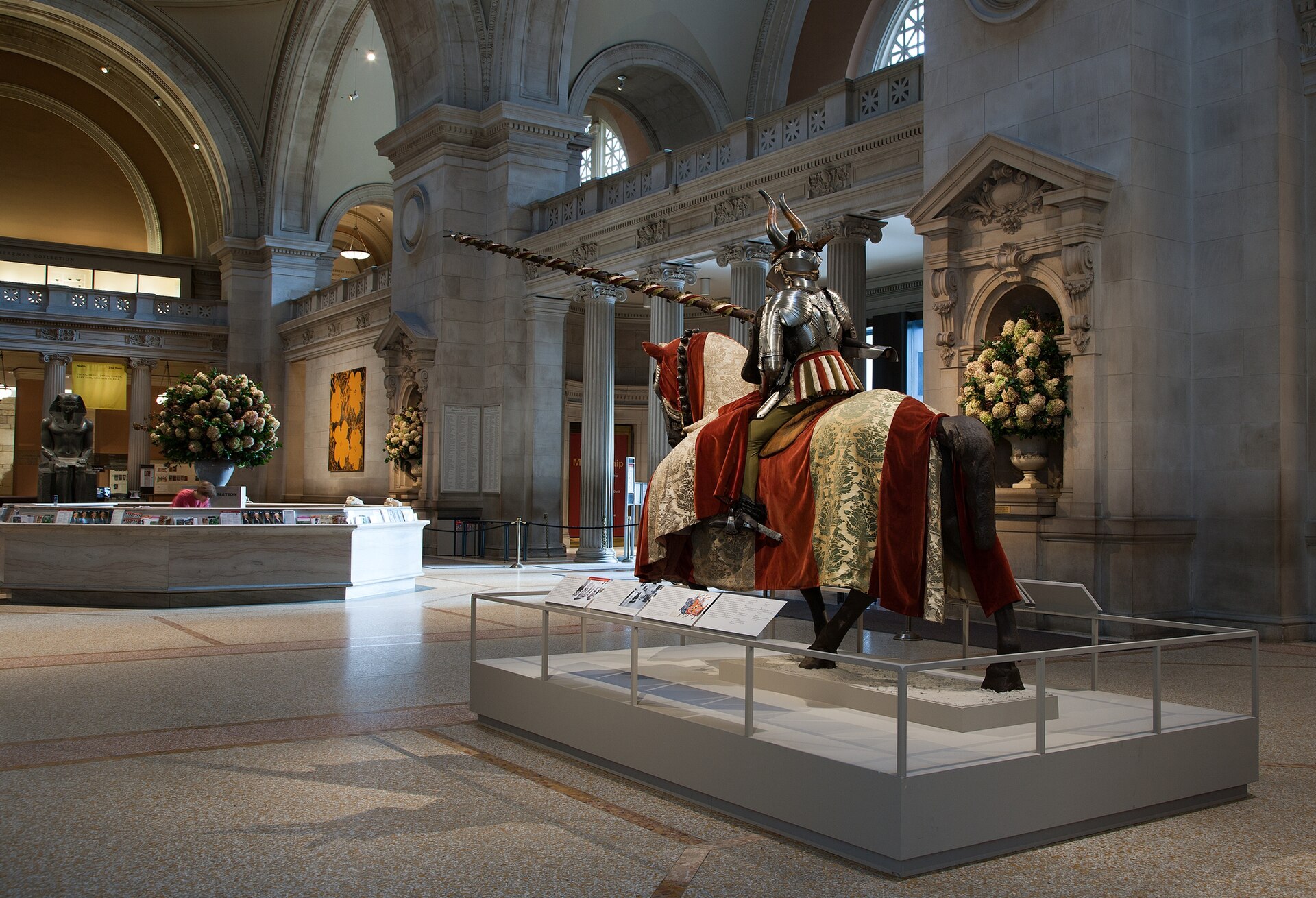
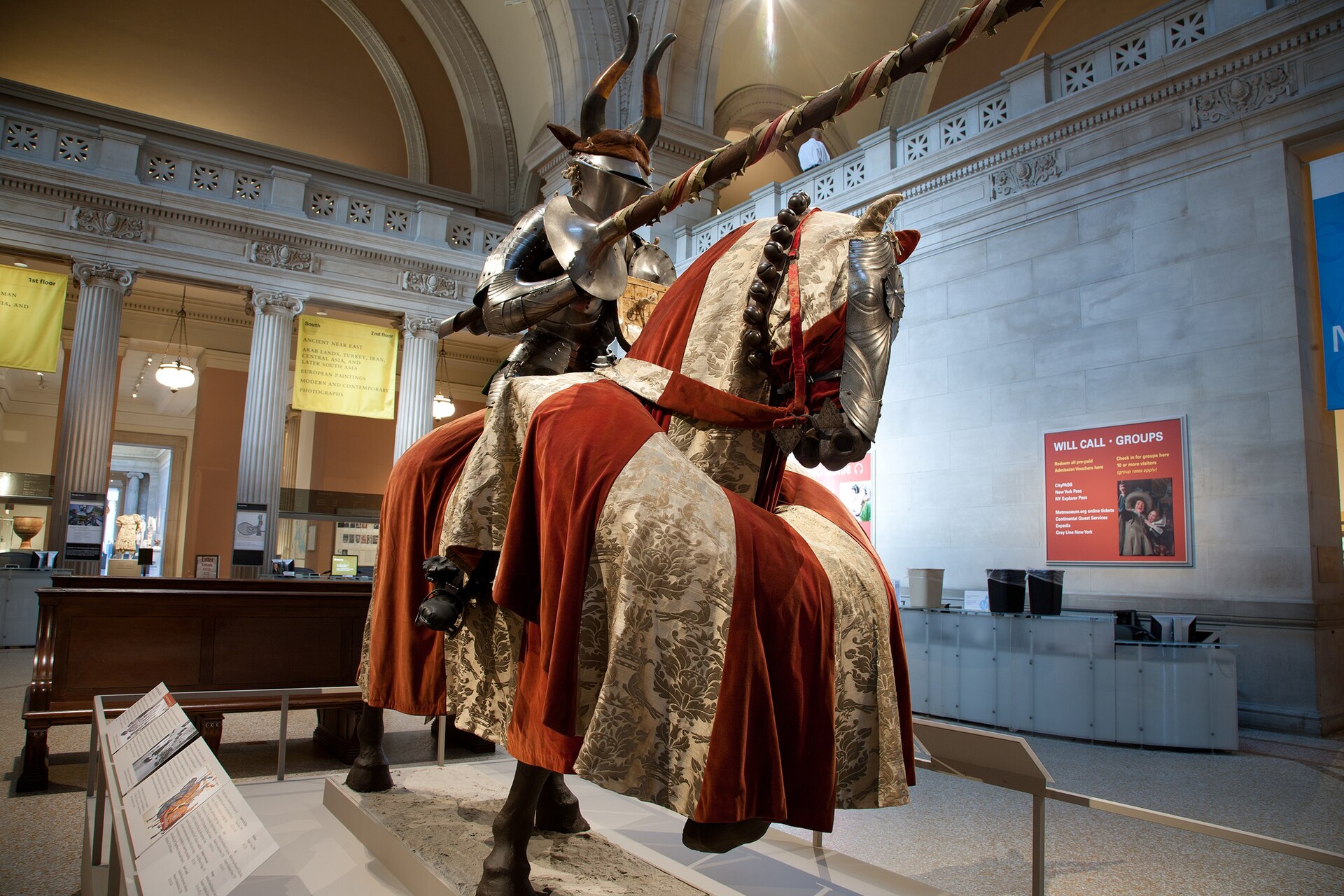
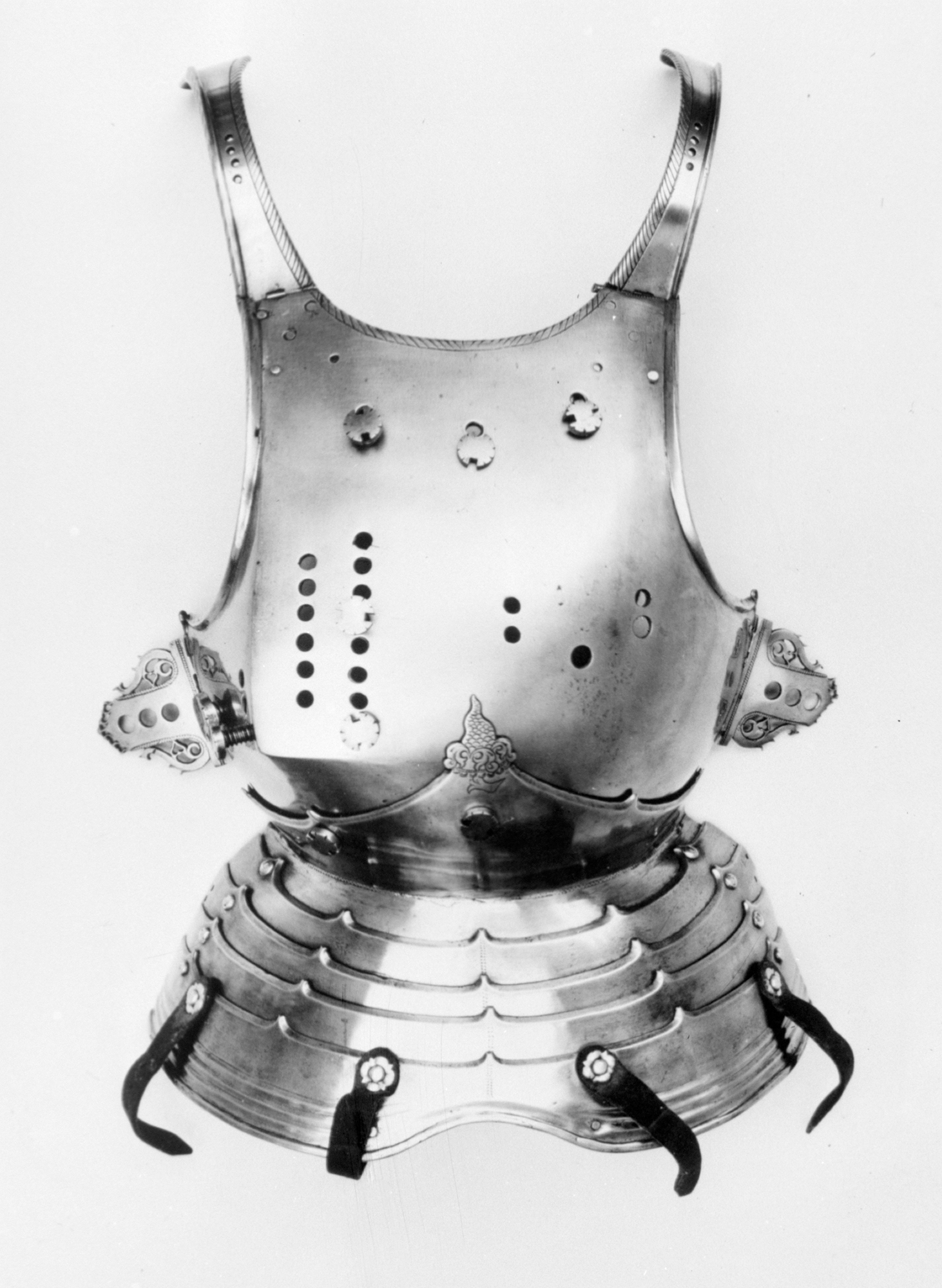
The record in full
Chapter 1What the accession number actually covers
This is not a single object. The Metropolitan's own accession number, 04.3.291a through q, plus 04.3.292, groups a helmet, a breastplate, a backplate, a pair of tassets, a pair of rondels and a...
This is not a single object. The Metropolitan's own accession number, 04.3.291a through q, plus 04.3.292, groups a helmet, a breastplate, a backplate, a pair of tassets, a pair of rondels and a shield into one catalogue entry, cross-referenced under two separate object records in the Museum's own database (object IDs 35928, titled "Armor for the Joust of Peace," and 21926, titled "Jousting Armor"). Only the helmet carries an artist credit, and it is a pointed one: "Helmet (04.3.291a) made by Daniel Tachaux." No other element of the group carries a maker's name in the Museum's public catalogue.
The medium given is steel, copper alloy, leather, textile and horn. The whole assembly weighs 85.5 lb (38.78 kg); the helmet alone weighs 21.5 lb (9752 g), the breastplate 23 lb, each tasset 6 lb, the backplate 5 lb, each rondel 5 lb, and the shield 6 lb. The Museum's culture field for the object reads, in full, "German; restorations, French, Paris" - a description printed on the object's own catalogue card that concedes, without elaboration, that a substantial share of what is on the mannequin is not German work of any date but a later Parisian remaking.
Chapter 2The joust of peace and the Stechzeug
The Gestech was the German tournament joust fought with blunted lances, in which two mounted contestants tried to unhorse each other or break a lance against an opponent's targe, a small shield...
The Gestech was the German tournament joust fought with blunted lances, in which two mounted contestants tried to unhorse each other or break a lance against an opponent's targe, a small shield strapped across the chest and left shoulder. Armor built for it, a Stechzeug, was never meant to be worn in the field. It was built to survive repeated direct blows at speed, which is why its helm, the Stechhelm or frog-mouth helm, was bolted rigidly to both breastplate and backplate rather than pivoting freely: the wearer turned his whole upper body to look, rather than his head alone.
The type is well represented elsewhere in American collections in undisputed form. The Metropolitan's own Bashford Dean Memorial Collection, given after Dean's death by Edward S. Harkness in 1929, includes a genuine Stechhelm of about 1500, probably made in Nuremberg, with no restoration history attached. The Philadelphia Museum of Art holds elements of another Stechzeug, commissioned by the Emperor Maximilian I from the Helmschmid workshop for jousts celebrating his 1494 marriage, itself catalogued frankly as surviving "with later replacements and additions." Composite survival, in other words, is close to the rule for this class of object, not the exception; what sets the Metropolitan's example apart is how completely one collector's paper trail survives to document exactly which pieces were added, by whom, and when.
Chapter 3Costantino Ressman builds it, piece by piece
The man who assembled the armor was not a dealer working to a customer's order.
The man who assembled the armor was not a dealer working to a customer's order. Costantino Ressman (1832-1899) was an Italian diplomat, an ardent supporter of the Risorgimento who had fled Austrian prosecution as a young man, served as Italy's ambassador at Constantinople and then Paris, and was removed from the diplomatic service in 1895 for his opposition to the Triple Alliance and his conspicuously good relations with the French government. He had been collecting arms since around 1867, and by the 1880s and 1890s he was buying for himself, in Paris, with the eye of a specialist rather than the budget of a duke.
He built the Stechzeug component by component over roughly a decade, and never hid what he was doing. In 1881 he bought the left jousting gauntlet, or manifer, from the collector Baron Basilewsky. In 1887 he bought the breastplate from the dealer Bachereau, who supplied new tassets, a lance-rest and a counter-rest made to match, and who separately polished the armor's "blind" shaffron, a horse's-head defense that covered the animal's eyes so it would not shy from the lance, and restored its roundel. In July 1888 he bought the right vambrace, an arm defense, at the Londesborough sale at Christie's in London; that December he bought the two pauldrons and besagews privately from Baron de Cosson. In November 1889 he had a Paris restorer named Negre fabricate the jousting targe, or shield, a wood core plated on the outside with scales of horn, and that same month he bought a genuine late fifteenth-century backplate from the Lyons collector Maurice Chabrieres-Arles.
Chapter 4The 1891 commission and Daniel Tachaux's hand
What Ressman did not have, after eight years of piecemeal buying, was a helm, or anyone to fit the parts together into something that would stand and read as a single armor.
What Ressman did not have, after eight years of piecemeal buying, was a helm, or anyone to fit the parts together into something that would stand and read as a single armor. In October 1891 he commissioned the Paris armorer Alexandre Lebon to complete the missing elements and mount the whole assembly. For the hardest single piece of that job, Lebon employed a younger armorer, Daniel Tachaux, who forged the helm itself.
The finished, restored and completed armor cost Ressman 7,950 francs in total. There is a small but genuine inconsistency in how the date of the helm's manufacture is recorded within the same modern scholarship: the main narrative account, drawn directly from Ressman's own inventories, correspondence and receipts, dates Lebon's commission and Tachaux's work to October 1891, while a separate footnote in the same publication's appendix, correcting an earlier statement by Bashford Dean, gives the helm as "the work of armorer Daniel Tachaux in Paris in 1889." Both figures come from the same author working from the same archive; this record follows the more detailed, directly sourced 1891 date in the main text and flags the discrepancy rather than silently picking one.
Chapter 5Ressman sells to the Duc de Dino, 1899
Ressman did not sell the finished Stechzeug immediately.
Ressman did not sell the finished Stechzeug immediately. He kept it, along with the rest of his collection, until 1899, when, gravely ill, he sold a large group of his best pieces, including this armor, ten of his finest helmets and thirty-four daggers, to the Duc de Dino. Baron de Cosson, who was close to both men, set the prices; he later described trying to secure the best possible terms for his dying friend without taking unfair advantage of Dino, who was paying him a commission on the same sale. The Stechzeug itself changed hands at 30,000 francs, nearly four times what it had cost Ressman to build. Ressman died in Paris on 8 July 1899. His own remaining collection, some 280 pieces, passed by his will to the Museo Nazionale del Bargello in Florence, where it remains.
Chapter 6The Duc de Dino
Charles Maurice Camille de Talleyrand-Perigord, 4th duc de Dino (1843-1917), was a great-nephew of the statesman Talleyrand and a minor figure in his own right: a soldier who served in the French...
Charles Maurice Camille de Talleyrand-Perigord, 4th duc de Dino (1843-1917), was a great-nephew of the statesman Talleyrand and a minor figure in his own right: a soldier who served in the French expeditionary force to Mexico in 1862 and in the Franco-Prussian War, a convert to the Republican cause who briefly called himself Citizen Perigord, an amateur archaeologist and writer, and, twice, the husband of a wealthy American. His first wife, Elizabeth Curtis of Boston, divorced him in 1886; his second, Adele Stevens, reputedly brought a dowry of three million dollars and divorced him in turn in 1903. Between those marriages and his military service he spent roughly two decades assembling, in France, one of the largest privately held collections of European arms and armor of his era, close to five hundred pieces in all, most of it acquired through Baron de Cosson as his agent. Baron de Cosson catalogued the collection privately in 1901, in a folio volume modeled on the earlier Spitzer collection catalogues, with brief entries that gave no hint of the restorations underneath.
Chapter 7The Metropolitan buys the collection sight unseen, 1904
In April 1904 the Metropolitan Museum bought the entire Dino collection en bloc for just over $250,000, then the largest sum it had ever committed to a single acquisition.
In April 1904 the Metropolitan Museum bought the entire Dino collection en bloc for just over $250,000, then the largest sum it had ever committed to a single acquisition. The purchase was negotiated almost entirely by cable, on the strength of a recommendation from the trustee Rutherfurd Stuyvesant, himself an arms and armor collector and a friend of Baron de Cosson's, and it went through without the purchasing committee ever consulting Dino's own 1901 catalogue in detail. The scale of the commitment forced the Museum's hand in a second way: that same year it appointed Bashford Dean, a Columbia University zoologist and arms enthusiast with no prior curatorial post at the Museum, as guest curator to organize what it had bought. Dean became honorary curator in 1906 and the Museum's first paid, founding curator of the Department of Arms and Armor when it was formally established on 28 October 1912.
Chapter 8Bashford Dean's own doubts, disclosed in print in 1905
Dean did not need decades to notice something was wrong with this particular armor.
Dean did not need decades to notice something was wrong with this particular armor. According to Stuart Pyhrr's account, Dean already held suspicions about the Stechzeug in 1904, having been alerted by the fellow collector William H. Riggs to its composite nature. Ressman himself, Pyhrr notes, had never tried to hide that it was a recent assemblage. What genuinely startled Dean was the helm specifically: he concluded it was not old at all.
He said so in print, in the Museum's own 1905 handbook of the collection, with what a later curator would call unusual candor for a young institution eager to show off an expensive new purchase: "The present writer . . . inclines to the view that it has suffered a number of 'adaptations' and that the helm is entirely modern, possibly of Viennese workmanship." Dean was right about the first half of that sentence and wrong about the second: the helm was indeed entirely modern, but it had been made in Paris, not Vienna, by a Frenchman rather than an Austrian. The armor stayed on view for decades regardless, usually mounted on a caparisoned horse with a lance in hand, but it quietly stopped appearing in the departmental handbooks that followed.
Chapter 9On view, off view, and back for a centennial
The armor was exhibited in the Metropolitan's Arms and Armor Galleries continuously from 1904 until 1988.
The armor was exhibited in the Metropolitan's Arms and Armor Galleries continuously from 1904 until 1988. It returned to public view only briefly after that, installed in the Museum's Great Hall in 2012 to mark the Department of Arms and Armor's centennial, the same year Pyhrr's identification of Tachaux was published. As of the Museum's most recently available public collection data, its own Collection API records no current gallery number for the object, consistent with the piece being held in storage rather than on permanent display.
Chapter 10Stuart Pyhrr names Tachaux, 2012
The identification of the helm's actual maker did not come from a metallurgical test or a new scientific method.
The identification of the helm's actual maker did not come from a metallurgical test or a new scientific method. It came from paper. In "Armor for America: The Duc de Dino Collection," published in the Metropolitan Museum Journal for the Department's centennial year, curator Stuart W. Pyhrr worked back through Costantino Ressman's own surviving inventories, correspondence and receipts, preserved among the papers of Baron de Cosson at the Royal Armouries Library in Leeds, and reconstructed the entire decade-long assembly of the armor component by component, dealer by dealer, franc by franc. Tachaux's name, and Lebon's, come directly out of that archive rather than out of connoisseurship or renewed physical examination.
The same 2012 article, in the same appendix, separately identifies a different and more celebrated Dino armor, reputedly belonging to the duke of Sessa, as a product of the restoration workshops run by the dealer Frederic Spitzer rather than by Tachaux or Lebon at all. That object is covered as its own record in this archive. The two cases share a purchase, a purchaser and a curator, but not a forger: Spitzer's workshop rebuilt around old fragments under his own direction; Ressman commissioned Lebon and Tachaux to make what he still lacked. They are two separate hands operating in the same Paris market for the same kind of buyer, and this record keeps them distinct rather than treating one as a stand-in for the other.
Chapter 11Daniel Tachaux: from the object's maker to the Museum's own armorer
Tachaux's subsequent career is the part of this story that a catalogue label cannot easily hold.
Tachaux's subsequent career is the part of this story that a catalogue label cannot easily hold. His work on the 1891 helm impressed Dean enough, once Dean investigated the Paris armor trade in later years, that in 1909 Dean hired Tachaux outright as the Metropolitan's own staff armorer, brought over from Paris to found what became the Department's conservation workshop. Tachaux arrived with 644 specialized tools, hammers, stakes and shaping irons of every size, many of them inherited from his own teacher, the German armorer Ludwig Klein, under whom he had trained in Paris. The workshop he founded still conserves, mounts and installs the Department's collection of some 14,000 objects.
Tachaux worked for the Museum from 1909 to 1919, and his responsibilities grew well beyond simple maintenance. When the United States entered the First World War in 1917, Dean was commissioned a major of ordnance and set to designing protective helmets for American troops; Tachaux built the working prototypes by hand, including a 1917 example the Museum now holds as "Prototype for Helmet Model No. 2." He left the Metropolitan in 1919 to work for the private collector Clarence Mackay, and died in 1928.
Chapter 12What is genuine and what is not
Sorted by Ressman's own paper trail, the armor divides cleanly.
Sorted by Ressman's own paper trail, the armor divides cleanly. Old and individually documented: the gauntlet, bought from Basilewsky in 1881; the core of the breastplate, bought from Bachereau in 1887; the right vambrace, bought at the Londesborough sale in 1888; the pauldrons and besagews, bought from Baron de Cosson later that year; the backplate, bought from Chabrieres-Arles in 1889; and the shaffron, an older piece that Bachereau restored and polished rather than replaced. New, and made to match: the tassets, the lance-rest and the counter-rest, supplied by Bachereau alongside the breastplate in 1887; the shield, fabricated whole by the restorer Negre in 1889; and the helmet, forged entirely by Tachaux in 1891. On the numbers alone, more of the object by weight and by element count is genuine fifteenth-century material than is later invention. But the single most visible, most photographed, most identifying part of the whole assembly, the helm that gives the piece its silhouette, is a nineteenth-century object wearing a fifteenth-century shape.
Chapter 13Part of a wider pattern: too good to be true
Pyhrr titled his appendix on the Dino collection's authenticity problems "Too Good to Be True," borrowing the phrase from a 1932 article in The Connoisseur by the English antiquarian Charles R.
Pyhrr titled his appendix on the Dino collection's authenticity problems "Too Good to Be True," borrowing the phrase from a 1932 article in The Connoisseur by the English antiquarian Charles R. Beard, which had accused a different Dino armor of being an extensively restored composite. The Museum's response at the time was defensive; it took until 1933 for the curator Stephen V. Grancsay to have that armor, and two others, formally declared of doubtful authenticity by the trustees, and two were subsequently deaccessioned and sold in 1934. Beard's target was the work of the dealer-restorers Carrand, father and son, and, in several other Dino pieces, of Frederic Spitzer; by the second half of the nineteenth century the supply of genuine high-quality medieval armor was drying up, and workshops in Paris built increasingly convincing fakes and pastiches to meet demand from American and European collectors who wanted the haute epoque look regardless of what was actually underneath it. Ressman's Stechzeug belongs to the same market and the same decade, but not to the same workshop: it is not a Carrand or a Spitzer improvement on an existing base, but a scholar-collector's own honest, well-documented assembly of real fragments, finished with one entirely new component that neither he nor, later, the Museum initially recognized as such.
Chapter 14What remains unresolved
Pyhrr's 2012 article settles the documentary question of who made the helm and roughly when, but it leaves several things open.
Pyhrr's 2012 article settles the documentary question of who made the helm and roughly when, but it leaves several things open. The date itself is internally inconsistent within his own publication, 1891 in the detailed narrative and 1889 in a corrective footnote to Dean's 1905 claim, and nothing in the sources consulted for this record resolves which is the transcription and which is the fact. Whether any of the other pieces Lebon or Tachaux touched for other Dino-collection owners, particularly the ten helmets Ressman sold alongside this armor, carry undetected restorations of the same kind is not addressed; Pyhrr's forensic attention in the same appendix falls almost entirely on the Carrand and Spitzer material. No metallurgical or technical imaging study of the 1891 helm, independent of the archival case Pyhrr built, appears in the record. And the Museum's own database still carries the object under two separate object identifiers for what is, by every other field, a single accessioned group.
The artist
Daniel Tachaux
Daniel Tachaux appears in the Metropolitan Museum's own records twice, in two entirely different roles. In 1891, working in Paris for the armorer Alexandre Lebon, he forged the helmet that the Museum would unknowingly buy as a genuine medieval antiquity in 1904 and that its own founding curator would call "entirely modern" within a year of acquiring it. In 1909, that same curator hired him, by then established as one of the most capable armorers working in Paris, to move to New York and found the workshop that has conserved the Museum's arms and armor collection ever since. The two roles are not a contradiction. They are the same set of skills, applied first to convincing a market and then to serving a museum, by a craftsman good enough to be trusted with both.
Related works
| Work | Relation | Where it is |
|---|---|---|
| Helm for the Joust of Peace (Stechhelm) Unknown German armorer, probably Nuremberg | Undisputed comparandum: a genuine Stechhelm of the same type and approximate date, with no restoration history, from the Bashford Dean Memorial Collection Given to the Museum by Edward S. Harkness in 1929 as part of Dean's own collection, after Dean's death the year before. Shows what an unrestored Stechhelm of this class actually looks like. | The Metropolitan Museum of Art, New York (accession 29.156.67a) |
| Elements from an Armor for the German Joust of Peace (Stechzeug) Helmschmid workshop, Augsburg | Comparandum: another Stechzeug of the same functional type, commissioned by Emperor Maximilian I for jousts celebrating his 1494 marriage, catalogued with its own later replacements and additions Shows that composite survival, with acknowledged later replacement of parts, is close to the norm for this class of tournament armor rather than an anomaly unique to the Dino piece. | Philadelphia Museum of Art |
| Armor of German Gothic style Composed under the direction of the dealer-restorer Louis Carrand | Same 1904 Duc de Dino purchase, same Metropolitan accession year, a different and separately documented nineteenth-century restoration case The armor at the center of Charles R. Beard's 1932 Connoisseur article "Too Good to Be True," and of the trustees' 1933 formal finding of doubtful authenticity. Not restored by Tachaux or Lebon. | The Metropolitan Museum of Art, New York (accession 04.3.293a-t) |
| Half Armor attributed to Don Gonzalo Fernandez de Cordoba, Duke of Sessa Genuine elements probably by Lucio Piccinino; restoration workshop of the dealer Frederic Spitzer | Same 1904 Duc de Dino purchase, same 2012 Pyhrr article, a different restorer's hand entirely Already covered as its own record in this archive, under the slug duke-of-sessa-armor-piccinino-met. Named here only to keep the two 1891-vintage restoration cases distinct: Spitzer's workshop rebuilt around old fragments; Ressman's helm was commissioned new. | The Metropolitan Museum of Art, New York (accession 21996) |
| Armor Garniture, Probably of King Henry VIII of England Greenwich armory workshop | A separate object acquired in the same 1904 Duc de Dino purchase Already covered as its own record in this archive, under the slug greenwich-armour-of-henry-viii. Named here only to mark the shared acquisition mechanism, not shared restoration history. | The Metropolitan Museum of Art, New York (accession 22741) |
Open questions
- Was the helm forged in 1891 or 1889? The 2012 scholarship that identifies Tachaux as the maker gives both dates in different places within the same publication, and nothing in the sources consulted for this record resolves the discrepancy.
- Do any of the other nine helmets Ressman sold to the Duc de Dino alongside this armor in 1899 carry restorations by Lebon, Tachaux, or another Paris workshop that have not been individually reassessed?
- Has the 1891 helmet ever been examined with metallurgical or technical imaging methods, independent of the documentary case Pyhrr built from Ressman's own papers?
- What became of the original, older shield and tasset forms that the 1887-1889 replacements were made to match, if any survived Ressman's decade of piecemeal assembly?
- The Museum's own public database still lists this accession under two separate object identifiers (35928 and 21926). Is that a data artifact awaiting correction, or does it reflect some other cataloguing distinction not stated in either record?
- Is the armor currently in storage, in conservation, or elsewhere; the Museum's Collection API records no gallery number, but the sources consulted do not state a reason or a date for its removal from view after the 2012 centennial display.
Questions about this object
What is Armor for the Joust of Peace?
Armor for the Joust of Peace is an arms and armour, dated genuine elements probably late 15th century; assembled and completed as a composite armor by Costantino Ressman, 1881-1891; helmet made by Daniel Tachaux, Paris, 1891. Medium: Steel, copper alloy, leather, textile and horn.
Who made Armor for the Joust of Peace, and is the attribution settled?
The attribution to Daniel Tachaux is recorded here as accepted. The helmet (accession 04.3.291a) is accepted as the 1891 work of the Paris armorer Daniel Tachaux, employed for the job by the armorer Alexandre Lebon. The identification was made by curator Stuart W. Pyhrr in 2012 from the papers of the collector Costantino Ressman, who commissioned the work, preserved among the Baron de Cosson archive at the Royal Armouries Library, Leeds. The Metropolitan Museum's own founding curator, Bashford Dean, had already recognized the helm as modern in his 1905 handbook, though he guessed wrong on where it was made. The surrounding elements of the composite armor are of varying, individually documented date: several are genuine fifteenth-century pieces Ressman bought from named dealers between 1881 and 1889; the shield and the tassets are further nineteenth-century replacements made to match.
Where is Armor for the Joust of Peace now?
The Metropolitan Museum of Art, New York, Department of Arms and Armor. Inventory number 04.3.291a-q, .292 (helmet element: 04.3.291a). Last confirmed 24 August 2026. Rogers Fund purchase, 1904, as part of the Duc de Dino collection. The Museum's public Collection API records no current gallery number for the object, consistent with storage rather than permanent display; it was exhibited in the Arms and Armor Galleries from 1904 to 1988 and returned briefly to the Great Hall in 2012 for the Department's centennial.
What is still unknown about Armor for the Joust of Peace?
Was the helm forged in 1891 or 1889? The 2012 scholarship that identifies Tachaux as the maker gives both dates in different places within the same publication, and nothing in the sources consulted for this record resolves the discrepancy.
Sources
- 1Metropolitan Museum of Art, Collection API record for object 35928, 'Armor for the Joust of Peace' / 'Helmet (04.3.291a) made by Daniel Tachaux,' accession 04.3.291a-q. metmuseum.org/art/...
- 2Metropolitan Museum of Art, Collection API record for object 21926, 'Jousting Armor' / 'Helmet made by Daniel Tachaux,' accession 04.3.291a-q, .292; etc. A separate database entry for what appears to be the same physical accession as source 1. Accessed via the Museum's open Collection API. metmuseum.org/art/...
- 3Stuart W. Pyhrr, 'Armor for America: The Duc de Dino Collection,' Metropolitan Museum Journal 47 (2012), pp. 183-230, including Appendix 1, 'Too Good to Be True: Arms and Armor Fakes and Pastiches in the Dino Collection,' and Appendix 2, the concordance of Dino catalogue numbers and Metropolitan accession numbers. Fetched and read in full (PDF, pdftotext extraction of the Museum's own publication file, 48 pages). resources.metmuseum.org/resources/...
- 4Metropolitan Museum of Art, Collection API record for object 23216, 'Helm for the Joust of Peace (Stechhelm),' German, probably Nuremberg, ca. 1500, accession 29.156.67a, Bashford Dean Memorial Collection, Gift of Edward S. Harkness, 1929. metmuseum.org/art/...
- 5Metropolitan Museum of Art label text for 'Armorer's Hammer,' accession 12.230.98 (object 35897), reproduced in an Alamy stock-image caption: training of Daniel Tachaux under the armorer Ludwig Klein, the 644-piece tool set brought from Paris to New York in 1909. alamy.com/armorers-hammer-culture-german-or-french-dimens...
- 6Metropolitan Museum of Art, Collection API record for object 35956, 'Prototype for Helmet Model No. 2,' Daniel Tachaux, American (New York), 1917, steel and pressed paper or cardboard. metmuseum.org/art/...
- 7Philadelphia Museum of Art, catalogue entry for 'Elements from an Armor for the German Joust of Peace (Stechzeug),' Helmschmid workshop, Augsburg, c. 1494 with later replacements and additions. philamuseum.org/collection/...
- 8Wikimedia Commons, five CC0-licensed Metropolitan Museum photographs of accession 04.3.291a-q: File:Armor for the Joust of Peace MET DP277982.jpg, File:Armor for the Joust of Peace MET DP277984.jpg, File:Armor for the Joust of Peace MET DP277985.jpg, File:Armor for the Joust of Peace MET 168825.jpg, and File:Armor for the Joust of Peace MET 168826.jpg. commons.wikimedia.org/wiki/...
- 9Italian Wikipedia, 'Costantino Ressman': birth and death dates, diplomatic career and 1895 removal from the Foreign Ministry, art and armor collecting from c. 1867, and the bequest of his own collection to the Museo Nazionale del Bargello, Florence. it.wikipedia.org/wiki/...

Last verified · Published
Change log
24 August 2026 - Record created at the house standard: researched narrative, technical evidence, maker dossier, graded provenance chain, prices with hammer and premium separated, related works, open questions and sources.