Lion dit "de Monzon"
Unknown bronze-founder, Cordoban Caliphal workshop · Late 10th - 11th century (Umayyad Caliphate of Cordoba); an older reading still found in some literature places it in the 12th-13th century (Almohad/Nasrid period)
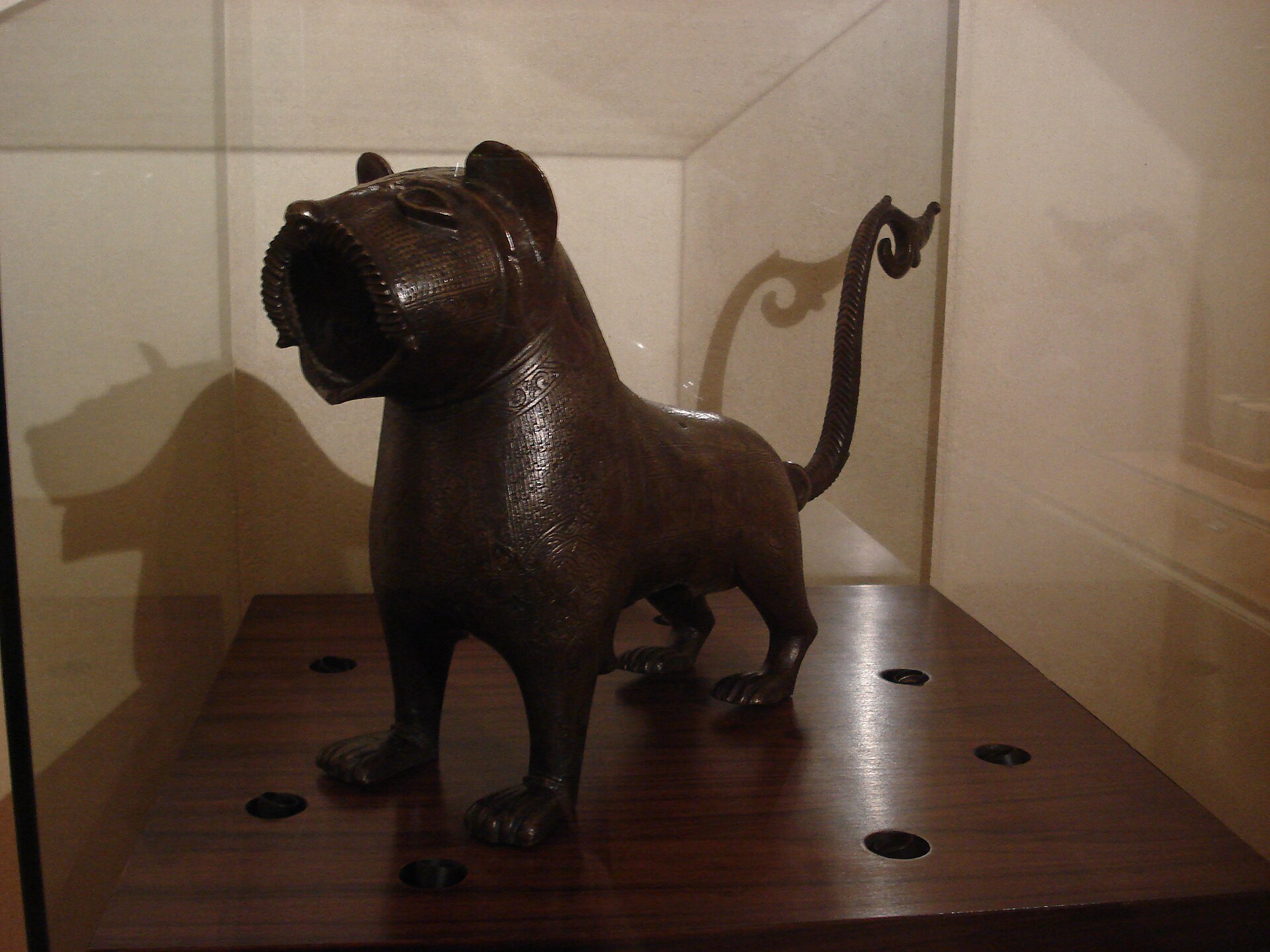
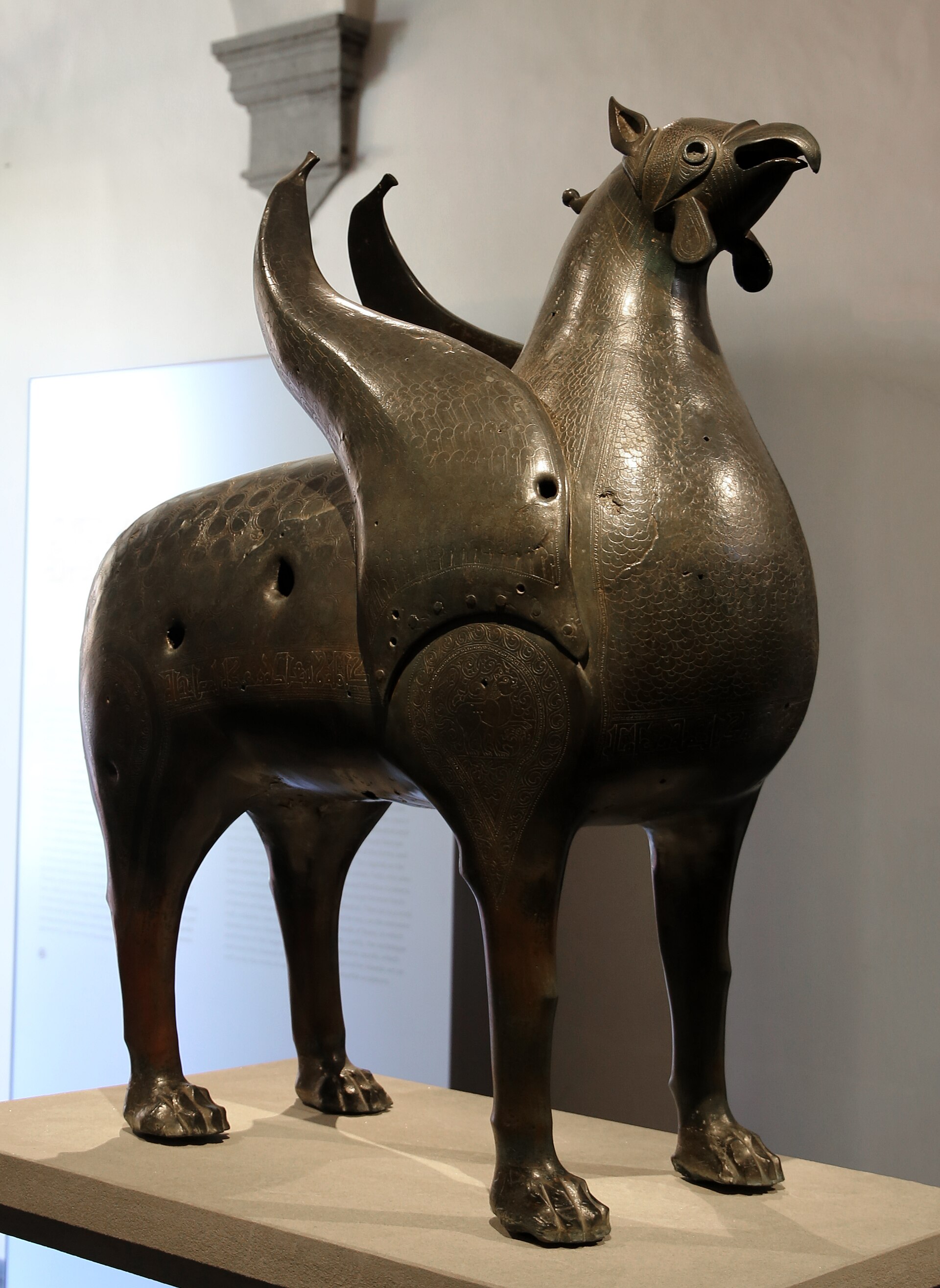
The record subject. Cast bronze with engraved Kufic decoration, late 10th-11th century, Cordoban workshop. Louvre, Departement des Arts de l'Islam, OA 7883.
Photo Vania Teofilo, own work, via Wikimedia Commons (CC BY-SA 3.0)| Artist | Unknown bronze-founder, Cordoban Caliphal workshop |
|---|---|
| Date | Late 10th - 11th century (Umayyad Caliphate of Cordoba); an older reading still found in some literature places it in the 12th-13th century (Almohad/Nasrid period) |
| Medium | Cast bronze (lost-wax/cire perdue), with chased and engraved decoration added after casting |
| Dimensions | H. 31.5 cm (max) x L. 54.5 cm x W. 13.7 cm (max); reported weight approx. 10.826 kg |
| Where it is now | Musee du Louvre, Departement des Arts de l'Islam, Parislast confirmed |
| Inventory number | OA 7883 |
| Attribution | AcceptedManufacture in a Cordoban workshop of the Umayyad Caliphate is the settled position, established by Manuel Gomez-Moreno's 1951 comparison with the bronzes of Madinat al-Zahra and reinforced since. Full note |
| Object type | Islamic metalwork |
| Period | Islamic Spain (al-Andalus), Umayyad Caliphate of Cordoba |
| Cases | Has a provenance gap |
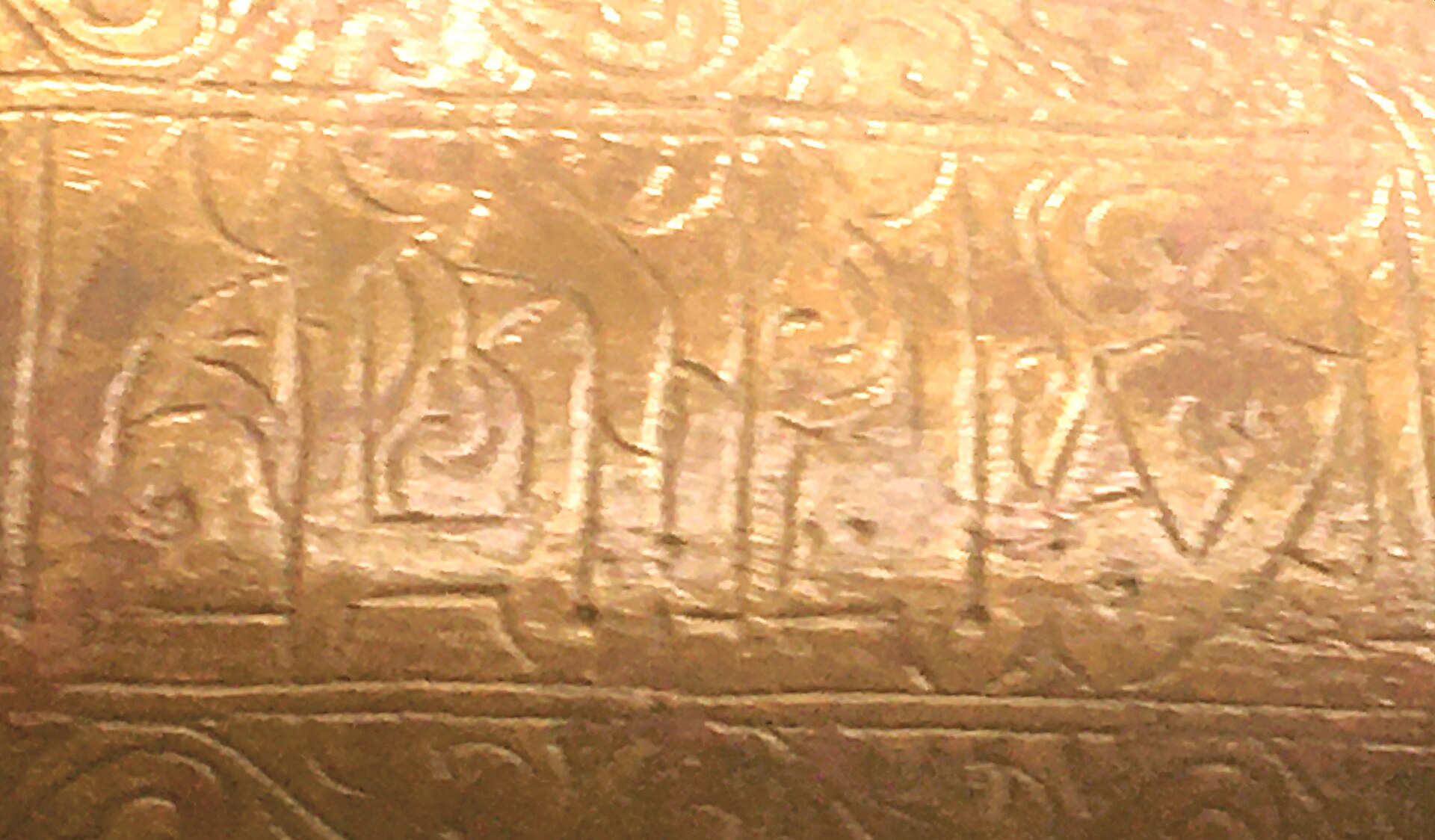
| Inscriptions | Kufic Arabic inscription in cartouches, repeated on both flanks and across the back: baraka kamila / ni'ma shamila ("perfect blessing / complete happiness"), a formulaic benediction common on Andalusian luxury metalwork. Letter terminals take the "swan-neck" form characteristic of Andalusian epigraphy of the period. |
| Owners on record | 8 links5 documented, 2 disputed, 1 unknown |
| Sources | 10 cited |
About this record Last verified · 10 sources cited · Change log
On this page 10 sections
ContentsClose
A hollow bronze lion cast in a Cordoban workshop of the Umayyad Caliphate, found in 1849 in the ruins of a castle at Monzon de Campos in Castile, three hundred kilometres and several centuries removed from the Andalusian court that made it. It passed through the hands of the Spanish painter Mariano Fortuny, the Parisian collector Eugene Piot and the banker Louis Stern before entering the Louvre by bequest in 1926-27.
What it was for is not settled. Cataloguers have long called it a fountain spout, water fed through the belly and out the open mouth; the art historian has more recently questioned whether the hydraulics work at all, and pointed instead to a documented Andalusian tradition of lion-shaped water-clock automata, with a companion inscribed mortar found alongside it in 1849 as physical support for that reading. Both positions remain live.
Its findspot has sometimes been mis-stated as Monzon in Huesca, a different castle entirely; every primary source checked for this record places the discovery firmly at Monzon de Campos, Palencia, and this record corrects the confusion rather than repeating it.
Provenance
Each link is graded. Documented: a cited source supports it. Disputed: the identification is argued but not established. Unknown: no owner for that span, and the gap is not smoothed into a narrative. The grades in the glossary.
- Late 10th - 11th century -Manufactured in a Cordoban workshop, Umayyad Caliphatedisputed
Cordoban manufacture is the accepted position since Gomez-Moreno's 1951 comparison with Madinat al-Zahra bronzes, superseding Migeon's 1927 Fatimid proposal. The precise date within the Cordoban tradition (Caliphal vs. later Almohad/Nasrid) is still argued in the literature; this record follows Fellinger's epigraphic redating to the late 10th-11th century.236
- 11th century (approx.) - 1849Unknownunknown
No owner or location is documented between the object's manufacture in Cordoba and its recorded discovery centuries later and hundreds of kilometres away, in Christian Castile at Monzon de Campos, Palencia (not Monzon, Huesca). How and when it travelled north, and whether it was deposited during the Reconquista-era transfer of the site or brought later, is not recorded in any source consulted.123
- 1849 - 1872Reported as Miguel Jalon, Marquis of Castrofuerte (landowner at the find), and separately as a pharmacist from Valladoliddisputed
Found in or near the ruined castle at Monzon de Campos, Palencia, alongside a bronze mortar carrying the identical Kufic inscription, itself now in the Museo Arqueologico Nacional, Madrid. Published in the 19th century by Pascual de Gayangos. One account names the Marquis of Castrofuerte as the landowner at the time of the find; a separate strand of the literature names a Valladolid pharmacist as the seller to Fortuny in 1872. These accounts were not reconciled in the sources consulted. The Museo Arqueologico Nacional was reportedly offered the piece and declined to acquire it.135
- 1872 - 1874Mariano Fortuny y Marsal, painterdocumented
Acquired in 1872 by the Catalan painter and collector Mariano Fortuny y Marsal for his studio and collection. Some later sources conflate his dates with those of his son, the textile and fashion designer Mariano Fortuny y Madrazo (1871-1949); this record follows the standard art-historical identification of the painter Fortuny y Marsal, who died in 1874.135
- 1874 - 1875Estate of Mariano Fortuny y Marsaldocumented
Fortuny died in 1874; his collection was dispersed at auction at the Hotel des Ventes, Paris, in 1875.13
- 1875 - 1890Eugene Piotdocumented
Acquired at the 1875 Fortuny dispersal sale. Lent by Piot to the Exposition Universelle of 1878 in Paris, displayed in the oriental gallery at the Trocadero.13
- 1890 - 1926Louis Stern, then Madame Louis Sterndocumented
Purchased by the Parisian banker Louis Stern following Piot's death in 1890, reportedly at another Hotel Drouot sale. Louis Stern himself died in 1900; his widow, recorded in Louvre documentation as Madame Louis Stern, lent the piece to the 1903 Exposition des Arts Musulmans at the Musee des Arts Decoratifs, curated by Gaston Migeon and Raymond Koechlin.13
- 1926 - presentMusee du Louvre, Departement des Arts de l'Islamdocumented
Entered the Louvre by the bequest of Madame Louis Stern. The Conseil des Musees Nationaux approved the acquisition on 5 July 1926; the decree formalising it followed on 9 May 1927. No purchase price applies to a bequest.1
Prices realised
| Date | Sale | Estimate | Result | Note |
|---|---|---|---|---|
| 1875 | Unnamed Paris auction house (Hotel des Ventes) | Not published in sources consulted | Hammer Not published in sources consulted With premium Not published in sources consulted Unknown | Sale of the dispersed Fortuny y Marsal collection following his 1874 death, at which Eugene Piot acquired the lion. No price for this specific lot was found in any source consulted for this record. |
| 1890 | Hotel Drouot, Paris | Not published in sources consulted | Hammer Not published in sources consulted With premium Not published in sources consulted Unknown | Sale following Eugene Piot's death, at which Louis Stern acquired the lion. No price for this specific lot was found in any source consulted for this record. |
Hammer is the price at which the bidding stopped; with premium adds the fee the house charges the buyer on top. Hammer price and buyer's premium in the glossary.
Technical evidence
| Attribution note | Manufacture in a Cordoban workshop of the Umayyad Caliphate is the settled position, established by Manuel Gomez-Moreno's 1951 comparison with the bronzes of Madinat al-Zahra and reinforced since. It replaced an earlier and short-lived proposal of Fatimid manufacture floated by Gaston Migeon in 1927. The precise date within that Cordoban tradition is still argued: some literature, echoing an older museum-label reading, places the piece as late as the Almohad or Nasrid twelfth-to-thirteenth century; Gwenaelle Fellinger's epigraphic analysis of the kufic letterforms instead redates it to the Caliphal period itself, late tenth to eleventh century, which is the position this record follows. No maker is named on the object or in any document; it is unsigned, like the entire corpus of Andalusian courtly bronzes. |
|---|---|
| Material and technique | Cast bronze, lost-wax (cire perdue) process, with chased and engraved surface decoration worked after casting.14 |
| Dimensions | Height 31.5 cm (max), length 54.5 cm, width 13.7 cm (max).13 |
| Weight | Reported at approximately 10.826 kg in the fullest published physical description located.4 |
| Inscription | Kufic Arabic, baraka kamila / ni'ma shamila ("perfect blessing / complete happiness"), repeated in cartouches on both flanks and the back, with swan-neck letter terminals diagnostic of Andalusian epigraphy.123 |
| Construction of the tail | The tail is cast or fitted separately and articulated at a hinge; the interior wall of the body is solid at the point of attachment, which rules out the tail acting as a water pump and is central to the unresolved function debate.24 |
| Ventral aperture | A large opening in the belly, read by the traditional fountain hypothesis as the point where a supply pipe once connected; contested by Gwenaelle Fellinger on hydraulic grounds.24 |
| Alloy composition | No published elemental or metallurgical analysis of this specific object was located. Contrast the Pisa Griffin, its closest technical comparandum, which has been analysed with X-ray fluorescence and laser-induced breakdown spectroscopy under Anna Contadini's project.67 |
Images
The record in full
Chapter 1What it is
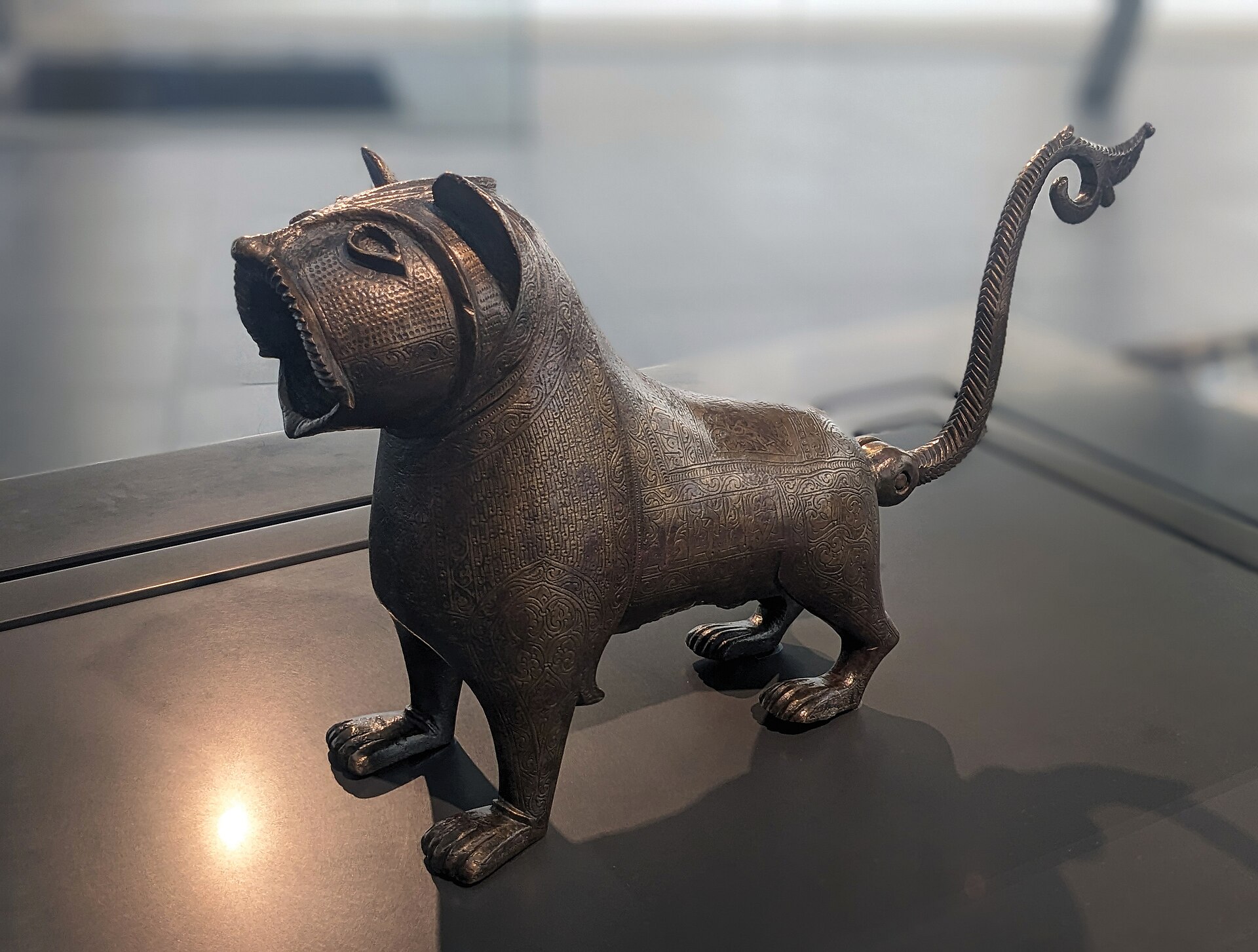
A hollow bronze lion, cast by the lost-wax process, standing 31.5 cm high and 54.5 cm long, its head disproportionately large for its body, mouth gaping open, almond-shaped eyes deeply outlined and...
A hollow bronze lion, cast by the lost-wax process, standing 31.5 cm high and 54.5 cm long, its head disproportionately large for its body, mouth gaping open, almond-shaped eyes deeply outlined and originally inlaid with another material now lost. The mane is suggested by parallel engraved loops; the breast, belly and paws carry palmettes and foliated scrolls; bands of circles and fleurons run along the extremities, and a small carpet-like pattern covers the back. The tail is long, striated, ends in a fleuron, and is articulated at a hinge rather than cast solid with the body.
The belly holds a large opening, and the working assumption for over a century has been that a pipe once terminated there, so that water travelling through the hollow body was ejected from the open mouth. That reading is the reason the object is catalogued as a fountain figure, and it is also the reading a working engineer has recently pushed back against, for reasons given below.
Chapter 2Where it was found, and where it was not
The lion was found in 1849 at Monzon de Campos, a village in the province of Palencia in Castile, in or near the ruins of a castle there.
The lion was found in 1849 at Monzon de Campos, a village in the province of Palencia in Castile, in or near the ruins of a castle there. This is not the better-known Monzon in the province of Huesca, Aragon, whose medieval castle is a separate site with a separate history; the two share only a name. Every scholarly and museum source consulted for this record, French and Spanish alike, gives the findspot as Monzon de Campos, Palencia, and this record corrects the Huesca attribution on that basis.
Even at Monzon de Campos the circumstances are not fully fixed. Accounts describe the find either as peasants turning up the bronze in a field, or as a discovery in a hiding place ("escondrijo") within the ruined castle. A bronze mortar bearing the identical Kufic inscription was found alongside it and is now in the Museo Arqueologico Nacional in Madrid; it is the strongest physical evidence that the lion had a functional companion object, whatever that function turns out to have been. The site itself, known locally as Los Castrillones, was a fortified position abandoned after the Carrion river undermined its foundations, and the historical record for the area shows a documented Islamic-era presence nearby, which is consistent with, but does not by itself prove, an on-site origin for the bronze rather than an object brought there and cached later.
Chapter 3How it was made
The body was cast in bronze by the lost-wax process standard for Andalusian zoomorphic metalwork of this class, then finished by chasing and engraving after casting: the mane loops, the foliate...
The body was cast in bronze by the lost-wax process standard for Andalusian zoomorphic metalwork of this class, then finished by chasing and engraving after casting: the mane loops, the foliate scrolls and the inscription cartouches are worked into the surface rather than cast in relief throughout. The tail was made separately and fitted with a hinge, which is unusual enough to have driven the recent functional debate covered below.
No published elemental or alloy analysis of the piece was located in the course of this research. That is a genuine gap, not an oversight of this record: the closest comparable object, the Pisa Griffin, has been the subject of a dedicated modern technical study using X-ray fluorescence and laser-induced breakdown spectroscopy, coordinated by Anna Contadini's SOAS-led project. No equivalent study of the Monzon Lion's alloy composition has surfaced in the literature searched, which means the workshop attribution rests on stylistic and epigraphic comparison rather than on any metallurgical fingerprint.
Chapter 4The inscription
Two words in florid Kufic script run in cartouches across both flanks and repeat on the back: baraka kamila, ni'ma shamila, "perfect blessing, complete happiness." It is a stock benediction, not a...
Two words in florid Kufic script run in cartouches across both flanks and repeat on the back: baraka kamila, ni'ma shamila, "perfect blessing, complete happiness." It is a stock benediction, not a dedication to a named patron and not a maker's signature; formulas of this kind recur across Andalusian courtly metalwork, ivory and textiles of the period as a general wish for good fortune rather than as an inscription tied to a specific commission.
The letterforms matter more than the words. Their upper terminals curl into the so-called "swan-neck" shape that epigraphers treat as diagnostic of Andalusian Arabic script, and it is the detailed comparison of exactly this feature that underlies Gwenaelle Fellinger's redating of the piece to the Caliphal period rather than the later centuries some earlier cataloguing proposed.
Chapter 5Settling on Cordoba: the attribution problem
The object's own findspot tells us nothing about where it was made; Monzon de Campos was Christian Castile by the time anyone buried or lost the bronze there, hundreds of kilometres from the...
The object's own findspot tells us nothing about where it was made; Monzon de Campos was Christian Castile by the time anyone buried or lost the bronze there, hundreds of kilometres from the Andalusian south. Working out where the lion was cast has been a century-long argument conducted entirely through comparison with other objects.
Friedrich Sarre and Ernst Kuhnel, exhibiting comparable Andalusian bronzes in Munich in 1910, already argued for a Spanish origin. Gaston Migeon nonetheless proposed a Fatimid (Egyptian) origin in 1927, a view current sources treat as superseded. Ugo Monneret de Villard in 1949 drew the comparison to the Griffin of Pisa that later research would develop much further. It was Manuel Gomez-Moreno, in 1951, comparing the lion's decoration directly against the bronzes excavated at the caliphal palace-city of Madinat al-Zahra outside Cordoba, who is credited with confirming the Spanish, and specifically Cordoban, origin on stylistic grounds that have held up since.
The remaining disagreement is narrower: not where, but exactly when within a Cordoban tradition that ran from the height of the Caliphate through its Taifa-period fragmentation and beyond. Some literature, apparently following an older museum-label convention, still describes the piece as Almohad or Nasrid work of the twelfth or thirteenth century. Fellinger's epigraphic argument for the late tenth to eleventh century, contemporary with or shortly after the Caliphate's peak, is the more recent and more specifically argued position, and the one this record adopts, while noting that the later dating has not vanished from the literature and deserves to be named as a live alternative rather than silently dropped.
Chapter 6Fountain, or something else: the function dispute
The traditional reading, repeated in most museum-facing descriptions of the object, is straightforward: the lion is a fountain spout, or aquamanile, with water fed through a pipe into the ventral...
The traditional reading, repeated in most museum-facing descriptions of the object, is straightforward: the lion is a fountain spout, or aquamanile, with water fed through a pipe into the ventral opening and expelled through the open mouth. On this reading the articulated tail is decorative, its mechanism unexplained but not load-bearing.
Gwenaelle Fellinger has pushed against that reading on hydraulic grounds, as consolidated in secondary (Wikipedia) accounts of her argument rather than her own primary publication, which was not read directly for this record; the summarized position is that the physics of the piece do not straightforwardly support its working as a simple fountain mouth, and pointing out that the tail's articulation is left unaccounted for by the fountain hypothesis. The alternative she and others have raised connects the lion to a documented Andalusian technical tradition: Ibn Khalaf al-Muradi's treatise Kitab al-asrar fi nata'ij al-afkar ("The Book of Secrets"), composed in Cordoba and Toledo around the year 1000, describes some thirty automata, among them water-clock mechanisms in which two lions mark the passing hours by spitting balls into a receiving vessel. On this reading the Monzon lion, together with the companion mortar found with it, would be a surviving fragment of exactly this kind of courtly automaton or timekeeping device, with the tail's hinge serving a mechanical function tied to the timing mechanism rather than being purely ornamental.
Neither position is proven. The fountain reading has the weight of a century of museum cataloguing behind it and a plausible physical mechanism (a pipe through the ventral opening); the automaton reading has the weight of a genuine contemporary Andalusian textual tradition describing exactly this class of object, plus the unexplained tail hinge and the coincidence of the companion mortar. This record treats the function as unresolved rather than settling it either way, because the literature itself has not settled it.
Chapter 7The companion mortar
A bronze mortar carrying the same Kufic benediction was recovered with the lion in 1849 and is now held by the Museo Arqueologico Nacional in Madrid, separated from the lion since the nineteenth...
A bronze mortar carrying the same Kufic benediction was recovered with the lion in 1849 and is now held by the Museo Arqueologico Nacional in Madrid, separated from the lion since the nineteenth century by the accident of two different collectors' interests. Its shared inscription is the strongest evidence that the two objects belong to a single original set; it is also the single strongest piece of evidence cited for the automaton hypothesis, since al-Muradi's lion-clocks describe pellets or water dropping into just such a receiving vessel. What is not established is whether the mortar and the lion were ever physically joined or merely stood near one another, and no technical study comparing the two objects together appears to have been carried out since they were separated.
Chapter 8What it is compared to
The strongest technical comparandum is the Griffin of Pisa, the largest surviving medieval Islamic bronze, now in the Museo dell'Opera del Duomo in Pisa and dated on independent grounds to roughly...
The strongest technical comparandum is the Griffin of Pisa, the largest surviving medieval Islamic bronze, now in the Museo dell'Opera del Duomo in Pisa and dated on independent grounds to roughly 1085-1110. Anna Contadini's Griffin and Lion Project, published as The Pisa Griffin and the Mari-Cha Lion in 2018, identifies shared construction technique, an identical benedictory-inscription formula, comparable pelage and ocelle-band treatment, and comparable tool marks, all pointing toward a Cordoban workshop tradition that produced both pieces, whether or not the same hands cast both.
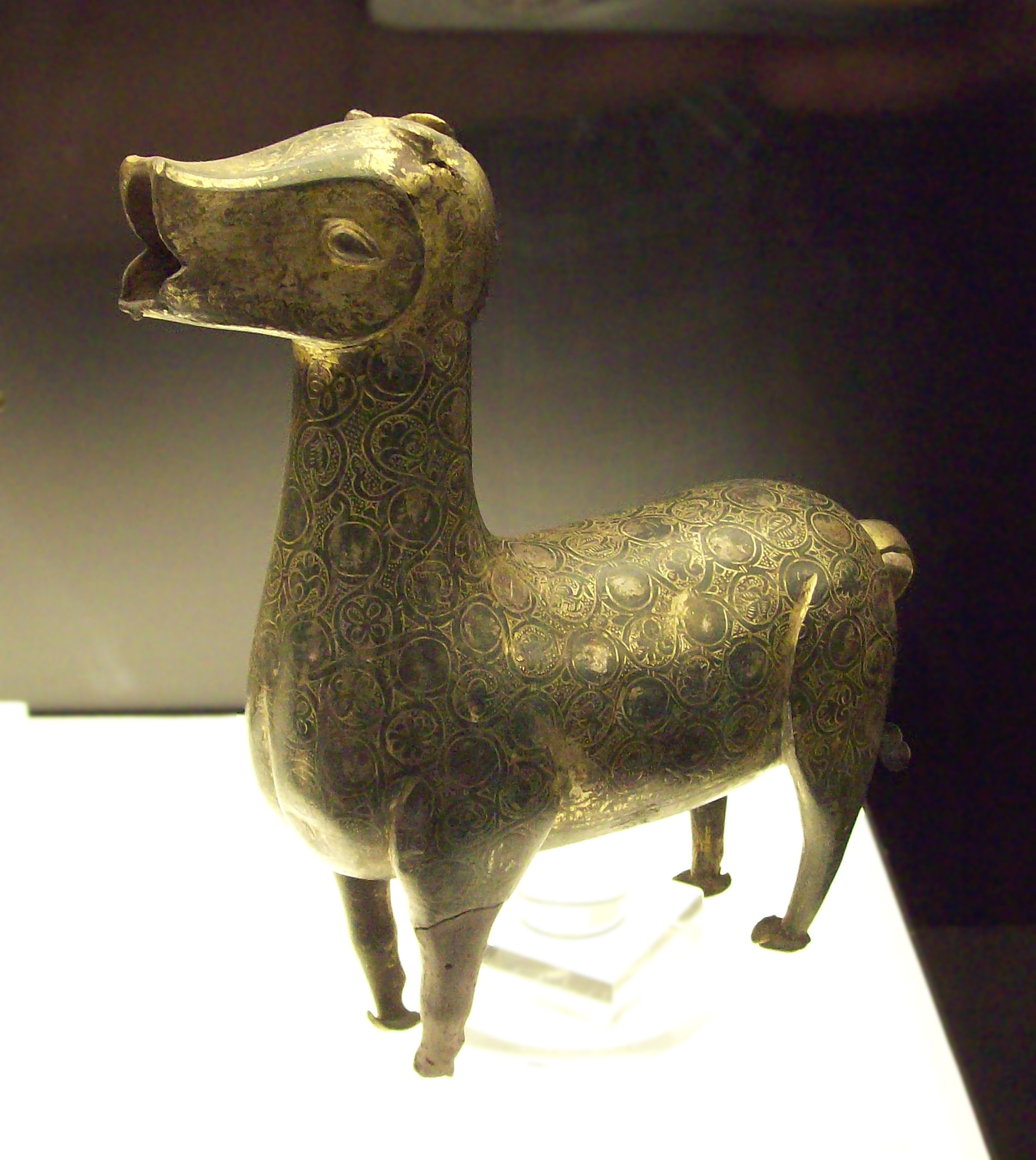
Within Spain itself, the closest stylistic relative is smaller and earlier: the bronze deer excavated at Madinat al-Zahra, the Caliphal palace-city outside Cordoba, now in the Museo Arqueologico Nacional in Madrid and dated to the second half of the tenth century. It is a genuinely different object, a courtly fountain figure rather than a large-scale display piece, but it belongs to the same Cordoban production context that Gomez-Moreno used to place the lion.
Two Fatimid-period lions, one in the Museum of Islamic Art in Cairo and one in the Kassel museum collection, were considered as comparanda when a Fatimid origin for the Monzon lion was still current in the literature; differences in decoration, proportion and inscription are now cited as arguments against that comparison rather than for it, which is part of why the Fatimid attribution did not survive Gomez-Moreno's Cordoban case. A horse-shaped aquamanile in the Rijksmuseum, recently redated by its own cataloguers to somewhere in the tenth-to-twelfth-century al-Andalus/Fatimid production world rather than to its older Lotharingian attribution, belongs to the same broader corpus of roughly twenty-one known Islamic bronze lavation vessels, though no source consulted for this record draws a direct line between it and the Monzon lion specifically.
Chapter 9From the castle ruins to a painter's studio
Pascual de Gayangos published the discovery in the mid-nineteenth century, which is why the find is documented at all.
Pascual de Gayangos published the discovery in the mid-nineteenth century, which is why the find is documented at all. One account names the landowner at the time of discovery as Miguel Jalon, tenth Marquis of Castrofuerte; a separate strand of the literature describes a pharmacist from Valladolid selling the piece on in 1872. Neither account contradicts the other outright, but this record cannot fully reconcile exactly whose hands the bronze passed through between the 1849 find and its documented sale in 1872, and that gap is recorded honestly rather than bridged with a guess. One strand of the record states that the Museo Arqueologico Nacional in Madrid was offered the piece and declined to buy it; this is not independently corroborated by the competing pharmacist account, so it is reported here as documented by one source rather than as a point both strands agree on. What both accounts do converge on is that in 1872 the bronze was acquired by Mariano Fortuny y Marsal, the Catalan painter and collector then working between Rome and Spain, for his own studio and collection, where the bronze became something of a fixture and appears reflected in the visual culture around his circle.
Chapter 10Fortuny to the Louvre: Piot, Stern, and the bequest
Fortuny died in 1874. His collection was dispersed at auction at the Hotel des Ventes in Paris the following year, and it was there, in 1875, that the collector and critic Eugene Piot acquired the...
Fortuny died in 1874. His collection was dispersed at auction at the Hotel des Ventes in Paris the following year, and it was there, in 1875, that the collector and critic Eugene Piot acquired the lion. Piot lent it to the Exposition Universelle of 1878 in the oriental gallery at the Trocadero, giving it its first documented public exhibition in France. Piot died in 1890, and the bronze was bought at another Hotel Drouot sale that year by Louis Stern, a Parisian banker. Stern's widow, referred to in Louvre documentation as Madame Louis Stern, lent the piece to the Exposition des Arts Musulmans at the Musee des Arts Decoratifs in 1903, an exhibition curated by Gaston Migeon and Raymond Koechlin, the same Migeon who would later, in 1927, argue unsuccessfully for a Fatimid origin. On her death the bronze passed to the French state by bequest; the Conseil des Musees Nationaux approved the acquisition on 5 July 1926 and a formal decree followed on 9 May 1927, bringing the object into the Louvre's Departement des Arts de l'Islam, where it remains.
No price is recorded in any source consulted for this record for either the 1875 or the 1890 Hotel Drouot sale, and none is recorded for the 1926-27 bequest, which by its nature involved no purchase price at all.
The artist
Unknown bronze-founder(s), Cordoban court workshop of the Umayyad Caliphate
No maker's name survives for this object, and none was ever likely to: Andalusian courtly bronzes of this class are, without exception, unsigned. What can be reconstructed is the workshop tradition rather than an individual hand, built up over more than a century of comparison between this piece, the excavated bronzes of Madinat al-Zahra, and the larger and later Griffin of Pisa, which the current literature treats as a product of the same broad Cordoban metalworking culture even where it stops short of claiming the same hands.
Related works
| Work | Relation | Where it is |
|---|---|---|
| Griffin of Pisa Cordoban workshop tradition (unattributed) | Closest technical and stylistic comparandum: shared construction technique, identical benediction formula, comparable tool marks This is NOT the Monzon Lion. A separate, much larger object (over a meter tall), dated independently to roughly 1085-1110, studied technically by Anna Contadini's Griffin and Lion Project. | Museo dell'Opera del Duomo, Pisa |
| Deer of Cordoba (Cierva/Cervatillo de Medina Azahara) Cordoban Caliphal workshop (unattributed) | Stylistic comparandum from the same Cordoban courtly production context, cited in the case for the lion's Cordoban origin This is NOT the Monzon Lion. A separate, smaller bronze fountain figure of a deer, excavated at Madinat al-Zahra and dated to the second half of the 10th century. | Museo Arqueologico Nacional, Madrid (inv. 1943/41/1) |
| The companion mortar Cordoban workshop tradition (unattributed) | Found together with the lion in 1849 and bearing the identical Kufic inscription; central to the automaton hypothesis This is NOT the Monzon Lion. A separate object, physically parted from the lion since the two entered different nineteenth-century collections. | Museo Arqueologico Nacional, Madrid |
| Fatimid lion (Museum of Islamic Art, Cairo) Fatimid workshop (unattributed) | Comparandum considered and largely set aside once Cordoban manufacture was established This is NOT the Monzon Lion. A separate Fatimid-period bronze once used to argue, unsuccessfully, for an Egyptian origin for the Monzon lion. | Museum of Islamic Art, Cairo |
| Fatimid-period lion (Kassel) Fatimid workshop (unattributed) | Comparandum considered and largely set aside once Cordoban manufacture was established This is NOT the Monzon Lion. Differences in decoration, proportion and inscription are now cited as arguments against, rather than for, a shared origin with the Monzon lion. | Museum collection, Kassel |
| Horse aquamanile Andalusian or Fatimid workshop (unattributed, disputed) | Member of the same broader corpus of roughly 21 known Islamic bronze lavation vessels; no direct comparison to the Monzon lion is drawn in the source consulted This is NOT the Monzon Lion. Recently redated by its own cataloguers from a 13th-century Lotharingian attribution to a 10th-12th century al-Andalus/Fatimid one. | Rijksmuseum, Amsterdam |
Open questions
- Fountain or automaton: the object's original function is not settled in the literature. The traditional fountain-spout reading and Gwenaelle Fellinger's automaton hypothesis, tied to al-Muradi's lion water-clocks, both remain live positions.
- Exactly whose hands the bronze passed through between its 1849 discovery at Monzon de Campos and its documented 1872 sale to Mariano Fortuny: the Marquis of Castrofuerte and a pharmacist from Valladolid both appear in the record, and this record could not reconcile the two accounts into a single confirmed chain.
- No published alloy or elemental composition study of the lion itself was located, unlike its closest comparandum the Pisa Griffin, which has undergone modern non-invasive metallurgical analysis.
- Whether the lion and the companion mortar recovered with it in 1849, now separated in different Madrid and Paris collections, were ever physically joined as parts of a single mechanism, or merely stood near each other when found.
- Whether the piece is currently on public display: the Louvre's own Atlas location data places it in Room 185 of the Departement des Arts de l'Islam, while a separate collections listing describes it as not currently on display. This record could not resolve the discrepancy.
- The precise date within the Cordoban tradition remains argued rather than settled: some sources retain a 12th-13th century Almohad/Nasrid reading against Fellinger's more recent late 10th-11th century epigraphic redating.
Questions about this object
What is Lion dit "de Monzon"?
Lion dit "de Monzon" is an islamic metalwork, dated late 10th - 11th century (Umayyad Caliphate of Cordoba); an older reading still found in some literature places it in the 12th-13th century (Almohad/Nasrid period). Medium: Cast bronze (lost-wax/cire perdue), with chased and engraved decoration added after casting.
Who made Lion dit "de Monzon", and is the attribution settled?
The attribution to Unknown bronze-founder, Cordoban Caliphal workshop is recorded here as accepted. Manufacture in a Cordoban workshop of the Umayyad Caliphate is the settled position, established by Manuel Gomez-Moreno's 1951 comparison with the bronzes of Madinat al-Zahra and reinforced since. It replaced an earlier and short-lived proposal of Fatimid manufacture floated by Gaston Migeon in 1927. The precise date within that Cordoban tradition is still argued: some literature, echoing an older museum-label reading, places the piece as late as the Almohad or Nasrid twelfth-to-thirteenth century; Gwenaelle Fellinger's epigraphic analysis of the kufic letterforms instead redates it to the Caliphal period itself, late tenth to eleventh century, which is the position this record follows. No maker is named on the object or in any document; it is unsigned, like the entire corpus of Andalusian courtly bronzes.
Where is Lion dit "de Monzon" now?
Musee du Louvre, Departement des Arts de l'Islam, Paris. Inventory number OA 7883. Last confirmed 15 August 2026. Bequest of Madame Louis Stern; council approval 5 July 1926, decree 9 May 1927. Louvre's own database records it in the department's galleries (Atlas location Room 185); a separate collections listing notes the piece as not currently on display. This record could not reconcile the two and flags it as an open point.
What has Lion dit "de Monzon" sold for?
Hammer Not published in sources consulted; with premium, Not published in sources consulted. Unnamed Paris auction house (Hotel des Ventes), 1875.
What is still unknown about Lion dit "de Monzon"?
Fountain or automaton: the object's original function is not settled in the literature. The traditional fountain-spout reading and Gwenaelle Fellinger's automaton hypothesis, tied to al-Muradi's lion water-clocks, both remain live positions.
Sources
- 1Musee du Louvre, collections database, "Lion dit 'de Monzon'", OA 7883. collections.louvre.fr/en/...
- 2Wikipedia (French), "Lion de Monzon". Consolidates the dating, attribution and function-dispute scholarship (Migeon 1927, Monneret de Villard 1949, Gomez-Moreno 1951, Fellinger, Contadini) and the al-Muradi automaton hypothesis. fr.wikipedia.org/wiki/...
- 3Wikipedia (Spanish), "Leon de Monzon". Consolidates the discovery, dating debate and acquisition chain to the Louvre. es.wikipedia.org/wiki/...
- 4Panorama de l'art, "Lion dit de Monzon", analytical entry by Sylvie Cuni-Gramont, covering physical description, weight, dimensions and the tail/aperture construction detail. panoramadelart.com/analyse/...
- 5COPE / TreceTV, "El misterioso hallazgo de unos campesinos en Palencia que hoy deslumbra en el Louvre", June 2025 feature covering the discovery, the Marquis of Castrofuerte, the Museo Arqueologico Nacional's declined purchase, and the acquisition chain through Fortuny, Piot and Stern to the Louvre. cope.es/trecetv/...
- 6Anna Contadini (ed.), The Pisa Griffin and the Mari-Cha Lion: Metalwork, Art and Technology in the Medieval Islamicate Mediterranean, Pisa: Pacini Editore, 2018. Cited for the Cordoban-workshop comparison between the Pisa Griffin and Andalusian bronzes, and for the modern XRF/LIBS technical study of the Griffin used here as a contrast case for the Monzon lion's untested alloy. researchgate.net/publication/...
- 7Muslim Heritage, "The Clocks of the Andalusian Ibn Khalaf al-Muradi", on the Kitab al-asrar fi nata'ij al-afkar and its lion water-clock automata, cited for the technical and textual background to the automaton-function hypothesis. muslimheritage.com/the-clocks-of-al-muradi
- 8Wikidata, Q55354061, "Fontaine Le Lion de Monzon", for the Louvre ARK and Atlas identifiers and structured location data. wikidata.org/wiki/...
- 9CastillosNet, "Castillo de Monzon de Campos", for the history of the findspot castle and its documented Islamic-era context. castillosnet.org/monumento.php
- 10The Rijksmuseum Bulletin, "The Horse Aquamanile in the Rijksmuseum: A 'New' Andalusian or Fatimid Bronze", cited for the scale of the surviving corpus of Islamic bronze lavation vessels (approx. 21 known examples) within which the Monzon lion sits. bulletin.rijksmuseum.nl/article/...
Last verified · Published
Change log
15 August 2026 - Record created at the house standard: researched narrative, technical evidence, maker dossier, graded provenance chain, prices with hammer and premium separated, related works, open questions and sources.