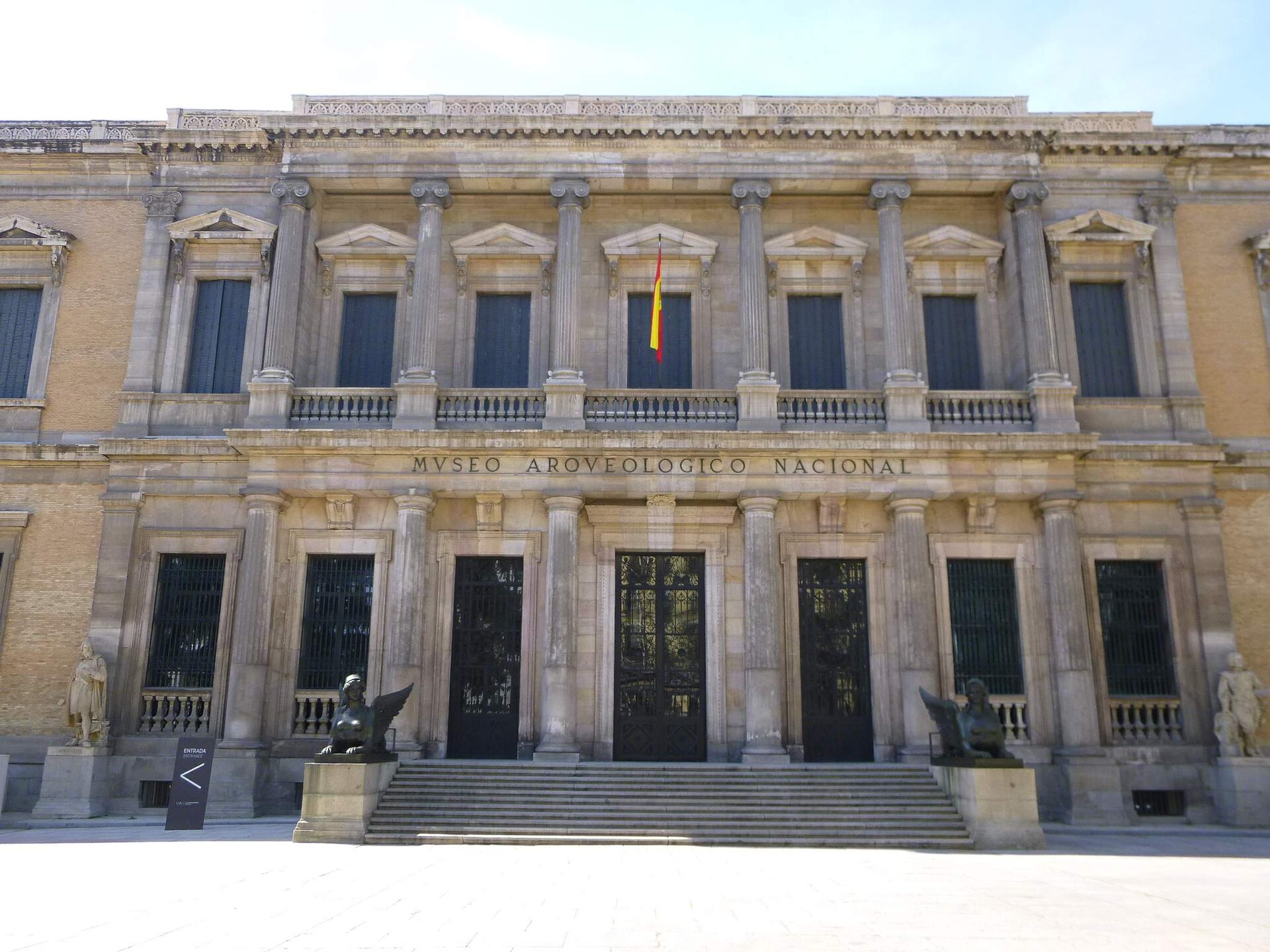
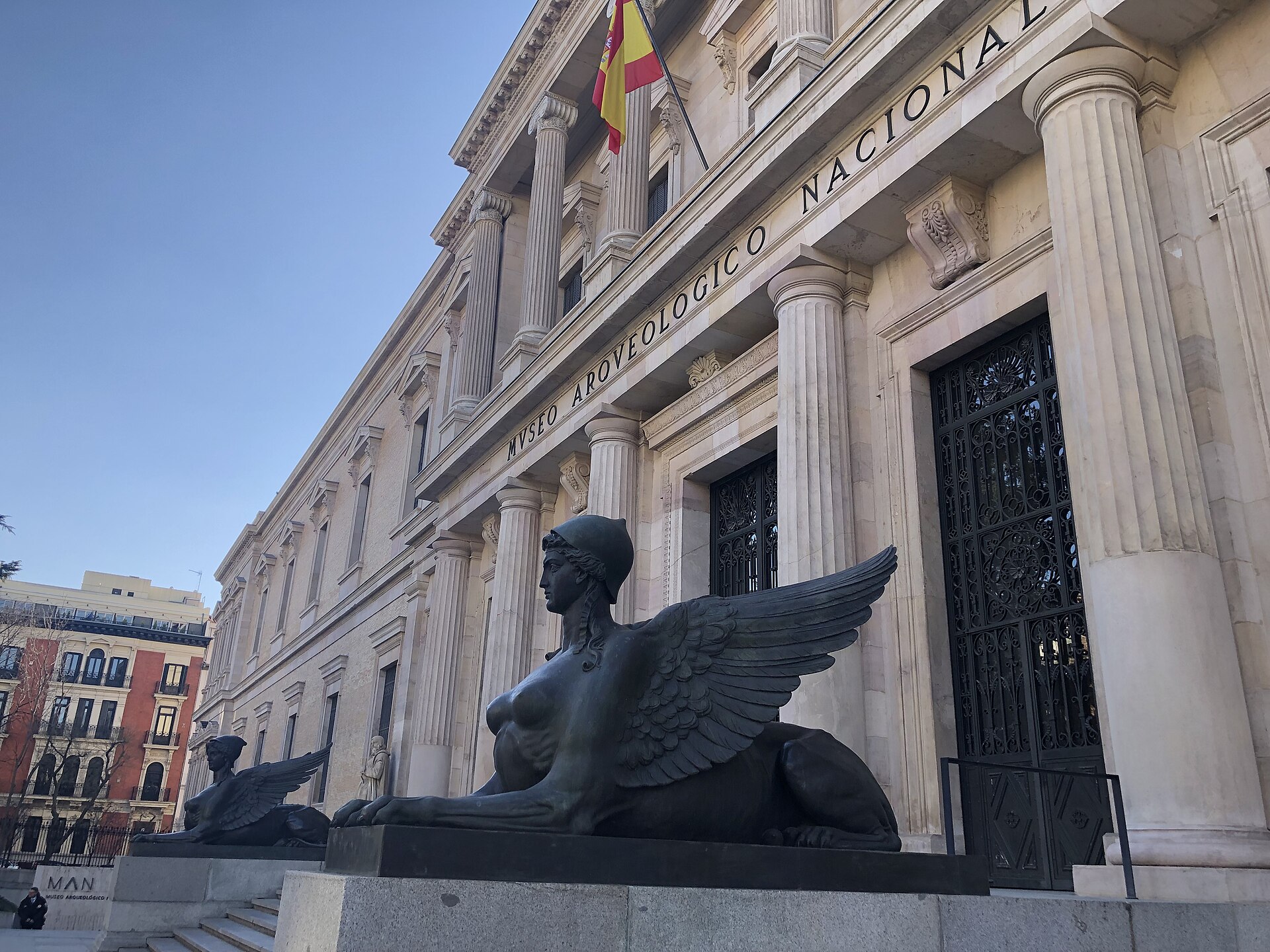
The neoclassical facade of the Museo Arqueologico Nacional, with its name cut into the entablature and the bronze sphinx guardians flanking the entrance steps.
Photograph by Zarateman, CC0Museo Arqueologico Nacional
Museum · Founded 1867
Open, admission and hours confirmed 26 August 2026 · 16 sources
On this page 15 sections
ContentsClose
Spain's national archaeology collection, founded by royal decree in 1867 to hold the crown's numismatic, archaeological and decorative-art material and expanded ever since. Its Iberian pre-Roman sculpture, above all the Lady of Elche and the Lady of Baza, is the reason most visitors come; its Visigothic goldsmith's work in the Guarrazar treasure and its holdings from Roman, Islamic and medieval Christian Spain make the case that the museum is not a one-object institution even when one object dominates its reputation. A comprehensive 2008-2014 renovation rebuilt the display of nearly all of it at once, which is part of why the museum now reads as more coherent than most collections of comparable age and range.
| Kind | Museum |
|---|---|
| Founded | 20 March 1867, by royal decree of Isabella II; moved into its purpose-built home on Calle Serrano in 1895 |
| City and country |  Madrid, Spain Madrid, Spain |
| Address | Calle de Serrano, 13, 28001 Madrid, Spain |
| Website | man.es |
| Status | Open, confirmed |
| Record last verified |
Visiting
- Hours
- Tuesday-Saturday09:30 to 20:00
- Sunday and public holidays09:30 to 15:00
- MondayClosed all year
- Closed
- 1 and 6 January, 1 May, 24, 25 and 31 December. The museum's own hours page warns that not every gallery can be guaranteed open at every advertised hour, for internal organisational reasons. Ticket office closes 15 minutes before the museum; room clearance starts 10 minutes before closing.
- Admission
- GeneralEUR 3
- ReducedEUR 1.50Groups of more than 8 people by prior request, accredited cultural volunteers, and RENFE long-distance or high-speed ticket holders within 48 hours of their journey
- Under 18 and over 65Freefree with accreditation; under-14s must be accompanied by an adult
- Students 18-25, unemployed, pensioners, large families, teachers, disability cardholders, official guides, journalists, ICOM and museum-association membersFreefree with accreditation
Free entry: Every non-holiday Saturday from 14:00, and every Sunday morning. 18 April (International Day for Monuments and Sites). 18 May (International Museum Day). 12 October (Spanish National Day). 6 December (Spanish Constitution Day)- Tickets
- man.sacatuentrada.es/es/entradas/museo-arqueo... The museum's own ticket page.
- Do I need to book?
- No for individual visitors at this price point, though online purchase is recommended
- Address
- Calle de Serrano, 13, 28001 Madrid, Spain MapMetro Serrano and Retiro (L4 and L2), both a short walk from the Calle Serrano entrance
On foot Beside the Plaza de Colon, sharing its building and forecourt with the National Library of Spain - Website
- man.es
- Telephone
- +34 91 577 79 12
Before you go how long, access, photography, bags, eating, shop
- How long to allow
- Two to three hours to cover the main galleries, by outside estimate; the museum's own permanent collection runs from prehistory to the modern age across multiple floors
- Access
- Not detailed in the pages read for this research; the museum's site carries a separate accessibility section not reached in this pass
- Photography
- Flash and tripod photography are not permitted; otherwise permitted (museum's own visitor-rules page, read 26 August 2026)
- Bags
- Large bags or backpacks over 40x40 cm, and motorcycle helmets, are not permitted in the exhibition rooms; the museum has a cloakroom (Consigna) (museum's own visitor-rules page, read 26 August 2026)
- Eating
- Not confirmed for this research
- Shop
- Museum shop (Tienda) listed in the site's own navigation
Prices and hours change. We take them from the institution's own pages and print the day we read them, and you can check the current position at the source we used. Confirm before you travel.
What is inside
Forecourt: replica of the Cave of Altamira
Visitors cross a full-scale replica of part of the Altamira cave, with its Palaeolithic painted ceiling, before reaching the ticketed galleries proper; it functions as the museum's own introduction to prehistory rather than a gallery of original objects.
Prehistory and Protohistory
Iberian Peninsula material from the Palaeolithic through the Iron Age, including the pre-Roman Iberian sculpture that is the museum's signature holding: the Lady of Elche, the Lady of Baza and the Bicha de Balazote.
Rome and the pre-Roman Mediterranean
Roman-period material from across the peninsula alongside Greek, Etruscan and Egyptian and Near Eastern antiquities, reflecting the museum's original 1867 remit as a repository for the crown's wider archaeological and decorative-art holdings, not only Spanish finds.
The Middle Ages: Visigothic, al-Andalus and Christian Spain
The Visigothic Treasure of Guarrazar, a set of seventh-century votive crowns and crosses including the Crown of Recceswinth, shown alongside material from al-Andalus and medieval Christian Iberia that traces the peninsula's successive rule.
Numismatic Cabinet
The museum's coin and medal collection, drawn from the same 1867 royal foundation that established the rest of the collection, shown in its own dedicated space rather than folded into the chronological galleries.
What to see first
The Lady of Elche
Iberian, 4th century BCThe museum's best-known object: a limestone bust found near Elche in 1897, sold to the Louvre within weeks of discovery, and returned to Spain only in 1941 in an exchange for Golden Age paintings. Its authenticity was seriously challenged in print in 1995 and defended since by pigment and residue analysis, and Elche has an active, government-level campaign running as of 2025 to bring it back to the city it was found in.9
The Lady of Baza
Iberian, 4th century BCA seated, painted limestone funerary sculpture found at Baza, Granada, in 1971, still carrying traces of its original polychromy; discussed by specialists alongside the Lady of Elche as evidence the Elche bust is not an isolated, and therefore not a forged, type.10
The Bicha de Balazote
Iberian, late 6th to early 5th century BCA stone sculpture from Albacete combining a bull's body with what is read as a human or divine head, most likely a guardian figure for a tomb; one of a small group of such hybrid Iberian animal sculptures the museum holds.10
The Treasure of Guarrazar
Visigothic goldsmiths, 7th centuryVotive crowns and crosses in gold and precious stones, found near Toledo in the 1850s, offered by Visigothic kings to their churches; the Crown of Recceswinth carries the king's own name spelled out in hanging gold letters. The museum's own catalogue page notes the treasure is today split across three collections: this museum, the Royal Palace in Madrid, and the Musee National du Moyen Age in Paris.18
The Cave of Altamira replica
Reconstruction of a Palaeolithic painted ceilingBuilt into the museum's own forecourt so that every visitor passes through a full-scale reconstruction of part of Spain's most famous prehistoric painted cave before reaching the ticketed collection.8
The Greek vase collection
Ancient Greek workshops, various datesDescribed by outside specialists as one of the strongest collections of its kind, reflecting the museum's founding remit as a repository for royal antiquities beyond the Iberian Peninsula.9
The Numismatic Cabinet
Coins and medals from antiquity to the modern eraPart of the original 1867 royal foundation and still shown as its own dedicated collection, a scale of coin holding most visitors walking toward the Lady of Elche never see.8
Exhibitions on now
- On now27 May to 18 Oct 2026Confirmed · check before you travel
Past exhibitions here
- Closed17 Feb to 13 Sep 2026Confirmed · check before you travel
A royal decree, and a shared building
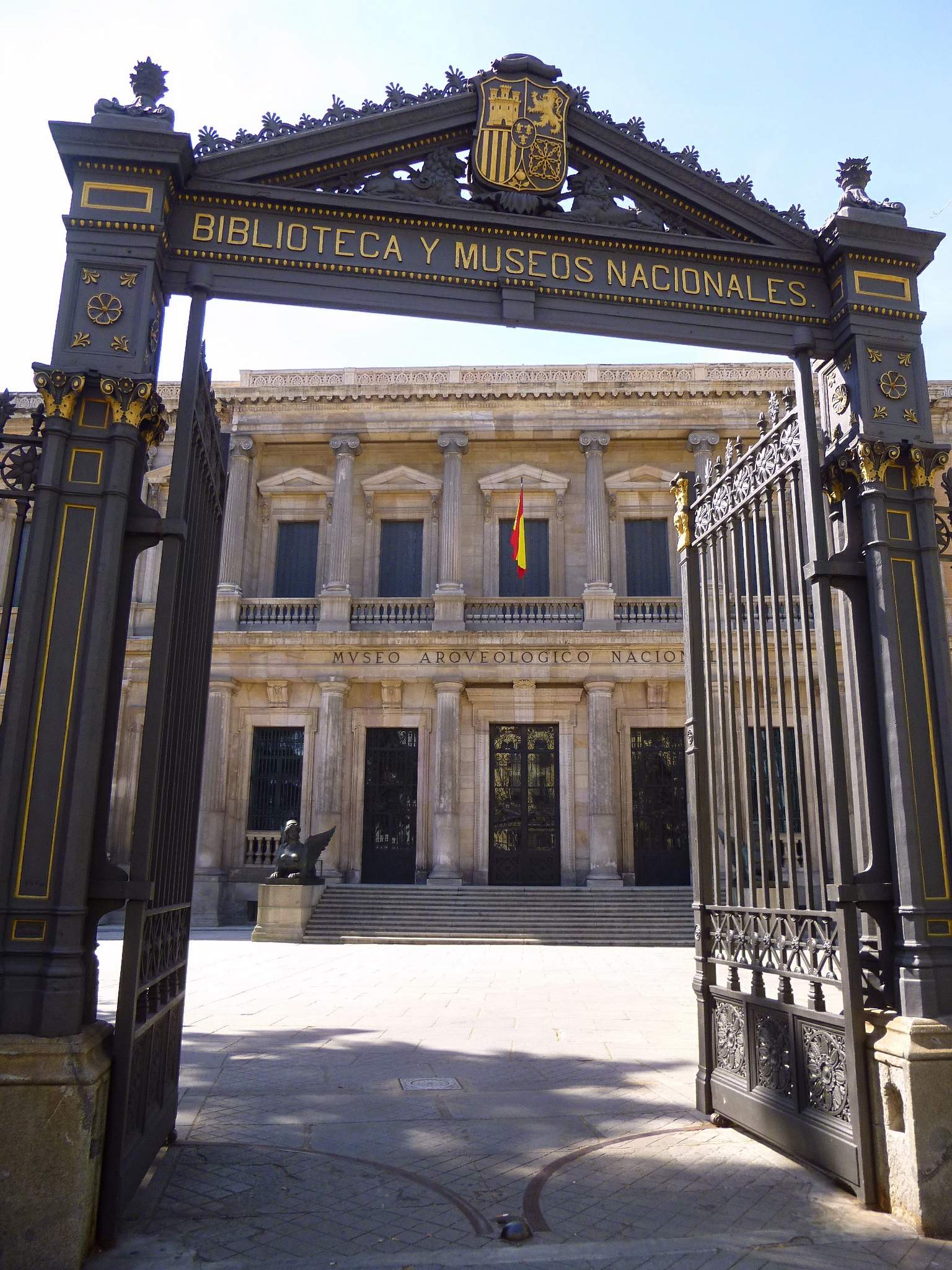
The museum was created by royal decree of Isabella II on 20 March 1867, as a repository for the numismatic, archaeological, ethnographic and decorative-art collections that had accumulated under the Spanish crown, not as a purpose-built archaeology museum in the modern sense. It occupied space in Madrid's Embajadores district before moving, in 1895, into the neoclassical building on Calle Serrano designed by the architect Francisco Jareno and built between 1866 and 1892 - a building it still shares with the National Library of Spain, the two institutions rising from the same royal decree and standing behind the same forecourt facing the Plaza de Colon.
The building was extended repeatedly through the twentieth century, work that had begun as far back as 1968, and none of it was resolved into a single coherent renovation until the twenty-first. In 2008 the museum closed its doors entirely and did not reopen until April 2014, six years in which Spain's national archaeological collection was largely inaccessible to the public - a closure long enough, and costly enough, to draw its own criticism at the time, whatever the eventual quality of the result.
The Lady of Elche: found, sold, exchanged, disputed
On 4 August 1897 a limestone bust was found at La Alcudia, near Elche, in circumstances still argued over locally: the popular account credits Manuel Campello Esclapez, though the town's own record-keeper at the time named a different finder, Antonio Macia. Within weeks the French archaeologist Pierre Paris had alerted the Louvre, which bought the piece for 4,000 francs over local objection and shipped it to Paris on 30 August 1897. It stayed there for more than forty years, moved to a chateau near Toulouse for safekeeping during the Second World War, before Franco's government negotiated its return in 1941 through an exchange that sent Murillo, Velazquez and El Greco paintings to France in the other direction. The bust was administered by the Prado until 1971, when it transferred to this museum.
Its authenticity has been formally challenged twice: first by the archaeologist Jose Ramon Melida in 1906, and far more seriously in 1995, when the art historian John F. Moffitt published a full-length study arguing the piece was a nineteenth-century forgery made by Francisco Pallas y Puig to impress Pierre Paris and enrich the landowner who commissioned it. Spanish archaeologists rejected the theory, and subsequent pigment analysis by Spain's CSIC in 2005 and residue analysis in 2011, which found human cremated bone inside the bust consistent with ancient funerary use, are cited against it. The dispute has not fully closed off the object's identity in the way a museum label suggests: what is now settled is that it is ancient, not that every reading of it is agreed.
A standing demand: Elche wants her back
Separately from the authenticity question, there is an active, current political campaign for the bust's return to the city where it was found. Elche's city council under mayor Pablo Ruz pressed the Ministry of Culture for a temporary loan in 2023 and was refused; by October 2024 the Generalitat Valenciana's president, Carlos Mazon, had raised the Lady's return directly with the Spanish prime minister as one of more than fifty regional requests, and a joint technical commission between the state, the region and Elche's own council was proposed to study it. As of August 2025 the Ministry of Culture, under minister Ernest Urtasun, maintains its refusal on stated conservation grounds - the risks of moving a fragile, singular object - a position Elche's officials read as political rather than purely technical, not least because a five-month loan of the bust to Elche in 2006 drew more than 380,000 visitors and demonstrated exactly the tourism case the city keeps making.
This is not a settled matter the museum's own visitor pages address. A reader who wants the fuller picture of what is, in effect, a live repatriation argument over the museum's single most famous object has to look outside the institution for it, in exactly the way this page tries to close.
Re-checked on 26 August 2026: the bust remains on display in the museum's Iberian collection, and a fresh institutional source dated 4 August 2026 - Elche's own 129th-anniversary coverage of the discovery - confirms the Ministry of Culture's technical experts still cite the same conservation risk in declining any transfer. Nothing about the underlying dispute has moved since the August 2025 sources used for the rest of this section.
What the Elche bust can obscure
The scale of the Lady of Elche's fame works against the rest of the collection getting its due. The Lady of Baza, found in 1971 and less contested, still carries original paint and is argued by specialists to corroborate the Elche bust's authenticity precisely by being a second example of the same tradition rather than a lone, suspicious object. The Bicha de Balazote, a bull-bodied guardian figure from Albacete, extends the same Iberian sculptural tradition into hybrid animal form. None of the three would individually justify a special trip in most visitors' planning, and together they make the museum's Iberian holding one of the strongest anywhere for the period - a case the institution's own signage, organised object by object rather than argued as a group, does not always make explicitly.
Beyond Iberia: a royal collection's wider remit
Because the museum's 1867 founding decree covered the crown's holdings broadly rather than Spanish archaeology narrowly, its galleries run past the Iberian material into Roman, Greek, Etruscan, Egyptian and Near Eastern antiquities, a range some outside reviewers rate among the strongest such holdings in Europe for a museum of this size. The Visigothic Treasure of Guarrazar, discovered near Toledo in the 1850s and including the gold Crown of Recceswinth, and the museum's medieval galleries covering both al-Andalus and Christian Iberia, carry the collection from the fall of Rome through to the reconquest. A Numismatic Cabinet, drawn from the same founding decree, sits apart from the main chronological run and is easy for a visitor moving toward the headline Iberian sculptures to miss entirely.
What visitors say
We publish no visitor review prose and cite no invented consensus. TripAdvisor's own aggregate for the attraction, read on the date below, put it at 4.7 of 5 from 4,290 ratings, ranked 15th of 1,594 things to do in Madrid. What recurs in outside coverage is less about the museum's presentation, which is consistently well regarded since the 2014 reopening, and more about the unresolved question of where its single most famous object should be kept.
What is praised, what is criticised
- Praised: the depth and staging of the post-2014 renovation, widely described as transforming a dated museum into a modern one
- Praised: the low admission price relative to the scale and quality of the collection, and the extensive list of free-admission conditions
- Praised: the Altamira cave replica as an introduction, and the range of the Iberian, Visigothic and Islamic-period material
- Criticised: the museum closed for renovation in 2008 and did not reopen until April 2014, a six-year closure of Spain's national archaeology collection that drew criticism at the time for its length and cost
- Criticised: Elche's city council and the Generalitat Valenciana have pressed the Spanish Ministry of Culture since at least 2023 to return the Lady of Elche to the city where it was found, at least temporarily; as of the Ministry's stated 2025 position it continues to refuse, citing conservation risk in transport, which local officials characterise as a political rather than technical objection
- Criticised: the Lady of Elche's own authenticity was seriously disputed in a full-length 1995 study arguing it was a nineteenth-century forgery, a claim scientific analysis has since weighed against but which the museum's own displays address only briefly
Ratings on other platforms
TripAdvisor: 4.7 from 4,290 ratings, read 7 August 2026
A platform average is a tertiary source: it moves, it is not audited, and we quote no visitor's words.
Questions about Museo Arqueologico Nacional
Where is Museo Arqueologico Nacional?
Calle de Serrano, 13, 28001 Madrid, Spain.
How much does it cost to visit?
General: EUR 3; Reduced: EUR 1.5; Under 18 and over 65: free; Students 18-25, unemployed, pensioners, large families, teachers, disability cardholders, official guides, journalists, ICOM and museum-association members: free. As confirmed 26 August 2026.
When is it open?
Tuesday-Saturday 09:30-20:00; Sunday and public holidays 09:30-15:00; Monday closed. Closed: 1 and 6 January, 1 May, 24, 25 and 31 December. The museum's own hours page warns that not every gallery can be guaranteed open at every advertised hour, for internal organisational reasons. As confirmed 26 August 2026.
How do you get there?
Metro: Serrano and Retiro (L4 and L2), both a short walk from the Calle Serrano entrance; On foot: Beside the Plaza de Colon, sharing its building and forecourt with the National Library of Spain.
What should you see first?
The Lady of Elche (Iberian, 4th century BC); The Lady of Baza (Iberian, 4th century BC); The Bicha de Balazote (Iberian, late 6th to early 5th century BC); The Treasure of Guarrazar (Visigothic goldsmiths, 7th century); The Cave of Altamira replica (Reconstruction of a Palaeolithic painted ceiling); The Greek vase collection (Ancient Greek workshops, various dates).
What we could not confirm
- Whether the Ministry of Culture's technical commission on the Lady of Elche's return, proposed in October 2024, has produced any binding outcome; sources as recent as 4 August 2026 still describe the Ministry's position as refusal on conservation grounds, unchanged from August 2025.
- Whether the identities of the Lady of Elche's 1897 finder (Manuel Campello Esclapez in the popular account, Antonio Macia in the contemporary record-keeper's account) have ever been reconciled.
- What the museum's own accessibility, photography and bag-policy pages say; this research did not reach them and the visit fields on this page mark those gaps rather than guess.
Images
Sources
- 1Museo Arqueologico Nacional (Ministerio de Cultura), Horarios: full opening hours, closed dates, 2026 holiday schedule, ticket-office and room-clearance timing. Read in the in-app browser, 7 August 2026. man.es/man/visita/horarios.html
- 2Museo Arqueologico Nacional (Ministerio de Cultura), Tarifas: every admission tier, free-admission conditions and accreditation requirements. Read in the in-app browser, 7 August 2026. man.es/man/visita/tarifas.html
- 5Wikipedia, National Archaeological Museum, Madrid: founding decree of 1867, architect Francisco Jareno, the 1895 move, the 2008-2014 renovation closure, and 2019 visitor figures. en.wikipedia.org/wiki/National_Archaeological_Museum,_Madrid
- 7Wikidata, National Museum of Archaeology (Q1352282): coordinates, country, inception date and official website, used as the and cross-checked against the museum's own address. wikidata.org/wiki/Q1352282
- 8TripAdvisor, National Archaeological Museum attraction page: the museum's own descriptive text, opening hours as listed, and the aggregate rating of 4.7 from 4,290 reviews. Read in the in-app browser, 7 August 2026. tripadvisor.com/Attraction_Review-g187514-d244277-Reviews-National_Archaeological_Museum-Madrid.html
- 9Wikipedia, Lady of Elche: the 1897 discovery, the sale to the Louvre, the 1941 exchange and return, the 1906 and 1995 authenticity challenges, the 2005 CSIC pigment study and 2011 residue analysis, and the 2006 temporary loan to Elche. en.wikipedia.org/wiki/Lady_of_Elche
- 10El Debate, 'Dama de Elche: la ciudad aspira al retorno de su icono de forma permanente 128 anos despues', 14 August 2025: the return campaign, mayor Pablo Ruz's position, Generalitat president Carlos Mazon raising the case with the prime minister in October 2024, the Ministry of Culture's continued refusal under minister Ernest Urtasun, and the 2006 loan's 380,000 visitors in five months. eldebate.com/espana/comunidad-valenciana/20250814/dama-elche-ciudad-aspira-retorno-icono-forma-permanente-128anosdespues_325355.html
- 11Museum-guide and press coverage of the permanent collection, cross-checked across sources, for the Lady of Baza (found 1971, Baza, Granada), the Bicha de Balazote, and the Treasure of Guarrazar including the Crown of Recceswinth. guiadelocio.com/a-fondo/10-imprescindibles-del-museo-arqueologico-nacional
- 12Wikimedia Commons, search results for 'Museo Arqueologico Nacional' Madrid: the plates on this page, each from .LicenseShortName and each image downloaded and inspected before use. commons.wikimedia.org/w/index.php?search=intitle%3A%22Museo+Arqueol%C3%B3gico+Nacional%22+Madrid&title=Special:MediaSearch&type=image
- 13Museo Arqueologico Nacional (Ministerio de Cultura), Horarios: re-read to reconfirm opening hours, closed dates and the 2026 holiday schedule, including the Good Friday extraordinary-opening exception. Read in the in-app browser, 26 August 2026. man.es/man/visita/horarios.html
- 14Museo Arqueologico Nacional (Ministerio de Cultura), Tarifas: re-read to reconfirm admission tiers and free-admission conditions, unchanged from the 7 August 2026 research. Read in the in-app browser, 26 August 2026. man.es/man/visita/tarifas.html
- 15Museo Arqueologico Nacional (Ministerio de Cultura), Normas: the museum's own visitor rules, covering photography (no flash or tripod), bag policy (no bags over 40x40cm, no motorcycle helmets, cloakroom available), food and drink, and touching objects. Read in the in-app browser, 26 August 2026. man.es/man/visita/normas.html
- 16Museo Arqueologico Nacional (Ministerio de Cultura), Accesos: address, phone and public-transport access, cross-checked against the existing record. Read in the in-app browser, 26 August 2026. man.es/man/visita/accesos.html
- 17Museo Arqueologico Nacional (Ministerio de Cultura), catalogue page for the Dama de Baza: confirms the piece remains part of the on-display Protohistory catalogue. Read in the in-app browser, 26 August 2026. man.es/man/coleccion/catalogo-cronologico/protohistoria/dama-baza.html
- 18Museo Arqueologico Nacional (Ministerio de Cultura), catalogue page for the Tesoro de Guarrazar: confirms the treasure remains part of the on-display Mundo Medieval catalogue, and that it is today split across three collections (this museum, the Royal Palace Madrid, and the Musee National du Moyen Age, Paris). Read in the in-app browser, 26 August 2026. man.es/man/coleccion/catalogo-cronologico/edad-media/guarrazar.html
- 19TeleElx, 'El hallazgo de la Dama de Elche cumple 129 anos con la reivindicacion de su regreso', 4 August 2026: confirms the Lady of Elche remains on display in the museum's Iberian collection and that the Ministry of Culture's technical experts still maintain the same conservation-risk objection to any transfer. Read in the in-app browser, 26 August 2026. teleelx.es/2026/08/04/el-hallazgo-de-la-dama-de-elche-cumple-129-anos-con-la-reivindicacion-de-su-regreso/