Third Imperial Easter Egg
House of Faberge, Saint Petersburg · 1886-1887, delivered for Orthodox Easter 1887
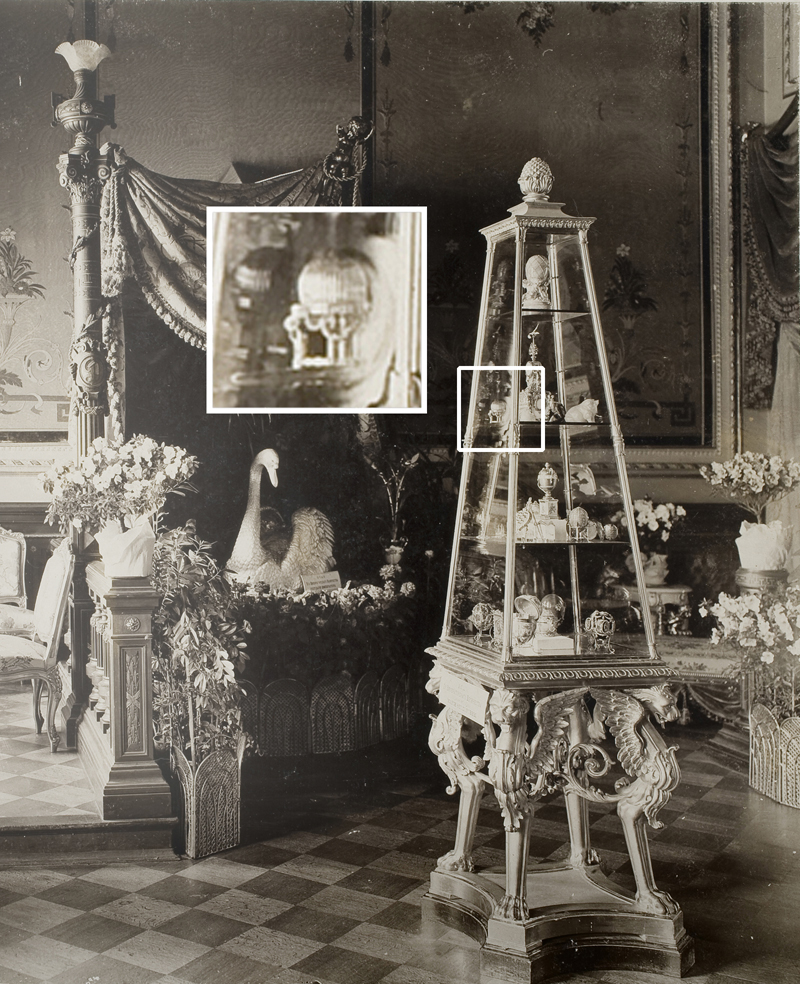
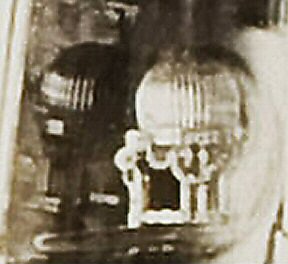
The record subject. Enlarged from the group photograph taken at the von Dervis mansion exhibition, Saint Petersburg, March 1902 - the only known image of the egg between its delivery in 1887 and the 1964 auction catalogue, and the photograph against which it was identified in 2011. Public domain.
| Workshop | House of Faberge, Saint Petersburg |
|---|---|
| Date | 1886-1887, delivered for Orthodox Easter 1887 |
| Medium | Gold, cabochon sapphires, old-mine and rose-cut diamonds; the surprise is a lady's watch in gold and white enamel by Vacheron and Constantin |
| Dimensions | 8.2 cm high; given as 3 1/4 inches in the 1964 Parke-Bernet catalogue |
| Where it is now | Private collection, owner not named |
| Attribution | AcceptedAccepted as the Third Imperial Easter Egg of 1887 by Wartski, by the Faberge Research Site, and by the Victoria and Albert Museum, which displayed it in 2021-22 as by Faberge, workmaster August Holmstrom. Full note |
| Object type | Goldsmith's work |
| Period | Historicism, 1830-1900 |
| Cases | Seized, looted or confiscated · Has a provenance gap · Rediscovered |
| Culture | Russian |
| Genre | non-figural ornament |
| Inscriptions | No Faberge name mark, workmaster initials or Russian assay mark is recorded in the sources consulted. The watch is signed by Vacheron and Constantin, which in 1964 was the only name the cataloguer could find on the object and which in 2012 was the only name its owner could find on it either. |
| Owners on record | 9 links5 documented, 2 disputed, 2 unknown |
| Sources | 18 cited |
About this record Last verified 30 August 2026 · 18 sources cited · Change log
On this page 11 sections
ContentsClose
A gold Easter egg 8.2 centimetres high, delivered by the House of Faberge to Tsar Alexander III for 2,160 roubles and given to Empress Maria Feodorovna at Easter 1887. It opens to a lady's watch by Vacheron and Constantin. It was photographed once, in a vitrine at the von Dervis mansion in Saint Petersburg in March 1902, and then vanished into the Soviet liquidation of the Romanov treasure.
It surfaced in New York in March 1964 as lot 259 at Parke-Bernet, catalogued as a gold watch in an egg-form case, with no mention of Faberge and no mention of the Russian imperial family, and sold for 2,450 US dollars. Four decades later a scrap metal dealer in the American Midwest bought it at an antiques stall for its melt value, could not find anyone willing to buy the gold at his price, and kept it at home for years. In 2012 he searched the internet for the two words he could read on it, egg and Vacheron Constantin, and found a newspaper article about a lost Faberge egg.
The identification is secure and heavily documented. The money is not. The 1964 price of 2,450 dollars is a matter of public record; the sum the dealer paid is given variously as 13,000, 13,302 and 14,000 dollars; and the figure of about 33 million dollars attached to the 2014 sale is a press estimate of a private transaction that Wartski has never confirmed. This record separates the three.
Provenance
Each link is graded. Documented: a cited source supports it. Disputed: the identification is argued but not established. Unknown: no owner for that span, and the gap is not smoothed into a narrative. The grades in the glossary.
- 1887 - 1917Empress Maria Feodorovnadocumented
Delivered by the House of Faberge for Orthodox Easter 1887 and given by Alexander III to his wife. The Imperial Cabinet account books record the payment of 2,160 roubles on 18 May 1887 for an Easter egg with clock, decorated with diamonds, sapphires and rose-cut diamonds. Kept at the Anichkov Palace, Saint Petersburg. Publicly exhibited once, at the von Dervis mansion, Saint Petersburg, in March 1902.12317
- 1917 - 1922Soviet state, Moscow Kremlin Armourydocumented
Removed from the Anichkov Palace after September 1917 and inventoried at the Kremlin Armoury as Article 1548: a lady's gold watch, opened and set into a gold egg with one diamond, the latter on a gold tripod pedestal with three sapphires. The entry names no maker.13
- 1922 - 1922Ivan Gavrilovich Chinariov, Special Plenipotentiarydocumented
Handed over in February or March 1922 with the description one gold egg with watch, diamond push-piece and pedestal with three sapphires and rose-cut diamonds. In May 1924 the egg was among eighteen valued for sale, recorded in the Goznak archive. This is the last Russian record of the object.1
- 1922 - 1964Unknownunknown
No owner, dealer or transaction is documented for approximately forty-two years. Fourteen Imperial eggs were sold out of Russia between 1930 and 1933, chiefly through Armand Hammer and Emanuel Snowman of Wartski, and Kieran McCarthy has suggested Hammer as the likeliest route by which this egg reached the United States. That is an inference. No document has been produced linking Hammer, or any other named dealer, to this object.4615
- by 1964 - 1964Mrs Rena Clark, New Yorkdisputed
The property in which lot 259 was offered is attributed to Mrs Rena Clark of New York. Sources vary between Clark and Clarke, and between a sale by her and a sale by her estate. How or when she acquired the egg is unrecorded, and there is no evidence she knew what it was.12
- 1964 - early 2000sUnidentified private buyer, described as a Southern ladyunknown
Bought at Parke-Bernet, New York, on 7 March 1964 for 2,450 US dollars, as an unattributed gold watch in an egg-form case. The buyer has never been named. She is reported to have died in the early 2000s, after which her estate was dispersed and the egg reached an antiques stall in the American Midwest, still unidentified.145
- c. 2004 - 2014Unnamed scrap metal dealer, American Midwestdisputed
Bought at a Midwestern antiques or bric-a-brac stall for its precious metal content, with the intention of reselling it to be melted. The price is variously given as 13,000, 13,302 and 14,000 US dollars, and the year as around 2004 or later. Prospective buyers assayed the metal, judged that he had overpaid, and declined to buy; he refused to sell at a loss and kept the egg at home for several years. In 2012 he searched online for the words egg and Vacheron Constantin, found the Daily Telegraph article of 13 August 2011 by Roya Nikkhah, and contacted Kieran McCarthy of Wartski, who travelled to the Midwest and confirmed the identification in person.345716
- 2014 - 2014Wartski, Londondocumented
Wartski bought the egg from the finder and sold it on by private treaty to a collector. Neither price was disclosed. Wartski announced the discovery in March 2014 and exhibited the egg at 14 Grafton Street, London, from 14 to 17 April 2014, admission free, its first public showing in one hundred and twelve years.1356
- 2014 - presentPrivate collection, owner not nameddocumented
Acquired through Wartski in 2014 for an undisclosed sum. Reported figures of about 33 million US dollars and about 20 million pounds are press and market estimates of a private transaction, not confirmed prices. The owner lent the egg to the Victoria and Albert Museum for Faberge in London: Romance to Revolution, 20 November 2021 to 8 May 2022, where it was labelled as by Faberge, workmaster August Holmstrom. No later public display is recorded in the sources consulted.379
Prices realised
| Date | Sale | Estimate | Result | Note |
|---|---|---|---|---|
| 7 March 1964 | Parke-Bernet Galleries, New York | Not recorded in the sources consulted | Hammer USD 2,450 With premium Not separately recorded USD | Lot 259, in the sale of the property of Mrs Rena Clark, held at Parke-Bernet on Madison Avenue over 6-7 March 1964; the egg sold on 7 March. Catalogued as Gold Watch in Egg-Form Case on Wrought Three-Tone Gold Stand, Set with Jewels, with the only maker named being Vacheron and Constantin. Neither Faberge nor the Russian imperial provenance was identified. The description was physically accurate down to the ring stretcher and the seventy-five point old-mine diamond, and it is that accuracy that made the object identifiable in 2011. Reported at the time as 875 pounds sterling, consistent with the fixed rate of about 2.80 dollars to the pound then in force. No source consulted distinguishes hammer from premium; the single figure is reported as the price paid. |
| 2014 | Wartski, London - private treaty sale, not an auction | USD 33 m and GBP 20 m have both circulated as estimates | Hammer Not applicable With premium Not applicable Not disclosed | Recorded here only to stop the widely repeated figure being read as an auction result. Wartski bought the egg from the finder and sold it on to a collector; neither transaction price was disclosed by any party. The figure of about 33 million US dollars derives from press reporting, principally CNN in 2015. The figure of about 20 million pounds originates in the Daily Telegraph headline of 13 August 2011, written before anyone knew the egg had survived, and recurs as a market estimate of the sale. There is no public record, no auction house, no hammer and no premium. This is a reported figure and should be cited as one. |
Hammer is the price at which the bidding stopped; with premium adds the fee the house charges the buyer on top. Hammer price and buyer's premium in the glossary.
Technical evidence
| Attribution note | Accepted as the Third Imperial Easter Egg of 1887 by Wartski, by the Faberge Research Site, and by the Victoria and Albert Museum, which displayed it in 2021-22 as by Faberge, workmaster August Holmstrom. The attribution does not rest on a mark. No Faberge or workmaster stamp is recorded on the egg or its stand in the sources consulted, and the 1964 auction cataloguer found only the signature of Vacheron and Constantin on the watch. It rests instead on a four-part documentary match: the March 1902 von Dervis exhibition photograph, the Imperial Cabinet payment entry of 1887, the 1922 Soviet inventory description, and the photograph in the 1964 Parke-Bernet catalogue. The specific ascription to Holmstrom's workshop is weaker than the identification of the object itself and is treated here as an open question. |
|---|---|
| Form and height | Reeded gold egg on a three-legged gold stand. 8.2 cm overall; measured as 3 1/4 inches by the 1964 Parke-Bernet cataloguer.124 |
| Egg case | Reeded, ridged gold. The 1964 catalogue specifies fourteen-karat gold for the watch case. Some later accounts describe the egg as solid eighteen-karat gold. The two readings conflict and this record does not resolve them.34 |
| Clasp | A seventy-five point old-mine diamond set into the front of the egg, functioning as the push-piece that releases the lid.34 |
| Surprise | A lady's watch by Vacheron and Constantin, with a white enamel dial and openwork gold hands set with diamonds, hinged so that it stands upright when the case is opened.127 |
| Stand | Eighteen-karat three-colour gold tripod. An annulus bordered with wave scrolling, carried on paired corbel-like legs terminating in chased lion paw feet joined by a ring stretcher.14 |
| Gem-set garlands | Three medallions of cabochon blue sapphire on the annulus, each surmounted by a bow of rose-cut diamonds, from which hang swags of roses and leaves worked in three tones of gold. One diamond bow is now missing.14 |
| Marks | No Faberge name mark, workmaster initials or Russian assay mark is recorded in the sources consulted. Mieks Faberge Eggs states the egg bears no maker's marks, as with the first Imperial egg of 1885. The only signature on the object is that of Vacheron and Constantin on the watch.24 |
| Condition | Surface scratches from assay testing, made in the 2000s by prospective scrap buyers sampling the metal to check its gold content. Wartski and others regard these as part of the object's documented history rather than as damage affecting value.4 |
| Original cost | 2,160 roubles, paid by the Imperial Cabinet to Faberge and entered in the account books on 18 May 1887 as an Easter egg with clock, decorated with diamonds, sapphires and rose-cut diamonds.1317 |
| Basis of identification | Four documents, not a mark: the March 1902 von Dervis exhibition photograph; the 1887 Imperial Cabinet payment entry; the 1922 Soviet inventory entry Article 1548; and the photograph and description in the 1964 Parke-Bernet catalogue. Supported by the stylistic consistency of the reeded gold and three-colour swags with Faberge work of the mid-1880s.238 |
Images
The record in full
Chapter 1A watch that a tsar turned into an Easter egg
The object is small. It stands 8.2 centimetres high, which the 1964 auction cataloguer measured as 3 1/4 inches, and most of that height is stand rather than egg.
The object is small. It stands 8.2 centimetres high, which the 1964 auction cataloguer measured as 3 1/4 inches, and most of that height is stand rather than egg. The egg itself is a reeded gold case, ridged like a fluted column turned on its axis, with a large old-mine diamond of about seventy-five points set into the front as the clasp. Press the diamond and the case opens.
Inside is a lady's watch by Vacheron and Constantin, with a white enamel dial and openwork gold hands set with diamonds. The watch is hinged so that it stands upright once the case is open. That is the whole surprise. There is no automaton, no miniature carriage, no portrait train of the kind Faberge built into the later eggs. In 1887 the tradition was two years old and still modest.
The stand does the display work. It is a three-colour gold tripod: an annulus bordered with wave scrolling, carried on paired corbel-like legs that end in lion paws joined by a ring stretcher. Three cabochon sapphires sit in medallions on the annulus, each capped by a small bow of rose-cut diamonds, and from each bow hang swags of gold roses and leaves worked in three tones of gold. Wartski records that one of the diamond bows is now missing.
Chapter 2The gift, and what it cost
Alexander III began the tradition in 1885 with the Hen Egg, a plain white enamelled shell that opened to a gold yolk, a gold hen, a replica of the imperial crown and a ruby pendant.
Alexander III began the tradition in 1885 with the Hen Egg, a plain white enamelled shell that opened to a gold yolk, a gold hen, a replica of the imperial crown and a ruby pendant. Empress Maria Feodorovna, born Princess Dagmar of Denmark, was delighted by it, and the firm was granted the title of Supplier to the Imperial Court on 1 May 1885. From then until 1917 an egg was delivered every Easter, one a year under Alexander III and two a year under Nicholas II.
This is the third of them. The Imperial Cabinet account books record the payment on 18 May 1887: an Easter egg with clock, decorated with diamonds, sapphires and rose-cut diamonds, 2,160 roubles. That entry is the birth certificate of the object, and it is one of the four documents that eventually put a name back on it.
The egg went to the Empress at the Anichkov Palace in Saint Petersburg, where she kept her Faberge. It stayed with her for thirty years.
Chapter 3One photograph, taken in 1902
In March 1902, shortly before Easter, the Faberge holdings of the Dowager Empress Maria Feodorovna and of the Empress Alexandra Feodorovna were put on public view at the von Dervis mansion in Saint...
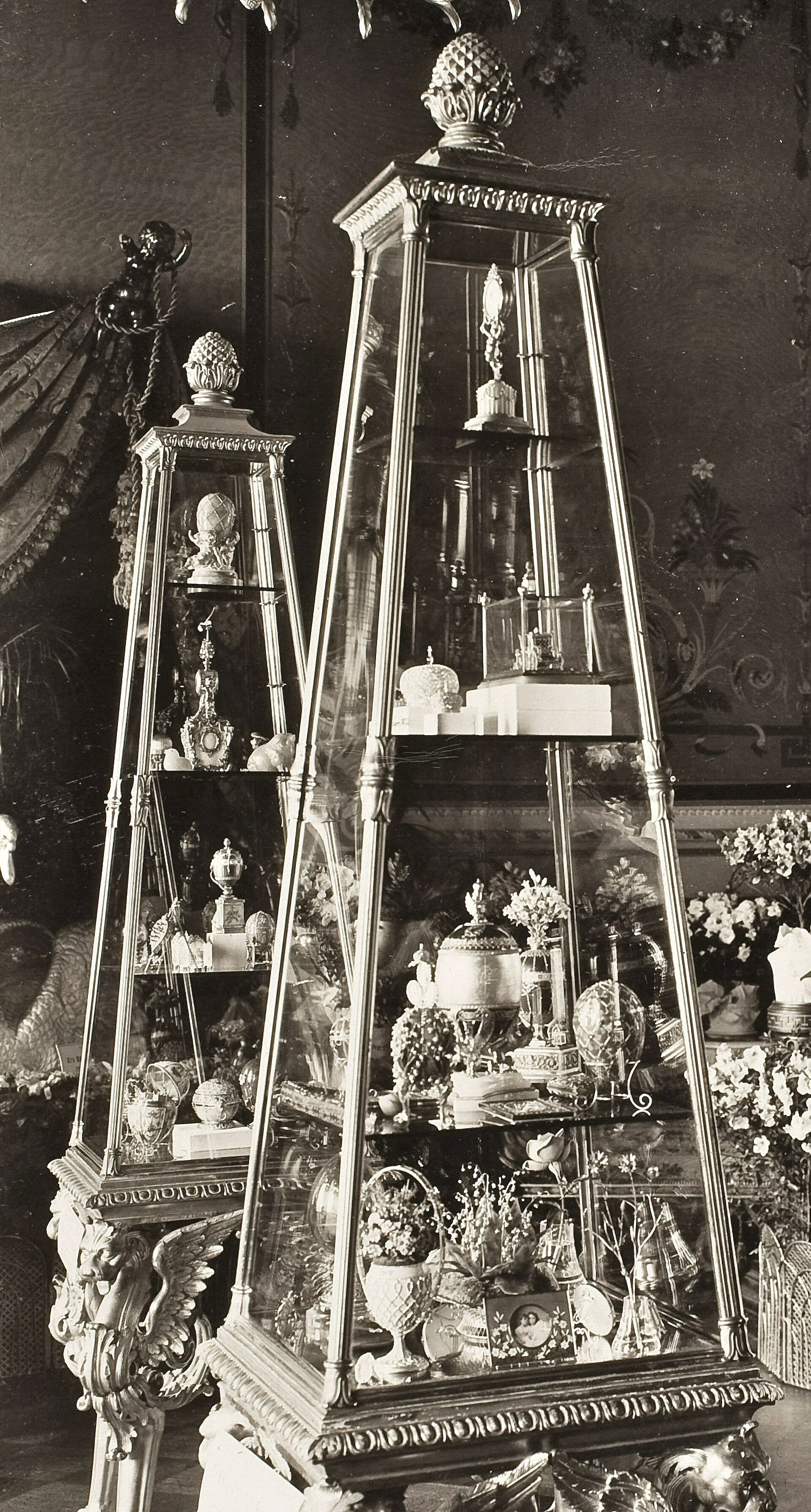
In March 1902, shortly before Easter, the Faberge holdings of the Dowager Empress Maria Feodorovna and of the Empress Alexandra Feodorovna were put on public view at the von Dervis mansion in Saint Petersburg. The eggs were arranged in glass vitrines and photographed, in at least one case by the Saint Petersburg photographer K. K. Bulla.
That photograph is the only image of this egg made between 1887 and 1964, and it is the reason the object could be recovered at all. Four of the eight eggs missing at the start of this century were known only from written descriptions, with no picture of any kind. This one had a picture, buried in a group shot of a shelf of eggs, and nobody knew which shape on the shelf it was until 2011.
After March 1902 the egg was not seen in public again under its own name for one hundred and twelve years.
Chapter 4How it left Russia
In September 1917 the contents of the Anichkov Palace were moved to the Moscow Kremlin Armoury.
In September 1917 the contents of the Anichkov Palace were moved to the Moscow Kremlin Armoury. The egg appears in the Soviet inventory as Article 1548, described without a maker's name: a lady's gold watch, opened and set into a gold egg with one diamond, the latter on a gold tripod pedestal with three sapphires. In February or March 1922 it was handed to Ivan Gavrilovich Chinariov, a Special Plenipotentiary, with a note reading one gold egg with watch, diamond push-piece and pedestal with three sapphires and rose-cut diamonds. In May 1924 it was among eighteen eggs valued for sale, a fact recorded in the Goznak archive.
Then the record stops. Between 1930 and 1933 fourteen Imperial eggs were sold out of Russia by Stalin's commissars, chiefly to the American dealer Armand Hammer and to Emanuel Snowman of Wartski in London. Kieran McCarthy of Wartski has suggested that Hammer is the likeliest route by which this egg reached the United States. That is a reasonable inference from Hammer's role and from where the egg turned up. It is not evidence, and no document has been produced connecting Hammer to this object.
There is a sharp irony in the two names. Wartski, which bought Romanov eggs from the Soviet government in the 1930s, is the firm that identified this one in 2014. Hammer, the other buyer, was later shown to have been given Faberge hallmarking tools by the Soviet trade authorities and to have stamped the firm's marks onto unsigned Russian objects for sale in his New York and Palm Beach galleries. The man most likely to have exported the egg is also one of the men most responsible for the fact that a Faberge mark proves nothing.
Chapter 5Lot 259
On 7 March 1964, at Parke-Bernet Galleries on Madison Avenue in New York, the egg came up as lot 259 in a sale of the chattels of Mrs Rena Clark.
On 7 March 1964, at Parke-Bernet Galleries on Madison Avenue in New York, the egg came up as lot 259 in a sale of the chattels of Mrs Rena Clark. The catalogue entry runs, with the accents stripped for this record:
Gold Watch in Egg-Form Case on Wrought Three-Tone Gold Stand, Set with Jewels. Fourteen-karat gold watch in reeded egg-shaped case with seventy-five point old-mine diamond clasp by Vacheron and Constantin; on eighteen-karat three-tone gold stand exquisitely wrought with an annulus, bordered with wave scrollings and pairs of corbel-like legs cisele with a capping of roses, pendants of tiny leaves depending to animalistic feet with ring stretcher; the annulus bears three medallions of cabochon sapphires surmounted by tiny bowknotted ribbons set with minute diamonds, which support very finely cisele three-tone gold swags of roses and leaves which continue downward and over the pairs of legs. Height 3 1/4 inches.
Read it again and notice what is not in it. There is no Faberge. There is no Russia, no Romanov, no imperial anything. The only maker named is the Swiss watch firm. The cataloguing is not lazy: it is minutely observed, correct in every physical particular, and it is exactly the description that made the object findable half a century later. What was missing was not the eye but the provenance.
It sold for 2,450 US dollars, reported at the time as 875 pounds sterling, a conversion consistent with the fixed rate of about 2.80 dollars to the pound then in force. That is the only price in this record that is a matter of public auction record.
Chapter 6Bought to be melted
The buyer at Parke-Bernet has never been named.
The buyer at Parke-Bernet has never been named. Accounts describe her as a Southern lady. She died in the early 2000s, her estate was dispersed, and the egg made its way to an antiques stall in the American Midwest, still carrying no attribution of any kind.
A scrap metal dealer bought it there. He was not buying an Easter egg; he was buying gold, sapphires and diamonds by weight, and he paid what he calculated the materials were worth. The prospective buyers he then approached tested the metal, decided he had overpaid, and would not take it at his price. He refused to sell at a loss. The egg went home with him and stayed on a kitchen counter for years. It still carries the scratches where those buyers scraped the surface to assay the gold.
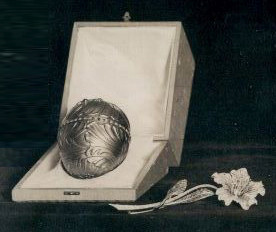
In 2012 he tried again, this time by searching the internet for the only two things he could read on the object: the word egg, and the name Vacheron Constantin. The search returned a Daily Telegraph article of 13 August 2011 by Roya Nikkhah, headlined Is this 20 million pound nest-egg on your mantelpiece?, which reproduced the 1964 auction photograph and quoted Kieran McCarthy of Wartski. He recognised his own object in the picture.
Chapter 7How it was identified
The identification was made in two stages, by researchers rather than by the trade, and it was made before anybody knew the egg still existed.The first stage was subtraction.
The identification was made in two stages, by researchers rather than by the trade, and it was made before anybody knew the egg still existed.
The first stage was subtraction. In November 2008 the independent researcher Annemiek Wintraecken argued that the Blue Serpent Clock Egg, then in the collection of the Prince of Monaco and assigned by most scholarship to 1887, in fact answered to the Faberge invoice of 1895. Removing it from the 1887 slot left that year empty and created a new missing egg, described in the archives but never pictured.
The second stage was matching. On 6 July 2011 the Faberge researchers Vincent and Anna Palmade found, in a catalogue for a 1964 Parke-Bernet sale, a photograph of an object that matched a shape in the 1902 von Dervis vitrine photograph. Their case rested on four legs: the visual match between the 1964 and 1902 photographs; the fit with the Imperial Cabinet account entry and the 1922 Soviet inventory; the stylistic consistency of the reeded gold and three-colour swags with Faberge work of the mid-1880s; and the chronological gap Wintraecken had opened three years earlier. That discovery is what produced the Telegraph article, and the Telegraph article is what the scrap dealer found.
McCarthy flew to the Midwest to see it. His account, given to the Telegraph and widely reproduced, is worth keeping as evidence of how a discovery of this kind actually happens: a modest house next to a highway and a Dunkin' Donuts, and the egg standing on the kitchen counter next to some cupcakes. The owner etched McCarthy's name and the date into the wooden bar stool the dealer had sat on to examine it.
Chapter 8What the price actually is
Four sums attach to this object and only two of them are established.Established.
Four sums attach to this object and only two of them are established.
Established. 2,160 roubles, paid by the Imperial Cabinet to Faberge in May 1887 and entered in the account books. 2,450 US dollars, the price at Parke-Bernet on 7 March 1964. No source consulted separates a hammer figure from a premium on the 1964 sale, and the single figure is reported as the price paid.
Disputed. What the scrap dealer paid. The figure is given as 14,000 dollars by the general press, as 13,302 dollars by the specialist Faberge literature, and as 13,000 dollars by CNN. The precision of 13,302 suggests a calculated melt value rather than a round negotiation, and it is the figure the Faberge Research Site carries. The year is also unsettled: accounts give around 2004, and others imply a purchase closer to 2011.
Reported, not established. The figure of about 33 million US dollars for the 2014 sale. This was a private treaty transaction arranged by Wartski, who bought the egg from the dealer and sold it on to a collector. The sum was not disclosed by either party. The 33 million figure comes from press reporting, principally CNN in 2015; the 2011 Telegraph article had used an estimate of 20 million pounds; the Faberge Research Site records market observers estimating around 20 million pounds for the sale itself. A private sale generates no public record, no auction result, and no third-party verification. It should not be cited as a price.
For scale against something that is a public record: the Rothschild Egg, a non-Imperial Faberge egg, sold at Christie's London on 28 November 2007 for about 8.9 million pounds including commission, then a record for any Faberge object, any Russian object and any timepiece at auction. And in 2004 Victor Vekselberg bought nine Imperial eggs together from the Forbes estate for a reported 100 million dollars, also a private transaction.
Chapter 9Where it is now, and what is still missing
Wartski exhibited the egg at 14 Grafton Street in Mayfair from 14 to 17 April 2014, free to the public, one hundred and twelve years after it was last shown.
Wartski exhibited the egg at 14 Grafton Street in Mayfair from 14 to 17 April 2014, free to the public, one hundred and twelve years after it was last shown. It then went to its buyer, who has not been named. In 2021 that owner lent it to the Victoria and Albert Museum for Faberge in London: Romance to Revolution, 20 November 2021 to 8 May 2022, where it was labelled as by Faberge, workmaster August Holmstrom. That is the only public appearance recorded since the Wartski show.
Faberge delivered fifty Imperial eggs before the revolution. Wartski's own count puts seven of them as still missing, of which only two are known to have survived the revolution at all. Other sources give six missing, and the counts drift because scholars disagree on whether a partially surviving egg or a surviving surprise counts as located. Before 2014 the missing number was eight.
The lesson of this object is not that treasure turns up at flea markets. It is that a correct, careful, detailed description is worthless without a name attached to it. Parke-Bernet described this egg accurately in 1964 down to the ring stretcher and the seventy-five point diamond, and sold it for the price of a used car, because nobody had written down whose it had been. The record, not the object, is what carries the value.
The artist
House of Faberge, Saint Petersburg, founded 1842 by Gustav Faberge, directed from 1872 by Peter Carl Faberge (1846-1920)
Faberge is the rare case of a maker whose name is more famous than any of his objects and less reliable than any of them. The firm was an industrial workshop of about five hundred craftsmen operating under a system of semi-independent workmasters, each of whom stamped his own initials alongside the firm's name. That system produced hundreds of thousands of objects, a hallmarking convention that is fully published and therefore fully forgeable, and a market in which the marks are the least trustworthy thing on a piece. The egg in this record carries no Faberge mark at all, and is one of the best-documented Faberge objects in existence. That is not a paradox. It is how Faberge authentication actually works.
Exhibited
- 2021-2022Faberge in London: Romance to RevolutionVictoria and Albert Museum, London
Related works
| Work | Relation | Where it is |
|---|---|---|
| Hen Egg (First Hen Egg) House of Faberge | The first Imperial egg, 1885, which began the series this object belongs to Given by Alexander III to Maria Feodorovna at Easter 1885. Like the Third Imperial Egg it carries no maker's marks. | Faberge Museum, Saint Petersburg |
| Blue Serpent Clock Egg House of Faberge | The egg wrongly assigned to 1887 for most of a century; its redating created the gap this object fills Annemiek Wintraecken argued in November 2008 that it answers to the Faberge invoice of 1895, not 1887. Removing it from the 1887 slot is what made the Third Imperial Egg a known missing object. | Palace of Monaco collection |
| Necessaire Egg House of Faberge | Still missing; the closest parallel case Delivered Easter 1889 to the same recipient. Sold by Wartski on 19 June 1952 for 1,250 pounds to an unidentified buyer and not seen since. One of only two of the missing eggs known to have survived the revolution. | Unlocated |
| Cherub with Chariot Egg House of Faberge | Still missing; known only from an archival photograph 1888, also for Maria Feodorovna. The 1902 von Dervis photographs are again the principal visual evidence. | Unlocated |
| Rothschild Egg House of Faberge | The market comparator that is a public record rather than a report Non-Imperial. Sold at Christie's London on 28 November 2007 for about 8.9 million pounds including commission, then a record for a Faberge object, a Russian object and a timepiece at auction. Bought by Alexander Ivanov and presented to the Hermitage by Vladimir Putin on 8 December 2014. | State Hermitage Museum, Saint Petersburg |
| Order of St George Egg House of Faberge | The only Imperial egg carried out of Russia by a Romanov 1916, Nicholas II to his mother. Maria Feodorovna took it with her when she left Crimea aboard HMS Marlborough in 1919, which is why it escaped both the Armoury and the Soviet sales. | Faberge Museum, Saint Petersburg |
Open questions
- Where was the egg between the Soviet transfer of 1922 and March 1964? No owner, dealer or transaction is documented for roughly forty-two years.
- Did Armand Hammer export it? Kieran McCarthy's suggestion is an inference from Hammer's role in the 1930-33 sales and from where the egg surfaced. No document connecting Hammer to this object has been produced.
- Who bought lot 259 in 1964? She is described only as a Southern lady who died in the early 2000s. Her name, and the route from her estate to a Midwestern antiques stall, are unrecorded.
- Is Mrs Rena Clark correctly identified as the 1964 consignor, and was the property sold by her or by her estate? Sources give Clark, Mrs Rena Clark and Rena Clarke, and differ on whether she was living.
- What did the scrap dealer pay, and when? The figure is given as 13,000, 13,302 and 14,000 US dollars, and the year as around 2004 or as late as 2011.
- What did the 2014 buyer pay? The sale was private and the sum undisclosed. The widely repeated figure of about 33 million US dollars is press estimation, not a transaction record.
- Is the egg case fourteen-karat gold, as the 1964 Parke-Bernet catalogue states, or eighteen-karat, as several later accounts have it?
- Is the Vacheron and Constantin movement the original of 1887? Mieks Faberge Eggs raises the possibility of a later replacement and records it as unconfirmed.
- On what evidence is August Holmstrom named as workmaster? The object appears to be unmarked, and the stylistic argument advanced at the time of identification cited Kollin's reeded gold and the three-colour swags of the Perchin transition rather than Holmstrom.
- How many Imperial eggs are now missing? Wartski says seven, of which two are known to have survived the revolution. Other counts give six. The discrepancy turns on whether partially surviving eggs and surviving surprises are counted as located.
Questions about this object
What is Third Imperial Easter Egg?
Third Imperial Easter Egg is a goldsmith's work, dated 1886-1887, delivered for Orthodox Easter 1887. Medium: Gold, cabochon sapphires, old-mine and rose-cut diamonds; the surprise is a lady's watch in gold and white enamel by Vacheron and Constantin.
Who made Third Imperial Easter Egg, and is the attribution settled?
The attribution to House of Faberge, Saint Petersburg is recorded here as accepted. Accepted as the Third Imperial Easter Egg of 1887 by Wartski, by the Faberge Research Site, and by the Victoria and Albert Museum, which displayed it in 2021-22 as by Faberge, workmaster August Holmstrom. The attribution does not rest on a mark. No Faberge or workmaster stamp is recorded on the egg or its stand in the sources consulted, and the 1964 auction cataloguer found only the signature of Vacheron and Constantin on the watch. It rests instead on a four-part documentary match: the March 1902 von Dervis exhibition photograph, the Imperial Cabinet payment entry of 1887, the 1922 Soviet inventory description, and the photograph in the 1964 Parke-Bernet catalogue. The specific ascription to Holmstrom's workshop is weaker than the identification of the object itself and is treated here as an open question.
Where is Third Imperial Easter Egg now?
Private collection, owner not named.
What has Third Imperial Easter Egg sold for?
Hammer USD 2,450; with premium, Not separately recorded. Parke-Bernet Galleries, New York, 1964-03-07.
What is still unknown about Third Imperial Easter Egg?
Where was the egg between the Soviet transfer of 1922 and March 1964? No owner, dealer or transaction is documented for roughly forty-two years.
Sources
- 1Wartski, London, 'The Third Imperial Easter Egg', the dealer's own account: dimensions, the Vacheron Constantin watch, the Imperial Cabinet payment of 2,160 roubles, the 1902 von Dervis exhibition, the 1917 and 1922 Soviet records, the 1964 Parke-Bernet sale and the 2014 exhibition. wartski.com/the-lost-third-imperial-easter-egg
- 2Mieks Faberge Eggs (Annemiek Wintraecken), '1887 Third Imperial Egg', the specialist research database: physical description, absence of maker's marks, the four-part Palmade identification, and the note that the watch movement may be a later replacement. wintraecken.nl/mieks/...
- 3Wikipedia, 'Third Imperial (Faberge egg)', consolidating the description, the Soviet inventory text, the 1964 catalogue extract, the 13,302 dollar purchase figure and the V&A loan. Tertiary. Flagged for replacement with the Wartski press documentation and Christel McCanless's Faberge Imperial Egg Chronology. en.wikipedia.org/wiki/...
- 4The History Blog, 'Scrap metal dealer finds lost Faberge Imperial Egg', 20 March 2014. Carries the Parke-Bernet lot 259 catalogue entry in full and quotes Kieran McCarthy's account as given to the Daily Telegraph, including the Indiana Jones remark, the Dunkin' Donuts detail and the bar stool. thehistoryblog.com/archives/...
- 5The Magazine Antiques, 'Lost imperial Easter Egg found': the 7 March 1964 sale date, the 14,000 dollar purchase figure, the Wartski exhibition dates and the count of missing eggs at the time of discovery. themagazineantiques.com/article/...
- 6Apollo Magazine, 'Easter Egg Hunt: The Third Imperial Faberge Easter Egg has resurfaced': the 20 million pound estimate, the exhibition, and Kieran McCarthy's Armand Hammer hypothesis and his view that at least two of the remaining missing eggs survive. apollo-magazine.com/easter-egg-hunt-third-imperial-faberg...
- 7Faberge Research Site (Christel Ludewig McCanless), 'Faberge Imperial Egg Chronology': the workmaster attribution to August Holmstrom, the 13,302 dollar purchase figure, and the record that market observers estimated the 2014 sale at around 20 million pounds. fabergeresearch.com/eggs-faberge-imperial-egg-chronology
- 8Faberge Research Site, 'Imperial Discoveries': Wintraecken's argument that a previously unrecognised 1887 egg must exist, the von Dervis photograph analysis, and the note recording the discovery of the March 1964 Parke-Bernet catalogue. fabergeresearch.com/eggs-recent-discoveries
- 9Victoria and Albert Museum, 'Faberge in London: Romance to Revolution', 20 November 2021 to 8 May 2022. Institutional confirmation of the loan and of the object label naming August Holmstrom as workmaster. vam.ac.uk/exhibitions/...
- 10Wartski, 'Where is the missing Faberge Necessaire Egg?': the count of fifty Imperial eggs delivered and seven now missing, of which only two are known to have survived the revolution; and the Necessaire Egg's 19 June 1952 sale for 1,250 pounds. wartski.com/a-new-clue-in-the-hunt-for-the-missing-faberg...
- 11Wikipedia, 'Fauxberge': the coining of the term by Geza von Habsburg in Art and Auction, 1994; the Armand Hammer hallmarking-tools account after Edward Jay Epstein's Dossier; the Soviet-era forgers; the two-stamp rule; and the 2021 Hermitage exhibition dispute. Tertiary. Flagged for replacement with von Habsburg's article and Epstein directly. en.wikipedia.org/wiki/...
- 12Faberge Research Site, 'Authentic': Peter L. Schaffer's rule that marks can be added and quality cannot, Geza von Habsburg on the American market, and the argument that published hallmarks cannot carry an authentication. fabergeresearch.com/authentic
- 13Wikipedia, 'Peter Carl Faberge': dates, Huguenot descent, training, the 1872 succession, the 1882 Pan-Russian Exhibition and the Niva notice, the 1 May 1885 court appointment, the 1918 flight and the 1920 death. Tertiary. Flagged for replacement with a scholarly biography. en.wikipedia.org/wiki/...
- 14Wikipedia, 'House of Faberge': the 1842 founding, the workmasters, the scale of the workforce and branches, the 1918 nationalisation and the later trademark history. Tertiary. Flagged for replacement with Lopato and von Habsburg, Faberge: Imperial Jeweller. en.wikipedia.org/wiki/...
- 15Wikipedia, 'Faberge egg': the totals for eggs made and surviving, the two undelivered 1917 eggs, and the account of the Kremlin Armoury, the Stalin-era sales of 1930-33 and the fourteen eggs sold to Armand Hammer and Emanuel Snowman. Tertiary, and its survival count conflicts with Wartski's; flagged for replacement. en.wikipedia.org/wiki/...
- 16Barnebys Magazine, 'Flea Market Faberge: The Third Imperial Egg': the 2004 purchase date and the 13,302 dollar figure, and the description of the 33 million dollar figure as an estimate of an undisclosed private sale. barnebys.com/blog/...
- 17Faberge Discoveries, '1887 Egg With Watch on Stand (MF)': the 2,160 rouble Imperial Cabinet price, the seventy-five point diamond and cabochon sapphire description, the 7 March 1964 sale date and the 2007 identification of the object in the von Dervis photograph. fabergediscoveries.com/1887-egg-with-watch-on-stand
- 18Wikipedia, 'Rothschild egg': the Christie's London sale of 28 November 2007 at about 8.9 million pounds including commission, the three auction records it set, the purchase by Alexander Ivanov and the 2014 presentation to the Hermitage. Tertiary, used only as a public-record price comparator; flagged for replacement with the Christie's sale result. en.wikipedia.org/wiki/...
Last verified 30 August 2026 · Published 2 August 2026
Change log
2 August 2026 - Record created at the house standard: researched narrative, technical evidence, maker dossier, graded provenance chain, prices with hammer and premium separated, related works, open questions and sources.
30 August 2026 - Re-verification pass. Fresh searches found no new sale, exhibition, litigation or ownership development since 2026-08-03; the anonymous 2014 buyer remains the last-recorded owner and the egg's whereabouts since the 2021-2022 Victoria and Albert loan are not publicly documented. One structural fix: the V&A loan (20 November 2021 to 8 May 2022, Faberge in London: Romance to Revolution) was already stated correctly in the narrative but missing from the structured exhibitions field - added. Source URLs re-checked; all still resolve.