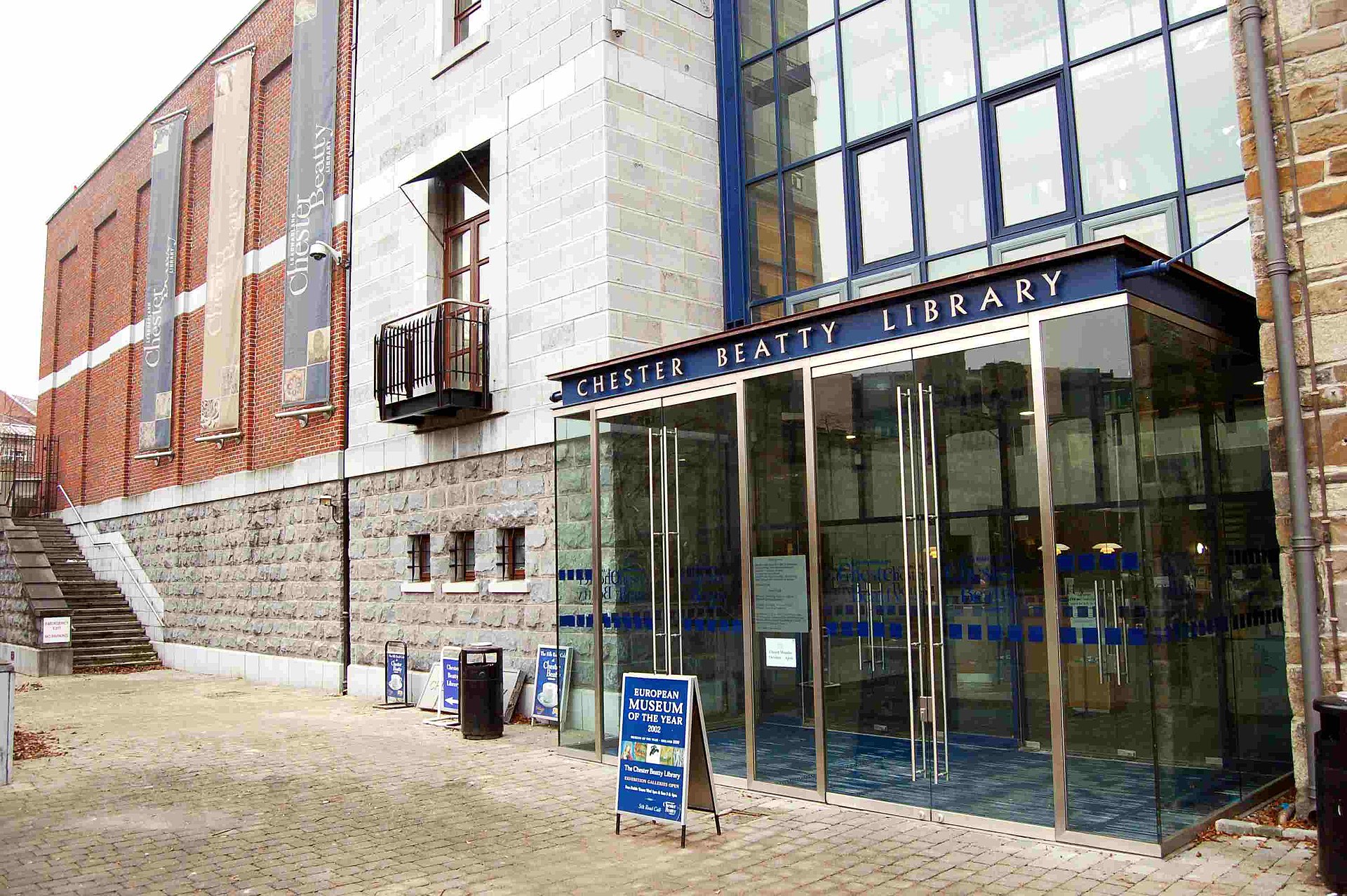
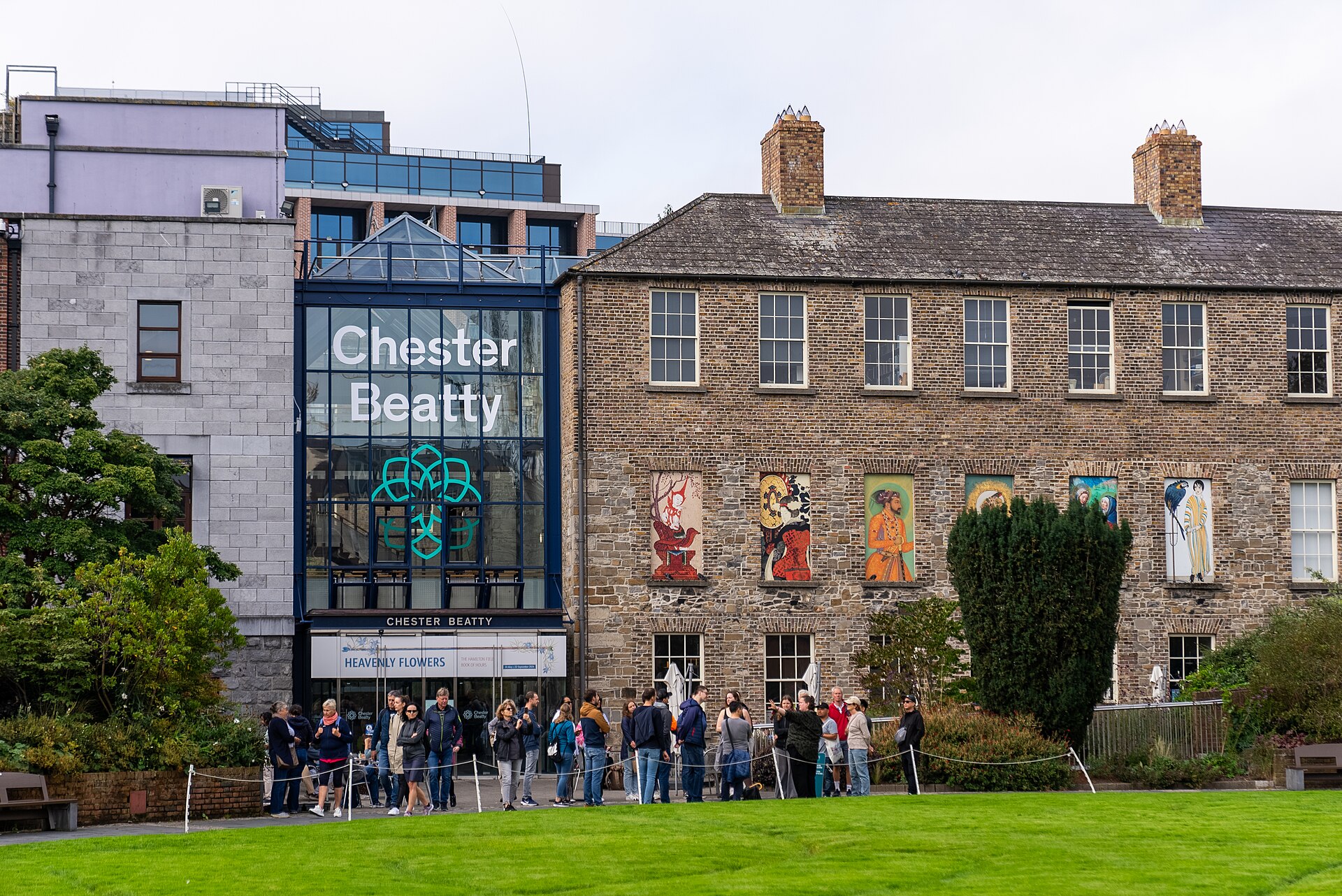
The museum's glazed entrance, lit sign reading Chester Beatty, set against the older stone range of Dublin Castle behind, with visitors queuing outside. Photograph by Derval O'Carroll, CC BY 4.0.
Chester Beatty Library is currently closed. Not open and not permanently closed. The museum's own visit and contact pages state plainly that Chester Beatty will be closed to the public from 15 June to the end of December 2026, and the live opening-times panel on those pages reads 'Closed today.' The closure lets Dublin Castle, where the museum is housed, serve as the operational base for Ireland's Presidency of the Council of the European Union. Named reporting places the wider Dublin Castle closure to state functions from 5 May 2026, with the Castle campus, including the Chester Beatty, closing to the public in full from 15 June once the presidency's own events intensify. Re-confirmed on the museum's own visit page on 17 September 2026: the same closure notice appears verbatim, unchanged since 13 August 2026 ('Chester Beatty will be closed to the public from 15 June to the end of December 2026'), and the live opening-times panel again reads 'Closed today.'
Expected to reopen: the end of December 2026 · a target, not yet confirmed
Closure confirmed from the institution's own page. We re-check this page on a schedule and will update it, from the institution's own announcement, the moment it reopens.
On this page 16 sectionsContentsClose
Over 25,000 objects, organised across four curatorial divisions - Early Printed Books, East Asian, Islamic and Western - and written in more than fifty languages spoken, or once spoken, across Asia, Africa and Europe, in scripts and media ranging from papyrus and parchment to paper, silk and jade. The range reflects Alfred Chester Beatty's own collecting rather than any single national school: Persian and European manuscripts from his earliest years as a young mining engineer, Islamic manuscripts and Egyptian papyri from journeys made after 1913, and Chinese and Japanese material, including snuff bottles, netsuke and jade books, added through the decades that followed. The collection's single most cited strength is its early Christian and biblical holdings, among them Papyrus 45 and Papyrus 46, but the same rooms hold one of the only Qur'ans attributed to the calligrapher Ibn al-Bawwab's own hand, Japanese picture-scrolls, and European printed books and bindings from the birth of the printing press onward. Access runs beyond the two permanent galleries through an active exhibitions programme, an online image database, international loans and Reading Room appointments for researchers.
Chester Beatty Library at a glance
Kind
Museum
Founded
1953, on Shrewsbury Road, Dublin; the present museum, in the Clock Tower Building at Dublin Castle, opened 7 February 2000
What it cost and when it was open, before the closureConfirmed 17 September 2026
Hours (pre-closure)
Tuesday to Friday09:45 to 17:30Pre-closure schedule, last published by the museum's own site in February 2025. Not bookable while the museum is closed for Ireland's EU Presidency (see open_status); kept here for a reader planning a visit after it reopens.
Wednesday09:45 to 20:00Late opening, overriding the general Tuesday-to-Friday hours on this one day. Pre-closure figure; not current while the museum is closed.
Saturday09:45 to 17:30Pre-closure figure; not current while the museum is closed.
Sunday12:00 to 17:30Pre-closure figure; not current while the museum is closed.
MondayClosed Mondays from November to February. The archived source does not separately state Monday hours for the rest of the year, so none are given here rather than guessed; this should be reconfirmed once normal opening resumes after the EU Presidency closure.
Closed
Entirely closed to the public from 15 June to the end of December 2026 for Ireland's Presidency of the Council of the European Union, based at Dublin Castle; the weekly hours above are the last regularly published schedule, not a current, bookable timetable. Closed Mondays from November to February in ordinary years. Closed 1 January, Good Friday, and 24 to 26 December in ordinary years.
Admission (pre-closure)
General admissionFreeFree every day the museum is open. The museum's own visit page does not charge an entry fee; it invites a suggested donation of EUR 10 instead.
Free entry: Every open day, since there is no entry charge to waive; the museum operates on free admission with a suggested EUR 10 donation rather than a ticketed model
Do I need to book?
No booking is needed for general entry, which is free. Free drop-in guided tours normally run Wednesday at 5.30pm, Saturday at 2pm and Sunday at 3pm, no booking required, for individual visitors, families and small groups of up to six; larger groups book separately as a Group Visit. All of this is suspended while the museum is closed for the EU Presidency.
On foot A two-minute walk from Dame Street via the Palace Street Gate of Dublin Castle; close to Christ Church Cathedral, reached via the Ship Street Gate LUAS Red Line to Jervis, or Green Line to Trinity or St Stephen's Green, then walk in through the Castle DART Tara Street station Bus Dublin Bus routes 27, 49, 54a, 56a, 77a, 123, 150 and 151, plus Dublin Bus Tours Car No onsite parking except for Disabled Person's Parking Permit or Card holders, who may drive into the Castle grounds via the Ship Street Gate; the nearest public car park is Christchurch Car Park Bike Bike stands just outside the entrance; a large Dublin Bikes station outside City Hall
Before you go how long, access, photography, bags, eating, shop
How long to allow
Not stated on the museum's own visit pages.
Access
A wheelchair and buggy-friendly building, with wheelchairs available free of charge; an accessible restroom for wheelchair users is on the ground floor, and many exhibits are set at a comparatively low height to help visitors who use wheelchairs. Dementia-friendly tours run on a regular basis, the lecture theatre has a hearing loop, and visitors with guide or service dogs are welcome. The most suitable entrance for visitors with reduced mobility is the Ship Street Gate of Dublin Castle, the closest gate to the museum; Disabled Person's Parking Permit or Card holders may drive into the Castle grounds through it.
Photography
Not addressed on the museum's own public visit pages. Unlike many museums, no general visitor photography policy for the galleries is published there; the site separately publishes Reader Photography Guidelines for researchers using the Reading Room.
Bags
Not stated on the museum's own visit pages.
Eating
The Silk Road Cafe, on the ground floor in the glazed concourse that links the historic Clock Tower Building to the exhibition wing.
Shop
A museum gift shop on site, plus an online shop.
The museum is closed (see above). These are the figures published before the closure, kept here for a visitor planning ahead rather than presented as bookable today, and you can check the current position at the source we used. We will re-confirm them once it reopens.
What is inside
5 spaces, 2 photographed
Sacred Traditions Gallery
The second-floor permanent gallery devoted to the sacred texts and rites of major world religions and belief systems, including biblical papyri, illuminated Qur'an manuscripts and Buddhist scrolls. Light-sensitive objects here are displayed for a maximum of two years before the whole rotation changes.
Arts of the Book Gallery
The first-floor permanent gallery, telling the story of how books have been made across cultures through almost 500 objects: illuminated manuscripts, bindings and prints from medieval and early modern Europe; calligraphy, narrative painting and mapping from the Middle East and South Asia; and Chinese jade books and Japanese picture-scrolls from East Asia.
Photograph by CharlieCLC · CC BY-SA 3.0
The Clock Tower Building
The restored eighteenth-century core of the museum, appearing on Roque's 1756 map of Dublin in nearly the U-shaped plan it still has. Its north facade and brick second storey were most likely added early in the nineteenth century by Ireland's leading architect of the day, Francis Johnston; the building fell derelict for over fifteen years before a 1990s restoration reinstated its wooden clock tower, chimneys and main staircase ahead of the museum's move here.
Photograph by CharlieCLC · CC BY-SA 3.0
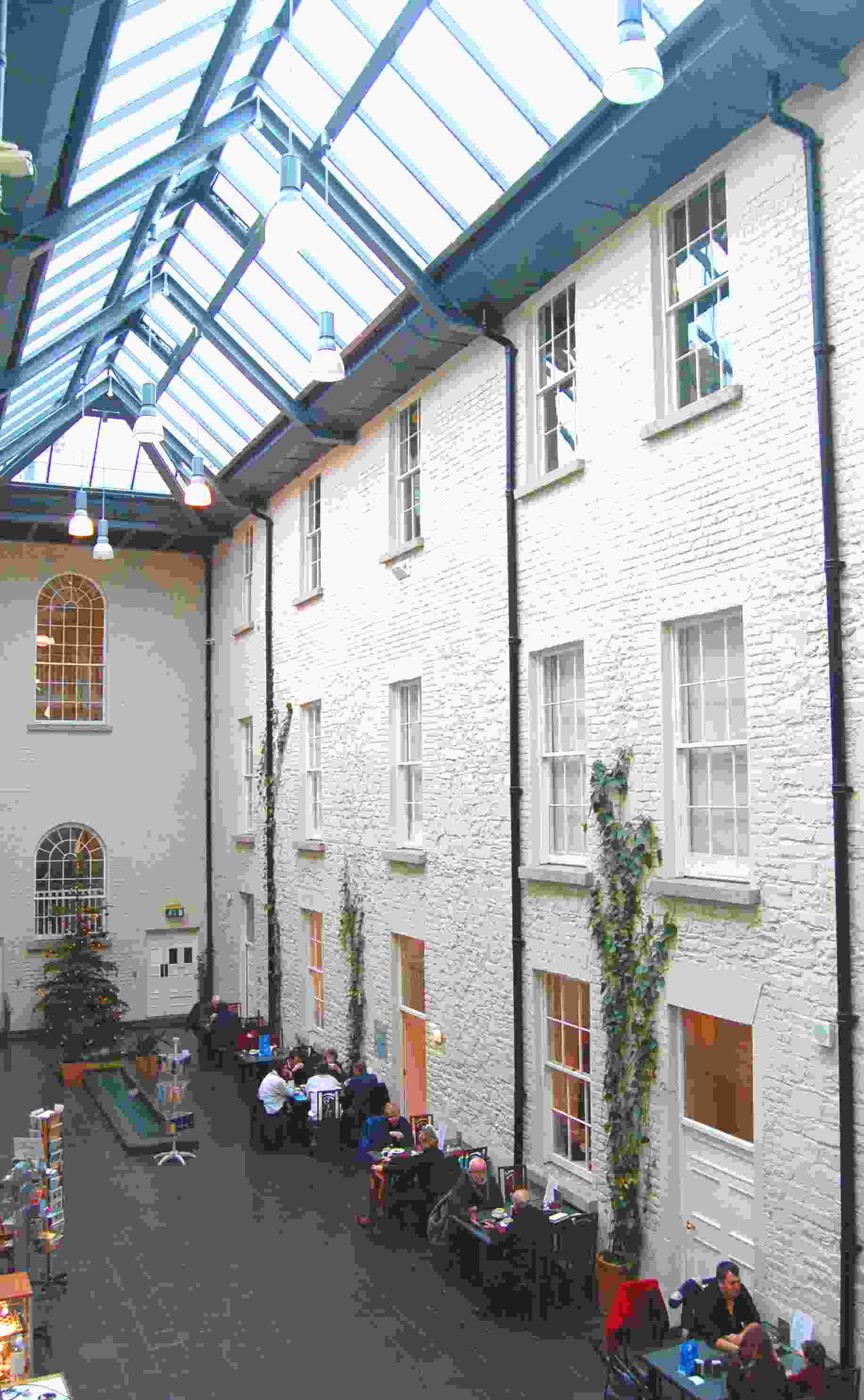
The glazed concourse and Silk Road Cafe
A lightweight glass link built onto the Clock Tower Building to join it to the museum's environmentally controlled exhibition spaces, added when the extension was designed in the 1990s. It holds the ground-floor Silk Road Cafe, the reception area and the route through to the galleries, lit by a long skylight roof.
The Roof Garden
A contemporary Irish garden above the exhibition wing, its surfaces divided between stone, hardwood, gravel and ornamental grasses leading up to a large silver birch. Timber trellises around the perimeter carry climbing plants and frame views of Dublin Castle and the city skyline through gaps cut in the screening; the south side is planted with scented herbs, trees and shrubs.
What to see first
The Ibn al-Bawwab Qur'an
Ali ibn Hilal, known as Ibn al-Bawwab, Baghdad, dated AH 391 (1000-1001 CE)
Signed and dated by the calligrapher himself, this is the only Qur'an confidently attributed to Ibn al-Bawwab's own hand out of the roughly sixty-four he is said to have copied, and one of the earliest surviving dated Qur'ans written on paper in a cursive naskh script rather than on parchment in an angular one.18
Papyrus 46 (the Chester Beatty Pauline Epistles)
Egypt, papyrus codex, dated by scholars to the second or third century AD
One of the earliest substantial surviving witnesses to Paul's letters, acquired through Cairo dealers in the early 1930s as part of the group that made Beatty's reputation in biblical scholarship almost overnight.17
Papyrus 45 (the Chester Beatty Gospels and Acts)
Egypt, papyrus codex, third century AD
A papyrus codex preserving the four Gospels and Acts, among the earliest substantial New Testament manuscripts known anywhere, announced to the world by Sir Frederic Kenyon in The Times on 19 November 1931.17
Adam and Eve
Albrecht Durer, Germany, 1504
A celebrated engraving on show in the Arts of the Book gallery, one of almost 500 objects there illustrating the design history of the printed and painted book across Europe and Asia.8
Chinese jade books
China, Qing dynasty, including work in the manner of the Qianlong court, c.1790
Part of one of the finest collections of Chinese jade books outside China itself, inscribed stone-bound panels of the kind imperial workshops produced for eighteenth-century Qing emperors.8
The Clock Tower Building
Dublin Castle, remodelled early in the 19th century, most likely by Francis Johnston
An eighteenth-century Board of Works building shown on Roque's 1756 map of Dublin, remodelled by Ireland's most important architect of the early nineteenth century and restored in the 1990s specifically to house the collection.3
Free drop-in highlights tours
Run by the museum's volunteer guides
Three free, no-booking tours a week through the permanent galleries, a low-friction way into a collection written in more than fifty languages across Asia, Africa and Europe.10
Book of hours (use of Rouen)
Follower of Jean Fouquet, Tours, c.1485-1490
A French devotional manuscript on display in the Sacred Traditions gallery, one of the light-sensitive objects rotated off view after a maximum of two years to protect it from light damage.7
24 Oct 2025 to 14 Jun 2026Confirmed · check before you travel
A mining fortune becomes a library
Alfred Chester Beatty was born in New York in 1875, the youngest of three sons, and began his working life at 23 shovelling rock for 25 cents a day at a small Colorado gold mine. He was quickly promoted to mine superintendent, turned the operation profitable, and by his early thirties was a millionaire consultant and financier through his work for the Guggenheim Exploration Company and later his own firm, Selection Trust. He was already collecting European and Persian manuscripts, and Chinese snuff bottles and Japanese netsuke, before a 1914 family trip to Egypt turned his attention to Islamic manuscripts and a 1917 journey to Asia added Japanese and Chinese painting. Beatty moved to London in 1913, then to Dublin in 1950, citing his frustration with heavy postwar British taxation and currency controls as well as his own Irish paternal heritage. His purpose-built library on Shrewsbury Road opened in 1953, first to researchers and then to the public; the Taoiseach, Eamon de Valera, told the opening audience that thanks to Beatty the library would be 'a mecca for scholars for generations to come.' In 1957 Beatty became the first honorary citizen of Ireland. He died in 1968 and was given the first state funeral awarded to any private citizen in the history of the Irish state, leaving his library and its collection to the nation.
From Shrewsbury Road to the Clock Tower Building
The sale of the Shrewsbury Road site financed the collection's move to its present home. The museum reopened on 7 February 2000, the 125th anniversary of Beatty's birth, inside the restored Clock Tower Building at Dublin Castle, an eighteenth-century office building that had stood derelict for more than fifteen years before OPW architect Angela Rolfe oversaw its restoration and a substantial modern extension to hold the collection and its galleries; the London-based design company Event was commissioned to structure the display of the objects themselves. The result won the European Museum of the Year Award in 2002, the first time the honour had come to an Irish institution: the judging panel praised what The Irish Times reported at the time as 'elegant, evocative displays' with tactfully handled explanatory video, and singled out how the collection had been used to illuminate world religions at a moment, the jury said, when the need for cross-cultural understanding was acute. Queen Fabiola of Belgium presented the award to the museum's then director, Dr Michael Ryan, at a ceremony in Luxembourg.
Two permanent galleries, one working principle
The museum organises its permanent display into two galleries rather than one continuous run of rooms. Sacred Traditions, on the second floor, sets biblical papyri, illuminated Qur'an manuscripts, Buddhist scrolls and other devotional material from several of the world's major religions side by side, framed around ritual and belief rather than geography. Arts of the Book, on the first floor, tells a different story with almost 500 objects: how books themselves were made, illustrated, bound and collected, from European illuminated manuscripts and Durer's prints through Islamic and South Asian calligraphy, narrative painting and album-making to Chinese jade books and Japanese picture-scrolls. Both galleries run on the same conservation principle: light-sensitive paper, parchment and silk objects are shown for a maximum of two years before the whole display changes, so a return visit some years apart can be a genuinely different museum rather than a repeat of the last one.
The Chester Beatty Biblical Papyri, and what is still not known
Beatty's best-known holding, the group of early Christian and Jewish texts known as the Chester Beatty Biblical Papyri, entered the collection between roughly 1930 and 1934 through Cairo antiquities dealers including Maurice Nahman and the Kalebdjian Freres, during the Beattys' regular winter stays in Egypt. Recent archival research by the museum's own curatorial staff has traced how deliberately opaque that trade could be: correspondence shows Beatty and his London advisers using a code borrowed from his mining days to describe incoming purchases by telegram, terms such as 'Silver Mine' for papyrus and 'Gold Mine' for an especially rare or valuable find, and no receipts or invoices survive in the Chester Beatty Archive for any of the individual biblical purchases. Sir Frederic Kenyon announced the acquisition to the world in The Times on 19 November 1931, and the two most celebrated results, Papyrus 45 (the Gospels and Acts) and Papyrus 46 (the Pauline Epistles), remain among the earliest substantial New Testament manuscripts known anywhere. The museum does not present this as a closed question. A Chester Beatty researcher, writing in an open-access academic volume on the collection published in 2023, states of a separate body of the museum's documentary papyri that 'no provenance history for them can be found in the archives: we do not know from whom, where, or when Beatty acquired them' - an honest account of the limits of what even the institution that holds the objects can currently say about how they got there.
A collection recognised, and a museum that keeps counting its own gaps
The 2002 European Museum of the Year award has aged into a settled part of how the Chester Beatty is described, and current visitor sentiment mostly agrees with the judges: on TripAdvisor the museum carries a 4.7-out-of-5 rating across several thousand reviews, and recurring review language singles out free admission, a manageable scale that rewards a real visit without exhausting one, and the novelty of finding a manuscript collection of this depth inside a working castle in a national capital. The same institution runs an active, named programme of provenance research into its own founding collection, including a dedicated research fellowship and an object-histories initiative, and the 2023 academic volume drawn on above is itself a product of that work rather than an outside investigation forced on the museum. That combination, a strong and largely earned reputation sitting alongside an open acknowledgement of what its own records do not show, is closer to how the institution actually presents itself than either an unqualified showcase or a scandal would be.
Closed for Ireland's EU Presidency, mid to late 2026
Dublin Castle began closing to ordinary state-function use from 5 May 2026 to prepare for Ireland's Presidency of the Council of the European Union, which uses the Castle as its operational base for more than one hundred ministerial meetings, working sessions and receptions across the second half of the year. Public access to the Chester Beatty, the 1926 Census exhibition in the Coach House and the Dubhlinn Gardens continued in this first phase, reachable through the Ship Street Gate, but the museum's own visit page states plainly that it closes to the public entirely from 15 June to the end of December 2026 once the presidency's own events intensify, a closure of more than six months. The timing is close to exact: the museum's last temporary exhibition before the shutdown, Manuscripts and the Mind, was scheduled to run only to 14 June 2026, a single day before the public closure began, leaving the two permanent galleries, Sacred Traditions and Arts of the Book, as the last thing on view. Irish tourism forums recorded real visitor disappointment at the closure once it was announced, from travellers who had built a Dublin itinerary around a museum that, for the second half of 2026, they could not visit at all.
What visitors say
We publish no visitor prose and cite no platform average as fact, only as a labelled aggregate. What follows draws on that aggregate, the museum's own published statements, and named journalism. Visitors consistently describe the Chester Beatty as a compact, free, world-class collection that over-delivers against expectations set by its size, and consistently name its free admission and manageable scale as reasons they recommend it. Set against that: the museum closed to the public for over six months in the second half of 2026 so that Dublin Castle could serve as the base for Ireland's EU Presidency, a closure travellers on Ireland's own tourism forums were still voicing disappointment about when this page was researched, and parts of the collection, most notably some of its documentary papyri, carry acquisition histories that the museum's own researchers describe as incompletely documented rather than settled.
What is praised, what is criticised
Praised: free admission to a manuscript and rare-book collection of genuinely global range, credited on aggregate review platforms with a 4.7-out-of-5 rating across several thousand reviews
Praised: its compact, walkable scale, which reviewers repeatedly contrast with larger institutions: thorough enough to reward a real visit, small enough not to exhaust one
Praised: the setting inside Dublin Castle, which lets a single trip combine a heritage building, the Dubhlinn Gardens and the museum itself
Praised: the museum's own free drop-in tours and Digital Guide app, cited by visitors as making a dense specialist collection approachable without a background in manuscript studies
Criticised: the prolonged 2026 closure for Ireland's EU Presidency: named reporting and visitor forum posts describe real disappointment among travellers who had planned a visit and found the museum, and eventually the whole Dublin Castle campus, shut for over six months with no public access
Criticised: documented gaps in the acquisition records for parts of the collection, most candidly the Chester Beatty's own documentary papyri, of which a Chester Beatty researcher writes plainly that 'no provenance history for them can be found in the archives: we do not know from whom, where, or when Beatty acquired them'
Criticised: no general visitor photography policy is published for the galleries, unusual among museums of this profile and a small but real gap for a visitor trying to plan a trip from the website alone
Reported the museum's European Museum of the Year 2002 award, the first time the prize had come to Ireland, quoting the judging panel's praise for the 'elegant, evocative displays' and for how the collection contributed 'to understanding in a world where religion has recently been associated with atrocities and divisions.'The Irish Times, Aidan Dunne, 14 May 2002 [16]
Ratings on other platforms
TripAdvisor: 4.7 from 4,219 ratings, read 13 August 2026 A platform average is a tertiary source: it moves, it is not audited, and we quote no visitor's words.
General admission: free. As confirmed 17 September 2026.
When is it open?
Tuesday to Friday 09:45-17:30; Wednesday 09:45-20:00; Saturday 09:45-17:30; Sunday 12:00-17:30; Monday closed. Closed: Entirely closed to the public from 15 June to the end of December 2026 for Ireland's Presidency of the Council of the European Union, based at Dublin Castle; the weekly hours above are the last regularly published schedule, not a current, bookable timetable. Closed Mondays from November to February in ordinary years. As confirmed 17 September 2026.
How do you get there?
On foot: A two-minute walk from Dame Street via the Palace Street Gate of Dublin Castle; close to Christ Church Cathedral, reached via the Ship Street Gate; LUAS: Red Line to Jervis, or Green Line to Trinity or St Stephen's Green, then walk in through the Castle; DART: Tara Street station; Bus: Dublin Bus routes 27, 49, 54a, 56a, 77a, 123, 150 and 151, plus Dublin Bus Tours.
What should you see first?
The Ibn al-Bawwab Qur'an (Ali ibn Hilal, known as Ibn al-Bawwab, Baghdad, dated AH 391 (1000-1001 CE)); Papyrus 46 (the Chester Beatty Pauline Epistles) (Egypt, papyrus codex, dated by scholars to the second or third century AD); Papyrus 45 (the Chester Beatty Gospels and Acts) (Egypt, papyrus codex, third century AD); Adam and Eve (Albrecht Durer, Germany, 1504); Chinese jade books (China, Qing dynasty, including work in the manner of the Qianlong court, c.1790); The Clock Tower Building (Dublin Castle, remodelled early in the 19th century, most likely by Francis Johnston).
What we could not confirm
No expected reopening date beyond 'the end of December 2026' has been published by the museum itself; whether normal public hours resume immediately in January 2027 or after a further gap is not yet stated anywhere sourced here.
The acquisition history of parts of the Chester Beatty's documentary papyri remains, in the museum's own researchers' words, untraceable to a specific seller, place or date.
Whether the pre-closure Monday opening hours for March to October differ from the stated Tuesday-to-Friday hours is not confirmed by the archived source used here.
Images
3 plates
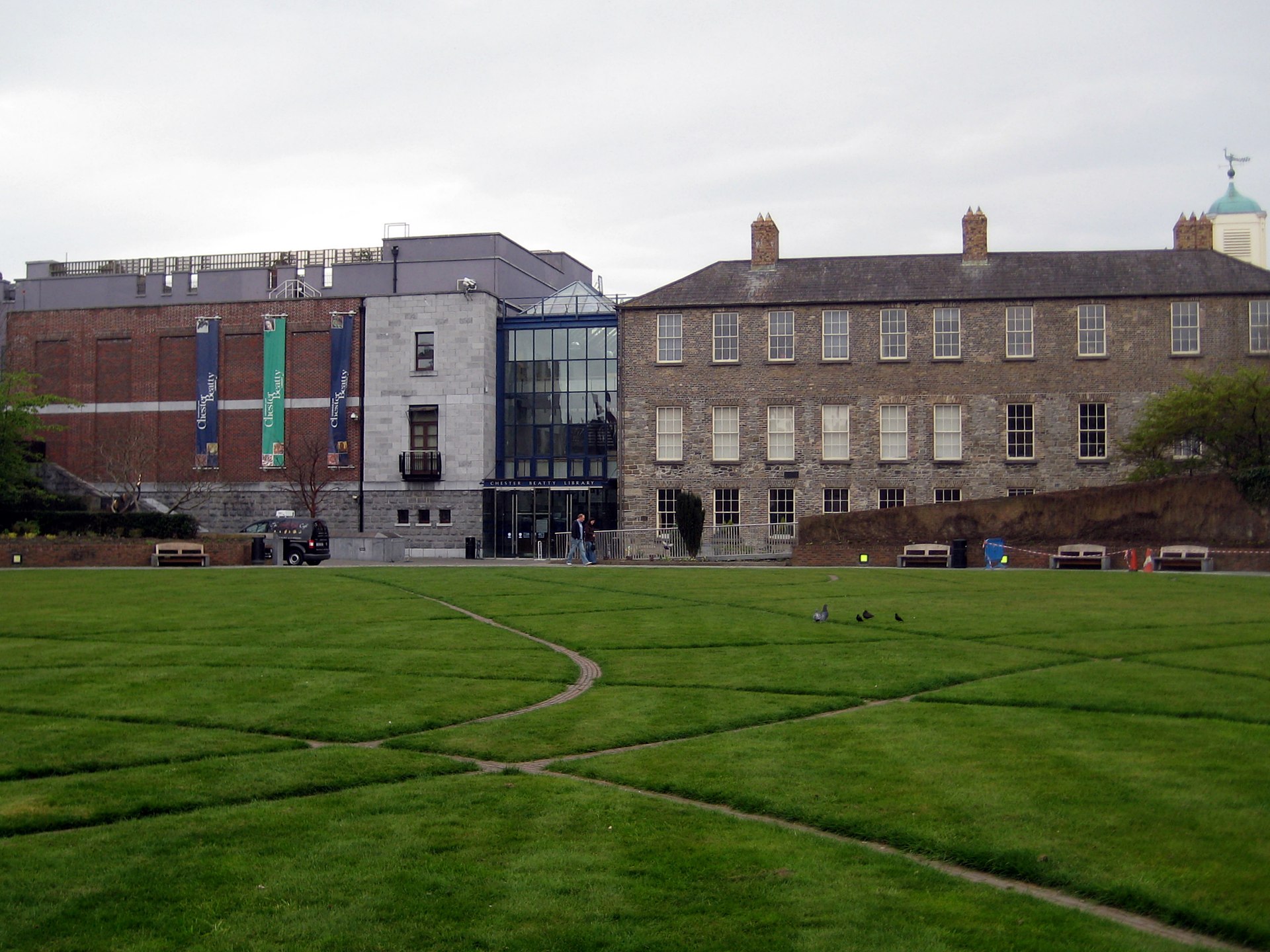
The museum seen across the Dubhlinn Gardens lawnA wide view from the Dubhlinn Gardens showing the museum's grey stone extension and the older brick range of Dublin Castle behind it. Photograph by Harold Strong, CC BY-SA 2.0.Photograph by Harold Strong · CC BY-SA 2.0
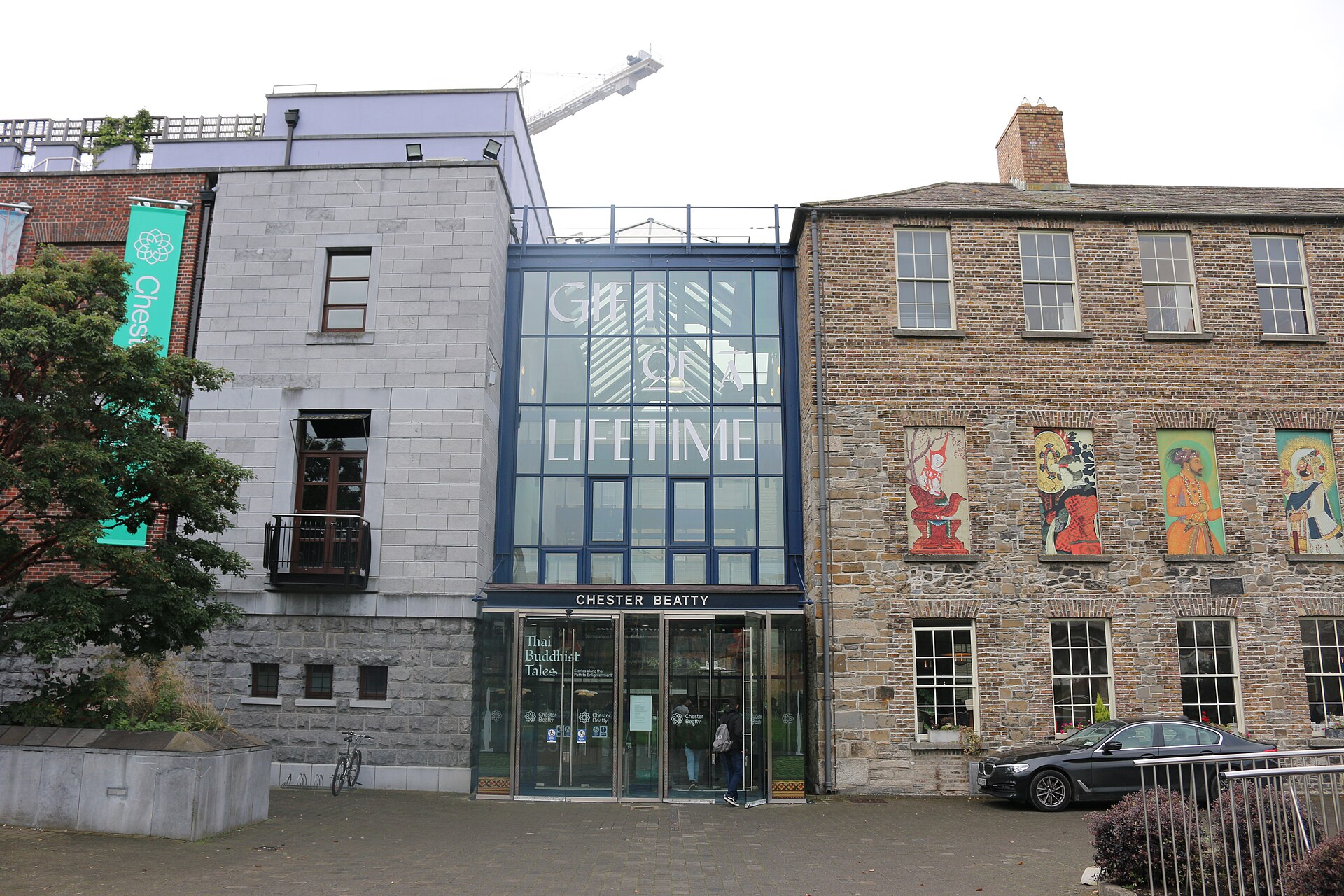
The entrance front, 2019The glazed entrance bay between the museum's stone and brick wings, with an exhibition banner reading Glass and Lifetime above the doors. Photograph by PersianDutchNetwork, CC BY-SA 4.0.Photograph by PersianDutchNetwork · CC BY-SA 4.0
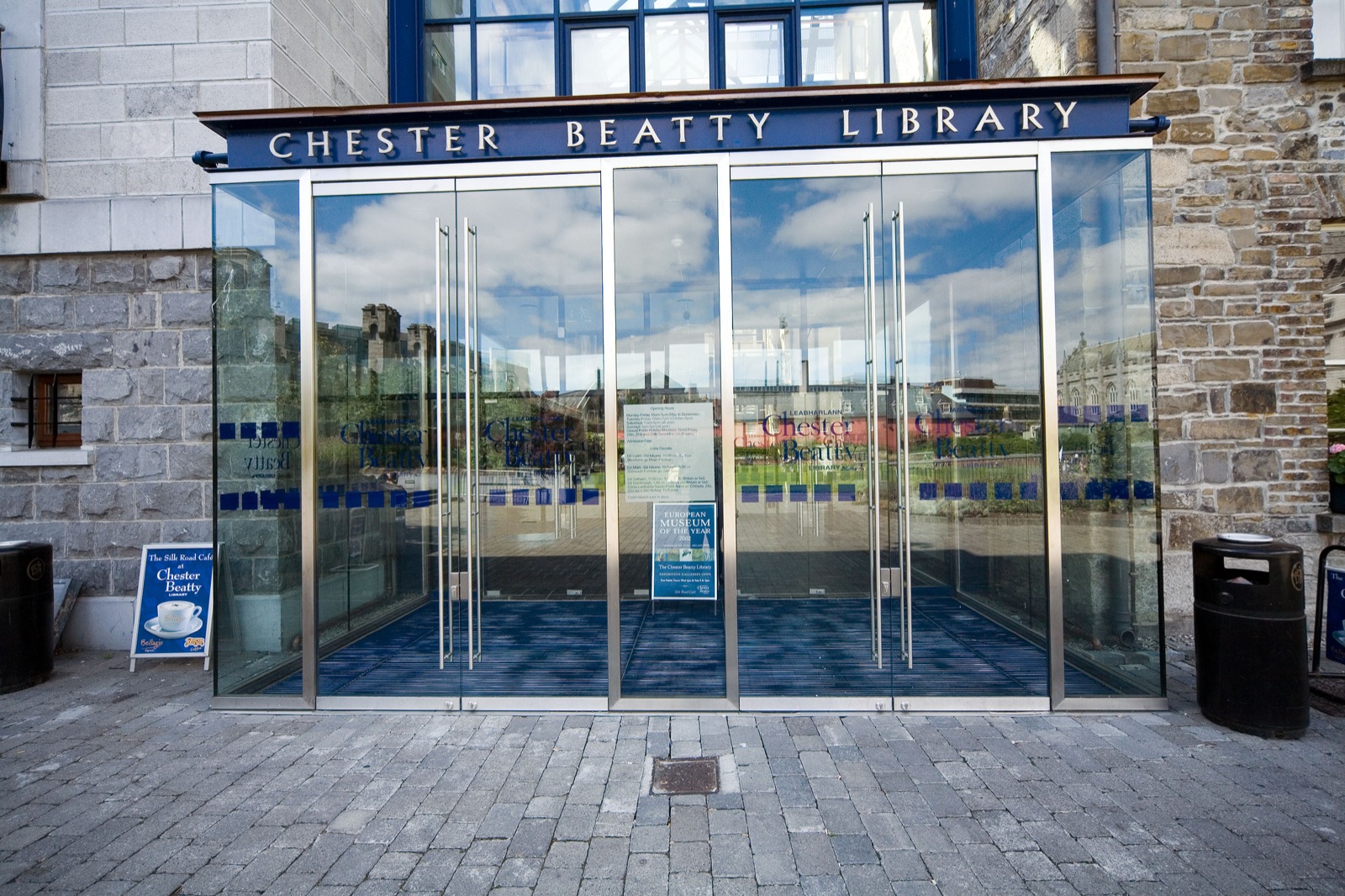
The glass entrance doorsThe museum's street-level glass doors, lettered Chester Beatty Library, reflecting Dublin Castle's grounds. Photograph by William Murphy, CC BY-SA 2.0.Photograph by William Murphy from Dublin, Ireland · CC BY-SA 2.0
Sources
24
1Chester Beatty, Visit: opening-times panel reading 'Closed today' and the 15 June to end of December 2026 closure notice, admission (free, suggested EUR 10 donation), address, phone, and Getting Here transport details (LUAS, DART, bus routes, car and bike). Fetched directly on 13 August 2026. chesterbeatty.ie/visit/
2Chester Beatty, Contact: postal address, phone number (+353 1 407 0750), and the same closure notice repeated in the page footer. Fetched 13 August 2026. chesterbeatty.ie/contact/
3Chester Beatty, Architecture: the Clock Tower Building's appearance on Roque's 1756 map, its attribution to architect Francis Johnston, its nineteenth-century use as the Ordnance Office and later Revenue Commissioners offices, its dereliction and 1990s restoration, and the design of the 1990s extension housing the galleries, conservation laboratory, reading room and roof garden. Fetched 13 August 2026. chesterbeatty.ie/about/architecture/
4Chester Beatty, The Roof Garden: the garden's surfaces, plantings, trellises and purpose as a public rooftop space. Fetched 13 August 2026. chesterbeatty.ie/about/the-roof-garden/
5Chester Beatty, Accessibility: the Ship Street Gate as the recommended accessible entrance, wheelchair loan, ground-floor accessible restroom, dementia-friendly tours, hearing loop and guide-dog policy. Fetched 13 August 2026. chesterbeatty.ie/accessibility-info/
6Chester Beatty, Collections: the collection's size (over 25,000 objects), its fifty-plus languages and scripts, and the four curatorial divisions (Early Printed Books, East Asian, Islamic, Western). Fetched 13 August 2026. chesterbeatty.ie/collections/
7Chester Beatty, Sacred Traditions gallery listing: second-floor location, free admission, scope (biblical papyri, Qur'an manuscripts, Buddhist scrolls), the two-year maximum display-rotation policy for light-sensitive objects, and named highlights including the Fouquet-follower book of hours. Fetched 13 August 2026. chesterbeatty.ie/exhibitions/sacred-traditions/
8Chester Beatty, Arts of the Book gallery listing: first-floor location, almost 500 objects on the design history of the book, and named highlights including Durer's Adam and Eve and the Chinese jade books. Fetched 13 August 2026. chesterbeatty.ie/exhibitions/the-arts-of-the-book/
9Chester Beatty, Chester Beatty Story: the founder's biographical timeline, including his 1950 move to Dublin, the 1953 Shrewsbury Road library opening and de Valera's remarks, his 1957 honorary Irish citizenship, and his 1968 death and state funeral. Fetched 13 August 2026. chesterbeatty.ie/about/who-we-are/chester-beatty-story/
10Chester Beatty, Free Drop-in Public Tours: schedule (Wednesday 5.30pm, Saturday 2pm, Sunday 3pm), 60-minute duration, no booking required, and group-size limit. Fetched 13 August 2026. chesterbeatty.ie/learning/tours-group-visits/public-tours/
11Wayback Machine capture of Chester Beatty's own Visit page, 9 February 2025, before the 2026 closure: the pre-closure weekly opening hours (Tuesday-Friday 9:45am-5:30pm, Wednesday late opening to 8pm, Saturday 9:45am-5:30pm, Sunday 12pm-5:30pm), the Monday closure November to February, and the fixed annual closed days (1 January, Good Friday, 24-26 December). web.archive.org/web/20250209022507/https://chesterbeatty.ie/visit/
12Wikidata, Chester Beatty Library (Q391976): , instance of library/museum/art museum, country Ireland, location Dublin, coordinates, and official website chesterbeatty.ie, used only to fix the entity and cross-checked against the museum's own address. wikidata.org/wiki/Q391976
15Nova.ie, 'Dublin Castle Closed For 8 Months to Accommodate EU Presidency': Dublin Castle closed 5 May to 31 December 2026, over one hundred EU Presidency events at the Castle, and the phased closure that keeps the Chester Beatty, the 1926 Census Exhibition and Dubhlinn Gardens open via the Ship Street Gate before the full closure begins. Read 13 August 2026. nova.ie/dublin-castle-closed-for-8-months-to-accommodate-eu-presidency/
16Aidan Dunne, 'Chester Beatty Library is European Museum of the Year', The Irish Times, 14 May 2002: the 2002 European Museum of the Year award, the judging panel's quoted praise for the museum's 'elegant, evocative displays' and its contribution 'to understanding in a world where religion has recently been associated with atrocities and divisions,' the presentation by Queen Fabiola of Belgium to director Dr Michael Ryan in Luxembourg, architect Angela Rolfe's restoration and extension, display designers Event, and Beatty's 1968 bequest of the library to the State. Fetched and read directly on 13 August 2026. irishtimes.com/news/chester-beatty-library-is-european-museum-of-the-year-1.1057066
17Garrick V. Allen (ed.), The Chester Beatty Biblical Papyri at Ninety: Papyrology, Paratexts, and Textual Criticism (De Gruyter, 2023, open access). Brian McGing's introductory chapter states of the museum's unpublished documentary papyri that 'no provenance history for them can be found in the archives: we do not know from whom, where, or when Beatty acquired them.' Jill Unkel's chapter, 'An Old Story Retold: The Acquisition of the Chester Beatty Biblical Papyri,' documents purchases from Cairo dealers Maurice Nahman and the Kalebdjian Freres between 1930 and 1934, the coded 'Silver Mine'/'Gold Mine' telegram language used to describe incoming papyrus purchases, and the absence of surviving receipts or invoices for the biblical papyri purchases. Daniel B. Sharp and Brent Nongbri's chapter gives the Gregory-Aland numbering (P45 for the Gospels and Acts, P46 for the Pauline Epistles) and dates P46 to the second or third century AD. PDF downloaded and text-extracted on 13 August 2026. eprints.gla.ac.uk/274555/1/274555.pdf
18Smarthistory, 'Adorning the Qur'an': the Ibn al-Bawwab Qur'an's colophon date of AH 391 (1000-1001 CE), its Baghdad origin, its status as the only Qur'an confidently attributed to Ibn al-Bawwab's own hand, and its significance as an early dated paper Qur'an in cursive naskh script. Read 13 August 2026. smarthistory.org/adorning-the-quran/
19Wikipedia, Chester Beatty Library: cross-check on the 2000 reopening date at Dublin Castle, the 2002 European Museum of the Year award, and the collection's approximate size and scope. en.wikipedia.org/wiki/Chester_Beatty_Library
20Wikimedia Commons, Category:Chester Beatty Library and its subcategories (Category:Interior of the Chester Beatty Library, Category:Clock Tower, Dublin Castle, Category:Collections of the Chester Beatty Library). Queried 13 August 2026. commons.wikimedia.org/wiki/Category:Chester_Beatty_Library
21Chester Beatty, Visit page, fetched via the in-app browser on 17 September 2026 after WebFetch returned on a direct fetch: confirms the closure notice is unchanged word for word since 13 August 2026 ('Chester Beatty will be closed to the public from 15 June to the end of December 2026'), the live opening-times panel still reads 'Closed today', and admission is still described as free with a suggested EUR 10 donation. chesterbeatty.ie/visit/
22Chester Beatty, Contact page, fetched via the in-app browser on 17 September 2026 after WebFetch returned on a direct fetch: confirms the postal address and telephone (+353 1 407 0750) are unchanged; the page publishes no email address, only a contact form. chesterbeatty.ie/contact/
23Chester Beatty, Exhibitions index, fetched via the in-app browser on 17 September 2026: confirms no current or upcoming temporary exhibition is listed beyond the two permanent galleries; the last temporary show before the closure, Manuscripts & the Mind, is listed as running to 14 Jun 2026, unchanged from the prior research. chesterbeatty.ie/exhibitions/
24Chester Beatty, Sacred Traditions gallery page, fetched via the in-app browser on 17 September 2026: confirms the same highlighted objects, including the Fouquet-follower book of hours, remain listed as on display, unchanged. chesterbeatty.ie/exhibitions/sacred-traditions/
Last verified Closed temporarily, confirmed Wikidata Q391976
One artwork and its story every Tuesday, with the picture: who owned it, what it made, and what closes soon in the exhibition calendar. No promotion, and nothing we cannot cite.
We send one email to confirm the address and keep nothing else. Every letter carries a one-click unsubscribe. How we handle your data.
 Dublin, Ireland