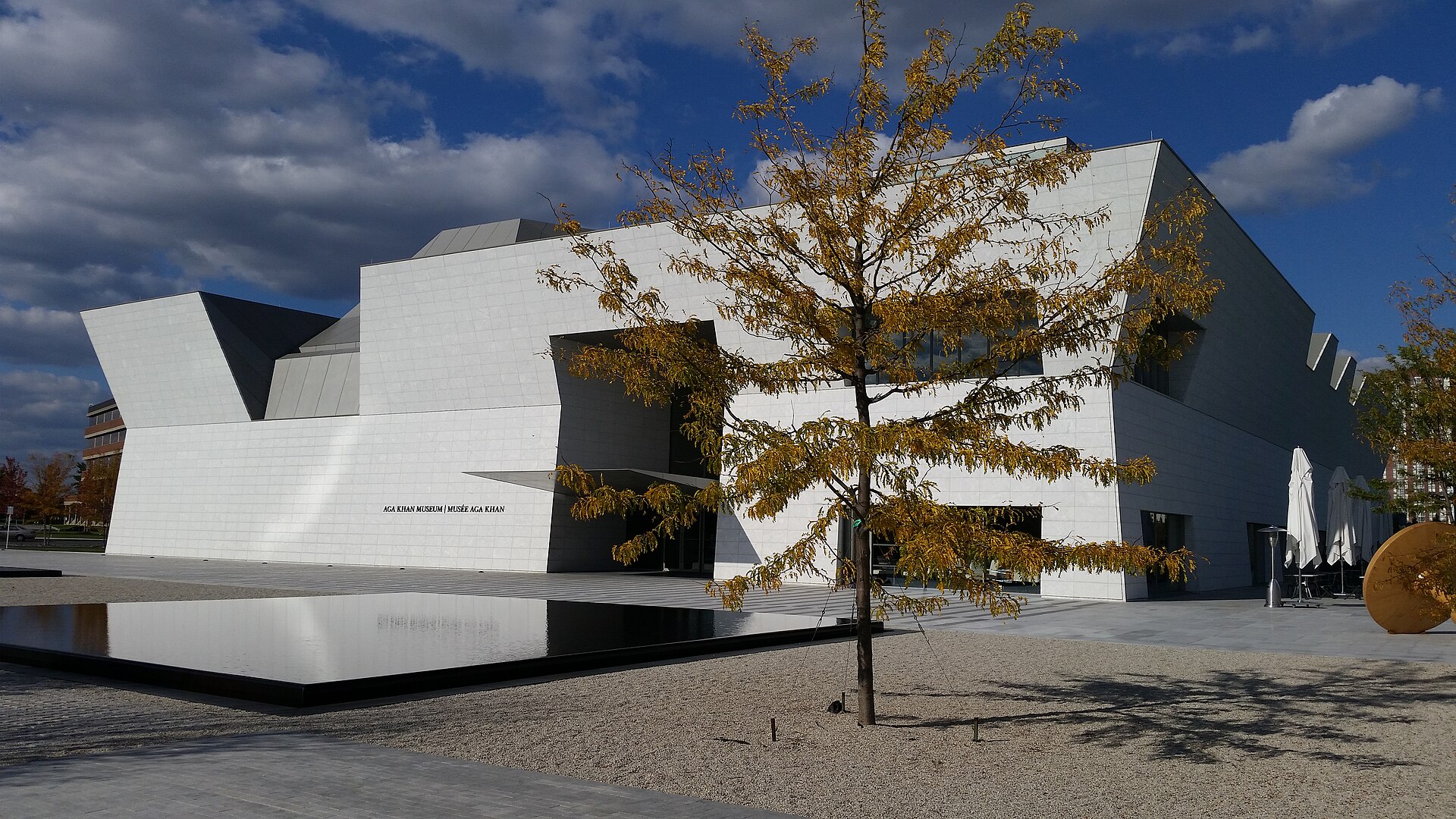
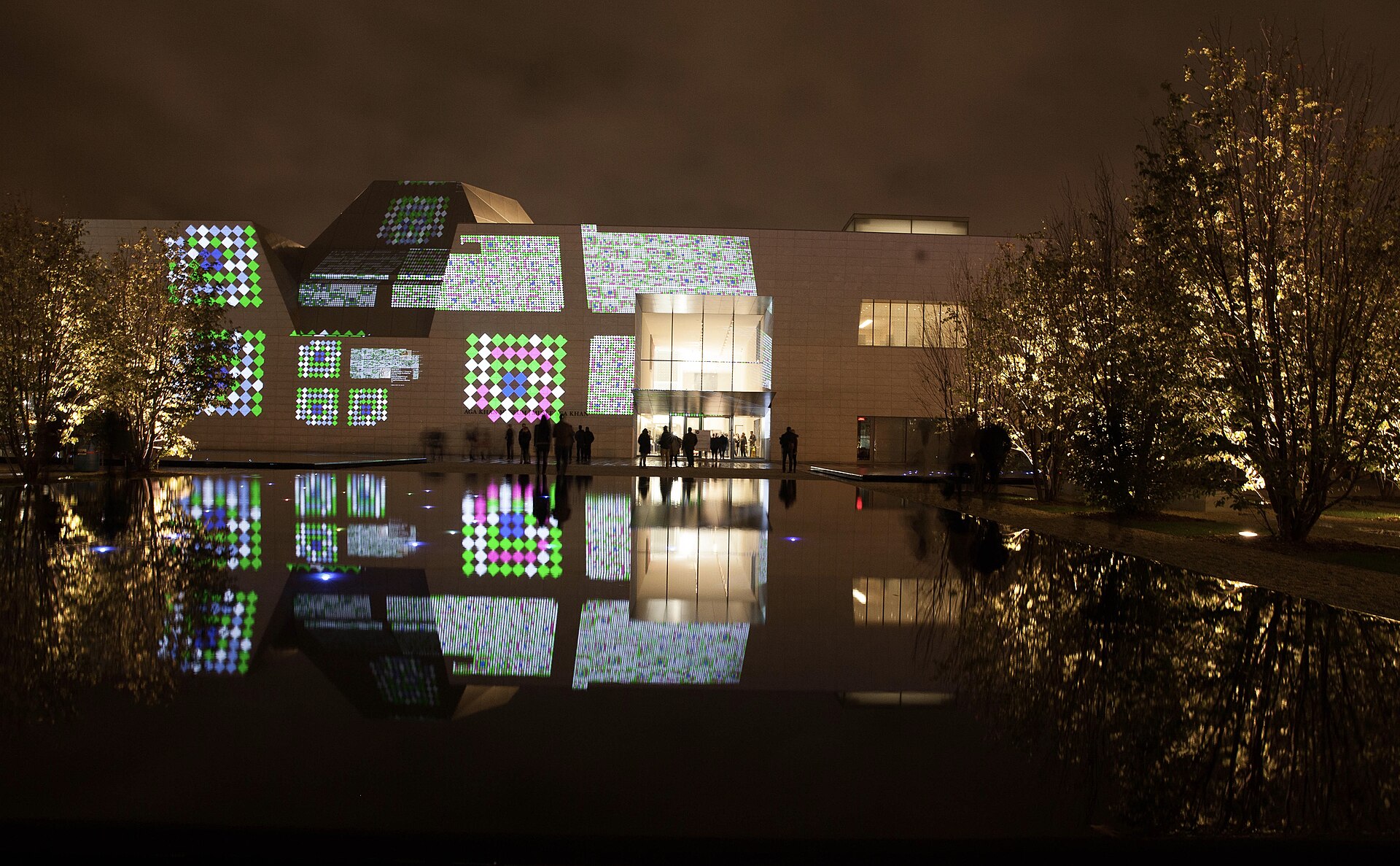
The Aga Khan Museum on Wynford Drive, Toronto, photographed in September 2014 shortly after it opened to the public
JohnOyston, CC BY-SA 4.0On this page 16 sections
ContentsClose
The museum's strength is depth rather than breadth: a collection assembled by one collecting couple over half a century, spanning roughly a thousand years and a geography from Spain to China, with particular density in Persian and Mughal manuscript painting, Islamic ceramics from the Bellerive Room's holdings, and a deliberate, ongoing programme of contemporary art by artists from Muslim communities and their diaspora shown alongside the historic material rather than apart from it.
| Kind | Museum |
|---|---|
| Founded | Conceived in the late 1990s; site confirmed in Toronto in 2002; foundation laid 28 May 2010; opened to the public 18 September 2014 |
| City and country |  Toronto, Canada Toronto, Canada |
| Address | 77 Wynford Drive, Toronto, Ontario M3C 1K1, Canada |
| Website | agakhanmuseum.org |
| Status | Open, confirmed |
| Record last verified |
Visiting
- Hours
- Tue, Thu, Fri, Sat, Sun10:00 to 17:30
- Wed10:00 to 20:00Free admission 4pm to 8pm
- Closed
- Monday. 25 December.
- Admission
- AdultCAD 2015 CAD in a pre-booked group of 10 or more; free for Friends of the Museum members
- Senior (65+)CAD 1512 CAD in a group of 10 or more; free for Friends members
- Student (with ID)CAD 1210 CAD in a group of 10 or more; free for Friends members
- Youth, 25 and underFreeFree entry
Free entry: BMO Free Wednesdays, every Wednesday 4pm to 8pm, sponsor-funded- Tickets
- ticketing.agakhanmuseum.org The museum's own ticket page.
- Do I need to book?
- No advance ticket is required for general admission; tickets can be bought online or in person. Private and school group tours must be booked ahead
- Address
- 77 Wynford Drive, Toronto, Ontario M3C 1K1, Canada MapLRT Line 5 Eglinton, exit at Aga Khan Park and Museum station, immediately beside the site
Bus From downtown, the 100A, 25B or 925 from Broadview subway station; from the north, the 925 southbound on Don Mills Road from Steeles
Car A short distance from downtown Toronto off the Don Valley Parkway; Wynford Drive is one traffic light north of Eglinton off Don Mills Road. On-site parking is metered by QR code, $5 for 30 minutes or less or a $10 flat rate 7am to midnight, with overnight parking not permitted - Website
- agakhanmuseum.org
- Telephone
- +1 416-646-4677
- [email protected]
Before you go how long, access, photography, bags, eating, shop
- How long to allow
- Roughly two hours for the permanent galleries and the Bellerive Room; longer with a special exhibition
- Bags
- Only essential items are permitted inside; bulky coats, bags larger than 30 by 40 centimetres, briefcases, backpacks, umbrellas, selfie sticks and tripods must be checked. Strollers and soft front-facing baby carriers are allowed
- Eating
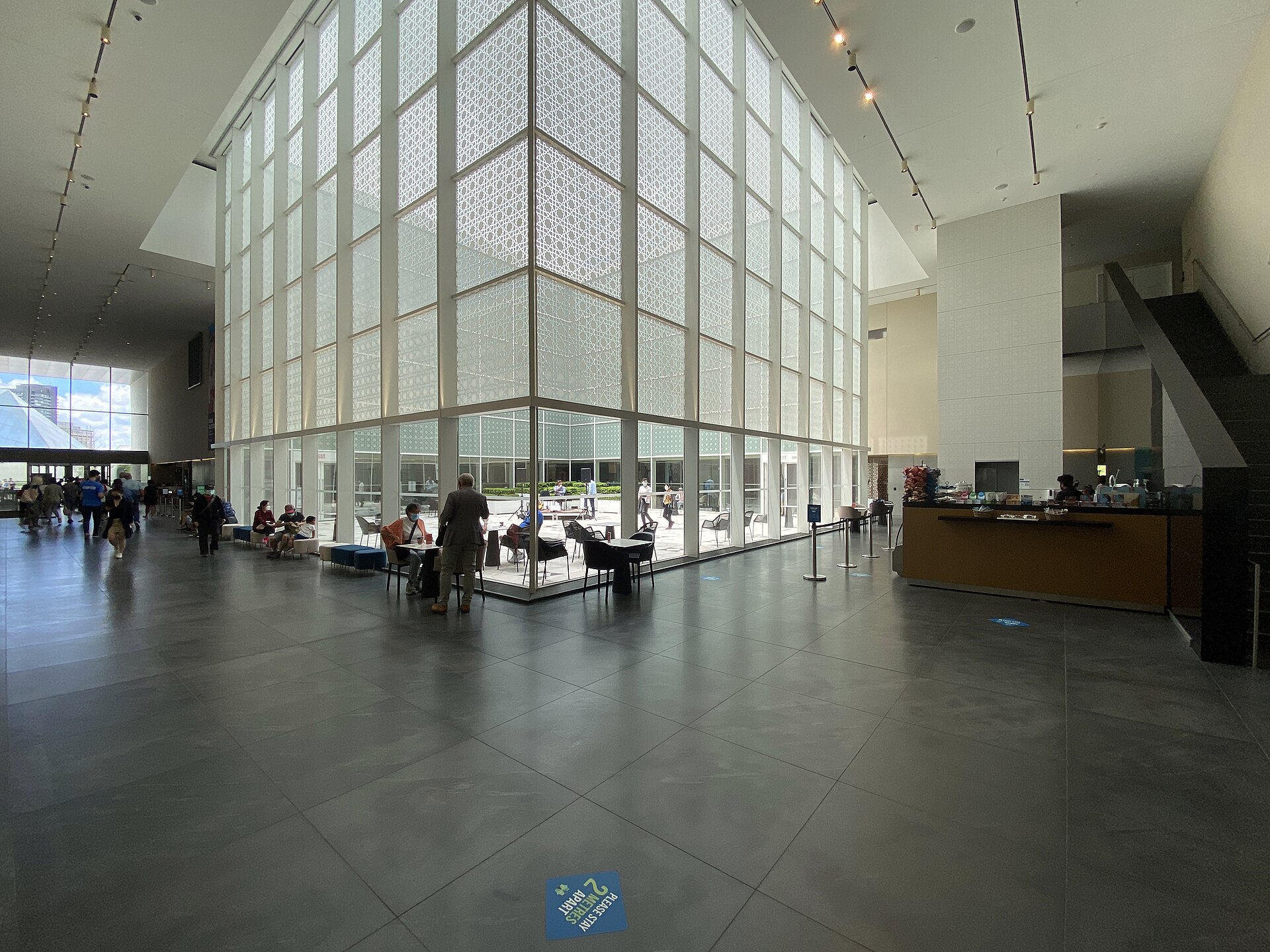
- Courtyard Cafe in the glass-enclosed Atrium, serving lunch items, sweets and beverages; no ticket required to enter the Atrium
- Shop
- Museum Shop, accessible without a museum ticket
Prices and hours change. We take them from the institution's own pages and print the day we read them, and you can check the current position at the source we used. Confirm before you travel.
What is inside
The Bellerive Room
A recreation of the Salon Persan that Prince Sadruddin Aga Khan and Princess Catherine Aga Khan kept in their home, the Chateau de Bellerive in Geneva. Sixty ceramic pieces, grouped by period and technique, run from the 8th and 10th centuries through to 16th-century Iznik ware, tracing Muslim potters' work from China to Europe.
Permanent Collection Galleries
The core display of the museum's holdings of over 1,200 objects spanning the 9th to the 21st century and a geography running from Spain and North Africa through the Middle East to South Asia and China: illuminated manuscripts, miniature paintings, ceramics, metalwork, and textiles.
Special Exhibitions Gallery
A rotating programme of temporary exhibitions and installations distinct from the permanent display. As of August 2026 this includes a family-oriented exhibition on games across Muslim cultures, a solo show by Moroccan-British artist Hassan Hajjaj, an installation by Kamrooz Aram, and a Toronto Biennial of Art presentation.
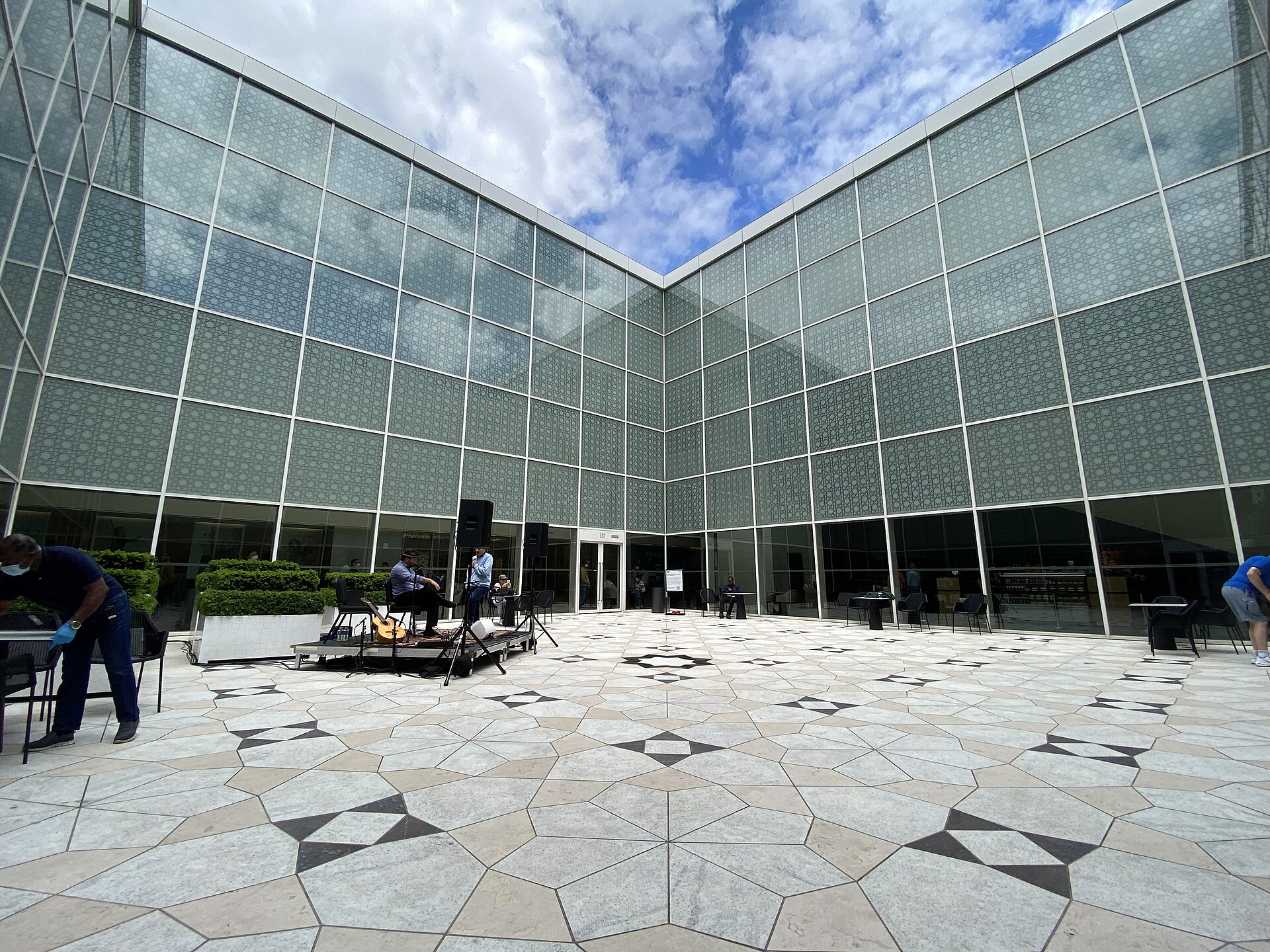
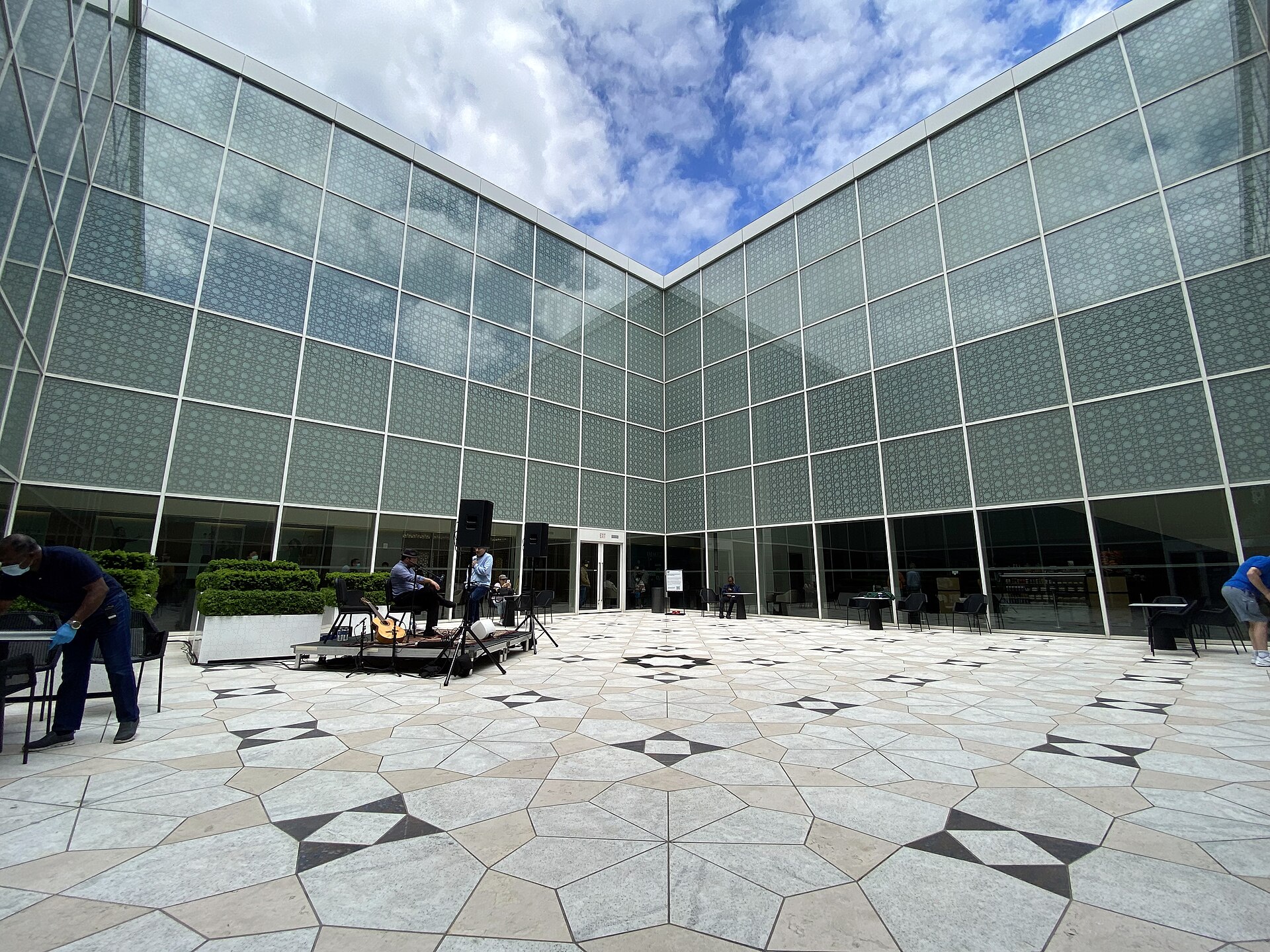
Photograph by Canmenwalker · CC BY 4.0 The Courtyard
A stone-tiled, glass-enclosed courtyard at the centre of the building, its glazed walls etched with a pattern that recalls the mashrabiya screens of historic Islamic architecture. Sunlight moving across the pattern throws shifting shadows onto the interior's white walls through the day and across the seasons; the space doubles as an events venue.
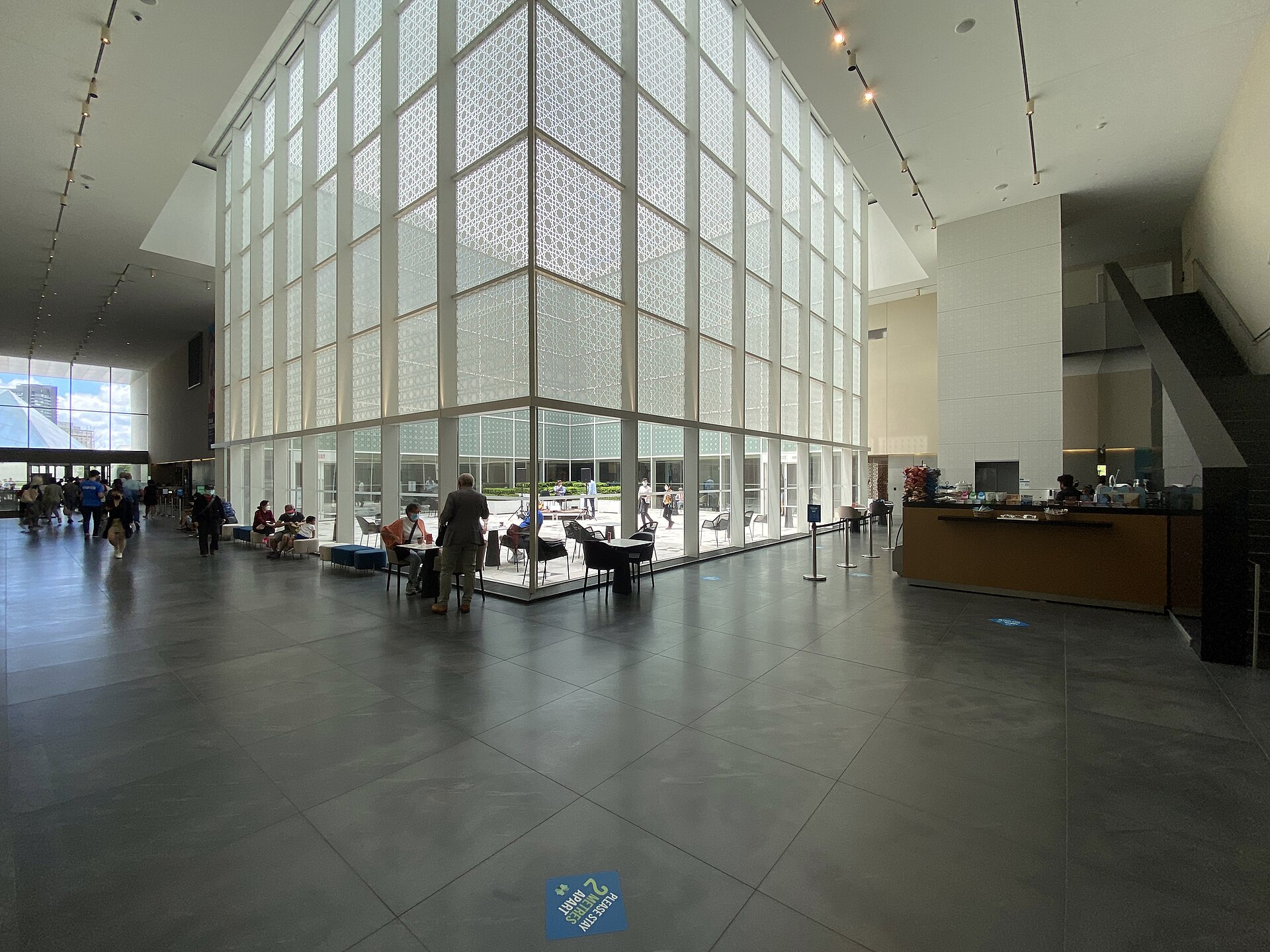
Photograph by Canmenwalker · CC BY 4.0 Entrance Atrium
The reception hall reached from the main entrance, giving onto the Courtyard Cafe and the Museum Shop; neither requires a paid museum ticket to visit.
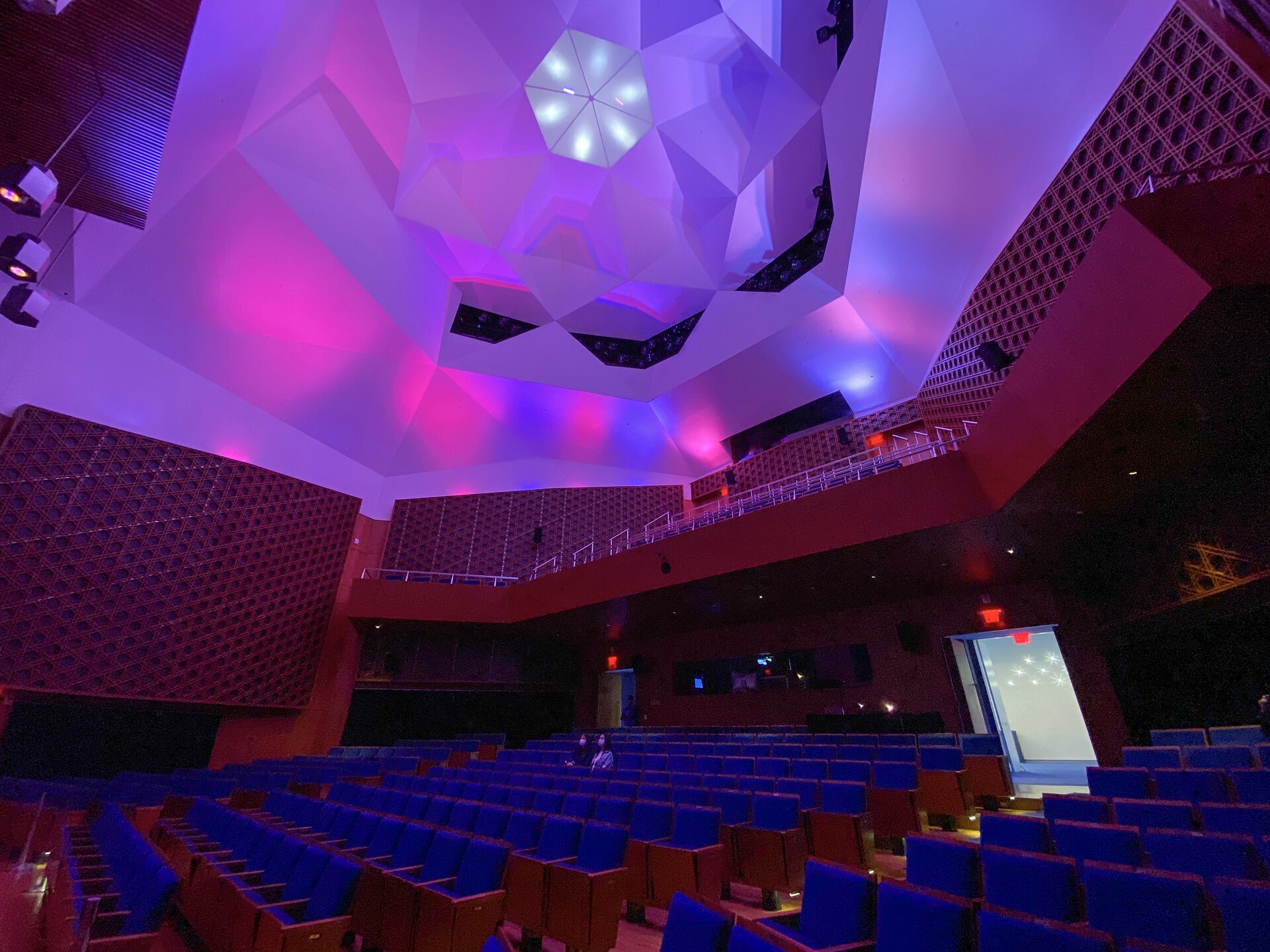
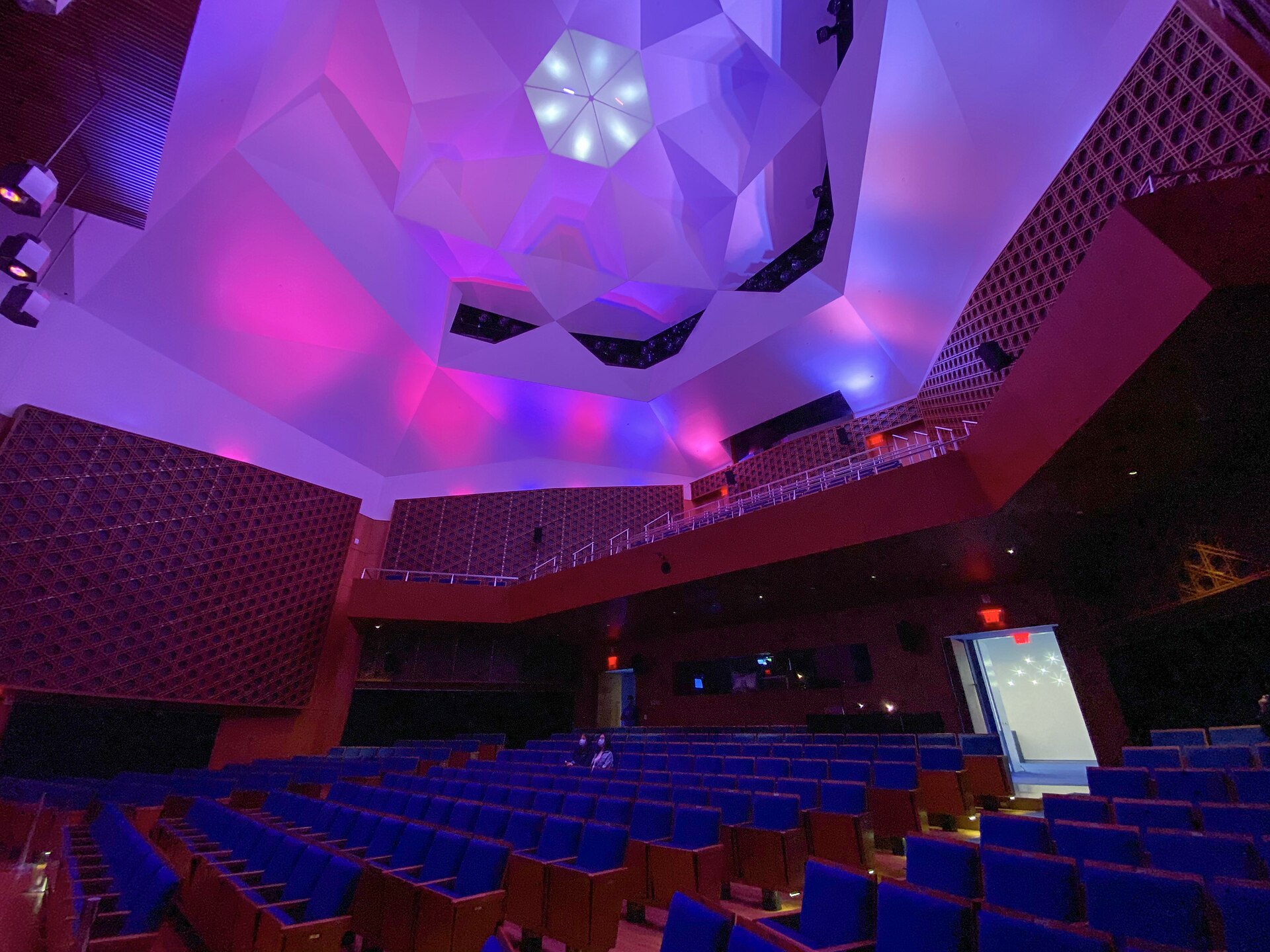
Photograph by Canmenwalker · CC BY 4.0 Nanji Family Foundation Auditorium
A 350-seat auditorium used for the museum's film, music and lecture programming, part of the building's original design alongside two classrooms and the museum's conservation and storage areas.
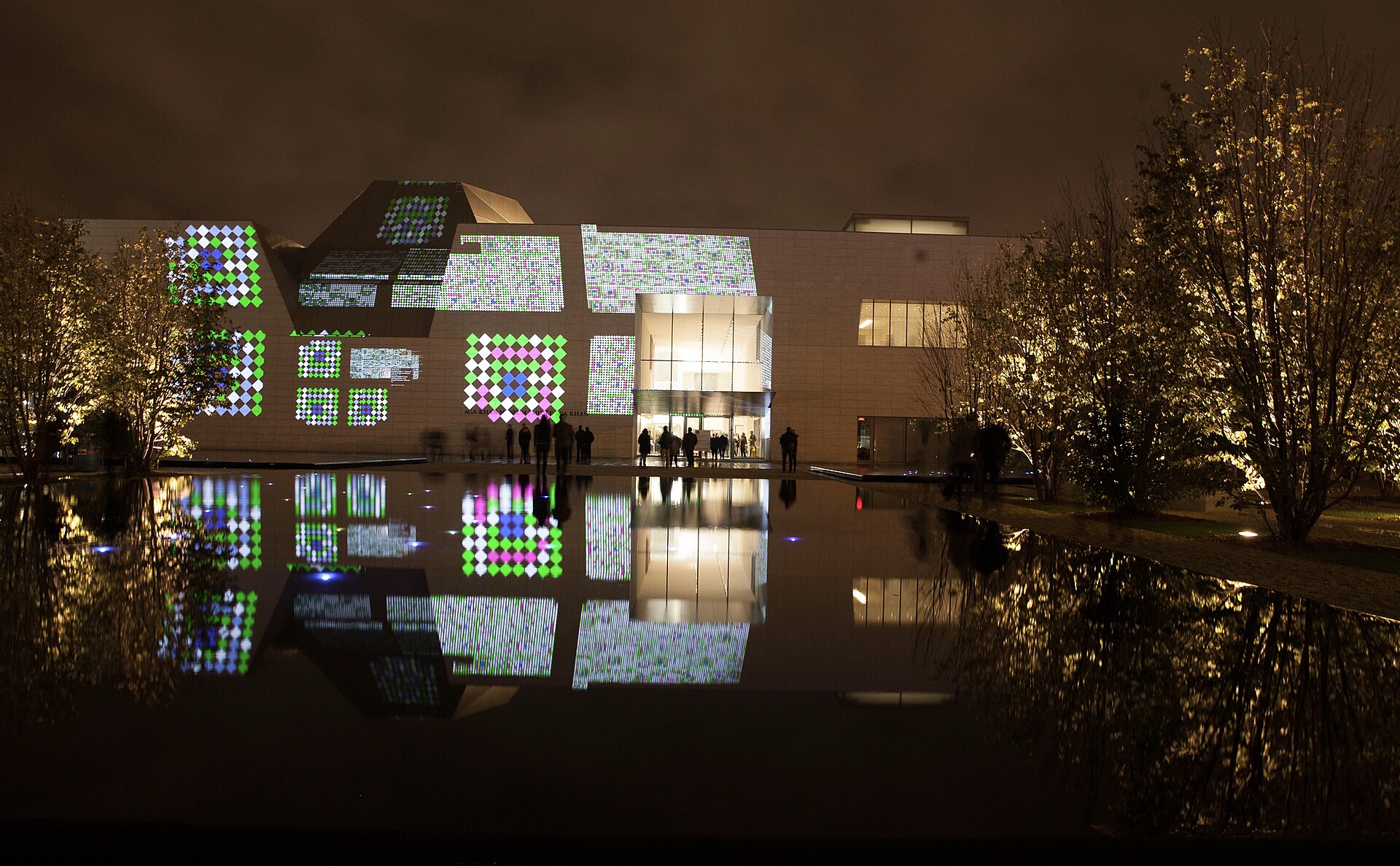
Photograph by Faisal Anwar · CC BY-SA 4.0 Aga Khan Park
A 17-acre (6.8-hectare) landscaped park surrounding the museum, its centrepiece a chahar bagh, a Persian and Mughal four-part garden plan, laid out by landscape architect Vladimir Djurovic with reflecting pools and tree groves. The park connects the museum to the neighbouring Ismaili Centre, a separate building by architect Charles Correa that is not part of the museum. The park is open daily from dawn until 10pm.
What to see first
The Canon of Medicine (Qanun fi'l-Tibb)
Ibn Sina (Avicenna)One of the oldest surviving copies of Ibn Sina's five-volume medical encyclopaedia, which set the standard for both Muslim and European medicine for more than 500 years, including his work on the study of contagion and its transmission10
Faridun Tests His Sons, from the Shahnameh of Shah Tahmasp
Unattributed court painter, Safavid IranA manuscript painting (accession AKM903) depicting King Faridun disguised as a dragon to test his three sons, its flourishes ranging from the hyper-realistic to the fantastical10
Court of the Kayumars, from the Shahnameh of Shah Tahmasp
Unattributed court painter, Safavid IranAccession AKM165; one of the best known and most reproduced manuscript paintings in the museum's collection, its colour built from layered clouds and mist10
Candlestick
Unattributed, Syria or Egypt, 14th centuryAccession AKM736; a Mamluk-period metalwork piece the museum's own collection notes single out for showing the interconnection of world artistic traditions10
Woven robe
Unattributed, Iran or Central AsiaAccession AKM677; roughly 800 years old, woven from silk cloth and metal thread10
Painted tile panel
Unattributed, Safavid Iran, 17th centuryAccession AKM590; a two-tile panel representative of the museum's Iznik and Safavid ceramic tile holdings10
Engraved elephant tusk with silver mount
UnattributedAccession AKM809; an ivory object combining carving and metalwork across a scale rare in the collection10
Your Way Begins on the Other Side
Aisha KhalidA contemporary work built from thousands of gold-plated steel pins that resembles a garden carpet from a distance, part of the museum's programme of pairing historic Muslim visual language with living artists10
Chestnut leaf with calligraphic composition
UnattributedA calligraphic study on a natural leaf form, part of the museum's holdings of works on paper10
Exhibitions on now
Past exhibitions here
- Closed13 Sep 2025 to 7 Sep 2026Confirmed · check before you travel
The building on Wynford Drive
The Aga Khan Museum was designed by the Japanese architect Fumihiko Maki, a Pritzker Prize laureate, working with the Toronto firm Moriyama and Teshima on the technical execution. The idea for a museum of this kind was first raised in the late 1990s by the late Aga Khan IV, and after a proposed site in the United Kingdom did not go ahead, Toronto was confirmed as the location in 2002, chosen, in the museum's own account, as a reflection of the country's pluralism. Prime Minister Stephen Harper and the Aga Khan laid the building's foundation stone on 28 May 2010, and the museum opened to the public on 18 September 2014.
The building itself is clad in sandblasted white Brazilian granite laid on a one-metre grid, its planes set 45 degrees off true solar north so that the facades work like a sundial through the day. A canopy cantilevers over the main entrance, and the roofline breaks at intervals into hexagonal skylights, a shape drawn from Islamic ornament, that admit filtered daylight into the galleries below. At the centre of the plan sits an open-roofed courtyard, its surrounding glass walls etched with a pattern derived from mashrabiya screens; as the sun crosses the sky the pattern is thrown as shifting shadow across the courtyard's white interior surfaces, which was the effect Maki said he set out to achieve when he wrote that he hoped the building would be read as a celebration of light.
The museum shares its 17-acre, 6.8-hectare site with the Ismaili Centre, Toronto, a separate building designed by the architect Charles Correa that houses a prayer hall and community spaces for the Shia Imami Ismaili Muslim community. The two buildings and the park between them were developed together, but they are distinct institutions with separate functions, and a photograph or a fact about one should not be read as describing the other.
The collectors behind the collection
The core of what the museum now holds was not assembled by an institution but by two people. Prince Sadruddin Aga Khan, uncle of the Aga Khan IV, began buying Islamic art in the 1950s while a student at Harvard, and continued collecting with his wife, Princess Catherine Aga Khan, for the rest of his life; he died in 2003. Part of that collection was on view in their own home, the Chateau de Bellerive on Lake Geneva, in a room the couple called the Salon Persan. The museum has rebuilt that room, calling it the Bellerive Room, and displays sixty ceramic pieces from the couple's holdings inside it in something close to the arrangement the collectors themselves chose.
The wider vision for a public museum, distinct from the Sadruddin collection itself, came from the late Aga Khan IV and his brother, Prince Amyn Aga Khan, working through the Aga Khan Trust for Culture. The museum states its own mission as an educational one: to use the arts to build understanding of Muslim cultures and their connections to the cultures around them, on the premise that this contributes to more inclusive societies. That framing shapes how the museum presents its objects throughout, favouring historical and cross-cultural context over a purely aesthetic hang.
Inside: two galleries, a period room, and what changes
The museum's exhibition space is smaller than its architectural presence suggests: two galleries hold the permanent collection and the rotating temporary programme respectively, alongside the Bellerive Room as a fixed period display and the auditorium, classrooms, and conservation and storage areas that a working collection needs but a visitor rarely sees. The permanent collection numbers more than 1,200 objects and covers roughly a thousand years, from the 9th to the 21st century, and a geography that runs from Spain and North Africa across the Middle East to South Asia and China: illuminated Quranic folios and manuscript miniatures, Iznik and lustre ceramics, metalwork, and woven textiles.
The temporary gallery and the museum's installation spaces carry a programme that changes on its own calendar. In August 2026 that included a family exhibition on games across Muslim societies, a solo presentation by the Moroccan-British artist Hassan Hajjaj, an installation by the Iranian-Canadian artist Kamrooz Aram sited in relation to the building's own architecture, and a Toronto Biennial of Art presentation, alongside a rotating spotlight installation built around a single object, the Spanish Holbein Carpet. The museum also actively collects and shows work by living artists from Muslim communities and their diaspora alongside the historic material, rather than treating contemporary work as a separate track.
What the collection is strongest in
Individual pieces the museum itself chooses to foreground give a sense of where its strength lies. One of the oldest surviving copies of Ibn Sina's Canon of Medicine sits alongside two of the best-known manuscript paintings from the Shahnameh, the Persian Book of Kings, made for the 16th-century Safavid ruler Shah Tahmasp: Court of the Kayumars and Faridun Tests His Sons. A 14th-century Mamluk candlestick from Syria or Egypt, an approximately 800-year-old silk and metal-thread robe from Iran or Central Asia, and a 17th-century Safavid tile panel represent the metalwork, textile, and ceramic holdings respectively. An engraved elephant tusk with a silver mount stands out as a rarer combination of carving and metalwork. Set against that historic material, Aisha Khalid's Your Way Begins on the Other Side, a contemporary piece built from thousands of gold-plated steel pins that reads from a distance as a garden carpet, is one of the pieces the museum uses to show a living artist working in direct conversation with the same visual traditions.
None of this is an encyclopaedic survey, and the museum does not present it as one. It is, in the words of one reviewer writing at its 2014 opening, a connoisseur's collection rather than the biggest collection of its kind, built by two people over half a century and then opened to the public in a purpose-built home.
Visiting: hours, admission, and getting there
The museum is closed on Mondays and open every other day of the week from 10am, closing at 5:30pm except on Wednesdays, when it stays open to 8pm and offers free admission from 4pm, underwritten by the sponsor BMO. It is open on statutory holidays with the exception of 25 December. Standard adult admission is 20 Canadian dollars, with reduced rates for seniors and students and free entry for anyone 25 or under; group rates apply for parties of ten or more, and Friends of the Museum members enter free at any tier.
The building sits on Wynford Drive, a short distance from downtown Toronto off the Don Valley Parkway. The Eglinton Line 5 LRT stops immediately beside the site at a station named for the museum and the park, and several bus routes connect from Broadview subway station and from Don Mills Road to the north. Visitors arriving by car pay for on-site parking by scanning a QR code, at a flat rate of 10 Canadian dollars for the day or 5 dollars for a stay of thirty minutes or less; overnight parking is not permitted. A cafe and a museum shop sit in the entrance atrium and do not require a museum ticket to visit, and visitors are asked to check bulky bags, backpacks, umbrellas and tripods rather than bring them into the galleries.
What visitors and critics say
On Tripadvisor the museum holds a 4.4 out of 5 rating across 875 reviews as of August 2026, and the pattern in what visitors write is consistent: the building and its courtyard are named as often as the objects inside it, and the guided tours, particularly an 11am highlights walk, are recommended repeatedly as the best way to see the collection. The recurring complaint runs the other way: several reviewers describe the museum as small for its admission price, and note that getting there without a car from central Toronto takes some planning, with parking an added cost on top of the ticket. One review noted that food smell from the cafe reached into the galleries, which they had not expected of a museum.
The museum has also had at least one public controversy since opening. In July 2022 it hosted, as part of a Toronto Metropolitan University student showcase called Under the Tent, a short film whose promotional poster depicted the Hindu goddess Kali in a way that Hindu community organisations in Canada and the Indian High Commission objected to as disrespectful. The museum removed the presentation from view and issued a statement saying it deeply regretted that the video and its accompanying social media post had, in its words, inadvertently caused offence to members of the Hindu and other communities, and that respect for diverse religious expressions was integral to its mission. The filmmaker publicly stood by the work. The episode is worth recording plainly: an outside university project shown once at the museum's venue, withdrawn within days, and followed by an apology from the museum itself, rather than a dispute over anything the museum collects or owns.
What visitors say
Visitors consistently single out the building itself alongside the collection: the granite-and-glass architecture, the lit courtyard, and the landscaped park around it are described as being as much the draw as the objects on display. The museum's guided tours, especially an 11am highlights walk, are repeatedly recommended as the way to get the most from a visit. Set against that, a recurring complaint is that the museum is physically small for its admission price, and that reaching it without a car is inconvenient from central Toronto.
What is praised, what is criticised
- Praised: The building and courtyard: reviewers repeatedly call the architecture and the light-filled courtyard the standout feature of a visit
- Praised: The permanent collection and its curation, especially for visitors with little prior exposure to Islamic art
- Praised: Guided tours, with the 11am highlights tour named specifically as worth timing a visit around
- Praised: Staff, described as welcoming and helpful
- Criticised: Cost relative to size: multiple reviewers describe the museum as small for the price of admission
- Criticised: Reaching the museum by public transit from downtown Toronto is described as inconvenient, and on-site parking carries its own fee on top of admission
- Criticised: One reviewer noted food odour reaching the galleries from the cafe, which they had not expected in a museum setting
Ratings on other platforms
Tripadvisor: 4.4 from 875 ratings, read 26 August 2026
A platform average is a tertiary source: it moves, it is not audited, and we quote no visitor's words.
Questions about Aga Khan Museum
Where is Aga Khan Museum?
77 Wynford Drive, Toronto, Ontario M3C 1K1, Canada.
How much does it cost to visit?
Adult: CAD 20; Senior (65+): CAD 15; Student (with ID): CAD 12; Youth, 25 and under: free. As confirmed 26 August 2026.
When is it open?
Tue, Thu, Fri, Sat, Sun 10:00-17:30; Wed 10:00-20:00. Closed: Monday. 25 December. As confirmed 26 August 2026.
How do you get there?
LRT: Line 5 Eglinton, exit at Aga Khan Park and Museum station, immediately beside the site; Bus: From downtown, the 100A, 25B or 925 from Broadview subway station; from the north, the 925 southbound on Don Mills Road from Steeles; Car: A short distance from downtown Toronto off the Don Valley Parkway; Wynford Drive is one traffic light north of Eglinton off Don Mills Road. On-site parking is metered by QR code, $5 for 30 minutes or less or a $10 flat rate 7am to midnight, with overnight parking not permitted.
What should you see first?
The Canon of Medicine (Qanun fi'l-Tibb) (Ibn Sina (Avicenna)); Faridun Tests His Sons, from the Shahnameh of Shah Tahmasp (Unattributed court painter, Safavid Iran); Court of the Kayumars, from the Shahnameh of Shah Tahmasp (Unattributed court painter, Safavid Iran); Candlestick (Unattributed, Syria or Egypt, 14th century); Woven robe (Unattributed, Iran or Central Asia); Painted tile panel (Unattributed, Safavid Iran, 17th century).
What we could not confirm
- The museum's own visit page lists Diwan as its on-site restaurant, while its plan-your-visit page states that Diwan Restaurant is temporarily closed while new dining options are developed and directs visitors to the Courtyard Cafe instead; the two pages had not been reconciled as of the last check on 26 August 2026.
- The museum's public pages do not disclose an operating budget, endowment size, or annual visitor count, so its financial scale cannot be stated from sources checked here.
Images
Sources
- 1Aga Khan Museum, Visit page (hours, admission overview) agakhanmuseum.org/visit
- 2Aga Khan Museum, Contact Us (phone, email, address) agakhanmuseum.org/contact-us/
- 3Aga Khan Museum, Plan Your Visit (admission prices, bag policy, cafe and shop) agakhanmuseum.org/plan-your-visit/
- 4Aga Khan Museum, Collections overview agakhanmuseum.org/collections/
- 5Aga Khan Museum, Location and Site (architecture, courtyard, Aga Khan Park, Ismaili Centre) agakhanmuseum.org/aga-khan-museum-site/
- 6Designboom, "aga khan museum by fumihiko maki showcases muslim heritage in toronto", 15 September 2014 designboom.com/architecture/aga-khan-museum-fumihiko-maki-toronto-09-15-2014/
- 7Aga Khan Museum, The Bellerive Room agakhanmuseum.org/belleriveroom/
- 8Aga Khan Museum, Exhibitions (current programme, checked August 2026) agakhanmuseum.org/exhibitions/
- 9Tripadvisor, Aga Khan Museum reviews and rating tripadvisor.com/Attraction_Review-g155019-d7125506-Reviews-Aga_Khan_Museum-Toronto_Ontario.html
- 10Aga Khan Museum, Tour the Collections (named highlight objects with accession numbers) agakhanmuseum.org/tour-the-collections/
- 11John Bentley Mays, Canadian Art, "Islamic Treasure House: The Aga Khan Museum", 15 September 2014 canadianart.ca/features/aga-khan-museum-islamic-treasure-house/
- 12The Tribune (India), "Kaali poster row: Canada's Aga Khan Museum regrets hurting Hindu sentiments" tribuneindia.com/news/diaspora/kaali-poster-row-canadas-aga-khan-museum-regrets-hurting-hindu-sentiments-410020
- 13Aga Khan Museum, Our History agakhanmuseum.org/our-history/
- 14Wikipedia, "Aga Khan Museum" (, cross-check only) en.wikipedia.org/wiki/Aga_Khan_Museum
- 15Aga Khan Museum, Location and Parking agakhanmuseum.org/location-and-parking/
- 16Wikimedia Commons, File:Aga Khan Museum in Toronto- Exterior.jpg (licence and file record) commons.wikimedia.org/wiki/File:Aga_Khan_Museum_in_Toronto-_Exterior.jpg
- 17Aga Khan Museum, online ticketing portal ticketing.agakhanmuseum.org/14828/16913
