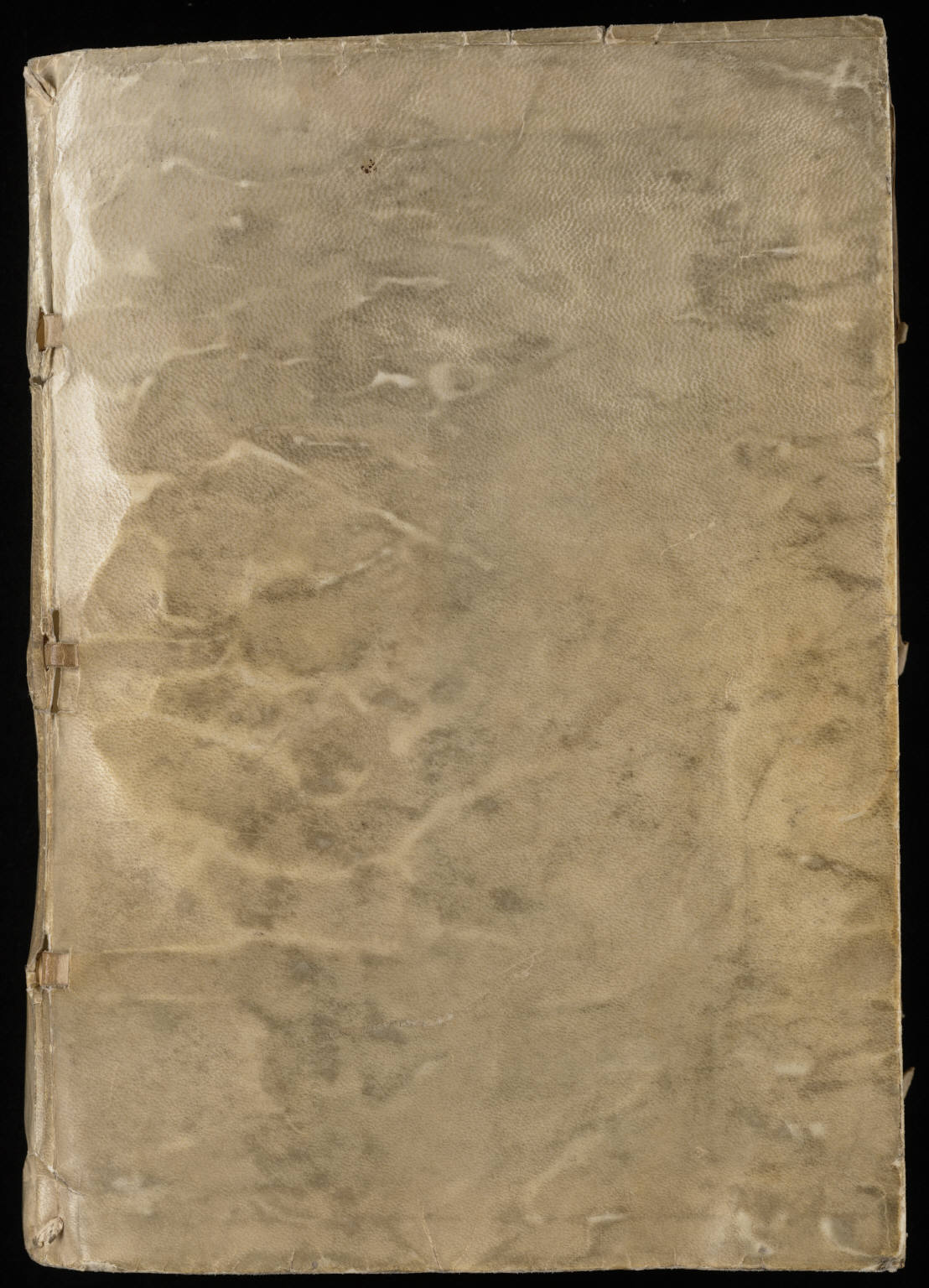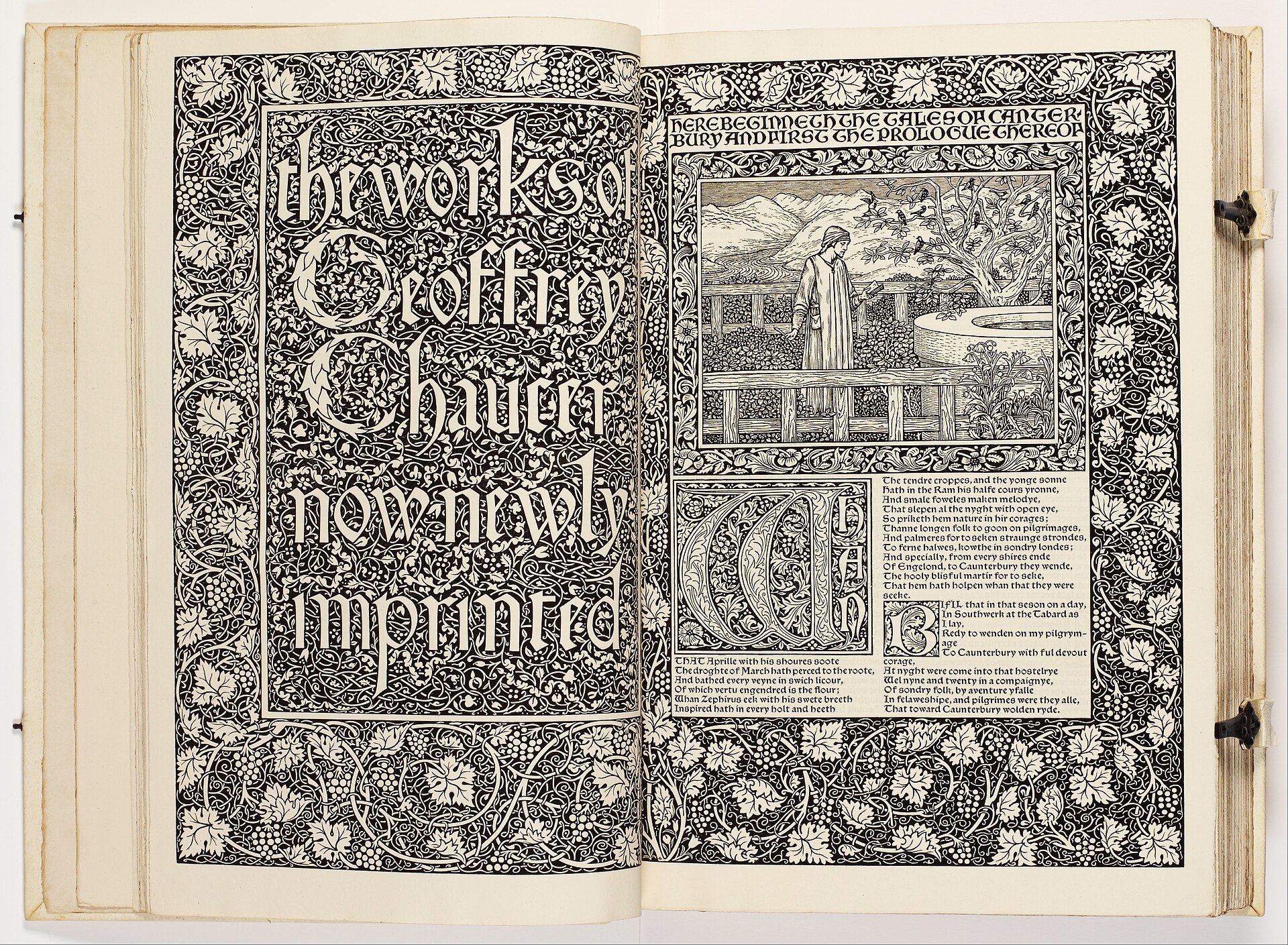
The Works of Geoffrey Chaucer (The Kelmscott Chaucer)
1896 · Letterpress in Chaucer and Troy type
Iris and B. Gerald Cantor Center for Visual...
 English · 1834-1896
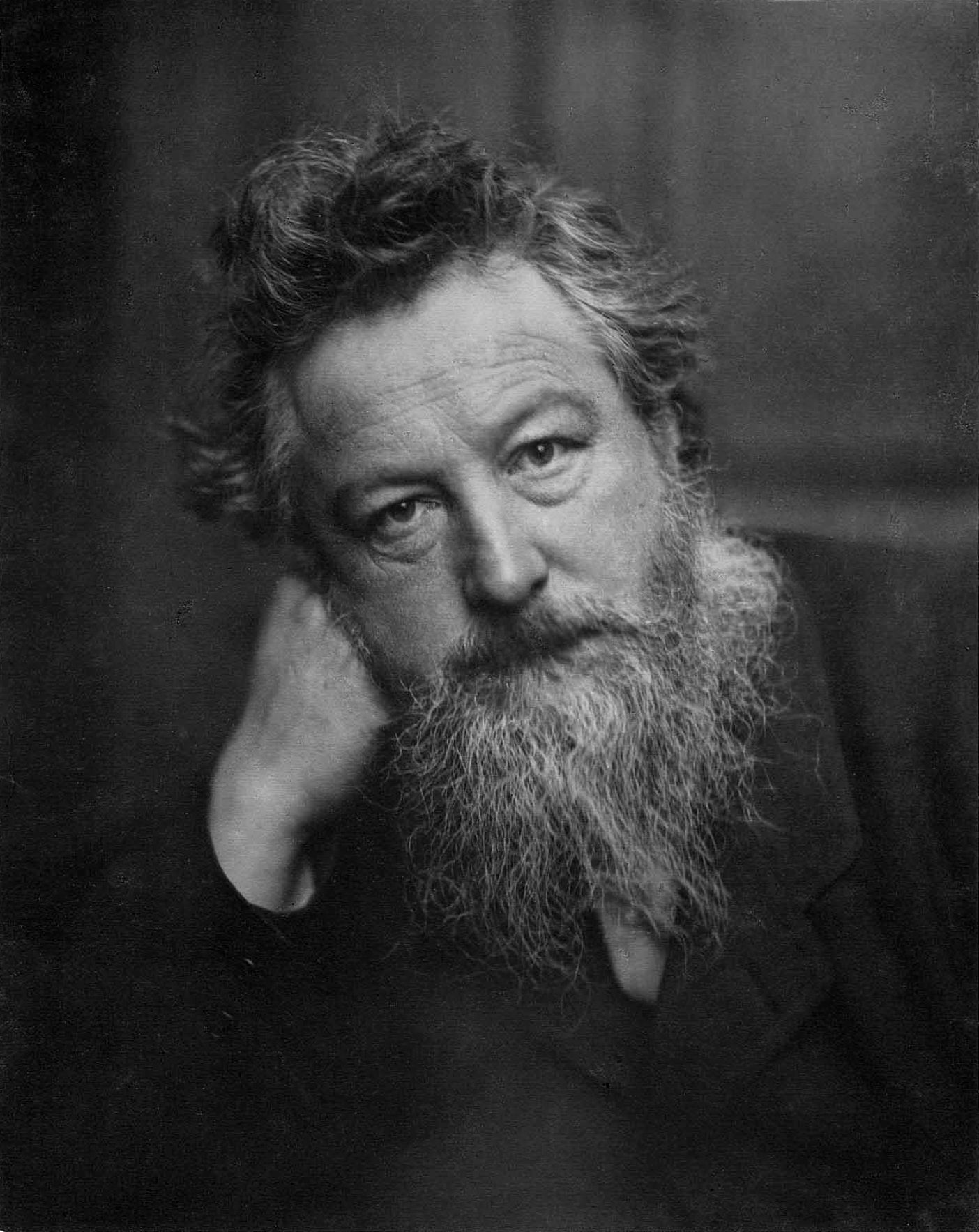
Morris photographed by Frederick Hollyer around 1887, when he was in his early fifties and Merton Abbey was in full production; first published in J.W. Mackail's 1899 biography, The Life of William Morris. A direct photograph of Morris himself rather than a reproduction of a painted portrait, and the identification is not disputed in any source consulted.
Frederick Hollyer, reproduced from J.W. Mackail, The Life of William Morris, vol. 1 (London: Longmans, Green and Co., 1899)| Worked as | Textile and wallpaper designer, Printer and typographer, Poet and translator, Socialist organiser |
|---|---|
| Born | 24 March 1834 · Elm House, Walthamstow, then just outside London |
| Died | 3 October 1896 · Kelmscott House, Hammersmith, London |
| Nationality | English |
| Movement | Arts and Crafts movement (founding figure) |
| In this archive | 1 artwork |
| Sources | 35 cited |
| Last verified |
About this page 1 artwork in the archive · Last verified · 35 sources cited
William Morris is remembered, on most walls and most tea towels, as a wallpaper pattern. He was also the founder of a socialist organisation that printed its own newspaper, the proprietor of a business that decorated a room at St James's Palace and supplied a wallpaper bearing Queen Victoria's own cipher for Balmoral, the translator of Icelandic sagas, and, in the last five years of his life, the designer of three typefaces and the maker of a single 556-page book, the Kelmscott Chaucer, that is still routinely called the most beautiful printed book of its age. He did all of this as, in his own words, a man who felt hatred of modern civilization and who tried, in wallpaper, in type, and eventually in revolutionary politics, to act on that hatred rather than simply state it.
The thing the standard account gets wrong is not a fact but a name. A large share of what is sold today as a William Morris pattern, particularly from the 1890s, was designed by John Henry Dearle, the shop assistant Morris trained as a tapestry apprentice and who became the firm's chief designer in 1890; Dearle exhibited his own early work under Morris's name and the confusion has never fully been corrected. Morris's own daughter May ran the firm's embroidery department from the age of twenty-three and edited her father's twenty-four-volume Collected Works after his death, work that has been, in the words of more than one recent institution to hold it, eclipsed by his reputation for a century. And Robert Catterson-Smith, hired to rework Edward Burne-Jones's pencil drawings into lines an engraver could cut for the Kelmscott Chaucer, is named nowhere in the book he helped make.
What follows treats Morris as what the record actually shows: a designer who ran a commercial firm selling luxury goods to the aristocracy while working, at the same time and without apparent contradiction in his own mind, to abolish the economic system that firm depended on; a printer whose last, largest book was also a stated argument against the century's own way of making books; and a socialist who wrote his politics down as carefully, and left as full a paper trail, as any provenance a specialist could ask for.
Born 24 March at Elm House, Walthamstow.1
Father dies; family moves to Water House, Walthamstow, later the William Morris Gallery.2
Matriculates at Exeter College, Oxford, in June, the same year as Edward Burne-Jones.3
Marries Jane Burden, 26 April, at St Michael at the Northgate, Oxford.4
Moves into Red House, Bexleyheath, designed for him by Philip Webb.2
Co-founds Morris, Marshall, Faulkner and Co. with Rossetti, Burne-Jones, Ford Madox Brown, Philip Webb, Peter Paul Marshall and Charles Faulkner; daughter Jane ('Jenny') Morris born.25
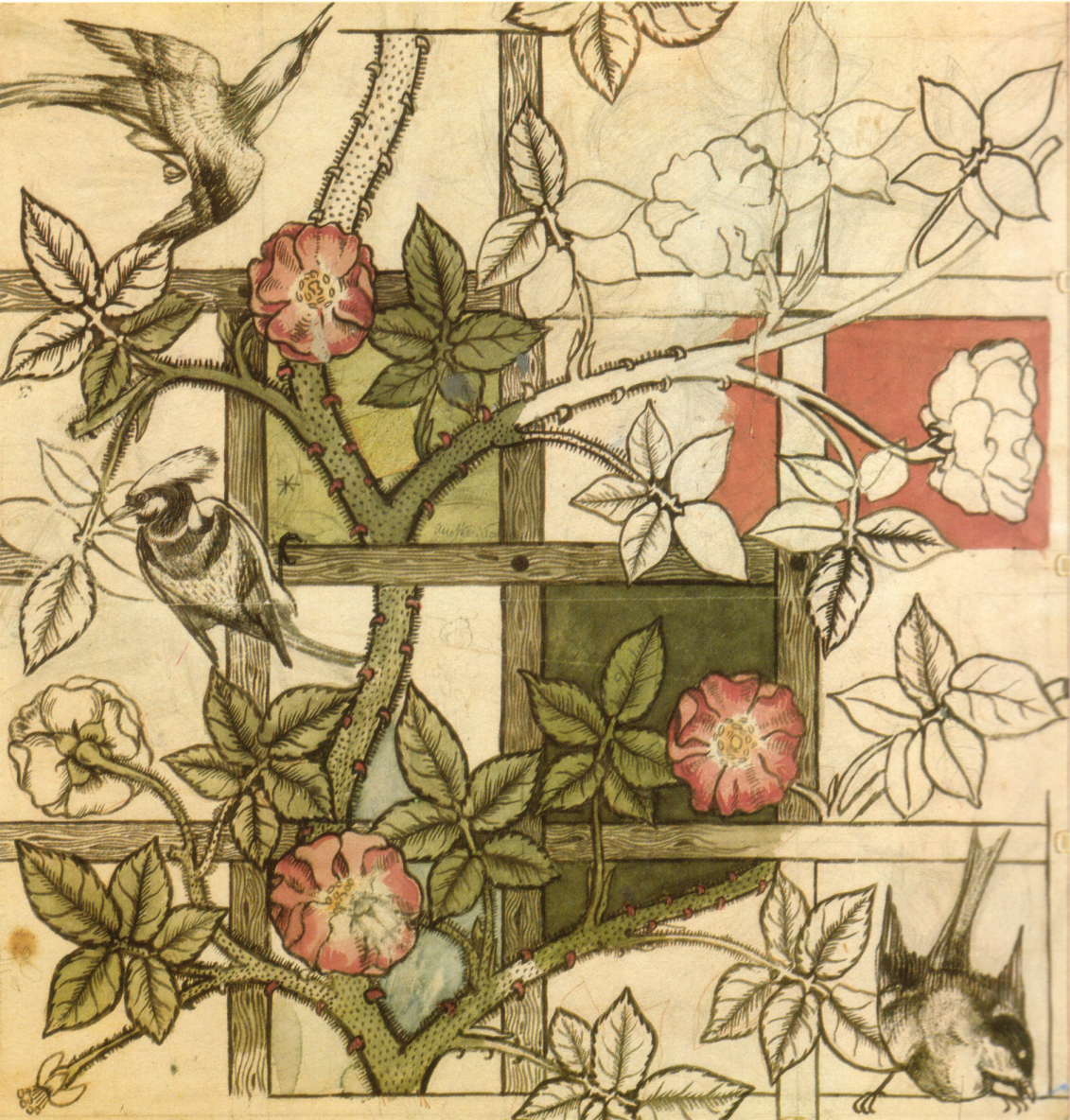
Designs Trellis, his first wallpaper, with birds by Philip Webb; daughter Mary ('May') Morris born.65
Takes a joint tenancy of Kelmscott Manor, Oxfordshire, with Dante Gabriel Rossetti.4
The Firm is dissolved and reorganised under Morris's sole ownership as Morris and Co., 31 March; Marshall, Rossetti and Madox Brown are each paid 1,000 pounds.7
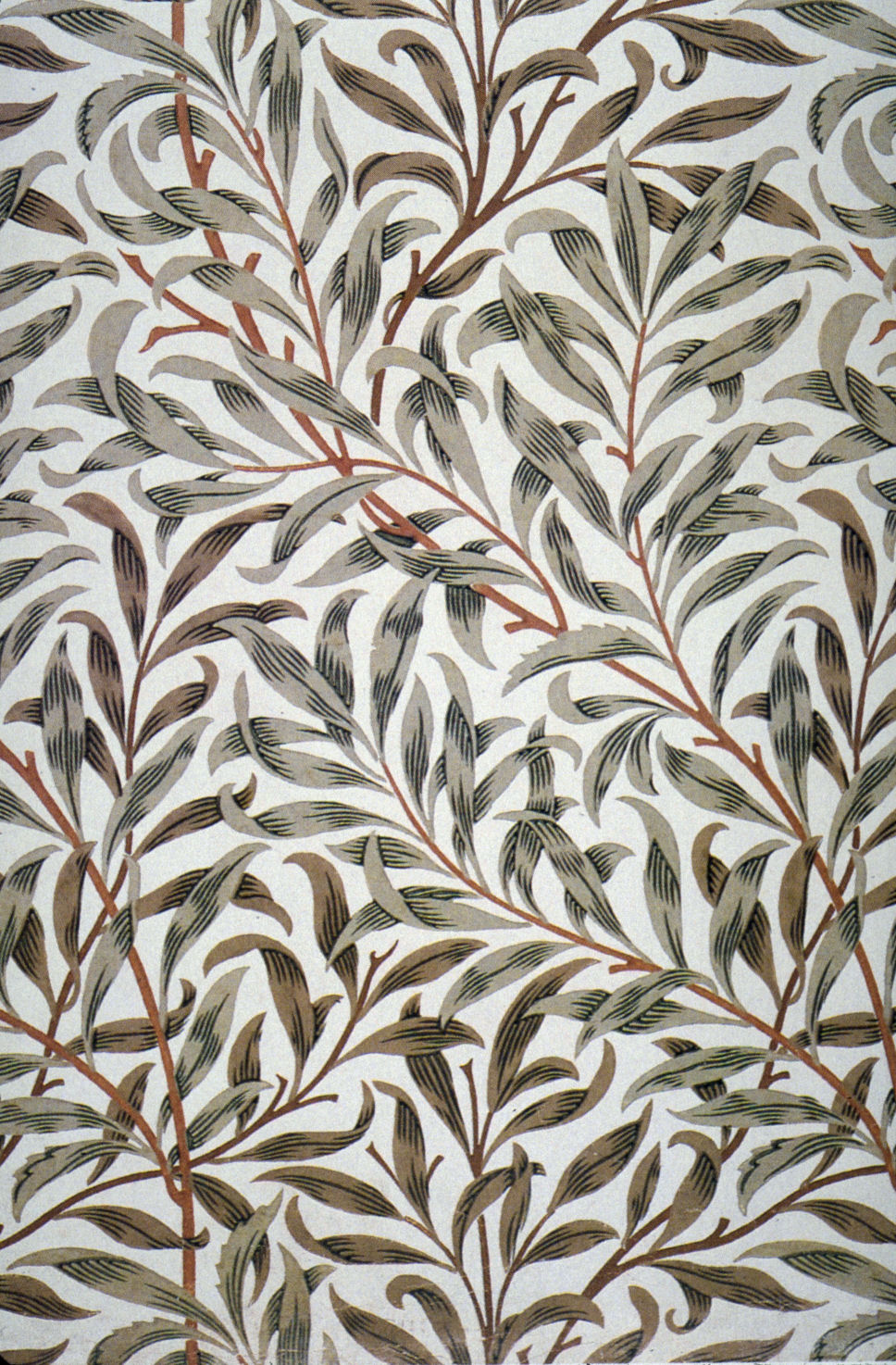
Willow, the first pattern successfully woven on the firm's new Jacquard loom, is completed.2
Commissioned to redecorate rooms at St James's Palace, producing the St James's wallpaper.6
Purchases the Merton Abbey works on the River Wandle, June; production of indigo-dyed textiles begins there in 1882.2
Joins the Democratic Federation, later the Social Democratic Federation, in January.8
Co-founds the Socialist League, 30 December, after a split from the Social Democratic Federation over a no-confidence vote against Henry Hyndman.9
Commonweal, the Socialist League's paper, begins publication in February, financed by a 300-pound loan from Morris, who edits it himself.9
Exeter College, Oxford, commissions the chapel tapestry The Adoration of the Magi, designed by Burne-Jones and woven by Morris and Co.; final payment received 1890.3
Queen Victoria commissions a bespoke wallpaper carrying her VRI cipher for Balmoral Castle.6
Attends Emery Walker's lecture on typeface design at the Arts and Crafts Exhibition Society, the immediate prompt for the Kelmscott Press.10
Serialises News from Nowhere in Commonweal.9
Founds the Kelmscott Press in January at 16 Upper Mall, Hammersmith; issues its first book, The Story of the Glittering Plain, in May.10
The reduced, 12-point Chaucer typeface is finished, cut for the forthcoming Chaucer volume.10
News from Nowhere issued in book form by the Kelmscott Press, in an edition of 300 paper and 10 vellum copies.10
Printing of the Kelmscott Chaucer begins in August.11
Kelmscott Chaucer completed 8 May and issued 26 June; travels to Norway in July; dies at Kelmscott House, Hammersmith, 3 October.1112
The Kelmscott Press closes in spring, having issued 53 titles; its final title, 24 March, is Morris's own A Note on His Aims in Founding the Kelmscott Press.1013
Morris and Co. renamed Morris and Co. Decorators Ltd under managing director Henry Marillier.2
May Morris co-founds the Women's Guild of Arts.4
Jane Morris purchases Kelmscott Manor outright shortly before her own death, securing it for her daughters.4
John Henry Dearle, Morris and Co.'s Art Director since 1896, dies; the firm's design quality is widely judged to decline afterward.14
May Morris dies at Kelmscott Manor.4
Morris and Co. Art Workers Ltd goes into liquidation, May; the Merton Abbey works close the same year.2
The William Morris Gallery opens to the public at Water House, Walthamstow.15
The clearest market data available for any single Morris object concerns the Kelmscott Chaucer, his last and largest book, where copies transact regularly enough to show a real pattern: rebound copies in later leather are common and do not automatically sell for less than copies in an original binding, while an original Doves Bindery pigskin copy, of which roughly 48 were made, appears to command a meaningfully higher pre-sale estimate, though no such copy in the sample gathered here had a retrievable completed hammer result. Original Morris and Co. pattern drawings, sample books and archival material occasionally reach the market through specialist dealers and institutional sales, but no such transaction with a verifiable hammer and premium was located for this record, and none is claimed here.
| Date | Sale | Work | Result | Note |
|---|---|---|---|---|
| 17 December 2024 | Bonhams, New York | Kelmscott Chaucer (paper copy, rebound in brown calf by Riviere and Son), part of the single-owner Complete Kelmscott Press Collection of Joseph Mark Van Horn | Hammer 89,800 With premium 114,800 USD | The full 53-volume Kelmscott Press collection in the same sale totalled 690,000 USD. |
| 22 February 2024 | RR Auction | Kelmscott Chaucer (paper copy, later full white leather rebinding with slipcase) | Hammer not separately published in the source consulted With premium 90,750 USD | Estimate given as 65,000 USD and up; the source did not separate hammer from premium. |
| undated, RR Auction | RR Auction | Kelmscott Chaucer (paper copy, binding closer to the original quarter-linen and blue-boards style) | Hammer not separately published in the source consulted With premium 68,750 USD | Source did not separate hammer from premium. |
Hammer is the price at which the bidding stopped; with premium adds the fee the house charges the buyer on top. Hammer price and buyer's premium in the glossary.
| Institution | City | Holdings | Note |
|---|---|---|---|
| William Morris Gallery | Walthamstow, London | The only public museum in the world devoted solely to Morris, at Water House, his childhood home; over 10,000 objects including original designs, textiles, wallpapers, furniture, stained glass and archival material. | Opened 1950; redeveloped and reopened 2012. |
| Victoria and Albert Museum | London | Extensive holdings of Morris and Co. wallpaper and textile pattern documentation, including sample books, printing blocks and finished patterns; the museum's own galleries and published research (Linda Parry) are the standard reference for dating and attributing individual designs. | Morris was himself an active supporter of the museum, then the South Kensington Museum, and used its collections for design research. |
| Kelmscott Manor | Kelmscott, Oxfordshire | Morris's country home from 1871 (joint tenancy with Rossetti) and, from 1913, owned outright by Jane Morris; furnished by May Morris after her mother's death with pieces from the family's other houses. | Managed by the Society of Antiquaries of London. |
| William Morris Society | Kelmscott House, Hammersmith, London | Morris's own Hammersmith home from 1878 until his death; holds one of the Kelmscott Press's original Albion hand printing presses. | The other two surviving full-sized Kelmscott Press Albion presses are at the Huntington Library, California, and the Rochester Institute of Technology, New York. |
| Fitzwilliam Museum | Cambridge | 85 of the 87 original Burne-Jones pencil drawings for the Kelmscott Chaucer, plus a presentation copy of the Chaucer itself, inscribed by Morris to his daughter Jenny. | |
| Exeter College | Oxford | Two copies of the Kelmscott Chaucer, one given by Jane Morris and one bequeathed by Sir Philip Burne-Jones in 1926; objects from Morris's own desk, bequeathed by May Morris in 1939; archival correspondence on the 1886 Adoration of the Magi tapestry commission. | Morris's own college. |
By the time Morris died in 1896 his surname had become, in the language of the interiors trade, an adjective: the Victoria and Albert Museum's own account of his wallpaper career records that by 1884...
By the time Morris died in 1896 his surname had become, in the language of the interiors trade, an adjective: the Victoria and Albert Museum's own account of his wallpaper career records that by 1884 the trade already spoke of 'Morrisonian' design as a recognised category. That fame has since detached itself from strict authorship. John Henry Dearle joined Morris and Co. as a shop assistant in 1878, was trained personally by Morris as a tapestry apprentice, and by 1890 was the firm's chief designer, working on tapestries, embroidery, wallpapers, woven and printed textiles, stained glass and carpets. Wikipedia's own sourced account of Dearle, citing the V&A textile historian Linda Parry, records that Dearle exhibited his early patterns under Morris's name rather than his own, including at the major Morris retrospective of 1899, and that Morris-attributed sales of Dearle's actual designs continue today. Scholars have disagreed about how to weigh this. The catalogue for a 1981 Birmingham Museums exhibition of Morris and Co. textiles dismissed Dearle's work as, in the phrase it quoted from the critic Lewis F. Day's 1905 assessment, 'rarely more than a pastiche of his master's'; by 1989 Parry was arguing the opposite case, identifying a distinct mature voice in Dearle's own 1890s designs, such as Seaweed wallpaper and the Eden printed cotton, that draws on Persian and Turkish sources in a way she attributes to Dearle's own taste rather than Morris's.
The erasure runs in the family too. May Morris, William and Jane Morris's younger daughter, became director of the firm's embroidery department in 1885 at the age of twenty-three and held effective responsibility for every stage of the firm's embroidery production for over a decade. The Kelmscott Manor guide published by the Society of Antiquaries, which now holds the manor, states plainly that her own work was eclipsed by her father's reputation. She went on to edit William Morris's twenty-four-volume Collected Works, published 1910 to 1915, and to co-found the Women's Guild of Arts in 1907; her own design and writing career has only recently begun to be treated as a subject in its own right rather than a footnote to his.
Morris matriculated at Exeter College, Oxford, in June 1852, the same year as Edward Burne-Jones, according to the college's own archive; the friendship the two men formed there lasted until Morris's...
Morris matriculated at Exeter College, Oxford, in June 1852, the same year as Edward Burne-Jones, according to the college's own archive; the friendship the two men formed there lasted until Morris's death forty-four years later. Morris married Jane Burden on 26 April 1859, and the couple moved the following year into Red House, Bexleyheath, Kent, a house designed for Morris by the architect Philip Webb, whom Morris had met while briefly working for the architect G.E. Street. Furnishing Red House themselves, with friends including Webb, Burne-Jones and Dante Gabriel Rossetti, led directly to the 1861 founding of Morris, Marshall, Faulkner and Co., a decorative arts partnership whose other named partners were the painter Ford Madox Brown, the engineer and amateur artist Peter Paul Marshall, and Morris's Oxford friend Charles Faulkner. Early commissions came chiefly from Gothic Revival architects ordering stained glass and furnishings for churches.
The partnership did not survive amicably. In 1874 Morris moved to restructure it, and a dispute followed with Marshall, Rossetti and Madox Brown over the value of their shares; the partnership was dissolved, and in March 1875 Marshall, Rossetti and Brown were each paid 1,000 pounds in compensation as the firm was reorganised under Morris's sole ownership as Morris and Co. It is one of the plainer facts of Morris's career that the socialist who later argued against private capital accumulating in a few hands ran, from 1875, a company he owned outright.
Trellis, Morris's first wallpaper design, was conceived in 1862, prompted by the rose trellis in the garden at Red House; the architect Philip Webb, an avid sketcher of plant and animal life...
Trellis, Morris's first wallpaper design, was conceived in 1862, prompted by the rose trellis in the garden at Red House; the architect Philip Webb, an avid sketcher of plant and animal life, designed the birds worked into the pattern, making it a genuine two-person design rather than a Morris design with a borrowed detail. Production delays meant it was actually the third pattern the Firm put on sale, in 1864, after Daisy, a simple design of meadow flowers issued that same year, and before Fruit in 1865. London decorators of the day, the V&A's own published account of Morris's wallpaper career records, found this early work 'peculiar': it matched neither the fashionable, illusionistic French-style florals of the 1860s nor the severe geometric reform patterns of designers such as Owen Jones and Augustus Pugin. Interest only widened after Charles Eastlake's 1868 book Hints on Household Taste drew wider attention to interior design as a subject.
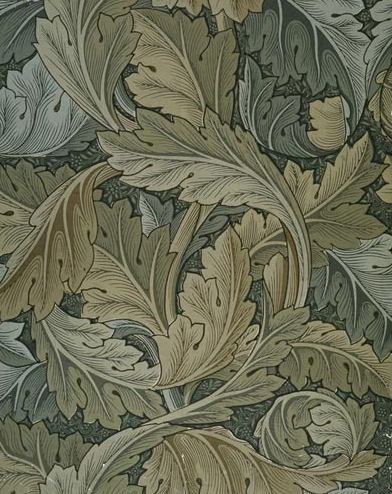
Morris mastered the form in the 1870s, the decade of Larkspur, Jasmine, Willow, Marigold, Wreath and Chrysanthemum, patterns built from a much larger number of interlocking printing blocks and correspondingly more expensive to produce. Two royal and aristocratic commissions mark the high point of his reputation as a wallpaper designer specifically: in 1880 he was asked to redecorate rooms at St James's Palace, producing a special St James's pattern that needed 68 separate printing blocks across a two-width repeat, and in 1887 Queen Victoria commissioned a bespoke wallpaper for Balmoral Castle carrying her own VRI cipher. Not everyone approved. An anonymous 1892 critic in the Journal of Decorative Arts complained that his patterns were 'palatial in scale' and too large for ordinary rooms; the architect Richard Norman Shaw held that 'a wallpaper should be a background pure and simple', in open disagreement with Morris's own preference for large, assertive pattern even in small rooms; and Oscar Wilde is recorded, by the same V&A account, as having disliked Morris's work outright. Morris himself, despite all of this, rated wallpaper below woven textile hangings, which he preferred for his own home, and described paper in print as no more than a 'makeshift' wall covering. Over his career he produced more than 50 wallpaper designs, 35 of them issued in the fourteen years between 1882 and his death alone.
By 1881 Morris's scattered London workshops could no longer accommodate the looms he needed, and he specifically required a site on a river suitable for dyeing.
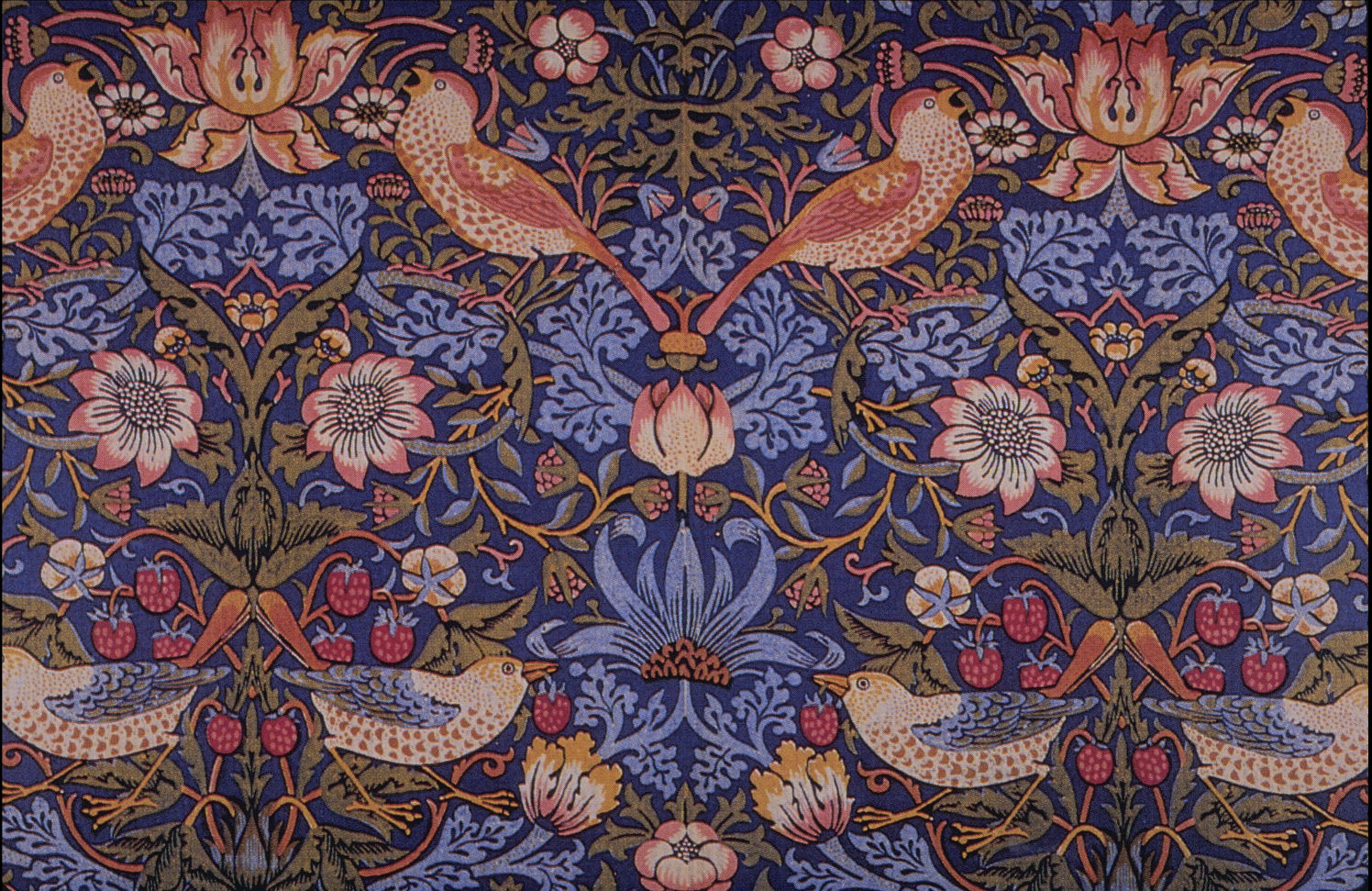
By 1881 Morris's scattered London workshops could no longer accommodate the looms he needed, and he specifically required a site on a river suitable for dyeing. He purchased the former calico-printing works at Merton Abbey, on the River Wandle in Surrey, in June 1881, refusing to demolish any of the existing buildings; production of indigo-dyed cloth began there the following year. Every dye Morris used at Merton was made from natural, mainly vegetable, substances worked out from historical recipes, a deliberate rejection of the synthetic aniline dyes that dominated Victorian textile manufacture; the local-history account maintained by the Merton Priory Trust records that Morris judged aniline colours harsh and short-lived by comparison. His most consistent method was indigo-discharge printing, developed in partnership with the dyer Thomas Wardle at Wardle's silk works in Leek, Staffordshire, in the 1870s before Morris brought the whole process in-house: cloth was dyed a uniform deep blue, then printed with a bleaching agent that removed the indigo from the pattern areas, after which mordants and further dye baths built up the remaining colours. Strawberry Thief, the printed cotton design of 1883, is identified in Linda Parry's standard catalogue of Morris's textiles as an indigo-discharge design of exactly this kind.
The workshop divided its labour in ways the surviving accounts describe candidly rather than romantically. Carpet weaving at Merton, according to the Merton Priory Trust's own history, employed mostly girls, on the stated grounds that smaller hands suited the intricate knotting work; each weaver produced roughly two inches of hand-knotted 'Hammersmith' carpet a day. Tapestries were woven on high-warp looms by teams of three per loom, working from designs in which Burne-Jones typically supplied the figures and Morris, later working with Dearle, supplied the foliage and background. Woven fabrics used Jacquard looms, operated by a French weaver, Louis Bazin, whom Morris employed specifically to set up the technology; the first pattern successfully produced on it, Willow, was finished at the end of 1877.
Morris gave his own account of his politics in an 1894 essay for the newspaper Justice, titled 'How I Became a Socialist'.
Morris gave his own account of his politics in an 1894 essay for the newspaper Justice, titled 'How I Became a Socialist'. In it he defines the word plainly, as 'a condition of society in which there should be neither rich nor poor, neither master nor master's man, neither idle nor overworked... the realization at last of the meaning of the word COMMONWEALTH', and names John Ruskin, whose writing he had read since Oxford, as 'my master' in forming the ideal that led him there; he names Ernest Belfort Bax, Henry Hyndman and Andreas Scheu as the friends whose conversation, more than his own reading of Marx, actually educated him in practical socialism. His own summary of the motive behind both his politics and his design work is unambiguous: 'Apart from the desire to produce beautiful things, the leading passion of my life has been and is hatred of modern civilization.'
Morris joined the Democratic Federation, soon renamed the Social Democratic Federation under Hyndman's leadership, in January 1883. The Federation's council split at the end of 1884 after a vote of no confidence in Hyndman, whom dissenting members accused of high-handedness and of censoring the party paper, Justice; Morris left with Eleanor Marx, Edward Aveling and Bax to found the Socialist League on 30 December 1884. He became the League's chief writer and paymaster, financing its newspaper, Commonweal, with a 300-pound loan and editing it himself from its first issue in February 1885. He serialised his own utopian novel, News from Nowhere, in Commonweal in 1890, and the Kelmscott Press itself issued it as a book in 1893, in an edition of 300 paper copies at two guineas and ten vellum copies at ten guineas, printed in the Golden type in black and red ink. The novel's argument, a future England without industry, capital or private property, is continuous with the case Morris had been making in lectures and pamphlets since the mid-1880s; the Kelmscott Press's later refusal of cylinder presses, machine-made paper and mechanised binding is not a separate aesthetic preference from that politics but a small working demonstration of it.
The plainest tension in Morris's career is one the record states rather than resolves: he ran, for the last two decades of his life, a company selling hand-made luxury goods to precisely the class...
The plainest tension in Morris's career is one the record states rather than resolves: he ran, for the last two decades of his life, a company selling hand-made luxury goods to precisely the class his politics wanted abolished, and he did both without apparent embarrassment. Morris and Co. redecorated rooms at St James's Palace for the royal household from 1880, supplied a bespoke wallpaper to Balmoral for Queen Victoria in 1887, and furnished Castle Howard in Yorkshire for the Earl and Countess of Carlisle, friends of the Morrises, through the first half of the 1880s. Exeter College, Oxford, Morris's own college, commissioned a chapel tapestry, The Adoration of the Magi, designed by Burne-Jones and woven by the firm, in 1886; the college's own archive holds the correspondence about the commission and the receipts for the final payment, made in 1890, the same decade in which Morris was serving as the Socialist League's paymaster and chief propagandist.
He was aware of the position he was in. Custom-made, hand-executed textiles, tapestries and carpets of the kind Merton Abbey produced were, by their nature, expensive; the audience able to afford them was overwhelmingly the audience Morris's political writing identified as the problem. He never resolved this in print by pretending otherwise, and no source consulted here suggests he did. He simply held the two positions at once: a designer who believed a decorated house should be within everyone's reach, and a manufacturer whose actual customers were the aristocracy, the church, and, twice over, the crown.
Morris founded the Kelmscott Press in January 1891, at 16 Upper Mall, Hammersmith, a few minutes from his own house; the operation moved to larger premises next door, 14 Upper Mall, within five...
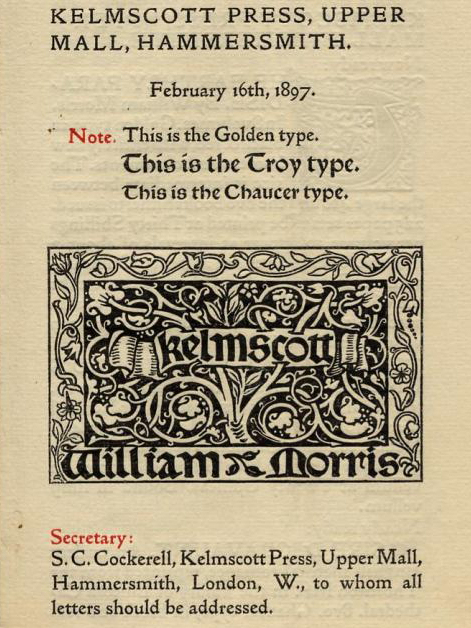
Morris founded the Kelmscott Press in January 1891, at 16 Upper Mall, Hammersmith, a few minutes from his own house; the operation moved to larger premises next door, 14 Upper Mall, within five months, and took on a third building at 21 Upper Mall in January 1895 as output grew. The William Morris Society's own account of the Press's founding identifies the specific trigger: in 1888 Morris attended a lecture on typeface design by his neighbour Emery Walker at the Arts and Crafts Exhibition Society, illustrated with lantern slides of type from early printed books. Walker declined Morris's invitation to become a formal partner in the Press but remained its most important technical adviser throughout its life.
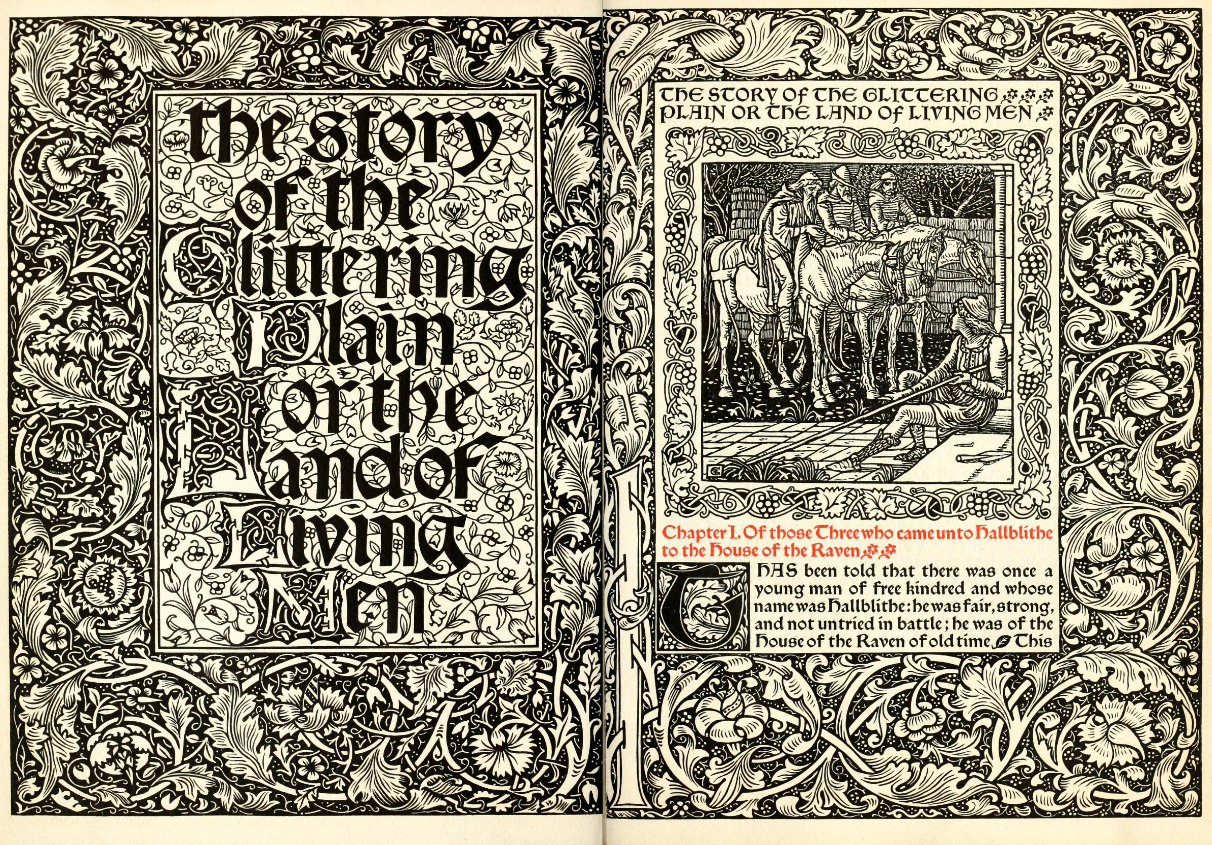
Every material choice at the Press was argued, not merely preferred. Morris rejected the thin, grey-printing inks of contemporary commercial printing and settled, on Walker's recommendation, on a dense black ink from the German firm Gebrueder Jaenecke; he never found a red ink that satisfied him, judging every one he tried wrongly balanced between pink and orange. His paper, made to order by Joseph Batchelor and Son of Little Chart, Kent, was modelled on paper he had examined in fifteenth-century books in his own library, an instance of Morris literally sourcing his materials from research into his own historic book collection. Binding, by the London firm J. and J. Leighton, deliberately avoided the fashionable leather bindings of the day in favour of limp vellum or plain quarter-holland linen and boards, styles closer to late-medieval practice than to Victorian taste. Morris stated his purpose in his own words, in an essay written in 1895 and published, after his death, as the Press's own last book: 'I began printing books with the hope of producing some which would have a definite claim to beauty, while at the same time they should be easy to read and should not dazzle the eye.' The Press's first published title, in May 1891, was Morris's own fantasy novel The Story of the Glittering Plain, printed in his newly cut Golden type; a second, illustrated Kelmscott edition of the same novel followed in February 1894.
Morris designed three typefaces for the Press, each one a documented act of historical research rather than free invention.
Morris designed three typefaces for the Press, each one a documented act of historical research rather than free invention. Golden, finished in 1890, was modelled on the roman type cut by the fifteenth-century Venetian printer Nicolas Jenson. Troy, an 18-point Gothic face finished in 1891 and named for The Recuyell of the Historyes of Troye, the first book printed in it, drew on the German printers Peter Schoeffer of Mainz, Guenther Zainer of Augsburg and Anton Koberger of Nuremberg. Troy proved too large for a book the length of Chaucer's collected works, so Morris had it recut at a reduced 12-point size, finished in 1892 and named Chaucer specifically for that purpose. All three typefaces were physically cut by the punchcutter Edward Prince, who, according to the William Morris Society, was by the time of his death in 1923 the last living independent punchcutter in England, a trade Morris's own commission had helped keep alive into the twentieth century.
The Kelmscott Chaucer, printing William Caxton's line of English poets in the format Morris had spent thirty years working toward, began printing in August 1894 and was completed on 8 May 1896...
The Kelmscott Chaucer, printing William Caxton's line of English poets in the format Morris had spent thirty years working toward, began printing in August 1894 and was completed on 8 May 1896, issued formally on 26 June 1896. Its 87 illustrations were designed by Burne-Jones, whose Oxford friendship with Morris, dating to their 1852 matriculation at Exeter College, supplied the working relationship that made the book possible; Burne-Jones described the project in a letter as likely, if finished, to be 'like a pocket cathedral, so full of design'. The credit line is more complicated than the colophon states. Burne-Jones's pencil drawings were photographed by Emery Walker's firm as platinotype prints, then reworked by an artist named Robert Catterson-Smith, hired by Morris for the purpose, into bold lines an engraver could actually cut; Catterson-Smith's revised versions, not Burne-Jones's originals, were what William Harcourt Hooper engraved onto the woodblocks, and Catterson-Smith's name appears nowhere in the printed book.
Sources disagree, without resolution here, on the edition's exact size. The majority figure, given by Bonhams, RR Auction, the Fitzwilliam Museum and Arizona State University's library guide to the Press, is 438 copies in total: 425 printed on paper at 20 pounds each and 13 on vellum at 120 guineas; a minority of sources give 15 vellum copies rather than 13, for a total of 440. The William Morris Society's own current published account states that all 486 copies were presold before printing was complete, a figure that matches none of the others consulted and is recorded here as an unresolved discrepancy rather than smoothed into either number. A further roughly 48 copies, sources vary slightly on the exact count, were specially bound in full white pigskin by the Doves Bindery under T.J. Cobden-Sanderson, at an extra charge of 13 pounds 13 shillings.
Chaucer prices at auction separate cleanly by binding and condition rather than by any single trend.
Chaucer prices at auction separate cleanly by binding and condition rather than by any single trend. In December 2024, Bonhams New York sold a paper copy, rebound in brown calf by Riviere and Son with recorded provenance from Goodspeed's Book Shop, Boston, in 1963, as part of a single-owner sale of one copy of each of the Kelmscott Press's 53 titles; the Chaucer made a hammer price of 89,800 US dollars against a 90,000-dollar high estimate, 114,800 dollars with premium, and the full 53-volume collection totalled 690,000 dollars. In February 2024, RR Auction sold a different paper copy in a later full white leather rebinding for 90,750 dollars including premium against an estimate of 65,000 dollars and up, without separately publishing the hammer figure; a further RR Auction sale of a copy closer to the original quarter-linen binding made 68,750 dollars, again without a separated hammer price given in the source consulted. A copy in one of the original Doves Bindery pigskin bindings, offered at Sotheby's London with provenance from a 1941 sale, carried a pre-sale estimate of 50,000 to 70,000 pounds; the result itself sat behind a login wall and could not be retrieved.
What the 1896 price meant at the time is itself only loosely documented. A specialist rare-book dealer converts the 20-pound paper-copy price to roughly 100 contemporary US dollars and sets it against an average American wage of 3.52 dollars a week, about 183 dollars a year, putting the paper copy at a little over half a year's average wages and the vellum copy at around nine years of them; this is the dealer's own conversion, comparing an English retail price to an American wage rather than drawing on a peer-reviewed historical wage index, and is recorded here as a documented data point rather than a verified equivalence.
The sources consulted for Morris's final illness do not agree with each other.
The sources consulted for Morris's final illness do not agree with each other. One biographical account dates the onset of serious kidney disease to 1891, the year the Press was founded; other accounts describe him as diabetic, and still others cite tuberculosis or heart disease as a contributing cause of death. This record does not attempt to resolve the medical question; the disagreement itself is worth stating rather than smoothing over. Morris travelled to Norway in July 1896, a trip one source describes his doctor as understanding to be his last, and returned with what is described as congestion of the lungs. He died at Kelmscott House, Hammersmith, on 3 October 1896, not quite four months after the Chaucer's issue.
Before his death Morris asked Emery Walker and his secretary Sydney Cockerell to consider carrying the Press on; both judged it too personal an expression of Morris himself to continue without him, and it closed in the spring of 1898 after completing work already in progress, including an eight-volume edition of Morris's own Earthly Paradise. Robert Catterson-Smith, the same artist who had reworked Burne-Jones's Chaucer drawings, finished Morris's own unfinished ornamental designs for these posthumous volumes. The Press's very last title, issued 24 March 1898, was Morris's own essay explaining why he had founded it in the first place, A Note by William Morris on His Aims in Founding the Kelmscott Press, meaning the Press's final act of printing was, deliberately or not, an argument for its own existence. It had issued 53 titles across seven years of operation.
Morris and Co. did not close with its founder.
Morris and Co. did not close with its founder. The Merton Abbey works continued under two junior partners, Frank and Robert Smith, with Dearle promoted to Art Director immediately after Morris's death; when Burne-Jones died in 1898, Dearle also became the firm's principal stained-glass designer. The company was renamed Morris and Co. Decorators Ltd in 1905 under the managing director Henry Marillier, and again as Morris and Co. Art Workers Ltd in 1925. Dearle's own death in 1932 marked the point at which, by the account of the Merton Priory Trust's local history, the firm's design quality began a decline that continuing market pressure did not reverse; it went into liquidation in May 1940, and the Merton Abbey works closed the same year.
Jane Morris purchased Kelmscott Manor outright shortly before her own death in 1914, securing it for their two daughters. May Morris, who had directed the firm's embroidery department, lived at the manor with her companion Mary Lobb until her own death in 1938, having spent the intervening decades editing her father's Collected Works and co-founding the Women's Guild of Arts. Jenny Morris, the elder daughter, whose epilepsy from her teenage years had prevented an independent adult life, was cared for by the family until her own death in 1935; as a girl she had produced seventeen issues of her own magazine, The Scribbler, for family and friends. Morris's own childhood home, Water House in Walthamstow, opened in 1950 as the William Morris Gallery, now the only public museum in the world devoted solely to him, holding a collection of more than 10,000 objects.
Textile and wallpaper designer; Printer and typographer; Poet and translator; Socialist organiser. 1834-1896.
Born 24 March 1834, Elm House, Walthamstow, then just outside London; died 3 October 1896, Kelmscott House, Hammersmith, London.
William Morris Gallery (Walthamstow, London); Victoria and Albert Museum (London); Kelmscott Manor (Kelmscott, Oxfordshire); William Morris Society (Kelmscott House, Hammersmith, London); Fitzwilliam Museum (Cambridge); Exeter College (Oxford).
The clearest market data available for any single Morris object concerns the Kelmscott Chaucer, his last and largest book, where copies transact regularly enough to show a real pattern: rebound copies in later leather are common and do not automatically sell for less than copies in an original binding, while an original Doves Bindery pigskin copy, of which roughly 48 were made, appears to command a meaningfully higher pre-sale estimate, though no such copy in the sample gathered here had a retrievable completed hammer result. Original Morris and Co.
How many copies did the Kelmscott Chaucer edition actually total? Bonhams, RR Auction, the Fitzwilliam Museum and Arizona State University's library guide give 438 (425 paper, 13 vellum); a minority of sources give 15 vellum copies for a total of 440; the William Morris Society's own current published account states 486 copies were presold.
Last verified
One artwork and its story every Tuesday, with the picture: who owned it, what it made, and what closes soon in the exhibition calendar. No promotion, and nothing we cannot cite.
We send one email to confirm the address and keep nothing else. Every letter carries a one-click unsubscribe. How we handle your data.