Lavinia Fontana
 Italian (Bolognese) · 1552-1614
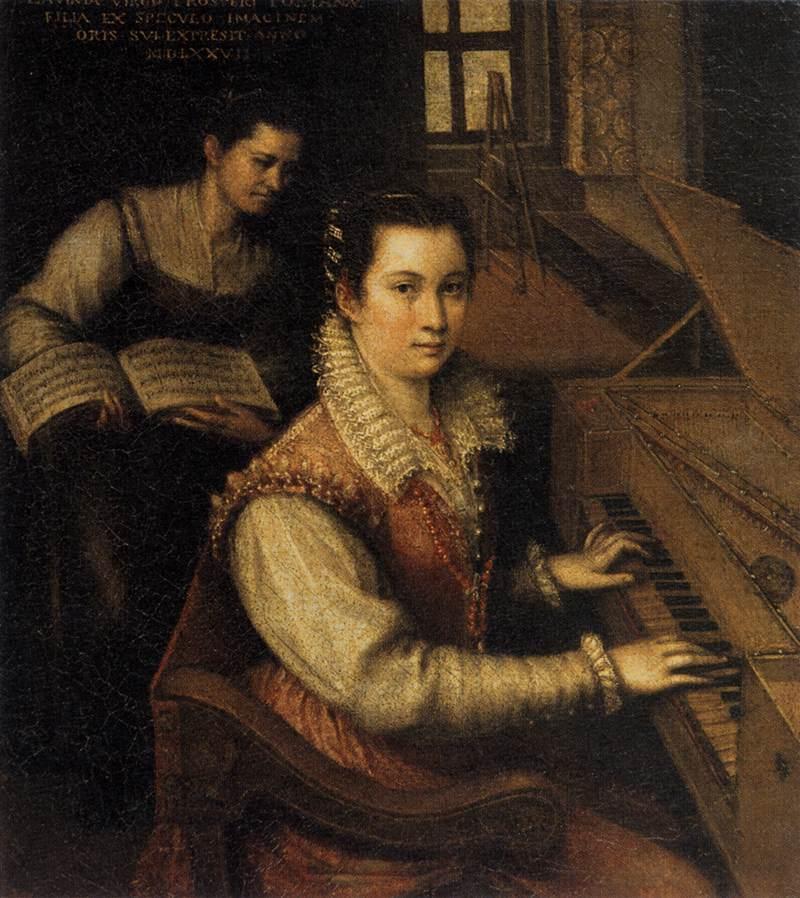
Self-Portrait at the Spinet, signed and dated 1577, Accademia Nazionale di San Luca, Rome. The Latin line on the picture names her as the daughter of Prospero Fontana and says she made the image of her face from a mirror, so the identification rests on her own inscription and on Medioli's account that she sent it to her groom's family, and Treccani identifies it with one of two portraits by her hand that Severo Zappi mentions in his letter of February 1577. A self-portrait.
Accademia Nazionale di San Luca, Rome (public domain, Web Gallery of Art file)| Full name | Lavinia Fontana, signing Lavinia Fontana de Zappis after her marriage |
|---|---|
| Worked as | Painter, Portraitist, Altarpiece painter |
| Born | Baptised 24 August 1552 (birth a few days earlier, exact... · Bologna |
| Died | 11 August 1614 · Rome |
| Nationality | Italian (Bolognese) |
| Movement | Late Mannerism and Counter-Reformation naturalism, Bologna and Rome |
| Sources | 25 cited |
| Last verified |
About this page Last verified · 25 sources cited
On this page 13 sections
ContentsClose
Lavinia Fontana ran a painting career on commissions from a city council and a king, with portraits paid for by the sitter, portraits of a pope and an ambassador that are now lost and a husband who managed the business. The National Gallery of Ireland calls her widely considered the first woman to achieve professional success beyond a court or a convent. That is the gallery's claim. This page separates what a document, a signature or a catalogue entry shows from what an exhibition text asserts.
Three numbers do not agree. Maria Teresa Cantaro's 1989 catalogue is described by the historian Francesca Medioli as identifying about one hundred works as incontestably hers. Nicholas Terpstra, reviewing Caroline Murphy's 2003 monograph, writes of 150 works known and a corpus that will grow. A Wikipedia article gives 32 signed and dated works and 25 more attributed. They count different things and none of them is a published numbered catalogue anyone can check line by line.
The fact most readers do not have: a mythological picture, the Minerva Dressing in the Galleria Borghese, inscribed FACIEBAT MDCXIII on its face, was catalogued as Titian's idea, then as Padovanino, then as Forabosco, then as Venetian school, for more than two centuries. It came back to her in 1955 on documentary evidence, including a payment for its frame, rather than on style.
Images
Chronology
- 1552
Baptised 24 August in the metropolitan church of San Pietro, Bologna, daughter of Prospero Fontana and Antonia de' Bonardis.1
- 1577
A letter of 13 February and a marriage contract of 14 February fix her marriage to Giovan Paolo Zappi, wedding set for early June; the Self-Portrait at the Spinet is sent to the Zappi family.13
- 1579
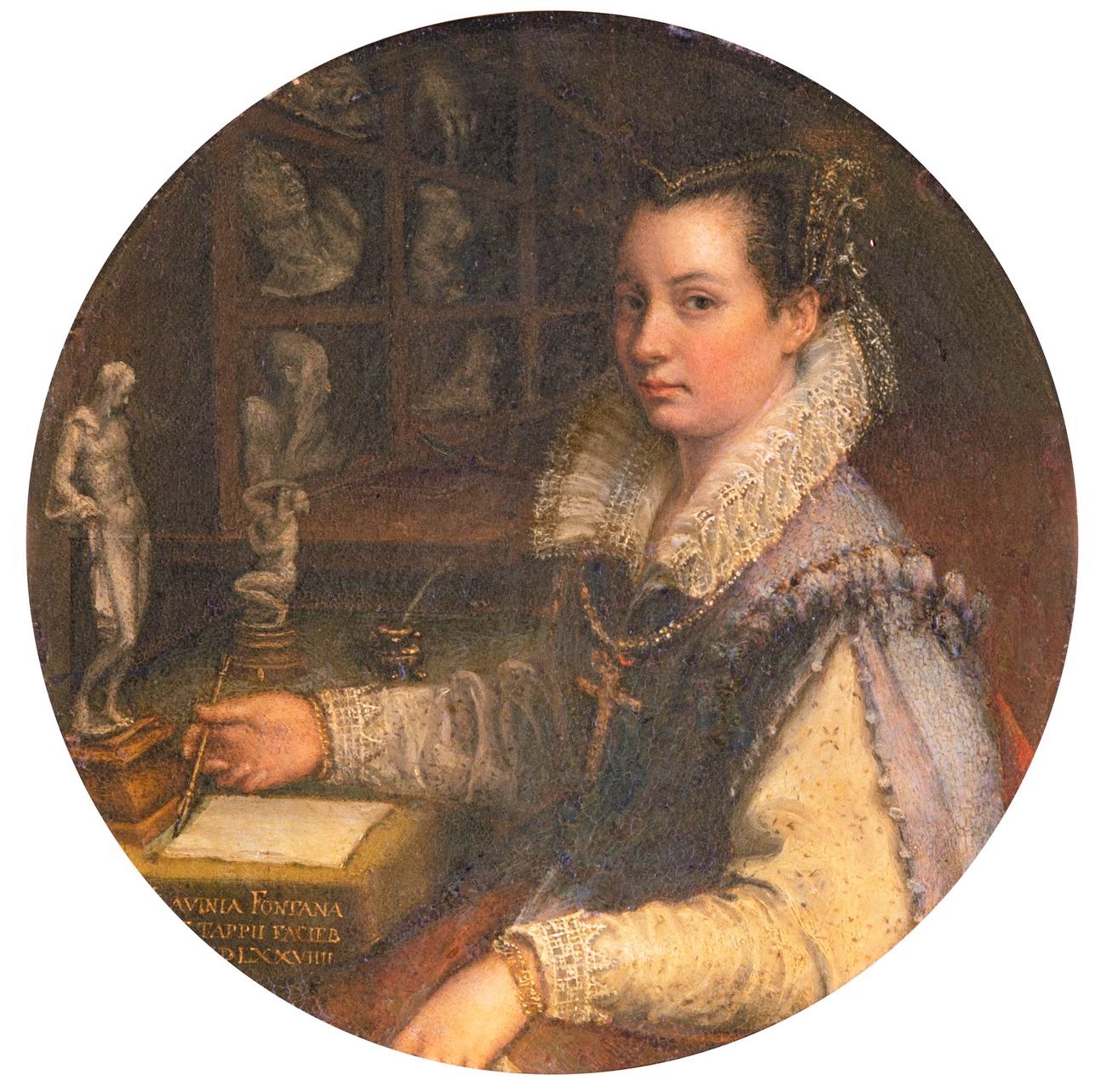
Signs the Uffizi self-portrait on copper with her married name; paints Carlo Sigonio about this time.13
- 1581
Noli me tangere, now in the Uffizi.1
- 1582
Cardinal Paleotti publishes his Discorso on sacred and profane images; Murphy argues it shaped her naturalism.2
- 1584
Assumption of the Virgin for the Imola city council, which Treccani calls her first public commission; the Gozzadini family portrait is painted the same year.12
- 1586
A deed of 3 July documents an earlier stay in Rome.1
- 1589
Holy Family with the sleeping Child, signed and dated, for the Escorial; Medioli reports a price of 1,000 ducats from Philip II.13
- 1597
- 1603
19 February: contract for the Martyrdom of Saint Stephen at San Paolo fuori le Mura, signed by Zappi and Abbot Angelo Grillo.1
- 1604
In Rome by spring; the Altemps Minerva of 1604-5 is a nude Pallas.14
- 1611
Felice Antonio Casoni strikes a medal in her honour; work begins on the Rivaldi chapel at Santa Maria della Pace.13
- 1613
Minerva Dressing inscribed FACIEBAT MDCXIII; the Borghese accounts record a payment for its frame (date not given in the entry), and Treccani says it was made for Cardinal Scipione Borghese.41
- 1614
Dies in Rome on 11 August; buried in Santa Maria sopra Minerva.118
- 1823
The basilica of San Paolo fuori le Mura burns and the Martyrdom of Saint Stephen is destroyed.1311
- 1955
Paola Della Pergola recognises the Borghese Minerva as Fontana's on documentary evidence; the frame payment is cited from her study.4
- 1989
- 1994
Fortunati's exhibition opens in Bologna and travels to Washington in 1997-98.24
- 2003
Murphy's monograph is published by Yale University Press.2
- 2019
The Prado's two-woman show runs to February 2020 with 65 paintings.10
- 2021
The Minerva is restored and diagnosed by the Istituto Centrale per il Restauro; director Francesca Cappelletti reads it as saying that a woman's beauty does not contradict talent.423
- 2023
National Gallery of Ireland show, 6 May to 27 August; Rouillac sells a second Gonsalvus portrait on 4 June.56924
- 2024
Rob Smeets shows the Rouillac Gonsalvus portrait at TEFAF; Tokyo's National Museum of Western Art, which acquired it, hangs it from September; Sotheby's offers the pregnancy portrait on 1 February.78
- 2025
The Musee de la Chartreuse in Douai announces a Portrait of a Gentleman, his Daughter and a Servant as hers.14
The market
The record I can source is a second version of the Antonietta Gonsalvus portrait, lot 57 at Rouillac's Garden Party sale at the Chateau d'Artigny on 4 June 2023. Rouillac's lot page records Adjuge : 1 250 000 EUR, which by French convention is the hammer price without fees. Rouillac's news page, quoting Arts Magazine of 1 August 2023, gives EUR 1,550,000 and calls it a world record for the artist; that is the hammer plus 24 per cent, a rate I did not find in Rouillac's conditions of sale, so I treat EUR 1.55m as the total with premium and mark the rate as inferred. Antiques Trade Gazette reported EUR 1.25m (GBP 1.1m) as a record, and Rouillac says about twenty bidders from around the world took part.
The earlier record, per Barnebys in October 2021, was USD 602,500 for the Portrait of Bianca degli Utili Maselli at Sotheby's in 2012; the basis is not stated and Barnebys is tertiary. The Sotheby's pregnancy portrait of 1 February 2024 was estimated USD 100,000 to 150,000 and its result is shown only to logged-in users.
I found no estimate for the Gonsalvus on Rouillac's lot page and make no comparison of price against estimate.
| Date | Sale | Work | Result | Note |
|---|---|---|---|---|
| 4 June 2023 | Rouillac, 35th Garden Party sale, Chateau d'Artigny, Montbazon, lot 57 | Antonietta Gonsalvus, second version, 54.5 by 47 cm | Hammer EUR 1,250,000 (Rouillac lot page: Adjuge) With premium about EUR 1,550,000 total, as reported through Rouillac's news page citing Arts Magazine; equals hammer plus 24 per cent by my arithmetic, rate not verified EUR | Found in a Burgundy private collection some months earlier per La Tribune de l'Art; expertised by Stephane Pinta of the Turquin firm; shown by Rob Smeets at TEFAF 2024 and bought by the National Museum of Western Art, Tokyo, which hung it in September 2024. |
| 2012 | Sotheby's | Portrait of Bianca degli Utili Maselli | Hammer not stated With premium USD 602,500 as reported; basis not stated USD | Reported by Barnebys, in a post of 19 October 2021, as her record at the time. Tertiary. |
Hammer is the price at which the bidding stopped; with premium adds the fee the house charges the buyer on top. Hammer price and buyer's premium in the glossary.
Recorded without a public price
- 1 February 2024 · Portrait of a Pregnant Woman, Possibly a Self-Portrait, 112 by 88 cm · Sotheby's New York, Master Paintings Part II, lot 417 · not seen: results shown to logged-in users only Estimate USD 100,000-150,000.
Where to see the work
| Institution | City | Holdings | Note |
|---|---|---|---|
| Accademia Nazionale di San Luca | Rome | Self-Portrait at the Spinet, 1577. | Gift of the academician Giulio Navone per the plaque on the frame in a Commons photograph taken at the Kunstmuseum Basel in May 2024; Commons says it normally hangs in the Academy. |
| Galleria degli Uffizi | Florence | Self-Portrait in the studio, 1579, oil on copper, 15.7 cm, no. 4013; Noli me tangere, 1581. | Per the Commons record and Treccani. |
| Galleria Borghese | Rome | Minerva Dressing, 1613, inventory 007. | Listed as not currently exhibited in the July 2022 entry. Check before a visit. |
| Pinacoteca Nazionale | Bologna | Gozzadini family portrait, 1584. | Per Treccani and Terpstra. |
| National Gallery of Ireland | Dublin | The Visit of the Queen of Sheba to King Solomon, inv. 76. | The gallery calls it her largest surviving and most ambitious painting. |
| National Museum of Women in the Arts | Washington | Portrait of Costanza Alidosi, about 1595, gift of Wallace and Wilhelmina Holladay. | |
| National Museum of Western Art | Tokyo | Portrait of Antonietta Gonsalvus, the Rouillac version. | The other known version is at the Chateau de Blois. |
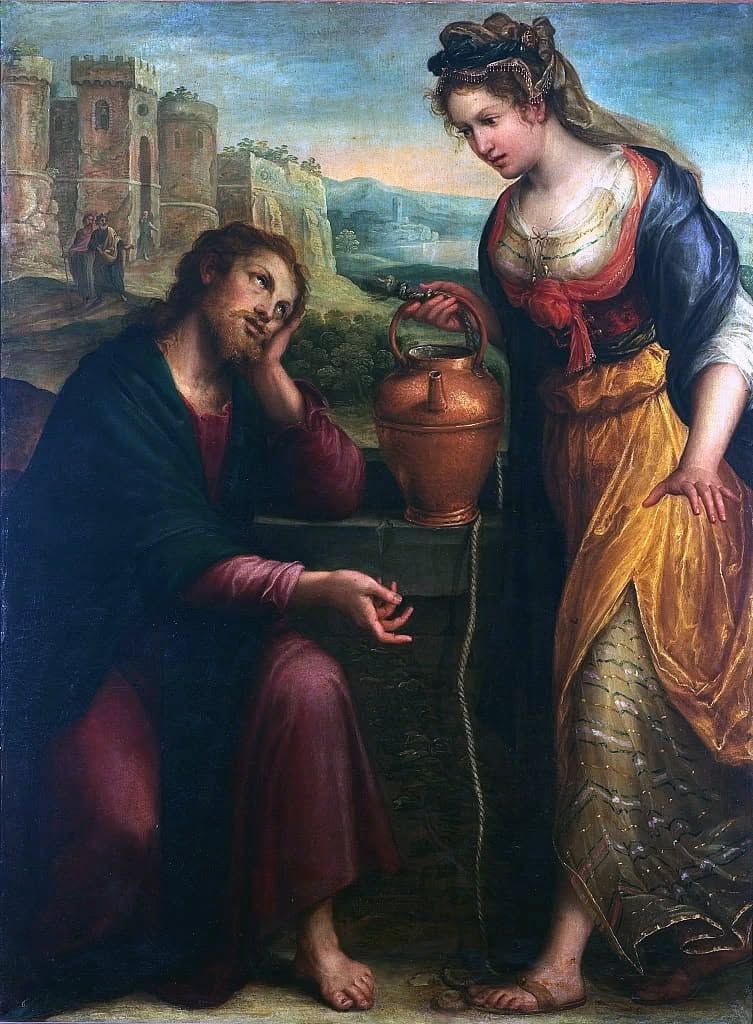
| Museo Nazionale di Capodimonte | Naples | Christ and the Woman of Samaria, 1607 per Treccani. | |
| Galleria Spada | Rome | Cleopatra. | Listed by Medioli. |
| Musee de la Chartreuse | Douai | Portrait of a Gentleman, his Daughter and a Servant, attributed 2025. | Attribution is recent. |
Forgeries and misattributions
- No forgery is documented; the recorded problems are misattribution and recent reattribution.
- The Minerva Dressing was assigned for two centuries to Titian's circle, Padovanino, Forabosco and the Veneto school despite a visible signature and date. The pregnancy portrait was sold as Coello in 1909 and Veronese in 1963 and printed by Murphy as Scipione Pulzone, then published as Fontana by Fortunati in 2007. The Minerva on documentary evidence, including a payment for its frame in the Borghese accounts, cited from Della Pergola 1955. The pregnancy portrait by stylistic and costume comparison by Fortunati, Cataldi Gallo, Cantaro and Pulini. No technical test is reported in the sources I opened.47
The essay
Chapter 1Counting what survives
No single count of Fontana's paintings can be cited as settled.
No single count of Fontana's paintings can be cited as settled. Terpstra's 2004 review in caa.reviews says she has the largest body of surviving work of any woman painter before the eighteenth century, 150 works known, and expects the figure to grow because pictures circulated through Italy, Germany and Spain and some are still being identified. Medioli's entry in Women in World History describes Cantaro's 1989 catalogue as identifying about one hundred works as incontestably attributed, usually signed and dated, now in museums in Italy and abroad. The Treccani biography goes the other way on her Roman years: it says few surviving works are known there and that for her portraits no secure example has come down, although many were made.
The Wikipedia article gives more than 100 documented works, 32 signed and dated and 25 attributed. I could not trace that breakdown to a catalogue. Treat it as a tertiary figure that may be a summary of Cantaro or Murphy and cannot be tested from the article.
What can be said is that the catalogue is still moving at the edges. Three recent additions: a Mars and Venus in the Liria Palace in Madrid, shown as hers at the Prado in 2019 and credited to Enrico Maria Dal Pozzolo's 2022 book (the two dates sit awkwardly together and I did not resolve them), a second version of the portrait of Antonietta Gonsalvus that sold in France in 2023, and a portrait of a gentleman, his daughter and a servant that the Musee de la Chartreuse in Douai unveiled in March 2025 as hers after decades in store; Wikipedia says it had been attributed to Pieter Pourbus.
Chapter 2The name on the picture
Her signature changes with her status and so can be used to date a picture.
Her signature changes with her status and so can be used to date a picture. Before the wedding of 1577 she signed as a daughter. The self-portrait she sent to the Zappi family carries a Latin inscription that reads on the Commons image as Lavinia, maiden, daughter of Prospero Fontana, made the image of her face from the mirror, in the year 1577. After the marriage she added her husband's name. The 1579 self-portrait on copper in the Uffizi, 15.7 cm across, carries a formula with her husband's surname and faciebat and a date that reads as MDLXXVIIII on the image, and Treccani says she signed it adding her husband's surname to her own, which matches the 1579 that Treccani gives.
One tertiary source prints that formula with the date MDLXXVIII, which would be 1578. The image and Treccani both say 1579 and this page follows them. The Minerva carries the same verb, faciebat, with MDCXIII under the foot of the seated putto, per the Borghese catalogue entry.
A woman's name that keeps its husband's inside it is also an attribution problem: Treccani, Wikipedia and Aware all say she added Zappi to her signature after marriage, so a work signed only Lavinia Fontana is not automatically early.
Chapter 4The self-portrait as an object sent to a father-in-law
The 1577 Self-Portrait at the Spinet in the Accademia di San Luca in Rome is a small picture made to travel.
The 1577 Self-Portrait at the Spinet in the Accademia di San Luca in Rome is a small picture made to travel. Medioli reports that Lavinia sent it as a present to her groom's family and that Severo Zappi, who had never met her, wrote that the bride was neither fair nor ugly but in the middle, as women must be. The picture therefore functioned as a marriage document: she shows an instrument, an easel in the window behind her, a servant holding a music book, a Latin line that names her father and a signed date.
The documents say only that it was sent and what the recipient wrote back. A separate Commons photograph of the framed picture, taken at the Kunstmuseum Basel in May 2024 and not the plate used here, shows a plaque reading as a gift of the academician Giulio Navone, 1853-1941. Treccani says it passed through several owners, reconstructed by Cantaro, and entered the Academy shortly after 1940. The instrument is a spinet in Treccani, a virginal at the National Gallery of Ireland and a clavichord in Medioli and Indiana.
Treccani says the 1579 Uffizi tondo was requested by the Spanish Dominican Alfonso Chacon for a collection of portraits of famous people, and cites letters between him and the painter of 17 October 1578 and 3 May 1579. The tondo shows a pen, an ink pot and a paper, with antique statuettes and a shelf of casts behind. Hyperallergic, reviewing the 2019 Prado exhibition, reads the statuettes as Mars and Venus and states that she painted it while pregnant with her third child. Both statements are the reviewer's.
Chapter 5Prospero Fontana and the Bolognese rules for images
Her father, Prospero Fontana, is the link to Bologna's reforming bishop.
Her father, Prospero Fontana, is the link to Bologna's reforming bishop. Murphy, per Terpstra, sees Fontana's naturalistic style as shaped in part by Cardinal Gabriele Paleotti, whose 1582 Discorso intorno alle immagini sacre e profane promoted subdued, moral and didactic art, and whose personal support opened doors from the late 1570s. Medioli adds that Prospero worked with Paleotti and gave technical support when the treatise was published; Aware calls Paleotti Prospero's close friend. Paleotti's name also appears among the godparents of Fontana's children alongside the Gozzadini and Boncompagni, per Medioli, and the National Gallery of Ireland likewise says the city's most powerful families appear in her children's baptismal records as godparents.
That is documented for the friendship and the godparents. That the Discorso shaped her pictures is Murphy's argument and not something a document states. Terpstra's own reservation is that Murphy explores patrons in depth and says little about Fontana's relation to the Carracci, so what the review sees in her work is a maturing technique more than a developing style.
Prospero died in 1597 according to Treccani's entry on him, Medioli, Aware and the Indiana museum. Terpstra gives 1596 for his dates. This page follows 1597.
Chapter 6Who paid, and how
Terpstra's summary of Murphy is the clearest account of her market in Bologna.
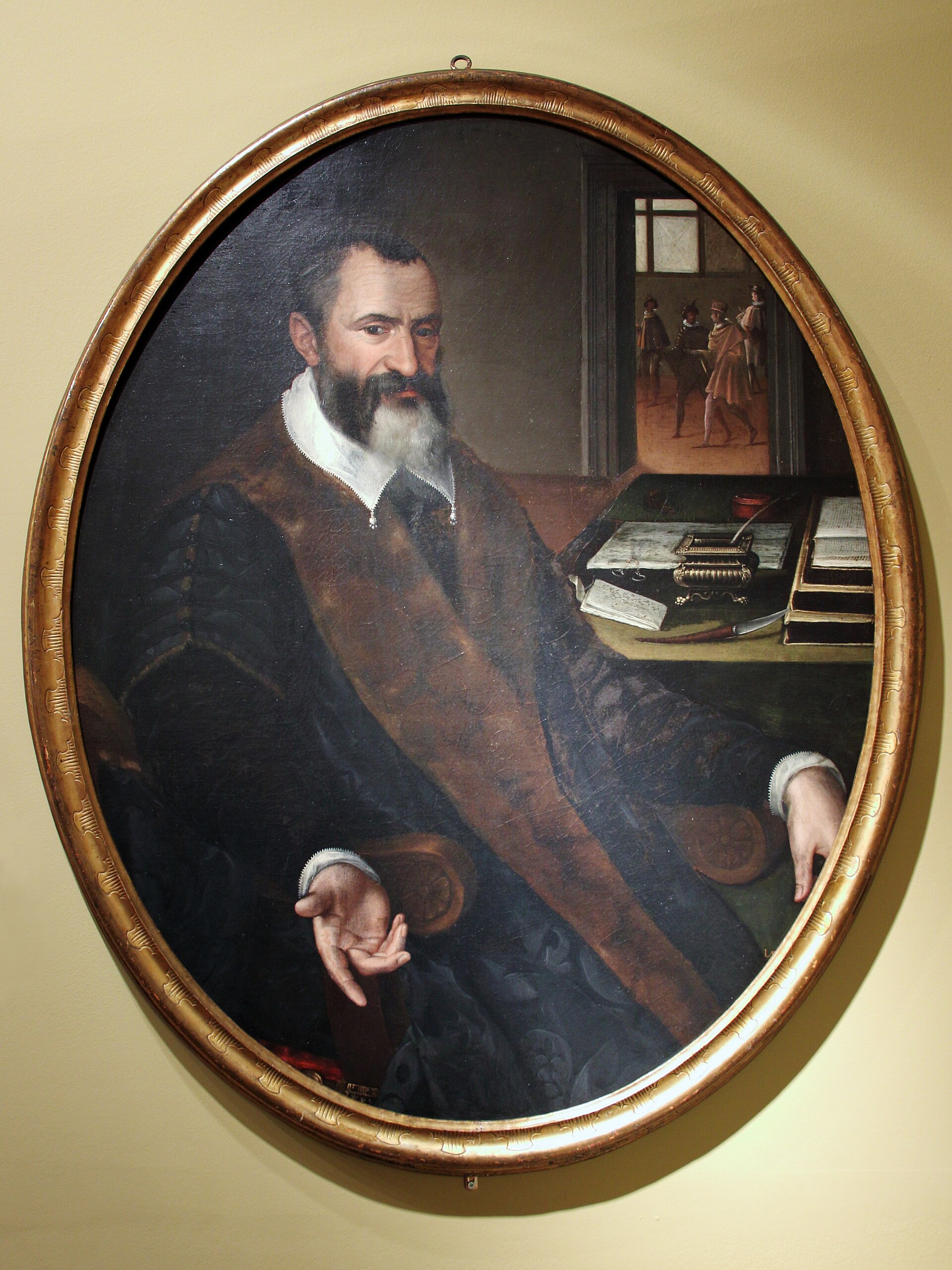
Terpstra's summary of Murphy is the clearest account of her market in Bologna. Early commissions were devotional pictures and children's portraits. From the late 1570s to the mid 1580s she painted scholars and clerics: Carlo Sigonio and Girolamo Mercuriale commissioned portraits they could send to correspondents elsewhere, and some clerics neglected to pay at all. From the mid 1580s noblewomen became her favourite sitters because they paid more handsomely and more reliably. Medioli records that the Sigonio portrait of about 1578 was asked for by the Dominican Alfonso Chacon, who collected portraits of eminent men. The painting is now in the Museo Civico in Modena, 125.5 by 98 cm, per the Commons record, and the photograph on this page was taken at an exhibition about Bartolomeo Cesi in Bologna.
The Gozzadini family portrait of 1584 in the Pinacoteca Nazionale in Bologna, according to Terpstra's reading of Murphy, was commissioned by one of the two legitimated daughters of Ulisse Gozzadini to assert her place in the family and in the inheritance; Murphy based this on correspondence, financial records and wills produced decades later.
The National Gallery of Ireland quotes Malvasia that at her height she could not walk the fashionable streets of Bologna without being stopped by women asking to be painted. That is a biographer's report from 1678, long after her death.
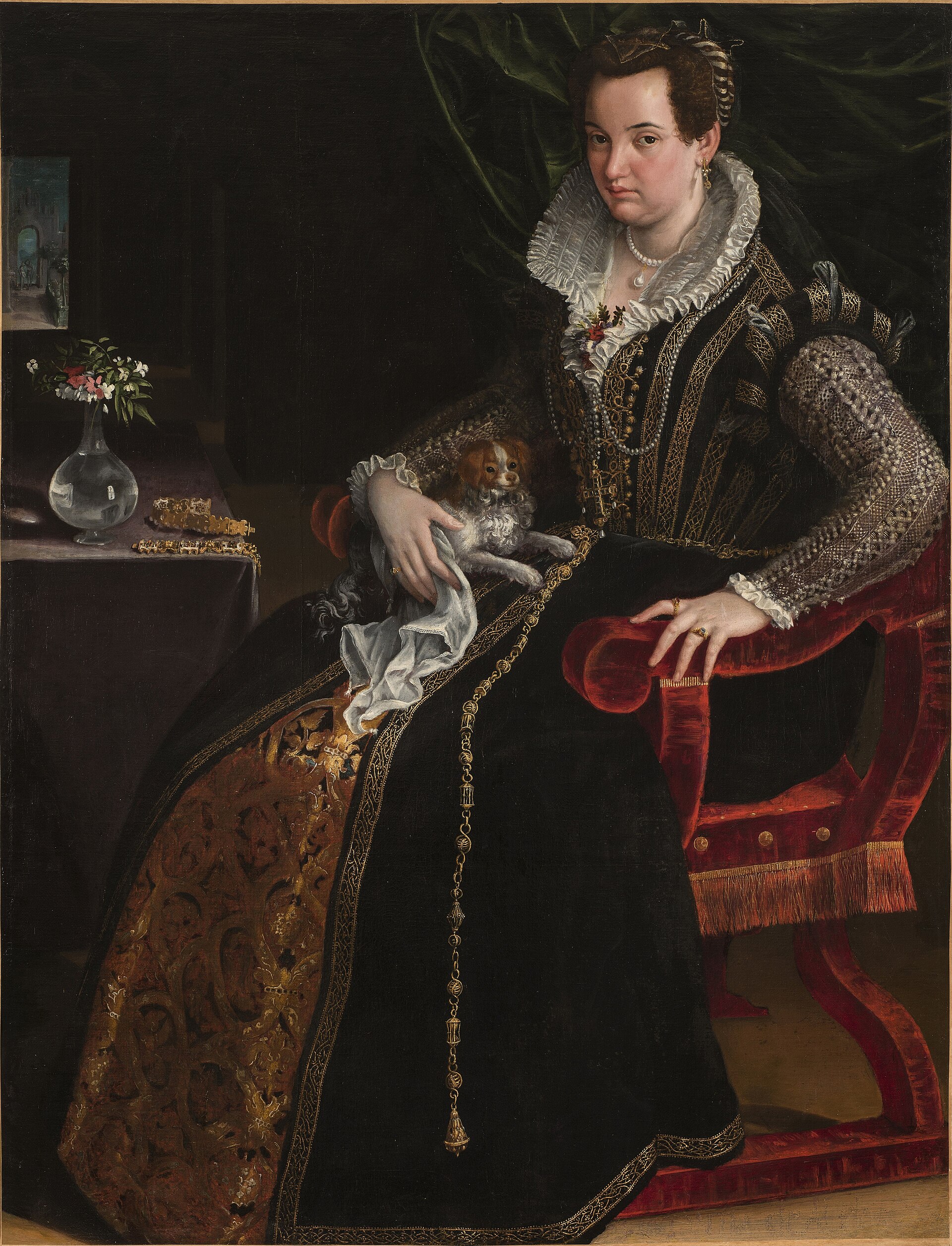
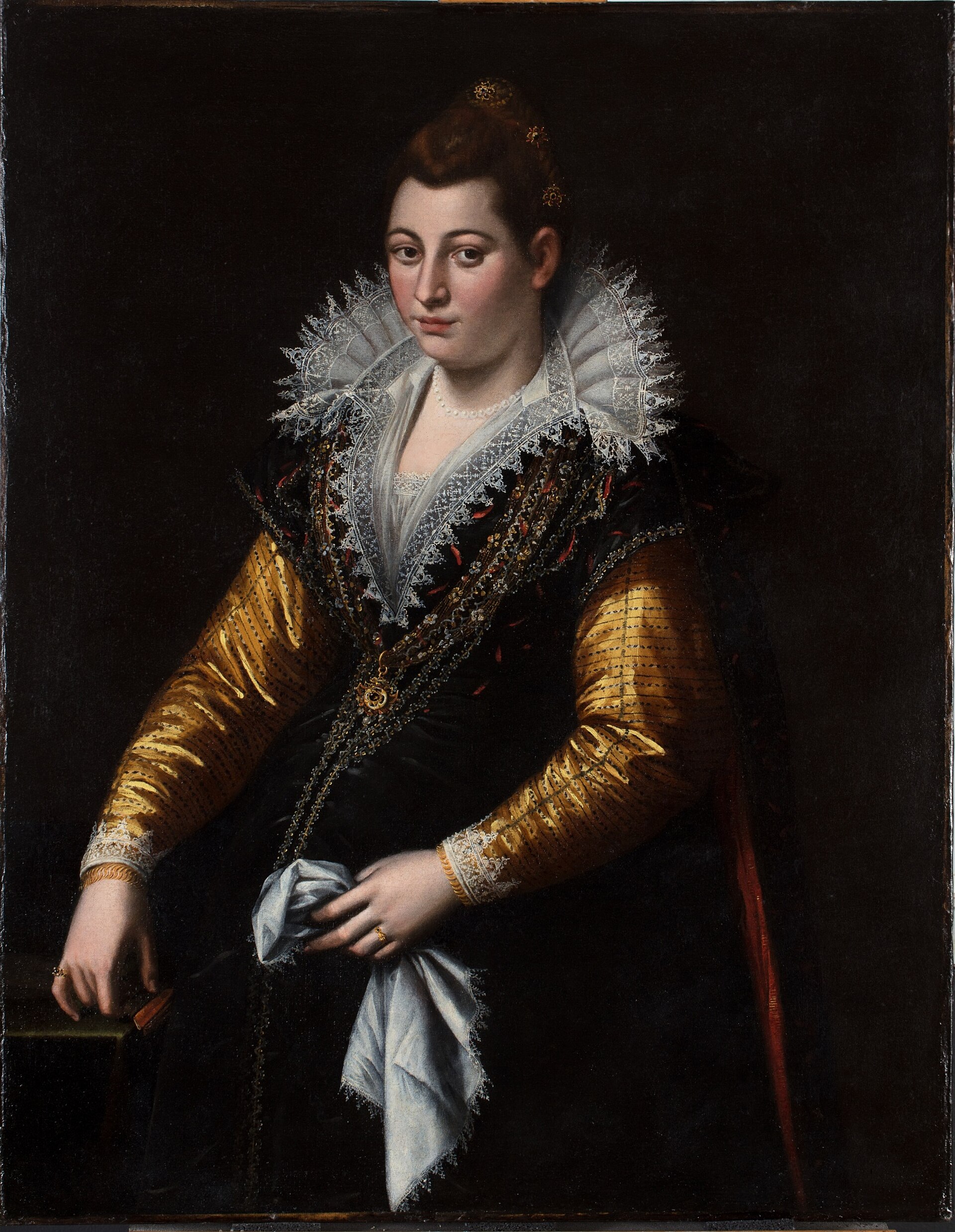
The Alidosi portrait in Washington shows what the sitters bought. The National Museum of Women in the Arts says Costanza Alidosi married the senator Ridolfo Isolani in 1571 and that the dog on her lap and the juniper blossoms at her bodice likely stand for fidelity to a husband who was often away. That is the museum's likely reading, flagged by the museum as likely, and not a document.
Chapter 7The king's altarpiece and the price
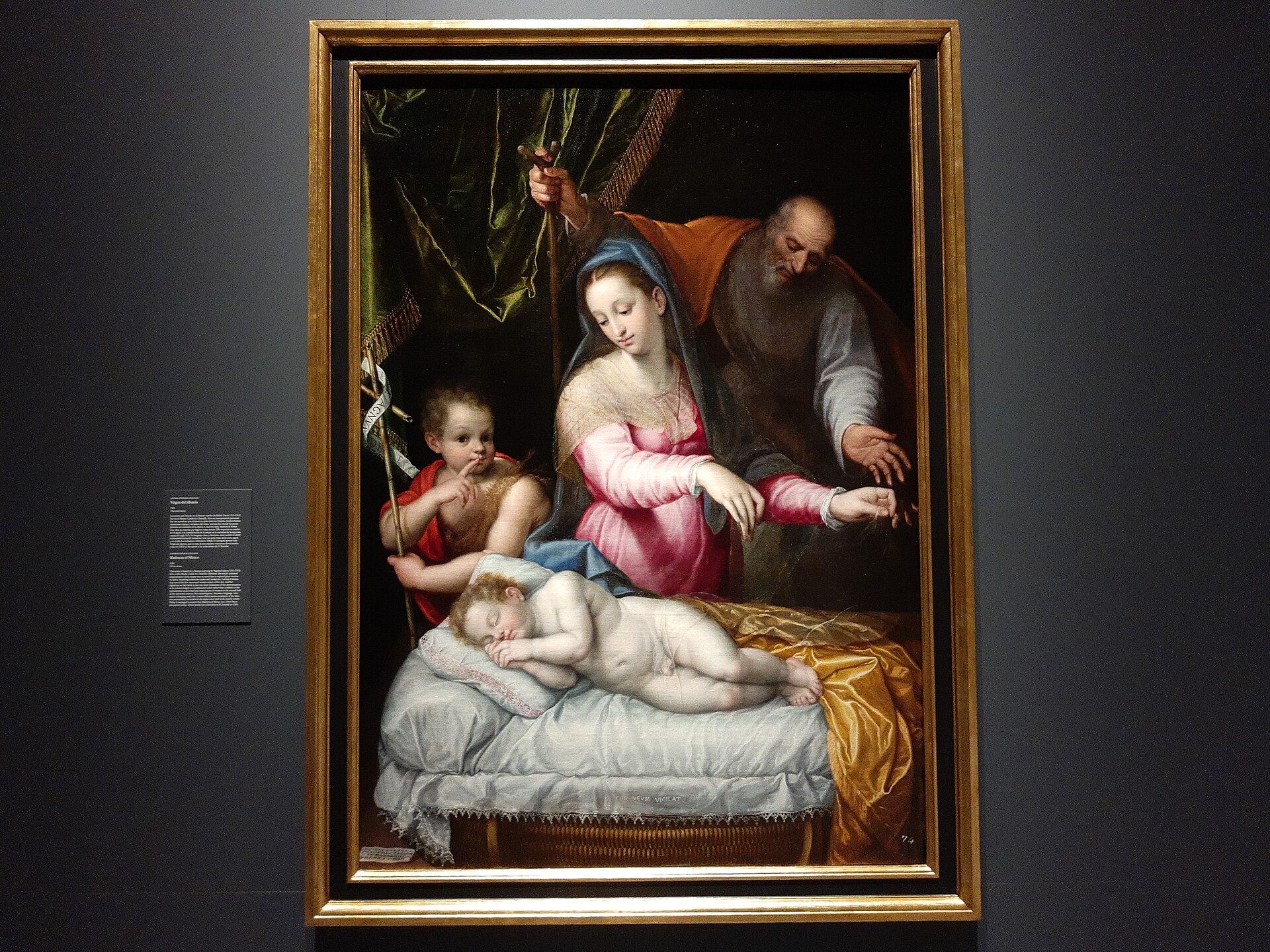
Treccani records a Holy Family with the sleeping Child and the young Saint John, signed and dated 1589, for the Pantheon of the Infantes at the Escorial, commissioned for Philip II of Spain.
Treccani records a Holy Family with the sleeping Child and the young Saint John, signed and dated 1589, for the Pantheon of the Infantes at the Escorial, commissioned for Philip II of Spain. Medioli says Philip paid 1,000 ducats, against 800 ducats paid to Annibale Carracci for pictures of similar size in the same period, and says the picture is still on the altar it was commissioned for, which sits oddly beside a Virgen del Silencio on display in Madrid. That price comparison is Medioli's and I could not trace it to an account in the sources I opened.
Treccani adds the picture's programme. It quotes Vera Fortunati (1994) reading it as a web of religious emblems running from Bocchi to Jesuit emblematics, with the sleeping Child, like the Spanish infante, dreaming of the sacrifice ahead, and it says the inscription Cor meum vigilat is taken from Giulio Bonasone's engraving of a Madonna of Silence after a Michelangelo prototype made for Vittoria Colonna. That is an argued reading by a named scholar plus an inscription Treccani reports; Treccani does not say who chose the emblem.
There is no documented modern equivalent here and none is attempted. Ducat values moved and the methods for converting them differ by an order of magnitude. The useful comparison is internal: on Medioli's figures a Bolognese woman painter was paid more by a king than Annibale Carracci was paid for pictures of similar size in the same period. Terpstra says the same thing more broadly, that she could draw greater fees than the Carracci.
A picture called Virgen del Silencio, dated 1589, hangs in the Galeria de las Colecciones Reales in Madrid, per two Spanish blogs, and the composition shown matches the subject that Treccani gives for the Escorial picture. I did not open a Patrimonio Nacional catalogue entry that ties the two, and the plate on this page is captioned accordingly.
Chapter 8Rome, 1603 to 1614
Treccani documents a probable earlier stay by a deed of 3 July 1586 and says she was in Rome by spring 1604, at about fifty.
Treccani documents a probable earlier stay by a deed of 3 July 1586 and says she was in Rome by spring 1604, at about fifty. The Wikipedia article says she moved at Clement VIII's invitation and Medioli says she lived in the palace of Cardinal d'Este; Indiana repeats the invitation. I found no archival source for the invitation or the lodging in what I could open.
The Roman career opened with the picture that failed. The contract for the Martyrdom of Saint Stephen for the basilica of San Paolo fuori le Mura is dated 19 February 1603. Treccani says it was signed by Zappi and by Abbot Angelo Grillo of Genoa, and that it was a commercial and critical failure, described by Baglione as a loud failure. Medioli calls it her last public commission and says it drew criticism at the start of her stay. The basilica burned in 1823 and the picture was destroyed, per Treccani and Medioli. What survives of the composition is a small engraving by Jacques Callot, plate 1 of Les Tableaux de Rome, dated 1607 to 1611 and catalogued by the Metropolitan Museum as after Lavinia Fontana, second state of three.
After that she worked in smaller formats and for private patrons. Treccani lists a Head of a Youth bought by Cardinal Scipione Borghese in 1606, the Samaritan Woman at the Well of 1607 now in Naples, and a portrait of Angelo Grillo of 1606 that is lost. Medioli says she portrayed Pope Paul V and the Persian ambassador and that both portraits are lost. Treccani and Medioli agree on the Rivaldi chapel in Santa Maria della Pace, 1611 to 1614: Treccani says she worked there with Albani and Passignano, and Medioli says she painted four full-length saints in oil on slate.
In 1611 Felice Antonio Casoni struck a medal in her honour, per Treccani; Aware says the reverse shows a personification of painting at an easel. She died on 11 August 1614 and was buried in Santa Maria sopra Minerva. Medioli gives 13 August in one line and 11 August in another, and Treccani, Wikipedia and Indiana give 11 August. Her sons wrote an epitaph, now destroyed, that said her fame reached outside the feminine sphere. Zappi died in Imola, in 1616 according to Medioli and in 1615 according to Aware.
Chapter 9The Minerva Dressing and the question of the nude
The Borghese entry by Antonio Iommelli of July 2022 documents the picture closely.
The Borghese entry by Antonio Iommelli of July 2022 documents the picture closely. It is oil on canvas, 258 by 190 cm, inscribed FACIEBAT MDCXIII, and it records a payment by Cardinal Scipione Borghese to Annibale Durante, the household carpenter, for a frame for the Pallas by Mrs Lavinia Fontana, thirteen spans high by eight. Whether Scipione bought it or was given it is unresolved; the 2018 Herrmann Fiore reference cited in the entry says either. The first mention is Domenico Montelatici in 1700, who calls it an idea of Titian. Mariano Vasi assigned it to Padovanino in 1818 despite the date and signature being clearly visible, Nibby, Piancastelli and Venturi followed, Longhi and Fiocco rejected that and proposed Girolamo Forabosco, De Rinaldis in 1939 gave it to the seventeenth-century Veneto school, and in 1955 Paola Della Pergola recognised the Bolognese painter on documentary evidence.
The entry also records an earlier similar picture of 1604 to 1605, now in the Pavirani collection in Bologna, commissioned by Marco Sittico Altemps. Patrizia Tosini found in 2019 that Altemps is named in a 1605 poem by Ottaviano Rabasco called La Pallade ignuda della famosa pittrice Lavinia Fontana, the nude Pallas by the famous woman painter. The entry argues that Scipione, having seen the Altemps picture, asked for a similar one to stand beside the Venuses in his collection. That is the catalogue's argument from a documented poem.
On what the subject meant, the entry reports Silvia Urbini's 1994 view that the subject has its source in Vincenzo Cartari's Imagini degli dei and in Achille Bocchi's Symbolicae quaestiones of 1555, which the entry says probably inspired it, and the entry itself adds that Minerva was also protectress of spinners, which appears to be suggested by the garments she is about to put on. The gallery's director Francesca Cappelletti, quoted by Art History News in March 2021, reads it as a Minerva painted naked in an attitude typical of Venus, to say that a woman's beauty does not contradict talent. That is a modern reading and is marked here as one.
The claim that Fontana was the first woman to paint the female nude is made in the National Gallery of Ireland's press release for its 2023 show and by Hyperallergic in 2019. The Borghese entry, which is the most documented text on her nude, does not make it. The Borghese entry itself records an earlier nude Pallas of 1604 to 1605, and Hyperallergic shows a Mars and Venus of about 1595, so the Minerva of 1613 is not her first nude. Whether she worked from a live model, a question popular surveys raise, no source I opened documents. The claim that she was first among women anywhere I could not test and it should be read as an exhibition claim. Wikipedia words it as perhaps the first, a topic of controversy. A second first-woman claim, that the Imola Assumption of 1584 was the first altarpiece by a woman in Catholic Europe, is Treccani's, and the National Gallery of Ireland repeats it as the first woman to paint public altarpieces; I found no source that tests it. The gallery's own wording that she is widely considered the first woman to succeed outside a court or a convent is likewise a claim about reputation.
One more fact complicates the Borghese picture. Treccani says another Minerva was painted in the same year, 1613, for Count Francesco Gambara, citing Boselli 1971, and Aware says she painted two versions in 1613. The Borghese entry mentions no such second picture of 1613, and I found nothing that places the Gambara picture.
Chapter 10Attribution traps and recent finds
The portrait of a pregnant woman offered by Sotheby's in New York on 1 February 2024 as lot 417 has a provenance that reads as a history of the problem.
The portrait of a pregnant woman offered by Sotheby's in New York on 1 February 2024 as lot 417 has a provenance that reads as a history of the problem. It was sold in Munich in 1909 as Alonso Sanchez Coello, in Hannover in 1963 as Paolo Veronese, and appears in Murphy's 2003 book as Scipione Pulzone; Vera Fortunati published it as Lavinia Fontana in 2007. Sotheby's catalogue note says it may be a self-portrait of about 1592 when she was pregnant with Severo or Costanza, a proposal credited to Massimo Pulini, while Cantaro placed it around 1600 and Cataldi Gallo and Fortunati in the 1590s. The note gives the birth dates of 5 December 1592 for Severo and 20 April 1592 for Costanza. Medioli lists Severo as born in 1592 and Costanza in 1595, so the catalogue and the encyclopedia disagree about Costanza.
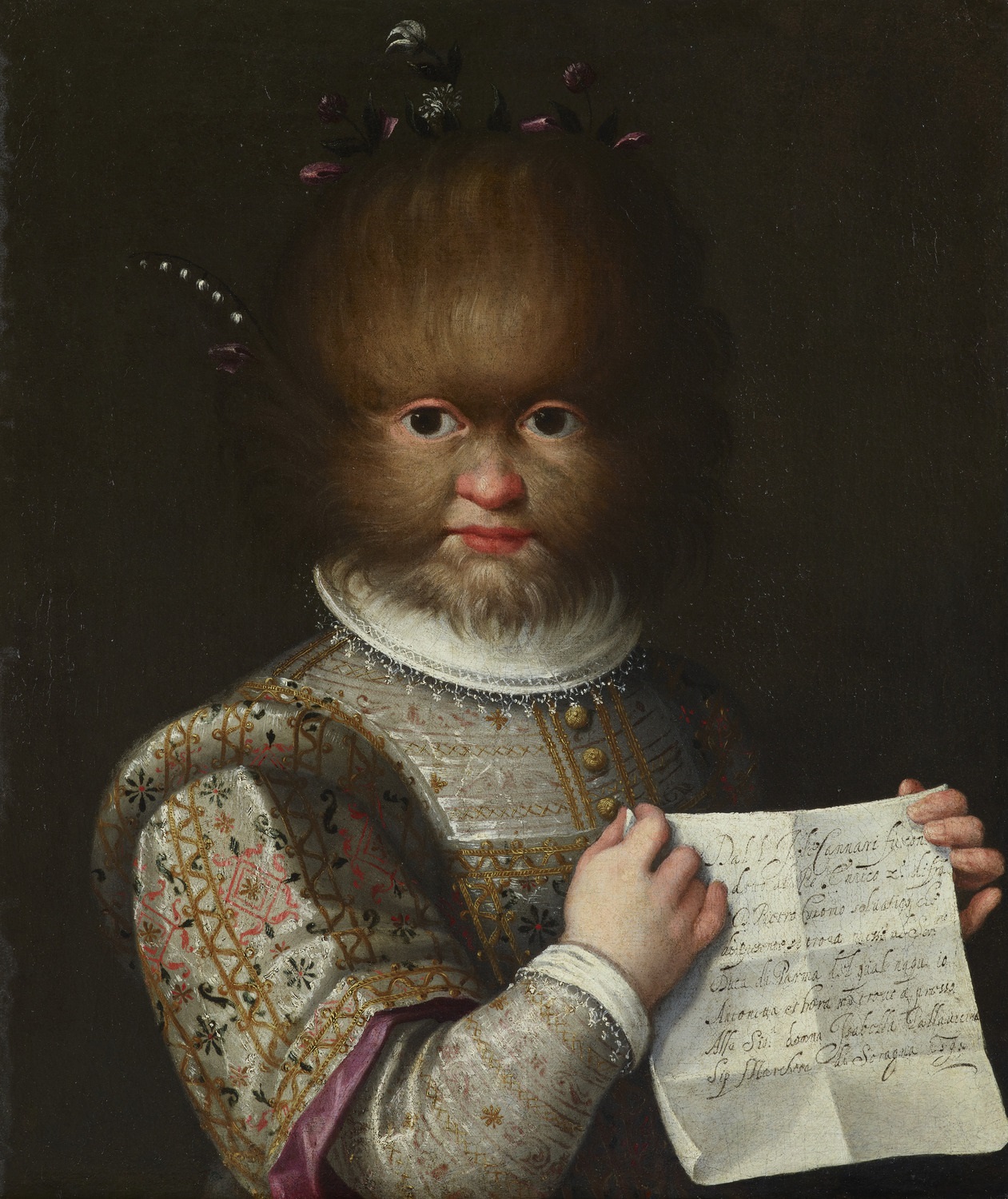
The Gonsalvus case runs the other way. Antonietta Gonsalvus, a girl with hypertrichosis dressed in court finery, was known until then through the version at the Chateau de Blois, per La Tribune de l'Art. Rouillac's June 2023 sale, expertised by the Turquin firm, was of a previously unpublished version found in a Burgundy private collection. The question of whether the Blois or the sold version is the original is the title of a Gazette Drouot article that appears on Rouillac's site; I could see the title and not the argument. Rob Smeets showed it at TEFAF 2024 and the National Museum of Western Art in Tokyo bought it and hung it in September 2024. Rouillac's lot page gives the sale as lot 57 on 4 June 2023 at the Chateau d'Artigny and the hammer price as EUR 1,250,000.
The Mars and Venus in the Fundacion Casa de Alba is credited to Dal Pozzolo in a 2022 book published by ZeL Edizioni; Finestre sull'Arte calls the attribution very convincing, which is its judgement. Hyperallergic, reviewing the Prado show in December 2019, already captioned the same picture as hers and dated it to about 1595, so the 2022 book cannot have been the first public attribution; I did not find an earlier publication.
Chapter 11Forgotten, then rebuilt
Medioli says her fame disappeared in the centuries after her death and that she was remembered as a prodigy, a woman as skilled as a man.
Medioli says her fame disappeared in the centuries after her death and that she was remembered as a prodigy, a woman as skilled as a man. Malvasia's 1678 Felsina pittrice is the first history. The scholarship that rebuilt her is short enough to list: Della Pergola's 1955 archival identification of the Minerva, Cantaro's 1989 catalogue, Vera Fortunati's Bologna exhibition of 1994, which went to the National Museum of Women in the Arts in Washington in 1997 and 1998, with an English edition of the catalogue from Electa in 1998, Murphy's 2003 Yale monograph, the Prado's A Tale of Two Women Painters in 2019 and 2020 with 65 paintings by her and Sofonisba Anguissola, the restoration and diagnostics of the Minerva by the Istituto Centrale per il Restauro in 2021, and the National Gallery of Ireland's 2023 show, which its curator Aoife Brady called the first monographic exhibition in almost thirty years; the gallery's press release adds that it was the first to focus on her portraits.
A genuine disagreement sits inside that story. The Irish press release calls her the first woman to manage her own workshop. Terpstra's 2004 review says the social setting that fostered her career left her without disciples, and that she could not run a workshop or train apprentices. Medioli says she never worked in a bottega, meaning as a pupil. Indiana's museum says Zappi painted background elements in her studio, and Treccani says he ran the commercial organisation of her bottega. These cannot all be right in the same sense, and the word workshop is carrying different meanings; I give the positions and do not reconcile them.
What is documented
Technique
The surviving work
- What is accepted
- About 100 incontestably attributed works per Cantaro 1989, as summarised by Medioli; 150 works known per Terpstra 2004; 32 signed and dated and 25 attributed per Wikipedia. No source gives a numbered, checkable list. The count of what is documented in the Roman years is low by Treccani's own account.
- What is contested
- The Minerva was given to Titian's circle, Padovanino, Forabosco and the Veneto school before 1955. The pregnancy portrait was sold as Coello and Veronese and printed as Pulzone by Murphy in 2003. Mars and Venus, the second Gonsalvus and the Douai portrait are recent additions. Roman portraits of Paul V and the Persian ambassador are lost. A Commons image labelled as her 1609 portrait of the Persian ambassador, credited to a Pinault collection, is not confirmed here.
- Who rules on attribution
- No authentication board or foundation that I found. Attribution is decided by curators and by the scholars Cantaro, Fortunati, Murphy, Tosini, Dal Pozzolo and Pulini, and by auction-house experts such as the Turquin firm for the Gonsalvus version.
Catalogue raisonne
- Maria Teresa Cantaro, Lavinia Fontana bolognese 'pittora singolare', 1552-1614 (Milan: Jandi Sapi, 1989). First full catalogue; set the parameters of the corpus per Terpstra.23
- Vera Fortunati (ed.), Lavinia Fontana of Bologna, 1552-1614 (Milan: Electa, 1998), from the 1994 Bologna catalogue. Exhibition catalogue that travelled to the National Museum of Women in the Arts.24
- Caroline P. Murphy, Lavinia Fontana: A Painter and Her Patrons in Sixteenth-Century Bologna (New Haven: Yale University Press, 2003). Documents contract, patrons and the Gozzadini commission; prints the marriage contract; catalogued the pregnancy portrait as Pulzone.27
- Aoife Brady, Lavinia Fontana: Trailblazer, Rule Breaker (National Gallery of Ireland, 2023), with Babette Bohn and Jonquil O'Reilly. Exhibition book; I did not see its contents.5
Questions about Lavinia Fontana
Who was Lavinia Fontana?
Painter; Portraitist; Altarpiece painter. 1552-1614.
When did Lavinia Fontana live?
Born Baptised 24 August 1552 (birth a few days earlier, exact day unrecorded), Bologna; died 11 August 1614, Rome.
How are fakes and misattributions of Lavinia Fontana detected?
No forgery is documented; the recorded problems are misattribution and recent reattribution. The Minerva Dressing was assigned for two centuries to Titian's circle, Padovanino, Forabosco and the Veneto school despite a visible signature and date. The pregnancy portrait was sold as Coello in 1909 and Veronese in 1963 and printed by Murphy as Scipione Pulzone, then published as Fontana by Fortunati in 2007.
Where can you see work by Lavinia Fontana?
Accademia Nazionale di San Luca (Rome); Galleria degli Uffizi (Florence); Galleria Borghese (Rome); Pinacoteca Nazionale (Bologna); National Gallery of Ireland (Dublin); National Museum of Women in the Arts (Washington).
What does the market for Lavinia Fontana look like?
The record I can source is a second version of the Antonietta Gonsalvus portrait, lot 57 at Rouillac's Garden Party sale at the Chateau d'Artigny on 4 June 2023. Rouillac's lot page records Adjuge : 1 250 000 EUR, which by French convention is the hammer price without fees.
What is still unresolved about Lavinia Fontana?
How many paintings are by her hand: about 100, 150 or more, and is there any published numbered list? Three sources give three figures and none can be checked line by line.
Open questions
- How many paintings are by her hand: about 100, 150 or more, and is there any published numbered list? Three sources give three figures and none can be checked line by line.
- Did she run a workshop? The National Gallery of Ireland says she was the first woman to manage her own workshop, Terpstra says she could not run one or train apprentices, and Indiana says Zappi painted backgrounds. No hand study separates the contributions.
- Which Gonsalvus is the original, the Blois picture or the Rouillac version now in Tokyo? I saw only the title of the Gazette Drouot article that asks the question.
- Did she paint the Minerva or any nude from a live model, and was she the first woman to paint the female nude? Nothing I opened documents a model and the Irish press release's first-woman claim cannot be tested.
- Is the second Minerva of 1613 for Count Francesco Gambara, reported by Treccani from Boselli 1971 and by Aware, a separate picture, and where is it now?
- Where are the portraits of Pope Paul V and the Persian ambassador that Medioli calls lost, and is the 1609 portrait of Ali-qoli Beg on Wikimedia Commons, credited to a Pinault collection, hers? I could not confirm it.
- Which dates are right: Prospero's death in 1596 or 1597, her own on 11 or 13 August, Zappi's in 1615 or 1616, and Costanza's birth in 1592 or 1595?
Sources
- 1Treccani, Dizionario Biografico degli Italiani, 'Fontana, Lavinia' (reference work, opened in full). treccani.it/enciclopedia/...
- 2Nicholas Terpstra, review of Caroline P. Murphy, Lavinia Fontana (Yale, 2003), caa.reviews, 15 April 2004, DOI 10.3202/caa.reviews.2004.29 (read on a mirror host). w-ww.caareviews.org/reviews/...
- 3Francesca Medioli, 'Fontana, Lavinia (1552-1614)', Women in World History: A Biographical Encyclopedia (Gale, via Encyclopedia.com). encyclopedia.com/people/...
- 4Antonio Iommelli, catalogue entry 'Minerva Dressing', Galleria Borghese, July 2022. collezionegalleriaborghese.it/en/...
- 5National Gallery of Ireland, press release for 'Lavinia Fontana: Trailblazer, Rule Breaker', 2023. nationalgallery.ie/node/...
- 6National Gallery of Ireland, 'Five things to know about Lavinia Fontana', 2023. nationalgallery.ie/node/...
- 7Sotheby's, Master Paintings Part II, 1 February 2024, lot 417, Portrait of a Pregnant Woman, Possibly a Self-Portrait, with provenance and catalogue note. sothebys.com/en/...
- 8La Tribune de l'Art, 'Tokyo acquiert un portrait de Lavinia Fontana', 10 January 2025 (first lines only; subscriber content). latribunedelart.com/tokyo-acquiert-le-portrait-inedit-de-...
- 9Antiques Trade Gazette, 'Second Gonsalvus portrait now emerges', June 2023 (opening lines read in a browser: sold in France for a record EUR 1.25m, GBP 1.1m; paywalled beyond that; the basis of the price is not stated there). antiquestradegazette.com/print-edition/...
- 10Lauren Moya Ford, 'A Tale of Two Pioneering Women Painters in Renaissance Italy', Hyperallergic, 5 December 2019 (review; the first-woman claims are the reviewer's). hyperallergic.com/sofonisba-anguissola-and-lavinia-fontan...
- 11Metropolitan Museum of Art, Jacques Callot after Lavinia Fontana, The Martyrdom of St. Stephen, plate 1 of Les Tableaux de Rome, 1607-11, object 59.569.2. metmuseum.org/art/...
- 12Eskenazi Museum of Art, Indiana University, 'A Space of Their Own', artist page for Lavinia Fontana. space.artmuseum.indiana.edu/artists/...
- 13Wikipedia, 'Lavinia Fontana'. en.wikipedia.org/wiki/...
- 14Agence France-Presse via South China Morning Post, 'Forgotten painting by woman master of Italian Renaissance rediscovered at French museum', 24 March 2025 (opening lines only). scmp.com/lifestyle/...
- 15Finestre sull'Arte, 'That pat on the butt of Mars to Venus', 28 January 2022 (opening only; paywalled). finestresullarte.info/en/...
- 16Barnebys, 'Lavinia Fontana: The Papal Painter', 19 October 2021 (; record claim predates 2023). barnebys.com/blog/...
- 17National Museum of Women in the Arts, 'Portrait of Costanza Alidosi', artwork page. nmwa.org/art/...
- 18Aware Women Artists, 'Lavinia Fontana' (; used for dates of Prospero and Zappi and the medal). awarewomenartists.com/en/...
- 20Treccani, Dizionario Biografico degli Italiani, 'Fontana, Prospero' (reference work; death in Bologna in 1597). treccani.it/enciclopedia/...
- 21Fotograrte blog (Substack), 'La Virgen del Silencio (Galeria de las Colecciones Reales, Madrid)' (blog; , for the 1589 date and location). fotograrteblog.substack.com/p/...
- 22Tal dia como hoy blog, 'Lavinia Fontana (1552-1614)' (blog; , labels the picture Virgen del Silencio, 1589, Patrimonio Nacional). taldiacomohoy.es/post/...
- 23Art History News (ed. Bendor Grosvenor), 'Lavinia Fontana's Minerva Conserved', 31 March 2021, quoting Francesca Cappelletti. arthistorynews.com/articles/...
- 19Wikimedia Commons, Category:Lavinia Fontana, file pages for the plates and portrait (licence, holding and photographer data). commons.wikimedia.org/wiki/...
- 24Rouillac, lot 57, 35th Garden Party sale, 4 June 2023, 'Lavinia Fontana (Italienne, 1552-1614), Portrait d'Antonietta Gonsalvus', with result 'Adjuge : 1 250 000 EUR' (read in a browser). rouillac.com/fr/...
- 25Rouillac news page quoting Arts Magazine (Diane Zorzi), 'Record mondial pour un chef-d'oeuvre de Lavinia Fontana', 1 August 2023 (read in a browser; gives 1.55 million EUR). rouillac.com/fr/...
Last verified