John Constable
 English · 1776-1837
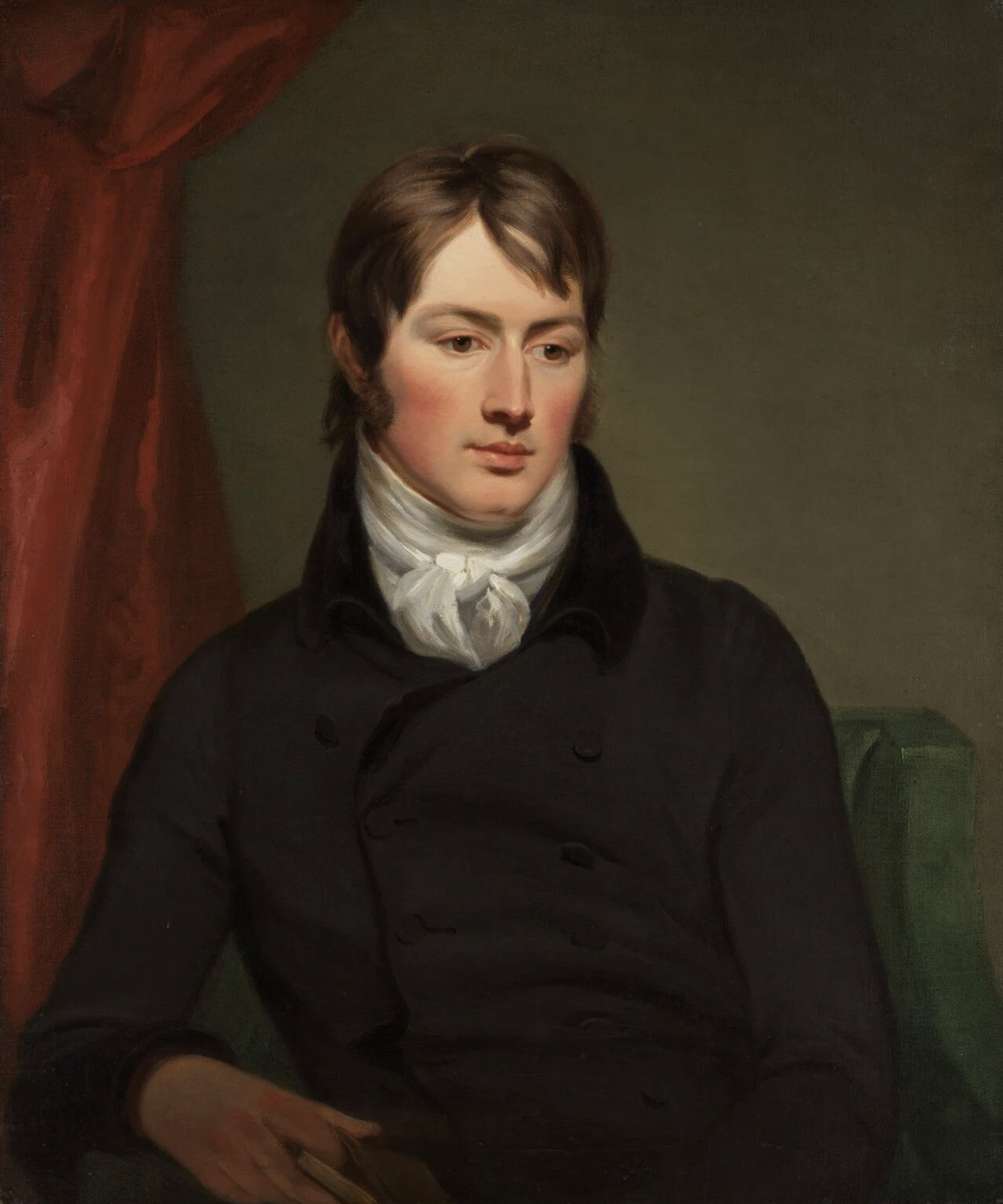
Portrait of John Constable by his fellow Royal Academy student Ramsay Richard Reinagle, probably painted around 1799 when Reinagle stayed with Constable's family in East Bergholt. Held by the National Portrait Gallery, London (NPG 1786). The identification of the sitter as Constable is not disputed in the sources consulted.
National Portrait Gallery, London| Worked as | Painter |
|---|---|
| Born | 11 June 1776 · East Bergholt, Suffolk, England |
| Died | 31 March 1837 (during the night · Hampstead, London |
| Nationality | English |
| Movement | Romanticism (landscape) |
| Sources | 32 cited |
| Last verified |
About this page Last verified · 32 sources cited
On this page 12 sections
ContentsClose
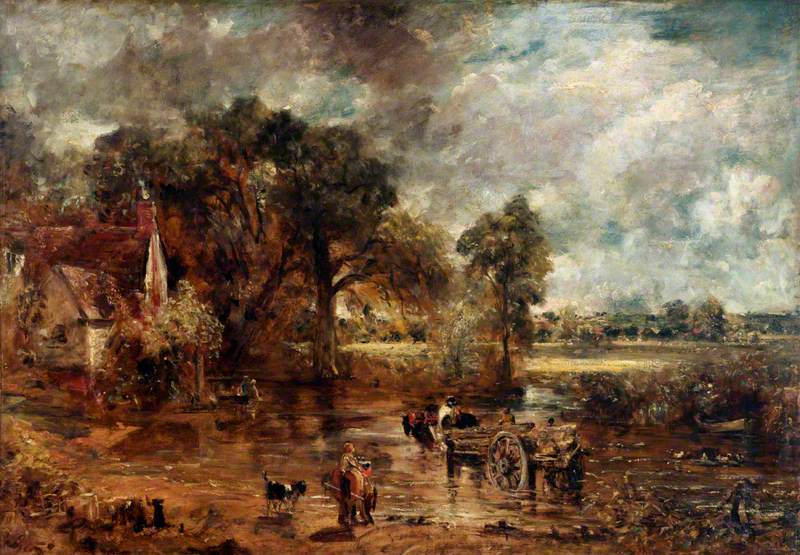
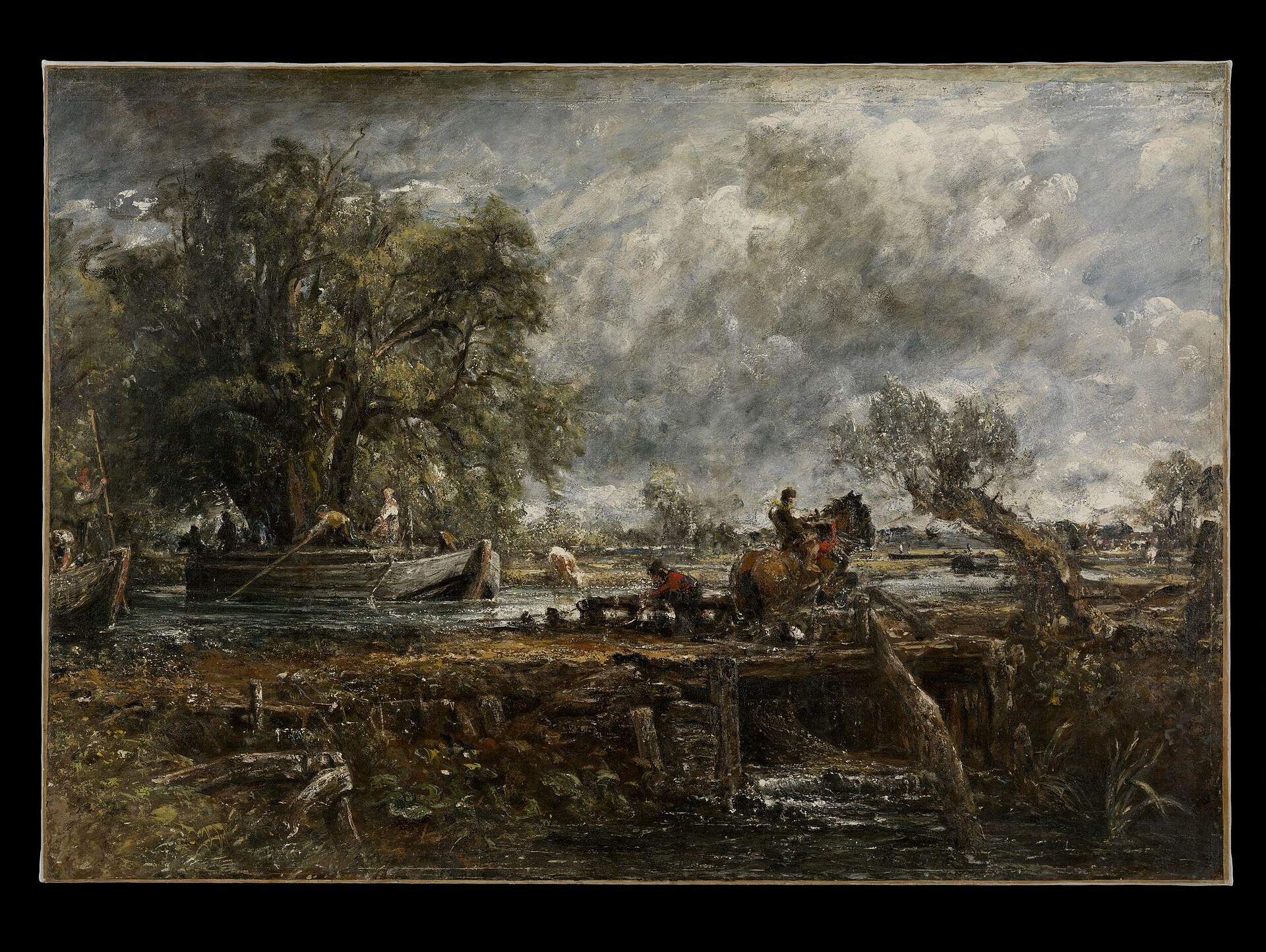
Constable painted the same handful of miles of the River Stour for most of his working life and called the result a new kind of landscape art. What is harder to find in the popular account is the working method underneath it: for his largest exhibition pictures, the so-called 'six-footers', he painted a full-size preparatory version in oil before starting the picture he actually intended to show. No other painter of the period is known to have worked this way, and a body of modern criticism, starting with Kenneth Clark, has argued that several of the sketches are more powerful than the finished pictures they prepared for. Sketch and finished picture now often hang in different countries, painted the same size, of the same view, months apart, and telling them apart is not always trivial.
He was also, for most of his career, a commercial failure in his own country. He sold about twenty paintings in England in his lifetime and more than twenty in France in a handful of years after a single Paris showing in 1824. He was not elected a full Royal Academician until 1829, at 52, and then by a single vote. The market since has corrected hard: a single canvas from his most productive decade, The Lock, twice broke his own auction record, most recently for over twenty-two million pounds, and Constable is now one of the few artists on the market where the preparatory sketch for a picture can outsell finished paintings by other hands entirely.
The corpus keeps moving in both directions. Works have been quietly dropped from his catalogue at Tate, and other works have been promoted into it: a small oil sold in 2013 as 'a follower of Constable' for 3,500 pounds was reattributed to the artist himself and sold two years later for 5.2 million dollars, and in 2026, the artist's 250th-anniversary year, a Texas historical society discovered that a painting it had displayed for decades was the largest known full-size study for The Cornfield.
Images
Chronology
- 1776
Born 11 June in East Bergholt, Suffolk, to Golding Constable, a corn merchant and mill owner, and Ann Watts Constable.2
- 1799
Enters the Royal Academy Schools as a probationer, older than most fellow students; portrait by his fellow student Ramsay Richard Reinagle painted around this time.12
- 1802
Refuses the post of drawing master at the military college that became Sandhurst; writes to John Dunthorne of his intent to paint truthfully from nature rather than imitate other painters.2
- 1811
First visits Bishop John Fisher and his family in Salisbury, beginning a lifelong connection to the city and cathedral.2
- 1816
Marries Maria Elizabeth Bicknell in October at St Martin-in-the-Fields, after years of opposition from her family; honeymoons at Archdeacon John Fisher's home in Osmington, Dorset.2
- 1819
Sells The White Horse, his first important sale, to Archdeacon Fisher for 100 guineas; elected an Associate of the Royal Academy on 1 November.23
- 1819
First occasion Constable stands for full Royal Academician; receives no votes.3
- 1820
Stratford Mill exhibited and bought by Fisher for 100 guineas, for his friend John Pern Tinney.2
- 1821
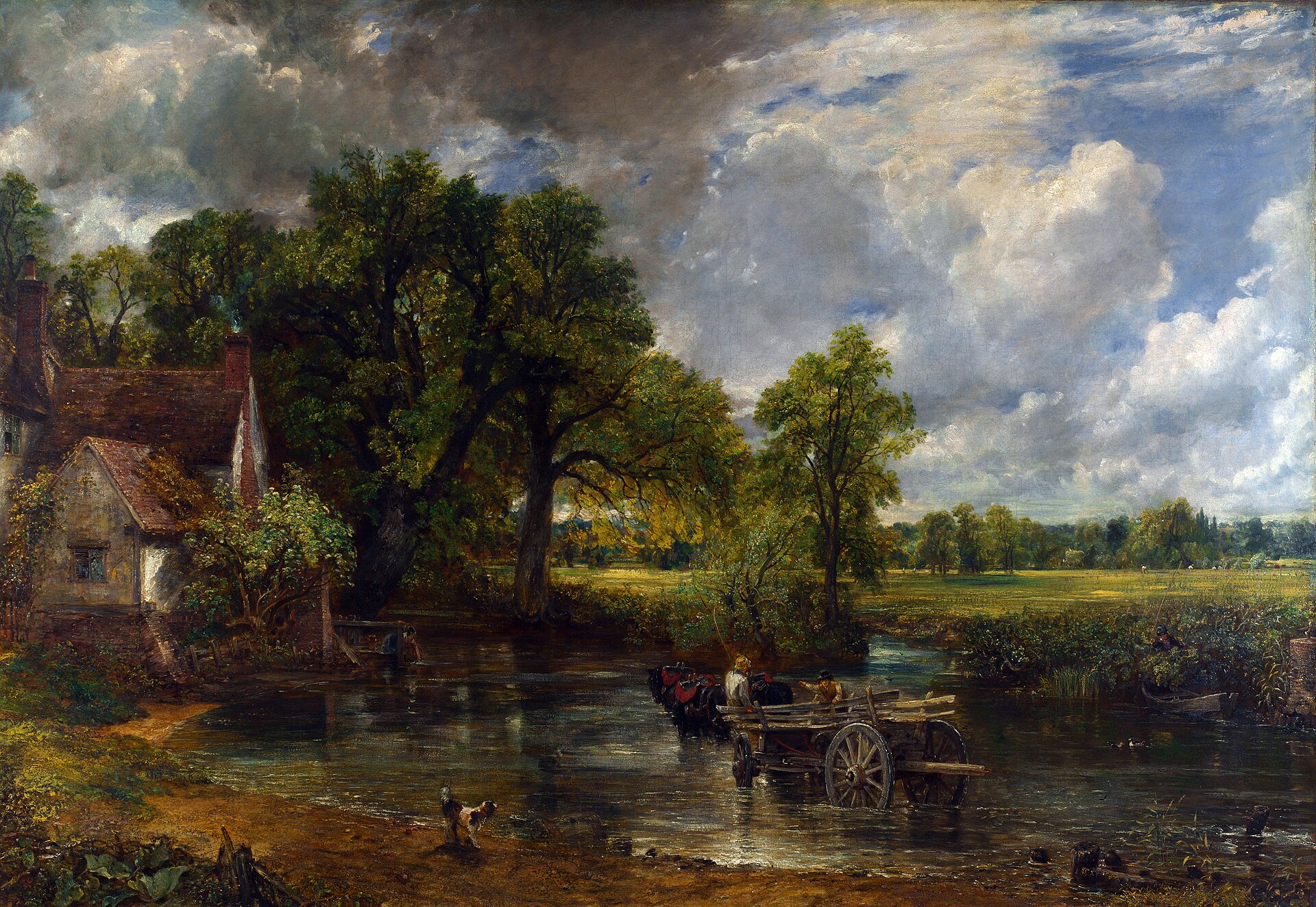
The Hay Wain shown at the Royal Academy; fails to sell.2
- 1824
The Hay Wain and View on the Stour near Dedham sold to dealer John Arrowsmith for a combined 250 pounds; shown at the Paris Salon, where The Hay Wain wins a gold medal from Charles X and reportedly influences Delacroix and Gericault.2
- 1824
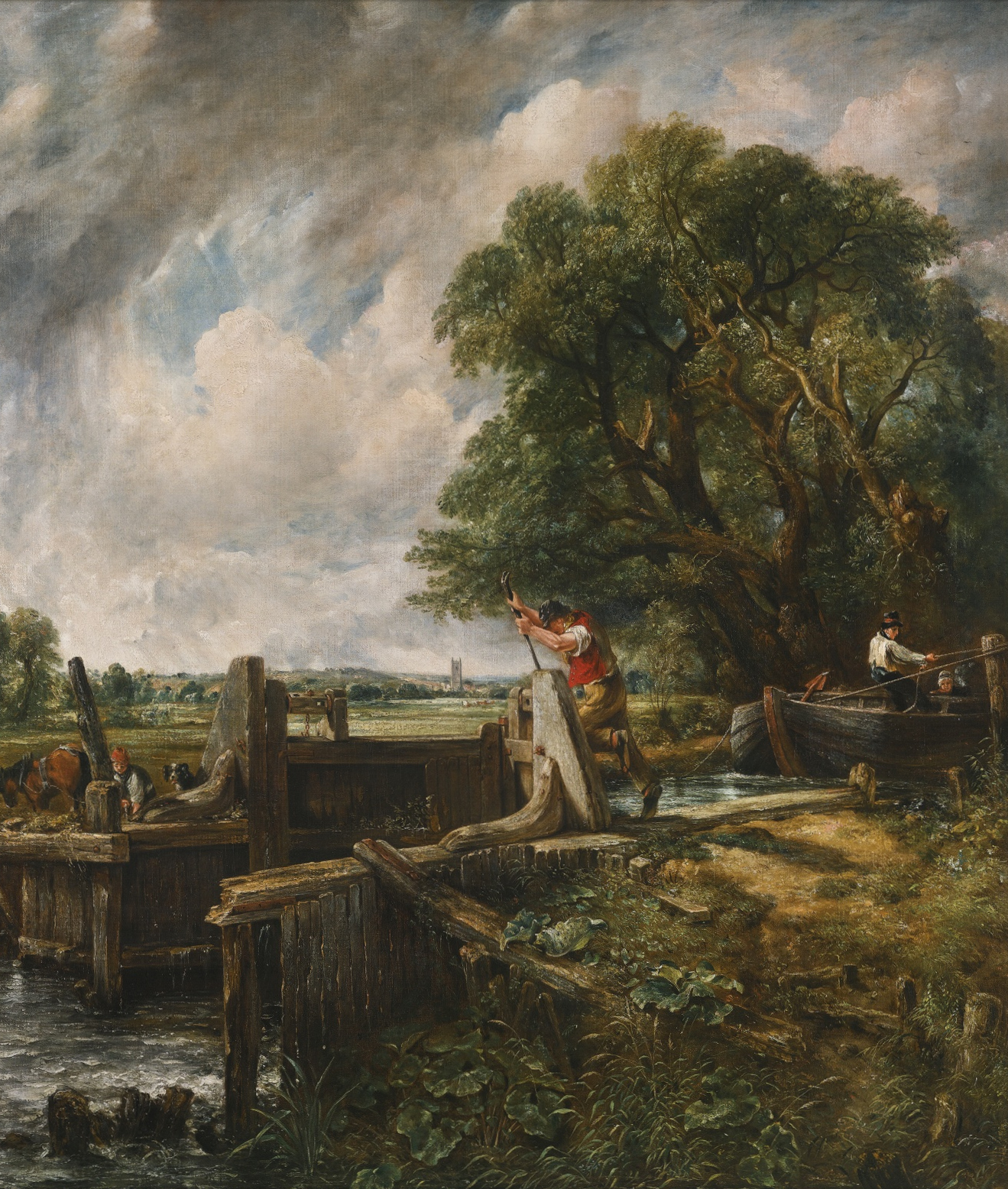
The Lock exhibited and sold on its opening day, the only Constable ever to sell that fast, for 150 guineas, to James Morrison.29
- 1825
Constable paints a second version of The Lock, later called the Foster version, and quarrels with Arrowsmith, losing his French dealer connection.29
- 1825
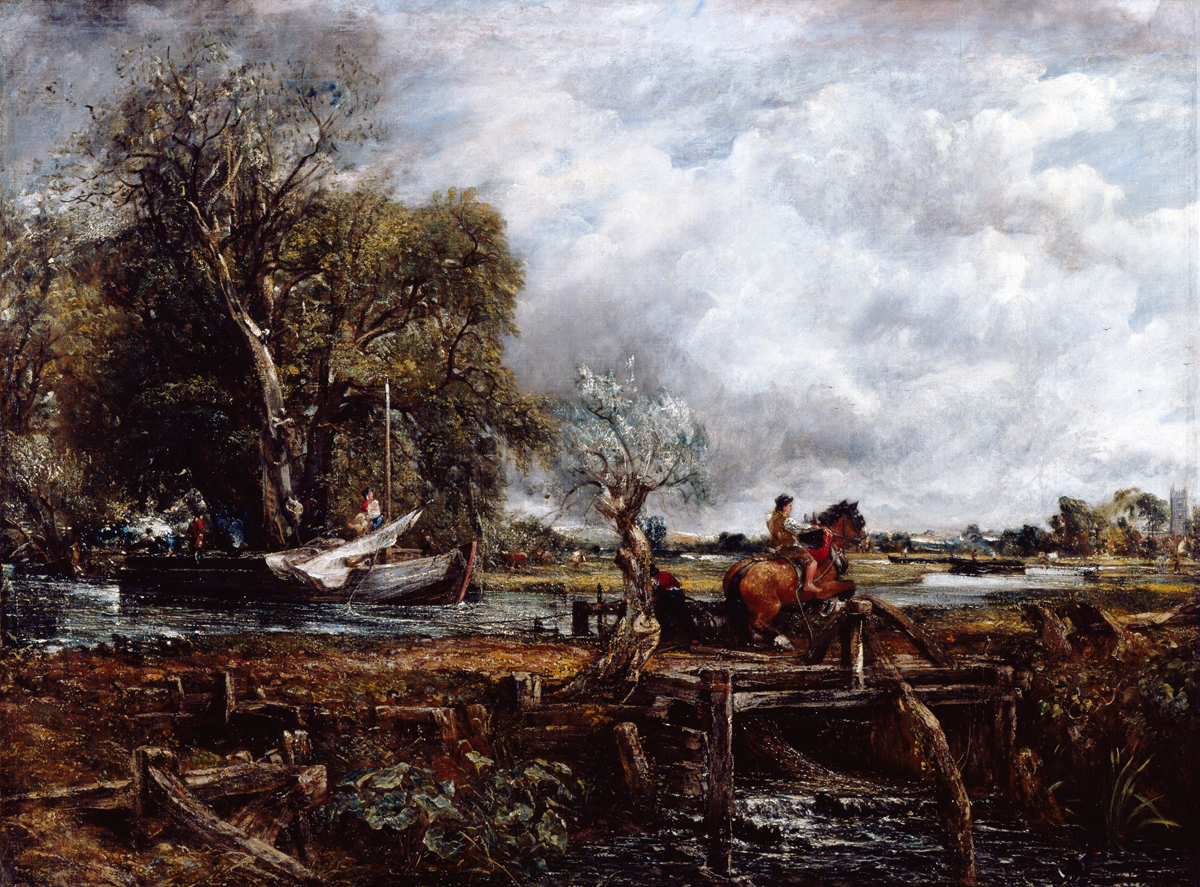
The Leaping Horse exhibited at the Royal Academy; the only six-footer from the Stour series unsold in Constable's lifetime.2
- 1826
Paints A Boat Passing a Lock, a landscape-format variant of The Lock, and a full-size study for The Cornfield, rediscovered in Texas exactly 200 years later.215
- 1828
Maria dies of tuberculosis at Hampstead on 23 November, aged 41, shortly after inheriting 20,000 pounds from her father.2
- 1829
Elected a full Royal Academician in February, by a single vote in the final round; gives A Boat Passing a Lock as his diploma work.3
- 1831
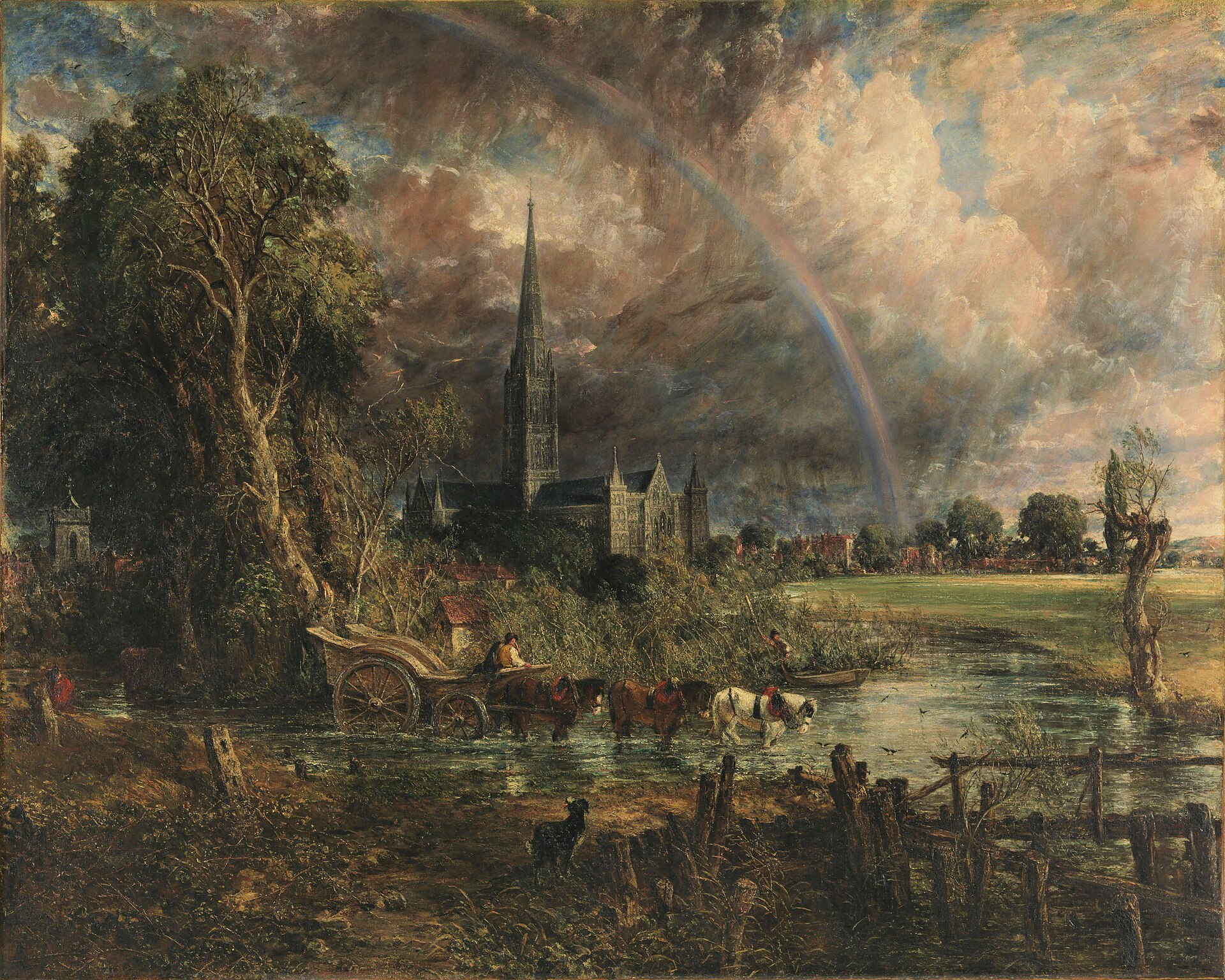
Salisbury Cathedral from the Meadows exhibited at the Royal Academy, without a rainbow; provokes hostile reviews of its weather effects.56
- 1832
Archdeacon John Fisher dies at Boulogne on 25 August; Constable later adds a rainbow to Salisbury Cathedral from the Meadows, resting on Fisher's house.6
- 1837
Dies of heart failure on the night of 31 March, in Hampstead; buried with Maria at St John-at-Hampstead.2
- 1838
Studio sale held by Foster and Son, Pall Mall, 15-16 May; The Lock makes 131 pounds ten shillings, second-highest price of the sale.9
- 1843
Charles Robert Leslie publishes Memoirs of the Life of John Constable.2
- 1886
The Hay Wain enters the National Gallery, London, as a gift from the collector Henry Vaughan.2
- 1888
Constable's daughter Isabel donates a large collection of his graphic work to the British Museum.2
- 1976
Tate bicentenary exhibition catalogue by Leslie Parris, Ian Fleming-Williams and Conal Shields separates paintings by Constable's son Lionel from the father's oeuvre.7
- 1984 / 1996
Graham Reynolds publishes his two-part, four-volume catalogue raisonne of Constable's paintings, split at 1816.7
- 1990
The Lock (original 1824 version) sells at Sotheby's London for a reported 10,780,000 pounds to Baron Hans Heinrich Thyssen-Bornemisza and Carmen 'Tita' Thyssen, then a record for a British work of art.911
- 2012
The Lock resells at Christie's London, 3 July, for a reported 22,441,250 pounds, a new auction record for Constable that still stands.911
- 2013
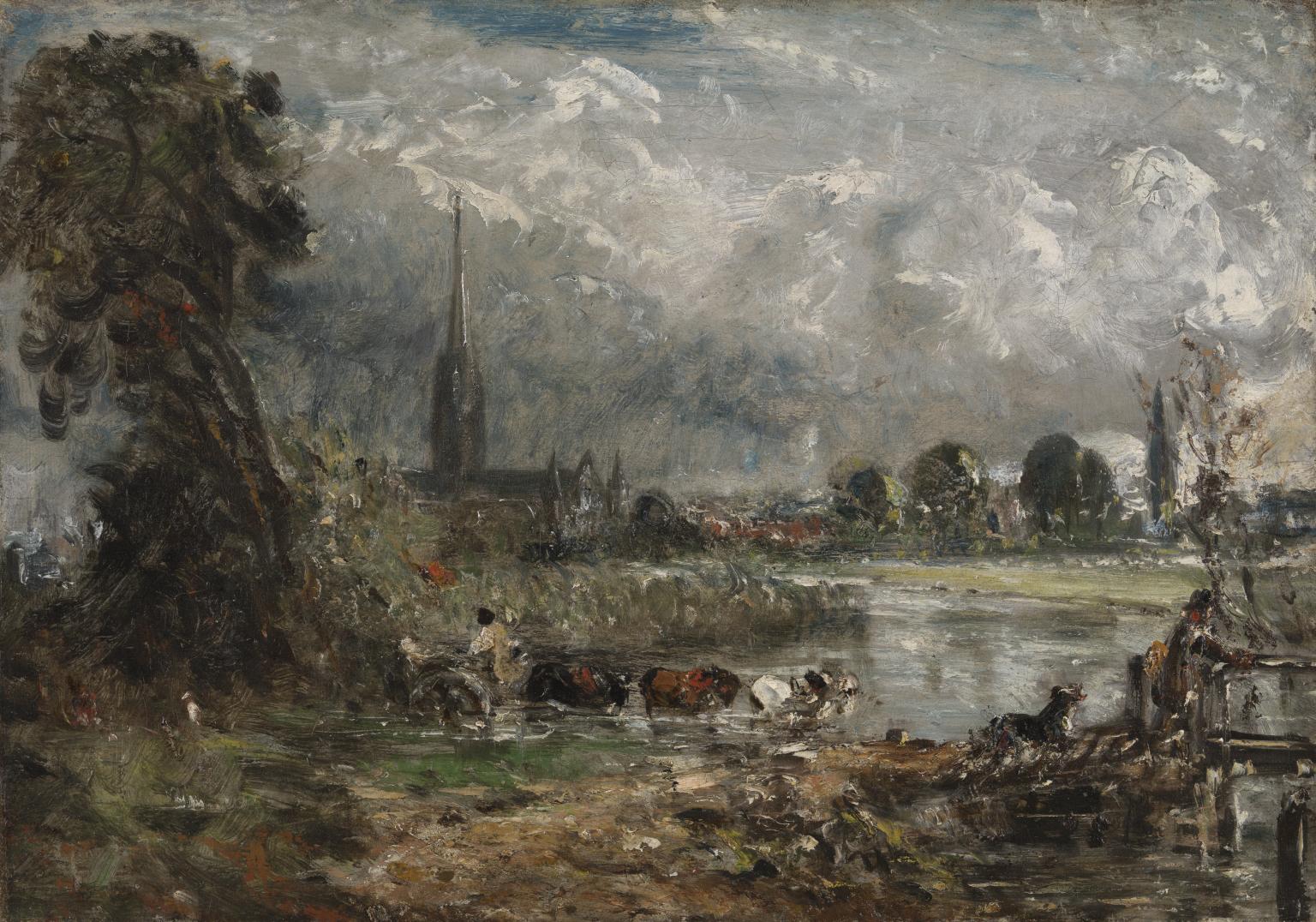
A small oil study for Salisbury Cathedral from the Meadows sells at Christie's, London (Hambleden collection), as 'a follower of John Constable' for 3,500 pounds.1314
- 2015
The same study, reattributed to Constable by Anne Lyles, sells at Sotheby's New York for 5.2 million dollars; the Foster version of The Lock sells separately at Sotheby's London for 9,109,000 pounds.149
- 2016
The full-size sketch for View on the Stour near Dedham sells at Christie's London for a reported 14.1 million pounds including premium.11
- 2026
Constable's 250th anniversary year: a large full-size study for The Cornfield is authenticated after decades at a small Texas museum and consigned to Heritage Auctions, Dallas; Colchester and Ipswich Museums stage the year-long Constable 250 programme, bringing The Hay Wain to Suffolk for the first time.151617
The market
Constable's market has two distinct behaviours. Finished six-footers and their full-size preparatory sketches now sell in broadly the same tier: a single sketch, for View on the Stour near Dedham, made 14.1 million pounds in 2016, within range of finished-picture prices. And the record price for any Constable belongs not to a unique masterpiece but to a single composition sold twice: The Lock, the only six-footer Constable painted in more than one version, which has separately broken his own auction record in 1990 and again in 2012.
Sources consulted for this record generally report auction results as a single total figure and do not consistently separate the hammer price from the buyer's premium; that gap is recorded rather than guessed at below.
| Date | Sale | Work | Result | Note |
|---|---|---|---|---|
| 14 November 1990 | Sotheby's, London | The Lock (1824, original exhibited version) | Hammer not established in sources consulted With premium reported total 10,780,000 GBP | Bought by Baron Hans Heinrich Thyssen-Bornemisza and Carmen 'Tita' Thyssen; then a record for a British work of art at auction, held until 2006. |
| 3 July 2012 | Christie's, London | The Lock (1824, original exhibited version) | Hammer not established in sources consulted With premium reported total 22,441,250 GBP | Consigned by Baroness Carmen Thyssen; pre-sale estimate 20-25 million pounds; the current auction record for Constable. Museum trustee Sir Norman Rosenthal resigned from the Thyssen-Bornemisza museum board in protest at the sale. |
| 9 December 2015 | Sotheby's, London | The Lock, 'Foster version' (1825 replica) | Hammer not established in sources consulted With premium reported total 9,109,000 GBP | Sold on its low estimate; descended through the Foster family of Apley Hall, Shropshire, since the mid nineteenth century. |
| 30 June 2016 | Christie's, London | View on the Stour near Dedham, full-size preparatory sketch (not the finished picture, which is at the Huntington Library) | Hammer not established in sources consulted With premium reported total 14.1 million (about 18.8 million US dollars) including buyer's premium GBP | Pre-sale estimate 12-16 million pounds; described by Christie's as 'the last great six-footer sketch in private hands'; sources differ on the ownership chain before this sale, with one Wikipedia-cited Christie's lot description linking it to Royal Holloway, University of London and a contemporary Artnet preview describing it as bought privately more than two decades earlier. |
| 2013-07 | Christie's, London (Hambleden collection sale) | Small oil study for Salisbury Cathedral from the Meadows | Hammer not established in sources consulted With premium reported total 3,500 (about 5,300 US dollars) GBP | Catalogued at the time as 'a follower of John Constable'; sold against a high estimate of 800 pounds, more than four times that estimate even before reattribution. |
| 29 January 2015 | Sotheby's, New York | Same study for Salisbury Cathedral from the Meadows, now catalogued by Anne Lyles as an autograph Constable | Hammer not established in sources consulted With premium reported total 5.2 million USD | Against a 2-3 million dollar high estimate; the consignor was the same buyer who had purchased it for 5,300 dollars at Christie's eighteen months earlier. |
Hammer is the price at which the bidding stopped; with premium adds the fee the house charges the buyer on top. Hammer price and buyer's premium in the glossary.
Recorded without a public price
- 5 June 2026 · Full-size study for The Cornfield (c. 1820-26), the largest known study for the picture · Heritage Auctions, Dallas (European Art Signature Auction) · not established in sources consulted Pre-sale estimate 300,000-500,000 dollars; consigned by the Jefferson Historical Society and Museum, Jefferson, Texas, which had held it since the late 1960s believing it a copy; authenticated in 2023-26 by Anne Lyles and conservator Sarah Cove. The sale had already taken place by the time this record was researched, but its realised price could not be confirmed from the sources consulted.
Where to see the work
| Institution | City | Holdings | Note |
|---|---|---|---|
| National Gallery | London | The Hay Wain (1821); Stratford Mill (1820); The Cornfield (1826) | The Hay Wain is the picture most identified with Constable and did not enter the collection until 1886, a gift from Henry Vaughan. |
| Victoria and Albert Museum | London | Full-size sketch for The Hay Wain (987-1900); full-size sketch for The Leaping Horse (986-1900); Boat-Building Near Flatford Mill (1815); Stonehenge (1835) | Holds the full-size preparatory sketches for two of the six-footers rather than the finished pictures themselves. |
| Tate Britain | London | Salisbury Cathedral from the Meadows, exhibited 1831 (T13896); a smaller, separately catalogued study of the same subject dated only '?1829' (N01814); Flatford Mill (Scene on a Navigable River), 1816-17; Chain Pier, Brighton; The Valley Farm | Also holds at least two works now catalogued as 'formerly attributed to John Constable' and not on public display. |
| Royal Academy of Arts | London | The Leaping Horse (1825, finished exhibited picture); A Boat Passing a Lock (1826, Constable's diploma work); Seascape Study with Rain Cloud (c.1824) | The Leaping Horse never sold in Constable's lifetime and has remained in the Academy's own collection since it was exhibited. |
| The Frick Collection | New York | The White Horse (1819); a version of Salisbury Cathedral from the Bishop's Grounds (1825) | The White Horse was Constable's first important sale, to Archdeacon Fisher. |
| Huntington Library, Art Museum and Botanical Gardens | San Marino, California | View on the Stour near Dedham (1822), the finished exhibited picture | The full-size preparatory sketch for the same composition is a separate object that has passed through the market privately; the two should never be treated as interchangeable. |
| Yale Center for British Art | New Haven, Connecticut | Hadleigh Castle (1829); full-size sketch for Stratford Mill; other studies and drawings | |
| National Galleries of Scotland | Edinburgh | The Vale of Dedham (1828) | On loan to the 2026 Constable 250 programme in Ipswich. |
| National Portrait Gallery | London | Portrait of John Constable by Ramsay Richard Reinagle, c.1799 (NPG 1786) | The main record of Constable's own appearance as a young man. |
| Christchurch Mansion | Ipswich | The largest collection of Constable's paintings outside London, built from local gifts and loans | Host venue for the year-long Constable 250 anniversary programme in 2026. |
| British Museum | London | A large collection of Constable's graphic work, given by his daughter Isabel Constable in 1888 | Basis of a 2026 exhibition of his later drawings and prints. |
| Guildhall Art Gallery | London | Full-size compositional sketch for Salisbury Cathedral from the Meadows | Distinct from Tate's own smaller ?1829 study of the same subject; this record has not established the precise relationship between the two. |
The essay
Chapter 1A corn merchant's son who was allowed to leave the mill
Constable was born in East Bergholt, Suffolk, the son of Golding Constable, a wealthy corn merchant who owned Flatford Mill and, later, Dedham Mill, and who moved his grain to London on his own small...
Constable was born in East Bergholt, Suffolk, the son of Golding Constable, a wealthy corn merchant who owned Flatford Mill and, later, Dedham Mill, and who moved his grain to London on his own small ship, the Telegraph. Constable's older brother was intellectually disabled, so John was raised to succeed his father in the business, and worked in it after leaving school. His younger brother Abram eventually took over the mills instead.
In 1802 Constable turned down the post of drawing master at the military college that became Sandhurst, a decision the Royal Academy's then master, Benjamin West, warned would end his career before it began. That year he wrote to the painter John Dunthorne that he intended to stop 'seeking the truth at second hand' and paint nature directly rather than imitate other men's pictures. He entered the Royal Academy Schools as a probationer in 1799, older than most of his fellow students, and later said plainly what had actually made him a painter: 'the sound of water escaping from mill dams etc., willows, old rotten planks, slimy posts, and brickwork, I love such things.'
Chapter 3Two men named Fisher
Constable's most important patron and closest friend were, confusingly, both called John Fisher.
Constable's most important patron and closest friend were, confusingly, both called John Fisher. The elder, Bishop John Fisher (1748-1825), had known Constable since his own days as rector of Langham, a parish next to East Bergholt, and became Bishop of Salisbury in 1807. It was the Bishop who first drew Constable to Salisbury from 1811 and who commissioned paintings of the cathedral, including one showing himself and his wife walking in the grounds. The younger man, his nephew, was Archdeacon John Fisher (1788-1832), Archdeacon of Berkshire and a canon of Salisbury Cathedral, and it was this Fisher who became Constable's closest correspondent and most consistent buyer. He purchased both The White Horse and Stratford Mill for 100 guineas each, on the second occasion admitting he thought the price too low, and it was money forwarded by Fisher that let Constable finish The Lock in time for its 1824 exhibition. Constable and Maria honeymooned at Fisher's home in Osmington, Dorset, in October 1816; secondary accounts differ on which of the two Fishers actually conducted the wedding ceremony at St Martin-in-the-Fields, and this record does not resolve that disagreement.
Archdeacon Fisher died at Boulogne on 25 August 1832. Research published by Tate in 2017 argues, from the solar geometry of the sky in Salisbury Cathedral from the Meadows, that Constable added the picture's rainbow after its first exhibition specifically to mark Fisher's death, timed and angled to a rainbow that would have been visible from the painting's viewpoint on the afternoon Fisher died, resting on Fisher's own house, Leadenhall, in the cathedral close.
Chapter 4Maria
Constable's courtship of Maria Elizabeth Bicknell, a childhood friend, began in earnest around 1809 and was opposed for years by her grandfather, Dr Rhudde, rector of East Bergholt, who considered...
Constable's courtship of Maria Elizabeth Bicknell, a childhood friend, began in earnest around 1809 and was opposed for years by her grandfather, Dr Rhudde, rector of East Bergholt, who considered the Constables social inferiors and threatened Maria with disinheritance. Maria's father, solicitor to George IV, was reluctant to see her forfeit her inheritance, and Constable's own parents withheld support for the marriage until he was financially secure. Golding and Ann Constable both died in the interim, leaving John a fifth share of the family business; the couple finally married in October 1816, when Constable was forty.
Maria began showing signs of tuberculosis in the 1820s. The family took lodgings in Brighton from 1824 to 1828 in the hope sea air would help her, a period Constable described in a letter to Fisher as offering only 'Piccadilly by the sea-side'. She died at Hampstead on 23 November 1828, aged forty-one, shortly after inheriting 20,000 pounds from her own father's death. Constable wrote to his brother that 'the face of the World is totally changed to me'; he dressed in black for the rest of his life and raised their seven children alone. His late work, including Hadleigh Castle (1829) and Salisbury Cathedral from the Meadows (1831), moves from the calm of his earlier pictures to a rougher, more turbulent handling that his contemporaries and later scholars both read as an expression of that loss.
Chapter 5Paris noticed him before London did
The Hay Wain failed to sell when it was shown at the Royal Academy in 1821.
The Hay Wain failed to sell when it was shown at the Royal Academy in 1821. It was bought in 1824, together with View on the Stour near Dedham and a small painting thrown in to close the deal, by the Anglo-French dealer John Arrowsmith, for a combined 250 pounds. Both six-footers were shown at the Paris Salon that year, where they caused what Constable's own National Gallery calls a sensation: the French artist Theodore Gericault was reportedly 'quite stunned' by them, the writer Charles Nodier urged French painters to look at nature rather than travel to Rome for inspiration, and Charles X awarded The Hay Wain a gold medal. Eugene Delacroix repainted the background of his own Massacre at Chios, then on show at the same Salon, after seeing Constable's broken colour and flickering light at Arrowsmith's gallery, and later wrote in his journal that Constable's comments on the colour of his meadows applied to 'every tone'.
Constable sold roughly twenty paintings in England across his entire career; in France, in the few years the Arrowsmith connection lasted, he sold more than twenty. He nonetheless refused every invitation to travel and promote himself abroad, telling a correspondent, Francis Darby, that he would 'rather be a poor man [in England] than a rich man abroad'. He quarrelled with Arrowsmith in 1825, for reasons connected to Maria's illness, the unpleasantness of Brighton and the pressure of unfinished commissions, and lost his French outlet for good. The Hay Wain itself did not reach a public collection until the collector Henry Vaughan bought it and gave it to the National Gallery in 1886, nearly fifty years after Constable's death.
Chapter 6Elected by one vote
Constable was voted an Associate of the Royal Academy on 1 November 1819, on the strength of The White Horse, at the not-so-young age of forty-three.
Constable was voted an Associate of the Royal Academy on 1 November 1819, on the strength of The White Horse, at the not-so-young age of forty-three. Full membership took a decade longer. Landscape painting was widely considered inferior to history painting in this period, and Constable's insistence that his subjects were simply observed rather than composed did his cause no favours with the history painters who dominated the Academy's vote. On his first attempt at full membership he received no votes at all. Before a later attempt, in 1829, he wrote that he had little heart to face an ordeal... from some 'highminded' members who stickle for the 'elevated & noble' walks of art... preferring the shaggy posteriors of a Satyr to the moral feeling of landscape.
He was elected a full Royal Academician in February 1829, three months after Maria's death, and in the final round he won by a single vote. The Academy's president, Sir Thomas Lawrence, told him he was 'fortunate' to have been elected over so many history painters on the list that year. For his obligatory diploma work, Constable submitted A Boat Passing a Lock (1826), a landscape-format variant of The Lock that he had already sold to a friend. He remained active at the Academy for the rest of his life, joining its governing Council in 1830 and teaching as a Visitor in the Schools from 1831, and gave his last lecture there a week before he died, praising the institution as the 'cradle of British art'.
Chapter 7The Lock, painted twice, and sold three times over
The Lock is the only one of the six-footers Constable painted more than once, and the resulting version confusion is close to a textbook case of the problem this record exists to prevent.
The Lock is the only one of the six-footers Constable painted more than once, and the resulting version confusion is close to a textbook case of the problem this record exists to prevent. The original, exhibited in 1824, was bought by James Morrison, an inn-keeper's son turned collector, for 150 guineas on the exhibition's opening day; Constable never again sold a picture on its first day of showing. Descending through Morrison's family and eventually reaching the market, it was bought in 1990 by Baron Hans Heinrich Thyssen-Bornemisza and his wife Carmen 'Tita' Thyssen for a reported 10,780,000 pounds at Sotheby's, then a record for a British work of art. The Baroness sold it at Christie's in London on 3 July 2012 for a reported 22,441,250 pounds, against a 20-25 million pound estimate; this record has not since been broken by another Constable at auction. Sources consulted for this record report both the 1990 and 2012 figures as single totals and do not separate hammer price from buyer's premium.
In 1825 Constable made a second version of the same composition, kept for his own use at later exhibitions and known as the 'Foster version' after a later nineteenth-century owner, William Orme Foster. It remained in private hands and sold at Sotheby's London on 9 December 2015 for 9,109,000 pounds. A third variant, A Boat Passing a Lock (1826), painted in landscape rather than upright format, is the diploma work Constable gave to the Royal Academy on his election in 1829 and remains in the Academy's own collection in London. Three paintings, one subject, three different owners today: the Foster version and the original both went through the market as 'The Lock' within a few years of each other, and a cataloguer working from memory rather than the accession trail could confuse them without much difficulty.
Chapter 8What is actually happening in Salisbury Cathedral from the Meadows
Constable called Salisbury Cathedral from the Meadows (exhibited 1831, Tate Britain) his best work, and it repays being read closely rather than admired generally.
Constable called Salisbury Cathedral from the Meadows (exhibited 1831, Tate Britain) his best work, and it repays being read closely rather than admired generally. He altered the actual topography to paint it: the tower of St Thomas's church, visible on the left of the picture, cannot in fact be seen from the meadow viewpoint he chose, and appears to have been added to strengthen the visual presence of the Church of England in the composition. At the foot of the large ash tree he added an elder bush, recognisable by its white blossom, of which he wrote in his own words that it was 'a favourite of mine, but 'tis melancholy; an emblem of death' -- added, on the evidence of Constable's own letters, in the period after Maria's death. When the picture was first shown, Constable displayed alongside it nine lines from James Thomson's poem The Seasons: Summer, describing the death by lightning of the fictional Amelia in the arms of her lover Celadon during a storm; his friend Archdeacon Fisher had initially suggested calling the picture 'The Church Under a Cloud'.
The picture's rainbow was not part of the original 1831 exhibition; no contemporary critic mentions it, and none of the surviving preparatory studies include one. Research published by Tate in 2017 (John E. Thornes, building on work by curator Amy Concannon) argues on the basis of solar geometry that Constable added it later, and that the specific rainbow he painted, arching over the cathedral and resting on Leadenhall, the house of Archdeacon Fisher, is consistent with the exact solar position on the afternoon of 25 August 1832, the day Fisher died. Constable was demonstrably capable of this kind of calculation: his surviving diagrams show a working knowledge of primary and secondary rainbow geometry, and his own printed notes on a related mezzotint discuss rainbow angles with some precision. Contemporary critics reviewing the reworked picture had no idea any of this was going on -- they simply found the weather implausible, one comparing the picture's white paint flecks to 'the shower of meal that seems to be falling in the foreground' -- and Constable, so far as the correspondence shows, never explained the addition to anyone.
The picture also carries a documented, and much less mysterious, political charge. Constable was a conventional Tory Anglican who opposed the Catholic Emancipation Act of 1829 and the parliamentary Reform Act then being debated, describing reform campaigners as 'vultures' in a letter; Fisher, similarly alarmed that reform would weaken the Church of England, called it a 'mischief'. Tate's own curatorial reading holds that the cathedral 'shown under a cloud' in the finished picture reflects those contemporary anxieties about the Church's position, with the added rainbow offering, on top of its private meaning for Fisher, a public note of hope that the institution would weather the change. None of this needs to be inflated into anything hidden: Constable told his friends plainly what he believed and feared, in letters that survive, and the picture reads exactly as documented rather than as requiring rediscovery.
Chapter 9Constable's snow
Constable habitually flicked or dabbed small touches of white paint across his finished surfaces to suggest glinting light, dew or the sparkle of water, applying paint with palette knives, scratched...
Constable habitually flicked or dabbed small touches of white paint across his finished surfaces to suggest glinting light, dew or the sparkle of water, applying paint with palette knives, scratched brush ends and scumbled layers rather than the smooth, invisible brushwork expected of an exhibition picture in this period. Contemporaries were largely hostile: one complained he 'dots and dabs and grubs and splashes, more strangely in each succeeding year', and the technique was mocked as 'Constable's snow'. Reviewing Salisbury Cathedral from the Meadows in May 1831, The Times suggested someone had spoiled the picture 'by spotting the foreground all over with whitewash', apparently unaware the artist had done it deliberately, and the Gentleman's Magazine compared the effect to a scene photographed 'immediately after a snow storm'.
Constable's palette, recovered from his studio after his death, shows vermilion, emerald green, chrome yellow, cobalt blue, lead white and madder, ground in linseed oil mixed with pine resin; he also used the slower-drying poppy oil as a medium, which let him rework a surface repeatedly before it set. Paint tubes did not yet exist: his colours were stored and carried in bladders made of pig membrane, tied at the neck to keep air out. From 1819 he also made outdoor oil sketches of skies alone, annotating many on the back with the date, time of day and weather conditions, a habit connected to his study of the meteorologist Luke Howard's newly published cloud classifications; Constable's own annotated copy of a related text on atmospheric phenomena survives and shows him fully conversant with contemporary meteorological terminology, a scientific precision he was willing to set aside, as the Salisbury rainbow shows, when a picture asked for something else.
Chapter 10A corpus that still moves in both directions
There is no single modern catalogue raisonne of Constable's paintings in the way a smaller, more tightly policed oeuvre would have one.
There is no single modern catalogue raisonne of Constable's paintings in the way a smaller, more tightly policed oeuvre would have one. The closest equivalent is Graham Reynolds's two-part catalogue, published in four volumes as The Later Paintings and Drawings of John Constable (1984) and The Early Paintings and Drawings of John Constable (1996), split at 1816, the year of Constable's marriage. A 1976 Tate exhibition catalogue by Leslie Parris, Ian Fleming-Williams and Conal Shields, marking the bicentenary of Constable's birth, did significant attribution work of its own, separating out paintings by his son Lionel Constable that had been circulating under his father's name. There is no single authentication board active today; new attributions are argued case by case by named specialists working with individual owners, auction houses and museums.
The corpus runs in both directions at once. Tate's own online catalogue includes at least two works now downgraded from Constable's name -- a small picture called The Leaping Horse and another called Barnes Common, both now catalogued as 'formerly attributed to John Constable'; the reasoning and date behind either rejection is not established in the sources consulted for this record. Running the other way, a small oil study for Salisbury Cathedral from the Meadows was sold at Christie's in July 2013 as 'a follower of John Constable' for 3,500 pounds against an 800-pound high estimate, before the former Tate curator Anne Lyles identified it as one of five genuine preparatory studies for the composition and catalogued it for Sotheby's, where it sold in January 2015 for 5.2 million dollars. In March 2026, in Constable's 250th anniversary year, the Jefferson Historical Society and Museum, a small institution in rural Texas that had held a large study for The Cornfield (1826) since the late 1960s believing it one of some eighty-five known copies of the composition, had it examined by Lyles and the conservator Sarah Cove; pigment analysis, cleaning tests and infrared reflectography showed, in Cove's words, 'complete consistency with Constable's materials and working methods', and it emerged as the largest known full-size study for the picture, overturning the previous scholarly assumption that Constable had gone directly from small preliminary sketches to the finished canvas.
Chapter 11The estate, the studio, and what circulated afterward
Constable died unexpectedly of heart failure on the night of 31 March 1837 and was buried with Maria at St John-at-Hampstead.
Constable died unexpectedly of heart failure on the night of 31 March 1837 and was buried with Maria at St John-at-Hampstead. His studio contents were sold by Foster and Son of Pall Mall on 15 and 16 May 1838, and further studio material was sold on the family's behalf over several decades after that, into the 1870s. The 1838 sale included major finished pictures still unsold at his death, among them Salisbury Cathedral from the Meadows, Hadleigh Castle and The White Horse; contemporary sale records show The Lock making 131 pounds ten shillings, the second-highest price of the sale after The White Horse, bought by the coal-fortune collector Charles Birch. Some lots were bought in on the family's behalf rather than sold to outside buyers.
His friend Charles Robert Leslie published the Memoirs of the Life of John Constable in 1843, which remains a primary source for Constable's own letters. Constable had already spent Maria's 1828 inheritance, disastrously by his own account, commissioning the engraver David Lucas to produce a portfolio of forty mezzotints after his landscapes, English Landscape Scenery; the venture never found enough subscribers to succeed financially, though Constable considered it a fair likeness of his intentions, telling Lucas he had 'showed me to the public without my faults'. Constable's daughter Isabel donated a large collection of his graphic work to the British Museum in 1888, which remains a core part of that museum's holdings and the basis of a 2026 exhibition there. The largest collection of his paintings outside London is at Christchurch Mansion in Ipswich, built from local gifts and loans rather than from a single bequest.
Chapter 12Forgotten in England, kept alive in France, reclaimed by everyone since
Constable's reputation slumped in Britain in the decades after his death.
Constable's reputation slumped in Britain in the decades after his death. The Pre-Raphaelites offered a different model of engagement with nature that displaced his, and John Ruskin, the dominant Victorian critic, was openly hostile to his work. In France the opposite happened. The Barbizon School painters who began working directly from the landscape around the Forest of Fontainebleau from the 1830s, among them Theodore Rousseau and Jean-Baptiste Camille Corot, responded specifically to Constable's broken, visible brushwork, as did Jean-Francois Millet, who added a documentary interest in rural labour that Constable himself, despite his own background in a milling family, never really painted. The connection to French Impressionism is more contested than popular accounts suggest: although critics discussed Claude Monet's and Camille Pissarro's work in relation to Constable and Turner, both painters are on record rejecting the comparison. Constable's influence on British Impressionism is more direct and less disputed, particularly on Philip Wilson Steer.
Later admirers have been specific rather than vague. Lucian Freud, who trained near 'Constable Country' as a teenager and initially found the work 'ridiculous' and 'soppy', came to regard Constable as an underrated portraitist as much as a landscape painter, and made his own etching after Constable's Study of the Trunk of an Elm Tree in 2003. The printmaker Leon Kossoff made a series of prints in direct response to Salisbury Cathedral from the Meadows in the 1990s, drawn to Constable's similarly thick, sculptural handling of paint. The image has also been put to openly political use: the artist Peter Kennard's 1980 photomontage Haywain with Cruise Missiles, made for the Campaign for Nuclear Disarmament, inserted three nuclear missiles into the bed of Constable's hay cart, converting the most reproduced image of settled rural England into an anti-nuclear protest work, and it remains one of the most reproduced political images of the period in its own right.
Chapter 13Where things stand now
2026 is the 250th anniversary of Constable's birth, and it is being marked in the region that made him, not only in the museums that hold his best pictures.
2026 is the 250th anniversary of Constable's birth, and it is being marked in the region that made him, not only in the museums that hold his best pictures. Colchester and Ipswich Museums are running a year-long 'Constable 250' programme at Christchurch Mansion in Ipswich, in three parts: Constable: A Cast of Characters (28 March-14 June 2026), on the people who supported him, including new work by the sculptor Sasha Constable, a direct descendant of the artist; Constable: Walking the Landscape (11 July-4 October 2026), bringing loans from the National Gallery, Tate, the V&A, the Royal Academy and the National Galleries of Scotland to Suffolk; and a closing show of contemporary responses running into early 2027. The Hay Wain travelled to Suffolk for the first time in its history as part of the programme, on loan from the National Gallery under the Weston Loan Programme with Art Fund, and was reunited in Ipswich with its own preparatory sketches, already held in the local collection.
The same anniversary year produced the Cornfield rediscovery in Texas: the newly authenticated full-size study was consigned to Heritage Auctions' European Art sale in Dallas on 5 June 2026, carrying a pre-sale estimate of 300,000 to 500,000 dollars. This record was researched and staged in September 2026; the sale had already taken place by that date, but its realised price was not established in the sources consulted and should be confirmed before republication.
What is documented
Technique
The surviving work
- What is accepted
- There is no single agreed headline count of accepted works comparable to a small, tightly policed oeuvre. Constable's output was large across finished exhibition pictures, full-size preparatory sketches, hundreds of smaller oil and cloud studies, and drawings; Isabel Constable's 1888 gift alone gave the British Museum a large body of his graphic work. The nearest thing to a full modern census is Graham Reynolds's catalogue raisonne (below).
- What is contested
- The corpus moves in both directions at once. Tate's own online catalogue carries at least two works downgraded to 'formerly attributed to John Constable' (a small Leaping Horse and a work called Barnes Common); no reasoning or date for either rejection was found in the sources consulted. Conversely, a small study for Salisbury Cathedral from the Meadows was sold in 2013 as 'a follower of John Constable' and reattributed to Constable himself by 2015, and a large full-size study for The Cornfield, believed for decades to be one of roughly 85 known copies of the composition, was newly authenticated in 2026.
- Who rules on attribution
- No single active authentication board. New attributions are argued case by case by named specialists working with individual owners, dealers and auction houses -- for example Anne Lyles (former Tate curator of 18th- and 19th-century British art) and the conservator Sarah Cove, both involved in the 2013-15 Salisbury Cathedral study and the 2026 Cornfield study reattributions.
Catalogue raisonne
- Graham Reynolds, The Later Paintings and Drawings of John Constable (Yale University Press, 1984, 2 vols) and The Early Paintings and Drawings of John Constable (Yale University Press, 1996, 2 vols), split at 1816, the year of Constable's marriage. The closest thing to a complete modern catalogue of the paintings; this record has not independently verified its inclusion/exclusion lists against the original volumes.7
- Leslie Parris, Ian Fleming-Williams and Conal Shields, Constable: Paintings, Watercolours and Drawings (Tate Gallery, 1976; revised as Constable, 1991). The 1976 bicentenary exhibition catalogue did significant attribution work, notably separating works by Constable's son Lionel from his father's oeuvre.7
Questions about John Constable
Who was John Constable?
Painter. 1776-1837.
When did John Constable live?
Born 11 June 1776, East Bergholt, Suffolk, England; died 31 March 1837 (during the night; some accounts give 1 April), Hampstead, London.
Where can you see work by John Constable?
National Gallery (London); Victoria and Albert Museum (London); Tate Britain (London); Royal Academy of Arts (London); The Frick Collection (New York); Huntington Library, Art Museum and Botanical Gardens (San Marino, California).
What does the market for John Constable look like?
Constable's market has two distinct behaviours. Finished six-footers and their full-size preparatory sketches now sell in broadly the same tier: a single sketch, for View on the Stour near Dedham, made 14.1 million pounds in 2016, within range of finished-picture prices.
What is still unresolved about John Constable?
The hammer price and buyer's premium for The Lock's 1990 (10,780,000 pounds) and 2012 (22,441,250 pounds) sales are not separated in the sources consulted; both figures are reported only as single totals.
Open questions
- The hammer price and buyer's premium for The Lock's 1990 (10,780,000 pounds) and 2012 (22,441,250 pounds) sales are not separated in the sources consulted; both figures are reported only as single totals.
- Sources disagree on the ownership of the full-size View on the Stour near Dedham sketch before its 2016 sale: a Wikipedia-cited Christie's lot description links it to Royal Holloway, University of London, while a contemporary Artnet preview describes it as bought privately more than two decades before 2016, with no mention of Royal Holloway.
- The realised price for the full-size Cornfield study sold at Heritage Auctions, Dallas, on 5 June 2026 could not be confirmed from the sources consulted, though the sale had already taken place by the time this record was researched.
- Secondary sources disagree on whether Bishop John Fisher or his nephew Archdeacon John Fisher conducted Constable and Maria's wedding ceremony at St Martin-in-the-Fields in October 1816.
- The precise relationship between the full-size compositional sketch for Salisbury Cathedral from the Meadows at the Guildhall Art Gallery and Tate's own smaller study of the same subject, catalogued only as '?1829', is not established in the sources consulted -- whether they represent different stages of the same preparatory process or have any other connection.
- Tate's own catalogue lists at least two works, a Leaping Horse and a Barnes Common, as 'formerly attributed to John Constable', without giving a reason or date for the rejection in the material consulted for this record.
Sources
- 1Wikimedia Commons file page, File:John Constable by Ramsay Richard Reinagle.jpg (source cites National Portrait Gallery, London, NPG 1786). commons.wikimedia.org/wiki/...
- 2Wikipedia, 'John Constable'. en.wikipedia.org/wiki/...
- 3Annette Wickham, 'John Constable's struggle to become a Royal Academician', Royal Academy of Arts, 21 December 2021. royalacademy.org.uk/article/...
- 4Tate, 'Constable's techniques, materials and six-footer paintings', in-depth guide to Salisbury Cathedral from the Meadows. tate.org.uk/art/...
- 5Tate, 'Subjects and meaning in Salisbury Cathedral from the Meadows', in-depth guide. tate.org.uk/art/...
- 6John E. Thornes, 'A Reassessment of the Solar Geometry of Constable's Salisbury Rainbow', Tate Research Publication, 2017. tate.org.uk/research/...
- 7Tate, 'Constable's legacy and influence', in-depth guide to Salisbury Cathedral from the Meadows. tate.org.uk/art/...
- 8Victoria and Albert Museum, 'John Constable's sketches'. vam.ac.uk/articles/...
- 9Wikipedia, 'The Lock (Constable)'. en.wikipedia.org/wiki/...
- 10Wikipedia, 'View on the Stour near Dedham'. en.wikipedia.org/wiki/...
- 11Eileen Kinsella, 'Rare Constable Sketch Offering Marks Christie's 250th Anniversary Sale', Artnet News, 26 May 2016. news.artnet.com/market/...
- 12Colin Gleadell, 'Christie's London's Solid British Art Sale Tallies $133 Million, Led by $33 Million Henry Moore', Artnet News, 1 July 2016 (byline corrected from an earlier draft that misattributed this piece to Eileen Kinsella; the article covers the 2016 sale of the View on the Stour near Dedham full-size sketch, not The Lock). news.artnet.com/market/...
- 13Eileen Kinsella, 'Sotheby's Ratchets Up Price on Rediscovered John Constable Sketch', Artnet News, 10 January 2015. news.artnet.com/market/...
- 14Eileen Kinsella, 'Constable Painting Bought for $5,000 Sells for $5 Million at Sotheby's', Artnet News, 29 January 2015. news.artnet.com/market/...
- 15Vittoria Benzine, 'Lost John Constable Painting Rediscovered in Texas Bound for Auction', Artnet News, 13 March 2026. news.artnet.com/market/...
- 16Artnet News, 'In John Constable's Hometown, a Trio of Shows Marks His 250th Birthday'. news.artnet.com/art-world/...
- 17Ipswich Borough Council press release, 'The Hay Wain to visit Suffolk for the first time as part of CONSTABLE 250', 13 November 2025. ipswich.gov.uk/ipswich-newsroom/...
- 18Tate collection record, 'The Leaping Horse', formerly attributed to John Constable (T01240). tate.org.uk/art/...
- 19Tate collection record, 'Salisbury Cathedral from the Meadows', John Constable, ?1829 (N01814). tate.org.uk/art/...
- 20Wikidata, Q398126 (Salisbury Cathedral from the Meadows, exhibited 1831, Tate accession T13896). wikidata.org/wiki/...
- 21Wikidata, Q119033351 (The Hay Wain, full-scale study, Victoria and Albert Museum accession 987-1900). wikidata.org/wiki/...
- 22Wikimedia Commons file page, File:Constable - The Hay Wain (full-scale study), c.1821, 987-1900.jpg. commons.wikimedia.org/wiki/...
- 23Wikimedia Commons file page, File:John Constable - The Hay Wain (1821).jpg. commons.wikimedia.org/wiki/...
- 24Wikimedia Commons file page, File:Constable - The Leaping Horse, 1825, 031391.jpg. commons.wikimedia.org/wiki/...
- 25Wikimedia Commons file page, File:Constable - The Leaping Horse (full-scale study), ca.1825, 986-1900, 2010EG9863.jpg. commons.wikimedia.org/wiki/...
- 26Wikimedia Commons file page, File:Constable Salisbury meadows.jpg. commons.wikimedia.org/wiki/...
- 27Wikimedia Commons file page, File:Constable - Salisbury Cathedral from the Meadows, 1829, N01814.jpg. commons.wikimedia.org/wiki/...
- 28Wikimedia Commons file page, File:John Constable - The Lock (second Foster version).jpg. commons.wikimedia.org/wiki/...
- 29Wikipedia, 'John Fisher (bishop of Salisbury)'. en.wikipedia.org/wiki/...
- 30Wikipedia, 'John Fisher (priest)' (Archdeacon John Fisher, 1788-1832). en.wikipedia.org/wiki/...
- 31Wikipedia, 'Graham Reynolds (art historian)', for the exact titles and publication years of the Constable catalogue raisonne. en.wikipedia.org/wiki/...
- 32Jeffry Cudlin, 'Constable's Great Landscapes: The Six-Foot Paintings', Washington City Paper, 3 November 2006, reproducing Kenneth Clark's 1936 exhibition-catalogue verdict on the full-size sketches for The Hay Wain and The Leaping Horse, via Charles Rhyne's catalogue essay tracking critical reception of the sketches. jeffrycudlin.com/constable.html

,_c.1821,_987-1900.jpg)
.jpg)

,_ca.1825,_986-1900,_2010EG9863.jpg)


.jpg)
Last verified