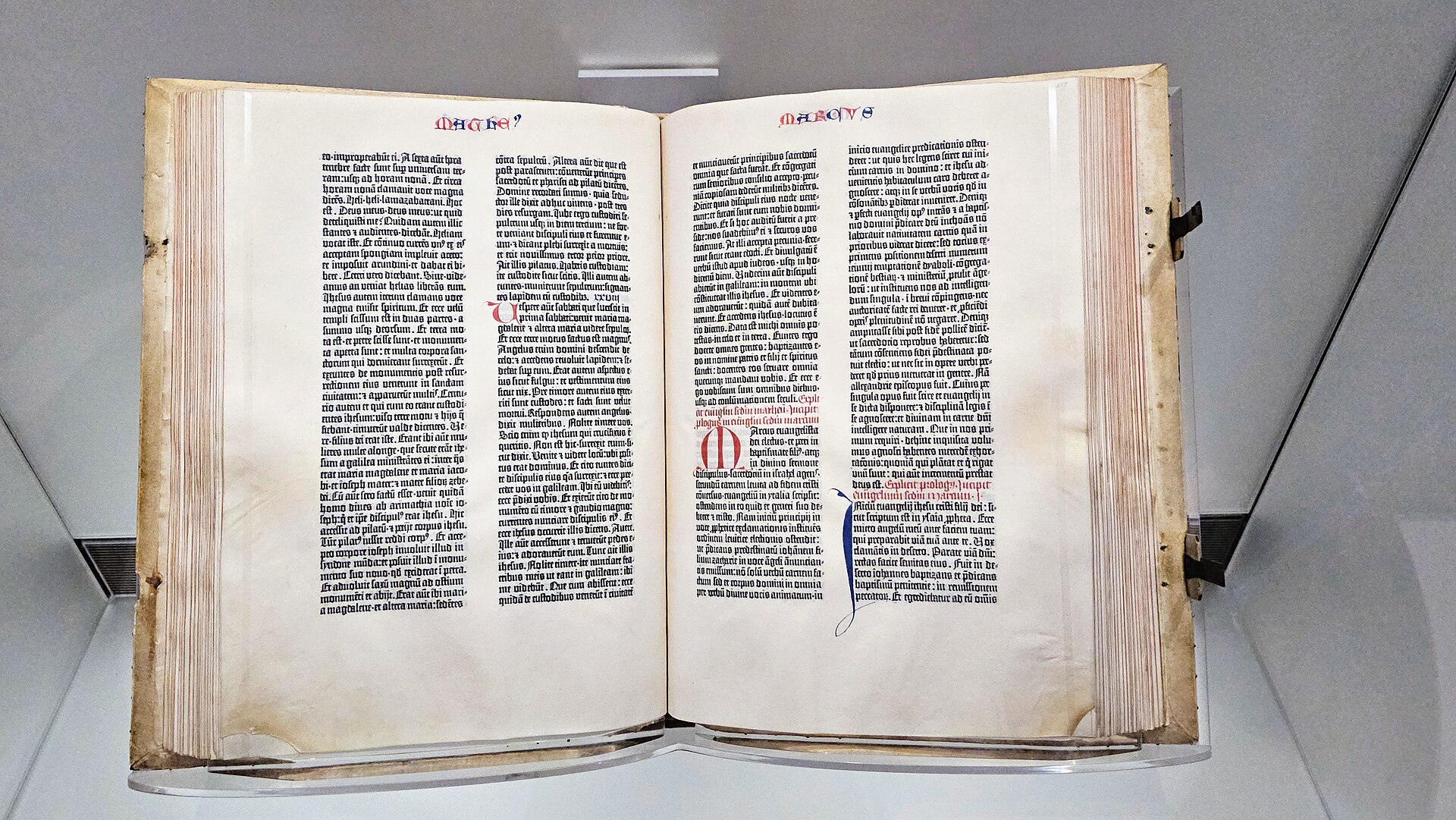
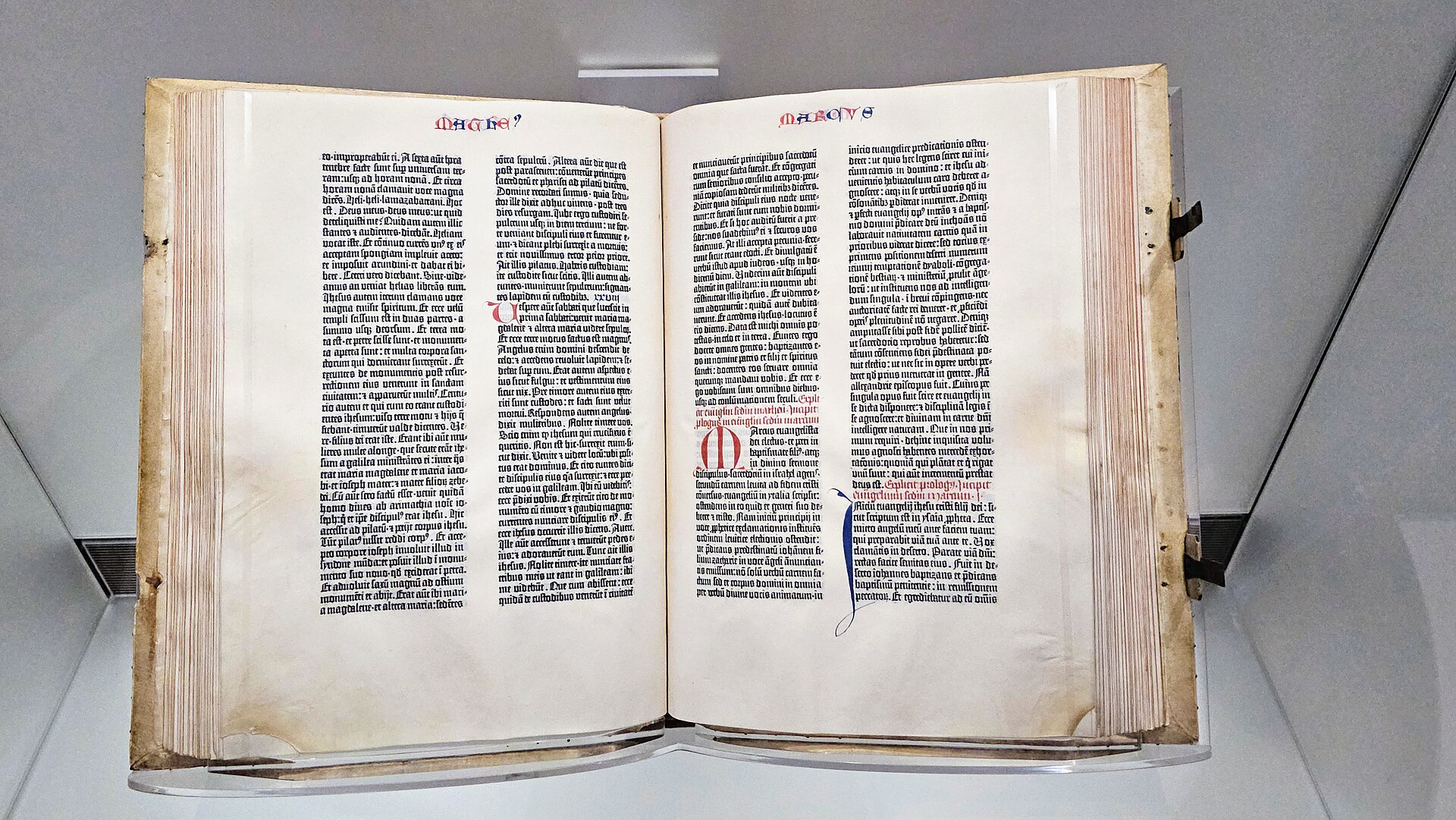
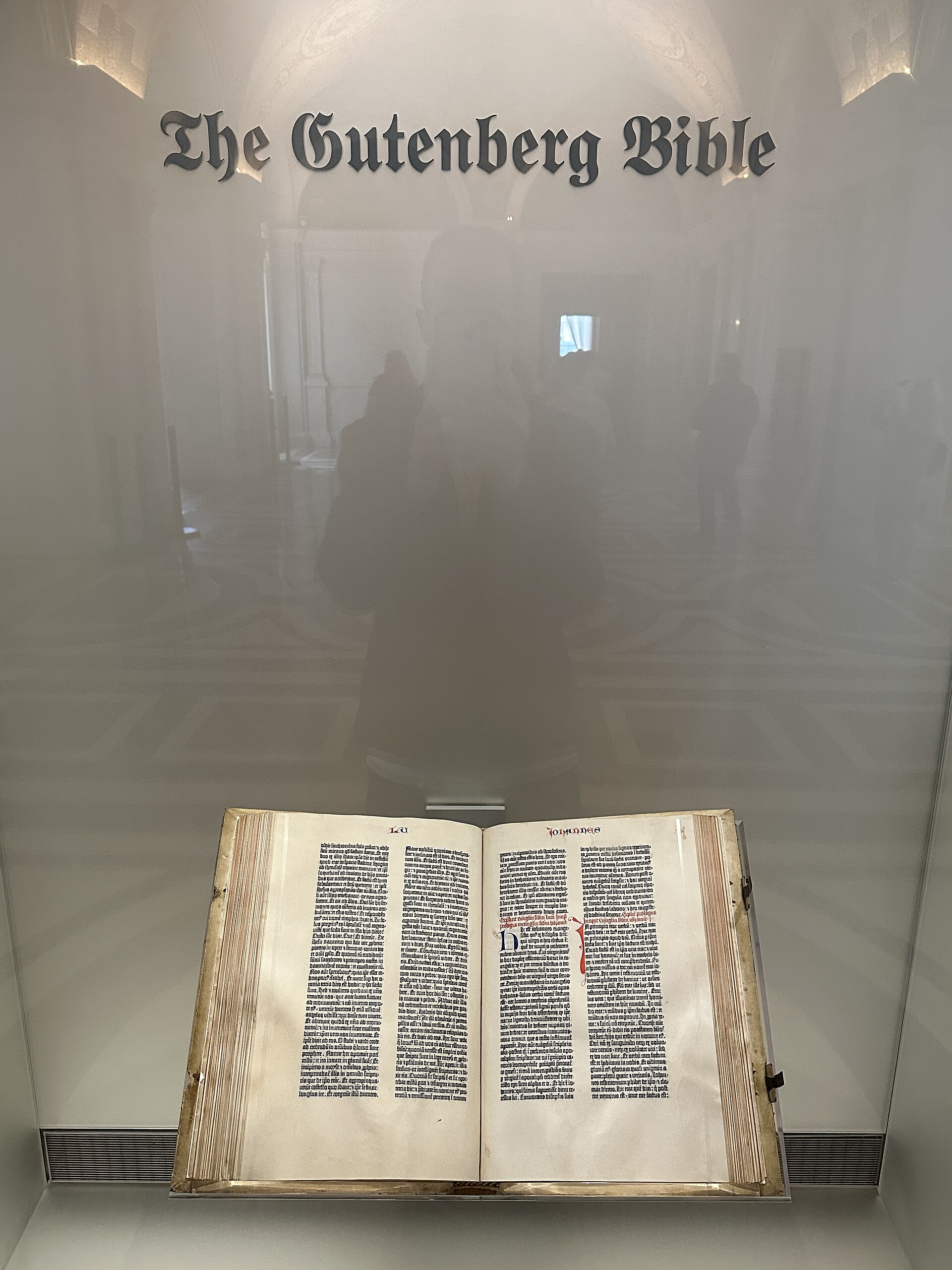
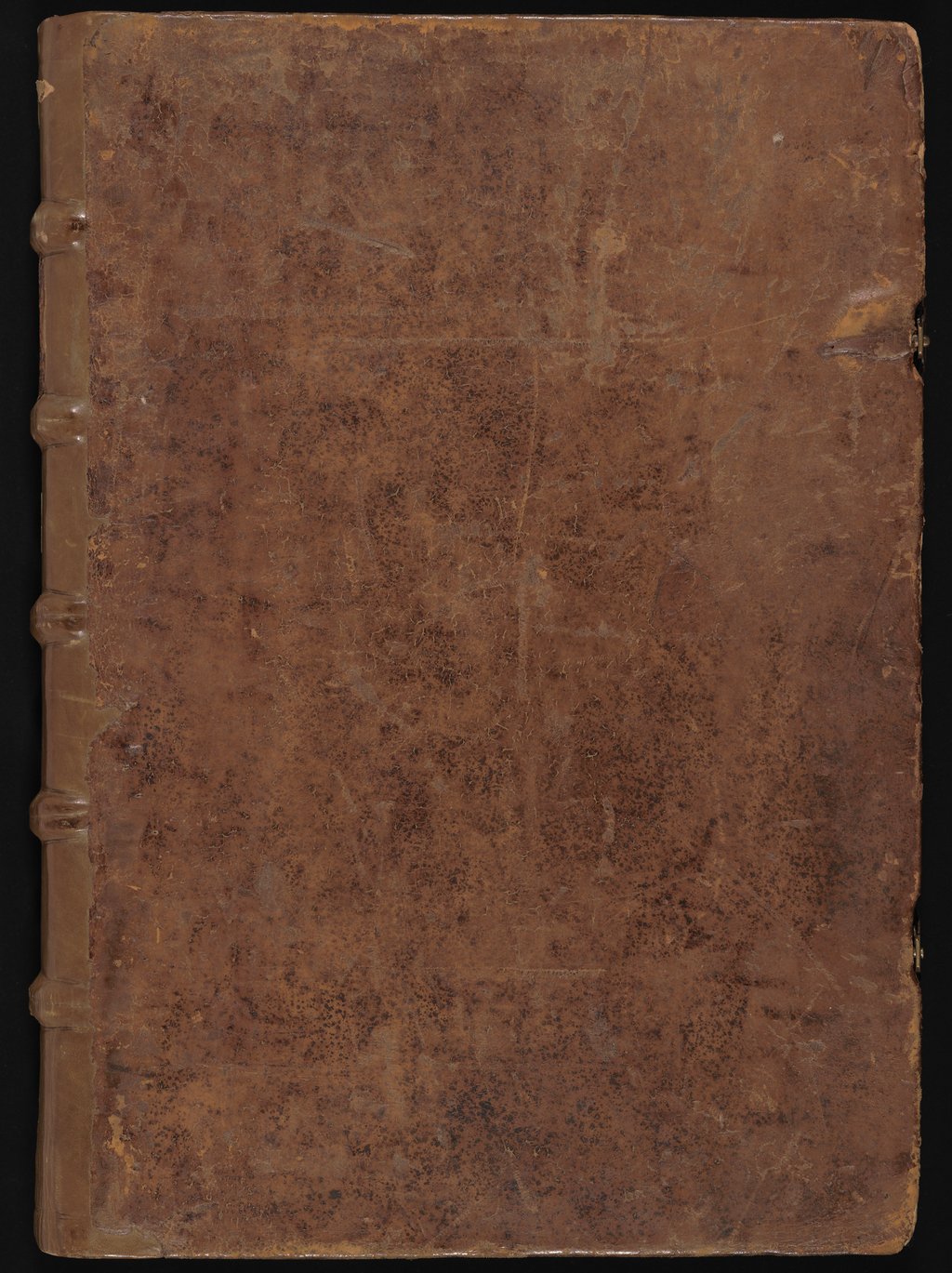
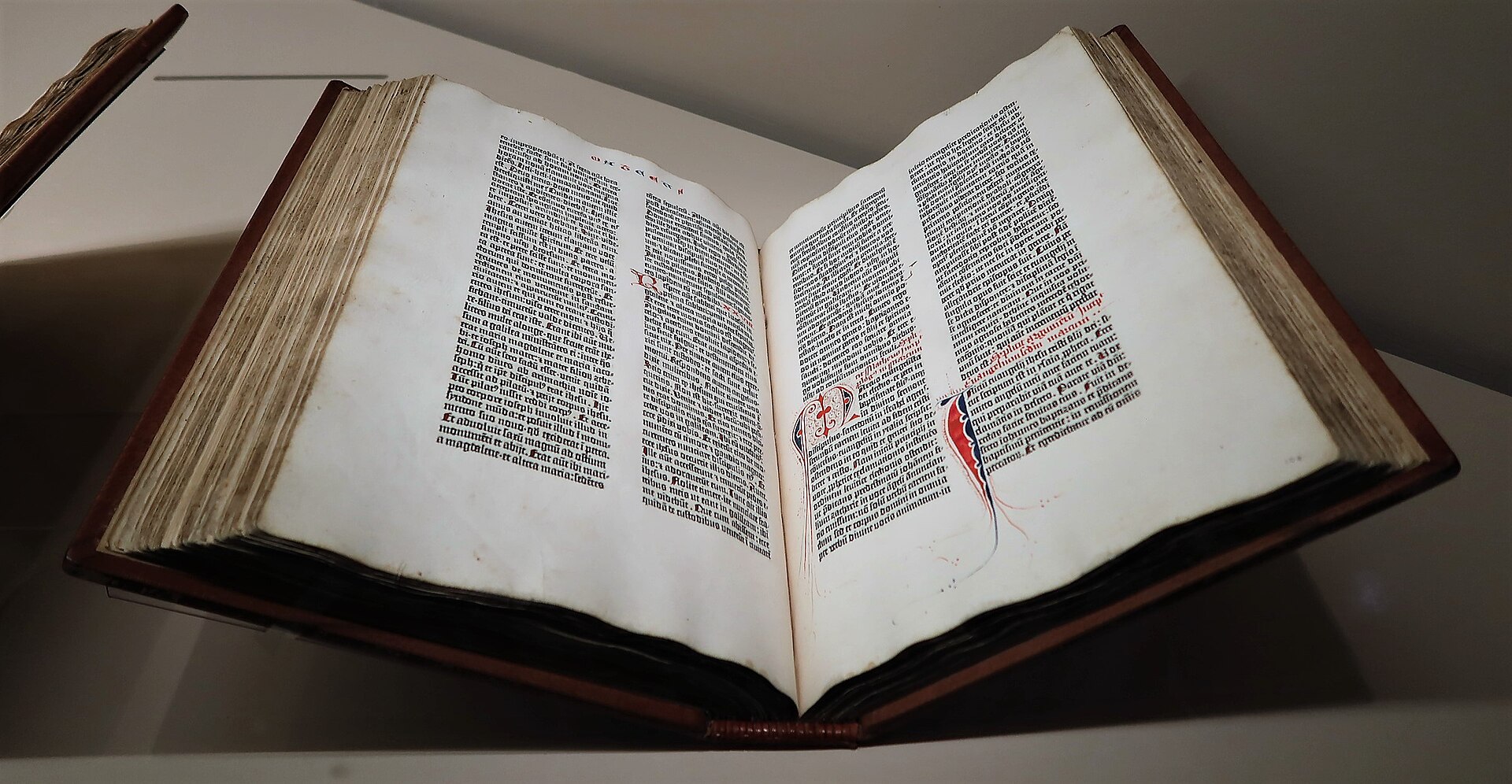
Biblia Latina, the 42-line Bible: the Library of Congress copy
Mainz, between 1454 and 1455, not after 1456 · Printed from movable metal type on vellum
Library of Congress, Rare Book and Special Collections...
 German (Mainz) · 1400-1468
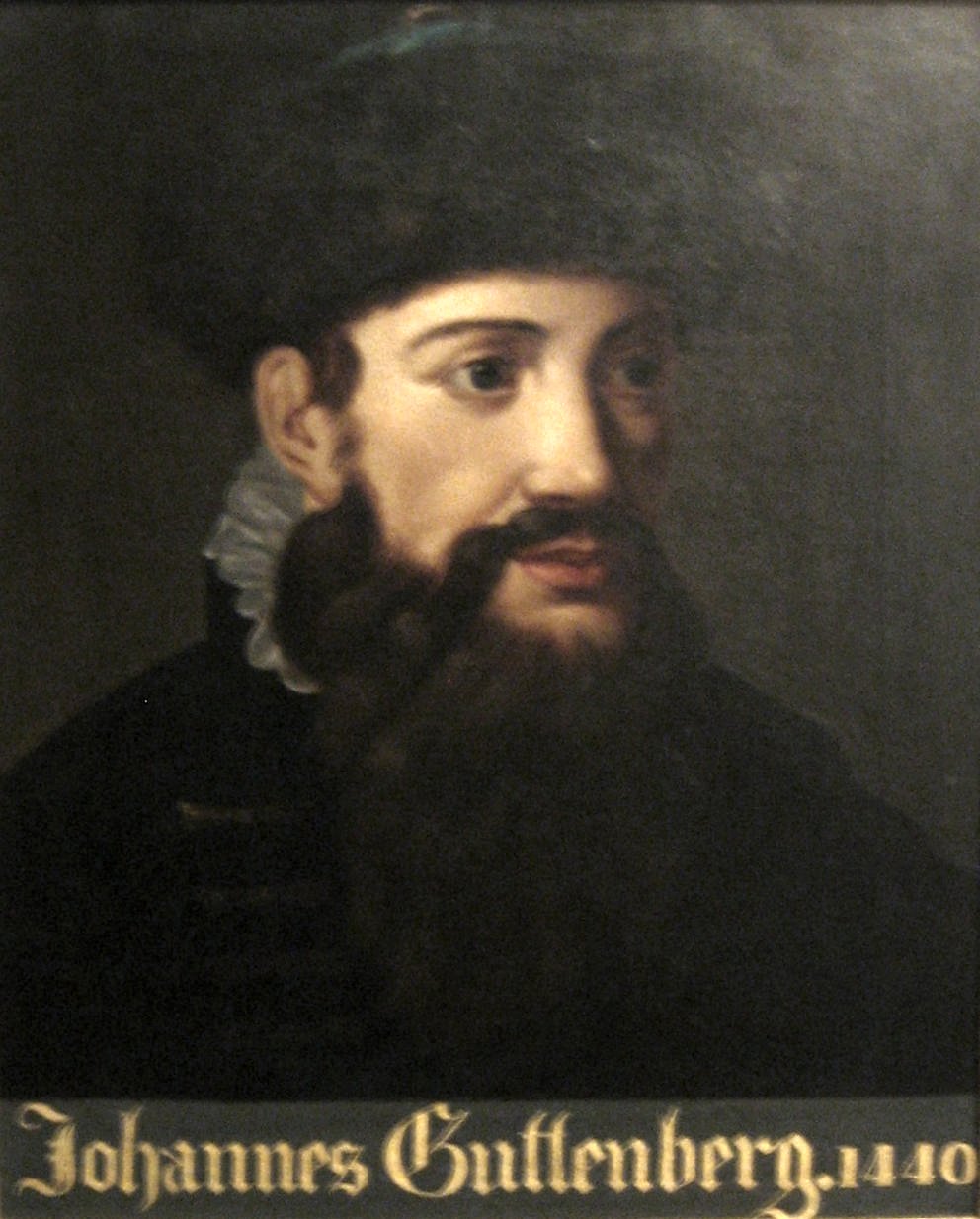
A later, imagined portrait Held by the Gutenberg Museum, Mainz, and often reproduced as if it were a likeness of the man. No portrait of Gutenberg made from life is known to survive, and this anonymous panel, despite the 1440 date sometimes attached to its title, is a later invented image rather than a documented contemporary likeness. It is shown here for what it is: the tradition, not the man. No verified portrait. No securely identified likeness of this maker is known under a free licence. We do not publish a face we cannot verify.
Gutenberg Museum, Mainz, via Wikimedia Commons| Full name | Johann Gensfleisch zur Laden zum Gutenberg |
|---|---|
| Worked as | Printer, Publisher, Inventor of the European movable-type press |
| Born | c. 1400 (not documented · Mainz, in the Holy Roman Empire |
| Died | 3 February 1468 · Mainz |
| Nationality | German (Mainz) |
| Movement | Early European printing, the incunabula period (books printed before 1501) |
| In this archive | 1 artwork |
| Sources | 18 cited |
| Last verified | 17 September 2026 |
About this page 1 artwork in the archive · Last verified 17 September 2026 · 18 sources cited
Johannes Gutenberg is credited with the invention that ended the manuscript age in Europe, and almost nothing about him is documented directly. No object he made is signed. No press, mould, or piece of type that passed through his hands is known to survive. No portrait made from life is known to exist. What is attributed to him rests on a handful of legal records, on the testimony of people who saw his work in progress, and on the printed evidence itself, compared letter by letter across the copies that survive.
The object that carries his fame, the 42-line Bible printed at Mainz around 1454-1455, does not name him. It has no title page, no colophon, no date, and no place of printing. The attribution to Gutenberg's workshop is a conclusion built by generations of scholars from a lawsuit, a handful of contemporary letters, and typographic comparison, not a fact stated anywhere in the book itself. Two copies of that Bible already have full records on this site, the Doheny copy at Keio University and the Vollbehr copy at the Library of Congress; this page is about the man and the invention behind both of them, and about how much of what is said about him is inference rather than record.
The single fact most readers do not expect: Gutenberg lost control of his own printing business in 1455, four years before his most famous book was finished being sold, to the man who had lent him the money to make it.

Born in Mainz to the patrician Gensfleisch family; the exact year is not documented and modern estimates range from 1393 to 1406.1
First documented in Strasbourg.2
Named in a Strasbourg court record concerning a broken promise of marriage, and shown teaching gem polishing to wealthy tradesmen.1
Forms a partnership with Hans Riffe, Andreas Dritzehn and Andreas Heilmann to mass-produce pilgrim mirrors for the Aachen pilgrimage.2
Andreas Dritzehn dies.2
Dritzehn's brothers sue Gutenberg in December, demanding partnership rights or repayment; surviving testimony describes a wooden press and printing materials, the earliest hint of the invention.2
Last documented in the Strasbourg tax rolls.2
Documented back in Mainz.1
Press operational at Mainz; first loan of 800 guilders from Johann Fust.1
Probable date, per the British Library's Incunabula Short Title Catalogue, of the Sibyllenbuch fragment, the earliest surviving remnant of European movable-type printing.7
Second loan of 800 guilders from Fust, generally connected to financing the Bible.1
The 31-line Indulgence, funding the defense of Cyprus, issued with the earliest fixed printed date in European movable-type printing.6
Enea Silvio Piccolomini writes to Cardinal Juan de Carvajal describing Bible quires already sold out at Frankfurt the previous year.89
Johann Fust sues Gutenberg before the Archbishop of Mainz's court; the Helmasperger Notarial Instrument records the case and its outcome, which cost Gutenberg his printing equipment.14
The 42-line Bible completed.4
Fust and Peter Schoffer, continuing the business Gutenberg lost, publish the Mainz Psalter, the first printed book with a printed date, printer's names and a colophon.1
Prince-Abbot Martin Gerbert von Horneau compares the Sankt Blasien 42-line Bible (now the Library of Congress copy) against a 36-line Bible at Memmingen.15
Archbishop Adolf II von Nassau grants Gutenberg a court pension with the title Hofmann.1
Dies in Mainz.1
The priority dispute between the 42-line and 36-line Bibles is resolved in scholarship in favor of the 42-line edition.15
The Sibyllenbuch fragment discovered reused in a book binding in Mainz.7
Gabriel Wells breaks up an imperfect Gutenberg Bible and sells it leaf by leaf as A Noble Fragment.11
United States Congress purchases Otto Vollbehr's collection of 3,000 incunabula, including the Bible now at the Library of Congress, for 1,500,000 dollars with no separate price set for the Bible.1516
The General Theological Seminary's copy is reported in secondary accounts to have had a forged leaf replaced with an authentic one, though this record could not confirm the detail against a primary source.
Two complete copies change hands within the same month, at the Harry Ransom Center and at the Wurttembergische Landesbibliothek, Stuttgart; no complete copy is known to this desk to have been sold since.12
Paul Needham publishes his census of surviving copies.4
The Doheny copy's Old Testament volume sells at Christie's, New York, for a hammer of 4.9 million dollars plus a 490,000 dollar premium.14
Blaise Aguera y Arcas and Paul Needham publish findings of significant variation among nominally identical letterforms in the 42-line Bible, challenging the single-matrix account of Gutenberg's type casting.5
Eric Marshall White publishes Editio Princeps: A History of the Gutenberg Bible, whose census the Library of Congress now cites as the standard reference.16
No complete copy of the 42-line Bible is known to this desk to have been sold since 1978, when two changed hands within the same month: the Harry Ransom Center's acquisition from the Pforzheimer Foundation for a reported 2.4 million US dollars, and the Wurttembergische Landesbibliothek's acquisition, through the dealer Bernard H. Breslauer, of the General Theological Seminary's copy for a reported 2.2 million dollars. Whether either was an auction sale or a private treaty sale is not confirmed in the sources consulted, and neither source separates a hammer price from a premium.
The one complete auction result this record can source with hammer and premium separated, the October 1987 Christie's sale, was a single volume of a two-part edition, not a complete Bible: 4.9 million dollars hammer plus a 490,000 dollar premium. Individual leaves, almost all traceable to twentieth-century breakups of imperfect copies, trade at far lower prices and with some regularity; a single leaf sold at Pook and Pook in April 2022 for a reported 68,200 dollars against a 20,000 to 40,000 dollar estimate, again without a hammer figure separated from the total in the source consulted.
| Date | Sale | Work | Result | Note |
|---|---|---|---|---|
| 22 October 1987 | Christie's, New York | Gutenberg Bible, Old Testament volume only (the Doheny copy, now Keio University; a single volume, not a complete two-volume Bible) | Hammer USD 4,900,000 With premium USD 490,000 (10 percent) USD | Sold on behalf of the Roman Catholic Archdiocese of Los Angeles to Maruzen Co. Ltd of Tokyo. Fully documented, with the object's own provenance chain, in this site's record gutenberg-bible-doheny-copy. |
Hammer is the price at which the bidding stopped; with premium adds the fee the house charges the buyer on top. Hammer price and buyer's premium in the glossary.
| Institution | City | Holdings | Note |
|---|---|---|---|
| Library of Congress, Rare Book and Special Collections Division | Washington, D.C. | A complete three-volume vellum copy (the Vollbehr copy), on permanent public display in the Great Hall of the Thomas Jefferson Building. | Full record on this site: gutenberg-bible-vollbehr-copy. |
| Keio University Library, Mita Media Center | Tokyo | A single paper volume, Old Testament (the Doheny copy). The only Gutenberg Bible held by any institution in Asia. | Full record on this site: gutenberg-bible-doheny-copy. |
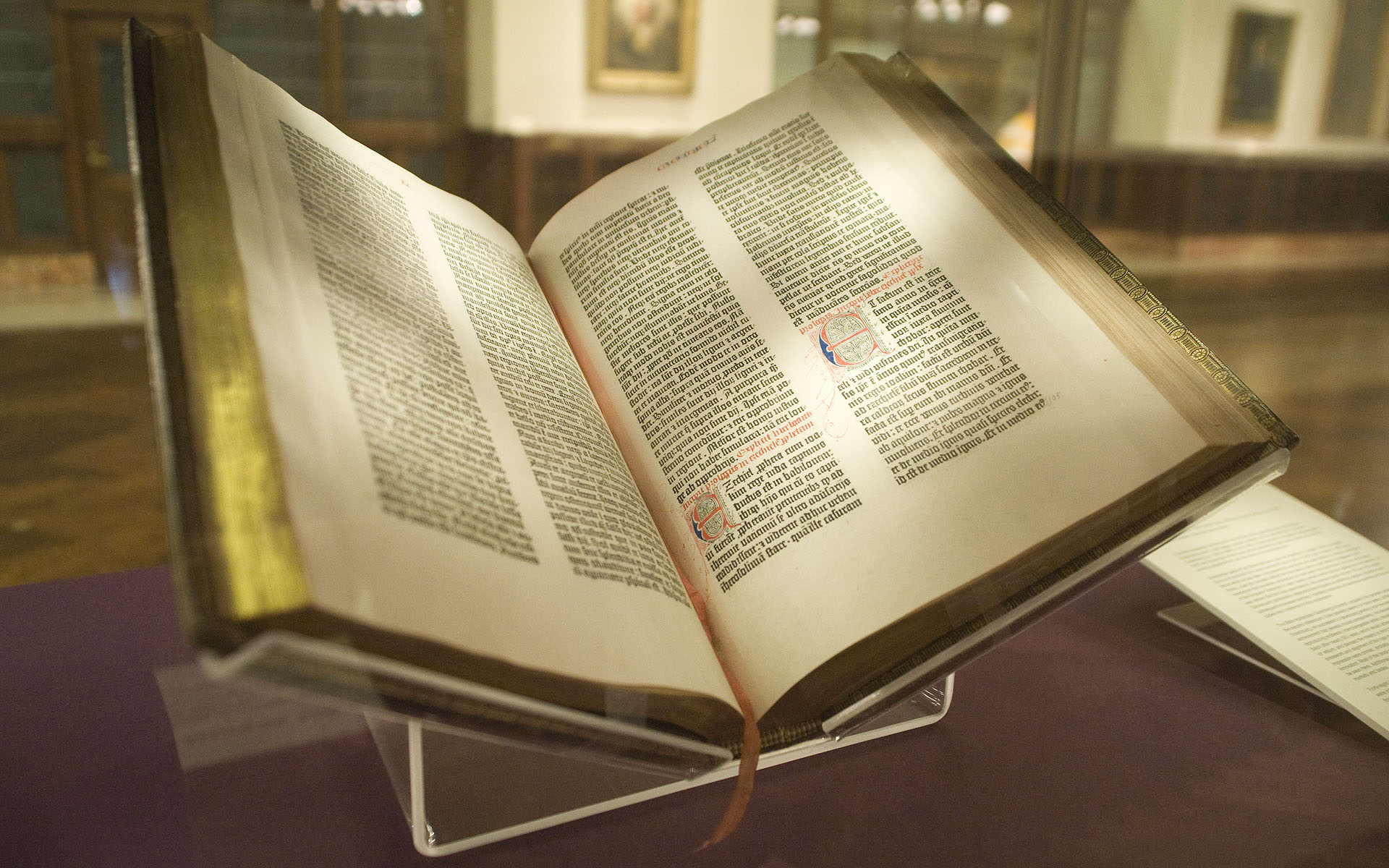
| New York Public Library | New York | A complete paper copy (the Lenox copy), the first Gutenberg Bible to reach the United States, in 1847. | |
| Bibliotheque nationale de France | Paris | A complete vellum copy (Res A71), named by the Library of Congress as one of a small group of perfect vellum copies. | |
| Bayerische Staatsbibliothek | Munich | A paper copy, one of only two surviving copies to retain the separately printed rubrication table (tabula rubricarum); the other is at the Austrian National Library, Vienna. | |
| Staatsbibliothek zu Berlin | Berlin | A vellum copy with about 100 hand-painted initials attributed to the Leipzig Pfauenwerkstatt. | |
| Harry Ransom Center, University of Texas at Austin | Austin, Texas | A complete copy, acquired in 1978 from the Carl H. and Lily Pforzheimer Foundation. | |
| Wurttembergische Landesbibliothek | Stuttgart | A complete copy, ex-General Theological Seminary, New York, acquired in 1978. | |
| Gutenberg-Museum | Mainz | The Sibyllenbuch fragment and other DK-type material, the museum's own portrait tradition of Gutenberg, and general reference holdings on the invention and the shop. | Holds the anonymous portrait discussed below. |
| Beinecke Rare Book and Manuscript Library, Yale University | New Haven, Connecticut | A complete paper copy. |
Gutenberg was born into the patrician Gensfleisch family of Mainz; the name by which history knows him, Gutenberg, is taken from the family's house rather than from his father's line, and he is the...
Gutenberg was born into the patrician Gensfleisch family of Mainz; the name by which history knows him, Gutenberg, is taken from the family's house rather than from his father's line, and he is the only member of the family generally known by it. His mother, Else Wyrich, came from a family of shopkeepers rather than patricians, a mismatch that later biographers have connected to friction over Gutenberg's standing in Mainz, though the connection is argued rather than documented.
His birth date was never recorded. Modern estimates range from 1393 to 1406; the Library of Congress and most institutional sources use the shorthand c. 1400, and this record follows that convention while noting it is a convenience, not a fact.
By 1434 Gutenberg was living in Strasbourg, outside Mainz's jurisdiction after a period of civic unrest at home.
By 1434 Gutenberg was living in Strasbourg, outside Mainz's jurisdiction after a period of civic unrest at home. Contrary to the popular claim, he was not a goldsmith by patrician right; Strasbourg tax records list him in 1444 only as an associate of the goldsmiths' guild, a lesser status than full membership, though he had certainly learned enough of the trade to teach it, and a 1436-37 court record shows him instructing wealthy Strasbourg tradesmen in gem polishing.
In 1438 he formed a partnership with Hans Riffe von Lichtenau, Andreas Dritzehn and Andreas Heilmann to mass-produce small pilgrim mirrors for sale at the Aachen pilgrimage, a seven-year devotional cycle the partners misjudged, expecting it in 1439 when it actually fell in 1440. Andreas Dritzehn, who had been apprenticed to Gutenberg since 1437, died at the end of 1438. His brothers Claus and Jerge sued Gutenberg in December 1439, demanding either repayment or admission to the partnership in Andreas's place.
The partners lost, but the surviving trial testimony, 16 of an original 40 witness statements, is the first documentary hint of the invention to come. A carpenter, Conrad Saspach, testified to having built a wooden press; a goldsmith, Hans Dunne, testified to having sold Gutenberg about 100 guilders' worth of unspecified printing materials as early as 1436. Neither witness used the word printing, and the case was ostensibly about mirrors and partnership shares, but the objects named, a press, lead, moulds, are exactly the equipment a movable-type shop would need. Gutenberg's presence in Strasbourg is last recorded in the 1444 tax rolls; by the time he resurfaces in documented history, in Mainz around 1448, the invention is essentially complete.
No press, mould, matrix, or piece of type known to have belonged to Gutenberg's own workshop survives.
No press, mould, matrix, or piece of type known to have belonged to Gutenberg's own workshop survives. The earliest illustration of any European printing press dates to 1499, more than four decades after Gutenberg's Bible, and the earliest surviving press of any kind dates from the mid-sixteenth century. Everything said about his equipment is therefore reconstructed from the printed evidence and from later, generic accounts of how presses of this type worked, not read off a surviving object.
The part scholars single out as genuinely original to him is the adjustable hand mould: a two-piece metal casting instrument, held in a wooden hand-grip, into which a matrix for a single letter could be fitted and molten type-metal poured, producing a cast sort that could be pulled free the instant it solidified and replaced with a matrix for the next letter or a different size. Every other element of the system, block printing, the screw press used for wine and paper, oil-based paint, had precedent; the adjustable mould is the piece nobody has found an antecedent for.
The type-metal alloy was mostly lead, with tin and antimony added; the antimony gave the alloy the useful property of expanding very slightly as it cooled, so that a cast letter took a sharp, complete impression of the matrix and could be extracted from the mould as soon as it set, without shrinking away from the mould walls first. The ink was oil-based rather than the water- or gum-based ink scribes used, formulated to adhere to metal type rather than to a quill's nib, and modern analysis of surviving printed sheets finds it carbon-based but heavily loaded with metal, principally copper and lead. The press itself was adapted from the screw presses already used for wine and paper; a plain wine press cannot print, because the platen rotates as the screw turns and would smear the impression, so Gutenberg's press needed an added mechanism, a bar between platen and screw, to keep the platen moving straight down. What that mechanism actually looked like on his own press is not known; it is inferred from how later presses solved the same problem.
The Bible was not Gutenberg's first printing.
The Bible was not Gutenberg's first printing. A single leaf found in 1892, reused inside an old book binding in Mainz and now called the Sibyllenbuch fragment, is set in an early, visibly unrefined state of a type scholars call DK type (from the Donatus-Kalender documents also set in it) and is dated by the British Library's Incunabula Short Title Catalogue to about 1452-1453, making it, if the dating holds, the earliest surviving remnant of European movable-type printing. A cyclotron analysis of its ink in 1987 found the same high lead-and-copper signature as other work attributed to Gutenberg's shop, which is offered as supporting evidence for the attribution rather than proof of it.
In late summer 1454 the Cypriot cleric Paulinus Chappe, acting as commissary for a plenary indulgence granted by Pope Nicholas V to fund the defense of Cyprus against Ottoman attack, contracted for the indulgence text to be printed in bulk. The result, known as the 31-line Indulgence, survives with a fixed printed date of 22 October 1454, the earliest European document with a fixed date printed from movable type, in 46 known copies. No copy names a printer, and the type differs enough from the Bible's later type that some scholars have proposed a different, competing Mainz printer rather than Gutenberg himself; the more widely repeated view attributes it to Gutenberg's shop on the strength of the type family, but the point is disputed rather than settled. Read together, the indulgence and the Bible show the same press being used, in the same years, for a piece of urgent commercial church business and for the largest and most ambitious book of the century; there is no evidence Gutenberg drew any distinction in kind between the two kinds of work, which is itself a fact about what printing was for in 1454, not an incidental detail.
Around 1450 Johann Fust, a Mainz financier, lent Gutenberg 800 guilders, and lent him a further 800 guilders in 1452, on terms that are not fully recorded but that evidently gave Fust a claim over...
Around 1450 Johann Fust, a Mainz financier, lent Gutenberg 800 guilders, and lent him a further 800 guilders in 1452, on terms that are not fully recorded but that evidently gave Fust a claim over the press and its output if the loans were not repaid. On 6 November 1455 Fust sued Gutenberg before the court of the Archbishop of Mainz to recover the money with compound interest, a total claim later put at roughly 2,020 to 2,026 guilders. The surviving record of that suit, known as the Helmasperger Notarial Instrument after the notary who wrote it, is the single most important contemporary document of Gutenberg's print shop; nothing else from his own lifetime describes the operation in comparable detail.
The court found for Fust. Gutenberg is recorded as having had some of his own expenses on the Bible project recognized, which limited how badly he lost, but the outcome was still the loss of his printing equipment and, on most accounts, a half-share of the Bibles printed so far, to Fust. Peter Schoffer, a calligrapher who had worked in Gutenberg's shop, went into partnership with Fust and continued printing under the Fust-Schoffer name, publishing further editions, including a Psalter in 1457 that is the first printed book to carry a printed date, printer's names and a colophon, the very things the 42-line Bible lacks. Whether the workshop Gutenberg lost is the same workshop that finished printing the Bible, or whether Gutenberg himself completed it before the judgment, is argued rather than settled in the secondary literature consulted for this record.
The edition ran to somewhere in the range of 158 to 180 copies by scholarly estimate, the great majority on paper and a smaller number, at least a few dozen, on vellum; the Library of Congress's own...
The edition ran to somewhere in the range of 158 to 180 copies by scholarly estimate, the great majority on paper and a smaller number, at least a few dozen, on vellum; the Library of Congress's own account puts the paper run at at least 120 copies and the vellum run at perhaps as many as 40. The text is the Latin Vulgate, in the emended form of the twelfth-century Paris Bible current along the Rhine in the fourteenth and fifteenth centuries, the same standard scriptural text an educated cleric of the period would already have owned in manuscript; choosing it was not a statement of any personal position, it was the obvious and only commercially sensible text to print at scale for a market of churches, monasteries and clergy. That the shop's largest undertaking was the most widely used religious text of the age, printed with no illustration and no doctrinal commentary of its own, is itself the finding: nothing in the choice of text argues for any personal program beyond selling copies of the book every institutional buyer already wanted.
Production evidently used more than one press and more than one team of compositors working sections in parallel, reconstructed from evidence of type reuse and setting rate rather than from any surviving business record; estimates run from four compositors working four roughly equal sections in the edition's early stages to as many as six working simultaneously later on, each responsible for several pages at once, requiring on the order of 46,000 individual pieces of type in circulation to keep that many pages in type at the same time. Partway through the print run, the shop reduced the interline spacing and increased the type from 40 to 42 lines per page, a change made to save paper rather than to alter the format; pages 1 through 9 and, at the far end of the book, pages 256 through 265, read as 40 lines, apparently the earliest sheets printed, page 10 shows a transitional 41 lines, and the rest of the edition settles at 42, the count that gives the book its modern name.
No colophon, date, or printer's name appears anywhere in the finished book. The earliest outside account of it is a letter Enea Silvio Piccolomini, the future Pope Pius II, wrote to Cardinal Juan de Carvajal on 12 March 1455, describing quires he had seen for sale in Frankfurt the previous year, already sold out before the letter was written, and reporting hearsay that 158 or, by other accounts he had heard, 180 copies had been finished. That is the closest thing to a contemporary sales figure the book has.
The received account of Gutenberg's process assumes that for each letterform a single steel punch struck a single copper matrix, from which every cast sort of that letter was then produced, so that...
The received account of Gutenberg's process assumes that for each letterform a single steel punch struck a single copper matrix, from which every cast sort of that letter was then produced, so that in principle every lowercase a in the book should be identical. In 2001-2002 the computer scientist Blaise Aguera y Arcas, working with the Gutenberg scholar Paul Needham, compared large numbers of supposedly identical letterforms across the 42-line Bible and found systematic variation inconsistent with a single shared matrix. A later statistical study applying cluster analysis to the letters i and a confirmed measurable, non-random differences among nominally identical sorts.
What that variation means is argued rather than settled. The straightforward reading is that individual sorts were being made independently of one another by some method other than one matrix striking many identical copies, which would put a different, less mechanized picture of Gutenberg's type foundry against the traditional one. Other scholars have proposed technical explanations consistent with a single-matrix process that could still produce this degree of variation, such as wear, distortion in casting, or a matrix that itself changed shape during use. No consensus has replaced the traditional account, and this record states the finding, the disagreement over its interpretation, and the fact that no surviving matrix or mould from Gutenberg's own shop exists to settle it, without adopting either side.
Gutenberg's DK type was also used, at Mainz or by an associate working from his type, to print a second complete Bible in 36 lines per page rather than 42, generally dated slightly later and usually...
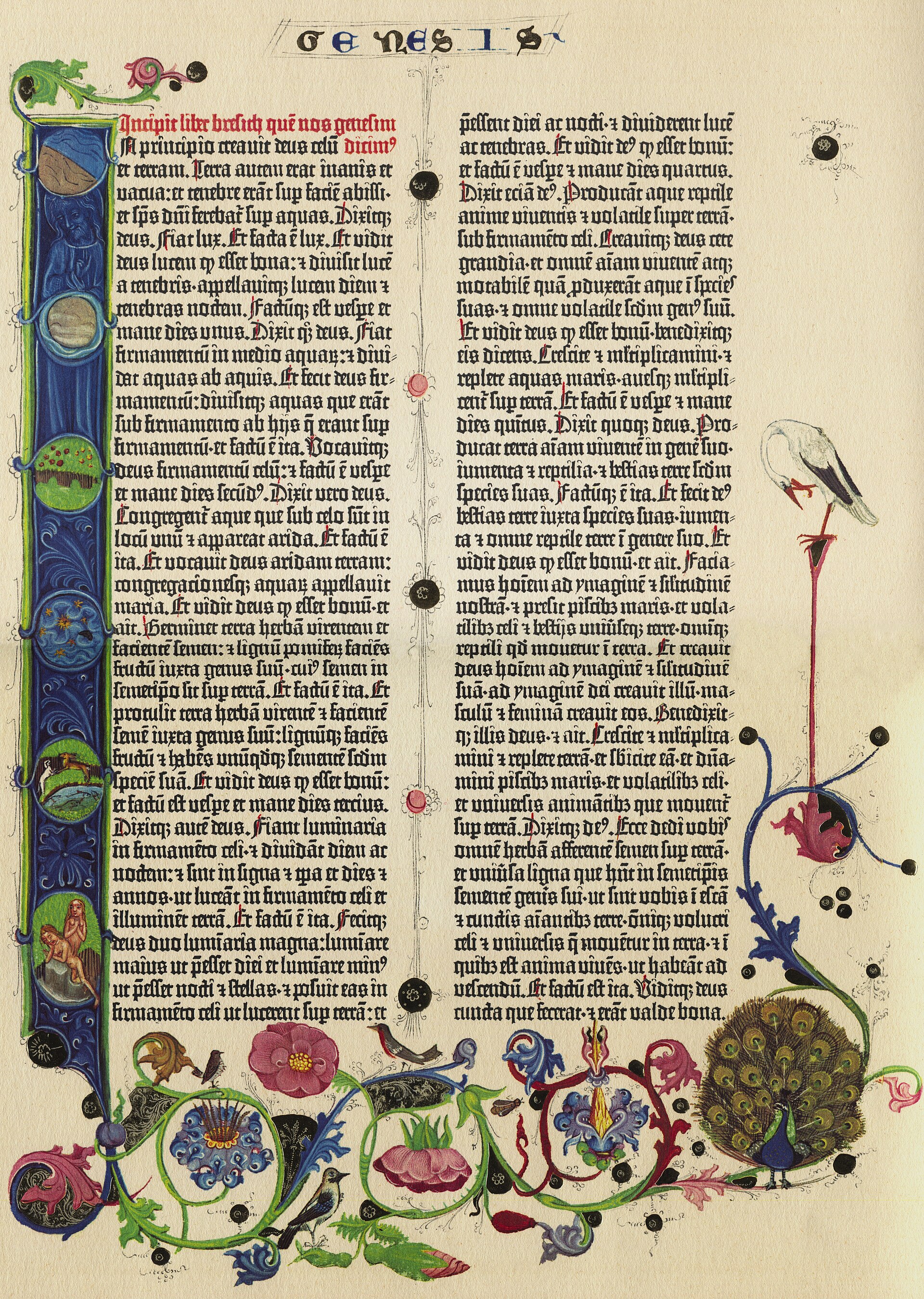
Gutenberg's DK type was also used, at Mainz or by an associate working from his type, to print a second complete Bible in 36 lines per page rather than 42, generally dated slightly later and usually associated with Bamberg rather than Mainz in its finished form; scholarship increasingly treats the 36-line Bible as the work of someone using Gutenberg's type rather than a book Gutenberg printed himself, though this record found the point argued rather than closed. Which of the two editions came first was not a settled question even to contemporaries. In 1765 Martin Gerbert von Horneau, the Prince-Abbot of the Benedictine abbey of Sankt Blasien, then owner of what is now the Library of Congress copy of the 42-line Bible, compared his own copy directly against a 36-line Bible held at Memmingen and published an engraving of the 42-line copy's distinctive Genesis initial so that other scholars could identify further copies by it. The priority question his comparison raised was not resolved in scholarship until 1890, more than a century later, in favor of the 42-line edition as the earlier of the two.
After the 1455 judgment, Fust and Schoffer used the equipment and, evidently, some of the type awarded to Fust to continue printing under their own names at Mainz, including the 1457 Mainz Psalter.
After the 1455 judgment, Fust and Schoffer used the equipment and, evidently, some of the type awarded to Fust to continue printing under their own names at Mainz, including the 1457 Mainz Psalter. Beyond that, the trail of Gutenberg's actual tools goes cold. No source consulted for this record documents what became of the type, moulds or press themselves after Fust and Schoffer's own working lives ended; nothing identified as Gutenberg's original equipment is known to survive in any collection today, and the absence is treated here as a gap rather than filled with the popular but undocumented claim that the type was later melted down.
Gutenberg himself did not stop working. A 1460 printing of the Catholicon, a Latin grammar and encyclopedia, is attributed by some scholars to a press Gutenberg operated independently after 1455, though, as with everything else in this record, without a signature or colophon to confirm it.
On 18 January 1465 Adolf II von Nassau, Archbishop and Elector of Mainz, granted Gutenberg a court appointment with the title Hofmann, carrying an annual allowance of grain and wine and exemption...
On 18 January 1465 Adolf II von Nassau, Archbishop and Elector of Mainz, granted Gutenberg a court appointment with the title Hofmann, carrying an annual allowance of grain and wine and exemption from certain taxes and duties. It is one of the only pieces of direct evidence for how his contemporaries regarded him in his own lifetime, awarded three years before his death and roughly a decade after he had lost his printing business in court.
Gutenberg died in Mainz on 3 February 1468. He is traditionally said to have been buried as a tertiary of the Franciscan order in the Franciscan church at Mainz, a building later destroyed, so that even his grave does not survive to be checked against the tradition.
The modern figure repeated across institutional sources, including the Library of Congress and the Gutenberg Museum, is that about 49 copies of the 42-line Bible survive today in whole or substantial...
The modern figure repeated across institutional sources, including the Library of Congress and the Gutenberg Museum, is that about 49 copies of the 42-line Bible survive today in whole or substantial part, out of an original print run in the range of 158 to 180, with roughly 21 of those counted as complete. That figure descends through three generations of scholarly census work: Ilona Hubay's published census, the numbering still used in the antiquarian trade (the Doheny/Keio copy is Hubay's No. 45); Paul Needham's 1985 census, built from paper-supply and typographical evidence and widely regarded as more systematic than what came before it; and Eric Marshall White's Editio Princeps, published in 2017, whose census at pages 307 to 353 is the reference the Library of Congress itself now directs readers to.
Even the current reference does not resolve every count cleanly. The Library of Congress's own resource guide states in one place that its copy is one of only three perfect vellum copies, naming the Bibliotheque nationale de France and the British Library as the other two, and in another, more recently updated page of the same guide, that it is one of four such institutions, adding the Gottingen State and University Library to the list. Both statements are live on the same institutional website at once. This record repeats the discrepancy rather than picking a side, because a corpus this well studied still disagreeing with itself about how many perfect copies exist is itself informative about how hard the counting is.
Two of the named surviving copies already have full, independent records on this site: the Doheny copy, a single paper volume now at Keio University in Tokyo, whose long chain of ownership runs through the Earl of Gosford, Lord Amherst of Hackney, C.W. Dyson Perrins and Carrie Estelle Doheny before its 1987 sale and 1996 arrival in Japan; and the Vollbehr copy, a complete three-volume vellum Bible bought by Act of Congress in 1930 as part of a bulk purchase of 3,000 incunabula from the dealer Otto Vollbehr, who was later found by a congressional committee to have spent most of the appropriation on pro-Nazi and antisemitic mailings inside the United States. Neither saga is repeated here in full; both are covered at length in their own records.
No complete copy of the 42-line Bible has been offered at public auction in this desk's research since 1978, when two separate complete copies changed hands within the same month: the Harry Ransom...
No complete copy of the 42-line Bible has been offered at public auction in this desk's research since 1978, when two separate complete copies changed hands within the same month: the Harry Ransom Center at the University of Texas acquired a copy from the Carl H. and Lily Pforzheimer Foundation for a reported 2.4 million US dollars, and the dealer Bernard H. Breslauer bought, on behalf of the Wurttembergische Landesbibliothek in Stuttgart, the copy previously owned by the General Theological Seminary in New York, for a reported 2.2 million US dollars. Whether either 1978 transaction was a public auction sale or a private treaty sale is not confirmed in the sources consulted for this record, and the two figures are given as reported totals because no source reached here separates a hammer price from a premium for either one.
The one complete-Bible sale since then that this record can source in full, the October 1987 Christie's sale of the Doheny copy, was a single volume of a two-part edition, not a complete Bible, and its hammer and premium are separated and documented in that copy's own record: a hammer of 4.9 million US dollars against a 10 percent buyer's premium of 490,000 dollars, a total of approximately 5.39 million dollars.
Individual leaves and small groups of leaves, almost all of them traceable back to one of a small number of imperfect copies broken up for the leaf trade in the twentieth century, do trade with some regularity and at far lower prices. At Pook and Pook in Downingtown, Pennsylvania, on 21-22 April 2022, a single leaf carrying part of the Second Book of Esdras, with a documented chain back through Gabriel Wells's 1921 breakup of an imperfect copy, sold to a private collector for 68,200 US dollars against an estimate of 20,000 to 40,000 dollars; the source consulted does not separate a hammer figure from the total, so this record states the reported result as reported rather than dividing it.
In 1921 the New York dealer Gabriel Wells bought an imperfect Gutenberg Bible, missing about 50 of its original 643 leaves and already stripped of much of its illumination, from the collector Joseph...
In 1921 the New York dealer Gabriel Wells bought an imperfect Gutenberg Bible, missing about 50 of its original 643 leaves and already stripped of much of its illumination, from the collector Joseph Sabin. Rather than sell it as a single damaged book, Wells had it disbound and sold off leaf by leaf, each one mounted and issued with a bibliographical essay commissioned from A. Edward Newton, under the title A Noble Fragment. The decision scandalized the antiquarian trade at the time; contemporaries were divided on whether it was, in one description, sacrilege or a canny deal. The leaves sold well, and other dealers later broke up further imperfect copies on the same model.
The consequence, a century later, is that most Gutenberg Bible leaves now on the market, including the 2022 Pook and Pook leaf described above, trace their individual existence directly to this decision: a complete or nearly complete book was deliberately dismantled to be sold in pieces, each piece worth more divided than the damaged whole was worth intact. This record states the fact plainly rather than either condemning or defending it: it is the reason a reader can realistically buy a piece of a Gutenberg Bible today, and the reason no dealer since has needed to invent a new source of supply.
Printer; Publisher; Inventor of the European movable-type press. c. 1400-1468.
Born c. 1400 (not documented; estimates in the modern literature range from 1393 to 1406), Mainz, in the Holy Roman Empire; died 3 February 1468, Mainz.
Facsimile leaves possibly by Adam Pilinski (1810-1887). When a vellum copy of the 42-line Bible lost three leaves and a number of border decorations to an earlier owner who cut them out, the missing material was replaced with facsimile work, according to the Morgan Library and Museum's own account of its copy, quite possibly by the Paris artist and lithographer Adam Pilinski, who is known to have restored at least two Gutenberg Bibles and whose facsimile work was, in the Morgan's own description, legendary enough in its day to have fooled more than one scholar who took it for the original printing.
Library of Congress, Rare Book and Special Collections Division (Washington, D.C.); Keio University Library, Mita Media Center (Tokyo); New York Public Library (New York); Bibliotheque nationale de France (Paris); Bayerische Staatsbibliothek (Munich); Staatsbibliothek zu Berlin (Berlin).
No complete copy of the 42-line Bible is known to this desk to have been sold since 1978, when two changed hands within the same month: the Harry Ransom Center's acquisition from the Pforzheimer Foundation for a reported 2.4 million US dollars, and the Wurttembergische Landesbibliothek's acquisition, through the dealer Bernard H. Breslauer, of the General Theological Seminary's copy for a reported 2.2 million dollars.
Gutenberg's exact birth year. Undocumented; modern estimates run from 1393 to 1406.
Of 204 published records in this archive, 85 state that no price for the object exists.
9 min read
16 of the 18 manuscripts and printed books in this archive wear a binding a later owner paid for.
10 min read
Last verified 17 September 2026
One artwork and its story every Tuesday, with the picture: who owned it, what it made, and what closes soon in the exhibition calendar. No promotion, and nothing we cannot cite.
We send one email to confirm the address and keep nothing else. Every letter carries a one-click unsubscribe. How we handle your data.
