Jean-Henri Riesener
 1734-1806
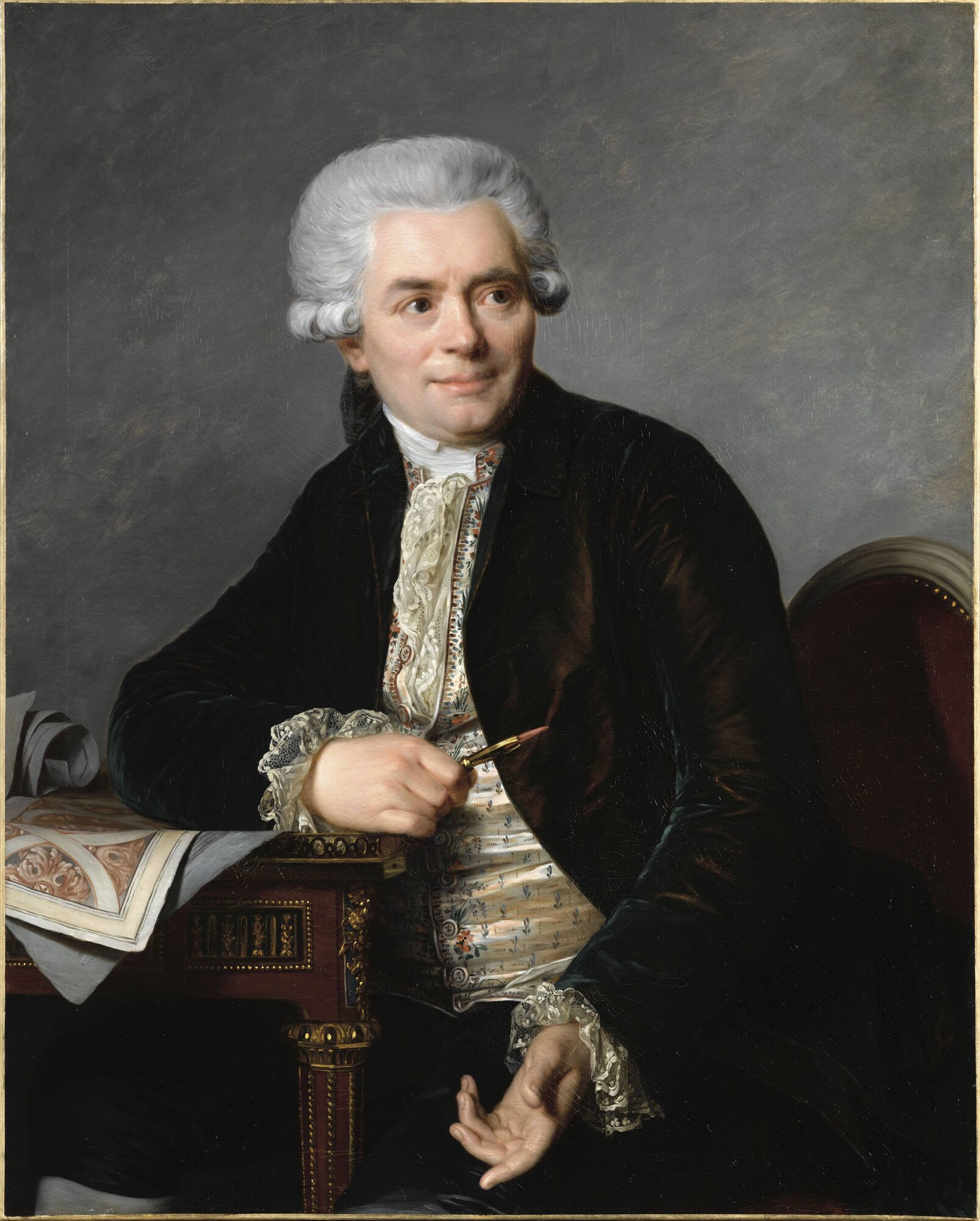
Antoine Vestier's 1786 portrait of Riesener at his worktable, holding a sanguine chalk holder and drawing a design for a gilt-bronze mount, shown at the Salon of 1787. Held by the Chateau de Versailles and descended through Riesener's own family before entering the national collection; the sitter's identity is not in dispute.
Chateaux de Versailles et de Trianon| Full name | Johann Heinrich Riesener, known in France as Jean-Henri Riesener |
|---|---|
| Worked as | Cabinetmaker (ebeniste) |
| Born | 4 July 1734 · Gladbeck, Electorate of Cologne, Holy Roman Empire... |
| Died | 6 January 1806 · Rue Saint-Honore, Paris, France, aged 71 |
| Nationality | German-born |
| Movement | Transition and Louis XVI neoclassicism |
| Sources | 22 cited |
| Last verified | 17 September 2026 |
About this page Last verified 17 September 2026 · 22 sources cited
On this page 13 sections
ContentsClose
Jean-Henri Riesener made more furniture for Marie-Antoinette than any other cabinetmaker in Paris, was appointed ebeniste ordinaire du roi in 1774, and delivered more than seven hundred pieces to the royal Garde-Meuble in the eleven years that followed. He also ran an independent workshop for over twenty years, before, during and after his royal appointment, and almost none of that private production was recorded in any surviving archive. The consequence is a name now attached to a genuinely enormous body of furniture, only a fraction of which can be tied to him by a document rather than a resemblance.
The thing most readers do not know is that this is not a modern problem. The Wallace Collection, which holds one of the largest groups of his furniture outside France, states plainly that a generation after the Revolution pieces were already being attributed to Riesener with no justification, and that the practice continues today. His own former patrons could not always tell his work from a good copy either: the greatest nineteenth-century buyer of his furniture, the 4th Marquess of Hertford, died owning at least one desk that a technical study a century and a half later showed was assembled specifically to deceive a collector like him.
What follows treats the name the way the evidence requires: a documented royal cabinetmaker of extraordinary and diagnosable technical skill, sitting at the center of a market that has spent two hundred years wanting more genuine Riesener furniture than Riesener ever made.
Images
Chronology
- 1734
Born Johann Heinrich Riesener in Gladbeck, in the west of the Holy Roman Empire, on 4 July.1
- c. 1754
Arrives in Paris and apprentices with the cabinetmaker Jean-Francois Oeben in the Arsenal.1
- 1763
Oeben dies while at work on Louis XV's roll-top desk; Riesener takes over direction of the workshop and marries Oeben's widow, Francoise-Marguerite Vandercruse.1
- 1768
Received master ebeniste.12
- 1769
Completes and delivers the Bureau du Roi to Louis XV at Versailles, signing only his own name in the marquetry.13
- 1774
Appointed ebeniste ordinaire du roi in July, succeeding Gilles Joubert.18
- 1776
Delivers, on 18 December, a marquetry commode numbered 2881 to Madame Adelaide's private chamber at Versailles; also delivers a costly commode to the comtesse de Provence within fifty days of ordering.113
- 1780
Delivers a chest of drawers with pastoral trellis marquetry to Marie-Antoinette's cabinet interieur at Versailles, coordinated with the room's silk wall hangings.36
- 1781
Delivers a mechanical writing and reading table to Marie-Antoinette's Grand Cabinet Interieur, its medallion inscribed Numine afflatur.14
- 1784
Delivers a cylinder desk to Marie-Antoinette's new private apartment at the Tuileries Palace in the second half of the year.16
- 1785
Removed from his post as royal cabinetmaker after Thierry de Ville-d'Avray succeeds Fontanieu at the Garde-Meuble.12
- 1787
Delivers a mahogany jewel cabinet clad in gilt bronze to the comtesse de Provence, one of his last major royal commissions.12
- 1793
Louis XVI and Marie-Antoinette are executed; the Revolutionary government empties and sells the contents of the royal palaces.1
- 1794
Sent to Versailles to strip royal insignia from furniture he had made; begins buying back his own former work at the Revolutionary sales at ruinous prices.1
- 1806
Dies at his home on the rue Saint-Honore, Paris, on 6 January, aged 71.1
- 1843
The Tuileries cylinder desk (Louvre OA 5226) is recorded at the Chateau de Saint-Cloud, decades before the Tuileries Palace burns in 1871.16
- 1866
Edouard Lievre publishes the pastiche desk now catalogued as Wallace Collection F306 as the frontispiece work in his survey of celebrated French collections, naming it Riesener's.8
- 1870
Death of the 4th Marquess of Hertford, whose collection of twenty-plus Riesener and pseudo-Riesener pieces later passes into the Wallace Collection.8
- 2018
The Societe des Amis de Versailles acquires the Madame Adelaide commode by private treaty (de gre a gre) in June, from the heirs of Juan Guillermo de Beistegui, ahead of the Beistegui collection's Christie's sale in Paris on 10 September; no source consulted states a price.112122
- 2020
Publication of the Riesener Project's monograph; a rare Oeben-stamped commode en bibliotheque of a design associated with Riesener's hand sells at Christie's for 2,505,250 British pounds.513
The market
Riesener's furniture is held overwhelmingly by museums, so an appearance at public auction is rare and closely watched, typically placed in Sotheby's Treasures sales in London and Paris or in named single-owner collection sales. None of the results below has its hammer price published separately from the buyer's premium in the sources consulted; each figure given is the publicly stated price achieved, in the currency of the sale, and this record says so rather than inventing a split. Museums also acquire Riesener furniture privately, at prices the open market never tests, which is a different thing from a market price and is recorded as such below.
| Date | Sale | Work | Result | Note |
|---|---|---|---|---|
| 18 October 2007 | Sotheby's | Commode attributed to Jean-Henri Riesener | With premium EUR 3,500,000 (price achieved; hammer not published in sources consulted) EUR | Cited by Sotheby's own published survey of its historic Riesener results. |
| 14 June 2000 | Sotheby's | Riesener furniture (piece not further specified in source) | With premium GBP 280,000 (price achieved; hammer not published in sources consulted) GBP | Cited by Sotheby's own published survey of its historic Riesener results. |
| 11 November 2000 | Sotheby's | Riesener furniture (piece not further specified in source) | With premium USD 210,000 (price achieved; hammer not published in sources consulted) USD | Cited by Sotheby's own published survey of its historic Riesener results. |
| 6 November 2008 | Sotheby's | Commode attributed to Jean-Henri Riesener | With premium USD 506,500 (price achieved; hammer not published in sources consulted) USD | Likely the Louis XVI ormolu-mounted mahogany commode from the Simone Berriau provenance offered as lot 104 in Sotheby's Important French Furniture sale that season, estimated at USD 500,000-700,000; the result itself was not independently verifiable behind Sotheby's login wall and is cited here to Sotheby's own published survey. |
| 25 June 2019 | Sotheby's | Henry Dasson, late 19th-century copy of a Riesener commode | With premium GBP 52,500 (price achieved; hammer not published in sources consulted) GBP | Sold openly as a period copy, not as an original; recorded here as comparanda for the value a faithful pastiche in this style carries in its own right. |
| 2020-12 | Christie's | Commode en bibliotheque, stamped J-F-OEBEN, of a design associated with Riesener's hand, circa 1763-1768 | With premium GBP 2,505,250 (USD 4,025,937 / EUR 3,083,963); price achieved, exceeding an estimate of GBP 1,500,000-2,500,000 GBP | Newly discovered Vienna Rothschild provenance. Only two examples of this model are known: this one stamped by Oeben, its counterpart stamped by Riesener. Recorded here as the clearest available market evidence for the design rather than as a confirmed Riesener sale, since the stamp on the sold piece is Oeben's. |
Hammer is the price at which the bidding stopped; with premium adds the fee the house charges the buyer on top. Hammer price and buyer's premium in the glossary.
Recorded without a public price
- 2018-06 · Commode delivered in 1776 to Madame Adelaide, Versailles inventory number 2881 · Private treaty purchase (not an open auction) · Not stated in any source consulted; acquired de gre a gre (private treaty), funded by named private bequests, not a public-auction result No source consulted publishes a price for this acquisition; recorded here as a private-treaty acquisition, not a priced market result.
Where to see the work
| Institution | City | Holdings | Note |
|---|---|---|---|
| The Wallace Collection | London | One of the largest groups of Riesener furniture outside France, the subject of the joint Riesener Project. | Includes pieces securely by Riesener, pieces only attributed to him, and at least one documented pastiche, F306, exhibited alongside the genuine work. |
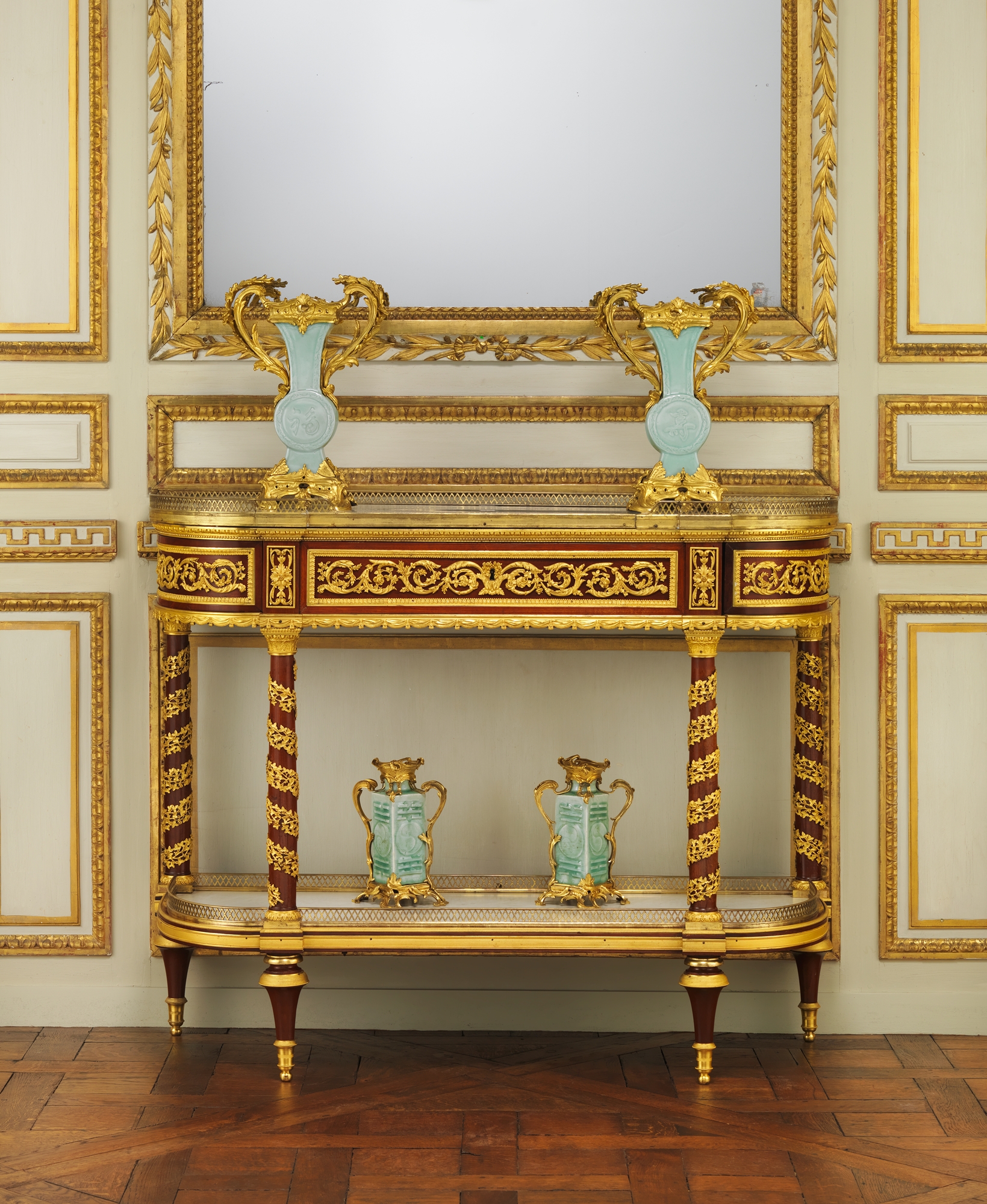
| Metropolitan Museum of Art | New York | Multiple pieces including a 1781 mechanical table made for Marie-Antoinette and a private-clientele side table of about 1790. | Open-access CC0 photography available for its Riesener holdings. |
| Waddesdon Manor (National Trust, Rothschild Collection) | Buckinghamshire, England | Royal and private-clientele furniture assembled by Ferdinand and Alice de Rothschild on connoisseurial, documentation-first principles. | A partner institution in the Riesener Project. |
| Musee du Louvre | Paris | Furniture delivered to Marie-Antoinette's private apartments at Versailles and the Tuileries, including the cylinder desk OA 5226. | Holdings catalogued online with full object histories, including surviving inscriptions and inventory numbers. |
| Chateau de Versailles | Versailles, France | Furniture returned to its original rooms where documentation allows, including the 1776 Madame Adelaide commode. | An active refurnishing policy continues to return Riesener pieces to their original locations when they can be acquired. |
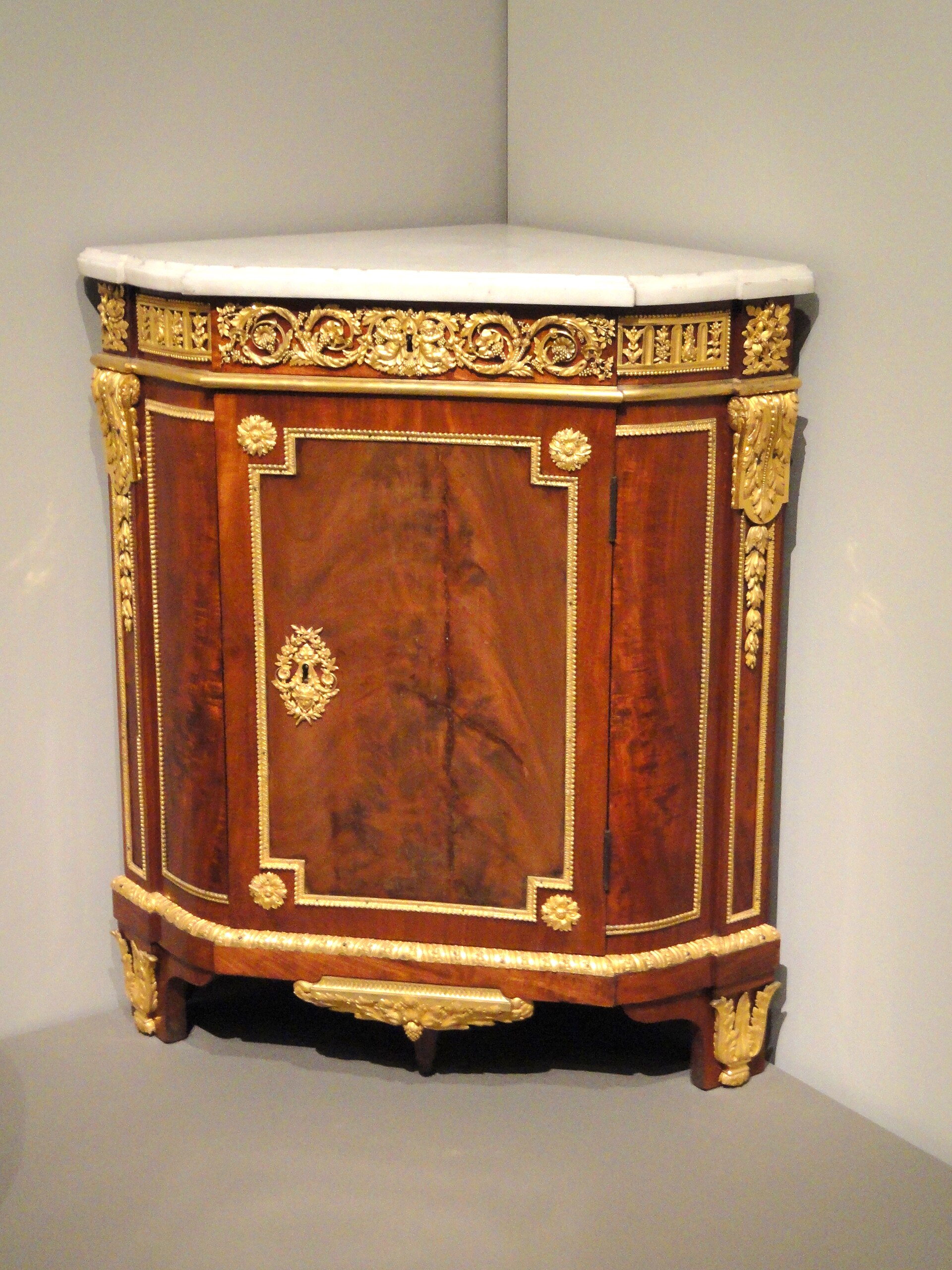
| Art Institute of Chicago | Chicago | A corner cupboard of about 1785. |
Forgeries and misattributions
- Wallace Collection F306, a small oval writing desk
- Praised by Hertford as one of the finest pieces in his collection and given pride of place as the first illustrated work in Edouard Lievre's 1866 survey of celebrated French art collections, where it was named as Riesener's and praised for marquetry as assured as any painting. Technical analysis carried out for the Riesener Project found the desk was not made in Riesener's workshop and was most likely assembled in the 1840s or 1850s, possibly incorporating genuinely old parts, specifically to deceive a collector.8
- The Pierre Gouthiere mount myth
- A nineteenth-century belief, current while Riesener furniture was fashionable, that his gilt-bronze mounts had been made by Pierre Gouthiere, the most celebrated chaser-gilder of the Louis XVI period. Now established as false by the archival record of Riesener's actual, more obscure mount-makers; the false pairing of two famous names is understood to have inflated both the reputation and the price of the furniture it was attached to.7
- Nineteenth-century commissioned copies entering the market as originals
- The 4th Marquess of Hertford commissioned an outright copy of the King's Desk (about 1853-1860, now Wallace Collection F460, possibly by Charles-Guillaume Winckelsen with mounts attributed to Carl Dreschler) and a separate copy of the comtesse de Provence's 1787 jewel cabinet, made under the London dealer John Webb between 1855 and 1857. Leading Parisian makers Charles-Guillaume Winckelsen, Henry Dasson and Alfred-Emmanuel Beurdeley went on to specialize in faithful copies and pastiches in Riesener's style for a fashion-driven market. These specific commissions are documented as copies at the time they were made; the risk this record flags is not that they were made, but that a faithful copy of this quality can circulate later, through resale, with its status as a copy quietly dropped.28
- Mount overcasting from surviving master models
- Because Riesener's gilt-bronze mounts were cast from reusable brass master models, and because original mounts could be copied again by taking an impression, or squeeze, from an existing cast, mounts materially and visually identical to Riesener's eighteenth-century designs could be, and were, produced on furniture decades after his death without any stylistic invention by a forger at all. Understood from the archival and technical study of the casting process itself, rather than from any single exposed case; it is the mechanism that makes bronze alone an unsafe basis for attribution.7
The essay
Chapter 1A German cabinetmaker's son who signed his name over his master's work
Riesener was born Johann Heinrich Riesener in Gladbeck, in the west of the Holy Roman Empire, and reached Paris by about 1754.
Riesener was born Johann Heinrich Riesener in Gladbeck, in the west of the Holy Roman Empire, and reached Paris by about 1754. The furniture trade in the Faubourg Saint-Antoine, east of the Bastille, was full of immigrant cabinetmakers, many of them German, and Riesener found work with one of them: Jean-Francois Oeben, a fellow German immigrant who held the title ebeniste du roi and worked from the Arsenal, a district that operated outside the ordinary Paris guild rules.
Oeben died in January 1763 while at work on a roll-top desk for Louis XV's private study at Versailles, a design that would secure the king's confidential papers behind a single sliding shell. Riesener took over the direction of the workshop and married Oeben's widow, Francoise-Marguerite Vandercruse; he was received master ebeniste in 1768. He also adopted her four young daughters by Oeben and, with her, had a son, Henri-Francois Riesener, born in 1767, who later trained as a painter under Jacques-Louis David.
Riesener finished the king's desk and delivered it to Versailles in 1769. The design and much of the decoration were Oeben's, but Riesener signed only his own name into the marquetry. It was a calculated claim of authorship over an unfinished commission he had inherited, and it worked: the piece, now known as the Bureau du Roi, made his reputation at court before he held any royal title at all.
Chapter 2Ebeniste ordinaire du roi, and what that job actually paid
Riesener's early patron at court was Pierre-Elisabeth de Fontanieu, head of the Garde-Meuble de la Couronne, the royal furniture administration, who commissioned a mechanical table and a chest of...
Riesener's early patron at court was Pierre-Elisabeth de Fontanieu, head of the Garde-Meuble de la Couronne, the royal furniture administration, who commissioned a mechanical table and a chest of drawers after the success of the king's desk. On the strength of that work, Riesener was formally appointed ebeniste ordinaire du roi in July 1774, succeeding Gilles Joubert.
Between 1774 and 1784 he received commissions from the crown averaging 100,000 livres a year, and archival Garde-Meuble records show his workshop delivered more than seven hundred pieces of furniture to the royal palaces over roughly a decade. His first major commission as royal cabinetmaker, a chest of drawers for Louis XVI's bedroom at Versailles replacing an older one by Antoine-Robert Gaudreaus, was rejected as not grand enough; Riesener supplied a larger and more costly replacement within the year. It is a rare, specific glimpse of a king exercising personal taste against his own newly appointed supplier, on the very first job.
Chapter 3Marie-Antoinette's own maker, and what her furniture actually says
Marie-Antoinette was Riesener's most important patron.
Marie-Antoinette was Riesener's most important patron. He developed a design language for her that recurs across many separate pieces: trellis marquetry interspersed with flower heads, floral naturalism built up in dozens of individual veneer pieces per motif, and gilt-bronze mounts modelled with garlands and pastoral trophies rather than the heavier classical ornament used elsewhere at court.
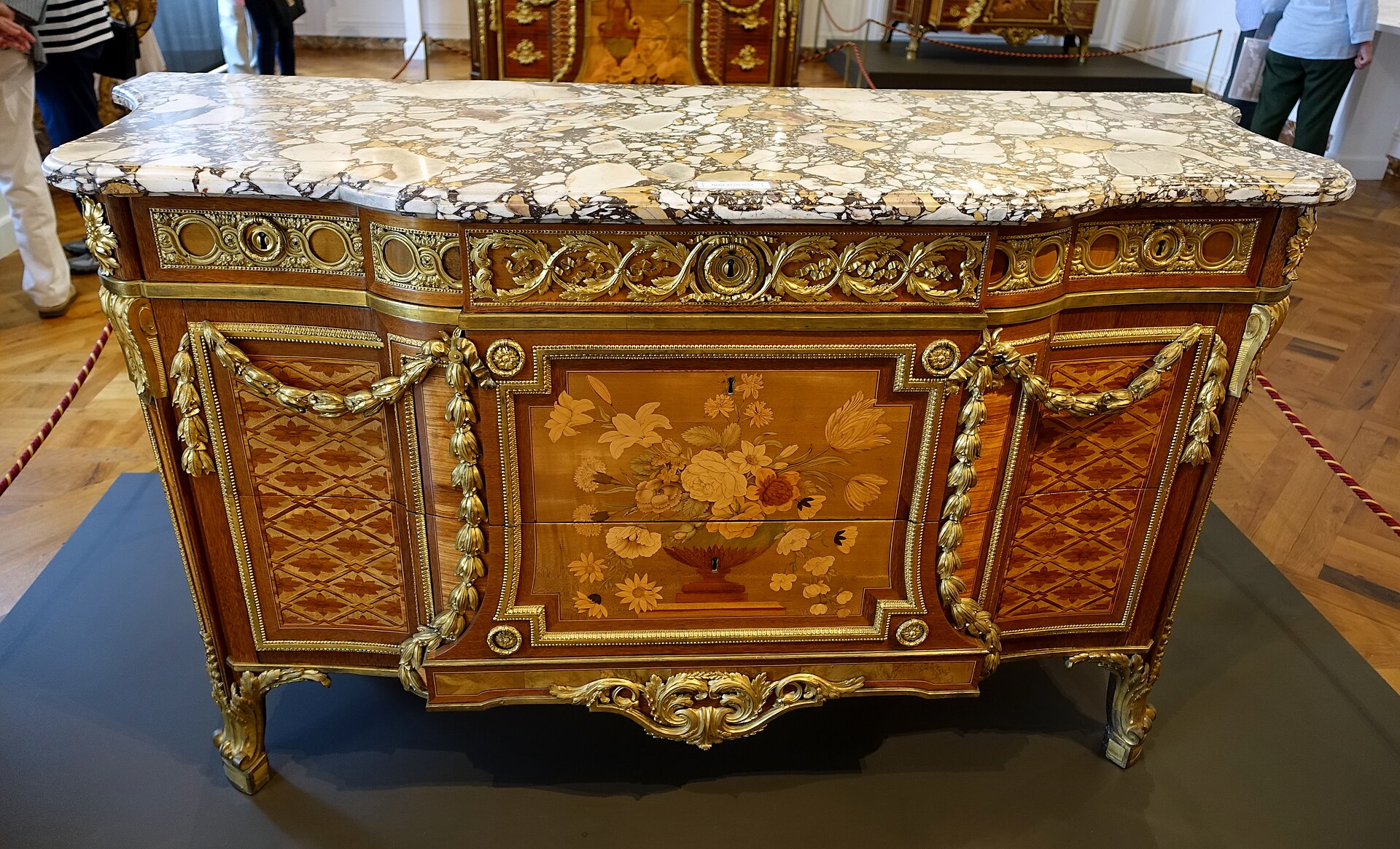
The decoration was not generic prettiness; it was coordinated with the rooms it stood in. A chest of drawers delivered to the queen's cabinet interieur at Versailles in 1780 carries a marquetry plaque of a shepherd's hat and bagpipes that echoes the pastoral trophies woven into the room's silk wall hangings, designed by the royal designer Jacques Gondoin; the Wallace Collection's own judgement is that Gondoin and Riesener must have worked in direct consultation to unify the room. A commode delivered in 1776 to Madame Adelaide, Louis XV's daughter, uses lozenge-shaped marquetry with a sunflower set into the center of each lozenge, a motif the curators at Versailles describe as one Riesener returned to repeatedly. Neither claim needs inflating into anything hidden: this is furniture built, quite openly, to agree with the room and the person it was made for.
The clearest case is a mechanical writing and reading table Riesener delivered in 1781 for the queen's Grand Cabinet Interieur, now in the Metropolitan Museum of Art. Its top slides back as its drawer moves forward to reveal a velvet-lined surface that ratchets up into a bookstand and reverses into a mirror. The central marquetry medallion encloses a trophy of the attributes of Poetry and Literature around the Latin motto Numine afflatur, inspired by the divine nod. On a piece of furniture whose entire mechanism exists to let its owner read and write more comfortably, the inscribed motto is not decoration standing apart from function; it names the function.
Chapter 4A workshop far bigger than the pieces that can be traced to it
Riesener held the royal appointment for just over ten years, but he ran his own workshop for more than twenty, both before and after it, and the private clientele he served alongside the crown was...
Riesener held the royal appointment for just over ten years, but he ran his own workshop for more than twenty, both before and after it, and the private clientele he served alongside the crown was never systematically recorded. The Wallace Collection's own furniture historians say this plainly: archival records for his non-royal clients simply were not preserved, so a wide swath of his actual output can only be judged on technical and stylistic grounds rather than a paper trail.
This matters because Paris guild law required a master to stamp his furniture, and Riesener's own stamp, JHRIESENER, only became legally his to use after his January 1768 reception as master. Furniture he made under Oeben's direction between 1763 and 1768, while running the workshop but not yet a master in his own right, would properly have carried Oeben's stamp rather than his own, whatever hand actually cut the veneer. A rare surviving pair of commodes en bibliotheque from exactly this transition period makes the problem concrete: one is stamped J-F-OEBEN and sold at Christie's in December 2020 as part of the Riahi collection for 2,505,250 British pounds (about 4,025,937 US dollars or 3,083,963 euros), well above its estimate, with newly established Vienna Rothschild provenance; its counterpart of the same rare model is stamped J-H-RIESENER. Whose hand actually made the Oeben-stamped example is exactly the kind of question a guild stamp cannot answer on its own.
Chapter 5Marquetry as construction, not decoration laid on top
Riesener's marquetry has been called painting in wood since the eighteenth century, but the comparison undersells the engineering.
Riesener's marquetry has been called painting in wood since the eighteenth century, but the comparison undersells the engineering. A single trellis compartment on a chest of drawers made for Marie-Antoinette in 1780 is built from a flower of twelve separate pieces of veneer, a background piece, and sixteen pieces of black and white stringing around its edge, every one of them cut with a fretsaw or knife and set into its neighbors like a jigsaw. The substrate was often a separate lamination of several veneer sheets glued together, strong enough to resist the splitting that plain solid wood suffers as it shrinks, and it let marquetry panels be prefabricated away from the main workshop and assembled onto the furniture later.
The furniture that survives today reads as brown and faded because organic dyes and natural wood colors both degrade under light. Technical examination by the Wallace Collection has recovered the original palette in places the light never reached: a discolored green frieze beneath a marble top on the 1780 chest of drawers turned out, once a mount was lifted, to have been a bright turquoise blue; the underside of a piece of trellis veneer showed an off-white ground, a red flower and black-and-white stringing where the exposed face has gone uniformly brown. Riesener also used a documented pattern source for at least some of his floral naturalism: the Livre de principes de fleurs, dedie aux dames, an undated set of flower engravings by Juste Chevillet after drawings by the Gobelins flower painter Louis Tessier, used across the Oeben-Riesener workshop tradition and specifically identified as a design source for the marquetry on the Bureau du Roi.
Chapter 6The bronze that is not bronze, and the men who actually cast it
Guild law in Paris forbade a cabinetmaker from casting or gilding his own furniture mounts; that work belonged to a separate trade entirely.
Guild law in Paris forbade a cabinetmaker from casting or gilding his own furniture mounts; that work belonged to a separate trade entirely. A Riesener design for a mount went from a two-dimensional drawing to a wax or wood maquette, then to a plaster model, then to a brass master model from which the actual furniture mounts were cast, then to a chaser who finely chiselled the cast surface, and finally to a gilder who fused a thin layer of gold onto the brass by mercury gilding, a process dangerous enough to the gilder that it was eventually banned across Europe.
Very few eighteenth-century mounts are signed, but archival records name some of Riesener's collaborators directly: the modeller Thomas Duplessis the Younger, the founder and chaser Louis-Barthelemy Hervieux and the gilder Anne-Francois Briquet worked on the King's Desk; the sculptor and chaser Etienne Martincourt, who advertised himself as a modeller for chasers, had a long-running collaboration with Riesener; and the gilder Francois Remond is the only collaborator whose contribution to specific royal pieces is well documented in the archive, gilding several of Riesener's mounts for Marie-Antoinette between 1781 and 1787. In the nineteenth century, when Riesener furniture had become fashionable, a myth grew up that his mounts had actually been made by Pierre Gouthiere, the most famous chaser-gilder of the period; this is now known to be false, but pairing the two names inflated the reputation, and therefore the price, of the furniture it was attached to. What English calls gilt bronze and ormolu is, strictly, gilded brass, a copper-zinc alloy; ormolu itself comes from the French or moulu, ground gold, describing the gold dust mixed with mercury for gilding.
Chapter 7Why a mount does not prove a maker
The casting process that made Riesener's bronzes possible is also what makes them impossible to authenticate on sight.
The casting process that made Riesener's bronzes possible is also what makes them impossible to authenticate on sight. A brass master model, once made, could be bought and sold by founders independently of the cabinetmaker who commissioned it, and it could go on producing identical mounts for decades after his death. Original mounts could also be copied directly by taking an impression, or squeeze, from an existing cast and overcasting a new one from it. Either method puts a mount that is materially and visually a genuine eighteenth-century Riesener design onto furniture Riesener never touched, without any forger's intervention beyond owning or borrowing the right mould.
The Wallace Collection's own technical study used CT scanning, X-radiography, XRF and UV-Vis spectroscopy to work around this problem, tracing construction sequences and alterations that connoisseurship by eye alone had missed. One chest of drawers in the study, examined this way, turned out to be built from more than five hundred individual pieces of wood. That level of internal, load-bearing complexity, invisible from the outside, is the kind of evidence a period pastiche assembled to look right on the surface tends not to reproduce, and it is a large part of why the technical study, not the visible bronze or veneer, is now the standard the field defers to.
Chapter 8Removed for costing too much, and what came after
Fontanieu died in 1784 and was succeeded at the Garde-Meuble by Marc-Antoine Thierry de Ville-d'Avray, who arrived with orders to cut royal spending.
Fontanieu died in 1784 and was succeeded at the Garde-Meuble by Marc-Antoine Thierry de Ville-d'Avray, who arrived with orders to cut royal spending. Riesener was removed from his post as cabinetmaker to the king in 1785 and had to compete for royal work against cheaper suppliers, chiefly Guillaume Beneman, who went on to repair some of Riesener's own furniture, including the fall-front desk made for Marie-Antoinette's cabinet interieur in 1780. Riesener's later royal pieces, made while competing rather than appointed, shifted toward sober, richly figured West Indian mahogany veneers with more restrained bronze, a cheaper and faster material drawn from the Atlantic timber trade rather than the elaborate multicolored floral marquetry of his high royal years.
He still produced major work after his dismissal. In 1787 he delivered a large mahogany jewel cabinet clad in gilt bronze to the comtesse de Provence for her bedroom at Versailles, one of his last documented royal commissions and, within a few decades, one of the pieces the 4th Marquess of Hertford would go to the trouble of having copied because he could not obtain the original.
Chapter 9The Revolution turned his own furniture against him
Louis XVI and Marie-Antoinette were executed in 1793, and the Revolutionary government emptied the royal palaces and sold the contents at public auction.
Louis XVI and Marie-Antoinette were executed in 1793, and the Revolutionary government emptied the royal palaces and sold the contents at public auction. Riesener was retained by the new authorities and sent to Versailles in 1794 with an unusual assignment: stripping the crowns and fleurs-de-lis, the insignia of feudality, from furniture he had personally made, so that the pieces could be resold without treasonous royal markings on them.
He also began buying back his own former royal furniture at the Revolutionary sales, at what the record calls derisory prices, gambling that he could resell it at a profit once the country settled. It was a bad bet. Style had moved on and the furniture's own royal provenance, the very thing that would make it priceless within two generations, made it actively unsellable for ten to twenty years after the Revolution. A small number of pieces recognized by the government as objects of extraordinary artistic merit, including the King's Desk, were protected from sale outright; the desk's resulting fame is precisely why it was, as the Wallace Collection notes, repeatedly copied in the nineteenth century. Riesener recovered some pre-Revolution debts from former private clients with government help and sank the money into Paris property speculation that brought no great success. He died at his home on the rue Saint-Honore on 6 January 1806, in relative obscurity, several years before his furniture found a market again.
Chapter 10Forgotten, then a household word for something he mostly did not make
No British collector is known to have bought Riesener furniture before the French Revolution.
No British collector is known to have bought Riesener furniture before the French Revolution. Once the Revolutionary sales scattered his royal work onto the market, English buyers acquired it through dealers and salerooms over the following decades, among them William Beckford, George Watson Taylor and George IV, who bought heavily at Watson Taylor's 1825 sale intending a grand display at Windsor Castle that was only partly realized. By the middle of the nineteenth century, Riesener's name in England had stopped meaning a specific cabinetmaker and started meaning any outstanding piece of Louis XVI furniture, whether he had made it or not, exactly the attribution drift the Wallace Collection now warns collectors against.
The 4th Marquess of Hertford, who spent most of his adult life in Paris, began buying Riesener furniture in the late 1840s and owned more than twenty pieces by Riesener or believed to be by him when he died in 1870. He was also the first major collector to commission outright copies of Riesener's greatest pieces: with permission from Napoleon III, he had a copy of the King's Desk made in Paris around 1853 to 1860, now Wallace Collection F460, and commissioned a separate copy of the comtesse de Provence's 1787 jewel cabinet from the London dealer John Webb in 1855 to 1857. His example started a fashion that became close to mainstream by the century's end, with leading Parisian makers Charles-Guillaume Winckelsen, Henry Dasson and Alfred-Emmanuel Beurdeley specializing in faithful copies and pastiches in his style. The generation after Hertford, led by Ferdinand and Alice de Rothschild, collected in the opposite spirit, hunting specifically for stamped, documented, unaltered originals and treating a copy as worthless; as British fortunes declined at the end of the century, American industrialists including J. Pierpont Morgan, Henry Clay Frick and William Kissam Vanderbilt bought the pieces that came onto the market, often through the Duveen Brothers. Morgan bought a Riesener secretaire from Joel Duveen for 17,600 British pounds in 1899; after Morgan's death in 1913, Joseph Duveen brokered its sale to Henry Clay Frick, and it remains on public display at the Frick Collection today.
Chapter 11The desk that fooled its own owner
Hertford, the most sophisticated buyer of French eighteenth-century furniture of his generation, did not only commission copies knowingly; he also seems to have bought at least two he believed...
Hertford, the most sophisticated buyer of French eighteenth-century furniture of his generation, did not only commission copies knowingly; he also seems to have bought at least two he believed genuine. One was a corner cupboard purchased just before his death in 1870 as one of a pair with a cupboard actually made for Marie-Antoinette, a pairing the Wallace Collection's own technical project later showed to be a manufactured deception, documented on this site under the queen's cupboard's own record.
The more striking case is a small oval writing desk, now catalogued as Wallace Collection F306. Hertford considered it one of the finest pieces in his entire collection, and in 1866 the connoisseur Edouard Lievre gave it pride of place as the very first work illustrated in his survey of celebrated French art collections, praising its proportions and its marquetry as assured as any painting, and naming it as Riesener's. It was not. Technical analysis carried out for the Riesener Project found that the desk was not made in Riesener's workshop at all, and was most likely assembled in the 1840s or 1850s, possibly using genuinely old parts, specifically to deceive a collector. The deception did not fail quietly in a back room; it succeeded in print, in a published survey of masterpieces, for well over a century.
Chapter 12What the market pays now
Riesener's furniture is now held overwhelmingly by museums, which makes any appearance at auction a rare and closely watched event, usually placed in Sotheby's Treasures sales in London and Paris or...
Riesener's furniture is now held overwhelmingly by museums, which makes any appearance at auction a rare and closely watched event, usually placed in Sotheby's Treasures sales in London and Paris or in single-owner collection sales. Verified results include a commode sold at Sotheby's Paris on 18 October 2007 for 3.5 million euros; a piece sold at Sotheby's London on 14 June 2000 for 280,000 British pounds; a piece sold at Sotheby's New York on 11 November 2000 for 210,000 US dollars; a commode sold at Sotheby's on 6 November 2008 for 506,500 US dollars; and, at the far end of the scale, a late nineteenth-century Henry Dasson copy of a Riesener commode, sold openly as a copy, that still made 52,500 British pounds at Sotheby's Paris on 25 June 2019, a useful reminder that even an acknowledged pastiche in this style carries real value.
Museums also acquire Riesener furniture outside the saleroom entirely, at prices the open market never sets. In June 2018 the Societe des Amis de Versailles, funded by bequests from three named donors, acquired by private treaty (de gre a gre) from the heirs of Juan Guillermo de Beistegui a commode Riesener delivered in 1776 for Madame Adelaide's private chamber, ahead of the Beistegui collection's Christie's sale in Paris on 10 September 2018, so that it could return to its exact original position at the palace; no source consulted publishes a price for this acquisition. No figure in this record should be read as a hammer price with premium separated out: none of the sources consulted publish that breakdown for these particular results, and this record says so rather than guessing at a split.
Chapter 13Survival is not automatic, even for a queen's furniture
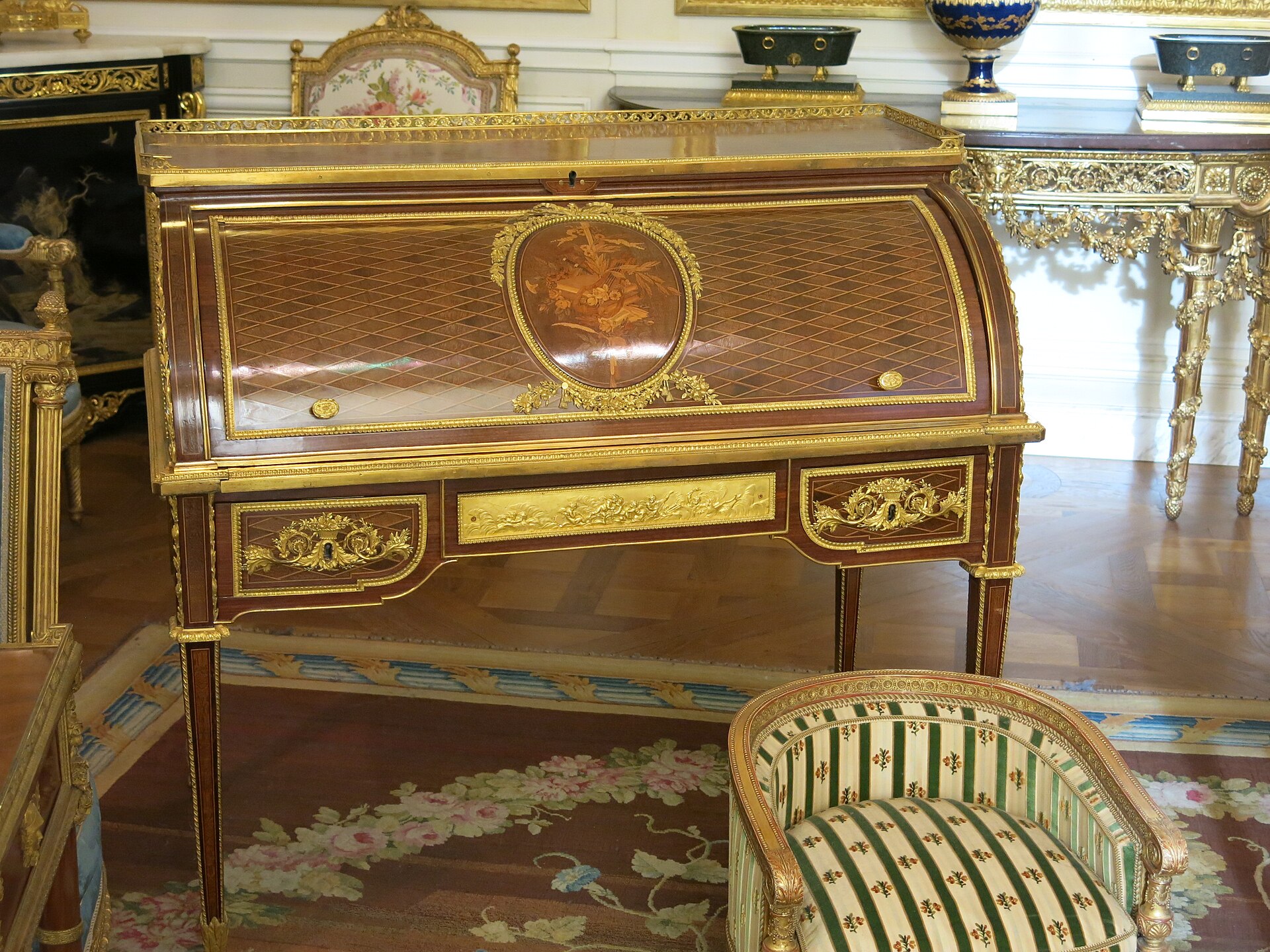
A cylinder desk Riesener's workshop delivered to Marie-Antoinette's private apartment at the Tuileries Palace in the second half of 1784, now in the Louvre as OA 5226, carries its own quiet lesson in...
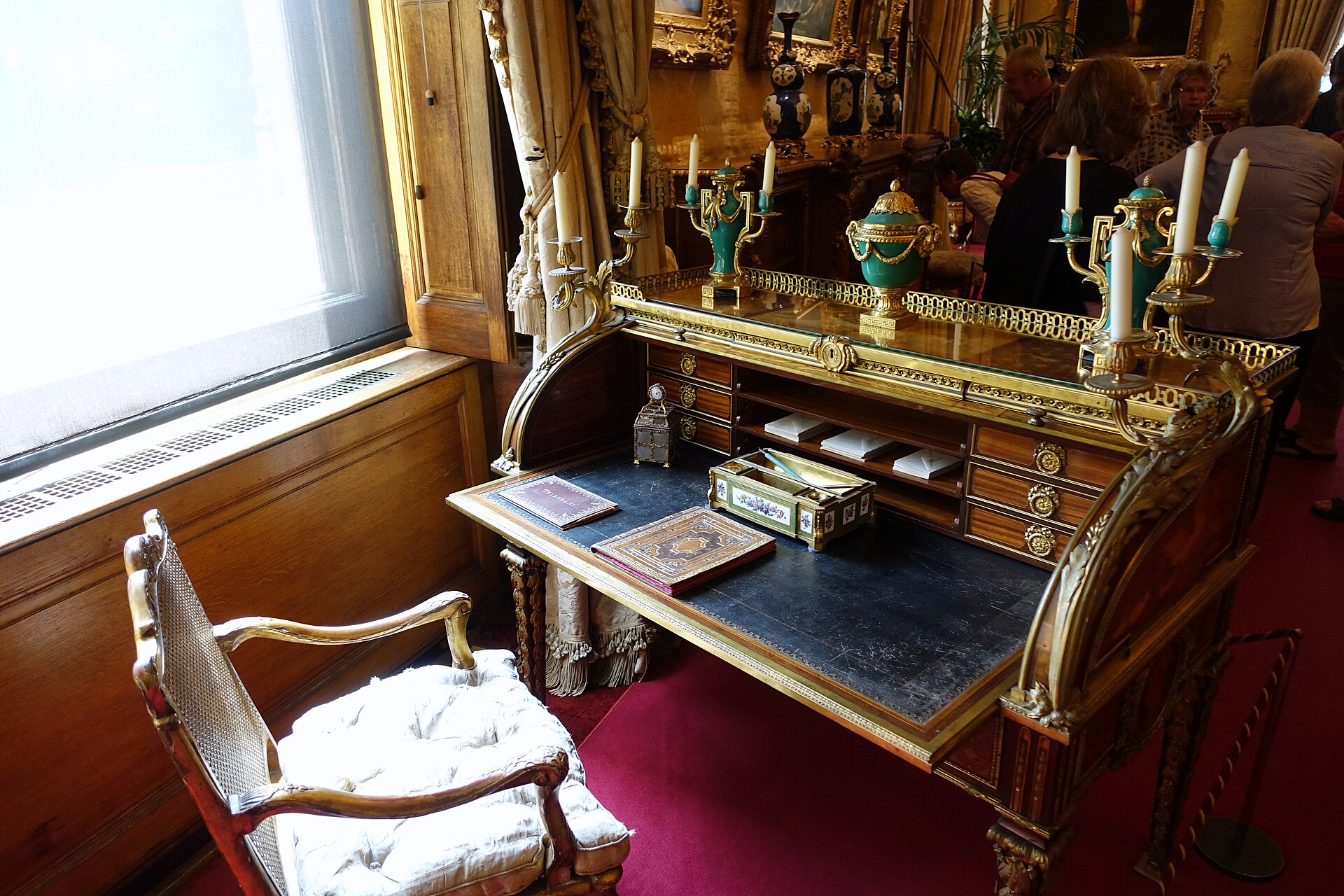
A cylinder desk Riesener's workshop delivered to Marie-Antoinette's private apartment at the Tuileries Palace in the second half of 1784, now in the Louvre as OA 5226, carries its own quiet lesson in contingency. It is decorated with four gilt-bronze reliefs of Music, Painting and Sculpture and a marquetry trophy of the attributes of Poetry on its cylinder, an entirely conventional allegory of the arts for a writing desk and not a program that needs reading into. The Louvre's own object history records it at the Chateau de Saint-Cloud by 1843, later at the Musee du Garde-Meuble by the late nineteenth century, and formally attributed to the Louvre by decree of 24 February 1901; it does not say why the desk moved, or draw any link between that move and what later happened to the palace it was made for. The Tuileries Palace itself burned to the ground, separately, during the suppression of the Paris Commune in 1871. The desk was elsewhere by the time of the fire, but the Louvre's record does not establish that the earlier move was made to protect it, or that the move is why it survives; the two facts sit next to each other without a documented cause connecting them.
What is documented
Technique
The surviving work
- What is accepted
- No catalogue raisonne assigns Riesener's surviving output a single accepted total. The most authoritative recent survey, published as the 2020 Riesener Project monograph by Helen Jacobsen, Rufus Bird and Mia Jackson after a joint technical study by the Wallace Collection, the Royal Collection Trust and Waddesdon Manor, examines thirty pieces held across those three collections in depth; it is the strongest current authority on those thirty objects specifically, not a census of everything Riesener made. Separately, archival Garde-Meuble records document more than 700 deliveries to the royal furniture administration between 1774 and 1785 alone, a figure for royal commissions only, which says nothing about his twenty-plus years of undocumented private-client work before, during and after that period.
- What is contested
- Museums routinely qualify Riesener attributions as 'attributed to' or 'workshop of' rather than a flat 'by', including the Louvre's own cataloguing of the Tuileries cylinder desk OA 5226 as 'Atelier de Riesener, attribution'. Furniture made between Oeben's death in 1763 and Riesener's own mastership in 1768, while Riesener directed the workshop but had no stamp of his own, is a specific and unresolved category: a rare pair of commodes en bibliotheque from exactly this period survive as one example stamped J-F-OEBEN and one stamped J-H-RIESENER, and which hand actually cut which example cannot be settled by the stamp alone.
- Who rules on attribution
- There is no standing authentication board for Riesener's work. Attribution rests on a combination of the JHRIESENER stamp (only valid from January 1768), archival Garde-Meuble delivery records where they survive, and technical examination of construction and materials of the kind carried out by the Riesener Project. The Wallace Collection states publicly that unjustified attributions to Riesener have circulated since a generation after the Revolution and continue today, which is itself part of why no single authority is treated as final.
Catalogue raisonne
- Helen Jacobsen, Rufus Bird and Mia Jackson, Jean-Henri Riesener: Cabinetmaker to Louis XVI and Marie-Antoinette. Furniture in the Wallace Collection, the Royal Collection and Waddesdon Manor, London, 2020. The outcome of the joint Riesener Project; covers thirty pieces across the three partner collections with full technical and archival documentation. It does not claim to catalogue Riesener's entire surviving output.5
Questions about Jean-Henri Riesener
Who was Jean-Henri Riesener?
Cabinetmaker (ebeniste). 1734-1806.
When did Jean-Henri Riesener live?
Born 4 July 1734, Gladbeck, Electorate of Cologne, Holy Roman Empire (present-day Germany); died 6 January 1806, Rue Saint-Honore, Paris, France, aged 71.
How are fakes and misattributions of Jean-Henri Riesener detected?
Wallace Collection F306, a small oval writing desk. Praised by Hertford as one of the finest pieces in his collection and given pride of place as the first illustrated work in Edouard Lievre's 1866 survey of celebrated French art collections, where it was named as Riesener's and praised for marquetry as assured as any painting.
Where can you see work by Jean-Henri Riesener?
The Wallace Collection (London); Metropolitan Museum of Art (New York); Waddesdon Manor (National Trust, Rothschild Collection) (Buckinghamshire, England); Musee du Louvre (Paris); Chateau de Versailles (Versailles, France); Art Institute of Chicago (Chicago).
What does the market for Jean-Henri Riesener look like?
Riesener's furniture is held overwhelmingly by museums, so an appearance at public auction is rare and closely watched, typically placed in Sotheby's Treasures sales in London and Paris or in named single-owner collection sales. None of the results below has its hammer price published separately from the buyer's premium in the sources consulted; each figure given is the publicly stated price achieved, in the currency of the sale, and this record says so rather than inventing a split.
What is still unresolved about Jean-Henri Riesener?
How many pieces from the more than 700 delivered to the royal Garde-Meuble between 1774 and 1785 survive today, in what condition, and how many have been reattributed away from him since. No published source consulted gives a running total.
Open questions
- How many pieces from the more than 700 delivered to the royal Garde-Meuble between 1774 and 1785 survive today, in what condition, and how many have been reattributed away from him since. No published source consulted gives a running total.
- Who actually made the Oeben-stamped commode en bibliotheque sold at Christie's in December 2020, and where is its Riesener-stamped counterpart now. The stamp names Oeben; the design and date bracket implicate Riesener's hand in the transition period between Oeben's death and Riesener's own mastership, and the sources consulted do not resolve it further.
- Who assembled the Wallace Collection's F306 pastiche desk in the 1840s or 1850s, and did Edouard Lievre know it was not genuine when he made it the frontispiece of his 1866 survey. Neither the maker's identity nor Lievre's state of knowledge is established in the sources consulted.
- What prices did Riesener's own furniture actually make at the Revolutionary sales of the 1790s, the sales at which he ruined himself buying his own work back. The ruin is documented; the specific lot prices that caused it are not given in the sources consulted.
- What is the full current total of pieces the Riesener Project's technical study has examined and how many, if any, were reclassified downward from 'by Riesener' to 'attributed to' or 'workshop of' as a result. The 2020 monograph is the authority on the thirty pieces it covers; a plain published tally of any reattributions was not found in the sources consulted.
Sources
- 1The Wallace Collection, Riesener: The Cabinetmaker, 'Who was Riesener?' wallacecollection.org/explore/...
- 2The Wallace Collection, Riesener: The Cabinetmaker, 'Why is Riesener Important?' wallacecollection.org/explore/...
- 3The Wallace Collection, Riesener: The Cabinetmaker, 'Who were Riesener's Patrons?' wallacecollection.org/explore/...
- 4The Wallace Collection, Riesener: The Furniture (overview page). wallacecollection.org/explore/...
- 5The Wallace Collection, The Riesener Project: Methodology and Outcomes. wallacecollection.org/explore/...
- 6The Wallace Collection, Riesener: The Designs, Materials and Techniques, 'Riesener's Marquetry'. wallacecollection.org/explore/...
- 7The Wallace Collection, Riesener: The Designs, Materials and Techniques, 'Riesener's Gilt-Bronze Mounts'. wallacecollection.org/explore/...
- 8The Wallace Collection, Riesener: The Collector. wallacecollection.org/explore/...
- 9Sotheby's, 'Jean-Henri Riesener, King of Cabinetmakers and Cabinetmaker to Kings', French & Continental Furniture department article. sothebys.com/en/...
- 10Sotheby's, lot page for 'An important Louis XVI ormolu-mounted mahogany commode circa 1785, attributed to Jean-Henri Riesener', Important French Furniture, New York, 2008, lot 104. Estimate and catalogue note read directly; the sale result itself is not published without a Sotheby's account login and is not asserted here. sothebys.com/en/...
- 11Chateau de Versailles, 'Acquisition of a Riesener masterpiece'. en.chateauversailles.fr/news/...
- 12Jeremie Glaize, 'Une commode de Riesener revient a Versailles', Le Journal des Arts, 13 July 2018. lejournaldesarts.fr/patrimoine/...
- 13TERTIARY REPRINT. Artdaily press release, 'Christie's sale of masterpieces formerly in the Collection of Monsieur and Madame Riahi realises $31.9 M', reprinted via Artron News. Flagged for replacement with a Christie's primary lot page or press release once located. m-news.artron.net/20201222/...
- 14The Metropolitan Museum of Art, object page for the mechanical table by Jean Henri Riesener, 1781, accession 49.7.117. metmuseum.org/art/...
- 15The Metropolitan Museum of Art, object page for the side table (commode servante or commode desserte) by Jean Henri Riesener, about 1790, accession 1977.102.8. metmuseum.org/art/...
- 16Musee du Louvre, collections database, object page for the Secretaire a cylindre de la reine Marie-Antoinette aux Tuileries, OA 5226. collections.louvre.fr/en/...
- 17J. Paul Getty Museum, French Rococo Ebenisterie in the J. Paul Getty Museum (online publication), citing Louis Tessier's Livre de principes de fleurs, dedie aux dames, engraved by Juste Chevillet, as a documented pattern source in the Oeben-Riesener workshop tradition. getty.edu/publications/...
- 18TERTIARY. Wikipedia, 'Jean Henri Riesener', for cross-checked biographical dates and for the specific claim that the Bureau du Roi's floral marquetry derives from the Livre de Principes de Fleurs. Flagged for replacement with the Riesener Project monograph's own citation of the same source. en.wikipedia.org/wiki/...
- 19Wikimedia Commons file page for Antoine Vestier's 1786 portrait of Jean-Henri Riesener. Licence verified at fetch time: LicenseShortName 'Public domain'. commons.wikimedia.org/wiki/...
- 20Wikimedia Commons category page for Jean-Henri Riesener, used to locate and individually licence-check the gallery photographs cited against this record. commons.wikimedia.org/wiki/...
- 21Societe des Amis de Versailles, project page on the acquisition of the Madame Adelaide commode. amisdeversailles.com/mecenat/...
- 22Societe des Amis de Versailles, activity page noting Christie's autumn 2018 sale of the Juan de Beistegui collection. amisdeversailles.com/activites/...

Last verified 17 September 2026