Jean-Antoine Watteau
 1684-1721
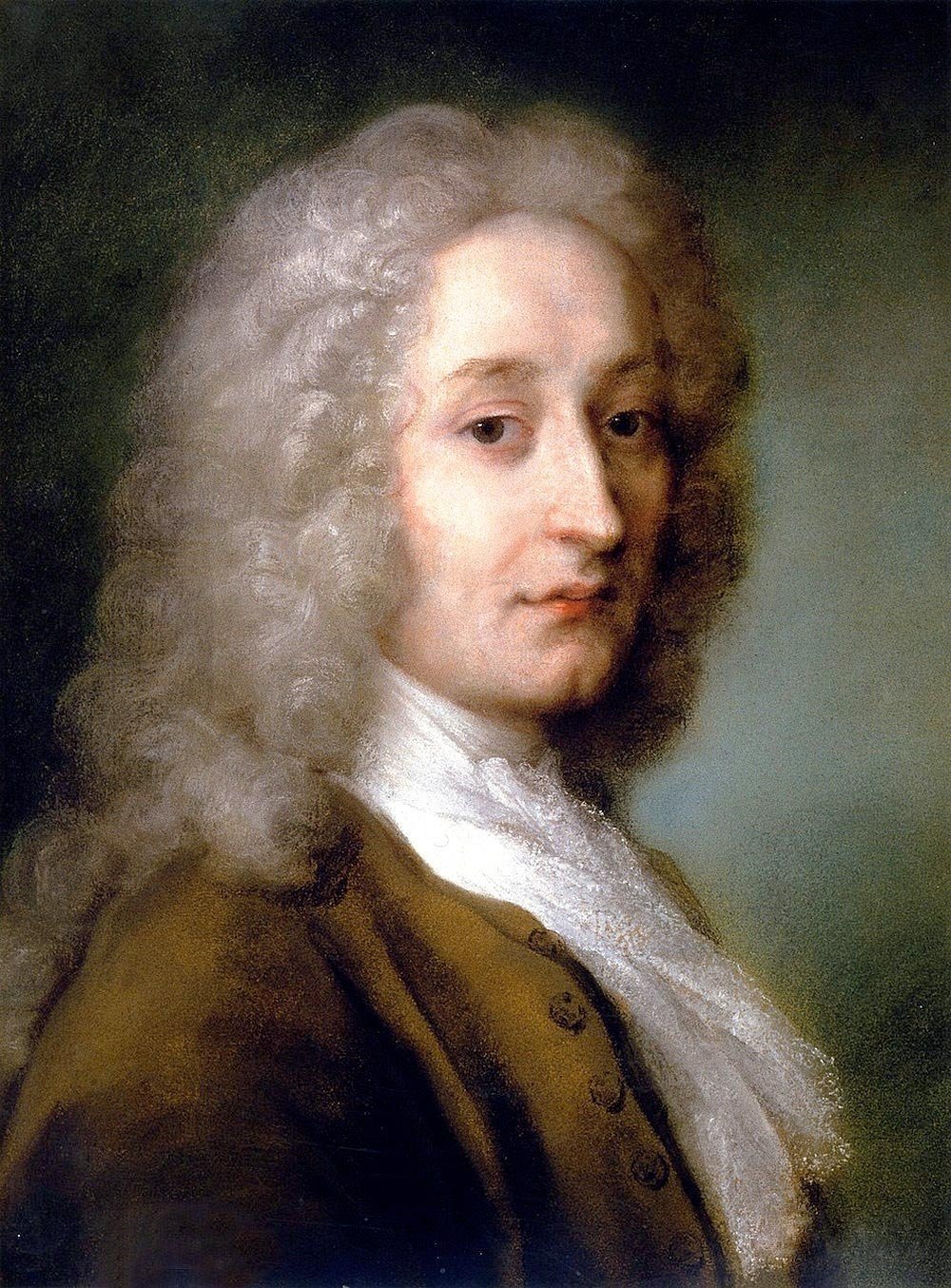
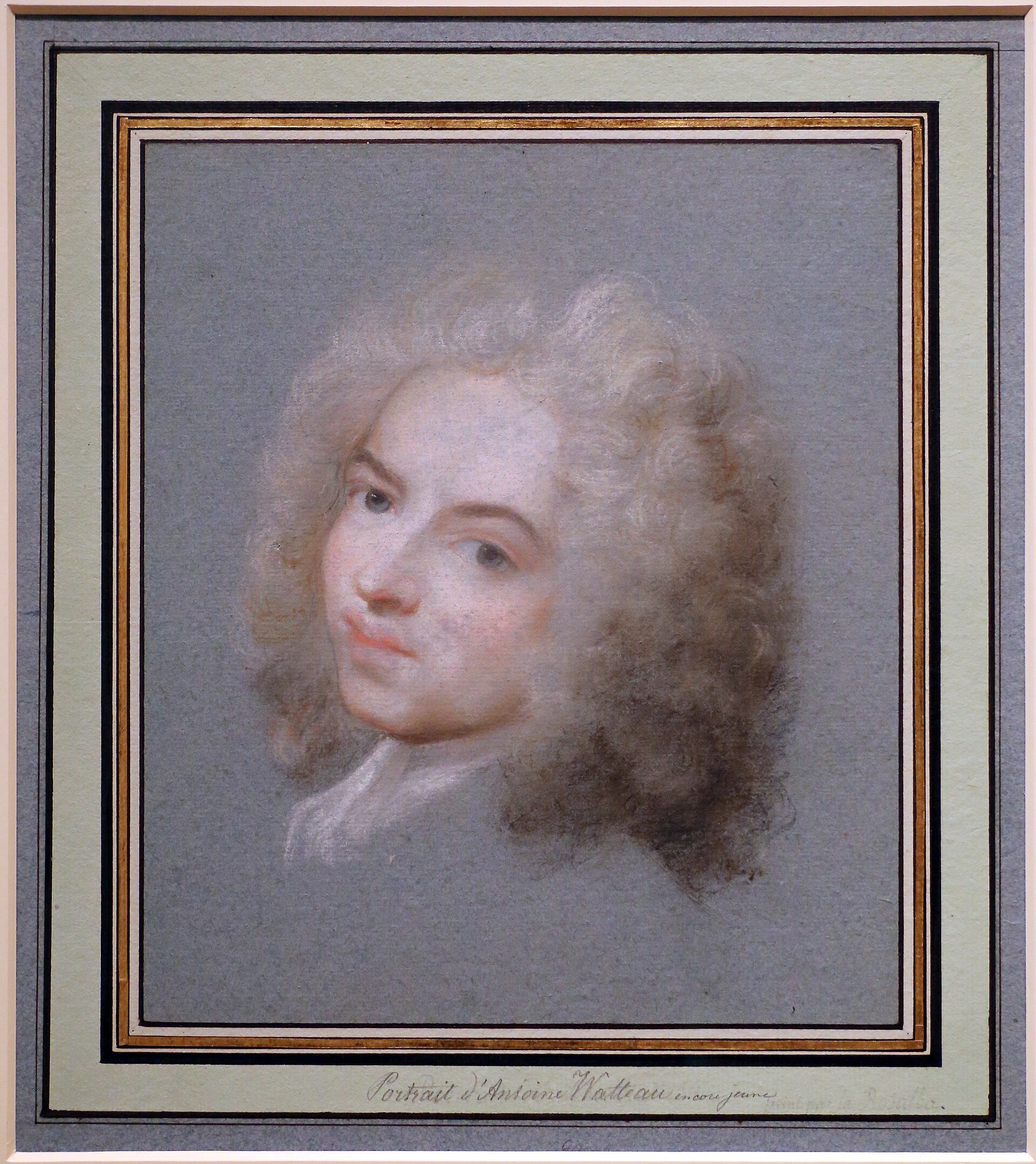
Pastel on paper, 55 by 43 cm, by Rosalba Carriera, Museo Civico Luigi Bailo, Treviso, dated 1721 on Commons. The sitter is not secure: Rosalba's diary records that on 11 February 1721 she began a pastel portrait of Watteau for Crozat, but the 1984 catalogue notes that Wilhelm (1953) thought the Frankfurt pastel was the one and Cailleux (1968) identified this Treviso pastel. The Stadel's own catalogue doubts its Frankfurt sheet. Treat this as a proposed likeness, made, if it is the 1721 commission, within months of his death; Rosenberg writes that Watteau's features still elude us. Public domain, checked on the file page and wikitext (PD-Art, PD-old-100-1923).
Museo Civico Luigi Bailo, Treviso (public domain; the Commons credit is a reproduction vendor, with the licence PD-Art for a flat work)| Worked as | Painter, Draughtsman, Etcher, Decorative painter |
|---|---|
| Born | Baptised 10 October 1684 (the birth date itself is not... · Valenciennes, parish of Saint-Jacques (French Flanders... |
| Died | 18 July 1721 · Nogent-sur-Marne, near Paris |
| Nationality | French (born in Valenciennes, which had passed from Spain to France... |
| Movement | Early eighteenth-century French painting |
| Sources | 15 cited |
| Last verified |
About this page Last verified · 15 sources cited
On this page 13 sections
ContentsClose
Rosenberg wrote in passing in 1984 of 'sixty or so sure works'; no count of accepted paintings has been published. Almost nothing survives in Watteau's own hand: a signature, spelled 'Vateau', at the foot of an Academy minute, a receipt for 200 livres, and scraps of draft letters on the backs of drawings. Everything else about his life comes from friends writing after he died, and the friends contradict one another. The pictures are small, painted fast in oil rich in medium, and many are cracked or cleaned beyond recognition. Pierre Rosenberg, who wrote the paintings section of the 1984 Washington, Paris and Berlin exhibition catalogue, put the position bluntly: paintings accepted as Watteau by everyone are the exception.
That is why the name carries what it carries. His work was reproduced in its entirety soon after his death, an almost unique occurrence in the history of painting in the words of the 1984 catalogue, by a friend who paid for it: Jean de Jullienne's etched Figures de differents caracteres (351 studies, 1726 and 1728) and the engraved Recueil Jullienne after paintings, published in 1735. The prints are the starting point for the catalogues that followed, and they are also a trap, because the paintings that were not engraved include two of the most famous things he made.
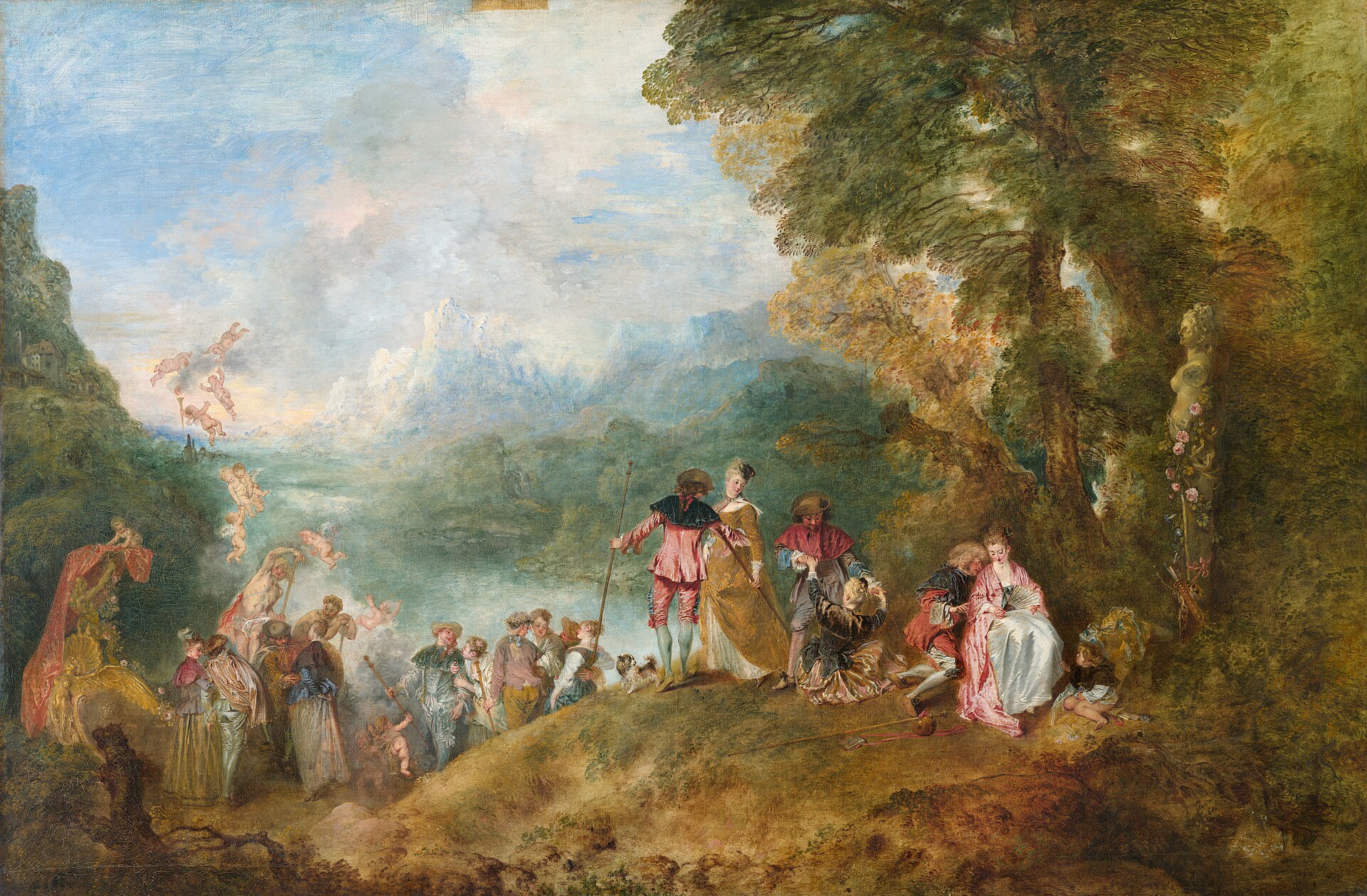
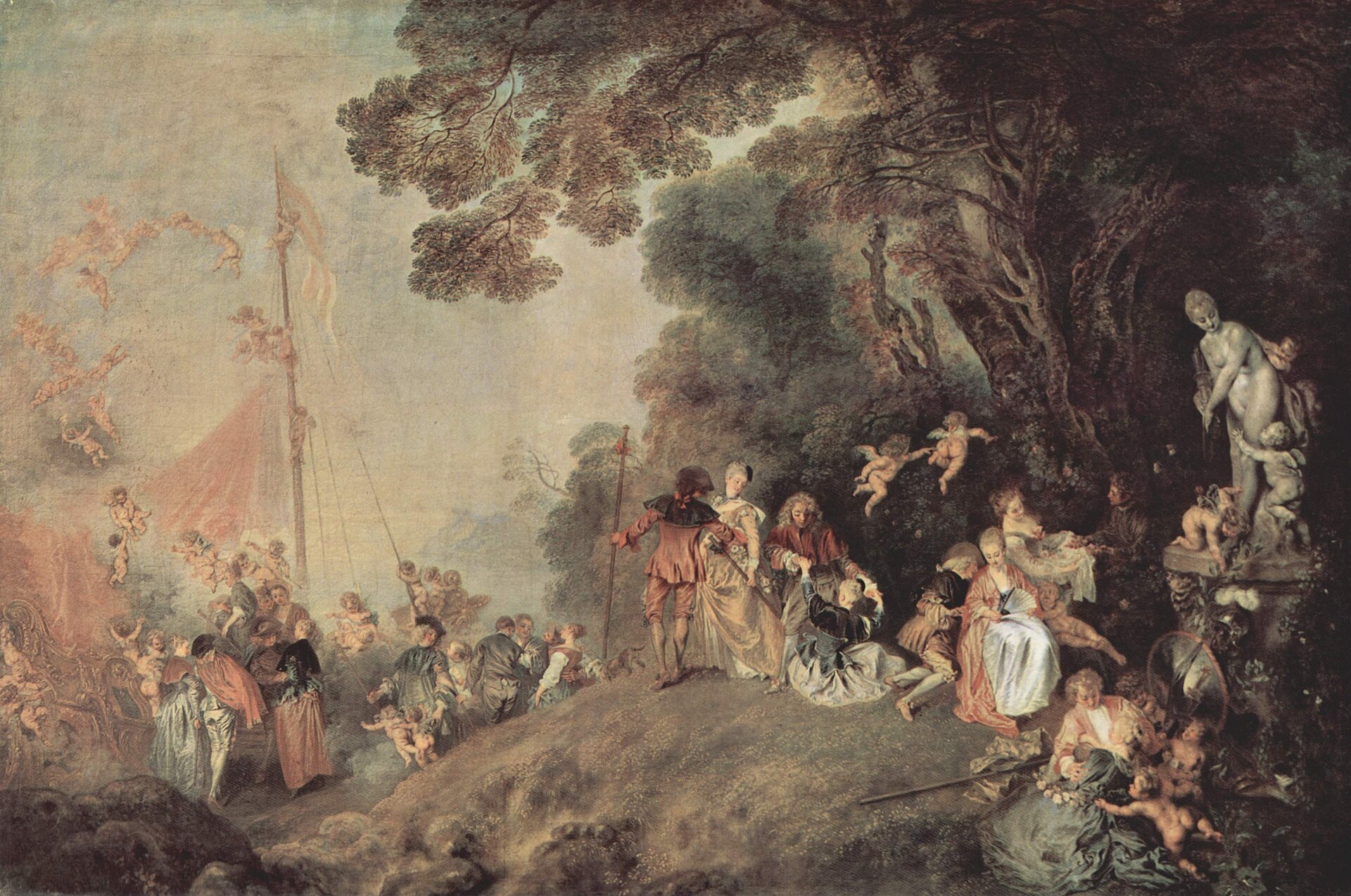
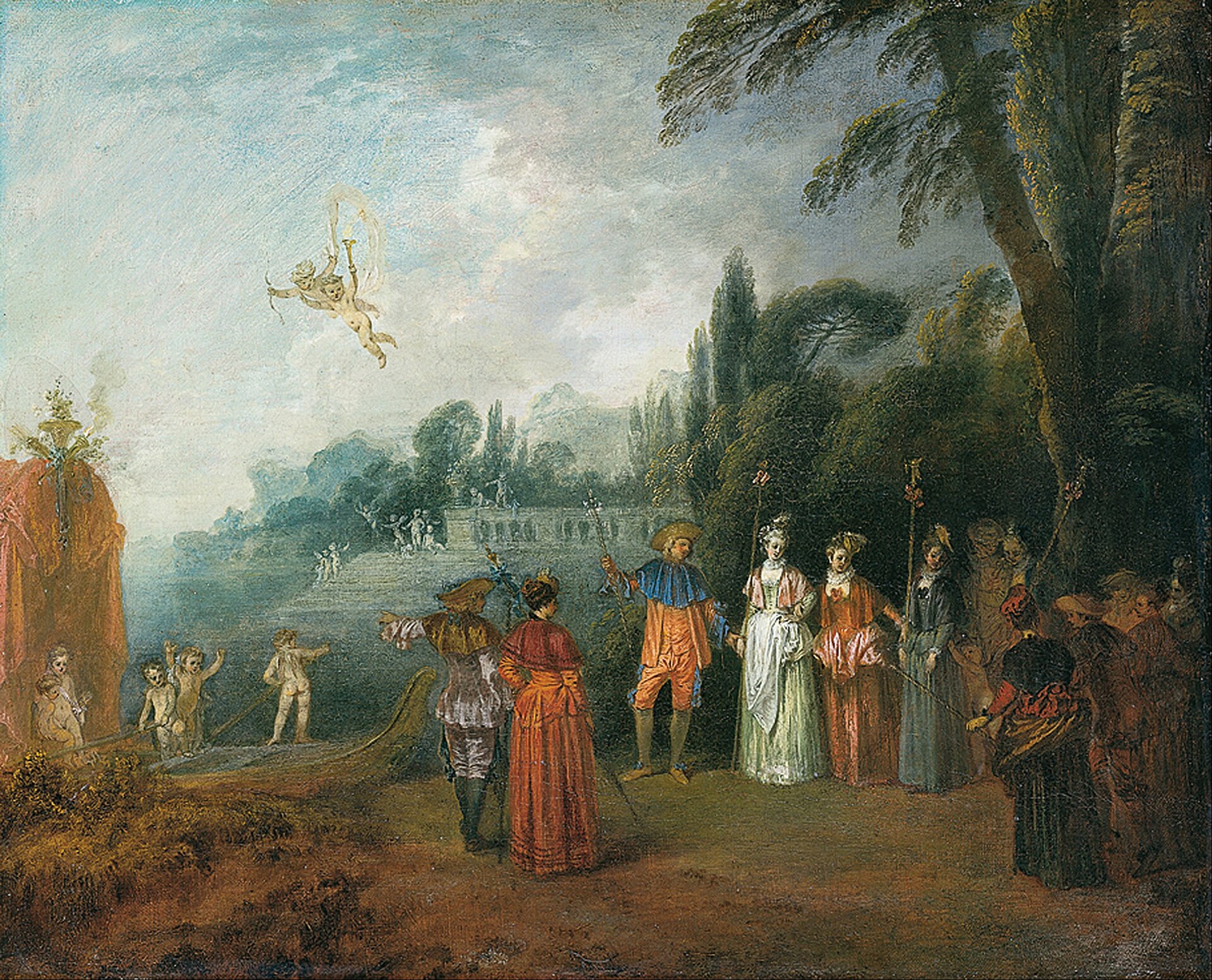
The thing most readers do not know is that the two best-known Cytheras are not what they are called. The Louvre picture is the reception piece the Academy waited five years for, and the Academy's clerk crossed out its title in the minute and wrote 'a fete galante'. The Berlin picture is a later repetition that Frederick the Great owned and that Prince Louis-Ferdinand of Prussia sold to the Charlottenburg palace in 1983 for DM 15 million. And the small canvas now in Frankfurt, which surfaced at Christie's in 1980 and 1981 and displaced the Heugel picture that every specialist but one had taken for the original, is, on Rosenberg's dating, the first idea of about 1709 to 1710 (Roland-Michel and Grasselli say 1712 to 1713).
Images
Chronology
- 1684
Baptised on 10 October at Saint-Jacques, Valenciennes, son of the roofer Jean-Philippe Watteau and Michele Lardenois; the godfather was Jean Antoine Bouche. No birth date is recorded and no other document names him in the city.1
- c. 1702
Arrives in Paris and works first for a dealer in religious images on the Pont Notre-Dame, copying pictures for the trade; then Claude Gillot's studio and Claude Audran III's decorative work at the Luxembourg Palace. Dates are the biographers', not documents.1
- 1709
Wins second prize in the Academy competition on 31 August (the painting is lost) and returns to Valenciennes for a short time; Sirois buys a military picture for 60 livres and later pays 200 livres for its pendant (Bivouac).1
- 13 June 1715
Carl Gustaf Tessin visits and notes a 'Watho', pupil of Gillot, on the quai de Conti: the oldest written document that names him.1
- 1717
Receives 200 livres from the Duc d'Arenberg for two paintings on 4 May, and on 28 August is received by the Academy with the Pilgrimage to the Island of Cythera, five years after he was accepted; the clerk replaces the title with 'une feste galante'.1
- 1717-1718
Lodges with Pierre Crozat in the faubourg de Richelieu (Almanach Royal for 1718), then at the end of 1718 with Nicolas Vleughels in the rue du Fosse Saint-Victor.1
- 1719-1720
In London about a year, consulting Dr Richard Mead, for whom he paints two pictures; back in Paris by 20 August 1720.1
- 1720
Rosalba Carriera arrives in Paris at the end of March and stays at Crozat's. Jullienne marries on 9 May. By the end of the year Watteau is living with the dealer Gersaint on the Pont Notre-Dame.1
- 11 February 1721
Sits to Rosalba at Crozat's request (her diary: 'Undertook for M. Crozat M. Watteau's portrait pastel').1
- 18 July 1721
Dies at Nogent-sur-Marne, in the house lent by M. Le Febvre through the Abbe Haranger. He leaves 9000 livres and divides his drawings among Jullienne, Haranger, Henin and Gersaint.1
- 1726-1728
Jullienne publishes the two volumes of Figures de differents caracteres: etchings after 351 studies. The first volume is announced in November 1726 at 48 livres.1
- 1735
The Recueil Jullienne, engravings after 269 works including 196 paintings, is delivered to subscribers; a bound set goes to the Academy on 31 December 1739.1
- 1744
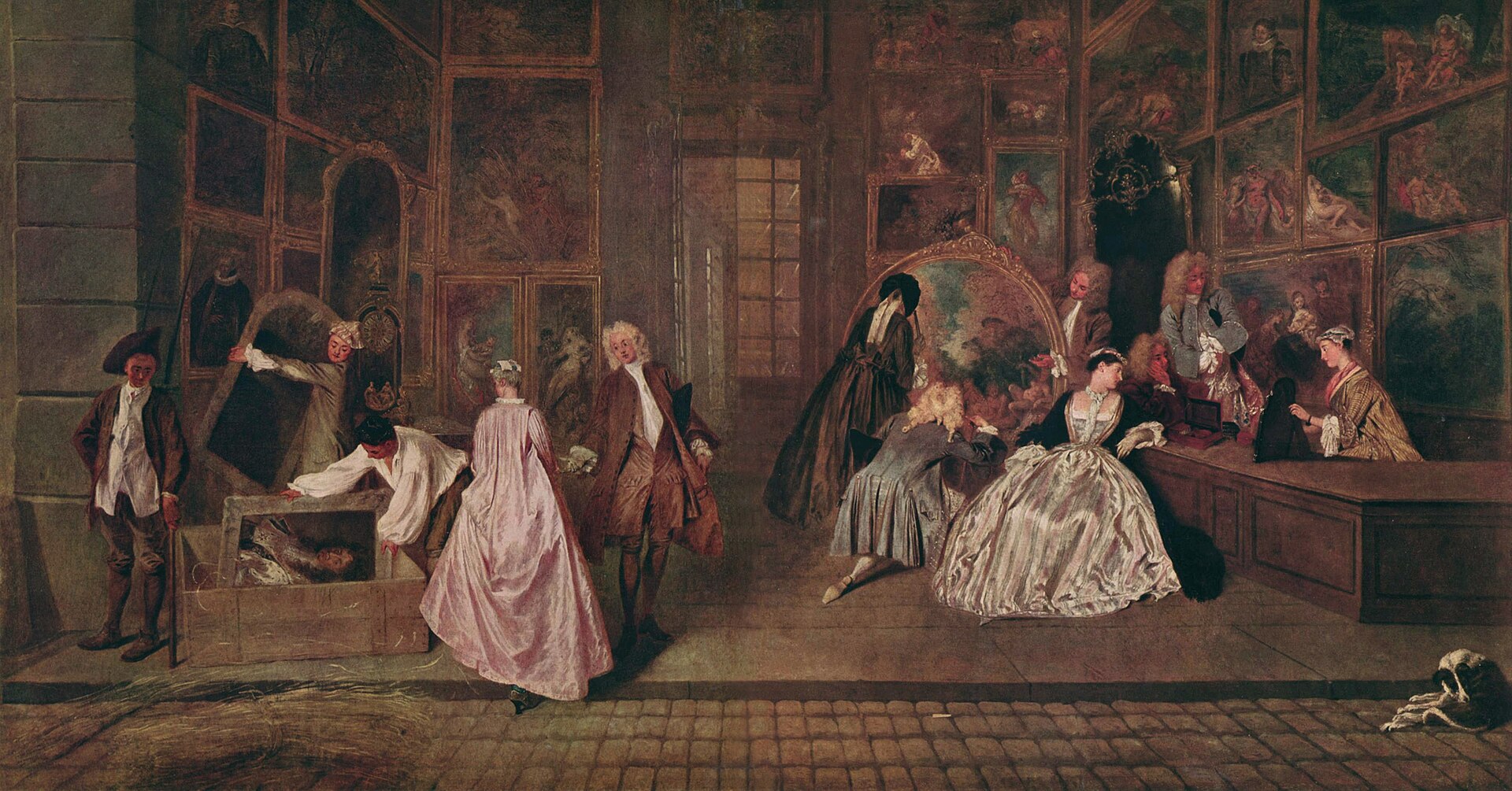
Gersaint prints his life of Watteau in the Quentin de Lorangere sale catalogue. In March Count Rothenburg is offered two large companion pieces for 8000 livres for Frederick the Great and finds the price exorbitant (27 April; the king agrees on 7 May); the pair finally bought are said to be the two halves of the Shopsign, price unknown.1
- 1760
Austrian troops occupying Berlin cut the Shopsign with sabres at Charlottenburg; the cuts show in the X-rays.1
- 1826
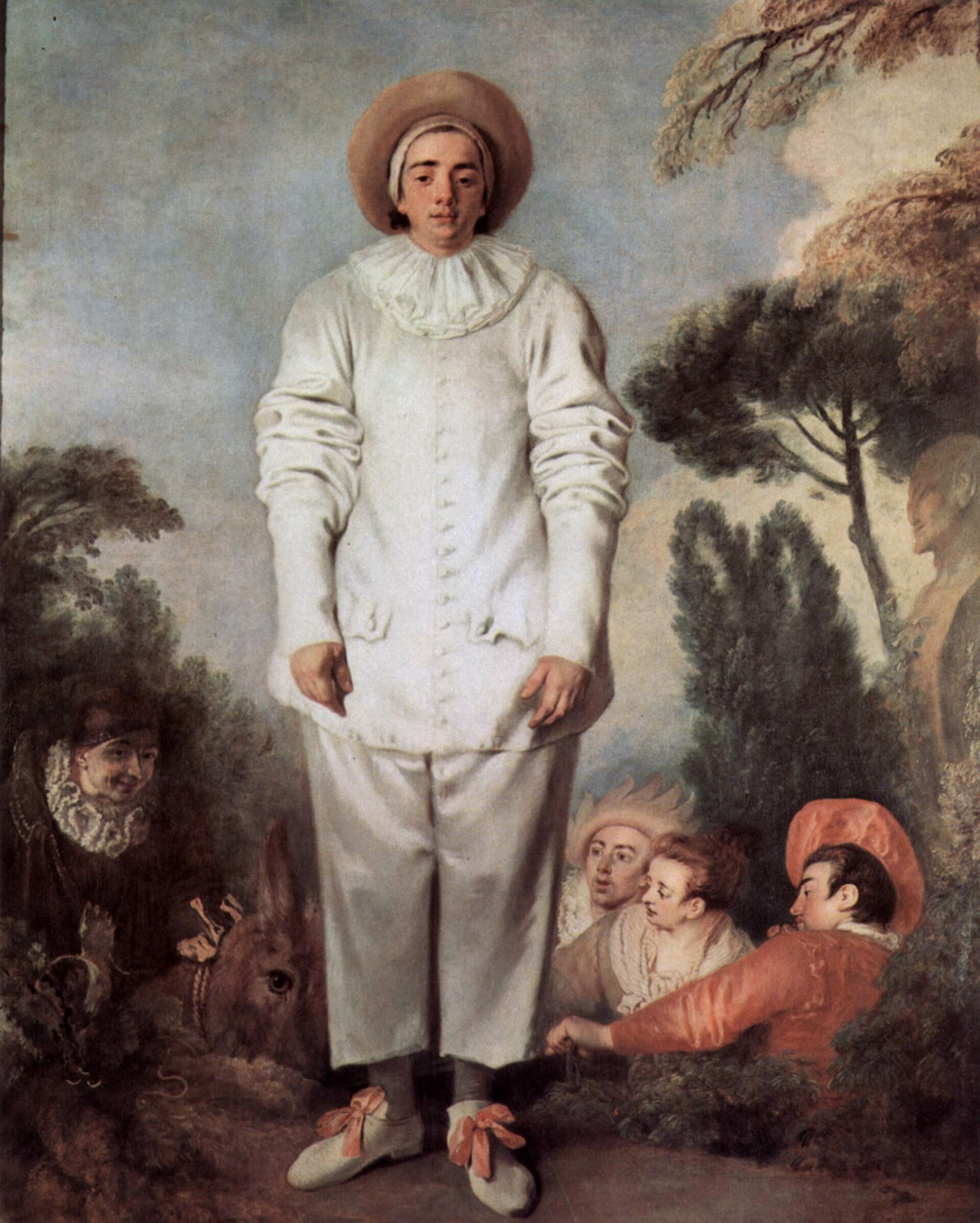
At the Denon sale in Paris the Pierrot, then called Gille, is lot 187 and goes to Denon's nephew for Fr 650; the first confirmed mention of the picture.13
- 1869
Dr Louis La Caze bequeaths the Pierrot and the rest of his collection to the Louvre.1
- 1981-1982
A smaller Island of Cythera, offered at Christie's in 1980 and again on 11 December 1981 as 'attributed to', is bought by the Stadel in Frankfurt and displaces the Heugel picture as the original.12
- 1983
Charlottenburg palace buys the Berlin Embarkation for Cythera from Prince Louis-Ferdinand of Prussia for DM 15,000,000, in thirds from the federal government, Berlin and a public subscription. The Louvre Pilgrimage is cleaned from June.1
- 1984
First international loan exhibition, National Gallery of Art, Washington (17 June to 23 September), Paris and Berlin; catalogue by Margaret Morgan Grasselli and Pierre Rosenberg.1
- 8 July 2008
Christie's London sells the rediscovered La Surprise for GBP 12,361,250, the highest price for a French Old Master painting at auction at the time.45
- 20 July 2017
The Getty Museum announces that it has bought La Surprise, with 16 drawings, from a British private collection; no price is given.7
- 16 October 2024 to 3 February 2025
The Louvre shows the restored Pierrot in 'A new look at Watteau', 65 works including seven Watteau paintings.3
The market
The figures are partial and sometimes in francs, florins or deutschmarks. No sourced method for converting any of them into present money, and none is offered. The record in the sources read is the Christie's London sale of La Surprise on 8 July 2008, which made GBP 12,361,250 against an estimate of GBP 3 million to 5 million; Christie's called it the highest price for a French Old Master painting at auction. No hammer is published, and the sources do not say whether the reported figure includes the buyer's premium.
Everything else is an old museum or private price, not an auction record. For scale in his own time: Sirois paid 60 livres for a military picture and 200 for its pendant about 1709 to 1710, the Duc d'Arenberg paid 200 livres for two paintings in 1717, Watteau died with 9000 livres, and in 1744 a pair thought to be the Shopsign's two halves was offered at 8000 livres and found too dear, the final price being unknown. The Berlin Embarkation was valued at 455 florins in 1743 and bought for DM 15 million in 1983 with public money, which is a tax-funded purchase and not a market price. The 2017 Getty purchase of La Surprise with 16 other drawings is a private deal with no disclosed price.
| Date | Sale | Work | Result | Note |
|---|---|---|---|---|
| 28 March 1743 | Sale of Jacob (Francesco) Lopez de Liz, The Hague | Embarkation for Cythera (the Berlin version), no. 12 in the catalogue | Hammer Not recorded; the 1984 catalogue gives a valuation of 455 florins With premium Not recorded Dutch florins | Sold by a bankrupt Portuguese financier; later bought by Frederick the Great at an unknown date between 1752 and 1765. |
| March 1744 | Private offer to Count Rothenburg for Frederick II, not a sale | Two large companion pieces, probably the two halves of Gersaint's Shopsign | Hammer 8,000 livres asked for the pair, found exorbitant by Rothenburg and the king; final price unknown With premium None: private offer livres | Letters of 27 April and 7 May 1744. The catalogue's provenance note (citing Seidel and Alvin-Beaumont) says the two pendants finally purchased were the two Shopsign halves; the price paid is not known. |
| April-May 1826 | Denon sale, Paris (cataloguer Perignon) | Gille (Pierrot), lot 187 | Hammer Fr 650, repurchased by the nephew Brunet-Denon With premium Not stated francs | Denon had paid Fr 150. Brunet-Denon sold it on 28 June 1838 for Fr 2000 to the Marquis de Cypierre, and La Caze bought it before 1845 for Fr 16,000 (Legrand) or Fr 2500 (Cypierre accounts); the two sources conflict. |
| 1972-1973 | Louvre, bought before the Galliera sale of 28 November 1972 | Portrait of a Gentleman (Louvre; sitter unknown, possibly a Crozat or Caylus) | Hammer No hammer: purchased from Pierre Bordeaux-Groult before the sale With premium Price not published in the 1984 catalogue; the press questioned it at the time francs | The Louvre had considered buying it in 1879 for Fr 220,000. |
| 4 December 1975 | Sotheby Parke-Bernet, New York (Dunlap sale), lot 380 | The Halt (cat. P. 5), bought by Baron Thyssen-Bornemisza | Hammer USD 75,000 as printed in the 1984 catalogue With premium Not stated whether premium is included USD | Engraved by Moyreau in 1729 from Jullienne's picture; copies are recorded. |
| 1983 | Private purchase by Schloss Charlottenburg, Berlin | Embarkation for Cythera (Berlin version) | Hammer No auction: purchase from Crown Prince Louis-Ferdinand of Prussia for DM 15,000,000 With premium None; one third each from the federal government, Berlin and a public subscription Deutschmarks | Acquired after about thirty years on deposit at Charlottenburg. |
| 8 July 2008 | Christie's, London, Important Old Master and British Pictures | La Surprise, about 1718, oil on panel, 36 by 28 cm | Hammer Not published. Derived, unverified: GBP 11,000,000, arithmetic only on an assumed 25/20/12 percent premium schedule that no source here confirms With premium Not published separately; total as reported GBP 12,361,250 (USD 24,376,385; EUR 15,513,369); estimate GBP 3 million to 5 million GBP | Rediscovered in a British country house in 2007; known before only from a Buckingham Palace copy and the 1731 engraving. Buyer and underbidder are not named in the sources read. |
Hammer is the price at which the bidding stopped; with premium adds the fee the house charges the buyer on top. Hammer price and buyer's premium in the glossary.
Recorded without a public price
- 18 December 1980 and 11 December 1981 · The Island of Cythera (now in Frankfurt) · Christie's, London, lots 97 and 6 · Not recorded in the sources read Withdrawn in 1980 as 'J. A. Watteau'; offered again in 1981 as 'attributed to'; bought by Maurice Segoura Gallery, New York, and sold in 1982 to the Stadel, Frankfurt. The price is the missing number.
- 20 July 2017 · La Surprise, with 16 old master drawings, from a British private collection · Private purchase, J. Paul Getty Museum · No auction; no price disclosed The Getty says only that the works came from a British private collection. The Art Newspaper, citing unnamed sources and reported second-hand by Enfilade, linked the collection to a private collector, Luca Padulli, who bought through the dealer Jean-Luc Baroni; this is unconfirmed. The New York Times remark that the group could have topped USD 100 million is a journalist's inference from sales records; the Getty gave no figure.
Where to see the work
| Institution | City | Holdings | Note |
|---|---|---|---|
| Musee du Louvre | Paris | Pilgrimage to the Island of Cythera (the reception piece of 1717), the Pierrot (La Caze bequest, 1869), Diana at Her Bath, The Indifferent, Finette, Assembly in a Park, The Faux-pas and others; 13 in 1984. | The Pierrot was restored at the C2RMF and shown 16 October 2024 to 3 February 2025; the Cythera was thinned of varnish in 1983. |
| Schloss Charlottenburg (Staatliche Schlosser und Garten Berlin) | Berlin | The Embarkation for Cythera (bought 1983 for DM 15,000,000) and Gersaint's Shopsign. | The Shopsign hangs reunited as one painting but is two canvases, 166 by 306 cm. |
| Gemaldegalerie, Staatliche Museen Preussischer Kulturbesitz | Berlin | The Dance (Iris, c'est de bonne heure; cat. P. 72 in 1984), acquired in 1766 by Frederick the Great or his brother Henry at the Braamcamp sale in Amsterdam. | Not at Charlottenburg; the 1984 catalogue says the picture is much altered in condition. |
| Staedel Museum | Frankfurt | The Island of Cythera (about 1709 to 1710) and the Rosalba pastel 'Portrait of Antoine Watteau (1721?)', inv. 1090, which is not on display. | The museum itself calls the identification of the sitter doubtful. |
| The Wallace Collection | London | Eight Watteaus in 1984 (other counts: seven or nine). | Not lent to the 1984 exhibition; the museum cannot make loans. |
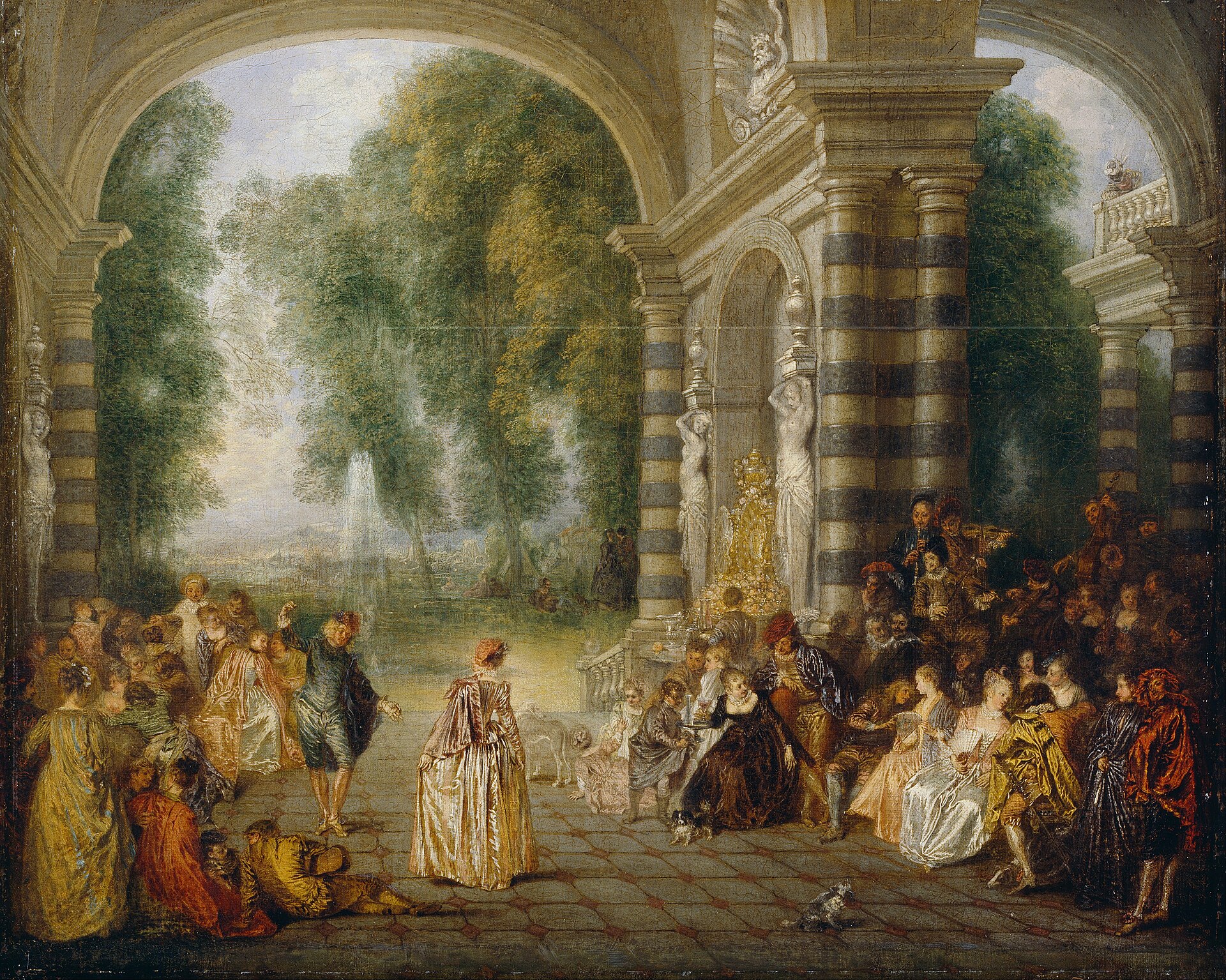
| Dulwich Picture Gallery | London | Les Plaisirs du Bal (Pleasures of the Dance), 52.6 by 65.4 cm, 'rightly considered one of the most beautiful' by Watteau in Mariette's words of about 1730. | Pater copies of it were popular. |
| National Gallery of Art | Washington | Italian Comedians (Kress collection, 1946) and the Groult copy of it; both were in the 1984 show. | Posner calls the Kress picture a copy; Rosenberg holds it is the original painted for Dr Mead. |
| The J. Paul Getty Museum | Los Angeles | La Surprise (about 1718, 2017 purchase), two drawings of 1716 to 1717 and an Italian Comedians bought in 2012. | The Italian Comedians is not universally accepted; the Getty's 2021 to 2022 show was 'La Surprise: Watteau in Los Angeles' with 12 works. |
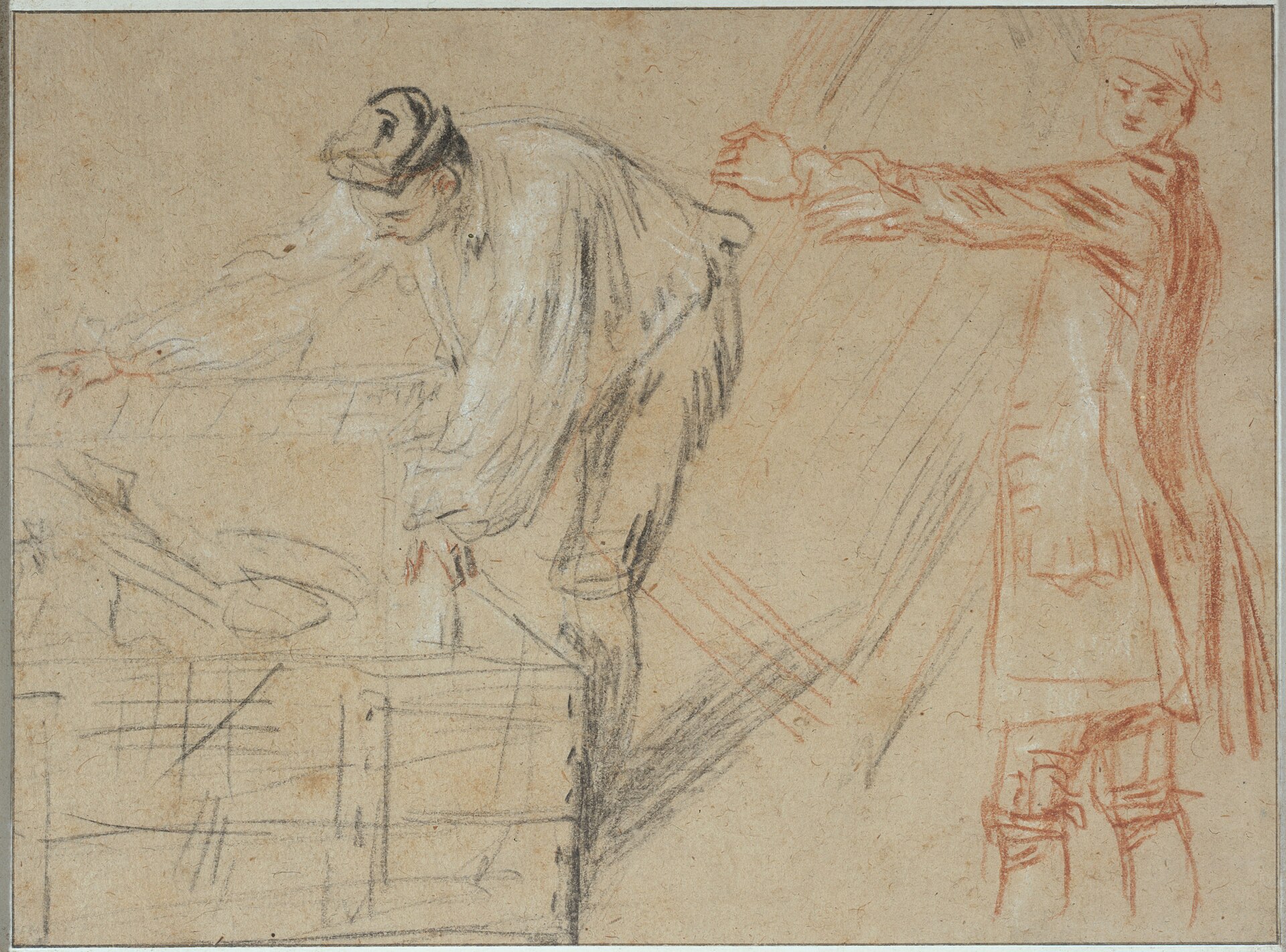
| Musee Cognacq-Jay | Paris | The trois crayons sheet J 195 for the packer and clerk in Gersaint's Shopsign, 16.8 by 22.7 cm. | Cut at the top; it appears to be the sheet the 1984 catalogue lists as cat. D. 126, the one real preparatory drawing known for the Shopsign. |
| Museo Civico Luigi Bailo | Treviso | Rosalba Carriera's pastel portrait identified as Watteau (Cailleux, 1968). | The identification is disputed; see the portrait caption. |
Forgeries and misattributions
- The receipt of 14 August 1719 from the Duc d'Orleans
- A receipt for 200 livres for payment by the Regent, linked to a lost painting on copper, The Monkey Painters (7.65 by 8.8 cm), owned by Duc Louis by 1727. Mirimonde's 1968 study proved the receipt false; the 1984 catalogue excludes it from the chronology.1
- The five disputed letters
- Four signed letters to Gersaint and Jullienne printed in the Archives de l'art francais in 1852 (the originals lost) and a letter of 1711 from the dealer Sirois, sold with the Benjamin Fillon papers in 1879. They mention books by Leonardo and letters by Rubens and several paintings. Style that is not eighteenth-century, facts that cannot be verified or contradict the record, capitals in the signature unlike the plain 'Vateau' in the Academy minutes, and owners who never allowed handwriting tests; Noel Charavay and the Goncourts judged the Sirois letter a forgery by 1889. The 1984 catalogue prints them with a warning.1
- The Michel-Levy half of the Shopsign
- A 98 by 130 cm fragment of the left half, with a documented line of owners from the Abbe Guillaume (1769) through the sculptor Auguste (1850) and Baron de Schwiter (1886) to Leon Michel-Levy; it was exhibited at the Petit Palais in 1900 and sold on 17 and 18 June 1925 for Fr 470,000. Before the war it was championed over the Berlin halves by Dayot, Vauxcelles, Josz and Maurel. Comparison with the Berlin canvases and the Louvre laboratory work (Alfassa, 1910); now generally agreed not to be Watteau. Its present whereabouts are unknown.1
- The Groult Italian Comedians
- After 1890 the Groult version was widely accepted as the Watteau original, with great fanfare, though it came from England. Parker (1931) and the 1932 London exhibition rejected it as an inferior replica; the 1984 catalogue says it is 'an old, mediocre copy' and sets it next to the Kress picture. The Kress picture itself is doubted by Posner and Eisler.1
- The Hermitage Landscape with a River
- Called nineteenth century or 'in the style of the nineteenth century' by Wildenstein, Chastel and Parinaud when shown in Bordeaux and Paris in 1965; Ferre (1972) called it a 'brazen fake'. Not a forgery finding. Rosenberg's reading is that a clumsy 1883 transfer from panel to canvas, repainting of ten to twelve centimetres on the left and careless cleaning produced the look; no laboratory results were known to him.1
- The Heugel Island of Cythera
- Accepted as the original by every specialist except Eidelberg until 1981. Rosenberg's reading: the original was in England before 1725 and engraved there by Mercier; Larmessin's print of 1730 names Jullienne's picture, probably the copy that the Heugel canvas represents. Side-by-side comparison with the version found in 1980 and 1981, pentimenti, and three technical habits: sky strokes like those of the Louvre Pilgrimage, etched lines for steps as in Pleasures of the Dance and the French Comedians, and dark brush outlines for the putti.1
- Pater, Mercier and the Recueil
- Pater was Watteau's only certified pupil; his copies, and Philippe Mercier's pictures in Watteau's manner, circulated as Watteau. The Aveline engraving for the Recueil follows a Pater copy of the Shopsign. By dimensions, handling and the Louvre X-rays, according to Alfassa and Laban as cited in the 1984 catalogue. No eighteenth-century forger's workshop is documented in the sources read, and a nineteenth-century fashion for fake Watteaus is not documented beyond Rosenberg's statement that he was pastiched in both centuries.1
The essay
Chapter 1Sixty or so, and why nobody says sixty exactly
There is no authority that rules on Watteau any more, and no figure everybody uses.
There is no authority that rules on Watteau any more, and no figure everybody uses. The nearest thing to an official number is a phrase in Rosenberg's own paintings introduction to the 1984 catalogue, where he hopes that a doubtful Louvre portrait, set 'alongside sixty or so sure works', will be confirmed. That is a curator's estimate in passing, not a count, and the catalogue does not print a total of accepted pictures.
What it does print is how thin the agreement is. Of the thirteen Watteaus the Louvre then held, only three (Diana at Her Bath, The Indifferent and Finette) were engraved for the Recueil Jullienne. The Louvre Pilgrimage, the Pierrot, Assembly in a Park and The Faux-pas were not, so the old rule that a picture engraved for Jullienne is genuine and one left out is not fails on the Louvre's own walls. In 1984 even the Pierrot and the Washington Italian Comedians were being doubted by specialists, and Rosenberg left out two Valenciennes pictures (True Gaiety and the Portrait of the Sculptor Antoine Pater) that most experts accepted, because he did not think they were by Watteau.
The eighteenth-century numbers are worth setting beside this. Matthias Oesterreich's description of Frederick the Great's palaces in 1773 lists twenty-four Watteaus, and his 1770 edition of another catalogue adds two more: twenty-six. Helmut Borsch-Supan's tally is that twelve of the twenty-six are genuine today (eleven if the two halves of the Shopsign are counted as the one picture they were), two vanished in the nineteenth century and cannot be checked, and three further genuine pictures were surely in the royal collection. That is one scholar's count of one collection, assembled by a king whose enthusiasm Borsch-Supan distinguishes from knowledgeable understanding.
Chapter 2A roofer's son and an empty archive
Jean-Antoine was baptised at Valenciennes on 10 October 1684, the second son of Jean-Philippe Watteau, a roofer in slate who was also, over the years, a dealer in wood and fish and a man the city...
Jean-Antoine was baptised at Valenciennes on 10 October 1684, the second son of Jean-Philippe Watteau, a roofer in slate who was also, over the years, a dealer in wood and fish and a man the city records show in court for violence, and Michele Lardenois, seven years older than her husband. His grandfather and uncles were roofers too. No document names the painter in Valenciennes except the baptism.
Hecart (1826) names the Valenciennes painter Jacques-Albert Gerin as his first master and the archives confirm that Gerin died on 7 June 1702, but the 1984 chronology found no trace of such an apprenticeship and leaves it hypothetical. He came to Paris about 1702, worked copying pictures for a dealer on the Pont Notre-Dame (Gerrit Dou's Old Woman Reading and saints for the street trade), then entered Claude Gillot's studio and moved on to Claude Audran III, concierge of the Luxembourg Palace, where he could study Rubens's Marie de' Medici cycle. On 31 August 1709 he won second prize in the Academy competition with a painting that is now lost.
The oldest written mention of him is a Swedish diary: on 13 June 1715 the young collector Carl Gustaf Tessin noted a 'Watho', pupil of Gillot, Flemish by birth, living on the quai de Conti. Four signed letters published in 1852 and a fifth, from the dealer Sirois, sold with the Benjamin Fillon papers in 1879, were included in the 1984 catalogue only at the end of the chronology with a warning: the Goncourts and the expert Noel Charavay thought the Sirois letter a forgery by 1889, and the 1852 letters are in a style that is not eighteenth-century. A receipt of 14 August 1719 for payment from the Duc d'Orleans was shown to be false by Mirimonde in 1968.
Chapter 3The reception piece the Academy waited five years for
Watteau was accepted by the Royal Academy on 30 July 1712 (the Pilgrimage entry in the same catalogue prints 30 June, an inconsistency inside the book) and told to choose his own subject for the...
Watteau was accepted by the Royal Academy on 30 July 1712 (the Pilgrimage entry in the same catalogue prints 30 June, an inconsistency inside the book) and told to choose his own subject for the reception piece, which was unusual. He then did nothing. The Academy called him to order on 5 January 1714, 5 January 1715 and 25 January 1716, and on 9 January 1717 gave him six months more. He was received on 28 August 1717 on delivering the Pilgrimage to the Island of Cythera, now in the Louvre, which is 129 by 194 centimetres and was painted in about eight months.
The clerk wrote the title 'le pelerinage a l'isle de Cithere' in the minute and then crossed it out and wrote 'une feste galante'. The change is in the minute itself, which the catalogue reproduces; why the clerk made it is not recorded, and the engraved Berlin version later carried the title 'Embarquement pour Cythere'. The picture stayed in the Academy's assembly hall, was inventoried by Chardin in 1775 as 'An embarkation for Cythera' and entered the Louvre in 1795. It was not engraved for Jullienne.
Rosenberg's 1984 text lays out the readings without choosing among them: a departure for the island of love, a return from it, or an allegorical place outside time. Levey (1961) first argued for a departure from the island; Bauer, Le Coat and Posner answered that the picture is an allegory of the power of erotic poetry and gallantry; Claude Ferraton (1975) read the Louvre canvas as a departure for Cythera, love imagined, and the Berlin canvas as the island itself. Rosenberg writes that both interpretations are correct, that the picture is as much a departure toward the isle as from it, and that Watteau wanted it that way; Posner holds that the clerk's 'feste galante' reflects the academicians' perplexity. What the picture meant to Watteau is not documented. The surviving evidence is the engravings' titles, probably Jullienne's, and Caylus's remark that his compositions had no object, a verdict the same Caylus undercut by saying Watteau thought deeply.
Chapter 4Two Cytheras, and a third that changed sides
The Berlin Embarkation for Cythera is a repetition of the Louvre picture, the same size (129 by 194 cm), probably of 1718 or 1719 on no document at all.
The Berlin Embarkation for Cythera is a repetition of the Louvre picture, the same size (129 by 194 cm), probably of 1718 or 1719 on no document at all. It is more crowded (twenty-four figures against eighteen), adds a couple on the right with three putti, replaces the bust of Venus with a full-length statue, gives the boat a sail, mast and banner and multiplies the cupids, and replaces the mountains of the background with a large azure and pink sky. Eidelberg showed in 1977 that the main groups were painted with the help of oil counterproofs taken from the first version. Rosenberg preferred the Louvre picture and called the Berlin one more mechanical, 'as if the artist were bored'. Seidel (1900) and Donald Posner (1984) preferred Berlin.
Its provenance is a miniature of how Watteau reached the north. It belonged to Jullienne in 1733, when Tardieu engraved it. In 1743 it was in the Hague sale of the bankrupt Portuguese financier Jacob (called Francesco) Lopez de Liz, valued at 455 florins; Frederick the Great bought it, and the catalogue gives two incompatible accounts: the entry's narrative says a Hague sale of 1763, the provenance note says an unknown date between 1752 and 1765. It stayed with the Prussian family until 1983, when Prince Louis-Ferdinand of Prussia, who had kept it on deposit at Charlottenburg for about thirty years, sold it to the palace for DM 15,000,000, one third paid by the federal government, one third by Berlin and one third raised publicly.
The third picture is the one that changed place. Until 1981 every Watteau specialist except Martin Eidelberg took the Cythera in the Heugel collection (46.5 by 56 cm) for the original small canvas engraved by Mercier about 1725 and by Larmessin in 1730. In December 1980 a smaller version (43.1 by 53.3 cm), long in an English family, was withdrawn from Christie's as 'J. A. Watteau' and offered again on 11 December 1981 as 'attributed to'. The Maurice Segoura Gallery bought it and sold it in 1982 to the Stadel in Frankfurt. Set beside the Heugel picture it reversed the field, and Rosenberg grounds the new decision in three technical habits: sweeping strokes in the milky blue sky like those of the Louvre Pilgrimage, lines etched into the paint to mark steps, as in Pleasures of the Dance and the French Comedians, and small dark brush lines for the putti, a practice he rarely abandoned. The Frankfurt picture is dated about 1709 to 1710 by Rosenberg and Posner, and 1712 to 1713 by Roland-Michel and Grasselli. Rosenberg's reading is that the original was in England before 1725 and was copied there; Jullienne, who owned it and probably believed it the original, probably had that copy engraved by Larmessin in 1730 and resold it before 1756. The Heugel picture is now treated as the copy.
Chapter 5How he painted: thin oil, white ground and a loaded brush
The 1984 restoration report on the Louvre Pilgrimage is the best technical document there is on how he worked.
The 1984 restoration report on the Louvre Pilgrimage is the best technical document there is on how he worked. The support is a loosely woven, irregular canvas (eleven threads one way and twelve the other per square centimetre) with an original horizontal seam near the bottom, lined in 1798 by Fouque. The ground is thick white lead in oil emulsified in animal glue, and because lead blocks X-rays the radiograph is hard to read. The paint is often very thin: in the pale blue sky of the upper left the white ground shows everywhere through rapid, liquid strokes, and the foreground is green and brown glazes put on fast with pink touches. The foliage was done in one sitting with a long supple brush carrying a lot of medium, leaving a thin wedge of surplus colour at each side of the stroke. The figures took longer; the cracks and wrinkling in the centre show it. Infrared shows pentimenti: the boatman's right arm was higher, a small figure behind the boatman was removed, and a cupid was painted out under the women's dresses. Crayon marks still show in the foreground.
The early biographers explain the condition. Gersaint wrote that, to be rid of a work, Watteau put a lot of rich oil on his brush to spread the colour, and that several of his paintings were being ruined daily because of it; Mariette named the 'huile grasse' as the cause, and Caylus agreed. The Watin treatise of 1776 describes the mixture as letting him lay on layers that dried quickly, with the result that the paint film cracked deeply. So the damage that Rosenberg regrets is not only age and bad cleaning. Part of it is the recipe.
The Louvre's first thinning of the varnish was in 1956 (Goulinat, under Germain Bazin); the second began in June 1983 under Jacques Roullet and thinned the layers of brown mastic varnish that had turned the blue lake brown and the azure sky green. Whether the result is the original colour, the report itself says, cannot be confirmed.
The drawings are a separate subject. His fame as a draughtsman rests on the trois crayons, red, black and white chalk used together, but Dezallier d'Argenville's 1745 life says he used the three 'sometimes' and Grasselli agrees that red chalk alone was the commonest medium; he used red for all his studies up to at least 1712. He did not draw in pen: the one traditionally attributed pen study is a copy after Callot that would be doubted if it were not inscribed. Graphite appears from about 1714 as a fourth colour. Caylus describes the method: he drew from the model in a bound book of studies, dressed his sitters in elegant clothes, some theatrical, took them in natural poses, then picked figures from the notebook to make groups for a landscape he had conceived or prepared.
Chapter 6Pierrot, called Gilles, and a sign nobody can prove
The Pierrot is the only life-size figure Watteau painted and his only monumental composition: a white-clad figure standing arms hanging against a blue sky, with four small characters and a donkey at...
The Pierrot is the only life-size figure Watteau painted and his only monumental composition: a white-clad figure standing arms hanging against a blue sky, with four small characters and a donkey at the foot. Nothing firm is known of it before the early nineteenth century. The 1984 catalogue gives its path: a dealer named Meunier, who had written two lines of a popular song on the background to draw buyers' eyes and could not sell it, then Dominique Vivant-Denon, who bought it for Fr 150 (Hedouin, 1845), said to have been against David's advice, then the Denon sale of April and May 1826, where it was lot 187 as 'Gille', repurchased by his nephew Brunet-Denon for Fr 650 (the catalogue gives that figure without saying how it was reckoned). He sold it to the Marquis de Cypierre in 1838 for Fr 2000 on the Cypierre accounts (Hedouin had said Fr 1200), and Dr Louis La Caze bought it before 1845 for Fr 16,000 (Legrand's figure from La Caze's friend Emile Rousse) or Fr 2500 (the Cypierre accounts). La Caze left it to the Louvre in 1869 with his whole collection, which the catalogue calls the finest donation the museum ever received.
Whether he is Pierrot or Gilles was argued by Dora Panofsky in 1952, who tied the picture to the parade 'The Education of Gilles'; Francois Moureau, writing in the 1984 catalogue, concludes that Watteau 'most surely painted a Pierrot'. Helene Adhemar proposed in 1951 and 1977 that it was a shop sign for the cafe opened by the actor Belloni, who played Pierrot, in the rue Aubry-le-Boucher about 1718. The evidence is a passage in the Parfaict brothers (1743) saying Belloni put his portrait as Pierrot in his cafe, plus a vertical line down the face visible in enlarged photographs, one side crackled and the other sound, which Faillant read as a sign struck and weathered. Rosenberg finds the hypothesis persuasive and dates the picture to 1718 or 1719; it is a hypothesis. Sitter identifications offered over the years include Francois Biancolelli (Mantz, 1870), the Academy's director Corneille van Cleve (Schefer, 1896), Giuseppe Balletti (Dacier and Vuaflart), Watteau himself (Panofsky, 1938, who did not rule it out) and Pierre Sirois (Parker and Mathey).
Rosenberg writes that its authenticity is difficult to doubt, though the catalogue's preface says that the Pierrot and the Italian Comedians have recently been placed in doubt, without naming who. The Louvre had it restored at the C2RMF and showed it in a monographic exhibition, 'A new look at Watteau', from 16 October 2024 to 3 February 2025. The Louvre states that its first confirmed mention dates only from 1826. Rosenberg argues for earlier traces that are not firm: a rental document published by Rambaud (1971) describing a room with three Watteau pictures including a Pierrot, a remark in Dezallier d'Argenville (1745) about a curate used as the model for a Gilles, and a print of the year VII; he reads them as showing that the picture was not unknown in the eighteenth century.
Chapter 7Gersaint's Shopsign: eight mornings, cut in two
Gersaint's own account, in the 1744 catalogue of the Quentin de Lorangere sale, is that Watteau came to him in 1721 and asked to stretch his fingers by painting a sign for the shop on the Pont...
Gersaint's own account, in the 1744 catalogue of the Quentin de Lorangere sale, is that Watteau came to him in 1721 and asked to stretch his fingers by painting a sign for the shop on the Pont Notre-Dame, and worked on it only mornings for eight days because his weakness would not allow more. The Mercure de France of 1732 says it was exhibited for only fifteen days and sold to Claude Glucq, who passed it to his cousin Jullienne; Aveline engraved it for the Recueil that year. The 1984 catalogue dates it to the last months of 1720 because the Almanach Royal for 1721 puts Watteau at Gersaint's address, which conflicts with Gersaint's 'on his return to Paris, which was in 1721'.
The painting that hangs in Charlottenburg is two pieces, 166 by 306 centimetres overall, with a strip eleven centimetres deep added to the top. It was originally arched, and the Pont Notre-Dame shops were 3.56 metres between the pillars, so the original width was about 3.55 metres against the present 3.06, which means two bands were cut from the sides and partly reused at the top. The Louvre laboratory (Alfassa, 1910) and Adhemar (1964) reconstructed this. When it was cut and by whom is not known, but laboratory results suggest it was soon after completion. Rosenberg thinks it clear that Watteau painted it on two separate canvases, the handle of the glass door marking the division. The X-rays show Austrian sabre cuts of 1760, when the palace at Charlottenburg was plundered by the Austrian troops that occupied Berlin; the guard's report mentions blows from a sabre in one of the large pictures by Watteau.
The picture reached Frederick the Great about 1744, through his agent the Count of Rothenburg, who was offered 'two large companion pieces' for 8000 livres in March 1744; Rothenburg found the price exorbitant (27 April) and so did the king (7 May). The catalogue's provenance note, citing Seidel and Alvin-Beaumont, says the two pendants finally bought were the two halves of the Shopsign, so Frederick probably had it about 1744 at a price that is not known. Before the First World War the question of whether the Berlin halves were originals divided scholars, because they hung in the Kaiser's private apartments and were hard to see. A large fragment of the left half, 98 by 130 centimetres, in the collection of Leon Michel-Levy, was championed by Alexandre, Vauxcelles, Dayot, Josz and Maurel and sold on 17 and 18 June 1925 for Fr 470,000; its present whereabouts are unknown and it is now agreed not to be by Watteau. The one real preparatory drawing is the trois crayons sheet in the Musee Cognacq-Jay (a packer laying a portrait in a case and a second man lifting a frame), which Watteau reversed when he painted it. The shop sign has been read as a testament and as criticism of earlier painting; Rosenberg's summary is that Watteau's ambition is obvious but Watteau's meaning is not known.
Chapter 8Crozat, Rosalba and a face nobody can fix
Pierre Crozat, the financier and collector who had brought back a harvest of Italian drawings in 1715, is the hinge of Watteau's middle years.
Pierre Crozat, the financier and collector who had brought back a harvest of Italian drawings in 1715, is the hinge of Watteau's middle years. He introduced him to Sebastiano Ricci (before 22 December 1716, when he wrote to Rosalba Carriera that of all the painters he only knew Watteau capable of making something to send her, with the warning that Watteau 'is very long in everything he does'). The Almanach Royal listed Watteau at Crozat's house for 1718, and Mariette's Abecedario reports that Watteau is said to have copied all of Domenico Campagnola's landscape drawings in the Crozat collection. The friend with whom he lived in 1718 and 1719 was the painter Nicolas Vleughels.
Rosalba arrived in Paris at the end of March 1720 and stayed with Crozat until March 1721. She met Watteau on 20 August 1720, visited him on 9 February 1721 and on 11 February wrote in her diary that she had undertaken Watteau's pastel portrait at Crozat's request. When Crozat wrote to her on 11 August 1721 to announce Watteau's death he said the friends' public discourse on his life would not forget to call attention to the portrait she made shortly before it. Which pastel she meant is disputed. Wilhelm (1953) thought it the blue-paper study in the Stadel in Frankfurt; Cailleux (1968) identified the finished pastel in the Museo Civico at Treviso; the Stadel's own catalogue now treats its drawing as doubtful, saying Carriera met him only shortly before his death and that it could be a fantasy portrait after an engraving. The Treviso pastel is the only face a reader can set beside the engraved portraits, and the 1984 catalogue says flatly that Watteau's features still elude us.
In February 1721 Le Nouveau Mercure reported that Watteau, Nattier and one other were entrusted with drawing the paintings of the King, the Regent and other Paris cabinets for the Recueil Crozat, to be engraved by subscription; that venture, devoted to old masters, is the one Jullienne's single-painter Recueil is sometimes thought to have rivalled.
Chapter 9London, Dr Mead and an Italian Comedians that keeps changing hands
Watteau crossed to England in 1719, probably before the end of the year, and stayed about a year.
Watteau crossed to England in 1719, probably before the end of the year, and stayed about a year. He went, according to Walpole, to consult the fashionable doctor Richard Mead, who collected French pictures, and painted two pictures for him. Vertue noted in 1724 two Mead pictures 'painted in England'. The Mercure of March 1733, announcing Baron's engraving, says the painting of the Italian Comedians was done for Mead on the London trip. Rosenberg gives reasons for identifying the National Gallery of Art's Italian Comedians with it, while noting that the version that came to Washington from the Groult collection, once treated by almost everyone as the original, was rejected as an inferior replica by Parker in 1931 and is now also in Washington as a copy. The 1984 text records that Eisler (1977) called the Kress picture an excellent early copy or a work begun by Watteau and finished by Mercier, and that Posner (1983 and 1984) saw it as a copy. The Getty bought another Italian Comedians in 2012, and its attribution is not universally accepted. A blog report of 2021 (not a primary source) quotes the Getty's curator Davide Gasparotto as saying the large canvas was not in the show 'La Surprise: Watteau in Los Angeles' because its size would create great imbalance beside the small works; he said it is discussed in the catalogue, the label still reads Watteau, new technical investigations have been run, and a panel of Watteau scholars is planned at the end of the show. Whether any Italian Comedians is the Mead picture is an open question.
He returned to Paris 'sicker than ever' (Leclerc, Jullienne, Mariette, Dezallier and Caylus agree); Gersaint puts it as a disease the English call consumption. Rosalba's diary has him back in Paris by 20 August 1720.
Chapter 10Nogent, the estate and the book that made him
In the spring of 1721 the Abbe Haranger, canon of Saint-Germain-l'Auxerrois, found him a refuge in the house of M.
In the spring of 1721 the Abbe Haranger, canon of Saint-Germain-l'Auxerrois, found him a refuge in the house of M. Le Febvre, administrator of the Menus Plaisirs, at Nogent-sur-Marne. Watteau died there on 18 July 1721. The Academy's minute of 26 July gives his age as thirty-five; the baptism makes him thirty-six, and the 1984 chronology says not yet thirty-seven. The 1984 catalogue says, on Gersaint's and Caylus's authority, that he left 9000 livres, of which 3000 was in goods and 6000 had been kept for him by Jullienne when the Law system failed during his trip to England, and that the money was returned to his family. He entrusted the drawings to Gersaint to divide among four friends: Jullienne, Haranger, the collector Nicolas Henin and Gersaint himself.
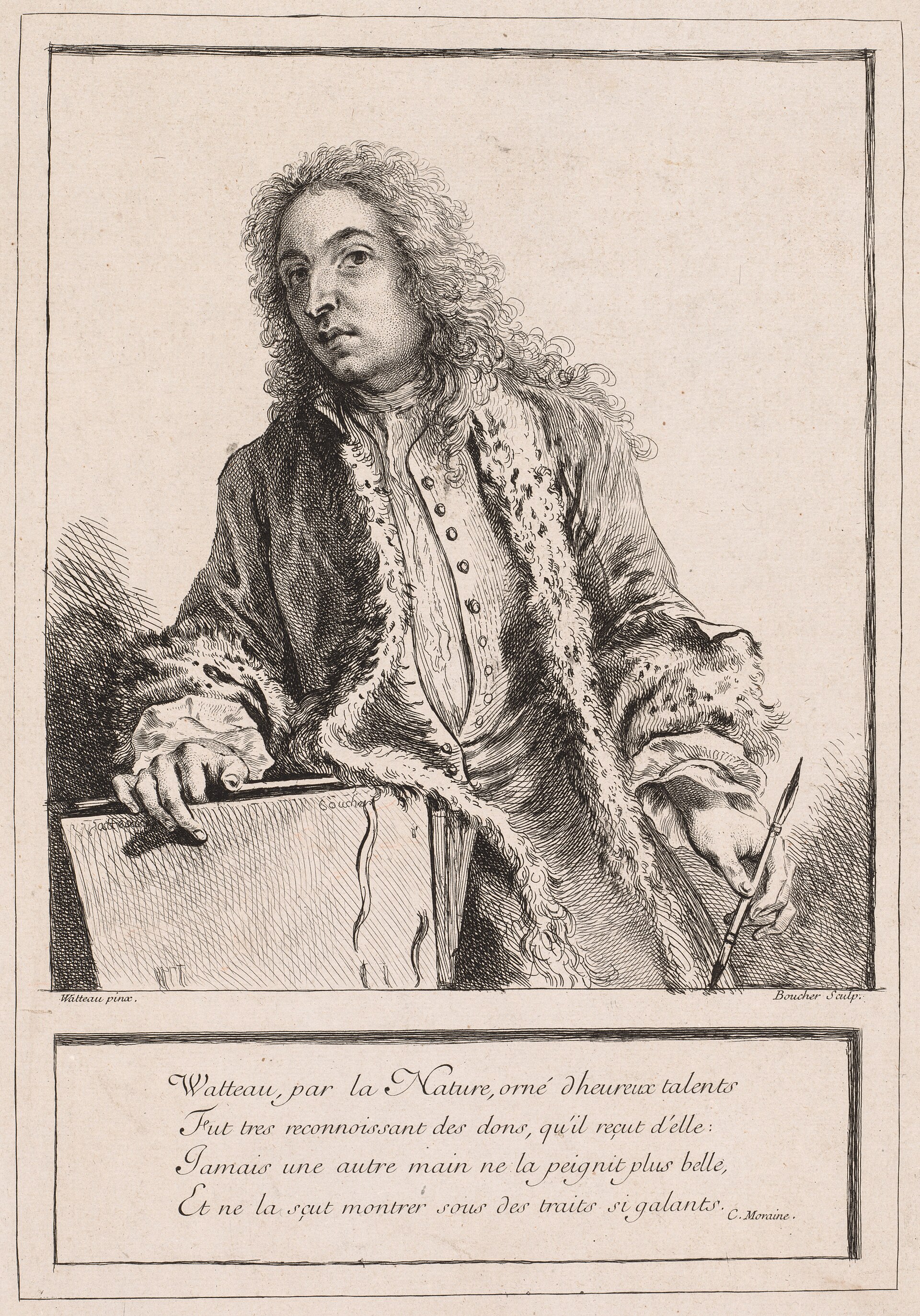
Jullienne is the reason there is a corpus. He bought up most of the paintings and had the drawings etched and the paintings engraved. The Figures de differents caracteres, two volumes in 1726 and 1728, reproduce 351 studies in etchings, and the Recueil Jullienne, delivered to subscribers in 1735, has plates after another 269 works, 196 of them paintings. Boucher, still unknown, worked on the etched volumes. The first volume sold at 48 livres. Jullienne gave a bound set to the Academy on 31 December 1739; it is now at the Ecole des Beaux-Arts. By 1756, when his manuscript catalogue was made, he kept only eight Watteau paintings.
The Recueil is the starting point for any attribution and it has limits that matter. Plates were sometimes taken from copies, so the Aveline engraving of the Shopsign probably follows Pater's copy rather than the huge original (Alfassa, 1910); the dimensions in the caption of the Louvre Diana differ appreciably from the picture; and pictures were left out for reasons nobody recorded. Dacier and Vuaflart, with Herold on the first volume, published four volumes on the Recueil between 1922 and 1929 and Rosenberg calls it indispensable; he regrets that nobody has done the same for the Figures de differents caracteres.
Chapter 11Frederick the Great's Watteaus
Frederick II is the single most important collector in the reception story.
Frederick II is the single most important collector in the reception story. In 1744 he wrote that he needed three paintings by Watteau, which Borsch-Supan reads as for the small gallery at Potsdam, and Rothenburg complained of the scarcity of large pieces, which the king preferred. In December 1754, refusing Lancret pictures offered through his reader Darget, he wrote that he was no longer inclined to that taste and was buying Rubens and Van Dyck. The Seven Years War then cost Charlottenburg most of its pictures: in 1760 the palace was plundered and most pictures were carted off. The Marquis d'Argens called the Shopsign miraculously spared, but the guard's report mentions sabre blows in one of the large Watteaus, and the cuts show in the X-rays; only the Shopsign, a Chardin and an early Pesne stayed in the palace. Frederick bought the Berlin Embarkation for Cythera late and the catalogue calls it the last Watteau he purchased; it gives a Hague sale of 1763 in one place and an unknown date between 1752 and 1765 in another.
Borsch-Supan adds three further genuine pictures that are not in any account of his lifetime but were surely in the royal collection: The Dance, The Shepherds and The Love Lesson. Borsch-Supan's count in the first section, twenty-six attributed in 1773 and twelve genuine, shows what a collector without a catalogue could end up with; Rothenburg complained in the 1740s that Watteaus were scarce.
Chapter 12The invented melancholy, and what the nineteenth century did
Under the Revolution the Pilgrimage went through a short eclipse in popularity.
Under the Revolution the Pilgrimage went through a short eclipse in popularity. Pierre Bergeret reported in 1848 that the picture hung in the Academy's drawing room and the students threw pellets of bread and clay at it, that one student of the 'primitive sect' punched it, and that the keeper, who said he had had the honour of knowing Mr. Watteau, a man of exemplary gentleness, put it in the attic. It was back in the 1816 Louvre, the only Watteau shown there before the La Caze bequest of 1869. In that gap the poets took him up, Nerval, Gautier, Banville, Baudelaire and Verlaine among them, and the melancholy Watteau was created. Posner's judgement, quoted by Rosenberg, is that this Watteau was invented out of whole cloth; his contemporaries felt more joy and merriment than sadness in the pictures.
The recent readings that replaced it are the ones in the catalogue: music and sculpture (Mirimonde), the theatre (Macchia) and eroticism (Posner). Rosenberg's verdict is that none of them explains everything and that the artist's greatness may lie in that multiplicity. That is a scholar's judgment, not a finding. The documented intellectual picture is thin: Gersaint says he liked reading, Caylus that reading was his greatest relaxation, and he is known to have owned Oppenordt drawings and to have copied a Van Dyck drawing that Tessin lent him. The 1852 letters that mention Leonardo's writings and Rubens's letters are among those doubted. No inventory of a Watteau library survives, and no hidden programme has been proved for any picture.
Chapter 13Copies, pastiches and the doubtful pictures
Rosenberg says that Watteau never signed and was very soon and often very cleverly copied, and imitated and pastiched in both the eighteenth and nineteenth centuries, and that only a side-by-side...
Rosenberg says that Watteau never signed and was very soon and often very cleverly copied, and imitated and pastiched in both the eighteenth and nineteenth centuries, and that only a side-by-side comparison of pictures permits a calm judgment. The reasoned cases he and his colleagues name are copies and misattributions, not documented criminal forgeries: works by Philippe Mercier taken for Watteau (The Pickpocket, which Larroumet in 1895 wished to see exhibited as a Watteau, is by Mercier), a Pater copy used for the Shopsign engraving, the Groult Italian Comedians, the Michel-Levy half of the Shopsign, and the Heugel Cythera. Two decisively false documents are on record: the 1719 Orleans receipt and the 1711 Sirois letter, with the 1852 letters under serious suspicion.
A nineteenth-century fashion for fake Watteaus is not documented beyond Rosenberg's remark and a handful of cases. The Hermitage's Landscape with a River was called a nineteenth-century work or in the style of the nineteenth century by Wildenstein, Chastel and Parinaud when shown in Bordeaux and Paris in 1965, and Ferre (1972) called it a 'brazen fake'; Rosenberg attributes the doubts to condition: an inexpert transfer from panel to canvas in 1883, a repainted strip on the left, and careless cleaning that removed the glazes. That is the model dispute: a condition problem that reads as a style problem.
What is documented
Technique
The surviving work
- What is accepted
- No settled figure. Pierre Rosenberg's 1984 paintings section speaks of 'sixty or so sure works' in a passing sentence and prints no total. The catalogue itself numbers its exhibited paintings up to at least P. 73, and records which he leaves out. As of 2026 no paintings catalogue raisonne by a single author has been confirmed as published (Wikipedia reports projects by Alan Wintermute and Martin Eidelberg; not verified).
- What is contested
- Rosenberg's 1984 rulings: he rejects True Gaiety and the Portrait of the Sculptor Antoine Pater in Valenciennes, which most experts had accepted; accepts The Children of Bacchus as the thirteenth Louvre Watteau; treats the Washington Italian Comedians as the original and the Groult version as a copy; and treats the Frankfurt Island of Cythera as the original, displacing the Heugel picture (1981). Wilhelm and Cailleux disagree over which Rosalba pastel is Watteau. In 1984 the preface said that even the Pierrot and the Italian Comedians had recently been placed in doubt; the Washington Italian Comedians has named doubters (Eisler, Posner). Adhemar, Ferre, Bazin and Saint-Paulien doubted a different Louvre picture, the Portrait of a Gentleman (P. 67). Ferre (1972) used two classes, A 'authentic' and B 'attributed', for the same corpus.
- Who rules on attribution
- No authentication board. Pierre Rosenberg's published rulings in the 1984 catalogue are the practical standard for paintings, with Margaret Grasselli for drawings in the same book and Rosenberg and Prat (1996) for drawings.
Catalogue raisonne
- Emile Dacier and Albert Vuaflart, with Jacques Herold on the first volume, four volumes on Jullienne and the Recueil, 1922-1929 (cited as DV) The standard work on the Recueil Jullienne, the engraved corpus. Its limits: the Recueil omits famous pictures (the Louvre Pilgrimage, the Pierrot, Assembly in a Park, The Faux-pas).1
- Karl Parker and Jacques Mathey, 1957, the catalogue of the drawings (cited as PM) Drawings catalogue, numbered to at least PM 950 in the 1984 citations; superseded for the drawings by Rosenberg and Prat.19
- Adhemar and Huyghe 1950 (AH); Mathey 1959 (M); Camesasca and Rosenberg 1970 (CR); Ferre 1972; Roland-Michel 1982 (RM); Donald Posner 1984 (P) The successive paintings catalogues; the 1984 catalogue cites a CR number for each picture (the Shopsign is CR 212). They differ on dates and on a number of attributions; Posner has the Italian Comedians as a copy.1
- Margaret Morgan Grasselli and Pierre Rosenberg, with Nicole Parmantier, Watteau 1684-1721, National Gallery of Art, Washington, 1984 Exhibition catalogue, not a catalogue raisonne: drawings by Grasselli, etchings by Parmantier, paintings by Rosenberg. It states which paintings are left out and why. It is the main source for the paintings entries.1
- Pierre Rosenberg and Louis-Antoine Prat, catalogue raisonne of the drawings, 1996 The drawings catalogue raisonne; reports of the number of volumes (two or three) and of the number of drawings accepted differ, and the book was not opened.89
Questions about Jean-Antoine Watteau
Who was Jean-Antoine Watteau?
Painter; Draughtsman; Etcher; Decorative painter. 1684-1721.
When did Jean-Antoine Watteau live?
Born Baptised 10 October 1684 (the birth date itself is not recorded), Valenciennes, parish of Saint-Jacques (French Flanders, French only since 1678); died 18 July 1721, Nogent-sur-Marne, near Paris.
How are fakes and misattributions of Jean-Antoine Watteau detected?
The receipt of 14 August 1719 from the Duc d'Orleans. A receipt for 200 livres for payment by the Regent, linked to a lost painting on copper, The Monkey Painters (7.65 by 8.8 cm), owned by Duc Louis by 1727.
Where can you see work by Jean-Antoine Watteau?
Musee du Louvre (Paris); Schloss Charlottenburg (Staatliche Schlosser und Garten Berlin) (Berlin); Gemaldegalerie, Staatliche Museen Preussischer Kulturbesitz (Berlin); Staedel Museum (Frankfurt); The Wallace Collection (London); Dulwich Picture Gallery (London).
What does the market for Jean-Antoine Watteau look like?
The figures are partial and sometimes in francs, florins or deutschmarks. No sourced method for converting any of them into present money, and none is offered.
What is still unresolved about Jean-Antoine Watteau?
How many Watteau paintings are autograph? Rosenberg's 1984 'sixty or so sure works' is a passing estimate; no catalogue raisonne of the paintings by a single author has been confirmed, and the Wintermute and Eidelberg projects reported by Wikipedia could not be verified as published.
Open questions
- How many Watteau paintings are autograph? Rosenberg's 1984 'sixty or so sure works' is a passing estimate; no catalogue raisonne of the paintings by a single author has been confirmed, and the Wintermute and Eidelberg projects reported by Wikipedia could not be verified as published.
- Which Rosalba pastel did Crozat commission on 11 February 1721? Wilhelm (1953) said Frankfurt, Cailleux (1968) said Treviso, and the Stadel now doubts its own sitter and suggests a fantasy portrait after an engraving. Is any pastel from life?
- Is the Pierrot a shop sign for Belloni's cafe? Adhemar's hypothesis rests on a printed passage of 1743 and a line down the face in photographs; no document ties Watteau to Belloni or the cafe.
- Was the Shopsign painted at the end of 1720 or in 1721, and when and why was it cut in two? The catalogue says the cut came soon after it was finished, but nobody knows by whom or why Jullienne, Glucq and Gersaint gave it up.
- Is the Louvre Portrait of a Gentleman (bought 1973) by Watteau, and who is the sitter? Adhemar (1950), Ferre (1972), Bazin (1974) and Saint-Paulien (1976, proposing Jean-Francois de Troy) rejected it; Rosenberg hopes it will be confirmed beside sixty or so sure works and suggests a Crozat or the Comte de Caylus as sitter.
- Is any Italian Comedians the picture Watteau made for Dr Mead in London? The Washington Kress picture, the Groult version and the Getty picture of 2012 have all been argued, and the 1984 catalogue says it is the Washington picture.
- What did he read? The 1852 letters that mention Leonardo's writings and Rubens's letters are doubtful, and no library inventory survives; Gersaint and Caylus say only that he liked to read.
- What did Mariette write about Watteau's habits as a draughtsman? The Notes manuscrites and the Abecedario are cited throughout the 1984 catalogue, but the passage on his drawing is not among the texts consulted.
Sources
- 1Margaret Morgan Grasselli and Pierre Rosenberg, with Nicole Parmantier, Watteau 1684-1721, National Gallery of Art, Washington, 1984 (full text; read in extract: Preface, Chronology, Friends of Watteau, Drawings introduction, paintings introduction, entries P. 5, 6, 9, 33, 61, 62, 67, 69, 71, 73, restoration reports, Appendix D). An exhibition catalogue and the best-documented source, with the paintings written by Rosenberg. Replace the page numbers cited with the printed pagination when quoting. nga.gov/content/...
- 2Staedel Museum, Frankfurt, collection record: Rosalba Carriera, Portrait of Antoine Watteau (1721?), inv. 1090; inscriptions and the museum's own doubt about the sitter. sammlung.staedelmuseum.de/en/...
- 3Musee du Louvre, 'A new look at Watteau: An actor with no lines, Pierrot, known as Gilles' (16 October 2024 to 3 February 2025): dates, 65 works, seven paintings, C2RMF restoration, first mention 1826. louvre.fr/en/...
- 4ArtDaily, 'Rediscovered Watteau Masterpiece - Lost for 200 Years - Sells for Record $24.4 Million' (July 2008), reporting the Christie's release; the page gives GBP 12,361,250 and an estimate of GBP 3-5 million but no hammer. artdaily.com/news/...
- 5Art Observed, 'AO Auction Results: Christie's Old Masters on Tuesday: a $24,400,000 lost masterpiece' (8 July 2008 sale; the page lists USD 24,376,385 and a USD estimate and does not give a hammer). artobserved.com
- 6Wikipedia, 'The Surprise (Watteau)' (): sale on 8 July 2008, provenance through Henin, Jullienne and La Live de Jully, rediscovery in a British country house. en.wikipedia.org/wiki/...
- 7Enfilade (blog of the Society for Eighteenth-Century Art), 'The Getty acquires Watteau's La Surprise and 16 master drawings' (31 July 2017), reproducing the Getty release of 20 July 2017 (). enfilade18thc.com/2017/...
- 8Sotheby's, Arcade Fine Arts sale 2005, lot 1: Watteau, Man Kneeling in Prayer (Saint Louis), catalogue note on Rosenberg and Prat's catalogue raisonne and Claude Vignon. sothebys.com/en/...
- 9Wikipedia, 'Antoine Watteau' (): Parker and Mathey replaced by Rosenberg and Prat for the drawings; paintings projects by Wintermute and Eidelberg; the Getty exhibition of 2021 to 2022. en.wikipedia.org/wiki/...
- 10Apollo Magazine, 'La Surprise: Watteau in Los Angeles' (the Getty show of twelve works from public and private Los Angeles collections). apollo-magazine.com/la-surprise-watteau-in-los-angeles
- 11LACMA on Fire (blog, 2021), 'Watteau Show Snubs Italian Comedians' (a blog, not a primary source): the Getty's 2012 Italian Comedians and its exclusion from the 2021 display. lacmaonfire.blogspot.com/2021/...
- 12Wikimedia Commons, file page for the Rosalba Carriera pastel at Treviso (Museo Civico Luigi Bailo), licence read as PD-Art, PD-old-100-1923. commons.wikimedia.org/wiki/...
- 13Wikimedia Commons, file page for the Cognacq-Jay study for the Shopsign (Paris Musees record, inv. J 195, CC0), whose catalogue text describes the packer and clerk. commons.wikimedia.org/wiki/...
- 14Wikimedia Commons, file page for the Cleveland Museum of Art etching by Boucher after Watteau (CC0), carrying Cleveland's description and date. commons.wikimedia.org/wiki/...
- 15Wikimedia Commons, file page for the C2RMF photograph of the Louvre Pilgrimage to Cythera (public domain; PD-Art, PD-old-auto-expired). commons.wikimedia.org/wiki/...


Last verified