Hans Holbein the Younger
 German, working in Basel and in England · 1497-1543
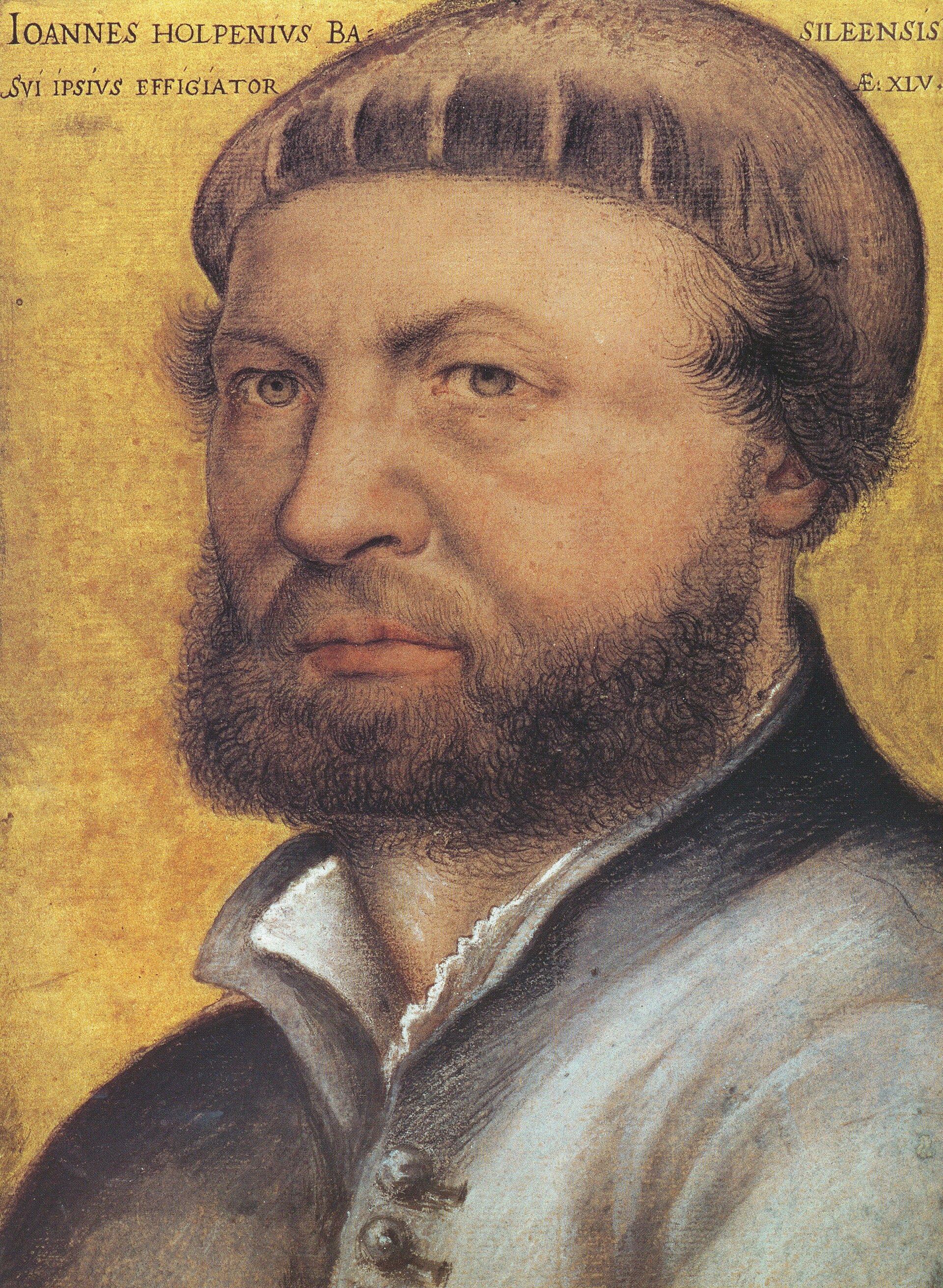
Self-portrait, coloured chalks, about 1542 to 1543, Gabinetto dei Disegni e delle Stampe, Galleria degli Uffizi, Florence; no accession number is given on the Commons file record and none is asserted here. The gold background is a later addition. That the sitter is Holbein is not in serious doubt, and the inscription, although late, evidently records an earlier one of which slight traces remain. What is qualified is the sheet itself: John Rowlands, author of the standard catalogue of the paintings, wrote that although this drawing has been enlarged on all sides and heavily reworked, enough of it still shows to allow the assumption that the original work was executed by Holbein, and that there is no evidence Holbein ever made a painted portrait from it. Painted versions by other hands exist, including one given to Lucas Horenbout in which the left-handed Holbein has been reversed. He made almost no other likeness of himself, which is a striking omission in a man who spent seventeen years recording other people's faces for money.
Galleria degli Uffizi, Florence, via Wikimedia Commons; licence verified as Public domain from extmetadata.LicenseShortName, Copyrighted: False| Full name | Hans Holbein, called the Younger to distinguish him from his father, the Augsburg painter Hans Holbein the Elder |
|---|---|
| Worked as | Painter, Portrait draughtsman, Designer of woodcuts, Designer of goldsmiths' work and jewellery |
| Born | c. 1497 · Augsburg, in the Holy Roman Empire |
| Died | between 7 October and 29 November 1543 · London, in the parish of St Andrew Undershaft, Aldgate |
| Nationality | German, working in Basel and in England |
| Movement | Northern Renaissance. He is the last great painter of the German-speaking world before... |
| Sources | 32 cited |
| Last verified | 17 September 2026 |
About this page Last verified 17 September 2026 · 32 sources cited
On this page 13 sections
ContentsClose
The hardest question in Holbein is not whether he painted a picture. It is who is in it. He worked for thirteen years at a court that was destroying its own records as fast as it made them, he almost never inscribed a sitter's name on a panel, and the group of drawings that is the primary evidence for his English portraits carries names written on it by somebody else, probably two hundred years after the sitters were dead. The Royal Collection's own catalogue text puts the position without softening it: in most cases the identity of the sitter is known only from the inscriptions on the drawings, copied, probably in the eighteenth century, from identifications reputedly made by Sir John Cheke, tutor to Edward VI. That is the evidentiary floor under a very large part of Tudor iconography.
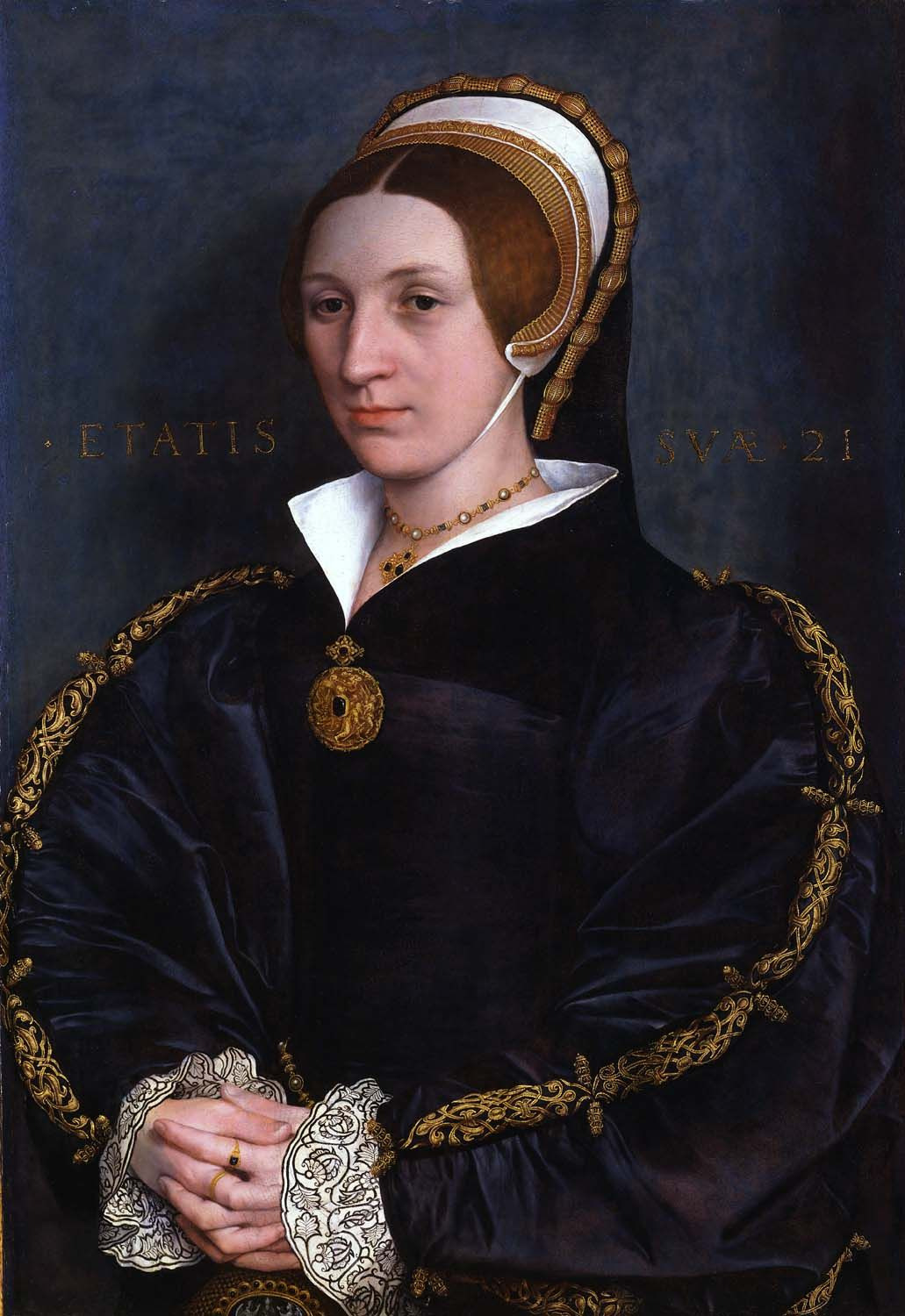
The consequence is that Holbein's corpus has been renamed repeatedly, and usually upwards. A picture of an unnamed gentlewoman is worth a fraction of a picture of a queen, and for four centuries the trade and the country houses supplied the difference. A drawing at Windsor called Ormond turns out to be James Butler and not Anne Boleyn's father. A three-quarter-length in Toledo that Lionel Cust published in The Burlington Magazine in 1910 as Queen Catherine Howard is now catalogued by the museum as a lady probably of the Cromwell family, perhaps Elizabeth Seymour. A panel bought by the National Portrait Gallery in 1898 as Catherine Howard turned out on dendrochronology to be a late seventeenth-century copy of that Toledo picture, so it was wrong about the sitter, the date and the hand at once. The National Gallery's Ambassadors was sold in Paris in 1787 as portraits of Messieurs de Selve and d'Avaux. Even the great pictures came with the wrong names attached.
What this page sets out is the machinery of identification rather than the mythology: the sixteenth-century inventory label that fixes Christina of Denmark, the squirrel and the starling that fix Anne Lovell, the Wyatt coat of arms on the back of a drawing that unfixes an Anne Boleyn, the infrared reflectogram that separates a Holbein transfer from a copyist's hatching, and the three-day conference held in front of two paintings in Dresden in 1871 that invented modern connoisseurship in order to decide which of two Madonnas was the original. This publication has already had to publish a record whose picture is filed under the sitter's married name; the Holbein corpus is that problem multiplied by a court, a workshop and four hundred years of dealers.
Images

Chronology
- c. 1497
Born at Augsburg, son of the painter Hans Holbein the Elder, brother of Ambrosius Holbein. He probably trained in his father's workshop.20
- 1515
In Basel by this date, working as a journeyman painter in a prosperous printing and university city that had not yet turned Protestant.20
- 1519
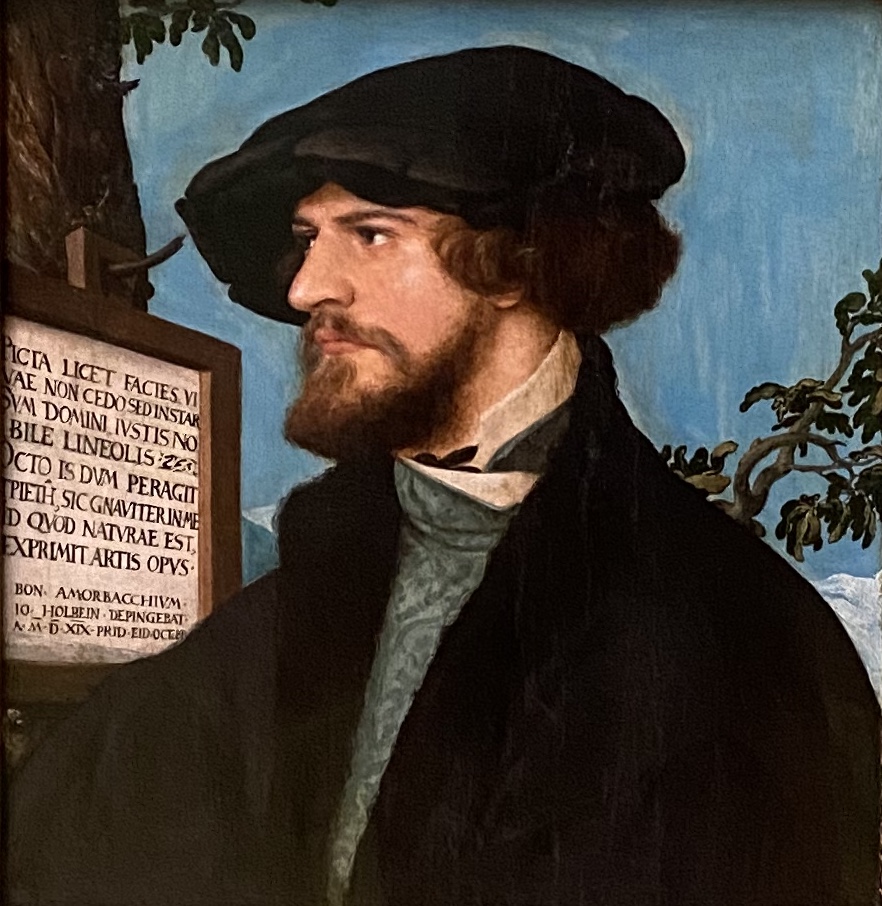
Joins the Basel painters' guild and takes Basel citizenship. Marries Elsbeth Binzenstock. Paints the portrait of Bonifacius Amerbach, the picture on which the whole Basel collection later hangs.1820
- 1521-1522
Paints The Body of the Dead Christ in the Tomb, oil and tempera on limewood, about 30.5 by 200 cm, commissioned by Bonifacius Amerbach. Its original function - predella, devotional panel, or the lid of a Holy Sepulchre - has never been established.22
- 1523
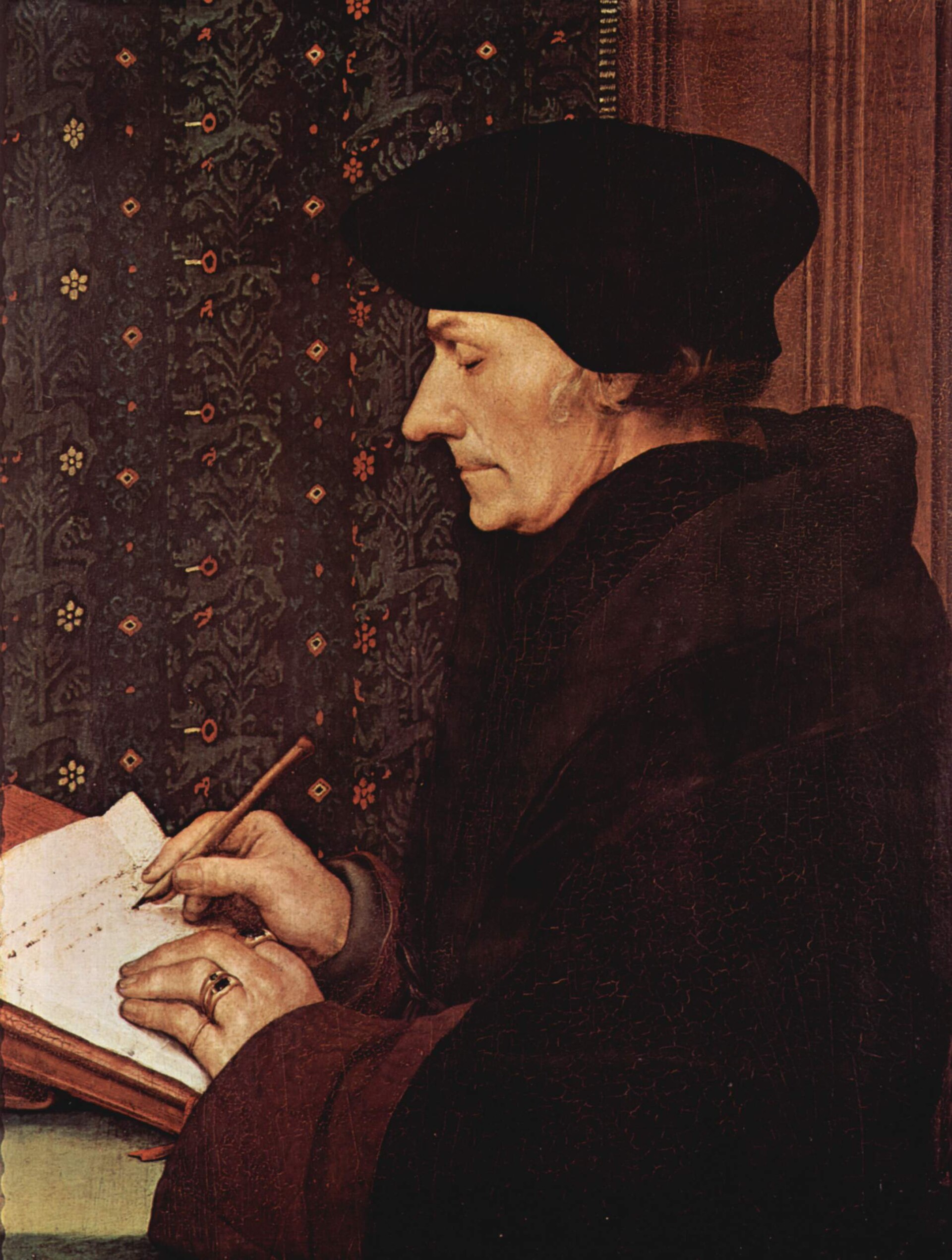
Paints Erasmus. Three versions of that year survive, in Basel, the Louvre and the picture long at Longford Castle. One is sent as a gift to Archbishop William Warham in England, which is how Holbein's name reaches London before he does.121
- 1523-1526
Designs the Dance of Death, cut in wood by Hans Lutzelburger. Publication is delayed by the cutter's death and the blocks appear at Lyon only in 1538.20
- 1526
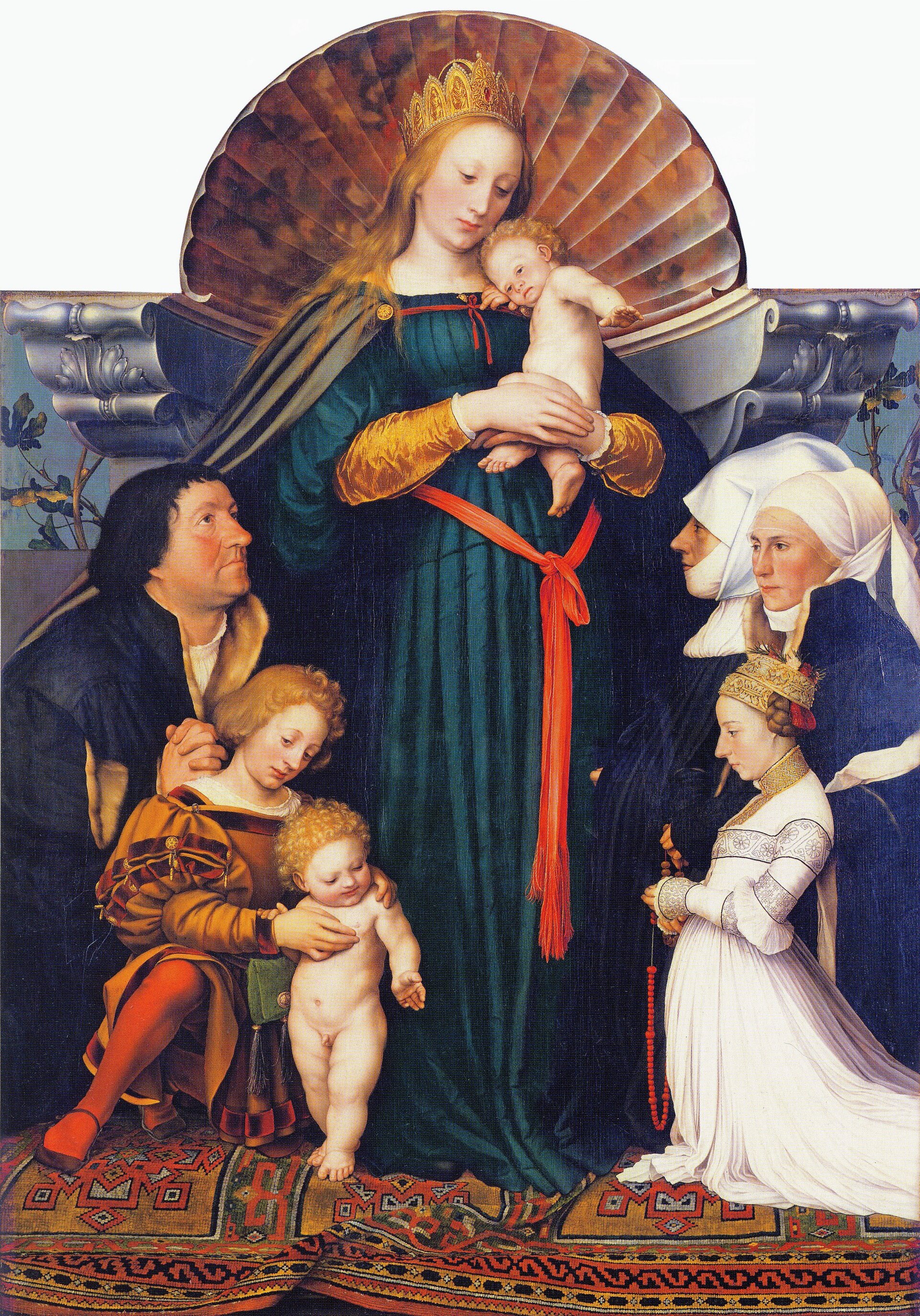
Paints the Madonna of Jakob Meyer zum Hasen for the Catholic burgomaster of Basel, begun about this date and worked on to about 1528. Late in the year he travels to England with a letter of introduction from Erasmus to Sir Thomas More.11623
- 1527
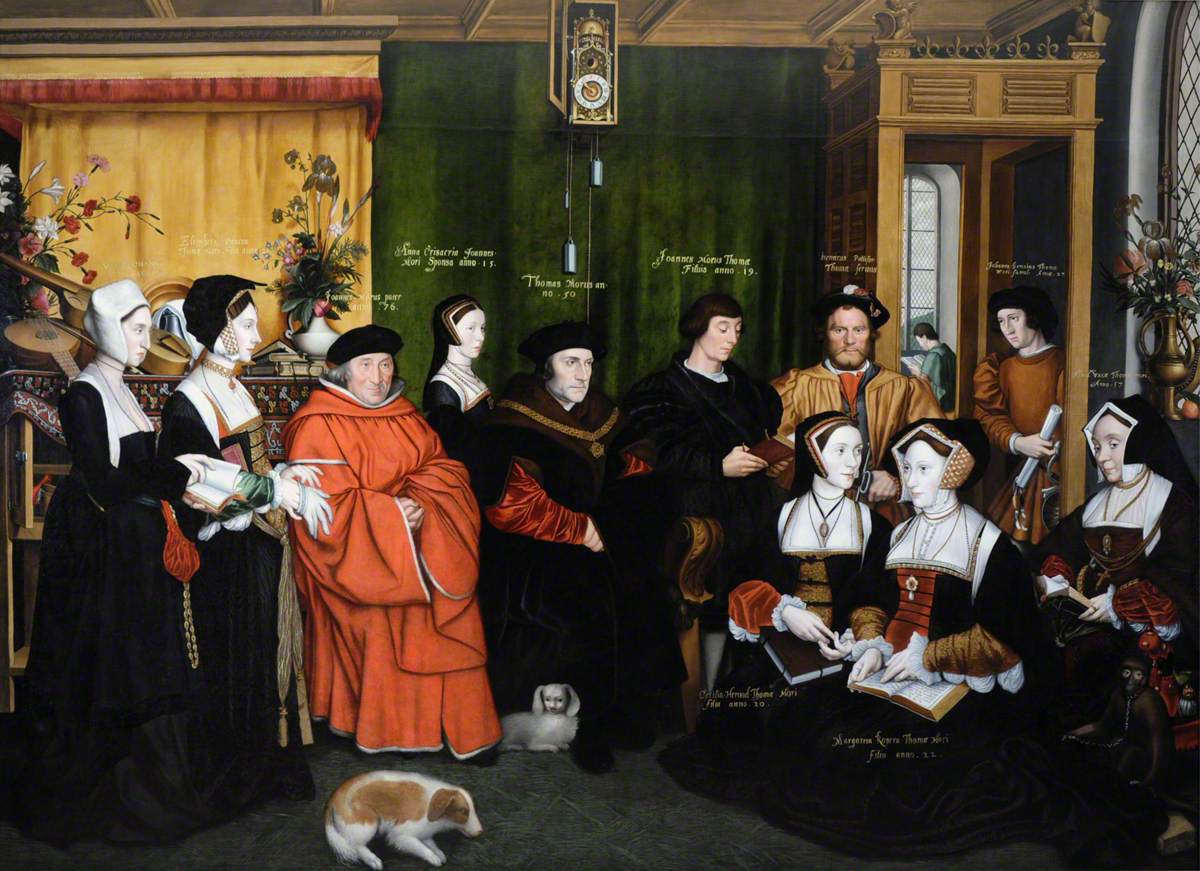
Draws Sir Thomas More, RCIN 912268, black and coloured chalks, 39.8 by 29.9 cm, the outlines pricked for transfer. Paints the single portrait of More now in the Frick, and begins the group portrait of the More family, which is lost.1
- 1527-1528
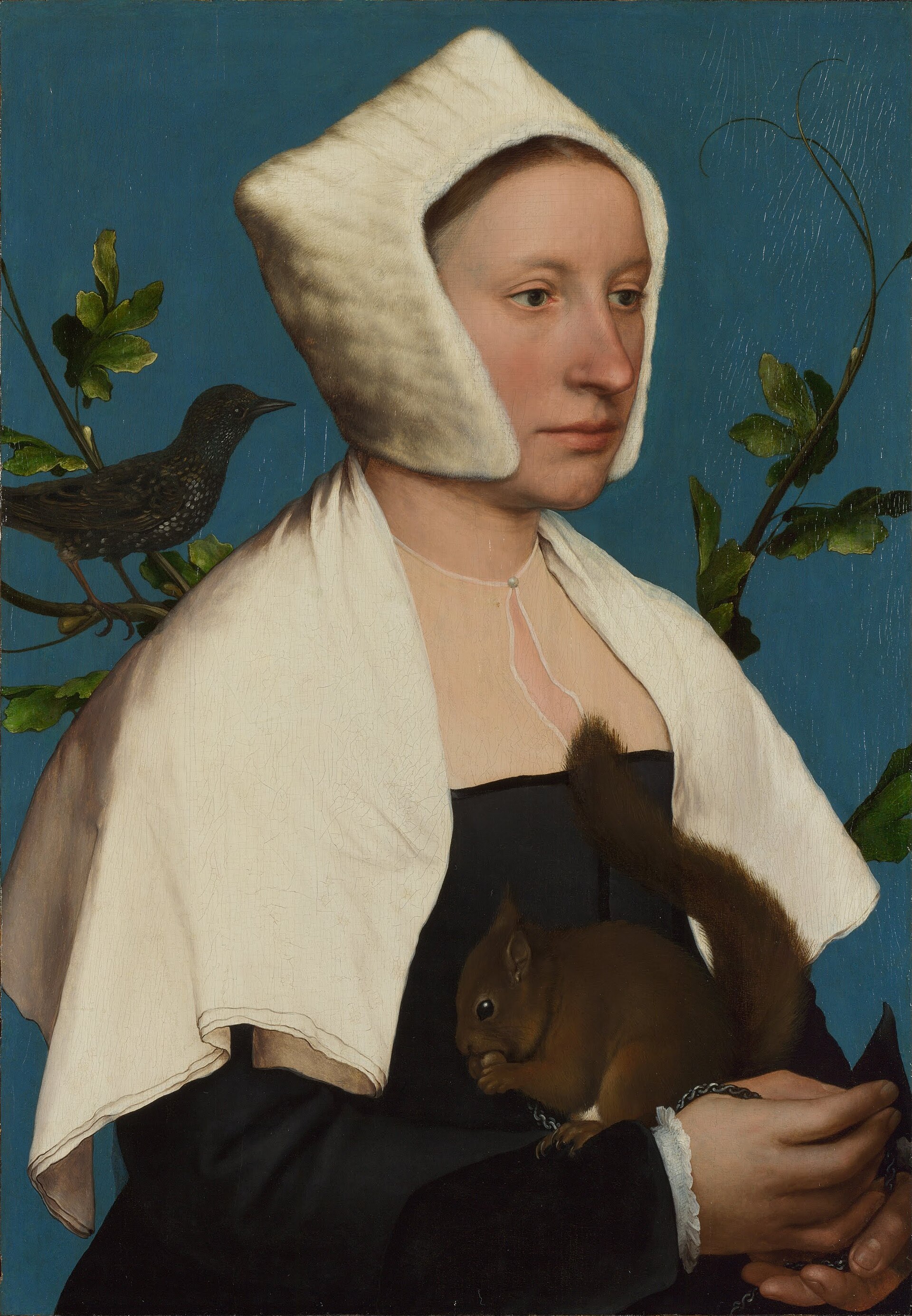
Paints A Lady with a Squirrel and a Starling, probably Anne Lovell, oil on wood, 56 by 38.8 cm, now National Gallery NG6540. The squirrel is Lovell heraldry and the starling a pun on East Harling.10
- 1528
Returns to Basel and in August buys a house in the St Johanns-Vorstadt.20
- 1529
Iconoclasm in Basel in April destroys religious images and with them the market for altarpieces in the city.20
- 1532
Returns to England for good, leaving his wife and four children in Basel. Works for the German merchants of the Steelyard; paints Georg Gisze.2021
- 1533
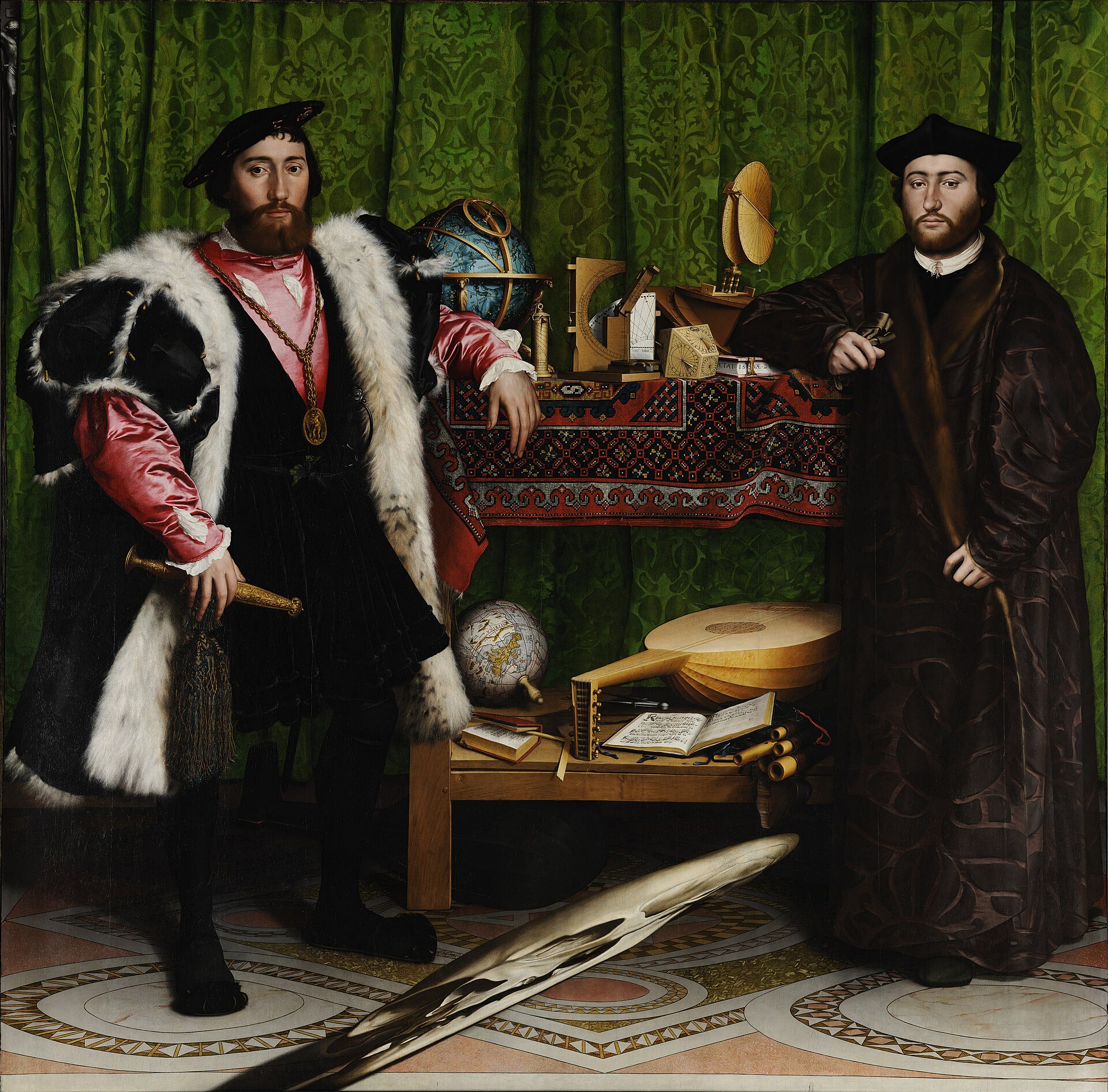
Paints Jean de Dinteville and Georges de Selve, The Ambassadors, oil on Baltic or Polish oak, 207 by 209.5 cm, signed and dated. Dinteville takes it back to France, probably in November, to the chateau of Polisy.9
- 1534
Begins working for Thomas Cromwell.20
- 1536
Appointed King's Painter at a salary of thirty pounds a year. Begins the Whitehall mural.620
- 1536-1537
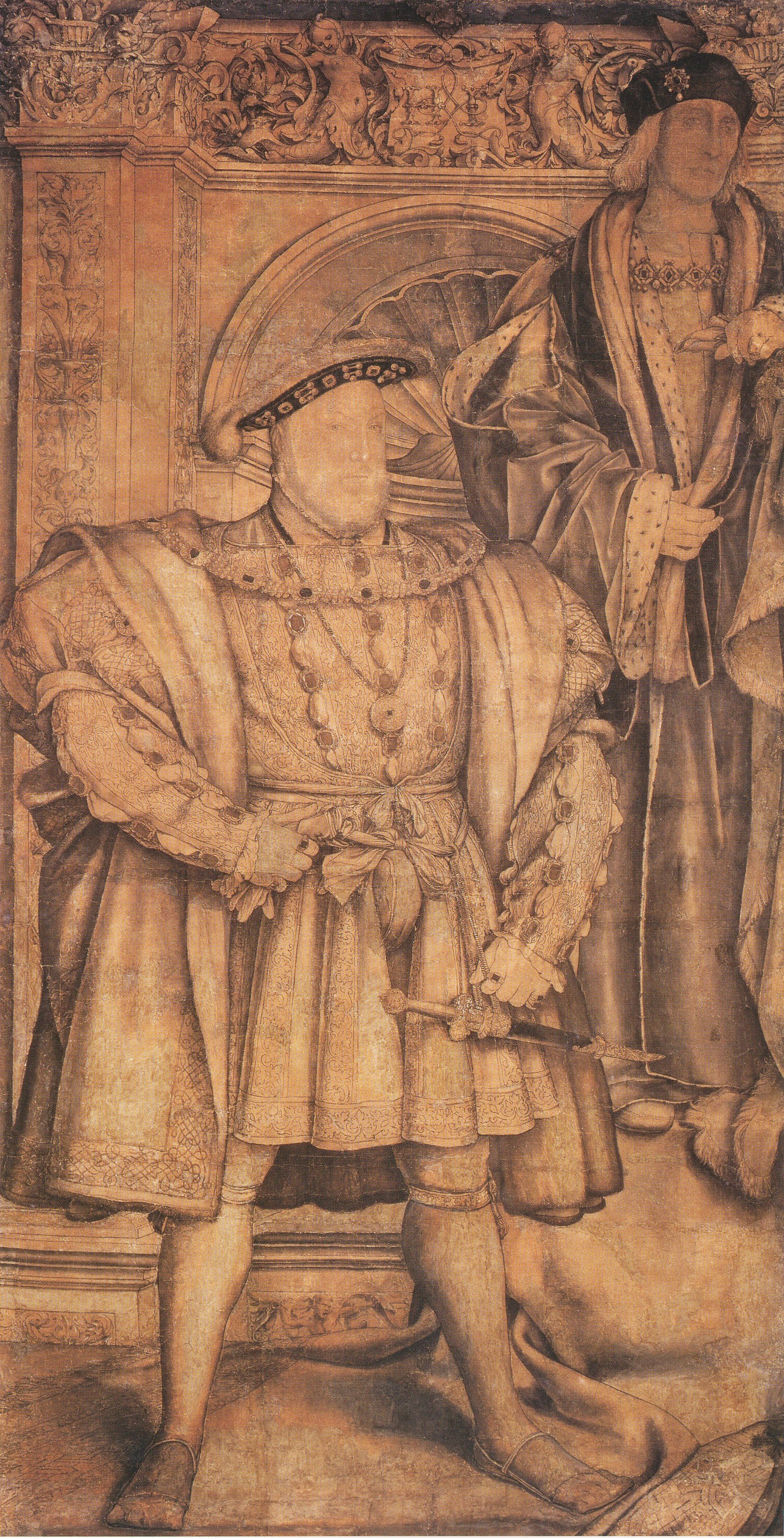
Makes the cartoon for the left-hand section of the Whitehall mural, ink and watercolour on joined sheets, 2578 by 1372 mm, exactly the size of the finished wall painting. He changes Henry's pose between cartoon and wall, turning the head to face the viewer.6
- 1537
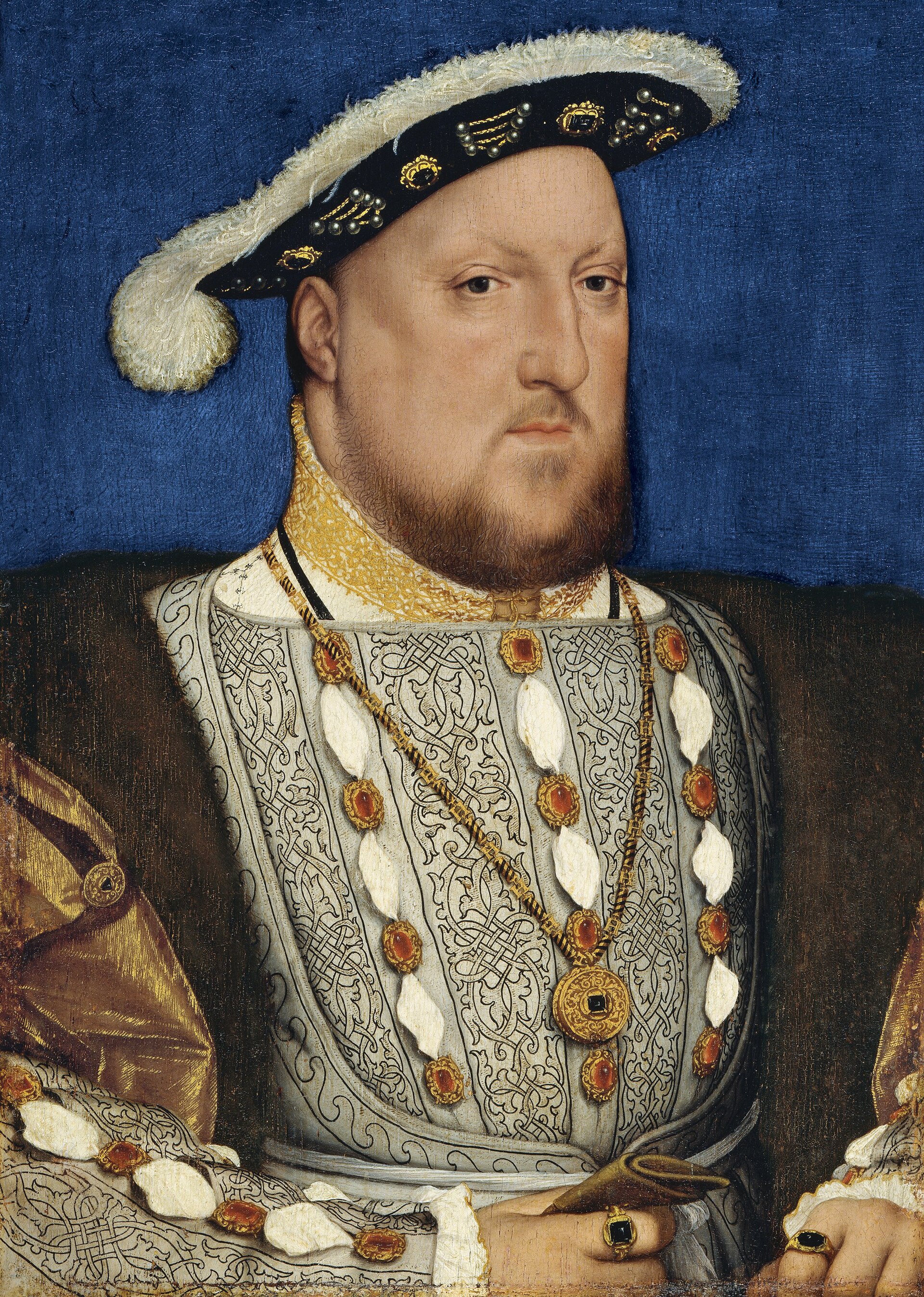
The Whitehall mural is completed. The Thyssen-Bornemisza panel, the only portrait of Henry VIII entirely secured to Holbein's hand, dates from about this year: oil on panel, 28 by 20 cm, inv. 191 / 1934.39.61330
- 1538
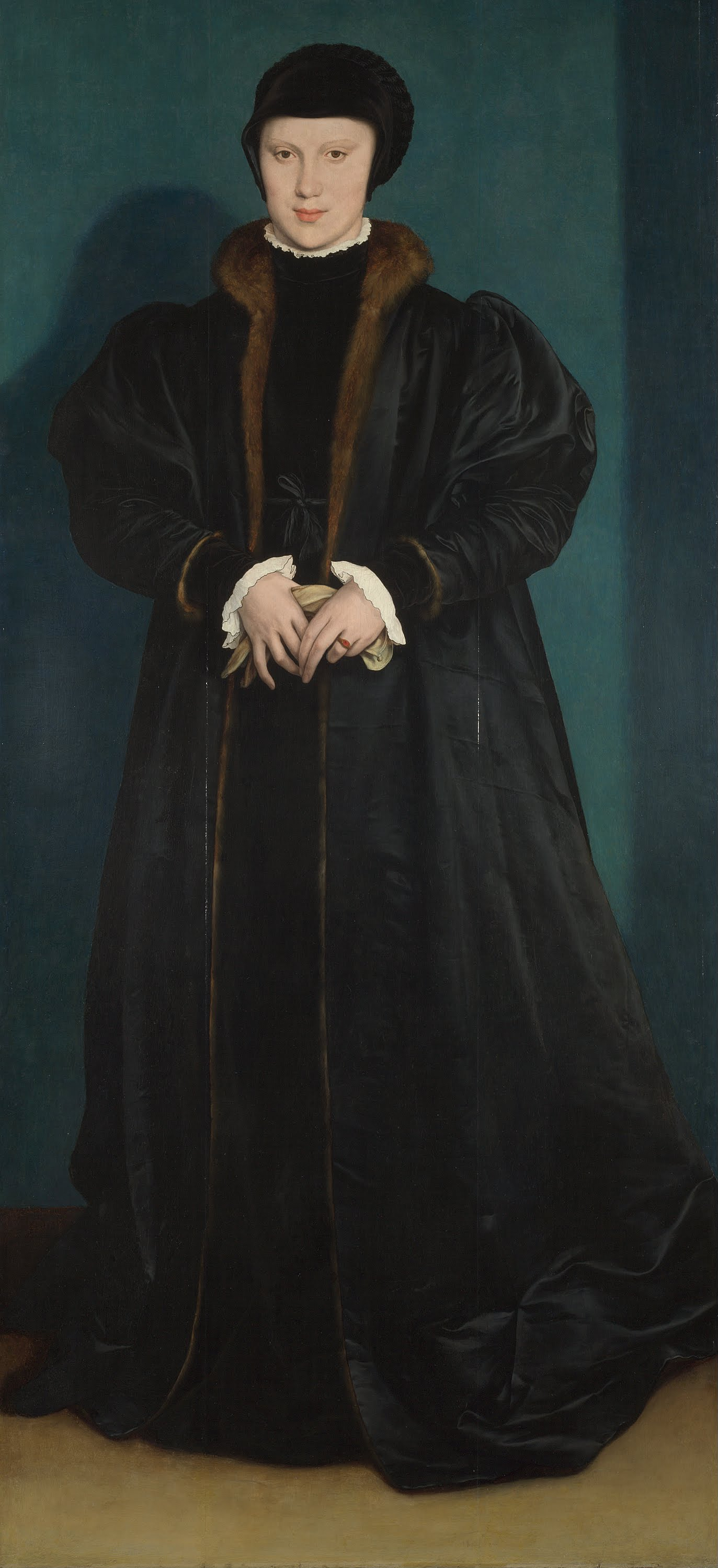
12 March: sits with Christina of Denmark at Brussels from one to four in the afternoon and makes the drawings for the full-length portrait. Henry VIII is reported in better humour than he ever was on receiving the image. The marriage negotiation fails; he keeps the picture until he dies.11
- 1538
The Dance of Death woodcuts are finally published at Lyon, more than a decade after they were designed and years after the block-cutter's death.20
- 1539
Paints Anne of Cleves at Burgau before her marriage, in oil and tempera on parchment, about 65 by 48 cm, now in the Louvre.2021
- 1542
The frontal half-length type with the gold-tipped staff, dated this year, is the last royal image to issue from his studio. Just over a dozen versions of it survive; only a few can be shown to have been painted before he died.13
- 1543
7 October: makes his will at Aldgate, describing himself as servant to the king's majesty, and provides for two infant children in England whose mother is not named. He is dead by 29 November, when John of Antwerp takes on the administration. The burial place is unknown.20
- 1547
The Windsor drawings are first documented, in an album owned by Edward VI. They leave and re-enter the Royal Collection twice before 1675, with losses and additions.1
- 1580
Henry FitzAlan, Earl of Arundel, bequeaths the album of drawings to John, Lord Lumley. Lumley's inventory of about 1590 describes the great book with the sitters' names subscribed by Sir John Cheke, and separately lists the Christina portrait by Haunce Hollbyn.1411
- 1591
Basilius Amerbach dies. His cabinet contains around fifty paintings, fifteen of them by Holbein, with a very large body of drawings and prints and a library of some nine thousand books.1819
- 1592
Rowland Lockey paints his version of the More family group at Nostell Priory, altering the composition and adding later members of the family. The Holbein original is lost.2131
- 1627-1628
Charles I exchanges the album of Holbein drawings with Philip Herbert, 4th Earl of Pembroke. Pembroke gives it to Thomas Howard, 14th Earl of Arundel. Charles II gets it back by 1675.1
- 1633
The dealer Christoph Le Blon acquires the Meyer Madonna, commissions Bartholomaus Sarburgh to copy it, and sells both under Holbein's name. The copy reaches Venice and then Dresden.17
- 1661
November: Amsterdam having offered 9,500 reichsthaler for the Amerbach Cabinet, the city of Basel and its university buy it for 9,000, the council paying two thirds and the university one third. It opens to the public in 1671 in the building zur Mucke.1819
- 1698
Whitehall Palace burns and the mural is destroyed. Remigius van Leemput's copy of 1667, RCIN 405750, becomes the only record of the whole composition.629
- 1727
Queen Caroline brings the Holbein drawings to light again in an album in a bureau at Kensington. George Vertue catalogues them in the 1720s and writes only that it is said Cheke wrote the names.426
- 1761
20 February: lot 75 in the Sir William Hamilton sale, A Woman with a Squirrel and a Starling, called Nurse to King Edward VI, sells for 47 pounds 5 shillings to the 3rd Earl of Cholmondeley. The sitter's name is wrong and stays wrong for another century and a half.10
- 1787
25 April: The Ambassadors is sold in Paris with the effects of the banker Nicolas Beaujon, described as two ambassadors, MM de Selve and d'Avaux. It is bought by the dealer Jean-Baptiste-Pierre Lebrun and sold on to England by 1792.9
- 1871
15 August to 15 October: the Holbein exhibition at the Dresden Gemaldegalerie shows the two Meyer Madonnas side by side, with more than 520 objects against 440 catalogue entries, loans from 38 cities and 58 collections, and 319 photographs. A three-day conference is held in front of the pictures.16
- 1871
5 September: the art historians' declaration finds the Darmstadt picture authentic but marred by later retouching, and the Dresden picture a loose copy. On 3 October a group of artists led by Ludwig Theodor Choulant, including the gallery's new director Julius Hubner, publishes the opposite in the Dresdner Anzeiger. Burckhardt and Grimm had voted for Dresden; Menzel for Darmstadt.16
- 1887
The Darmstadt picture is thoroughly restored. The overpaint that gave the Christ child a smile comes off, and the detail the whole dispute had turned on disappears from the object. It survives only in reproductions made before this date.16
- 1890
The 5th Earl of Radnor sells The Ambassadors to the National Gallery with two other pictures for 55,000 pounds, funded by a special government grant of 25,000 and gifts of 10,000 each from Charles Cotes, Lord Iveagh and Lord Rothschild.9
- 1906
Lionel Cust, Director of the National Portrait Gallery, observes that many of the identifications on the Windsor drawings remain open to question.4
- 1909
22 April: the 15th Duke of Norfolk tells the National Gallery he has an offer of 61,000 pounds for Christina of Denmark and gives them to 1 May to match it. Colnaghi buys it and offers it to Henry Clay Frick for 72,000. The National Art-Collections Fund buys it with an anonymous gift of 40,000 pounds, a Treasury grant of 10,000 and other contributions, and presents it to the Gallery.11
- 1910
Emil Major attributes the Dresden Madonna to Bartholomaus Sarburgh and dates it about 1635-1637, closing the Holbein dispute thirty-nine years after the Dresden congress. In the same year Lionel Cust publishes the Toledo picture as a portrait of Queen Catherine Howard in The Burlington Magazine.816
- 1925
Paul Ganz identifies and publishes the picture hanging at Cholmondeley Castle as a Holbein, in The Burlington Magazine.10
- 1945
K. T. Parker's catalogue of the Windsor drawings is published at Oxford and London. It remains the reference for the group.12
- 1957
The Whitehall cartoon is accepted in lieu of tax by H.M. Government and allocated to the National Portrait Gallery as NPG 4027.6
- 1974
22 November: Christie's London sells lot 152 as English School, circa 1550, overpainted and inscribed Henry 6. It is now published as Holbein's portrait of Sir Thomas Wyatt the Younger.12
- 1977
John Rowlands, deputy keeper of prints and drawings at the British Museum, challenges the traditional identification of his own museum's Anne Boleyn drawing in the British Museum Year Book, on the ground that its documentary record begins only in the seventeenth century.5
- 1981
David Starkey proposes in The Burlington Magazine that the Windsor drawing inscribed Ormond is James Butler and not Thomas Boleyn. Jane Roberts adopts the reading in the 1993 National Galleries of Scotland catalogue.5
- 1983
February: Rowlands and Starkey publish An Old Tradition Reasserted: Holbein's Portrait of Anne Boleyn in The Burlington Magazine, arguing for the Windsor sheet. Neither their article nor Rowlands's of 1977 prints the two rival drawings side by side.5
- 1985
John Rowlands publishes Holbein: The Paintings of Hans Holbein the Younger at Oxford, the standard catalogue. He lists the Wyatt tondo in neither the autograph nor the rejected works.12
- 1992
The National Gallery buys A Lady with a Squirrel and a Starling by private treaty sale from the 7th Marquess of Cholmondeley, with contributions from the National Heritage Memorial Fund, the Art Fund and J. Paul Getty Jnr. Apollo names it acquisition of the year.10
- 2006
Roy Strong publishes In search of Holbein's Thomas Wyatt the Younger in Apollo in March. Sotheby's London sells the picture as Hans Holbein the Younger in the Old Master Paintings sale L06031, lot 17.12
- 2007
The Royal Collection adopts the Windsor drawing as Anne Boleyn, thirty years after Rowlands first proposed it. Bendor Grosvenor notes the change as settled in December 2011.5
- 2011
July: the princely house of Hesse sells the Darmstadt Madonna privately to Reinhold Wurth. Neither party publishes a price. The Frankfurter Allgemeine Zeitung leads its front page of 14 July with the headline Germany's most expensive artwork. It had been on loan to the Stadel in Frankfurt since 2004.1623
- 2015
8 July: Sotheby's London sells the Castle Howard Henry VIII, as Workshop of Hans Holbein the Younger, for 965,000 pounds with premium against an estimate of 800,000 to 1,200,000. On 9 December it sells the ex-Warwick Castle version, also as workshop, for 821,000 pounds.131415
- 2021-2022
Holbein: Capturing Character opens at the Getty Center on 19 October 2021 and travels to the Morgan Library and Museum in February 2022, the first major presentation of Holbein in the United States.1024
- 2022
8 December: Christie's London sells a recently rediscovered portrait of Erasmus as Hans Holbein the Younger and Workshop, lot 3, for 1,122,000 pounds with premium against an estimate of 1,000,000 to 1,500,000. It is the highest published auction price for anything under the name.14
- 2023-2024
Holbein at the Tudor Court runs at The Queen's Gallery, Buckingham Palace, from 10 November 2023 to 14 April 2024.27
- 2024
Susan Foister's National Gallery Catalogues: The German Paintings before 1800 is published, with new provenance research on the Gallery's Holbeins. Michael Daley publishes ArtWatch UK's attack on the Anne Boleyn re-identification on 31 May.59
- 2026
24 March: Davies, Ugail and Stork publish a facial-recognition reassessment of the Boleyn drawings in npj Heritage Science, proposing that the unidentified RCIN 912190 is Anne Boleyn and that the inscribed RCIN 912189 may be her mother.4
The market
Holbein is the rarest of the very great names on the open market, and the reason is not fashion but distribution. The corpus went into public collections early: the drawings by inheritance from the studio to the crown in 1543, the Basel paintings by municipal purchase in 1661, the English pictures by museum acquisition between 1890 and 1992. What is left in private hands is largely in British and continental family collections where a sale abroad triggers an export licence application, and in practice the important pictures have moved by private treaty rather than through a saleroom.
The consequence is stated best by a dealer rather than by a house: no fully attributed painting by Holbein has appeared at auction. Every benchmark result carries a qualifier in the catalogue heading, and the qualifier is where the money is. Workshop of Hans Holbein the Younger has twice made between 800,000 and one million pounds. Hans Holbein the Younger and Workshop has made 1,122,000 pounds. The step from and workshop to nothing at all has never been tested in public.
All three modern results below are premium-inclusive prices published by the houses; none published a hammer separately, and the estimates quoted alongside them are on a hammer basis, so the two figures are not comparable and should never be set against each other as though they were. The historical prices are given in the currency of the sale, and no modern equivalents are offered, because the methods for calculating them differ by an order of magnitude and the choice of method decides the answer.
| Date | Sale | Work | Result | Note |
|---|---|---|---|---|
| 20 February 1761 | London, sale of Sir William Hamilton, lot 75 | A Woman with a Squirrel and a Starling, called Nurse to King Edward VI; now A Lady with a Squirrel and a Starling (Anne Lovell?), National Gallery NG6540 | Hammer GBP 47 5s With premium no buyer's premium existed GBP | Bought by George Cholmondeley, 3rd Earl of Cholmondeley, described in the sale record as Ld. Chomley. The picture was catalogued under a sitter identification that was wrong and was not recognised as a Holbein at all until Paul Ganz published it in 1925. Holbein's salary as King's Painter had been thirty pounds a year. |
| 8 July 2015 | Sotheby's, London, Old Master and British Paintings Evening Sale, lot 7 | Portrait of King Henry VIII, half-length in a red velvet surcoat holding a staff, inscribed H and dated 1542; oil with gold and silver on oak panel, 93 x 68 cm. Catalogued as Workshop of Hans Holbein the Younger | Hammer not published With premium GBP 965,000 GBP | From the collections of Castle Howard. Estimate GBP 800,000 to 1,200,000, quoted on a hammer basis. The published result is premium-inclusive and the house did not publish a separate hammer; the two figures are therefore not directly comparable. Bendor Grosvenor noted before the sale that the staff, unusual in a royal portrait, must relate to the ulcerated legs that at times left the king unable to walk. |
| 9 December 2015 | Sotheby's, London, lot 8 | Portrait of King Henry VIII, the same 1542 type; oil on oak panel, 91 x 64 cm. Catalogued as Workshop of Hans Holbein the Younger | Hammer not published With premium GBP 821,000 GBP | The version formerly at Warwick Castle, described by Sotheby's in 2019 as a high-quality version. Two panels of one composition, from two English houses, sold five months apart in the same city by the same house, at a spread of GBP 144,000 on the published totals. |
| 8 December 2022 | Christie's, London, Old Masters, lot 3 | Portrait of Erasmus, recently rediscovered. Catalogued as Hans Holbein the Younger and Workshop | Hammer not published With premium GBP 1,122,000 GBP | Estimate GBP 1,000,000 to 1,500,000 on a hammer basis. The highest published auction price for any picture under Holbein's name, and the attribution includes the word workshop. Shown at the Classic Week preview on 2 December 2022 alongside a Van Dyck estimated at GBP 2 to 4 million. |
Hammer is the price at which the bidding stopped; with premium adds the fee the house charges the buyer on top. Hammer price and buyer's premium in the glossary.
Recorded without a public price
- 1890 · The Ambassadors, 1533, oil on Baltic or Polish oak, 207 x 209.5 cm, NG1314, sold with two further pictures then attributed to Titian and Velazquez · Private sale to the National Gallery, London · not applicable GBP 55,000 for the three pictures together, paid to William Pleydell-Bouverie, 5th Earl of Radnor, and funded by a special government grant of GBP 25,000 with gifts of GBP 10,000 each from Charles Cotes, Lord Iveagh and Lord Rothschild. The other two pictures are now catalogued as Moroni (NG1316) and del Mazo (NG1315). No allocation of the 55,000 between the three is published.
- 22 April 1909 · Christina of Denmark, Duchess of Milan, 1538, oil on Baltic or Polish oak, 179.1 x 82.6 cm, National Gallery NG2475 · Private treaty, refused; then Colnaghi; then the National Art-Collections Fund · not applicable The 15th Duke of Norfolk reported an offer of GBP 61,000 and gave the trustees until 1 May to match it. They could not. Colnaghi bought it and offered it to Henry Clay Frick for GBP 72,000, allowing the Gallery until 1 June to match that. The National Art-Collections Fund bought it at the last minute with an anonymous donation of GBP 40,000, a Treasury grant of GBP 10,000 and other contributions, and presented it. The donor's identity was withheld at her own request and is not asserted here.
- 1992 · A Lady with a Squirrel and a Starling (Anne Lovell?), probably 1527-8, oil on wood, 56 x 38.8 cm, NG6540 · Private treaty sale to the National Gallery, London · not applicable Bought from the 7th Marquess of Cholmondeley with contributions from the National Heritage Memorial Fund, the Art Fund and Mr J. Paul Getty Jnr through the American Friends of the National Gallery. The price is not published by the Gallery. A private treaty sale to a British public collection carries tax relief shared between vendor and buyer, so any figure would in any case not be an open-market price. Apollo named it acquisition of the year.
- 2006 · Portrait of Sir Thomas Wyatt the Younger, circa 1539-1542, oil on panel, originally circular, let into another panel with made-up strips at left and right · Sotheby's, London, Old Master Paintings, L06031, lot 17 · not published The picture had sold at Christie's London on 22 November 1974, lot 152, as English School, circa 1550, overpainted and inscribed Henry 6. Strong accepted it as Holbein in 1980 and again in Apollo in 2006; Brinkmann published it as Holbein in 2005; Rowlands in 1985 placed it in neither his autograph nor his rejected list. No price is given on the Sotheby's lot page and none is asserted here.
- 2011-07 · The Madonna of Jakob Meyer zum Hasen, the Darmstadt Madonna, c. 1526-1528, oil on wood, 146.5 x 102 cm; Sammlung Wurth Inv. 14910 · Private sale, no auction · not applicable Sold by the princely house of Hesse to the industrialist Reinhold Wurth. Neither party published a price. The Frankfurter Allgemeine Zeitung of 14 July 2011 led its front page with the headline Deutschlands teuerstes Kunstwerk, Germany's most expensive artwork. The picture had been on loan to the Stadel in Frankfurt from 2004 and has hung since 2012 in the Johanniterkirche at Schwabisch Hall. Figures have circulated in the press; none could be traced to a source this record was able to fetch and none is repeated here.
Where to see the work
| Institution | City | Holdings | Note |
|---|---|---|---|
| Royal Collection Trust, Windsor Castle and The King's Gallery | Windsor and London | Eighty portrait drawings by the Royal Collection's own count, eighty-five by its object records; seven paintings and four miniatures. | In three cases - Sir Henry Guildford, William Reskimer and Elizabeth, Lady Audley - both the preparatory drawing and the finished painting are here, the only place the whole process can be followed on one object. The drawings are light-sensitive and shown in rotation; the last full presentation was Holbein at the Tudor Court, 10 November 2023 to 14 April 2024. |
| Kunstmuseum Basel | Basel | The largest collection of the Holbein family's work anywhere, descending from the Amerbach Cabinet bought by the city and university in 1661 and augmented by the Museum Faesch in 1823. | Includes The Body of the Dead Christ in the Tomb, the Bonifacius Amerbach portrait of 1519 and one of the three 1523 Erasmus portraits. The collection has been continuously public since 1671. |
| The National Gallery | London | The Ambassadors (NG1314), Christina of Denmark (NG2475), A Lady with a Squirrel and a Starling (NG6540). | The current catalogue is Susan Foister's German Paintings before 1800, 2024, and the Gallery publishes extracts of its provenance sections online. The Ambassadors and Christina hang in Room 4. |
| National Portrait Gallery | London | The Whitehall cartoon, NPG 4027, on display in Room 1 on Floor 3; NPG 1119 and a large body of after-Holbein material. | The Gallery associates 325 portraits in its collection with Holbein as artist or producer, which is a measure of how much Tudor portraiture is downstream of him rather than by him. |
| Museo Nacional Thyssen-Bornemisza | Madrid | Portrait of Henry VIII, inv. 191 / 1934.39, oil on panel, 28 by 20 cm, about 1537. | The only painted portrait of Henry VIII entirely secured to Holbein's hand. Formerly in the Spencer collection. |
| Musee du Louvre | Paris | Erasmus of 1523, Anne of Cleves of about 1539, and the portrait of Sir Henry Wyatt. | The Wyatt panel was redated by dendrochronology to no earlier than 1535, which moved it out of Holbein's first English visit and compressed his work for three generations of one family into about six years. |
| The Frick Collection | New York | Sir Thomas More, 1527, and Thomas Cromwell. | The two men hang in the same room. Their careers destroyed each other. |
| Johanniterkirche, Sammlung Wurth | Schwabisch Hall | The Darmstadt Madonna, Inv. 14910, on permanent display among the old masters of the Wurth Collection since 2012. | It hung at the Stadel in Frankfurt from 2004 until the 2011 sale. It is the only one of Holbein's major religious paintings in private ownership. |
| Gemaldegalerie Alte Meister, Staatliche Kunstsammlungen Dresden | Dresden | The Dresden Madonna, Gal.-Nr. 1892, Bartholomaus Sarburgh's copy after Holbein, dated about 1635-1637. | Hung for most of two centuries as the original, beside Raphael's Sistine Madonna, and celebrated as a major work of German art. It is the most consequential copy in the history of connoisseurship and is worth seeing as such. |
| Toledo Museum of Art | Toledo, Ohio | Portrait of a Lady, probably a Member of the Cromwell Family, about 1535-1540, oil on wood panel, 72.1 by 49.5 cm, 1926.57, gift of Edward Drummond Libbey. | Published in 1910 as Queen Catherine Howard and catalogued under that name for most of a century. Recorded as not on view at the time of writing. |
| Gemaldegalerie, Staatliche Museen zu Berlin | Berlin | Georg Gisze, 1532, oil and tempera on oak, 90.3 by 85.7 cm. | The best surviving picture of the Steelyard commissions, the German merchants who employed Holbein when he came back to England in 1532 and before the court did. |
| Nostell Priory, National Trust | Wakefield, West Yorkshire | Rowland Lockey's version of 1592 of the More family group, after Holbein, oil on canvas. | The Holbein original of 1527 is lost. Lockey's picture is not a faithful copy - it alters the composition and adds later members of the family - so the first great secular group portrait north of the Alps is known through a partly reinvented version painted sixty-five years later. |
Forgeries and misattributions
- The upgraded sitter, which is not forgery and does more damage
- The commonest falsification in the Holbein corpus is a name, not a hand. An anonymous Tudor gentlewoman is worth a fraction of a queen, and the difference was supplied for four centuries by dealers, owners and cataloguers. The Toledo picture was published as Catherine Howard in 1910 and is now a member of the Cromwell family; the National Portrait Gallery's version was bought as Catherine Howard in 1898; the National Gallery's Anne Lovell was sold in 1761 as the nurse of Edward VI; The Ambassadors was sold in Paris in 1787 as de Selve and d'Avaux. By demanding the source of the name. If the answer is an inscription on a drawing, ask which category of inscription and what the descent is. If the answer is a sixteenth-century inventory entry matched to a physical label on the object, as with the Lumley cartellino on Christina of Denmark, the identification is secure. Very little in between is.14891011
- The copy sold as the original: Sarburgh's Dresden Madonna
- In 1633 Christoph Le Blon bought the Meyer Madonna, had Bartholomaus Sarburgh copy it, and sold both under Holbein's name. The copy was bought for the Elector of Saxony in the eighteenth century and hung in Dresden as a masterpiece of German art beside Raphael's Sistine Madonna until 1871, and its attribution to Sarburgh was not established until Emil Major's article of 1910. First by comparison: the two were hung side by side in Dresden in 1871 and a three-day conference examined them in front of the window. Then by the objects: X-radiography and infrared show that the Darmstadt panel contains changes of mind matching Holbein's surviving chalk studies, while the Dresden picture reproduces only the final state. A copyist has nothing to revise. It took 277 years from the copy being made to the copyist being named.1617
- Late copies sold as lifetime workshop pictures
- The frontal Henry VIII type of 1542 exists in just over a dozen versions, made over a long period, and the market price depends entirely on whether a given panel was painted while Holbein was alive. The National Portrait Gallery's NPG 1119 is the clearest failure: bought in 1898 as a Holbein of Catherine Howard, it is a late seventeenth-century copy of a picture in Ohio, of a sitter who is probably somebody else. Dendrochronology on the oak. It gave a likely usage date from 1535 onwards for the panel Sotheby's exhibited in 2019, placing it with the ex-Castle Howard and ex-Warwick pictures among the few that can predate 1543, and it put NPG 1119 a century and a half too late.713
- Copies that fail on the invisible layer
- Two panel versions of the Wyatt tondo are of a quality that has fooled owners for centuries. Both are excluded not by connoisseurship of the surface but by what is under it. Infrared reflectography. Holbein's underdrawing is transferred from a finished preparatory drawing by tracing. The Fry version shows marked hatching, which Holbein never used, proving it was not made from a transferred design; the Romney version has linear underdrawing not of a type associated with him. A copyist reproduces the surface and invents the underdrawing, because he has never seen the original's.12
- Inscriptions added to make a picture sellable
- The Wyatt tondo surfaced in 1974 substantially overpainted and inscribed Henry 6. A cross-section of its background shows, from the back forward: a secondary oak panel, the veneer of the original panel, the original ground, Holbein's azurite blue, a dark brown film, and then several layers of predominantly blue overpaint. The picture had been shaved to a veneer, mounted in another panel, trimmed and made up with strips, repainted and relabelled. Paint cross-section and physical examination of the panel construction, plus the National Portrait Gallery's seventeenth-century copy, which records the picture after it had already been let into its curious secondary panel and therefore dates the mutilation.12
- The Anne Boleyn market, which runs on a name nobody can secure
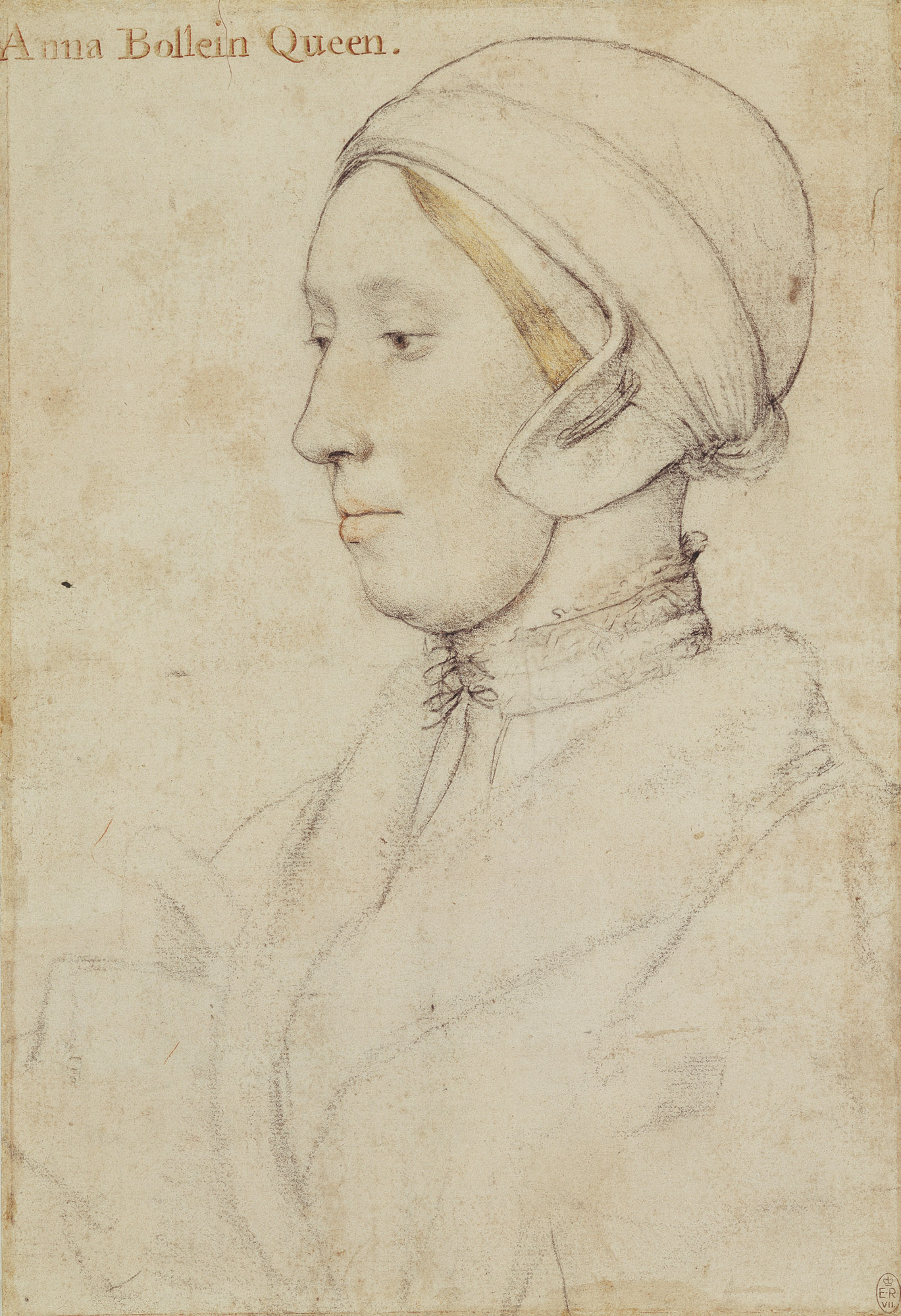
- Two Holbein drawings inscribed Anne Boleyn show different women, and both inscriptions descend from the same claimed authority. Paintings of Anne Boleyn produced in the later sixteenth century descend from the British Museum sheet; the Royal Collection sheet has no iconographic legacy at all. Anything sold as a portrait of Anne Boleyn is therefore sold on an identification that at least one serious scholar publicly rejects, whichever line it descends from. By reading the argument rather than the label. Rowlands 1977 and Rowlands and Starkey 1983 for the Windsor sheet; the Royal Collection's adoption in 2007; Michael Daley for ArtWatch UK in 2024 pointing out that strengthening Cheke as a witness strengthens both inscriptions equally; Roy Strong's separate suggestion that the Windsor sitter may be Jane Hawte, Lady Wyatt, on the strength of the Wyatt arms on the verso; and Davies, Ugail and Stork in 2026 proposing a fourth answer.451226
The essay
Chapter 1The names on the drawings are the weakest evidence in the corpus
Everything in Tudor portraiture leans on the Windsor drawings, and the Windsor drawings lean on a sentence in an inventory.
Everything in Tudor portraiture leans on the Windsor drawings, and the Windsor drawings lean on a sentence in an inventory. The 1590 inventory of John, 1st Baron Lumley describes a great book of drawings done by Hans Holbein of the lords and ladies and gentlemen and gentlewomen of King Henry VIII's court, their names subscribed by Sir John Cheke. Cheke was Edward VI's tutor. He was in a position to know who these people were. That single line is the whole authority for the traditional identifications.
It will not carry the weight put on it. The inventory names no sitter. It does not say how Cheke made the identifications, or when, or how many sheets were in the book when he saw it, and it does not describe the book closely enough to establish which of the drawings now at Windsor were in it. The word subscribed is itself ambiguous: it could mean names written on the sheets, names on their mounts, or entries in a separate list that no longer exists. None of those can now be checked.
The scepticism is not modern. George Vertue, who catalogued the drawings for Queen Caroline in the 1720s, wrote only that it is said Cheke wrote the names. Lionel Cust, then Director of the National Portrait Gallery, observed in 1906 that many of the identifications remain open to question. The 2026 study by Karen L. Davies, Hassan Ugail and David G. Stork in npj Heritage Science puts numbers on it. Across a corpus of eighty-one Holbein sketches in major collections, twelve, or 14.8 per cent, have contemporary documentary verification through a connection to a painted portrait or another record. Of the remaining sixty-nine, fifty-four rest on eighteenth-century or later inscriptions, thirteen are unidentified, and two are identified by external evidence without an inscription. Within the inscribed group the twenty-eight described in the literature as an eighteenth-century copy of a mid-sixteenth-century original cannot be distinguished, by any published method, from the twenty-nine acknowledged as plain eighteenth-century additions.
And the supposedly authoritative category contains demonstrable errors. The same study records five of those twenty-eight, 17.9 per cent, carrying transcription mistakes or misidentifications: Henry Howard repeatedly written as Thomas, James Butler filed under Ormond. A drawing inscribed Charles Wingfield Knight names a man who was never knighted; the Royal Collection sheet reads Winkfield and a copy of the same likeness in the Boijmans Van Beuningen in Rotterdam reads Winhfield. An inscription can be wrong about the spelling, wrong about the generation, and wrong about the person.
The practical consequence for anyone reading a Tudor provenance is blunt. An eighteenth-century name in ink at the top left of a chalk drawing is not evidence of who sat for it. It is evidence of what somebody in the 1720s believed, or was told, or inferred. Every serious identification in the Holbein corpus has had to be built from something else.
Chapter 2How a sitter is actually established
There are five kinds of evidence that carry weight, and they are worth separating because catalogues routinely blur them.The contemporary inventory label.
There are five kinds of evidence that carry weight, and they are worth separating because catalogues routinely blur them.
The contemporary inventory label. The strongest and rarest. The National Gallery's Christina of Denmark once bore the characteristic cartellino used on pictures in the collection of John, 1st Lord Lumley, and by that means alone it is securely identifiable with the entry in the Lumley inventory of about 1590: the Statuary of the Duches of Myllayne, afterwards Duches of Lorreyn daughter to Christierne King of Denmarke doone by Haunce Hollbyn. A physical label on the object matching a written inventory is as close to proof as sixteenth-century evidence gets, and it is why this picture is never argued about while others are.
Heraldry, badges and rebus. The National Gallery's A Lady with a Squirrel and a Starling was an anonymous sitter for four centuries. She is now called Anne Lovell because the squirrel and the starling are not pets but arms and a pun: squirrels nibbling nuts appear on the Lovell heraldry, and the church at East Harling in Norfolk, the estate the family had recently inherited, has two Lovell coats of arms in stained glass, each with six red squirrels; the starling puns on Harling. The National Gallery still prints the name with a question mark, which is the correct level of confidence. The same evidence can work in reverse: the National Portrait Gallery's tondo version of the Wyatt portrait, NPG 3331, bears the Wyatt coat of arms, and Sotheby's catalogue entry says plainly that this confirms the identity of the sitter.
The documented commission or embassy. Holbein is recorded taking Christina's likeness at Brussels for Henry VIII in 1538, and the sitting is timed: from one to four in the afternoon on 12 March. That fixes the picture to a person and a day. The same category covers the Steelyard merchants and the Basel town council work.
The surviving document about the object. The Ambassadors is the cleanest case. Three related seventeenth-century documents, one of them a fragment now in the National Gallery Archive dated 1653, name the sitters as Jean de Dinteville, seigneur de Polisy, and Georges de Selve, Bishop of Lavaur, give their offices and dates of death, say the two men met an excellent Dutch painter in England and employed him to make the picture, and record that it had been carefully preserved at Polisy until 1653. Without those papers the picture would still be catalogued as two anonymous Frenchmen, or under the names the 1787 Paris sale gave it, de Selve and d'Avaux.
Technical dating. Dendrochronology now decides who could possibly have painted a panel. It moved Holbein's portrait of Sir Henry Wyatt in the Louvre out of the first English visit, since the panel cannot have been painted before 1535. It condemned the National Portrait Gallery's NPG 1119 to the late seventeenth century. It supported the Sotheby's 2019 catalogue's argument that a Henry VIII panel with a likely usage date from 1535 onwards is one of the few that can have been made in Holbein's lifetime. The wood is often the only witness left.
Everything else, including likeness, is argument.
Chapter 3Cases where the name changed, and what changed it
Ormond becomes James Butler. A Windsor drawing inscribed Ormond was long taken to be Thomas Boleyn, Anne Boleyn's father, one of two rival claimants to the earldom of Ormond, although it was noticed...
Ormond becomes James Butler. A Windsor drawing inscribed Ormond was long taken to be Thomas Boleyn, Anne Boleyn's father, one of two rival claimants to the earldom of Ormond, although it was noticed that the sitter looked younger than fifty, which is what Thomas Boleyn was at the time of Holbein's first English visit. David Starkey proposed in The Burlington Magazine in 1981 that the sitter is instead James Butler, son of Piers Butler, the other claimant. Jane Roberts adopted the reading in the 1993 National Galleries of Scotland catalogue Holbein and the Court of Henry VIII, and it holds. This is what a good re-identification looks like: a historian who knows the family and the title reads the inscription as a title rather than a name and finds the other man entitled to it.
Catherine Howard becomes, probably, Elizabeth Seymour. The Toledo Museum of Art's three-quarter-length, oil on wood panel, 72.1 by 49.5 centimetres, object number 1926.57, the gift of Edward Drummond Libbey, was published as Queen Catherine Howard by Lionel Cust in The Burlington Magazine in July 1910. The museum now titles it Portrait of a Lady, probably a Member of the Cromwell Family and records the suggestion that she is Elizabeth Seymour, sister of Jane Seymour and wife of Thomas Cromwell's son Gregory. The National Portrait Gallery followed: its NPG 1119 is catalogued as Unknown woman, formerly known as Katherine Howard. The evidence that turned it is not a document but a costume and a jewel, and then, decisively, the wood. NPG 1119 was bought in 1898 as a Holbein of the fifth queen; technical analysis dated the panel to the late seventeenth century, and it is now catalogued as after Holbein. The sitter's gold medallion, showing Lot and his family fleeing Sodom, was designed by Holbein, and the drawing for it survives in the British Museum, so the picture behind it is genuinely Holbein's invention. The panel in front of you is not.
English School, circa 1550 becomes Holbein. On 22 November 1974 Christie's in London sold lot 152 as English School, circa 1550. It was substantially overpainted and carried the inscription Henry 6. The original tondo had at some point, on the evidence of the National Portrait Gallery's copy, in the seventeenth century or earlier, been shaved to a veneer and let into another panel, and trimmed at both sides, which were then made up with strips of wood about a centimetre on the left and two on the right. Roy Strong catalogued it as Holbein in 1980; Bodo Brinkmann published it as Holbein in the Stadel catalogue of 2005; Strong wrote it up again in Apollo in March 2006 as Holbein's portrait of Sir Thomas Wyatt the Younger. John Rowlands, in the standard 1985 catalogue of the paintings, referred to Strong's entry without comment and included the picture in neither his list of autograph works nor his list of rejected ones, which is a position, and worth recording as one. Sotheby's sold it in 2006 as Hans Holbein the Younger.
Anne Boleyn changes address, and the change is contested. Two Holbein drawings are inscribed as Anne Boleyn: one now in the British Museum, formerly called the Bradford drawing, and one in the Royal Collection, RCIN 912189, black and coloured chalks on pink prepared paper, 28.1 by 19.2 centimetres, with heraldic sketches on the reverse. They show different women. For most of five centuries the British Museum sheet was taken as the record of Anne's face; the later Anne Boleyn paintings and Wenceslaus Hollar's etching descend from it. In 1977 John Rowlands, then deputy keeper of prints and drawings at the British Museum, challenged that in the museum's own Year Book, on the ground that the documentary record for his museum's sheet begins only in the seventeenth century. In February 1983 he published with David Starkey in The Burlington Magazine under the title An Old Tradition Reasserted: Holbein's Portrait of Anne Boleyn, arguing for the Windsor sheet. The Royal Collection adopted the Windsor identification in 2007, and Bendor Grosvenor noted the change as settled on Art History News in December 2011.
Michael Daley, director of ArtWatch UK, attacked the whole sequence in May 2024 and the objection is a logical one rather than a stylistic one. Both drawings were inscribed on the authority of the same near-contemporary witness. If Cheke is made a more reliable identifier in order to strengthen the Windsor sheet, he becomes a more reliable identifier of the British Museum sheet at the same moment. Daley also notes that neither the 1977 nor the 1983 article printed the two drawings side by side, so the visual comparison on which the case ultimately rests was never actually put before the reader, and that no iconographic legacy of any kind descends from the Windsor sheet. The Royal Collection's own record for RCIN 912189 titles it as Queen Anne Boleyn with a question mark and notes that the verso carries a coat of arms of the Wyatt family, which is why Roy Strong suggested a third possibility: that the sitter is Jane, daughter of Sir William Hawte, who married Sir Thomas Wyatt the Younger in 1537. Three named scholars, three sitters, one sheet of paper.
And the married-name problem. A woman's name changes when she marries and the pictures do not. This publication holds a record whose canvas is filed on Wikimedia Commons under the sitter's married name, Baroness Elisabeth Bachofen-Echt, and in the catalogues under her maiden name, Elisabeth Lederer, for one sitter and one object. In the Tudor corpus the same mechanism operates in reverse and much more destructively, because the sitters are known by titles that moved between families and between generations: Ormond, Wiltshire, Suffolk. A title is not a person. It is an office that several people held.
Chapter 4The machine joins the argument
On 24 March 2026 npj Heritage Science published Reassessing Anne Boleyn and other Boleyn women in Holbein drawings using facial recognition, by Karen L.
On 24 March 2026 npj Heritage Science published Reassessing Anne Boleyn and other Boleyn women in Holbein drawings using facial recognition, by Karen L. Davies, Hassan Ugail and David G. Stork. It is the first attempt to put a number on a Holbein sitter identification, and it is worth reading carefully in both directions.
The method restricts biometric comparison to Holbein's life-drawn sketches, on the argument that a drawing made in front of the sitter carries less of the artist's stylistic mediation than a finished panel, and uses a deep learning model built on AdaFace embeddings. The finding is that RCIN 912190, catalogued as an unidentified woman, shows 76.9 per cent similarity to the authenticated portrait of the thirteen-year-old Elizabeth I by William Scrots, a level consistent with the documented mother and daughter pairs in the authors' validation set, while RCIN 912189, the traditionally inscribed Anne Boleyn, does not, and conflicts with the contemporary descriptions of Anne as dark-haired and slender. Their proposal is that RCIN 912190 is Anne Boleyn and that 912189 may be her mother, Elizabeth Howard, Countess of Wiltshire, on the model of the documented Henry Howard for Thomas Howard confusion elsewhere in the corpus.
The authors are careful about what the number means, and their caveats should be quoted rather than paraphrased: a similarity score of 76.9 per cent reflects relative proximity within the embedding space rather than probabilistic accuracy, with 100 per cent achievable only when a face is compared with itself; error rates are likely to be higher on portraits than on photographs; algorithmic similarity provides probabilistic guidance rather than proof, and no computational result can substitute for contemporaneous identification. They describe their own reattribution as provisional. The analysis code and similarity matrices are published in a public repository, which is more than most connoisseurship offers.
The objection a specialist will raise is the one the paper anticipates and answers only partly: whether the algorithm is measuring a face or measuring Holbein. If a single hand drew both sheets in the same medium at the same period, some part of any similarity score is the hand. The authors argue that chalk carries little of the artist's line-weighting, that documented relatives cluster high while unrelated sitters stay low, and that scores are not uniformly elevated across the corpus. That is a real argument, not a wave of the hand, and it is testable.
One discrepancy has to be recorded rather than resolved. The paper states that RCIN 912227 bears the eighteenth-century inscription Mother Iak and that the sitter has been definitively identified, through the More family group, as Margaret Giggs, More's adopted daughter. The Royal Collection Trust's own published material identifies RCIN 912227 as Mary Shelton, later Lady Heveningham, and reproduces it under that name in both its exhibition material and its conservators' article on the drawings. Two published sources give two different sitters for the same inventory number. This record does not arbitrate; it flags it, because a number that does not resolve to one person is precisely the failure mode this whole subject is about.
Chapter 5Eighty drawings, and the album that left the Royal Collection twice
The group at Windsor is the largest surviving body of preparatory portrait drawing by any Renaissance artist, and the count is not settled even inside one institution.
The group at Windsor is the largest surviving body of preparatory portrait drawing by any Renaissance artist, and the count is not settled even inside one institution. The Royal Collection Trust's collection story gives the core as a group of eighty drawings. The Royal Collection's own object record for the Sir Thomas More sheet says the bulk of the eighty-five portrait drawings now at Windsor were probably in Holbein's studio at his death. The 2026 study says approximately eighty-five surviving drawings and then analyses eighty-one across major collections. The variation is not carelessness; it reflects genuine disagreement about which sheets are autograph and which are early copies, and it is a useful reminder that even the base number in Holbein studies is a judgement.
The provenance is one of the best documented in European drawings and it is a lesson in how nearly the whole thing was lost. The sheets were in Holbein's studio when he died, passed to Henry VIII, and are first documented in 1547 in an album owned by Edward VI. From there: Henry FitzAlan, Earl of Arundel; bequeathed by him to John, Lord Lumley in 1580; probably bequeathed by Lumley to Henry, Prince of Wales in 1609 and so inherited by Prince Charles, later Charles I, in 1612; exchanged by Charles I with Philip Herbert, 4th Earl of Pembroke in 1627 or 1628; given by Pembroke to Thomas Howard, 14th Earl of Arundel; and acquired by Charles II by 1675. It left the Royal Collection and came back twice, with losses and additions along the way, before it was brought to light again in an album in a bureau at Kensington by Queen Caroline in 1727.
Two footnotes on that chain matter. The first is that a king traded the entire visual record of his grandfather's court away for a picture, which is the sort of transaction that makes a provenance record worth keeping. The second is a naming trap of the kind this subject produces endlessly: the Royal Collection calls the man who owned the album before Lumley the 12th Earl of Arundel, and the National Gallery, describing the same Henry FitzAlan in the provenance of Christina of Denmark, calls him the 19th Earl. Both are in use; the earldom of Arundel has been numbered two ways. Anyone matching one catalogue against another has to know that before concluding they are looking at two different men.
Alongside the drawings the Royal Collection holds seven paintings and four miniatures by Holbein, acquired in later centuries. In three cases, the portraits of Sir Henry Guildford, William Reskimer and Elizabeth, Lady Audley, it has both the preparatory drawing and the finished painting, which is the only place on earth where the whole of Holbein's portrait process can be followed on the same wall. About thirty of the drawings can be connected with surviving paintings. Nearly all the rest were studies for works that are gone.
Chapter 6What the drawings are made of
The Royal Collection's paper conservators Rachael Smith and Victoria Button published a study of the physical evidence in the drawings, and because there is almost no archival record of Holbein's...
The Royal Collection's paper conservators Rachael Smith and Victoria Button published a study of the physical evidence in the drawings, and because there is almost no archival record of Holbein's working practice it is the closest thing to a description of him at work.
He used good quality handmade paper, and many sheets carry watermarks that place the mills: mostly French, a few Swiss or German. The sheets were trimmed later, so their original size is unknown, but the position and orientation of the watermarks show that he drew some on whole sheets and many on halves and quarters, and occasionally extended a sheet by gluing on a strip. That is the habit of a man working fast and economically in someone else's house.
Sometimes he drew straight onto white paper. More often he prepared the sheet in advance by painting one side with a pink coating and letting it dry, which saved time in front of the sitter and gave him a mid-tone he could model both up and down, in white highlights as well as shadow, in a manner closer to the painting that might follow. The pinks vary from sheet to sheet, probably to suit the sitter's colouring. Analysis has found the same four components recurring: white chalk, red vermilion, yellow ochre and lamp black, probably bound in animal glue mixed with warm water. Reconstruction shows how wide a range of pinks those four will give.
The likeness went down in chalk, black for the structure, red for the eyes and lips, with brown and yellow and white for the rest. Chalk responds to pressure, so a tentative line could be laid in lightly and then confirmed with a heavier one, and it can be smudged with a finger or a stump of coiled paper, leather or cloth, which is how the modelling in the faces was softened. Occasionally he wet the drawn line with a brush and water to spread it. He then finished with watercolour, which gave him colours chalk does not have in the earth: blue and green eyes are watercolour, bound in gum arabic. Lead white, brighter and stronger than white chalk, appears in a small number of drawings, mostly of women, in flesh highlights and the whites of eyes. A saturated carbon black made from soot deepens the shadows and reinforces the outlines, and the outline is the part most likely to be transferred to a panel, which tells you what he thought he was making.
The clothes are where his mind shows. The faces are worked; the costume is often roughly indicated, because Holbein was not drawing a coat, he was making a note about a coat. He recorded a few centimetres of a repeating pattern, enough to reconstruct the rest, drew unique jewels carefully and sometimes enlarged them in the margin, and wrote the fabric down instead of drawing it. On the sheet of William Parr, RCIN 912231, the word on the shoulder is burpor felbet, which is purple velvet spelled by ear. That is a working document, not a work of art, and the fact that it is now one of the most beautiful things in the Royal Collection is an accident of what survived.
Chapter 7From drawing to panel, and how a copy gives itself away
Holbein did not redraw his composition on the panel.
Holbein did not redraw his composition on the panel. He transferred it, and the two methods he used leave different traces, both of which are now diagnostic.
For the small panels, the National Gallery describes the mechanism used for the Anne Lovell portrait: a sheet of paper covered in charcoal was laid face down on the panel, the drawing was placed over it, and pressure along the outlines pushed the contours down in charcoal. He painted over those lines. Occasional departures are visible, and in the Anne Lovell he seems only to have moved the fur cap and altered the hairline. This is the reason his portraits look drawn: they are.
For the wall he used pouncing. The National Portrait Gallery's cartoon for the Whitehall mural, NPG 4027, ink and watercolour on several joined sheets with the faces of the two kings cut out and pasted onto the backing, is exactly the same size as the finished painting. The Gallery's own labels set out both accounts: that the cartoon itself was pricked along the main outlines, fixed to the wall, and charcoal dust brushed through the holes; and that, given how good its condition is, it more likely stayed in the studio as the record while a second cartoon was pricked through from it and pounced onto the wall. Either way the mechanism is the same and the vocabulary is worth having straight, because catalogues use pricking and pouncing loosely. Pricking makes the holes. Pouncing pushes the powder through them. Holbein's own drawing of Sir Thomas More, RCIN 912268, black and coloured chalks, 39.8 by 29.9 centimetres, is described by the Royal Collection as pricked for transfer, so the holes are there to be looked at.
The forensic pay-off is what happens when somebody else copies a Holbein. Infrared reflectography of the Wyatt tondo revealed extensive underdrawing which was not drawn freehand but, as Sotheby's catalogue puts it, as was Holbein's usual practice, transferred from a finished preparatory drawing by means of tracing. The same technique applied to the two other panel versions of the same head separates them decisively. The Fry version shows marked hatching, a technique Holbein never used, which makes it clear the picture was not based on a transferred design at all. The Romney version has more linear underdrawing but not of a type associated with Holbein. Two pictures that look like Holbeins under normal light are excluded under infrared, not on quality but on procedure.
That is how after Holbein is decided in practice. Not by taste. By the invisible layer: is there a traced contour under the paint, is the panel old enough, and does the design descend from a surviving drawing or from another painting.
Chapter 8Henry VIII: one autograph panel, a wall that burned, a dozen versions
The most reproduced image of any English monarch survives in no autograph full-length at all.
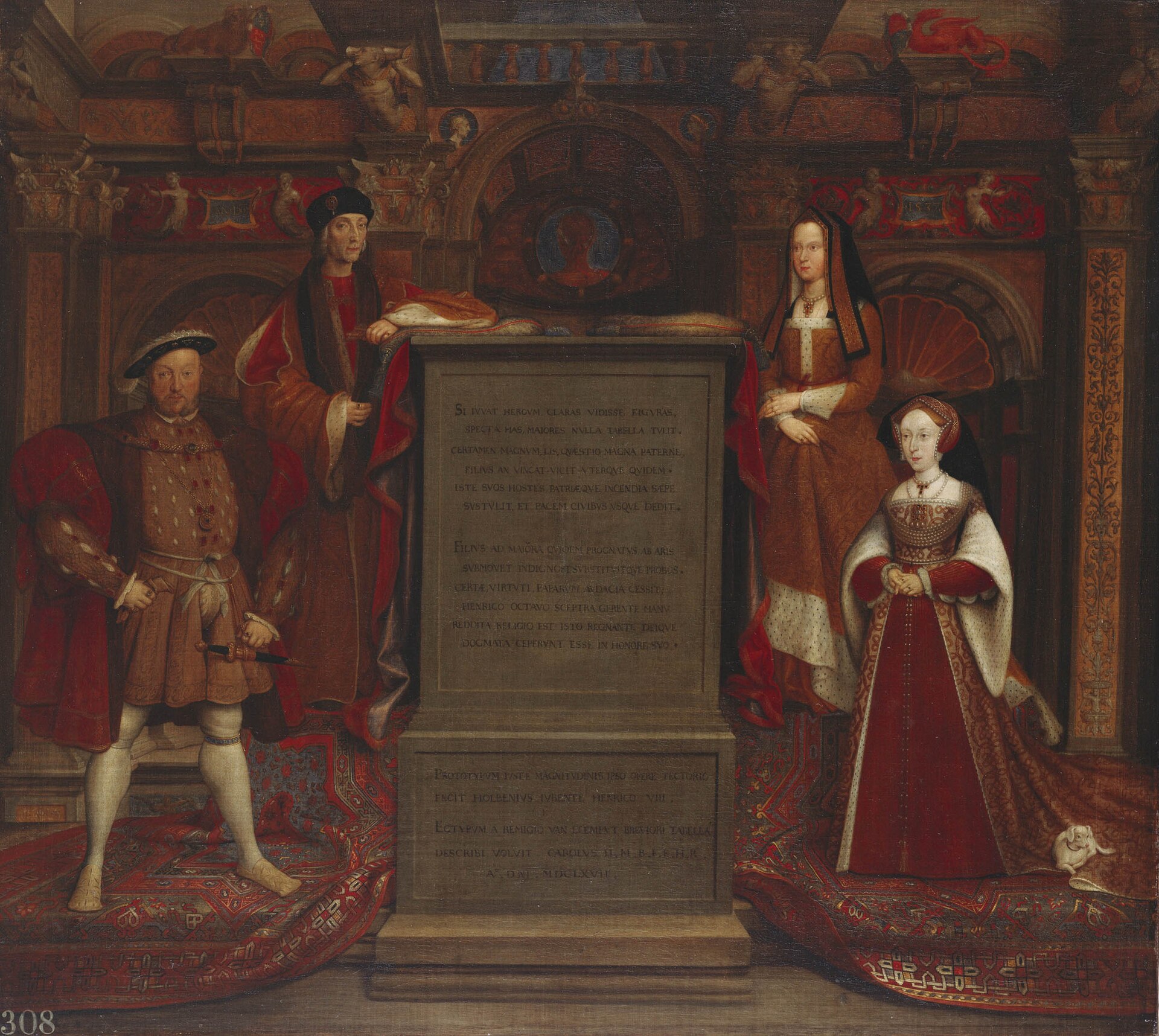
The most reproduced image of any English monarch survives in no autograph full-length at all. Holbein painted the dynastic group in the privy chamber at Whitehall Palace in 1536 to 1537: Henry VIII with his third wife Jane Seymour and his parents Henry VII and Elizabeth of York, arranged around a marble plinth. The immediate occasion may have been the birth, or the expected birth, of Edward in October 1537. Whitehall Palace burned in 1698 and the mural went with it.
What is left is a chain of substitutes, and knowing which is which is the whole of the subject.
The cartoon for the left-hand section, showing the two kings, is National Portrait Gallery NPG 4027: ink and watercolour, circa 1536 to 1537, 2578 by 1372 millimetres. The cartoon for the right-hand section, with the two queens, is lost. Holbein changed his mind between the cartoon and the wall, turning Henry's head to face the viewer directly with a more confrontational gaze, so the cartoon does not record the finished image; it records the stage before the decision that made the image famous.
The whole composition is known from a copy of 1667 by Remigius van Leemput in the Royal Collection, RCIN 405750. Every reconstruction of the mural in every textbook descends from that canvas. It is a seventeenth-century Fleming's record of a lost English wall painting by a German, and it is the only witness.
Of the panel portraits, the Thyssen-Bornemisza in Madrid holds the one that is, in the words of Sotheby's 2019 catalogue entry, the only one of the versions entirely secured to the hand of Holbein: Portrait of Henry VIII, inventory number 191, also cited as 1934.39, oil on panel, 28 by 20 centimetres, dated about 1536 or 1537. It is small. The picture that made Henry's face is the size of a sheet of paper.
Then there is the second type, the frontal half-length with the gold-tipped staff, dated 1542, the last royal image to come out of Holbein's studio. Bendor Grosvenor, writing in The Art Newspaper before the Castle Howard example came up in 2015, made the point that gives the type its meaning: the head is the same mask used for the mural, reused in the workshop from Holbein's life drawing, but the posture is not, because of the staff. A king in a state portrait is meant to be an image of health. This one is leaning on something, and the reason is the ulcerated legs that at times left Henry unable to walk. The propaganda image contains the medical record.
Sotheby's counted the survivors of that type in 2019: just over a dozen extant versions, most of them probably painted during or very shortly after the king's lifetime, of which, in the present state of research, only a few can be shown to have been painted while Holbein was alive. The named examples are the ex-Castle Howard picture sold in 2015, a high-quality version formerly at Warwick Castle sold later the same year, one at Rothesay in the collection of the Marquess of Bute, and then examples at Knole, Melbury House, the National Portrait Gallery, the University of Cambridge, the Bethlem Royal Hospital in London, the Moores Foundation at Compton Verney and Seaton Delaval, a canvas dated 1544 but probably later at St Bartholomew's Hospital, and a reduced head-and-shoulders at Chatsworth. Dendrochronology on the Chatsworth-exhibited panel gave a likely usage date from 1535 onwards, which places it with the ex-Howard and ex-Warwick pictures among the small group that can have been made before Holbein died in 1543.
Holbein's own drawing from life for the frontal head is lost. What survives closest to it is a copy in the Staatliche Graphische Sammlung in Munich, inventory 12875 Z, inscribed with the name Hans Swarttung, who may have been one of the artist's assistants. The most famous face in English history reaches us through a copy of a lost drawing, a burned wall, a Fleming's canvas of 1667 and a dozen workshop panels, and the only panel everyone accepts is twenty-eight centimetres high.
Chapter 9The cartoon and the tax bill
NPG 4027 entered the National Portrait Gallery in 1957, and the acquisition credit is one line long and worth reading twice: Accepted in lieu of tax by H.M.
NPG 4027 entered the National Portrait Gallery in 1957, and the acquisition credit is one line long and worth reading twice: Accepted in lieu of tax by H.M. Government and allocated to the Gallery, 1957.
Acceptance in Lieu is not a purchase and the sum involved is not a market price. An owner facing an inheritance tax charge offers an object; if it is accepted, the tax liability is extinguished at an agreed valuation and the object is allocated to a public collection. The state pays nothing in cash and forgoes revenue instead; the owner realises a value that is calculated, not bid. Any attempt to read a Holbein market from museum acquisitions has to strip this mechanism out first, and it recurs across the corpus. A Lady with a Squirrel and a Starling came to the National Gallery in 1992 by private treaty sale from the 7th Marquess of Cholmondeley, bought with contributions from the National Heritage Memorial Fund, the Art Fund and Mr J. Paul Getty Jnr through the American Friends of the National Gallery. A private treaty sale to a British public collection carries its own tax relief, the douceur, split between vendor and buyer, so the figure paid is again not the open-market figure.
The single most important image of the Tudor monarchy in Britain arrived as a tax settlement. That is not a footnote about administration. It is the reason the picture is in London rather than New York, and the same mechanism, twenty years earlier or with a less willing owner, would have produced the opposite result.
Chapter 10Basel: fifteen Holbeins in a lawyer's cabinet
Basel holds what it holds because two law professors bought the contents of a studio and because a city refused to let it leave.Holbein reached Basel by 1515 as a journeyman, joined the painters'...
Basel holds what it holds because two law professors bought the contents of a studio and because a city refused to let it leave.
Holbein reached Basel by 1515 as a journeyman, joined the painters' guild and took citizenship in 1519, and painted Bonifacius Amerbach's portrait that same year. Amerbach was the son of a great printer and a friend of Erasmus, and he and later his son Basilius bought Holbein steadily, the son acquiring heavily in the late 1570s. When Basilius Amerbach died in 1591 the cabinet contained around fifty paintings, fifteen of them by Hans Holbein the Younger, together with an extraordinarily large body of drawings and prints, coins and medals, natural history and ethnographic material, the family's letters, and a library of some nine thousand books.
In 1661 Amsterdam offered 9,500 reichsthaler for the whole thing. Professors at the University of Basel intervened; the mayor, Johann Rudolf Wettstein, and the Grand Council agreed; and in November 1661 the cabinet was bought for 9,000 reichsthaler, the council paying two thirds and the university, which took custody of the collection and its library, raising the remainder. Basel paid five hundred reichsthaler less than the foreign bid and kept the collection.
It was installed in the building known as zur Mucke by the Munsterplatz and opened to the public in 1671, at first on Thursday afternoons and later twice a week. By 1769 the paintings had their own hall. On that sequence rests Basel's claim, which the museum makes in its own words, that it holds the world's oldest public art collection, and that the city was the first to own one, long before the residents of other European cities were let into their rulers' galleries.
The rest of the institutional history is worth having because it explains why a Holbein is where it is. In 1823 the Amerbach collection was merged with the Museum Faesch, assembled by the jurist Remigius Faesch, which brought further Holbeins and a large body of Upper Rhenish painting. In 1833 the partition of the canton of Basel into two half-cantons put the university's property at risk; the collection was ceded to the city for a one-off payment of 22,000 Swiss francs, assessed as its value, which kept it whole. It moved to Melchior Berri's building on the Augustinergasse in 1849 and to the purpose-built Hauptbau on St Alban-Graben in 1936.
What that chain preserved includes The Body of the Dead Christ in the Tomb, oil and tempera on limewood, about 30.5 by 200 centimetres, dated 1521 or 1522, commissioned by Bonifacius Amerbach and catalogued in the Amerbach Cabinet as a picture of a dead man by H. Holbein with the title Iesus Nazarenus rex. It is the most extreme religious painting of the northern Renaissance: a corpse at eye level in a stone slot, at life size, with no resurrection in the picture. Its original function is not established. It has been argued as the predella of an altarpiece, as an independent devotional panel, and as the lid of a Holy Sepulchre used in Easter week, and the choice between them changes what the picture means. Dostoevsky saw it in Basel in 1867 and his wife had to pull him away from it; he said a man could lose his faith looking at a painting like that, and put it into The Idiot two years later, where a character says the same thing at greater length. A picture whose liturgical purpose we cannot establish became, three centuries on, the standard European image of doubt.
Chapter 11The Reformation took his market
Holbein's career divides at a religious revolution and the division is economic before it is anything else.His Basel work up to the late 1520s is what a successful Catholic city commissioned...
Holbein's career divides at a religious revolution and the division is economic before it is anything else.
His Basel work up to the late 1520s is what a successful Catholic city commissioned: altarpieces, a Madonna for a burgomaster, murals for the council chamber of the town hall, designs for stained glass and for goldsmiths, and a great deal of book illustration for the Basel printers, Erasmus's publisher Johann Froben among them. He married Elsbeth Binzenstock in 1519 and had four children by her. He bought a house in the St Johanns-Vorstadt in August 1528 and a second next door in 1531.
In 1526 he went to England for the first time carrying a letter of introduction from Erasmus to Sir Thomas More. The two had been correspondents for years within an international circle of humanists that included Archbishop William Warham, and Holbein's 1523 portrait of Erasmus had been sent to Warham as a gift, so his abilities were known in London before he arrived. He probably lodged in More's house at Chelsea throughout that first stay, because guild rules obliged foreign craftsmen to live and work outside the City. His major work of those two years was the group portrait of More's family, and it is lost. It survives as a preparatory drawing in Basel and in painted copies, of which the best known is Rowland Lockey's version of 1592 at Nostell Priory, which alters the composition and adds later members of the family. The first great secular group portrait north of the Alps exists only as somebody else's picture of it.
He returned to Basel in 1528. In April 1529 the city's iconoclasm destroyed religious images, and the market for altarpieces in Basel ended. When he came back to England in early 1532 he did not go back to More, who by then was on his way to the scaffold, but to the German merchants of the Steelyard and then to the circles around Anne Boleyn and Thomas Cromwell. By 1536 he was King's Painter, on a salary of thirty pounds a year, which for perspective is roughly two thirds of what a single portrait from his hand fetched at a London auction two centuries later.
The moral is not that he was a trimmer. It is that his subject matter was set by what could legally be commissioned. A painter who made Madonnas for a Catholic burgomaster in 1526 was making portraits of the men dissolving the English monasteries in 1536 because the first market had been abolished and the second had opened. The Dance of Death designs he made in Basel in the 1520s, cut by Hans Lutzelburger, sat unpublished for years after the cutter's death and finally appeared at Lyon in 1538, by which time their satire of pope, cardinal, bishop and abbot read as Reformation polemic in a way it had not necessarily been meant to when it was drawn.
Chapter 12The Darmstadt Madonna, the Dresden copy, and the invention of connoisseurship
The best documented attribution fight in the history of European painting was about two versions of one Holbein, and it is the reason art history exists as a discipline with a method.The picture is...
The best documented attribution fight in the history of European painting was about two versions of one Holbein, and it is the reason art history exists as a discipline with a method.
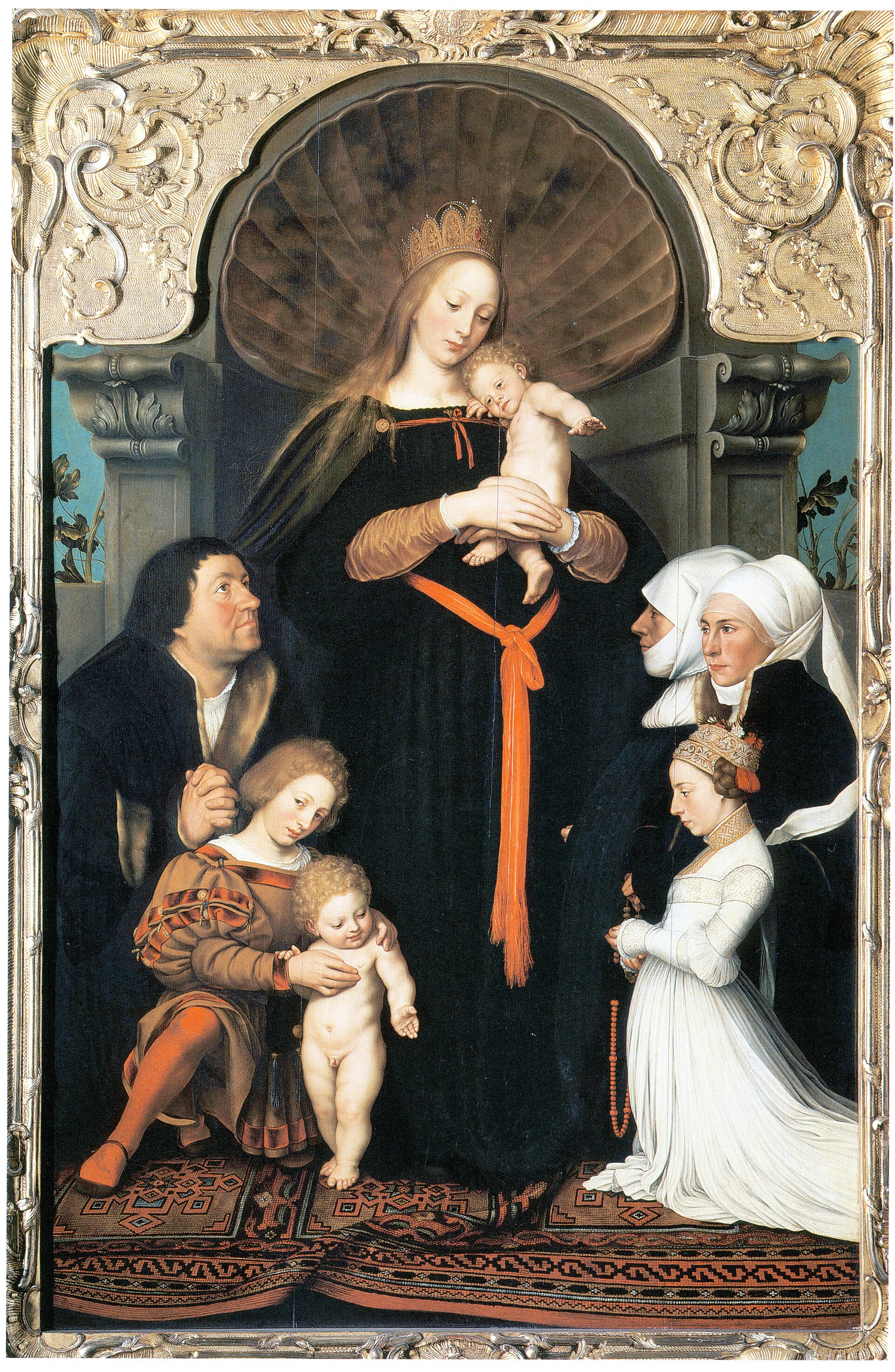
The picture is the Madonna of Jakob Meyer zum Hasen, painted in Basel about 1526 to 1528: the burgomaster who had commissioned Holbein's earliest surviving portrait kneels with his household under the mantle of a standing Virgin. The composition is the Madonna of Mercy, in which the Virgin shelters her petitioners under her cloak, and the family group inside it is not straightforwardly a family. Meyer's first wife, already dead when the picture was painted, kneels beside his second. There are two male children whose identity is disputed and who may be Meyer's two dead sons. This is a picture in which the living and the dead kneel together and are given the same treatment, which is what a votive image of this type was for: it is an intercession, commissioned by a man who believed it would work, and it should be described as that rather than as a family portrait with religious trimmings.
In 1633 the Huguenot dealer Christoph Le Blon acquired the original. Before reselling it he commissioned the painter Bartholomaus Sarburgh to make a copy, and marketed both under Holbein's name. The copy reached Venice and was bought in the eighteenth century for the collection of the Elector Friedrich August II of Saxony, where it hung in Dresden beside Raphael's Sistine Madonna as a major work of German art. The original resurfaced in 1821, went to Berlin in 1822 into the collection of Prince Wilhelm of Prussia, and ended in Darmstadt in private hands, where it remained throughout the dispute.
For decades scholars travelled between Dresden and Darmstadt and compared the two from memory. In 1871 they were hung side by side. The Holbein exhibition at the Dresden Gemaldegalerie ran from 15 August to 15 October 1871; the catalogue, edited by Albert von Zahn, listed 440 entries but more than 520 objects were shown, with loans from thirty-eight cities and fifty-eight collections and museums, alongside 319 photographs and photographic reproductions, and a group of drawings wrongly attributed to Holbein deliberately included for comparison. Francis Haskell called it the first time old masters were transported across frontiers in order to be exhibited. The exhibition was organised jointly by artists and art historians: Julius Schnorr von Carolsfeld and Jakob Felsing as directors, with a committee stacked on purpose with advocates of both pictures, among them Julius Hubner, Hermann Hettner, Ludwig Gruner, Edouard His, Adolf Bayersdorfer, Carl Schnaase, Alfred Woltmann, Rudolf Eitelberger, Friedrich Lippmann and Julius Dielitz.
The two pictures hung side by side, Dresden on the left and Darmstadt on the right, mounted on hinges so that each could be angled toward the window. A three-day conference was held in front of them, inside the exhibition halls, with the participants given access from eight to ten in the morning before the public was admitted at ten. Cases were opened, magnifying glasses used, photographs and drawings held up against the paintings, chairs and step-stools brought in. It was the first art-historical conference to arise from an exhibition and to be conducted in front of the objects, and that is its real claim on the discipline's history.
The communique went out on 5 September 1871, published as an Erklarung in the Zeitschrift fur bildende Kunst over the name of Adolf Bayersdorfer and others. It made three findings: that the Darmstadt version is authentic; that it had suffered not insignificant later retouching by which its original state was marred; and that the Dresden picture is a loose copy. It was not, as it is often called, an authenticity manifesto. Its own wording concedes that the original was damaged and that the copy is not a mechanical one.
The reply came within a month. On 3 October 1871 the Dresdner Anzeiger carried a counter-declaration by a group of artists led by Ludwig Theodor Choulant, among them Hubner, by then the newly appointed director of the Dresden gallery, and the painter Alfred Richard Diethe, arguing that the Dresden picture was authentic and that the Darmstadt one was too damaged and overvarnished for any fundamental judgement about its originality to be possible. Their position was not stupid, and it was not confined to painters: among the art historians, Jacob Burckhardt and Hermann Grimm voted for Dresden, while the painter Adolph Menzel, who went to Dresden and sketched the scene, sided with Darmstadt. The line was never cleanly artists against scholars, whatever the later textbooks say.
Gustav Theodor Fechner, the physicist and psychologist, put a desk in the room with a pen and a large book and a placard, and invited the public to record a comparative judgement. Woltmann reported the arrangement with visible scepticism, writing that Fechner intended to enable a decision between the two pictures on the basis of universal suffrage. It failed on its own terms and is a landmark anyway: of 11,842 visitors only 113 made an entry, about one in a hundred, and most of those addressed attribution rather than the aesthetic question Fechner was asking. It is the first empirical study of aesthetic response conducted in a public space, and it was run inside an attribution dispute.
The dispute did not end in 1871. In 1887 the Darmstadt picture was thoroughly restored, and the restoration removed the overpaint that had given the Christ child a smile. The smile is the detail the entire pamphlet war had turned on. After 1887 the original looked more like the copy than it had before, and the argument can now only be followed in reproductions made before that date. In 1910 Emil Major attributed the Dresden picture to Bartholomaus Sarburgh and dated it about 1635 to 1637 in the Anzeiger fur Schweizerische Altertumskunde, and only then was the case closed. X-radiography and infrared examination have since confirmed the finding from the objects themselves: the Darmstadt panel shows changes of mind corresponding to Holbein's surviving chalk studies, while the Dresden picture reproduces only the final state. A copyist has nothing to change his mind about.
The Dresden version is Gemaldegalerie Alte Meister, Gal.-Nr. 1892. The original hung on loan at the Stadel in Frankfurt from 2004 to 2011, was sold by the princely house of Hesse in July 2011 to the industrialist Reinhold Wurth, and has hung since 2012 in the Johanniterkirche at Schwabisch Hall as part of the Wurth Collection's permanent display of old masters, as Sammlung Wurth Inv. 14910. Neither party published a price. The Frankfurter Allgemeine Zeitung put it on its front page on 14 July 2011 under the headline Germany's most expensive artwork. Figures have circulated in the press ever since; none could be traced to a source this record was able to fetch, and none is repeated here.
Chapter 13What he was hired to make people believe
Holbein left no writings and joined nothing that generated a membership list, so his own convictions have to be read from what he made and for whom, which is a lower grade of evidence and should be...
Holbein left no writings and joined nothing that generated a membership list, so his own convictions have to be read from what he made and for whom, which is a lower grade of evidence and should be labelled as such. What can be documented is the intellectual world he was employed inside, and it is unusually well recorded because that world wrote constantly.
The Basel years put him inside Erasmian humanism at its centre: Erasmus sat to him, Erasmus's printer employed him, and Erasmus's letter of introduction got him into England and into Thomas More's house. Three versions of the 1523 Erasmus survive, in Basel, in the Louvre and in the picture long at Longford Castle, because a portrait of Erasmus was a diplomatic object, made to be sent. The Warham gift is the model: a scholar's face travelling to another scholar as a token of a correspondence. Holbein's earliest English commissions came to him through that network and not through the court.
The Meyer Madonna is the other pole and it is a Catholic votive picture in the full sense, commissioned by a man who was politically the leader of Basel's Catholic party, at the moment the city was turning against images. Reading it as a portrait group with a Virgin added inverts the transaction. The picture exists to place a family, living and dead, under a protection its patron believed in and paid for.
In England the intellectual content moves into the objects. The Ambassadors is the densest example and the National Gallery's reading of it is grounded in things that can be checked. The arithmetic book is wedged open with a set square at the page on division. The lute has a broken string. One flute is missing from the case. The hymn book is Lutheran and shows two pages that do not follow one another in the standard book, the hymns Come Holy Ghost and the Ten Commandments, chosen and juxtaposed. The terrestrial globe shows Polisy, the hamlet where Dinteville had his chateau and where the picture would hang, recorded in the great hall in the 1589 inventory. The instruments on the upper shelf are of the kind made by Nicholas Kratzer, Henry VIII's astronomer, whom Holbein painted. And in the top left corner, half hidden by the curtain, there is a crucifix. Between the sitters' feet is an anamorphic skull that resolves only when you stand close to the right of the picture.
Set those together and the programme is not obscure. It is a picture about a Europe coming apart in the year Henry married Anne Boleyn, made for a man who wrote that he was the most melancholy, weary and wearisome ambassador that was ever seen. Division in the arithmetic, discord in the broken string, an incomplete consort, a Protestant hymn book open at hymns about unity, death arriving from an angle at which nothing else in the picture can be read, and salvation in the corner where you have to look for it. There is no need to reach for anything hidden. The picture says it in objects because that was how a humanist patron expected a picture to say things.
The Dance of Death designs belong to the same intellectual habit at the popular end: death takes the emperor, the pope, the cardinal, the abbot, the merchant and the ploughman in turn, an old subject given a new edge by the moment. The Basel town hall murals, of which almost nothing survives, were civic moral exempla for a council chamber, the same programme applied to government.
What is absent is as much a finding as what is present. There is no documented evidence that Holbein belonged to a confraternity, held a heterodox position, owned an occult library or worked to a private system of meaning. He designed what his patrons specified, in the vocabulary they read, and he was better at it than anyone. The absence of a hidden programme in Holbein is not a gap in the research.
Chapter 14A will, two children nobody names, and no grave
Holbein made his will on 7 October 1543 at his house in Aldgate, describing himself as servant to the king's majesty.
Holbein made his will on 7 October 1543 at his house in Aldgate, describing himself as servant to the king's majesty. His neighbours, German merchants, witnessed it, and John of Antwerp, the goldsmith he had painted, undertook the administration on 29 November. He was dead somewhere between those two dates, aged about forty-five or forty-six. Plague is the traditional explanation and is not established. His burial place is unknown.
The will disposes of the affairs of a man with two households. His wife Elsbeth and their four children, Philipp, Katharina, Jacob and Kungold, were in Basel; he had not lived with them for eleven years. In London there were two infant children, and the will provides for them. Their mother is not named in the document and has never been identified. Two people who were alive in London in 1543, whose father is one of the most studied artists in Europe, are absent from the record entirely.
Nothing is recorded of a studio sale. There was no dispersal, no atelier stamp, no numbered lots. The Windsor drawings went to the king because he was the king. Whatever else was in the Aldgate house is gone. That single administrative fact governs the whole subsequent history of the corpus: with no inventory of the studio, there is no list against which a claimed Holbein can be checked, and no equivalent of the estate mark that tells a buyer of a Degas or a Rodin exactly where an object was on a given date.
Chapter 15The market: nothing fully autograph has ever come up
The single most useful sentence in the Holbein market is on a New York dealer's website.
The single most useful sentence in the Holbein market is on a New York dealer's website. Nicholas Hall states it flatly: no fully attributed painting by Holbein has appeared at auction. Not in living memory, not in the period the databases cover. Everything that trades under the name carries a qualifier.
Three sales define the modern ceiling and all three are premium-inclusive figures published by the houses; none of the three published a separate hammer.
On 8 July 2015 Sotheby's London sold, as lot 7 of the Old Master and British Paintings evening sale, a Portrait of King Henry VIII catalogued as Workshop of Hans Holbein the Younger, from the collections of Castle Howard: oil with gold and silver on oak panel, 93 by 68 centimetres, inscribed with an H on the staff and dated 1542. The estimate, which is quoted on a hammer basis, was 800,000 to 1,200,000 pounds. The published result was 965,000 pounds. On 9 December 2015 the same house sold, as lot 8, another version of the same type, oil on oak panel, 91 by 64 centimetres, also as Workshop of Hans Holbein the Younger, for 821,000 pounds. On 8 December 2022 Christie's London sold, as lot 3, a recently rediscovered portrait of Erasmus catalogued as Hans Holbein the Younger and Workshop, estimated at 1,000,000 to 1,500,000 pounds, for 1,122,000 pounds. That is the high-water mark, and the attribution on it includes the word workshop.
The gap between those numbers and what a secure Holbein would make is not measurable, because no secure Holbein is available and none is likely to become so. The corpus is in museums, and the small residue in private hands is mostly in British collections where an export licence application would be triggered on any sale abroad, which changes the buyer pool before a bid is made.
The historical prices are more informative than the modern ones, because they show what the name has done over three centuries.
In 1761, at the sale of Sir William Hamilton on 20 February, lot 75 was described as a Woman with a Squirrel and a Starling, called Nurse to King Edward VI, in Monsieur Slingeland's Collection. It was bought for 47 pounds 5 shillings by George Cholmondeley, 3rd Earl of Cholmondeley. Holbein's own salary as King's Painter had been thirty pounds a year. A picture by him sold, two hundred and twenty years later, for about eighteen months of his wages, catalogued under a sitter's name that was wrong. It hung in the Cholmondeley houses until 1925, when it was identified and published as a Holbein by Paul Ganz in The Burlington Magazine. The National Gallery bought it by private treaty from the 7th Marquess in 1992 as NG6540.
In 1890 the 5th Earl of Radnor sold The Ambassadors to the National Gallery for 55,000 pounds, together with two other pictures then attributed to Titian and Velazquez and now to Moroni and del Mazo. The money came from a special government grant of 25,000 pounds and gifts of 10,000 pounds each from Charles Cotes, Lord Iveagh and Lord Rothschild. It is worth noticing what that transaction actually was: a single 55,000-pound cheque for three pictures, one of which is now one of the most famous paintings in Europe and two of which were sold under the wrong names.
In 1908 the 15th Duke of Norfolk told the National Gallery's trustees he was being offered substantial sums for Christina of Denmark, which had been on loan to the Gallery since 1880, and undertook to offer it to them at the same price. On 22 April 1909 he said he had an offer of 61,000 pounds and gave the trustees until 1 May to match it. They could not. The picture went to Colnaghi, who offered it to Henry Clay Frick for 72,000 pounds on condition that the Gallery be allowed to try to match that figure by 1 June. At the last minute the National Art-Collections Fund bought it with an anonymous donation of 40,000 pounds, a Treasury grant of 10,000 and other contributions, and presented it to the Gallery. The dealer's mark-up between the two offers, 11,000 pounds, is more than the entire recorded lifetime earnings of the man who painted it, several times over.
And in July 2011 the princely house of Hesse sold the Meyer Madonna to Reinhold Wurth in a private transaction whose price neither side published, and which the German press treated as the most expensive artwork ever sold in Germany. The three most important Holbeins to change hands since 1890 all moved outside the auction room. That is the market: a rare-book market in which the important copies never come up, and the ones that do are catalogued with a qualifier.
Chapter 16Where the corpus sits, and what it is catalogued in
There is no agreed total for Holbein's paintings and no body with standing to produce one.
There is no agreed total for Holbein's paintings and no body with standing to produce one. The reference literature is a sequence of individual catalogues of different ages and different scope, and a specialist checks several of them rather than one.
Paul Ganz's The Paintings of Hans Holbein, published in London in 1950, was the first modern complete edition and it is still cited; Ganz had also been the man who identified the Cholmondeley picture as a Holbein in 1925. Roy Strong's Holbein: The Complete Paintings followed in 1980 and is the source of the type numbers still used for the royal portraits, including Type VII for the frontal Henry. John Rowlands's Holbein: The Paintings of Hans Holbein the Younger, Oxford 1985, is the standard catalogue of the paintings and the book a specialist reaches for first; its practice of listing autograph and rejected works separately, and of leaving some pictures in neither list, is itself informative. K. T. Parker's The Drawings of Hans Holbein in the Collection of His Majesty the King at Windsor Castle, Oxford and London 1945, remains the catalogue of the drawings and the source of the numbers used for them. Susan Foister's National Gallery Catalogues: The German Paintings before 1800, London 2024, is the current authority for the National Gallery's Holbeins and carries provenance research that supersedes everything published before it on those pictures. For the Basel material the reference is Christian Muller, Stephan Kemperdick and Maryan Ainsworth's Hans Holbein the Younger: The Basel Years. The 2021 Getty and Morgan exhibition Holbein: Capturing Character, with a catalogue edited by Anne T. Woollett, was the first major presentation of Holbein in the United States.
The holdings themselves are concentrated in a way that reflects the two halves of his life. Basel has the largest collection of the Holbein family's work anywhere, because a lawyer bought it and a city refused to sell it. The Royal Collection has eighty or eighty-five drawings, seven paintings and four miniatures, because the drawings were in his studio when he died and the studio belonged, in effect, to the crown. The National Gallery in London has the two greatest English pictures. The Louvre has the Erasmus and the Anne of Cleves and the Sir Henry Wyatt. The Thyssen-Bornemisza has the one Henry VIII everybody accepts. The Frick has the More and the Cromwell, which is to say it has the two men who destroyed each other, hanging opposite one another in a room in New York.
The access constraint everybody should know before planning a trip is the drawings. Chalk on paper is a light-sensitive medium and the Windsor sheets are shown in rotation and rarely; the last full presentation was Holbein at the Tudor Court at The Queen's Gallery, Buckingham Palace, from 10 November 2023 to 14 April 2024, which showed about fifty works, more than forty of them drawings. A researcher who missed it should assume years, not months, before the next one.
What is documented
Technique
The surviving work
- What is accepted
- There is no ratified number and no body with standing to produce one. The paintings have been catalogued four times in the modern period - Paul Ganz in 1950, Roy Strong in 1980, John Rowlands in 1985, and, for one collection at a time, in the current museum catalogues of which Susan Foister's National Gallery volume of 2024 is the most recent - and no two of those use the same inclusion rule. For the drawings the count is between eighty and eighty-five at Windsor alone, depending on which Royal Collection publication is consulted, with about thirty connectable to surviving paintings. A 2026 study analysing eighty-one sheets across major collections found only twelve with contemporary documentary verification. Any figure quoted for the size of the Holbein corpus is therefore a figure for a particular catalogue, and should be cited that way.
- What is contested
- The disputes divide into three kinds and they are not the same problem. First, sitter identity: the great majority of the English portrait drawings are named by eighteenth-century inscriptions of unverifiable descent, and named sitters have moved repeatedly - Ormond to James Butler, Catherine Howard to a member of the Cromwell family, and the two rival Anne Boleyns which cannot both be right. Second, hand: the difference between Holbein, his workshop, a lifetime copy and a seventeenth-century copy is now settled largely by dendrochronology and infrared reflectography rather than by eye, and the results have demoted well-known pictures, including the National Portrait Gallery's NPG 1119, bought in 1898 as a Holbein and now catalogued as after Holbein on a panel dated to the late seventeenth century. Third, the pictures that sit in neither list: Rowlands's 1985 catalogue mentions the Wyatt tondo without placing it among either his autograph or his rejected works, which is a real position and is routinely reported as if it were an endorsement or a rejection.
- Who rules on attribution
- No authentication board, no foundation, no committee. Attribution is done by named individuals publishing in journals and museum catalogues, and increasingly by laboratories. In practice a Holbein enters or leaves the corpus through four routes: a dendrochronological date on the panel, an infrared reflectogram showing transferred rather than freehand underdrawing, a documentary link to a sixteenth-century inventory or commission, and a named scholar's published argument. All four were used on the Wyatt tondo between 1974 and 2006, and the picture moved from English School, circa 1550 to Hans Holbein the Younger without any body ever ruling on it. The same absence of an authority is why the Anne Boleyn question has been reopened three times in fifty years and is open again now.
Catalogue raisonne
- K. T. Parker, The Drawings of Hans Holbein in the Collection of His Majesty the King at Windsor Castle, Oxford and London, 1945. The catalogue of the Windsor group and the source of the numbers still cited for the drawings. Sotheby's cites it for the profile drawings and for the Bourbon woodcut. It predates all the modern technical work on the sheets, including the pigment analysis of the pink grounds published by the Royal Collection's conservators.123
- Paul Ganz, The Paintings of Hans Holbein (first complete edition), London, 1950. The first modern attempt at completeness. Ganz was also the scholar who identified the picture hanging at Cholmondeley Castle as a Holbein in The Burlington Magazine in 1925, which is a useful reminder that catalogue-makers also make attributions.10
- Roy Strong, Holbein: The Complete Paintings, London, 1980; and Strong, Tudor and Jacobean Portraits, London, 1969. The source of the type numbers used for the royal portraits - the frontal half-length Henry VIII with the staff is Strong's Type VII. Strong accepted the Wyatt tondo as Holbein at number 132 and argued the case again in Apollo in March 2006.1213
- John Rowlands, Holbein: The Paintings of Hans Holbein the Younger, Oxford, 1985. The standard catalogue of the paintings. Rowlands separates autograph from rejected works, and the pictures he places in neither list are the ones to watch. He is also the author of the 1977 British Museum Year Book article that reopened the Anne Boleyn identification, and of the assessment of the Uffizi self-portrait drawing quoted on this page.51225
- Susan Foister, National Gallery Catalogues: The German Paintings before 1800, London, 2024. The current authority for the National Gallery's Holbeins. Its provenance sections, which the Gallery now publishes online in extract, supersede everything earlier on those pictures and are the source for the 1653 Dinteville documents, the Lumley cartellino on Christina of Denmark, and the 1761 and 1992 Cholmondeley transactions.91011
- Christian Muller, Stephan Kemperdick and Maryan Ainsworth, Hans Holbein the Younger: The Basel Years, 1515-1532. The reference for the Basel period and the Amerbach material, cited on the Wikimedia Commons record for the Darmstadt Madonna as the source of that reproduction.32
- Anne T. Woollett, ed., Holbein: Capturing Character, J. Paul Getty Museum, 2021, with contributions by Austeja Mackelaite and John T. McQuillen. The catalogue of the first major Holbein exhibition in the United States, shown at the Getty Center from 19 October 2021 and at the Morgan Library and Museum from 11 February 2022. Its title for the Saint Louis picture, Mary, Lady Guildford, reflects the current identification of that sitter.24
Questions about Hans Holbein the Younger
Who was Hans Holbein the Younger?
Painter; Portrait draughtsman; Designer of woodcuts; Designer of goldsmiths' work and jewellery; Miniaturist; Mural painter. c. 1497-1543.
When did Hans Holbein the Younger live?
Born c. 1497, Augsburg, in the Holy Roman Empire; died between 7 October and 29 November 1543, London, in the parish of St Andrew Undershaft, Aldgate; the grave is not known.
How are fakes and misattributions of Hans Holbein the Younger detected?
The upgraded sitter, which is not forgery and does more damage. The commonest falsification in the Holbein corpus is a name, not a hand. An anonymous Tudor gentlewoman is worth a fraction of a queen, and the difference was supplied for four centuries by dealers, owners and cataloguers.
Where can you see work by Hans Holbein the Younger?
Royal Collection Trust, Windsor Castle and The King's Gallery (Windsor and London); Kunstmuseum Basel (Basel); The National Gallery (London); National Portrait Gallery (London); Museo Nacional Thyssen-Bornemisza (Madrid); Musee du Louvre (Paris).
What does the market for Hans Holbein the Younger look like?
Holbein is the rarest of the very great names on the open market, and the reason is not fashion but distribution. The corpus went into public collections early: the drawings by inheritance from the studio to the crown in 1543, the Basel paintings by municipal purchase in 1661, the English pictures by museum acquisition between 1890 and 1992.
What is still unresolved about Hans Holbein the Younger?
How many portrait drawings are there at Windsor? The Royal Collection's collection story says eighty; its own object record says eighty-five; the 2026 study says approximately eighty-five and analyses eighty-one across all major collections.
Open questions
- How many portrait drawings are there at Windsor? The Royal Collection's collection story says eighty; its own object record says eighty-five; the 2026 study says approximately eighty-five and analyses eighty-one across all major collections. No published account reconciles the figures or lists which sheets each number includes.
- Which sheets were in Lumley's great book? The 1590 inventory is the only evidence that Cheke identified any of them, and it is too general to say which drawings it covers. Without that, the standard qualification eighteenth-century copy of a mid-sixteenth-century original cannot be tested on any individual sheet.
- Who is RCIN 912227? The Royal Collection publishes it as Mary Shelton, later Lady Heveningham, in both its exhibition material and its conservators' technical article. The 2026 npj Heritage Science paper states that RCIN 912227 bears the inscription Mother Iak and has been definitively identified as Margaret Giggs, Thomas More's adopted daughter. Two published sources, two sitters, one inventory number. This record does not arbitrate.
- How many Windsor drawings connect to surviving paintings? The Royal Collection says about thirty; the 2026 study says only thirty can be securely connected through contemporaneous documentation, but its own corpus analysis finds twelve of eighty-one with contemporary documentary verification. The two figures in the same paper are not obviously the same measurement.
- Which of the two Anne Boleyn drawings, if either, shows Anne Boleyn? The British Museum sheet has the iconographic legacy; the Royal Collection sheet has the institutional endorsement since 2007; Roy Strong proposed Jane Hawte, Lady Wyatt, for the Windsor sitter on the strength of the Wyatt arms on its verso; and the 2026 study proposes Elizabeth Howard, Countess of Wiltshire. No contemporary document settles it.
- What did the Darmstadt Madonna sell for in 2011? Neither the princely house of Hesse nor Reinhold Wurth published a price. Figures circulate in the press. None could be traced to a source this record was able to fetch.
- Was a German export or cultural-property restriction actually in force on the Darmstadt Madonna at the time of the 2011 sale, and did it depress the price? The picture stayed in Germany and moved from one German display to another, but no primary document on its protected status was located for this page.
- How was the 55,000 pounds paid to Lord Radnor in 1890 allocated between The Ambassadors, the Moroni and the del Mazo? The National Gallery publishes the total for the three pictures and no breakdown. The individual value the trustees placed on The Ambassadors is therefore unknown.
- Who was the anonymous donor of 40,000 pounds who saved Christina of Denmark in 1909? The National Gallery records only that the donor was a woman and that anonymity was at her own request.
- What did the National Gallery pay for the Anne Lovell portrait in 1992? The private treaty price is not published. Nor is the douceur split, which would in any case make the figure incomparable with an auction result.
- What were the hammer prices in the three benchmark auction results? Sotheby's and Christie's published premium-inclusive totals of 965,000, 821,000 and 1,122,000 pounds and no separate hammer. The estimates against which they are usually compared are quoted on a hammer basis, so every published comparison of estimate against result for a Holbein is comparing two different things.
- Who was the mother of Holbein's two English children? The will of 7 October 1543 provides for them and does not name her. No document identifying her has been published.
- What killed Holbein? He was alive on 7 October 1543 and dead by 29 November. Plague is the traditional explanation and rests on no cited document consulted for this page. His burial place is unknown.
- Where is the rest of the studio? The drawings passed to Henry VIII. No inventory of Holbein's workshop contents, stock, patterns or tools has been published, which is why there is no baseline against which any claimed Holbein can be checked.
- Is the Uffizi self-portrait drawing wholly by Holbein? John Rowlands's assessment is that the sheet has been enlarged on all sides and heavily reworked, but that enough remains to assume the original work was his. That is a carefully hedged position and it has not been superseded by any technical study located for this page.
Sources
- 1Royal Collection Trust, object record for Hans Holbein the Younger, Sir Thomas More (1478-1535), 1527, black and coloured chalks, the outlines pricked for transfer, 39.8 x 29.9 cm, RCIN 912268. PRIMARY REFERENCE for the Windsor group: the eighty-five figure, the first documentation in an album owned by Edward VI in 1547, the two departures from and returns to the Royal Collection before 1675, the statement that about thirty drawings connect to surviving paintings, the statement that in most cases the sitter is known only from inscriptions copied probably in the eighteenth century from identifications reputedly made by Sir John Cheke, and the full provenance chain from Henry VIII through Arundel, Lumley, Prince Henry, Charles I, Pembroke, the 14th Earl of Arundel and Charles II. Text adapted by the Royal Collection from Holbein to Hockney: Drawings from the Royal Collection. Read through the in-app browser; rct.uk returns HTTP 403 to automated fetching. rct.uk/collection/...
- 2Royal Collection Trust, collection story, Holbein in the Royal Collection. The core group of eighty drawings, the majority probably acquired by Henry VIII on Holbein's death; seven paintings and four miniatures acquired later; and the three cases - Sir Henry Guildford, William Reskimer and Elizabeth, Lady Audley - where both the drawing and the finished painting are in the collection. Read through the in-app browser. rct.uk/collection/...
- 3Rachael Smith, Senior Paper Conservator, and Victoria Button, Head of Paper Conservation, Holbein's portrait drawings, Royal Collection Trust. The technical study of the drawings: the eighty figure, the watermarks and their French, Swiss and German origins, the pink prepared grounds and their analysed components of white chalk, red vermilion, yellow ochre and lamp black in animal glue, the use of black and red chalk, stumping, watercolour bound in gum arabic, lead white and carbon black, and the written annotations on clothing including burpor felbet on RCIN 912231. Read through the in-app browser. rct.uk/collection/...
- 4Karen L. Davies, Hassan Ugail and David G. Stork, Reassessing Anne Boleyn and other Boleyn women in Holbein drawings using facial recognition, npj Heritage Science, volume 14, article 175, published 24 March 2026, open access. Source for the Lumley 1590 inventory wording, the Vertue and Cust caveats, the corpus analysis of eighty-one sheets (twelve with contemporary documentary verification, fifty-four on eighteenth-century or later inscriptions, thirteen unidentified, two on external evidence), the twenty-eight against twenty-nine inscription categories, the 17.9 per cent error rate, the RCIN 912227 Mother Iak and Margaret Giggs statement, the Charles Wingfield and Winkfield variants, the AdaFace method, the 76.9 per cent similarity figure and the authors' own limitations. Analysis code and similarity matrices published at github.com/ugail/RCIN-912189. nature.com/articles/...
- 5Michael Daley, Director, ArtWatch UK, Holbein's Anne Boleyns and the 'Discovery' Trope, 31 May 2024. The counter-position on the Anne Boleyn re-identification, with the sequence: John Rowlands, A portrait drawing by Hans Holbein the Younger, British Museum Year Book no. 2, 1977; David Starkey, Holbein's Irish Sitter?, The Burlington Magazine, 1981, on the Ormond drawing and James Butler; Rowlands and Starkey, An Old Tradition Reasserted: Holbein's Portrait of Anne Boleyn, The Burlington Magazine, February 1983; Jane Roberts, Holbein and the Court of Henry VIII, National Galleries of Scotland, 1993; the Royal Collection's adoption in 2007; and Bendor Grosvenor, Anne Boleyn regains her head, Art History News, 15 December 2011. Daley's logical objection, that strengthening Cheke as a witness strengthens both rival inscriptions equally, is his own. artwatch.org.uk/holbeins-anne-boleyns-and-the-discovery-t...
- 6National Portrait Gallery, London, object record for Hans Holbein the Younger, King Henry VIII; King Henry VII, ink and watercolour, circa 1536-1537, 2578 x 1372 mm, NPG 4027, accepted in lieu of tax by H.M. Government and allocated to the Gallery in 1957. Source for the cartoon's construction from joined sheets with pasted cut-out faces, its identity in size with the finished mural, the two published accounts of pricking and pouncing, the loss of the right-hand cartoon, the 1698 Whitehall fire, the Leemput copy, the change of pose between cartoon and mural, and the Gallery's count of 325 portraits associated with Holbein. Read through the in-app browser; npg.org.uk returns HTTP 403 with a Cloudflare block to curl and to the fetch tool. npg.org.uk/collections/...
- 7National Portrait Gallery, London, object record for NPG 1119, Unknown woman, formerly known as Katherine Howard, after Hans Holbein the Younger, oil on panel, late 17th century, 737 x 495 mm, purchased 1898. Source for the re-identification of the sitter as a member of the Cromwell family, perhaps Elizabeth Seymour; for the technical dating of the panel to the late seventeenth century; for the derivation from the Toledo picture; and for the Lot and Sodom medallion designed by Holbein whose drawing is in the British Museum. Read through the in-app browser. npg.org.uk/collections/...
- 8Toledo Museum of Art, object record for Hans Holbein the Younger, Portrait of a Lady, probably a Member of the Cromwell Family, about 1535-1540, oil on wood panel, 72.1 x 49.5 cm, object number 1926.57, gift of Edward Drummond Libbey. Source for the current title and attribution, the Elizabeth Seymour suggestion, and the published reference to L. Cust, A Portrait of Queen Catherine Howard by Hans Holbein the Younger, The Burlington Magazine, XVII, July 1910, pp. 193-199. The label text and provenance panels on the museum's eMuseum are loaded asynchronously and could not be read; the tombstone data and the Cust citation were obtained from the record and from indexed search results. emuseum.toledomuseum.org/objects/...
- 9The National Gallery, London, object record for Hans Holbein the Younger, Jean de Dinteville and Georges de Selve ('The Ambassadors'), 1533, oil on wood (Baltic/Polish oak, identified), 207 x 209.5 cm, NG1314, bought 1890. Includes the provenance extracted from Susan Foister, National Gallery Catalogues: The German Paintings before 1800, London 2024: the 1589 Polisy inventory, the three seventeenth-century documents identifying the sitters, the 1728 and 1759 Lamoignon inventories, the Beaujon sale of 25 April 1787 as de Selve and d'Avaux, Lebrun, the sale to the 2nd Earl of Radnor in 1808-9, and the 1890 sale by the 5th Earl for GBP 55,000 with three other pictures funded by a government grant of GBP 25,000 and gifts of GBP 10,000 each from Charles Cotes, Lord Iveagh and Lord Rothschild. Also the objects on the table, the gilding technique and the bare underpaint in the carpet. nationalgallery.org.uk/paintings/...
- 10The National Gallery, London, object record for Hans Holbein the Younger, A Lady with a Squirrel and a Starling (Anne Lovell?), probably 1527-8, oil on wood, 56 x 38.8 cm, NG6540, bought with contributions from the National Heritage Memorial Fund, the Art Fund and Mr J. Paul Getty Jnr in 1992. Source for the heraldic and rebus identification, the azurite background, the charcoal-transfer method, the statement that hands were added later and not necessarily from the sitter, the sixteenth-century Flemish frame, and the provenance including the Six sales of 1702 and 1734, the Hamilton sale of 20 February 1761 lot 75 at GBP 47 5s to the 3rd Earl of Cholmondeley, the 1925 identification by Paul Ganz in The Burlington Magazine, and the 1992 private treaty sale from the 7th Marquess. nationalgallery.org.uk/paintings/...
- 11The National Gallery, London, object record for Hans Holbein the Younger, Christina of Denmark, Duchess of Milan, 1538, oil on wood (Baltic/Polish oak, identified), 179.1 x 82.6 cm, NG2475, presented by the Art Fund with the aid of an anonymous donation, 1909. Source for the sitting of 1 to 4 p.m. on 12 March 1538, the 1542 and 1547 royal inventories, the Lumley cartellino and the Lumley inventory entry, the Pembroke and Sandrart references, the 1774 Worksop restoration bill, the loan from 1880, and the 1908-9 sequence: the offer of GBP 61,000, the Colnaghi purchase, the offer to Henry Clay Frick at GBP 72,000, and the rescue by the National Art-Collections Fund with an anonymous donation of GBP 40,000 and a Treasury grant of GBP 10,000. Provenance extracted from Foister 2024. nationalgallery.org.uk/paintings/...
- 12Sotheby's, Old Master Paintings, London, sale L06031, lot 17, Hans Holbein the Younger, Portrait of Sir Thomas Wyatt the Younger (1521-1554), circa 1539-1542, oil on panel, originally circular. Source for the 1974 Christie's sale as English School circa 1550, the Henry 6 inscription and overpaint, the panel cross-section, the infrared reflectography showing traced rather than freehand underdrawing, the hatching in the Fry version and the linear underdrawing in the Romney version, the Fry, Romney and National Portrait Gallery (inv. 3331) versions with the Wyatt arms confirming the sitter, the Lumley 1590 inventory entries for both Wyatts, the Louvre Sir Henry Wyatt dendrochronology, Roy Strong's suggestion about the Windsor Anna Bollein drawing and Jane Hawte, and the literature: Strong 1980 no. 132; Rowlands 1985 p. 134 under cat. no. 29, in neither the autograph nor the rejected lists; Brinkmann and Kemperdick 2005; Strong, In search of Holbein's Thomas Wyatt the Younger, Apollo, March 2006, pp. 48-56. No price is published on the lot page. sothebys.com/en/...
- 13Sotheby's, Inspired by Chatsworth: A Selling Exhibition, New York, N10201, lot 1, Workshop of Hans Holbein the Younger, Portrait of King Henry VIII, oil on oak panel, 90 by 65.5 cm. The catalogue note is the source for: the Thyssen-Bornemisza panel as the only version entirely secured to Holbein's hand, with its inventory number 191 (1934.39) and dimensions 28 by 20 cm; the lost ad vivum drawing and the Munich copy inscribed Hans Swarttung, Staatliche Graphische Sammlung inv. 12875 Z; the count of just over a dozen extant versions of the 1542 type and the list of holders; the dendrochronological usage date from 1535 onwards; Strong's Type VII; and the citations to the Castle Howard and ex-Warwick pictures sold at Sotheby's on 8 July 2015 lot 7 and 9 December 2015 lot 8. sothebys.com/en/...
- 14Nicholas Hall, New York, dealer page on Hans Holbein the Younger. Source for the statement that no fully attributed painting by Holbein has appeared at auction, and for the three benchmark results with their catalogue attributions: Sotheby's London 9 December 2015 lot 8, GBP 821,000, as workshop of Hans Holbein the Younger; Christie's London 8 December 2022 lot 3, GBP 1,122,000, as Hans Holbein the Younger and workshop; Sotheby's London 8 July 2015 lot 7, GBP 965,000, as workshop of Hans Holbein the Younger. The estimate and subject of the Christie's 2022 lot - a recently rediscovered portrait of Erasmus, estimate GBP 1,000,000 to 1,500,000, previewed at Classic Week on 2 December 2022 - come from the Alamy press photograph captions from the preview; Christie's own lot page could not be located. nicholashall.art/artist/...
- 15Bendor Grosvenor, Surfacing on the market: Henry after Holbein, The Art Newspaper, 30 June 2015. Source for the Castle Howard picture's estimate of GBP 800,000 to 1,200,000, the reuse of the mural head-type as a mask in the workshop, the point that the gold-tipped staff must relate to Henry's ulcerated legs, and the statement that this was the first time in recent years that a later derivation of the type had come to market. theartnewspaper.com/2015/...
- 16Lena Bader, Artists versus art historians? Conflicting interpretations in the Holbein controversy, Journal of Art Historiography, number 19, December 2018. PRIMARY REFERENCE for the 1871 dispute: the exhibition dates 15 August to 15 October 1871 at the Dresden Gemaldegalerie, Albert von Zahn's catalogue with 440 entries against more than 520 objects, loans from 38 cities and 58 collections, 319 photographs, the organising committee, the three-day conference held in front of the pictures with participants admitted from eight to ten in the morning, the hinged hanging with Dresden left and Darmstadt right, the communique of 5 September 1871 published as Erklarung in the Zeitschrift fur bildende Kunst over the name of Adolf Bayersdorfer and others with its three findings, the artists' counter-declaration led by Ludwig Theodor Choulant in the Dresdner Anzeiger of 3 October 1871, the votes of Burckhardt and Grimm for Dresden and Menzel for Darmstadt, Fechner's album and the figures of 11,842 visitors and 113 entries, the 1887 restoration and the disappearance of the Christ child's smile, Emil Major's 1910 attribution to Sarburgh, Haskell on the first cross-border loan exhibition, and the reference to Rose-Maria Gropp, Deutschlands teuerstes Kunstwerk, Frankfurter Allgemeine Zeitung no. 161, 14 July 2011, front page. The Heidelberg artdok mirror of the companion essay is behind an Anubis challenge; this text was obtained as a PDF and extracted locally. arthistoriography.wordpress.com/wp-content/...
- 17German Wikipedia, Dresdner Holbeinstreit. TERTIARY SOURCE, used only for the 1633 Le Blon purchase and commission of the Sarburgh copy, the route of the copy through Venice to the Saxon electoral collection, the 1821-1822 resurfacing of the original and its passage to Prince Wilhelm of Prussia in Berlin, and the subsequent X-ray and infrared confirmation that the Darmstadt panel shows alterations matching Holbein's chalk studies while the Dresden picture reproduces only the final state. To be replaced with Bernhard Maaz, Hans Holbein d. J., Die Madonnen des Burgermeisters Jacob Meyer zum Hasen in Dresden und Darmstadt, Kunzelsau 2014, which is the current monograph on the pair. de.wikipedia.org/wiki/...
- 18Kunstmuseum Basel, History of the Offentliche Kunstsammlung Basel. The museum's own account: the collection of more than 300,000 works; the Amerbach Cabinet as its nucleus; around fifty paintings of which fifteen by Hans Holbein the Younger at Basilius Amerbach's death in 1591; the 1661 acquisition for 9,000 reichsthalers with the council paying two thirds and the university one third under Mayor Johann Rudolf Wettstein; the installation at zur Mucke and the opening to the public in 1671; the 1823 merger with the Museum Faesch of Remigius Faesch; the 1833 cession to the city for CHF 22,000 on the partition of the canton; the move to Melchior Berri's building in 1849 and to the Hauptbau in 1936; and the claim to the world's oldest public art collection. kunstmuseumbasel.ch/en/...
- 19English Wikipedia, Amerbach Cabinet. TERTIARY SOURCE, used for the Amsterdam offer of 9,500 Reichsthaler against the 9,000 paid by Basel, the contents including a library of 9,000 books, the acquisition of the Holbein material in the late 1570s, the Thursday-afternoon and later twice-weekly public opening from 1671, the dedicated painting hall by 1769, and the present division of the collection between the University of Basel, the Kunstmuseum Basel and the Historisches Museum Basel. To be replaced with the Kunstmuseum's own scholarly literature on the cabinet. en.wikipedia.org/wiki/...
- 20English Wikipedia, Hans Holbein the Younger. TERTIARY SOURCE, used for the biographical spine where no better source was reachable: birth at Augsburg about 1497, death between 7 October and 29 November 1543 in London, the marriage to Elsbeth Binzenstock in 1519 and the four children Philipp, Katharina, Jacob and Kungold, the two infant children in England, Basel guild membership and citizenship in 1519, the house purchases of August 1528 and 1531, the April 1529 iconoclasm, the Dance of Death designed 1523-1526 and cut by Hans Lutzelburger with publication at Lyon in 1538, the King's Painter salary of thirty pounds a year by 1536, the will of 7 October 1543 describing him as servant to the king's majesty, the administration by John of Antwerp on 29 November, and the unknown grave. Every date here should be replaced with the primary or monographic source; the will in particular is a document that can be read. en.wikipedia.org/wiki/...
- 21English Wikipedia, List of paintings by Hans Holbein the Younger. TERTIARY SOURCE, used only for locating and dimensioning works not otherwise sourced on this page: the three 1523 Erasmus versions in Basel, the Louvre and the picture long at Longford Castle; Georg Gisze, 1532, Berlin, 90.3 x 85.7 cm; Anne of Cleves, about 1539, Louvre, oil and tempera on parchment; Jane Seymour, 1537, Kunsthistorisches Museum Vienna; the Solothurn Madonna of 1522; and Rowland Lockey's 1592 version of the More family group at Nostell Priory. The list describes itself as a selection rather than a catalogue and must not be cited as a corpus count. en.wikipedia.org/wiki/...
- 22English Wikipedia, The Body of the Dead Christ in the Tomb. TERTIARY SOURCE, used for the date of 1520-1522, the medium of oil and tempera on limewood, the dimensions of 30.5 by 200 cm, the inscription IESVS NAZARENVS REX IVDAEORVM, the Bonifacius Amerbach commission and the Amerbach Cabinet catalogue wording, the three competing accounts of its original function, and Dostoevsky's encounter with it in 1867 and its use in The Idiot. en.wikipedia.org/wiki/...
- 23English Wikipedia, Darmstadt Madonna. TERTIARY SOURCE, used for the dimensions of 146.5 by 102 cm, the identification of the sitters as Jakob Meyer zum Hasen with his dead first wife, his current wife and his daughter, Franny Moyle's suggestion that the boy and baby may represent Meyer's two deceased sons, the comparison with Mantegna's Madonna della Vittoria of 1496, the loan to the Stadel in Frankfurt from 2004 to 2011, and the display in the Johanniterkirche at Schwabisch Hall from 2012. The article carries no price for the 2011 sale. en.wikipedia.org/wiki/...
- 24J. Paul Getty Museum, exhibition page for Holbein: Capturing Character in the Renaissance, the first major presentation of Holbein's art in the United States, supported by an indemnity from the Federal Council on the Arts and the Humanities. Source for the catalogue edited by Anne T. Woollett with contributions by Austeja Mackelaite and John T. McQuillen, for the exhibition's use of Simon George of Cornwall from the Stadel Museum, and for the title Mary, Lady Guildford, 1527, oil on panel, Saint Louis Art Museum, which is the current identification of that sitter. getty.edu/art/...
- 25Wikimedia Commons file record for the Uffizi self-portrait drawing, quoting John Rowlands: although this drawing has been enlarged on all sides and heavily reworked, enough of it still shows to allow the assumption that the original work was executed by Holbein; the inscription, although late in date, evidently records an earlier one, of which slight traces remain; there is no evidence to suggest that Holbein ever executed a painted portrait based on this drawing. Also the note that the gold background is later and that painted versions by other hands exist, including one by Lucas Horenbout in which the left-handed Holbein is reversed. Credit given as Stephanie Buck, Hans Holbein, Cologne: Konemann, 1999. Licence verified from extmetadata.LicenseShortName as Public domain, Copyrighted: False. commons.wikimedia.org/wiki/...
- 26Wikimedia Commons file record for RL 12189, the Windsor drawing inscribed Anna Bollein Queen: black and coloured chalks on pink prepared paper, 28.1 x 19.2 cm, heraldic sketches on the reverse, the note that the identification has produced sharp division among scholars, that it comes from the collection discovered by Queen Caroline of Ansbach in a bureau at Kensington in 1727, and that it is one of two Holbein drawings inscribed as Anne Boleyn, the other being in the British Museum. The file's credit line gives the Royal Collection URL, whose slug records that the verso carries a coat of arms of the Wyatt family. Licence verified as Public domain. commons.wikimedia.org/wiki/...
- 27Royal Collection Trust, exhibition page for Holbein at the Tudor Court, The Queen's Gallery, Buckingham Palace, 10 November 2023 to 14 April 2024, showing drawings, paintings, miniatures and book illustrations. The page reproduces RCIN 912227 as Mary Shelton, later Lady Heveningham, which is the source of the conflict with the 2026 study recorded in the open questions. Read through the in-app browser. rct.uk/collection/...
- 28Wikimedia Commons API, action=query&prop=imageinfo&iiprop=extmetadata. Every image on this page was licence-checked file by file at the time of writing against extmetadata.LicenseShortName and extmetadata.Copyrighted. All fifteen files returned LicenseShortName: Public domain and Copyrighted: False. Files returning CC BY, CC BY-SA, No restrictions or No known copyright restrictions were rejected; one candidate reproduction of the Dresden Madonna, a photograph by a Commons user released under CC BY 4.0 with Copyrighted: True, was rejected on this rule and replaced. commons.wikimedia.org/w/...
- 29Wikimedia Commons file record for Remigius van Leemput's copy of the Whitehall mural, crediting royalcollection.org.uk collection number 405750. Licence verified as Public domain, Copyrighted: False. commons.wikimedia.org/wiki/...
- 30Wikimedia Commons file record for the Thyssen-Bornemisza Portrait of Henry VIII, dated circa 1537, crediting museothyssen.org and its image file 1934.39_retrato-enrique-viii-inglaterra.jpg, which is the source of the accession number cited on this page. Licence verified as Public domain, Copyrighted: False. commons.wikimedia.org/wiki/...
- 31Wikimedia Commons file record for Rowland Lockey's Sir Thomas More and His Family after Holbein, National Trust inventory 960059, crediting Art UK artwork 170839. Licence verified as Public domain, Copyrighted: False. commons.wikimedia.org/wiki/...
- 32Wikimedia Commons file record for the Darmstadt Madonna, crediting Christian Muller, Stephan Kemperdick, Maryan Ainsworth and others, Hans Holbein the Younger: The Basel Years, 1515-1532, which is the reference publication for the Basel period. Licence verified as Public domain, Copyrighted: False. commons.wikimedia.org/wiki/...


,_by_Hans_Holbein_the_Younger_(Thyssen-Bornemisza_Museum,_Madrid).jpg)
_-_Sir_Thomas_More_and_His_Family_(after_Hans_Holbein_the_younger)_-_960059_-_National_Trust.jpg)

Last verified 17 September 2026