Giotto di Bondone
 Florentine · 1267-1337
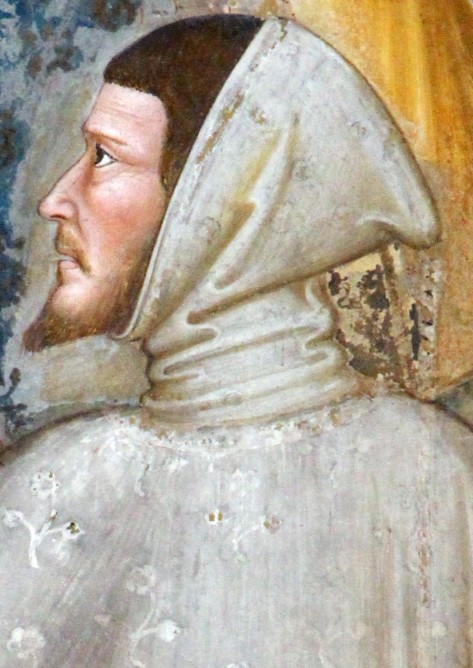
A conventional identification of Giotto among a crowd of illustrious men in Andrea di Bonaiuto's fresco the Church Militant and Triumphant, Spanish Chapel, Santa Maria Novella, painted c. 1366-1368, roughly three decades after Giotto's death, by a painter with no claim to have known him. Traditional guidebook identifications in the same crowd scene also name Cimabue, Dante, Petrarch and Boccaccio. This is a naming convention repeated for centuries, not a documented likeness, and it is presented here as exactly that.
Photograph by Sailko, Santa Maria Novella, Florence| Worked as | Painter, Architect |
|---|---|
| Born | c. 1267 (disputed · Florence, or Vespignano in the Mugello (disputed) |
| Died | 8 January 1337 · Florence |
| Nationality | Florentine |
| Movement | Late Gothic / early Trecento, traditionally read as the start of the break toward... |
| Sources | 10 cited |
| Last verified |
About this page Last verified · 10 sources cited
On this page 12 sections
ContentsClose
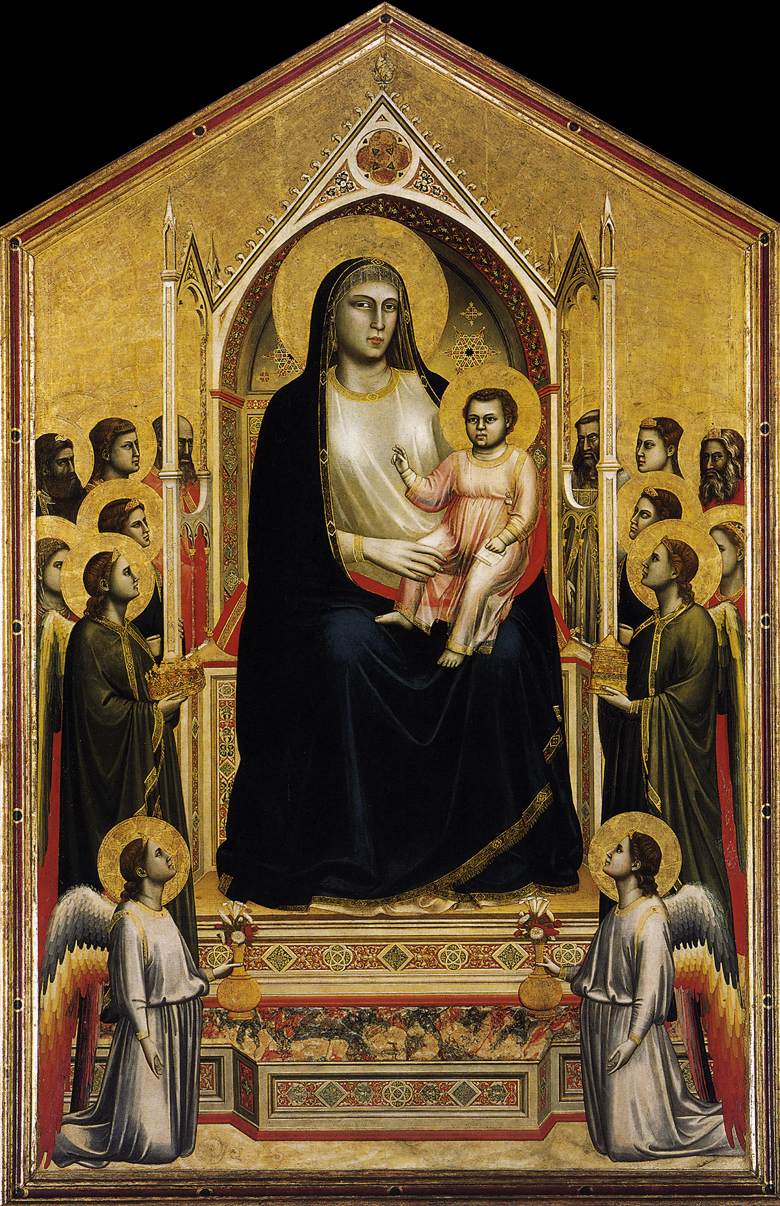
Giotto di Bondone is usually introduced as the man who ended the Middle Ages in painting, and there is enough truth in that to survive careful checking. The shift from flat, frontal, Byzantine-derived figures to bodies that carry weight, turn in space and grieve with their whole faces happens, documentably, within his lifetime and largely through his hand. What the standard account tends to skip is how little of that hand can actually be proven on paper. No painting by Giotto is signed. No contract survives naming him as the painter of any single picture still standing. The one panel every specialist accepts without argument, the Ognissanti Madonna now in the Uffizi, is accepted on the strength of an early fifteenth-century written notice, not a signature or a document from his own lifetime.
This record gives the biography, but the more useful thing it can offer is the shape of the argument underneath the biography: which frescoes are attributed by unbroken tradition, which by connoisseurship built up since the nineteenth century, and which, Assisi above all, remain a live scholarly dispute with named positions on both sides. It can also offer the fact that almost nobody has ever had to price a Giotto, because almost none change hands. The one Giotto-attributed panel to reach an English court in the last decade did so not at auction but in a fight over an export licence, and it is still, so far as the public record shows, sitting in storage in London.
The single fact most readers will not know: Giotto's largest and most complete surviving work, the fresco cycle in the Scrovegni Chapel in Padua, exists today largely by luck. In March 1944 an Allied bombing raid aimed at a nearby German command post levelled the apse of the Eremitani church a few hundred metres away, reducing Andrea Mantegna's frescoes there to more than eighty thousand fragments. The Scrovegni Chapel, standing exposed on the site of a Roman arena, was not hit.
Images
Chronology
- c. 1267
Born, probably in the Florentine countryside or in Florence itself; the birth year rests on Antonio Pucci's 1373 statement that Giotto was seventy at his death, and is disputed against Vasari's later date of 1276.1
- c. 1290
Marries Ricevuta di Lapo del Pela, known as Ciuta; the couple eventually have eight children.1
- 1297-1300
Painted (on the traditional attribution, disputed since 1912) in the Upper Church of San Francesco, Assisi, on the Legend of St Francis cycle.15
- 1298
Cardinal Jacopo Stefaneschi commissions the Navicella mosaic for the atrium of Old St Peter's, Rome; the original is now almost entirely lost.1
- 1301
Documented as a householder in the Santa Maria Novella quarter of Florence.15
- 1303-1305
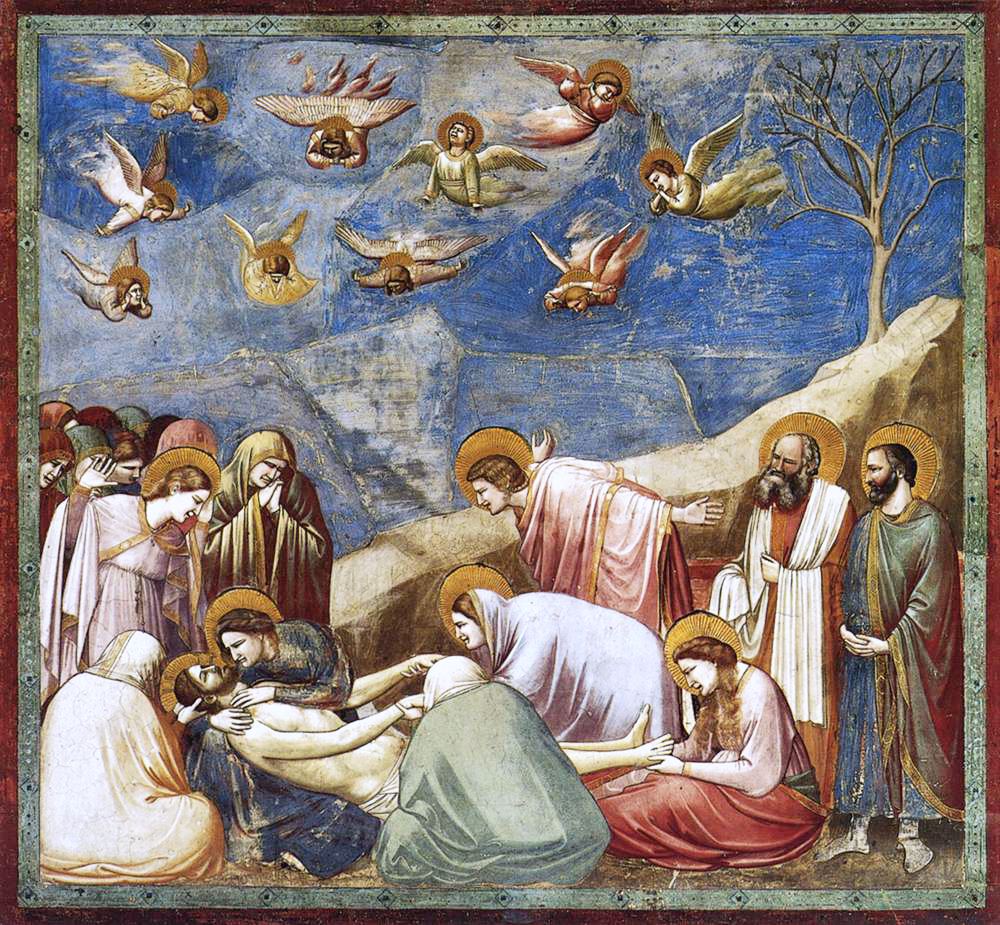
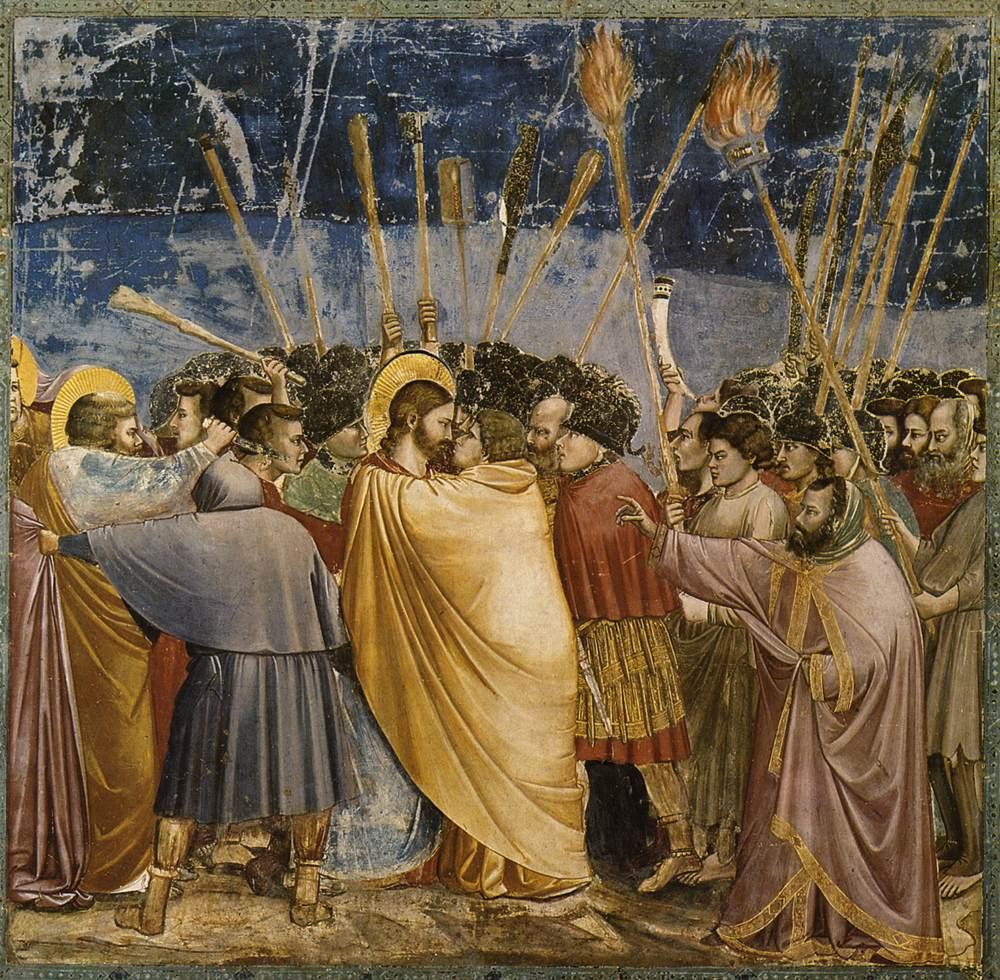
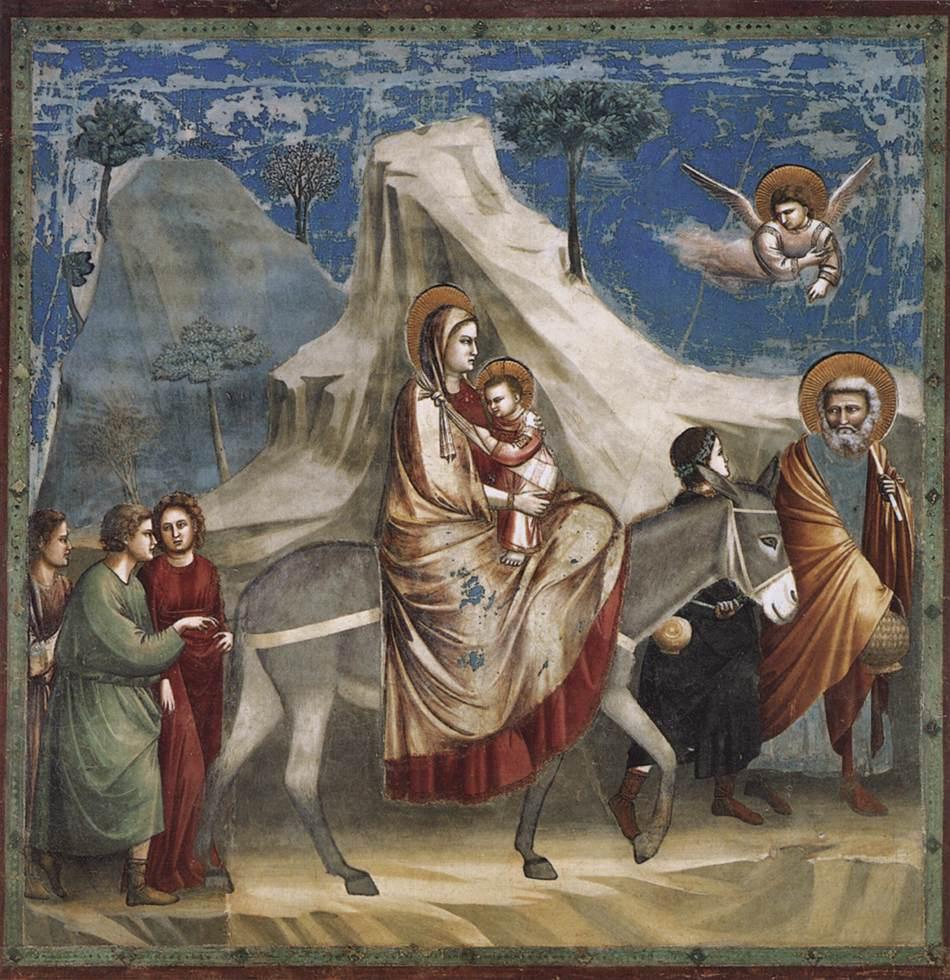
Frescoes the Scrovegni (Arena) Chapel in Padua for the banker Enrico Scrovegni; the chapel is consecrated 25 March 1303 and again, on completion, 25 March 1305.23
- c. 1305-1310
Paints the Ognissanti Madonna for the church of Ognissanti, Florence; now in the Uffizi and the only panel universally accepted as autograph.1
- 1320s
Frescoes the Bardi and Peruzzi Chapels in the basilica of Santa Croce, Florence, for two rival banking families.1
- 1328-c. 1333/34
Serves as court painter to King Robert of Anjou in Naples, arriving c. 1329; named first court painter, with a yearly pension, by 1332. Almost none of this work survives.1
- 1334
Appointed capomaestro (master of works) of Florence Cathedral; lays the first stone of the campanile on 19 July.14
- 8 January 1337
Dies in Florence, having completed only the lowest level of the campanile; his burial location is itself disputed.14
- 2000
A forensic team led by Francesco Mallegni examines bones excavated beneath Florence's Santa Reparata and proposes, contestedly, that they are Giotto's.1
- 2021
The Scrovegni Chapel is inscribed on UNESCO's World Heritage List as part of Padua's fourteenth-century fresco cycles.2
The market
Autograph Giotto panel paintings do not appear at public auction in any meaningful sense; the pictures held by major museums were acquired historically or by gift, not bought at recent sale. The one Giotto-attributed panel to generate a real market event in the last several decades did so through litigation over an export licence rather than through a sale. Kathleen Simonis bought a panel at auction in Florence in 1990, cheaply, as a nineteenth-century imitation; a subsequent attribution to Giotto by the specialist Filippo Todini raised its declared value roughly fourteen-fold over the following decade, to an estimated 10 million pounds sterling by the time of a 2018 High Court judgment, and the panel remains, so far as the public record shows, unsellable outside Italy or the United Kingdom under the export ruling upheld on appeal in 2020.
| Date | Sale | Work | Result | Note |
|---|---|---|---|---|
| 1990-05 | unspecified auction house, Florence | Madonna con Bambino (attributed to Giotto or his school after 1992; catalogued in 1990 as a nineteenth-century imitation) | Hammer 8,000,000 lire (approx. GBP 3,500 at the time) With premium not recorded ITL | Bought by Kathleen Simonis before any attribution to Giotto existed. By 1998 the same panel carried a declared value of 700 million lire; by 2018 litigation it was valued at approximately GBP 10 million. No sale at the attributed value has taken place; the panel is presently in storage in London under an unresolved export restriction. |
Hammer is the price at which the bidding stopped; with premium adds the fee the house charges the buyer on top. Hammer price and buyer's premium in the glossary.
Where to see the work
| Institution | City | Holdings | Note |
|---|---|---|---|
| Cappella degli Scrovegni (Arena Chapel) | Padua | Complete fresco cycle, 1303-1305: Life of Joachim and Anna, Life of the Virgin, Life of Christ, Last Judgment, and grisaille Vices and Virtues. | Part of the UNESCO World Heritage inscription Padua's fourteenth-century fresco cycles (2021). |
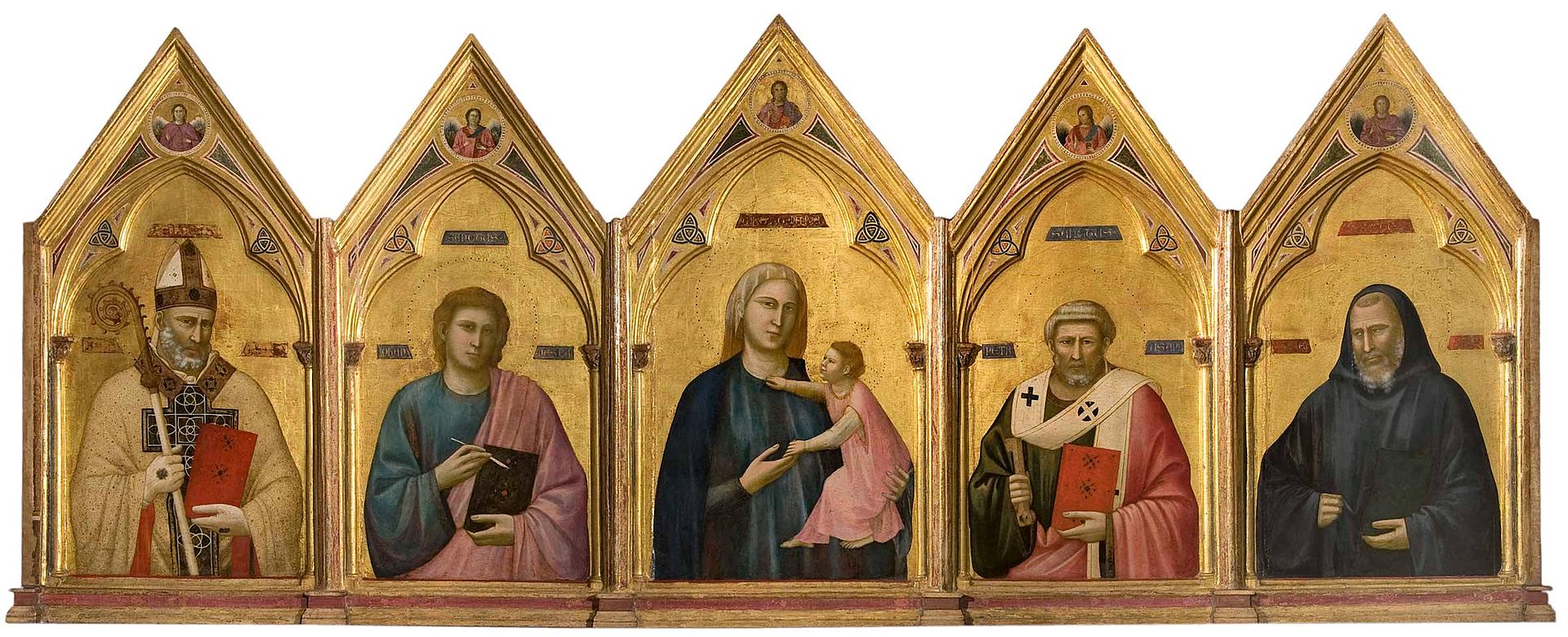
| Galleria degli Uffizi | Florence | Ognissanti Madonna (the one universally accepted panel) and the Badia Polyptych. | |
| Basilica di Santa Croce | Florence | Bardi Chapel and Peruzzi Chapel fresco cycles. | The Peruzzi Chapel is more contested in condition and dating than the Bardi Chapel. |
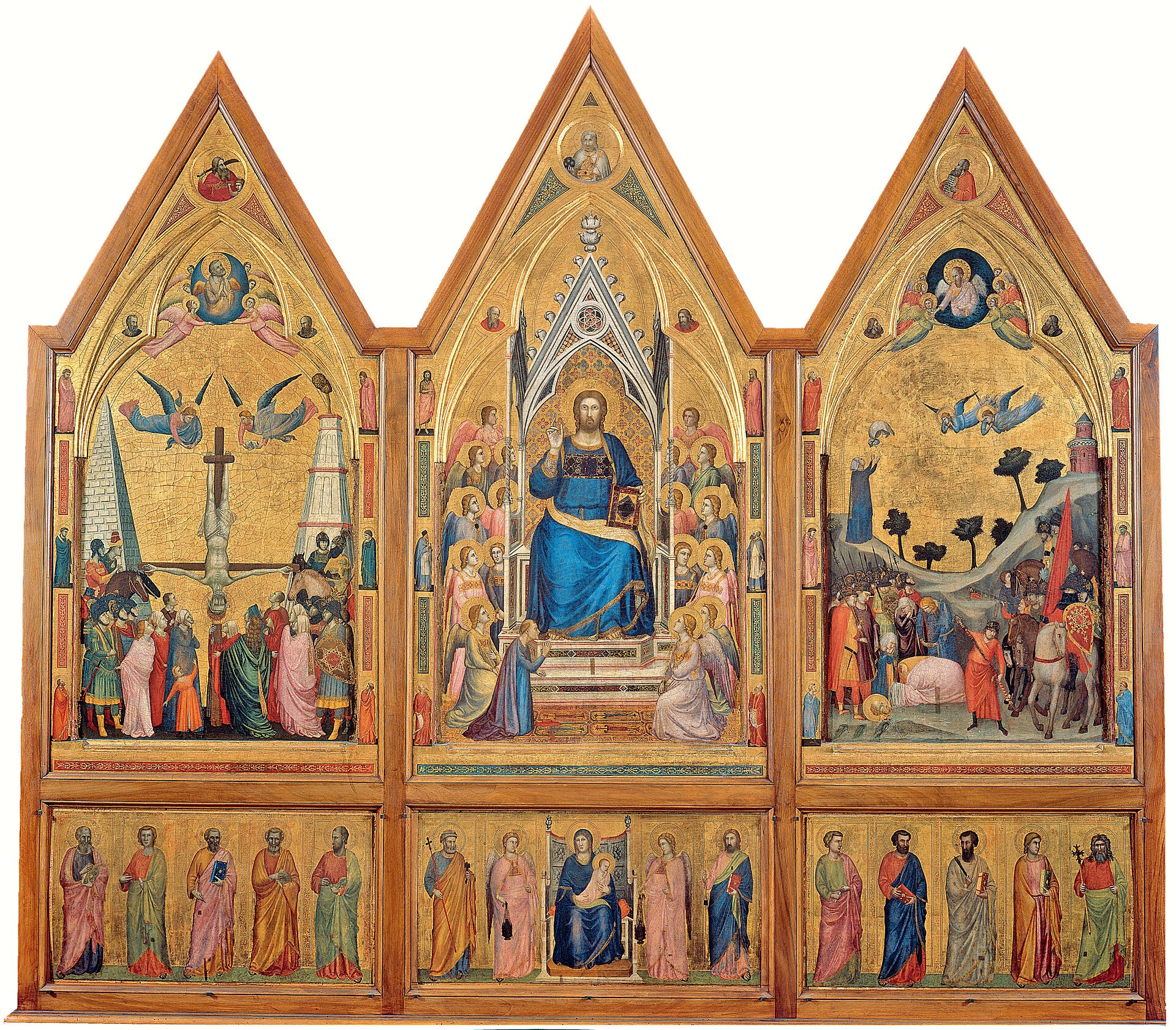
| Musei Vaticani, Pinacoteca | Vatican City | The Stefaneschi Triptych, a double-sided altarpiece commissioned by Cardinal Jacopo Stefaneschi. | |
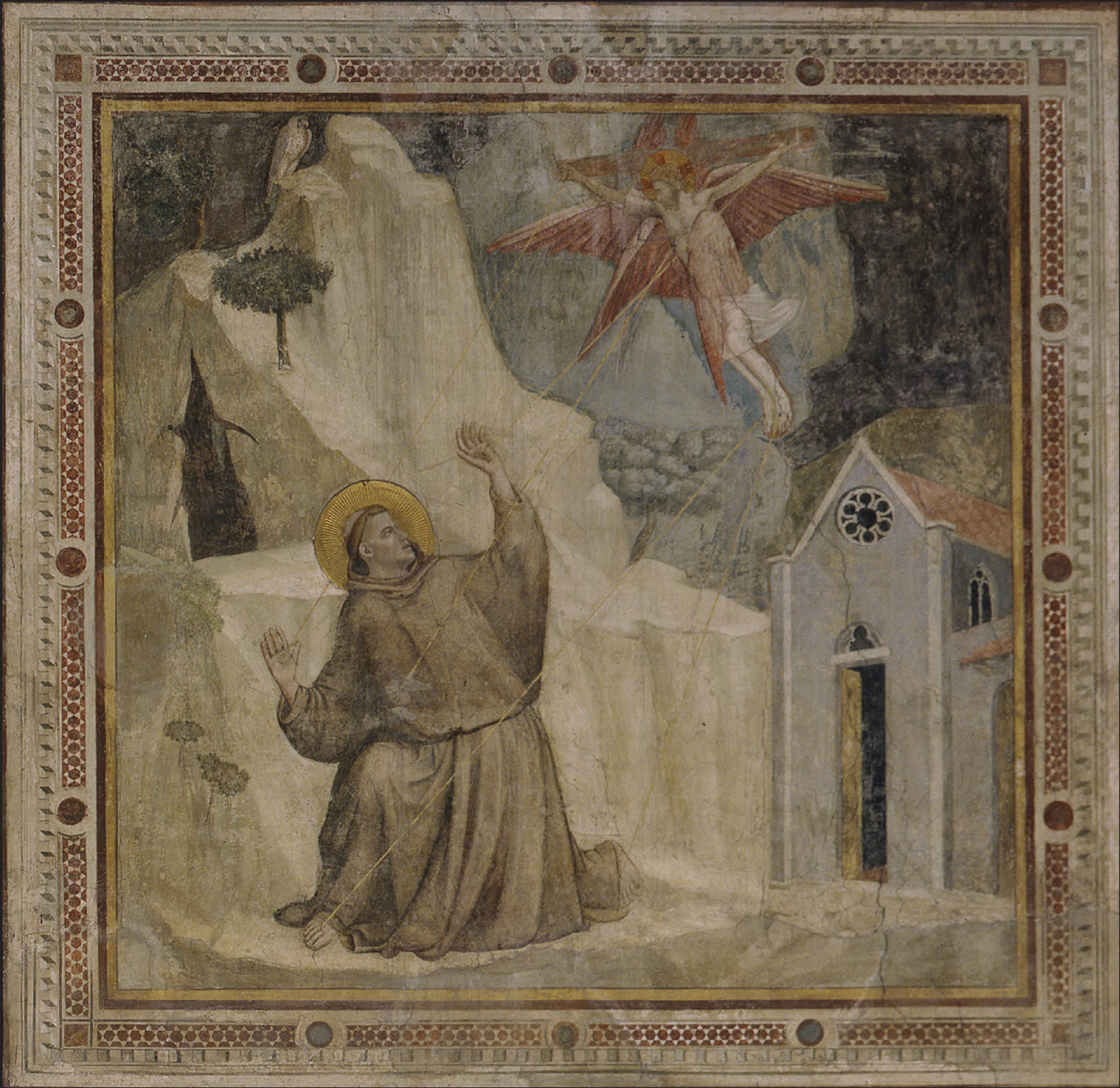
| Musee du Louvre | Paris | Saint Francis Receiving the Stigmata, a signed panel. | |
| National Gallery of Art, Samuel H. Kress Collection | Washington, DC | Madonna and Child, c. 1310-1315, accession 1939.1.256, believed a fragment of a dismembered polyptych. | Subject of the 2016 mixite pigment study. |
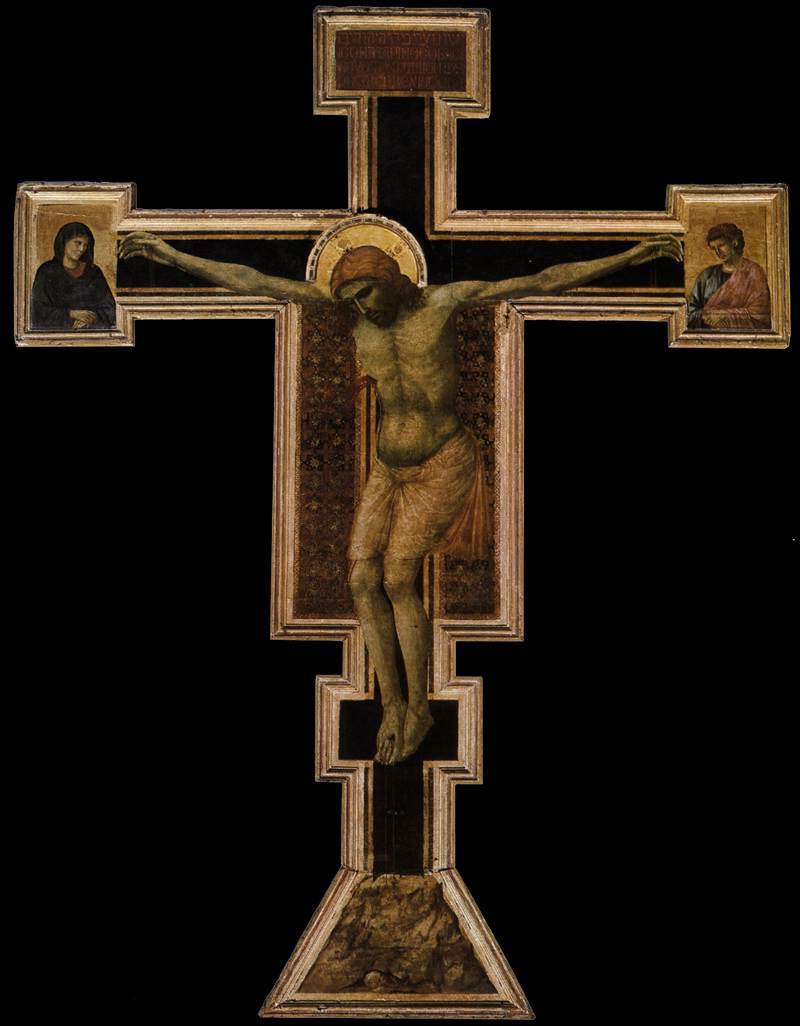
| Santa Maria Novella | Florence | Painted Crucifix, tempera on panel. | |
| Basilica di San Francesco, Upper Church | Assisi | The Legend of St Francis fresco cycle. | Attribution to Giotto disputed since 1912; see corpus.contested. |
The essay
Chapter 1A name that may not be his own
Every surviving document calls him Giotto, but several historians of the name think Giotto is itself a nickname: a contraction of Ambrogiotto, a diminutive of Ambrogio, or of Angiolotto, a diminutive...
Every surviving document calls him Giotto, but several historians of the name think Giotto is itself a nickname: a contraction of Ambrogiotto, a diminutive of Ambrogio, or of Angiolotto, a diminutive of Angiolo. Which underlying name he was actually given at baptism, if either, is not resolved and probably cannot be from the surviving record.
His birth date rests on the same kind of indirect arithmetic. The poet Antonio Pucci, writing in 1373, says Giotto was seventy when he died in January 1337, which puts his birth around 1266 or 1267. Vasari, writing in 1568, gives 1276 instead, a full decade later, with no source cited. His birthplace is contested in the same way: since 1850 a tower house at Colle Vespignano, in the Mugello north of Florence, has carried a plaque claiming the honour, a claim repeated in guidebooks ever since. Documentary research places his father, a man named Bondone, as a resident of the Santa Maria Novella quarter of Florence, and records Giotto himself as a homeowner there by 1301. Other sources describe Bondone as a blacksmith, others as a small landholder of good standing. None of this is trivial civic trivia: it is the first demonstration, before any painting is discussed, of how much of Giotto's biography is reconstruction rather than record.
Chapter 2The Cimabue story does not survive the checking
The account repeated in almost every popular life of Giotto comes from Vasari: that Cimabue found the boy Giotto drawing a sheep on a rock near Vespignano and took him into his workshop, and that the...
The account repeated in almost every popular life of Giotto comes from Vasari: that Cimabue found the boy Giotto drawing a sheep on a rock near Vespignano and took him into his workshop, and that the grown Giotto later painted a fly on one of Cimabue's panels so convincingly that his master tried to brush it away. The fly story is not unique to Giotto. It closely parallels a story Pliny the Elder tells about the ancient Greek painter Zeuxis, whose painted grapes were realistic enough to fool birds into pecking at them, which strongly suggests literary borrowing rather than a remembered fact, and most modern scholars discount the apprenticeship narrative on the same grounds: it reads as a foundation myth built to give the new master a pedigree, not as reportage.
What actual stylistic evidence suggests is more interesting than a tidy master-pupil handoff. Giotto's early work owes at least as much to late thirteenth-century Roman painting, and specifically to Pietro Cavallini, as to Cimabue or to any purely Florentine line of descent. Dante, a genuine contemporary, describes Giotto's fame eclipsing Cimabue's in the Purgatorio; the same comparison is echoed decades later by Filippo Villani, writing after Giotto's own death and not himself a contemporary, rather than by his grandfather Giovanni Villani, the chronicler who actually lived through Giotto's career. Neither Dante nor Filippo Villani says Cimabue trained him.
Chapter 3What is actually his: the corpus problem
Only one panel painting is accepted by every specialist without qualification: the Ognissanti Madonna, a Virgin and Child in Majesty over three metres tall, painted for the Florentine church of...
Only one panel painting is accepted by every specialist without qualification: the Ognissanti Madonna, a Virgin and Child in Majesty over three metres tall, painted for the Florentine church of Ognissanti and now in the Uffizi. Its attribution rests on a written notice from the early fifteenth century, not on a signature or a contemporary document, and it remains the closest thing Giotto has to an undisputed autograph benchmark.
Beyond that single panel, the three fresco cycles most consistently given to his own hand, the Scrovegni Chapel in Padua and the Bardi and Peruzzi Chapels in Santa Croce, are accepted on the strength of old and unbroken tradition rather than a surviving contract or payment record naming Giotto as the executant. A small number of panels carry signatures, and two have some form of documentary support, but even these are, in current scholarship, sometimes assigned instead to his workshop or to painters working in his immediate circle. There is no single agreed catalogue number for what Giotto painted, because there is no agreed method for counting a corpus this thinly documented; estimates for panels alone, once workshop pictures are folded in or excluded, have ranged from about a dozen to several dozen depending entirely on how generously a given scholar reads the evidence.
Chapter 4Assisi: the argument that will not close
The Legend of St Francis, a cycle of twenty-eight frescoes in the Upper Church of San Francesco at Assisi, is the single largest attribution dispute attached to Giotto's name.
The Legend of St Francis, a cycle of twenty-eight frescoes in the Upper Church of San Francesco at Assisi, is the single largest attribution dispute attached to Giotto's name. Vasari gave the cycle to Giotto without qualification, and that attribution held almost without challenge until 1912, when the German scholar Friedrich Rintelen first questioned it in print. The dispute has never closed. Italian scholars including Roberto Longhi, Giovanni Previtali and Luciano Bellosi have defended the traditional attribution, reading the cycle as Giotto's own early masterpiece and the site of his decisive break with Byzantine convention. Non-Italian critics, among them Richard Offner, John White and Alastair Smart, rejected it on stylistic grounds, arguing that the cycle differs too sharply from Giotto's documented late style at Padua to be by the same hand at any point in a normal career, and proposed instead either later followers imitating Giotto's manner or an earlier, independent team of Roman painters.
The most consequential technical intervention came from Bruno Zanardi, whose study of the plaster, tool marks and pigment sequence at Assisi concluded that at least three distinct workshops worked on the Upper Church, and assigned a large part of the Legend of St Francis to a team led by Pietro Cavallini, the leading Roman painter of the previous generation, rather than to Giotto at all. No document from the commission survives to settle the question either way: the relevant Franciscan archive was destroyed by Napoleon's troops around 1800. This record treats the Assisi attribution as unresolved, because it is.
Chapter 5Enrico Scrovegni buys his father out of hell
Enrico Scrovegni was a Paduan banker who inherited his fortune from his father Reginaldo, a moneylender whose usury was severe enough that Dante placed him, by name, in the seventh circle of Hell in...
Enrico Scrovegni was a Paduan banker who inherited his fortune from his father Reginaldo, a moneylender whose usury was severe enough that Dante placed him, by name, in the seventh circle of Hell in the Inferno, written within Giotto's own lifetime. Enrico built a private chapel on the site of Padua's Roman arena, attached to a grand palace he had built for himself, and by 1303 had commissioned Giotto to fresco its interior. The chapel was first consecrated on the feast of the Annunciation, 25 March 1303, and finally consecrated on the same feast two years later, 25 March 1305.
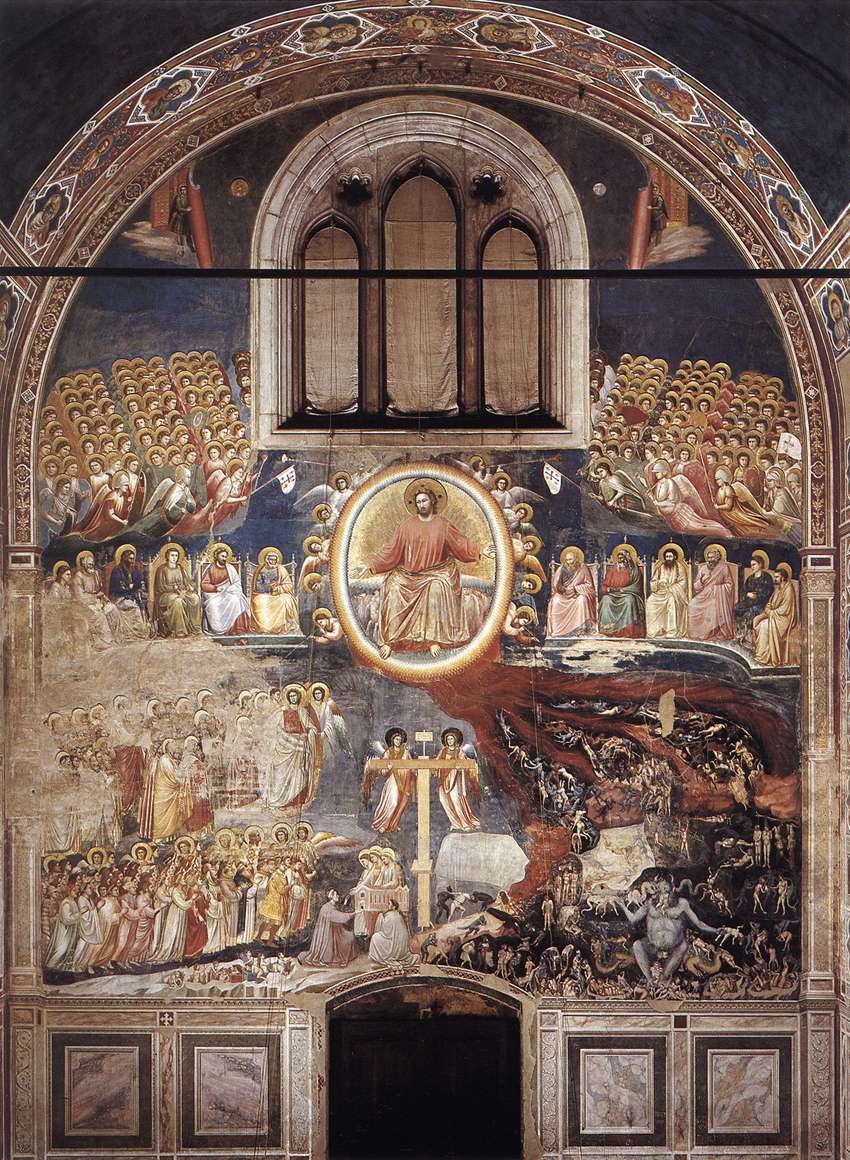
Whether the chapel was built specifically to atone for his father's sin, and by extension to shield Enrico's own soul from the same charge, is a real dispute among scholars rather than a settled fact, and the version of the story that ties it directly to Dante's verdict on Reginaldo is itself complicated by the timing: some scholars argue Dante's condemnation postdates the chapel's design and so cannot have been its trigger. What is documented rather than argued is Enrico's own act of self-presentation: on the entrance wall, inside his own Last Judgment, he had himself painted kneeling to offer a model of the chapel to the Virgin, among the saved. The theological programme behind the fresco cycle, the sequence of the Lives of Joachim, Anna and Mary, the Life of Christ, and the Vices and Virtues painted in monochrome grisaille below, is credited to the Augustinian friar Alberto da Padova, drawing on the apocryphal Gospel of Pseudo-Matthew, the Golden Legend and the Pseudo-Bonaventure Meditations on the Life of Christ as textual sources for scenes Giotto then had to compose.
Enrico did not end his life quietly in the chapel he built. Padua's civil wars forced him to flee to Venice in 1320, and the rival Carrara family had him formally banished from his native city in 1328. He died in Venice in 1336, a year before Giotto, and his will left one hundred ducats specifically to bring his body back to Padua for burial in the chapel, appropriately, he specified, and with pomp.
Chapter 6How he broke with Byzantine painting
Giotto worked in buon fresco, painting into wet plaster so the pigment binds to the wall as it dries, a technique that forces a painter to plan and execute a composition in sections, called giornate...
Giotto worked in buon fresco, painting into wet plaster so the pigment binds to the wall as it dries, a technique that forces a painter to plan and execute a composition in sections, called giornate, one for each day's plaster. Technical study of the original 1303-1305 execution of the Scrovegni Chapel has counted roughly 625 giornate across the cycle, executed with the help of around forty collaborators, a scale of organised labour that is itself evidence against the idea of a single genius working alone.
The stylistic shift this technique served is documentable rather than a matter of taste. Byzantine convention, which had governed Italian painting for generations before Giotto, favoured frontal, flattened figures and gold or patterned grounds with little illusion of depth. Giotto gave his figures weight and turning bodies, built architecture as a staged, receding space for the action to happen inside rather than a flat backdrop, and gave faces individual, legible emotion rather than fixed devotional expressions. Giovanni Villani, a Florentine chronicler who was Giotto's contemporary, recorded at his death that he was the most sovereign master of painting of his time, who drew all his figures and their postures according to nature: a description of a specific, observable technical change, not a vague compliment.
Chapter 7Vasari, writing two hundred years later
Giorgio Vasari's Lives of the Most Excellent Painters, Sculptors and Architects, first published in 1550 and revised in 1568, is the source for most of the anecdotes attached to Giotto's name, and it...
Giorgio Vasari's Lives of the Most Excellent Painters, Sculptors and Architects, first published in 1550 and revised in 1568, is the source for most of the anecdotes attached to Giotto's name, and it was written more than two centuries after Giotto died. Vasari drew in part on Giovanni Boccaccio, a genuine near-contemporary who mentions Giotto in the Decameron and is the source, via Vasari, for the claim that there was no uglier man in the city of Florence. But Vasari also supplies specific, quotable anecdotes with no earlier attestation: the fly painted so well that Cimabue tried to brush it off a panel, which closely echoes a story Pliny the Elder told of the painter Zeuxis thirteen centuries earlier, and Giotto's reported reply to Dante, that he made his pictures by day and his children by night, which has no independent source and reads as invented dialogue.
Set against Vasari is Giovanni Villani, a Florentine banker and chronicler who was alive during Giotto's career and recorded his death in the Nuova Cronica in plain, unembellished terms. Villani's account is not neutral in the sense of being uninterested, he clearly rated Giotto highly, but it was written without two centuries of accumulated legend to draw on, which is why this record treats it as the more reliable of the two named sources and flags Vasari's specific anecdotes as legendary rather than factual wherever they cannot be corroborated.
Chapter 8What is lost
A substantial part of Giotto's documented output no longer exists in any form that can be examined.
A substantial part of Giotto's documented output no longer exists in any form that can be examined. The Navicella, a large mosaic of Christ walking on water commissioned in 1298 by Cardinal Jacopo Stefaneschi for the atrium of Old St Peter's in Rome, survives today only as a heavily restored and relocated Baroque version; the original was moved repeatedly, lost its inscription, and shed most of its original tesserae over three centuries of repair, with only two small fragmentary angels from the original scheme identifiable today. The apse frescoes Giotto is recorded as having painted in the same basilica were destroyed outright when Old St Peter's was demolished and rebuilt in the sixteenth century.
His five or six years at the Angevin court in Naples, from 1328 to around 1333 or 1334, are almost as thoroughly lost. A 1331 document records him working on an altarpiece and wall paintings in two chapels of the Castel Nuovo, but almost nothing of that work survives; what traces remain are fragments and window paintings usually attributed not to Giotto himself but to students working in his style. Frescoes he is recorded as having painted in Milan, in his last years, have left no surviving trace at all. Even his final undertaking, the campanile of Florence Cathedral, was cut short by his death in 1337 after only the lowest, marble-faced level had been built; his successors, Andrea Pisano and then Francesco Talenti, followed his design for the lower stages but abandoned the spire he had drawn, finishing the tower at under 85 metres against a design that would have reached roughly 122.
Chapter 9The workshop, the pension, and the money
Giotto's arrangement with King Robert of Anjou of Naples, documented from his arrival around 1329, was unusually generous for the period: a salary, a house, gifts, and by 1332 formal appointment as...
Giotto's arrangement with King Robert of Anjou of Naples, documented from his arrival around 1329, was unusually generous for the period: a salary, a house, gifts, and by 1332 formal appointment as first court painter with a yearly pension, an arrangement with no close parallel elsewhere in Italy at the time for a painter. Documents from 1301 and 1304 already show him as a Florentine property owner, and further Florentine records from the 1310s and 1320s attest to financial dealings of his own, though the surviving documents do not spell out their nature in enough detail to characterise them further here.
The labour behind the paintings is far less visible than the money. The roughly forty collaborators counted in the technical survey of the Scrovegni Chapel are, with rare exceptions, unnamed in any surviving record; the picture is catalogued under Giotto's name alone. Taddeo Gaddi is the one assistant named with any confidence, and he went on to complete decoration in the Baroncelli Chapel at Santa Croce usually discussed as part of Giotto's orbit rather than his own hand. The pattern, a single master's name standing for a workshop's labour, is not unique to Giotto, but the scale of the Scrovegni commission makes it unusually visible here.
Chapter 10A market that essentially does not exist
Autograph Giotto panel paintings do not appear at public auction in the modern art market in any meaningful sense; the handful of attributed pictures in institutional hands, the Uffizi's, the...
Autograph Giotto panel paintings do not appear at public auction in the modern art market in any meaningful sense; the handful of attributed pictures in institutional hands, the Uffizi's, the Louvre's, the Vatican's, the National Gallery of Art's, were acquired historically or by donation, not bought at a recent sale. That absence is itself informative, and the closest thing to a market event in Giotto's case did not happen at an auction house at all, but in an English courtroom.
In May 1990 Kathleen Simonis bought a panel, Madonna con Bambino, at auction in Florence for 8 million lire, then roughly 3,500 pounds sterling, catalogued as a nineteenth-century imitation. In 1992 the art expert Filippo Todini published an article attributing the panel to Giotto. Restoration the following year by Umberto Ticci uncovered a medieval paint layer beneath later overpaint; Ticci judged the underlying work possibly thirteenth-century in date and potentially by Giotto himself, a dating other Italian experts did not dispute even where they contested the specific attribution to Giotto. The declared value climbed accordingly, from 8 million lire in 1990 to 700 million lire by 1998, and by the time of litigation in London the panel was valued at roughly 10 million pounds. When Italian officials inspected it in 1999 ahead of a proposed state purchase, they described the panel itself as being of extraordinary pictorial quality and in excellent state of preservation, and, separately, judged that its acquisition would constitute a moment of fundamental importance of Roman figurative culture, language that reflects the same uncertainty running through the case: this is a picture whose importance is not seriously disputed and whose author still is.
What followed was a decade and a half of export litigation rather than a sale. Italy issued a temporary export licence for the panel in 1999, valid five years, then moved in 2000 to annul it and all licences derived from it, on the stated ground that the 1993 restoration had made the picture into another work of art, a striking argument that conservation itself can legally change what an object is. A second decree to the same effect followed in 2004. Simonis's Italian lawyers won a ruling annulling that decree in February 2007, and five days later exported the panel to London, a move Arts Council England's own counsel later described in court as the painting having been spirited away; Italy's highest administrative court reversed that annulment in November 2008, restoring the decree and, with it, the argument that the export had never been lawful. Arts Council England refused Simonis a further licence to move the panel on to Switzerland, and in 2018 the High Court, in R (Simonis) v Arts Council England, agreed that the 2007 export had not been lawful and definitive under Italian law, so only Italy, not Britain, could licence any further move. The Court of Appeal upheld that ruling in March 2020. So far as the public record shows, the panel remains in storage in London: attributed by a named specialist to one of the most sought-after names in Western painting, valued in the millions, and functionally unsellable anywhere outside Italy.
Chapter 11The mineral nobody expected to find in a fourteenth-century painting
A small Madonna and Child panel in the National Gallery of Art in Washington, from the Samuel H.
A small Madonna and Child panel in the National Gallery of Art in Washington, from the Samuel H. Kress Collection and dated around 1310 to 1315, is believed to be a fragment of a dismembered polyptych whose original location is unknown. A 2016 technical study of the panel by conservation scientists Barbara Berrie, Marco Leona and Richard McLaughlin found that Giotto had not used ultramarine, the costliest blue pigment of the period, ground from lapis lazuli, choosing the cheaper mineral azurite instead for the Virgin's mantle.
Inside that blue paint, electron backscatter diffraction identified particles of mixite, a rare copper-bismuth arsenate, the first confirmed identification of that mineral in any painting anywhere, of any date. The scientists could not determine whether Giotto's workshop chose the mineral deliberately for the cooler, greener blue it produces, or picked it up unknowingly, bound together with the azurite it occurs alongside in the ground; they judged the second more likely given how rare mixite is, while noting the resulting colour choice, cooler than the ultramarine expected in a Madonna's robe at this date, was itself a considered one. The finding also has a trade-history dimension: period sources call azurite by names such as azzurro tedesco, German blue, pointing to sourcing from Germany or Hungary, and mixite is known to occur naturally in exactly those mining districts.
Chapter 12What he looked like, probably not
No portrait of Giotto securely dates from his own lifetime.
No portrait of Giotto securely dates from his own lifetime. Vasari, drawing on Boccaccio, called him the ugliest man in the city of Florence, a claim impossible to verify and easy to suspect as literary colour. A conventional identification places a portrait of Giotto among a crowd of illustrious men in Andrea di Bonaiuto's fresco the Church Militant and Triumphant, painted around 1366 to 1368 in the Spanish Chapel of Santa Maria Novella, alongside similarly traditional identifications of Cimabue, Dante, Petrarch and Boccaccio in the same scene. The fresco was painted roughly three decades after Giotto's death by a painter with no claim to have known him; the identification is a naming convention repeated for centuries rather than a documented likeness, and this record treats it as exactly that.
Two further, mutually incompatible folk traditions survive independently of the Santa Maria Novella figure: a dwarf in one of the Santa Croce frescoes, locally said to be a Giotto self-portrait, and a man in a white cap among the blessed in the Scrovegni Chapel's Last Judgment, also claimed as a likeness of the painter. The two cannot both be right, and neither rests on documentary evidence. In 2000 a forensic team led by Francesco Mallegni examined bones excavated in the 1970s from beneath Florence's Santa Reparata, at the spot Vasari's account places Giotto's grave, and reported a very short man, just over four feet tall, with a large head, a prominent hooked nose, and neck vertebrae consistent with years spent tilting the head back, alongside chemical traces consistent with handling lead and arsenic-based pigments. The team concluded the remains were Giotto's, a finding that would support the Santa Croce dwarf tradition over the Padua one if accepted; other scholars, including the art historian Franklin Toker, remain openly unconvinced. No image in this record is presented as a confirmed likeness of Giotto.
Chapter 13After him
Dante, who died in 1321 and so was writing within Giotto's own lifetime, already recorded the handover of reputation in the Purgatorio: that Cimabue thought he held the field in painting, and now...
Dante, who died in 1321 and so was writing within Giotto's own lifetime, already recorded the handover of reputation in the Purgatorio: that Cimabue thought he held the field in painting, and now Giotto has the cry, so that the fame of the other is dimmed. Villani's Nuova Cronica, recording Giotto's death on 8 January 1337, calls him the most sovereign master of painting in his time. Two centuries later Vasari opened his Lives with Giotto, casting him as the artist who began the renewal of painting after more than two hundred years of neglect, a framing so influential that the periodisation of Western art history still runs through it substantially unchanged.
Interest cooled for long stretches in between: Mannerist and Baroque taste had little patience for a flattened, gold-ground trecento style, and Giotto's reputation was sustained mainly by Vasari's account rather than by direct encounter with the pictures. The nineteenth century revived it. John Ruskin wrote an extended study of the Scrovegni Chapel frescoes to accompany a series of wood engravings the Arundel Society issued of them in instalments between 1853 and 1860, introducing the cycle to an English audience that had, in most cases, never been to Padua and never would be. In 2021 the Scrovegni Chapel was inscribed, together with seven other painted buildings in the city, on UNESCO's World Heritage List under the name Padua's fourteenth-century fresco cycles, formal international recognition of a building that survived, by a matter of a few hundred metres, an air raid in 1944.
What is documented
Technique
The surviving work
- What is accepted
- Only one panel painting, the Ognissanti Madonna (Uffizi), is accepted without qualification by every specialist, on the strength of an early fifteenth-century written notice. Three fresco cycles, the Scrovegni Chapel in Padua and the Bardi and Peruzzi Chapels in Santa Croce, are accepted by old and effectively unbroken tradition rather than by surviving contract or payment record. Beyond this small core there is no single agreed number: estimates for accepted panels alone, once workshop pictures are included or excluded, run from about a dozen to several dozen depending on the scholar.
- What is contested
- The Legend of St Francis cycle at Assisi, twenty-eight scenes traditionally given to Giotto by Vasari, has been disputed since 1912. A 1996 technical study by Bruno Zanardi assigned a large part of the cycle to a workshop led by the Roman painter Pietro Cavallini rather than to Giotto. The Peruzzi Chapel frescoes in Santa Croce are also more contested in condition and dating than the neighbouring Bardi Chapel.
- Who rules on attribution
- No active attribution authority exists for Giotto comparable to a modern authentication board. Attribution proceeds case by case through peer-reviewed art-historical argument and, increasingly, technical analysis of pigments, plaster sequence and tool marks, illustrated in this record by both the Assisi dispute and the Simonis litigation, where expert reports rather than any single connoisseurship body effectively decided how a disputed panel would be treated in practice.
Catalogue raisonne
- Luciano Bellosi, Giotto (Scala, 1981; English edition Giotto: Complete Works, 1985) The nearest thing to a single-author compiled corpus in general circulation; Bellosi is among the Italian scholars who accept the traditional Assisi attribution, a position not shared by every specialist cited in this record.5
Questions about Giotto di Bondone
Who was Giotto di Bondone?
Painter; Architect. c. 1267-1337.
When did Giotto di Bondone live?
Born c. 1267 (disputed; Vasari gives 1276), Florence, or Vespignano in the Mugello (disputed); died 8 January 1337, Florence.
Where can you see work by Giotto di Bondone?
Cappella degli Scrovegni (Arena Chapel) (Padua); Galleria degli Uffizi (Florence); Basilica di Santa Croce (Florence); Musei Vaticani, Pinacoteca (Vatican City); Musee du Louvre (Paris); National Gallery of Art, Samuel H. Kress Collection (Washington, DC).
What does the market for Giotto di Bondone look like?
Autograph Giotto panel paintings do not appear at public auction in any meaningful sense; the pictures held by major museums were acquired historically or by gift, not bought at recent sale. The one Giotto-attributed panel to generate a real market event in the last several decades did so through litigation over an export licence rather than through a sale.
What is still unresolved about Giotto di Bondone?
Whether any of the twenty-eight scenes of the Legend of St Francis at Assisi are by Giotto's own hand or entirely by a Roman workshop associated with Pietro Cavallini: disputed since 1912, with named scholars on both sides and no surviving contract, since the relevant Franciscan archive was destroyed around 1800.
Open questions
- Whether any of the twenty-eight scenes of the Legend of St Francis at Assisi are by Giotto's own hand or entirely by a Roman workshop associated with Pietro Cavallini: disputed since 1912, with named scholars on both sides and no surviving contract, since the relevant Franciscan archive was destroyed around 1800.
- What has happened to the Simonis Madonna con Bambino since the Court of Appeal dismissed her case in March 2020: whether it remains in London storage, has been returned to Italy, or has been resolved by private agreement. No public record located.
- Whether the bones excavated beneath Florence's Santa Reparata and forensically examined in 2000 are actually Giotto's remains: the identifying team's conclusion is contested by other scholars.
- Giotto's true birthplace: the tower house at Colle Vespignano, claimed since an 1850 plaque, against documentary evidence placing his father's household in Florence itself.
- What, if anything, survives in any recognisable form of Giotto's own hand from his five or six years at the Angevin court in Naples (1328 to c. 1333/34): almost the entire body of that work is lost or reduced to fragments attributed to students.
Sources
- 1Wikipedia, 'Giotto', for the consolidated biography, the naming and birth-date disputes, the Assisi attribution controversy, Vasari's account and its unreliability, the Naples appointment, lost works, and the 2000 forensic examination. The Cambridge Companion to Giotto, ed. Anne Derbes and Mark Sandona). en.wikipedia.org/wiki/...
- 2Wikipedia, 'Scrovegni Chapel', for the commission dates, consecration dates, the fresco programme and its theological sources, the giornate and workforce count from the original 1303-1305 execution, and the 2021 UNESCO inscription. en.wikipedia.org/wiki/...
- 3Wikipedia, 'Enrico degli Scrovegni', for the patron's biography: his father Reginaldo's usury and Dante's condemnation, the chapel commission, Enrico's exile from Padua in 1320, his formal banishment in 1328, his death in Venice in 1336, and his burial wishes. en.wikipedia.org/wiki/...
- 4Wikipedia, 'Giotto's Campanile', for the 1334 appointment, the construction timeline, the extent of Giotto's own completed work, and the successors who altered his design. en.wikipedia.org/wiki/...
- 5Cavallini to Veronese, 'Giotto' (specialist reference page), for the named positions in the Assisi attribution dispute (Longhi, Previtali, Bellosi for; Offner, White, Smart against), Bruno Zanardi's technical study assigning the cycle in part to Pietro Cavallini, and the state of the accepted corpus. cavallinitoveronese.co.uk/giotto
- 6R (Simonis) v Arts Council England [2018] EWHC 1822 (Admin), judgment of Mrs Justice Carr DBE, High Court of Justice, Queen's Bench Division, 23 July 2018. Primary source for the full purchase, restoration, attribution and export-licence history of the Madonna con Bambino panel. judiciary.uk/wp-content/...
- 7Blackstone Chambers, case note on R (Simonis) v Arts Council England [2020] EWCA Civ 374 (Court of Appeal, 13 March 2020), for the outcome and reasoning of the appeal. blackstonechambers.com/news/...
- 8The Art Newspaper, 'Owner of 10m pound Giotto to appeal High Court ruling that painting left Italy unlawfully', 26 July 2018, for the 1990 purchase price and the narrative history of the panel's attribution and export dispute. theartnewspaper.com/2018/...
- 9Barbara H. Berrie, Marco Leona and Richard McLaughlin, 'Unusual pigments found in a painting by Giotto (c. 1266-1337) reveal diversity of materials used by medieval artists', Heritage Science 4, Article 1 (2016). Primary technical source for the pigment analysis of the National Gallery of Art's Madonna and Child panel and the identification of mixite. nature.com/articles/...
- 10Open Letters Monthly, 'Most Sovereign Master', for the transmitted text of Giovanni Villani's Nuova Cronica entry on Giotto's death. openlettersmonthlyarchive.com/olm/...
Last verified