Gertrude Kasebier
 American · 1852-1934
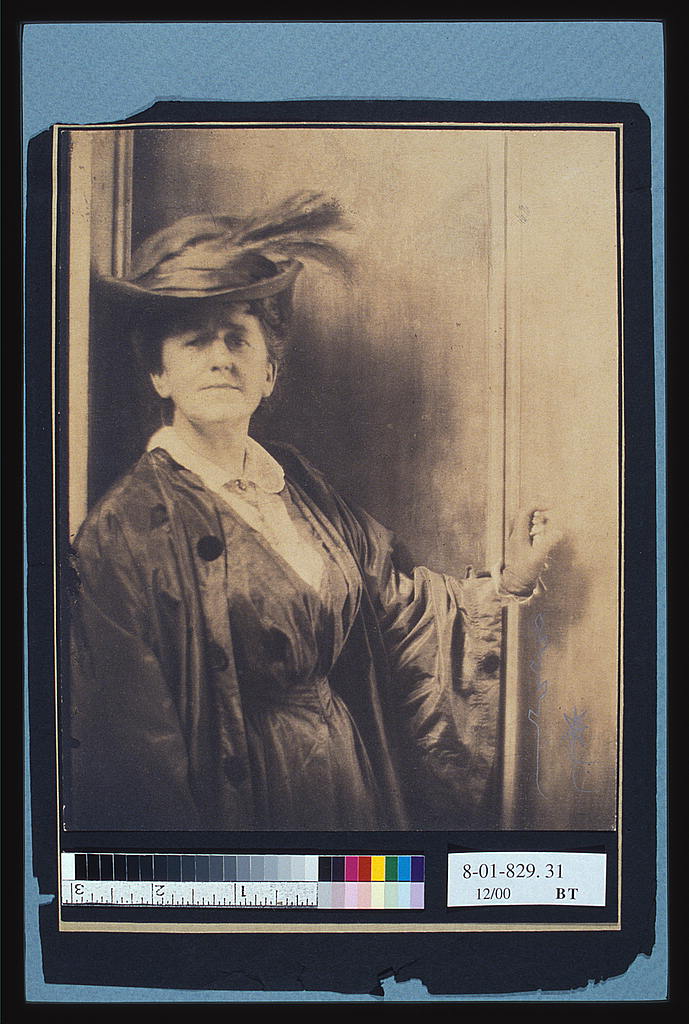
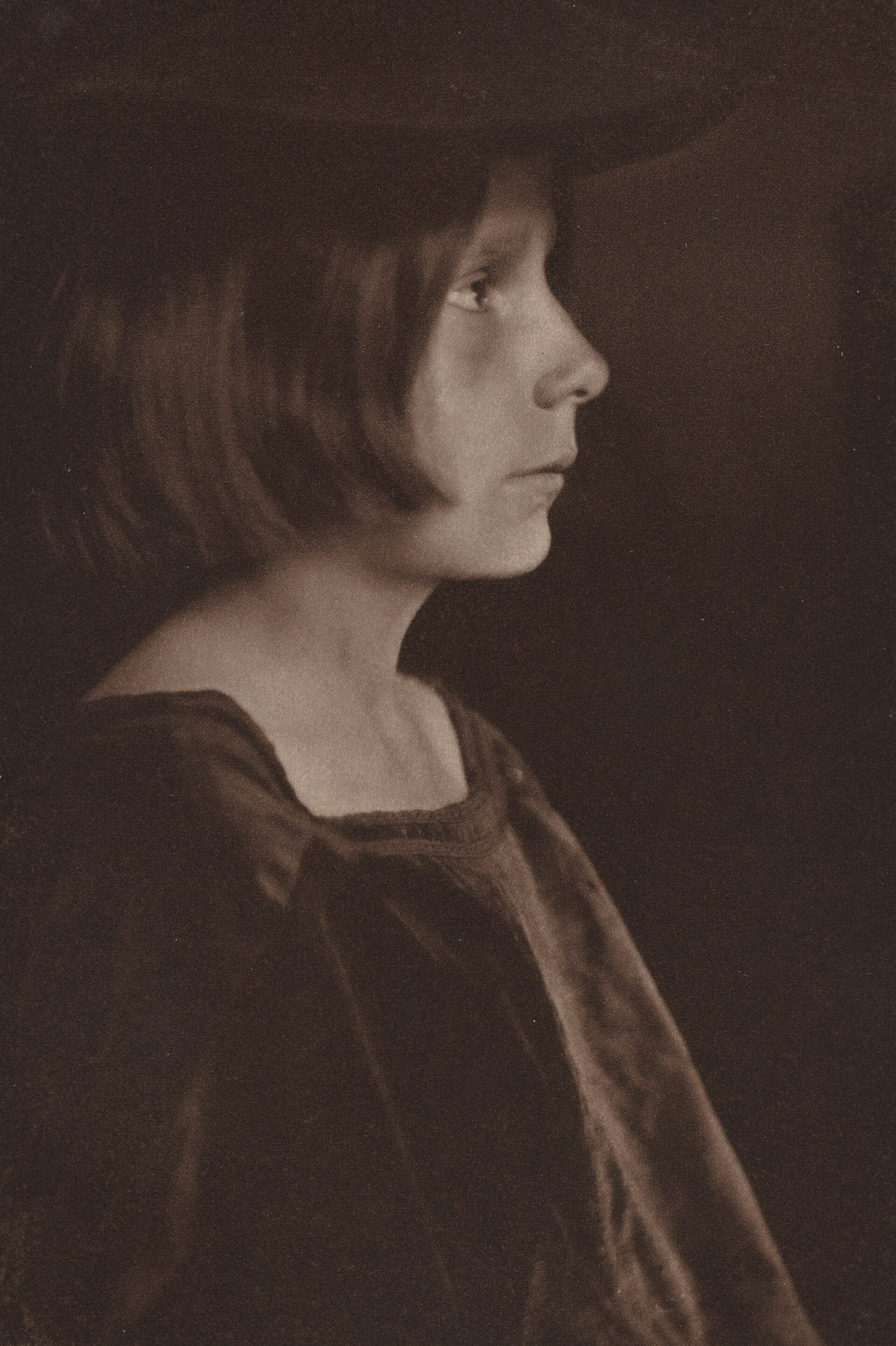
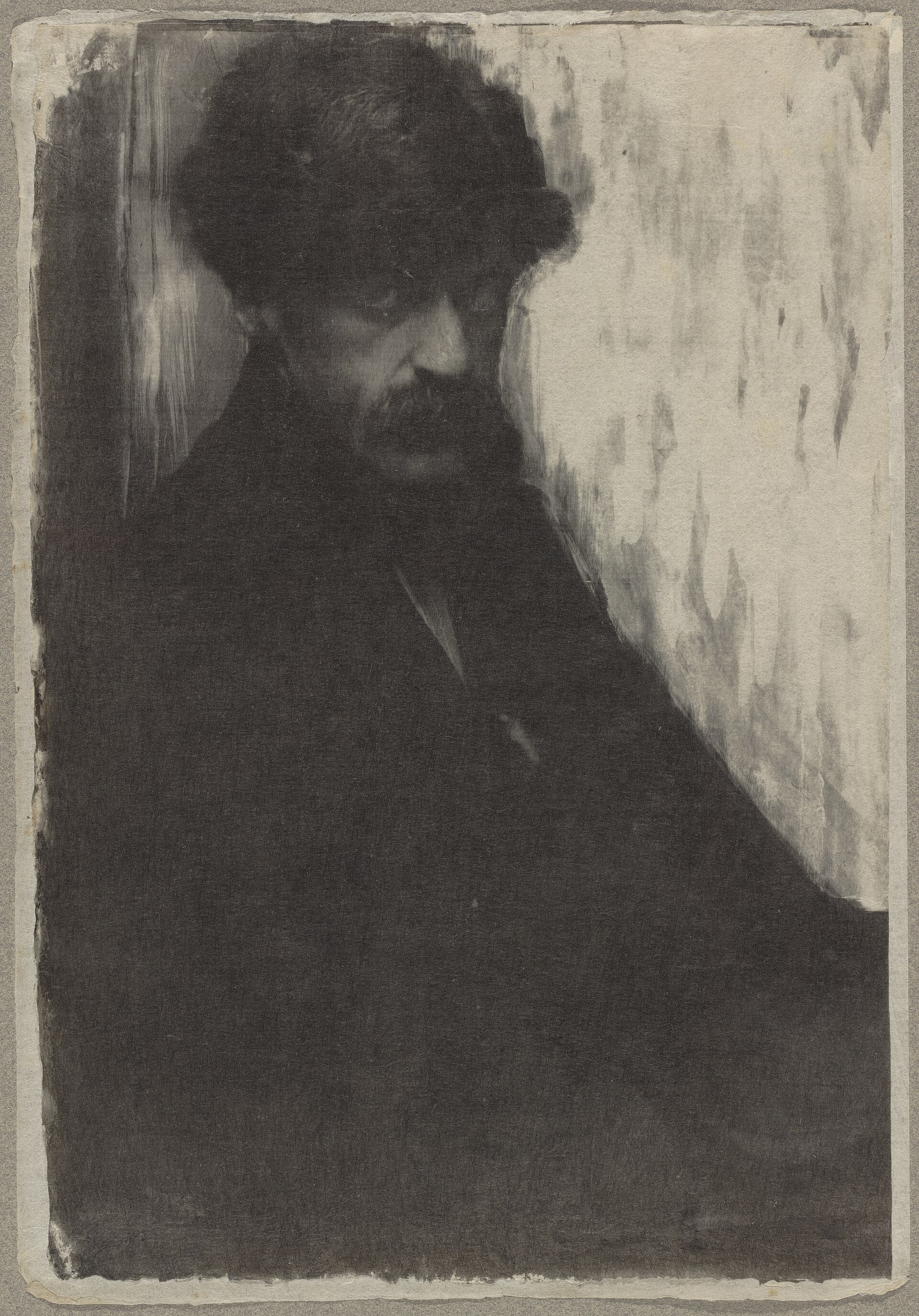
Gertrude Kasebier in a feathered hat, half-length, a platinum print attributed to Baron Adolf de Meyer and dated c. 1900 by the Library of Congress (LCCN 97515342). The Library's record says the title was devised by Library staff and notes a monogram signature, so the identification of the sitter and the attribution to de Meyer are the Library's cataloguing, not independently tested; no inscription naming her was read.
Adolf de Meyer, platinum print; Library of Congress Prints and Photographs Division (public domain)| Full name | Gertrude Stanton Kasebier (born Gertrude Stanton) |
|---|---|
| Worked as | Photographer, Portraitist, Founder member of the Photo-Secession |
| Born | 18 May 1852 (the Library of Congress essay gives 19 May) · Fort Des Moines, Iowa (now Des Moines) |
| Died | 12 October 1934 (Lempertz's artist index gives 13 October) · New York City, at the home of her daughter Hermine Turner |
| Nationality | American |
| Movement | Pictorialism |
| Sources | 27 cited |
| Last verified |
About this page Last verified · 27 sources cited
On this page 13 sections
ContentsClose
Gertrude Kasebier made her name as a portrait photographer who printed like a painter. She took up the camera as a professional in her forties, was called 'beyond dispute the leading portrait photographer' in the country by Alfred Stieglitz in 1899, and was a founder member of the Photo-Secession when he launched it in 1902. Her platinum and gum bichromate prints of mothers and children, and her studio portraits of Sioux performers from Buffalo Bill's Wild West, are the work the name stands for.
The thing a reader probably does not know is that nobody has ever counted her. There is no catalogue raisonne, no authentication board and no published census of prints. The four large holdings that carry her estate (the Smithsonian, the Library of Congress, the University of Delaware and, until its sales of about 2014, the Art Institute of Chicago) all came from one family, through her granddaughter Mina Turner and her great-grandson Mason Turner Jr, and the figures institutions publish for them do not agree. This page sets out what each source says and does not average them.
It is also the page that records where the standard biography is thinner than it looks. The date of her Sioux sessions is given as 14 April and as 24 April 1898 by sources that cite the same book. Her teacher Arthur Wesley Dow is named by every summary, yet his Pratt tenure as given by Wikipedia starts after her enrolment. Her portrait of Rodin is dated 1905 by the auction houses and 1907 by the Metropolitan Museum. Each is a recorded gap rather than a settled fact.
Images
Chronology
- 1852
Born Gertrude Stanton at Fort Des Moines, Iowa; Wikipedia and the Delaware material give 18 May, the Library of Congress essay 19 May.11224
- 1860
Joins her father in Colorado, where he is Golden's first mayor; he dies in 1864 and the family moves to Brooklyn.1
- 1874
Marries Eduard Kasebier, a shellac importer, on 18 May; three children follow, Frederick, Gertrude Elizabeth and Hermine.124
- 1889
Enrols at the Pratt Institute in Brooklyn aged 37 and studies there until about 1895 by the Cody Studies count.34
- 1894
Spring: a photograph is published in the Quarterly Illustrator. Summer: chaperones Frank Vincent DuMond's art students in France and works with a German chemist on photographic chemistry.412
- 1896
Works as assistant to the Brooklyn portrait photographer Samuel H. Lifshey; Arthur Wesley Dow's Pratt tenure begins this year by Wikipedia's count.123
- 1897
Opens her own portrait studio; first solo shows at the Boston Camera Club and the Pratt Institute.12
- 1898
Sioux performers from Buffalo Bill's Wild West sit for her in April; the day is given as 14 April by Wikipedia and 24 April by Cody Studies. In June she writes to Stieglitz for advice.14712
- 1899
Stieglitz publishes five of her photographs in Camera Notes (July). She makes The Manger and Blessed Art Thou Among Women; in autumn she sells a print of The Manger for USD 100.1121320
- 1900
Wikipedia says she is elected, with Carine Cadby, one of the first two women in the Linked Ring.1
- 1901
Everybody's Magazine prints her article on the Sioux in January; Caffin devotes a chapter to her in Photography as a Fine Art; Johnston writes of her in the Ladies' Home Journal in May.1012
- 1902
Founder member of the Photo-Secession, per Wikipedia.1
- 1903
Camera Work No. 1 carries her plates with texts by Caffin and Johnston.21322
- 1905
Photographs Rodin; auction catalogues date the prints 1905 while the Metropolitan Museum's print is catalogued 1907.161827
- 1906
Joins the Professional Photographers of New York in May; her joint exhibition with Clarence H. White at 291 is reviewed that March by Roland Rood.110
- 1910
Twenty-two of her prints hang at the Albright Art Gallery's International Exhibition of Pictorial Photography; the Albright buys a print of The Manger. Her husband dies (December 1909 or 1910 by source).11213
- 1911
Joseph Keiley publishes a hostile piece on her in Camera Work; she suspects Stieglitz of prompting it.1
- 1912
Resigns from the Photo-Secession, the first member to do so, after protesting Stieglitz's handling of sales and payments.1
- 1916
Helps Clarence H. White found the Pictorial Photographers of America.1
- 1929
Gives up photography and, per Wikipedia, liquidates her studio's contents; the Brooklyn Institute of Arts and Sciences holds an exhibition of her work.112
- 1934
Dies on 12 October at her daughter Hermine Turner's home in New York City.112
- 1969
Her granddaughter Mina Turner deposits more than 100 Sioux prints and 14 drawings at the Smithsonian; the Library of Congress also holds 50 Sioux glass negatives from her (the year is not stated).58
- 1973
Mina Turner gives prints to the Art Institute of Chicago, according to a Phillips catalogue essay.1617
- 1977
Her great-grandson Mason Turner Jr begins gifts of her prints to the University of Delaware, repeated for more than ten years.2
- 1979
William Innes Homer's pioneering exhibition at the Delaware Art Museum, with the catalogue A Pictorial Heritage.2
- 1992
Michaels's Abrams monograph and the Museum of Modern Art exhibition; a Philadelphia exhibition follows in 1993.2
- 2007
Sotheby's New York sells a platinum print of The Manger for USD 39,400 with premium; Delaney's Smithsonian book on the Sioux portraits appears.131410
- 2014
Phillips sells Kasebier prints from the Art Institute of Chicago's collection (sale codes UK040314 and NY040214; the pages state no date).1617
The market
Her market is thin and sparsely documented. The best-sourced result found is USD 39,400 with buyer's premium for a vintage platinum print of The Manger at Sotheby's New York in October 2007, estimated at USD 35,000 to 50,000. Photogravures from Camera Work and the 1901 portfolio sell for a few thousand dollars or less. Gum bichromate Rodin portraits from the Art Institute of Chicago's deaccession came with estimates of USD 15,000 to 30,000 or GBP 12,000 to 18,000.
Hammer and premium are not separated in any source opened, so every figure below is a total or a price realised as published, with the premium treatment stated where it is known. Aggregator claims (Art.Salon: a Rodin at USD 40,000 in February 2016, house not named; a search summary of MutualArt: USD 50,000 at Phillips in 2011) could not be tied to lot pages and are not listed as results. A sale-by-sale cohort for each image was not found; Phillips and Sotheby's lot pages for most sales hide results behind logins.
Recorded without a public price
- Autumn 1899 · The Manger, vintage print · Private sale; buyer named by Sotheby's 2007 catalogue as Ellen Terry · Not applicable (private sale) USD 100. The Library of Congress essay calls it the highest price yet paid for a photograph. No bill of sale seen.
- October 2007 · The Manger, platinum print, 1899, signed and titled on the secondary mount, inscribed The Angelus on the reverse · Sotheby's, New York, Photographs, lot 133 · Not published USD 39,400 with premium per iPhotoCentral (buyer the dealer Peter MacGill); estimate USD 35,000 to 50,000; provenance the photographer to Charles Fox; conservation with in-painted upper corners. The exact sale day is not in the page opened.
- Date not stated (sale code UK040314) · Auguste Rodin, gum bichromate print, 1905, 34 x 26.7 cm · Phillips, Photographs from the Collection of the Art Institute of Chicago, lot 3 · Not published Sold for GBP 21,250 against an estimate of GBP 12,000 to 18,000. Given to Chicago by Mina Turner in 1973 per the catalogue essay.
- Date not stated (sale code NY040214) · Auguste Rodin, gum bichromate print on Japanese tissue, 1905 · Phillips, same collection, lot 4 · Not shown Estimate USD 20,000 to 30,000; the page shows no result.
- 2017 · Auguste Rodin, gum bichromate print on Japanese tissue, signed on the mount, 1905 · Sotheby's, New York, Photographs (sale N09640), lot 49 · Not shown Estimate USD 15,000 to 25,000; provenance Art Institute of Chicago gift 1973, then Clars Auction Gallery, Oakland, 19 September 2015, lot 6321. The page shows no result.
- 4 December 2020 · Blessed Art Thou Among Women, photogravure from American Pictorial Photography Series II, printed c. 1900 · Sotheby's, New York, Photographs from the Ginny Williams Collection, lot 99 · Not published USD 2,772 as reported by the aggregator Art.Salon, premium treatment not stated; estimate USD 1,500 to 2,500. A reproduction, not a vintage print.
- Not stated (sale NY040219) · Blessed Art Thou Among Women, photogravure on tissue printed 1903, on the original Camera Work leaf · Phillips, Artist | Icon | Inspiration: Women in Photography, lot 72 · Not shown Marked sold against an estimate of USD 4,000 to 6,000; no price on the page.
- July 2022 · Portrait of Arthur Mooney, platinum print, 1900, 8 1/8 x 3 1/4 in., original exhibition frame with Photo-Secession label fragment · Sotheby's, Modern Discoveries, lot 586 · Not shown (login) Estimate USD 12,000 to 18,000; the result is behind a login.
Where to see the work
| Institution | City | Holdings | Note |
|---|---|---|---|
| University of Delaware, Library, Museums and Press | Newark, Delaware | The largest collection: 166 photographs in the Museums by the current exhibition page, 'more than 175 works' by the 1993 Messenger, plus the Kasebier papers (MSS 0149) and Mina Turner's reminiscences. | Gifts of Mason Turner Jr from 1977. Check the finding aid; it blocked this page's fetch. |
| National Museum of American History, Smithsonian Institution | Washington, DC | About 100 Sioux portraits and 14 drawings from the April 1898 session. | Photographic History Collection; the Cody Studies site reproduces them. |
| Library of Congress, Prints and Photographs Division | Washington, DC | Fifty Sioux glass negatives, the negatives of The Heritage of Motherhood and The Red Man, and many Kasebier prints and portraits. | Digital copies online; the originals tie her prints to their negatives. |
| The Metropolitan Museum of Art | New York | 37 object records, including twenty from the Alfred Stieglitz Collection and the 1907 Rodin platinum print (48.77). | Open Access data. |
| National Gallery of Art | Washington, DC | Prints including The Manger, The Bat, Florentine Boy, Alfred Stieglitz and Little Good Harbor, Maine. | Open Access images; process and accession details were not read. |
| Los Angeles County Museum of Art | Los Angeles | Blessed Art Thou among Women, 1899, platinum print (M.2008.40.1116), Marjorie and Leonard Vernon Collection. | On view in the Pictorialism to Modernism gallery per the record. |
| Museum of Modern Art | New York | A significant collection per Cody Studies, including Rodin and Blessed Art Thou Among Women. | MoMA's own pages blocked this page's fetch; the holding is reported, not verified. |
Forgeries and misattributions
- None documented; the practical hazard is reproduction mistaken for original
- No source opened records a forgery, a fake signature or a disputed attribution. What the market does show is a clear risk of confusing a Camera Work photogravure or a 1901 Series II photogravure with a vintage print. Both circulate as signed-looking sheets of her best-known images. By process and sheet. The lots are described as photogravure on tissue or Japanese paper, on the original Camera Work leaf or tipped to a mount as issued, where the originals are platinum or gum bichromate on the artist's own mounts, signed in pencil. No instrument test (X-ray fluorescence for platinum against silver, paper analysis) was found in any source.131519
- Retouched or manipulated plate (not a forgery)
- Because the softness in a print came from the printer, two prints of one image can look unlike each other, and neither is spurious. Compare with the glass negative where one survives: the Library of Congress holds those for The Heritage of Motherhood and The Red Man.312
The essay
Chapter 1No count, no catalogue raisonne and no authority: what is known about how much exists
There is no catalogue raisonne of Kasebier's work and none of the sources opened for this page says one is in preparation.
There is no catalogue raisonne of Kasebier's work and none of the sources opened for this page says one is in preparation. The standard book is Barbara Michaels, Gertrude Kasebier: The Photographer and Her Photographs (Abrams, 1992), which accompanied the 1992 exhibition organised by the Museum of Modern Art and the 1993 Philadelphia show. It is a monograph with plates, not an inventory, and auction houses cite it by plate number (the Sotheby's 2017 Rodin lot gives 'Michaels, pl. 73'). The earlier benchmark is William Innes Homer, A Pictorial Heritage (University of Delaware and Delaware Art Museum, 1979), the first major exhibition of her work. Michelle Delaney's 2007 Smithsonian book covers only the Sioux portraits.
No authentication board exists and none is documented. Attribution in practice rests on the maker's signature (she signed and titled exhibition prints in pencil on the secondary mount, and the Library of Congress essay notes a signature in Japanese chop-block style on her published illustrations for the Mowbray novel), on the provenance back to the family, and on the institutional holdings that act as comparanda.
The institutional counts disagree. The University of Delaware's 1993 Messenger said its University Gallery held 'more than 175 works', the largest collection of her photographs owned by any institution. Its current exhibition page says the Museums hold a group of 166 photographs. Both can be true if prints left or were recounted, and neither source says. The Smithsonian's Sioux material is given as 'more than 100' prints with 14 drawings in one Cody Studies page and as 100 photographs with 14 drawings in another. The Library of Congress holds fifty glass negatives of the Sioux portraits according to the same project. The Metropolitan Museum's open data returns 37 object records under her name, one of them a portfolio parent record whose eleven plates are listed separately, as of 24 November 2026.
Nobody has published a total for negatives, vintage prints, photogravures and later prints together. That absence is the single most useful thing a buyer should know: a lot described only as 'Kasebier, platinum print' has no census to be checked against.
Chapter 2Who she was, and the small contradictions in the standard life
She was born Gertrude Stanton in Fort Des Moines in 1852.
She was born Gertrude Stanton in Fort Des Moines in 1852. Wikipedia, citing Michaels, gives 18 May. The Library of Congress essay on her gives 19 May, and also gives her mother's name as Gertrude Muncy Shaw Stanton where Wikipedia has Muncy Boone Stanton. Her father took a sawmill to Colorado in the 1859 gold rush and was Golden's first mayor in 1860; he died in 1864 and her mother ran a boarding house in Brooklyn. In 1874 she married Eduard Kasebier, a shellac importer from Germany. Cody Studies and the Delaware Messenger both describe him as a shellac importer, and the Messenger adds that he was a tenant in her mother's boarding house.
The marriage was unhappy and permanent. Wikipedia, citing Michaels, says they lived separate lives after 1880 and never divorced, and that her husband had objected to her studying art. The Delaware exhibition page says the couple never divorced but lived separately. Her husband's death is dated December 1909 by the Library of Congress essay and 1910 by Wikipedia. Her death is 12 October 1934 in most sources and 13 October in the Lempertz index.
None of these differences changes the account. They matter because a reader citing a date from one summary can be contradicted by another summary, and because Michaels, the source that all of them lean on, was not opened for this page. Every biographical date here is attributed to the source that gives it and marked where two sources differ.
Chapter 3Pratt, Dow and a chronology that does not close
Kasebier enrolled at the Pratt Institute in Brooklyn in 1889, aged 37, over her husband's objection according to Wikipedia.
Kasebier enrolled at the Pratt Institute in Brooklyn in 1889, aged 37, over her husband's objection according to Wikipedia. The Cody Studies biography says she graduated four years later and stayed enrolled for another two years of study, which carries her to about 1895. It also says her Pratt instructors tried to dissuade her from photography, even from taking a camera to Europe in summer 1894. The Library of Congress essay adds that when a photograph she published in the Quarterly Illustrator in spring 1894 won a prize, her teachers shamed her for it and she gave the prize money away.
The best-known name attached to her Pratt years is Arthur Wesley Dow. Wikipedia says he taught her and later promoted her by writing about her work. The Library of Congress essay says she forged a long relationship with him at Pratt and that he wrote favourable reviews of her exhibitions. Dow's own Wikipedia article says he taught at Pratt from 1896 to 1903, and a search-engine summary of Britannica and Princeton pages gave 1895 for the start. If Wikipedia's date is right, his time at Pratt begins after or at the very end of her enrolment as the Cody Studies biography counts it.
That does not disprove the relationship, which could rest on friendship, on her continued hospitality to teachers and students, or on dates that differ between sources. It does mean that 'trained under Dow at Pratt' is a repeated assertion rather than a documented fact on the sources opened. No Dow letter, enrolment record or review of hers by him was read for this page, so the claim is graded as asserted by secondary sources only. What is documented is her formal training in drawing and painting at Pratt, the summer 1894 trip to Paris and Crecy-en-Brie chaperoning Frank Vincent DuMond's art students, and a period of work with a German chemist on the chemistry of photography the same summer. Her own later account, quoted in a 1913 New York Times article reproduced in the Library of Congress essay, was that she went to art school to learn to paint her children's faces and chose a quicker medium.
Chapter 4The studio, the money and the $100 print
She became a professional because the household needed money.
She became a professional because the household needed money. Her husband was seriously ill in 1895 and the family's finances were strained, according to the Library of Congress essay and Wikipedia. She worked in 1896 as an assistant to the Brooklyn portrait photographer Samuel H. Lifshey, learning printing and studio management, and opened her own studio in 1897. Where the studio was is not stated consistently. The Library of Congress essay has her starting in her Brooklyn home before moving to Fifth Avenue; Wikipedia places the studio on Fifth Avenue in 1898; the Delaware Messenger says she opened in New York in 1897 and a second studio at Newport, Rhode Island, in 1899; and the Cody Studies 1898 season page calls the April 1898 sitting a visit to her Brooklyn studio.
The best-documented price is the one that made her name. In autumn 1899 she sold a print of The Manger for $100. The Library of Congress essay calls it the highest price yet paid for a photograph and says the record was rarely challenged for over fifty years. Wikipedia gives the figure without naming a buyer. The 2007 Sotheby's catalogue note says the buyer was the English actress Ellen Terry. That is the only source opened that names her, and it is a cataloguer's statement, not a receipt; no bill of sale was seen. No period comparison (a skilled worker's wage, the price of a painting by a contemporary) was found in any source opened, so no modern equivalent is offered. A figure converted by any method would be invented precision.
Her income was not only from prints. The Library of Congress essay documents a second business in magazines: ten portraits for World's Work between 1900 and May 1902, including Booker T. Washington and Jacob Riis; illustrations for J. P. Mowbray's novel serialised in Everybody's Magazine in 1901; and the Sioux article in January 1901. John Wanamaker bought Everybody's in December 1899, and the essay says the title reached an estimated 150,000 homes around 1900. Her studio stood between those worlds. Stieglitz objected to that, as a later section shows. In the mid-1920s she handed the portrait studio to her daughter Hermine Turner, and Wikipedia says that in 1929 she gave up photography and liquidated her studio's contents. The 1929 liquidation is single-sourced to Wikipedia and no inventory or sale record of it was found.
Chapter 5The Manger and Blessed Art Thou Among Women: what the titles say and what is argued
The two pictures that fixed her reputation in 1899 are both framed by Marian titles.
The two pictures that fixed her reputation in 1899 are both framed by Marian titles. Blessed Art Thou Among Women takes its title from a line of the Bible (Luke 1:42 is the verse), and the 2024 Los Angeles County Museum of Art note by Britt Salvesen points out that the print on the wall behind the figures is an Annunciation. LACMA's note names the sitters as Agnes Lee and her daughter Peggy and says the scene is probably in Boston; other accounts give the poet Agnes Rand Lee, her daughter Harriet and a house in Jamaica Plain, which this page did not check. That the title is biblical and that the wall print is an Annunciation are observations from the object. Salvesen's reading, which links the picture to maternal love, guidance and the passage from innocence to maturity, is a curator's interpretation published in 2024 and is graded argued.
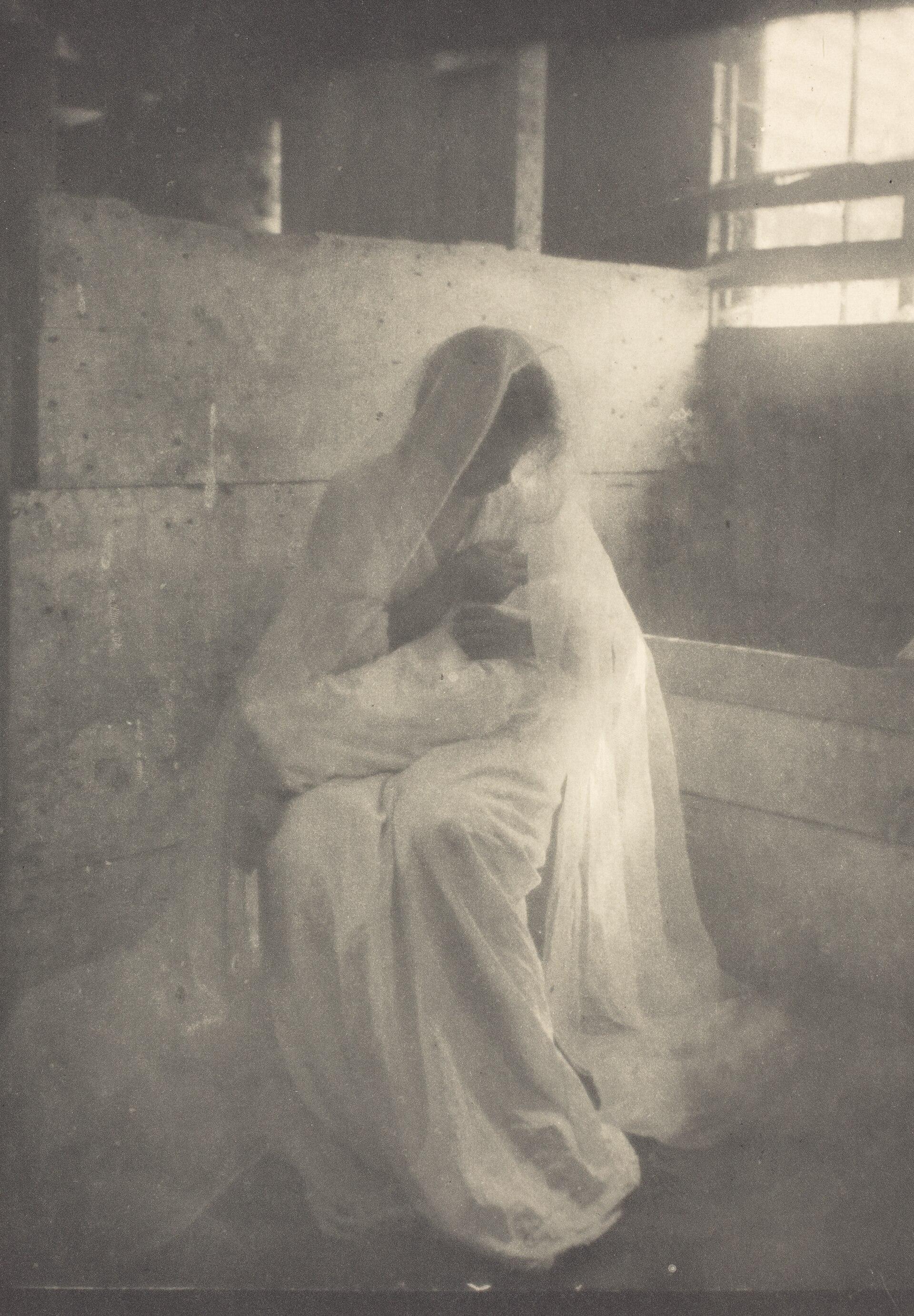
The Manger was made in summer 1899 in the stable at Long Meadow, her Newport cottage, with the illustrator Frances Delehanty posing in layers of diaphanous cloth that, according to the Sotheby's catalogue note, may have belonged to F. Holland Day, who was visiting with a trunk of costumes. The 'may' is the cataloguer's. The same Sotheby's lot records that Kasebier herself pencilled The Angelus on the back of the print offered, which means the picture carried at least one other title. That is a documented fact about an inscription on one print, not a statement of what she meant. Charles Caffin, quoted in the same note from Camera Work No. 1, praised 'figures of touching refinement in rude surroundings' and a light that 'surrounds the figures with divinity'. Caffin's reading is a critic's reading in 1903 and shows how the picture was received, not what she intended.
On what she read, joined or believed, the sources opened give very little that is documented. Wikipedia, citing Michaels, says that at Pratt she learned the educational theories of Friedrich Froebel, the kindergarten reformer, whose view of the mother's role she is said to have taken up, and that the Arts and Crafts movement influenced her. The Library of Congress essay confirms that she furnished her studio in a simple Arts and Crafts style. The Froebel link is argued by Michaels and relayed by Wikipedia; no letter or book in her library tying her to Froebel was seen. No lodge, church, society or religious practice is recorded in any source opened. The absence of a hidden programme is the finding: the Marian framing is open on the face of the titles, and the evidence for anything beyond it is a later scholar's interpretation.
Chapter 6Platinum, gum bichromate and the brush on the glass: how the prints were made
Platinum was her preferred process, according to the University of Delaware exhibition text, which also shows the same image, Untitled [Woman and Children with Horse], in both gum bichromate and...
Platinum was her preferred process, according to the University of Delaware exhibition text, which also shows the same image, Untitled [Woman and Children with Horse], in both gum bichromate and platinum so the two can be compared. The Delaware text calls platinum helpful for a soft atmosphere and gum bichromate well suited to soft, atmospheric effects but labour-intensive and demanding of a skilled printer; the Cody Studies pictorialism page describes platinum's rich dark tones of black and gray and gum bichromate's brush-stroked, textured look. The Delaware Messenger says she worked with platinum, gum bichromate and silver, manipulated the backgrounds of portraits with brushwork on the negatives, and opposed retouching of faces because it made people look like 'peeled onions'.
The softness is made in the darkroom, not in the camera. The Delaware exhibition text sets her 1904 gum bichromate The Heritage of Motherhood against its original glass negative at the Library of Congress, which is crisp and highly detailed, and says the print's mottled, dissolving surface came from her manipulation of the printing process. The Library of Congress essay makes the same comparison for The Red Man, whose negative differs from the print she modified artistically. Hence the practical rule for a buyer: a Kasebier print is an interpretation of a negative, and two prints from one plate can differ in tone, format and surface. Her working method also included re-use. The essay says a travel snapshot published in 1895 as Waiting for the Procession reappeared in 1901 with a stippled background as La Grand-mere.
Mounts matter for dating. Sotheby's 2007 lot is described as a platinum print mounted along the top edge only to thin board, signed and titled in pencil on a secondary mount, with an inscription on the reverse. The cataloguers call that presentation appropriate to an exhibition print of the early twentieth century. That is a specialist's dating judgement, not a test, and no dendrochronology-style physical test (watermarks, fibre analysis, platinum versus palladium by X-ray fluorescence) was found in any source opened.
Chapter 7The Sioux sessions of 1898: what the record says and where it contradicts itself
In April 1898 Buffalo Bill's Wild West was in New York.
In April 1898 Buffalo Bill's Wild West was in New York. The Cody Studies biography, by Michelle Delaney and Rebecca Wingo, says Kasebier watched the parade pass her studio, wrote to William F. Cody asking to host a visit from the Sioux in his troupe, and waited a few weeks for his permission. The text of her letter and of his reply was not found in any source opened; both are reported, not read. Her friend Adele Miller may have helped through her family's friendship with Cody, which Cody Studies attributes to Michaels. Cody Studies says the tea and sitting were reported at once on the women's page of the New York Times and cites the article as 'Sioux Chief's Party Calls' (1898); the page gives no printing date, and the address of the linked copy suggests 24 April, which is an inference from the address, not a stated date. Cody Studies' account quotes her answer to a warning that the guests might stay a long time: 'Well, let them come'.
The date is where the sources split. Wikipedia, citing Delaney 2007, says the session began on Sunday morning, 14 April 1898. Cody Studies, which is Delaney's own project, says Sunday morning, 24 April 1898, with tea at ten and a three-hour portrait session, and dates a New York Journal item of 17 April as one week before the visit. 24 April 1898 was a Sunday; 14 April was a Thursday. The Sunday evidence favours the 24th, and the weekday check is this page's own arithmetic, not a source's finding. The Times article's own date was not read: if it was printed on 24 April, a report of a sitting held that Sunday morning is hard to square with a same-day edition, and it would fit 14 April better, so the Times does not settle the question either. This page does not settle it.
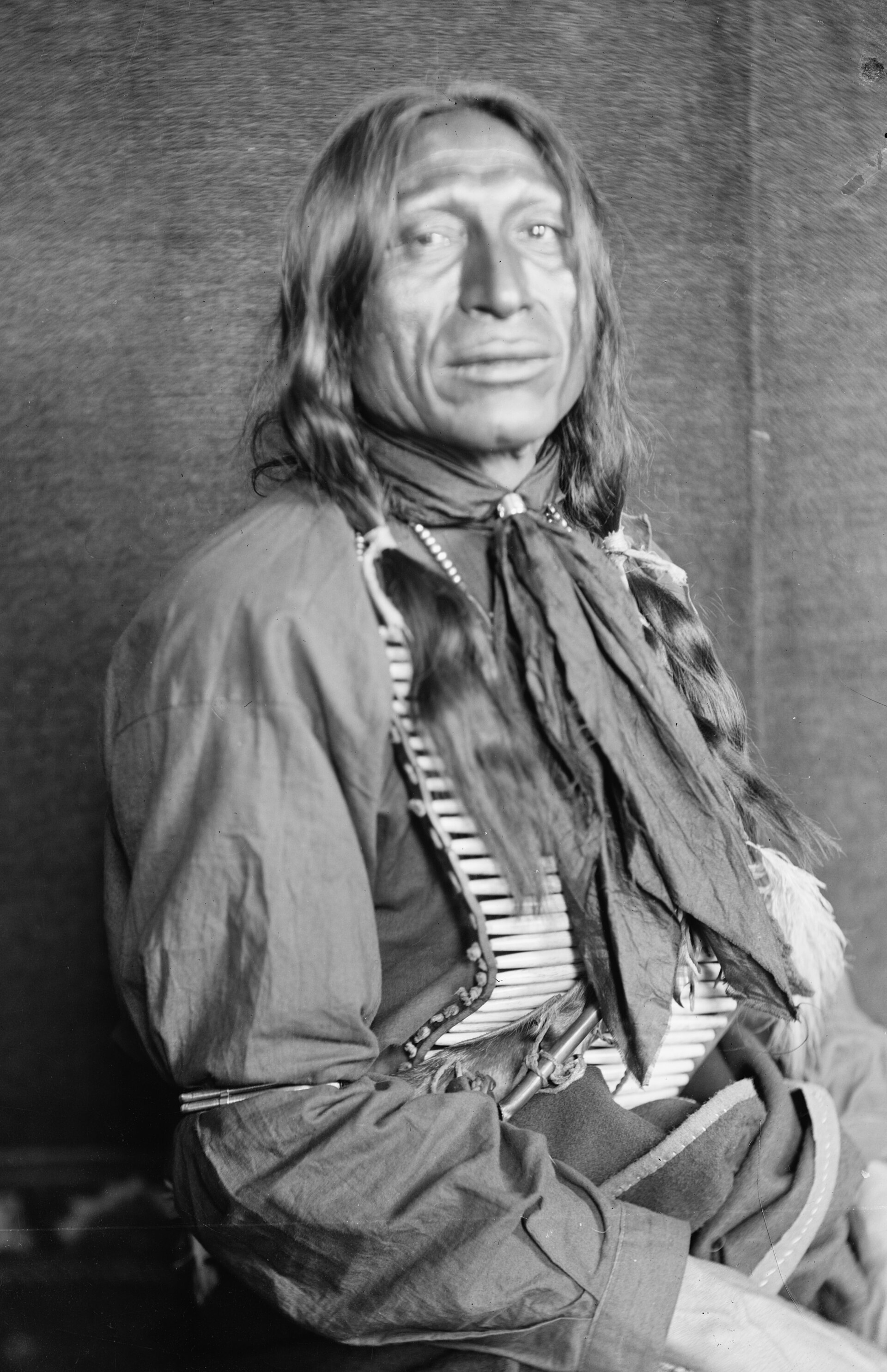
Cody and his managers sent nine men: Chief Iron Tail, High Heron, Has-No-Horses, Samuel Lone Bear, Joseph Black Fox, Red Horn Bull, Shooting Pieces, Phillip Standing Soldier and Kills-Close-to-the-Lodge. By the Cody Studies account Kasebier asked Iron Tail to sit without regalia, because she wanted, in her words, a 'real raw' Indian of the kind she saw as a child in Colorado. When Iron Tail was shown the print several days later he tore it up and said it was too dark; she photographed him again in his headdress, and kept the first print, which she used as the frontispiece of Everybody's Magazine in January 1901. The one account of the incident is the 1901 article, which Cody Studies says may have been written by Kasebier or a close friend. Nothing independent confirms it.
The article published her drawings by the sitters and letters from Samuel Lone Bear, Joe Black Fox, Amos Two Bulls and David Bull Bear. Cody Studies says the portraits were selectively and infrequently exhibited and that she often gave prints to people who showed real interest in Native American culture. The photographs were not used in the show's programmes or posters. The scholar Rayna Green, in History of Photography (Spring 2000), is quoted there as saying that Native people who did not look like Buffalo Bill's show Indians did not get their pictures taken. Cody Studies adds that there is no evidence Kasebier took part in any Indian reform group of the period. The sitters were paid performers under contract to a show whose costume rules forbade on the reservation what they wore in New York; the photographs record a studio encounter between a paying commercial photographer and contracted performers, and the sources do not say what the sitters thought of her beyond the letters in the 1901 article.
Chapter 8The Photo-Secession, Camera Work and the break with Stieglitz
The documented chain is short. In June 1898, per the Library of Congress essay, she introduced herself to Stieglitz and asked for advice on photographing outdoors.
The documented chain is short. In June 1898, per the Library of Congress essay, she introduced herself to Stieglitz and asked for advice on photographing outdoors. In July 1899 he published five of her photographs in Camera Notes and called her 'beyond dispute the leading portrait photographer in this country' (the wording as given in the Sotheby's 2022 note; Wikipedia and the Library of Congress essay quote slightly different forms of it, so the exact sentence should be checked against the original). In January 1903 the first issue of Camera Work carried her plates, with texts by Caffin and Frances Benjamin Johnston. The Delaware Messenger says Stieglitz devoted almost the entire first issue to her. Wikipedia says she was a founder member of the Photo-Secession in 1902 and had a joint exhibition with Clarence H. White at the Little Galleries in 1906; Roland Rood's review of that show is listed in the Cody Studies bibliography as appearing in the March 1906 American Amateur Photographer.
What came next rests on Michaels through Wikipedia and the Library of Congress essay, neither of which can be checked against the book here. In May 1906 she joined the Professional Photographers of New York, which Stieglitz, according to Wikipedia, saw as everything he disliked about commerce. Stieglitz still showed her work: he included twenty-two of her prints in the 1910 International Exhibition of Pictorial Photography at the Albright Art Gallery, Buffalo, where the Albright bought a print of The Manger afterwards, according to the Sotheby's note. In 1911 Joseph Keiley, an associate editor of Camera Work, published a hostile piece about her. Wikipedia says why he changed his view is unknown and that she suspected Stieglitz. The piece itself was not read; the Heidelberg digitisation of Camera Work is behind a bot-check and was not bypassed.
In 1912, per Wikipedia, she became the first member to resign from the Photo-Secession, after protesting that Stieglitz sold prints for far less than their worth and took months to pay the photographer. That is the only evidence of the Photo-Secession's finances found: a single sentence in a tertiary source, derived from Michaels. No ledger, sales book or letter was seen. The reading that the quarrel was commerce against idealism is Michaels's interpretation as relayed by Wikipedia and the Library of Congress essay, and the essay notes the purists dissociated themselves from her 'because of her open desire to earn a living'. In 1916 she helped Clarence H. White found the Pictorial Photographers of America, which Wikipedia says Stieglitz took as a challenge. The Metropolitan Museum's open data lists twenty objects credited to the Alfred Stieglitz Collection (1933 and 1949), eighteen of them platinum prints, which shows that he kept her work even after the quarrel.
Chapter 9Rodin and Steichen: a portrait dated two ways
Her portraits of Auguste Rodin are among her most traded images and carry two different dates.
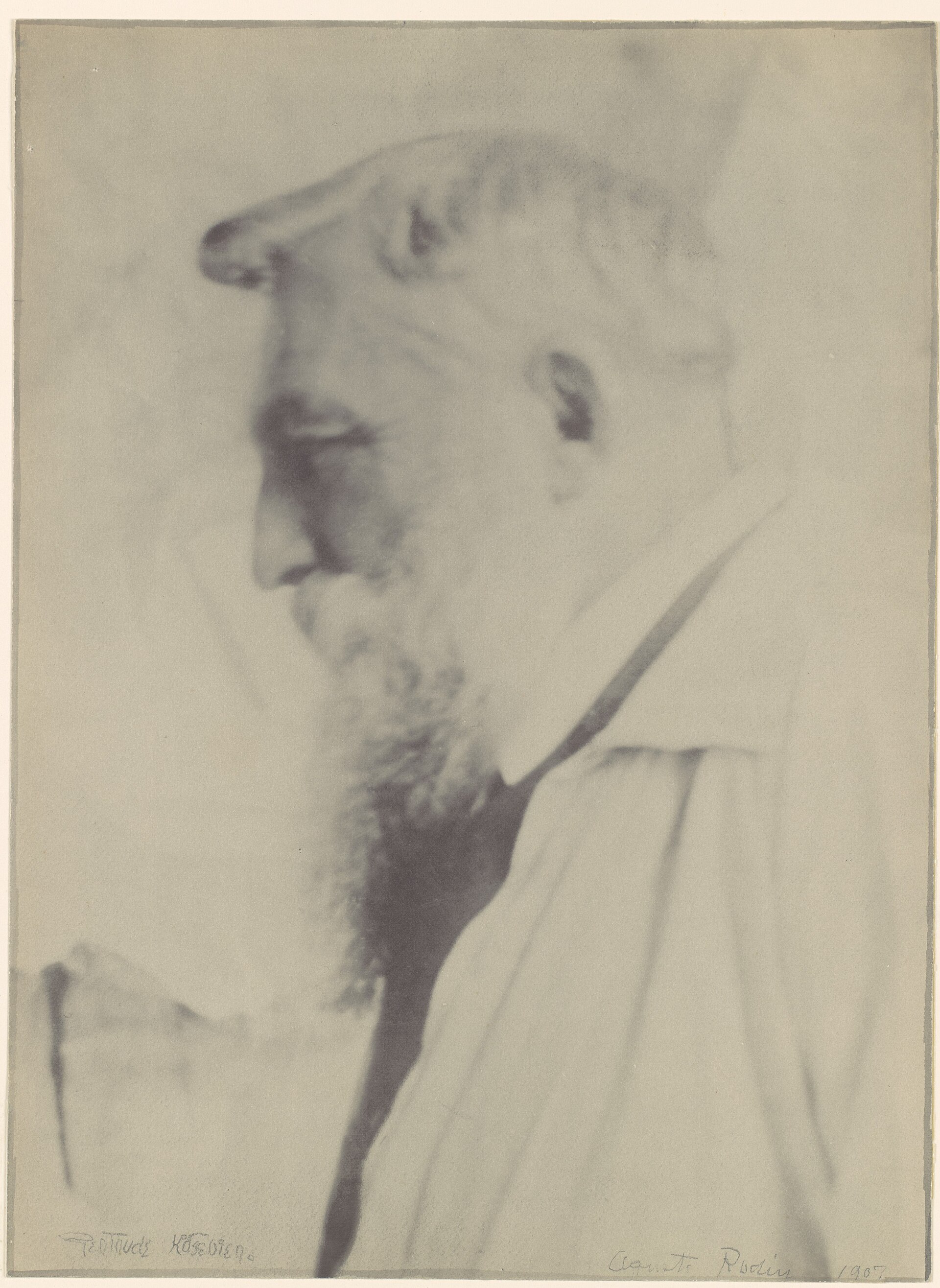
Her portraits of Auguste Rodin are among her most traded images and carry two different dates. The Phillips and Sotheby's lots for gum bichromate prints on Japanese tissue date them 1905, signed in pencil on the mount, and the 2017 Sotheby's note cites Michaels plate 73. The Metropolitan Museum's platinum print of Rodin, accession 48.77, gift of Adele Rollins Clifton in 1948, is catalogued 1907, and the print as shown on Commons bears a pencilled name and the year 1907. Whether the sitting was 1905 with a later print, or the Met's print is a separate 1907 session, is not stated in any source opened.
The link to Edward Steichen is reported by Wikipedia: she was able to photograph the reclusive sculptor through connections Steichen gave her. The Delaware papers are said by Cody Studies to include notes from interviews with Steichen, which suggests the connection is documented at Delaware, but the notes were not read. The grade is therefore argued, on a tertiary source. A Rodin sitting is also an unusual commercial object in the market: the three Rodin gum bichromate lots in the Phillips and Sotheby's sales all share one provenance line, which is the next section.
Chapter 10Where the estate went, and why it did not stay together
Kasebier gave up the studio in the 1920s and died in 1934 at her daughter's house.
Kasebier gave up the studio in the 1920s and died in 1934 at her daughter's house. What survived did not go to one place. Cody Studies says her granddaughter Mina Turner, Hermine's daughter, divided the photographs, documents and artefacts left by Kasebier among several institutions. The documented destinations are the Smithsonian's National Museum of American History (about 100 Sioux prints and 14 drawings, deposited 1969 per the Cody Studies home page), the Library of Congress (fifty glass negatives of the Sioux portraits), the University of Delaware (papers, Mina Turner's reminiscences and interview notes), the Museum of Modern Art, and the New York Public Library (letters). A Phillips catalogue essay (sale code NY040214) adds the Art Institute of Chicago, saying Mina Turner gave it prints in 1973.
The second branch ran through the family. The Delaware Messenger of Fall 1993 says William Innes Homer's research led him to Mason Turner Jr of Wilmington, Kasebier's great-grandson, who had inherited a sizeable number of her works. Turner gave his first group to the University in 1977, taking the tax benefits of donating to an educational institution, and repeated the gifts for more than ten years. The Messenger says this gave the University Gallery the weightier part of a collection it calls the largest owned by any institution. It also means the acquisition price of that collection is not a market price: the tax deduction is built into it. No appraised values were published.
The third branch is a deaccession. Phillips's catalogues for its 'Photographs from the Collection of the Art Institute of Chicago' sales (sale codes UK040314 and NY040214, which suggest March and April 2014 but the pages do not state a date) offered Rodin gum bichromate prints that the essay says Mina Turner gave to Chicago in 1973. One sold for GBP 21,250 against an estimate of GBP 12,000 to 18,000. A later Sotheby's 2017 lot of the same subject gives the provenance as the Art Institute gift of 1973, then Clars Auction Gallery, Oakland, 19 September 2015, lot 6321. Whether that is one of the Phillips prints cannot be told from the pages. What is clear is that a family gift that went to a museum was later sold by the museum, and that prints given as gifts can return to the market.
Chapter 11Photogravure, edition and vintage print: the cohort a buyer has to separate
Her images circulated in at least three forms, and they trade in very different ranges.
Her images circulated in at least three forms, and they trade in very different ranges. The vintage form is the print she made: platinum or gum bichromate, signed on the mount. The reproduction form is the photogravure. The Manger appeared as plate II of Camera Work No. 1 in 1903, engraved by the Photochrome Engraving Company of New York per the Art of the Photogravure site. Stieglitz also issued The Manger and Blessed Art Thou Among Women in the portfolio American Pictorial Photography, Series II (1901), an edition the Art.Salon record puts at 150. A third form is a later print made from her negatives, but no source opened identifies a dated example or a printing campaign.
The market has kept the forms apart. A Sotheby's sale in December 2020 sold the Series II photogravure of Blessed Art Thou for USD 2,772 against an estimate of USD 1,500 to 2,500 (reported by Art.Salon, an aggregator, premium treatment not stated). Phillips marked a Camera Work photogravure leaf of the same image sold at an estimate of USD 4,000 to 6,000, with no price shown. The 2007 platinum print of The Manger brought USD 39,400 with the buyer's premium. The three prices are separate objects in separate decades, not a trend line, but the gap between a gravure and a vintage platinum print is the point a buyer needs.
No source opened gives the number of platinum printings of any image, the count of existing vintage prints of The Manger or a whole-cohort census. Individual known prints include the NGA's print, the Albright's print bought in 1910 and the 2007 Sotheby's print provenanced to the photographer, then Charles Fox of Broomhall, Pennsylvania, who studied under her. That is a start, not a census.
Chapter 12What a collector should read into the numbers
Her auction results are modest and thinly documented.
Her auction results are modest and thinly documented. The best-sourced figure opened is USD 39,400 for the 2007 The Manger, which iPhotoCentral's Alex Novak reported as selling to the New York dealer Peter MacGill at just under the low estimate, with Sotheby's new higher buyer's premium included. The same sale put a complete set of Camera Work at USD 229,000 and a Stieglitz platinum print of Marie Rapp, with fee, at USD 49,000. Art.Salon names Rodin, c. 1905, in February 2016 at USD 40,000 as the highest price it has observed, without naming a house; a search-engine summary of MutualArt reported USD 50,000 at Phillips in 2011, which was not opened. These two aggregator claims disagree and neither could be tied to a lot page.
What moves price on the evidence is process and subject: vintage platinum or gum bichromate against photogravure, the mother-and-child or Rodin subject against a portrait of a minor sitter, provenance back to the artist's circle, and condition. The 2007 note says the print had undergone conservation, with skilful in-painting to the upper corners and a report available. That the price sat at the low end of the estimate is a fact; why is not stated in any source. A 2022 Sotheby's lot of a platinum print, Portrait of Arthur Mooney (1900), came with a fragment of a Photo-Secession gallery label and Stieglitz annotations on an original frame, and was estimated at USD 12,000 to 18,000; the result was behind a login and is not recorded.
What is documented
Technique
The surviving work
- What is accepted
- No accepted total is published by anyone. Institutional counts differ: Delaware 166 photographs (current) or more than 175 works (1993); the Smithsonian about 100 Sioux prints and 14 drawings; the Library of Congress 50 Sioux glass negatives; the Metropolitan Museum 37 object records in its open data on 24 November 2026.
- What is contested
- No attribution has been removed or added by a named body in any source opened. What is disputed is counts and dates, not attributions: the Sioux sitting (14 or 24 April 1898), the Rodin portrait (1905 or 1907), the husband's death (1909 or 1910) and her birth day (18 or 19 May).
- Who rules on attribution
- No active authority. There is no authentication board or estate committee in any source opened. Attribution rests on signature, family provenance and institutional comparanda, and the heirs' gifts are the main cluster.
Catalogue raisonne
- Barbara L. Michaels, Gertrude Kasebier: The Photographer and Her Photographs (New York: Abrams, 1992) Monograph with plates; the source most summaries and auction houses cite (for example 'Michaels, pl. 73' for the Rodin). Not opened for this page.1218
- William Innes Homer, A Pictorial Heritage: The Photographs of Gertrude Kasebier (University of Delaware and Delaware Art Museum, 1979) Catalogue of the first major exhibition, built on the Delaware holdings; cited by Sotheby's for The Manger.213
- Michelle Delaney, Buffalo Bill's Wild West Warriors: A Photographic History by Gertrude Kasebier (Smithsonian, 2007) Covers the Sioux portraits only; the Cody Studies site is its digital counterpart.811
Questions about Gertrude Kasebier
Who was Gertrude Kasebier?
Photographer; Portraitist; Founder member of the Photo-Secession. 1852-1934.
When did Gertrude Kasebier live?
Born 18 May 1852 (the Library of Congress essay gives 19 May), Fort Des Moines, Iowa (now Des Moines); died 12 October 1934 (Lempertz's artist index gives 13 October), New York City, at the home of her daughter Hermine Turner.
How are fakes and misattributions of Gertrude Kasebier detected?
None documented; the practical hazard is reproduction mistaken for original. No source opened records a forgery, a fake signature or a disputed attribution. What the market does show is a clear risk of confusing a Camera Work photogravure or a 1901 Series II photogravure with a vintage print.
Where can you see work by Gertrude Kasebier?
University of Delaware, Library, Museums and Press (Newark, Delaware); National Museum of American History, Smithsonian Institution (Washington, DC); Library of Congress, Prints and Photographs Division (Washington, DC); The Metropolitan Museum of Art (New York); National Gallery of Art (Washington, DC); Los Angeles County Museum of Art (Los Angeles).
What does the market for Gertrude Kasebier look like?
Her market is thin and sparsely documented. The best-sourced result found is USD 39,400 with buyer's premium for a vintage platinum print of The Manger at Sotheby's New York in October 2007, estimated at USD 35,000 to 50,000.
What is still unresolved about Gertrude Kasebier?
What are the actual dates and text of her letter to Buffalo Bill and his reply, and was the Sioux session on 14 or 24 April 1898? Cody Studies and Wikipedia disagree, the 24th was a Sunday, and the letter itself was not found in any source opened.
Open questions
- What are the actual dates and text of her letter to Buffalo Bill and his reply, and was the Sioux session on 14 or 24 April 1898? Cody Studies and Wikipedia disagree, the 24th was a Sunday, and the letter itself was not found in any source opened.
- Did she study under Arthur Wesley Dow at Pratt? His Pratt tenure begins after her 1889 enrolment by Wikipedia's dates, and the Cody Studies count has her enrolled to about 1895. No letter or record of the relationship was opened.
- Is the Rodin portrait 1905 or 1907, and how many prints exist? The Met's platinum print is 1907; the gum bichromate prints at Phillips and Sotheby's are signed 1905 and come from the same family source.
- What exactly did Joseph Keiley write about her in Camera Work in 1911, and was Stieglitz behind it? The piece was not read and Wikipedia says Keiley's reasons are unknown.
- How much did the Photo-Secession actually pay and sell for her? The only statement found is that Stieglitz sold prints cheaply and paid slowly; no ledger or correspondence was opened.
- Is there any census of Kasebier prints, and what happened to the contents of her studio in 1929? The Delaware, Smithsonian and Library of Congress counts differ and the liquidation is single-sourced to Wikipedia.
- Did the Art Institute of Chicago sell all of Mina Turner's 1973 gift, and are the 2014 Phillips prints the same ones that later reached Clars and Sotheby's? The catalogue pages give no dates and no provenance for the Phillips lots.
Sources
- 1Gertrude Kasebier, Wikipedia (; cites Michaels 1992, Homer 1979, Delaney 2007; primary books) en.wikipedia.org/wiki/...
- 2Michael W. Hall, 'The Gertrude Kasebier Collection', University of Delaware Messenger 3, no. 1 (Fall 1993) www1.udel.edu/PR/...
- 3University of Delaware Library, Museums and Press, 'Gertrude Kasebier', Women in Pictorialist Photography exhibition exhibitions.lib.udel.edu/women-in-pictorialist-photography
- 4Michelle A. Delaney and Rebecca Wingo, 'The Life of Gertrude Kasebier', Cody Studies (Papers of William F. Cody, 2012) codystudies.org/kasebier/...
- 5Delaney and Wingo, 'Documents', Cody Studies codystudies.org/kasebier/...
- 6Delaney and Wingo, 'Formal Portraits', Cody Studies codystudies.org/kasebier/...
- 7Delaney and Wingo, 'The 1898 Season', Cody Studies codystudies.org/kasebier/...
- 8Delaney and Wingo, home page, Cody Studies (Mina Turner deposit 1969) codystudies.org/kasebier/...
- 9Delaney and Wingo, 'Pictorialism in Context', Cody Studies codystudies.org/kasebier/...
- 10Delaney and Wingo, 'Works Cited', Cody Studies (bibliography) codystudies.org/kasebier/...
- 11Delaney and Wingo, 'About', Cody Studies codystudies.org/kasebier/...
- 12Library of Congress essay on Gertrude Kasebier, as republished by Infinite Women ( republication; Library's own page) infinite-women.com/women/...
- 13Sotheby's New York, Photographs, 2007, lot 133, Gertrude Kasebier, The Manger (catalogue note) sothebys.com/en/...
- 14Alex Novak, 'Daytime Portion of Sotheby's Multi-Owner Sale', iPhotoCentral E-Photo Newsletter no. 140 (20 February 2008) iphotocentral.com/news/...
- 15Art.Salon, record for Blessed Art Thou Among Women, Sotheby's 4 December 2020, lot 99 (aggregator) art.salon/artwork/...
- 16Phillips, Photographs from the Collection of the Art Institute of Chicago (UK040314), lot 3, Auguste Rodin phillips.com/detail/...
- 17Phillips, Photographs from the Collection of the Art Institute of Chicago (NY040214), lot 4, Auguste Rodin phillips.com/detail/...
- 18Sotheby's New York, Photographs (N09640), 2017, lot 49, Gertrude Kasebier, Auguste Rodin sothebys.com/en/...
- 19Phillips, NY040219 Artist | Icon | Inspiration, lot 72, Blessed Art Thou Among Women phillips.com/detail/...
- 20Los Angeles County Museum of Art, Blessed Art Thou among Women, M.2008.40.1116, curatorial note by Britt Salvesen (2024) collections.lacma.org/node/...
- 21Metropolitan Museum of Art Open Access API, search results and object records for Kasebier (queried 24 November 2026) collectionapi.metmuseum.org/public/...
- 22The Art of the Photogravure, The Manger (Camera Work I, 1903) photogravure.com/collection/...
- 23Pratt Institute 1896 to 1903) en.wikipedia.org/wiki/...
- 24Lempertz artist index, Gertrude Kasebier lempertz.com/en/...
- 25Sotheby's New York, Modern Discoveries 2022, lot 586, Portrait of Arthur Mooney sothebys.com/en/...
- 26Wikimedia Commons, Category Photographs by Gertrude Kasebier (licence status of each file read from ) commons.wikimedia.org/wiki/...
- 27Metropolitan Museum of Art, Auguste Rodin, 1907, platinum print, accession 48.77 metmuseum.org/art/...
Last verified